The Macro Paradise Which is Northern Sulawesi (Short Version)To: Long Version, Related FAQs: Indonesian Biotopes, |
|
|
Bob Fenner, WetWebMedia.com |
The locale, sites, folks and what to expect.
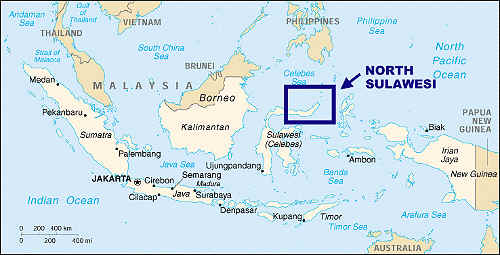
Sulawesi (formerly Celebes) is the big "hand-shaped" island of Indonesia to the north of Java, Bali, Lombok, Flores. Komodo, Timor... and south of Malaysia. The 73,000 square miles, about the size of Great Britain, and surrounding waters of this wonderland present a full-spectrum of natural history experiences. (need more input here, see travelogues).
Air fare is reasonable and variable seasonally and sporadically, most folks transiting from Singapore (Silk Air) to the principal town of Manado, a 3 1/2 hour ride. I strongly suggest that you avail yourself (reservations in advance) of the excellent transit hotels in Singapore's Changi Airport. No need to check customs (the airport even issues free 4 hour "See Singapore" bus passes!) if you just want to sack in for a few hours... a bargain to shower (swim, go to the gym if you want...) and lie down for a while.
Northern Sulawesi has a few (check the Internet here) alternatives to dive/stay resorts, all providing "one stop" access to dive services, food, rooms. About an hour boat-ride out of Manado to the north for the budget-minded are several international "resorts" (most are rather primitive) in the Bunaken National Marine Preserve. Our perennial favorite has been Froggies Divers, low on creature comforts, high on friendliness and charm. There are other choices in this area (a new all-Italian resort on Siladen Island in Bunaken), Tasik Ria Resort on the mainland (along with hour or so daily boat rides to dive the sites in Bunaken)...
Alternatively you can be be motored "over the hill" (about 1 1/2 hour... what's a few more?) to the larger town of Bitung to base yourself at KBR (Kungkungan Bay Resort)... a fabulous property, experience that encompasses expert dive guiding (so adept it makes photography, videography a matter of "next"! Rather than seeking subjects), excellent food (multiple page menus with the kitchen open 24 h/d), comfortable cottages with fans, running hot and cold water... and a very amiable and competent staff all the way around.
| Some views of the both low and high end accommodations.
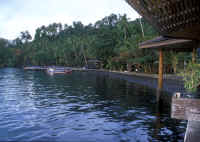
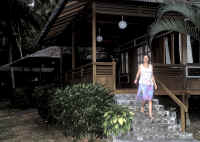
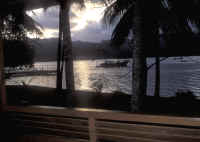
First line below: Kungkungan Bay Resort: KBR beach south from the
dining/meeting building. C. Petrinos did all his night diving for his book
"Realm of the Pygmy Seahorse"
along the resort's 1000 feet or so of shoreline. Gorgeous. Middle: the
lovely Di emerges from her cottage. Rooms are clean, very comfy. At right:
Early AM, time to get up and dive! View from outside your patio. |
 |
 |
 |
|
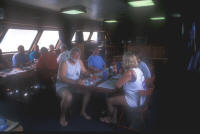
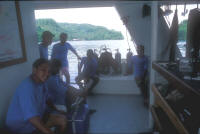
A new (mixed if you'd like... with some resort diving ahead,
after...) option is the relocated (Truk) Aggressor... the North Sulawesi
Aggressor is their usual floating palace... great food, individual bathrooms
with enough shower space for two...
http://www.aggressor.com/ |
||
 |
 |
|
|
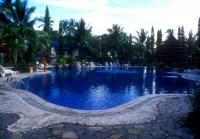
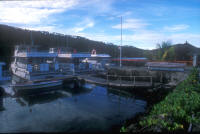
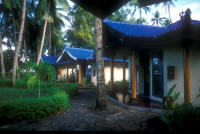
Located a few miles west of Manado town, necessitating about an hours pleasant cruise to Bunaken itself (though shorter to the three house reefs and other western shore dive sites), Tasik Ria Resort is a "middle" comfort resort dive destination, with nice grounds, a pool and spa, good food and good dive service provided by Eco Divers (of the same name in nine locations, eleven boats in the Red Sea)... who currently (2005, 06) managed dive operations in KBR as well. A view across the pool, out on the dock and seaside bar and alternate grill, and a view of some of the single bungalows (there are multiple units as well). |
||
 |
 |
 |
|
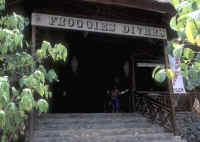
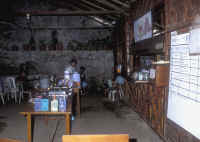
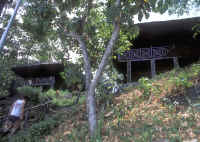
Lower three pix: Froggies Divers, located on Bunaken Island: The entrance (right on the beach), the communal restaurant, bar (beer and wine, and soft drinks), and a view of the climb to some of the cottages! |
||
 |
 |
 |
There is little middle ground in cost/amenity choices . It's either the 30 some dollars (U.S.) per day stay in/on Bunaken or the three-four plus times cost per day (with concomitant value and features) for room and meals, with actual dive costs about the same at all providers (about 30 dollars p.p., p.d., with some discounting for volume) (Winter 2002 data). You can book the elements (travel, stay, diving... or use a professional service like PATA)
The people here are gentle, helpful, and educated. We have been there when there have been upheavals in other parts of Indonesia... not here. Most everyone speaks at least some English, and many of the resort workers are fluent in this and a few other languages. The dollar is accepted most everywhere (as are credit cards), with good value for all native produced goods.
Life Groups You'll Encounter.
No More "Mr. Big Stuff"
A few decades back it was commonplace to see sharks, turtles on most every dive. Due to overfishing the pelagics are all but gone. Instead, this area is host to smaller animals (well up to meter plus long Jacks and Tunas)... It IS the Frogfish capital of the world... no place else has as many species, numbers of nudibranchs, tube-mouth fishes (ghost pipefishes, pipefishes, seahorses...). Though it still pays to keep turn your eyes to the "big blue" behind you, the reef up-close is what N. Sulawesi is all about.
Who You Calling Spineless?
Non- or more well known as invertebrates rule in N. Sulawesi! Nowhere that I've been is there the diversity and numbers of species, individuals found here. Like the rhyme: "Little fleas have littler fleas upon their backs to bite 'em, and those fleas have still smaller ones, and so ad infinitum", you have to get used to looking close, then closer, as this is THE place to saturate yourself with an understanding of just how tightly all life is tied together... actually.
Sponges: No, Not Your In-Laws:
Every color of the rainbow, including mixed and mottled, every shape, tubes, volcanoes, encrusting plates, amorphous blobs... of Sponge life you can find... attached to rock, parasitizing corals, stuck in the mud by itself... Recognizable from stinging-celled animals (whose polyps, when open, bear tentacles), Sponges have one or more openings (osculae) for allowing water to pass through their bodies (no organized circulatory system, remember, they're tissue-grade life). They can be soft to the touch, rubbery, flexible along axes to quite rigid. Examples:
Stinging-Celled Animals Galore, The Corals, Anemones, Sea Pens, Sea Fans...
Worms of All Kinds, In All Places:
Mollusks; Snails,
Crustaceans: Crabs, Shrimps, Lobsters... Squat and Otherwise:
Spiny Skinned Animals; Sea Cucumbers, Urchins, Feather Stars, Sea Stars, Brittle Stars:
Sea Squirts: the Ubiquitous Ascidians:
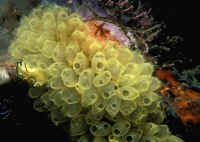
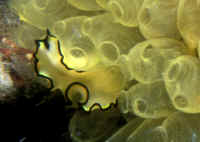
| Clavelina sp. and a "marauding" flatworm, Pseudobiceros species that resembles the nudibranch, Glossodoris atromarginata (Cuvier 1804) feeding upon the colony. |
|
Talking Fish:
And how! There are some 2,800 described species of fishes from this
area? enough to make an ichthyologists head spin underwater? including many
rarities; Ghost Pipefish and relatives, Scorpaeniforms (Mail-cheeked fishes like
Lions, Stonefishes?). Think of how many Anglerfishes, Frogfishes you?ve seen
in the Caribbean or anywhere for that matter. It?s not unusual to see multiple
species on a single dive here (insert). I use fishbase.org (on the Net) to
generate a ?species list? (resorted by family please) to remind me of what
to look for (good luck) underwater, prepare photo gear for same? There?s a
bunch, a huge bunch.
Looking for a quick course on Phycology (algology if you?re from the Old World)? N. Sulawesi?s got the goods on all but the giant kelps. Here?s a short picture story on what to expect:
|
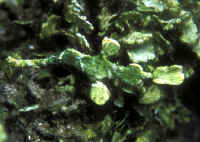
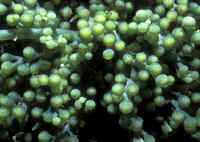
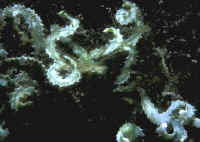
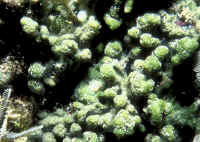
Greens (Division Chlorophyta), what most folks think of as Algae? Important as foods, hiding places (you?ll be richly rewarded here for looking closely, then even more closely!). Pictured below: a healthy bunch of Caulerpa racemosa, C. serrulata, C. webbiana just to mention three of the same genus.. |
 |
 |
 |
|
|
Here's a cactus-like articulated algae, Halimeda discoidea... a favorite haunt of the like-named Halimeda Ghost Pipefish, Solenostomus armatus (right), some camouflage job now! |
|
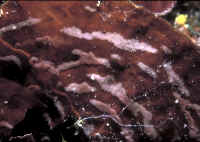
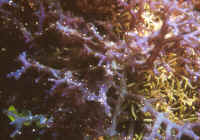
| Reds can be leaf-like, filamentous, or encrusting as hard pieces or flat sheets. Some species are of extreme importance in reef-building, serving to hold living and non-living components together in all weather through eons. Shown: Peyssonniela and Rhodymenia sp. |
|
|
Real Live Plants:
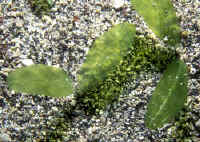
| Yes, there are "true" plants in the sea... most known as "Seagrasses". Unlike the lowly algae, plants have functional roots, leaves, transporting tubules (xylem, phloem), flowers (seasonally) and seeds... Here's a common one for our area, the aptly-named Paddle Weed, Halophila ovalis. |
|
Photo Notes:
Don't know much about photography, especially underwater? This is a great place to start! Perhaps due to a lack of "places to run to", many species that are elsewhere difficult to approach, virtually pose for you here. Even simple, inexpensive, point and shoot cameras will make superb photographs in N. Sulawesi... and video?
Like drinking wines, fine or no, it?s better to start with the ?less sweet? types (wider lenses) in diving here? lest you never switch from your 105 mm! Seriously, I have been here and never taken off my 70-180 tele-macro? and have given up on carrying much beyond all Velvia (50 ISO) film? the Macro photography here is just that good. Do start wide... a dive or two (ask the dive guides what to expect... they know) for scenery, people... of fish-eye to "normal" topside vision 28, 35 mm. or else you'll come home with only close-ups... trust me.
Don?t be like me (or maybe do what I do and bring a ?loaner?
digital rig or two and have ?recruits? shoot out landscapes, whole colonies
and groupings of organisms so you can/will focus on the minute.
?We?ve traveled halfway around the planet to dive in mud? No way! Yes way. A good deal of the fantastic diving here occurs in sandy, silty settings. Yes, there are areas of intact, beautiful stony and soft corals, walls of rock with nary a bit of muck in sight that plunge below where divers fear to fin? but the muck, ahhh. The life there, within, above? is spectacular in its number, diversity, oddness?
|
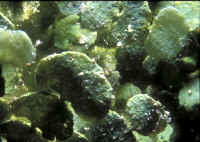
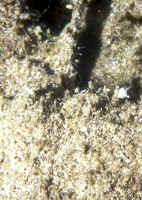
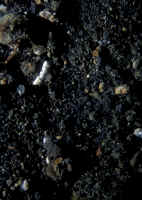
Is the muck so bad? It's mostly silicate (sand) and carbonate (old shell, coral skeleton...) based... with a bit of mud and unconsolidated biological ooze for color and composition... Just the thing for the super-vivacious life and overall metabolism of the place. Night/day and in-between there's life aplenty in, over and amongst its particles. Some scenes of what the muck looks like up close. |
|
|
Taking a bit of this substrate apart reveals it to be more like Live Sand.
Banggai card.s and two pix
Wherefore art thou Wallace?
Parts of Northern Sulawesi lie
near, are the path of the Wallace Line, the so-called ?crucible of life?, site
of the most species of most all groups of living things on this planet. A bit of
necessary history: Alfred Russell Wallace was a contemporary of none other than
Charles Darwin of ?Origin of Species? fame? and in all fairness should be
equally credited with this landmark work, having ?goosed? Darwin into
compiling his notes, publishing his ideas on the matter. Russell wrote
(paraphrasing here) Darwin while residing in Indonesia, doing a tour as a
natural historian, ?Charles, I think I?m seeing relationships twixt form and
function, usefulness of variants through time and space in living things. What
say you?? Darwin to himself: ?Yikes, better get a move on, else this upstart
will pre-empt my similar observations?! Well, at least Wallace gets a
?line? in his name, sort of like longitude, latitude, extending irregularly
north-south in Malay-Australia. Check any organismal group for numbers of
species in this region against? Hawaii, the west coast of the United States,
the Mediterranean? more species abundance here by far in almost all cases.
Send to:
Natl. Geo travel? Or Rodale?s
Koralle
Mark of KBR, Christine at Froggies