 |
|
| Home | Marine Aquariums |
Freshwater Aquariums |
Planted Aquariums |
Brackish Systems |
Ponds,
lakes & fountains |
Turtles & Amphibians |
Aquatic Business |
Aquatic Science |
Ask the WWM Crew a Question |
| Please visit our Sponsors | ||||
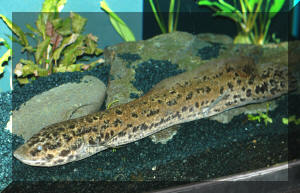
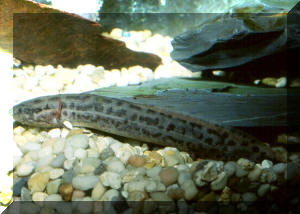
Really old fishes... likely arose in the mid to lower Devonian... possibly a side-shoot of the organisms that gave rise to land vertebrates. Tail fin diphycercal, ending in a point, confluent with dorsal and anal fins. Premaxilla and maxilla bones absent. Have functional lungs. Three extant genera with six living species. Order Ceradontiformes Flipperlike pectoral and pelvic fins. Large scales. Unpaired air bladder/lung. Young without external gills, adults don't "hibernate" (estivate) Family Ceratodontidae, the Australian Lungfish. One species.
Order Lepidoseriformes Filamentous pectoral and pelvic fins, lacking rays. Small scales. Air bladder/lungs paired. Young with external gills, adults do estivate in dry seasons. Family Lepidosirenidae, the South American Lungfish. One species.
Family Protopteridae, African Lungfishes. One genus, four species.
Bibliography/Further Reading:
|
|

|
Features: |
|
| Featured Sponsors: |
.JPG)