|
FAQs on the
Halfbeaks
Related Articles: Halfbeaks, Species, husbandry and breeding by Neale
Monks, Halfbeaks, Livebearing Freshwater Fishes, Livebearing Fishes by Bob Fenner, Poeciliids: Guppies, Platies, Swordtails,
Mollies by Neale Monks,
Related FAQs:
|
|
|
Identification 5/27/19
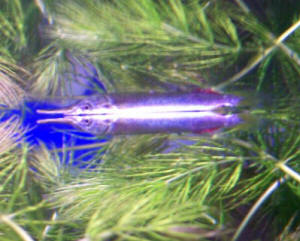
I have had this top dwelling fresh water fish in my tank for 4 months. It has
not grown in size, as promised by the pet store… lol…. I got it to see what size
tank I would need in the future, but it has not grown and is happy eating
bloodworms. Any thoughts? I thought it looks like a tiny Arowana or needle nose
gar, but it has not grown.
Any ideas? It is about 3” long and very thin:
<Platinum Halfbeak is what these are called in the trade. May be Dermogenys
siamensis or Dermogenys sumatrana, or even some hybrid between them. Males stay
quite small, 3-4 cm, but females do reach a fair size, maybe 7 cm or so. Nice
fish, but jumpy, and like all Halfbeaks, can be a bit finicky about food. Not
too bothered about water chemistry, but neutral, medium hardness water is
probably the idea. Will tolerate slightly brackish water too. Cheers, Neale.>
|
 |
|
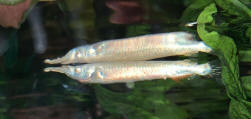
Platinum Half Beak 5/27/19
Found it! So sorry, I looked all over the website in areas that made sense to me
but due to the fact I had no clue what this fish was, I didn’t know where to
start and stumbled on to your halfbeak page. Sorry to bother you. :)
<Not a problem! Cheers, Neale.>
|
Re: Molly Question; now Halfbeaks
4/25/18
That's great news! Thank you!
<Welcome.>
And if you can stand another question, something just came up this
morning.
A friend of mine called me to say he's moving and has to get rid of his
tanks and fish (don't know the whole story, but experience suggests I
don't want to know), He has two halfbeak fish (I've never heard of
them).
<My favourite aquarium fish! Do see here:
http://www.wetwebmedia.com/ca/volume_4/V4I1/halfbeaks/Halfbeaks.htm
Not widely sold, but well worth keeping.>
He calls them Red Line Gold Spot, Hemirhamphodon-tengah (spelling?) and
asked if I would take them because they've always been in his brackish
tank (though his SG is higher than mine - he said 1.008).
<Interesting he's keeping them in brackish as these are usually
considered freshwater fish, often soft water fish at that.>
I told him I'd do some research (mostly to protect the Goby - I don't
want him to be out-competed) and get back to him.
<Wise. But theoretically, the two share little in common in terms of
swimming level and diet, so unlikely to compete.>
But the research I've turned up so far says these fish are strictly
freshwater, not brackish, and the only place I have room for them is my
brackish tank. If that's true, then they shouldn't be in his brackish
tank and I won't torture them further by keeping them in mine. Is this
strictly a freshwater fish?
<I would agree these are freshwater fish. However, halfbeaks are
peculiarly sensitive to water chemistry changes. If these have been
doing well in the conditions he's got, let's say for the last six
months, feeding happily without any sign of ill-health, I'd be tempted
to stick with those. Do also be aware that his halfbeaks might be called
something by the retailer, but actually are something else. Wrestling
Halfbeaks, Dermogenys spp., are euryhaline and will do well in brackish
water, perhaps even better than plain freshwater. Then there are the
River Halfbeaks, Zenarchopterus spp.,
which while rarely traded, are big fish that thrive in hard freshwater
through to fully marine. Hope this helps, Neale.>
Re: Halfbeaks 4/26/18
Ok, after some thought, I decided these fish would be better off with
someone much more experienced than I am, so I told him I'm not going to
take them and referred him to the store where I get my aquarium
supplies.
<Understood.>
The man that owns it has been in business there for 35 years, is very
experienced, and they have an "orphan tank" so they can take fish that
their owners can no longer care for and find them good homes.
<Definitely fish for fairly advanced fishkeepers, that is true.
Hopefully he finds a good home. Do you live in a city with an aquarium
club? I'd expect these fish to be attractive to such.>
But thank you for the information.
<Welcome.>
Halfbeaks sound like interesting creatures, just not right for me at
this time.
<Quite possibly. While your fish can't talk, I can say for sure they
appreciate you taking the time to think carefully about this hobby and
acting accordingly. Cheers, Neale.>
Re: Halfbeaks 4/27/18
I'm about 37 miles northwest of Boise, Idaho. The aquarium store I told
you about is in Boise and they are the only source for aquarium
maintenance services in the state. The man that owns this store provides
maintenance
for a great number of restaurants, businesses, and private individuals
with very large tanks, and in many cases he provides the fish, tanks,
and equipment as well (thus retaining ownership of all). These are also
really good people who genuinely care about the animals in their care
(that's why they established the orphan tank).
<Sounds most impressive and very reassuring to have such a retailer
(relatively) close by.>
I've seen them refuse to sell fish to customers who they suspect will
not provide appropriate care, do not have sufficient tank size for the
fish they want, or do not have a sufficient skill level to handle the
special care some fish require. That's why I recommended my friend take
the fish to them.
<Definitely!>
So I'm confident they'll be in good hands. In fact, I have one of the
store's rescued fish. It's a Tinfoil Barb (about 8 inches) that was left
to die, among other fish who did not survive, in an abandoned aquarium
left behind after the owner was evicted. This lone survivor did not
escape unscathed as his dorsal fin and left pectoral fin had rotted off
by the time they got to it. But he seems happy and healthy now and I
think he's absolutely beautiful!
<Tinfoils are absolutely beautiful fish, in the right sized tank. They
aren't easy to house though, and a lot end up being rehomed at zoos and
parks. Cheers, Neale.>
Wrestling halfbeaks breeding questions 12/9/16
Hello all,
I recently purchased a group of six wrestling halfbeaks with the goal of
eventually breeding them.
They will be put into a 55 gallon low end brackish tank with one violet
dragon goby. The SG will be 1.003. My pH is 7.6 and water very hard.
<Sounds fine, though I think the Violet Goby might spook them. See what
happens. If well fed, shouldn't be much of a threat otherwise.>
I'm pretty sure I have at least 1 male and possibly 3 or more females.
The male is thin through the chest and has red on his dorsal fin. The
females are all silver and a bit rounder in the chest. I also ended up
with two I'm not sure of. They have rounded chests like the females, but
also have a hint of red on their anal fin.
<The "barrel chested" appearance of the females is distinctive, but the
safest feature is the anal fin, which should be more or less triangular,
compared with the differently shaped (more rectangular) anal fin of the
male. Also, males tend to have longer beaks than females, though this
isn't obvious in Dermogenys spp. (it's a lot more obvious on
Nomorhamphus
spp.).>
They are all between 1 and 1.25 inches in length.
<Still tiny! Adult females are easily twice that, depending on the
species.
Males tend to remain weedy little things, but should still get a bit
bigger.>
I haven't yet seen any fighting.
<Given space, any fighting is trivial.>
At what age do these fish reach sexual maturity?
<With halfbeaks it's a bit more complicated than this. They probably can
get pregnant when about half adult size, but since female Dermogenys
species range in size from around 5 cm to maybe 8 cm in length when
fully grown, but identifying species is very difficult, it's very
difficult to know if a specimen in front of you is anything like half
grown! Basically, I'd assume yours are sexually mature now, but they
might not be. If they are, the females will become very barrel chested
once pregnant.
Unfortunately, one big issue with halfbeaks is that as they age,
fertility seems to decline. No idea why, and it might not always happen.
But personally, while I've gotten big broods early on, as the females
got older, broods got smaller and/or more prone to stillbirths.>
Is there any way to estimate how old they might be now? Is pregnancy 8
weeks like I've read (only one source, so want to confirm).
<I think that's an overestimate to be honest. 3-4 weeks seems more
likely, given their adult size.>
Thank you!
Meghan
<Cheers, Neale.>
|
Halfbeak Jaw Dislocated? 5/26/10
Hello Crew,
<Hello,>
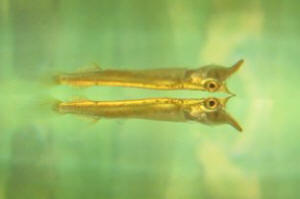
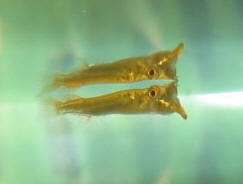
I have a month-old Halfbeak fry (Dermogenys pusilla) that's
had its mouth stuck in the open position for a week now (please
see attached photos).
<Yikes!>
This happened after I fed it some crushed algae wafer, I believe
one of the pieces was too large.
<Oh dear.>
Is it possible that it has dislocated its jaw?
<Certainly possible.>
It tries very hard to eat, but can only manage tiny amounts of
soft, frozen foods.
<Indeed.>
The poor thing is growing thinner.
<I can well imagine.>
Do you think it would be best to euthanize it, or is there a
possibility that this will resolve?
<It's unlikely to resolve itself without intervention. You
might try, very gently, to click the upper jaw back down. But
fish bones are very delicate, so this has to be done very
carefully. Use something padded, like a Q-tip,
to put pressure on the upper jaw rather than anything pointy. You
might even use your fingertips, if you feel confident
enough.>
My water tests are as follows: 0,0,5. KH:9 GH:13. Ten-gallon fry
tank.
Thanks for your help,
Judy
<Good luck, Neale.>
|
  |
|
Re: Halfbeak Jaw Dislocated? 5/27/10
Hello Neale,
<Judy,>
I anesthetized the little Halfbeak with clove oil and tried to
push the upper jaw down, however, it would not stay in place, so
I went ahead and euthanized it.
<Oh, too bad.>
On a happier note, my female Halfbeak looks ready to give birth
again...
<Cool! Halfbeaks are amongst my favourite fish. I have a piece
about them in one of the upcoming 'Aquarium Fish' issues,
so keep your eyes peeled.>
Thanks so much for your advice.
Judy
<No problems. Cheers, Neale.>
|
|
Re: Very Sick Black Molly... (RMF? Ever seen this type
of prolapsed vent on a Molly?)
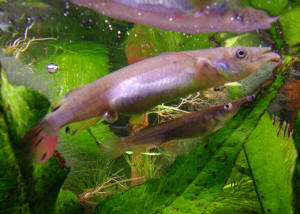
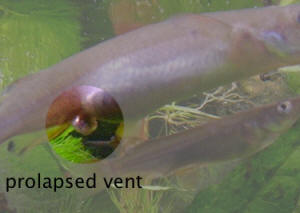
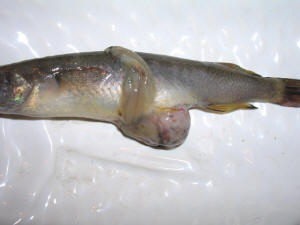
Nomorhamphus liemi 7/8/09
Hi Bob,
<Neale>
Images attached. Includes alternative version with the prolapsed
vent highlighted and labeled. These are gratis for your use on
WWM where relevant.
Cheers, Neale
Re: Very Sick Black Molly... (RMF? Ever seen this type
of prolapsed vent on a Molly?) 7/8/09
Hi Bob,
Have sent the images along.
<Have seen. Thank you Neale>
For what it's worth, in the case of this halfbeak, by guess
is that hybridisation might be the culprit. Within the genus
Nomorhamphus, there's a spectrum of degrees of viviparity,
from simply ovoviviparity through egg/embryo cannibalism to
proper placental connections. Since they're all a closely
related species flock from a single island, I wonder if closely
related species can fertilise one another, but as the embryos
develop various failing develop if the connection with the mother
isn't "just so"?
<Possibly>
It's a shame exporters make no effort at all to offer a
single species in each batch of fish, and this may further
explain the supposed difficulty of breeding halfbeaks in
captivity. Cheers, Neale
<Such is both the nature of the trade presently, and the
broader nature of humans... We are "fighting" this
gradient... Cheers, BobF>
|
 |
Halfbeak care and purchasing 12/16/08 Hi all! Great website!
I've been doing lots of reading here. I currently have a slightly
brackish, planted 29 gallon tank with platies, mollies, and a Krib. I
was at a local pet store today that sometimes gets a few oddballs and
they had one lone halfbeak. It was labeled as a "Celebes
Halfbeak" but it looks almost exactly like this picture:
http://www.aqua-fish.net/show.php?h=halfbeak1 <That fish appears to
be the so-called Silver or Platinum Halfbeak, a species I believe to be
Dermogenys siamensis. The Celebes Halfbeak is Nomorhamphus liemi. You
can easily distinguish Dermogenys from Nomorhamphus. For a start,
Dermogenys halfbeaks are generally smaller and more slender in build.
Dermogenys halfbeaks also have longer "beaks". When viewed
from above, Dermogenys halfbeaks have semi-transparent
"flanges" on either side of the lower jaw, so that
there's a scoop-like construction that is presumably used to guide
food particles into the mouth. Nomorhamphus halfbeaks lack these
flanges, and generally have short, stubby beaks that curl downwards in
some species. Nomorhamphus have a stocky body shape, and the females
especially are very sturdy-looking. Nomorhamphus also seem to be
happier swimming at different levels of the aquarium, even the bottom,
whereas Dermogenys rarely go much below the top of the tank.>
Straight beak, silver body, red and yellow fins. It's a little over
two inches, and the lady who does the fish ordering says she's
never seen any with a hooked beak like the actual male Celebese, but
yet has seen them breed in the tank. Supposedly he's been eating
flakes. I decided to take the little guy home and see how he does.
She'll be ordering a few more soon, as well as the flag fish I was
hoping to find. <Does sound like Dermogenys siamensis. I have a
picture of a male and female on one of my web pages, here:
http://homepage.mac.com/nmonks/Projects/halfbeaks.html Scroll about
halfway down.> Are there other species that look close to this
picture that I should also consider? He's currently loving my thick
stand of hornwort so I don't know if I'll be able to get a
picture soon. <Yes, they do like floating plants!> What exactly
does the andropodium look like? I can't find any pictures on Google
and it sounds like it's not as well defined as the gonopodiums of
my other livebearers. <Correct; essentially all you will see is that
some of the rays in the anal fin are kinked. But don't expect to
see anything like the gonopodium of a male livebearer. Regardless,
they're quite easy to sex once you compare males and females in the
same tank.> I'd like increase my single fish into a properly
sexed trio if possible. Or would that require more space than my 29
gallon? Some articles say they're aggressive with each other.
<Dermogenys are aggressive, but in your tank I'd get half a
dozen and let them sort themselves out. They won't fight to the
death if there are plenty of floating plants.> Also, my current
feeding regiment includes Spirulina flakes, a color boosting tropical
flake, peas, and frozen bloodworms (and livebearer fry, which everyone
seems to relish!). Will this be a sufficient diet for the halfbeak, or
should I look at adding something else? <Sounds perfect. Algae-based
flake is probably essential, as halfbeaks are at least partially
herbivorous in the wild. My specimens thoroughly enjoy Hikari Micro
Pellets as well.> Also, I'm getting conflicting information on
water changes. I currently do weekly 30% water changes. One of the
articles recommended changing only 5% at a time. Are halfbeaks really
that sensitive or will my current weekly schedule be suitable? I do
check the parameters every day or two just in case. Both my tap water
and my tank water are pH 7.5 so there wouldn't be a pH change.
<Some halfbeaks are sensitive to water chemistry changes,
particularly Nomorhamphus. But Dermogenys are generally quite tough,
and some species occur across a wide range of water chemistry values.
Dermogenys pusilla for example can be found in fresh, brackish and
saltwater conditions. Provided you don't expose your fish to
extreme, rapid water chemistry changes, they should be fine with the
usual 30% water changes you do.> Thanks! Angela <Cheers,
Neale.>
|
Re: Halfbeak, now with pictures 12/16/08
Hello crew! This is Angela, writing from my home email. I emailed
you earlier this night from my work email at Pentair Water. My
little Halfbeak friend has come out of hiding and allowed me to
take a few pictures. Please excuse my poor skill with aquatic
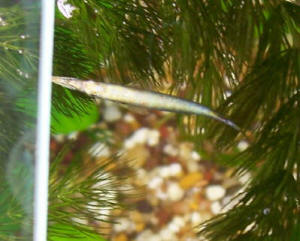
photography, I'm much better with furry animals. Side view,
colors washed out a little:
http://i15.photobucket.com/albums/a371/naturestee/100_6635a.jpg
Top view:
http://i15.photobucket.com/albums/a371/naturestee/100_6621a.jpg
Am I right in thinking this is a Wrestling Halfbeak?
<Certainly Dermogenys sp., most likely D. siamensis. To my eye
at least, D. pusilla is more greenish rather than the brilliant
white-silvery colour of D. siamensis. There's a nice picture
of D. siamensis here:
http://research.kahaku.go.jp/zoology/Fishes_of_Libong/data/p017_01b.html
All Dermogenys are very similar in terms of care, and in my
opinion they are the ideal "beginner's halfbeak".
They breed readily, but the fry are quite small and easily eaten
by other fish, so you're lucky if you find even one or two.
Quite possibly worth moving pregnant females to their own
quarters, or even a largish breeding net, depending on the size
of the female. By contrast Nomorhamphus females are huge (10 cm/4
inches in some cases) and produce enormous fry that easily
survive a few hours in well planted tanks, so you've got more
chance of catching them and moving them. Once you've got the
fry, rearing halfbeak fry is pretty easy.> He is shy of my
other fish but is otherwise settling in well. He even ate a
little and left his safe hornwort patch to fight his reflection.
<Halfbeaks generally settle in well. I hand feed mine using
Needlenose forceps, offering them a bloodworm at a time. In my
opinion, this helps them get used to humans as
"friends" rather than potential predators. Halfbeaks
are notorious jumpers and can be skittish, as you'd imagine
for a fish that lives so close to the surface. They do love
floating plants!> Also, I forgot to mention it before but
Neal's halfbeak website address, as posted in an FAQ, does
not work:
http://homepage.mac.com/nmonks/aquaria/halfbeakbreeding.html
<Has been moved; the link was on the bottom of the page
originally sent, otherwise simply go direct, here:
http://homepage.mac.com/nmonks/Projects/halfbeakbreeding.html
Have stuck a redirect at that old address as well, so thanks for
the warning.> Many thanks for any help with this little guy!
Angela <Cheers, Neale.>
|
 |
Halfbeak advice -- 03/18/08 Hello! <Ave!>
About six weeks ago, I found two pairs of halfbeaks at a chain pet
store. They were labeled 'Celebes Halfbeaks'. I was surprised
to see them there, and asked a clerk to bag them up for me. The clerk
made me promise to put them in a brackish tank. I was pretty sure that
they were not brackish fish, since I recently finished reading
Neale's new book, "Brackish-Water Fishes." (Great book!)
<Thanks!> But, since they were in brackish water at the store, I
put them into a quarantine tank with brackish water. <Ah, not ideal
for most Nomorhamphus species. So far as I know, only Nomorhamphus
erhardt lives in brackish water; all the others are soft/acid water
beasties. That said, one store near me has a female Nomorhamphus liemi
in its display brackish tank and has done so for a long time. So like a
lot of "peripheral freshwater fish" (i.e., freshwater fish
from marine families) they likely have significant salt tolerance.>
They did fine, grew a little, and time passed and I never got around to
acclimating them to fresh water. Last week, I wanted the quarantine
tank, so I moved them into one of my brackish display tanks. I noticed
at the time that one of the females was quite fat. Just now as I was
feeding them, I noticed baby halfbeaks in the tank! They are quite
large, about 1 cm or more long. I saw four or five of them, and they
are very lively. <Indeed they are! And wonderfully easy to rear. The
tricky bit is getting the mothers through pregnancy; once the babies
are delivered, life gets a lot easier.> My question is, are these
Nomorhamphus liemi? I looked through Baensch's Aquarium Atlas 1
through 3, and they look more like N. liemi than any of the other
halfbeaks. <The give-away is the shape of the beak: Nomorhamphus
liemi has a beak that curls, like a little beard, under the jaw.> My
picture doesn't show it well, but the male's pelvic fins are
yellow. I want to make sure before I do acclimate them to fresh water.
If they are reproducing, they are not exactly unhappy where they are,
and I want to keep them happy! <I'd leave them where they are
for now. With halfbeaks, what seems to matter most of all is water
chemistry stability, and if adding a little marine salt mix gives them
that, I don't think they care all that much.> Thank you for your
time, <You may care to peruse my "halfbeak breeding diary"
at my web site, here:
http://homepage.mac.com/nmonks/aquaria/halfbeakbreeding.html > Susan
<Good luck! Neale.>
Re: Half-beaks I have seen half-beaks in my Local Pet shop (I
use PetSmart and I have never been given bad advice.) I would like to
purchase some but I would like to know more about their care and
breeding. <Search at http://www.wetwebmedia.com using the
Google search box and also search the web for these fish and you'll
find a wealth of information.> Thanx, please respond AS SOON AS
POSSIBLE! <You're welcome! Ronni>
|
|

