 |
|
| Home | Marine Aquariums |
Freshwater Aquariums |
Planted Aquariums |
Brackish Systems |
Ponds,
lakes & fountains |
Turtles & Amphibians |
Aquatic Business |
Aquatic Science |
Ask the WWM Crew a Question |
| Please visit our Sponsors | ||||
"When in the course of pet-fish events", the biggie: Livestock. A large part of the fun and excitement of the marine aquarium hobby is the anticipation and "scavenger" (that's you) hunt for your new livestock. The "what" to get and even "how to select" actually should have been decided (as in, nothing's decided till it's done) way in advance of even acquiring the system and its components. Yes, in an ideal world, aquarists would/will know what sort of presentation and/or livestock they intend to house way before actually buying their tanks and support paraphernalia. What about such issues as; "how big" a system? (Answer: As large as you can afford to maintain. Notice I didn't write "to purchase"; that's a minor matter comparatively). What shape? A heavy bias on more flat, "standard" formats over "show" profiles that are tall and narrow. Lighting? What will your organisms need/take? Substrate? Nitrate removal/reduction considerations? Foods, feeding, nutrition? And oh so much more need to be addressed and answered with confidence. And as you're cogitating furiously, seeking and discovering what's available, possible and the paths you'll try out matching your "dry-goods" purchases with the "live", what sorts of questions might you, should you explore concerning "what" species you'll place? Beyond these, what criteria can you apply to optimize your chances of securing the best/better specimens of the varieties of livestock you want? Unsurprisingly from the title of this piece, these are my answers. Marine Livestock Species Selection: Determining "What" then "Which": There are two issues to be addressed in figuring our what you'll be keeping in your marine system. First, the ideal of what is available and suitable for your particular set-up; secondly how to go about picking out the best of these species. Discounting the possibility of "The Creature that Ate Brooklyn" deriving from your live sand and rock, the following issues must need be evaluated when considering potential fishes, invertebrates, algae and vascular plants: size (at purchase, growth, and ultimate potential), foods/feeding, compatibility (behavioral characteristics like territoriality) and anomalous losses issues. Even the issues of shipping problems and legal aspects should be of concern. Allow me to expand on these ideas and offer examples. The Issue of Legality: Legal & Moral Concerns:
Bad Species: Poor Capture, Transport, or Adaptability Record: Mortuus Est: One outright contraindicated behavior to avoid in livestock selection is death itself; some species, for whatever unknown reasons, don't generally live through the rigors of collection, holding and shipping. Both a "clean" list of desirable species and a "dirty" list of those to avoid run very long; an ongoing compilation is available on the net at http://www.amdareef.com/ecolist_main.htm; some pleasing examples are:
Others rarely live any length of time regardless of size;
Does the Species Eat Captive Foods?:
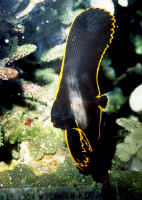
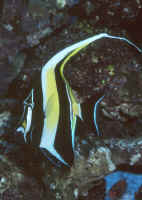
Other not-usually eating examples of fishes commonly offered in the aquarium trade include the aforementioned Moorish Idol and Pinnatus Batfish, Platax pinnatus...
And too many more common retail offerings are in league with these poor and specialized feeders. Collectors, wholesalers, retailers should avoid them, but rarely do. Chilly Willy:
To: Part 2, |
|

|
Features: |
|
| Featured Sponsors: |