|
Amazon sword, hlth. Q's /RMF
3/6/14
Hello Crew,
<Phill>
And a happy Thursday to you all. It's been awhile since I dropped in and
hope all is well with you guys and gals. Been racking my brain on this
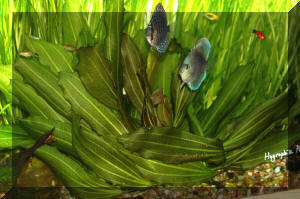
one for some months now and cannot resolve this. I have included photos
of the setup for your convenience. The issue here as can be seen in the
photos is the older leaves on my Ozelot sword.
<See them>
Tank: 40 gallon breeder tank (South Amazon Biotope)
Plants: Stargrass, Dwarf Sag, Ozelot sword, Red temple
Fish: Silver hatchets x7, Bolivian Rams x5, Angelfish, Keyhole,
Bristlenose Pleco
Lighting: 10 inches above the water; 2 T5 lights (5000K and 6500K) on
for 10 hours per day with timer.
<Would like to have you measure PAR/PUR at depth, perhaps via a borrowed
LFS or fish club meter>
Water is changed weekly at 15-20%
To address this problem I have tried different combinations of chemical
dosing. I have consistently used the following per manufacturers
recommendations:
2 Flourish root tabs at base of sword every 3 months
1/2 cap Flourish Excel Monday - Saturday
1/2 cap Flourish Comprehensive Monday and Thursday
1 cap Flourish Potassium Monday and Thursday (this was just started 3
weeks ago)
1/2 cap Flourish Nitrogen Monday and Thursday
Note that I was using 1/2 cap Flourish Phosphorus but stopped using that
at the same time I started the Potassium.
<... what re your water quality? pH, alkalinity especially... Do you
have much in the way of NO3? Is the Echinodorus planted in any medium?>
Issue has been going on since the plant was added 5-6 months ago.
Stargrass and temple are new so no issues there yet.
Some older Sag has yellow or some small algae but over all growing very
very well.
You will note that the plant is sending up beautiful reddish green
leaves on a regular basis. This issue is just isolated to the older
leaves.
Leaves are firm and hard though (almost plastic in feel) until the holes
develop which I am not sure if that is normal but just making
observations. I was going to do my water change today and add the
Phosphorus back into the routine. Please let me know your thoughts. I've
fought this battle bravely but I'm coming to the experts now. Thank you
again for your continued support and advice!!
Phill
<Need info... Bob Fenner>
Amazon sword /Neale
3/6/14
Hello Crew,
<Phill,>
And a happy Thursday to you all. It's been awhile since I dropped in and
hope all is well with you guys and gals. Been racking my brain on this
one for some months now and cannot resolve this. I have included photos
of the setup for your convenience. The issue here as can be seen in the
photos is the older leaves on my Ozelot sword.
<Indeed.>
Tank: 40 gallon breeder tank (South Amazon Biotope)
Plants: Stargrass, Dwarf Sag, Ozelot sword, Red temple
Fish: Silver hatchets x7, Bolivian Rams x5, Angelfish, Keyhole,
Bristlenose Pleco
Lighting: 10 inches above the water; 2 T5 lights (5000K and 6500K) on
for 10 hours per day with timer.
Water is changed weekly at 15-20%
To address this problem I have tried different combinations of chemical
dosing. I have consistently used the following per manufacturers
recommendations:
2 Flourish root tabs at base of sword every 3 months
1/2 cap Flourish Excel Monday - Saturday
1/2 cap Flourish Comprehensive Monday and Thursday
1 cap Flourish Potassium Monday and Thursday (this was just started 3
weeks ago)
1/2 cap Flourish Nitrogen Monday and Thursday
Note that I was using 1/2 cap Flourish Phosphorus but stopped using that
at the same time I started the Potassium.
Issue has been going on since the plant was added 5-6 months ago.
Stargrass and temple are new so no issues there yet. Some older Sag has
yellow or some small algae but over all growing very very well.
<Good.>
You will note that the plant is sending up beautiful reddish green
leaves on a regular basis. This issue is just isolated to the older
leaves. Leaves are firm and hard though (almost plastic in feel) until
the holes develop which I am not sure if that is normal but just making
observations. I was going to do my water change today and add the
Phosphorus back into the routine. Please let me know your thoughts. I've
fought this battle bravely but I'm coming to the experts now. Thank you
again for your continued support and advice!!
Phill
<Normally yellow leaves (and consequent failure to thrive) have been
ascribed to either nitrogen or iron deficiency, so these are the two
nutrients to try out. Increase the dosage, ideally by dosing more
frequently, and see what happens. Amazon Swords are notorious "gluttons"
and need a lot of feeding and very high light intensity to prosper in
the long term, probably because they aren't true aquatics but marsh
plants.
They have a big root system and probably limited ability to remove
nutrients from the water (unlike true aquatics, which are usually the
opposite) so dosing more frequently with suitable Fe/N-rich root pellets
would probably be the best approach. Cheers, Neale.>
|

Re: Amazon sword 3/7/14
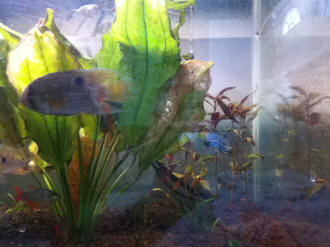
Thanks again Neale. As always your wisdom is very much appreciated! I'm
excited to finally send you guys pics of the Asian 20g biotope and this 40
Amazon when they are done. Years in the making very such a joy!
Phill Shubert
<Looks a great tank and thanks for the kind words. Cheers, Neale.>
|
Re Amazon swords 8/2/12
Hi Neale and crew!
<Hello again!>
I really hate to continually bother you as I promise I research this
prior to writing. I just really value your expert input. Still fighting
with these swords. Currently 29 gallon with Zoo Med dual T5-HO bulbs at
24w per bulb for total of 48w. Light is 3" about water. Frogbit floating
to dim for cichlids.
<And may well be blocking the light getting at the Amazon Swords. It's
easier to keep the floating plants trimmed well back while establishing
bottom plants, then as those bottom plants grow upwards towards the
light, you can let the floaters expand a bit. But you'll notice that
while floating plants look good, they're a poor choice for use alongside
light-hungry bottom plants (though they work brilliantly with those
plants that dislike strong overhead light, like Anubias and Java fern,
and to some degree Cryptocoryne spp.).>
Eco complete substrate. Light on 12 hours per day. Using Flourish tabs
every 3 months. E. parviflouris "tropica" and Pygmy chain.
<Both light-hungry.>
Tropica new growth turns yellow then gets holes.
<Insufficient light, and exhausting the plant's own energy reserves and
minerals, hence the weak growth.>
Chain sends runners but just overall weak growth. Per your
previous advice I am upgrading lights as I upgrade tanks.
<Yes.>
Going to 40 breeder with Eco complete. Wondering what you think of the
following:
1. Tabs every 2 months instead of 3 months. Is this overkill or better?
<Doubt it's the issue, but go ahead and try.>
2. Dosing weekly with Flourish Excel. I know Swords are root feeders but
I have seen this recommended on numerous sites now.
<For sure, but many of those sites involve aquarists keeping Amano-style
tanks without floating plants. Their Swordplants will be growing rapidly
under intense lighting.>
3. Removing Frogbit all together.
<Or at least 90% of it, yes. Keep a few bits so you can let it expand in
due course. Do bear in mind this stuff grows super-fast, so you can be
ruthless about chucking most of it out.>
4. Here is the main question. I have the option of either the Zoo Med
dual 36" T5-HO or the Odyssea triple 36" T5-HO. I have heard some poor
reviews about the Odyssea. I want my plants to look nice without CO2 if
possible.
Was planning on a 6500K bulb and 5000K bulb.
Just forgot to mention that the 36" bulbs are 39w per bulb. That would
be 78w for Zoo Med and 117w for Odyssea for 40 breeder. Zoo Med appears
to get better reviews.
<Possibly, but both should be fine. Here's the thing -- the more
wattage, the more energy, and the more light gets to your plants.
Differences between the tubes may be real, but yet not significant
compared to one system offering something like 50% more watts. Assuming
they're all T5 tubes of the same length and colour spectrum, 3 tubes
will be better than 2, but for good plant growth, you do seem to need at
least 3 and preferably 4 tubes running the length of the hood,
especially for deep tanks (by which we mean anything deeper than ~40
cm). Alternatively, look at choosing plants that will thrive under the
lighting you have. Why focus on Amazon Swords, which are terrestrial bog
plants that happen to grow underwater but needs lots of light to do so?
There are some big Crypts that are less demanding, as well as things
like Java Fern and Anubias? Some of the Crinum species can be very
impressive, but again, aren't too fussy. Lots of options. So two ways to
crack this nut -- more watts or different plants.>
Thanks again Neale for your advice. It is greatly appreciated.
Phill
<Cheers, Neale.>
Pygmy chain swords 7/19/12
Hi guys,
Good morning. Quick and easy one. 50/50 Internet split based on
research.
Chain swords.....will the runners find their way into the soil since
they are above substrate or do I need to manually plant each baby
runner.
<Many aquarists deliberately plant them, spread out, so as to create a
'turf'. But you can buy a potted specimen, and let it send out runners
and take over the tank itself. Obviously it manages in the wild! I've
never had much success with this plant -- it's demanding in terms of
light, and baby plants at least are easily uprooted by almost anything
that forages at the
bottom. They have more value in Amano-style systems that boisterous
communities.>
Thanks guys.
Phill
<Cheers, Neale.>
Echinodorus 6/19/12
Hi crew,
<Hello,>
I hope you all are well and had a great Father's Day. Just a quick
question. I have an Amazon tank setup up. It's a 29 gallon tank at 30 x
12 x 18. I have a Whisper 30 filter with dual T5HO lighting at 24 watts
per bulb for a total of 48 watts. The bulbs are 6500K and 5000K. I have
Eco complete substrate that I placed flourish tabs every 5 inches. Water
is about 7.2 pH with water hardness around 150. Temperature is kept
about 78-80. I leave the lights on a timer for 12 hours daily. Water
changes are 20% weekly. Stocking is angelfish x1, black phantom tetra
x6, Apisto agassizi x3, Bristlenose Pleco x1.
I have Amazon Frogbit, Echinodorus parviflorus tropica, and Pygmy chain
sword. Frogbit is fine and grows like mad which I thin out weekly.
<Good.>
The rosettes did their transitional wilt and have new greener, pointy,
softer leaves.
<As per usual. The leaves we see when we buy Amazon Swords are commonly
the aerial rather than aquatic leaves because these plants grow better
(i.e., faster) out of the water, which is how they're grown in the
greenhouses.>
However now those leaves are starting to get yellow spots on them.
<Could be lack of light or lack of some micronutrient (iron, magnesium,
manganese or potassium), or indeed some combination of these.>
Also my chain swords are just sitting there.
<Yes. May take a while (some weeks) to settle in and re-root, and this
may be delayed if fish are disturbing them (digging). Again, lack of
light is the most common reason for poor plant growth.>
They also experienced some die off with some leaves making it through.
But now they are doing nothing. I have reduced my lighting to 10 hours
starting today just to try something as algae growing is starting to
increase.
<Would go with 12 hours light, but 6 hours on, 1 hour off, then another
6 hours. Algae around the edges of leaves is usually a sign of excessive
nitrates, so more water changes should help. Siamese Algae Eaters are
also good at trimming these Rhodophyte algae commonly seen around
Echinodorus spp. In any event, your lighting level is a bit low; for 29
gallons you'd be aiming for something like 60 watts for light-hungry
plant species.
Culling the Frogbit may ensure more light gets down to the rooted
plants, but that may only be a small part of the problem. More tubes,
the use of reflectors may be more helpful.>
Any thoughts on how to help my tropica rosettes and chain swords? Thanks
guys!
Phill
<Cheers, Neale.>
Amazon swords 4/24/12
Forgot to mention that each bulb is 24 watts for total of 48.
Phill
<Umm, the previous correspondence? What is the size/shape of this
system? This is not much light likely>
*Amazon swords*
Hi crew,
How are you all? I hope this finds you well. Quick plant question.
Current tenants are angelfish, black phantom tetras, and Apisto agassizi
trio. Ammonia is 0, nitrites 0, nitrates 5-10. Weekly 20% changes.
Substrate is eco complete. Lighting is dual t5ho, 6500k and 5000k. Had
the lighting hanging 6" from top of tank with glass cover.
<Mmm, why so high?>
As you can see my Echinodorus parviflorus tropica is getting
some brown areas.
<No pic attached>
I have emailed the grower to see if they were grown submerged or emerged
hoping this was just transitional.
I also have Amazon Frogbit which I thought may be shading it so I
thinned it out, removed the glass cover, and dropped the light down to
1" above tank. I figured the Frogbit may prevent any jumpers by allowing
them to feel calm and protected from above.
<I agree>
1. Do any of these fish strike you as potential jumpers to the point I
should replace glass?
<Not really, but I'd leave the water level down an inch or so>
2. Do I need to dose with flourish excel or something in spite of Eco
complete?
<I would add the Flourish/SeaChem product>
3. Any ideas for height of light for best performance?
<Close to the water surface>
4. What is your best guess at what is causing this. I'm expecting
shipment of Pygmy chain and if I can't nail these guys I see bad things
for the chains.
<Could be simple transplant shock... or a nutrient deficiency... Bob
Fenner>
Re: Sickly Dwarf Gelius Barb,
now kinky loaches, algae on (nee) Echinodorus 10/2/10
Wow...that's what I call service, thanks!!
<Not bad for free'¦>
Okay, will decrease temperature a little, and look into anti-Hexamita
medication (mysteriously and collectively referred to online as a
treatment for discus, it seems??)
<Indeed. Hexamita is one of the so-called Discus Diseases, and in
fact is most often encountered among cichlids generally. Whilst I doubt
this Barb is suffering from Hexamita itself, it may be something
similar, and an anti-Hexamita medication might help.>
Will keep you posted.
<OK.>
While I've got you, am I permitted to ask a couple of unrelated
questions? Will try to be brief (not easy for me, as you know). I have
5 loaches, 2 striata and 3 yo-yo.....both my striatas were
"cast-offs" from different aquatics stores, I spotted them
swimming in random stock tanks with other fish, totally unnoticed by
the shop. One is very small (partly why I bought him), but I've
noticed that he has a strange kink in his body (just behind the dorsal
fin). Could this be the deformity of the spine that I read about in
loaches? How will it effect him long term?
<Kinked spines are either congenital, caused by malnutrition, or
much more rarely, caused by some sort of trauma. There's nothing
you can do to fix them, but they don't seem to cause the fish undue
harm, at least not under aquarium conditions.>
I also have an issue with algae on my live plant
leaves. I have some tall Amazon swords, and a few of the
leaves have very lovely brown smears on them, plus what looks like
black spots (like felt tip) on one or two.
<Yes, very common with Amazon Swords, typically in situations where
light intensity is not that high, and the aquarium isn't densely
planted with fast-growing plants. Certain fish help, particularly those
sorts that eat Red Algae, but improving overall conditions for the
plants will be the main issue. Do read:
http://www.wetwebmedia.com/ca/volume_6/volume_6_3/fwalgae.html
>
Despite my reading, I can't seem to find an accurate description of
it online - I thought it was brown algae/diatoms but it doesn't
completely fit that description....???
<Brown Algae and Diatoms are different things. Brown Algae are the
kelps and bladder wracks, and they're essentially absent from
freshwater environments. Diatoms -- sometimes called Golden Brown Algae
-- are unicellular things that form thin, greasy films on the glass
walls of the tank. Occasionally they bloom in the water. They're
basically harmless and tend to go away by themselves once the aquarium
settles down. Snails eat diatoms readily, so control of the few
remaining diatoms is easy. Red Algae form the bushes, threads, and
small but hard spots seen on glass, solid objects, and of course
plants. These are among the most difficult algae to eliminate.>
The shrimp, panda Corys and zebra snail have all had a go at eating it,
but it won't shift - and I can't seem to scrub it off manually.
Some of the leaves are perfectly clean.....so will this be a case of
simply removing the algae stained leaves altogether, is there nothing I
can do?
<To some extent, plants combat algae themselves under good
conditions. A decent clump of floating Indian Fern will go along way to
removing nutrients from the water and suppressing the growth of algae.
Otherwise use fast-growing plants such as Hygrophila and Vallisneria
under intense lighting -- ironically, one of the best ways to fix algae
problems is to add more light so your plants can grow more rapidly. If
you aren't pruning weekly, then your fast-growing plants probably
aren't growing as quickly as they should be.>
Thanks very much!
Susie
<Cheers, Neale.>
Amazon Sword Plant, trimming 9/30/06
Hi everyone im <I'm> new to the site, but have been doing
research all day today on Amazon sword plants, but haven't came
across the info i was looking for. Ok ive <I've>
had my sword for about 3 months now, and its growing out of the water.
I wanted to know if these plants could be trimmed, <Can be, but
unless this Echinodorus is "getting in the way" I'd leave
it sans trimming... maybe except fo obviously yellowing, dying
side-leaves on the bottom> and if so how, like where do you cut at
and stuff like that. Thanks you have a very informative
site by the way!!! <Welcome. Bob Fenner>
Platy and Plant problems 9/17/06
Hello WetWebMedia crew! <John> After several months of a
well-established tank, I have developed quite a frustrating and
persistent problem. It began with a stubborn case of fin rot
on a guppy that would not resolve. Consequently I treated
with erythromycin for 5 days and this cleared up the problem with his
tail and he is now on the mend! Nitrites have fallen back to
zero from peaking at about 0.3 ppm and the tank is doing fine in terms
of water quality. Parameters are: Ammonia: 0 ppm Nitrites: 0
ppm Nitrates: 12 ppm pH: 7.5 Temp: 25C The tank is approximately 24
gallons and 40 cm deep with 18W fluorescent lighting (single tube) from
Sylvania that claims to have 10,000K spectrum and the company says is
ideal for growing plants. As the medication damaged some of
my plants, I have removed the dying ones and replaced with some new
ones (soaked for 10-15 min.s in potassium permanganate to remove
unwanted visitors) - similar to Amazon swords, but I only have the
Italian name and not the scientific name. <Both likely
Echinodorus species> The problem with the plants is that they are
turning yellow and developing some brown holes on the established
leaves (veins seem green) even after I purchased them a healthy green
colour from the LFS. I have fertilized with solid pellets
and have also used a pellet that encourages rooting. There
is also some liquid fertilizer in the tank that I add approximately
every three weeks as indicated on the product. Still, I am
not sure what would be causing this. <Mmm... could likely be just
the KMnO3 treatment... permanganate is a powerful oxidizer...
dangerous. But could also easily be a bit of "moving shock"
syndrome... All that can be done is be patient at this point> The
second problem is with a female sailfin platy. I noticed her
with some laboured and rapid breathing. She does not swim as
much and seems lethargic. On closer inspection I could see
fine white filaments (diameter is sub-millimetre, very fine) extruding
from her mouth and also extruding from her gills. Looks like
very fine silk thread. Currently I can see about 4 or 5 of
these maybe 3-4 mm long. Could this be gill worms? <Mmm,
not likely, no> I had thought mouth fungus, but it does
not look "cottony". If worms, then I am not sure
where they came from as the plants I added are not from a tank
containing fish and I even did the potassium permanganate soak, so it
seems improbable that this would be the source. There have
been no new additions and it is even possible that I was seeing these
prior to the addition of the plants. Clearly it is a gill
problem, but I cannot seem to identify it. Would this
possibly result from the erythromycin treatment?? <Likely this is
some bit of mucus from the trials of being present in a non-cycled
system... and will clear on its own> I hope you can offer some
advice as I am not sure what is going on with my tank! Best regards.
<Well... better by far never to actually treat (most fish medicines
are generally bio-cidal in action) in ones main/display tank (but do
elsewhere)... And a need to understand that aquatic time-frames are
different (much more delayed) than our terrestrial impressions...
Some/many things "take time"... Best to learn/practice
patience here. Bob Fenner> FW Ram and Plant Questions -
5/2/2006 1. My rams have been doing very well lately but I just
have 1 concern. On the bottom of their bodies, they are fine but about
half way to their tail and their body's curve inward. Is their
stomach not full? Are they hungry or starving? They always eat but my
other fish are really quick and I don't want to put more food in
because if my other fish are full... the rest will go to waste and
pollute my tank. What should I do? < Over feed them some live brine
shrimp or Tubifex worms and see if they fill out. You may need to
change the food to sinking pellets to make sure they get enough to
eat.> 2. I have one Brazilian Sword and it has 4 open leaves and one
that is in the process of opening. Will it grow more stalks with more
leaves or is this how little it will be forever? < The Brazilian
sword plant is actually not a fully aquatic plant. The leaves should be
out of the water. You plant will slowly waste away after awhile. Try
switching to a fully aquatic plant like an Amazon sword.> 3. If
there is a slight tear and around that tear, brown spots on one of my
swords' leaves, should I cut the entire leaf off because then my
plant will look really skimpy? Also, I if I cut anything off, I should
cut it as close as possible to the roots as with any plant right?
Thanks < The Brazilian sword is already rotting away. Swap it out
for an Amazon sword.-Chuck>
Re: Amazon Sword plants with
Black Fungus - Makes Sense Now! Bob and Crew, <Dave> Thanks.
I understand more clearly now. I hate it when I go back and re-read the
FAQ once I have been pointed to it specifically and it all of a sudden
makes perfect sense. <Mmmm, like old age... "beats the
alternative!"> One follow up question: If the nutrient level in
the water (NO3, in my case - way too high) is
the cause of the beard algae, and if the leaf-wasting phenomenon
(leaves becoming lacy) is due to a *lack* of nutrients, then I must
conclude that I need to research the measurement and possible
supplement of other (non-nitrogenous) nutrients? Does that make sense,
or am I still missing something? <Well stated... yes, nitrate
isn't actually very "available" to aquatic plants... a
good idea to provide either lots of fish "wastes", count on
slow growth... or provide a complete (N,P,K) fertilizer... and BEST to
do this AND have a soil mixed in with your substrate, carbon dioxide
infusion....> Got a lot to learn, apparently, that is for certain!
<Mmm, well... the way I see it, the more I understand the more I
enjoy life...> I recently finished reading (pass 1) "The
Conscientious Marine Aquarist"; please let me add my
congratulations to the long list for the clearest introductory marine
aquarium text I have read. Excellent job. Quite enjoyable. Cheers, Dave
<Thank you for your kind, encouraging words. Bob Fenner>
Re: Amazon Sword plants with Black Fungus, FAMA
"sales" Bob and Crew, <Dave> Thanks again for the
response. Illuminating, as usual. Hopefully, this short spate of
follow-on questions is not overstaying my welcome. <Not going to
happen> Well, I have spent the last several days perusing the
WetWebMedia and The Krib web pages per your earlier response, and I now
find myself, like the guy in "Zen and the Art of Motorcycle
Maintenance", with lots of great answers to my questions, but,
now, even more questions, some of them quite basic, it appears. At the
risk of being pointed to pages that I have seen but skipped in the last
several days, I am going to try and make sure I am not going in a
completely inappropriate direction here. <Ahh, clarity is
pleasurable... and your "quest" will yield this in time,
effortlessness> My goal with the freshwater aquarium was to create a
planted aquarium which would host a reasonable amount of diverse but
compatible freshwater fish, with perhaps a few invertebrates. It is a
sort of pre-school step for setting up my 90 gallon marine tank.
<Very good to understand a situation, critical to understand what
one is about...> I have a 46 gallon glass tank with an undergravel
filter as well as a Marineland Penguin 170 outboard filter. I have two
AquaClear 30 powerheads, located near the top of the water, one on the
left and one on the right, which drive the undergravel filter. I have
2x Blue Tetras, 2x Neons, 2x Green Barbs, 2x Tiger Barbs, 6x Glass
Cats, 2x Plecos, 2x Chinese Algae Eaters, 6x Serpae Tetras, 2x Masked
Corys, and 2x, Clown Loaches, plus a few various small shrimp. My
current plant crop is limited to Amazon Swords, several of which are
succumbing to the Beard Algae that started this whole discussion.
<Yes> Now, after reading through several of the WWM/Krib
FAQs/Articles, I am a bit concerned about the undergravel filter and
its compatibility with the intent to grow live plants. So, my first
question is, do I need to dispose of the undergravel filter, and, if
so, what would I replace it with? <I would at least "turn
off" the powerheads (leaving the plates, risers in place) at this
point... the hang on filter will do what you need here> A larger
external mech/carbon/bio filter? Or do I need to take a page from
marine aquarium technology and set up some sort of sump (I don't
have a ready location for this sort of thing with the freshwater tank)?
Or what? I thought I had done a good job of going through the set-up
FAQs before I started, but, did I make a major mis-calculation here?
<I would see how the current hang on does... do monitor your
nitrogen cycle initially... as cessation of circulation through the
substrate does have some consequences> Some of the WWM webpages seem
to indicate that using an undergravel filter is perfectly compatible
with plant cultivation. Is this true? <Mmm, strictly speaking,
yes... Please allow me a shot to be clear/er here. Non-rooted plants
(e.g. "grasses") do not "care" whether there is UG
use or no... many rooted plants are disadvantaged by UG use...
loss/competition for nutrients mostly... Such that these rooted plants
are far better off "planted" in blind pots, or sequestered to
an area that lacks UG plates... Overall, almost all "planted
freshwater aquariums" are far better off WITHOUT undergravel
filtration.> The idea I have forming here is to add substrate (I am
using natural 1/8" - 1/4" mixed gravel) so it is deeper, say
2-1/2" - 3" or so (I have about 1-1/2" - 2" right
now) and buy or make some small plastic dishes, say 3" - 4"
in diameter, maybe 2" deep for each plant and "plant"
each plant in an aquatic soil (need to figure out what that means, as
well) in one of these Petri-dish sort of things. However, this would
seem to restrict me to plants whose root systems are clustered, and
would seem to mean I would have to forget any idea of cultivating
"carpet" type plantings. This, with considered application of
some (small) amount of NPK fertilizer would seem to offer an
alternative to disposing of the undergravel filter. <A good
plan, but this is so> BTW, while exploring the possibility of
downloading some of the FAMA references in various WWM pages, I see
that FAMA is now soliciting requests from subscribers (I am one) for
online back-issue articles. They say that they haven't a lot
available yet, but the webpage for requesting articles is
"Article
Request Page" if anyone is interested. <Thank you for
this... good of them, but disturbing for content providers... they do
NOT have the legal right/s to reproduce our work... A small concern of
mine for my part... as my hundreds of articles, thousands of images
that ran in their pages are posted on WWM...> I have requested a few
.. we'll see what happens. Cheers and Many Thanks. Dave
<Thank you, Bob Fenner>
Re: Amazon Sword plants with Black Fungus Bob & Crew,
<Dave> Thanks for the info. I have unplugged the undergravel
filter (I plan to set up the two powerheads for circulation only) and
installed a larger (280 GPH) external power filter, plus I am doing 10%
water changes every other day until the NO3
level gets down to something reasonable. <Keep this under 1.0
ppm> I plan to limit the gravel vacuuming to weekly at present until
I see what the result of the above steps is. I may need to clean it
more thoroughly, but I figured I'd approach that with caution.
<Good> I will quit requesting/downloading articles from the FAMA
website - I did not realize that that was not sanctioned by the
authors. It would probably be a good idea to make that fact more
generally known. <I thank you for this... as a content
provider being stolen from, a citizen, human> One (another)
follow-up question: can I go ahead and start trying an NPK plant
nutrition supplement while the NO3 level is
high, or do I need to wait until the NO3 level
gets down to 0 - 20 ppm before starting to use NPK supplements?
<Mmm, don't know... in my ignorance, I would NOT add it at this
point. You might posit the same question on "thekrib"... look
into making PMDDs going forward... Bob Fenner>
Tank Replacement and Plant Transplant Questions Hey guys,
Thanks for providing such a great service. You guys are the greatest. I
have a 55 gallon discus tank planted with Amazon sword plants.
Everything seems to be in a great balance, which took an awful long
time to achieve. Sword plants are multiplying and discus seem happy.
The problem is the aquarium itself. The support at the top has broken
and I am concerned about the stability of the tank. My question is will
the sword plants survive a move to another tank? It has taken several
years to achieve such a good balance and I hate to lose everything. How
hard will it be to transplant the swords? Will it be like starting
over? What is the least invasive way to take out and replace the sword
plants? I am also concerned about the two discus. They are adult size
and apparently are a pair, but are very sensitive and do not like to be
fooled with. Anytime a change is made they get very upset. Thanks for
the response. < These tanks with the plastic support in the top
center get old and fragile and break. I took a piece of glass and cut
it to fit from the front of the tank to the back of the tank and about
6 inches wide. Drop the water level about 6 inches from the top of the
tank and silicon the new piece of glass in place under the old broken
bracket. Hold it in place with some clamps or vice grips. Take a
straight edge to the front of the tank. Your tank may be bowed so you
should straighten it out before it is siliconed back in place. After a
couple of days you can go ahead and fill the tank back up.-Chuck>
Best regards Bart
Concerning an Amazon sword specimen I have had an Amazon
sword for almost a year now. When I first bought the plant, it only had
about three large leaves. After putting it into a tank, (which only
held about four gallons and had no controlled heat or any lighting, [I
was living in a college dorm at that time]) my plant grew and developed
many more large, beautiful leaves. But, then I moved back home and put
the plant (and my two goldfish) into a 10-gallon tank with a
flexible-necked floor lamp next to it to supply light, (the tank has no
hood besides a framed mesh screen, and thus no built-in lighting).
Since then, my plant has not grown larger, and the leaves have become
very narrow and are beginning to turn brownish and frayed on the ends.
What can I do to help the poor thing? < Hard to tell. Sometimes
Amazon swords don't like to be moved and will lose their old leaves
but soon grow new leaves to adapt to the new environment. I would start
by replacing the light bulb in the lamp with a Gro-lux light that is a
full spectrum light bulb made for indoor plants. I would use fluorite
by Seachem as a substrate. Start with these two things first. They
should help.-Chuck> Stephanie
Problems With Plants Hi, I am having problems and this time
with my plants. I tried to look up their care but did not
find answer. I have bought 2 plants initially (I have 55 gal
tank). One was onion plant, another I do not
remember. They grew like crazy for a while and I decided to
get some more. I got a big sword plant and 2 smaller ones,
one grass type, another--purple leave one. <Typically,
anything reddish and anything used primarily as foreground require very
strong lighting - what kind of lighting to you have on your tank?>
Once I got those, it seems that all my plants stopped
growing. I fertilized them, I started to turn my pump on the
lowest setting (I have the one that hangs on the side of my
tank). I have constant light for 11 hours, water conditions
seem to be excellent and I do not know what is going on. I
assume it might be lack of CO2 because when there were only 2 plants in
the tank, they grew right by my eyes and now one of them seems to be
almost dead, <Lack of CO2 *might* be an issue, but I'm betting
in this case, the new plants require brighter lighting, and if that
isn't available, they probably won't survive. The
lack of growth in the other plants probably is due to either not enough
nutrients to go around, or not enough CO2 to go around.> only half
of what I had is left, well I kind of moved it from place to place a
lot since I got that plant, maybe that was harmful?
<Rough handling can damage some plants; it would really help to know
what they were, though. You might want to try out a good
plant book, "Encyclopedia of Aquarium Plants" by Peter
Hiscock or "Aquarium Plants, a Practical Guide" by Pablo
Tepoot. Both are quite informative, full of good stuff.>
I am really bummed and after spending time on the internet and trying
to find what is the matter, I decided to write you.
<Ahh, don't get bummed yet. We can certainly help you
through this.> I also have a question, I have a black hood and I was
told to put a glass instead and put more light on the tank, where can I
buy the glass hood? <Most fish stores carry them - but
that won't affect your lighting intensity well enough to house very
demanding plants. I'm assuming you're using a single
strip light, like what usually comes in a tank kit? There
are a lot of plants that like low-light situations (like your onion
plant - Crinium thaianum - and things like java moss, java fern, plants
in the genus Anubias and Valisnera; really, you have a whole lot of
options, no matter what your lighting situation is.> And also if it
is the lack of CO2, can I put the liquid CO2 in or do I need to get
some device (I saw those on sale on the internet). <I
don't much trust the liquid CO2 stuff; admittedly, I haven't
tried it at all, but I've been discouraged by a couple of friends
who have had poor results. Check out this link, to learn how
to build your very own CO2 unit: http://www.thekrib.com/Plants/CO2/co2-narten.html
. It's easy, inexpensive, and (if you're a freak
like me), fun.> So I hope to get an answer from you soon and thank
you very much, your web-site is the best. Lina <And thank
you, Lina, for the kind words!! Hope everything goes
well! -Sabrina>
Swordplants of the Genus Echinodorus My plants seem to be
doing fine in the past, but now the leaves are now turning yellow and
then to a deep rust color. Thus dying and falling off. Could you help
me on this issue? Any lighting requirements, additives? My
Oscars seem to stay away from them, swimming near the top in hopes of a
meal every 5 minutes. Robert C. Moyer <It could be caused
by any number of things, a change in water circulation (i.e.: movement
of powerheads), a disruption of the roots while vacuuming the gravel or
by your Oscars digging, etc. The addition of a CO2 Reactor may help but
is not always necessary for these plants. Please read http://www.wetwebmedia.com/PlantedTksSubWebIndex/echinodorus.htm
and the related FAQ's for more info. Ronni>
Sword plant - leaves turning rusty I've recently set up a
planted 10gal freshwater tank. My sword plant's leaves
have been steadily turning a rusty color. Would this be an
algae problem or some other disease perhaps? None of the
other plants seem to be experiencing this problem
(Anubias). Any input would be appreciated. Thanks in
advance. Iris <It could just be a lighting issue. If your lighting
is stronger or weaker than the tank they came out of then the leaves
could change color. It could also have to do with nutrients in the
tank. Go to http://www.wetwebmedia.com and search
for Sword Plant to see what it pulls up. You should find a ton of
helpful info there. Ronni>
Pesky Swords Greetings, you guys have been the best resource
to date for me, thanks! <Thank you!! Ronni here this
morning.> With your help I now have a 50gal planted tank where the
algae is finally very nearly under control. I have put in
some swords (long stem, broad leaf at the end), but am having trouble
with them. They insist on putting out leaves (which are
reddish) above the water level, right next to the lights where they
then get cooked. Doesn't look nice. pH is ~
7.6, been trying to lower it slowly (was ~8.2) to help control the
algae. Right now it seems buffered at 7.6, doesn't want
to get much lower. Figured to let it sit for a couple weeks
and see what happens. Any hints for the swords, or did
somebody sell me a houseplant? <These shooters are
normal for some plants; I have one that does the same thing on a
regular basis. Unfortunately, there's not a whole lot you can do
about it other than clip the leaves off when they start getting close
to the waters surface. The only other thing that might work would be to
raise your light a little bit higher from the surface.> Also,
surface algae (growing in the gravel, on the plant leaves) is still an
annoyance, will getting pH lower help, or should I try to get a bit
more current. (Filtration is a 155gph can and a UV sterilizer (only way
I could finally kill the floating algae bloom)) < I am curious as to
what kind of lighting you're using? Too much lighting can really
increase algae. On my planted tank I have 3 40w NOF's that are on
for about 15 hours daily and my plants seem to do really good with
these but it's not enough that I have an algae problem. Actually,
this is my most algae free tank, even after months of being set-up I
still have to supplement my pleco with algae wafers to keep him from
starving! Adding more current might help but it may end up affecting
your plants so add this cautiously. Lowering the pH may or may not
help. At this point I'd do some tinkering with the lights to see if
that helps. Maybe just removing one bulb for a little while. Or you can
reduce your photoperiod, that often helps.> Thanks for the help!
Nate <You're welcome! Ronni>
Re: Pesky Swords Another quick question, what if I were to
cut my photoperiod to say, 4 hrs a day, for about a
week? Not good for the plants, but maybe they would be OK
and it would be sufficient for the algae to die. Thoughts?
NjB <This is something to try too although you might start with 8
hours rather than 4. See how the plants do at that and if the algae
decreases. If the plants are OK but the algae is still a problem, then
try the 4 hours. Ronni>
Re: Pesky Swords Should I clip them near the surface or at
the base of the plant? If I clip them all, my they will have
no leaves at all. I assume that's not good for em'.
=) <Yeah, it'd be better to clip them near the surface.> 4X55
brightwatt kit from AH Supply, ~12hrs/day. <Might be a bit much.
Your plants are probably loving it but unfortunately, so is the
algae.> I'll pull a bulb from the end that has the most trouble
for a week or two and see what happens. <Very good. One
other thought, how old are the bulbs? If they're older, you might
try replacing them one at a time.> Thanks again! Nate <You're
welcome! Ronni>
Echinodorus lapsing Gage, <Now you've got Bob>
Thanks for your advice on the discus. I
have one more question regarding my 100G planted tank. As I
told you, I have (or had) a large red Rubin sword that has been doing
well for several months and was about15-18inches tall and producing
nice, reddish leaves. However, over the last week or so, the
leaves have started to develop clear, almost eroded away patches so
that the leaves become transparent in places. No other plant
seems affected and I have not added any new fish in the last
month. There a plenty of snails but there always have been
and I grew a E. bleheri in the same tank w/o this
occurring. And the tiger lotuses, spatterdocks, a.
rigidfolious, cryptos, and various bunch plants are growing as fast as
ever. I add iron, macronutrients and micronutrients on a
regular basis and keep the water in good enough condition for the
tetras to thrive. Is there some kind of sword specific
disease that I am missing? <Likely not> My search through the
books mention the dying off of leaves previously grown emersed, but
whatever is going on is killing the red leaves produced submerged, as
well. Thanks for you help. Steve Thornton MD <A few possibilities
come to mind. The reddish leaves are a function of lighting
conditions... and you state you've had bleheri (that are) green in
the same system. You may be experiencing an example of
photoadaptation... and/or there may be a nutrient deprivation (likely
nitrogen) from other plants being favored under the existing
circumstances (you might try inserting, injecting nitrogen sources
immediately around the Rubin's roots). Lastly do take a close look
from time to time at your fishes activity around this plant. Some may
be "picking" the leaves to pieces. Bob Fenner>
Looking for Echinodorus Hi - Just saw a link to your
site. Seems very comprehensive. <Getting better all the
time> A couple of questions. I was looking up info for
Echinodorus aka sword plants. ON you site I saw only two
listed E. tenellus and E. bleheri. But in the FAQs there was
a reference to statements made in "the Echinodorus
site". Is there another area of your web site that I
have not yet found on Echinodorus? <There is another site dedicated
to the genus... not ours though> Similar for Anubias where I only
found two plants listed. Bob Alston <Bob Fenner>
Echinodorus site @ wetwebmedia.com Hi Bob, at the Echinodorus
site you wrote, that there are 3 species of Echinodorus at Africa/Asia.
The latest information belonging to Echinodorus is, that Echinodorus
occurs only in the American continent. All other information are wrong.
You can find more information about Echinodorus at my homepage:
www.echinodorus-online.de <Thank you for this link. Will place along
with your statements here. Is it your assertion that the species
currently listed as Echinodorus have been placed in other genera? What
about members that can be found on Caribbean islands (e.g. E.
intermedius)? Bob Fenner> Best wishes Curt
Echinodorus publications... Dear Mr. Fenner, as I am very
interested in the genus Echinodorus, I was surprised to find so many
articles on your webpage which were unknown for me. <Yes, a popular,
widespread, useful group of plants> Especially, you noted down some
journal abbreviations I could not find anywhere. It would be
interesting for me to get the publicaions in FAMA and TFH, but without
correct journal name it was not possible to order these articles via
libraries. <Sorry for this laziness on my part. These acronyms stand
for Freshwater and Marine Aquarium and Tropical Fish Hobbyist. Their
website addresses can be found here on our site:
http://www.wetwebmedia.com/links.htm Please make it known if you have a
lack of fortune in locating actual citations. Bob Fenner> Best
regards, Dierk D. Wanke Max-Planck-Institute for plant breeding
research Dept. biochemistry/phytopathology AG Somssich Carl-von-Linne
Weg 10 50829 Koeln e-mail: echinodorus@gmx.de
wanke@mpiz-koeln.mpg.de
phone: +49 - (0)221 - 5062 - 314 fax: +49 - (0)221 - 5062 -
313