|
|
| Home | Marine Aquariums |
Freshwater Aquariums |
Planted Aquariums |
Brackish Systems |
Ponds,
lakes & fountains |
Turtles & Amphibians |
Aquatic Business |
Aquatic Science |
Ask the WWM Crew a Question |
| Please visit our Sponsors | ||||
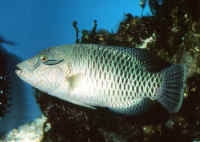
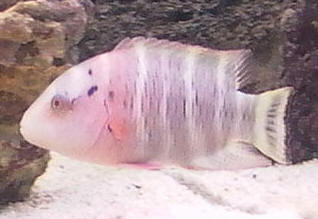
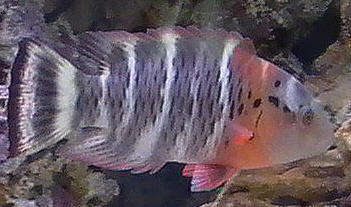
Cheilinus oxycephalus/Wrasse
Compatibility 7/23/11
Cheilinus fasciatus and Choerodon fasciatus 2/11/09 Hallo, <And you> I found some very useful information from both the Cheilinus fasciatus as well as the Choerodon fasciatus, but I still have one question found unanswered. Is it possible to keep both species in one aquarium? <Mmm, I give one good odds if there's sufficient room> Do people have experience with a Cheilinus fasciatus and a Choerodon fasciatus in the same tank? <I have never encountered this> Or are there problems to be expected when you put them together? <Again... if hundreds of gallons, likely not> I hope you can give me an answer and sorry for my poor English. Marjan Hofmans The Netherlands <Bob Fenner, California>
Question about Broomtail Wrasse compatibility 01/18/2008 Hello everyone. <<Hello, Andrew here>> The reason I am writing is because I have the opportunity to buy 2 quite big specimens of Broomtail Wrasses. I am not entirely sure they are both males but still looking into it. However, in the event that they are a male and female, is there a chance they can get along in the same tank? I can't seem to find much information regarding these fishes being kept together and I have always assumed them to be intolerant of each other, but at the same time I have to wonder if they are like Bird Wrasses where 1 male can be kept with 1 or more females in a big enough tank. <<From considering these fish, I would like to hope you have a 400 gallon or bigger tank, as these do get very large indeed. Keeping a male and female together are fine, they are actually a peaceful fish>> If anyone has any information/guidance on this topic I will appreciate the info. Otherwise, I would likely err on the side of caution and just get the 1 definitive male. <<View related FAQ's here.. http://www.wetwebmedia.com/cheilinusfaqs.htm >> Thanks, Ivan <<Thanks for the questions, A Nixon>>
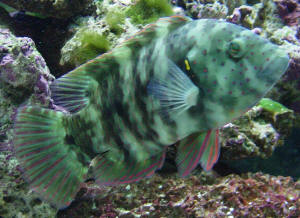
Protecting the largest labrid... Dear Mr. Fenner, <Agata> I'm an intern at the Center For Biological Diversity in San Francisco and am writing a petition to get the Humphead wrasse listed as endangered under the ESA. <Yay! Kudos to you... this gentle giant should be protected IMO> I was wondering if it would be alright to use the photo you have up on the web http://www.wetwebmedia.com/cheilinus.htm of a juvenile Humphead. Please let me know. Cheers, Agata <You are welcome to use any/all of my content for your purpose. Make it known if you would like different format, larger scans. Bob Fenner> Napoleon wrasse Bob, <Paul in for Bob today> My LFS has a 6 in. Napoleon wrasse. <Oh no. These are wonderful fish but absolutely do not belong in aquaria. A public Aquarium is the only place I can advocate its use> I know they can get HUGE. <gets the size of your couch! To seven feet (2.3m) and more than four hundred pounds. Folks ought to leave this friendly giant in the sea.> But will this juvenile grow any bigger in my 240 gallon? <Why wouldn't it? Usually fish grow faster in closed systems due to the lack of competition for food and predators> I know fish don't really grow much in a closed system. <Not really true. Most fish may only have some small changes from their natural ocean state (coloration and rarely a slightly smaller size) but usually it is only a matter of a few inches. Fish tend to grow rapidly in closed systems for the reasons above> How about this wrasse?? <Encourage the owner to never bring another wrasse of this magnitude into the store, as it shows ignorance and apathy for the very business that gives 'em a living. I would not keep this fish> Thanks <Thanks for letting state my opinion through your question. ~Paul> Linstun - Broomtail Wrasse Compatibility - Hi everyone: I was referred to your site by one of your regular users that said she has been helped many times. I did a search already on this subject and have not found any specific info on the topic I am about to ask. Can a Broomtail Wrasse coexist in the same 225 gallon tank as a Harlequin Tuskfish? I was told yes and then no by other people outside of your website. <I'd say yes... both are actually pretty easy going fish, but the broom tails can get quite large, almost two feet which means is trouble broke out, the Tuskfish would lose.> I have seen them kept together in display tanks before and never saw a problem and I never read anywhere that they could not be kept together. A friend of mine has a 180 gallon tank and has a Broomtail, Tusk, Twinspot and Hardwicke (spelling?) wrasses together with other fish. <Your friend's tank is much too small for a broomtail wrasse to make an extended stay.> They are all about the same size at 5 inches each and there is no problem in the tank. They have been together for 1 year now. This is just one example of where I have seen this combination but this situation might as well be the exception to the rule. My Tusk seemed ok initially when the Broomtail was introduced but shortly after (a day after) started chasing it and trying to kill it by shredding his fins and dislodging a few scales. I initially placed the Tusk in the sump for 2 days. I moved him today into a plastic "critter carrier" and into the 225 for him to see the Broomtail again. He seems more interested in getting out than attacking the wrasse but I will still leave him there for a couple more days. I rearranged the whole d?or in the tank in hopes of disrupting any territory the Tusk had and give the Broomtail some time to recover from the mild injuries. Any ideas? <All fish are individuals, and it's impossible to predict much of anything when it comes to their behaviour.> Any options I have? <Not really - return one or the other and try again.> Or is it back to the store with the Broomtail? <Something like that - I really don't recommend keeping these fish in anything less than 500 gallons, they simply get too large and are much more colorful when left in the wild.> Thanks in advance, Ivan <Cheers, J -- > Maori Wrasse? Hi Bob, <Hello Lee-Anne> I am wondering if you have any good photographs of the Humpheaded Maori Wrasse that we may be able to use for signage in the aquarium? <Cheilinus undulatus? At a particular size? With divers present (in the wild?). Do have a bunch of pix of this fabulous species. Will ask Jason.C to help you (am in Hawai'i visiting). Mahalo and aloha, Bob Fenner> I would, of course, be happy the photographer. Regards, Lee-Anne McFadden National Zoo & Aquarium It's a Jungle Out Here! Wrasse (Cheilinus) Hi Crew, <cheers> Another dumb minded question (only for me) <not at all... an admirable pursuit of knowledge> I want to know more about Cheilinus mentalis. <Fishbase.org for starters: http://filaman.uni-kiel.de/Summary/SpeciesSummary.cfm?ID=12779&genusname=Cheilinus&speciesname= mentalis > They've got one at the LFS that I work at, but no info, the guys at the store don't even know what it is, and it is eating well. I have searched WWM and found only small tidbits on info. I've got a small tank (29 gallon) But am adding a 20 gallon sump soon. After that I've got a 55 to use. <hmmm... even this is too small in the 3-5 year pic. The Mental Wrasse gets 8-9" long, needs a lot of swimming room and is somewhat active as a decorator (flipping rock/coral)> I've got live rock, a skimmer (yes it's a Prism, but it works ok for the small tank) and an Emperor 280 power filter, and a few power heads. Will this be outgrown in the long run, <in the 1-2 year picture> and if so, will I need a huge tank (above 90 gals) to keep him? <Actually... a 90 may work. But a six foot long tank would be assuredly comfortable indefinitely past 5 years> BTW, my H2O is 0 ammonia, 0 nitrites, and 5 nitrates. pH is around 8.5, temp 79, has been set up for about 4 months, with monthly 25% water changes with bottled/RO water. Thanks guys!!! Keep up the good work! Jen Pittsburgh PA <thanks kindly... and please say a prayer for our Steelers tomorrow :) Anthony> Broomtail wrasse (Cheilinus lunulatus) Dear Bob, I am new at reefkeeping. I have a 125 gallon aquarium with SPS, LPS, soft corals mushrooms, rock anemone, fish (tangs, gobies, fire fish, grammas, one flame angel, tiny Cuban hogfish), two Tridacna clams, snails, tube anemone, feather dusters, a few tiny hermits which I don't care if I lose, starfish ("Purple Linckia, many brittles, sand sifters) and have the opportunity to purchase a broomtail wrasse which I think is beautiful. I know that it is probably not reef safe for everything. Can I keep it in this tank? <Not a good risk... very likely to eat your Giant Clams... other invertebrates in time...> I apologize for writing you but I have searched the web for several hours and can get no info. I have read many of your articles and know that you are extremely knowledgeable about this fish. Please help me! <Glad to chat. Bob Fenner> Best, Karl Green Re: broomtail wrasse (Cheilinus lunulatus) Thanks for the info. This one was about 3 1/2 inches and beautiful, but "very likely" sounds like a grave risk! Liked him so much that I even thought, albeit briefly, of having his teeth extracted. Enjoyed you article on the Red Sea. I was fortunate enough to dive there in 1979 and remember some of those fish as if it were yesterday. <I first went (just Eilat down to Sharm) in '73... quite different now, but still fabulous> If you ever come to Miami, you are welcome to stay with us. <A gracious offer. Thank you. Bob Fenner> Best, Karl Broomtail Wrasse I saw a Cheilinus lunulatus in a store. It was mostly white though (orange spots on face) and not the green that you see in pictures. I'm wondering if this is a female or if they grow into their adult colors ? <May be a female... or a sub-adult of either sex... do take a look here: http://www.fishbase.org/Photos/ThumbnailsSummary.cfm?ID=12780 and click on the individual pix for more details> If you do end up getting a male, do the wrasses change sexes and become assume the less colorful female coloring ? <Under "good" conditions the Splendour Wrasses do change into males from females... takes time, big spaces (hundreds of gallons for the species listed... Please see here: http://www.wetwebmedia.com/cheilinus.htm Bob Fenner whose friend Ron Elander has a male Broomtail at his store, Octopus' Garden in San Diego, and was chasing them last week in the Red Sea to take their picture!> Thanks Jim Cheilinus oxycephalus Hi Bob, <Anthony Calfo in your service while Bob suspiciously claims to be diving in Australia during the same week as the International Naked Karaoke competition> I notice that you say that the above species can be reef safe when young. <agreed> I have the opportunity to add a 4 inch specimen to my 120 SPS tank. However I also have some rather small fish, notably a Wetmorella nigropunctata, and an Amblygobius hectori. Is this too much of a gamble?? <a minor risk in my opinion but one that I would not take. This species is a great fish and quite hardy, but notoriously curious and will also present difficulties with corals not glued in place (they flip them over looking for crustaceans). More than a few valuable corals have been lost or killed this way. With so many beautiful alternative fish... why bother? If you really admire it though, may I suggest a 20L or 30 gallon refugium in line to house this species in separate? Kindly, Anthony Calfo> Thanks, Jason Edward Broomtail wrasse/NatuReef denitrator Bob; I regularly peruse the WetWebMedia website and go through old and newly posted FAQs. I find most interesting even the questions that don't necessarily apply to me or my systems. <Yes... a useful mechanism of "making known" what needs, might well need be> I currently have a 45 gallon reef tank and a 180 gallon fish only both of which I'm thinking about increasing in size. My questions are twofold. You have no information on broomtail wrasses other than they are two big for aquarium use. <Splendour, Cheilinus wrasses... can be very hardy aquarium specimens... as you/I state... for very large systems only> Since I have acquired I find that they are a splendid looking species with a easy going community personality. No subversive behavior with my other fish consisting of varying sizes between the smallest flame hawk and the largest emperor and queen angels. I realize that the fish will all grow and hence my plans to upgrade the size in the future. How quickly do the broomtails grow? I would imagine it would depend somewhat on the quantity of food that they eat? <Hmm, yes... a few inches per year, especially initially... something like this is my best guess for "average" size at the end of 1 year: 6-8", 2 years, 8-12", 3 years 9-15"...> Second question is the NatuReef denitrators. I've been running one since I started a little over two years ago with the original 125 since upgraded to the 180 I currently have. Why no suggestions to people with fish only tanks to use these products to help improve water quality between changes? <Many pitfalls to avoid here... in dealing with such units and describing their practical use on the Net... as I'm sure you do appreciate... most denitrators are wildly inconsistent in their performance... requiring almost constant checking and feeding (most with sugars, some with alcohols... other stocks), adjusting flow rates... The best "ones" are those that are used redundantly... with people not fooling with them (good luck)... Hence my alacrity in promoting any but the "more passive" live rock, deep sand beds, real plenums sorts of approaches... > Fish are happy and healthy. Keep sg @ 1.018 and temp around 82 and they appear to flourish. All fish beside broomtail and emperor have been with me for 1 1/2yrs emperor (6-7") has been for 1/2 yr. Thanks for your input. <Thank you for yours. Bob Fenner> |
|

|
Features: |
|
| Featured Sponsors: |