|
FAQs on Flasher Wrasses, Genus Paracheilinus
Stocking, Selection
Related Articles: Flasher Wrasses,
Related FAQs: Flasher Wrasses, & FAQs on:
Flasher Wrasse Identification,
Flasher Wrasse Behavior, Flasher Wrasse Compatibility, Flasher Wrasse Systems, Flasher Wrasse Feeding, Flasher Wrasse Disease, Flasher Wrasse Reproduction, &
Wrasses, Wrasse Selection, Wrasse Behavior, Wrasse Compatibility, Wrasse Feeding, Wrasse Diseases,
|
Will the rest of your livestock get
along?
|
Flasher wrasses - pair/trio or single?
11/23/18
Hi WWM Crew,
<Hi Kim>
I was planning on keeping a pair or trio of flasher wrasses in my 65g FOWLR once
the tank has stabilized & the refugiums have matured.
<Neat fish! >
I keep running across conflicting information though... Based on the WWM
articles & FAQs, it seems the pair/trio is the way to go for fish health,
happiness, and display colors. Unfortunately, none of the suppliers online seem
to regularly have females available.
<The size of your tank may be a limiting factor, I suggest a 100 g as a bare
minimum, as these fish become very aggressive towards each other in limited
spaces, but, since you already have the 65,you can give them a try.>
While I was researching where I would be able to buy a pair/trio in the future,
I ran across this article which argues the exact opposite, that attempting to
keep a pair/trio always ends up having all the females transition to male:
https://www.reef2reef.com/ams/pairing-wrasses-thats-not-how-any-of-this-works.3/
<Personally I haven´t had that issue; when introducing a trio or more specimens
at the same time, it always ended up with only one becoming the dominant male.
However, I recommend you to introduce them at a small size , 2-2.5” would be
ideal; this way you will give them time to get used to each other and coexist
peacefully.>
Keeping single males from multiple flasher species would certainly be more
colorful and be easier to procure, but I want to stick to what's best for the
fish's happiness/health. Have you seen issues with flasher females in a
pair/trio transitioning despite already having a terminal male like that
article claims? If so, what recommendations do you have for avoiding this and
maintaining the pair/trio's status?
<Go for the trio or a small group(five or six), if you plan upgrading in the
medium term. Pay special attention to their diet; pods and other critters
growing in your refugium will make a good basic, daily food source, but, you
should also supply meaty foods, mysis, frozen and vitamin supplements. Also
provide a thick sand bed(4-5") and plenty of rockwork to decrease aggressiveness
and make them feel at home.>
Thanks!
<You´re very welcome>
~Kim
<Wil>
Flasher Wrasse Question 11/10/18
Good morning crew!
<Charles>
A quick question on stocking Carpenter's Flasher Wrasses. My current system is a
75 gallon reef (plumbed in line with a 30 gallon mangrove tank
and 20-tall sump) - so total system volume around 100 gallons. My
current fish stocking list is as follows:
Desjardinii tang
<Yikes; will get MUCH larger in time>
Potters Angel
Helfrichi Firefish
pair of Ocellaris clowns
Tailspot blenny
I've been planning to add a small harem of Carpenter's Flasher Wrasses - 1 male,
2 females.
<Mmm; I wouldn't w/o re/moving the Zebrasoma first... not enough
psychological/room here>
I finally found someone who has females in stock. I wanted to clarify a couple
of things:
1 - I've read in 1 or 2 places that it is best NOT to quarantine these fish. I
wanted to get your opinion on this. My usual quarantine is 6 weeks for all new
arrivals. Thoughts?
<IF the fish/es are in good (apparent) shape, full-bodied, feeding, they may
benefit from quarantine... THEY ARE JUMPERS! A small opening may find them out
on the floor; more so in small/er volumes. IF they were mine, I'd likely utilize
a dip/bath (see WWM re) and simply place them in the main/display>
2 - I've read that I should add the females first. Is that advisable, or would
it be ok to add the females and male all at once. My concern is one of the
females turning male while the male is in quarantine if I wait.
<For a trio... this setting, I'd place all at once>
As always, your input is greatly appreciated.
Regards,
-Charles
<Again; I'd trade out your Tang in advance of introducing the Wrasses. Bob
Fenner>
McCosker's Wrasse - Single male or harem?
1/3/17
Hi There,
<Angela>
We would love to hear your opinions on male Flasher Wrasse -specifically
McCosker's and placing one with a harem of two females, but first here is some
background on our piece of the sea :)
We have a Red Sea Reefer 525 xl which is roughly 108 gallons in
the main tank 118 inc sump - It has been fully cycled and set up now for 2
months. We are running the Red Sea Nopox system which we are finding has sped up
the cycling and is amazing but a very different way of running a tank compared
to our previous tanks.
It will predominantly be a soft coral reef but in time we will add some LPS.
We have a false Perc pair of clowns, three red leg hermits, 5 Cerith snails, 5
Trochus snails and 3 Nerites snails. our planned next additions will be a yellow
watchman goby with a yellow pistol shrimp (Not a tiger!!), 2 cleaner shrimp and
2 peppermint shrimp (all in a couple of months). If we do add a flasher wrasse
harem we will make sure these are the next to go in before the Goby e.t.c
The list for our future additions:
McCosker's flasher wrasse male and two females??!?
Purple tang
Gold rush tang - Only if algae growth increases with more bioload!
<I take it this is the Bristletooth Tomini Tang>
Purple fire fish - pair if true pair only
2 conch snails
6 Money cowries
A mixture of more snails, red leg hermits and shrimp will be added as our bio
load increases.
List for much much further in the future:
Dragonet - scooter blenny or mandarin (we are adding a Baffle into our sump to
have a macro algae/copepod farm) - We will only add if is feeding on frozen and
if our intended wrasse do not deplete our pods without us maintaining them.
Anemone (undecided)
<I'd leave this out... too much potential for trouble w/ the stony corals>
Tuxedo urchin - 1 red and 1 blue
Maxima clam
We are undecided about any other additions fish wise so very open to ideas to
add to our research pile
<Take your time here is my real advice>
We are trying our hardest to research and plan our additions out so that we can
get as close as possible to the creatures natural relationships.
<A worthy goal>
As you can imagine whilst researching the topic of Wrasse harems we have found
many conflicting views about whether the females will eventually turn male.
<Mmm; won't usually in such a small volume if there's a male already present>
We have no intention of adding any other wrasse and intend on this being a
peaceful system - Fish and inverts allowing of course :)
Please see below for one of the papers we have read - we would be very
interested in your opinions:
http://www.reef2reef.com/ams/pairing...-this-works.3/
<Is about so... Labrids are protogynic, simultaneous hermaphrodites... do change
given circumstances; mostly social>
We have also read your paper on Flasher wrasse but you do not mention the
probability of 'sub males' within the harem (May of missed it?!).
<The individuals are all a matter of degree undifferentiated-female-male...>
Do you think that this is a big issue or one that is a slight risk as is a
Anthias harem?
<Not really a risk, and the ratio you list should be fine. There really isn't
much space for more females here. IF you start with three apparent females, or
juveniles, one will develop into a terminal/male individual; the others stay as
females... unless something happens (death esp.) to the male>
Thank you for reading :)
Many Thanks
Angela and Shane
<Thank you for sharing; writing so completely. Bob Fenner>
Re: McCosker's Wrasse - Single male or harem?
1/4/17
Hey Bob,
<Hey Angela>
Thank you so much for your speedy reply and much appreciated info/input.
<Sure>
We do indeed mean Bristletooth Tomini Tang - in your experience would you say
that they are more or less peaceful than the Yellow Eye Kole Tang? And which
would you recommend, if either?
<It's been my experience that all Ctenochaetus are about the same peaceful
toward other fishes... some; e.g. C. striatus are more social toward their own
kind>
As I stated previously, we intend on adding a Purple Tang - do you personally
agree with this addition? And the joint addition of the Bristletooth Tomini
Tang?
<They will likely both be fine here. I'd start with smallish specimens (three
inches or so)>
Here is a tad more info on our layout - We have 60 KG of live rock scaped into
two arches with big caves, so lots of
swimming space and large hiding spaces. Our sand bed is a mixed depth and ranges
from 1/2 inch to 4 inches (which changes as our wave makers change movement)
This is such a taboo subject these days and one which you must
get asked a lot!!! So understand if you don't wish to answer :)
<You should be fine with this arrangement. Enough water movement and
substrate-moving livestock prevents most issues>
We will definatly re think the anemone if our clowns take up home in our leather
toadstool (fingers crossed) - He is in a strop at the moment and is only just
settling in and extending his tentacles/polyps after two weeks, poor guy got
very stressed :( If they do not host him then we will look towards an LPS which
can withstand their movement - any ideas would be most welcome?
<You can see the many instances of other-than-anemone symbionts recorded on WWM.
Captive-produced clowns are fine without such>
Our LFS has a stunning Mc Cockers male which we are keeping our eyes on whilst
researching - the plan is to put him in first (once our tank cover has arrived
and been fitted) Our LFS has asked their supplier to keep their eyes open for
some females - fingers crossed if they can source some we will then add two at
the same time to join our male.
<This simultaneous addition is a good idea>
Am I correct in thinking that the females are much harder to identify amongst
similar genus' ? If we ended up with two Carpenter Flasher Wrasse would they
stay female or would one turn Male?!
<Good question. Have seen congeners form haremic associations... w/o females
converting into males>
Thank you so much for your time and knowledge :)
Cheers
Angela and Shane
<And you, Bob Fenner>
Re: McCosker's Wrasse - Single male or harem?
1/4/17
Hey Bob,
Thanks again for your wealth of knowledge :)
Happy New Year
Angela and Shane
<And you two too. BobF>
Lineatus fairy wrasse swimming problems; hlth., stkg./sel.
3/11/13
Hello wwm crew,
<Joe>
This is my first time sending an email but I am on the website just
about every day for info, very informative!
Keep up the great work
Anyway on with my problem, I purchased a 5" " super male"
lineatus fairy wrasse 10 days ago.
<Mmm, better to start with smaller specimens... adapt better to captive
conditions>
I bought if from a lfs that I have had good success buying fish from in
the past. I received the fish in the bag from my lfs supplier and I
placed it into my 56G quarantine tank which has been running since last
October. I set up a drip for about an hour then moved him in. The tank
has an Eheim 350 canister filter, aqua c remora pro skimmer with 60lbs
live rock.
Ammonia-0, nitrite-0, ph-8.1, nitrate-10ppm, temp78 deg, solidity 1.025.
The lighting is a small led set from MarineLand.
He was eating right away and was looking good the entire time he was in
quarantine so I decided to move him into the main tank after a week, I
know it was not a good idea
<I would have done the same>
as I like to quarantine at least two weeks and I have no excuse but
impatience, so back to the topic, I moved him with no net as he swam
into a container and I poured him into the DT as the perimeters are the
same as my quarantine tank( 180g tank, 30g sump with refugium, 3 EcoTech
Radion led lights, aqua c ev-240 skimmer, HC gfo and carbon reactor, 230
lbs live rock and assorted lps and soft corals, red bubble anemone, 4
cleaner shrimp, male-female flame wrasse, pair of percula clowns, sail
fin and chevron tangs and a female lineatus wrasse. Ammonia, nitrite-0,
nitrate-1, phosphate-.03, ph-8.1, temp-77.5, solidity 1.025.)
At first he was in hiding and wouldn't come out for the first day,
except to eat. I realized it was the lighting being to intense so I set
a new program with an acclimation periods for him to adjust and he was
out in no time swimming around all day which explains why he was doing
good in the dim lighting of the quarantine tank. The second day went by
with no issues and he looked great.
I noticed at night on the second day in the DT he was having a problem
releasing his bowels and when he finally did it was large and solid and
mostly white so I removed it from the tank to inspect for possible
parasites but I couldn't see anything.
On the third day he started off good, but I noticed a bulge in his
stomach, on his right side towards the bottom, and he was swimming a
little crooked, leaning to the opposite side of the bulge. After feeding
the tank around 11am spectrum pellets and some Mysis shrimp he was
swimming erratically, unbalanced and he seemed lost. Later on around 6pm
I fed Mysis again and he ate a lot and about a half our later he was
completely out of control, swimming upside down and in circles so I
quickly netted him and held him upright with my hands so he could regain
his composure which he did in about 5 minutes then I let him go and he
went to sleep for the night.
He woke up the next morning swimming good again, not perfect but good,
so I added SeaChem Metronidazole with focus to some Mysis and fed the
tank sparingly which he ate. After feeding there were no real bad
balance issues but I did notice two white things attached to his gill
area which he was rubbing on the rocks so I attempted to help remove
them and they fell of in the tank as I grabbed him, I don't know what
they were. As the day progressed I noticed the bulge getting larger and
after the evening feeding the erratic swimming came back, but not as bad
as the day before.
So with my long story being told(sorry) I want to know what you think
might be wrong here?
<Perhaps a "worm" (or more than one) problem here>
Do you think I'm heading in the right direction with the Metronidazole?
<I'd add an anthelminthic.. see WWM re.>
Or is it a issue of constipation?
Should I move him back to the quarantine tank and treat/observe him in
there?
D you think my other fish are in danger of getting sick?
<Not likely. Such issues tend to be more species, genus specific; and
often the parasites have complex life cycles; w/ intermediates missing
in captive systems>
Please let me know what you think and what I should do going forward.
<Add the vermifuge to the foods>
Thank you very much,
Joe Marino
<Welcome. Bob Fenner>
New stocking list, sm. reef 11/30/11
Hello
<Hi there>
Recently I moved my 3 year old reef tank. I had to give away all of my
fish so now I'm ready to restock. As of now, I am planning to get a
starry blenny, a McCosker's flasher wrasse,
<Just a single individual? This is a social species... won't be
as colorful or... oh, I see your system is actually too small>
an Ocellaris clownfish, and a fathead Anthias.
<A fave>
The tank is a 40 gallon breeder with a few types of mushrooms and
Zoanthids. I also have a sump with various algaes and media for
filtration. My water quality has always been fine.
My concern and question is if the fish I plan to get will do well in
this tank?
<Mmm, not this wrasse by itself likely, and again there's not
enough room for a small harem>
I'm especially concerned about the Anthias and the wrasse. Would
all of these fish be compatible? Also, do you perhaps have a suggestion
for a 5th fish or would that be too many?
<Do read here: http://www.wetwebmedia.com/StkgSmSWsysArt.htm
and the linked FAQs files above>
Thanks for your time, and sorry for any grammar issues, I'm a
chemistry major not an English teacher lol.
<I taught H.S. sciences, including Chemistry... Correct English is
requisite for getting along in the professional world... Learn it
outright or (do as I do/did) and utilize spelling and grammar checkers.
Cheers, Bob Fenner>
Flasher wrasse pair. Sys., stkg./sel.
8/15/11
Hello! I am very interested in flasher wrasse. I saw one (male) at my
LFS and have been interested in keeping one ever since. I have two
aquariums which are both empty of fish at the moment: one is 30g and
the other is an ADA 60-P tank (17.4g) attached to a 20g sump/fuge.
<These systems are both too small for this genus>
First, I am wondering if either would be large enough to house any
flasher wrasse? I know that Hiroyuki Tanaka said a single adult could
be kept in 60 x 30 x 30 cm (about 15g)
<Am surprised at this stmt. ascribed to Hiro>
and another site said they only need 10g while yet another said a
minimum of 55g so as you can imagine I am clueless. Are there any that
are particularly small or suitable for Nano-sized tanks like mine?
Next, I am curious as to why it is always suggested to keep a single
male with a minimum of 2 females. Are they like Anthias in the sense
that the males harass females?
<Keep reading>
Or is it just because they are found with many in the wild? I am unable
to find any information about this.
<? really>
Ideally I would like to keep a male+female pair but I don't know if
that is possible.
Finally, as for my 30g tank, if I kept an active flasher wrasse, I am
curious as to whether or not it would scare my (planned) yellowhead
Jawfish into hiding or if it would encourage it to come out more as a
"dither fish"? Thanks! :)
Allie
<Please see/read on WWM re Pseudocheilinus. Bob Fenner>
Re: Flasher wrasse pair 8/16/11
Hello,
Wow! Thanks for the quick response. I am curious to know if we are on
the same foot, though, so I am sending this in hopes of confirmation. I
am referring to the flasher wrasse (Paracheilinus) and not the lined
wrasse (Pseudocheilinus)
<Ahh, I do apologize... was so jet-lagged/pooped that I sent the
wrong genus. Actually yes to both genera's members... They
don't do well in such small volumes. I would not place either in
anything that was under four foot in length... the 55 "show"
you mentioned minimal>
which you mention at the end. Is it possible that you could link me to
where it says whether or not the males harass?
<Males do. Are you familiar w/ our search tool: Please read
here:
http://www.wetwebmedia.com/WWMAdminSubWebIndex/question_page.htm
it's linked on every page>
I searched through the flasher wrasse section but found nothing. I have
read to keep groups in larger tanks together, but not a reason why.
<These species of Labrids live in loose associations, shoals (with
dissimilar status of individuals as opposed to schools)... in sorts of
"haremic" groups... with an alpha/dominant male, perhaps
a/some upcoming semi-males (terminal individuals), a bunch of
initial/females and sexually undifferentiated members... They (these
species) are not colorful or interesting behaviorally, nor
happy/long-lived kept as singles in captivity>
I was thinking it may be like Anthias but at the same time I see pairs
offered on websites like Liveaquaria which makes me question why.
<Are a great deal like the Anthiines; yes>
Here is the tank size "ascribed" to Hiroyuki Tanaka:
http://reefkeeping.com/issues/2006-08/ht/index.php
<Thank you for this. I do see the comment under: Flasher Wrasses in
the Aquarium
And here is confirmation:
http://www.reefcentral.com/forums/showthread.php?p=15636070
Allie
<Thank you for this correction, follow-up. Bob
Fenner>
Re: Fairy/Flasher wrasses, Labrid sel. for sm. vol.
8/17/11
Okay wow. I definitely want some type of wrasse though. What would you
suggest?
<Please see/use WWM... B>
Maybe a Fourline wrasse? Also, just wondering if ALL fairies and
flashers need larger tanks or are any suitable? Thanks for all the
help.
75g fish compatibility problems
7/13/11
Hi,
<Hello Tony>
I'm having problems finding a group of fish that will all live
happily together in my 75g tank.
<Oh?>
My tank is a 4ft tank 75g with no sump and internal protein skimmer. It
is a coral reef tank with at least 100lbs of live rock and not huge
amounts of swimming room for the size of tank.
It has been set up for around 10 months. All parameters I believe are
good, ammonia/nitrite 0, nitrate around 5ppm, ph. 8.2 and S.G. at
1.025. I have about 8 years fish keeping experience but only about 3
years or so with marine.
My current stocking is as follows:
Kole Tang (3.5 inch long been in tank for 7
months)
Yellow fin flasher wrasse (male, 3.5 inches long, in
tank for 6 weeks)
Purple Dartfish (fully grown, in tank for 9 months had fish for 3+
years)
Ocellaris clown (2.5 inch, in tank for 9 months had fish for 3+
years)
Royal gramma (3 inch long been in tank for 4 months)
Also in the tank is a coral banded shrimp, snails and various coral
mainly LPS with a large section live rock covered in mushroom
coral.
The problems is that the Kole tang and the wrasse are attacking most
other fish in the tank.
<Mmm, well... if this tank were a bit larger... 100 gallons, five
foot long or more, I'd be getting two or more females to go w/ the
Wrasse...>
The Kole tang will chase the purple Dartfish the moment it appears from
the live rock (which is very rare these days). The wrasse will also do
this but not quite so aggressively.
The wrasse is attacking the royal gramma. The aggression was the other
way around when I introduced the wrasse to the tank but now the wrasse
is charging at the gramma and has caused some damage to its fins.
The wrasse sometimes does this to the clown also but I haven't seen
any damage as yet.
The Kole tang follows the wrasse around constantly where ever it goes,
it doesn't attack the wrasse but it is probably irritating it. It
is also around whenever the wrasse attacks the gramma and clown but
I'm unsure as to whether it is showing aggression to the other fish
or just following the wrasse.
I'm considering removing both the Yellow fin wrasse and Kole tang
and returning to the LFS. The tank is maybe a bit small for the tang
and the wrasse lacks females which are not easy to get hold of here. I
like both fish and will be sad to part with them but I will do whatever
to bring calm to the tank. Is this the best course of action?
<May seem a bit odd, but I'd first try covering one outside end
panel w/ paper... to negate internal reflection. At times, territorial
animals "get riled up" seeing their own reflections in
aquariums. This may well solve the issue of agonistic behavior
here>
If I have to remove the aggressive fish what would you recommend
replacing these fish with for a happy tank?
<I'd try the paper first>
I'm finding it hard to find fish that are suitable my size tank and
get along with the other fish, corals and inverts. I was thinking of a
Banggai cardinal fish and some form of blenny (I liked the bicolor in
my previous 25g tank but it did annoy my Duncan corals). Will these be
suitable.
<The blenny might have problems w/ the Gramma, Microdesmid>
Any help or advice you can give will be very much appreciated.
Thanks for an extremely informative website.
Tony
<Welcome. Bob Fenner>
Re: 75g fish compatibility problems, Paracheilinus stkg./sel.
7/15/11
Bob,
<Tony>
Thanks for the tip I have done as you suggest and I will see how things
go.
At the moment the Kole tang may be a little more settled but the wrasse
is still showing plenty of aggression.
<This genus is never found singly in the wild... Live in groups of
one alpha male (unless the association is of several individuals, then
there may be more than one), several females and developing
juveniles... Your
system may be too small, but I'd place a couple of females of the
genus (not necessarily the species; if you can't find them)>
Thanks again for your help.
Tony
<Welcome! Bob Fenner>
Adding A Flasher Or Fairy Wrasse To My Tank (Not
Recommended Here) 03/22/11
Hi,
<<Hello Marlyce>>
I have a 55 gallon FOWLR tank. I have about 60 pounds of live rock, an
AquaC Remora protein skimmer, a sump pump and a couple of power heads
for circulation. The tank was started in September of 2009, and has
been stable for about a year, and most of the current tank residents
have been in the tank for a year or more.
<<Okay>>
Current tank inhabitants include one hermit crab, a coral beauty
angelfish, a royal gramma, a yellow tang, two blue-green Chromis, a
Banggai Cardinalfish, and a tiny ocellaris clownfish.
<<This tank is a bit on the small-side for the angel and the
tang, in my opinion both will likely develop social and/or physiological
issues over the long term>>
Another small ocellaris recently disappeared during a water change, and
a skunk cleaner shrimp that I've had for over a year just died. I
supplement with minerals (1 tsp once a week), vitamins, and
"Purple Up" (for calcium for my shrimp and to keep the
beautiful coralline algae on my live rock thriving). All the fish in my
tank seem to get along very well, with very little aggression. My water
parameters are: Ammonia-0, Nitrites-0, Nitrates-around 20, Ph-8.4,
Salinity-1.025, Kh-8, Temp-77.5. I do a 20% water change every other
week using RO water. My question: My ocellaris clownfish were tank
raised, not very brightly colored,
<<I have heard/read this to be a possible factor among
tank-raised specimens>>
quite small, and just hovered in the back of the top of the tank around
the heater-hard to see and not very spectacular.
<<Perhaps being bullied by some of the other fishes>>
I would like to replace the clown that died with a fairy wrasse or a
flasher wrasse because I want some bright orange or red in the
tank.
<<I do not recommend this>>
I have done a fair bit of research, and it seems like one of these
would be compatible with my tank.
<<I am compelled to disagree These fish do not do well in systems
with more aggressive fishes such as you have and even if not directly
targeted, just being around boisterous fish can cause them to hide/not
feed well and jump from the tank. These fish are also best kept in
groups and you just don't have the tank for it. Better left to larger
systems where they are the feature of the system and all else is
considered and designed around them>>
However, is it OK to have only one of these?
<<In my opinion, no These are haremic fishes meant to be in
groups of several females (five or more preferably) to a male specimen.
I've seen fellow hobbyists try to keep single specimens, especially
males of some of the different species of Fairy Wrasses offered in the
hobby, and in most all instances they perish within a year (loneliness
perhaps?)>>
Particularly with the flashers, it seems to be recommended to have a
male and two females
<<more>>
in order for the male to stay brightly colored.
<<Among other things, yes>>
Would a single male do OK in my tank?
<<No as stated>>
And would one of these (fairy or flasher wrasses) be likely to be
picked on by any of my other fish?
<<By most any of them, as some point>>
Since these fish are fairly expensive, I want to be pretty sure it will
be able to survive in my tank before I order one.
<<Okay but lets also consider the well being of the
fish>>
If you don't advise one of these, do you have any other suggestions
for an orange or red fish that might work in my tank?
<<The size of your tank coupled with your current stock list
leaves out my current faves and Im afraid nothing else comes to mind at
the moment. There may well be something suitable available do some
searching and please feel free to come back to discuss what you
find>>
How about replacing the small clown I have left with a larger, more
brightly colored clown?
<<A possibility maybe>>
Would a maroon clownfish be too aggressive for my tank?
<<Ultimately I think, yes. Perhaps a Cinnamon Clownfish
(Amphiprion melanopus) can work here smaller and a bit less aggressive
than the Maroon, though still likely to grow to be the alpha
personality of the bunch>>
Any suggestions would be much appreciated.
Thanks,
Marlyce Gundy
<<Happy to share Eric Russell>>
Questions About Purchasing/Adding Carpenter
Wrasses 06/05/10
I recently purchased four carpenters wrasses for my 150-gallon tank (4
juveniles).
<<Splendid little fish and will do best in a system specific to
their needs (e.g. adequate structure/hiding places, multiple small
feedings, no overly bright lighting and a dearth of large and/or
rambunctious fishes)>>
I ordered them for delivery by overnight mail and, to my dismay, the
fed-ex delivery guy came into my office flipping the package in the air
and catching it (even though it was labeled "live fish handle with
care" in giant letters).
<<Yikes I would complain about this to the delivery company as
well as to the e-tailer who shipped the fishes>>
They looked horrific on arrival, and it appears that only 2 of the 4
fish survived the ordeal and the acclimation process.
<<Mmm this species of Flasher generally ships pretty well in my
own experience sad>>
So here are my questions. (1) I have read that carpenters wrasses will
change gender (one of the pack to male) relatively quickly, and that
one should introduce females to the tank first.
<<Ideally yes but one can also add more females at a later date,
with success>>
Am I likely to have difficulties (conflicts) if, with the 2 surviving
juveniles in the tank, I introduce 2 new juveniles one week to 10 days
later?
<<There will likely be a small amount of bickering to establish
ranking among the harem but this would/does take place even when all are
added at once. Given the size of your display, I would give good odds
that you can successfully add more females>>
(2) Should I get my replacements from the same mail order company?
<<If you like/trust them, sure. Switching suppliers isn't going to
necessarily mean the livestock wont be handled/transported by a
different delivery company, unless you purposely search out one that
does>>
They are willing to send replacements (they seem reputable),
<<Then why not?>>
and my LFS seems to be unable to get these.
<<I see>>
But I think it cruel if the mortality rate from shipping is more than
negligible (which, this time around, it clearly was).
<<I have been in the sorting facilities where companies like this
one handle and sort packages for delivery. For the most part they are
diligent in their work (yeah, we've all heard the stories to the
contrary), but what you describe of the drivers way he handled your
livestock package, right in front of you, is nothing but idiocy on the
part of the delivery driver. But delivery driver idiocy aside, I find
damage/mortalities to be much less if I arrange to pick up my package
at the delivery company, rather than have it ride around for hours on a
hot (or cold) delivery truck before it gets to me>>
(3) Finally, I noticed the fish were shipped with very little water in
smallish bags;
<<An increasing trend Saves on weight/shipping
charges>>
would larger bags with more water better protect them better in
transit?
<<Indeed>>
I would happily pay the additional costs involved if it increases the
likelihood of survival.
<<In your/any particular instance it may or may not be the
difference in survival, but it wouldn't hurt though you may well find the
extra cost for shipping prohibitive. But, just picking up the shipment
rather than waiting for the truck to deliver it can also make a world
of difference. In fact, some suppliers wont guarantee live arrival
otherwise>>
In any event, your advice would be much appreciated; I am deeply
saddened by the fate of these beautiful fish and do not wish to
contribute to a repeat.
<<I hope I have been of service Cheers, Eric Russell>>
Finding A Female Flasher Wrasse (Paracheilinus
filamentosus) 05/23/10
Dear Wet Web Crew,
<<Wendy>>
Can you give me any info on how/where one can obtain female flasher
wrasse?
<<If your LFS cant (or wont) special order them for you, have a
look among the e-tailers on the Net (try here [
http://www.liveaquaria.com/product/prod_display.cfm?c=15+1378+1400&pcatid=1400
] and here [ http://www.saltwaterfish.com/Filament-Flasher-Wrasse_p_702.html
] and here [
http://www.bluezooaquatics.com/productDetail.asp?cid=290&pid=1011&did=1
] for starters). Contact them directly (email or phone) to inquire
about availability of female specimens>>
I have a Male Filamented and would like 2 females, but having no luck
here in Michigan at any LFS.
<<Is likely a seasonal availability>>
Dealers I've asked to find one have not been able to do so. Also,
I'm wondering if females of any flasher variety may form a harem
with my male?
<<Some species may interact in the wild but I wouldn't bank on
throwing just any species of female in there and having them form a
harem>>
And lastly, I've searched your site and others and can't find
much info on female Filamented wrasse, except I believe they have no
filaments on dorsal and I'm assuming would have same shape tail as
male which is v-shaped, not round as in the Carpenters. Are those 2
identifying features of the female Filamented flasher correct?
<<For the most part, yes In my experience, the dorsal filaments
are less pronounced on the female but may not be completely absent (and
may appear in order of dominance among the females in the harem)the
female will also be a bit less colorful, and will likely show more
white on the lower half of the body>>
Thank you,
Wendy Dyke
<<Happy to share Eric Russell>>
Community Wrasse Tank 5/10/10
Hi WWM!
First... Thank you for the wonderful service you provide!
<Welcome>
I have a 180 gal mixed reef that has been up for just over a year.
I'm running a turf scrubber, some Chaeto growing in the sump, and a
good growth of Halimeda in the display. I have plenty of access to live
arthropods to supplement feeding. I also make my own food from a
combination of clam/oyster/Shrimp/Nori, and other assorted grocery
counter seafood soaked in Selcon and frozen in saltwater to make cube
food.
I was thinking about turning the tank into a community fairy/flasher
wrasse tank. I was just wondering how many or if this list was
applicable.
<These genera can be mixed, some species even tog... sex ratios are
important>>
I expect I that I should keep my list limited to genus Paracheilinus
and Cirrhilabrus. I know most Cirrhilabrus get along ok, but what about
Paracheilinus? Are there any exceptions to this?
<Mainly sex ratios, but better in a volume, shape system as this to
stick w/ one species>
Any other specific wrasse outside this genus that could also go nicely
into the mix?
<... all sorts. A good "window" to select through is
overlap in natural distribution... a biotopic presentation/mix>
What would be the maximum number of wrasse you would recommend for this
size tank?
<...? Depends on species>
Or am I limited basically by bioload.
Current Inhabitants.
*Inverts*
assorted snails (turbo/Astrea/Cerith/Nassarius/Nerite)
1 brittle and 2 serpent stars
1 Cleaner shrimp
1 Crocea clam
1 Deresa clam
<Some Labrids will eat some to all of the above. Not the two you
mention in general>
*Fish*
1 Lyretail Anthias
1 Royal Gramma
1 Banggai Cardinal
2 Zebra gobies
1 Orange spotted goby
1 Solar Wrasse (Cirrhilabrus solorensis)
1 Blue Side Wrasse (Cirrhilabrus cyanopleura)
* Intended Additions*
Carpenter's flasher wrasse (Paracheilinus carpenteri)
Purple velvet fairy wrasse (Cirrhilabrus luteovittatus)
Scott's Fairy Wrasse (Cirrhilabrus scottorum)
<... Were it me/mine, I'd just stick w/ more sub-adult (non
terminal phase individuals of Cirrhilabrus and whatever one species of
Flasher you choose.
Bob Fenner>
Re: Community wrasse tank 5/10/10
Sorry forgot to include my name at the bottom :-P
Thanks,
-Nick
<No worries Nick. B>
McCosker's Flasher Wrasse Aggressive Male
03/13/10
Hi crew,
<<Greetings>>
Have a question about a pair of McCosker's flasher wrasse, male and
female pair that I recently acquired.
<<These are a haremic fish species better kept in a group of three
or more females to a single male>>
The male is acting with some intermittent dominant/aggressive behavior
towards the female and I'm not sure if this is normal in an
established pair or if it is the process that this species goes through
to become a pair.
<<In addition to being haremic, these fish are also protogynous
hermaphrodites (born female can change to male)the males behavior
establishes his dominance and is a behavioral cue to suppress the
female from becoming male. Unfortunately, without other females about
to spread his aggression, the single female must bear the brunt of
all>>
I'm afraid the aggression will be too much for the female in the
long run.
<<This is likely>>
She is timid now and stays to one side of the aquarium, unable to
venture out into the open most times.
<<Add a couple more females>>
Parameters are all excellent. The tank is a 29g and has many places to
hide.
<<This tank needs to be larger especially with the needed addition
of more females>>
She is eating well and does not have any outward sign of disease.
<<She will likely just disappear if left on her own with the
male>>
On another note, sometimes after eating this female does "barrel
rolls" and will flip over seemingly on purpose. She does put
obvious effort into doing so, and it is not a swim bladder thing. Maybe
helps with digestion or overeating?
<<More likely courtship behavior even just play>>
I feed spectrum and frozen Mysis or brine every day or every other
day.
<<Ah my friend, do research your charges these fish need multiple
small feedings EVERY DAY for their long term wellbeing. Start reading
here and follow/read among ALL the links in blue at the top of the page
(http://www.wetwebmedia.com/paracheilinus.htm) >>
Thanks for your advice.
Happy to share Eric Russell>>
Re: McCosker's Flasher Wrasse Aggressive Male
03/15/10
Hi Eric,
<<Hello Victor>>
Thank you for the advice.
<<Quite welcome>>
I had read several reports of people keeping pairs of these without
issue - hence why I moved forward with the species.
<<Indeed, as have I but for how long? There may well be
exceptions, but for the bigger part these fish definitely do best in
small groups>>
Perhaps my male is more aggressive than others
<<Is a possibility but likely just being what it is>>
or is in a different state of asserting dominance/territory
<<Another possibility but still>>
(or these other people were just not paying attention to the
interactions in their tank).
<<Does happen>>
In any case, what is your opinion on keeping the male solo without
accompanying females?
<<It may do okay, but will fare far better (be healthier, more
colorful, longer lived) with a harem and in a system large enough to
support such>>
I do not really feel comfortable adding more of these fish to the
29g
<<Am in agreement>>
(boy I can't wait to move into a house and get a 100g+).
<<Anticipation!>>
Have also planned on having my flat-mate do a minor feeding through the
morning and early afternoon while I am at work to satisfy their needs
of small feedings throughout the day.
<<Excellent>>
Thanks,
Victor
<<Happy to share mate Eric Russell>>
Compatibility of Cirrhilabrus rubriventralis in
55 gallon tank, sel./genus/sys. 3/4/10
Dear Wet Web Media Crew,
<Kacey>
I'm new to the hobby and looking to put together my first 55 gallon
tank.
I'm currently in the process of gathering supplies and reading like
a mad fiend, including, of course, The Conscientious Marine Aquarist.
My goal is to create a reef tank (start with hardy soft corals and work
my way up as I gain experience and confidence) with some small,
peaceful fish making it their home.
<Good>
I was thinking of adding 2 or 3 *Cirrhilabrus rubriventralis *to this
tank. Originally, I thought to add only one, but from my reading, it
sounds like they're much happier in a group. But, I'm not sure
if 55 gallons
is simply too small for a small group of social wrasses.
<Is borderline too small. Velvet/Fairy wrasses are
"Zoomers", liking to cruise a bunch in the wild>
My dream stock list
currently looks like this:
1 Purple Firefish
2-3 Social Wrasse Cirrhilabrus rubriventralis
1 Chalk Bass
1 Royal Gramma Basslet
<Mmm, the Gramma and Firefish may not get along here... I'd get
either one, or just two Firefish>
1 Mandarin Dragonet
I'm worried that's too long a list for a 55g, though most of
the fish are very peaceful and seem more inclined to protect one small
nook rather than carve out a large territory (at least from what
I've read). How might you suggest adjusting or modifying this list?
Is there a different velvet wrasse you might suggest or no wrasse at
all?
<There are some other species, other than Cirrhilabrus, that are
more suitable. See here for ex.: Oh, have just looked and my Labrids
for small systems stocking piece hasn't run in the print
'zines... hence isn't posted on WWM. Do search through the
Articles/FAQs files here:
http://wetwebmedia.com/marine/fishes/FishInd1.htm
at the bottom... and this pc.:
http://wetwebmedia.com/halichoeresbestart.htm
and...: http://wetwebmedia.com/StkgSmSWsysArt.htm
The fish I definitely want included
in my tank are the Purple Firefish and the Mandarin (once there are
enough copepods to support one). The rest I'm willing to change, if
you see any problems.
<Flexibility is a hallmark of a successful species... You will be
successful Kacey>
Thanks so much for reading and for sharing your expertise!
Kacey
<Welcome. Bob Fenner>
Re: Compatibility of Cirrhilabrus rubriventralis in 55 gallon
3/4/10
tank
Dear Bob,
<Kacey>
Thanks so much for your reply! From reading over the suggested links,
it looks like you'd recommend possibly a singular specimen of
*Halichoeres chrysus* or perhaps a small harem of Paracheilinus.
<Yes; particularly the former would be a very nice choice here for
you>
The 55 g tank I have is 4 feet long which sounds like it would offer an
acceptable amount of 'zoom room' for a trio of smaller
Paracheilinus.
<Are actually a tad "too touchy" for me to suggest for you
at this juncture, this size, shape system>
Unless three would require a space more like nine feet long in which
case never mind that thought so much. What would your opinion be on a
trio of *Paracheilinus mccoskeri* in a 55g with a purple Firefish, a
chalk bass and a mandarin dragonet?
Thank you once again!
Kacey
<... go w/ the Yellow "Coris" from this choosing.
BobF>
Stocking a 75 gallon tank 12/23/09
Hi,
I am in the planning stages of my 1st saltwater tank. I have been doing
extensive research for the last 3 months or so.
I have decided on a 48x15x24 75 gal. tank due to space
restrictions.
I will be running a AquaC EV-180 Skimmer with a 25 gallon sump and
about 100 lbs of live rock and a 3"-4" live sand bed.
After curing and cycling, and all is well with the water ( a few
weeks/months down the road from setup) I want to start adding some
fish.
I do plan on adding some soft corals and lps in a year or so after the
tank is well on its way. This is my proposed list of fish: 3 Blue/Green
Reef Chromis, 1 Ocellaris Clown Fish, 1 Yellow Eye Kole Tang, 1 Orange
Spotted Goby (with pistol shrimp), 1 Royal Gramma Basslet, 1
McCosker's Flasher Wrasse.
My questions are: Are these good choices and is it too many fish for
tank size and setup?
<Are very good choices... the Flasher Wrasse is the most likely fish
to leave out... really only does well in a harem, larger volume>
I do NOT want to overstock my tank.
Thanks a lot in advance. WWM has been indispensible in my research.
Thanks for being here!
Sincerely, Lyle
<Thank you for sharing. Bob Fenner>
Re: Stocking a 75 gallon tank
12/23/2009
Bob, Thanks so much for your quick reply. I was wondering however, if
you meant that the flasher wrasse would most likely be the fish to
leave out solely because it isn't the best choice, or because it
wasn't the best choice and I need to have a little less bio
load?
<More the former>
Can I get away with one more smaller fish to replace the wrasse and
still have a safe and happy tank?
<Yes; very likely so>
Thanks again so much for your input. I have learned so much for WWM I
am very grateful. Sincerely, Lyle
<Sorry for the lack of clarity, and happy holidays. BobF>
QT Female Filamented Flasher Wrasses?
04/04/09
I'll be receiving 3 female flasher wrasses to put in with the male
I currently have.
<<Mmm, not the best sequence for stocking these fishes. Perhaps
you can sequester the male until the females arrive and then place all
at once?>>
I planned to hold them in QT at least 4 weeks
<<Not recommended in my opinion. These fishes are fairly disease
resistant but more importantly often suffer from such quarantine in my
experience and warrant direct placement in the display>>
but just tonight read that if there is no male the dominant female will
become the male and this can take place in as little as 10-14 days.
<<Perhaps a bit longer considering the confusion and stress of
capture/transportation/quarantine in a bare tank but still a
possibility, yes>>
I was also told that wrasses don't need to be QT because of their
slime coat.
<<Many are quite resistant to protozoan infection>>
Are either of those true?
<<To a degree, yes but as stated, I think it is more important
that with these fishes just the quarantine itself may prove more
detrimental than beneficial. You can try a freshwater dip before
introduction (http://www.wetwebmedia.com/dips_baths.htm), but do watch
the fish closely during>>
I still want to QT the fish but I don't want to have one become a
male.
<<You have my thoughts re this process and these
fishes>>
Thanks.
Debra
<<Happy to share EricR>>
Re: QT Female Filamented Flasher Wrasses?
Now Royal Gramma comp. - 04/06/09
Thanks for the reply.
<<Quite welcome>>
The male was in QT for 4 weeks (not your typical QT... It was my 2 year
old 20g that needed to be broken down with tons of live mysids) I
didn't have to feed him for three days.
<<Hokay>>
Anyway, he was put in his new home Friday. My new issue is my Royal
Gramma.
<<Oh?>>
I currently have the tank now divided in half via eggcrate &
1/4" casting net. Will the gramma accept his new tankmates over
time?
<<Mmm, as the established fish here you likely will have to remove
it until the Flasher Wrasses have settled in and acclimated to the new
system>>
If so, about how long would the divider need to be kept in place?
<<It is best to remove the Basslet altogether for a time to
disorient it/provide the upper hand to the Wrasses upon its
return>>
He seems to be showing less aggression today. Only if absolutely
necessary I can move him to my frag tank.
<<It is up to you You can try the divider but I would be more
inclined to move the fish for a while, for the benefit of the
Flashers>>
I have a catch net resting on the Monti cap for him to get used to
should I need to try and catch him.
<<Excellent>>
The females are supposed to be shipped today so they'll be here
tomorrow.
<<Though less of a risk than the Basslet, do keep an eye out for
excessive aggression towards the females from the male (being first in
the tank)>>
Oh and rearranging the tank won't work. His fave spot is the 10x10
Monti cap attached to a large rock - not an easy piece to
rearrange.
<<Agreed temporary relocation of the Royal Gramma is best here I
think>>
Thanks again!!!
<<Good luck with your Flasher Wrasses wonderful little fish!
EricR>>
Filamented Flasher Wrasses follow-up
04/12/09
I had ordered three female flasher wrasses to join my male and the
shippers held them an extra week until they felt they were ready for
shipping. In the meantime I moved the royal gramma the day before their
arrival to another one of my tanks and he's doing well. Absolutely
the best decision as the gramma owned my large Monti cap, slept there
and swam in and out of all the holes... the wrasses have now taken it
over. Before moving the gramma the male wrasse was out and about
occasionally with a divider separating him and the gramma but still
stayed hidden 90% of the time.
<Submissive>
The females arrived early Friday morning and after a lengthy
acclimation (4 hours) were put directly into the tank. The only other
fish in there now was the male wrasse. The three females dove right
into the huge Monti cap and hid. Even with the females hiding, within 5
minutes the male was out and hovering over the Monti cap darting in and
out. Within 20 minutes the male and dominant female were hovering
together over the Monti cap.
<Ahh!>
I saw him more yesterday after the females were in the tank than I have
the whole six weeks I've had him. What a huge difference in his
behavior... their interaction as a group is fascinating. I have a
Vortech that they love to face into the outflow above the Monti.
<Very nice>
After another couple hours I decided to try feeding and had frozen
mysis and Rod's food soaking in Selcon. As soon as the food hit the
water the male and two of the three females were scooping it up and
wanting more. I fed them 3 more times throughout the day. The remaining
female who looked more stressed than the other two during acclimation
remained hidden. I kept the lights on actinics only all day.
<Good>
I made a tank cover using 1/4" monofilament casting net because
during the male's stay in a holding tank the male was always
jumping (just because he could) and kept hitting the acrylic cover on
that tank. 1/4" black nylon casting net covers the Vortech.
For the slower to recover female Is there anything else I can do to
help her through this?
<Mmm, possibly add/try some live foods, otherwise, nothing else I
would do>
I'm running eight T5 HOs in the tank, no Halide, and was thinking
of keeping the lighting subdued again today running only half of the
lights.
I hope some of this is helpful to others thinking about getting flasher
wrasses.
Thank you,
Debra
<And you. Bob Fenner>
|
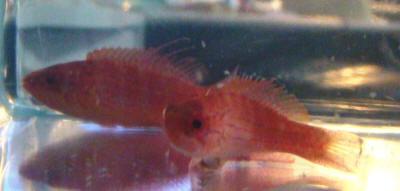
Female Flasher Wrasse ID - 4/13/09
Hi All,
<Hi Debra, Mich with you today.>
You've answered many questions and have been very helpful
regarding my 3 new females and single male filamented flasher
wrasses.
<Ahh, glad to hear.>
I wanted to verify something. I continue to read about them to
learn more and last night I read the females do not have the long
dorsal spines. However, one of the females appears to have
them.
<Fishbase.org says females can have slightly prolonged dorsal
fins. More here:
http://www.fishbase.org/Summary/speciesSummary.php?ID=4844&genusname=Paracheilinus&speciesname=filamentosus
>
When they first arrived I was very concerned and contacted the
shipper with a picture. I was assured it was definitely a female
but the dominant female. I simply want a second opinion in light
of what I've recently read.
<Does sound like it is possible that it is a female.>
I apologize for the photo but this was during acclimation and in
very subdued lighting.
<Yes, is not the easiest to make out.>
If you look closely, you can see the one in the back has what
appears to be a few longer dorsal spines.
<I see.>
Thank you again.
<Welcome.>
Debra Piedra
<Mich>
|
 |
Stocking Flasher Wrasses &
Fathead Anthias 04/09/09
Hello All,
<<Hiya Tricia>>
I have been reviewing the posted emails, but I'm finding a little
conflicting information regarding appropriate tank size for a flasher
wrasse harem and a fathead Anthias.
<<Mmm, yes much can be put to personal opinion/experience. I have
kept both fishes, and in the same tank, so Im happy to proffer
mine>>
There are some posts that say neither should be housed in a tank
smaller than 100 gallons.
<<Bigger IS better but much also depends on the total stocking
densities and other species present>>
However there are other posts that indicate that 55 gallons would work
for 3 flasher wrasses (1 male/2 female) and 37 gallons is enough for
the fathead.
<<Again, it depends on whether other fishes will be introduced
But most hobbyists cant ignore the impulse to add more fishes So, a 75g
should probably be considered minimum>>
I would like to keep the following in a 46 gallon (3ft long, 21 inches
tall and 16 inches wide):
1 Firefish (Nemateleotris sp.)
1 fathead Anthias (Serranocirrhitus latus)
3 flasher wrasses (Paracheilinus sp.)
2 cleaner shrimp
A few assorted mushrooms
Live rock & macro algae
Would this stocking level and this introduction order work?
<<The bio-level is not out of bounds here, it is the species
selection that is cause for concern I think. The Flasher Wrasses will
need to establish a territory with a bit of room preferably a rock
outcrop that extends toward the surface but with enough room overhead
for the male to display or flash. The Fathead Anthias will need a cave
or overhang to allow it to get away from the light. And the Firefish
will also require a bolt-hole to feel secure and allow it to feed
properly. I just don't think a 3ft tank is adequate here/for this
species selection. Otherwise, as for the order of introduction, I would
add the Anthias last to preclude any problems re it and the sometimes
twitchy Flasher Wrasses>>
Also, am I correct to assume that I am maxing out my bioload, or could
I add another fish-- say a clown goby (Gobiodon sp.) or a Meiacanthus
blenny?
<<If you go forward with this plan, I would certainly be hesitant
to add any other fishes>>
Thank you very much for your time-
Tricia
<<Happy to share EricR>>
Re: Stocking Flasher Wrasses
& Fathead Anthias 04/12/09
Eric,
<<Hiya Tricia my apologies for the delay>>
Thank you so much for your quick response!
<<Oh well, guess I blew that here [grin] Quite
welcome>>
From reading your email, I think in my attempt to please all these fish
in my aquascaping I'm pleasing no one.
<<Happens all the time We so often try to fit everything we
like/want in a single system and often to the detriment of
all>>
About half of my tank is rock that goes a few inches from the top in
the back with several big overhangs, further shielded with a stand of
macro algae. The next little more than a quarter of the tank is
sand/crushed coral with live rock rubble. The final part of the tank is
a pile of rock with an overhang at the bottom and another small stand
of macro algae to make the overhang dark.
<<I see>>
From an aesthetic point of view the tank looks great, but it sounds
like there isn't enough space.
<<Another common issue, in my opinion. We hobbyists have been
conditioned to cram all the live rock we can in to our tanks (the
ubiquitous rock wall) for the beneficial bio-filtration provided re.
But with sensible stocking/maintenance and the use of ancillary
filtration/vessels to hold more rock if needed, a much more pleasing
display can be had with less rock and more room for fishes to swim and
develop and for corals to grow>>
Which (the fathead or the flasher wrasses) would be happiest in this
much space with this aquascaping?
<<I have seen single specimens of Serranocirrhitus latus do quite
well in similarly sized and aquascaped systems as you describe. Though
be aware these systems were also very lightly stocked with other
piscine inhabitants (no more than a few other small fishes). I think
this fish would indeed be the better choice over the harem of Flasher
Wrasses for this 46g tank>>
Also, would the Firefish benefit from a pre-made PVC bolt hole, or will
the rubble be enough?
<<If there is a small cave or pile of rock with a couple means of
access, the Firefish should be fine>>
Thank you again!
Tricia
<<A pleasure to assist Eric R>>
R2: Stocking Flasher Wrasses
& Fathead Anthias 04/13/09
Eric,
<<Tricia>>
The Anthias it is then.
<<Ah good the better choice here I think. Do provide two or more
feedings a day of small frozen meaty foods (Mysis, Plankton, Glass
Worms, Cyclops-Eeze, etc).all thawed before feeding of course [grin].
And do also try the small (1mm) New Life Spectrum pellets a very
palatable and very nutritious food for all your fishes>>
Thank you so much for your help!
Tricia
<<Always a pleasure Eric Russell>>
McCosker Flasher Wrasse
03/26/09
Hey Crew,
<Jonathan>
I recently added a male McCosker wrasse to my 29 gallon tank after
quarantining it for 4 weeks. The wrasse peacefully shares the tank with
a pair of ocellaris clowns living in a RBTA.
<Jon... No! This animal is NOT compatible, suitable for this
setting>
I read somewhere that the McCosker will lose its color because there
are no females or males to "show off" to. Is this true?
<Won't live long enough for you to appreciate>
That same site said it's ok to keep two males, but different
species i.e. Carpenter and McCosker in the same tank so they will
"flash" each other and keep their color intense.
<... no>
Can I keep two male flasher wrasses of different species in my tank w/o
them tearing each other apart? I prefer not to keep a female wrasse
because the male wrasse looks better; sorry, that sounded very selfish,
but I had no other way of putting it =) . I also plan to add a yasha
goby/pistol shrimp in the near future, do you foresee any problems?
<... Please don't write us, w/o reading what is archived on WWM
ahead of time. This won't work either>
Thanks!
<B>
Stocking My New Baby!! (Mixing Flasher Wrasse
Species in a 300g Tank) 03/07/09 Hello all at the WWM site!
<<Hey Erik! Tis Eric here>> Now I have to start off by
saying all of you here are providing an invaluable resource and deserve
a huge pat on the back! <<Thanks dude!>> But I digress
:D....Well you see I will soon be upgrading from a modest 30 gallon
saltwater aquarium to my dream aquarium of 300 gallons! <<Wow,
quite a jump congrats. I myself went from an 80g reef display to a 375g
reef display about 5 Ã'½ years ago>> As
you can guess I'm in a surreal state and can't wait to get this
puppy going. <<Been there done that seen the video (as the saying
goes). And let me impress upon you to slow down, take your time, and
research your equipment and installation to the fullest>> So I am
going to make sure I do this right, so I wanted to know if a sump
filtration system will also act as a refugium for Mysid shrimp as well
as copepods. <<Indeed it can/will But I prefer separate vessels
(and the bigger the better) for such to ease control of differing water
flow rates and lighting levels betwixt the two>> Just another
quick question I plan on having a harem of Paracheilinus cyaneus,
Paracheilinus Filamentosus, Paracheilinus Mccoskeri, or maybe a mix of
the three? Would that be possible? <<Some may tell you it is
possible to intermix species in a tank of this size, I recommend you
pick a single species to focus on. Even 300-gallons is NOT AS BIG as
you think it is re flexibility in fish stocking>> As they are
gorgeous fish and I would love to wake up to those beautiful colors
every morning! <<Many a fishes demise can be traced to a
misguided hobbyists sense of aesthetics. Im not saying its wrong to
try; and its certainly not impossible, to create a breathtaking
display just be smart about how you go about it. Choose a central
species for your display and then build the system/select tankmates
around this species needs. Some effort (and self control) on your part
now can save you and all your fishes much trouble down the road>>
Well my real question was; are any of these species less inclined to
attack cleaner shrimp? <<None that you mention should be a
problem just be sure not to add any new shrimp additions by dropping
them in the tank like food>> I have two and was hoping when they
became a mated pair to use their newborns as a snack every couple of
weeks or so? <<Ah yes your fishes will much appreciate such
spawnings/hatchings (and are quite interesting to watch, too!)>>
Thanks in advance for any help and advice you can supply. <<I do
hope I have been of some assistance>> And best wishes and regards
to you and the rest of the WWM crew, you are all doing an inspiring
job!!! <<Many thanks for the kind words, mate>> Best
regards, Erik <<Cheers, Eric Russell>>
Re: Stocking My New Baby!! (Mixing Flasher Wrasse
Species in a 300g Tank) 03/09/09 Well thanks for the advice
and the quick response Eric! <<You're quite welcome, Erik>>
And don't worry I plan on taking my sweet time with this tank.
<<Is best>> As I know all too well the consequences of
trying to rush anything in this hobby. And I don't plan on adding
any life forms whatsoever until I have at least a 3 inch sand bed and
my desired amount of live rock, and fully stocked refugium.
<<Indeed And letting the tank run for a few months sans
macro-predators will help many beneficial organisms to flourish (given
the have something to eat themselves e.g. toss in a few shrimp pellets
every few days) and attain sustainable populations>> By the way
how many lbs of rock would you recommend for the Paracheilinus
attenuatus? <<This can be hard to judge I recommend using less
rock than many others might recommend (especially those selling the
rock). Less rock in the tank not only gives fishes more room to swim
and corals more room to grow but has a nicer look, in my opinion. You
still need to provide adequate bio-filtration (the DSB will also help
with this), and you need to provide adequate hiding/sleeping places for
all your fish so the quantity of rock will depend on species selection
and stocking density as well as the quality of the rock and/or the
availability of ancillary vessels for holding a supplemental supply.
But to address your question more directly. As a start, use enough rock
to build two bommies/rock piles along the centerline of the tank and
spaced irregularly from the ends, and go from there>> :) Yes, I
will definitely be taking your advice on revolving the tank around one
particular fish! <<I think you/your fish will be happier and
healthier for this>> Which I always wanted to try but in a 30
gallon it kind of limited me so I never got the chance. Also about
those little scarlet cleaners of mine. I added them to my 30 gallon
simultaneously and just wanted to know how long do you think it will be
before they "get together"? <<If they are going to they
probably already have. Though I believe spawnings are more likely with
Lysmata amboinensis than with Lysmata debelius >> Best regards
thanks for the continued advice. Erik <<Happy to share.
EricR>>
R2: Stocking My New Baby!! (Mixing Flasher Wrasse
Species in a 300g Tank) 03/11/09
Alright, well once again thanks for the quick response Eric!
<<Quite welcome Erik!>>
I must admit the whole same name thing gives me a little laugh.
<<Hee-he indeed! But at least the spelling is different so we can
keep up with who is talking to whom [grin]>>
Anyways...just a little update.
<<Okey-dokey>>
It seems that the 300 gallon may not be coming so soon the salesman
just informed us that the stand does not come with the tank!!
<<Mmm, not unusual with such large tanks in my
experience>>
So we are going to put it on hold till we can find someone to make it
for us.
<<Okay It really is not difficult to do yourself if you have some
basic carpentry skills, depending on how ornate you want it to
be>>
So meanwhile I figure may as well use my 30 gallon to raise some corals
so I wont need to buy such small corals for such a big tank.
<<Indeed>>
Oh and I thought you might like to know that my cleaner shrimp are
indeed a mated pair!!
<<Excellent!>>
I saw fresh eggs under her this evening!!! So I guess it doesn't
take that long after all!!
<<Nope a short lifespan (I've heard estimates of 2-3 years) means
they cant wait around too long>>
Under the right circumstances of course?
<<Which in the case of these hermaphroditic creatures pretty much
means just getting any two together in a healthy system>>
Such as peaceful tankmates, good water parameters, and some good ol
fashion hope!
<<Ah!...yes>
I also had one more question:).
<<Okay>>
You see for a while after the lights went out these very tiny snails
would appear out of the rocks and feed I assume?
<<Likely so, yes>>
You see well they seemed to have undergone a population explosion and
cover my sand bed.. Even during the day!!? So I was wondering if you
could give me an idea as to what they are.
<<Don't know Maybe you could provide a picture (close-up good resolution
no more than a few hundred KB is size)>>
They are all tiny, about 1 cm or 2?
<<I wouldn't consider this as tiny. Perhaps you meant mm vs.
cm>>
Also if you know what they might be do you know what may feed on
them?
<<Likely any small wrasse species particularly from the genus
Halichoeres though not in a 30g tank. A Macropharyngodon spp or
Pseudocheilinus spp would also likely be certain to take care of the
snails (assuming they really are tiny), but the former is too difficult
for most hobbyists to keep, and the latter is just too mean for small
tanks and like the Halichoeres species, all need larger quarters for
continued good health>>
Maybe a mandarin?
<<Not likely, no and also needs much more tank than the
30g>>
Not that I would buy one, I know my tank is much too small and I would
never condemn a fish like that to such a horrible fate.
<<Very good to know>>
But I'm sure it would probably eat them. Maybe?
<<Im going to err on the side of caution and say, no>>
So once again thanks for any advice.
<<Unless these snails are destructive to your other life I would
just leave them be. It is very likely they will wane on their
own>>
Best regards,
Erik
<<Be chatting Eric Russell>>
Flasher Wrasse Additions 02/24/09 Hello
Crew, <<Hiya Michele>> Thanks as always for the invaluable
advice. <<We are happy to provide>> On a side note, I
totally agree with the grammar requirements!
<<Excellent!>> We have a 250 gallon reef with 200 pounds
live rock, SPS/LPS, 3 tangs, Sargassum triggerfish, a pair of Clarkii
clowns, harem of McCosker's Flasher wrasses, and a pair of mated
mandarin dragonets. The fish have always been very peaceful even at
feeding time and they "hang out" together. The tank has a
'fuge, sump, and coral frag tank plumbed in making the total volume
around 600 gallons. <<Very nice>> We purchased the wrasse
(one male and four females) six plus months ago and quarantined them in
a 90 gallon with live rock, but no other fish for several months.
<<Mmm, why so long I wonder These fish actually don't often
quarantine well and are one of the exceptions to the rule in my opinion.
Better to acclimate and add directly to the display>> After a few
weeks in quarantine, one of the female wrasse disappeared. <<Did
you check the floor? Likely a jumper>> About one month after we
had moved the harem to the main tank, we were shocked to find the
missing female wrasse in the 90 gallon! <<Hee-hee! Hiding,
eh>> We have no idea if she had made it into the 'fuge or
sump and somehow made it back out (overflows are covered with mesh)
<<Nope>> or if she had been hiding in the rock for all that
time. <<Yep and my guess this is the most subordinate of the
females>>>> We were so excited and moved her to the main
tank....big mistake! She dove into the live rock to hide and we never
saw her again. <<Hmm>> Then, we found another female wrasse
with a tattered tail. Eventually, she disappeared leaving us with 1
male and 2 female wrasse. We assumed we should not have added the
single wrasse to an established harem and a fight had occurred.
<<Best to add together, yes But it may also be that these two
females were just too weak (both physiologically and psychologically)
to survive the aggressive attentions of the other members of the harem
in this volume of water/with this number of members>> Now, maybe
three months later, our male mandarin has disappeared. <<All too
common>> He was fat, the pair were spawning, and we added home
cultured copepods to the main tank. Plus, we have the in-line fuge and
plenty of live rock. I don't think lack of food was an issue.
<<Hmm it still could be a nutritional issue or perhaps you have an
unwelcome guest>> As my husband was pulling rock out looking for
the mandarin, he found a surprise hitch hiker in the live rock....a
large crab with a 1.5 inch carapace and huge claws!
<<Yikes!>> He removed the crab to the copepod culture tank
and now we are wondering if this is the reason for the missing wrasse.
<<Is one possibility>> So finally on to the question....can
we add more female wrasse to our established harem? <<Under
differing circumstances I would say yes, add another three females. But
the problem I have here are the tankmates. The wrasses do best in a
peaceful environment with other small and peaceful fishes. The activity
of the three Tangs, and aggression from the Clownfish, are stressful to
the Flasher Wrasses. This stress may also contribute to more aggressive
behavior among the wrasses themselves. Its up to you, but as with
corals/inverts, you cant always keep everything you want in the same
tank and have all go well for the long term it would be best to decide
on a central theme or species, and then stock accordingly>> Are
we asking for a fight or can we assume the crab snatched the two wrasse
and now the mandarin? <<The crab may be the culprit but that's not
all that was/is going against your success here>> If we add to
the harem, is one ok or do we need to add multiples? <<A minimum
of three to spread aggression/to have any chance against those already
established>> Thanks for any thoughts! <<The Flasher and
Fairy Wrasses are exquisite little fishes but long term success really
does require a system designed/tailored to their needs>> Oh,
water parameters to be complete: ammonia/nitrite/nitrate: 0, specific
gravity: 1.025, temperature: 79/80, pH: 8.2, calcium: 400 ppm,
alkalinity: 2.5 mEq/L, magnesium: 1250 ppm and ORP: 250 mV (low, but
perhaps that's a question for another e-mail!). Michele
<<Regards, Eric Russell>>
Re: Flasher Wrasse Additions - 02/24/09
EricR, <<Hello Michele>> Thanks for the reply!
<<Quite welcome>> We quarantined the flashers because we
are so paranoid about introducing disease to the display.
<<Indeed But there are species/circumstances where disease is
less of a risk and/or the quarantine is more detrimental to the new
additions>> We thought since we had a well established 90 gallon
sitting fallow waiting for us to decide on a stocking plan, we would
use it to be safe. <<In retrospect aside from a dearth of natural
food organisms vs. your well supplied display system, the wrasses were
probably fine as the sole occupants of such a large quarantine tank.
Certainly more so than the usual 10-20 gallon vessels usually dedicated
to such use>> The 250 gallon tank is surprisingly peaceful,
although the tangs are definitely active. <<Yes They likely pay
little if any attention to the Flashers but their size and exited
behavior can still prove stressful re in the confines of an
aquarium even a 250g aquarium>> We will follow your advice and
leave the flashers at the current three. <<Probably best>>
We were most distressed at the loss of the mandarin....had been in the
tank for a long time and the spawning behavior between the male and
female was most interesting. <<Considering the size of the tank
and your experience thus far with this species, I see no reason not to
try to introduce a new male>> Thanks again for the advice.
Michele <<Happy to share. Eric Russell>>
|
Cirrhilabrus/Paracheilinus compatibility/harem
size 2/16/08 Good morning WWM Crew, <RA> Well, I've
been thinking a lot about what exactly I'm going put in my
86g (48"L x 16"W x 26"T). I've been thinking
about getting a harem of the smaller (3") wrasses of either
of the above genera. First off, would these fish be compatible
with a pair of maroon clowns and a BTA? <Mmm, possibly... in a
system of this size, shape... there's a very real poss. that
a Premnas would kill other fishes in time> My tank is tall,
and the top of the live rock barely extends past the bottom half
of the tank, giving plenty of open room for the wrasse. Second,
how large are harems in the wild generally? <Of the above
genera, species? Usually dozens of individuals... some lower
"caste" males perhaps only with a few females per>
I'm trying to form a biotope, so I'm avoiding all fish
that only school/group in very large numbers. How many wrasse
could I keep in my tank? <Not many... perhaps a handful
here> Well, thanks for reading this. Your crew has been very
helpful with me and my countless hypothetical questions. TIA,
Random Aquarist <Welcome. Less random BobF>
Re: Cirrhilabrus/Paracheilinus compatibility/harem size
2/17/08 So, I'm guessing it would be best to not mix
maroons with wrasse. <We are in agreement> However, I still
like the idea of mixing clowns and wrasse. What BTA-hosting
clowns would be compatible with a harem of wrasse? <Smaller,
easier-going species... particularly tank-bred/reared...
Ocellaris, true Perculas... at the top of my choice list. Bob
Fenner>
|
Can I Add Juvenile Flasher Wrasses with Existing Male
To Create a Harem? 02/06/08 Hi, <<Hello>> I have had a
male Paracheilinus octotaenia wrasse - eight lined fairy wrasse
<<Is actually considered a Flasher wrasse. Do see here:
http://www.wetwebmedia.com/paracheilinus.htm>> - 3 1/2 inches -
for 3 years -he's mostly been wonderful but sometimes seems a bit
stressed. <<Indeed, these wrasses do much better in haremic
groupings. Frankly, Im surprised this one has survived on its own for
three years>> I've been thinking of getting him some females
for a while. <<A good move>> I also have a Foxface rabbit,
2 percula clowns, 2 blue-green Chromis, 1 black cap Basslet, 1 mandarin
dragonet, 1 Kole tang and 1 navarchus angel. I have a 110 gal reef tank
with a 30 gal sump/refugium; it is designed with plenty of swim room
and caves. <<Mmm, I see Though pretty much filled-up, I think a
couple female P. octotaenia would still be a good addition>>
Here's my question: I would like to add 2 female wrasses for my
male. It is difficult to find these fish <<Likely due to their
geographic distribution (Western Indian Ocean and the Red Sea)>>
but I just saw 2 juveniles (2 inches) available!
<<Excellent!>> I've been reading about adding and
I've seen very different advice.... 1) Take my wrasse out and add
them all together (... but there is no way I can catch him!)
<<Not necessary, in my opinion>> 2) Add larger wrasses (my
male is pretty big...I've never seen females for sale that are
larger) <<Indeed not plausible/possible in this instance. And
again in my opinion, its best to introduce smaller subordinate
individuals anyway>> 3) It should be fine... <<Well, I
guess that depends on your definition of fine. There will be some
initial posturing by the male as well as some herding around just to
show the newcomers who is boss (and not gently)but yes, things will
settle down after a bit and all should be fine. On a very positive
note the addition of the females should result in improved social
interaction/health/vigor/color of this male>> Etc, etc. So, after
reading and reading some more, I am confused and coming to you...
<<For more opinions? [grin] >> Would you recommend adding 2
juveniles, planning that they will grow into females, into this tank
with my male to make his harem? <<I would And just to note, these
fish are protogynous hermaphrodites they all start out as
females>> or do you think that it is just too risky? <<Not
at all>> Thank you very much for your time and expertise, Beverly
Ash <<I hope this proves helpful. Eric Russell>>
Flasher Wrasse Stocking Question... Too Many Wrasses
12/05/2007 Good Evening, <Good evening Jonathan, Mich here.>
After reading all of the information about the Flasher
wrasse(*Paracheilinus)* species I am left looking for an opinion for
stocking my specific tank. I have a 28 gallon Nano-cube (if you are not
familiar with the line there is roughly 25g of swimming space with
another 3 gals partitioned in the back for filtration and skimming. My
tank has been cycled for almost 4 weeks and I just added a small
mushroom colony and Zoa colony over the last week. These are already
starting to grow larger. The tank also contains 3 species of snail
(about 24 total), <Hopefully 3 species with different diets. other
wise I'd worry about starvation.> a dozen hermits, <Not a
fan.> and a pair of cleaner shrimp. <Like these!> In a few
more weeks I will be ready for fish (assuming my tests stay good) and I
have been very excited about stocking this tank with Flasher wrasses
since before I even purchased the tank. <The plural form you use
here concerns me.> Your site has provided the most amount of info
from the web that I have been able to find to date, so thank-you very
much for that! <There is much here. I'm glad you have found it
helpful!> Now for the actual question: <OK!> Will 25gal be
sufficient to stock this tank with a trio of *P. mccoskeri *(1 male, 2
female)? <I would not do this. Generally this should not be done in
a tank of less than 100 gallons.> If not would the *P. attenuatus*
be a better choice? <No, your tank is much too small to house three
wrasses. It is questionable if it is big enough for just one.> Long
term the plan is to also have a clown goby (haven't settled on a
specific one yet) <OK. But I would only recommend one wrasse and
possibly this goby in a small setting.> and possibly another
interesting invert, along with several more corals. <Need to be
careful here with the potential for allelopathy.> I appreciate your
time and dedication to this "hobby" <On behalf of Bob and
the rest of the crew, we thank you for your kind words. Mich>
-Jonathan
Three questions (worms, Wormfish, not-so-wormy
wrasses) Bob- It's been over 2 years since I've picked your
brain, so I'm going to indulge with 3 questions: 1) I just bought a
"Trap-em" Bristleworm trap for my nanoreef, b/c of my first
ever infestation after 3 years. When I checked at midnight, it was full
of worms; in the morning it was empty. Do you have any suggested mod.s
to contain them? <These are posted in FAQs files on WetWebMedia.com
under Polychaete, Bristleworms...> 2) I can't find any info on
the Curious Wormfish I put in my main tank except for the Fishbase
info. It stays hidden under the crushed coral 90% of the time and seems
to come out at night. No one picks on him. <They do hide...
generally more than this!> 3) Is it crucial that filament wrasses be
kept in m/f pairs? I've got a small female that seems to be doing
fine. <Not crucial... males look, behave "better" in the
presence of females... Bob Fenner> Thanks, Steve
I want the wrasse, but not the cyanide >Hi to
all, >>Well HELLO Bry! Fancy meetin' you here. ;) >I
haven't asked any questions for a while as I have been busy
redesigning my tank and getting it set up. It has now been running for
about 3-4 months this time around. I have a 55 gal corner bow, 20 gal
sump 15-20 X turnover rate, 60 lbs of liverock, 4" DSB, and quite
a few snails, blue leg hermit crabs, tons of bristle worms, brittle
stars and various pods. >>I remember from your post on RDO. >I
decided on the list of fish to keep before I set up the tank, and
conferred with several of you on different choices. Here is the list
that was decided on: 3 Carpenter Flasher Wrasses (2 female and 1 male)
2 PJ Cardinals 1 Fire Goby 1 Pearlscale Butterflyfish 1 Longnose
Hawkfish They were to be added in that order, with a minimum of a month
quarantine. >>Sounds pretty good to me. But, I've become
particular to Banggai cards, myself. >Now for my problem. The
Carpenter Flasher Wrasses are hard to find. >>Oh yes they are!
But GORGEOUS. >I have also heard a little bit of rumor that they are
being caught with cyanide. So, I am wondering, >1.. Have any of you
heard of a company that has Carpenters that are guaranteed to not be
caught with cyanide? >2.. If not, is there any way to tell by
looking at a live specimen if it was in fact captured using those
means? I have not read of any kind of test that can be done by the time
the end user (me) receives the fish, but I was wondering what your
thoughts on this are. >>Well, IIRC, Budhaboy suggested going with
Mary Middlebrook. Matt Wandell, as well as NKT (sorry, don't know
his real name) seem to know of where to find the "hard to
find" fishes, and the only places I know of are wholesale ONLY.
(Sea Dwelling Creatures would be the first place I'd look, but they
will not sell to you, and I've seen them at Quality Marine as
well.) Have you Googled? Now, let's see if we can sort out whether
or not cyanide caught. The issue is that the only test I know of
requires the fish to be killed. Beyond that, we look to point of
origin: Paracheilinus carpenteri hails from the Indo-Pacific, so we
could surmise that there's a good chance that, even if not actually
caught with cyanide, they may have been exposed. Check this link on
http://www.fishbase.org (bookmark
that!)
http://www.fishbase.org/Summary/SpeciesSummary.cfm?ID=4843&genusname=Paracheilinus&speciesname=carpenteri
>3.. If I can't find this fish, could you suggest a replacement
that would go good with the other fish in my list? Thanks once again
for your time and a great website. Bryan Flanigan >>Digging in my
memory banks here, I recollect something called a "mystery
wrasse" (our own JasonC has a very nice--and hard to come
by--specimen), there are also picture wrasses, as well as other fairy
wrasses. If you go for Red Sea animals you'll be more certain to
avoid the cyanide issue, as well as with Australian animals. If you see
that an animal hails from Indonesia or the Philippines, you might be
concerned with cyanide exposure. IIRC, it's not as widespread in
Fiji or Bali, two other areas to consider. I don't know if
there's a wrasse site quite as dedicated as that Japanese goby site
(that site is da bomb), but it's worth a Google, eh? Do feel free
to contact Mary at http://www.seacrop.com because even if she
can't supply you with the fish, she knows at least as well as
anyone I can think of what the chances are of being able to determine
whether or not an animal's been exposed. Talk to you soon!
Marina
Flasher Wrasses Hi All, <Tyler> I am the new
owner of a 55 gallon tank. I'm planning to make this into another
reef tank. I absolutely love Flasher Wrasses. Would four (1 male, three
females) be too much for a 55? If this sounds right, would I be at my
maximum for fish? Thanks. <Mmm, I would try just a trio, one male...
with lots of live rock... some other fishes might fit in... as long as
they aren't too large, aggressive. Bob Fenner>
Re: Flasher Wrasses Thanks for the quick response!
After the tank is cycled, should I add one at a time, or should I add
the females first, followed by the male later? <The second process
is best. Bob Fenner>
Pass on The Wrasse? (Fairy Wrasse Selection)... a much
better answer Dear Bob (or crew), <Scott F. your Crew Member
today!> I have been looking through the site for info on Carpenter
Flasher wrasses, but some of my questions I did not find answers to.
I've been looking at one that is at one of my local fish stores but
they only have one fish, 1) Are they ok to be kept single? <While
they can be kept as solitary specimens, they are far happier and will
behave more "naturally" (if there is such a thing in
captivity!) when kept in smaller groups of one male to several females.
You might see some of the "flashing" behaviors for which they
are known. In my opinion, keeping more than one male in a smaller tank
is not advised, however.> 2) What do they eat? <They will
generally eat meaty foods, such as Mysis shrimp, enriched brine shrimp
(noticed I said "enriched"?), and some of the prepared
"Formula" foods.> I have a Trigger, Coral Beauty Angel, 2
Perculas, Orchid Dottyback, and a Spotted Hawkfish. 3) Will the wrasse
be compatible? <Well, the fish can work in such a community setup,
provided that your tank is large enough, plenty of hiding spaces
provided, and if the Trigger doesn't harass him too much...> And
what I have read on the site makes me think that this is not an easy
fish to keep. 4) Are its chances of surviving low enough to not try the
fish? <Well, Fairy Wrasses run the gamut from quite hardy to very
touchy. This fish, in my experience, seems to fall somewhere in
between. If it was collected carefully, handled well along the chain of
custody from reef to your LFS, and if the fish is quarantined and
eating, your chances are excellent for success.> Sorry for so many
questions, but I was amazed by the fish when I saw it, but I don't
buy anything without researching on your site Thanks a lot. Mike <We
appreciate the confidence in our advice, Mike! However, do get some
opinions from fellow hobbyists who have also kept the fish, and do
consult the writings of authors such as Scott Michael and Rudy Kuiter,
who have written extensively on this group of fishes over the years.
Take all advice (even ours!) with a grain of thought, and make your
decisions accordingly! Good luck! Regards, Scott F.>
- Fairy
Wrasse and Clown Gobies - Hey Bob <Actually, JasonC today...>
You will not remember me but you answered many of my questions back
when you were working with the now defunct flyingfishexpress.com folks.
<Seems like a long time ago.> Thanks for all that info, it helped
me a lot. I'm putting together a new system, a basic reef with a
RBT anemone and 2 Percs (had them for years) under MH lights. The tank
is a 110 gal, 30 high, 48 long, 18 back to front with a massive skimmer
(Euro-Reef CS8-2), 20 gal refugium with 6 inch DSB, 35 gal total in
sump. There will be 4 Maxi-jets hooked to a wave-maker/controller, and
I have not decided on the size of the Maxi-jets. There will be corals
in the tank, however the focus is going to be on flasher and fairy
wrasse. If I do my home work, and pick the wrasse for size and color to
offset aggression, how many individuals could my system hold? <I
wouldn't go nuts with fairy wrasses - even though they aren't
typically aggressive fish, mixing more than two species in your tank
might lead to trouble. You could do male/female pairs of each.>
Also, are the various clown gobies (Gobiodon sp) able to live with
fairy wrasse? <Sure.> Thanks for the help! Rich <Cheers, J --
>
Flasher wrasses 8/14/05 Dear Crew, <Michael>
I have always had an eye for flasher wrasse. I love their color and
shape. I have a 55G peaceful FOWLR. I want to get a mated pair.
<Mmm, no such thing really> I have seen Paracheilinus carpenteri
in a local store and just stared at it for an hour. That was the fish I
planned to add to my tank, however after reading the article, Flasher
Wrasses, the Genus on your site, I like the looks of Paracheilinus
flavianalis and Paracheilinus rubricaudalis (what is their max size in
an aquarium). <A couple, three inches...> Which of these three
species would be best to have in my tank, or are they about equal.
<The latter... much depends on previous care, capture,
handling...> I don't see the latter two species in any local
stores, so I'm thinking I may have to go with the Carpenter's
Flasher Wrasse. Do the colors vary between fish? <Yes...
considerably... take a look at the pix of fishbase.org, Google
Images...> The two that are shown in that article are not as pink
and showy as the one I saw in the store. Is this different fish from
different seas, or do these fish change color as they mature? <Both
location, time, care...> Thank you for any personal preference and
insight into these fish you can provide! Mike <Keep good notes,
please! Bob Fenner>
|
P. mccoskeri For a Small Reef? (Oh Yes!) -
03/02/07 Hello, <<Howdy>> I would like to know if
my 40 breeder tank would work for a male Paracheilinus mccoskeri
Wrasse? <<Very neat little fish...yes it would>> My
total water volume is 65 gallons. I have a 25 gallon
sump/refugium. The male I would like is only 2in. I know, of
course, it will eventually grow. <<Mmm...but not much more
in my experience (to about 3~31/2 inches)>> I will upgrade
my system in the future. Just wanted your thoughts on this.
<<P. mccoskeri is an excellent little wrasse for reef
systems. Very peaceable (conspecifics aside), generally very
hardy, and quite attractive too!>> I have a nice stable
reef right now. 66 pounds of LR/ not all in the main display, but
a good amount for hiding, DSB, BM150 skimmer, LPS, Refugium,
closed-loop with a Sequence snapper. <<Sounds very
nice>> I haven't been able to find someone that asked
this question about this particular Wrasse. Please let me know.
<<I think I just did [grin]>> I currently have no
other fish. I'm looking to get some and this one looked great
and sounded like it has great personality, plus it's
Gorgeous. <<Indeed>> Thank you. Gina <<A
pleasure to share. EricR>>
Re: P. mccoskeri For a Small Reef? (Oh Yes!) -
03/03/07 Thank you for writing me back.
<<Welcome>> Another quick question is would this
wrasse not be good to mix in with a mandarin dragonet?
<<Would be fine...in a larger, mature system supported by a
plankton generating refugium capable of sustaining the mandarin
for the long term>> I am breeding many copepods in my
refugium and will not add him for another year.
<<Ahh...very good...though I am still a bit skeptical re
the size (40g) of the display tank...would prefer to see the
mandarin in at least twice that volume. These fishes browse/graze
constantly and require a fair amount of real-estate>> The
store I would order him from said if there was ever a problem and
I ran out of pods, they would keep him and fatten him up, or just
take him back. So I have that option. <<Mmm, the issue here
is that often by the time a problem is detected it is too late.
Much better to be sure you can provide for the mandarin's
health yourself>> The owner did tell me that others have
been able to wean them onto Mysis. <<Yes...can sometimes be
done...and is an excellent supplement to the copepods/other biota
the mandarin needs/finds among the live rock>> Well, I know
the chances of that are slim, but I'd always have the option
of taking him back to the store, which is what I'd do if
there was ever a problem. <<And hopefully not before it was
too late for the mandarin to recover>> I want to be a
responsible fish/reef keeper. <<Then study our pages/the
net re captive husbandry of this animal and do what is necessary
to provide for its long-term health>> I know many would
advise against it, but I do have cultures going right now and I
would not add him for a long time. So would this wrasse not work
with the Mandarin? Please let me know. <<Socially it should
be fine...though the wrasse will compete with the mandarin for
food among the live rock...something else to consider re the size
of the system in which the mandarin will be placed>> Thank
you so much for writing me back. <<Happy to provide my
perspective. Eric Russell>>
|

