Become a Sponsor

 
Home
Information Pages:
Marine Aquarium
Articles/ FAQs
(enter words you'd like highlighted in this page)
Freshwater Aquarium
Articles/ FAQs
Planted Aquarium
Articles/ FAQs
Brackish Systems
Articles/ FAQs
Popular Pages:
Features:
Daily FAQs
FW Daily FAQs
SW Pix of the Day
FW Pix of the Day
Conscientious Aquarist Magazine
New On WWM
Helpful Links
Hobbyist Forum bb.WetWebMedia
Ask the WWM Crew a Question
Calendars
Search Feature
Admin Index
Cover Images


Related FAQs: Sea Fans, Sea Fans 2Sea Fan Identification, Sea Fan Behavior, Sea Fan Selection, Sea Fan Compatibility, Sea Fan Systems, Sea Fan Feeding, Sea Fan Disease, Sea Fan Reproduction,

Related Articles: Octocorals, Water Flow, How Much is Enough

/The Conscientious Marine Aquarist

Sea Fans for Marine Aquaria, the Gorgonians, Order Gorgonaceae

Part 2

To: Part 1

Bob Fenner

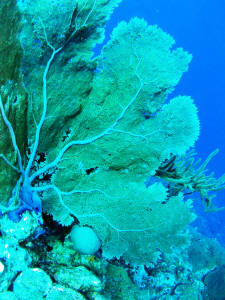
In Bonaire, ahhhh!


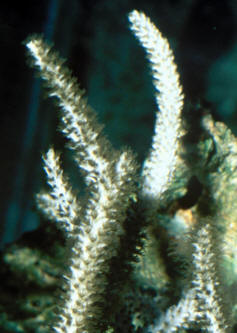
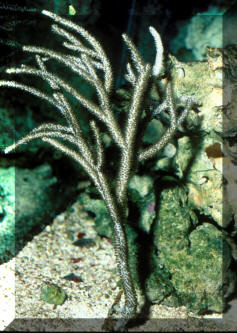
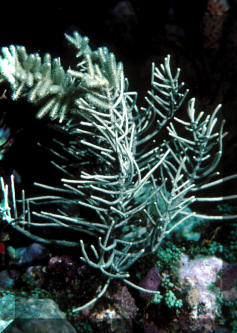
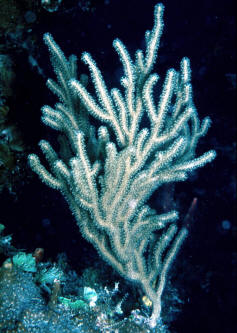
Muricea laxa, Delicate Spiny Sea Rod. Tall colonies that are bushy, branched in many planes, with hard calyces (protuberances, spines...) that extend out and upward with branches. Whitish, yellowish. Aquarium photos. 

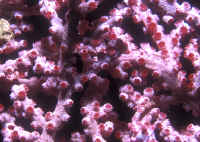
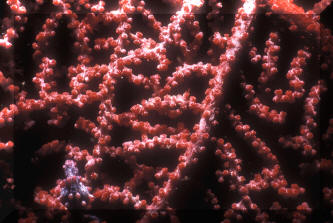
Muricella sp. Large, intricately inter-branched species (up to more than a meter across). Many polyps, form distinct bumps on branches, contrast in color (red/pink against grey to white branches. West Pacific; Philippines, Indonesia, New Guinea. N. Sulawesi pix. 

Muriceopsis flavida, Rough Sea Plume. Bushy colonies made up of tall branches or many small branchlets that extend in all directions (not uni-planar). St. Lucia and Jamaica pix.

Plexaura homomalla, Black Sea Rod. Bushy, planar colonies. Usually branch laterally (versus dichotomously). Have light brown to yellow polyps against dark brown/black stalks/rinds. Bahamas pix. 

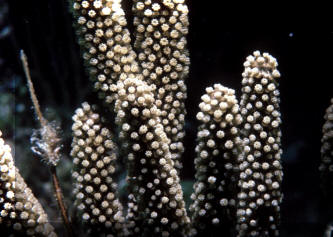
Plexaura nutans, Giant Slit-Pore Sea Rod. Tall colonies with thick stalks, not much branching. When closed, polyp openings like small open, raised slits. Tobago image. 

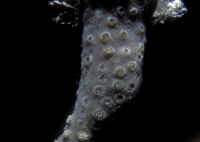
Pseudoplexaura sp. Porous Sea Rods. Definitive genus detail are small openings in rind when polyps are retracted. Variable in appearance, color. Mostly dichotomous asymmetrical branch division. Brown, grey, tan to light purplish in color. Below: Tobago and two Cozumel images. 
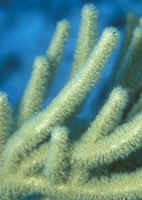
Pseudopterygorgia sp., Sea Plumes. Tall (to seven feet), bushy plumes of branches that are pinnately branching in single planes. Often purple, other times brown to yellowish. Tobago, Belize and Cozumel close-up (Di.F) pix. 
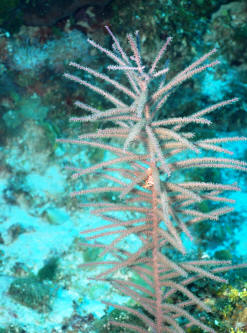
Pseudopterygorgia bipinnata, Bipinnate Sea Plume. Colonies as single planes of bilaterally arranged branchlets. Usually purple, sometimes yellow to white. One of the most popular aquarium Sea Fans due to its beauty, small size (to two feet tall in the wild) and relative hardiness (when collected, held, shipped properly). Bahamas photos showing open and closed polyp colonies. See above/top for aquarium image at title.  

Pterogorgia citrina, the Yellow Sea Whip. S.O. Holaxonia, Family Gorgoniidae. Tropical West Atlantic; abundant at times. Smallish, bushy colonies whose branches are flat, narrow, polyps along lateral edge . Branches variable in color. Di.F pix in Cozumel and the Turks.

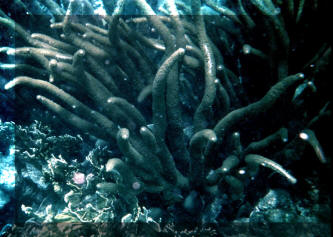
Pterogorgia guadalupensis, the Grooved-Blade Sea Whip. Tropical West Atlantic. To two feet in height, branches to 1/2" diameter. Appears uniplanar in view, with branches bearing a distinct groove in middle, tapering toward ends. Polyps extend from a common groove along edges. Di.F pic in Cozumel.

Semperina cf. rubra Kolliker 1870. Branched, one plane, with ends that are spatula like. Red to orange with white openings at ends. 

Subergorgia appressa Nutting 1911. Laterally branches with medial groove that are somewhat flattened. Red to brownish in color. N. Sulawesi pic. 

Subergorgia hicksoni. The large sea fans encountered in the Red Sea... in areas of high current and subdued lighting. Here a six foot plus diameter colony sieves the waters of Egypt's Sharm El Sheik.

Subergorgia mollis (Nutting 1910). Fan-like colonies, uni-planar, inter-branched in a rectangular fashion every 10-60 mm. . May be 2-3 meters in diameter. Thin branches (1-3 mm). May be pink-orange or red if overgrown with epizoics. Western Pacific. N. Sulawesi pix. 

Bigger PIX:
The images in this table are linked to large (desktop size) copies. Click on "framed" images to go to the larger size.
  

Selection:

Robert P.L. Straughan through his numerous writings in the fifties, sixties, into the mid seventies stated that "Sea fans are difficult to keep alive in the aquarium at present" (emphasis mine). he suggested trying a small six inch or so specimen attached to a rock; or to use a dried specimen in a shadow box (behind the tank as a background). Unfortunately, Bob's reasons, prejudices, opinions are still valid. The same problems in selecting or collecting sea fans are present today. Ridiculous.

First of all sea fans are not delicate creatures that fall apart when touched or moved. It seems to me the two most important factors that limit our success in keeping them are artifacts of collection and transportation. 1) Cutting, breaking their "rind" skin by rough handling and stacking specimens on top of each other and other matter, and 2) Lack of continuous circulation yielding low oxygen tension.

Think about these organisms in the wild; they live firmly attached to the hard ground, waving back and forth in the direct flow of the reef, not touching or being gouged by anything. And receiving the full benefit of continuous aeration.

Large individuals have been carefully (one at a time) collected and kept long term by large public and private aquaria worldwide. So what's a pet-fish fanatic to do, collect their own? Possibly so, though you might find some dealer in your town that will give them a try.

At the dealer's check out the specimens that are anchored firmly upright. Examine their base(s); the best are the ones with thick stems (3/8 to 1/2") with large polyps, . with some part of the original substrate still attached to the holdfast. Smell the water they're in. Bad specimens are malodorous; okay downright stinky. If the skin is broken, it probably will not live long. Lastly, though gorgonians filter feed mainly at night time, some portion of their polyps should be open and evident during the day.

Should your dealer be involved directly in picking out specimens, or chatting with the collector, give them this article! If you can get a healthy specimen, there is a very good chance of your keeping it alive. If damaged, sea fans may die easily, quickly releasing toxins into the system with disastrous result. Especially in small systems with inadequate filtration, sea fans can give off a slime when disturbed that can take them and the rest of your livestock off to Davey Jones Locker. Shades of sea cucumbers and cowfishes! Okay, enough negative said.

Notes regarding collecting: Picking up gorgonians, among other invertebrates, is restricted in a great many places. Be careful to check with local authorities re permitting. If, where allowed take only what you can transport and keep alive in your system. Geez, of course; does that sound as stupid to you as it does to me? One other thing; pay attention to your surroundings while collecting! (Carpe diem, seize the carp?) There are many critters that live in and on others... you get the picture? Stinging hydroids, fire corals are often found in conjunction, even coating over sea fans, and will sting the jammies off of you. Be careful.

Environmental Conditions:

Habitat:

Making a suitable display is simple; replicate the reef! Now, seriously; anchor the specimen(s) firmly in the more or less direct path of moving water. The most vigorous arrangements I've encountered have utilized fluid-moving pumps to oscillate (rock) the water back and forth in the area of the sea fans.

Chemical/Physical:

Concerns are more or less "invertebrate-standard". Synthetic and natural waters have been employed with equal facility. High (8.0 plus) pH water, near-saturation oxygen. Keep nutrient (phosphate, nitrate...) levels low through filtration, feeding, algal growth...

Lighting is important; mainly in terms of quality, and next quantity. The majority of species sold are shallow water (bright) reef in origin. Gutierrez used 4300K and 5500K metal halides and actinic/metal halide combinations. Other folks have had success with just more red-end shifted and full-spectrum fluorescents. Light regimens should be long, 14-16 hours per day, on a timer. Most sea fans have symbiotic algal relationships (zooxanthellae); they need the light.

Enough current at a right angle of incidence to the animal's body has been mentioned. In a "happy" situation the entire colonies' polyps will open up in the course of any given day.

Other Biology:

Not to drive you absolutely crazy, but some slime production is normal, healthy, and to be anticipated. Sea fans produce and shed these coats to prevent drying when exposed and to cleanse themselves of algae, bryozoans and other fouling organisms. Siphon or filter this material out as it occurs.

Behavior:

Territoriality doesn't seem to be a difficulty; just position your sea fans in such a way that they don't touch other living or non-living materials! Other stinging-celled organisms will usually "win" in such scenarios, so keep them out of coral, anemone et al.'s ways. doesn't seem to be a difficulty; just position your sea fans in such a way that they don't touch other living or non-living materials! Other stinging-celled organisms will usually "win" in such scenarios, so keep them out of coral, anemone et al.'s ways.

Predator/Prey Relationships

A touchy area. How much harm and/or good is it to fret over intentional and accidental grazers? Certain errantiate polychaete (bristle, fire...) worms, snails (most celebratedly the flamingo tongue, Cyphoma gibbosum), the aforementioned fire corals, even hungry/curious fishes of the usual types (angels, butterflies, triggers...) may overly chew up/eat your sea fans. Keep your eye on them.

Introduction/Acclimation:

Is easy. Pull out the temperature stabilized specimens, rinse off with system water and place appropriately. Discard shipping water. Done.

Foods/Feeding/Nutrition:

Various authors have suggested live brine shrimp nauplii, rotifers, prepared mashes (macerated shrimp, clam...) Feed sparingly a few times a week. Make the feeding time and procedure routine. Turn the lights off, subdue particulate and skimmer filtration, introduce some food, wait a determinate time and put in the rest. This will prime the sea fans opening and feeding repertoire. Some writers encourage soaking the foodstuff with vitamin mixtures, Aminoplex solution... to each their own.

Disease:

Not well elucidated in the literature I could find. Perhaps you'll be work on some aspect for your Master's of Doctorate degree. Follow the above guidelines for selecting healthy colonies; isolate, quarantine if the become questionable.

Summary:

Any creature that can live on reef flats or fore reefs is not touchy. Gorgonians can and do thrive when and where collected, transported and maintained with some minimum standards.

They come in an amazing mix of colors and exhibit enough interesting behavior to warrant trial and inclusion in advanced reef collections.

Bibliography/Further Reading:

Gutierrez, Santiago. 1991 From a reef's point of vies. FAMA 9/91.

Lasker, H.R. 1985. Prey preferences and browsing pressure of the butterflyfish Chaetodon capistratus on Caribbean gorgonians. Mar. Ecol. vol. 21, no. 3, pp. 213-220.

Lewis, J.B. & E.E. Post. 1982. Respiration and energetics in West-Indian Gorgonacea (Anthozoa, Octocorallia). Comp. Biochem. Physiol. A.; vol 71 A, no. 3 pp. 457-459.

Mancini, Alessandro, translated by Paolo Mancini. 1994. Breeding octocorals in tropical marine aquariums. FAMA 9/94.

Straughan, Robert P.L. 1976. The Salt Water Aquarium in the Home, 4th ed, rev. A.S. Barnes, N.J.

Straughan, Robert P.L. Keeping Live Corals and Invertebrates. A.S. Barnes, N.J.

Wells, Jerry G. 1982. Encyclopedia of Marine Invertebrates. T.F.H. Publications, Neptune City, N.J.

Volkart, Bill. 1993. The secret lives of gorgonians. TFH 3/93.


Featured Sponsors:
Google
 
Web www.WetWebMedia.com