|
FAQs about Fish
Behavior
Related Articles: Marine
Fishes,
Related FAQs: Marine
Fishes 1, Marine Fishes 2, &
FAQs on Marine: Fish Identification,
Fish Compatibility, Fish Selection, Fish Systems, Fish
Feeding, Fish Disease, Fish Reproduction,
See also, the many other Behavioral FAQs files by
organism, group in the Indices.
|
|
|
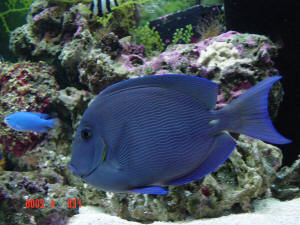
That fish followed Arya
5/20/15
<<Well, it looks like you all had fun with the fishes... Cheers, Neale.>>
Re: re: That fish followed Arya
Oh my goodness! I'm honestly not sure how I sent that to you! Haha so
sorry.
<No problem. Neale>
It was a good time.
|
 |
orange shoulder tang dorsal fin; beh.
4/22/15
Hi guys,
<Mark>
I have an Orange Shoulder Tang that been with me for around 18 months and is
close to 6" in length. It still has juvenile colors (but occasionally
turns gray/blue at night).
<What they do at night... helps to hide from predators>
My question is about it's dorsal fin.
For as long as the fish has been with me, it's dorsal fin has always remained
closed. The fish appears to be in good health otherwise, very active, feeding
well, no signs of parasites or other illness and growing well. Is this just a
random occurrence or something with which I should be concerned?
<Not a problem. The opposite of freshwater, marine fishes keep their dorsal and
anal fins mostly closed... whereas freshwater keep them raised... Your
Acanthurus would have its fins spread more if it were in a bigger system, one
with more circulation>
Many thanks,
Mark
<As many welcomes. Bob Fenner>
confused... SW Fish beh.
8/21/09
Good morning !
<And you>
? I'm writing because I'm confused with almost everything
that's going on with my tank. First of all, I have a clarkii clown
that is hosting a CONDY anemone, which everyone I've spoken with
has never ever heard of any clown
hosting a Condy.
<Can/does happen... not in the wild of course>
And yes, it is a Condy, no a long tent. was wondering if you've
ever heard of this? My other clarkii is hosting a carpet anemone,
<Actually vice versa>
which isn't shocking at all. My second question; why in the world
does my sergeant major damsel clean my yellow tang?
<Happens as well>
I've never ever heard of this before either. And lastly, I have a
lawnmower blenny that eats any shrimp or pretty much anything I put in
the tank, including other fish that fits in his mouth ?
<Yes>
It's like I read and study on everything, and everything does the
complete opposite in my tank.
Thanks a bunch, Angel
<Welcome to the world! Bob Fenner>
Marine animal life expectancy
5/12/09
Do you know of a text or website that provides information on life
expectancies for various marine animals? Obviously, the more inclusive
the better. I do understand that with many animals we do not know
how
old the animal may be when it comes to our care, but the only info I
have been able to find is bits and pieces you have to hunt for, and
much of it is on the on-line retail sites so it's reliability must
be questioned.
<Mmm, as with humans, environment, diet, etc will have much to do
with life expectancy of marine animals and life expectancy would be
difficult to determine in that regard. Likely, the most information on
fish can be obtained at www.fishbase.org. For invertebrates I will ask
the crew for their input.>
Thanks.
<You're welcome. James (Salty Dog)>
Mark Simon, VP
Living Marine Art
SW: System: Use of Dither Fish
4/23/2009
Hi Crew,
<Hi Samuel>
Just wanted to share something. Over time when reading about fish I
have come across the comment that
a particular fish tends to stay in the open and thus causes you other
fish to come out of hiding.
<Yes, dither fish. They convince the other fish that it is safe to
come out. (i.e. There are no predators around.)>
I never paid much attention to that.
My wife generally comments that she hardly sees any fish even though my
tank is overstocked.
<Not too overstocked I hope, what is in the tank?>
Recently I was buying something and the store and they just got in a
batch of baby Percula Clowns. So I bought one even though it does not
fit my current group but I figured that at least my wife would now have
something to look at.
<Not the best selection method for purchasing a fish.>
Since he did not attempt to go into the rock there was no aggression
from the old timers. He just fluttered around up and down back and
forth out in the open.
Since then all my fish are out in the open. In fact my wife commented
that now I have a lot of fish and maybe it is overcrowded.
<Thank you for your observations.>
<Mike>
Fishes Losing Color (Inadequate Nutrition) --
01/26/09 Hi Guys, <<Hey Brian>> I have a 330g reef
tank fairly well stocked with 70g sump, weekly 50-60g water changes,
ozone, skimmer, Kalk reactor, 4 x 400w HQI MH 20k. <<Cool>>
I maintain good water quality and stable conditions. I have noticed
many of my fish have slightly lost the vibrant color they had when
introduced to the tank, mostly: Lyretail Anthias (the male and
females), purple tang and Sailfin tang. The color is more faded on
tangs, and on Anthias the appearance of slight darker spots on them. My
blue/green Chromis, orange clownfish, and Pseudochromis still have very
good color. I have been feeding: Bio-Pure mysis shrimp green seaweed
<<Ah! This alone is not enough to adequately meet the nutritional
requirements of your fishes and is very likely the reason for their
loss of color vibrancy. Food additives can help (Selcon/Selco,
Vita-Chem), but these often are abused or simply not provided due to
the cost/hassle. Offering a wider selection of frozen foods would also
be of benefit 'but if you do nothing else, I VERY MUCH suggest
you add New Life Spectrum pellets to your fish's diet. This
pelleted food is very palatable and amazingly nutritious and wholesome.
I have a 375g reef display housing five Tangs from four genera. Along
with an assortment of frozen foods, I provide daily offerings of the
Spectrum pellets and the colors of these and all the fishes are
(admittedly 'my opinion) spectacular>> I have recently
switched to PE mysis due to higher protein content (although I am
starting to wonder if they get higher simply due to less water mixed
into cubes) and brown/green/red seaweeds. <<Still not
enough>> Rarely do I use Vita-Chem and garlic additives.
<<Okay>> I have also recently stopped using carbon due to
suspected involvement w/ lateral-line on my tangs.
<<Mmm'¦this will also likely be 'cured' with
better nutrition>> I am wondering if this is likely a nutritional
deficiency or what exactly is the cause? <<Very much an
environmental issue'¦and in this case a lack of adequate
nutrition, I do believe>> Thanks a lot as always! <<Happy
to assist>> Best, Bryan <<Cheers, EricR>>
Re: Fishes Losing Color (Inadequate Nutrition) --
01/27/09 Thanks a lot! <<Quite welcome Brian>>
What's your opinion on plankton cubes, brine, and bloodworms?
Worthless and not beneficial? <<The Brine Shrimp is of
questionable value, but both the Plankton and Blood Worms are of
benefit>> I'll look for those pellets. <<Please
do'¦ The Spectrum food will be of great benefit to the health,
vigor, and color of your fishes>> Should I continue Vita-Chem and
add Selcon also? <<These can also be of benefit (the Selcon more
so than the Vita-Chem, in my opinion). I use both on an infrequent
basis>> I always had read brine is useless except to entice
feeding initially. <<Depends'¦ Adult Brine Shrimp are
mostly water with little nutritional value, but if 'gut loaded'
before feeding if live, or freezing by the food manufacturer, they can
be of some value. Even so, I don't think they should ever be the
primary food source. Regards, EricR>>
R2: Fishes Losing Color (Inadequate Nutrition) -
01/27/09 BTW I failed to mention I feed a mix of Formula One,
Two, and Reef Blend w/ an automatic feeder 4 times a day. Does this
change anything? <<Mmm, no'¦ Our previous discussion on
the color and condition of your fishes would seem to indicate it is
still not enough/is not 'doing the job.' Make sure the fish are
eating this offering'¦and that you are providing
'enough' of it. And I can't mention this enough, but if
this were me, I would replace these with New Life Spectrum pellets in
the auto-feeder. Cheers, EricR>>
Predator Life Span -09/02/08
Hello, I was just wondering about the life spans of the fish in my
predator tank? Also, I don't know their current age so if you could
determine that by my estimating their size, it would be greatly
appreciated. -Snowflake Eel (20 in.) -Humu Picasso Trigger (5 in.) -3
stripe damsel (1.5 in) -Blueface Wrasse (6 in.) Thank you for your
time. <Hmm, this is something you could/should research on your own.
Though, I'd caution you to be discerning regarding some sources on
the internet (I've seen some sites say that surgeon fish only live
2 to 3 years-- um, no, many can/do live for decades, even in
captivity). It's difficult to estimate the age of fishes based on
size because they grow at different rates depending on different
factors in their environments. However, it's fairly safe to say
that if a fish is only a fraction of its adult size, it's likely
still a juvenile. As for lifespans, again, this is difficult to
estimate for fish in captivity. Typically, larger, egg-laying fish tend
to have longer lifespans, usually on the order of decades (though this
is a generalization). Damsels likely don't live quite as long, I
would think <10 years. Best, Sara M.> Re: Predator Life
Span -09/02/08 Well, thank you for your time. I couldn't
find much useful stuff online, <There does indeed seem to be a
dearth of this particular kind of info for individual species (perhaps
because it's not known for certain?).> but maybe I wasn't
looking hard enough. <Not necessarily... specific species info does
seem hard to find. Maybe BobF knows better where to look?> And as
you said, it can be hard to say... Again, thank you for your time.
<De nada,
Sara M.>
|
Do fish sense water? -08/22/08 Hey guys,
love the site. Thanks for your patience when dealing with us.
<our pleasure> I'm sure you have heard it all, but here
is one for you. Yesterday my BTA died. It had been going through
a period of seclusion under live rock and moving all over the
walls of the tank. I knew something was up, and was trying to
figure it out. When I next visited the aquarium, I noticed a
flesh-colored slime floating in the water and accumulating on the
filter intakes, powerhead, and wall near the surface. I located
the BTA and it was "spitting" out a white cloudy
substance every couple of seconds. <possibly a stress
spawn?> The mouth was open (and didn't look like a mouth
anymore), and looked like it had melted. <Hmm... this might
have been the proper time to remove it.> For the next couple
of hours I spent some time trying to figure out what happened,
and what to do in order to make sure the rest of my tank
didn't suffer (I read many WWM topics). After I went to bed,
a storm rolled into the area. Right as I was about to fall asleep
the power flickered. I thought nothing of it until I heard a
rattling noise coming from my aquarium room. I got up and
discovered that the filter was no longer functioning correctly.
The power flicker had caused something to go wrong as the
canister was no longer taking in or exhausting water. I spent
another couple hours trying to figure this out, as now was not
the time I needed my filter to go out (as if there is a good time
for this). Finally, I had enough and went to bed. <Oh, not
good...> The next day I got up early to try and solve the
problem before work. When I went to the aquarium room, a small
movement caught my eye. When disassembling the filter the night
before, I had used a lid to a plastic container to catch the
water. I left it on the floor, with about a ¼ inch of
water, that I was going to clean up later. The movement I noticed
was coming from this lid. Upon closer inspection, my ocellaris
clownfish was flopping around in the lid. I couldn't believe
it ? it had jumped. After rescuing the fish, I looked around the
tank and found a trail of dried water from behind the tank all
the way to the lid. <Hmm... from the splashing fish inside the
lid I imagine.> All throughout this message, there are many
opportunities for learning the hobby, as well as many places to
explore for further education. I'm not writing for that. What
I am really curious about, is if fish can sense water? <Can
they sense water when they are outside of it? ...doubtful. I
imagine this fish either just got really lucky, or, it jumped in
a particular direction responding to your activity, such that it
happened to land in the lid.> I didn't mention that with
the way the lid was positioned on the floor, there would be about
an inch lip for the fish to get over. <Uh, it seems HIGHLY
unlikely that the fish knowingly or intentionally jumped into the
lid after falling to the floor. I believe that it either fell
into the lid and the water around the lid was just splashes made
by the fish inside... or, it landed on the floor and just flopped
around energetically enough that it got lucky and flipped itself
into the lid. Either way, this was almost certainly just a lucky
shot, not any "intelligent" action of the fish.> To
me this is really amazing, and I am very happy that it found the
water. <Not amazing to me... except for the "dumb
luck" of the fish/you.> BTW - I was able to get the
filter functioning before work. When I returned home the
"diver" seemed to be back playing with ocellaris #2, so
everything seems ok for now. <Ah, good... happy to hear
it.> Thanks for your time, Tony <De nada, Sara M.
|
Questions Regarding a Rehab Project
(Marine Tank Cycling) -- 08/23/08 First and foremost,
what an amazing site you have here <<Thank
you'¦quite the collective effort>> -
it's quite popular on all the search engines; nearly
every query leads me to your site which is loaded with
great information. <<Ah yes, I too have noticed
this>> While I have been searching and reading as
much as I can, it is the obvious sick appearance of my
urchin that has prompted me to write sooner, as opposed to
later. <<Okay>> Please bear with me; I feel
like I know some of the very basics, but certainly not
enough to stop reading and learning. :) <<Hee-hee!
Nor do I!>> Some background: I have little background
in saltwater aquariums but ended up inheriting a 45 gallon
salt water tank that was in need of serious rehab. The
water was dark green, and I could barely see the animals
inside, rocks were covered in green "carpet",
especially hair algae. <<Does sound like a serious
case of neglect>> It contained 1 lawnmower blenny, 2
clown fish, 1 black long-spined sea urchin (still trying to
figure out exact species- see attached photo), <<I
see it'¦some possibilities are Diadema antillarum
and Diadema savignyi. Try a keyword search on those names
(or even just on the common name 'black long-spined
urchin) and see what you think. I do also want to mention
that a 45g tank is a bit small for this animal. The urchin
can easily reach the diameter of a soccer ball in size, and
the tank really isn't large enough to house ample live
rock for the urchin to graze upon. Also, if you plan to
keep corals this genus is known to munch on them as
well>> 5 crabs, 1 goby, 1 small star and a Tiger
Cowry Snail. It also contained 50 pounds of live rock, and
live sand. The person I got the tank from was using an
effusion/infusion (did I spell that right?),
<<Hmm'¦ 'Effusion' seems to have
something to do with hair loss (as well as the nomenclature
for animals and plants)'¦and 'infusion'
seems to be a hair conditioner (Infusium 23). I think what
you may have meant to say was
'refugium''¦see here and among the
associated links in blue:
http://www.wetwebmedia.com/refugium.htm >> which he
swore was the best way to go, <<A valuable
methodology/system component for sure>> but it broke
while we were disassembling the tank cabinet.
<<Mmm'¦perhaps you can employ another. Doing
so would certainly add to the stability and long-term
health/success of the system>>>> The first
thing I did was test the tank's water and received the
following numbers: Ammonia .25, <<This should be
'zero''¦and the tank's inhabitants
should be moved to another system until it is>>
Nitrite .25, <<Ditto here'¦ These last two
are VERY toxic to your livestock. If these are accurate (do
'check the checker'), more than the urchin will be
malaffected'¦and soon>> Nitrate 100,
<<Much too high as well'¦it seems this tank
is 'cycling''¦see here:
http://www.wetwebmedia.com/estbiofiltmar.htm >> pH
8.3, Spec Gravity 1.025, <<These are
good>>>> KH 12.2, ALK 4.34. <<I think
these are okay too'¦but for future reference
please include the units of measurement (e.g. -- ppm,
mEq/l, etc.) Temp 78. <<Also good>> I was torn
between getting the animals in a healthier environment, and
not shocking them by making huge environmental changes.
<<Based on you water chemistry readings you should be
executing large water changes to keep the nitrogenous
compounds diluted'¦right now these are more
harmful than any 'changes' will be>> I was
told to not scrub the algae off the rocks, <<Not
important at this stage'¦and possibly an ally at
the moment re the high Ammonia/Nitrite/Nitrate
readings>> so I just rinsed them with clean salt
water, made with Oceanic Natural Sea Salt mix. <<This
is fine, though I would use a better brand of salt mix. I
find this brand too inconsistent between batches. I would
like to encourage you to look to the Seachem line of
products for salt, additives, test kits'¦excellent
quality/value in my opinion>> We began using a
protein skimmer. <<Excellent'¦and hopefully
a quality design. For this tank I would highly recommend
the AquaC Remora (hang-on style)'¦or the AquaC
Urchin if you employ a sump>> I did a major water
change, nearly half the tank, replaced the animals, crossed
my fingers and hoped for the best. <<Mmm, need to do
more than 'wish' these problems away. Do keep up
your research/reading and learn to 'know' what the
right approach is. But as stated'¦the large water
change(s) are definitely called for here>> Everyone
seemed to make it through okay; we fed them once a day with
either Cyclopeeze or granulated krill/shrimp mix and
everyone seemed active and fine. I have been testing the
water daily, and it has stayed in approximately the same
range that it is now, after I changed the water the very
first time: Ammonia .25, Nitrite .1, Nitrate 2, pH 8.0,
spec. gravity 1.022. Temp 80. <<Do check your test
kits for accuracy against another brand'¦if true,
you need to move that livestock to a safer system, stat!
You also need to keep the Salinity up and closer to NSW
levels (1.025/1.026)>> I'm frustrated that I
can't seem to raise the pH even after adding baking
soda in increments as you have suggested in a previous
post. <<The Sodium Bicarbonate won't (can't)
raise the pH any more than this. Look to the Seachem buffer
for this'¦though changing/choosing a better salt
mix as suggested will likely help as well'¦along
with proper preparation re. Start here and browse among the
associated links for much info on water changes/water prep:
http://www.wetwebmedia.com/watchgantart.htm >>
I'm wondering what I'm missing here.
<<Nothing I think'¦other than the urgent
need to move the livestock to safe quarters and letting
this tank cycle and stabilize, for now>> I was
tempted to add some damsels to munch some of the excess
hair algae, <<No!>> but was hesitant to add
anything to a tank that is unstable. <<Indeed>>
What prompted this email, is over the past two days, my
urchin is losing his spines, and the more I read about it,
the more grave it seems. <<Indeed'¦at the
least the toxic environment is killing it, though I suspect
other factors at play as well (starvation, lack of
sufficient bio-mineral content of the water)'¦and
it is likely beyond saving now. These animals decline very
rapidly once they start to 'lose spines'>>
First it was 2 spines lost, which I chalked up to
"normal", <<A couple spines lost now and
again is not of concern, agreed>> but this morning I
woke up and found about 8 or 9 on the bottom of the tank.
<<'¦and so it begins. A very bad
sign>> There are two spines that appear to be still
attached to the urchin that are almost white. <<This
is not atypical>> I read about how urchins can lose
spines when they are not getting enough to eat, so I fed
him extra, and made sure that he "got some".
<<The extra feedings/presence of these animals in
this toxic system period, are only compounding the
problem>> Then, I emailed you. The urchin seems to be
active, moving around, etc'¦but the spine loss is
scaring me. I'm wondering if I shocked him, and if so,
why is this just showing up now? <<Not
shocked'¦poisoned>> Is there anything I can
do to help him? <<Move it'¦all
livestock'¦to a safer system. Perhaps there is an
LFS that will hold the livestock until your tank is ready
to receive such again'¦or maybe a fellow
hobbyist>> Is it too late? <<To be
honest'¦for the urchin, I think so. But if you act
quickly, who knows?>> All of the other animals appear
to be fine; active and eating. <<Not fine my
friend'¦they too are being poisoned>> He
seems to be too, except he's losing spines. I would
like to know more about the steps I need to take to improve
the water quality, how to remove the tremendous amount of
green algae from the rocks and what I can do (if anything)
to save my urchin. <<All posted'¦and plenty
of time to read/learn once you move your animals>>
Today makes one week since I received this tank for rehab.
<<Ah'¦then almost certainly the Nitrogen
cycle was upset/restarted when the tan was moved. This will
balance out again, but you must give it
time'¦something your livestock doesn't have at
the moment, in this system>> I'm still sifting
through my books and online resources, and it can get
overwhelming. Hope you can help point me in the right
direction. <<I hope I have'¦ And
again'¦I can't stress enough the importance of
removing the livestock while this tank cycles>>
Thanks, Ginger <<Happy to assist. Regards,
EricR>>
|
Growth rate and max size of a few
fish... Reading, the high/er cost of ignorance, marine fish
stkg. 2/8/08 Hello, <Scott> I have a 75
gallon tank and am wondering how rapidly and to what maximum size
a couple fish will reach. They are the Formosan Coris, Queen
Angel and the Blue face Angel. <Uhh... each of these species
will be mal-affected in its growth rate in this (small)
size/volume system... the angels in particular with each
other> My LFS that so far has been very good with
recommendations and setup questions, assures me that they will
grow very slow and will not outgrow my tank. <Actually... the
more likely scenario is not quite so promising... the Holacanthus
ciliaris will likely kill the other two... the Blueface dying
first here> Also, in a fish only tank, how many fish of decent
size could I safely put in? <You're not joking?> I
currently have 2 Damsels, (Lemon and 3 Stripe), Royal Gramma, 2
False Perculas and a Purple Tang. Thanks for your advice. Scott
<... please, follow directions if/when writing us. Use the
search tool/indices... for the species you list... You need to.
Bob Fenner>
Re: Growth rate and max size of a few fish I apologize,
I have a disability with my vision due to diabetic retinopathy,
which makes it next to impossible to read through the incredible
amount of information the website has. I am new to the hobby,
which I am sure you could figure that out and am trying to learn
as much as I can without destroying my eyesight completely. Sorry
to trouble you and thank you for your time. Scott <The loss of
vision has been a continual issue with me my entire life (have
greatly diminished use of one eye, congenital)... I encourage you
to have a well-sighted friend help you by searching, reading for
you. Cheers, Bob Fenner, who looks forward to better technology
in coming years... for seeking out information for us, as well as
human health>
|
QUESTIONNAIRE 2/4/08 Hi crew, and thanks to
Bob for his recent advice re: Ich, Hypo, Copper, Moray, Formalin.
Everything is back in the reef tank now and no sign of ich as yet (5
days later). I am tackling the HLLE that developed on my A. Lineatus
while in QT with a 'super dooper enriched vitamin home made
food' that cost me a small fortune in supplements from my local
health shop! I'm sure I can see an improvement already - he's
been munching on sponges, algae's and the like that have grown in
my tank over this period as well. I'm feeling pretty positive at
the moment! <Good> Only thing is that the sudden introduction of
all these fish has caused a bacterial bloom and my water is cloudy.
Should I leave this to sort itself out, or should I drag my old U.V.
out of hibernation and employ that for a few days? <Up to you> I
have filled in your questionnaire, <Thanks> Thanks very much,
Simon, England Question #1: List the common and, if available, the
scientific name each of the fish and/or invertebrates that have lived
at least three years in your aquarium. (If more than three, choose the
longest living three in your tank. Three years Niger Trigger (Odonus
niger), Green Bubble Anemone (Entacmaea quadricolor) Four years Green
Wolf Eel (Congrogadus subduscens) Five Years Clown Tang (Acanthurus
lineatus) Emperor Angelfish (Pomacanthus Imperator) Volitans Lion
(Pterois volitans) More than five 2 Clarkii Clowns (Amphiprion
clarkii), Giant hermit crab (blue legged, species unknown) Question #2:
Please indicate current water parameters for the following: Ammonia 0
Nitrite 0 Nitrate 2 ppm PH (I'm having trouble measuring this. My
test kit shows 8.1 (Salifert), my meter shows 8.8. I think that both
are wrong, as when I calibrate the meter (it's a Hanna meter) it
goes to 8.5 for a while then back up again. I still think that 8.5 is
still too high as after calibration I test it with borax and it still
reads high). Total Alkalinity 8.3 dKH Calcium 520 Question #3 Please
fill in the following blanks: Tank Size 180gallon US Water Changing: Bi
monthly (every other Saturday) Water Changing: 20 percent Finally one
admittedly unrelated, but in the author's opinion, extremely
important question that should be of interest to every aquarist who
buys sea salt: Please indicate the nitrate content and brand of sea
salt you use. (Use I/O water only and check 12 hours after mixed but
prior to adding to tank. Also check I/O water for nitrates first. Only
if zero nitrates are indicated should you continue with this test)
Product: Gro-tech Coralmarine Reef salt Nitrate Level After Mixing Salt
w/R/O water Nitrate - 0 Phosphate - 0.03 (trace) Etc.... <Again,
thank you, BobF>
Survey 1-22-08 Question #1: List the common and,
if available, the scientific name each of the fish and/or invertebrates
that have lived at least three years in your aquarium. (If more than
three, choose the longest living three in your tank. I started about 5
years ago. It took a few months of failing then finding WWM to get
things right. Four years Spotted cardinal- Sphaeramia nematoptera Green
Clown Goby Gobiodon atrangulatus Question #2: Please indicate current
water parameters for the following: PH 8.2 (field 16) <Thanks for
the input Sam. Bob Fenner> Survey 01/22/2008 Question
#1: List the common and, if available, the scientific name each of the
fish and/or invertebrates that have lived at least three years in your
aquarium. (If more than three, choose the longest living three in your
tank. 3 years-Blue Hippo Tang (Paracanthurus hepatus) Pink Skunk
Clownfish (Amphiprion perideraion) Acanthastrea Echinata 4 years-Banded
Coral Shrimp (Stenopus hispidus) 5 years-Candy Cane Coral (Caulastrea
furcata) Green Mushroom Coral/Anemone (Rhodactis sp.) Ocellaris
Clownfish (Amphiprion ocellaris) Question #2: Please indicate current
water parameters for the following: Ammonia-0 ppm Nitrite-0 ppm
Nitrate-Unknown PH-8.0 Total Alkalinity-8.0 dKH Calcium-430 ppm
Question #3 Please fill in the following blanks: Tank Size-125 gallon
tank with 30 gallon sump half full Water Changing: Slightly more than
bi-monthly Water Changing: 10-20 percent Finally one admittedly
unrelated, but in the author's opinion, extremely important
question that should be of interest to every aquarist who buys sea
salt: Please indicate the nitrate content and brand of sea salt you
use. Red Sea Coral Pro used with DI only water-not sure about nitrates
of mix P.S.-I apologize in advance if I've filled out this survey
incorrectly or submitted it to the incorrect email address. Wasn't
quite 100% sure how to do it. Thanks though-these surveys are so
important and MANY, MANY more should be done. Thanks so much. <Thank
you for your participation/input. Bob Fenner>
Re: Fall 2007 Sea Scope Article... now marine
livestock longevity 1/1/08 Thanks for the suggestion.
It seemed to me he was describing an on-going process rather than an
isolated phenomena, but either way, I will pursue further reading on
the subject and read Hovanec. <Ah, good> Also, a suggestion: I
find there to be very little info. on the longevity (real life) of
various marine species in salt-water aquariums. I wonder if you would
consider adding a brief survey to your website on this issue. <You
pen it, I'll place it! And make a folder, links to archive
input> I realize the vast disparities in equipment and upkeep make
the effort less scientific, but if, say, basic parameters were asked
for in the survey, it might improve the value of responses. I also
think most readers who fill out the survey probably could be considered
serious hobbyists. <Good points... there are some hard data re for
public institutions, but much of this is not published, and/or very
hard to find> Since there is no possible way the aquarium industry
will ever produce such data, perhaps you can do this as a service to
both hobbyists and fish. Just a thought. Thanks for all your
information and commitment, it is genuinely appreciated. <Thank you
for your input, participation. Bob Fenner>
|
Re: Fall 2007 Sea Scope Article 1/12/2008 <<Yes...
it's back:
http://www.instantocean.com/sites/InstantOcean/knowledge/newsletter.aspx?id=1298>
Mr. Fenner: I've attached a first draft of the survey I'm
suggesting. If you like the basic idea, feel free to make any
changes/additions you wish. I think given the large viewership of
sophisticated marine aquarists that you have, the survey results
would be of genuine interest throughout the hobby. I tried to
make it as simple as possible for people to fill out in the hope
that it will increase participation. <Looks good Eric> On
the last question, I took your suggestion and went to the FAQ you
suggested. I found not a single mention of the nitrate specific
issue. Moreover, in taking a look at the most recent
comprehensive analysis of the contents of sea salts, a study
which examined over 30 different elements and compounds, nitrate
was not included. <Such is our "science"
presently> I find this either unbelievable or some sort of
effort by the industry to suppress this information. Either way,
I think the question needs to asked and answered. <Yes... a
bit might be stated re the use/costs of making synthetics... the
combination of metals/non-metals that are salts... the history of
formulations, problems, mostly induced re...> Please take a
look at it and let me know what you think. I love your web site
and your book. Thanks! Eric Shulman <I will post today. Thank
you for your efforts. Bob Fenner>
Re: Fall 2007 Sea Scope Article 1/12/2008 Fabulous. Let
me know if I can be of further assistance. BTW, in my own
experimenting I found that Tropic Marin had almost no Nitrate.
<Ah, yes... "real" salt mixes don't. Cheers,
BobF>
Re: Fall 2007 Sea Scope Article... Marine fish/livestock
longevity survey - 1/17/08 Bob -- Where do things stand
on the survey? Have you run into any problems? <Posted... but
no responses thus far... Need to think of a way to display this a
bit better. B> Re: Fall 2007 Sea Scope Article -
1/17/08 I'm inclined to agree as I couldn't find it
either! Perhaps on the "Marine Aquarium Articles and
FAQ's" page with a word or two from you asking for
participation. <Will try...> That might boost
participation! Thanks for your effort here. I am aware this is
largely a 'labor of love' for you! Eric <Ah, yes...
Cheers, BobF>
|
|
Livestock Longevity Survey: Please fill out and
return to us via email for accrual.
|
|
Longevity Survey of Common Marine Fishes and
Invertebrates
The primary purpose of this survey is to inform aquarists,
aquarium stores and the aquarium industry in general of the
likelihood of success in keeping common marine fish and
invertebrates. Although there is certainly a great
deal of information available on this topic of a species specific
nature based on extensive research and observation, there is
virtually no empirical data gathered from a large group of those
closest to the hobby, aquarists themselves.
There is some attempt to insure uniformity
of results by requiring information on tank size, water quality
and maintenance habits, however, it is not possible to remove all
variables. As such, the survey should only be
considered a guide to likely success in caring for a particular
fish or invertebrate. Readers should also factor in the
overall number of survey respondents in considering its ultimate
reliability. The larger the participation rate, the more
reliable the results.
By definition, this survey should only be
filled out by people who have maintained salt-water or reef
aquariums for at least three years.
Question #1:
List the common and, if available, the
scientific name each of the fish and/or invertebrates that have
lived at least three years in your aquarium. (If more than
three, choose the longest living three in your tank.
Three
years
(field one)
(field five)
(field nine)
Four
years
(field two)
(field six)
(field ten)
Five
Years
(field three) (field
seven) (field eleven)
More than five (field
four) (field
eight) (field twelve)
Question #2:
Please indicate current water parameters for
the following:
Ammonia
(field 13)
Nitrite
(field 14)
Nitrate
(field 15)
PH
(field 16)
Total
Alkalinity
(field 17)
Calcium
(field 18)
Question #3
Please fill in the following
blanks:
Tank
Size 20 --
40
(field 19)
40-75
(field 21)
75-150
(field 22)
150-300
(field 23)
>300
(field 24)
Water Changing:
Frequency
Weekly
(field 25)
Bi-Monthly (field 26)
Once Monthly (field 27)
Water Changing: Volume
10
percent (field 28)
10-20 percent (field 29)
20-30 percent (field 30)
30-50 percent (field 31)
>50 percent
(field 32)
Finally one admittedly unrelated, but in the
author's opinion, extremely important question that should be
of interest to every aquarist who buys sea salt:
Please indicate the nitrate content and
brand of sea salt you use.
(Use I/O water only and check 12 hours after
mixed but prior to adding to tank. Also check I/O
water for nitrates first. Only if zero nitrates are
indicated should you continue with this test)
Product:
Instant Ocean (field 33) Tropic
Marin (field 34)
(Fill in other major brands)
Nitrate Level After Mixing Salt w/R/O
water
Instant Ocean Tropic Marin
Etc'¦. We may also want to
ask about test kits, but since this is not intended to be a
scientific survey I think we can forgo it and still get some very
interesting and useful data. (ES)
|
|
Survey 1/18/08 Hi Bob, I'm hoping this
is the email address that you'd like these surveys sent to!
Take care, -Lynn <Thank you Lynn! BobF> Longevity Survey
of Common Marine Fishes and Invertebrates The primary purpose
of this survey is to inform aquarists, aquarium stores and the
aquarium industry in general of the likelihood of success in
keeping common marine fish and invertebrates. Although there is
certainly a great deal of information available on this topic of
a species specific nature based on extensive research and
observation, there is virtually no empirical data gathered from a
large group of those closest to the hobby, aquarists themselves.
There is some attempt to insure uniformity of results by
requiring information on tank size, water quality and maintenance
habits, however, it is not possible to remove all variables. As
such, the survey should only be considered a guide to likely
success in caring for a particular fish or invertebrate. Readers
should also factor in the overall number of survey respondents in
considering its ultimate reliability. The larger the
participation rate, the more reliable the results. By definition,
this survey should only be filled out by people who have
maintained salt-water or reef aquariums for at least three years.
Question #1: List the common and, if available, the scientific
name each of the fish and/or invertebrates that have lived at
least three years in your aquarium. (If more than three, choose
the longest living three in your tank. Three years Purple
Firefish (Nemateleotris decora) Four years Lawnmower Blenny
(Salarias fasciatus) Five Years (field three) (field seven)
(field eleven) More than five (field four) (field eight) (field
twelve) Question #2: Please indicate current water parameters for
the following: Ammonia -0- (field 13) Nitrite -0- (field 14)
Nitrate -0- (field 15) PH 8.2 (field 16) Total Alkalinity 9.62
dKH (field 17) Calcium 365ppm (field 18) Question #3 Please fill
in the following blanks: Tank Size 20 -- 40 one (30g) (field 19)
40-75 one (55g) (field 21) 75-150 one (75g) (field 22) 150-300
(field 23) >300 (field 24) Water Changing: Frequency Weekly
(field 25) Bi-Monthly X (field 26) Once Monthly (field 27) Water
Changing: Volume 10 percent (field 28) 10-20 percent X (each
time) (field 29) 20-30 percent (field 30) 30-50 percent (field
31) >50 percent (field 32) Finally one admittedly unrelated,
but in the author's opinion, extremely important question
that should be of interest to every aquarist who buys sea salt:
Please indicate the nitrate content and brand of sea salt you
use. (Use I/O water only and check 12 hours after mixed but prior
to adding to tank. Also check I/O water for nitrates first. Only
if zero nitrates are indicated should you continue with this
test) Product: Instant Ocean X (field 33) Tropic Marin (field 34)
(Fill in other major brands) Nitrate Level After Mixing Salt
w/R/O water Instant Ocean - Sorry, never checked this! I mix with
RO/DI water so I know there aren't any nitrates in the water
going in. Just assumed there wouldn't be any coming from the
salt. It's supposed to be nitrate free, but I've never
confirmed this. Tropic Marin Etc'¦. We may also want to
ask about test kits, but since this is not intended to be a
scientific survey I think we can forgo it and still get some very
interesting and useful data. (ES) The test kits I use are
Salifert (for everything - Iodine, phosphates, calcium, Alk, pH,
ammonia, nitrites, nitrates). I also use a refractometer for
specific gravity.
Re: the survey 1/18/08 Hi there!
<Howzit?> I just wanted to comment - I like the line across
the FAQ's about the survey, and the link works. However, (and
I don't think this is purely because I am a Mac User), I have
tried 3 browsers - Safari, Firefox, and Opera - and in none of
the browsers does the survey work properly. To give you an
example, this is what I get: "Question #1: List the common
and, if available, the scientific name each of the fish and/or
invertebrates that have lived at least three years in your
aquarium. (If more than three, choose the longest living three in
your tank. Three years (field one) (field five) (field nine) Four
years (field two) (field six) (field ten) Five Years (field
three) (field seven) (field eleven) More than five (field four)
(field eight) (field twelve)" Because of this, while I would
like to answer the survey, I cannot do so...just thought I would
respond as possible. Thanks for your tremendous site, Kerstin:-)
<Arghh... Is the medium really the message? If so, I need a
massage. Danke. BobF>
Survey 1/18/08 <Thank you for your input.
BobF> 3 fish living apprx 4 years: Naso Tang Fridmani
Pseudochromis Foxface Lo Ammonia 0 Nitrite 0 Nitrate 40 -- has
been this way for a couple years pH 8.2 Alkalinity 1.0245 Calcium
unknown 75 gallon tank (240 gallon on order -- yeah!!!) Weekly
15% water Changes Have always used Instant Ocean (nitrate .10
after mix) Thanks Again for all you do'¦. Committed to
Your Success, Scott Nicholson
|
Lifespan of aquarium fish Hello, I just found your
site. Anyway, where can I find information about the lifespans of
various saltwater aquarium fish. <The most readily data here
are posted (at times) by Public Aquariums. You can find links to many
of them here: http://www.wetwebmedia.com/marlinks.htm> I have or
should say had a small brown Scopas tang for about 1 1/2 years. This
morning I found it dead. Basically I would like this information just
so I can tell if it is just old age or other problems. <Mmm, not old
age... Zebrasoma Tangs have been kept in captivity for teens of
years> I had it in a 50 gallon tank with 60 lbs of live rock. All of
the water parameters are fine. Also in the tank are 2 small clownfish,
a blue damsel and a yellow tailed wrasse. These fish are all fine and
very active. The Brown Scopas has always been very active up until this
morning. Thanx, Rod <Be chatting, Bob Fenner>
Rapid gill movements? REM...er, RGM: rapid gill
movements? Hello guys, hope things are well. <and to you the
same with thanks> This is a quick one (I think/hope!). I've seen
many warnings against improper gill movements, but a description of
what that is hard to come by. <each species is different...
but 60/min is close for many> I agree that this along with other
observations is a very good indicator of health, and I'd like to
know where my fishes' breathing should be at. Right now, the fish
I'm researching are the ones I own...one of each of Centropyge
tibicen (4-inch) Pomacanthus semicirculatus (2 1/2-inch) Zebrasoma
flavescens (4-inch) Ctenochaetus strigosus (5-inch) Pseudochromis
diadema (2-inch) 2 Amphiprion frenatus (2-inch) Thanks for the input
Matt <yes... a lazy and deliberate once per long second is
"normal" for many fishes. Labored breath is fairly obvious
and indicates impending infections of parasites in gills, low dissolved
oxygen, etc. Best regards, Anthony>
Fish Lifespan How long can I expect my fish will
live if the conditions I give them are good? Yellow tang? <Easily
10-15 years or more.> Blue devil and Yellow tail damsel? <Well
over five years, perhaps as much as ten.> Boxing shrimp (red
banded)? <I don't really know about this one. Easily over five
years, but I don't know the maximum. What I can say, is just about
any fish will live longer in captivity than in the wild, given
appropriate care and conditions. In aquariums, they are free from
disease and predation. The predation is the real killer. I remember
seeing a study on Jawfish which showed they only lived about a year in
the wild. They eventually get eaten. It is like this with many smaller
fish. They are food for someone else.> Thank you, Carlos
Diaz <You are welcome. -Steven Pro>
Life expectancy? >What are the life
expectancies of salt water fish. I have a regal tang,
percula clown and a bi-color blenny in a 30 gallon
tank. Thanks. >>All species are different, but the
fishes you've mentioned should live at least ten years, with the
tang possibly having a lifespan of 20 years. Marina
Aussies discover world's tiniest
fish SYDNEY, Australia (AP) -- They must
have needed a really small hook, but Australian scientists say
they've caught what they believe is the world's smallest and
lightest fish.
In fact, researchers at Sydney's Australian
Museum say the Stout Infant fish is so minuscule -- it would take a
million of them to tip the scales at one kilogram -- they are seeking
to have it listed as the world's smallest and lightest
vertebrate.
The microscopic fish, first discovered by
Australian scientists in 1979 but not classified until today, is
formally identified as Schindleria brevipinguis. Males of the
species are just seven millimetres long while females average 8.4
millimetres.
The world's current acknowledged smallest
vertebrate is the dwarf goby fish. Males of that species reach
8.6 millimetres and females 8.9 millimetres.
The Stout infantfish, a wormlike thread with
big -- comparatively speaking -- eyes but no teeth, scales or
pigmentation, has only been found near one island off
Australia's east coast.
It was listed as a new species in the
Records of the Australian Museum, Volume 56 Number 2,
published Wednesday after two American researchers, William
Watson of the National Marine Fisheries in La Jolla, Calif.,
and H.J. Walker of the Scripps Institution of Oceanography at
the University of California, San Diego, confirmed it was a
separate species.
Fishies won't come out and play
1/20/07 I have a quick question for The Crew. <and I
might have an answer for ya! Graham T. with you tonight.>
I just bought a Foxface and Blue Spotted Puffer a week ago
and they seem to be uncomfortable in the tank.
The puffer is a little better then the Foxface but they
pretty much just hide in the back and come out every once in
a while to eat (if I'm not standing by the tank).
<Normal for the Foxface, and not a cause of concern for
the puffer, either.> Does this mean they're not
feeling healthy, therefore they don't feel strong enough
to take on a challenge like "get used to
humans"? Or does it mean they are simply not
social? Appreciate the help!! <It means you may
have to give them more time to acclimate to their
surroundings. Consider what they've been through.> Jon
<-Graham T.>
Behavioural Question, SW
fishes 6/13/07 Hello Bob & Crew,
<Mike> I have a question regarding the curious
behaviour of the inhabitants of my aquarium. I read all the
compatibility info on these species that I could, but nothing
on "group behaviour" though. <Wouldn't it be
great to have such...> Set-up: Three month old 72gal.
Bowfront with 80lbs LR, 1-2" Reef Sand, Eheim Pro-ll
Filter, Hang-on slightly oversized Skimmer, and now a new
Maxi-Flo 1200 Powerhead. Thanks for that advice Bob. (I knew
your name sounded familiar. Small world. The Conscientious
Marine Aquarist was one of the first books I bought at
start-up. Served me well, thank you) <Ah, welcome>
Stock: Various Snails and Hermits, smooth Brittle Star,
Conch, Feather Duster, Colt Coral, Blood Shrimp, Coral
Beauty, 2 Percula Clowns and a Pixie Hawkfish. Water quality
tests well weekly. PH 8.2, no sign of ammonia, nitrites and
nitrates, I'm slowly raising SG from 1.021 to 1.023 as
per Bob's advice. I do have a little trouble keeping temp
stable though. The heater keeps the temp up (mid 70's)
and I occasionally have to use my home A/C to bring it down.
(from low 80's) <Small vacillations, changes here
should not be a problem in this good-sized volume>
Here's the situation that I find odd. The Blood Shrimp
set up shop at one end of the new (but cycled) tank in a
crevice between two rocks with a nice view and a bit of beach
in front. (Lucky Shrimp!) I noticed when I added the two
young Clowns, they liked to "hang out" on the beach
in front of the Shrimp's luxury accommodations. They
might only take the occasional stroll up and down the beach.
Then I added the young Coral Beauty and, sure enough, she
likes to hover around in the same crevice above the shrimp
when she's not cruising the length of the tank swimming
in and out of all the tunnels. I just added my Hawkfish, and
now he seems to want to hang around with the crowd at the
same bottom corner of the tank when he's not rock
climbing all over the tank. (Don't ask why the Coral
Beauty is a "she" and the Hawk is a "he".
It's either a mental thing or just lack of knowledge, or
both) <You are to be congratulated for such
self-awareness> Ok, it may not be a 210gal tank, but 72
gallons is looking huge the way these inhabitants are
treating the available real estate. I don't understand. I
did my research and built all the tunnels and hideouts to
accommodate my stocking plan and now everyone seems to want
to live at the same address. Trust me. The rest of the beach
front properties are equally nice. I know. I built them. I do
not limit feeding to this end of the tank, and there are no
Sharks, Triggers or nets at the other end. Is it the draw of
the Shrimp's "cleaning station"? <Likely to
a large degree, yes... This Lysmata has probably "set
the dynamic" here> He is only doing minor detail work
on the Coral Beauty at present. I do have short bursts of
tiny air bubbles intermittently coming out the filter output
tube at the opposite top corner of the tank. Are they trying
to keep away from this? <Perhaps> They certainly
don't mind cruising the area. Where they congregate is
right beside the entrance to the room they are in. Do they
just want company? Ours; theirs? <Heeee! Hard to state...
there could possibly be many factors at play... Would it not
be neat to have several such systems? Or this one on a set of
casters to rotate, move around... to investigate whether
it's some aspect of ambient lighting, perhaps the dipole
moment of our planet... That may be influential here?> I
can not see anything inside or outside the tank at the other
end that I can recognize as a problem (but I am not a fish).
Again, they do cruise the area regularly. Don't get me
wrong. I have no problem with this. Frankly, it makes
observation easy. But is it normal, or is it extremely
unusual and should I be looking for something. <Maybe
there is some sort of predator... perhaps a crustacean
hitchhiker toward the other end...> Everyone seems to get
along so far. Only one tiny Clown occasionally tries to play
tough guy with the new, but larger, Hawkfish. This is just
too funny to watch. It's half the size of the Hawk! Just
wanted to check if there is anything to worry about here.
(I'm sure you are accustomed to all novices worrying too
much) Thank you for your time and any words of wisdom you may
offer. Mike <Likely no worries... and the stock will
"spread" out in time... Esp. with the Clowns
growth... Bob Fenner>
Re: Behavioural Question -- 06/14/07
Hello Bob & Crew, Just a thank you note. No reply
required. Funny, we had the same thought of being able to
turn the "tank on casters" to test the attraction
to that one end of the tank. <A friend who was studying
fish physiology... orientation to polarized light... actually
had a tank on a record player... to slowly rotate...> I
will not be attempting this any time soon. <Heeee!> For
what it's worth, I am very impressed with the crew's
knowledge, patience and the level of service you are
providing to baffled, head scratching, nervous mother
aquarists of every skill level. <So am I!> I can only
imagine how grateful the surviving fish are! <Ah yes my
friend... Karma works in many ways... perhaps the antithesis
of that "pay back" thing> I may not know
anything about fish, but I do know a great deal about service
and yours is excellent. My fish thank you. Mike <And we
gladly accept them cosmically. BobF> I know certain
fish can transition from freshwater, brackish, and
saltwater. 5/11/07 Hello Crew, I hope
everyone is having a good day. <So far, so good!> I
know certain fish can transition from freshwater, brackish,
and saltwater. <Indeed. Such fish are called
"euryhaline fish" as opposed to "stenohaline
fish" that are confined to freshwater or saltwater
habitats their entire lives.> Does their food need to
change also? <A good question. It depends upon on the
fish. Certain fish live in one environment for part of their
life cycle, and another environment the next part of the life
cycle. In many cases, there are dietary changes along with
these ecological changes. Atlantic Salmon for example live in
freshwater as hatchlings and for the first few months of
their life, feeding mostly on insect larvae. They then go to
sea for a few years where they feed on crustaceans of various
kinds and small fish. Once they reach a certain size they
will migrate back into rivers to spawn, but during this
spawning run they don't feed much, if at all. They then
return to the sea and begin feeding again, in preparation for
the spawning run the next year. Other fishes, like scats,
simply eat whatever they find wherever they go. These fish
move between freshwater and the sea all the time, and what
they eat depends only on what they encounter. For the
aquarist, one of the striking things about brackish water
fish is their greediness. The problem is making sure you
don't overfeed them and compromise water quality as a
result. Some brackish water fish are predators, and need a
primarily meaty diet, but most are omnivores and take a
variety of foods including algae, plant matter, frozen foods,
and pellets.> I know the salt levels change, but what
other effects does it have on their bodies? <The change in
salinity is the main thing euryhaline fish have to deal. So
in freshwater a scat (for example) will be pumping out excess
water while conserving salt, but doing the reverse when it is
in the sea. Secondary issues will be differences in
temperature (the sea varies more slowly than neighbouring
rivers so may be cooler or warmer depending on the season),
pH, hardness, and other aspects of water chemistry. Salt
water also provides more buoyancy than freshwater, and
euryhaline fish also need to adjust the amount of gas in the
swim bladder to keep the same level of poise when
swimming.> I am particularly interested in mollies.
<The relationship between mollies and brackish water is
complex. Mollies are naturally found in freshwater, brackish,
and marine environments. But in aquaria they tend to do
poorly in freshwater, being very prone to fungus, Finrot, and
the "shimmies". It is not 100% clear to me that
they need brackish water, and some aquarists have suggested
that it is the ambient level of nitrates that matter. In
brackish water nitrate is less toxic than in freshwater, so
the mollies will thrive even if the nitrate levels are quite
high. It certainly seems to be the case that people who have
luck keeping mollies in freshwater aquaria also keep the
nitrates at very low (practically zero) levels. In ordinary
community tanks where the nitrates are around 20-100 mg/l,
mollies just don't do well.> Thank you,
Ann <Cheers, Neale>
|
|

