|
|
| Home | Marine Aquariums |
Freshwater Aquariums |
Planted Aquariums |
Brackish Systems |
Ponds,
lakes & fountains |
Turtles & Amphibians |
Aquatic Business |
Aquatic Science |
Ask the WWM Crew a Question |
| Please visit our Sponsors | ||||
Paracentropyge harem/small group
6/7/17
Paracentropyge boylei, the Peppermint Angelfish... culture,
avail. -- 02/04/11
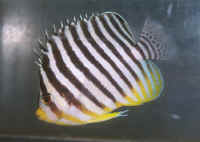
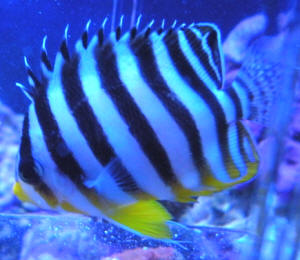
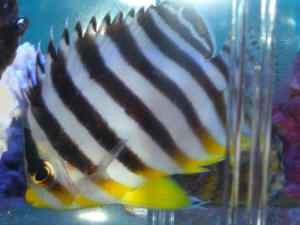
Venustus angel rating Mr. Fenner how are you? My name is Jason and I wanted to get your opinion on a specific angel that I really like. I swear by your book and follow it through everything I do but I don't see anything about this angel in there. The Sumireyakko venustus: how do you feel about this particular angel? Does it fare well in the home aquarium? Will it live a long life? Thanks a lot, Jason <Unfortunately this beautiful angelfish has a dismal survival history. Most live less than a week in captivity. For hardiness, look to some of the Centropyge dwarf angels... my and many others input is archived on our website: www.WetWebMedia.com Be chatting, Bob Fenner> Multi-barred Angel - Paracentropyge multifsciata Hello crew- <Michael) I recently saw one of these fish in my LFS, and went on the hunt for information before purchase. Unfortunately, there isn't a lot out there. From what I've been able to find, they get to about 4 inches, and are a deepwater species. <Relatively, yes> I have also been told that the biggest problem with these fish is getting them to feed. Scott Michael's book gives them a 2 for aquarium suitability for this reason. <I give this species the middle of three levels of rating. Most live about three months in captivity> I emailed the Marine Center about these guys, and was told that they definitely need a reef system, to pick on the rocks for supplemental feedings. <Agreed> I have a 1.5 year old 90 gallon reef tank with over 95 lbs. of live rock. I was wondering if you may have any additional information on feeding and behavior, as well as what to look for when purchasing an individual. <Nowadays, the few individuals of this species that are imported come in initially in good health... I would skip quarantine, but do a dip/bath for several minutes, and place immediately in your reef system> Additionally, if anyone has kept one of them, that would be great to know as well! Thanks for you time and help. Mike <More first hand information might be obtained from posting your query on BB's like reefs.org. Do record and volunteer accounts of your experience for others edification. Bob Fenner> Re: Multi-barred Angel - Paracentropyge multifsciata Thank you for the response. I did purchase it after I saw it picking at the rock in its tank at the store. I placed it directly in the tank based on the Marine Center's information. It quickly found a dark place to hide, but popped out the next day to pick at the rocks. I have seen it pick at Formula 2 flakes off the rocks as well, so I'm encouraged. <Me too. Great!> Still acting very shy, especially when it sees me coming by. No problem with aggression, and I haven't seen it pick at any of my corals (mostly leathers and Shrooms with a frogspawn and open brain), although it has only been a couple of days. <Only time will tell...> Also, I didn't think that my message got through (my computer crashed as I hit send), so I sent another one from my work address with the same subject. Sorry for the inconvenience. Mike <No worries. Thanks for the input. Bob Fenner> -Paracentropyge multifasciata: the Multi-Barred Angel- Hi WWM crew! First of all : thanks for all your support and sharing your knowledge. I'm reading Bob's and Anthony's books almost every day again&again and still finding something new and interesting. Now to my question: I was enjoying pics of Paracentropyge multifasciata in the marine books and was sure I will never see it in my LFS, all the books say, this angel is very rare and not imported. <A spectacular fish, unfortunately very difficult to feed.> What was my surprise when I've found it in LFS in Vienna last week. The specimen was looking good, healthy and alert, the price was good , so who could resist? <If it wasn't eating I would find it very easy to resist> It is hard to find any more information regarding this angel. Now I have 3" Multi-barred in my 110g reef , my other fishies are: 3" yellow tang 3" maroon clown 2" Yellowtail damsel 1,5" Allen's damsel 2" dimidiatus cleaner 2" bicolor blenny approx 30 soft corals, some LPS , one Montipora. Water parameters are OK. So far , the angel is doing well, I dipped him in freshwater dip, bathed twice in aquarium water to wash all parasites and powered on the 15W UV sterilizer. He looks good, not hiding too much and he is discovering holes and caves in the rocks. My questions are: 1: what should be his meal plan, so far he is sampling the LR and sand, will 110g provide enough food or should I try something to feed? yes there are some algae , but not too much , the tang lives mostly on spinach and lettuce. <You will most definitely need to feed it. Try all sorts of frozen foods like Mysis shrimp, clam, shrimp, etc. You must also incorporate plenty of algae into its diet as well. I would suggest halting the spinach and lettuce in favor of dried seaweeds. Good luck getting it to eat, they can be very tricky. You may need to try garlic and vitamin supplements in the food as potential attractants.> 2: would it be OK to add one more tang (hepatus) and one more angel (flame) in the future ? <You should be fine with a hepatus tang, but I'd skip the flame since you already have an angel.> thanks for your help, Roman from Slovakia <Good luck Roman! -Kevin> Rare Angel I've been seeing a lot of these around the LFS. Are the easy to keep ? What are the causes for their untimely death? <The Multibar Angel (Paracentropyge multifasciata) IS a neat fish, but most people have a very difficult time with them for the simple reason that they cannot get these guys to eat. Since they are from deeper water, they often suffer from various collection traumas, and in many cases, are doomed before ever arriving at the LFS. If you can get a specimen that is eating, provide it with a more dimly lit tank and few competitors, this fish can be maintained successfully. I think the whole key with these fishes, and with some of the more rare Centropyge angelfishes, is to get a specimen that has been eating prepared foods. Quarantine is an absolute must! Not only will it give you a chance to make sure that the fish is healthy, but it will "toughen up" this fish for captive life. The rest is just a matter of common sense, providing an appropriate level of care, an environment suited to their needs. Take a tip from WWM's David Dowless, who practically camps out in his LFS before buying a fish! This is a great strategy! You need to observe this fish for a good long time to ascertain its health. Ask the LFS personnel to feed th fish- not once- but a couple of times or more...see how it feeds, watch it's general behaviour. You may even want to place a deposit on the fish and see if it's still eating and healthy for a week or so before you bring it home. Good luck with this beautiful fish, if you do get one, and let us know how things turn out! Regards, Scott F> Rare Angel (Cont'd) Thanks for the info: My next question is whether or not the Multi-Barred Angel can be kept in a 378 gallon tank with a Coral Beauty and a Lemon Peel, or a Coral Beauty and a Flame ? <Well, in a sizeable tank like that, it's certainly possible if there is enough rockwork to create defined "territories" for each angel. It's tough to generalize how each individual will react to the presence of other Centropyge species, but your chances are certainly increased in a spacious aquarium. In my experience, Lemonpeels seem to be among the more belligerent pygmy angels, so you may want to introduce the Lemonpeel last. Flame Angels can be quite aggressive to other Centropyge angels, too. Coral Beauties seem to be quite sociable most of the time, so this fish might be a good choice. Finally, if you are going to introduce the Multi-Barred Angel, I'd get this fish in the tank first; let it establish a "routine" and a territory. It tends to be somewhat shy, so by letting it settle in, it will probably be better off when the other angels arrive. Good Luck to you! Regards, Scott F>
|
|

|
Features: |
|
| Featured Sponsors: |