|
FAQs about Rabbitfish
Identification
Related Articles: Rabbitfishes,
Related FAQs: Siganids 1, Siganids 2, Rabbitfish Behavior, Rabbitfish Compatibility, Rabbitfish Selection, Rabbitfish Systems, Rabbitfish Feeding, Rabbitfish Disease, Rabbitfish
Reproduction,
|
|
|
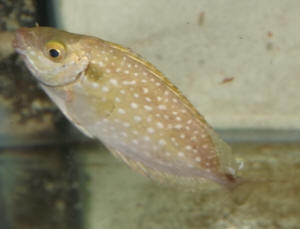
Quick Id question - what kind of fish is this?
6/27/14
<A Siganid. Bob Fenner>
AndrewC
|
 |
|
some ID please if you can
1/8/12
How are you guys,
<Fine.>
Went to the beach (Pattaya Gulf of Thailand)
tonight as it was low tide to look for snails, Hermits and some
crabs to add to my Sump and Fuge set up.
Found a lot of life there.
Saw some nice anemones (which I decided not to touch) caught a
little octopus but decided to put it back as I don't think it
is something for the aquarium.
Also found tons of snails (Nassarius) and crabs what I was
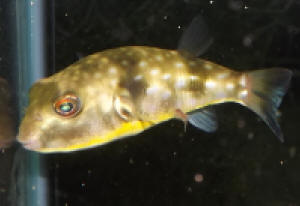
looking for Anyway now my son found this one can someone ID this
puffer?
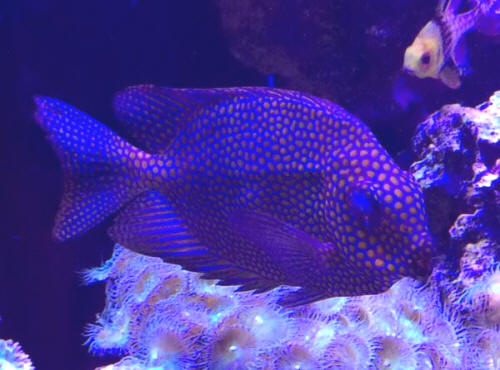
Also found some of these fish?? Not sure if they are fit for the
aquarium but the wife said to take them grow them and eat them??
She is Thai and gave them some Thai name but would like to find a
name and check out what they are?
can anyone help?
Dirk and Noi
<Hi Dirk and Noi. The puffer is a Chelonodon sp., likely
Chelonodon patoca or C. laticeps (taxonomy of this genus is a
little messed up in my personal opinion... forget about most of
the online picture IDs and much of the printed material). The
Rabbitfish is likely Siganus canaliculatus
http://www.flickr.com/photos/puffinbytes/5492401605/
and
http://farm5.static.flickr.com/4018/4548481776_0b40d288ca.jpg
which is
actually a food fish. Cheers, Marco.>
|
|
|
Foxface ID (Siganus unimaculatus) - 01/23/07 Just a quick
question here. I have a Siganus vulpinus with two black
spots, one on either side. <<Hmm, then is not S. vulpinus>>
I read in another FAO that this spot depends on geography. I
was just wondering what part of the world my little guy comes from and
what part of the world the solid yellow one comes
from. Thanks for you help. Jonathan <<Well Jonathan,
what you have is actually a different species of
Foxface. You have Siganus unimaculatus (the
"One-Spot" or "Blotched" Foxface) which hails from
the Western Pacific: Ryukyu Islands, the Philippines, and the North
West Shelf, Western Australia. This species looks very
similar to S. vulpinus, and there is some overlap in their ranges but
this species is a bit farther reaching being found in the Western
Pacific: western Philippines...as well as Indonesia, New Guinea, Great
Barrier Reef, Vanuatu (sighting), New Caledonia, Caroline Islands,
Marshall Islands, Nauru (sighting) and Kiribati
(sighting). And recently recorded from Tonga (geographic
information for both species per FishBase.org). Do a search
on the species name I gave you and see what you
think. Regards, Eric Russell>>
Rabbitfishes Dear Mr. Fenner, I have a couple of questions
regarding Rabbitfish. 1) I purchased a Rabbitfish one year ago and
can't tell what species it is. After searching WWM and my Burgess
Atlas, I am still uncertain whether I own a S doliatus or an S
virgatus. Is there some distinguishing feature that I can utilize to
determine the difference between those two species of Rabbitfish?
<Mmm, the first almost always has yellow bands on the body. S.
virgatus has an upper yellow dorsal-rear region, light below: http://www.wetwebmedia.com/rabbitfi.htm
If you saw them side by side...> 2) I also have a Lo vulpinus housed
in my 125 gallon tank with the Siganus sp. I've read on this site
as well as others that this may not be the best situation for the two
Rabbitfish. Despite this, they have lived at least nine months together
in complete harmony. In fact, along with my Z. desjardinii, the
Rabbitfish almost look as if they are schooling together. <Might
well be> Aside from five Chromis, these are the only three fish in
the tank. Presently, the tang and two Rabbitfish are all approximately
four inches. Should I expect more aggressive behavior between the two
Rabbitfish as they mature, or should I feel extremely lucky that my two
Rabbitfish do not display typical behavior towards one another?
<As they've grown up together there should be no major conflicts
between these two> I am interested because if it is likely that
there will be aggressive episodes in the future, I want to make
arrangements to get rid of one of the Rabbitfish. Thanks for all the
help your site has provided! <You are welcome. Bob Fenner>
How did the Foxface come about its name? 8/5/05 Hello Bob.
<James> Probably a silly question, but it is one where the common
name does not seem to fit the fish very well. Why did they name this
fish: Foxface Lo? <The old genus name "Lo" means
"rabbit"... and the one species, species name vulpinus,
"fox"... in reference to the physiognomy of the fishs
face...> Hawaii would be awesome but from lack of vacation (since we
both took most of ours already this year) and finances it is just not
in the cards'¦ =( Sincerely, James Zimmer <Though it takes
some looking into, the original scientific descriptions, namings of
biological entities can be sought... and generally make some sort of
sense... to the descriptor/s at least. Cheers, Bob Fenner>
|
|