Reef Slopes of the Red Sea:
These are regions of drop off from reef
flats/plateaus of principally rock and mineralized skeleton make-up. As
with reef flats in the Red Sea, the Slopes occur almost continuously
along the coast line and few island masses. Most (99 %) are a few to
several meters in expanse, with a few areas actually sandy beach (e.g.
Na'ama Bay, Sharm) and fewer still represented by drop-offs of
dozens to hundreds of meters in depth (e.g. Ras Mohamed). Most slopes
are steep, vertical to at least sixty degrees, with little taper,
presenting restricted light conditions for all but the top lip of the
slope.
About Red Sea Reef Slopes: Make-Up, Features of
Aquarium Importance
Flow rates for current are likewise reduced
locally. Appreciated by divers in high water movement conditions is the
"micro-climate" of diminished water flow at/near the reef
slope face itself. Typical water movement in aquariums (non-linear, a
few to several times per hour turnover) are fine for these
displays.
As with most Fish Only with Live Rock (FOWLR) to
reef displays, a careful stacking of larger (two fist size and larger)
rock with large openings in a more vertical arrangement are
desirable.
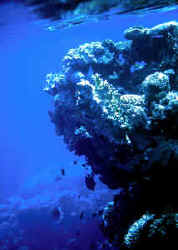
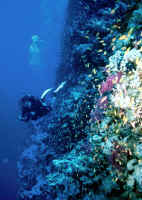
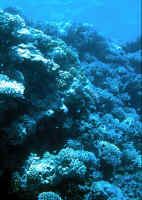
| Images of Red Sea Reef Slopes showing
characteristic traits. Near-vertical faces of rocky composition,
low light other than upper lip, predominance of principal life
forms: hard, soft corals, Milleporina, Orange Anthias
Basslets. |
| Video of Sandy Red Sea Reef Slopes: to
be done: place link to video at right, instructions to right click
icons. |
|
Biota of the Reef Slopes of the Red Sea:
A Rough/Inexact Delineation But Useful
Here we will list and describe the species of
most use and availability to aquarists. Of course there are many more
species than can be practically detailed here and some species that
should not be offered to the hobby do make their way into markets. As a
precautionary measure we'll include a table of ones that are often
for sale, but shouldn't be due to historically dismal survival
records.
|
Most Common Species of the Red Sea Reef Slopes
|
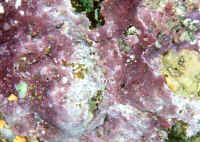
| Misc. encrusting Red Algae, filamentous Greens.
Same as the reef flat/plateau, with a sprinkling of other
species: Here's a nice patch of encrusting Red Algae with
the soft coral Parethropodium fulvum on its left. |
 |
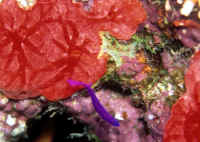
| Sponges of various sorts, encrusting, globular to
tubular occur sporadically. Most are small, inconspicuous, though
there is the occasional spectacular specimen that "rises
out" off the hard substrate. The hobbyist is most likely to
encounter encrusting species like Spirastrella coccinea
(shown), though the Red Sea is home to all Classes of Poriferans,
some tubular, some arborose, others vase and globular in
shape. |
 |
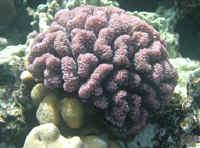
| Pocilloporids (Cat's Paw Corals) and Acroporids
(Staghorn Corals). The genera Acropora, Porites, Seriatopora,
dominate here. |
 |
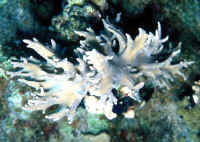
| Soft Corals, particularly "tree like"
Litophyton, Toadstool like Sarcophytons, occasional
rubbery when closed Sinularia (Shown S. polydactyla)
in upper, better lit regions of the slope. In lower, slower current
areas you'll find Pulsing Corals, family Xeniidae of various
species predominate and occasionally some dazzling
Dendronephthya. |
 |
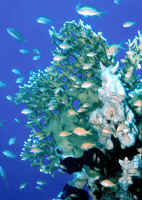
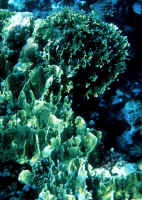
| Fire Coral, Millepora spp. A ubiquitous
genus in the Red Sea. Occurring as larger branches, encrusting
forms and even pillars growing on any, all hard surfaces where not
out-competed by other life. |
  |
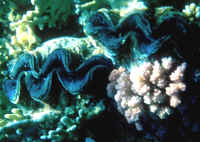
| Giant Clams, There are some T. crocea here
as well, but mainly you find Tridacna maxima (Pictured).
T. squamosa also occurs in the Red Sea; it's mainly
found further down on the sandy slope. |
 |
| Orange Anthias, Pseudanthias squamipinnis,
THE most common, make that "poster child" organism of the
Red Sea. Shoals of males and their harems are found throughout the
region. Other species of Anthiines occur in the region (see below),
though only one other in abundance. For aquarists these fishes live
in haremic associations, one or two males (if you have hundreds of
gallons) with as many females as you like. If the male/s perish, a
female will convert to replace it. |
 |
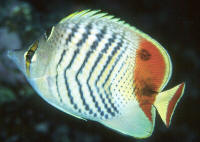
| Butterflyfishes; Chaetodon semilarvatus, C.
paucifasciatus (shown), C. auriga, C. fasciatus and
Heniochus intermedius "visit" the reef flat for
short feeding forays (or to avoid divers) but are more often
encountered on the reef slope, dipping in and out of overhangs and
rocky caves. |
 |
| Basses of various sorts (other than the omnipresent
Anthiines), family Serranidae. Some one is always lurking about.
All a diver has to do is turn their head to spy the hallmark delta
shaped eye of a serranid keeping their eyes on them. A handful of
species that are found in the Mares Rouge are imported to the
trade. Some are real winners for folks with big enough
systems. |
 |
| Tangs, family Acanthuridae, particularly the Naso
(lituratus) and Purple Tang, Zebrasoma xanthurum, Z.
desjardinii (Pictured, a ten inch one in the Red Sea)... though
a few others are common and useful enough to be mentioned. |
 |
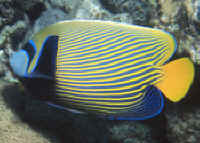
| Angelfishes; mainly juvenile Pygoplites
diacanthus, Centropyge multispinus (darting out of sight most
everywhere) and the occasional Pomacanthus imperator and
P. maculosus are seen here. Other species of pomacanthids
are found in the Red Sea, but are rarer especially on reef slopes.
Though not common in the wild, do look for the now-almost-available
everywhere cultured P. asfur's (see below) |
 |
|
Species Offered Occasionally from Red Sea Reef
Slopes but Should be Avoided
|
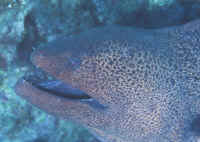
| Gymnothorax javanicus, the Giant Moray
Eel. To three meters in length. A fish, then crustacean
eater... and biter of humans when provoked. |
 |
| Coral polyp feeding
Butterflyfishes: Chaetodon austriacus, the Exquisite
Butterflyfish. Along with some other Red Sea Butterflyfishes
(Chaetodon pictus, C. melapterus, C. larvatus, C. lineolatus, C.
trifascialis) which are thankfully rarely offered in the
aquarium trade this species is sold from time to time, and is a
virtual obligate corallivore, making live coral polyps its
principal food source. |
.JPG) |
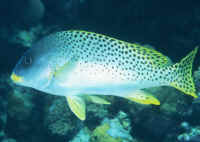
| Sweetlips, family Haemulidae, subfamily
Plectorhynchinae. No less than nine Sweetlips Grunt species call
the Red Sea home. Other than Plectorhynchus gaterinus
(pictured) which has only a marginal survival rate, most all
species die soon after introduction (if not before, enroute) to
captive conditions. |
 |
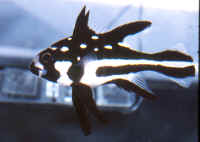
| The Black and White Snapper,
Macolor niger. Some friends in the wet pet industry and
other authors give this fish grand marks, but I have yet to see a
juvenile of less than five inches live for any length of time. Make
sure the one you are buying has been around a few weeks and is
feeding. Juvenile shown. |
 |
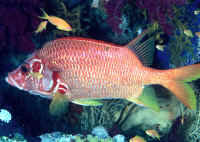
| Sargocentron spiniferum,
the Sabre or Giant Squirrelfish. A beauty, but often lost to trauma
in capture and shipping and too large for most systems (to eighteen
inches in length). |
 |
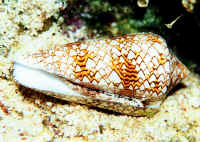
| Conus textile Linnaeus 1758, the Textile
Cone. Indo-Pacific; Red Sea, much of the rest of the tropical
Indo-Pac. Feeds on other prosobranch snails. Can be fatal to
humans. Red Sea image. This and the equally venomous C.
geographus are sold into the trade from time to time... and
should not be. |
 |
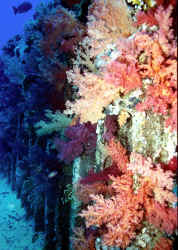
| Dendronephthya spp. (D. hemprichi,
D. klunzingeri in the Red Sea). These Soft Corals are often
breathtakingly beautiful in fluorescent reds, greens, oranges,
purples... but have absolutely dismal survival histories in
captivity. Attempts are being made, experiments by public aquariums
as to what these Alcyonaceans nutritional demands are... dissolved
organic carbon, nano-plankton? Shown: "classic" view of
the cargo container from the wreck at Ras Mohamed. |
 |
Survey of Best, Available Species of Red
Sea Reef Slopes:
Algae: There are no large stands of Red, Brown or Green Kelps
in the Red Sea, but quite a few encrusted and attached forms of these
Divisions can be found, and employed by aquarists, most of a
distribution encompassing the Indo-West Pacific.
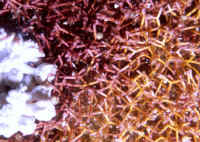
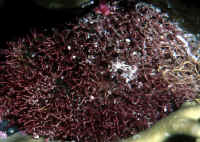
| Actinotrichia fragilis (Forsskal) Borgeson
1932, Spikeweed. Close up and colony images, in the Red
Sea. |
|
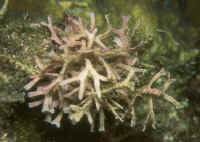
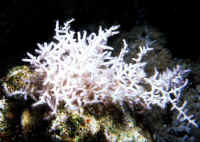
| Galaxaura sp. (maybe G. marginata) in
Hawai'i and a bleached-out colony in the Red Sea. |
|
On to: Red Sea Reef Slope 2 of 5
On to/down the slope to:
|
|