 |
|
| Home | Marine Aquariums |
Freshwater Aquariums |
Planted Aquariums |
Brackish Systems |
Ponds,
lakes & fountains |
Turtles & Amphibians |
Aquatic Business |
Aquatic Science |
Ask the WWM Crew a Question |
| Please visit our Sponsors | ||||
Seahorse coloration 12/28/12 seahorse behavior question (Bob Fenner)
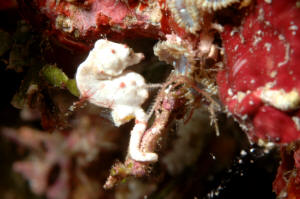
9/19/12 Carotenoids and seahorses -- 05/07/07 Hello Bob, <Hey Jorge! Howzit? Last time I saw you, your wife was about to deliver and we were giving pet-fish pitches!> I have read some of your articles about color in fish and I thing they has been very informational. I work with seahorses and I have done several experiments to improve the color in seahorses that naturally in nature present varieties of red, orange and yellow (i.e. Hippocampus reidi) I have used Canthaxanthin as well Astaxanthin in their diet with some not very satisfactory results. I think it should be another factor that is necessary to synthesize the carotenoids, Light for example, the type and color temperature of the light that they are exposed to. I have exposed yellow seahorses to strong metal halide and they have turned black in few hours. Of course background color is also important for mimicry <Oh yes> Did you know publications or work done on Syngnathids and their color? <I do not... would have to do a computer search... But do know some folks (am sure you know them too) that will know re such, likely up to current literature... Am cc'ing Pete Giwojna here> If you cave ideas of what we can do to improve the color in seahorses please let me know Thank you very much in advance Jorge <And would ask other friends in the trade... but this is likely a proprietary area. Bob Fenner> Jorge A. Gomezjurado President Draco Marine Aquaculture, LLC Center of Marine Biotechnology Pier V, 701 East Pratt Street Baltimore, Maryland 21202-3101 U.S.A < http://www.dracomarine.org> Re: carotenoids and seahorses 5/9/07 Dear Jorge: For display purposes, I find it is best to avoid high-intensity lighting such as metal halides due to the phenomenon you observed with your yellow seahorses. If the lighting is too intense, the seahorses expand their melanophores and produce excess melanin, which causes them to darken and obscures their underlying coloration. I believe this is a protective mechanism designed to safeguard the seahorses against the ultraviolet radiation associated with excessively bright light, just as we will develop a deep tan if we spend a lot of time outdoors in the bright sun. If you have red or orange Brazilian seahorses (Hippocampus reidi), display them under lighting that is shifted towards the red end of the spectrum to show off their coloration to best effect. For example, I find that the Osram Gro-lux fluorescent bulbs, which put out wavelengths of light that are concentrated toward the red and violet regions of the spectrum, produce spectacular results in that regard. They are intended to stimulate better plant growth, but have the added affect of greatly enhancing any red or orange or purple colors they illuminate. When bathed in Gro-lux light, bright red or orange seahorses literally glow! In fact, when I first discovered this effect with a Red Philippine Lobster (Enoplometopus sp.) in a specialty tank I believed I was witnessing actual fluorescence. The seven-inch bulldozer of a crustacean was covered with sensory bristles that made it look almost fuzzy, and under the Gro-lux bulb, the extraordinary excavator was instantly suffused with a fiery radiance that dazzled the eye. At first I thought it's exoskeleton was glowing, and I hypothesized that perhaps the chitin was infused with the type of calcite crystals that fluoresce under ultraviolet, and which perhaps could be similarly excited by the wavelengths emitted by the Gro-lux bulb, akin to the way scorpions fluoresce under UV. I only realized the truth of the matter when I added the same type of bulb to an aquarium containing, among other choice specimens, a gorgeous purple-and-yellow Royal Gramma and a rare red-orange erectus. Now, that seahorse was very colorful under any kind of lighting, but as soon as that Gro-lux lamp switched on, the erectus was ablaze with a shade of brilliant Day-Glo orange ordinarily only seen from neon signs, nuclear meltdowns, and psychedelic posters displayed under UV. The stunning steed shone with a luminous aura, awash with glorious orange glow that made it look like it was swathed with liquid fire. Suddenly, it was the color of red-hot lava, aflame with a blinding orange incandescent, and the result was truly spectacular. Then my shy Royal Gramma emerged from it's sleeping cave to keep the seahorse company, and it's magenta end was immediately suffused with a dazzling hot-pinkish purple glow that ended abruptly where it's yellow half began. That made it obvious that the new bulb was accenting colors at the red and violet regions of the spectrum, which are precisely the wavelengths of light chlorophyll absorbs best. In short, sir, your red or orange H. reidi will be dazzling if displayed under the right type of lighting that enhances their natural coloration. Best of luck with your display animals, Jorge! Respectfully, Pete Giwojna <Thank you for this input Pete... Do I understand there is not much/documented influence from nutrition on Seahorse color? Bob Fenner> Re: carotenoids and seahorses 5/10/07 Dear Bob: <Pete> Yes, sir -- I know of no published studies or research regarding the influence of carotenoids or other natural color enhancers on the coloration expressed by seahorses. <Interesting... I "did a little paper" in college on the role of these compounds on the development of reddish-orange color in a local obnoxious Damsel... the Garibaldi (Hypsypops rubicunda), named in honor of Louis and his colorful tunics... The folks at Longlife foods (yes, a while back) gave me 1/2 a k towards... and got to chat with none other than Carl L. Hubbs (he and Feder did a paper in the mid-50's re sources of predisposing nutritional factors (sponges mostly) and their role here...> I don't have anything more to offer in that regard that Jorge isn't already well aware of through his own efforts and contacts. That might be a good question for him to pose on the Syngnathidae pro discussion group; perhaps other curators and zoo keepers and aquarium professionals can advice him regarding their own experiences along those lines. Respectfully, Pete Giwojna <Good idea! BobF> Pipefish Behavior - 06/07/06 Hi Bob, great site by the way. My question is about my bluestripe pipefish. I keep a pair in my reef tank and feed them twice a day frozen mysis. Recently the male has been vibrating his body very awkwardly . Could this be a sign of the mating ritual or could he have an internal parasite. thanks. Joe <Is very likely reproductive, pair behavior. Neat animals. Bob Fenner> |
|

|
Features: |
|
| Featured Sponsors: |