|
|
| Home | Marine Aquariums |
Freshwater Aquariums |
Planted Aquariums |
Brackish Systems |
Ponds,
lakes & fountains |
Turtles & Amphibians |
Aquatic Business |
Aquatic Science |
Ask the WWM Crew a Question |
| Please visit our Sponsors | ||||
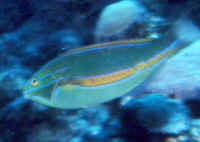
I was wondering if a blue line wrasse is a reef safe fish? 10/8/06 Thank You <Well, depends what you mean as the Bluelined wrasse. If you mean Stethojulis albovittata, then I don't believe you should even have that animal in captivity - it will die. No question about it. So it really doesn't matter whether its reef safe or not - which I wouldn't put it in a reef tank. However the Christmas/ornate wrasse Halichoeres ornatissimus I've also heard called a blue line wrasse would be OK mixed with corals however may be a threat to Fanworms, small hermit crabs, snails, and ornamental shrimps - so I wouldn't really add it to a full reef tank either. I'd recommend looking elsewhere for a suitable reef addition. Try some research of WWM. Have a good one, Jen S.> - Stethojulis Wrasses - Spastic Zoomers - Hello, I was
reading up on the Stethojulis wrasse genus and read that they don't
tend to live long in captivity. The one I'm considering is a Orange
axil (Stethojulis bandanensis). Do you know why they don't tend to
live long, is it diet or some unknown factor that causes them to
die? <It's a couple of things: they tend to bash
themselves pretty hard when captured, and this seems to continue
through the chain of custody. Bob likes to call them Spastic Zoomers
because this is what they do in the wild, and just spastic zoom times
10 when caught. This bashing about more than anything is what does them
in - they are exhausted, stressed, and injured by the time they get to
you. Additionally, they also just don't make the adjustment to
captivity... they seem to bum out as it were.> BTW, this would
be going into a well established 200g reef tank. <If your tank
were twice the size, it would likely make little difference. Their best
chance is in massive [1,000 gallon +] systems. They are very pretty but
super active fish.> Thanks |
|

|
Features: |
|
| Featured Sponsors: |