Florida/TWA Biotope stocking questions - 02/08/2019
Hello Crew! Hope this email finds you well.
<Aloha>
I am in the planning stages of a Florida/TWA seagrass meadow and
patch reef biotope tank. I'd like to get the details and
stocking selection done before starting to buy the equipment to help
this go more smoothly and avoid impulse decisions.
<Good idea.>
The tank will be in the 65-75 gallon range. There will be a seagrass
"meadow" (Thalassia) on one side of the tank, and a patch reef on the
other side. I'll be getting South Florida and Tampa Bay aquacultured
live rock for the patch reef, especially since this is the only way to
get stony corals from this area. Then I will also add (as needed)
gorgonians, Ricordea, Discosoma carlgreni, Zoas, and a selection of
macroalgae including calcareous macroalgae that will grow "rooted" in
the substrate.
<"as needed" - ? Why would any of these be "needed?" And with respect to
gorgonians, I would not recommend them. They are very difficult to keep,
especially in smaller systems.>
And some shrimp, snails, etc. as cleanup crew, and several rock flower
anemones (Epicystis crucifer). I will also be seeding the tank with
pods, copepods, live mysids, etc.
<Ok...>
As you know, the seagrass requires a very deep sandbed. I'm planning on
at least 9 inches deep.
So I figured with a sand bed that deep, it would be good to put in fish
who can take advantage of this.
<Not necessarily and not initially.>
First fish in will be a small group (3-4) of Jawfish, either Pearly,
Blueheaded, or Dusky juveniles. They will be the only fish for at least
several months.
<These should be the last to be added (unless you plan to keep the
system without fish for a long while). The seagrass will take some time
to take root. If you add the jaw fish before the seagrass is well
rooted, they are liable to tear it up. Do read this lovely article by
Sarah Lardizabal:
http://reefkeeping.com/issues/2006-04/sl/index.php>
So what other fish might be included? I am considering some Blue
Dartfish (Ptereleotris calliura), Seminole gobies (Microgobius carrii),
or similar fish.
When the seagrass meadow matures, a few pipefish or small seahorses
would be a nice addition.
<Let me ask you something... have you ever seen a set up like the one
you are describing? Have you ever seen seahorses and pipefish kept in a
65-75g system along with Jawfish, puffers, filefish, rock anemones and
all? I do encourage you to read at length about all, starting here:
http://www.wetwebmedia.com/Pipehorses3.htm>
Is it likely that they would hang around the seagrass area rather than
the reef area?
<They will likely hang out wherever they perceive is the best place to
hide... and you will be crossing your fingers the whole time that they
don't get blown into all those rock anemones at the other side of the
tank.>
Other fish in consideration are a Lancer dragonet (but only after the
tank is mature), a Slender filefish (Monacanthus tuckeri), Sharpnose
puffer (Canthigaster rostrata), and/or Apogon quadrisquamatus, A.
binotatus, Malacoctenus boehlki (Diamond blenny).
Sharpnose puffer is of interest because help keep seagrass healthy by
grazing on it (also because I like them). Lancer dragonet is because I
love dragonets, and this is the only one I could find that is native to
this biotope. Slender filefish is interesting, stays small, and more
reef-safe than the other filefishes. The Cardinalfish/Diamond blenny can
be kept as commensals with Corkscrew/Condy anemones which is cool, like
a TWA clownfish set up. (Note: note planning on getting ALL of these,
just looking for good possibilities).
Oh, and a question about corals. Obviously I will not be having any
Acropora cervicornis in my tank, but is there another coral that would
be a close look-alike? There are lots of Acroporas in the market but I
want that golden brown color, and the majority of the Acros for sale are
very colorful (not a bad thing but I am going for an authentic look
here). Any specific suggestions?
Also I will not be including fire coral as I am afraid of it taking over
the tank, plus I tend to become allergic to stinging things. Thinking of
substituting Heliopora caerulea for the fire coral as the look is quite
similar but doesn't go out of control.
<See here:
http://www.wetwebmedia.com/blue,pip.htm>
Thoughts? Suggestions? Criticisms? Thank you so much for your help,
which will certainly help me avoid making bad mistakes on this setup!
<Well, my first thought is that you need a bigger tank. Second thought
is, go slow my friend. If sea grass is your thing, focus on that first.
You're going to need quality lighting and have you thought about water
movement yet? Do read that reefkeeping article, and also here:
http://www.wetwebmedia.com/ca/volume_3/cav3i3/seagrasses/seagrasses.htm>
*Joanne White*
<Cheers,
Sara L.>
|
Puerto Rico coral ID 4/6/18
I have a friend that is in Puerto Rico helping out with environmental cleanup
after the hurricane. She was never really a coral person but needs to ID some
corals and to be honest it has been forever since I dug into the
Caribbean corals. I was wondering if you could give me your expert opinion on 3
of them. Thanks Bob!
Best Regards,
Cory Shank
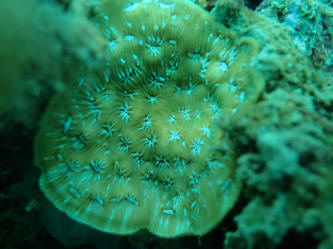
The first image looks like a Pavona, so i would assume an Agaricia sp.?
<I'm re-answering as I looked at these in another order. Yes to this one being
an Agariciid. I make it out as A. lamarcki>
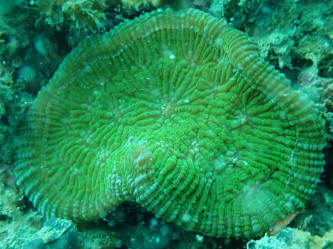
The second one almost looks like a chalice, I haven't dug to deep and I am quite
rusty with Caribbean corals.
<Mmm, am guessing while I ask friends for their input. Is this a Mycetophyllia
young colony... M. lamarckiana?... Turns out it is likely M. aliciae>
I'm pretty sure the third image is a "HAIRY" Corallimorph, she couldn't give me
anyone except for the image.
<Yes, for me, Rhodactis osculifera. Bob Fenner>
|
.jpg) |
|
Re: Puerto Rico coral ID 4/7/18
Thanks again Bob!
Hope we can catch up again sometime soon!
Cory
<Me too Cory. BobF>
|
|
A pic on your site 11/14/16
Hi
<Ross>
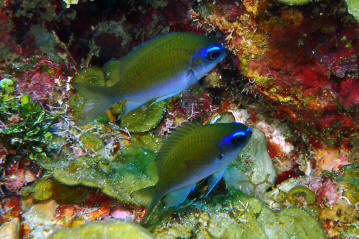
I would like to know who this photo belongs to, as I would like to use it on my
website www.stri.org/sfgc <http://www.stri.org/sfgc>
Thanks
Ross Robertson
<Ah; yes; this is my image (from Roatan, West End, earlier this year), and I do
grant you free non-commercial use. Will try sending the original file... on my
new DNS here in Mauritius. Wish us luck. Cheers, Robert (Bob) Fenner>
|
 |
|
Re: A pic on your site
11/14/16
Fenner
Excellent, and thanks for the quick response
<Welcome... Robertson!>
I was in the submarine at West Bay last month and saw lots of insolata,
including one or two like this that I was confused about for a while
<Ah; at depth do look different>
All images come with ownership acknowledgements on my websites...how would
you like yours done: name@wetwebmedia.com ? your website
www.wetwebmedia.com ?
Ross
<The latter is fine. Cheers, BobF>
Re: A pic on your site
11/14/16
Ok...will do, thanks
<Thank you for your efforts Dr. R. The site is of worth. BobF>
|
|
Strange growth? 10/11/15
Hello there. Just want to firstly thank you for the wealth of information you
share here. You are my number one spot to research everything. Now, for my
question. I have a 55 gallon salt water tank that has a cluster of mussels (no
longer living) which I collected from the ocean (Atlantic coast
southeast Florida).
<Ahh!>
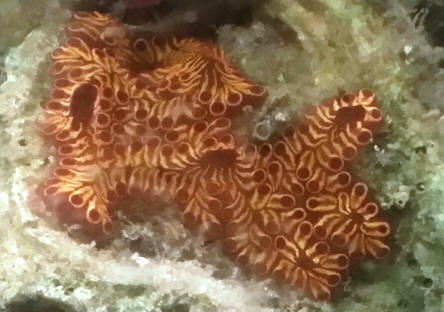
There is a very strange, but beautiful growth spreading slowly on it and I'm not
even sure what to search to try and identify it. Could you help?
<Yes; this is a colonial Ascidian... the "Flat Tunicate", Botrylloides nigrum >
The picture is taken close up, the grow is about the size of a dime currently.
Any help would be greatly appreciated. Thank you!
<Cheers, Bob Fenner>
|
 |
|
Coral ID 4/21/15
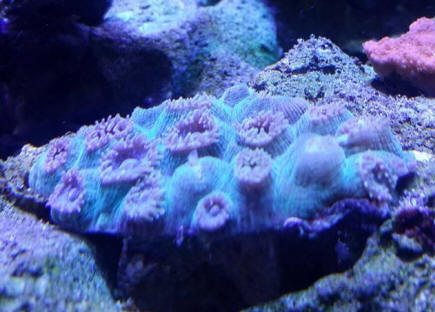
Hey Bob, Robert George Peets posted this coral in one of the fb groups.
Collected off the coast of Bermuda about 30' down. Said the piece that
was around 5' wide.
<Five feet?!>
It has not opened all the way but did eat some mysis. Thought you might know. He
has been involved in coral conservation programs in Bermuda for 12 years and has
no idea what it is. Help would be appreciated.
Thanks,
Lori Johnson
<Mmm; well; the size of polyps, color, the stated shape of the colony... may be
Eusmilia fastigiata... the polyps/skeleton are usually more pronounced. Their
colonies max out at about half this size. A beauty in any case. Bob Fenner>
|
 |
Re: Tropical West Atlantic biotope 4/20/15
Hello once again Bob (and crew),
I have progressed a bit in my build but have stalled due to budget overrun. I am
the proud owner of a 29g oceanic biocube (still need a good
divider to keep jumpy Jawfish from invading the back chamber,
<Fashion one out of Polythene netting (like Naltex) and fasten it in place w/ a
bit of Silastic sealant>
have a rodi and am seeding biofiltration hoping it'll help cure future seed rock
quicker.
Plan is to order 80lbs of mixed Bahamas substrate from marcorocks and 20 lbs of
dry rock to be seeded later by probably 10-15 lbs of kpaquatics rock.
<This is a bunch of substrate>
Do you believe I could get away with a mated pair of pearly Jawfish, or even a
non confirmed pair?
<Likely so>
Other desired livestock are Gramma loreto,
<Mmm; the jaws and grammas may not mix>
Elacatinus oceanops, and either chalk bass or a couple of Caribbean cardinals if
possible. And either Pederson's shrimp or peppermints.
<The chalk bass... may not go>
Would these organisms be appropriate for a gorgonian forest like environment?
<All; yes; but would be better with more room; like a regular-sized/shaped
forty>
I do have a few books on the Caribbean coming that should help some more. As
usual your input will be highly appreciated.
Thanks!
~Keith
Charlotte, NC
<Welcome. Bob Fenner>
Shipped fish sufferin 3/25/15
hey Bob-
<BH>
I shipped some fish in from the Caribbean. Shipping only cost me 45 dollars ups
overnight.
<... only>
Everything looks great , except for large black angel (Resting on the bottom)
and large Atlantic blue tang. They looked iffy on shopping bags, and so I drop
acclimated for 2 hours.
<.... what they do at times>
In my tank, the Atlantic blue is swimming upside down, sideways, near the
surface, and at times bobbing at the surface.
<Ditto>
I am in contact with the seller, however I do not like watching animals suffer.
The shipper is telling me to give it time, and it should straighten out.
<He's, they're right>
How much time would you give it before thinking of using clove oil or another
with euthanasia product.
<All the time in the world. B>
Thanks
Shipped fish 3/25/15
hey Bob, thanks for the fast response, much respect.
It was 40 to ship 70 pounds of boxes over night,
<Wow! How many organisms?>
to my house; not to the airport. To me that seems very fair.
Fish seem to still be doing the same. I shut my powerheads off, seems they
enjoyed floating around only to get stuck in them.
The symptoms I listed , does that sound like ammonia poisoning, lack of O2, or
just flight stress?
<Likely ammonia burn mostly... see WWM re Guerilla Acclimation... for biz>
Thanks, and have a good evening
<Off to cook, serve at the Green Flash HHH. B>
Re: Shipped fish 3/25/15
Roughly 17 organisms.
<Wow! That's a BUNCH>
70 lbs worth of water, including a few big Angels (6 inches or so)
<... do you have room for all this?>
a few bigger tangs, a few large sponges and a ten inch stop light parrot fish.
<.... a poor choice. Viride's of this size rarely adapt>
All fish with exception of two acting strange came in beautiful.
<ly>
(Ps this guy, who seems very honest, said with his ups discount, shipped this
order for 340 overnight. But his flat rate shipping of 40 is what saves the
consumer) I could never justify 340 in the fish let along just the shipping.
I highly recommend this guy ( foxy tropicals ) for anyone looking for Caribbean
specific fish.
<Ah, good>
I read that gorilla article a long time ago, couldn't find it today so that is
why I asked.
<Use the search tool, indices... Guerilla...>
I see some people advocate bag floating for temp acclimating, and dropping fish
in, no dripping. This seems in attempt to not arouse ammonia with rising ph.
<No.... read>
What is the green flash? Jersey guy here who doesn't make it out much.
<A local brewery; the Hash House Harriers... we have a monthly run there>
Thanks again for all you do.
<Cheers (and the reading as usual) B>
Re: Shipped fish
3/26/15
Good morning,
<B>
To answer some of the questions and make a few points:
1. Do I have room for all these organisms? No, some of these fish, went to the
guy who bought my last tank. I myself have two big tanks for the bigger fish I
ordered.
<Ah>
2. When looking for that acclimating article, I typed "gorilla" acclimation.
Forgot about the other spelling for it.
<Oh>
3. The parrot, when speaking with this diver, said once they stop feeding, it's
hard to keep them. But getting direct from ocean, with minimal airport and
facility stops, he says improves your chances. We shall see I suppose, I can
tell you he started pounding algae, krill and clams within 6 hours hitting my
tank.
<.... Sparisoma... see WWM re...>
4 I spoke with this guy about the two who have yet to improve (black angel, atl
blue tang) he said if they don't make it, he will replace them no problem.
<Fair of him>
Not a whole lot is said about what a parrot should actually eat as a staple once
they are eating. Most places warn to stay away, any guidance would be
appreciated.
<NLSpectrum pellets, large/r size, sinking.... and the reading>
And lastly, of all the fish I bought, my favorite is the 20 dollar pork fish
(Anisotremus virginicus).
<A neat, and beautiful species... And good to eat>
Neat, confident personality, typical aggressive water column feeding and nice
colors too.
<Best in a small group in a large system>
I think my days of the 200 dollar tusk fish, and 200 dollar achilles tangs are
behind me.
Thank you
<B>
Re: Shipped fish
3/26/15
Hey Bob.
Came home from work to see the atl blue tank succumb. He was on bottom, and
looked as if someone dipped acid on his body, welts, discoloration and just
overall ugliness on the body. Sorta like someone used paint removed on a car.
Does that sound about right to ammonia toxicity?
<Is>
Instead of getting another one, I may opt to use the credit towards something
else. Perhaps a blue hamlet , some high hats or a few small grunts.
Seems to me like the atl blue tang doesn't ship well.
<READ on WWM>
Thanks, Bob
Re: Shipped fish 4/2/15
Hey Bob-
<BH>
Just a follow up, placed another order in to same diver in the keys. 14 fish,
one loss, all looks great and ate within 24 hours.
<Good service and survival rate>
For the price of shipping (40 to your door) I am upset I didn't know
about this years ago.
<Mmm; not for everyone....>
The one downside is having a Caribbean biotype tank, however for the cost, and
more importantly, healthy fish, seems to be a very good resource to have.
Bob
<B>
Tropical West Atlantic biotope; stkg.
3/12/15
<Oooh, a fave topic>
Greetings Wet Web Crew! I'll commence with the praise, your site is an amazing
wealth of information and I'd like to thank you all for your work in maintaining
it and answering the ceaseless deluge of questions we the unwashed masses
bombard you with. And Bob, thanks to your books (primarily the Conscientious
Marine Aquarist) I have become drastically more
thoughtful about how I approach the hobby.
<Ahh; thank you; though I must and do account myself as part of the unwashed>
I'm planning for either a 29 gallon biocube or a 20-25 gallon drilled
with as large a sump as I can manage. I'm hoping to target a tropical
West Atlantic biotope but I'm suffering a bit of confusion as to the
conservation status and the legal protections for the corals from the region.
<Mmm; well; depends on where you're at... some countries allow use of their own
resources, quite a few don't... >
There seems no shortage of maricultured rock available, and in a decent load of
said rock one could expect to obtain a few assorted coral specimens.
<Yes>
But how do things go after that? Is there a gray area in trading frags grown
from these?
<Have seen quite a few; yes. Dick Perrin's "Tropicorium" among others>
If not, are there any dealers specializing in aquaculturing these organisms?
<Not specifically as far as I'm aware... there's just not enough (perceived)
demand, and many of the species, groups aren't deemed as beautiful as tropical
Indo-Pacific types... Though I always and still consider that Manicina et al.
would def. sell if cultured, small...>
And finally, what coral species are legal to wild collect in these regions?
<In the US? Scleractinians? None>
I'm certainly very interested in moving forward in my biotope plan, I intend to
focus on the pearly Jawfish and develop a system to complement this burrowing
fish as best I can. But I'd also like to grow some photosynthetic organisms as
my lighting budget allows without being an irresponsible consumer of Gulf
/Caribbean life, or ending up on the wrong side of conservation law (I don't
fancy orange jumpsuits)!
<Oh! Well; you could try some of the hardier Gorgonians (Pseudopterygorgia...),
sponges, Corallimorphs...>
I find the availability of maricultured live rock from just a few hundred miles
away compelling, and it doesn't hurt that I could realistically hand collect
specimens on my own. And diving on a live reef features high on my bucket list ,
the Caribbean and Keys seem most accessible for this goal.
<Yes; but again... the legality. Do check w/ Fish and Game, licensed collectors
in the area>
If you could help shed some light on these topics for me I'd greatly appreciate
it!
~Keith
Charlotte, NC
<We'll be chatting further. Bob Fenner>
Re: Tropical West Atlantic biotope 3/29/15
Hi Bob, thanks for answering so quickly before! I hope I'm not trying your
patience on email length or number of questions this time.
<Nope>
I'm ready to start moving forward on hardware and finalizing the stocking in my
head (did I say finalize? I mean continuous beta).
<Ah yes; "Nothing is decided till it's done"... a fave spiel>
Building management is form on the 20 gallon limit. One issue
with tank selection is that I'm always finding conflicting information regarding
a Jawfish ideal sandbed depth, you guys state 4" as good while Schultz at
reefkeeping.com believes 6" is a bare minimum.
<The deeper the better... here comes another broad stmt: "Life is a series of
compromises"... similarly our systems. One doesn't want to "give up/trade" more
and more depth at the "expense" of water volume at some point>
At the shallower depth, I believe it would be quite presentable in a 20 long,
and reap the benefits of more gas exchange and horizontal swimming area.
<Ahh! Much better stated>
At Schultz's suggested depths I feel I'd have to compromise and choose a tall. I
certainly want my future jaw to display his digging to his wee fish heart's
content, so I'm a bit torn.
<Don't be>
My rough draft of stocking is O. aurifrons, Gobiosoma oceanops (mated pair if
available, else single) and either a Gramma loreto or candy Basslet (need more
research on him still). Am I pushing my limit on bioload?
<Not so much this as needed space for fish-comfort>
And is the recommendation for the Jawfish to still skip full quarantine?
<IF you're pretty sure it's hardy initially; yes... Otherwise, if it IS the
first organism... it IS being quarantined wherever it's going>
Would likely acquire him first and let him settle in for a while before moving
on to the gobies, and then the last.
<Yes>
Could you recommend any sites or sources for good underwater photography of the
Caribbean that might serve my goal of developing better knowledge of the
aesthetic and habitat?
<All sorts... just Google searches... dive service/company sites.... tourist
bureaus...>
Would you recommend Albert Thiel's new book on nano reefs?
<Haven't seen it first hand, but his works are worthwhile>
It's difficult to find reviews on, likely because he is publishing and selling
independently.
<Ah yes>
My last question is on the issue of stony coral were it to turn up on live rock.
Let's say something like boulder star or Staghorn turned up, is there any legal
issues regarding growing it out and fragging / trading it thereafter?
<There are not as far as I'm aware>
Thanks for all your help as always,
~Keith
<Thank you for sharing. Bob Fenner> New to saltwater, lots of questions. Sm. TWA reef stkg.
Hello All,
<Geo>
I hope this isn't a dumb question. I am just now starting a new nano
“reef” in a 20 gallon long tank.
<Ahh!>
A skimmer may be added down the line when I have livestock (weeks/months
from now after my rock cures). I am aware of the limitations of such a
small system, but I want to get my feet wet (pun intended) with a
manageable tank. It is going to be a loose Florida biotope stocked with
a few small and reportedly hardy Caribbean/Atlantic fish. Corals wise I
want to stick with gorgonians,
<I'd skip seafans in such a small volume; you being so new. Not easily
kept>
Ricordeas, macroalgae with perhaps a few frags of open brains. I am torn
about sponges.
<I'd leave off with these as well>
I am tempted to try to keep one alive but I realize this may not be
possible.
<Not practical>
I have done a fair bit of research on general saltwater tank husbandry
and keeping corals, but one thing I cannot seem to find a good answer to
is how one attaches corals to live rock!
<There are a few ways... from (best) just placing securely and allowing
themselves to attach, to the use of "superglue" and epoxies...>
It seems like corals magically go from frag plugs to live rock. I have
seen some just stick the plugs into the rockwork which I suppose would
work too. What is the proper way to get coral on a plug off the plug and
in your tank?
<As you and I state above>
Additionally, I have questions about quarantine. I am getting a lot of
conflicting information. My LFS is reasonably okay but I imagine I will
be getting most of my fish online and having them shipped (which I
understand affects acclimation?).
<Better to do your own quarantine if you have time, can make simple
facility for>
Here is my (tentative) planned stock list. Feel free to critique:
Mated pair of either Rusty Gobies or Neon Gobies (not both)
1 Swissguard Basslet
<Mmm; not with the below>
1 Black-capped Basslet (slightly worried about conspecific aggression
with two Basslets)
<You should be... just the G. melacara or a G. Loreto here>
1 Horseface Blenny
<Just the gobies; not this blenny>
It is to my understanding that Gobies don't do well in quarantine (is
this still the case?).
<They're fine; given a tube/pipe or such to hide in; low light...>
If I don't quarantine, what is the best way to rid them of any unwelcome
additions?
<Dips/baths. See WWM re>
I am familiar with the concept of freshwater dips but there is a lot of
conflicting information on how to do it and what to put in with the
fresh water (if anything). I planned on getting the goby pair first in
case of catastrophe so that way they don't kill off the rest of the
fish. Worst case scenario I can move them into quarantine and let the
tank lie fallow. For the rest of the list, are they okay to quarantine?
<Yes>
Should I do any dips before quarantine?
<After, enroute to the main/display if they're looking "rough" on
arrival>
I have seen a lot of mixed thoughts about prophylactic treatment while
in quarantine, but it seems most are okay with preemptive PraziPro.
Should I wait until I see obvious illness or go ahead and treat?
<I'd wait w/ the fishes you list here>
I mainly don't want to kill off my fish or stress them excessively by
improper dipping and quarantining procedures, especially if they are
already stressed from shipping.
<You are wise here>
Thank you in advance for the help!
<Glad/happy to assist your efforts. Bob Fenner>
Re: New to saltwater, lots of questions. Stkg. 20 gal. reef
10/27/14
Bob,
<Georgianne>
I appreciate the fast reply! I figured my stocking list could use major
editing. I know enough about marine fish that they can be nasty towards
the same species but not enough to know who is going to play nice with
relatives and who isn't yet.
<Best to be/stay tentative>
Between the two Basslets, which is preferable?
<More the Loreto... stays a bit smaller, more used to bright light...
Oh, I see below... the Swiss Guard, but not by much>
It's kind of a toss-up to which one I prefer aesthetically. I am
disappointed the blenny won't work, but I'm sure there is a good reason?
<Too mean... esp. toward similar niche-occupiers... and particularly in
smallish vol.s>
I just love that horsey face.
The (Heavily) Revised Stocking List:
* Mated pair of gobies (rusty or neon)
* Either the Swissguard or the Black-capped Basslet
* ?????
I would like to add another fish or two max to liven things up a bit.
Not sure what would go well with that trio. The salty equivalent of
dither fish. With fairly heavy biofiltration and a skimmer I should (of
course will have to be proven by water quality and not guaranteed) be
able to support 4 to 6 small fish, depending on species. I plan on
stocking slowly with appropriate quarantine between fish, so I have some
time to figure out what else I may want. And time to figure out I am at
my max before I crash my tank....
Just for clarification, are you suggesting no corals at all or just not
the ones I have picked as potentials?
<Better to do a bit more reading for now... perhaps introduce small
Cnidarians a few months later>
I definitely want a reef tank (eventually) but need to go slow due to
not wanting to crash my tank killing off $$$$ livestock and also because
I am not made of money! Nothing good happens in a nano tank quickly
anyways.
<Ah yes>
I may be adding like a frag or two a month when my tank is stable.
<Very good. BobF>
RE: nitrate update. Actually; TWA travel
poss. 4/24/14
She is certainly one who appreciates different aspects of culture. She
is a social worker, and goes into various cities and homes with very
different "normal" levels. I am sure some inland lifestyles would be of
interest.
<Mmmm... yes>
I myself, like more of the meat, less of the potatoes. I could very well
see myself going to an island for 5 days, and snorkeling all 5. So
something that is geared for both would be ideal. I have had the Caymans
suggested before, and Belize as well. I was under the impression Belize
was wiped out years ago?
<Not... recovers w/in a few years of any near hit hurricane event.
Perhaps Puerto Rico... don't laugh; nor dismiss the poss. out
of hand. B>
Re TWA travel 4/25/14
Never ever had Puerto Rico suggested, will look into that. May even be a
cheaper option as well.
<Some very nice diving and cultural possibilities>
Strange discovery this morning. My pinpoint ph monitor in my fowlr has
been consistently (for the week I have had it) read 7.7 ph when lights
are off, 7.9 when they are on. Yesterday I did not feed at all, I was
gone all day, and didn't have the time to do it. This morning, prior to
lights coming on, it read 8.05. I am thinking since I did not feed, the
organic acids in the
water were low, which did not drive my PH down.
<Keep reading, speculating; cogitating furiously>
Caribbean reef biotope; stkg... a 100 gal...
3/13/14
Good afternoon crew,
<Rob>
It's been quite a few years since my last reef tank. I am interested in
doing a Caribbean biotope 100 gallon reef tank with gorgonians,
Ricordeas, Zoas and maybe some pacific SPS that look like their Atlantic
counterparts.
<Ahh!>
Stocking list-wise I am thinking of adding 1 blue tang (Acanthurus
coerulus), 1-2 cherub angelfish (Centropyge argi), 1 longsnout Atlantic
Butterflyfish (Prognathodes aculeatus), 3 royal gramma (Gramma loreto),
2 yellow head Jawfish (Opistognathus aurifrons), 1 diamond blenny
(Malacoctenus bohlkei), 1 saddle blenny (Malacoctenus triangulatus), 2
chalk bass (Serranus tortugarum), maybe 1 Colon goby (Coryphopterus
dicrus) or bridled goby (Coryphopterus glaucofrenum)
<This is a bunch of bottom-dwelling fish species...>
if I can find a specimen, 3 Flame cardinal fish (Apogon sp) and some
wrasses.
I think most of the wrasses in the Caribbean are not reef safe. I really
like Yellowhead wrasse (Halichoeres garnoti), Clown wrasse
(Halichoeres maculipinna) and Bluehead wrasse (Thalassoma bifasciatum).
If I drop the tang, could I add all 3 of them?
<Mmm; I do wish this system was going to be bigger... like twice your
planned 100 gal. None of these Labrids will do well here>
Since they love eating inverts, would it be realistic to only have urchins
and a queen conch as the clean up crew?
<Until the last gets too big... there are some cultured Conchs
nowayears>
I have never heard of anyone keeping a reef tank without snails but it
sounds like sea urchins eat the same algae. Do you know if these wrasses
would also eat sea stars?
<Might>
Would neon goby (Elacatinus oceanops) or green banded goby
(Elacatinus multifasciatum) be at risk of being eaten by the wrasses?
<I'd leave off w/ the Wrasses period>
On my search on FishBase, I found some other Caribbean wrasses that
appear to be invertebrate safe (Halichoeres bathyphilus and Halichoeres
burekae). I'm guessing they are pretty rare to find in the hobby, do you
know anyone that has kept them?
<I've never seen these species offered in the trade, and they're rare in
the wild...>
I am planning on finishing the set up with a view-able "refugium" that
would have feather dusters, cluster dusters, shrimps, scallops and
gobies (if I cannot keep them on the main tank).
<I'd skip the scallops... maybe hope that some come in, survive live
rock from the area... and no more bottom fishes!>
Thank you very much for your input! I hate to send so many questions but
I don't see much information on Caribbean biotopes and haven't gotten
much replies in different forums.
<Mmm, a shame... Cheers, Bob Fenner>
Re: Caribbean reef biotope
Thanks for the quick feedback! I will definitely look into some of the
aqua-cultured sea conch varieties. So reef tanks are doable with just
sea
urchins and not doomed?
<?>
I'll also look into adjusting the list, taking off some of the bottom
dwellers and adding a Swissguard Basslet (Liopropoma rubre) or Harlequin
Bass (Serranus tigrinus). I do like a lot the hamlet that mimics rock
beauties, but I'm concerned it would eat the smaller fishes. If I do get
a larger tank (I don't think I can get anything bigger than a 180gal), I
would like to add something else, maybe a Greenblotch Parrotfish
(Sparisoma atomarium) or several female Bluehead wrasses (T.
bifasciatum).
<The Thalassoma, or a trio are a poss., not so much the Scarid. BobF>
Atlantic / Caribbean Biotope (Corals?) – 09/23/12
Happy Friday…Hello WWM Crew,
<<Morning John, Sunday now…apologies for the delay>>
My wife & I went to a new LFS and they had a large quantity of corals
(frags / large pieces, etc). Now my wife is saying that she wants me to
set up a reef tank.
<<Lucky fella…it is usually “we guys” who have to convince our spouses
re>>
I wanted a FOWLR Caribbean Biotope.
<<Hmm, okay…nothing wrong with that either>>
''If'' I go the reef tank direction, what Caribbean corals could I look
for?
<<Jake Adams has a series of articles on just this subject posted on the
Advanced Aquarist website…here’s a link to the first in the series
(http://www.advancedaquarist.com/2007/12/aafeature2 ). Do also search
our site, and the Net in general, with search-phrases like ‘Tropical
West Atlantic Corals ‘>>
Thanks for your help.
<<Happy to share>>
Regards,
John from Jersey
<<Cheers…Eric from SC>>
Atlantic / Caribbean Biotope 8/29/12
Hello Mr. Fenner, et al,
<Hello John>
I hope that you & all the WWM Crew are well.
<Everyone is still kickin'>
I recently came back from Can Cun <Cancun> where I was able to spend a
little time snorkeling. When I returned home, I was charged up about
restarting a salt water aquarium. I broke down my last tank down in 2004
before I moved into my current house.
Reading the available magazines I learned about Biotopes. Specifically,
an Atlantic / Caribbean Biotope. I have read the posts on WWM, however,
I am unclear about one thing, namely, must a biotope always contain
corals, etc? Or, can a biotope be a FOWLR set up?
<Does not have to contain corals, just displaying fish that are found in
a particular region.>
Also, one of the crew tried to dissuade a person who was interested in
getting a Blue Tang for his biotope because it would need a lot of
swimming room. I am thinking of a 75 gallon tank with live rock. Would
that size tank be big enough for a blue tang?
<No, more like a 180.>
Finally, are 4 eye butterflies 100% out of the question? I think that
they are one of the most beautiful fish available.
<Difficult to keep for any length of time.>
Well, that is all. Thanks for your help & guidance.
<You're welcome. James (Salty Dog)>
Rgds
John from Jersey
|
Crab: Persephona mediterranea - 3/22/11
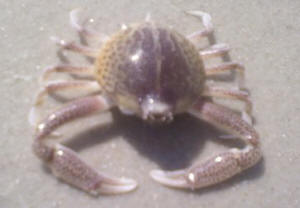
<Hello Ginger, Lynn here today.>
Can you identify this crab for me? I see them at Dayton Beach all
the time.
<It appears to be Persephona mediterranea (family:
Leucosiidae), aka the 'Mottled Purse Crab'. These crabs
are commonly found around Florida, where they bury themselves in
the sand with only their eyes showing. The term 'purse
crab' is derived from the female's unusually large
abdomen, which is used to hold eggs underneath the body until
they're ready to be shed. For more photos/info, please see
the following links: http://www.jaxshells.org/slife7.htm
http://www.gsmfc.org/seamap/picture_guide/Crabs/persephona.pdf
Photos showing the abdomen of a gravid/egg-bearing female:
http://www.okeefes.org/Crabs/crab_photos.htm
>
Ginger Cole
<Take care, Lynn Zurik>
<<Thank you Lynn! I couldn't find this decapod in any
of my TWA ref.s, or online. B>>
|
|
|
Sonnier Banks Biotope - Spanish Hogfish,
Bluehead Wrasse and Smaller Fish 2/18/11
Hey crew -
I am planning a new tank, likely to be 200 to 300 gallons and would
like to feature a biotope instead of a particular fish or coral.
<Oooh, a fave presentation approach of mine>
I set my sights on Sonnier Banks because it is very close to where I
live. I used the Reefs.org site to assemble a fish list. The top three
fish that are hobby friendly are the Queen Angelfish, Spanish Hogfish
and Bluehead (I slipped the other angels b/c I know they would not mix
with the Queen Angel). My questions regard the Hogfish (Bodianus rufus)
and Bluehead (Thalassoma bifasciatum).
<Ok>
First, will these two wrasses be compatible in a 200 gallon system?
<Yes... the latter should be kept in a small numbered shoal... w/
one definite alpha male, some females...>
Second, I know that I can not keep two Spanish Hogfish, but can I keep
a Spanish Hogfish and a Cuban Hogfish?
<Mmm, either species and one individual would be better than both at
adult sizes>
Third, if the Bluehead is compatible with the Hogfish, is there a
chance I could get a mated pair of blueheads?
<There is no such thing... live in haremic conditions... see ref.s
re, even just WWM>
I suppose I could start with juveniles, or maybe get one juvenile and
one sub-adult, if this is doable in captivity.
<It is... are you going to collect your own? I can help you w/
technique here>
Finally, with either the hogfish or Bluehead or combinations thereof,
would I be able to keep any of the smaller reef fish: Seaweed Blenny or
Redlip Blenny, Neon Gobies, Colon Goby or other gulf substrate Gobies,
Damselfish (Stegastes sp), Reef fish (Gulf Chromis), Flame fish, Cherub
Angel or Wrasse Bass?
<Yes; certainly in this volume... w/ sufficient cover/decor>
If not, what would you recommend?
<To keep adding to your own want list... from reading,
diving>
By the way, I do not plan on adding all of these, just naming all the
possibilities.
Bonus question, would either a Doctorfish (rare in trade) or an
Atlantic Blue Tang be appropriate for this tank, or is there too much
aggression.
<Could do fine here>
What minimum length of tank would I need for either of these?
<The bigger the better... and wider rather than taller... at least
two feet wide, six feet long>
I will end up with something between 5' and 7' in length.
Would either of these pair or shoal in captivity?
<Not in this size volume, not really>
Other information on the tank. The only inverts I plan to keep is to
grow Millepora Fire Coral and various sponges from aqua-cultured live
rock, and then maybe add a few other non-gulf corals to litter the
aquascape since gulf corals can not be purchased. I don't plan on
adding any mobile inverts. I do plan on adding the Queen Angelfish if I
get a tank closer to 300 gallons, but will skip it if I am closer to
the 200 gallon size.
<You are wise here>
Thanks
Chris
New Orleans
<Please do send us periodic updates, images of your progress. Bob
Fenner>
Re: Sonnier Banks Biotope - Spanish Hogfish, Bluehead Wrasse and
Smaller Fish 2/19/11
Thanks for the response Bob! I do wish biotopes were more common place
in the hobby.
So as a follow up, definitely only one hogfish and I can mix a Bluehead
wrasse with the hogfish a 200 gallon. Your suggestion on the Bluehead
harem caught me off guard and I really like the idea. I did not think
this could be pulled off in an aquarium and now you have me re-thinking
my stocking plans. How many should I do in a 200 gallon tank, keeping
in mind there would be a Spanish hogfish? Are we talking only 3? Could
I do as many as 7?
<Three or four>
Would I introduce them all at once, or stage them so that not all the
juveniles are the same age?
<Could be placed all at once... if you can only get a terminal/male
individual at first, place that>
I do want to accommodate all the fish in their adult life, that is no
other large tanks to split them up later (I can only sell my wife on
one).
From what I have read, blueheads are planktivores, so if I do a shoal
of blueheads, I should probably pass on the chromis, or do you think
this would still be ok?
<The three Chromis species of the TWA are not easily kept, not even
generally available in the trade>
I would still like to do some damsels that are native to the area.
Their nasty tendencies would be welcomed in my house.
<Mmm, see here: http://wetwebmedia.com/fwgtwa6.htm
and the next file in this series>
I do just want to verify that the wrasses can hold their own with a few
in there. And likewise, the damsels. The two most common to my biotope
are the cocoa damsel and bi-color damsel. Neither of these are your
standard issue Stegastes. Would three or five or each be ok in this
display or am I pushing it?
<... I'd have only two of any given species in this genus. Too
territorial>
I don't know if a 200 gallon has enough 'footprint' for
them to settle down.
Not planning on collecting my own fish. Just don't have the means
to get out there. Being in New Orleans, Id have to go pretty far out to
do that. I envy the Floridians for this luxury.
"To keep adding to your own want list... from reading,
diving"
I have done a lot of research on my fish choices, i.e., www.reef.org and www.fishbase.org are my favorite two.
This site is a wonderful supplement. Unfortunately, when your ideas are
outside the norm, you forced to confront a lot of mis-information out
there, especially on the hobby boards. But also my goal here is not to
showcase everything the Gulf has to offer, which is what people think
when you say "Gulf Biotope". I want to just show case the
fish that are most common at Sonnier Bank and/or have a relationship
with a fire coral- sponge zone reef.
For example, the Red-spotted Hawkfish will actually perch on top of the
fire coral as the Hawkfish is immune from the fire coral sting. A small
grouping of damsels or chromis would take cover within the fire coral
if the fire coral colonies are large enough, particularly with a
hogfish in the tank. These are the kind of things I am looking to
showcase.
So if you are aware of any fish that could have a unique mannerism in
this biotope, I would love to know about so I could pursue that
direction instead of just the generic 'here are all the fish in the
Caribbean, you should get one of each and call it a biotope."
<Mmm, there are hours we could talk... Am off to Cozumel at
month's end if you can make it to dive, chat, photograph>
Thanks for the help. I will definitely share my experience with you all
as this develops. I believe I already have a post on your site
regarding the Sonnier Banks biotope when I fist thought about it a year
ago.
Take Care.
<And you, BobF>
St Thomas USVI
2/22/10
crew, Bob et al.,
we are going to St. Thomas on our honeymoon toward the end of Oct. plan
on doing an "eco-tour" but also am taking snorkeling gear,
maybe going to get Lonnie to go diving.
Does anyone have an specific suggestions on destinations on the
island?
have read over some stuff at trip advisor and the like, but figured I
would ask if anyone had any specific experience I could gain from.
Thanks,
do hope all is well with each of you,
Forrest
<I have only been there once, and mainly just stayed at, dived
through the service associated with the Marriott. A hike into the
surrounding hill/town was worthwhile, sampling the more/less local rums
as well; the diving not great, but fun enough. Do consider a day trip
to BVIs, the National Park.
Bob Fenner>
Re: St Thomas USVI -- 02/22/10
Ok,
thanks, I'll consider the trip to the BVIs. have also been told
specifically to jaunt over to St. Johns, will as it were also be
staying at the Marriot.
do you think the diving was worth doing? Lonnie has never been before,
and I'd like her to go. do you think it'd be a good first
dive?
cheers,
Forrest
<I do... the water is sheltered, calm where the dive svc. goes, not
much current, there is much to see, and if the same staff and mgmt. are
still there, they are excellent. Cheers, BobF>
Re: St Thomas USVI
ok, thanks again
<Bon voyageeee! B>
|
Ga Ga For Grammas (Royal Gramma Biotope System)
7/7/09
Hello Crew,
<Hey there! Scott F. your Crew member today!>
I am in the process of setting up a 29g reef, which has been
built, but not yet stocked pending the conclusion of my
research.
<Good heavens- you're RESEARCHING before setting a system
up? This is really great to see/hear. So many problems can be
eliminated with a little time spent researching. Good for
you!>
I want to showcase Condylactis anemones (only one type, hopefully
the gigantea), and my wife is interested in a Royal Gramma.
<One of my all-time favorite fishes!>
That led me to focus on a
Caribbean biotope, having read Tullock's and Mr Fenner's
books, as well as Reef Invertebrates by Mr Fenner and Mr
Calfo.
<Excellent references all!>
I am leaning toward
the shallow side of a fore reef, with a 2x65w Coralife fixture,
an Aqua C Remora skimmer, and dual returns routed from a SCWD
that should result in a total flow rate of around 300-350gph
after accounting for head loss and the head pressure of the SCWD.
The tank has been drilled and has a 1" Durso installed.
<Know the man- love his standpipes!>
I have around 25lbs of well established Fiji rock (can't get
Gulf rock locally), another 25lbs of well established base rock,
and 40+ pounds of live sand. I anticipate about a 4" sand
depth in the display, with a 20g long being used for the
sump.
<Sounds good so far. If you're thinking about the whole
biotope idea, do consider building up a rock overhang under which
your Royal Gramma can hang out in a natural fashion This is a
really interesting biotope. In fact, I'll be in the Caribbean
next week, and hope to be visiting my pals the Grammas in their
natural environment!.>
Other species I am considering include 3-5 peppermint shrimp, a
few Astraea and turbo snails, and a pair of Atlantic cleaner
shrimp (actually, Lysmata amboinensis, as I can't get the
Atlantic version locally). I would want to place the anemone or
anemones in first to let them settle a bit, as I anticipate them
wandering a bit more at first. I only plan on keeping one Royal
Gramma. I don't think a second fish is a good idea in a tank
this size, unless you think there's a practical option.
<I would generally not attempt adding more than one in an
aquarium of this size. Perhaps a few Neon Gobies might fit in
nicely and add to the interest of this biotope, but that's
about it. If this were a larger system, I'd definitely create
an aggregation of Grammas, and perhaps a few other fishes>
I've looked around the site, but haven't found info on
this specific setup...any advice?
Stan
<Well, Stan, I think that you are on the right track. As an
obsessed by biotope geek myself, I really think that this is a
great way to highlight and learn more about animals that you are
interested in. Fishes and inverts in a system that attempts to
replicate the natural environment will display more natural
behaviors and colors, as well as possibly engage in spawning
behavior. And, biotope systems are highly educational to both
hobbyists and non-hobbyists alike. They are truly unique displays
that can provide a new dimension of enjoyment to your hobby. Best
of luck! Regards,
Scott F.>
Re: Condy anemone/royal gramma biotope
Stocking a Royal Gramma Biotope 7/8/09
Scott,
<Hey Stan>
Since you're headed that way, can you suggest a few names of
likely Royal Gramma habitats in the Caribbean? I know they are
prolific, but I am hoping to find some biotope pictures online,
and it seems the best way to research biotopes is by looking at
tourist-oriented websites, especially for deep sea diving
locations.
<Excellent thought. The tourist and dive sites are a great
source of biotope information and usually have great photos as
well! I would look for information from The Bahamas, Venezuela,
the Lesser Antilles, and other outlying parts of the Caribbean. I
hope to see some in Grand Cayman and Isla Roatan, but that might
be wishful thinking. They seem to be very commonly encountered in
Bimini in the Bahamas, so checking out dive sites for this area
could be fruitful. Check the sites for dive operators in the
other areas mentioned, too, and www.fishbase.org for specific
type localities and other great information!>
Also, I hear the C. gigantea species can top out at 12 inches. I
anticipate not having any corals or sessile inverts in the tank,
but will this anemone's size be a problem?
<In the size of aquarium that you are contemplating, this
species could be a problem. I'd be more inclined to consider
smaller, hardier, more abundant "Rock Anemones", such
as Phymanthus or the "Corkscrew Anemones", Bartholomea
species. Although it would be cheating a bit, as these species
are generally not found in the same environment as the Grammas,
these would probably fare better in a system of this size. To be
honest, I would pass on an anemone altogether in the biotope, as
they are generally not found in super close proximity to the
Grammas in nature. I would be much more inclined to utilize
Gorgonians, or even (artificial!) sponges and encrusting soft
corals (versions of Sinularia, perhaps- although not found in the
region, could make a suitable facsimile of the local corals, if
desired.). Passing on the anemone would create a more
faithful/functional/sustainable reproduction of the biotope,
IMHO. You should consider planting some calcareous macroalgae,
such as Halimeda, in the rocks.>
As the focal point of the tank, I am okay with it filling the
tank...
<Umm...consider the options above.>
Lastly (though I know better), any chance of an Arrow Crab
working in this size aquarium with a Royal Gramma? I am under the
belief that sooner or later every snail, shrimp, or fish would be
lunch at some point in a tank this size (29g). I just think they
are cool, so I like to ask around.
<I, too, have always loved the Arrow Crab, but I'm a bit
leery of them at the larger sizes. Although better known for
eating polychaetes like bristle worms, they do tend to develop
more "cosmopolitan" tastes in the confines of an
aquarium, perhaps even going after more desirable life forms,
such as Feather Dusters, etc. They will definitely be a threat to
smaller crustaceans, such as shrimp, and could at least
potentially be problematic to smaller more sessile fishes, so
keep this in consideration. Although not really piscivores per
se, "accidents" do happen in the aquarium. I would
certainly keep a small specimen if you are inclined to have one,
and keep a close eye out for potential problems in a system of
this size. Best to use some of the small to medium sized shrimps
instead, although not to small, as you might end up feeding your
Gramma an expensive little meal! So much to consider, I know, but
we just need to be mindful of the potential issues in a
modest-sized system.>
Thanks again for a great site!
Stan
<My pleasure, Stan. Don't want to "rain on your
parade", but I did want to give you some food for thought in
regards to potential stocking issues for this aquarium. Best of
luck, and keep me posted on how this system evolves!
Regards, Scott F.>
Re: Condy anemone/royal gramma biotope
Stocking a Royal Gramma Biotope (cont'd.) 7/8/09
Scott,
<Hey Stan!>
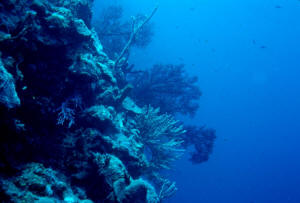
Something like this, perhaps, with my tank representing a slice
of the bottom of this wall. I have some synthetic Red Sea live
rock that looks very similar to the red encrusting sponges found
in the Caribbean. I could use that along the corner to conceal
the overflow and mimic the sloping wall. Pillars of true live
rock go along the bottom, inter spaced with Halimeda. I can get
gorgonians pretty readily here, and there are rock anemones
brought in as hitchhikers pretty often as well. I may also attach
some dried sea fans to augment the gorgonians.
<Very nice...This is a great biotope to replicate. I have
often though that it would work well in one of those tall, narrow
aquariums (You know- the kind that end up in the garage
collecting dust for eternity, or become
terrariums..>
Final livestock plan appears as such:
1 Royal Gramma
2 Cleaner Shrimp
3-5 Peppermint Shrimp
2-3 Turbo Snails
3-5 Astrea Snails
maybe a...
<Hmm...maybe a Neon Goby or some kind of Blenny...Maybe a
Jawfish, if you have deep enough sand! Keep me posted on this
setup! Regards, Scott F.>
|
 |
|
Re: Condy anemone/royal Gramma
biotope
Caribbean Biotope (cont'd.) 7/23/09
Hey Scott,
<Hey there!>
I found this on the web...great report that has actual counts of
coral specimens, along with their locations and the
fish/invertebrates found with them.
<Very cool to find this kind of information on the web. There
is a wealth of useful biotope information out there for the
hobbyist willing to take a serious look!>
Here's another report dealing with anemones in the Keys
specifically...Also, a really good website, with movies and pics
of Caribbean biotopes (help planning your dives?) can be
found
here...http://jrscience.wcp.muohio.edu/html/tropecoimages.html.
<Neat..in fact, Michelle L. and I just returned from a
Caribbean dive trip, and we noticed Condylactis anemones on reefs
in Belize and Cozumel..I was surprised, quite frankly, to see
them there.>
Interestingly, I noted that there are fairly low appearances of
Cleaner/Banded Shrimp, suggesting that multiple specimens in a
29g tank is not representative of their natural habitat (unless
they are pairing). This holds true for Arrow Crabs as well,
although they are already known to fight each other in
aquariums.
<Absolutely. Although once again, on the reefs I did see these
creatures residing in surprisingly close proximity to each other.
This would be completely crazy to attempt in an aquarium, IMO.
One of the coolest things I saw was in Cozumel- a
"family" of 3 Arrow Crabs- two adults and a little guy-
all on a small patch of rock. It was really cool to see.>
Sure is a lot of stony coral...I will be using some "branch
rock" around the slope and along the bottom to replicate the
pieces that would normally fall off and deposit along fore reef
slopes due to storm damage. The Acropora count was around 50-60%
of the coral counted in some areas, with algal growth accounting
for most of the rest...
<I was surprised to see so much macroalgae, such as Dictyota
and some turf algaes, covering the reefs...far more predominantly
than corallines.>
For my setup, I will be trying to replicate a small slope that
might be found along a fore reef wall, a ledge, if you will.
<Nice idea.>
Also, here's a super website that has lots of pics, and some
movies, of various locations in the Caribbean.
<Hmm...not seeing it. I'm very excited to see your concept
coming together.
Best of luck- and keep me in the loop! Regards, Scott F.>
Re: Condy anemone/royal gramma
biotope
Emerging Biotope System 7/24/09
Hey Scott,
<Hey there!>
The aquarium is set up and running--with a minimal clean up crew
and livestock for now.
<Good! Patience will pay off...stock slowly!>
I wound up using base rock for most of the aquascape, as it
worked better for the look I was going for. I added a few pounds
of Tonga branch (we'll call it Caribbean acropora!) around to
mimic fragments that would have fallen down the slope. There is a
large cave, with several holes and nooks. Additionally, I put in
some plastic Vallisneria plants (still not sure on these) to
mimic errant sea grass.
I couldn't resist a dried sea fan the LFS had to add to the
effect.
<I like the idea of the plastic plants...You can always remove
them or replace them with real seagrasses if you don't like
the effect.>
There's a bit of a brown algae bloom (thanks to a mini cycle
the live rock and substrate went through when it was moved over
from the FO tank), so I added 3 turbo snails and 3 Astrea snails,
along with a single fuzzy green mithrax crab. I also put in two
rock anemones (which rarely make it to my LFS).
<Just stay calm...LOL>
Most of the 15lbs or so of Fiji live rock is in the sump, which
will eventually house a DSB underneath the plastic egg crate the
live rock is sitting on.
<Sounds good.>
After we get back from our trip to the beach (Hilton Head, SC), I
plan on adding the rest of the clean up crew (mostly more Astrea
and a few hermits), along with some peppermint shrimp and the
royal gramma. I may also add a cleaner shrimp OR a coral banded
shrimp (most likely the former).
<Good...stock slowly and keep an eye on things as you go...No
rush here.>
I'll keep you in the loop...
<Please do!>
Stan
After a few weeks, I hope to add either corky sea finger or
silver rod gorgonians.
<Has the basis for a really cool display. Looking forward to
seeing it evolve! Regards, Scott F.>
|
|
Snorkeling 5/15/09
Hello to Bob and the rest of the crew. First I wanted to just say
thank you all very much for the work you do and the wealth of
knowledge you share on WWM.
Just recently back from my wedding/honeymoon in the Florida Keys,
Everglades region. The trip included some snorkeling at the Dry
Tortugas as well as the Grecian Rocks area of Pennekamp State
Park. That being said
I just wanted to share a pic from the snorkeling with you, it was
one of the better that we took. Enjoy and thanks again!
Joe
<Ahh! A Gray Angel in sea fan city! Thank you for sharing Joe.
BobF>
|
[1]%20Joe%20Dinaro.JPG) |
Caribbean Biotope, stocking, new tank media
replacement and substrate for Jaw Fish 4/25/09
Hello all,
<Hello, sorry for the slow response here.>
Thanks in advance for answering my questions and for being (at least
for me) one of the best online sources of information.
<Welcome!>
My question is this I read you FAQ on Caribbean Biotope and I wanted to
start my own but with some slight differences. I was going to add LR to
both sides and leave the center open or maybe just on one side and
leave the rest an open area would the latter be better for
everybody?
<Either can work fine, tis more of a personal aquascaping
choice.>
I have 3 fish now a Royal Gramma, a Lawnmower Blenny, and a Yellow
Clown Goby and 2 Peppermint Shrimp that I want to add to my new
system.
My new system is a Red Sea Max 65 Gallon all in one and because it is a
new system I will leave it fallow for 2-3 months or more so it can get
established or my wife makes me.
<LOL! NO reason to wait so long unless you are curing new
rock...even then you can accomplish the swap once it is
"cured". See:
http://www.wetwebmedia.com/ca/volume_2/cav2i3/Live_Rock/live_rock.htm>
For stocking I was going to add some more fish but I don't know
what else to put in there and my wife want to put fish that are seen
and not hidden and I don't want to push my bio load because I want
to make a reef safe tank with some species of coral that will go with
my lighting.
<Okay, again a very personal choice of taste. Research re
suitability and compatibility will show you the way.>
My next question is should I replace my foam media with a different
type of foam? Also should I replace my ceramic pieces for LR
rubble?
<What, where? Do you have LR in the main system?>
My last question is the substrate for the Jaw Fish, I read your FAQ on
Jaw Fish systems and I want to make sure that I have my 'ducks in a
row' before I start. Can I add 30lbs of Aragonite Aragamax sugar
sand, (1st layer) 40lbs of Ocean Direct Caribbean Live Sand (2nd layer)
and 10lbs of Florida Crushed Coral sand (3rd layer) or would I have to
add more to make my new Jaw Fish happy?
<This will put you at about the bare minimum IMO. I would include
some more CC or even some larger shell type pieces.>
Thank You,
Ramon and Sons
<Welcome, Scott V.>
Re: Caribbean Biotope, stocking, new tank
media replacement and substrate for Jaw Fish 4/26/09
Thank you for answering my question,
<My pleasure.>
The tank has been set-up for about a week and it has some base rock and
a piece of LR, I will be transferring some of my LR from my 29 Gallon
that is already running but I have BGA on the rocks and I'm in the
process of trying to get rid of it via a 10 gallon tank with a skimmer
and water changes.
<Ah, good, steady with the battle.>
The tank it self has a compartment in the back of the tank that has a
foam block (black) that keep air bubbles from going into the pump and
back into the tank, it also has and area that houses 1 bags of ceramic
media( rings) and a platform that holds 2 bags of carbon.
<Okay.>
I was thinking about changing the carbon for a bag Chem-Pure Elite and
adding a bag of Purigen while removing the foam because of the build up
it might cause but I wanted to know should I do it during the cycle
process?
<You can leave it be, but be sure to rinse it frequently. The other
medias are fine, but of little value over just carbon in most
cases.>
My other half wanted the water changes to be at least once a month so I
don't know what I should do to keep her happy and not put me in the
outs with he as far as spending all the money.
<Well, no way around it, smaller more frequent water changes are
just better.>
She also said that I can have a Refugium but no more DIY's.
<Dang! DIY is fun!>
I also will be adding another 20 lbs of substrate to the tank, it is by
RedSea (Reef Base) would this be good to add or another type.
<Sure, sounds good, Scott V.>
Diving Bonaire 11/27/08 Scott V,
<Hello again Mark!> This isn't part of our original
discussion, but I wanted to say a little about the efforts that Bonaire
has undertaken to protect their reefs. Bonaire is a beautiful place and
they understand that one of their biggest attractions is the underwater
world around their island. Even with the rain prior to our dives, we
had visibility of over 80 feet. During the summer they receive very
little rain, which is evident by the cactus growing on the island.
It's not unusual for them to have visibility of over 100 feet. The
corals are beautiful. When you dive in Bonaire you have to pay a $10
fee to enter their National Marine Park. They have declared the area
around the entire island as a national park and instituted several
things that I found very cool. In addition to the fee they have made it
mandatory for all dive operations to perform a buoyancy check for all
divers prior to diving on the reefs. They also do not allow divers to
wear any gloves to discourage anyone from touching. As an experienced
diver, I found it a little annoying to have to do the buoyancy check
and a checkout dive, but I understood what they were trying to do.
<Yes.> If you dive, you've seen the people that like to go in
with too much weight, "just to be sure", and end up crashing
into the bottom with utter disregard for what they just destroyed! This
is the first time I've actually had to show buoyancy control before
being allowed to dive since my certification dives in 2002. I'd
actually like to see some of these common sense things done in the US.
I dive in Fort Lauderdale, Florida at least one every year. Now, the
water is a bit colder there, so taking the gloves off may not be
possible, but a buoyancy check? I don't think that's too much
to ask. <It is a good idea.> It would actually benefit the dive
boat operators to protect the reefs. It is the source of their income.
No reef, no divers! Kudos to Bonaire! Mark Gustin <Thank you for
sharing this. It is good to hear that they are taking these steps to
protect what is there. Perhaps we will meet on a dive some day! Quite a
few members of the crew are divers in fact. Talk again soon, Scott
V.>
|
Caribbean biotope stocking plan Planning a
Spicy Caribbean Biotope System! 6/5/08 Howdy Crew! <Hey
there! Scott F. in tonight!> Finally managed to get a much
bigger tank. After placing sand, the internal volume (not
counting rock) will be 130gal, with a quite sizable
sump/refugium. Besides the return (which runs to a SCWD), I'm
also running a closed loop with a Quiet One 4400 (with headloss
it's running about 700 GPH). After the rock is in and
everything is cycled I will likely be placing a Koralia, Vortech,
or something else in there for added flow. <Good idea!>
Anyways... I've been spending a week or two a year in the
Caribbean, and this last trip to Cozumel gave me some extended
bottom times that allowed me actually sit and observe, rather
than just drifting by in an effort to see everything. This has
led me to deciding on a biotope, rather than a selection of fish
and corals from all over. <Excellent! I'm a huge fan of
biotope systems. There are numerous advantages to creating such a
system, among them decreased allelopathic competition, a more
"familiar" environment for animals, and a far more
unique display than the usual "garden reefs" that we
are so used to seeing!> For corals, I plan on having various
Zoas, Ricordea/Mushrooms, Brain Coral, Purple Seawhips, Golden
Rods, and some others that are easy to take care of and that wave
around a bit. I'd also like to have some sponges, like the
Red Balls, but have yet to attempt any. <Sponges do have some
specialized husbandry requirements, so do read up on the specific
needs of the species that you intend to keep. Consider limiting
your coral selections to just a few species.> Fishwise,
I've got an extensive list. Numbers wise, I'm sure this
will have to be trimmed down some, but I'm more worried about
introduction order. Would really appreciate some advice there.
But, on to the list! 4-5 Blue Reef Chromis 3 Pygmy
"Cherub" Angels (I do have some experience with harems)
<I've always been a big fan of monogamy, but whatever
floats your boat...!LOL Introduce 'em last> 2 Yellowheaded
Jawfish (mated pair from a friend) 1-2 Sharp-nosed Puffers
(they're actually pretty comedic!) <Do rethink them if
you're going with small, peaceful species.> 1 Red Lip or
Diamond Blenny 1 Royal Gramma (I'd like more, but they fight
so much...) <You can keep them in groups with enough rockwork
for them to hide under and establish territories, and aggression
is general dispersed among the group without too much bloodshed,
in my experience.> 2-4 Neon Gobies 1 Blue Tang (gotta find an
adult with a yellow tail! Seen 'em!) <Do re think the
Tang- they need a lot of physical space in order to live long and
healthy lives. Think small fishes!> 1 Longsnout Butterflyfish
(one of my favorite! Hard to find for sale though) or Spotfin or
Reef <Good luck- neat fishes if you can get 'em...>
I'd also like to have a small Golden or Shy Hamlet. Other
maybes include 3-4 Flamefish, Chalk Bass, Bicolor Damsel (the
pretty variety, jerks, but entertaining). Might also reduce the
list in order to have a Porkfish or Queen Angel. It's really
a shame that the Cowfish and Boxfish all get so big... <All
nice fish, but you need to think about the stocking limits of
this aquarium- unfortunately, you can't have it all! The
Queen Angel, although beautiful, is best enjoyed in the wild-
this fish simply gets HUGE and is just not a good choice in
anything less than a HUGE aquarium (ie; a public aquarium),
IMO.> Inverts: Usual assortment of stars and hermits. I really
had a good time watching Sexy Shrimp, but they're lunch for
so man fish that I don't think any would survive without an
Anemone (which I am not fond of at all). No Banded Coral Shrimp
or Sally Lightfoots, as in my experience they are too aggressive.
<With small fishes, they can be a nuisance at times. Best to
follow your instincts on this one.> I am tempted to put in a
Frogspawn. <Umm...wrong ocean, babe!> I have access to a
pretty amazing colony that has multiple colors mixed in the same
heads! No, seriously, the colors are not separated into distinct
segregated heads, there are literally pink and green tentacles
mixed on the same head. Pretty wild, but out of the Caribbean
biotope... <I was just giving you a hard time. Of course they
are out of place in a Caribbean biotope, but it's all a
matter of how "authentic" you want to go with your
biotope. They are VERY aggressive corals that can nettle other
species, so do keep this in mind when considering stocking your
system with one of these specimens. Provide large spatial
separation between the Frogspawn and other corals.> Related,
this trip I saw a HUGE number of Pipefish, but not where I
normally find them. The currents were rippingly fast in the
Palancar area, but there were large deposits of seagrass bits and
pieces in slack areas. There were many different species of
Pipefish in these areas, and even scouting out the sandbeds
nearby. I was shocked to find a trio cruising the sand at
125', picking at all sorts of tiny critters, not a bit of
cover in sight! <Neat observation...could make an interesting
biotope aquarium in and of itself, huh?> Near-shore Seahorses
have apparently been carried away in recent months, and I
didn't see a single one. There were more lizards in the water
than Seahorses... <Lovely...> Anyways, many suggestions or
advice would be appreciated! Thanks, Darby <Well, Darby, I
think that you're on the right track with this biotope (okay-
the Frogspawn...I dunno about that one!), and it could be a
unique display. A few thoughts here: I'd try to limit both
the number of coral species and fish species. For example, keep
maybe two or three coral species maximum, perhaps just two. Also,
consider limiting the fish species as well. I'd consider
keeping a group of several Royal Grammas (like 5 or more), a few
Hamlets, and perhaps that trio of Centropyge. With good
aquascaping, you can create a tall vertical reef structure on one
side of the aquarium, with a large overhang, which will provide a
very natural setting for the Gramma colony. You might even get
the chance to observe breeding behavior. If you leave on side of
the aquarium almost devoid of rock, you could create a sandy
rubble area in which the Jawfishes could construct their burrows.
You could create a very unique display in with small fishes and a
few corals! Think about it!> p.s. The Catalina Goby fry that I
passed to a friend a couple of years ago have been spawning with
others. My buddy is now attempting to raise them in commercial
quantities, but having some problems. He's also a bit too
proud to seek concerted advice, as he doesn't want anyone to
get the jump on him. Ah, the failings of ego... <Neat to hear!
Good for him and for the hobby! Thanks for sharing, and be sure
to send me some pics of your system when it gets going! Could use
some for my MACNA biotope presentation! Good luck! Regards, Scott
F.>
Re: Caribbean biotope stocking plan Caribbean Biotope
(Pt. 2) 6/7/08 Thanks for the advice Scott! I do appreciate
it. <I'm happy to be of service! Thrilled that you're
considering biotope modeling for your aquarium!> Keeping the
types of corals low is going to be tough for me. I guess I'll
go with the purple photosynthetic gorgonians (for movement and
color, as well as cover), Zoas, and maybe one of the encrusting
brains (hard to find, but they look great under blue moonlights
when they open up at night!). This should give a pretty good
color variety with the green and red/orange sponges. I'd
really like some of the purple sponges, but from what I
understand they aren't very hearty in captivity. <They can
be touchy, categorically. You will need to research the specific
sponge that you plan on keeping to see if it is viable in
captivity.> The way this tank is built, the closed loop comes
into the back wall almost in the center. With a 5" sandbed,
it's closer to the bottom, so I built a horizontal spray-bar
out of 1" pvc, painted black (using Krylon Fusion,
supposedly marine safe. Please let me know if otherwise!) to help
hide it against the black background, until the coralline algae
takes hold. Because of this, my aquascaping plan is to create a
pair of rock pinnacles in the center of the tank, allowing the
fish to more room to swim (in racetrack laps if they wish) and
for the alternating flow of the SCWD to have some effect. <I
like that aquascape idea...it breaks up the usual
"wall" of rock that we construct, and provides the
addition of multiple territories for fishes.> As I don't
have the rock yet, I do not know whether there will be a bridge
between them, or if they'll be individuals, but it should
present enough sand bed for the Jawfish to be just about wherever
they want. <I would not build a "bridge"- let them
stand without touching each other for maximum effect.> I'm
not sure if this scheme cuts down on hidey-holes or not, but
there'll be plenty of ledges. I do like the idea of having
separate "zones" like you suggested, and this was my
plan when I was going with a 90gal Long (I was going to have a
reef zone, rubble zone, sand zone, then seagrass zone, over the
course of 6' of length). I'll seriously ponder keeping
the rockwork on one mostly one side, but want to be sure that it
doesn't look unbalanced/awkward. <It is a different sort
of aesthetic than we're used to, but you will find it to be
quite attractive and interesting over time!> I'm surprised
that you suggested more than 1 Hamlet. I figured that, as bass,
they'd be much more prone to predatory action in a group than
solitary. That was the reasoning for having a shoal of Blue Reef
Chromis; the Hamlet may get them to shoal, but they'd be too
big for him to eat. I saw one while diving with a juvenile Cherub
Angel in it's mouth, and though I wasn't happy about it,
that's nature... I wouldn't want a repeat in my tank!
Would Golden or Shy Hamlets be more appropriate? <I like the
Indigo Hamlet, myself. I do need to backtrack a bit- I must
confess that I wasn't thinking "Hamlet" when
responding to your query. You are right- one per aquarium, in
most cases. I was thinking about Serranus tortugarum, the
"Chalk Bass", for some reason. You can keep a small
group of these guys in a large aquarium.> I like the idea of
multiple Royal Grammas, as they're colorful and fun to watch.
One of the few fish that actually hangout upside down! <Yes-
and they do surprisingly well in groups if you have a rockwork
for them to shelter in and under.> As for the harem... well, I
was young and... I mean, er... <Heh, heh- I couldn't
resist!> From what I've seen with others who have had
Cherubs in groups, it is apparently good to start with 5 all at
once, as you'll likely loose at least 1, and another will
likely become a "superfluous second banana" who can be
removed, leaving the 3 breeders. If you just go with 3, you may
end up with only 1, as there's no guarantee on gender if
there is territory to claim as individuals. Guess I may be
writing up a report all this at some date, if it works. <You
got it- this is really the best way to start multiple Centropyge
in an aquarium. Introduction of modest sized groups of juveniles
is the way to go.> Big fish will stay out. They were just a
pipedream anyways, as I know where they belong. ...sigh...
It'd be nice to have a system though where you could have a
Queen Angel, Queen Trigger, some large Cowfish and Filefish, and
maybe a ray or two. Man, it'd have to be HUGE! Guess
that's what the ocean's for... heh heh. <You hit it
right on the had, Darby...Think SMALL!> Thanks again, Darby
<Best of luck! Regards, Scott F.>
Re: Caribbean biotope stocking plan 6/10/08 Caribbean
Biotope (Cont'd.) Hiya Scott, <Hi there!> Chalk Bass!
Hadn't even thought of them as an aquarium species! I think
it's probably because most that I've seen were laying
tight against the reef, or in crevices. They are somewhat
attractive, though I can't remember seeing any in any LFS.
Hmm, I'm sure a direct supplier in Florida would be the
route. Better research them a bit. <Yes, they make fine
aquarium fishes!> The Indigo Hamlet certainly is a handsome
fish, but not the color combo I'm looking for. I think a nice
bright yellow Shy Hamlet could be a nice "visual
piece". <Ahh, I hear you. It's important to choose
types and colors of fishes that please you!> The tough part is
visualizing the tank beforehand. I mean, before I was angling
towards a blue-fish based tank, with a few brightly colored
accent fish, but now it's a bit yellow. <Again- no right
or wrong here. It's just a matter of personal preference.>
I say that, but who knows what the temperament of the Royal
Grammas will be? I've had some that were very active and
always out, and some that tended to be much more shy... <The
personalities of these fishes do vary widely. However, they are
quite sociable in groups, once a social hierarchy has been
established. With enough hiding places and a large enough group,
you'll see fascinating social interactions.> Here's
another question: I've seen some Dendrophylliids (no, not the
'tree lovers') in several places in the Texas gulf and
Caribbean. Though they are an introduced species, their
coloration certainly would add a splash! Do you think they'd
be proper for a Caribbean biotope? Thanks again, Darby <Well
Darby, I'd have to say that they are not appropriate.
However, there us no "law" that says that you need to
follow certain stocking guidelines. It's all about your
tastes and goals for the system. If you're a purist,
you'll only utilize animals strictly found in the biotope
that you are attempting to replicate. If you want to take a
little "geographic liberty", it's your call! Enjoy!
Regards, Scott F.>
Artificial Jawfish homes? Helping a Jawfish Construct
his Home 10/17/08 Hey Crew, <Hey there! Scott F. in
today!> Well, my 150gal Caribbean Biotope is cruising along.
Live rock has sprouted numerous interesting types of micro and
macro algae, gorgonians and Ricordeas seem to be enjoying
themselves, and even a trio of Royal Grammas are socializing and
getting along. All is great! ...except... <Always that
exception, huh?> I thought I had thoroughly prepared the sand
to accept Jawfish prior to filling. After running for 2 months, I
received my first Jawfish. He was unfortunately the only survivor
of 2 mated pairs that were delayed during shipment due to
Hurricane Ike. He was a touch traumatized, finally coming out
from the rocks to dig a burrow after a full week. This is when I
discovered that the sand is apparently too fine! I had used a 1/3
live sand, 2/3 pulverized limestone. Mixed in was about 4 lbs. of
large rubble, and 20lbs of "Puka shells" (small mixed
shells). I'm not sure if much of the rubble has settled
deeply, or what, but all this 3-1/2" fella has been able to
create has been a bunch of 3" deep circular craters. He had
a shallow tunnel one time, but it collapsed and filled in very
quickly. <Sounds like you'll need to utilize additional
coarse materials to help him create a more stable matrix for him
to construct his burrows.> I'm hoping that perhaps I may
find an artificial solution. Do you think that perhaps several
1" diameter or so PVC pipes sunk into the sand might about
4"-5" might work for them? I figure they'd have to
be full of sand so that Jawfish could dig them out themselves,
but I'm not so sure that they'd recognize them as
possible locations for homes. However, if they DID accept them,
then it'd be a cinch to locate them where I'd like the
fish to hang around conveniently for display. <A good idea. My
friend Anthony Calfo has suggested a similar type of construction
with PVC pipes for Moray Eels. As you presume, it may that the
fishes do not use the PVC "tunnels". However, I would
give it a shot. I'd also add some additional coarse material
to enhance your substrate. I think that a combination of the two
will help your Jawfish construct his homes. As always, thanks for
your help! Darby (I have to remember to get a photo of the tank
in for Scott F...) <My pleasure. And, yes- please do forward
along some pics! Regards, Scott F. (who will be doing some diving
in Jawfish country next week!) >
|
Atlantic Blue Tang stopped eating 03/19/2008 Hi
WetWebMedia Crew, <<Morning, Andrew today>> A few months
ago I upgraded from a reef 90 to a 215 gallon with a 65 gallon sump
that had Caulerpa growing in it. All water parameters were normal. The
aquarium had been crystal clear until 4 nights ago when the lights went
out in the main display tank, and the lights cycled on in the sump.
About a half an hour later, I noticed the tank was muddy dirty.
Alarmed, I looked everywhere in the tank to see what could have caused
it. I looked down in the sump and noticed that the Caulerpa was looking
pretty pale so I pulled it all out. I also observed a spider and a lady
bug in the sump water. I immediately went to your website to read up on
Caulerpa, and started to get worried. I didn't have any salt water
available because we had just performed a water change. I already had a
PolyFilter in place, and immediately added activated carbon. The
protein skimmer was skimming like crazy and had an odor to it. I even
turned the ozonizer on. I observed the tank all night long hoping
everything would be fine. The tank cleared up completely after a few
hours. So far, everything seems fine except my Atlantic Blue tang (who
use to eat like a pig) suddenly doesn't want to eat anymore. She
has two other tang tankmates; a Sailfin tang and a Yellow tang. The
other two tangs still eat like pigs. All the other fish are doing fine.
<<Continue to provide greens, maybe add some garlic or Selcon to
attract the tang to eating again. Probably been spooked from the tank
water issue. Very delicate species of tang>> The Atlantic Blue
tang will swim up to the algae clip as though she is going to eat from
it, but them swims away and doesn't eat a single bite. When I feed
in the morning, she swims up to the food as though she is going to eat
it, and then swims away not grabbing a single bite. She does, however,
graze on the live rocks and sand. I have also noticed that she
doesn't appear to be the dominant tang anymore. She is somewhat
passive now. <<As the tang is still picking from the rock and
sand, i don't think its anything to be overly concerned about. Try
feeding as i mentioned above>> Today I ordered some Red Tang
Heaven from Indo-Pacific, hoping she might eat that. I read about this
stuff on your website and ordered it several months ago. My tangs
absolutely love the stuff. <<Good deal>> Do you think the
Caulerpa crashed and caused the tank to go dirty? I don't think it
was from the liverock because it had been in the 90 gallon for almost a
year, with the exception of a few pieces that I bought from the LFS,
already cured. <<Its possible it did cause the water issue
yes>> Any suggestions as to what might be wrong with the tang? Is
there anything I can do to save her? This is my favorite fish and I
would feel really sad if something were to happen to her. <<See
above, also read more here including linked articles and FAQ's
http://www.wetwebmedia.com/acanthurTngs.htm Your help is greatly
appreciated. Thanks, Nancy <<Thanks for the questions, hope this
helps. A Nixon>>
|
What was it - eel or sea snake? -03/13/08
This week while snorkeling in St. Kitts I saw an eel or sea snake
[I know there are supposed to be none in the Caribbean.]
<Correct> It was 11 inches long, checkered [perfectly] from
head to tail and I think the tail appeared pointy. The checkered
colors were bright white and jet black and perfect rectangles.
Each rectangle was sharp, about 8 mm long by 5 mm wide and the
long rectangles were oriented length wise. The design was a
perfect black rectangle next to a white rectangle on either side
as well as on top and bottom. Each of the four corners of the
black [or white rectangle] touched a black [or white] rectangle
about or below. It looked geometrically perfect. <Mmm, maybe
Muraena retifera. Bob Fenner>
What was it - eel or sea snake? -03/13/08
This week while snorkeling in St. Kitts I saw an eel or sea snake
[I know there are supposed to be none in the Caribbean.] It was
11 inches long, checkered [perfectly] from head to tail and I
think the tail appeared pointy. The checkered colors were bright
white and jet black and perfect rectangles. Each rectangle was
sharp, about 8 mm long by 5 mm wide and the long rectangles were
oriented length wise. The design was a perfect black rectangle
next to a white rectangle on either side as well as on top and
bottom. Each of the four corners of the black [or white
rectangle] touched a black [or white] rectangle about or below.
It looked geometrically perfect. Please email what you think it
was. Thank you, Dr. George Oremland <Possibly a Snake eel.
Have a look here:
http://www.robertosozzani.it/Bonaire/murena03.html ; here:
http://florent.us/reef/carib/sharptaileel.html and here: http://www.wetwebmedia.com/ophichthidae.htm.
Cheers, Marco.>
Re: What was it - eel or sea snake? Follow up -
03/14/08 Thanks Marco. I checked all of those sites and none
of those eels were even close. <Too bad, one of these species
is pretty common in the Caribbean.> When I saw it I was in 3
feet of clear water. I observed it for a few minutes and was only
a foot above it. It was swimming over the sand about 20 feet from
a pile of rocks. Sorry I didn't have a camera and was afraid
to touch it. <A picture would be great, although it could
still be difficult to ID, because there may not be much material
to compare it to. A number of contrasting black/white snake eels
is known from the Caribbean, many are from shallow water, but
nonetheless they are rarely seen and live cryptic, often
nocturnal lives, so the only pictures/drawings available can be
found in the first descriptions. There are quite a few of the
genus Ophichthus (about 10 species), Callechelys and some others
with various color patterns, possibly one of them was your eel.
You could try Carpenter, K.E. (ed.): The living marine resources
of the Western Central Atlantic. Volume 2: Bony fishes part 1
(Acipenseridae to Grammatidae). FAO Species Identification Guide
for Fishery Purposes and American Society of Ichthyologists and
Herpetologists Special Publication No. 5. Rome, FAO. 2002. pp.
601-1374, which is available online (at the FAO page), but often
details of the dentition or vertebral counts are needed for ID.
Cheers, Marco.>
|
TWA ID question? - 08/27/07 Hey Robert,
<Pullz> Captured this pict inside a tube sponge.... I
believe.... what is the little creature inside? <Mmm, well
there's a couple/pair? of Stenorhynchus (Arrow Crabs) and what
appears to be some species of brittlestar further down... and a
teensy Cleaner Goby... Gobiosoma... in the foregd. a bit out of
focus...> How goes life in Cali?? <Mighty fine... Great
weather this time of year> I received my UW camera system.?
Ended up going with a Canon Digital SLR and Ikelite housing and
strobe.? <How nice! A fancy D10...30?!> Jumped in a
friend's pool this afternoon to see how things were balanced.?
Seems to work out fairly well... looking forward to getting in the
waters around the Bahamas in Oct!? What's the status with you??
<Still up in the air... I've got a pressing book re-write...
am working on diligently. If I have to sign up last minute, are
there single bunks avail. at this point?> Hopefully, you both
are coming.? It will be good to catch up above and below the
waterline... Thanks for your help.... Chris
<I do hope to make it Chris. Cheers, BobF> |
|
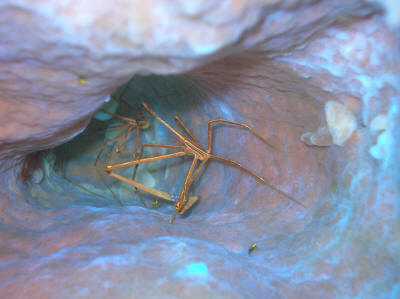
|
Underwater Fish Encounter, Questions RE, TWA Labrid
ID 8/16/07 Good Day WWM Crew-- <Eric> Your website is such an
AMAZING wealth of knowledge and has helped me MANY times!! <Ah,
good> This is not necessarily an "aquarium related"
question... but specific to marine fish.... A few months ago I was
lucky enough to go snorkeling in the Caribbean, mainly off the shores
of St. Thomas and St. Maarten. This was very exciting.. as I'm sure
you all know. I LOVE IT!! and want to go diving very soon... Anyway-- I
almost (accidentally of course) stepped on a 2-3ft wide Stingray when
swimming on the surface of about 3 feet of water that emerged DIRECTLY
under me, and swam away, just as I was about to step down in the sand.
That was exhilarating, to say the least! Good thing I didn't make
contact. <Yes> Also, I saw many amazing things and different
fish, but have one specific question. In about 10 ft of water, I went
down toward the bottom, and looked up. Almost immediately, there was a
smaller sized school (probably 10-20) fish, each between 6-12 inches in
length formed a circle and swan around me, one fish behind the other in
close succession, with me at the center. The diameter of the circle was
probably 6-8 feet or so.. They were bright blue, and the best way I can
describe them is as follows": They look like a cross between
Yellow Tang-ish and Damsel fish bodies, but were much more
"stretched out".. Close to a Foxface Lo body shape, without
the long nose and or "spikes"... maybe close to an Anthias,
especially the tail section... but this isn't a great match
either... very vibrantly colored blue as well. They look like nothing
(no exact match) I have seen in all my reading of the WWM site, nor
through looking at every (yes, every marine fish) on the Dr's
Foster and Smith Website. I tried fishbase.org but that site is a list
of scientific names... <An apt description of what many folks
don't recognize as a Wrasse/Labrid... the Creole Wrasse, Clepticus
parrae (Bloch & Schneider 1801)> I know this is a wide opened
question, with many possibilities, but any help
(suggestions/websites/etc) would be great! Also, have you heard of/seen
this behavior (circling around me) while diving? <Heeeee! Yes...
lucky they didn't all take a small bite! Just kidding. Cheers, Bob
Fenner> Thanks!!! Eric
Purple Spined Sea Urchin... Arbacia punctulata
7/30/07 Hi Crew. <Hi Rick, Mich here.> I was walking the
beach in Florida the other day on the Gulf of Mexico side and found a
purple spined sea urchin. <Lucky you... the walking on the beach
part... I seem to be good at finding urchins with my feet! Ouch!> I
did a web search on them and they are, according to them Arbacia
punctulata- purple spined sea urchin. <Is endemic to Florida, and
generally live on rocky bottoms as opposed to sandy bottoms.> I was
thinking about putting him in my FOWLR tank. Is he safe? <Mmm, I
doubt that you will be able to provide suitable nutrition for him.
These animals typically eat sessile invertebrates which he will likely
consume your current tank population quite quickly. Gut content
analyses have show bryozoans, hydroids, barnacles and tunicates and
limited algae. The algae are typically only those growing on the
rubble. but the diet is usually more heavily weighted with animal
matter> I have a coral shrimp and a tang. goby and clown. Right now
I have him in my QT tank. Would he benefit my tank? <I don't
think the tank would benefit nor do I think it the urchin would
benefit. I think it would be best to return him to where he was
found.> I also found some large hermit crabs, about 2 1/2 inches and
was wondering if these would be good substrate cleaners? <A big no
go there! Usually any large hermit crabs are highly predatory, capable
of killing fish and even well protected animals such as urchins.>
Those I didn't bring home <Wise.> but the urchin was too
pretty to pass up and they do sell them locally. <I do not have
personal experience with this species, but from what I have read, I
obviously have concerns, perhaps those in your local market may be able
to guide you better, but with the information I found describing the
typical diets of these urchins, I would be concerned about starvation.
More here: http://www.int-res.com/articles/meps2005/295/m295p171.pdf
> Thanks for all info past and present you guys are great and make
my hobby so much easier. Rick <You're welcome and thank you for
the kind words. Mich>
| Invert IDs, TWA Hey Crew. <Andy> I was
hoping that you could help me ID some inverts that came in on some
Florida aquacultured live rock that I purchased. I have scoured WWM
and the web but came up empty. I believe the creature in the first
picture is some type of soft coral. <Mmm, to me also... though
this may be the beginnings of a gorgonian... likely of the genera
Telesto or Stereotelesto... even an antipatharian... Antipathes
lenta... Easier to make out with growth> At first, I assumed it
was an algae, but then I noticed it will retract very quickly
<Oh! Not likely the latter on this info.> into its
"cave" if my cleaner shrimp touches it and then will
immediately come back out to play once danger is away. The second
picture is some type of anemone. I want to know if it is what you
guys refer to as a "pest" anemone so that I can clear it
out before it starts to go all sexual on me. Thanks for your help!
Andy <Is likely a Sponge Anemone... though could be a Glass
Anemone... BobF> |
|
|
TWA Theme Aquarium Stocking Questions 6/5/07 Dear
WWM Crew, <Jeff> Thanks for the great site. I've recently set
up a 225 Gal aquarium and found your site to be invaluable in getting
over some initial hurdles. My favorite search for a couple of weeks was
"sump noise Fenner". <Heeee!> I'm finally over my
initial plumbing concerns thanks to your site but I have a few
questions about stocking that I couldn't totally resolve using your
site. <I do wish you, EricR... someone, would take on the
semi-monumental task of writing some definitive work (article series, a
small book) re the ins/outs of choices, tools, application of setting
up marine systems... particularly plumbing, circulation, aeration,
filtration issues> My basic setup is a 225 Gal aquarium
(72"x24"x30") with a standard 55 Gal aquarium used as a
sump/refugium. BTW, your Reef Invertebrate book was very helpful both
in suggested aquascaping and refugiums. <Ah, good> I have about 4
inches of sand (both in the main tank and in the refugium) and around
300lbs of LR. I have two overflows feeding the sump of about 600 gph
each. I'm using a quiet one 6000 which should be giving me about
1000 GPH at a 5' head. I'm also running a CoralLife 220 skimmer
in the sump and have 4 powerheads in the main tank of 300GPH each for
additional current. I want to set up a TWA theme FOWLR tank but without
being a fanatic about it. My intended stocking list (and finally my
question!) is: small zebra moray(<1'), <What species? Not
Gymnomuraena...> small SFE(<1'), rock beauty(3"),
french(4") and queen angel(4") <Mmm, I'd settle on
just one of these Pomacanthids> and a tang(5"). <And
depending on species try three or five of this...> Also a few
inverts such as a pair of banded coral shrimp and a couple of urchins.
The rock beauty seems to be the most questionable on my list but this
setup seems like a reasonable start. If you think the rock beauty would
be doomed in this setup do you think I could substitute some other
dwarf angel such as a flame? <... Not of the TWA... I think you
could try, be successful with any of the three listed indigenous
species here> Is the stocking order very important with this list?
<Yes... actually always a good idea to investigate, stock in a
"certain" order... by and large less to more
aggressive/territorial...> I think the queen should probably come
last with either the zebra or rock beauty first but I'm really not
sure. <The alpha animal/s should almost always be placed last>
I've gotten some advice from a LFS which advised me NOT to try the
zebra moray with a queen angel but I've since seen several posting
from other sites where that was done successfully. What do you think?
<Queen Angels can be trouble... see my article and the FAQs files on
WWM re...> The stocking seems to be well within the rough guidelines
that I found on your site. What do you think? Thanks for the help! Jeff
Barnes <Mmm, well... I'd like to urge you (so I am) to do a bit
more look/seeing here... It will add greatly to your enjoyment,
appreciation of the biotope you're trying (I think) to acheive...
To select, source a TWA Muraenid if you're going to stock one... to
suggest you secure Floridian LR... Keep reading, taking good notes for
now... and we'll be chatting. Bob Fenner>
Atlantic Blue Chromis (Chromis cyanea) 4/14/07 Wet
Web Media - <Mmm, is this the person who was chatting with Morgan
Lidster... (Inland Aquatics)... He and I talked on the phone yesterday
re this species...> I have a question concerning the mortality rates
of the Atlantic Blue Chromis. I have designed and setup a 90 gallon
reef tank as a niche biotope to the Northern Gulf of Mexico.
<Neat> The tank was setup a year ago and invert and sponge growth
has been great. The rockscape will feature large boulder type layouts
and will feature 3 Pacific Montastrea corals, a couple of Porites and a
lone Gorgonia. One of the Montastrea's is farmed and I was able to
acquire 11 frags from the same mother colony to simulate one coral
dominating the area, with the others scattered in to give some color
and texture. Other inverts would be the Orange White Claw Hermit (C.
tibecins?), Coral Banded Shrimp pair and a dozen Cerith snails (they
should breed to a stable population up or down depending on the algae
available). The fish plan was to feature a pair of neon gobies and a
school of 7 blue chromis (C. cyanea). All my research on the web and in
books indicates everything should be okay and my biggest problem will
be that they may not school once comfortable in captivity, <Perhaps
in time...> not a concern to me. However, in looking for a source to
purchase these fish, I am finding that they are in fact difficult to
keep. <Mmm, yes... I think this is mainly due to the fact that this
fish is poorly handled post capture/collecting... but it also does not
adapt easily to captive conditions> This is the first I have heard
of this and I see no references to this, not even on this site.
<Mmm:
http://www.google.com/custom?domains=www.WetWebMedia.com&q=chromis+cyanea&sitesearch=www.WetWebMedia.com&client=pub-4522959445250520&forid=1&ie=ISO-8859-1&oe=ISO-8859-1&cof=GALT%3A%23008000%3BGL%3A1%3BDIV%3A%23336699%3BVLC%3A663399%3BAH%3Acenter%3BBGC%3A99C9FF%3BLBGC%3A336699%3BALC%3A0000FF%3BLC%3A0000FF%3BT%3A000000%3BGFNT%3A0000FF%3BGIMP%3A0000FF%3BFORID%3A1%3B&hl=en>
What are the issues with keeping these fish? <This fish? As stated
above... it doesn't "like" being netted... like Zanclus,
Dascyllus albisella, a bunch of other examples... it seems to die
easily from "stress"...> The tank is pretty much dedicated
so it would not be much effort for me to meet any known special
requirements. Is there anything special I need to do? Is my fish
stocking plan destined to fail? <Mmm, not necessarily... I think you
have better chance than most all folks here... with your biotope of
size, age... Just need to find someone willing to ship you the Damsels.
I'd try contacting some of the "diver-direct" sources in
Florida...> If I need to change my fish stoking list, can you
recommend another fish in the Gulf that would do well with my plan
(perhaps the Purple Reeffish)? Thanks, Chris Sanchez New Orleans
<Mmm, well, there are always "standard" animals from here
like the Pearly Jawfish... But do try the Chromis... Bob Fenner>
Re: Atlantic Blue Chromis (Chromis cyanea) 4/16/07
Bob Fenner, thanks for your reply. Being that there are no other fish
in my aquarium, would you still recommend quarantine? <With this
species, situation, no> My concern is that quarantine will cause
additional stress that may lead to a higher likelihood of mortalities
since QT tanks are seldom as large and as mature as the display tank.
<We are in agreement here> For example, I use a 3 gallon for
coral quarantine with no skimmer or live rock and perform daily water
changes. A school of chromis would not do well here so I would need to
start over on the QT setup. What would you recommend as the minimum
quarantine standards if I were to get the Chromis five at a time? <I
would still directly place this number, species, in the ninety posited,
w/o quarantine... in batches> Tank size, equipment, rock/substrate,
aged (1 month, 3 months...)? Thanks Again. Chris Sanchez New Orleans
<Welcome. Bob Fenner>
Condylactis Anemone Compatibility 4/10/07 Hello, <Hi
Cindy> I have been searching for the past few days and can not find
an answer to this. What are the natural enemies of a Condylactis
anemone? I have heard that blue leg hermit crabs will attack them.. but
have found nothing to prove that (just a rumor at this point). <Do
not believe the blue legs will be a problem. The Four Eye Butterfly
Fish which is native to these waters would be a problem with the Condy.
The Condylactis (gigantea) has many symbioses also; Periclimenes
anthophilus (cleaner shrimp), Stenorhynchus seticornis (Arrow Crab) and
Apogon spp. (juvenile wrasses). As for compatibility with other
animals, I advise you to search for a fish/invert you wish to add to be
sure that either the anemone or fish/invert will be compatible with
each other.> We are wanting to set up a tropical Atlantic only tank
and want to avoid any problems with critters attacking the Condylactis
when the time finally comes to purchase one. I know it will be some
time before we actually add the anemone to the tank; but also want to
avoid any problems with unsuitable tank mates. <Understand.>
<<Likely only large crabs, possibly Angels will be problematical
here. RMF>> Thank you for any assistance you can give me.
<You're welcome. James (Salty Dog)> Cindy p.s. We already
have two reef tanks up and running, so we are not complete newbies to
reef keeping.. just can't find a straight answer on the question at
hand. <Searching/reading/learning will pay big dividends in this
hobby.>
125 Gallon Atlantic Biotope 02/17/07 Hello, <Hi Mike! Mich
with you tonight.> I recently acquired a juvenile gray or French
Angel (Pomacanthus paru) less than 1 inch in length. I have had the
fish for almost 2 months now. It is doing quite well. It's feeding
on freeze-dried brine shrimp and formula 2 flakes. <Not much
nutrition in the brine.> I have an empty 125 gallon tank I will be
setting up shortly for the fish and I would like to set it up with only
Atlantic fish as a FOWLR. <Biotopes are always nice.> Would it be
possible to keep both the French/Gray with a Queen. <Not a good idea
in a 125-gallon.> My ideal setup would be the French/Gray, Atlantic
Blue Surgeon (Acanthurus coeruleus), Atlantic Longnose Butterfly
(Prognathodes aculeatus), Pygmy Angel (Centropyge argi), Blackcap
Basslet (Gramma melacara), and if possibly the queen instead of
something else on the list. Would this be possible? <I think the
Queen (Holocanthus ciliaris), lovely as she may be, is an inappropriate
choice for you tank. The Queen should be housed in a tank of at least
180 gallons. Mixing with a French in 125-gallon tank would not make for
peace and harmony in my opinion. I think the rest of your stocking list
is fine.> Thanks, Mike <Welcome! -Mich>
Caribbean Biotope + Herbivores in a Nano cube 1/24/07 Hey
guys. <Hi there, Mich here.> I'm planning a Caribbean biotope
in my 24 gallon tank. I haven't been able to find much info on the
net regarding setup or types (different reef types, depths) of these
aquariums, and I was wondering if you knew any good ones. <John
Tullock has an excellent book called The Natural Reef Aquarium, which
is arranged by geographically area. This would be an great resource for
you.> On another note, I can't find any herbivorous Caribbean
fish! <How about a Redlip Blenny (Ophioblennius atlanticus), would
be appropriate for a 24 gallon tank. Would best be off using the
herbivorous Mithrax crabs or is there some other option? <Mmm,
don't know that I would call the Mithrax crab herbivorous, they do
at times prey on small animals, so I would use these with caution. I
would consider using a snail or two, not much more in such a small tank
at there will most likely not be enough of a food supply and may result
in starvation. Turbos, Astraea, Trochus, Nerite, Cerith and Nassarius
are all possibilities.> Thanks. <Welcome! -Mich>
Live Shell Collecting?...Banned Or Not?
Salty's go 7/6/06 Hi Bob and Crew. Hello Lloyd> I have a
question I haven't seen addressed on your website (although I
suspect its there somewhere - you have a very comprehensive
website). I know that there are state and federal bans on the
harvesting of wild live rock. Most of the definitions I have found
for "live rock" relate to marine life growing on coral
structure and rocks. I like to snorkel with my kids (I'm
fortunate enough to live in South Florida, hurricanes aside) and
when I do, its not at all unusual to find large shells (no snails
inside) that are encrusted with coralline algae, as well as all
kinds of other stuff. I'm not aware of any general ban on the
collection of empty shells. Would it be your opinion that shells,
after becoming encrusted with coralline algae, would be considered
"live rock", and if not, is their any reason they
couldn't perform the same function in a marine aquarium?
<Lloyd, in my opinion, a shell is not a rock, so I'm
thinking it would be legal. Folks go shelling along the shores and
this isn't banned. I like going shelling at the seaside
taverns...One large shell of Bud, please. OK, I am thinking that,
should the conch shell have soft coral(s) growing on it, this could
present a problem. To be on the safe side I'd go here (Florida
Fish And Wildlife Conservation) and click on the "ask
FWC". http://myfwc.com/ Mr. Fenner may know if this is legal.
What do you think, Bob?> I've attached a picture of a horse
conch shell I found a few weeks ago off Florida's gulf coast.
If you look closely, you can see (in addition to the gorgeous
purple algae) two fan worms (I think) on the bottom to the lower
right of the hermit crab, and another three at the top.
<Neat!> Thanks for your thoughts, you guys perform a very
valuable service. <You're welcome. James (Salty Dog)>
Lloyd |
|
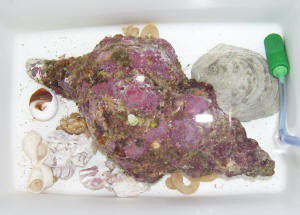
|
| Re: Live Rock (shells) 7/6/06 Thanks for
your help, James. I've e-mailed the Florida FWC, and will let
you know their response. Now that I know how easy this is, I have
another quick question (or two). Can you direct me to a single
location that lists the acceptable high/low range for the various
factors that determine marine aquarium water quality (i.e., PH,
copper, calcium, phosphate, alkalinity, nitrite, nitrate, ammonia,
etc.), and what steps to take if your readings are above or below
those ranges (i.e., what to add and how much)? Obviously,
nothing's going to apply in all situations, but there must be
some kind if "norm." Is it safe to say that if you use
RO/DI water and a commercially available salt mix, there
shouldn't be a problem with the water going into the tank, and
any water problems arising after that would be the result of other
things being introduced into the tank (waste, excess nutrients,
medicine, biological pests, etc.)? <Lloyd, this info can easily
by found on our site. Do look/search. I'll start you off here.
http://www.wetwebmedia.com/watrqualmar.htm> Thanks
again. Lloyd <You're welcome. James (Salty Dog)> |
| Live Rock (shells). RichardB's response
7/6/06 Hi Bob and Crew. < Hello! > I have a question I
haven't seen addressed on your website (although I suspect its
there somewhere - you have a very comprehensive website). < Your
flattery will get you everywhere! > I know that there are state
and federal bans on the harvesting of wild live rock. Most of the
definitions I have found for "live rock" relate to marine
life growing on coral structure and rocks. I like to snorkel with
my kids (I'm fortunate enough to live in South Florida,
hurricanes aside) and when I do, its not at all unusual to find
large shells (no snails inside) that are encrusted with coralline
algae, as well as all kinds of other stuff. I'm not aware of
any general ban on the collection of empty shells. Would it be your
opinion that shells, after becoming encrusted with coralline algae,
would be considered "live rock", and if not, is their any
reason they couldn't perform the same function in a marine
aquarium? < There is not restriction on the collection of empty
shells, and unless you are intentionally collecting them with
intent to sell, there should be no problem. In small numbers, the
shells can be a beautiful addition to an aquarium. Unfortunately,
the stagnant water inside of the shells may cause problems in the
long run, especially if there are too many shells present in too
small of a body of water. The "live rock " has much more
surface area, and can therefore house more bacteria for more
biological filtration. The surface of a shell cannot compare in
that aspect. Piles upon piles of shells would also become a sink or
deposit of detritus and mulm over time, thereby even further
increasing the risk of oxygen depletion. One or two would not be a
problem. Ten or twenty would. > I've attached a picture of a
horse conch shell I found a few weeks ago off Florida's gulf
coast. If you look closely, you can see (in addition to the
gorgeous purple algae) two fan worms (I think) on the bottom to the
lower right of the hermit crab, and another three at the top. <
The shell is beautiful. It must be wonderful for your kids to be
able to grow up with a "backyard" such as South Florida.
> Thanks for your thoughts, you guys perform a very valuable
service. Lloyd < Thank you for your compliments, I know everyone
here appreciates them! RichardB > |
Losing angelfish only - 06/07/06 Hi Bob and Crew, <O &
R> Thanks again for all the help you and the crew provide. Much
appreciated! I've e-mailed before and you guys and gals were very
helpful. I always try to find the answers to my problems first, before
I take up your time. This time I've had a little trouble so thought
I would drop a line. My problem has been with keeping queen and French
angels. Both juvenile and adults. I have a 135g <Not large
enough...> with powder blue tang, 2 perculas, black cap, bi color
blenny, and mandarin goby. Have 150lbs live rock, Dual Bak Pak skimmer,
and emperor 400. Aquarium is about 1 year running. Water parameters
have always been excellent. All at 0. PH 8.2. Have 30g quarantine tank
in place and use it wisely. I have not had any problems with my fish
except for 2 queen angels and 2 French angels. Which I've read are
very hardy and disease resistant. <Generally so> None of them
have died right away, seems to be a couple of months down the road. No
signs of disease other than minor lymphocytes here and there. <This
is telling... a large stress component> One day they start breathing
heavy or labored and then die a day or so later. I've read in your
book about size range for each and all of them would be what you would
call acceptable range. 4-5 inches. <In this small sized system,
better to start with even smaller specimens... down to 2-3 overall
inches> I do have corals in my tank as well and don't know if
these are possibilities. <Are as well... material coming off/from
these could be malaffecting these fishes> I recently pulled my
bubble tip and Sebae anemones out thinking my angels may have come into
contact with them and died from that. <A possibility> Is that a
possibility that even a larger angel can die from an anemone sting.
<Yes> Corals in my tank currently are torch coral (which my
clowns hosted after losing their bubble tip), flowerpot, branching
hammer, and frogspawn. Could any of these been the cause or am I
missing something. <Not able to tell from here/this> All my other
fish have not shown any signs of problems to date. After the fourth or
fifth queen and French I'm quite frustrated. I feed them Nori
seaweed red and green, formula one, angel food containing sponge (which
they didn't take to very well) and mysis. A good variety I thought.
Any advice would be much welcomed. Thank you again for taking time out
of your busy schedule. Sincerely, Royce <I would look to a smaller
Pacific, Indian Ocean pomacanthid species here. Wait till you have a
tropical West Atlantic biotopic effort to try one of these Caribbean
angels. Bob Fenner>
Quick TWA Fish ID question, Clepticus parrae
- 4/11/2006 Oops, sorry hit the wrong key and sent an empty email.
<Ahh, there you are!> My girlfriend and I just got back from a
cruise in the Bahamas. We went snorkeling on one of the reefs there and
saw tons of this little fish that she absolutely loves (among many
others). I have been trying to ID it online since getting home with no
luck. It is around 6" long at the most. Shaped long and slender
kind of like a wrasse Coloration: green head, with a narrow white
stripe surrounded by black around gill line, and the rest of the
body/tail is yellowish. Any ideas??? <Likely a/the Creole Wrasse:
Clepticus parrae> This was my (and her) first trip to the tropics
and diving on a reef and it really made me realize how small my tank is
compared to a reef. Even though it is a 125, there were corals and rock
formations there larger than my whole tank! I even followed one blue
Atlantic tang for probably 30 or 40 feet while it swam and grazed. Put
things in a new perspective for me. Thanks -Ray <A very worthwhile
experience, cross-experience for aquarists... Please see WWM,
fishbase.org, Google for pix... Bob Fenner>
Re: Quick Fish ID question - 04/11/2006 Thanks for the reply.
Did a search and that is not the fish. The one I saw had much sharper
lines of color change. The one I saw looks more like the Bluehead
Wrasse - Thalassoma bifasciatum - but all I have read it says that is
found in the indo-pacific, not Atlantic/Bahamas. Ideas? <Mmm,
perhaps initial phases of Thalassoma bifasciatum... see WWM, Google,
even better the works by Paul Humann and Ned DeLoach... BobF> Thanks
-Ray
Conch reaction? 3/17/06 My friend is going to the Turks soon
and is allergic to abalone, the only thing she is deathly allergic too.
She wants to try Conch when she goes back to the Turks. Is Conch
related to the abalone family? She is afraid to eat anything with conch
in it and of coarse everything has conch in it there. She just got
certified for diving and is anxious to go dive when she gets there so I
thought of you and since Peter put another one of your lovely fish on
my screen, and your web site calendar it is hard to not think of you.
Hope all else is well with you and Di. Mary Rosi <Hey Mar! I would
be careful re eating Conch (maybe try just a bite of fritters and see
how she feels next day)... as am given to understand that seafood
allergies are pretty broad. BobF, in HI>
Diving and more in the Caribbean - 03/09/2006 Hey Dogfish,
Great cooking on Sunday. Where did you get those sausages? (the ones on
the grill). <They were purchased at Costco> Rolling Rocks and I
are planning a trip to the Caribbean. One of the things that we would
like to do is go snorkeling. I assume you have been there. Would you
recommend any of the islands? <Yikes... many... there are many other
elements that go into such decisions... The best water quality
unseasonally is to be found in the Cayman's, Bonaire, Cozumel...
but MANY other things to mention... costs of getting to/fro, staying,
other activities... there is "some" snorkeling most
everywhere in the tropical West Atlantic... likely other considerations
will take precedence. Many places have websites... Bob Fenner/DF>
Thanks. Bone of Arc
Diving TWA 03/9/06 Diving Bob, <Aundrea
(Woman of the Sea!)> Hi, we met you at the DFWMAS Next Wave a few
months back. I had the Naso in the 125, and I'm from Dana Point,
CA, we were talking about diving in Kona, Hawaii. <Ah, yes... am
about "out the door" on my way this very AM to there>
First off, I wanted to tell you how much we enjoyed your presentation.
It is great to have some humor in a sea of dry authors! It was well
worth the two hour drive to speak to you and gain insight from your
presentation. <Glad to share> Anyways, I am going to take you up
on your offer to join you diving one day soon, <Come on over
anytime... If you'd like to be there during this run, I'll be
in Kona till 4/4...> but I was wondering if you have had any
experience diving Key Largo. <Just on brief hauls to/fro from Miami
to Key West> Aundrea and I are planning on going in June and would
love to know if you recommend any dive sites or outfitters. Currently
we are going with Rainbow Reef (http://www.rainbowreef.us/) . Thanks
for your time!, -Jeff <Have heard/read many good things re this
outfit. Cheers, Bob Fenner>
Stocking A Gulf Biotope -
02/25/06 Hello WWM crew! <<Hello!>> Alas another
compatibility question, but I did as much research as I could before
resorting to bugging y'all. I am preparing to stock my 215g FOWLR
and will be going for a Caribbean/Flower Garden Banks biotope.
<<Hmm, an interesting and very unique Gulf biotope. Have you
studied the information available re at GulfBase.org?>> My
current stocking list was my best effort at a group of fish that would
tolerate each other within the size and bioload capacity of my tank.
probably pushing it. <<As we all tend to do <G>.>>
Please advise otherwise if need be. <<Ok>> My main concern
is regarding a Spanish Hog and Bluehead Wrasse (Thalassoma
bifasciatum). Haven't found any info on WWM regarding housing this
Hog and Thalassomas. <<As far as compatibility between these two
I don't see/know of any particular problems. Do be aware the
hogfish will get quite large...even for your tank.>> Stocking
list: Damsels- Jewel Damselfish Microspathodon chrysurus Bicolor
Damselfish Stegastes partitus Angels- Queen Angel Holocanthus ciliaris
Cherub Angel Centropyge argi Tangs- Atlantic Blue Tang Acanthurus
coeruleus Wrasses/Hogfish- Bluehead Wrasse Thalassoma bifasciatum
Spanish Hogfish Bodianus rufus Would only pick one of the Damsels,
probably leave out the Argi, and possibly the Tang as well.
<<With the exception of the damsels (though likely incidental
visitors), all specific to your biotope...kudos for doing your
homework! But I have concerns. The Queen angel, Blue tang, and Spanish
hogfish will all become very large. I think your instinct to drop the
tang is well founded as it will need much more space than this tank
supplies, especially with the other large fishes...I would also leave
off the hogfish. Let the Queen Angel grow in to your centerpiece fish
and keep both specie of damsel and the dwarf angel on your stock
list...all of which will (as should the wrasse) be small or fast enough
to stay out of the angel's way as it matures/becomes more
aggressive.>> Tank specs: 215g Oceanic w/ dual Megaflows
72x24x29, 30g Sump containing mechanical/chemical filtration, Euro-reef
cs8-24, Tunze temp and top-off controllers, Tunze 3130, Mag 12 return,
Tunze Stream 6060, 180lbs LR, 120lbs LS, 30g fuge and UV to be added
this summer, 30g weekly water changes. <<All sounds good.>>
I've got 2 20g quarantine tanks up and running ready to start
holding fish in order of temperament and size. <<With the
exception of the Queen Angel (to be added last), I don't see any
need for a particular stocking order other than maybe begin with the
smallest and proceed to the largest.>> Please advise. Thanks
mucho! Kenney B <<Welcome Kenney, EricR>>
TWA Chaetodont sel. - 02/16/2006 In case you want specifics,
I've tried 4 Atlantic Blue Tangs. I would never ever do this again.
But it was the one fish that I most wanted when I got into the hobby.
But now I will leave them alone. Tried them young and yellow, old and
blue, transitioning. <I see> The weird thing is that they were
fine for months in each case. Two as long as 6-7 months, one 4 months,
one 3 months. All ate and swam just fine. Fat, healthy. In each case,
one morning the fish would appear sluggish after having been fine the
night before. Then splotches by noon, dead by evening. <My
experiences parallel yours... I put the whole lot in a "just
don't do well in captive conditions" category> Sad, but as
I said, I am now leaving them alone. Strange thing is almost every
store, online and LFS, reports them to be very strong fish, easy to
keep, while only a couple report them to be delicate and difficult.
<"And so it goes"> Oh well. Thanks. <Thank you for
relating your experience. You have saved many animals thereby, and
hobbyists, trouble. Bob Fenner>
Requesting Permission to use Pictures for Class Assignment
11/21/05 Good day, My name is Molsaurol Spencer and I am currently
attending the University of the Virgin Islands. I emailed you because
as part of my class assignment for my Ichthyology course, we were asked
to create a website on a fish family. I choose Pomacanthidae and I am
asking for you permission to use your pictures for my web page. Please
note, that the pictures would be properly cited. Thank You. Your
websites:
http://www.wetwebmedia.com/marine/fishes/angels/holacanthus/tricolor.htm
http://www.wetwebmedia.com/marine/fishes/angels/holacanthus/ciliaris.htm
<As your use is non-commercial, I do grant you this use, per our
Policy: http://www.wetwebmedia.com/WWMUsePolicyStmt.htm.
Good fortune in your studies and beyond. Bob Fenner>
Hunting for eels! 11/6/05 Hi, my name is William; I live on
an island in the Caribbean. I live on the shore and lately have been
chasing after what I believe to be chain-link morays. <Most common
species in shallow water there...> It seems to be tougher than I
expected. I was wondering if there are anyways of attracting these
magnificent eels to a certain area. Just the other night I went to look
for them since they are nocturnal, but I believe they went out to sea
for feeding. The area I usually find them in is a small cove covered in
spiny lobster, parrotfish, sea urchins, and green morays. Recently I
have seen three of them in the span of two days. Two of them were large
averaging about one and a half feet long. The third though was quite
skinny and was about eight inches long. Any help would be greatly
appreciated, thank you. <Can be caught in "minnow traps"
incorporating a fyke on one/both end/s... with bait inside. Or with a
barbless hook and line, with something meaty for bait... or via a small
fence and hand net... Please read here: http://www.wetwebmedia.com/collmarsdvg.htm
and the linked files above, and the accounts on moray eels archived on
WWM. Bob Fenner>
Puffers! TWA Boxfish ID 10/19/05 Bob... I just stumbled
across your site while trying to identify what I presume to be a puffer
about two days ago. I hope you can help me! I was diving just next to
the "Wall" at Cozumel, and had come up to some coral about 45
ft. down, when I saw the most beautiful little fish I'd ever
seen...and it was TINY!! From the basic shape, I'm guessing it was
a puffer of some kind, and here is the description: Very small, almost
boxy, and only about an inch square...Solid black, but with brilliant
yellow spots all over the black...and probably due to coloration, I
could see no eyes or mouth...and the fins (I'm assuming there WERE
some!), were totally transparent. One clue to me that it was some type
of puffer was that it didn't move any noticeable tail side-to-side
like many fish. <Ahh, yes> It was gorgeous...but I still
can't find any picture that looks like it. Any ideas? Thanks a
bunch for your help... Dan Stroud, OKC <Yes... likely a juvenile
boxfish... a Lactophrys species. Please see here: http://wetwebmedia.com/fwgtwa11.htm
and then use the names to seek other image work on Google, fishbase.org
Bob Fenner>
Stocking Order and Territorial Flameback Pygmy Angel
10/11/05 Dear Crew, <Hello> I appreciate that there is much
relevant information on your website but I would be most grateful if
you could please spell it out for me - apologies in advance for taking
up your time. I have a 55 gal FOWLR system, with 66lbs of live rock. I
use a Fluval 304 for mechanical filtration, a Red Sea Prizm skimmer and
two MaxiJet 600 powerheads for circulation. In the aquarium I currently
have 2 mated percula clownfish, 1 mandarin dragonet (who thankfully is
happy to eat frozen food) and a Flameback pygmy angel. Unfortunately
the pygmy angel has become unsurprisingly territorial. <Mmm, is
surprising> I recently tried to add 2 cardinal fish but these were
chased by the pygmy angel until I had to return the surviving one to
the LFS where I had bought him. I subsequently tried introducing a
lemon peel pygmy angel, <This tank is too small for two Centropyge
species> taking in part the advice from your site to rearrange the
rocks into two distinct piles and removed the Flameback for a couple of
days into the QT tank to allow the lemon peel to establish himself but
again he did not survive. <Good techniques> My question
therefore, is whether there are any fish that you could recommend to
me, in particular, fish that will be strong enough to not be affected
by the behaviour of the Flameback but at the same time gentle enough
not to frighten my dragonet (of whom I am incredibly fond!). I read on
the saltwater.about.com website that a yellow and a Naso tang might be
possible contenders? <Maybe a smaller Zebrasoma species, not a
Naso... your tank is too small> I appreciate that I will in a few
years need to buy a larger aquarium to accommodate the Naso. Or do you
recommend that I remove the Flameback and return him to the LFS
(although he is all but impossible to catch without removing all the LR
from the tank). <I would look into other species that are found in
this fish's range (use fishbase.org here) that are also available
in the ornamental trade... some of the small basses, Hypoplectrus...
come to mind, as well as some of the smaller labrids from the area>
Thank you so much for all your help and assistance! Kindest Regards,
Tim Kroemer <Bob Fenner>
Unknown TWA Fish 10/6/05 I was snorkeling off the coast of St
Thomas when this school of fish, maybe four or five went right in front
of me. Before I could grab my camera they were gone. They were the size
and shape of a pencil wrasse and were bluish purple in color. But the
thing that stood out was the 3 inch unicorn horn that was coming out of
their head. Any idea what they were? Thanks Kevin <Mmm, if it
weren't for the horn... I'd say these were Clepticus parrae:
http://wetwebmedia.com/marine/fishes/wrasses/index.htm Maybe
what you saw as horns were just the black areas on their heads?
Otherwise, I'd look through the Caribbean Reef Guide, Fishes by
Paul Humann and Ned DeLoach. Bob Fenner, away from his copies in HI>
My IMAC plans, TWA f' Hi Bob - welcome back. Always wanted
to go to Bonaire. You'll have to tell me how you liked it (I'm
not a big Carib. fan but Bonaire and Cayman are two places there
I'd actually like to go dive). <Bonaire, Caymans and Cozumel are
the "triumvirate" of tropical West Atlantic diving IMO...
clear water, warm, intact reefs... and lots of amenities> I'll
see you at IMAC. I'm going to try to get a dinner/lunch together
for the group to go over some important developments with RPI stuff.
<Hotay. BobF> Thanks........Drew
ID Creature Seen on Dive (3/22/05) I'm hoping to identify
a creature seen in 15' of water off Peter Island in the British
Virgin Islands a couple weeks ago. It was about 10" long and
4" wide, quite rectangular, with what seemed like only 6 legs
spaced widely apart. There was no obvious head and the front half of
it, seen from above, was a milky grey, the rear was off-white, but the
distinguishing feature was a band across the middle of its back about
1.5" wide that was bright yellow with black dots over the yellow.
None of the photos I've seen of slipper lobsters look like what I
saw, which is what someone initially suggested it was, but I have no
idea...it could be something else altogether, not a lobster at all. Any
suggestions? Thanks, David Pearl, Ann Arbor MI <It's always hard
to ID something without seeing it for oneself. I recommend that you
check our or purchase a good ID book. If you are a frequent diver in
the Caribbean, this book and its companion volumes will be very useful
to you:
Reef Creature Identification: Florida, Caribbean, Bahamas. I hope
you find it here. There are many other guides available if you search
Amazon. Good luck, Steve Allen.>
Could use your help ID'ing this photo gallery
<TWA invert's> Hi Bob, <Chris> My name is Chris
Shea, I want to thank you for your site, it's really expanding my
horizons on the knowledge of Marine life! I just found you a few weeks
ago looking up Blue Faced Angels.. I had NO idea they morphed like they
do, and also what varieties these similar looking juv's can morph
into... Amazing... Ok, Let me first introduce myself and give you a bit
of background on my SW experiences: <Okay> After a 8 years of
running a nano, (unsuccessfully at times) and watching my beautiful
little creatures I would buy and stock my little tank with, slowly die
off and stress out...( I remember buying stuff and thinking to myself
as I looked at whatever I was about to buy..."are you ready to
come home and DIE WITH me!" How pathetic.. oh well just being
transparent... <Honesty, the truth is so> I vowed two years ago
(before I started my recent larger tank) that I would learn all I could
to be responsible to the life forms that I purchased at the LFS. I
swore that I would NOT be ignorant any longer and my ignorance would
NOT be the CAUSE of my animals DEATH . I decided I would do whatever it
took to learn about how to keep this stuff not only ALIVE but Happy. I
got hooked up with RC and started reading and reading and reading.. The
first few major changes I made was getting rid of the canister filter
and going with more LR and adding a good skimmer. and live sand.
Canisters aren't bad if you maintain them, but most don't and
these become nitrate factories...Next was learning about testing and
water quality. I now build most of my own equipment in my shop:
Poseidon2 Vortex Skimmers, CJStandpipes, and now am getting into retail
sumps. ( I built my own 30 gallon sump for my 60gal) All this can be
seen on my main site if you want to take a gander.. http://www.nautilusreef.com/ <Yes. Very nice> Of course
I realize there are many lessons that will still need to be learned
(most recently adding Two Little Fishies epoxy to mount my frags not a
good thing! Arggghhhh) the hard way. Doing so added two days of MB
misery to my tank. I'm now going with acrylic dowels and drilling
the LR. No more epoxy for me. BTW how can they say this stuff is
"Safe"? <Mmm... got me... there are quite a few
"scam" products out and about in our interest> Smells like
hell and I'm sure it leaches out after curing? Not to mention
driving protein skimmers into a frenzy. (makes you wonder why) Buyer
beware. The FDA told us VIOXX was "safe" and I remember
pictures from the 60s where they were fogging school children with DDT
to prove how "safe" it was. <And until several years back,
spraying folks on their way north of the Mexican border with same,
sigh...> If I'm not mistaken this was done, in all places my
hometown of CLEVE OH. anyway I'm digressing. Let me move on to my
questions.. Ok now on to the topic at hand: I'm pretty sure you are
already aware of Tampa Bay Saltwater, and the products they sell.
Really astonishing what life comes with this Rock! Anyway after
ordering a "package" for my 60gal reef tank, I realized there
was no good resource or photo index page available on his site, to
first of all basically ID the life and not least of all, to do research
on the life forms that are on this rock along with the cool unusual
hitchhikers that can also be found along with it. Because of this I
have been in contact with Richard the owner at TBS about doing some
form of ID photo index page for his Live Rock and "package"
for the web, so that newbies like myself, can learn what this stuff is,
and how to keep it alive and happy in our tanks. We need your help with
titles and indexing of some of these photographs in my gallery. I
started a photo gallery for TBS (Tampa Bay Saltwater) Live Rock
Aquaculterers sp. (is this even a word? hahah) <Is now> What I
have done is start a numbered index photo gallery with some
descriptions below. I'm sure I have got PLENTY of mistakes in
naming and in the descriptions alone. but I did what I could with my
limited knowledge since not too many others chimed in on the details..
What I would like for you to do, if at ALL possible is help me ID the
UNKNOWN ones and also correct and add to anything you see in the
gallery. I would really like to add the proper names i.e. Latin names
to some of the photo's titles to make it really nice. Maybe you
could do a quick text file for me with names and descriptions matching
the photo numbers? Whatever you can do would be most appreciated. There
are pictures coming in that I have NO clue what they are, and I'm
not sure many on the Earth know either. :) <Mmmm> Here is the
index page for TBS Index, please peruse it at your leisure and feel
free to correct, add, subtract anything you see here. I will deal with
my multiple typos later :) http://www.nautilusreef.com/html/tbs_photo_gallery_index.html
TIA for and all HELP! Chris Shea <Chris... better for you... if you
have access to the larger file sizes... to do these identifications.
Most all I can make out are pictured in Paul Humann and Ned
DeLoach's works... Do you own these for the tropical West Atlantic?
Look them up... on Amazon.com et al. and order a set. Bob
Fenner>
Re: Could use your help ID'ing this photo
gallery thanks for the reply, as far as the sizes of the pictures
I'm assuming you clicked on the thumbnails to open them into larger
shots? Do you think they should be larger for ID purposes? I think you
can see them pretty good as is? no? :) <Nope... the stony corals...
there are only sixty some species there... are hard for me to make out
to even family at the available resolution> Ill check out that
reference you mentioned on Amazon.com thanks for that tip! <You
should have Humann and DeLoach's books in your reference library...
for sure> Oh and just to give you a little update on that epoxy
situation, I went to my LFS and noticed he had TLF (two little fishies)
epoxy and I related my horror story to him, he looked puzzled because
he had just used some a few weeks ago in a picky clients tank, with no
problems. I asked to see his tubes of epoxy and low and behold they
were different color on the inside, his were red and orange while mine
was grey and black like typical LHS epoxy. I wonder if TLF changed the
epoxy after complaints? <Likely so... they don't "make
it"> I'm going to contact them since I have purchased goods
from them direct in the past and get some clarification just for
giggles.. <A good idea> I'm told Aquamend from HD works well
is cheap, <This is so> but I'm still leaning toward doweling
my stuff. thanks Bob Chris <Welcome. Bob Fenner>
Juvenile eel
ID Hi, I work as a dive instructor in Little Cayman, Cayman
Islands. I recently found a small (1 inch max) black eel with yellow
dashes down its body and a yellow T - shaped marking on its head. Any
idea what it might be? Thanks. <Wow, that's small... might be a
blenny actually... or if a true eel a Gymnothorax saxicola, Echidna
catenata... You might go to Paul Humann, Ned DeLoach's works on
marine life of the area (see Amazon.com re), or fishbase.org under a
search for Muraenids, Blennies of the region... see the search by
locality, sort by family... Bob Fenner>
FL Keys good snorkeling? Hello Bob, my fianc?and I started in
this hobby by reading your well known book, T.C.M.A. around a year ago.
<Ahh, have you ever noticed the similarity between the words
fianc?and finance! Heee!> This summer we visited the Dominican
Republic (La Romana) and could not resist going snorkeling. Wow, I am
so glad we did. We were amazed at the variety of angels, butterflies,
puffers and even an amazing school of Atlantic blue tangs (see below).
We now hope to go somewhere new once a year to snorkel or possibly
learn to dive. <Sounds great!> Early in January we are flying to
Ft. Lauderdale and driving to Key West for 4 nights to relax, enjoy
sunsets, hopefully snorkel and see dolphins. My question is, do you
recommend any specific places for snorkeling (probably not ready to
dive just yet) along the Keys? For example, I am wondering if John
Pennycamp state park Key Largo is worth a stop for a night, and are
there other good spots? Thank you and take good care. <Pennekamp is
VERY worthwhile... as are a few of the Keys (islands) along the way...
the further you get toward Key West though, generally the worse the
water clarity is... need for a boat ride increases> P.S. We did find
your recommended spots in the Caribbean - Bonaire, the Caymans and
Cozumel. We hope to explore them. I would assume these apply to
snorkelers also? Stephan & Lara <Yes my friends. A multiple of
lifetimes of pleasure, learning and self-discovery await you. Bob
Fenner>
What's under that big blue carpet? Hello Bob
and Crew. Hope this finds you all well. I was wondering if you could
recommend some good diving spots in the western Caribbean. <I'll
try> I'll be fortunate enough to travel there this December and
would like to do as much under-sea observation as possible - in Cozumel
and Belize, specifically. I've never been before and from what
I've seen on your site it seems like the crew has visited every
reef on the planet, so I thought I'd ask the experts. I have one
free day in each locale - <One day?!> how could I best spend
them? I'm fully certified and promise I won't touch a thing.
Any suggestions would be most appreciated. Thanks. - Dekon <Scuba
may be hard to arrange (use the Net!) for such a short while... and you
are likely aware of the admonition re diving one day and flying the
next... for Cozumel, contact Paradise Divers (one of the larger
services there) and try to go as far south as possible, paying an extra
fee for a "fast boat" if necessary, doing three tank dives if
available... For Belize... where will you be? About half the folks
visiting there haul immediately to Ambergris Key/Caye... to the
principal town in the south, San Pedro... For one day go out to the Hol
Chan preserve with whatever dive service seems reasonable... if
you're staying on the mainland, where? You will want to secure a
place with a service that will haul you out to their barrier reef or to
a convenient/close Caye... like Caulker, Tenerife, Laughing Bird... Bob
Fenner>
| What's wrong with my Atlantic Blue Tang? Hi. Never
got a reply. <Mmm, don't recall seeing this...> The spots
cycled over 72 hrs, appearing, fading, gone, reappearing, and came
back larger each time. Yesterday was between the size of a pea and
a grape. Fish dead this morning. <Not good...> The
protrusions were just above the fin joints as the pic I attached
before showed. Any ideas? Thanks <Need more background info...
is there anything that has lived in this system? How long has it
been up? Gear? Chemical, physical tests? Any better/closer-up pix?
Bob Fenner> |
|
|
| Re: What's wrong with my Atlantic Blue Tang? Ok,
here goes. It is a 75G reef with 20G sump. Mix of SPS and softies.
2 clams. 3 blue Chromis, 1 royal Gramma, 1 Atlantic pygmy angel,
and the ex-blue tang. Large cleanup crew. Tank is several years
old, I acquired it June 03. Euro-Reef ES5-2 skimmer, Phosban
Reactor, Mag7 return and a Gemini Pump for a total of 1700GPH flow.
Temp 79-81, pH 8.1, Ca 440 (though after a water change with
Oceanic salt this does bump to 550+), <Too high... if you're
supplementing for this additionally, I would stop> dKH 10.8,
nitrates at trace levels, all others zero (ammo, nitrite,
phosphate, etc). All Salifert tests. Those pics were the best I can
get I'm feared. Thanks Bob. Joel <Mmm, I really do like A.
coeruleus as an aquarium specimen, but a bunch do end up with these
"anomalous" skin breaks... I suspect they're largely
resultant from net damage, rough handling, poor water quality
issues enroute from capture to retail... And given the input you
provide above, it very much looks like your system is okay, your
other livestock pointing up the small likelihood of environmental
trouble, infectious or parasitic disease. You might try
dipping/medicating the specimen, even directly applying an
antimicrobial (with a daub like a Q-tip) onto the site... otherwise
I'd keep up good water quality, vitamin-enhanced feeding and
hope for the best. Bob Fenner> |
Atlantic Jewel (damsel) and water temperature. Very nice web
site. I'll return often, I'm sure. <Appreciate your
company> I have a 58 gallon tank with 40 lbs live rock, several
snails, hermits, shrimp, a pick tipped anemone, large feather duster
and a coral. The tank has been set up for about 6 months now. I change
4 - 5 gal every two weeks. Live stock: 5 Blue-Green Chromis 1 Blue
Damsel 1 Domino Damsel 1 Clown fish 1 bi color Dottyback 1 yellow tang
1 coral beauty dwarf angel and just added an Atlantic Jewel Damsel. My
local fish dealer didn't say anything about water temp, but your
web site suggests that the Atlantic Jewel likes 'cooler' water.
My tank varies daily between 78.3, before lights come on, up to 79.4
during the evening. Is this going to be a problem for the Atlantic
Jewel? Thank you for your time. Joe Ellis <Not a problem... this is
well within tolerable range, variation. Bob Fenner>
Helfrichi Firefish 10/28/04 I plan on keeping a biotopic
setup with Nemateleotris helfrichi. <outstanding... one of my fav
fishes. I have kept more than a few for years. Hardy with the right
(peaceful) tankmates> My tank is 800 l (200 gal) and will have 4 in
line refugia of 200 l (50 g) each. my question is what fish and
invertebrate live in the same niche and occur in the same geographical
regions and will peacefully co-exist with the dartfish? Thanks Huig
<this is very exciting to hear you interested and willing to do the
research and set up a proper tank for this/any animal. My advice to
start you on your journey is to go to fishbase.org... see the
geographic distribution of the species (and so many more links on the
species splash page with info on diet, reproduction, etc)... then carry
that info to the library for field guides. Better still... check out
the outstanding regional/field and dive books at seachallengers.com for
some outstanding additions to your library. A good field guide will
tell you much about history, niches and possible tankmates.
Anthony>
Question about Creole Wrasse Clepticus parrae Dear Bob,
<Jake> I recently read your online article about Labridae wrasse
family. In it you briefly mention the Creole Wrasse. I have seen these
many times in the wild and think they are a beautiful and interesting
fish. <Yes, and only infrequently seen in captivity... I've
noticed them only a handful of times in public aquariums and the
trade> Especially due to their schooling behavior. A friend of mine
has a 400G reef and we have been trying to get our hands on a school of
these guys for his tank. In my observations diving the males seldom
reach 1 ft and most are around 8 inches with the females significantly
smaller (~5 inches or so and much less full bodied). <Our
observations agree> All my observations of them are from reefs in
the Turks and Caicos Island chain. In your article a brief paragraph is
devoted to the Creole wrasse that accompanies its picture. In the
paragraph you state that it "(mis)enters" the trade and that
most pass away in shipping. I get the feeling that you feel that these
are ill suited for aquarium life. Have you had any first hand
experience with these fish? <No first hand... and to be clear, it is
not that the species is ill-suited, but rather the current practices in
handling and shipping it are inappropriate> I have found few people
that have kept them, but those I have contacted say they are large for
the average reef but that they are hardy and eat almost any prepared
food. One person contacted had kept them in a 300g tank and said they
formed a polarized tight school in captivity and were wonderful to
watch. <Neat> Considering the size of the tank (400G) that these
are meant for and the much smaller size of the females would you think
that these might be a good choice for a unique schooling fish in this
large tank? <Yes, particularly if you can either go collect them
yourself, or convince a diver/collector (there are some that deal, sell
direct to the public) to pack them... and this is very different than
virtually all marines... in one large double-bag per box, placing more
than one individual (number will vary depending on size) together>
Possibly one male with 6 or so females? <Sounds good> I have a
contact at a local pet shop who was looking for these for me and has
acquired a couple of 2.5 inch juveniles direct from a diver in the
Caribbean he purchases from. <Perfect> They seem to be in
remarkable health, very active and alert. I and my friend were planning
on picking them up tonight and acclimating them to his sparsely
populated reef and acquiring 4 more juveniles and a "Super
male" for his tank as my contact is able to acquire them. Have you
had any experience with these or know of any experiences with these
that might be helpful to our keeping this fish or possibly knowledge
that might discourage their purchase? <It has been many years since
I dive-collected in the tropical West Atlantic and had first hand
contact with folks in the trade there (John Noyes, Dave Vatter...), but
there are many fine people in the industry you might try contacting re
information. Forrest Young (Dynasty Marine), the folks at ORA...
through the Net> Thanks you very much for any info you might be able
to provide Regards Jacob Maki <Sounds like a very interesting
project. Do report back your experiences, please. Bob Fenner> Thanks
so much for the response. I will let you know how things proceed. Kind
Regards Jake <Thank you. Bob Fenner>
"Blackbeard
Cruises"
<courtesy@blackbeard-cruises.com> 2004 Dive the Best of
The Bahamas Professional Courtesy Week Sept 4-10 and Oct 2-8 Just
$395.00plus $55 port tax and$100 tip *3-4 dives per day on pristine
reefs with tons of fish *dormitory style cabins with all meals and
beverages *Incredible u/w geography- walls, swim thru-s, and wrecks
*Easy flights to Miami and Fort Lauderdale *Explore the Bimini,
Berries, and Andros chains of island Normally $839.00 per person,
You'll get top- notch service and attention from our friendly crew
while you dive, dive, dive! Call today to make your dive getaway a
reality- 800.327.9600 www.blackbeard-cruises.com
<RMF has done this trip three times... and it is a fab bargain...
many dives for the money and time... nice boats, crew. A bit rough
water at times (it is the hurricane season), but if you're
"into" diving, visiting the area, better deals not to be
found.>
Great Bahamas Raffle Prize - Great Cause 8/12/04 Hi friends,
<Hi Cheri> I wouldn't normally "spam" my friends
and acquaintances, but a dear friend of mine is trying to raise the
thousands of dollars needed to adopt a 9-year-old Russian orphan that
she and her husband fell in love with when they hosted him this summer.
I helped her get this raffle going and wanted to let all my friends in
on the chance for a great prize - a one week stay at my in-law's
place in Treasure Cay, Bahamas! I know I've told many of you about
our trips there. Check out: http://www.reefsource.com/Hosting2004/bahamas_vacation_raffle.htm.
Mary, her husband and son are really good people, with big hearts, so
I'm proud to help them out if I can. You may win free raffle
tickets by passing this link on to your friends, so please do! Take
care, Cheri <Thank you for sending this along. Will post on our root
web (WetWebMedia). Bob Fenner>
| Atlantic corals ID 2/17/04 Hi,
Bob or whoever answers now. <Anthony Calfo in your service>
Thank You very much for Your I.D. of the anemone. I also received
some rock fragments with live corals on them. Could You i.d. them
for me. They were collected on the same Cayo in shallow water,
3' here in the Caribbean. There are 3 corals. The finger coral
in the front, the yellow cone like coral in the middle and the
light brown one far in the back on a rock that has 2 more on them.
My photos are not so good, that's why I send You several of the
same corals for better id. Sorry to rob you of your valuable time.
<no worries... its an easy ID too: looking at the last photo
(file name MVC-002S), the finger coral is a hydrocoral - the
dreaded Millepora Fire Coral... the yellow stony is "Mustard
Hill" Porites (astreoides)... and the brown coral looks like
it may simply be encrusting Porites porites (may branch to fingers
in time)> Do You have a web site with Corals from the West
Atlantic? <Hmm... I'm not aware of a dedicated web site as
such, but there is an excellent book series for you of Atlantic
corals, fishes and invertebrates by Paul Humann and Ned DeLoach.
Look them up on Amazon.com. "Reef Corals" in this
case> Thank You very much and Saludos Bernd P.s. Should any of
You ever come to this corner of the world, Honduras, Bay Islands,
You have to visit me and try some of my home made
"moonshine" called Mangowitz. Distilled only from Mangos.
The only in the world. (Don't tell the authorities!)
<ahhh... that sounds fantastic. Was thinking of a trip to Belize
in the next year... perhaps a steal away to Honduras is in order!
kindly, Anthony> |
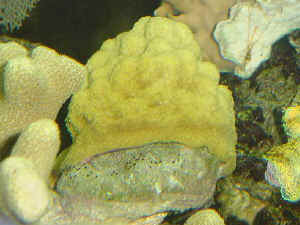 |
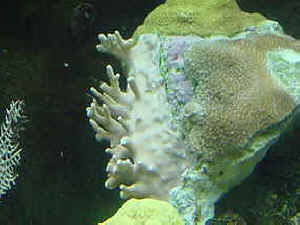 |
New Tank in Honduras, A Short Adieu.. >Hi, Marina and
crew. >>Hola. Como estas, Bernd? Soy bien (mas o menos). ;)
>Thank You very much for Your advise. >>De nada, mi amigo.
>We will heed it. Once we have started adding fish, I will keep You
informed of our progress. Thanks again, Saludos from the wet (rainy)
tropics, Bernd >>Please do, so few people get to set up a tank of
this size, let alone with certain acquisitions so difficult. Marina
New diver in Roatan hi bob, <Robin> hope you have had
some nice dives lately. we are interested in taking a virgin diving
trip to Roatan. never dived b4. we are looking at going the 2nd week of
April. what do you think about the sea lice? <Not much... that is,
these bothersome isopods are rarely encountered by divers anywhere>
will it be a problem? <Very, very unlikely> are there any other
potential hazards or problems that our travel agents might not disclose
that you might be aware of that you could share with us? <Yes... the
most "dangerous" organism one will encounter is oneself...
gain familiarity, confidence in your gear, yourself... next is your
dive-buddy... know who this person is and learn to trust your
predictability re them... Other than humans, really the only animals to
look out for there are sea urchins... those dang spiny pincushions will
poke you unmercifully if you touch them... Oh, and the many types of
hydrozoans (the fawn-colored fire coral and little "Christmas
tree" like forms of life, esp. on ropes underwater (that dive
masters will ask you to hold on to)... wear thin gloves if you're
concerned and otherwise don't "touch anything" and you
will be fine. It's far more dangerous out of the water than
in...> if you think this is not a good first diving vacation choice,
then where would you send us? and lastly, is there anything we should
make sure we take with us? <Roatan, Honduras is a very nice area...
nice folks, good accommodations and food, not too distant or
expensive... only a seasonal concern with hurricanes (at times). Do
take a read through this travel checklist: http://www.wetwebmedia.com/travelchklists.htm
Adapt, adopt it to your use> many thanks for helping us out, Robin
<Bon voyage my friend. Bob Fenner>
Tank-raised marine livestock query Hi All, I have a 75 gallon
reef tank in a Caribbean biotope. Live sand and LR from TBS. I have two
tank raised Neon Gobies and a tank raised Royal Gramma. I've been
looking for one more fish to put in this tank. As I prefer tank raised
fish, I'm at a lost as to which fishes may be compatible in this
arrangement. Any thoughts or suggestions would be appreciated, Mike
<Mmm, well your current choices are limited to non-tropical West
Atlantic species... a good number of the Clownfishes, Dottybacks, a
couple of marine angels... There are some cultured invertebrates to
consider, including the Caribbean Lysmata wurdemanni... Bob
Fenner>
Dive locations hi bob, <Howdy> my family has decided to
go snorkeling/scuba diving the first week of march 2004 (instead of
snowskiing!) we have never been except for the snorkeling we did this
summer. we live in SC. in your opinion, where would be some great
places to go that are on this side of the country? <The best areas
along the coast have got to be in the State of Florida... can you and
your family make it on down to the Keys? This is likely where I'd
go... if not the Bahamas... or even further south. Are you all
certified already? If not, look into "resort certification"
at many places in the tropical West Atlantic that offer this... If it
fits the budget, the all-inclusive family resorts (like Beaches) can be
a great time> and certainly, we would travel outside of the US
border. many thanks, Robin <A new world awaits you. Bob
Fenner>
Re: dive locations thanks for the info. we are planning to
get certified here in town b4 we go. yes, we would definitely be
interested in the islands. we've been to the Bahamas. would like to
go somewhere else. are most all of the islands going to give us great
snorkeling? and what kinds of fish should we expect to see? thanks
Robin <Lots of possibilities, and many qualifying questions to ask
back to you... Do you folks like archaeology as well? Have you been to
Cozumel? There are some good deals to be had there now (we've just
returned from a dive industry tradeshow in Miami, and many folks were
advertising such)... or other attractions (hiking, touristing...) above
water? How much time do you have to be on this holiday? Have you been
to many other places in the Caribbean? Bonaire, the Caymans and Cozumel
have the best visibility in all the TWA (IMO of course), but there are
many other activities and sights to consider. Bob Fenner>
Re:
dive locations thanks Bob, <Robin> we will definitely start
investigating these places. we are going to be on vacation for a week.
do you have any websites for the aforementioned places? <Many... but
Google and other search engines, directories are a better use of your
time... make a "folder" in your favorites to organize the
sites you find, share with your crew... Wishing you a bon voyage, Bob
Fenner> thanks a bunch! Robin
Belize Dear Mr. Fenner, I hope that this gets through to you
withy this address. <Yes. Hello> I am a Canadian who has been
involved in importing and distributing marine fish and organisms for
many years in a relatively small way. I have also done some collecting
in the Caribbean, again in a small way, usually while visiting with a
supplier. <A way I like to spend time, get to know folks as well>
As I near retirement age, I have an interest in doing more collecting
on a small commercial basis and export to several regular customers. I
have been looking at Belize as an option, and through gleanings from
WetWebMedia, understand that you have been involved in the Belize scene
in the past. I would appreciate any comments or suggestions that you
may have with regards to the current and future situation, and your
opinion on the feasibility of involving myself in a small way.
<It's been a few years since my last visit there, but I do
hope/trust Mr. Harry Reeves is still about and at the collection/export
of marine livestock still. Do inquire of him if/when contacting
fisheries folks there re the possibility of joining the trade. Five
years back or so there were only three license holders involved in
ornamental aquatics... and not that much at that... with a HUGE
resource (second largest barrier reef on this planet)... and MUCH good
work done by Canadians there... roads, land surveyed, a good deal of
"snow bird" population...> I understand that there is at
least one organization operating there and am told that there are many
restrictions regarding quotas, permits etc. and I am sure that there
are logistical problems as well . <We visited with the
fisheries/resource management agencies in Belize City re these
issues... not insurmountable> I would welcome any input that you may
have, and look foreword to your response. Keep up the good work that
you and the crew are doing. Respectfully, Grant Armstrong <Really,
not just best, but only way of making progress on information,
permits... and gaining insight as to whether you're going to like
living there (a very nice, civilized place except for the old capital
and San Pedro on Ambergris IMO) is to go there, stay a few weeks. Bob
Fenner>
Sea & Learn on Saba Hello from Saba, a 5-square mile
island in the Caribbean. My name is Lynn Costenaro and I am an owner of
Sea Saba Dive Center. We are hosting "Sea & Learn on
Saba", a month long celebration of nature. <Sounds very
nice> We have invited guest lecturers: academics, naturalists and
scientists from around the world to give presentations and follow-up
field work on nature--from orchids and rainforests to seahorses and
sharks. We are specifically looking for a frogfish expert and found
your website: wetwebmedia.com From the site I'm not certain if you,
Bob, are a Frogfish "expert", enthusiastic aquarist or have
some scientific background... <Mmm, a bit of the aquarist,
diver/photographer (I produce content in the aquarium, diving and
underwater natural history markets)> but let me explain that the
persons we invite do not have to be 'the foremost expert in their
field'....if you can give me a better idea of your expertise, I
will greatly appreciate it. <For frogfishes, family Antennariidae, I
can't think of anyone more well-versed and experienced than Scott
Michael. See from the attachment below, you're aware of him. Does
he have time, interest?> I thank you in advance for your time and
consideration--best regards from Saba, <Okay. A very nice offer...
but this slot only on Caribbean lophiiform fishes? Have not been to
Saba (yet!), but have been to dozens of tropical West Atlantic sites,
dived there a few thousand times... and not seen many Anglers... Can
make said presentation (out last week of Oct. to the Marquesas though).
Will ask Scott re (as he is best choice IMO) and otherwise re-contact
you. Thank you for your consideration. Bob Fenner, WetWebMedia> Lynn
& John and the Team of Sea Saba Dive Center www.seasaba.com DIVE
THE SEA SABA DIFFERENCE SeaSaba@aol.com PO Box 598; Windwardside Saba,
Netherlands Antilles 599-416-2246--Phone 599-416-2362--Fax
Saba, Anglerfish, Presentation? Hi Bob. Many thanks---sorry I
missed your messages the first time. Yes, we know of Scott Michael.
John is a "member" of his 'on line club' and a
frogfish fanatic as well. Scott can't make it until next year's
Sea & Learn event. <I see> Not sure what you mean when you
write: "... fishes? Have not been to Saba (yet!), but have been to
dozens of tropical West > Atlantic sites, dived there a few thousand
times... and not seen many Anglers... > Can make said presentation
(out last week of Oct. to the Marquesas though)." > Will ask
Scott re (as he is best choice IMO) and otherwise re-contact you."
perhaps if frogfish are not your most comfortable area there's
another area you can give a presentation on? <Several. Have given
presentations on many aspects of underwater natural history, species
groups of marine organisms of the area. The TWA (tropical West
Atlantic) is a principal part of the dive/adventure travel industry as
well as a large section of one of my books (The Fishwatcher's
Guides...)> Let me know--our platform is quite vague--basically
anything having to do with nature in our tropical environment. Cheers,
<Will chat with you soon re. What sort of offer can you make to
bringing along ones significant other for stay, diving? Bob Fenner>
Lynn Costenaro Sea Saba Dive Center <A
HREF="www.seasaba.com">www.seasaba.com</A> DIVE THE
SEA SABA DIFFERENCE SeaSaba@aol.com
Saba, Presentation > species groups of marine organisms of
the area. The TWA (tropical West > Atlantic) is a principal part of
the dive/adventure travel industry Ok, Bob! Let's take this to a
next step. I am attaching our Official Invitation that I sent to Scott
Michael. <Yes. You sent this along with the first notice. Have it,
printed out> I just need a clearer understanding of the
presentation--do you mean along the lines of fish identification?
<If you'd like, yes... or just one group (e.g. Algae, all
Invertebrate groups in the area, sharks and rays... or even topics on
"how to" issues like underwater photography...> Have a
look at our offer (basically you would need to cover airfare and a few
meals, we comp hotel, diving and 3 dinners for a 7 night stay for both
you and your significant other. BUT, you would need to avoid the last
week of October as we're about full with divers and experts and
I'm not sure I'd be able to get you on our boat. <No
worries. We are scheduled to be in the Marquesas the last week of Oct.,
first of Nov., so have to leave a few days ahead of this time>
Ideally, first week of October because I'd love to see your
presentation and we go to DEMA Oct 6 and don't return until the
24th....Let's talk more. Thanks! Lynn <Intending to be at the
(Miami) DEMA show as well (did I see you last Nov. in Vegas?). Will
respond firmly one way or the other by early next week. Again, thank
you for the offer. Bob Fenner, WetWebMedia>
Saba, Presentation by the way...if you want to come and it
can all work out, I'll need a photo (preferably a shot done
"in the field"), a one paragraph bio and dates--for the
website--once you have a l look at the other bios we did I think
you'll understand--easy! Lynn <Okay. Bob F>
Re: Saba, Presentation > presentation--do you mean along
the lines of fish identification? > <If you'd like, yes... or
just one group (e.g. Algae, all Invertebrate > groups in the area,
sharks and rays... or even topics on "how to" issues like
> underwater photography...> > Have a --great news, Bob. We
have two shark experts in the plan already (can there ever be too many
as we expect this always to be a big attraction...although I think
algae and its importance in the balance of the reef is interesting
perhaps invertebrates may be more so??? BUT, if you already have both
presentations prepared from a previous exercise, we'd love to have
both! That way, just more we can offer. let me know and look forward to
hearing back from you on this. Hopefully, you've looked at our
website or other sources and see this as a nice getaway for you and
your other half and a means of having a good time at a much reduced
price and not so much input required from you. Again, thanks. Lynn
<Will get back with you soon re plans. Bob Fenner>
Re October possibilities at Saba Lynn, am having to pass on
your generous offer. The DEMA show in Miami and a visit thereafter in
S. Florida is crowding our trip later Oct. to the Marquesas. Would
appreciate the chance/opportunity to present talks to your clientele in
future, so do please keep my name on file. Bob Fenner, WetWebMedia
Re October possibilities at Saba Hi Bob. I appreciate your
reply. By all means, consider October 2004 as an open invitation.
Please stop by our booth at DEMA so we can meet in person and talk
about any future plans. Cheers! <Will hope to see you in Miami and
beyond. Bob Fenner> Lynn & John and the Team of Sea Saba Dive
Center <A
HREF="www.seasaba.com">www.seasaba.com</A> DIVE THE
SEA SABA DIFFERENCE SeaSaba@aol.com PO Box 598; Windwardside Saba,
Netherlands Antilles 599-416-2246--Phone 599-416-2362--Fax
Caribbean display >OK guys, >>And gals, hello.
>>I went through the list of google searches, and couldn't
find an answer for my question so I had to write. I'll be brief. I
believe I have made up my mind to keep a Caribbean Biotope in a 125.
Here are the species, and the approximate amounts- please keep in mind
this is a work in progress- >>Aren't they all? ;) French or
Queen Angel Royal Grammas- (3 to 6) -Tullock outlines a Caribbean tank
with 6 grammas Yellow headed Jawfish- 3 Chalk bass- 3 Blue Chromis-3
Peppermint bass-1 Cuban hog-1 Cherub angel-1 Flameback angel-1
Caribbean blue tang-1 Blue hamlet?- would he try to eat any of the
smaller fish? Caribbean hawk- Ditto for him? >Let me know if you see
any potential problems- I know that the Queen or French will most
likely out-grow the tank and need larger quarters- not a problem,
justification for a new tank! >>At the moment my concern is the
mixing of angels, potential for trouble there in a tank that is not
much, much larger. Also, with *any* fish the rule is: if it can fit
someone in its mouth IT WILL. Please be aware. >If you have any
other Caribbean species I would appreciate it. Lastly, I have a wet dry
and skimmer ready to go. My thoughts are to pull the bioballs, and go
the live rock and sand route- better for this mix of fishes?
>>Better for *any* mix of fishes. If you can set up a deep sand
bed and refugium, you'll be far better able to control nitrates in
this manner. With a wet/dry, you will not be able to culture any
denitrifying bacteria. >Sorry, one more last question. I am
struggling with the idea of 125lbs of LR. Is it feasible to seed other
rocks with live and have them function? >>Possible, yes. Try
looking for cultured rock, eh? >By the way, where can I find dry
rock? The cheapest I can find is $1.99/lb. I can get fully cured base
rock for that. Would a landscape store offer an alternative?
>Masonry supply, but one *really* needs to know their stuff,
mineral/chemical composition of rock is problematic in a tank,
especially a saltwater tank. >And how does the biological filtration
capacity of cement based rock fare with the real thing? >>Not
well at all. Eventually, you can hope to see *some* biological
filtration, but you'll be hard pressed to garner the benefits of
the denitrifiers, as mentioned above. Links to follow here-->
http://www.wetwebmedia.com/grammas.htm
>> http://www.wetwebmedia.com/basses.htm
>> http://www.wetwebmedia.com/twafwgv1.htm
>> http://www.wetwebmedia.com/serranus.htm
As well as searching our site, please search at http://www.reefs.org/library
(another good site). >Thanks again, Chris >>Good luck!
Marina
Gulf of Mexico Algae and plants Bob: Just curious to learn if
you are aware of a website (or other source) with information regarding
macro algae and seagrasses that may be found along the beaches of the
Florida Panhandle. Observation in their natural habitat is my only
motivation at the moment - the state of Florida has a moratorium on
marine life and crab endorsements until July 1, 2005 :o( I am assuming
that extends to these organisms as well. David <There are a few
guides... some much more complete than others. The ones I use are
carried by David Behrens at Sea Challengers (.com). Please peruse his
online catalog of books. Bob Fenner>
- Creating a 200 gallon Caribbean Fore-Reef - Hi Bob,
<Actually, I'm not Bob but I play one on TV... JasonC here.>
I was planning on setting up a 200 gallon or so Caribbean fore-reef,
and was wondering what you thought about my stock list, which will be
as follows, and if you wouldn't mind commenting on it. <You
bet.> Fish: School of Sergeant Major Damsels <Hmm... well, most
schooling behaviors don't seem to work out in the long haul and in
anything but the largest of system - 1,000s of gallons. Additionally,
these damsels grow up to be quite pugnacious and will terrorize each
other and the other inhabitants - I would reconsider the damsels.> 1
Beau Gregory Damsel <Unless you want a tank of trouble-makers, I
would avoid any/all damsels.> 1 Harlequin Bass <While these
don't get quite as big as their grouper cousins - at a maximum of
one foot, this fish will likely demolish your population of smaller
fish.> 1-2 Spotted Drums <These are very shy fish, it's hard
enough to spot them in the wild. They don't always ship well or do
any better once they've landed. Do your best to secure the best
specimens. More on these here: http://www.wetwebmedia.com/croakers.htm
> 1 or possible a school of Bluehead Wrasse <One would be nice,
I'm not sure they would school after the juvenile phase.> 1-2
Royal Grammas <With the other fish on the list, I don't think
these could hang, but they are great fish.> What would you think
about a school of Blue Tangs in this setup? <How about one? I've
never seen these in a school in the wild, only individually.> Or do
they usually occur on reefs? <Oh sure.> Also, any other fish that
are found in this habitat that you would recommend? <Quite a few,
especially as substitutes for some of the ones you listed so far, but
the list is rather long. If I were you I would just go through the
WetWebMedia site - all of these choices are well-documented there.>
Inverts: Many Blue-legged Hermits Many Astraea Snails Few Brittle Stars
(Oreaster reticulatus) 1 Arrow Crab <These guys are bad news - quite
predatory.> 1 Coral Banded Shrimp 5-10 Peppermint Shrimp Some
Feather Dusters 1 Pink-tipped Haitian Anemone <Make sure you have
the proper lighting before you attempt this.> Assorted Macroalgae 2
or so Cucumbers 1 Long-spined Urchin Corals: Various Gorgonians: Sea
Fans, Sea Fingers, Encrusting, Sea Plumes, maybe some Sea Mat? Can you
recommend any stony or hard corals or this environment? <Again,
please avail yourself to the resources on our site - they are
extensive.> I plan on using local live rock and sand, probably from
tampabaysaltwater.com. Lighting will be fairly intense as to mimic the
shallow water environment, probably some combination of Halides,
Actinics, and/or Power Compacts. There will be a refugium as part of
the filtration, most likely using an overflow system, with a return to
the main tank. As far as flow rates go, I was doing some research and
found that systems of this types should be fairly high, due to the
natural turbidity of the environment. What kind of flow rate would you
recommend for this system? <As high as you can afford.> There
will be protein skimming, as well as the usual other types of equipment
that you would find in reef tank filtration. Is there anything else
that you would recommend in addition to the questions that I have
asked, or anything that you think that I have left out. <If
you're not already certified to dive, consider doing so and then
try to get out there and see some Caribbean fore-reefs before you try
to create it peace-meal. Once the damsels try to bully you away, more
things will become apparent to you. Biotopic systems are the probably
the best shot any of us has at long-term success, but I think it's
also very important to get to understand some of the interactions in
these systems before we try to reproduce a home-size slice of the real
thing.> Thanks a lot, Mark <Cheers, J -- >
Re: Florida Biotope Aquariums Hi, I was wondering if you guys
could give me a list of possible fish, invertebrates, and plants that
would inhabit the shallow coastal waters off of Florida. I would like
to set up a Seagrass bed type of aquarium. Also, along the same lines,
what kind of fish and invertebrates would be found in the mangrove
habitats off of Florida also? Thanks, Mark <Please see here:
http://www.wetwebmedia.com/twafwgv1.htm
and particularly the bibliography, Paul Humann's books. Bob
Fenner>
Honeymoon in Florida, Fish store visits, like glue and sand?
In February I am going to Orlando, FL, for my honeymoon (taking the
plunge) I would like to know if you folks have any ideas of some retail
dealers of marine aquatics in that area as I would like to check out
some of the local dealers and maybe pick up some marine life. I'm
sure there is stuff down there that I can't get here in Michigan. I
am always looking for obscure and hard to find sealife there are few
dealers here in Kalamazoo, MI. any info will be great. James Wesley
<Dude...it's your honeymoon! Stay out of the fish stores! HA! If
you new wife will let you go fish shopping, do it. WooHoo! Check out
the links pages at Wetwebmedia.com There are quite a few companies in
the Florida area. I see a long happy future for this marriage...*sigh*
David D. getting misty-eyed in Las Vegas...>
Moray info. Correction (to do) >Bob/Crew: Just for
reference - here is the paragraph in the article Bahamas to Brazil that
led me to ask the question below: >"The other West Atlantic
morays get too big, jump out too readily and gladly eat their fishy
tankmates > (2).. Nevertheless, because these "big
nasties" are available we'll list them here. The Goldentail
> (Gymnothorax miliaris), Spotted (G. moringa), Purple Mouth (G.
vicinus), even "monster" Green or > Golden Moray Eels (G.
funebris). Other names, including the infamous "assorted" and
"miscellaneous" > are applied to these and a few other eel
species imports. If you get one of these escape artists, watch >
your hands and your piscine livestock!" >Sounds like maybe the
Goldentail was not meant for that list. Hope this helps >David
<Thank you for this... Gymnothorax miliaris, is a good choice (for
the family) for aquarium use. Please see the coverage here: http://www.wetwebmedia.com/morays.htm Bob
Fenner>
My plan (Caribbean biotope stocking...) Hi Bob, Anthony,
Steven Pro, <Plus, Jason and newly added Craig, Gage, and Scott.>
I've been trying to get some ideas together on building a Caribbean
biotopic setup divided into three show tanks with a common sump and
refugium. Here's the plan so far: 100-125 gallon FOWLR (cultured
LR) 1 Blue Tang Acanthurus coeruleus 1 Cuban Hogfish Bodianus
pulchellus <This hogfish will grow to about one foot and would be
inappropriate in all but the largest of aquariums (hundreds of
gallons).> 1 Graysby Cephalopholis cruentata <Another guy over a
foot and needing a larger tank.> 1 Harlequin Bass Serranus tigrinus
1 Golden Hamlet Hypoplectrus gummigutta 5 Yellowtail Reeffish Chromis
enchrysurus 4 Neon Gobies Gobiosoma oceanops (tank raised) 1
Trumpetfish ? Aulostomus maculatus <Another large guy that is
challenging, too.> Full grown this should be about 60" of fish.
Basses and hogfish may not work well together. Thoughts? <See above.
Since I knocked off several of your choices, let me add a few;
Centropyge argi, Gramma loreto or melacara, Serranus tortugarum, and
Lysmata wurdemanni.> 50-55 gallon invertebrate tank with LR. I have
yet to figure out what corals, etc. are endemic to the Caribbean. Any
ideas? <The hard corals are all protected, but plenty of Ricordea
and other soft "corals".> 20 gallon high Seahorse tank
with LR 6 Hippocampus erectus (Ocean Rider) <I would go with no more
than 4 in this size tank.> DSB with Thalassia sp. 50-55 gallon Sump
Miracle Mud Mangroves 20 gallon Refugium DSB Thalassia sp. Aiptasia sp.
? Gracilaria sp. Phyto/zoo-plankton culture I try to use tank-raised or
culture specimens whenever possible. All sand: aragonite seeded with
live sand. All three tanks will simultaneously pump water to the sump,
pumped to the refugium, and pumped back to the respective tanks. The
sump will be connected to a heavy-duty protein skimmer and a calcium
reactor. The refugium will contain a passive carbon filter just prior
to the water being pumped back to the show tanks. Metal halides will
light the reef tank, while PC's will light the other two show
tanks. 24 hour lighting to the refugium via PC's, and a pendant PC
on the sump because of the mangroves. <I would prefer you keep the
reef tank separate from the rest. I think nutrient could become a
problem from the feeding of the fish tanks. You could still tie the
other together. In that case, your refugium would benefit from Caulerpa
to maximize nutrient export.> Plumbing will utilize float valves,
check valves, and cutoffs for each tank (in and out) for emergencies.
I'll probably put a doser on for top off. This is a pipe dream for
now, but if I start with the FOWLR tank and add on from there, I may
get it done in a few, maybe 5, more like ten years. I just want to
start the whole project with a plan. What do you think? <See my
notes above.> Thanks for your input, Mike <You are welcome.
-Steven Pro>
| Atlantic Corals Anthony, or whomever is on
tonight, <cheers mate> Thank you for identifying the last two
pics I sent you. These are all hitchhikers on my LR from the
Florida Keys. <wow... hat is some killer live rock you have
there! Purchased or collected? Very beautiful diversity it
seems> I'm not going to add any corals to this tank, but I
like to know what I have in order to supply these creatures with
the best care I can give them. <admirable my friend> I
don't believe in the idea that when something dies to say,
"oh well, it came with the LR". Every organism deserves
its best chance in my setup. <I'm starting to sound like the
aquarist's version of M. L. King Jr.> <we are in
agreement... and you do have some rarities that many reef keepers
would trade dearly for and give a great home of you ever choose to
part with them> Anyway, some more pics, if you please. I thank
you so much (and my critters thank you even more), Mike <my
pleasure... the first image is likely a Faviid: the Rose coral
(Manicina)... although it is not crystal clear from the
image/age/size of coral. Possibly Mussa... but I think it likely
will be a rose coral. The second image is a solitary cup coral.
Three families with more than a handful of species looking quite
similar are included under this umbrella name. Both corals here are
scleractinian reef builders... the latter is weekly symbiotic or
not symbiotic at all (requires daily feeding). Feeding finely
minced meaty foods of marine origin 3-5 times weekly minimum is
necessary and will keep these beauties just fine, Daily feeding for
fast growth. Do consider buying the Humann and DeLoach set (3) of
dive books on Florida and Caribbean creatures... all of these
corals and so much more on your live rock are Id.ed therein. Great
books (Reef Creatures, Reef Coral, Reef Fishes). With kind regards,
Anthony> |
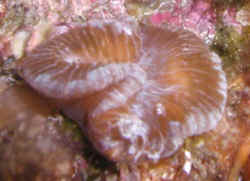 |
|
|