 |
|
| Home | Marine Aquariums |
Freshwater Aquariums |
Planted Aquariums |
Brackish Systems |
Ponds,
lakes & fountains |
Turtles & Amphibians |
Aquatic Business |
Aquatic Science |
Ask the WWM Crew a Question |
| Please visit our Sponsors | ||||
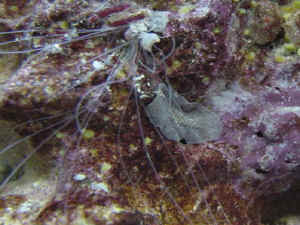
Help, tiny white worms... SW 8/31/09
How To Get Rid Of Hair Worms… Why Would You Want To? - 09/14/07 Hey guys, <Hi Josh, you've got one of the gals tonight.> I have done some looking on your website and it appears that what I have in my tank are hair worms. They are about 1-2 inches long, about as thick as hair, and white and kinda fuzzy toward the ends. I've read that they are completely harmless, so I'm not worried about them hurting anything, but they are multiplying like crazy. I started with just a couple that I believe came in on a frogspawn I bought. Now I have roughly 25-30 of them in a 9-gallon tank! <Lucky you!> There are a lot of them on one particular rock near my Zoas and they are constantly brushing them causing them to close up. <I wouldn't be too concerned. I doubt the Zoas are suffering.> Is there anything that eats these guys or anything I can do to get rid of them? <Oh, I would discourage you from doing this. These are quite beneficial to your system and have many predators, so you are lucky to have them. Predators include hermit crabs, cleaner shrimp and many nipping fish.> It's a little unattractive to have 25-30 white strands of hair blowing around all in your tank. <Perhaps a little relocation?> Thanks for everything, <Welcome! Mich> Josh Feather Duster & Worm Questions Hello again, crew.<Hello, MikeB here.> I have a feather duster/worm question for you. I looked through everything I could find on the site and couldn't find any information on it, so please forgive me if I missed this in some previous answer. <Sure, no problem.> We originally had 2 Hawaiian feather dusters and 1 small, dark purple feather duster. The small feather duster (don't have a more accurate name) had what seemed like a calcareous tube that looked like it was made of substrate - not like the leathery tubes of the other two. The Hawaiians seem to be doing just great, and we have a number of other dusters that have begun growing on live rock. However, a couple of months ago, the small feather duster appeared to have died - the feather crown fell off, tube in several pieces, no visible worm. We cleared out the old crown and empty pieces of tube that were easy to reach, leaving one small (maybe 3/4") piece of tube that was under a rock shelf that not as easy to get to. There is now a lot of activity originating in the old piece of tube, which we hope means the original worm is still around.<If the worm gets stressed it will drop its head and eventually a new one will regrow.> There are many grayish, thread-like projections coming from the tube (like 40-50) that spread out to cover a pretty wide area of substrate and appear to be moving small substrate pieces back toward the tube. Our concern is to make sure it's the original duster worm doing his or her thing, vs. another species that might not be such good news that might simply be opportunistically using the old tube section.<My hunch is that it is the old feather duster trying to reattach itself on the live rock or substrate.> I didn't see anything on the site about these hair or thread projections. Finally, on what I think is an unrelated topic (we have given up on being sure of anything), we have noticed that we have some pink and some white worms in that general "construction" area of the substrate. We think they would be called bristle worms.<You are correct.> We haven't seen them elsewhere, although maybe we just missed them. Related? <No they are not related to feather dusters.> Meaningful? <They are good for substrate circulation but can be a nuisance if they are in large proportions.> Get a life and quit looking at the tank? <Absolutely not, I live by looking at my tank.> Thanks, as always. This is absolutely the best resource on the web; wish we had known about it all along, but it saves us regularly now. Laura & Jim <Good Luck, MikeB> - Worm ID - Hi, I am very new to the saltwater
hobby. I have a 90 gallon FO tank, has been up and running
for about 2 months. I have started to notice very small (
size of a hair) black worms in my sand and on my rock. Any
idea what they are and if they are bad. <I think they are small,
black worms... probably not harmful.> Like I said they are the size
of a hair and maybe 1/4" long and black?? <Sorry I don't
have a more exact answer for you, but the worms are among the most
diverse group of organisms on the planet. Hard for even the PhD's
to be true experts, and I am neither.> Thanks,
Spaghetti worms - marine 1/14/04 I've looked and looked and looked and can't really seem to find the answer to this questions, so could you PLEASE HELP??? Are spaghetti worms something to worry about in a salt water aquarium tank? <they are very helpful... detritivores. I'm not sure where exactly you were looking... but a simple keyword search on Google or another large search engine turns up hundreds of references to these desirable denizens of marine substrates> I've just discovered some coming out of the live rock. Let me know if they need to be fished out or are actually a good critter to have in there. THANKS! Jen <they are as good as gold if you could breed and sell them. Keepers. Anthony> Nuisance crab and worm Hello <Hi. Steve Allen here tonight> I have started a new 55 gallon reef tank. Its been up and running for just under a month. After adding my live rock I happened to notice a number of what I suspect are bristle worms. The problem is in one piece of live rock there was a very large worm. It's length was approximately 3 to 4 inches and that was the part sticking out of the rock. Since my attention has been drawn to this large piece of rock I have noticed that there is a good sized crab living within and under it. I haven't been able to identify it yet but when I shine a pen light into one of the holes in the rock I can see that its quit large. In any event I want both of these creatures gone. <A bristle worm of this size is not really a problem. Read through the Bristleworm FAQs before you commit to getting rid of it.> I have tried trapping the worm by wrapping brine shrimp in a weighted nylon stocking, but that has failed. <There are better ways. Check the FAQs.> My question is since this tank is still so new, can I remove the rock and try extracting these creatures? I have heard that I could run the rock under fresh water and the worms and crab will exit and I have heard that I could submerge the rock in a high salt content water and they will vacate. <Number 2 is the better way to go. SG >1.030 > What would your suggestions be? I have also attached the tank log for your inspection <nice log. Do you have Excel? A spreadsheet is a nice way to track/trend your parameters.> thank you for the help <Hope this helps.> Planarians maybe you can help me, I need too kill planarians hope that is the correct name) once and for all I'll be most grateful for this information. best regards. <Please read here: http://www.wetwebmedia.com/pestflatwrmanthony.htm and the linked (in blue, at top) files beyond. Bob Fenner> - Worm Caused Tank Crash, News at 11 - Guys, I have asked you a few questions in the past. Your answers have not only helped me but the LFS with whom I do a lot of business and have passed on your advice. I am writing this email on behalf of the LFS. Something very strange happened that caused a tank crash in a 125g reef. He started noticing a small (pin head sized) white worms eating a plate coral. Within 1 day, there were hundreds of these that ate the flesh and killed the plate, a nearby Fungia, a brain and numerous other corals. There are skeletons left at this point (3 days later). This tank is used to sell corals, so it has high turnover of stock. I haven't seen a worm caused crash in any of your FAQs. What could this be? <Probably not what it looks like - in my experience, most worms are harmless but still opportunistic meaning they won't pass up an easy meal. Typically they are lured out into the open by dead or dying organisms and arrive en masse to consume the necrotic flesh. I've often heard reports from folks who say, "Bristle worms have killed my coral." When in fact, the coral was already dying and the worms were just doing what they do. There are predatory worms, but they are typically larger and most often singular in occurrence in the aquarium... the folks at the LFS would have lost other corals before this.> Have you heard of this before? He would like to know, if possible, where these worms come from so he won't order corals that originate from that area for a while. <Impossible to say 'where' they came from.> This infestation occurred quickly and spread throughout the tank within a very short period of time. <Again, my thought here is that the death of the coral and the appearance of the worms is somewhat coincidental - likely the worms have always been there but perhaps this is the first Fungia that began to die before it was sold.> This is somewhat scary. <Perhaps for the easily scared - I personally really wouldn't worry about this too much.> Would peppermints/arrow crabs/6-line wrasse help? <Wouldn't hurt - would certainly keep such a population under control.> What other creatures would help? <I think just about any of the Pseudocheilinus wrasses would work... probably any of the small wrasses would work.> The water chemistry is perfect. The tank isn't fed, so there isn't nutrient problem. Thanks very much. <Cheers, J -- > Hitchhiker/Worm ID: Sipunculid... AKA Peanut Worm, rest easy 8/25/03 I found this worm(?) in my tank this morning. Any ID help would be greatly appreciated. It is a Sipunculid... AKA peanut worm... delightfully useful and harmless detritivores> Is this a good or bad thing? <do enjoy> I am attaching the picture. Rich <best regards, Anthony>
Worm ID - 08/12/03 <Hi John, PF answering your message
today> Hello there, Great site you have here.... and greetings from
Finland.. One question, I find last weekend bright red thing in
my tanks coral bottom, it was inside the coral sand and all around it
the coral sand was black ( like carbon), and in the other
end of that worm it has a lot of long thin tentacles. I
leave the worm alone and it bury it self inside the coral sand only the
tentacles are over the sand and are moving all over. the worm is about
2cm long and the tentacles much more. So any ideas what can that
be ?? <Go here: http://www.wetwebmedia.com/polychaetes.htm
and about half way down the page is a picture of a spaghetti worm. They
come in a number of colors including red, white, and orange. Is this
what you saw? If so, it a beneficial scavenger, and will hopefully
reproduce in your tank. Have a good one, PF> Thank you and Best
Regards,
Worm ID: Eurythoe Fireworms... Yikes! 7/8/03 Alrighty, here are a couple of pictures: <thanks for the follow-up. Your worm unfortunately is a Eurythoe Fireworm. Indeed predatory and even slight risk to you (painful setae/bristles) can be shed/shot into your skin. Do use the name provided to browse our website and the Web for more on the subject. We also chat about these critters versus the harmless bristleworms at length in our new book on Reef Invertebrates (P. 172): https://secure.wetwebmedia.com/order_form.jsp for signed copies of the book http://wetwebfotos.com/store/nma-ri.html best regards! Anthony> Another Worm Question for Ya - 7/7/03 Anthony or Bob, <Cheers, my friend> Hey there! Hope all is well with all of you and yours. First, I want to say your new invertebrate book is excellent. When will the next book in the series be coming out? <Gracias! And we're hoping to have the new book out within 12 months... less likely.> Been awhile since I've written. No problems lately! Ha-ha! Tank is going extremely well. Many incidental sponges and what appears to be a tunicate have taken hold and are growing very quickly (the tunicate organism is quite large and still expanding). If it is a tunicate that would be surprising but in a good way. Corals and invertebrates doing extremely well. A Sarcophyton has put on about 9cm in the past 6 months. <Outstanding> Well anyway... The issue is a very large Polychaete, or what I believe is a Polychaete. I've attached 9 pictures compressed in .zip format. <Cannot read/open the zipped files... please resend simply as downsized jpegs my friend. Only a couple needed. Thanks kindly, Anthony>
Small, transparent worms <Hi Meonne, PF here this AM> Please help me identify and provide suggestions on what I need to do about the small (inch or less), almost invisible, transparent worms in my 75 gallon saltwater tank. My tank has been setup for 7.5 weeks now. I also noticed some tiny white worms on the sides of my tank glass. I think I found out by reading your website that they are harmless and I just need to stop feeding my fish for 3-4 days to help eliminate them. Please advise. Thanks, Meonne <Well Meonne, unless they are in plague proportions, I wouldn't worry about them. Many organisms come and go over the lifetime of a tank as conditions change to favor some over others. Currently, I have a number of small worms myself that have only recently appeared. If you really want to cut down on their numbers, you could stop feeding the fish, or maybe just feed them less so that there is not so much food available for them. About 99% of all the worms in our tanks our harmless, and the other 1% may not even be harmful to anything you have in your tank. If they grow to plague proportions, write back with more details about your tank (water parameters, inhabitants, etc.) and we can give you better advise. Have a nice day, PF> ID this worm I found this little bugger crawling around the other day and I couldn't get a good shot of him in the tank so I pulled him out. Extended he is about 6 inches long. When he moves he actually pulls his body into himself then pushes it back out. What is this and is it good or bad? I know the PIC isn't real clear. I got a new camera and still haven't figured what settings are the ones to use. He has small black line encircling his entire body. At first it looked segmented but looking closer they are just markings. Help me. Oh yeah by the way you guys rock!!! <Thanks. Looks like a Peanut Worm (Sipunculid) to me. You can see a few of these on WWM or use your Net search tools with these terms for much more. Bob Fenner> Tiny white worms? Hi.... <Hi Luke, Don here> my tank is about 4 weeks old. I've noticed today that suddenly a huge number of little tiny white 'lines' appeared on the sides of my tank. They were moving and quite fast actually. They seem everywhere and there's tons of them. About 1mm in length I would say. What are those? Are they bad for inverts or fish? <These are worms that appear as a part of the natural progression a new tank goes through. Not to worry. If they are on a viewing pane, you can scrape them off very easily.> Thank you, Luke
Worms in my reef tank >Now I know that you get asked so many questions about worms in a reef tank and I have gone over recently asked questions and answers and mine just don't seem to fit. In my reef tank I am getting an over abundance of white, long stringy worms that live in tubular structures in my rock. >>Do they seem to build their own structures? >They have now eaten my flame scallop, clown goby, and other small invertebrates. I have heard of making a trap, but they don't ever fully come out of their holes. >>Something doesn't jive, here. If they *never* fully come out of their holes/tubes, then how would they be eating your other specimens? It's not uncommon for some worms to eat dead or dying animals (of which the flame scallop would be a highly likely candidate), but not so for the tube worms I'm familiar with. Also, any pictures you could send would be helpful in identification, along with sizes and so on. Once we get some of that information an ID would be a bit easier, though I can't guarantee it. >You can sit and watch them. They are long, single stringed, no crown or branches off the head or body and are carnivorous worms. How do I start to single out a few? >>Clearly, your husbandry of these worms is outstanding and they're proliferating. Not just surviving, but thriving as it were. >They do not bother peppermint shrimp, but they don't eat them either. |
|
|||||||||||||||||||||||||

|
Features: |
|
| Featured Sponsors: |