|
Bumblebee goby parasite? 1/6/19
Hi .
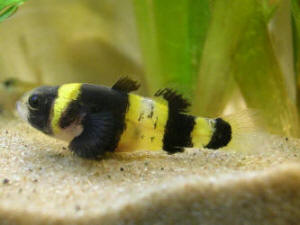
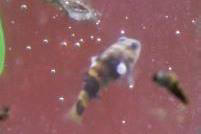
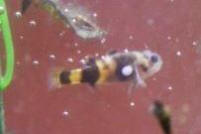
My Goby, Crazy Horse, developed the growth in the attached photo. It started
maybe two months ago as a small white spot on one side growing larger and then
appearing on both sides. Then it looked as though it was falling off, resembling
a loose fish scale (but too big to be one of Crazy's scales) or looking very
similar to the fin it is behind, I treated with Praziquantel and it seemed to
calm down for a while but is back now with vengeance. Pictures may not show
clearly it is now a opaque sack like growth, when I netted her I tweezered one
side removing the ‘sack’ which is about 2-2.5mm. In the area I tweezered remains
a white spot/growth about .5-1mm, she is currently in a bag and I am treating
her with Avitrol plus, a Levamisole and Prazi combo bird wormer and I gave her a
Potassium Permanganate dip the other day, neither of which seem to be having
much of an effect (other than stressing the poor little soul) She also seems to
have developed a bit of a humpback over this time, it has not effected her
appetite or weight but she is quite pale on and off. Tank is 65 litres has a
total of 7 Gobies and a ton of trumpet snails, salinity 1.005, Ammonia 0,
Nitrites 0, Nitrates never been above 5, PH 7.6. None of the other Gobies
showing any issues. Appreciate your time, and ideas if you have some.
Kind regards, Teresa.
<Hello Teresa. I don't think this is a parasite, but some sort of bacterial
infection. Still, you could see if saltwater dips help. These aim to stress any
external parasite before the fish gets stressed, and with brackish water
species, you can immerse the fish in full strength seawater for a long time, in
some cases indefinitely, which will usually kill any freshwater parasite such as
Anchor Worms. Conversely, freshwater dips will shift marine parasites like Sea
Lice. In this instance, some dechlorinated water at 25C with 35 gram marine salt
mix dissolved into each litre should produce seawater (SG 1.025 at this
temperature) and you can immerse the Bumblebee Goby for anything up to 20
minutes. Remove if the BBG looks stressed, but from experience I've seen them
handle seawater for some days, so 20 minutes should be fine. Anyway, if this is
an external parasite, this should work. But as I say, this looks more like a
pocket of tissue fluid under the skin, whether caused by a physical injury or a
bacterial infection is hard to say. Medicating as per internal bacterial
infection with a reliable antibiotic is probably the best approach. Kanaplex or
something along those lines would be my suggestion. Cheers, Neale.>
|
  |
|
Re: Bumblebee goby parasite? 1/6/19
Thanks so much Neale. I am in New Zealand and Kanaplex is not available here but
I see I can try to get some from overseas, unsure if it will make it through
though.
<Understood. Here in the UK, and most of the world in fact, antibiotics are
prescription-only, so you can get them from a vet. This isn't often cost
effective for small aquarium fish, but some reasonably reliable
alternatives to exist. My particular favourite is a product called eSHa 2000.
Waterlife Myxazin is often recommended too, but I haven't used it, so can't
vouch for its efficacy. The main thing is to avoid tea-tree oil and other such
herbal treatments as these generally don't work at all.>
Otherwise (I have not found a vet in my area with any decent
experience/knowledge) I will try my vet and see if they can come up with an
alternative now I have an idea of what we are dealing with.
Much appreciated
<Good luck, Neale.>
|
|
brackish - bumblebee goby fin problems (BobF?)
5/30/17
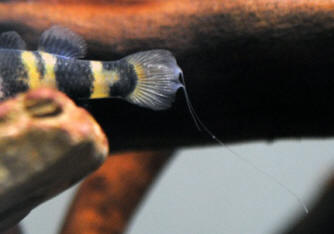
Hello,
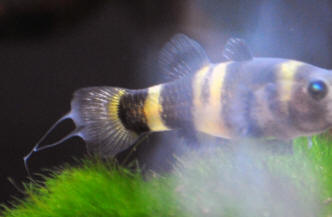
can you please help me identifying fin problems with my bumblebee goby which I
bought just recently. I have SG at 1.003 and they are the only fish in my
25gallon (100L) tank. The system is established (more than 1month old). Please
see the attached pictures. They are fully active and eating live daphnia, live
Artemia.
Best regards, Dejan
<Hi Dejan. I'm not convinced this is Finrot. Indeed, it's almost certainly not
given the fins themselves aren't eroded. Nor does it look like plain vanilla
fungus, lacking as it does the fluffy cotton wool-like masses we associated with
fungal infections. I'm much more inclined towards an external parasite, either
crustacean or worm. Treating these can be difficult, but one approach available
to brackish water fishkeepers is to expose their fish to substantial changes in
salinity. Half-strength seawater won't harm BBGs, and for short periods,
seawater dips should work
nicely. This means you could use salinity to "shock" any external parasites by
using saltwater dips, or else stress the parasites and break their life cycle by
exposing the fish to half-strength seawater over a few weeks. With few
exceptions, external parasites are either marine or freshwater, and tend not to
survive in (strongly) brackish conditions. Am asking our boss, Bob F., for his
ideas too. Cheers, Neale.>
|
 |
|
brackish - bumblebee goby fin problems /RMF
5/30/17
Hello,
can you please help me identifying fin problems with my bumblebee goby which I
bought just recently. I have SG at 1.003 and they are the only fish in my
25gallon (100L) tank. The system is established (more than 1month old). Please
see the attached pictures. They are fully active and eating live daphnia, live
Artemia.
Best regards, Dejan
<I agree w/ Neale; this appears to be a parasite... I would treat for directly
IF Neale's approach at manipulating salinity doesn't remove them; using both a
vermifuge (Praziquantel is my choice here) AND arthrocide
(some version of DTHP likely. See here Re:
http://www.wetwebmedia.com/fwsubwebindex/fishlicef.htm
Bob Fenner>
|
Re: brackish - bumblebee goby fin problems (BobF?)
6/3/17
hello Neale and Bob.
First thank you for the answer and tips.
<Most welcome.>
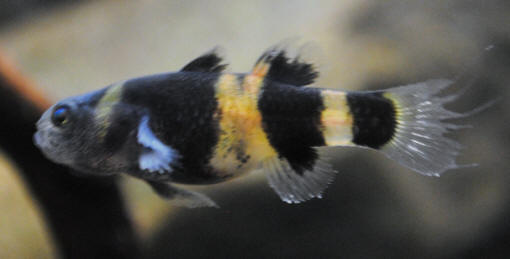
I did try salt-dip (20g marine/1L for 30min) but unfortunately it seems to have
no effect. Now (and before salt-dip) the BBGs have fins that appear to be torn
and ragged – please see attached file (there is no aggression in the tank).
<I do agree; I would be treating for Finrot to start with, but also elevating
background salinity to around SG 1.005-1.010 for a few days or weeks. This will
hopefully stress the parasites sufficiently to budge them, or at least break
their life cycle. As BobF mentioned, an alternative would be physically
remove and/or use commercial anti-helminths and anti-crustacean medications
(the latter primarily used to treat things like Anchor Worm). The use of
salinity, on the other hand, is less toxic and cheaper, and standard operating
procedure on fish farms where euryhaline fishes are being kept, such as sea
trout and salmon.>
In this thank I also have Caridina gracilirostris and some plants: Cladophora
aegagropila, java moss, java fern and I think I’ll kill the plants if I would
increase salinity.
<Can these be removed to another tank temporarily? None of your plants have
roots, so removing them to an unheated tank with some ambient (but not direct)
sunlight would be fine during the summer months. The shrimps would probably be
fine in an unheated tank during the summer, too, but would of course need some
sort of basic filtration, even a simple sponge or corner filter running from an
air pump.>
The behaviour of fish is normal and they’re eating normally. Does it still look
like external parasite?
<Yes. Something is growing beyond the normal length of the fins. Finrot erodes
the fins, making the membranes smaller but sometimes leaving the fin rays (i.e.,
the bones) "dangling" for a while, giving the classic cobweb appearance of
Finrot. But if the fins are longer than usual, that's something else.>
Any other suggestions?
<None; see above, or even better, consult a friendly parasitologist with a
microscope able to ID the parasite or pathogen. This isn't a disease I've seen
before, I confess, but it looks so much like a crustacean parasite of some sort
I'd be treating as per Anchor Worm before anything else.>
Best regards and have a nice weekend, Dejan
<Welcome. Cheers, Neale.>
|
 |
|
Species compatibility... Comp. of FW puffers, bumblebee gobies.
12/4/15
Hello! Im writing you back after getting my new planted tank started... its a
150 gal high tech tank..
A few messages ago i wrote you a list of very peculiar species i wanted to keep
in this planted tank.
So far i have got none of them except for the green fire tetras (10).
Additionally i got a few fish for free from a fellow aquarist who no longer
wanted them:
A breeding pair of chocolate gouramis (and they ARE breeding!), and 4 golden
barbs, though these seem to be the mixed gold and green variety. Im planning on
getting 3 or 4 more gold barbs.
Anyway, the tank is still very under stocked and while searching for some
candidates for the tank i stumbled upon Sahyadria denisonii, and ordered 7 with
a local importer, they should be arriving in three weeks. I found out they are
endangered species so i will probably try to breed them, in fact i might try to
breed any endangered species i come across.
<Neat!>
So getting on point. I was about to order 5 Colomesus asellus, but i
continuously got mixed opinions about them... some say fin nippers and others
say they are totally peaceful...
<Can be fin-nippers; but much less so than all other small puffers sold for
aquarium use. IF kept fed, uncrowded, you should be fine>
i really want the fish but im not sure if im ready for everything the guys mean
(breeding snails, cutting the teeth twice per year... be on the lookout for
possible aggression) i might try them in a separate tank but not for now...
instead, while looking for similarly looking fish i stumbled on bumblebee
gobies.
I would like to get them but im getting mixed reviews on them too. Some say
totally brackish while others say that they can live in freshwater,
<There are a few species.... some are one or the other: READ here:
http://www.wetwebmedia.com/brackishsubwebindex/bumblbgobyfaqs.htm
and the linked files above>
but that they tend to be a bit more delicate... this last statement, however, is
not clear enough to understand how they will fare in freshwater... i normally
run acidic, soft tanks using RO water and peat but this 150 gal will have my
normal tap water... which is about 12 Dh and 7.7-8.0 ph... i understand this ph
will favor gobies, is this enough to manage to keep them successfully their
normal lifespans?
<Can>
i already breed mosquitoes larvae and grindal worms so i have live food for
these guys, but i would like your confirmation.
<Re? Please learn to/use WWM in advance of writing us; the search tool, indices.
SEE/READ the "HOW TO USE WWM" file>
Also, is it just me or does it seem like fish that need soft, acidic water are
more likely to acclimate successfully and be kept their normal lifespans in
alkaline and hard water...but the opposite doesn't happen?
<Mmm; some; yes.... but I chalk/credit a great deal of this to the fact that
many ornamentals are captive produced nowayears and that they are far more
adaptable to a wider range of conditions. I can recall when Chocolate Gouramis
were almost impossible to keep; same w/ Discus/Symphysodon, and, and....>
i kept my cardinals, neons, black neon tetras and some of my current Apistos in
my normal tap water for some time and the Apistos even bred... but my platies
and mollies rapidly showed signs of sickness when i started to turn their water
more acidic/soft.. (don't worry they are in hard tap water right now).
Thanks again.
Roberto
<And you for sharing. Bob Fenner>
Mini bumblebee gobies
11/14/13
I got suckered into an impulse buy of 2 "mini bumblebee gobys".
<Presumably one of the smaller Brachygobius species such as Brachygobius
nunus or Brachygobius aggregatus.>
They're I'm my 3g planted shrimp tank. Haven't seen any hunting behavior
at all (I intended tiny shrimp as a possible food....a lil natural
population control), so I'm hatching some BBS. Any other food
suggestions?
<Pretty much and frozen invertebrates including bloodworms and
brine shrimps are good. My specimens even ate small chunks of shrimp!
However, these gobies only snap at food that drifts past, and don't go
looking for food. A turkey baster can be useful for squirting food in
their general direction, while fiddling with the water current from the
filter may help ensure food moves close to them.>
Are they really a fw species (like they were sold to
me), or do they need salt to live? Thanks for any info on these adorable
oddballs
<It is true that Bumblebee Gobies ("BBGs") may be easier to keep in
slightly brackish water. Most shrimps won't mind slightly brackish
water, 2-3 grams marine aquarium salt per litre, and nor will most hardy
plants (Java moss, Java ferns, Anubias, etc.). But do review your
species and act
accordingly. Can BBGs live in plain freshwater? Yes, and clearly do in
the wild, but they may be a touch more sensitive. Most BBGs that die
prematurely in fish tanks starve to death, but if you have the option,
using a little salt will make a difference to your long-term success.
Cheers, Neale.>
New to Brackish Setups, BBGs;
stkg. more broadly
10/27/13
Hello,
I've had a spare 10g tank for ages and I'd like to try an aquarium with
brackish fish; ideally the salinity would be about 1.005 (that's the low
end of brackish water, correct?).
<It's "high-low end" if that makes sense. For what you have in mind,
going down to SG 1.002-1.003 at 25 C/77 F might be better.>
I was hoping you might be able to suggest some tank mates for
Bumblebee gobies (Brachygobius xanthozona). I was
considering Endler's Livebearers due to their small size; are there
other notable small fish that thrive in brackish water?
<BBGs will get along with any small fish that won't steal all
the food.
Endler's and regular Guppies can work, so can other small brackish water
livebearers; Limia spp., Micropoecilia parae and Micropoecilia picta
would be particularly interesting options. Wrestling Halfbeaks can also
work well, perhaps even better given they ignore food from at the bottom
of the tank.>
Similarly, I've read that Bumblebees can be somewhat aggressive; how
many are suitable for a 10g (with aforementioned tank mates)?
<BBGs are territorial rather than aggressive; provided each has a cave
of its own, and a good couple inches clear space between it and the next
BBG, they're fine. Indeed, big groups can be somewhat useful in the
sense that a large swarm can't be dominated by a single bully. So trying
getting 6-8 rather than 2-3. Given their tiny size and low cost, this
approach isn't difficult. You might also look out for the gregarious
species, Brachygobius aggregatus, that is best in a school.>
Lastly, the classic aquarium question: will crabs work with this set up?
<Not really. Crabs have such specific needs it's almost never "easy" to
mix them with fish.>
I was hoping to try out a male/female Fiddler crab pair, but I know
mixing crabs and fish is a tricky business. (As far as dry land
goes for the crabs, I would set up a DiY "underwater island" for their
benefit.).
<Instead of crabs, consider shrimps. Cherry Shrimps will thrive at SG
1.002-1.003, and should even breed. They'd look good. Amano Shrimps will
work too, but need more saline water to breed.>
Any other information for a brackish-tank-newbie would be most welcome.
Please let me know what you think!
<Much here; read. Any questions; ask. My FAQ might be useful, too.
http://brackishfaq.webspace.virginmedia.com
>
Thank you,
Ryan
<Most welcome, Neale.>
Re: New to Brackish Setups 10/27/13
Thank you for the prompt response! Though...now I think I have
more questions than when I started...
<Go on...>
I found out that my LFS actually sells both Brachygobius
aggregatus and xanthozona, so...is one preferable to the other or do
they look/act different...?
<Brachygobius xanthozona is distinctive because it is never sold in
aquarium shops, despite the name being extremely commonly used. What you
see in aquarium shops are various Brachygobius species that are
impossible to identify to species level (without examination under a
microscope, at least). But there are two "flavours" out there, the dwarf
species (apparently mostly Brachygobius nunus and Brachygobius
aggregatus) and the normal-sized species (Brachygobius doriae and
Brachygobius sabanus are said to be the most common). Beyond that,
there's absolutely no way the hobbyist, or the retailer, can be sure
what's for sale. None. Zip. Nada.
And anyone who tells you otherwise hasn't spent time talking with goby
scientists who work on the taxonomy of this genus! For all practical
purposes then, you have Bumblebee Gobies for sale, you buy some, and you
enjoy them. Hopefully they'll all be one species so they'll breed. If
you're really lucky, you might be offered a "swarming" species under the
Brachygobius aggregatus name, but whether that's what you've actually
got is up for debate; Brachygobius mekongensis for example looks and
behaves very similarly. Be clear: these are all differences without
distinctions; beyond the fact the "dwarf" species are smaller and more
sociable, all BBGs have identical requirements. Slightly brackish water,
shells and other caves, some plants, moderate water current, small
live/frozen foods, and suitably small tankmates that won't compete for
food.>
From what I've read, B. xanthozona is more tolerant of freshwater
environments, is that the major difference?
<Nope; as I say, the key thing about Brachygobius xanthozona seems to be
its extremely rare in the wild and hardly ever collected, even by
scientists. So it's the one species you can be 99.99% sure you will
never see in an aquarium shop. On the odd chance that one sneaks in, the
fact it was called "Brachygobius xanthozona" on the aquarium shop label
is sheer fluke -- they use the "Brachygobius xanthozona" name in the
hobby for any/all of the larger Brachygobius species, most of which seem
to be Brachygobius doriae, Brachygobius sabanus, and other
similar-looking species.>
I searched both species online and the same images show up for both;
frankly, I'm not sure what to make of it.
<Quite so. Externally their colours are all virtually the same, with
enough variation within a species to mean some from species A end up
looking more like species B. When I was editing my brackish water
aquarium book, the goby-scientist who wrote the chapter on gobies said
that the one thing you can say for sure about Bumblebee Gobies is that
almost all photos in magazines, books and on websites are
misidentified.>
I'm also a bit puzzled by the numbers you recommended; I really didn't
think a 10g could biologically support 6-8 Bumblebee gobies and another
shoal of small fish.
<Oh for sure you could fit 6-8 BBGs with, say, a school of 6
Micropoecilia picta.>
Are these gobies really that "light" of a bioload?
<They're certainly small, yes, and don't move about much. Such a tank
would be less heavily stocked than, say, the average 55-gallon tank with
a Plec and an Oscar!>
If so, how many Wrestling Halfbeaks would you recommend as tank mates?
<Wrestlers are bit more finicky and fiddly to keep because the males
squabble, so a single male and 2-3 females would make sense. Possibly
just the females if you wanted. The commonly traded Silver Halfbeak seen
nowadays is a very small, slender fish that only gets to about 5 cm in
length, the males less.>
Lastly, what kind of flow is ideal for these species of fish?
<For the BBGs, a brisk current is ideal. That's the point of their
"suckers", to hold onto rocks and plants while plankton is washed
overhead.
They like to snap at food that streams past them. But they aren't fussy.
Micropoecilia prefer more moderate currents, as the "Swamp Guppy" name
would suggest. Halfbeaks are fine either way.>
Were it up to me, I'd stick a Aquaclear 30 HOB filter (rated at 150gph)
on the 10g tank for the extra turnover, but I don't want these little
fish to be blown away either.
<No risk of that with the gobies at least.>
Should I stick with an Aquaclear 20 HOB (rated at 100gph) instead?
<It's an option, but to be honest I'd look at an internal sponge filter
so that you can offer live and frozen foods (which BBGs need) without
worrying all such foods will be sucked away into the filter. Plus, by
turning the air pump up or down, you could adjust flow rate to suit the
livestock you've got.>
Thanks again for your help, I really appreciate it.
-Ryan
<Most welcome. Cheers, Neale.>
Re: New to Brackish Setups; stkg. more broadly (include
prev. corr.)
10/28/13
Well, I'm really looking forward to getting this brackish 10g started!
I'd like to try the fish you recommended:
Bumblebee Goby x 6
Wrestling Halfbeak x 5 (1m, 4f)
Possibly a few Red Cherry Shrimp if it doesn't seem crowded.
<Should be fun.>
I believe my LFS keeps their BBGs and Halfbeaks in freshwater, so should
I set up the tank as purely freshwater for the initial addition of fish
and slowly increase the SG with my weekly water changes until it reaches
1.003?
Is an increase of .001 per week too fast of an increase? I just want
to avoid shocking the fish with more salt than they're used to.
<I would do precisely as you suggest.>
Along the same topic, I saw that you had a webpage listing plants that
can tolerate brackish water and I'm debating moving some Dwarf Hairgrass
from one tank to this new setup. Do you generally see something
akin to "melting" as the plants adjust to the new salinity level?
<It can happen, but "melting" is a reaction to changes in the
environment generally rather than to a specific change. Set the tank up
as per your local water chemistry, get everyone settled in (including
the plants) and then do slight salinity changes over succeeding weeks.>
Are there any plants you can recommend to help replicate the BBGs
natural environment?
<Relatively few authentic species from these habitats are traded, the
most notable ones being things like Crinum spp. (one species, Crinum
augustifolium is a brackish water specialist) and Cryptocoryne spp.
(again, Cryptocoryne ciliata being something of a specialist in such
environments).
So while you might not get the precise species mentioned, any hard water
tolerant Crinum or Cryptocoryne will do just fine at SG 1.002-1.003, and
would provide the right sort of look, too. Otherwise your aim is
probably for a jungly sort of look, but bear in mind that in the wild
(remarkably enough) BBGs are often found in soft, acidic blackwater
habitats with little submerged vegetation, so you might elect for a mix
of bogwood roots, thin twigs and branches, and perhaps a few epiphytes
like Anubias and Java fern to green things up. Really, since these fish
live in a range of environments from mangrove forests through to inland
forest streams, any Southeast Asian biotope tank is going to be
acceptable.>
Thanks again, my apologies for the excessive questioning!
-Ryan
<Most welcome. Cheers, Neale.>
Re: New to Brackish Setups 10/30/13
Neale,
It's always a pleasure to read your responses and I highly value your
staggering knowledge of all-things-aquarium. Thank you very much
for all your help!
-Ryan
<Thank you for these kind words. Good luck with the aquarium! Neale.>
Re: New to Brackish Setups, stkg.
11/3/13
Neale,
<Ryan,>
Unfortunately I've hit a bit of a snag in that I can't seem to locate
any Wrestling Halfbeaks (Dermogenys pusilla) at this time.
<Can be tricky to find... perhaps seasonal? Do remember for a couple of
years not seeing them at all, then they were everywhere all at once!>
Celebes Halfbeaks are in abundance, but would not be suited for a 10g.
<I do agree.>
I'll continue to search, but in the meantime I wonder if you could
suggest a few alternative top-dwelling brackish fish to go along with
Bumblebee Gobies. The best I can come up with are Endler's,
Celebes Rainbows, or the Poecilia picta guppies we had discussed
previously.
<Correct, though Celebes Rainbows probably don't need brackish water,
despite older books suggesting they do. Do also look at Micropoecilia
parae "melanzona red" and Micropoecilia parae "melanzona blue". They'd
be ideal and are extremely pretty. Limia species such as the Humpbacked
Limia (one of my favourite fish) are another possibility. In fact
virtually all small livebearers will thrive in slightly brackish water,
even if they are not naturally found in it. Also look at Pseudomugil
species, several of which are sometimes found in brackish water areas
(Pseudomugil cyanodorsalis, Pseudomugil signifer and Pseudomugil
gertrudae among others) and their small size and lovely colours make
them really nice fish to keep. Finally, consider the Ricefish, some of
which will tolerate slightly brackish water extremely well including the
species Oryzias dancena that is currently very widely traded (usually as
Oryzias melastigma). Ricefish are easy to breed and completely peaceful
fish, and their tiny adult size and high degree of hardiness make them
ideal for small tanks.>
Are there possibly any small Hatchetfish that would thrive in low
salinity (1.002-1.003)?
<Not that I'm aware of. They're strictly inland, rainforest habitat
beasties, and most likely soft water fish at that.>
I also had a few questions related to brackish stocking; I read your
page regarding Nerite snails and saw that Corona Nerites (Clithon
coronae) were listed as freshwater, though they breed in brackish.
Are they capable of permanently living in brackish waters (SG of
1.002-1.003)?
<Most if not all Nerites will do perfectly well in low-end brackish
conditions.>
Would a pair of Peacock Gudgeons (Tateurndina ocellicauda) be suited for
the same low-end brackish environment? I've been on several different
sites, some claiming they're strictly freshwater, others saying they're
entirely capable of living in brackish water.
<They are freshwater fish in the wild, but I expect they will tolerate
slightly brackish water given their evolutionary background. I've not
tried it though. In a bigger tank I'd have suggested Empire Gudgeons as
an alternative. They're as much brackish water fish as freshwater, and
the males have amazing colours when spawning.>
Thanks for your time,
Ryan
<Most welcome. Neale.>
|
Brine shrimp? 8/4/13
Hi Neil, Hope you are well. I have a few questions
regarding Bumble Bee Goby and live food.
<Fire away.>
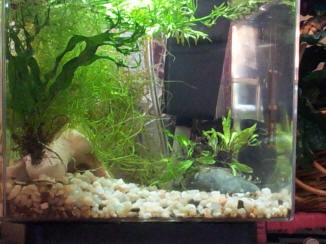
I have a 3 gallon planted tank that has/had brine shrimp. They
must have tagged along on some plants from a LFS. Do these breed
in fresh water?
There seemed to be a small number of them, maybe 7 as I was salvaging
quite a few when I changed water last, and sometimes they were attached
together in a pair.
<Yes; mating, I believe why the male has such large headgear.>
I have very hard water already and I stuck a limestone with a small cave
opening in there, there was already a bunch of java moss and some java
ferns and I added a watersprite and some little tiny top floating plants
tagged along (but it's low lit LED and those didn't grow out of control
when they tagged along before). A couple of days ago I put a freshwater
raised (the species with the unbroken bands) bumblebee goby in this
tank. He was initially pale and it looked like he'd die during the
very first hour, but then he might have found a brine shrimp, because
then he colored up nicely and became more curious and active. It's
got a lot of plants and hiding areas and a bubbler and a small filter
and it was long time cycled, plus I rubbed a small Fluval cylinder
sponge in my big tank's filter bacteria and put this over the air stone
so I'd have even more healthy
filtration.
<Even though sold as a freshwater species, I'd be prepared to add a
taste of salt, just in case, and choose plants/companion species
accordingly.
Identifying BBGs on the basis of colour markings simply doesn't work, so
don't for a second imagine you can identify your species that way! Goby
scientists have told me this in unambiguous terms, before then
describing how they identify them reliably -- under a microscope! Given
yours were sold in a pet store, you can fairly assume these are from the
standard issue "Brachygobius doriae" group of species, and these do well
in both hard water and slightly brackish, and as I say, I'd be prepared
to add salt at 1-2 gram/litre, which won't harm hardy plants at all.>
He ignores the frozen blood worm but he's so active and plays
continuously in the bubble current, so I think he must have been eating
brine shrimp. I used to see the brine shrimp swimming around
sometimes, but I haven't lately.... I'm wondering, could he have
eaten them all already in 2 days?
He's so tiny. He'd have to have a voracious appetite. Just
eating 1 would be like a person eating a 12" submarine sandwich.
<Quite so. But that's a trend across the animal kingdom: small animals
eat more as a proportion of their body size.>
In a small tank like this, if they do breed in my hard water, what are
the chances some could hide from him and that they will they breed
before he eats them all? Or do I probably need to purchase a
culture and breed them in marine salt?
<Chances of Artemia breeding successfully in freshwater are almost nil,
and they don't usually live that long in freshwater anyway. Do try
Daphnia instead. I have a gazillion Daphnia in an 8-gallon windowsill
tank that lacks a filter, and I'd imagine adding a small air-powered
sponge or similar wouldn't cause any undue problems. Just add Gobies!>
The lady claimed the bumble bee gobies will eat the frozen blood worm.
<They will, and also small bits of seafood, especially prawn. With BBGs
it isn't so much their lack of interest in frozen foods as their
slowness, so if kept alone, they're usually easy enough to train to take
frozen foods.>
I've heard stories of people struggling with getting them to eat.
I purchased him thinking that the living food already in my tank would
help him to adjust, and it's a well established nano tank so there's no
cycling issues for him to endure. I hope he'll eat the
bloodworm too. He's looking plump and active now and may not need
the bloodworm just yet. If he never does I guess I can let the
Betta and Endler's eat it as treats and buy the brine shrimp culture for
the Bee.
Jill
<Hope this helps, Neale.>
Re: Brine shrimp? 8/4/13
Thank you, Neale. That's very helpful.. I'll try daphnia.
<Definitely worthwhile.>
A pet store manager had thought that's what I had, but I later realized
from pictures they were actually brine shrimp. They are kind of
cute little critters, but I need a reproducing live food source. I
had clipped a little blood worm in a bobby pin hung over the edge of the
tank but it was untouched, but since he likes to skim the glass he'll
probably eventually see if I keep putting it there. The
Betta who I ended up giving it to the other day was much quicker.
<I bet.>
The goby is shy but end of night yesterday he kept circling and passing
the front of the tank. He plays all along the glass of the back
side and rides the bubble stream, but when he passes the front of the
tank he hops cautiously and then waits in the gravel where he blends in
then hops, waits, hops.
<Pretty much what they do; perhaps in the wild they hop into the water
current to catch zooplankton, then sink down once they've caught
something.
Adding food to the current near the Goby, for example by using a turkey
baster, might be worth trying.>
I hope he eventually realizes no harm will come of him swimming in full
display. Maybe this will happen when he discovers the food and
receives regular blood worm treats.
Have a nice Sunday.
Jill
<Likewise, Neale.>
|
 |
bumblebee goby tankmates 2/3/13
G'day, let me first say i have enjoyed the better part of a day reading
from your site, finding out lots of interesting things. I am in the
process of setting up a brackish tank mainly for bumblebee gobies,
<A wise approach; they can be tricky to feed.>
but of course i would like to have a rounded community tank of sorts.
<Do-able, but avoid species likely to steal bloodworms and other small
meaty foods from the substrate.>
What I have been trying to find is a list of suggested bumblebee
tankmates but have had no luck. Going by my research so far(and what is
currently available from wholesalers) this is a list of maybes: Desert
goby,
<Possible, but they will be very territorial about caves and other
hiding places. This species is bigger and potentially more aggressive
than the BBGs.>
Blue spot goby,
<This latter… Pseudogobius olorum? As the Desert Goby; possible, but
risky.>
Glass fish,
<Yes, doable, have done so.>
Hardyheads,
<Yes, if size and water chemistry suit.>
Hoplo cat,
<No, too big and will compete for food too strongly.>
Cherry red shrimp,
<Yes, but low-end brackish.>
Blue Panchax,
<Probably too big and predatory.>
Pacific blue eyes,
<Yes.>
Spiny eel,
<Only the very smallest species, and with the understanding both will be
competing for the same food.>
Golden halfbeaks,
<Yes.>
female Krib,
<Possibly, but will be competing for space, hiding places.>
Celebes rainbows,
<Yes, but rather large for some of the other fish, and my scare them
with the excessive activity.>
Freshwater sole,
<Yes, but again, competing for the same food.>
Freshwater pipefish.
<On their own with the BBGs, yes, but both species will be consuming for
small live foods (Daphnia, Brine Shrimp) so some care will be required
over ensuring a regular supply of food.>
I would greatly appreciate your feedback on this along with any
additions or subtractions. Of course i am not contemplating keeping all
of this list in the one go, but these seem to be my options. I am very
experienced in FW (30+yrs) but this would be my first BW tank. Your help
planning would be appreciated (by myself and others in love with the
grumpy little BBGs), Dave
<Hope this helps, Neale.>
Re: bumblebee goby tankmates 2/4/13
I'm so amazed that somebody actually answered an email!, thanks so much.
<Welcome.>
i have much the same fears regarding competition for food but i figure
if I'm sucking up to the BBGs i can feed other fussy eaters.
<For sure. If they're all slow -- no problems. But if one species is a
fast feeder and one is slow, that's when things can go wrong.>
i am surprised to learn that the cherry red shrimp is low end brackish,
<Not its preferred conditions, but tolerates SG up to 1.003 without
problems. Do remember these shrimps come from a marine family and some
species have marine larvae.>
both major wholesalers have them in the miscellaneous marine section.
<Actually in full marine conditions? Wow!>
I'm thinking BBG, halfbeaks and maybe the desert goby or a female Krib
to break things up.
<Could work with a little care at feeding time and with regard to
caves.>
The freshwater sole is a must have if i can get one.
<A lot of fun. Possibly more fun in a smallish tank where you can
actually see it -- likely to vanish without trace in a big tank with the
requisite sandy substrate.>
thanks for your feedback. i still think someone needs to nut out the
question "what can i keep with my bumblebees?" though.
<Not that hard. A classic combo is with Figure-8 Puffers, the two
species seeming to get along great.>
thanks so much, Dave
<Welcome, Neale.>
F8 Puffer/BB Gobies possible Eggs?
2/21/12
Good Evening.
<Hello,>
I have 2 Figure 8 Puffers and 3 Bumblebee Gobies in a 35 gallon planted
tank (Java Fern, Java Moss) that has been established for approximately
4 months. I was taking a glance at the back of my tank this
evening and found 12 yellow vesicles placed in the sand of the back
corner. They are a yolk-like color and approximately 2-3mm in
diameter. I have done some research on Bumblebee Goby
reproduction, and the egg sac description is nothing like what I have
found in my tank.
<Indeed?>
In addition, there isn't any behavior that would make me think that
it was a spawning-related issue -- at least in regards to the Bumblebee
Goby (egg placement on wall/ceiling of cave/hideaway, protective nature
over eggs, etc).
<Yes; usually the eggs are laid on the roof of a cave; see the cover
of my Brackish Water Fishes book for an example.>
Could it be possible that these are Figure 8 eggs?...granted, nobody
really knows the reproductive habits of the Figure 8 puffer.
<Quite so.>
There are no large snails in the tank, just feeders (I have seen many
feeder snail egg sacs…nothing like this...) I've been
looking online and cannot find anything that matches this
scenario. Any information would be greatly appreciated.
<Well, there seems to be few reports of spawning behaviour, though
some aquarists (e.g., Frank Schaefer) have reported seeing eggs in
their T. biocellatus aquaria. Some Tetraodon species extend brood care,
e.g., T. fluviatilis, with the male guarding the eggs until they hatch.
But others have been reported to be simple egg scatterers, as with T.
schoutedeni. In all cases the fry small, so a major problem is rearing
the fry, with foods like infusoria or Cyclops required initially rather
than brine shrimp Artemia.>
My most recent chemistry as of 1730 on 2/20/12:
pH: 7.4
Nitrite: 0
Ammonia: 0
Nitrate 10
SG: 1.003
<All sounds good for this/these species.>
Thank you for your help!
Billy
PS. Sorry to email twice so soon, but I'm noticing some things
about my one Figure 8 Puffer that is really making me think that
it's her eggs that were the objects I mentioned earlier. I
know it seems very VERY hopeful, but '2' is swimming
vigorously, and searching around the patch of sand where the
aforementioned vesicles were lying.
<Could be foraging for food…>
I say 'were' because I saw a BBG begin to eat them, so I took a
60cc syringe and was able to save 5 of them. They are currently
in the syringe on a small patch of gravel that was sucked up under them
when I drew them up, and the syringe is sitting in my tank...it was
sterile out of the packaging.
<Hmm… would put these in a breeding trap near a good water
current. Well worth seeing what hatches!>
Anyways, '2' also keeps chasing away anything that comes close
to that patch of sand…including shrimp (but doesn't try to eat
them at all, just nips once and turns away). I know that puffers
hunt pretty much 24/7, but this wasn't the hunting behavior I see
for feedings/snail hunting. So, now I'm kind of wondering
what I should do with the...well, hoping, eggs. Keep them in the
syringe and in the tank? Make a 1 gal with cycled water from the
original tank?
<Would keep the eggs in the aquarium you have for now, perhaps using
a breeding trap, and do read up on rearing Tetraodon fry generally.
Many reports on T. suvattii for example, and a few on T.
fluviatilis.>
Any ideas would be great. Thanks.
<Very exciting! Good luck, Neale.>
|
Aquarium planning, please help...
FW stkg.
3/13/12
Hello, I am not entirely sure if I am sending this message to the
right place... but here goes,
<Fire away.>
My boyfriend is planning on setting up a 45 gal/ 171 L
aquarium.
<A nice size.>
I myself had no idea what I was doing at first (5 years ago when
my parents bought me my 170 L tank), now however my fish tank is
going fine and I am trying to help him chose the right products
and fish for his own aquarium, so that he will avoid disasters
such as what happened with my aquarium and his mothers
aquarium.
<Real good.>
With my help he has chosen fish that he thinks he would like and
have the best chance of being OKAY in his aquarium, these are; 8
neon tetras,
<Soft, cool water required here.>
1 red tailed black shark,
<Aggressive; would avoid to be honest, given the other fish
are all small and sensitive (in terms of personality).>
10 crystal red shrimp (S+ V-Band),
<Goby food.>
3 Bumblebee Goby (fresh water species).
<Can do well in freshwater, but not all species do, and
telling different BBG species apart is hard (and your retailer
hasn't a clue -- trust me on this). The bigger problem though
is feeding. These fish are EXTREMELY difficult to feed in
anything other than a small, single-species (or at least slow
feeder) aquarium. In a tank this size, small Gobies aren't
really a sensible choice. They're too difficult to see, and
that means feeding them is difficult, and they'll basically
starve if they can't find their own food.>
Is this a good number of fish? or too many?
<I wouldn't expect this to work for long.>
I have done some research surrounding all the species, which
enabled me to create a table in excel (which is attached to this
email message). I found the dH (hardness) to be a issue, as the
tetras (1-2 dH) and gobies (12-18 dH) seem to have requirements
that outlie the rest.
<Correct. The BBGs aren't too fussy, but hard, alkaline
water is probably best. But the Neons really don't live long
in hard water, and the quality of Neons in the trade is dismally
low anyway.>
I ultimately decided that a dH of 6.5 would be the best... If and
only if:
it wont cause the tetras to die, or the gobies to die.
<Quite so. Would think again.>
Will it cause death or stress, not sure what to do here?
I have also made a list of 'things needed' as well as
products and a 'check list'
List
45 gal Tank: N/A
45 gal Stand: N/A
Filter: Marineland Emperor 400 Filter System 400gph (80 gall) Is
this good?
Filter media: Fluval BioMax filter+media (ceramic cylinders),
Seachem
matrix, aqua one carbo pad, aqua one zeo pad, AquaOne Phos
pad
Light: Need Help, so hard to chose
UV Sterilizer: Is it good to have?
Heater: N/A
Plants: Not researched or picked yet...
Substrate: Eco complete x4 (more or less)
Fertiliser: wonder shells, need help choosing more
fertilizers
Fish: 8 tetras, 1 black shark, <<Will get VERY large.
RMF>> 10 crystal red shrimp (S+ V-Band) , 3
Bumblebee Goby.
Fish food: Live Blackworms, Live Fly larvae, Poached Cucumber,
Frozen Bloodworms, Frozen Brine shrimp, Bottom Feeder Pellets,
Spirulina.
Co2: DIY, Diffuser
Essentials:
Test kit (pH, Nitrite No2, Nitrate No3, Ammonia NH3/4, )
Extra tests (Phosphate P04, Calcium, Magnesium Mg, Hardness gH,
Carbonate Hardness KH, Potassium, dH)
RedOx test: Methylene blue or RedOx meter
Hardener: How do I adjust the hardness?
Prime: N/A
Thermometer: N/A
Cycle product: What cycle product can I use? Or could I use dead
bait?
(don't want to use fish food because I have heard it has a
lot of mercury?)
<Flake food works fine. If you have another aquarium, why not
clone the filter? Remove 50% of the media from the mature filter,
and add to the new filter. Add a few fish straight away, and you
should be okay, assuming both aquaria have the same water
chemistry, temperature.>
trimming scissors: N/A
Scrubber: N/A
Bucket: N/A
water sucker: N/A
Drop checker (for Co2): How could I get one of these?
<CO2 test kits will be available wherever high-end planted
aquarium gear is sold. Cheers, Neale.>
|
|

Re: Aquarium planning, please help... stkg. FW
... 3/14/12
Thank you!
<Most welcome.>
I knew there were some issues, wasn't sure if they were that
detrimental...
My boyfriend originally wanted a shark like mine, because he/she
is very fun to watch chase my cat fish and my angel fish,
playfully of course, and in general the fish has wonderful
charisma. I have 10ish Bristlenose catfish; which seem to be
cross something? because of the white tail tips, 1 angel fish and
1 albino shark, which I recently discovered is a albino rainbow
shark.
<Indeed. Not to my taste, but each to their own!>
Too many uncertainties with the shark though unfortunately...
just the possible aggression, and may eat other fish. I did at
one time have over 100 baby catfish in the aquarium and a few
tiny ones were picked off by the angel fish, I never actually saw
the shark eat any.
Anyway, I have rechosen the fish because there were just too many
issues:
10 cherry shrimp
<Are very small, may well be harassed by any fish
substantially larger… But good with very small fish (Neon-sized
and smaller) or exceedingly non-aggressive types such as Whiptail
cats, Otocinclus, Kuhli Loaches, Dwarf Corydoras...>
1 Siamese algae eater
<Are gregarious… better in groups of 5+, if you have the
space.>
4 zebra Oto
1 dwarf gourami
<Junk species.>
6 harlequin Rasbora
<Nice; do need softish water to do well.>
Is this selection much better than the other one?
will the Siamese algae eater and gourami be lonely?
<Yes to the first; no the second.>
temp at 24 C be good?
<Bit cool for most Gouramis, but better/hardy species, like
Banded Gouramis, will be fine.>
7 pH good?
and hardness in-between 5-15? what number should I aim for?
<All good for fish that don't need either hard water or
very soft water. Around pH 7, 10 degrees dH, is great for most
Southeast Asian and South American community species. Would be a
bit soft for Central American livebearers. Cheers,
Neale.>
Re: Aquarium planning, please help...
3/14/12
Thanks again,
<Most welcome.>
Oh I forgot, I also have 2 Kuhli loaches, I originally thought
they would be good for my boyfriend's tank but changed my
mind, because
1. they are nocturnal
2. need more than 5 (or 5)
3. they are scaleless and hard to treat with medications.
<Yes, yes, and sort-of. Nonetheless, excellent community fish,
and probably the best loaches for community tanks, provided you
understand their limits.>
Is a UV steriliser a good idea for my boyfriend's tank?
<Not really, no.>
and what do you mean by junk species? are the dwarf gourami and
Oto bad in some way?
<Farmed Dwarf Gouramis are plagued with diseases; Otocinclus
need somewhat cool, well-oxygenated water and an aquarium with
lots of green algae -- most Otocinclus end up starved or
suffocated within a year. Do review these
species here on WWM and elsewhere. With Colisa lalia especially,
you'll find a lot of messages about sick, dying
specimens:
http://www.wetwebmedia.com/fwsubwebindex/dwfgdis.htm
http://www.wetwebmedia.com/fwsubwebindex/otocinclusart.htm
Cheers, Neale.>
Re: Aquarium planning, please help... stkg.,
FW 3/16/12
Ok thanks, I read both the links and due to some enlightenment,
decided that Gouramis aren't the best...
Such a shame though because they are quite beautiful fish.
<Gouramis generally are fine; it's the Dwarf Gourami
that's the worthless fish unless you can get locally bred
specimens, or at least specimens that aren't from Southeast
Asian fish farms. The Banded Gourami and the Thick-lipped Gourami
are extremely similar and much, much hardier fish.
They're slightly bigger and not quite so pretty, but still
attractive fish that work well in community tanks.>
How about Kribensis instead of the Gourami?
It is a cichlid, but I have heard it is peaceful to most fish,
however slightly territorial towards other bottom species, which
might be dangerous, since the Cherry shrimp, Siamese algae eater
and Otto would be down there.
What do you think?
<Kribs will eat the shrimps. They are peaceful except when
breeding; pairs breed almost constantly. A singleton would be
fine in a community.>
Mmmm damn about the Oto, although would the problem be overcome
if:
1. Either 2 of the marine land 400 filters were used, or 1 faster
filter that's recommended for a larger gal. threshold (hang
over filters is a must, as I have struggled a lot personally with
the canister filters)
<Strong water current is antithetical to gouramis and some
cichlids, tetras and barbs, so stock accordingly. And what's
the problem with canister filters? Hang-on-the-back filters are
okay, but they do have some severe shortcomings. The inlet pipe
is close to the outflow, and the inlet doesn't usually go
right down to the bottom of the tank. Some designs lock you into
use proprietary filter "modules" that include worthless
media like carbon and don't let you add different types of
media from other manufacturers.>
2. Good healthy specimens are chosen and quarantined (not sure
how to quarantine, wouldn't it require a whole extra set up
basically?) and wormed.
<It's not the quality of the livestock, assuming the
Otocinclus aren't starved at the pet shop (often the case).
It's feeding them in the aquarium.>
3. Drift wood in the tank, as well as being fed poached zucchini,
cucumber and squash 2 times a day, and removing debris of left
overs before it decays. (only issue with this is how to keep the
veggies from floating up, without using veggie clips: because
they are large and bulky, do you know another way of keeping the
poached food stable at the bottom?)
<Sinking algae wafers are a good food. Use 1 per 3-4
Otocinclus every other day. This should keep them well fed.
Healthy specimens are lively and have convex, slightly rounded
bellies. Starving specimens have "hollow" bellies that
are rounded inwards, i.e., concave. They often look skinny too,
but because of their armour plating, even experts can find it
difficult to judge this.>
How would I know if there is enough oxygenation in the tank?
Is there some kind of test that can be conducted to water
parameters to check if the oxygen is sufficient?
<Yes, oxygen test kits exist. But freshwater aquarists
don't normally need them. Just keep the aquarium modestly
stocked and ensure a good water turnover rate, around 8 times the
volume of the tank per hour. Internal or external canister
filters are generally better than hang-on-the-back filters
because you have more flexibility about where the water current
will be. But whatever filter you use, make sure there's lots
of water movement at the bottom of the tank. Cheers,
Neale.>
Re: Aquarium planning, please help...
3/16/12
Oh I see,
In that case a normal banded gourami would be good?
<So long as the Banded Gourami is Colisa fasciata, then yes,
that's an excellent, if a trifle boisterous, species well
suited to medium to large community tanks. But plain vanilla
Dwarf Gouramis, i.e., standard Colisa lalia, have the same
blue-red bands, so not every banded gourami is a Banded Gourami,
if you see what I mean.>
or would u recommend another fish?
<Most of the other Gouramis are excellent fish. Lace Gouramis
and Moonlight Gouramis are two favorites. Honey Gouramis are
excellent provided you have soft/acid water conditions (they
don't do well in hard water). Three-spot Gouramis are hardy
and available in many colour forms -- blue and yellow being the
two most popular -- but the males are aggressive. It's really
the Dwarf Gourami you need to avoid, including all its varieties
-- Neon, Cobalt Blue, Powder Blue, Sunset, Robin, etc. The stock
on fish farms in Southeast Asia are plagued with a nasty viral
infection, and even those that aren't infected are very prone
to Mycobacteria infections. Locally bred ones though can be
worthwhile, especially if you have warm, soft, slightly acidic
water.>
I don't mind if its not as pretty because if they stand out
too much it would detract from the beauty of the environment I
guess.
<Quite so. There's a balance to be struck. Something very
vivid like a bright red "coral" Platy is nice in a
formal aquarium arranged with plain rocks or ceramic ornaments,
but in a planted tank it looks unnatural, and it makes
regular-looking fish seem bland. On the other hand, Cherry Barbs
have gentle shades of peach (females) and ruby-red (males) that
look superb against the greenery of a planted aquarium.>
Would a single gourami be okay alone and would all the fish
tolerate the current from say another marineland emperor 400?
<Single Gouramis are fine. Most community fish do well with
turnover rates between 4-6 times the volume of the tank per hour.
So review the turnover rate (i.e., gallons/hour or litres/hour)
for your filter, and if it's 4-6 times the volume of your
aquarium, you're fine.>
the fish are:
1 Banded Gourami
10 Cherry Shrimp
6 Harlequin Rasboras'
4 zebra Oto
4 Siamese algae eaters
(45 gall aquarium)
Well I research the filters that interest me and make sure they
have enough space and allow for filter media to be placed inside
I don't like external ones because they are hard to clean,
the pipes get dirty, they are annoying to place and to move and
are heavy.
<Can be true for some of the older styles. But the flip side
is the clean a LOT of water, and the modern filters from the
likes of Fluval and especially Eheim are very much easier to use.
I clean mine 2-3 times a year, which is much less often than many
would recommend, but really, these filters are largely
trouble-free. But it's horses for courses, to be
sure.>
also hang on ones can be up to $100 cheaper or more.
<Perhaps. But again, do bear in mind a good Eheim filter will
last 10, 15, 20 years.>
They are easy to access and change the filter media as well as
clean and the inlet and outlet areas are easy to adjust, compared
to the canister filters.
<Real good.>
Ok thanks again, I will look at more fish types and see if
there's cat fish that are easier than the Oto, and aren't
destructive or produce a lot of waste, like my catfish. I just
don't want a complete disaster to happen and believe that as
much research should be conducted before actually purchasing fish
and products or they might all die. which would be horrible and
unfair to the fish.
<Yes.>
Some sites I have looked at say that the Siamese algae eaters,
gouramis, and even Rasbora will munch on baby shrimp and even
adults is this true?
<Most any fish will try and eat shrimps given the chance. My
shrimps breed like crazy with fish of similar size, such as
Ricefish, and those that can't eat big prey, like Whiptails.
On the other hand, if your tank has lots of plants and much
shelter, the shrimps may survive.>
Should I change fish selection again?
<In all honesty, unless you really want shrimps, forget about
them. Shrimps work in tanks with tiny tankmates: Ricefish, Dwarf
Corydoras, Neons, Dwarf Rasbora, Endler's Guppies. Anything
bigger than these isn't going to be sensible.>
Not sure what could be chosen instead of them since they are
probably the most non aggressive species and such.
<Cheers, Neale.>
|
Trying to stock a 35g hex BW
6/19/11
Hi there!
<Des>
I just finished a fishless cycle for my 35g hex tank. I used ammonia as
well as seed material from a mature tank to do the cycle and it took
somewhere around 40 days to complete. I am using a Marineland canister
filter.
<Ok>
I had originally planned on this to be a home for a rescued molly
(I've had a lot of opinions given on what kind of molly he is. I
can send a photo if you like, but he looks to be about full grown at
around 2.5- 3", has a large sail-like fin, but I'm fairly
certain he is not a Poecilia latipinna...maybe a hybrid), a few others
of his kind and a few bumblebee gobies in a BW tank.
<Mmm, okay>
The molly was living in another tank with an equally rescued emerald
catfish. I have since purchased more emerald catfish and 3 more mollies
of the same kind, at least they appear to be!
<Brochis live under different water conditions...>
With that in mind, I prepared the tank with a very fine sand substrate,
some stones and caves for the gobies and various silk plants at
different heights.
I have come to realize that hex tanks are far from ideal, but this is
what I have to work with. I have also started to shy a little away from
the gobies. I think they are just adorable with their bulldog faces,
but I worry about their feeding requirements and difficulty in finding
them locally.
So, keeping in mind I was still planning on putting the mollies in this
tank, what would you put with them in a hex tank environment?
<Many choices... I'd peruse the stocking areas on the brackish
index of WWM: http://wetwebmedia.com/BrackishSubWebIndex/BrackishSubWebIndex.htm
esp. the Compatibility FAQs for Mollienesia>
Should I stand strong with the bumblebee gobies?
<Up to you. Are compatible system and behavior wise>
This tank is in a main room in the house so will be observed by many,
so I'm hoping for happy, interesting fish. :)
Thanks so much,
Desiree
<Welcome. Bob Fenner>
Re: Flower Pattern eel - What kind of Spiny eel? Now: Tiger
bumble bee gobies? 4/5/10
Thanks for the info on my spiny eel Neale, but I think Bob forwarded
along this message because of the last part.
<Oh.>
I'm wondering if you have ever heard of tiger bumble bee
gobies?
<Nope. I'm reliably told that identifying Brachygobius species
is extremely difficult and that virtually every photo in the hobby
literature is misidentified. The safest thing to do is assume these are
merely Brachygobius sp. of some sort, and treat them accordingly. There
are two basic species group, the small Brachygobius (such as
Brachygobius
aggregatus) and the large Brachygobius (such as Brachygobius doriae).
Apart from size differences, care is remarkably uniform. Best kept in
brackish water, and the prime source of mortality tends to be
starvation, so don't
mix with other fish likely to consume the food they need.>
Are they any different than a regular bumble bee goby? The gobies are
not going in with the eel, they will be housed in a 20G brackish tank
most likely with a F8 puffer or two.
<I wouldn't keep two Tetraodon biocellatus in a tank as small as
this. Apart from that, yes, the species should coexist, but have the
gobies settled in and feeding before adding the puffer.>
-Matt
<Cheers, Neale.>
Bumblebee Fish 6/13/09
Hi, I was wondering if I could have some advice. is there a way to tell
the gender of a Bumblebee Fish? Thanks, Jesse
<Nope; most of the time both sexes look very similar. Both males and
females are territorial, but males more so, since they're the ones
who look after the eggs. So if you have a group of Bumblebee Gobies,
the ones that seem to be most aggressive are likely the males. That
said, as with most fish, sexually mature females filled with eggs will
be obviously more "swollen" than the males, and in some
Bumblebee Goby species at least, males will change their colours when
courting females. That's of no use at all when buying them since
the fish offered by retailers will be juveniles.
But once settled in and a bit older, you will probably be able to use
all of these clues to sex your gobies. Cheers, Neale.>
Help! Mollies/BB Gobies 9/18/09 Hello,
<Hi,> I have a 30 gallon brackish (1.004-1.005) tank. Nitrites,
nitrates, and Ammonia are all zero, pH is 7.6. In the tank I have 1
adult Dalmatian molly, 2 "teenage" mollies, and 5 baby
mollies (I haven't found a home for them yet, and now I don't
know if I can). I recently purchased 5 bumblebee gobies (I didn't
have a quarantine tank, hopefully my mollies won't pay the price
for my ignorance). <Oh? Sounds nice so far...> The bumblebee
gobies (BBGs) all became sick... the first had a very crooked spine,
like he had been bent in half (he didn't look like this when I got
him). He was floating around the tank like a person in space. I had him
euthanized. Then, a few days later, a second with a crooked spine, same
listless floating around, not eating - neither were eating. A few days
later, the rest were listless, not eating. One appeared to have an
advanced case of tail rot that progressed rapidly - seemed to be
overnight. All have been euthanized now. As a side note... when the
BBGs would eat, I was feeding a combination of live brine shrimp &
blackworms, frozen brine shrimp and frozen daphnia. I was using a
turkey baster to shoot it down to them at the bottom so the mollies
wouldn't eat all of it. <OK. This is odd. Did this happen within
days of purchase? Here's a bunch of other thoughts. Firstly, are
you 100% sure the salinity is what you think it is? Do double check.
Some hydrometers are more accurate than others. Maybe you can take
yours to a pet store and have them check it by using it in one of their
marine tanks. Or else you can add 35 grammes of cooking salt to one
litre of warm water. Stir until it's dissolved, and then when the
water is still, test the hydrometer. At 35g/l, it should read 1.025. If
it's far off that, you have a problem. The plastic swing arm models
are notoriously variable. Next, do check water quality. Usually when a
bunch of fish die, it's a water quality issue or a water chemistry
issue. We've already mentioned salinity, but do a quick nitrite
test and see where you're at. To be fair, gobies generally are
pretty tough animals, but still...> My question is for the remaining
mollies, do I just wait this out and see what happens? <Pretty
much.> Or, should I do something as a precautionary treatment?
<Randomly adding medications without a diagnosis is usually
pointless.> I am going out of town for 4 days and my pet sitter
doesn't know anything about fish. I can ask him to medicate, but he
probably wouldn't be able to identify a problem. Any help would be
appreciated. <Do a 25% water change the morning of the day before
you go, check everything is fine that afternoon, and then forget about
it. Do take care the pet-sitter doesn't overfeed the fish; if
anything, for 4 days, don't feed the fish at all. Mollies will be
fine, and they'll turn their attention on any algae.> I am
worried about the possibility of Fish TB, b/c of the crooked spines.
<Nope.> I had a similar problem with one of my mollies many
months ago. We had her euthanized and sent off for pathology. There
were no signs of TB. <Quite so; very rare among freshwater fish.
Grossly misdiagnosed within the hobby; a "catch-all" rather
than anything tangible.> I don't have the report in front of me,
but from what I remember the vet suggested treating the rest for
internal parasites and feeding a more nutritious diet, which I have
done - I have lost one adult molly since, possibly to age (no other
apparent signs). Anyway, when I mentioned this Fish TB possibility to
my husband, he assumed I was over-reacting, again, and we did not send
the BBGs off for pathology. I hope that was not yet another colossal
mistake in my short time of keeping fish. Does this ever get easier, or
should I just stick to four-legged friends? I love my fish and want to
give them the best care possible, but I feel like I am failing them.
<My gut feeling is you were unlucky, and got a bad batch of perhaps
half-starved BBGs. These are easily starved in retail tanks. Not all
come from brackish water, in fact they're mostly freshwater fish in
the wild, so if your salinity is higher than you think, they might have
been shocked by the change. Mollies tolerate salinity above normal
seawater, so are unlikely to be stressed by high salt
concentration.> I also have an unrelated question... I have
driftwood in my 20 gallon FW tank for algae to grow on for my Otos. One
piece seems to have a white, fluffy mold growing on it. <Fungus;
essentially harmless, though implies the wood wasn't cured prior to
sale. The fungus is consuming organic matter in the wood.> Should I
throw it out? <Plecs usually eat the stuff pretty quickly! Not
something to worry about unduly, though it's consuming oxygen and
adding to the bioload. And no, this isn't fungus that's going
to jump onto your fish!> Will the other pieces of driftwood be
alright, or should I get rid of all of them? <If the other bits of
wood have organic content, they'll fungus as well, regardless of
what's happening to this bit of wood.> Thank you for having the
patience to read through all of this, and for taking the time to help.
Amy <You're welcome, Neale.>
Re: Help! Mollies/BB Gobies 9/18/09 Thanks,
Neale, for your quick reply. <Most welcome.> Do you like when
people respond to your answers? Or does it clog up your system too
much? I usually don't write back when I ask a question, just read
your answers, but this time I wanted to touch base. <Go for it!>
Here it goes... All of this happened in one week - I purchased the BBGs
on Tuesday last week and they were all dead by this Tuesday. I'm so
sad, because they were so adorable and I was so happy to finally have
found them (Petco special ordered them for me). I got them all their
own little terra cotta pots. Got lots of different foods for them, b/c
I read they could be finicky. <Oh yes... I swear my single specimen
feeds almost entirely on juvenile cherry shrimp. He only seems to eat
the odd bloodworm, but has been in the tank for at least a year, and
stays nice and plump.> I feel absolutely awful, especially if this
is my fault b/c of the salinity - I researched them for so long and
fell in love with their cute little faces. <They are nice fish; but
despite being widely sold, they're actually among the most
difficult gobies to keep. Many other species are substantially easier.
The Australian species Chlamydogobius eremius for example eats flake
and algae, and produces babies that are so big they're no more
difficult to raise that baby Kribs!> Anyhow, I did the salinity
test, but I'm not sure my conversions were correct. I used 4.23
cups of water and 2.44 tbsp of salt (that was iodized salt - does that
make a difference? <Ah, for this test, cooking salt of whatever type
is fine. By my reckoning normal seawater salinity is 4.7 oz per US
gallon... how many tablespoons that is will depend on your tableware, I
guess! I do have a little freeware tool for Mac and Windows that
converts salinity, SG, and weights on the fly:
http://homepage.mac.com/nmonks/Programs/brackcalc.html > I use
marine salt for the mollies, but for this test, I just used my iodized
table salt. I looked the conversion up on
http://www.ez-calculators.com/measurement-conversion-calculator.htm).
That was off the charts on my hydrometer - over 1.032. I'll try to
take the hydrometer over to the LFS and have them check it. <Does
sound odd. Do a couple things before panicking. First, give the
hydrometer a good clean with lemon juice or vinegar, to remove any lime
that might be bunging up the pivot (if the swing arm type). Do also
check temperature. If you play with my Brack Calc tool, you'll see
temperature has a big impact on specific gravity, which is a measure of
density, not salt concentration.> I also just checked ammonia,
nitrates, and nitrites - still all zero, pH was 7.8 today. I've
been using the saltwater API test kit, b/c the FW kit always seemed
hazy when I first turned the tank brackish - not sure if that is a
problem, but all levels look okay. <Sounds fine.> Thanks for the
recommendations - I will change the water right before I leave. I'm
using auto flake feeders, I'll set them to distribute a small
amount. I'll just have the pet sitter look in to see that everyone
is alive and kicking'. <Cool. For up to 7 days, fish don't
need food, and even to 14 days shouldn't do any harm if there's
algae and plants for them to attack. If you're "doing"
fish right, they really should be VERY EASY pets.> Thanks, also, for
the words about fish TB - I feel a little less worried about that now
(though it will be looming in the back of my head, until I've
waited this out a few weeks ;-) <Fish TB is primarily a marine fish
thing, and the symptoms associated with in the freshwater hobby are
almost always better explained by other diseases, many of which are
quite easy to prevent/fix. I certainly remember back in the 80s when I
started keeping fish, every time a fish diet in a mysterious way, Fish
TB was blamed. That's largely stopped now. Do see here though:
http://www.wetwebmedia.com/Wound.htm Even if Fish TB isn't a major
issue, it's as good a reason as any to be alert to the importance
of health and safety around the fish tank.> Thanks, again, for
everything. Amy <Cheers, Neale.>
Brackish and small... BB gobies,
reading 12/16/07 I'd like to try a small
brackish aquarium with the BB gobies and olive Nerites I read about on
your site. what kind of easy food do you recommend? can I avoid buying
live food often? Any ideas on plants? the science teacher mentioned
java fern. is plant acclimatization recommended? can I go with one
quarter salt water? what type of salt do you recommend, or can I use
rock salt? Thanks, Elaine <Hello Elaine. Bumblebee gobies do very
well on a diet based around small chunks of seafood (small enough to
swallow), wet frozen bloodworms, and live foods including brine shrimp
and daphnia. Under such a regimen, they are easy to keep. In my
personal experience they should be given live food once every week or
two. Java fern is an excellent choice for a low-end brackish water tank
around SG 1.003-1.005. Also very good choices are Anubias and Java
Moss. All three plants are epiphytes, so they grow attached to solid
objects. They do not like being put into the substrate, and will die if
you do so. Otherwise, they are pretty idiot-proof, and will thrive even
under quite low light levels. Acclimating plants to slightly brackish
water generally isn't required. As for salt, you MUST use marine
salt mix (Instant Ocean, Reef Crystals, etc.). Since you only need
10-20% the dose used in a marine aquarium, this isn't a major
expense. For Bumblebee gobies, 6 grammes of marine salt mix per litre
of water is perfect. This is about 1/6th the salinity of normal
seawater. Olive Nerites will also do well in these conditions. Good
luck, Neale.>
Reclusive BBGs -- 07/01/07 I have a 10 gal
brackish tank at about 1.008 spg (established, all the levels normal)
with two bumblebee gobies, a fiddler crab, and I just added one figure
eight puffer this past week. Realizing that the gobies and crab would
need places to hide from the puffer, I gave them about a month by
themselves to establish territory, with plenty of places to hide - lots
of fake plants, a patch of java moss, and a few little caves. The crab
was shy, but the gobies were friendly and were always at the front of
the tank. The first day I added my puffer, the gobies acted normally
even when the puffer was nearby. But since then, I am lucky to see my
gobies once a day. I have, surprisingly, seen the crab out more than
the gobies. Is there anything I can do to make the gobies more
comfortable with their new tankmate? Or will they be in hiding for the
rest of their lives? Thanks for your help, Ben <Greetings. A few
comments first. The SG is a little high for this community. SG 1.005 is
more than adequate. Bumblebee gobies -- despite their reputation in the
hobby -- are found in both freshwater and brackish water habitats. Some
species even live in blackwater streams with virtually no hardness and
a very acidic pH. So opting for a low SG gives you the safest option;
SG 1.005 won't stress gobies collected in freshwater, while being
high enough to satisfy ones collected in brackish water. Figure-8
puffers are good at SG 1.005 as well. Now, the reason the gobies are
hiding is they don't feel safe. The natural instinct of gobies is
to stay near their burrows and dive into the burrow at the first sign
of danger. In a tank 10 gallons in size with a pufferfish and fiddler
crab, the gobies likely don't feel safe. Fiddler crabs, by the way,
need amphibious conditions as they are really land animals that only
dip in water to wet their gills and for breeding. I'm curious how
you fit dry land into a 10 gallon tank and still have space for the
puffer. Eventually the adult puffer will kill and eat the fiddler crab.
Crabs are pufferfish food. So I think you have bigger problems than the
hiding gobies to worry about! Hope this helps, Neale.>
Bumblebee goby -- 6/8/07 Hi, <Hello.> I have
3 bumblebee gobies in a 10 gal tank. They are currently the only fish
in the tank. The tank is brackish with 1.012 specific gravity, is
established, and the levels are optimal (pH, ammonia, nitrite, etc.).
<The SG is a bit high for bumblebee gobies. Contrary to popular
belief, bumblebee gobies (which I'll shorten to BBGs) are as much
freshwater fish as they are brackish water fish. Some species even
occur in acidic blackwater streams alongside things like rasboras and
Carinotetraodon puffers. So, BBGs are best kept at the low end of the
salinity range. Something around SG 1.003-1.005 is just about ideal,
and should be acceptable for both BBGs collected in freshwater habitats
and BBGS collected from brackish waters.> Two of the gobies are
active and healthy. The third has had problems. He is very skinny
compared to the others, and it is reluctant to eat. He first happily
ate the frozen krill I fed them, then lost interest. Knowing that he
could just be a picky eater, I switched to live black worms (to try
something new, and have read they are more substantial for the fish
anyway). <BBGs are indeed finicky feeders. I've found shrimp
eggs to be remarkably popular with them. Depending on the time of year
the shrimp spawn in your part of the world, you can find them under the
legs of unshelled shrimps. If you can't obtain them, then frozen
lobster eggs work nearly as well, but are smaller and more fiddly to
use. Lobster eggs can be obtained from any store selling food for
marine fish, as they're widely used to feed invertebrates. Defrost
them, and then use a pipette to throw them in the general direction of
the BBGs. Either type of egg provides lots of oil and protein -- making
them an first-class way to fatten up gobies. Other picky feeders, such
as glassfish, seem to enjoy them, too.> He at them at first and
continues to show interest, but has stopped eating them. Even though he
still won't eat, his overall condition has improved - he swims with
the other two and is becoming more active. I'm ruling out parasites
or disease, because of the extended period of time he has been like
this without dying. I'm very confused about this fish and have no
idea what to think. Any ideas?? <My feelings are two-fold here.
Firstly, the salinity is a bit high, and that might be creating
borderline-tolerable conditions for the one goby. No attempt is made by
collectors or retailers to identify them to species level, so it is
entirely possible you have different species, the one having a lower
salt tolerance than the other two. (Identifying BBGs to species level
is in fact impossible for aquarists, despite the widespread use of
various names in the hobby.) Secondly, it's possible you have males
and females. If the thin fish is otherwise healthy, the fat fish might
simply be females swollen with eggs. BBGs spawn rather easily in
captivity (though rearing the fry is whole other ball game). In the
meantime, try varying the diet some more. Shrimp/lobster eggs work
well, but also try bloodworms, small chunks of prawn, small earthworms,
and other suitably sized foods. Even brine shrimp and daphnia should do
the trick.> Thanks for the help <Cheers, Neale>
New tank set up, FW leaning to BR. Bumblebee
Gobies... 5/11/07 Hi all,
<Hello!> Its been a while since I last wrote in. I am
about to be the proud owner of a new 60 gallon tank.
Wondered if you could answer a few questions as my set ups
have never been this large. <Will do my best.> I now plan to keep
tropical fresh water fish. I love the brackish
fish especially the bumble bee goby and wondered if they could
be adapted to the fresh water environment. <Basically no.
A few supposedly brackish water fish are actually freshwater fish that
tolerate salt, such as glassfish and wrestling halfbeaks, and these are
obviously fine in freshwater. Bumblebee gobies are a mixed bag. Some
species are found in freshwater and can potentially be kept in even
soft/acid conditions. However, identifying bumblebee gobies to species
level is basically impossible for aquarists. So as a default position,
BBGs are best kept in a brackish water tank (and ideally a single
species one, as they're quite tricky to feed).> Brackish fish
are quite hard to find here in Scotland and I found my
choice limited hence the decision to go freshwater.
<Often people don't realise the variety of brackish water fish
out there. Besides the things like scats and monos, there are also
numerous cichlids that do well (if not better) in brackish water, and
there are also a few marine fish that thrive in (strongly) brackish
water, such as various Arothron and Lutjanus spp. as well as a few
inverts, like blue-leg hermit crabs. Agreed, brackish water fish are
not easy to obtain on a single trip to your pet store, but over the
year you are bound to see many different types. In the UK, you have
some good options for mail-ordering fish, with stores like Trimar
Aquaria and Wholesale Tropicals offering overnight delivery. Skim
through a copy of a British fishkeeping magazine like PFK and
you'll find lots of such dealers. These places often have lots of
brackish water fish, and would be able to plug any gaps you can't
find locally. I'll add that when I live in Scotland (Aberdeen) I
didn't have much trouble getting brackish water fishes. There were
a couple of decent shops in Aberdeen plus another in Dundee. Trips to
Edinburgh or Glasgow would likely be rewarding, too.> I also plan to
have some clown loaches how many I believe they like to be in groups.
<Correct, they are sociable, and best kept in at least trios.> I
have a supplier near by also that stocks mollies reared in fresh water
will they thrive the same? <Rearing mollies in freshwater
doesn't change anything. They are sensitive to high nitrates
(anything much above zero), low pH, and low hardness. Keeping them in
brackish water fixes these problems, which is why they do best in
brackish water. So even if reared in freshwater, if you plonk a molly
into water with high nitrates or a low pH/hardness, it'll get
sick.> I will have a shallow sand bed (playsand) and I know it must
be stirred regularly to prevent gas and
toxins. is there any freshwater critters available that can
aid in this. <Anything that burrows. I happen to like Malayan
livebearing snails (Melanoides spp.) but these will breed rapidly if
you overfeed the tank and do not remove organic waste quickly. Loaches
and catfish also clean sand very effectively, and so will most benthic
cichlids.> Finally I would like to have some real plant
life. I thought if I bought them potted they
would thrive better than placing then directly in the sand. <Potted
plants are a bit of a con in some ways. Many plants do not thrive when
potted, and need to be unpotted at once. Java ferns and Anubias, for
example, shouldn't even be put in the ground at all! What matters
is the development of the roots. I'd sooner take a loose plant with
a decent root system than a potted one I cannot observe properly.>
What are your recommendations? <For plants? Depends on your level of
experience. Because sand is pushed about a bit by large fishes like
clown loaches, you want to choose plants that develop deep root systems
quickly, such as Vallisneria. Alternatively, go for Java ferns and
Anubias that grow attached to stones/wood, as these don't care
about the substrate either way. In fact, sticking with epiphytic plants
like Java ferns, Anubias, and Java moss, plus floating plants like
hornwort and water sprite, might be the best option. That way you only
need 1-2 cm of sand, and there's zero risk of anaerobic decay.>
Thanks ever so much Lesley <Cheers, Neale>
Bumble Bee Goby <Kit...er, Kat: you are
being directed to a friend of ours who is a grand master fish breeder
and an enthusiastic expert on gobies and blennies among many things.
Her name is Dr Sallie Boggs. Best regards to all, Anthony Calfo and Bob
Fenner's WetWebMedia> Hi again Dear Bob, I am writing once more
with a few (hundred lol) more questions about the gorgeous Bumblebee
Goby, which incidentally, I have grown to love and admire I have
managed to keep them alive and well for 4 weeks now with my other tank
mates. But, first things first. I seem to breeding them!! I have what I
believe to be the male Goby (is he the smallest of the two? as
information I have been reading has me thoroughly confused) guarding
some eggs!! Woohoo!! But alas, they are on a rocky structure in my main
tank, and surrounded by platy's, tetra's, and the likes. What
do I do now?? I would love to ensure the survival of the fry, and so am
guessing (probably correctly) that I will need a fry tank. How long
before they hatch? I have noticed them today, and believe that they
were laid last night or the night before. What will I need to feed them
once they hatch? Will the other Goby's eat or protect them? Will
separating the parents from the eggs be detrimental to the parents or
the eggs? Should I wait till they hatch until I separate them? Help me
Dear Bob - what do I do now????? I can find NO information on the
breeding and/or fry for my beloved Bumblebee's. Thanks Again In
Advance Kit-e-kat9 :-))
Bumble Bee Goby (guest appearance by: Sallie
Boggs) The male may be smaller than the female. At the very least
he is slimmer. The female can get very fat with eggs. Generally the
eggs are oval shaped and are hung from the roof of an overhang by fine
threads. The male spends a lot of time upside down fanning the eggs
with his fins. The time to hatching varies with the temperature, but
takes several days. You can see the embryos developing in the egg if
you use a flashlight. Usually, the bumblebee goby male will guard the
eggs until they hatch and then he may eat them. The thing to do is
watch the eggs until the eyes become golden and then remove the eggs
from the male and place them in their own tank with air bubbles passing
near the eggs (not on them) so they are gently agitated. The golden
eyes are an indication that the fish are about to hatch. A small amount
of sea (non iodized) salt can be added to the tank with the eggs.
Although the bumblebees live well in freshwater they are really from
brackish water. The fry will swim up and down for a while and then they
will swim horizontally. That is when they need to be fed newly hatched
brine shrimp. They are indeed delightful charming fish and you will
love the babies. Let me know how it works out. Sallie <Sallie...
thanks so much as always for your wisdom! Anthony, WWM and
beyond>
Bumblebee Gobies Hello Bob. I have 3 BB
gobies and I need to learn how to identify their sex and also their
mating habits. I have been unable to find a correct source on the web
(almost too much info) that address this specific information. <Mmm,
what a co-inky-dink. There's a similar query/response posted on the
daily FAQs today: http://www.wetwebmedia.com/dailyq&a.htm under the
subject title: "Strange Brew". Bob Fenner.> Can you direct
me to a source (with pix) and/or do you and could provide an
explanation? Thank you so much. Marty Linke
Strange Brew Hi, I have just purchased some
bumble bee gobies. My pet store attendants were inundated with
customers, and could not spare me much time. So, I hope that you could
answer a few (hundred) questions for me. Firstly, what should I be
feeding them? <small meaty foods (they will not survive eating
prepared foods alone). Frozen mysids, Gammarus and Pacifica plankton
would be fine. NEVER feed brine shrimp (nutritionally barren).
Sweetwater plankton is also excellent (comes in a jar)> I am feeding
neon tetra's in my tank with a tropical fish flake, but the gobies
don't seem interested in it at all. <they would die of a
deficiency if they did eat it as a staple anyway. And WOW... we have a
new problem. The gobies are brackish and need salt... the tetras are
soft water Amazon fishes (NO salt). You need to read more in the
archives my friend. Begin here and work your way through...
http://www.wetwebmedia.com/FWSubWebIndex/gobioids.htm> I have seen
them sucking in the flakes and spitting them back out. Should I be
feeding them live bait or pellets? <live food is critical, so is
salt in the water and warmer water> I notice that one is
particularly fin nipped, he came this way from the store. Should I be
adding anything to the water, to stop him/her from fin rot or other
diseases, as I will be introducing fish regularly for a few months. I
read a few letters in your FAQ, and was wondering if I also should add
salt to the tank. <yes... at least one tablespoon per five
gallons. But this may disturb your tetras... they really cannot stay
together long term> Apart from the gobies and tetra's, I also
have a Bristlenose catfish. <it belongs with the tetras> I
am intending to keep the tank stocked with other 'peaceful' and
small fish. More tetra's, loaches, mollies, platys and the odd red
tailed shark. <not a great mix... the Pleco, tetras and loaches will
like soft and neutral to acidic water, the livebearers (platys, mollies
and swordtails) will need hard alkaline water, the gobies need alkaline
brackish water and the shark will just plain nip and kill any of the
above eventually. Really four different tanks above> My tank is
about 60 liters, with a rocky outlook and few plants. I currently have
a fluor study lamp giving light to the tank. I have an 'AquaClear
mini' filter, with carbon and wool. Will the carbon be detrimental
to the tank. <nope... the carbon is quite helpful and
necessary> There is also a stone for aeration. I keep the tank at
about 25 degrees Celsius (for the tetra's) with a non-submersible
water heater, will this temperature be okay for the other species I
wish to add? I noticed the other FAQ's talking about 'ph'
and water 'hardness'. What are they talking about? <please
read more my friend... many pages needed to describe it fairly> Are
there any other hints that you can give me, that will keep the tank
harmonious and happy for both myself and the fish. <you need a good
book my dear. Tetra encyclopedia of freshwater fishes or the like would
be in order> Hoping you can help this beginner. Yours Patiently,
Tracey <best regards to you in your endeavors... a beautiful hobby!
Enjoy. >
Help! Sick bumblebee goby Hi
guys, <Ter> I have a bumblebee goby in a 3 gallon planted
community tank along with a Dwarf Blue Gourami, a Gold dojo Loach, an
Oto, and a couple ghost shrimp. All of them seem to be doing fine,
except for the Goby lately. Ever since he lost his hiding place (a
tunnel underneath a rock), he has stopped eating and started ignoring
the live bloodworms I've been giving him, and also seems to have
the skin around his mouth coming off. I thought it might be a fungal
infection, so I tried treating the tank with Maracyn for 5 days ( at
the LFS's recommendation) <...> but that didn't help. It
looks like there are some translucent white pieces of skin being torn
off around his mouth, and before, from behind his eyes. So now Day by
day he seems to be getting skinnier, and his body color is getting
paler. Can you offer any help?? Everybody else seems to be doing great.
Thanks, Terence PS tank profile, Ammonia 0ppm, PH 7.2, Alkalinity
80ppm, Nitrite 0ppm, Nitrate 40ppm <Nitrate is too high, but the
real root problem here is that this fish is not really freshwater, but
brackish. Please see here: http://www.wetwebmedia.com/BrackishSubWebIndex/bracgobioids.htm
near the bottom... live foods, salt... Bob Fenner> FW/BW Bumblebee Goby 10/10/06 I purchased a
'freshwater' Bumblebee goby three days ago and put him in my
Endler's tank, an Eclipse 12. <No quarantine? I just lost
upwards of 8 mollies in my brackish tank because of not quarantining a
new addition for long enough...> There are eight adult Endler's
in there, along with many tiny fry. It's heavily planted with
Cabomba on top and lots of java moss on the bottom, along with a small
piece of bog wood and a fake log. I have one tsp. of salt per gallon of
water and the temperature is 75degrees. The problem is the Bumble Bee
shows no interest in eating. I had hoped he would feast on the fry but
they swim right past him and he ignores them. I even witnessed a small
fry bump against his snout as it swam by.! He isn't shy, as now he
spends much time resting on top of the moss in the middle of the tank.
Any advice? <This is likely not a true
"freshwater"...There are two distinct species of bumblebee
gobies: Brachygobius xanthozona and Brachygobius nunus, the first being
able to better "tolerate" freshwater, the latter needing
strictly brackish (around 1.005 SG). See here for more info.:
http://www.aquarticles.com/articles/breeding/McKane_Bumblebee_Gobies.html
You will have to establish a separate brackish tank for the goby, or
find a more suitable home (probably not the LFS, if they can't even
correctly identify him) for him. From what I know,
Endler's livebearers can't handle brackish water; you should
slowly acclimate the bumblebee, whichever species it is, to a more
suitable salinity. See also here: http://www.wetwebmedia.com/BrackishSubWebIndex/bracgobioids.htm
Thanks, Gregg. <Hope I've
helped. Jorie>
FW/BW Bumblebee Goby: Table Salt vs.
Aquarium or Marine salt. 10/10/2006 Thanks for the
tips Jorie. <You're welcome.> I'm almost certain this
Goby is the more freshwater tolerant Brachygobius xanthozona variety.
The stripes and coloration look right. I will read up more on
appropriate salt level for them. By the way, I added a level Tsp. of
noniodized table salt per gallon to my tank. the Endler's and
plants don't seem to mind but should I use aquarium or marine salt
instead? <You definitely should be using either aquarium or marine
salt, not table salt - these are very different. I
personally use Instant Ocean marine salt in my brackish
tank. I'd suggest doing enough water changes to remove
the table salt, then very carefully increasing the salinity with either
aquarium or marine salt. Do invest in a hydrometer if you don't
have one. The table salt is very likely why the goby
isn't happy at the moment - I'm surprised the Endler's are
OK, to be honest. Endler's livebearers aren't
brackish, and even though the goby can "tolerate" freshwater,
that doesn't mean he will thrive. In all reality,
you've got two types of fish with very different requirements that
really don't belong together. For the best interest of
all, I still recommend separating the two, and making the goby's
tank brackish.> Thanks again. Gregg. <You're
welcome. Good luck, Jorie>
Bum Bum Bumble Bee, Bumble Bee Gobies (not tuna) 10/22/05
Please can I ask for some advice? <Sure, it's Pufferpunk
at your service!> I have two tanks at present, one is a 30 litre
BiOrb (established for 6 months) and the other a 15 litre nursery tank
(established for 5 months). I have in the BiOrb 2 bumble bee gobies,
that seem to be doing great. The temp is good. I have added aquarium
salt and feed flakes to them and the other fish in the community. I
have had them 3 months now. Is there anything else I can feed them to
give them some variety? I heard they should have live food (yuch) but I
cannot readily obtain this. <Live brine shrimp will do as a treat
(not very nutritious, being mostly water) & live blackworms (great
source of protein). Both are good as live foods. More available foods
are freeze-dried plankton or bloodworms. Aquarium salt does not make
brackish water though. To make water brackish, you should be
using marine salt & measure it with a hydrometer. A specific
gravity of 1.005 should suit them well. If you have any freshwater fish
in with them though, they will not appreciate this much salt (comes to
roughly around 1 cup salt/5gallon).> Also, last week I went and
bought another 2 for my nursery tank which currently has no fry. Was
this a wise idea? Will they thrive just as well as the others, being
the only fish in the tank and will they eat any fry that I do
add? <They should be fine without any tank mates. They will
eat anything they can fit into their mouth.> Thanks for your advice
<Enjoy your little bees! ~PP> Lesley from Dunfermline
Scotland
|
|