|
FAQs on Freshwater Dropsy, Dropsical Conditions
Related Articles: Dropsy, Environmental
Disease, FW
Disease Troubleshooting, Freshwater
Diseases,
Choose Your Weapon: Freshwater Fish Disease Treatment
Options by Neale
Monks,
Related FAQs: Infectious
FW Diseases 1, Environmental
Disease 1, Environmental
Disease 2, Popeye/Exophthalmia,
Nutritional
Disease, Aquarium
Maintenance, Establishing
Nutrient Cycling, African
Cichlid Disease 1, Cichlid
Disease,
|
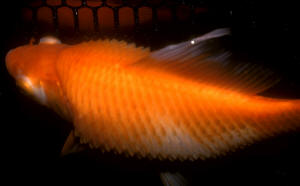 Typical
"pinecone" appearance... from intracellular fluid
increasing the intercellular fluid pressure... usually related to
bacterial involvement which in turn is related to
"poor" and/or changeable water quality. Typical
"pinecone" appearance... from intracellular fluid
increasing the intercellular fluid pressure... usually related to
bacterial involvement which in turn is related to
"poor" and/or changeable water quality. |
Sick Flowerhorn 11/16/19
Hello,
<Hello Sue,>
I am really hoping that you can help me we’re all out of ideas.
<Will try.>
Approx six weeks ago I noticed a small swelling on the side of my
Flowerhorns abdomen. The swelling has since got larger and the other
side of her abdomen is now swelling (the swelling appears to be internal
and she is not displaying any external signs of illness.)
<Let's just be clear on this. The fish has a swelling, but apparently
internal, meaning you can see that the skin and scales look normal, just
stretched out because of the swelling? The swelling was more obvious on
one side first, but now seems to be on both sides?>
With the help and advice of my local aquatic shop, I treated her with
aquarium salts for 2 weeks which I removed with water changes and then I
tried ParaGuard for 2 weeks, which I removed with water changes and
carbon. (neither of which have worked.) I have removed the carbon from
my filter and I am currently dosing the tank with API general cure
(today is the last day of treatment) but I can see no improvement.
<Understood. API General Cure was a good call, containing metronidazole,
and therefore a good treatment against Hexamita infection, which the
stringy white faeces would be consistent with. On the other hand, the
fact we're dealing with abdominal swelling points more towards Dropsy,
which though it is a symptom rather than a disease, tends to be related
to opportunistic bacterial infections and general environmental stress.>
She has white stringy feces (indicating an internal parasite?) but none
of the treatments are working. I am going to make a medicated food using
the last sachet of API general cure, garlic juice, her fish pellets and
Epsom salts.
<Epsom Salt is a good choice for Dropsy, and can reduce the swelling,
but by itself isn't a cure.>
Thing is, she’s stopped eating so I’m not sure how successful this will
be. The aquatic shop staff and I are now out of ideas on how to help
her.
<Indeed.>
I have noticed lots of very tiny snails in her tank. I’m assuming they
came in with some water lettuce plants that I added to the tank approx 2
months ago (I’ve since removed the water lettuce.) I suspect that I
hadn’t noticed the snails before as maybe she had been eating them. She
had also eaten all of the roots of the water lettuce plants (could these
have caused a blockage?)
<On the contrary: fresh green foods provide fibre, which (just as in
humans) prevents all sorts of problems with the digestive tract. Small
snails, while unsightly, are unlikely to cause problems, and some
cichlids enjoy eating them, using the pharyngeal mill to grind up the
shells. So again, no risk.>
My main thinking is that although I rinsed the water lettuces prior to
adding them to the tank, if I inadvertently missed a snail on them then
maybe I didn’t rinse them well enough and introduced parasites too.
<Yes to how the snails got in, but no, unlikely to have been a source of
parasites. Yes, snails can carry parasites, but most of the bad ones
have complex life cycles involving water birds and mammals, so don't
persist in aquaria. So while snails are unsightly, they're almost never
a danger. Fish are MUCH more likely to pass parasites between
themselves, which is why "feeder fish" are so dangerous.>
She is in a 55g tank, I have tested the water and the readings are all
fine.
<Need some data here, rather than "fine". 55 gallons isn't particularly
big, especially for a cichlid that should be at least 30 cm long when
fully grown. Let me have you do some reading, here:
http://www.wetwebmedia.com/FWSubWebIndex/FHParrotCichArtNeale.htm
My concern here is that cichlids of all types are subject to health
issues when 'cramped'. Whether it's the lack of oxygen, or excessive
nitrate, I don't really know. But I've seen it many times, and learned
the hard way when breeding various kinds at home. Again, the link above
will provide some water chemistry range values to aim for (but in brief,
hard, alkaline water is what you want) and besides 0 ammonia and 0
nitrite, you want to aim to keep nitrate below 20 mg/l, and certainly
not above 40 mg/l for any length of time. Skipped water changes cause
cichlids real problems because they are so much more sensitive to
nitrate than most other freshwater fish.>
As we live in the U.K, I am limited on what medication can be used (I
had to order the API general cure from the U.S.) Please have you any
idea on the next step for me to take? Blossom means a lot to me and my
husband and we’d hate to lose her.
<Treating Dropsy is hard, and best done with antibiotics from a vet, but
my favourite medication available in over-the-counter from UK stores is
eSHa 2000. It's relatively inexpensive (around £5 a bottle) and
tolerated very well by virtually all fish, even sensitive species like
Pufferfish.>
I’d really appreciate any help that you can give.
Many thanks,
Sue.
<Welcome. Neale.>
Re: Flowerhorn/Red Devil Cross with swim bladder disorder symptoms
1/9/19
Hi again. Just a quick update on Jiana, the flower horn/red devil cross with the
damaged swim bladder. On October 10th 2018, after a lot of research, I
surgically removed the gas from her swim bladder and managed to sink her.
<Crikey! That's beyond my pay grade, as we say in England.>
The risk at that point was outweighed by potential gain. Her side began to heal
immediately.
<Good to hear.>
As of January 2019, she is still on her side at the bottom most of the time but
is able to right herself and swim the length of her tank when she wants to. When
she stops she drifts over onto her side. Her colour is great, appetite is huge
and she seems to still be improving slowly but steadily.
<Nice.>
She is able to play again and remains very interactive with people. She may
never be the same as she was but seems to be content. Thanks again for all the
advice and help with her. Your website is my go to site whenever I need expert
help.
Cheers
Andrea
<Glad this has worked out well, and thanks for the update (and the kind words).
Cheers, Neale.>
Treating dropsy with salt 10/2/18
Hi, i wanted to ask your help in treating dropsy with salt.
<Epsom, better than table... >
i have a jewel cichlid who started to bloat and raise his scales 2 days
ago. I read a lot about treating with salt{in addition to antibiotic}
but there are tons of different recommendations about the dose, about
whether to use NaCl or Epsom salt and whether using in a dip or in a
bath. I would really appreciate your advice ,thank you
<The antibiotic and Epsom route is the most likely efficacious. Do read
here:
http://www.wetwebmedia.com/fwsubwebindex/saltusefwartneale.htm
and
http://www.wetwebmedia.com/fwsubwebindex/dropsyfaqs.htm
Bob Fenner>
|
Dropsy-like symptoms killing fish
10/1/18
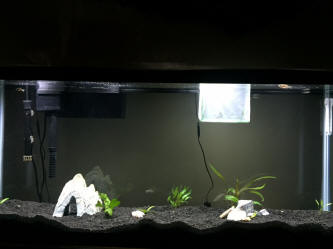
I have an Aqueon 55 gal aquarium that came in a kit/box with a Quiet
Flow 75 filter that has the pump that goes in the water. It also came
with an underwater heater and 2 LED hoods.
<Okay>
I have installed all the equipment that came in the box along with Carib
Sea planted aquarium substrate and live plants. The aquarium has been
set up for about 3 months and water quality tests as good (no ammonia,
nitrates, nitrates,
<No NO3? Unusual. I'd have your fish store check a water sample here.
Nitrates should be measurable>
ph around 8.0 to 8.2). Water is clear and plants are thriving.
However, I am having trouble keeping fish alive in it. Everything I have
tried to add (mollies, zebra Danios, corys) immediately develops dropsy
symptoms and dies within days or a couple of weeks. Could there be
something wrong with the equipment, e.g. some kind of toxin leaking into
the water?
<The latter might be an issue. A household cleaner getting into the
water, indoor air pollution from cooking, smoking.... What do the fish
look like when they're dying, dead? Do you have pix to share?>
I have tried treating it with a high concentration of salt, frequent
water changes, and leaving it without fish for a month after treating it
with Praziquantel to allow any parasites to die.
<Mmm; I'd try a good deal of activated carbon in a Dacron bag (to
contain it) placed in your water flow path. Likely inside your hang-on
filter...
And adding more aeration (likely an air pump, tubing, airstone...)>
Last idea I was given is to remove plants, bleach and rinse everything,
and start over. May have to try that since I don't know what is causing
the problem.
<Might be worth doing this last... as the "poisoning" (if that's what
the cause is here) could be due to noxious algae growing in the system
itself.
I am a huge fan of having at least some live plants... to outcompete
such and do a few other essential environmental improving things. Please
see/read on WWM re live plant use... perhaps some Sagittaria,
Watersprite.... Bob Fenner>
Re: Dropsy-like symptoms killing fish 10/2/18
Bob,
Thank you for your reply.
<Glad to help Rita.>
To check water quality, I used the test kit from API. Everything
measured in the lowest color range, so I assumed it was 0.
<Okay>
I don’t think any toxins are getting in from our house. We don’t smoke
and I am careful to wash my hands/arms when working in the tank. The
filter pump and heater are actually in the aquarium, so I wondered if
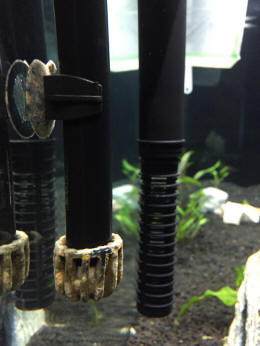
they could have something leaching into the water from them. One of the
attached pics is the inside of the pump. This part is actually submerged
so I wondered if this material could leach something.
<Unlikely; these motors are embedded for function and safety's sake in a
chemically inert potted material; but the pix of the distal end of the
heater and suction cup do make me querulous>
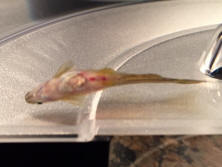
All the pics of the dead fish are the same fish from over 1 month ago. I
was trying to capture different views of the abdomen. The pic of the
fish with a string of white poop is a different fish from a month ago.
This was the one that made me wonder if it was a parasite.
<Again, doubtful that the initial, direct cause here is biological;
perhaps secondarily bacterial. There is/are some source of stress/or/s
here debilitating your stock>
The last 5 pics are from recently. After 1 month with no fish I added 3
zebras.
<Good "test fish" I'd warrant. Brachydanio rerio are tolerant of broad
(aquarium) conditions; used extensively as test animals for research;
sort of aquatic fruit flies>
One already bloated and pineconed and died in 2 days. The other two are
sluggish, not eating and slightly bloated. Because they are not eating,
the food grows white fur if I don't get it out in time.
<Yes>
(FYI - The white breeder bag holds floating live plants to keep them
from getting sucked into the pump until I can mount them on something to
hold them in place.)
<You could; there are various "clip" products for offering foods
mostly...>
The last 2 pics are the underwater heater. The growth on the rubber
parts started almost immediately after I installed it several months
ago. Not sure what it is or if I need to clean it off.
<I'd remove it period. This bit of plastic is intended to absorb shock
should the heater strike something hard. Am concerned that it's being
heated to the point that it's degrading, possibly a source of trouble
here. Unplug the heater first if/when removing it from the system>
I'm sure this is more than you asked for, but I had the pics so I sent
them on.
<Appreciated>
I have been trying to think of what might be causing the problem. Our
local state university vet school has a service where they will
test/autopsy sick fish and water samples for $55. Would it be worth
taking a chance on this?
<Worthwhile if it will set your mind to ease>
Would it be able to point to a cause?
<Only the biological manifestations. Mmm; I have long-standing writing
and ppts re the influences that determine livestock health. Do have a
read:
http://www.wetwebmedia.com/mardisease.htm
and as much of the linked files above as you find instructional>
Thank you for your time. I appreciate it.
<Welcome. Bob Fenner>
|
 |
Just a little suggestion... Dropsy addn.
7/31/16
Hey,
I noticed that you link to Wiki How's page about Dropsy
(*http://www.wikihow.com/Cure-Goldfish-Dropsy
<http://www.wikihow.com/Cure-Goldfish-Dropsy>*) in your response on you FAQs on
Goldfish Medications post
(*http://wetwebmedia.com/FWSubWebIndex/GFDisMiscMedF.htm
<http://wetwebmedia.com/FWSubWebIndex/GFDisMiscMedF.htm>*).
My page (www.landoffish.com/dropsy-treatment ) has a lot more information
about diagnosing and treating dropsy, so I believe it would be valuable to your
readers if you added it as a link in your response.
Thanks for your time & let me know what you think,
- Derek from Land Of Fish
<Thank you for your efforts. Bob Fenner>
|
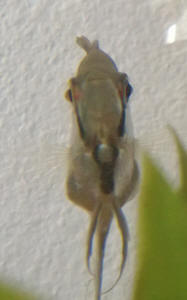
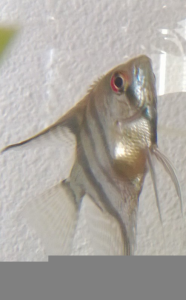
Persistent problem with a bloated freshwater angel fish
1/13/13
Dear WWM crew,
I've been reading the great advice on this site throughout the past few
years while we learned how to maintain a freshwater aquarium. Thanks for
all the effort you guys put in!
<Thanks for the kind words.>
I’m hoping you can help us with a persistent bloating problem that we’re
having with one of our freshwater angels. First about the aquarium: we
have a 55gal freshwater tank, with about half an inch of coarse gravel
(small stones), plastic plants, a piece of driftwood, a rock and a ‘fake
plastic rock’, an Eheim 2217 filter ‘in good health’ (occasional
coarse filter rinse, occasional fine filter swap, rarely a carbon pad,
rarely a gentle rinse of the bio media to prevent clogging), UV
sterilizer before the filter, air bubbler, filtered tap water with
AquaSafe conditioner, recommended dose of CopperSafe (can you tell we’re
afraid of diseases?), temperature 78F. The water here is outlandishly
hard, pH something like 8.5 if I recall correctly. We do about 20
percent water change per week as we vacuum the gravel. We don’t add
salt. The aquarium never gets direct sunlight, but it’s in a room that
gets kind of warm during the day, room temperature may vary between
65F-85F throughout the day. The aquarium has been running for a few
years without major problems.
<All sounds good, save for the rather high pH. While farmed Angels
aren't delicate at all, they do best in soft to moderately hard water
between 2-20 degrees dH, pH 6-8.>
We have four medium sized freshwater angels, one tiny angel, one pictus
catfish, one blue gourami, one pearl gourami, and three yoyo loaches.
Everybody seems to get along fine these days. We feed tropical flakes,
frozen shrimp, bloodworms, and two more from the ‘freshwater pack’ from
‘San Francisco Bay Brand’. All have good appetite.
And now for the problem, one of our angel fish started getting bloated
about seven weeks ago. After initially hoping that it was pregnant, it’s
now clear it has a problem. It used to be one of our strongest fish,
getting to all the food first, so we also considered that it was just
getting fat, but the bloat seems localized, like something is pressing
outward. Over these 7 weeks we've tried several things, including
putting it on a diet behind a divider for two weeks (no clear change),
feeding it peas for a few days (no effect – didn't eat much either
though), giving it medicated food (Jungle Anti-bacterial), and treating
with Maracyn II and Tetra Parasite Guard simultaneously. Throughout all
of this it has basically looked the same, see the attached pictures. We
do have the feeling that it gets noticeably worse if we feed it even
tiny amounts of food.
<To recap the basics: Dropsy occurs when fluid accumulates within the
body cavity. Though often considered terminal, it can be cured if caught
early, which may be the case here if the Angel is still active and
feeding. Start by raising the water temperature to 28-30 degrees C/82-86
degrees F, then add 1-3 teaspoons of Epsom salt (not tonic salt) per 20
litres/5 gallons of water. Ideally, add an antibiotic medication like
Maracyn (a good antibacterial like eSHa 2000 can be an adequate
substitute that might be used in lieu of antibiotics). After about a
week, the swelling should subside. Since dropsy is usually a sign the
fish was stressed by its environment, this would be a good time to
review things like filtration and water changes. Because Dropsy is
almost always caused by some sort of environmental stress, review the
aquarium conditions.
Stocking, water changes, water quality, filtration, etc.>
Given everything we’ve done we’re at a bit of a loss. Can you think of
anything else we can try? Thanks in advance for any help you can give.
<Deworming is something you might want to do, though serious worm
infections usually cause the fish to waste away at the same time its
abdomen swells up. The Metronidazole and Nitrofuranace combination also
works well with mystery cichlid problems >
Best regards,
Joe
<Hope this helps, Neale.>
|
  |
Re: Persistent problem with a bloated
freshwater angel fish
1/13/13
Wow, thanks for the amazingly fast response. So based on the pictures you
think it's most likely dropsy, not constipation?
<Assume both. Treatment for one will work fine with the other.>
Can we do the salt
<...Epsom, not regular salt...>
treatment in the main tank or will it stress out the other fish?
<Is safe with other fish.>
If it's dropsy, should we continue to feed normally, or feed the sick angel
only minimally or even not at all?
<As normal, but given constipation may be a factor, leave out flake and
other dried foods, and instead focus on brine shrimp, daphnia, cooked peas,
and perhaps spinach if your Angel eats the stuff.>
Thanks again for the advice. -Joe
<Welcome, Neale.>
Re: Persistent problem with a bloated freshwater angel fish
4/8/13
Hi there, just a quick follow-up on our bloated angle fish problem. In
the end were afraid to move him to a hospital tank for fear of added
stress, and we didn't want to medicate the entire tank again with
antibiotics. We kept the divider in the tank with the sick angel in a
small section (like 1/4 of the tank) with some plants to hide behind,
adding the recommended dose of Epsom salt, and feeding very sparingly.
I'm happy to report that after one month or so he got back to normal
size. By now the divider has been out for about six weeks, and he's
feeding as greedily as ever before without any sign of bloating. Hurray!
Thanks for the advice. The healing was so gradual that for weeks we
convinced that things were not improving, until one day we realized that
he was back to normal. A true fishmas miracle!
<So great to hear a happy ending to this WWM story! Thanks for writing
in. Yes, I agree, the Epsom salt treatment is slow but does sometimes
work miracles. Wouldn't have believed it myself without having had to
try it out. One of the best tricks I've personally learned from Bob
Fenner. Take care, Neale.>
|
angel fish pregnant or not? FW Dropsy f'
1/9/13
Hello,
I have a 36 gallon tank with a variety of small fish including 3
medium/large size angel fish. One of the fish looks very pregnant
or bloated, he/she is about twice the normal width. I thought she was
pregnant and I prepared the tank for her laying eggs. However,
it's been close to 2 months now and nothing has happened. The fish
appears to be healthy in
other ways but the only observable difference has been this fish
somewhat secluding from the others and one angel fish keeping the third
one away from this pregnant or bloated fish. I also just observed
this fish swimming vertically with the mouth up for just a brief moment.
Do you have any guidance for me? Thank you,
Greg R.
<This fish has Dropsy. Dropsy occurs when fluid
accumulates within the body cavity. Though often considered terminal, it
can be cured if caught early. Start by raising the water temperature to
28-30 degrees C/82-86 degrees F, then add 1-3 teaspoons of Epsom salt
(not tonic salt) per 20 litres/5 gallons of water. Ideally, add an
antibacterial medication. After about a week, the swelling should
subside. Since dropsy is usually a sign the fish was stressed by its
environment, this would be a good time to review things like filtration
and water changes. Because Dropsy is almost always caused by some sort
of environmental stress, review the aquarium conditions.
Stocking, water changes, water quality, filtration, etc. Cheers, Neale.>
Re: angel fish pregnant or not?
1/9/13
Thank you so kindly, that is very helpful!
Greg
<Most welcome. Cheers, Neale.>
Re: angel fish pregnant or not?
1/9/13
Thank you again, I had one more question, would you consider dropsy to
be contagious?
Greg
<It is not. Dropsy is a symptom that the organs inside a fish aren't
working properly. Specifically, those organs concerned with
osmoregulation such as the kidneys. So it's more like a organ failure
than a disease, though opportunistic bacteria may be involved. Fix the
environment, use the heat/Epsom salt treatment, and medicate against
internal bacterial infections (something like KanaPlex in the US), and
you can save a fish with Dropsy, especially if it is still feeding and
swimming about. Cheers, Neale.>
Re: angel fish pregnant or not? Dosing MgSO4
1/16/13
Hello, how often would you say that I need to treat the water with Epsom
salt? Is it a one time thing or should I repeat the dosage
daily/weekly?
Thank you again,
Greg R.
<Dose the tank once to start up with, sufficient for the entire volume
of water. So if your tank holds 36 gallons of water, at 3 teaspoons per
5 gallons, that's about 7 x 3 = 21 teaspoons altogether. Mix in a jug of
warm water, then add slowly to the tank across half an hour or so. Doing
this avoids shocking the aquarium fish in any way. Now, each time you do
a water change, replace only as much Epsom salt as the water change took
out. So if you take out 10 gallons of water, then you need to add10
gallons of new water, so you add 2 x 3 = 6 teaspoons of Epsom salt. Keep
doing this for as long as necessary for the Dropsy to go away. Epsom
salt is not toxic or even stressful to the fish (it's a laxative of
sorts, and helps to "reset" the osmotic balance inside the fish, or so
we think) so you can use it for many weeks, even months if needs be.
Cheers, Neale.>
Re: angel fish pregnant or not?
Wonderful! Thank you again!
<Welcome, Neale.>
Re: angel fish pregnant or not? Dosing MgSO4
1/16/13
Hello, how often would you say that I need to treat the water with Epsom
salt? Is it a one time thing or should I repeat the dosage
daily/weekly?
Thank you again,
Greg R.
<Dose the tank once to start up with, sufficient for the entire volume
of water. So if your tank holds 36 gallons of water, at 3 teaspoons per
5 gallons, that's about 7 x 3 = 21 teaspoons altogether. Mix in a jug of
warm water, then add slowly to the tank across half an hour or so. Doing
this avoids shocking the aquarium fish in any way. Now, each time you do
a water change, replace only as much Epsom salt as the water change took
out. So if you take out 10 gallons of water, then you need to add10
gallons of new water, so you add 2 x 3 = 6 teaspoons of Epsom salt. Keep
doing this for as long as necessary for the Dropsy to go away. Epsom
salt is not toxic or even stressful to the fish (it's a laxative of
sorts, and helps to "reset" the osmotic balance inside the fish, or so
we think) so you can use it for many weeks, even months if needs be.
Cheers, Neale.>
Re: angel fish pregnant or not?
Wonderful! Thank you again!
<Welcome, Neale.>
Bloated Gourami 1/13/13
Hello,
The severe bloating occurred in less than 48 hours. I
have a 55 gallon tank that has been established for about three years.
The residents are 4 Pearl Gouramis (one male, three female), 1 female
Moonlight Gourami, 1 Ctenopoma acutirostre, 1 African Knifefish, and 1
female Betta. The Betta and Ctenopoma were added about a year ago and
I've had the others for three years. There are no aggression issues,
everyone gets along. The water is 75F, 3GH, 3KH. I do 30% water changes
every week. I feed tropical crisps twice daily, and thawed bloodworms
three times a week. Two days ago all the fish were fine and normal.
Yesterday I fed them, but didn't look closely, so I don't know how she
was. Today, one of the female Pearl gouramis is extremely bloated. She
looks like she swallowed a golf ball!. Her abdomen is bulged out on both
sides so she is almost as wide as she is long. The bloating is bending
her back so her nose is pointing upwards. Despite this, she is swimming
around like normal, her colour is bright, eyes clear, fins not clamped
or ragged. Her scales are not protruding The other fish are not
harassing her. What could have caused her to bloat so extremely and
suddenly? I have clove oil in case I should euthanize her.
<Provided she is still active and feeding, there's a good chance she can
recover. Dropsy occurs when fluid accumulates within the body
cavity. Though often considered terminal, it can be cured if caught
early. Start by raising the water temperature to 28-30 degrees
C/82-86 degrees F, then add 1-3 teaspoons of Epsom salt (not tonic salt)
per 20 litres/5 gallons of water. Ideally, add an antibacterial
medication. After about a week, the swelling should subside. Since
dropsy is usually a sign the fish was stressed by its environment, this
would be a good time to review things like filtration and water changes.
Because Dropsy is almost always caused by some sort of environmental
stress, review the aquarium conditions.
Stocking, water changes, water quality, filtration, etc. Diet can be an
issue in herbivorous and omnivorous fish that aren't getting adequate
sources of fibre, such as algae, cooked peas, brine shrimp and daphnia.
Cheers, Neale.>
angel fish pregnant or not? FW Dropsy f'
1/9/13
Hello,
I have a 36 gallon tank with a variety of small fish including 3
medium/large size angel fish. One of the fish looks very pregnant
or bloated, he/she is about twice the normal width. I thought she was
pregnant and I prepared the tank for her laying eggs. However,
it's been close to 2 months now and nothing has happened. The fish
appears to be healthy in
other ways but the only observable difference has been this fish
somewhat secluding from the others and one angel fish keeping the third
one away from this pregnant or bloated fish. I also just observed
this fish swimming vertically with the mouth up for just a brief moment.
Do you have any guidance for me? Thank you,
Greg R.
<This fish has Dropsy. Dropsy occurs when fluid
accumulates within the body cavity. Though often considered terminal, it
can be cured if caught early. Start by raising the water temperature to
28-30 degrees C/82-86 degrees F, then add 1-3 teaspoons of Epsom salt
(not tonic salt) per 20 litres/5 gallons of water. Ideally, add an
antibacterial medication. After about a week, the swelling should
subside. Since dropsy is usually a sign the fish was stressed by its
environment, this would be a good time to review things like filtration
and water changes. Because Dropsy is almost always caused by some sort
of environmental stress, review the aquarium conditions.
Stocking, water changes, water quality, filtration, etc. Cheers, Neale.>
Re: angel fish pregnant or not?
1/9/13
Thank you so kindly, that is very helpful!
Greg
<Most welcome. Cheers, Neale.>
Re: angel fish pregnant or not?
1/9/13
Thank you again, I had one more question, would you consider dropsy to
be contagious?
Greg
<It is not. Dropsy is a symptom that the organs inside a fish aren't
working properly. Specifically, those organs concerned with
osmoregulation such as the kidneys. So it's more like a organ failure
than a disease, though opportunistic bacteria may be involved. Fix the
environment, use the heat/Epsom salt treatment, and medicate against
internal bacterial infections (something like KanaPlex in the US), and
you can save a fish with Dropsy, especially if it is still feeding and
swimming about. Cheers, Neale.>
Babies and a platy that possibly has dropsy
1/10/13
I want to start by saying how grateful I am for your website. I
almost gave up a few times and you threw me a lifeline to what is now a
fun hobby but tonight I'm in trouble. I just lost a Mickey Mouse
Platy tonight and felt horrible but had been pretty secluded most of the
time I had him I believe. Looking at another Mickey Mouse that I bought
at the same time( a couple of months ago) tonight looks huge and the
fins look a little pine coned.
<Yikes>
I know from reading your site that it is most likely dropsy and although I
do water changes with the holidays I got a little behind but kept
testing water and nitrites and ammonia stayed zero so I felt I was okay
but I must have guessed wrong. Now for my problem, I don't really
have a hospital tank but might be able to get one I'm not sure.
<Better to leave the mal-affected fish where it is. "Dropsical
conditions" aren't "catching"; but the causes need to be addressed for
all>
In my tank, I have the Mickey, two other Platies, 4 male guppies and three
very young Mickey Platies from my females that are doing well and
several little fry that are so cute but very tiny but also seem to be
doing well so if I can't get the hospital tank put together will it kill
all of my babies if I treat the Adult Platy?
<Depending on the treatment...>
What do you suggest I do if I can't get the hospital tank together soon
enough? Thanks for being there!!! Karen Fadely
<Please read here:
http://www.wetwebmedia.com/FWSubWebIndex/dropsyfaqs.htm
and the linked files above. Bob Fenner>
would you euthanize for "dropsy"?
11/2/12
Hi WWM crew,
<Helen>
I have a Siamese algae eater in my tank that is so bloated in its middle
that it is starting to pinecone. It is uninterested in food and hiding
almost all the time. What should I do?
<A few possible (exploratory mainly) treatments, or doing nothing...
Please read here:
http://wetwebmedia.com/FWSubWebIndex/dropsyfaqs.htm
The tank is a 220l planted freshwater community. The inhabitants are -
15 Congo tetras
- 3 Siamese algae eaters
- about 8 Corydoras trilineatus and panda
- a few guppies
- a heap of cherry and "algae eating" shrimp (the latter are an
Australian native, I don't know the species).
<Mmm, then, given these tankmates, IF treating either with salt/s or
antimicrobials, I'd remove the one SAE to elsewhere for administration>
I feed a mixture of flake, Spectrum and/or Hikari community food and
occasional earthworms or brine shrimp.
<I see>
The water temperature is about 25 degrees, pH 6.8, nitrate 10ppm. I
haven't measured anything else, as my test kits are nearly all expired
anyway (the nitrate one isn't though), but the tank has been established
for nearly 4 years now so I very much doubt there is a problem with
ammonia or nitrite.
<Agreed>
I do water changes of around 20% every couple of weeks, with the
occasional large change of 50% or so. Not as much as I'd like, but I am
a busy mum of small children and if you've been there you'll understand
what I mean.
I've had this tank running since before my first was born, and it seems
to me to be a very stable system run this way.
Anyway, so this fish is sick and I'm not sure what to do.
<Given the information presented, I personally would do nothing... just
wait, see if the bloating resolves on its own>
It's one of my older fish, having been in my tanks for maybe 5 or 6
years (I'm not certain, but certainly it's been there since this
particular tank was set up). I don't know whether this is old for the
species or not.
<It is for Crossocheilus>
Actually my "school" of 5 Siamese algae eaters is now down to three
soon, I suspect, to be 2. Could be old age getting them or could be
something else. I figure that my options are:
<Could be "senescense"... cumulative genetic/replicate errors>
- euthanise (this, I think, may be the kindest thing to do, also the
easiest for me, to be honest)
<This choice is up to you>
- wait and see what happens, which will, I am sure, result in a dead
fish that gets eaten by the others if I don't find it and fish it out
first (lots of hiding places and wood to die under in this tank). If
it's carrying a heap of some pathogen then others may get sick.
<Highly doubtful that there is some sort of "spreading" pathogen at work
here... again, given the age, make-up of your set-up; maintenance,
foods/feeding>
I don't think it's big enough to
destabilise the tank's cycle, but I'm not sure.
- isolate in a 5g tank and attempt to treat with medication.
<Not my choice here>
This is the biggest fish I have at the moment, being 4 or 5 inches long,
and it would be a tight fit in one of my 5g quarantine tanks. So this
would be a very stressful experience for the fish, I am sure, which
might be enough to kill it anyway. Or maybe not. Then we get onto the
fact that in Australia we don't have access to all the fancy modern fish
medicines you folks in other places have. So I could try triple sulfa,
tetracycline, Methylene blue - stuff like that. I won't bother to
mention Melafix to you...
<Thank you>
I haven't used any medication on my fish for years and what I tried as a
beginner pretty much uniformly didn't work. I rely on quarantine to keep
my tank healthy and it seems to work, as far as I can tell, anyway. So
when it comes to medication I am only experienced enough to steer clear
of the stuff - if you can suggest something that would be sensible to
try I'm certainly open to trying it. But I don't want to prolong or add
to the suffering of this animal, if that's all it will do.
- treat the tank. This is my least favourite idea because I reckon it
would kill something else in the process. Like the shrimp or the Corys.
What would you do?
<As stated; in order: Leave all as is, remove the one fish to
treatment... euthanize>
Would you guess this to have been caused by some error I've made, or
would you put it down to old age and go out and get some more Siamese
algae eaters.
<This last>
I am planning to add another bunch of 4 or so to the tank, as I like
them. But not until I've resolved what to do with this old fellow/gal.
<I'd just be waiting>
Thanks for your advice,
Helen
<Welcome. Bob Fenner>
Re: would you euthanize for "dropsy"? 11/4/12
Hello Bob,
<Hey Neale>
Read this message in today's FAQs.
As it happens, last month my own Garra cambodgiensis ("False Siamese
Algae Eater") came down with dropsy. Likely my fault, having skipped
water changes for longer than I should. I any case, it was a fair age, 5
or 6 years old, but after our previous conversations, decided to treat
it rather
than euthanise.
<Ahh!>
Raised water temperature to 28 C; added Epsom salt at 3 teaspoons per 4
gallons; and medicated with a product called eSAa 2000, an inexpensive
antibacterial medications sold widely in the UK and used to treat Finrot
and the like. It contains ethacridine lactate ("Rivanol"), proflavin,
copper 2+, and methyl orange. Within a week, the fish was completely
recovered.
<Wow!>
First time I've ever seen a fish recover from dropsy! Meant to write
earlier to let you know that your dropsy treatment described on WWM
really does work.
Possibly this is of use to your correspondent.
Sincerely, Neale
<I, we both thank you... Am wanting to re-emphasize/make clear that the
salt and eSHa product I would not expose the (if memory serves) shrimp
in the system to... would move the mal-affected false SAE (the true
doesn't get to the size stated) to another system (w/ the existing
water) and treat there. Bob Fenner>
Re: would you euthanize for "dropsy"?
11/4/12
Hello Bob,
<Salud Neale!>
I do also agree re: moving shrimp from a tank if using the eSHa product
(it does contain copper). But Epsom salt should be fine, surely? Have
kept cherry shrimps in low-end brackish and the breed like crazy!
<Mmm, maybe... not so sure re the Magnesium>
If all else fails, I'd suggest moving as many shrimp as you can to a
1-gallon or larger aquarium; most species (including Amano and Cherries)
are easy to maintain at room temperature, so don't need a heater, just
an air-powered filter. Treat the fish, then afterwards move the shrimps
back.
Quite possibly this is easier than setting up a quarantine tank for the
injured/sick fish.
<They stated they have a 5 gallon system for treatment. T'were it
me/mine,
I'd just move the false SAE. BobF>
Cheers, Neale
|
Colisa lalia... hlth. 8/10/12
Hi. Just found your site by accident and I am hoping you can help with
my dwarf Gourami problem I have two male dwarf Gourami's in a 180 litre
tank; the tank has been running successfully for about 18 months now.
One of the Gourami’s has developed a bloated stomach, it started about
two weeks ago and it increased in size for about seven days, for the
last seven days it has remained the same size he also has long stringy
white waste (see photo).
<Yes... evidence of a likely lumenal parasitic involvement>
He seems to be eating normally but hangs near the top of the tank and
doesn’t move about much except at feeding time he’s scales are not
sticking out and he seems normal apart from the above symptoms.
He has been in this tank for about a year and always seemed quite happy
until now.
I do a 20% water change with gravel vac every week the tank temperature
is 25c.
The tank is not overcrowded and the only recent additions were two
freshwater clams a six weeks ago, both alive and well.
<Rare... most of these clams starve in short order>
I did have a white spot problem a couple of months back which I treated
with WS3 (malachite green) for two weeks unsuccessfully, but eventually
eradicated the problem with heat alone as advised on another forum.
<And WWM>
My water parameters are all good Ammonia, Nitrate and nitrite all 0’s
and Ph. 6.5.
<A bit low>
I have been to several aquatic shops and have been told the problem is.
Dropsy, Internal bacteria, Internal Parasite, Worms, Hexamita, with so
many conflicting diagnoses I don’t know how to treat this fish.
<A combination of Metronidazole and an anthelminthic (likely
Prazi/quantel)... laced in foods... you can buy it commercially prepared
or DIY... See WWM re... and the diseases of this species period on WWM.
Bob Fenner>
Hope you can help. Chris.
P.S great site will be here often.
|
.jpg)
.jpg) |
|
Re: Bloated Dwarf Gourami 8/11/12
Hi. Just big thanks for your help, I’m guessing you guys are USA based
and the problem I have is that the remedies suggested are not always
available here in the U.K,
<Ah yes. Neale Monks is in the U.K., and I know of no other place where
treatments are so available as the U.S.>
or if they are the guys at the aquatic centre look completely lost when
you ask for them.
<Mmm, yes... IF you consider the expense, general resource "worth it",
you might contact a veterinarian...>
Anyway on the positive side you have given me the information as to what
I am dealing with, a parasite.
<Likely so... A simple/r treatment is Epsom Salt, Magnesium Sulfate...
should be available from the drug store>
I decided to treat with a Flubendazole based treatment and after just 36
hours my Gourami is looking much less swollen, he still has the white
stringy waste but I am much more optimistic about he’s chance of
survival now.
<Ahh!>
He is eating well which is a good sign, and moving about a bit more, in
he’s weakened state he is being bullied by the healthy Gourami a bit
more but I am not overly concerned as it doesn’t seem too serious, will
keep an eye on the situation.
Regarding the clams, yes I was aware they do tend to starve, so as an
experiment I tried them on finely crushed algae wafers and so far they
seem to be thriving.
Thanks again for a great site. Chris.
<Thank you for contributing to it, sharing. Bob Fenner>
|
|
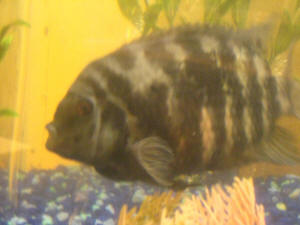
female convict cichlid with bloat? 7/3/12
Hello!
I have a 6 year old female Convict Cichlid (Miss Stripes :) ). For the
last several months I've noticed she's seemed to have labored breathing
off and on. Just this week she's been hanging out in weird places
in the tank (instead of in her "rock house"), sinking to the bottom in
odd positions, and she isn't interested in food. Her scales are a
little fluffy, but not pine coned. I haven't noticed any feces.
She also seems to have a little bloatiness just under her gills (see pix
below). After researching your website, I'm wondering if she has bloat?
I know she is getting older so she is probably more susceptible to
disease if I neglect tank cleaning (which unfortunately I have more in
the last few months).
<And likely these are the causes at the root of this problem. I've seen
this many, many times. In fact whenever I come across a cichlid with
these nondescript bloating, HLLE and Hexamita-type infections, the
cichlid was in a small, dirty, neglected tank or otherwise exposed to
something that shouldn't have been a problem if the tank was bigger,
equipped with a better filter, and provided with more water changes.
This is bitter experience -- I've lost quite a few dwarf cichlids over
the years by putting off a water change "for just one more week".
Nitrate is often cited as the killer, but whether it's merely an
indicator of the problem or the toxin itself is hard to say. Perhaps
best to see Nitrate as part of the problem.>
I just ordered some Clout (as I heard this is even a better med than
Metronidazole--much stronger) and it should be here in a few days.
However, I'm worried that may be too long! I do have some Jungle
Parasite Clear (has some Metronidazole in it) and Jungle Fungus Clear if
you feel either is better than Clout.
My questions are 1) What are your recommendations for treatment? And 2)
I don't have a hospital tank set up but I do have a free 10-gallon one I
can use. How can I get it ready for her as to not stress her out
by putting her in a non-conditioned tank? Is using water from her
current tank enough? The only other fish in the tank with her (a
20-gallon) is a large Pleco. Can I treat them both or is it still
a good idea to move her?
<Both in a 20-gallon tank? No wonder she's not well. Overstocked!>
Any other suggestions would be greatly appreciated! Thank you so much
for your time. Josey (and Miss Stripes!)
<Hmm... do read:
http://www.wetwebmedia.com/FHParrotDisArtNeale.htm
http://www.wetwebmedia.com/metranidazole.htm
And the links them. Since your fish is apparently mobile and presumably
feeding, then using an oral medication (e.g., in the food) is much MUCH
better than a medication added to the water. Your vet should be able to
help here with specific advice on dosage. Cheers, Neale.>
|
 |
|
Re: female convict cichlid with bloat?
7/3/12
Neale,
<Josey,>
Thank you for your quick response and the links!
<Most welcome.>
I learned a lot from the link talking about aquarium size, etc... I'm
really bummed that having ONLY her and the Pleco in the tank is
overcrowding! What is a good size tank for just one convict cichlid?
<I wouldn't keep a singleton is less than 30 gallons. It's not so much
the fact a smaller tank would kill them instantly, but that anything
smaller than 30 gallons will be a pain in the backside to maintain --
long term -- to the standard a cichlid the size of female Convict
requires.>
I do have to admit I had NO CLUE the Pleco would get so big.
<Oh dear…>
It is about 11 inches long now and does produce a lot of waste that
dirties the tank quickly (was probably 2 inches when I got him and
didn't start growing until I had him for 2 years!!) .
<Indeed. These fish are really an insane species for 90% of the
aquarists in the hobby, and I wish they weren't so cheap or widely sold.
The Bristlenose Plec is an infinitely better species, only getting to
about 12 cm/5 inches in length, and a far better algae eater, yet they
are far less widely sold.>
I would love to go to a 50g tank, but financially I may not be able to
swing that at this time. I'll have to look into it. It seems the only
thing to do other that that is find the Pleco a new home.
<For sure.>
If i put him in a 50g will he just get bigger and bigger?
<Yes. These fish get to about 45 cm/18 inches, and even in a 50 gallon
tank they create murky, dirty conditions. They're the fish equivalent of
sheep, constantly grazing and constantly pooping.>
Do you have a recommendation for bottom feeders/algae eaters that stay a
small size? Or are the bottom feeders not even necessary?
<See above for recommendations. And no, they're not necessary. Quite the
contrary in fact; adding any fish, even a "scavenger" or "algae eater"
will only make the aquarium dirtier, faster.>
I haven't been able to locate straight up Metronidazole (Flagyl), so
while I'm waiting for the Clout to arrive (which I may not use? what do
you think?)
<Not an expert on either medication -- they're only available under
prescription in the UK, so not widely used by aquarists -- but either
should be helpful as it's the Metronidazole that seems to help..>
I decided on trying the Fungus Clear because it contains Metronidazole
(plus Nitrofurazone and Furazolidone). I also made a 50/50 mix of table
salt/Epsom and put a small handful in. That was all yesterday. I just
did a 25% water change (Nitrates/ites are high--darn, I wish I would
have kept this tank set up or had an extra bio filter running on the
main!). Should I keep changing the water 25% a day until the levels are
safe?
<Yes, but do wait a while after medicating; ideally, medicate one day,
do water change the next, and each day after until the second dose of
medication, in which case you (again) wait a day before doing a water
change. Make sense?>
So Miss Stripes is in her 10g hospital tank. I set it up with no
substrate (just a little from her original tank in a muslin bag), some
plastic plants and her rock house. I am keeping it around 82F
<Too warm; warm water = low oxygen -- better to go for a more clement 25
C/77 F, the optimal for almost all tropical fish.>
and have a filter with only a bio filter (unfortunately not established,
but I did add some Start Zyme to help out). The move to the hospital
tank was interesting--she practically swam into the net and didn't
flounder at all! I think she knew she was getting help :) She hasn't
been eating for a few days, so the food with the meds is out. :(
She's swimming around quite a bit (but still not well) and I offered her
one little pellet of food which she ignored, so I will wait a few more
days until I offer it again.
<OK.>
I'm feeling pretty sheepish and guilty that I may have to learn this
lesson the hard way. It really sucks! :( I am keeping my fingers crossed
she will recover. I'll let you know how it turns out. Thank you so much
for your time! In the meantime, I'm scouring more of the WetWeb site!
~Josey~
<Glad to help. Cheers, Neale.>
|
Re: Thorichthys Ellioti bloat 6/8/12
Hi guys,
it seems I've got my fourth case of bloat in a Thorichthys Ellioti
coming up. A bit frustrating, it seems we have our Elliotis for about a
year, then they balloon up and expire!
<Not fun>
I'd understand if the junior Elliotis got stressed out as there is a wee
bit of chasing, but it's always the senior (bully) who dies...
<Perhaps a clue>
We introduced two juvenile Bristlenose Plecos about a month ago, can
that be the issue?
<Shouldn't be>
Would gladly hand them back to my LFS if that's the problem.
Our water quality is decent, but NO3 is a bit high
<How high? I'd keep under 10 ppm. Do see WWM, the Freshwater
Sub Index, re>
(London UK tap water). I've got two good filters running, loads of
plants, aeration, very careful stocking... Don't know what else I can
do.
I've got a bottle of Anti-internal bacteria (bronopol formaldehyde) from
Interpet – is that good?
<Mmm, have not read re use of for this symptom.>
Also have some EsHA2000, suppose that won't do any good?
<What little I know re bloat/dropsical conditions, in cichlids and other
FW fishes is archived here:
http://www.wetwebmedia.com/FWSubWebIndex/dropsyfaqs.htm
Any advice? I'm really fond of my Elliotis and I hate to see them
suffer.
<Yes... perhaps a bit more alkalinity, carbonate presence might help...
There seems to be a correlation re>
thank you,
Fredrik
<Welcome. Bob Fenner>
Re: Thorichthys Ellioti bloat 6/12/12
Bloat Problems With Thorichthys Ellioti
Hi team,
Thank you for good advice. Ruby the senior Ellioti bit the big one I'm
afraid. Tried treating her with internal bacteria meds but she was too
far gone. I'm aware of NO3 issues, but I can't understand how Ruby could
have stayed perfectly healthy for over a year with consistent 40 ppm NO3
and then suddenly balloon and die within 48 hours?
We also had a heat wave in London a few weeks ago, and the water
temperature went up from 25 to 28-29 C for a few days, that could have
stressed her too I guess?
< Probably not since this is in their normal temp. range.>
My three Elliotis got along much better after our separating Ruby in the
birthing cage as you suggested btw, it worked a treat. Adding liquid
carbon daily for the plants. pH very stable at 8.
Pretty close to giving up on this species now, it's been my favourite
all along but it's so annoying when they keep dying...many thanks,
Fredrik
< Check the diet. I have found that glass or blood worms may cause
intestinal problems with some cichlids. In any case the binder of some
commercial foods also may case intestinal problems. Try a change in food
and see if that helps.-Chuck>
Short body Flowerhorn Bacterial
Infection (?)
Bloating Flowerhorn 10/30/11
Dear Experts at WWM,
< Expert = Someone who realizes how little they know.>
My name is Shami Thoke, and I am writing to you from Bangalore, India.
My short body Flowerhorn, "Fi", is unwell, and I need your
urgent help. I've Googled numerous sites, but I am unable to find
anything that I am experiencing. I will really appreciate if you could
bear with my lengthy email, and suggest me a solution.
My "Fi" (not sure if it is male or female) is with me for the
last eight months. She is about 3-4 inches in diameter. I feed her
Hikari Cichlid Excel, and I keep her in a 50 Litre (~15 G) tank. I
maintain the temperature at 26 degrees, and I use an internal filter. I
clean the tank every week. I keep sucking the dirt out of the tank till
it is clean, While the inlet pipe keeps the water pouring in. I use
bore well water (I do not know the parameters), and I add DoAqua BeFine
during every water change.
Last week (Friday Oct 21st 2011) before leaving for office, I observed
that she had difficulty in swimming, and was toppling over and over
again. I got a little suspicious, so I changed 70% water, and refilled
with mineral water, and added 3 tablespoons of rock salt, and increased
the temperature to 27 degrees. When I came back home, she was upside
down and could not get straight at all. I did another 50% water change
(henceforth I am using mineral water), and now I added 15mg of Epsom
salt, and increased the temperature to 28 degrees. I stopped feeding
from the evening.
By next morning (Saturday), there was no change in the condition, and I
observed white-stringy-fungus kind of poop, so I again changed 50%
water and added two tablets of Flagyl 400mg (contains Metronidazole),
and upped the temperature to 30 degrees, and fed her blanched green
peas soaked in Metronidazole.
Her condition did not improve till Saturday evening, so I did another
50% water change and added one tablet of Flagyl 400mg. She could get
straight by Sunday morning though not for long, so I followed the same
procedure - two times water change and adding two Metronidazole
tablets.
By the grace of god, she was much better on Monday morning, so I kept
the water change to once per day, while feeding Metronidazole soaked
peas. I continued with the treatment with Metronidazole on Tuesday and
Wednesday, too, Since she was a little better on Wednesday, I started
with a little bit of Hikari, and I noticed that she again had
difficulty in swimming on Thursday, but I did not pay much attention
and did not stop the feeding. And on Friday (Oct 28), she was upside
down again. I starved her for two days with water change once a
day.
Sunday morning, I fed her a bit of green peas soaked in Metronidazole.
But she is
upside down about 50% of the time, and is craving for food.
I have to confess one more thing - last night, when I changed the water
I forgot to switch on the heater back (I am cursing at myself for
this), and she was at room temperature, which was about 24 degrees, for
six hours (12 midnight to 6am). I switched on the heater back at 6 am,
and kept it at 26 degrees for an hour before raising it to 28 degrees.
I am not maintaining the 28 degrees temperature.
I feel horrible seeing her upside down, though it is not as bad as the
initial few days. I will really, really appreciate if you can tell me
what I am doing wrong, or what I can improve up on.
Eagerly awaiting your response. Thank you so much!
Shami.
< All these changes are probably stressing out your fish. Causing
the reoccurrence of the problem. Set up the tank as you would normally
and leave it alone and see if she gets better for one week. Do not feed
her. There may be an internal infection. If she looks worse then treat
with a combination of antibiotics and the Metronidazole. Start to feed
after the treatment but only feed enough so that all the food is gone
in a couple of minutes. Remove any uneaten food after
that.-Chuck>
Phantom glass catfish -
swollen stomach 10/26/11
Hi Crew,
Sorry to have to bug you with yet another question, but I'm having
trouble finding any information about phantom glass catfish. I have 6
of them in a 150L community tank - one of them has an enormous stomach.
I only noticed it this morning, but it would have to be fairly recent
as I took some photos of the school 2 days ago and none stood out as
being abnormally huge. Two of my phantoms are older and so have always
been larger, but one of these now has a stomach swollen to around twice
the size of its head.
<Will at times over-eat, but...>
Nitrate is 0, pH is 7 and water temp is 25C (though it has been
fluctuating lots around this over the last few days due to typical
Melbourne weather being summery one day and wintery and raining the
next). My ammonia and nitrite is at 0, though I did have an ammonia
spike starting two weeks ago that cleared up a few days ago.
<This is likely "it", cause-wise>
During that time I was feeding at a minimum
<Good>
(once every third day, I would have ceased completely but a baby loach
and baby Koi angel in my tank were looking very very thin so I wanted
to get some food to them). The tank only got a proper feed last night
(one cube of frozen brine shrimp and later after lights out an algae
pellet and a few pellets of bottom feeder food for the Bristlenose Plec
and the loaches), so since they've gotten much less food over the
last few weeks than normal I doubt it's swollen from eating too
much.
How can I tell between it being a disease or gravid?
<Only by necropsy>
Most of the information I've found on glass catfish breeding just
says that it's a rarity and little is known about it. Any anecdotal
information comes from places like Yahoo Answers, so notoriously
untrustworthy. But this reported difficulty makes me doubtful that it
has eggs. Any thoughts on this one?
<Just time going by; good care. Bob Fenner>
Thanks,
Rhiannon
Re: Phantom glass catfish - swollen stomach 10/29/11
Hi Bob,
<Rhi>
Thanks for your reply. I ended up being away from home for 3 days, and
when I got home everything was much worse. No one else in my household
thinks it's bad or can even notice, but I am convinced that almost
everyone has a swollen stomach.
<Very bad>
Three of my angels are definitely very bloated, my black widow tetra
and dwarf Gourami definitely are. The Opaline Gourami seems to have a
bigger belly than normal. The guppies too look large, two of the
females are massive but I think (hope) this is pregnancy as they have
been looking large for a few weeks. Even the rummy noses seem larger.
The only ones that don't seem bloated are the clown loaches and my
smallest angel. I also noticed that one rummy wasn't looking so red
in the face, which I've read is usually a sign of poor water
quality. Everyone tells me they didn't feed the fish while I was
away, so I'm going to believe them as say they haven't been
overfed.
I tested the water and the ammonia was back up to at least .25ppm,
maybe as bad as .5ppm.
<Don't feed anything!>
Nitrite/nitrate was at zero. pH is still 7 and water temp is 25C. I
immediately did a 40% water change and treated with bio booster.
<Do look into Dr. Tim's "One and Only">
I gave them brine shrimp last night and peas this morning. This morning
I tested the water again and still had a little ammonia, hard to tell
from the test kit but it indicated perhaps a slight amount (weird thing
is, once the test has sat for a few hours, it changes back to yellow,
i.e. 0 ammonia - it does this both with the new and old kit I have).
I'm at a loss as to why it keeps spiking after it has been stable
for so long.
<Do check just the tap water... it may be your kit/reagents are
faulty... or that they're detecting a false positive from a water
conditioner chemical>
I did notice that when I got back there were a lot of dead, decaying
leaves that had been neglected to be removed from the tank in my
absence. Would that be enough to cause the spike again?
<Could>
Most of the info I found on WWM was about goldfish, but it indicated
that poor water quality could cause infections/bloated stomachs.
<Yes; can>
It didn't look as bad as dropsy; the stomachs aren't as massive
as the photos I've seen, the scales aren't protruding and
everyone has a healthy appetite. They just look like they've been
badly overfed, but that's not the case. I went to my LFS this
morning and explained the situation and asked if there was anything I
should treat the bloated bellies with. I was told to treat it with
permaflix,
<Pimafix... don't use this>
use stress zyme to help the water along. I also brought ammo lock to
try to stop the ammonia from hurting the fish as I've had
fluctuation spikes over the last 3 weeks and they must all be so
stressed.
<It's the ammonia>
And then it got even worse - as I was moving an ornament to get to the
filter to remove the carbon before adding permaflix, a massive white
worm swam out from under it. I was going to take a photo but it quickly
buried under the rocks, so I scooped it out and discarded it as quickly
as possible before I lost it again. It looked a lot like an earth worm,
but perhaps thinner. It was probably at least 10cm long. I will keep
reading around WWM for worm info, but most of what I'm coming
across doesn't sound like that worm. I read that sometimes worms
are an issue in clown loaches.
And then it occurred to me that one of the baby loaches has always been
really thin. It looks a lot like the photo here in the post
"Skinny Clown Loach 4/6/10"
http://www.wetwebmedia.com/fwsubwebindex/clnlchdis.htm?h=worm
. Alarm bells.
Is it possible that something so huge came from this loach? Is it at
all related to the swollen belly issue?
<Only in so much that the amount of organic material present has
allowed such presence, growth>
I'm going to guess that the one I saw is not the only worm in the
tank. Do you know what this is and if so how to treat it?
<There are Anthelminthics, but I would not treat/use... better to
get the ammonia solved... do you have an outside power filter, canister
you can add?>
Is this because of the ammonia, or is this something the clown loach
probably arrived with?
Thanks,
Rhiannon.
<The ammonia. BobF>
Re: Phantom glass catfish - swollen stomach 10/30/11
Hi Bob,
<Rhi>
Thanks for replying so quickly.
<Welcome>
Have tested the tap water on a few occasions and it always comes out
zero for 3 ammonia/nitrite/nitrate.
<No nitrate? Unusual>
Both the tap water and another cold water tank I have don't react
the same way when tested. While the cold water tank was cycling it
would remain the initial tested colour no matter how long the test sat
there. Even now when I test both tanks, it's only the tropical test
that will change colour after a few hours. Both tanks are also treated
with the same water conditioners. There's nothing that could be
floating in the water of the tropical that could be digesting the
ammonia in the tropical test and turning it back to yellow (i.e. zero)
is there? I figure that's a long shot.
<Mmm, no>
Yes, Pimafix, sorry! Wrote the email in a panic and didn't go back
to check the spelling. May I ask why I shouldn't use this so I
don't make the error again?
<See WWM re my input here... this stuff is a placebo at best... a
ruiner of beneficial microbes at worst>
I don't think I was clear in my last email, but I did give them a
dose of this yesterday.
As for the tank today, almost everyone's bloatiness has at the very
least reduced.
<Ah good... whatever the toxin was appears to have been
transient>
Two of my angels now just look slightly fat (one of them has always
been on the tubby side seemingly regardless of how much food he gets),
the other two are back to normal. Most everyone else looks back to
usual, even the original phantom I emailed about. Only the black widow
still looks noticeably bloated.
<These do at times...>
I did an ammonia test this morning, but since I used the ammo lock
it's virtually useless. It comes up as 2ppm. Which is why I avoided
using any chemicals for so long as I didn't want to have to deal
with false positives.
<Agreed>
I don't have another filter unfortunately. I'm operating this
tank on a uni student budget, the other tank belongs to my housemate.
The only other filter I have is one of those old corner filters that
you use with an air stone.
<Then continue to be very stingy re feeding>
As for my skinny loach, is there anything aside from keeping the
ammonia in check to help it fatten up?
<High protein foods that sink, offered near "sun down"
time>
It has been extremely skinny since I bought it home, which was at least
a month or two ago, and my water parameters were fine back then.
Thanks,
Rhiannon
<Welcome. B>
Water cloudy and electric blue
jack Dempsey, bloat 9/13/2011
I have a recently established 40 gallon tank and I am currently getting
a 75gallon started. I have a tiger Oscar that is 3.5 inches and a 2
inch and 2.5 inch ebjd's. I also have a golden nugget Pleco. I am
looking ahead to having to find a home for the Oscar ,in the future,
but so far he is thriving and is not very aggressive.
<They are generally not, outside of breeding.>
I do not test water more than once a week but last week it was all
zeroes as for a nitrogen related molecules.
<An odd way to state this!>
I have been using treated tap water from Tampa, Florida. It is hard,
slightly basic, and full of organic dissolved solids. I have been doing
three 12 percent water changes per week. My water has been slightly
cloudy for two weeks. As if someone spilled a little milk in it.
<If the tank is new, likely diatoms or a bacterial bloom; should
settle down in time (perhaps weeks, or a couple of months) if you
provide good water quality, regular water changes, and adequate
mechanical filtration (i.e., fine filter wool, replaced often).>
My theory is that my recently treated tap water has so many dissolved
solids that it is feeding bacterial blooms when I do water changes.
<Diatoms thrive in unstable conditions, and in a new tank, water
changes can exacerbate the problem, yes. They aren't feeding on the
minerals, but rather the fluctuating conditions favour the diatoms over
other life forms.>
My fish do not seem to be gasping and my marine land 200 gph filter
drips into tank creating high surface agitation for oxygenation. My
alpha ebjd seems to be a bit bloated in rib cage but is active and
aggressively pursues food.
<Bloating may be caused by constipation, but with cichlids, the
wrong diet is always a problem. Obviously "feeder fish"
shouldn't be used, EVER, for all sorts of reasons, but you also
need to watch out that you're offering things like krill and brine
shrimp (good for constipation), plant-based foods (cooked peas are
ideal), as well as the dried foods that are nutritious but do seem to
cause bloating. Do be aware of Hexamita infections and other failures
with cichlids caused by overstocking, high nitrate, lack of oxygen,
lack of green foods.>
I fear treating with antibiotics will cycle my already tentative grip
on water quality. Temp is 74 f. Any help on water cloud and possible
bloat?
Buying that much ro water will be cost prohibitive....
<Cheers, Neale.>
Re: Water cloudy and electric blue jack Dempsey 9/14/11
Thank you for your time:)!
<Most welcome! Neale.>
|
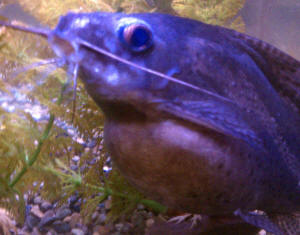
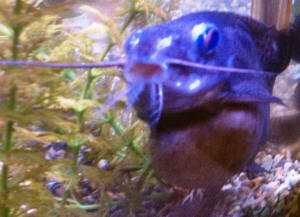
bloated stomach in Synodontis eupterus
9/4/11
Hello,
<Hi there>
I have a Synodontis eupterus (named Creepy Malarkey) that I have
had for approximately 12 years. He has always been healthy, but
about 2 months ago, he had what appeared to be Popeye. I treated
him with Melafix and cleared that up.
<Only coincidental>
However, a few days ago his stomach started getting bigger and
bigger (please see attached pictures).
<I see>
I have had fish for several years and treated them fairly
successfully, but don't really know what to do about him. He
is in a 10 gallon aquarium,
<Mmm, hard to keep stable, optimized water quality
wise>
which I know is too small, but had to downsize when I was
divorced and forced to move into a smaller place. He's been
in a 10 gallon for about 2 years now and wasn't moving around
much prior to transplanting him to the smaller tank, so he seemed
to be doing okay until recently. I perform regular water changes
(every 2 weeks or so) and change the filter about every
month.
Any idea what may be wrong with him or if there is anything that
I can do to treat him?
<Mmm, yes; the generic "bloat"... some speculate
this is most all times an issue of "secondary"
bacterial involvement... the root "cause"
environmental, coupled with a loss of resistance>
Maybe at this
point I should just let nature take it's course, but I wish
it would hurry up since I can't imagine having a distended
stomach like that would be very comfortable for him.
Thank you for any help you can provide! I truly appreciate
it!
Melissa McMahon
(Sorry for the large pics. I wasn't able to reduce them.)
<Do read here re the use of Epsom:
http://wetwebmedia.com/FWSubWebIndex/SaltUseBloatF.htm
and Neale's article re salt use linked above. Bob
Fenner>
|
  |
|
Re: bloated stomach in Synodontis
eupterus 9/5.5/11
Thank you so much for your help! I did see the notes on your
website about Epsom salt, but wasn't sure if it was safe or
would treat the problem for him. I will definitely give it a
try.
<Well, unfortunately most cases of "bloat" are very
hard to cure... but the Epsom may be of use here. BobF>
|
|
Goldfish pet dropsy? anything else we
can do? 8/16/11
Hi team/fish family!
I've read lots of the info on dropsy and still need help.
I'm including photo and video rejoice44@mac.com if will help
our kind pet goldie "Its history is that of a feeder fish
bought over 3 yrs ago for pond area testing. Only one of 3 that
survived by putting its mouth to air bubble tube when it appeared
dead!
Was fine in 65 gal tank w/two fair-mates <Like this term!>
(goldfish) for over 3 years.
This past 3 mo noticed getting really big and thought she was
just a good eater or pregnant. Water changes consistent q two
weeks with 2 of those $50-70 Fluval filter pumps and good bio
filtrations. Tank has always been stable in parameters.
Last week looked like golfball in back of her left side.
<Note, on one side>
Then I noticed the pine-coning so I thought it may be dropsy
<A symptom... like sneezing in humans... NOT a disease itself
borne of one mechanism>
but weirdly in seemed mostly on her left side (even only the left
eye) though whole body quite bloated left was worse. I QT'd
20 gal with 1 tsp Epsom salt per 5 gal., water temp increased
slowly to 78 , + air bubbles, and non charcoal pump. Next day
started Kanamycin dosing as per label q two days NTE 3 doses. She
wont eat medicated food (tried MetroMeds powder mix to pellets
per their instructions as no one carried metro med food. or other
med food). Still quite bloated... poops some long stringy white
(parasite)?
<Not likely, no. Where would this come from in such a
long-established system?>
some brown and long w/ string on end. Tried feeding peas.
Appetite poor.
Been cleaning tank small tube getting all junk out of bottom.
Have done a couple water changes about 5 gal then adding back
appropriate meds/Epsom.
Tried increasing temp to 82 /84.
Another thing went terribly wrong when I was suctioning I noticed
her huge soft boggy side and had read that the pinecones were
really blisters of pus and I touched her side with the tube
looked like long strings coming out.
I thought perhaps may help get the infection out but really I
think it made it worse (see her side) as the scales popped off
leaving a space between the outer scale layer and inside layer.
Ugh it looks horrible.
I think the right side is better after Kanamycin yet fish still
really bloated. I don't really see much improvement. So after
a pwc (25% we started Maracyn + (today was second dose of q other
day).
Question add more Epsom?
<I would, yes>
(have read 1/8 tsp to 1 tablesp. advice so perhaps under
dosed).
Should I increase temp?
<Mmm, no... not warmer than where you have it
presently>
...I read that 86 degrees has helped some with dropsy. Find a vet
(perhaps she just needs fluid removed off that one side or
Baytril injections)?
<IF paying, do seek out Chloromycetin/Chloramphenicol (in a
succinic acid base, IP)>
Im hoping you don't say we need to euthanize her:(
<Am not a fan of giving up... though such dropsical
conditions/Ascites are almost always fatal>
On the positive side, she's never been ill and has been a
great pet. She is swimming fairly well. Always comes to the
corner when I enter the room.
Its seems one side of her looks fine...et the other is pine-coned
and now injured. Also I noticed some black marks around scales
read this may be indicative of healing response. Also I noticed a
bit of whitish very slight coat on head.
PS We are changing all the big golds diet from pellets to
alternate peas q day (read your dietary guidelines).
<Do look into the Spectrum line of pelleted foods... Is what I
feed my fancy goldfish almost exclusively>
Any help is greatly appreciated! And so sorry to bother you
knowing how busy you are...I'm just so desperate to help
her.
God bless,
Teresa
<Cheers, Bob Fenner>
Goldfish pet dropsy? anything else we can do?
8/16/11
Addendum: so sorry!
Goldie's vital signs;
T 84
pH 7.6
Nitrates 0
Nitrites 0
NH3/NH4 4.0
<?! Have seen your next email>
(also have been adding some Kent Garlic Extreme drops (2 drops
per day)
Goldfish pet dropsy? anything else we can do?
8/16/11
Hi again (sorry)
My husband said to disregard the test results as the test kit is
way beyond expiration. Also since the QT is newly made up with
1/2 new water and 1/2 old (but changed regularly water) it cannot
be correct.
<DO check that ammonia. Deadly toxic. BobF>
So we are out to get another kit and Ill get back to you on this!
PS have been adding stability with water changes. Did 1/3 change
just in case her condition has caused her to put out a lot of
ammonia. Thanks again for your help and bearing with me. God
bless, Teresa
|
|
Re: Goldfish pet dropsy? anything else
we can do? 8/16/11
Thanks so much Bob..The Spectrum line of pelleted foods is what
we use also:) I doubt there's much else I can do now as today
she is laying on her side and back and breathing funny. The bloat
is still considerable and perhaps her body cant continue in this
state.
<Dang!>
I know this and the others (fair mates) have had a bad start. All
the more reason to be hyper vigilant on water quality. The tank
has been no problem for over 3 years. With this fish I noticed
she was getting bigger and growing more than the other two but
then it seemed to suddenly bloat up over 24 hours.
Curious...could a renal issue cause the ammonia to spike?
<How so?>
She left us with about 10 fry that have made it to about 2 inches
long.
Guess we will call one little goldie".
Sorry for the scattered email. And thanks for bearing with
us...we are very informed now about this particular symptom and
have learned a lot so I guess Ill try to focus on that and that
she had a happy life.
<Sounds good>
Blessings,
Teresa
<And you. BobF>
|
Dropsy Tank --
02/05/11
Hello all,
<Salve!>
I have a ten gallon freshwater tank.
It is fully cycled.
pH 7.6
Temp is around 78 F
gH is around 75, and kH is around 100
<So towards the soft end of the water range. Choose fish
accordingly.>
Stock includes a Dwarf Gourami,
<A junk species not worth keeping unless you can source locally-bred
fish; farmed ones are simply diabolical in quality, and even if you do
buy a good one, they're quite fussy about water quality, chemistry
and temperature.>
a Mollie, a Platy,
<Neither Mollies nor Platies will do well in soft water.>
and an Otocinclus.
<A schooling species that requires plenty of fresh greens and algae
to last for long.>
I have had some problems with some slight Pop eye in my Gourami
recently.
He has only had it in one eye previously. Had no quarantine tank at the
time so the whole tank was treated with Melafix. The treatment helped
the single popped eye.
<Okay.>
Fast forward a couple of months, I noticed that my plants were not
doing well. Since there was no nitrates in the water, I believed that
they may need supplementation. I bought some Flourish,
<Yikes! No, generally you don't need to add anything unless you
have extremely fast-growing plants and you can see patches of yellow on
their leaves. Normally slow-growing plants will get more than enough
nitrate from community fish, and do fine with nothing more than monthly
top-ups of iron fertiliser as either drops or pellets.>
And dosed the tank with a "less than recommended" dose.
During the next week I noticed an increase in green dot algae and brown
algae on my plants and decorations. I tested water parameters last
Saturday and found nitrates to be around 20 . I did a 25% water change
and a gravel vac.
<Unsurprising result.>
Here's where it gets tricky. I recently started a 20 gallon,
planted freshwater tank. I seeded my new tanks bio filter with
substrate from my ten gallon. I initially stocked it with a Dwarf
Gourami, and two Otocinclus. Water parameters are around the same as
the ten gal. Two weeks went by and every thing seemed fine in the 20,
so I went to the store for a suggestion on more fish. I wanted a
schooling fish so I asked if the Cardinal Tetra would work.
<A good choice for life with a Dwarf Gourami, but less than ideal
for Otocinclus that need quite cool conditions to live for
long.>
They said it was fine. I bought seven. I read(too late) however, that
those tetras like slightly acidic water!
<Please understand the difference between pH and hardness. For the
most part, you can ignore pH. It doesn't matter. But because
it's a simple number, people latch onto it. What fish care about is
hardness. Cardinals need soft water. Provide the pH isn't wildly
above, say, 7.5, they'll do fine in soft water with a slightly
basic pH. So your water should be fine for them, "as
is".>
So I decide that I'm going to slowly bring Down the pH to the lower
end of the tolerance scale of all my other fish to accommodate my seven
new ones.(because I plan on consolidating both tanks, and using the 10
as a hospital tank)
<No, no, no! Never, EVER change the pH in an aquarium without
reviewing water chemistry, i.e., hardness, first. Absolutely the
easiest way to kill everything in your aquarium. Changing the pH is
sort of like observing that your home is cold and deciding to fix that
by setting fire to it! A fire will raise the temperature, but not in a
helpful way. Same here; pH is merely a measurement that gives you a
ball-park estimate of water chemistry, soft water *tending* to be
acidic and hard water *tending* to be basic (alkaline). So yes,
Cardinal tetras do indeed come from streams where the pH is between
5-6. But in itself, that isn't a big deal. The key thing is that
those streams are extremely soft, typically less than 5 degrees dH (one
general hardness degree, dH, being about equivalent to 18 mg/l or ppt
calcium oxide or, more loosely, calcium carbonate). Your tap water at
75 mg/l (~4 degrees dH) calcium oxide already has a low general
hardness, and your carbonate hardness isn't much higher either, 100
mg/l calcium oxide (~ 5.5 degrees KH). All things considered, this is
good water for Cardinals and Gouramis, though pretty unpleasant for
livebearers.>
So I started on that Saturday water change in both tanks. On Wednesday,
the fish in the 20 looked fine, but the fish in the 10 didn't. The
Gourami's eyes were both swollen. Nitrates were around 10, So I did
a 50% water change last night. I added aquarium salt(to reduce stress)
but didn't reduce the pH this time. Today, I noticed that my platy
has some pine coning on one side of his body.
<A very, VERY common reaction in livebearers to soft or acidic water
conditions.>
Behind his top fin, upper part of his side. He is mostly golden
colored, but right at the line of demarcation, a small section of black
is all pine coned. He is pestering my Mollie, and is still eating and
swimming fine.
Should I move the Mollie and the Otocinclus to the 20 and try to treat
the two others with clean water an Melafix again? Less salt? Try
Epsom?
Increase temp? HELP!
Thanks for your help, and your time.
Cody
<For a mish-mash of community tank species like these, there really
isn't an ideal middle ground. If this was me, I'd maintain the
Platies and the Mollies in one tank with hard water at middling
temperature, say 25 C/77 F, though Platies tend to prefer somewhat
cooler water to the average fancy Molly. You may want to slightly
harden the water in here, or failing that, add 2-3 grammes of marine
aquarium salt mix (like Reef Crystals or Instant Ocean) per litre of
water. Without going into the science here, marine salt mix both
buffers the water chemistry and adds salinity, these two things having
a very beneficial effect on livebearers. Leave the other tank with your
tap water "as is", ignoring the pH, but just accepting that
it's soft enough for tetras, gouramis and so on to thrive. The
Otocinclus would be happiest here too, if the tank was brightly lit so
there was plenty of GREEN algae for it to eat (they don't eat other
algae types, and don't really eat much of anything else either,
which is why they so rarely live for more than a year in aquaria). Do
read:
http://www.wetwebmedia.com/fwsubwebindex/fwh2oquality.htm
http://www.wetwebmedia.com/fwsubwebindex/fwsoftness.htm
Cheers, Neale.>
My fish seems to have dropsy...
9/7/2010
I've had a fish die of dropsy
<Mmm, a symptom... like "pop-eye", HLLE... not the result
of a specific pathogen, genetics, environmental abuse...
"Dropsical conditions" have a few etiologies/causes>
a few months ago, and the condition of my current fish is
worrisome.
It is a 3 inch long Red Cap Oranda living in a 10
gallon tank.
<... Much too small a volume. This is likely the largest origin of
trouble here... Had you read...>
We have no heater in the tank, and we occasionally do forget to change
the water (I suspect this may be an issue).
I just did a 100% water change today
<... not a good idea>
after about a week. I added 4 tsp. of API Aquarium Salt,
<Of no use...>
but it doesn't seem to have had a very significant impact on the
fish. It seems to have swollen eyes (the area beneath the eyes are a
little bit puffy), and the scales on one side seem to be protruding a
bit. This just started today. However, she was also sitting right on
the bottom, tail up, and the area right behind the gills are puffy.
I've tried to diagnose this, but I can't tell if it is a body
slime issue or if it is indeed dropsy. Both have the sign of abnormal
osmotic function. I am considering using the Fungus Cure from API to
try to treat it, but I'm also not sure if Victoria Green B and
Acriflavine
<Also non-efficacious>
will have dangerous side effects on fish that do not need them.
I hope you can help.
Anna
<I hope you can read. http://wetwebmedia.com/FWSubWebIndex/fwlvstkind1.htm
The third to last tray down.
Bob Fenner
My fish may have dropsy.. .
Adding to what I already sent you in my previous email, I did check out
the malnutrition area of the site, and I'm now trying to figure out
whether this may
be the cause of my fish's dropsy-like appearance.
<Mmm, what are you feeding? And, do the fish's scales protrude
from the sides?>
If malnutrition is indeed the culprit, could you suggest some stores
where I can buy Epsom salt
<Most any good-sized grocery store>
to add to the tank in addition to the vegetables I give them? And is it
okay if I only feed green peas to my fish or do I have to feed leafy
greens such as spinach?
<Both are fine Anna. BobF>
Anna
Re: My fish may have dropsy... 9/8/10
Other than the tank conditions, my fish was eating the flake food you
find at pet stores (which has a much too high protein content now that
I read the diet page).
<Very common>
I also gave it a few deshelled, defrosted green peas several times each
month to aid in digestion.
<Need daily>
The scales on one side are noticeably lifted slightly. It's not
quite like the full-blown protrusion seen in dropsy, but the previous
fish (who was overfed, probably the culprit) had similar symptoms prior
to dropsy.
If malnutrition is the case and veggies and water changes will reverse
the damage, then is Epsom still necessary as written on the
website?
Anna
<The magnesium sulfate can help discernibly. BobF>
|
Bloated Otocinclus
9/3/10
Dear WWM,
<Hello Rebecca,>
I wonder if I can ask for your help.
<First things first. Please don't send 16 MB of images
again! Just your message alone took up two-thirds of our e-mail
space on this server. If anyone else sent a big attachment today,
that would block the whole system, and every one else would have
their messages bounced back. We do, explicitly, ask for photos to
be cropped or resized down to about 500 KB each. That levels the
playing field for everyone. It also means images download to my
computer quickly, so I can get on and answer more
questions.>
I have two Otocinclus in a small planted tank (28l) with a couple
of shrimp and 5 platy fry which has been up and running for 8
months.
<Okay.>
I have had the Otocinclus for 3 months and they have been doing
really well.
<Good. A fussy species with a poor track record in captivity,
but if they're still lively after 3 months, you're
through the worst of it.>
They finished off all the algae in the tank within a week so I
have been supplementing their diet with seaweed (rinsed, then
soaked in old tank water for half a day to ensure there is no
salt added to the tank with the seaweed). I've also tried
zucchini, spinach and cucumber but they were never very
interested in these.
<Indeed. Do try Hikari Algae Wafers as a useful
alternative.>
I went on holiday and left my fish under the care of a very
responsible friend,
<Almost always best to leave fish unfed if the trip is 2 weeks
or less.>
but unfortunately a close relative of hers became very unwell and
subsequently died so naturally she went to be with him, leaving
my fish with some seaweed and a holiday block for the platys.
<These feeding blocks are lethal. Do NOT use them.>
This meant that my fish were left without a water change for 3
weeks!
<Which is why NOT feeding fish is better. Fish can go weeks
without food.
If they're not eating and you nudge the water temperature
down a bit, their metabolism slows down and the more importantly,
the rate at which water quality deteriorates slows down as well.
All these animals of yours will be happy at 22 C/72 C, so keeping
them cool shouldn't be an issue.>
I got back on the same day as she did to find the tank a mess. I
did a 50% water change with a siphon to clean the gravel and all
the fish looked well at the time. Now 5 days later one of my
Otocinclus is very bloated.
<I see! Was it bloated before you did the water change? It may
simply have overeaten as a reaction to the change in water
quality or simply you offering more food that it likes.>
I searched on the internet and found that they are prone to
parasite infections and worms when the water quality is poor.
<Can be the case, yes.>
I tested my water again today and found the ammonia level was
0.25 ppm and nitrate 40ppm (nitrite 0ppm).
<Otocinclus are sensitive to ammonia, and to a less extent
high nitrate levels.>
I did another 50% water change and rushed to the shop that sold
me the fish. They thought that it sounded most like it could be
an internal parasite, but also wondered if it could be
dropsy.
<"Internal parasite" and "could be Dropsy"
are code words for "Haven't a clue, but I'm going to
sell your 15 quids' worth of stuff that won't work but
helps my bottom line.">
I bought treatments for both, along with an air pump to improve
aeration in the tank.
<Aeration is widely misunderstood. It doesn't add air or
oxygen. Why should it? Without adding pressure as well,
there's no reason air bubbles with force oxygen into the
water. If it did, I could bubble CO2 through a straw and
carbonate the cup of tea sitting next to me. Doesn't work
like that.
What aeration does is increase circulation. As the bubbles rise
they carry water, and in particular they're taking water from
the bottom of the tank to the top. In doing this a cycle is
created with bottom water going up and surface water being pulled
down to replace it. This circulation ensures better distribution
of oxygen since the oxygen is diffusing into the water *at the
surface* where the water and air touch each other. There's no
magic about bubbles. A good filter will circulate the water much
better than air bubbles.>
The treatment for parasites is called Sterazin and contains
Malachite Green, Piperazine Citrate, Formaldehyde and Acriflavine
Hydrochloride.
<Malachite green and Formaldehyde are for treating external
parasites; Piperazine works against worms. No reason at all to
imagine this medication will treat anything else. Certainly not
bacterial infections like Dropsy.>
The shop recommended starting with this as it would be less
harmful to the fish, and recommended treating at half the
standard dose. The other treatment is an Interpet Anti-Internal
Bacteria treatment containing
Bronopol, Formaldehyde and Benzalkonium chloride.
<Have yet to see this product cure anything. Bronopol is an
antimicrobial, but honestly, I've never been impressed by it.
One problem with antibacterial medications is you need to add to
the food or inject into the fish to get a useful dose. Vets will
tell you precisely how much to add if you need to add to the
water, because factors such as the size of the fish are critical.
Anything based on drops per gallon is a long-shot at
best.>
I'm giving you the ingredients as I'm based in England
and I don't know if the treatments will be the same as the
ones you are used to.
<Have used both these medications in years past. Neither are
ones I recommend.>
I have treated for the parasites using half the standard dose as
recommended, but now I am really unsure if I should be treating
for bacterial infection instead and I would really appreciate
some advice. I do not own a quarantine tank so I am having to
treat the whole tank and just hope my shrimp and other fish come
through this ok.
<Sterazin will likely kill the Shrimp outright. It does state
this on the packaging: do not use with crustaceans! Specifically,
formalin is highly toxic to them.>
I have attached a couple of pictures, neither of which is very
helpful, but I think the side-on view does show how bloated
his/her belly is.
<I wouldn't treat this fish at all. I'd optimise water
quality, lower the temperature if needs be (Otocinclus will be
stressed above 25 C/77 F, as will Platies), and ensure a sensible
diet. Don't overfeed. Watch and wait.
If the fish becomes thinner again after a few days, you should be
fine. If not, with fish this small, Dropsy-type conditions tend
to be fatal anyway, so treatment is pointless.>
Many thanks in anticipation, Rebecca
<Hope this helps. Good luck, Neale.>
|
 |
swordtail, dropsical? 6/7/10
Hi
<Ave,
Please help. Your site is great.
<Thanks.>
I have a male swordtail about 2.5yrs old appears to have dropsy?
<Certainly possible, and livebearers are perhaps a bit more prone to
dropsy than some other fish.>
He looks fine no fungus etc but he is a bit swollen and his scales are
standing out. 2 others in the tank are fine. He is presently in a fry
net.
<Sounds like Dropsy.>
What can I do for him?
<Not much. Do read here:
http://www.wetwebmedia.com/fwsubwebindex/dropsyfaqs.htm
Bob has seen fish recover and has some recommendations for treatment;
for my part, I usually euthanise fish that exhibit these symptoms.
http://www.wetwebmedia.com/euthanasia.htm
>
Also do you have any advice re swordtails breeding. Should I separate
male and females?
<Ideally, yes.>
Have 3 males in one tank and they are fine, 2 are very friendly, 1 less
so but ok.
<He's the dominant one, I'd wager.>
Have a 40 gallon tank with 1 male and 4 females and fish look pregnant
most of the time but I never see any babies despite searching hard and
often.
<Do you have floating plants? Indian Fern makes a huge difference.
Provides both shelter for the females -- which reduces the risk of
stress-induced miscarriages -- and also cover for newborn fry --
reducing the risk of cannibalism. Most problems with breeding
livebearers come down to these two issues.>
Also have Danios.
<Will eat baby Swordtails.>
Are babies being born and eaten?
<Probably.>
Thanks
Pam
<Cheers, Neale.>
Re: swordtail, dropsy 6/7/10
Hi
Wow, thanks for quick reply.
<No problem.>
So do you think I should isolate him and what should I put in the
water. I have read the page suggested but dont recognise the
medication. (UK).
<As I say, Dropsy is one of those diseases that I've never seen
a fish recover from, but Bob has. Take that advice for what it's
worth. If you do choose to medicate, obviously you need a separate
aquarium, minimum 8 gallons/30 litres with a heater and filter. Epsom
salt can be used alongside the Metronidazole and/or Nitrofuranace, but
it isn't a substitute. I've never, ever seen the "Anti
Internal Bacteria" medications sold in the UK cure anything at
all. I If you need an antibiotic such as Metronidazole or
Nitrofuranace, you are going to need to visit a vet, not a pet store.
These are NOT sold in pet stores, and anything sold in the UK in pet
stores WON'T treat Dropsy, whatever the advertising on the box
might suggest. This is why I argue in favour of [a] prevention and [b]
euthanasia.>
Should I do a water change and what should I add to the water?
<The vet will tell you what dosage to add to the hospital tank.
Treating the display aquarium is possible, but isolating a sick fish as
large as a Swordtail in a breeding trap will simply stress him,
reducing the risk of recovery even further.>
Tested water on weekend, nitrate and nitrite at 0. Mostly I feed food
crisps but also frozen selection, is this ok?
<Yes. Swordtails are typically stressed by over-heating and social
interactions, the males being highly aggressive.>
Cant destroy him, my favourite, called Spot!
<Sometimes humane destruction is the kindest thing to do.>
Have seen a pond fish make a remarkable recovery last year, not dropsy.
Now he is the first up to me in the morning.
Thanks
Pam
<Good luck! Cheers, Neale.>
Re: swordtail [Bob, feel free to chime in here re: Dropsy]
6/7/10
Had a sick goldfish last year, about 11" long. 2 vets refused to
see him or medicate.
<Can be a problem sometimes. Do visit the Fish Veterinary Society;
they have a listing of vets who treat fish.
http://www.fishvetsociety.org.uk/
>
Thanks for reply, really appreciated.
Pam
<Happy to help. Cheers, Neale.>
Re: angel fish w/possible dropsy symptoms
5/11/10
Thanks...so you think I should probably put her to rest? Or get the
medicine?
<I don't like to "give up" easily... I would try the
possibilities gone over on WWM. BobF>
Re: angel fish w/possible dropsy symptoms
5/12/10
What exactly does high alkalinity cause?
<... Please see WWM re>
The strips I have don't give me a number, just colors. My water is
reading at the farthest/darkest one on the strip.
<...>
I need to do a water change, but I'm afraid that will stress her
out. What do you think?
<What?>
Thank you so much for your quick replies...
<Your message does not make sense to me... sorry. B>
Re angel fish w/possible dropsy symptoms 5/13/10
My water testing strips read "very alkaline"...literally. You
asked me in my first email "how alkaline?"
<Please see WWM re test strips... neither accurate nor precise...
"Very" is not "very" useful>
Will a water change not be good for my sick angel fish at this time
(it's been 3 weeks)?
<... and see WWM re water changes... likely IS a good idea... IF
this system is cycled, stable>
I am not a pro at this. I just was wondering if changing the
water/vacuuming the rocks will stress her? I don't know how else to
ask this...
<You need to read, to have a fuller understanding... your
consciousness is not full enough to ask such hit/miss questions.
B>
Re: angel fish w/possible dropsy symptoms
5/13/10
I apologize for not having the knowledge you hold. I have been reading,
but unfortunately I do not have the time to devote my life to my
aquarium.
<You don't have to devote anything like as much time. You're
missing the point Bob was making. The important thing is to buy one
good book up front, read it, understand it, and apply what you've
learned. Basic freshwater fishkeeping is actually very easy if you
"go by the numbers" and do things step by step.>
Too many different opinions about everything in the aq. world.
<Really, there isn't. Again, the problem is reliance on the
Internet rather than books. The Internet is filled with good
information, but hidden under mountains of garbage. A good book will be
written and edited by experts who've kept fish for decades.
Maintenance of Angelfish is really very straightforward. A 30 gallon
tank; 0 ammonia and 0 nitrite; temperature around 25-28 C; moderate
water current; soft to slightly hard, acidic to slightly basic water,
i.e., 5-15 degrees dH, pH 6.5-7.5. If you don't understand these
things, then learn; if you don't have the tools to measure them,
buy them. Problems come when people keep them with nippy fish, in tanks
that are too small, and in new tanks that haven't been properly
cycled. Like all cichlids, they're sensitive to nitrate and
oxygen-poor water; keep nitrate levels below 20 mg/l and ensure water
circulation is around 4-6 times the volume of the tank per hour, and
that the tank isn't overstocked.>
Thanks for your "help"...I will not bother you again...
<Dropsy is almost always inflicted on fish by careless fishkeeping.
End of discussion. Every time I've seen a fish with dropsy,
it's been maintained in a tank that was overstocked, or water
changes weren't frequent, or nitrate levels were high, or diet was
monotonous. Bob and I have different opinions on treating dropsy, my
experience being that it's almost impossible to cure once small
fish like Angels exhibit the problem. So I tend to recommend painless
destruction of the afflicted fish.
http://www.wetwebmedia.com/fwsubwebindex/dropsyfaqs.htm
http://www.wetwebmedia.com/euthanasia.htm
It's important not to "write off" the experience though,
and make sure you have identified why the fish got sick. Be under no
illusions here: you did, somehow, cause the dropsy. We all do, whenever
we have a fish with this syndrome. It isn't a "disease"
but a symptom, and doesn't sneak in at night to get your fish!
It's a sign of organ failure caused by some chronic stress on the
fish, perhaps mediated through a bacterial infection of some sort. So
something YOU did caused this. Before you buy another fish, try to
figure out why. From there, you'll learn, grow, and become a better
fishkeeper. Cheers, Neale.>
Floating Jack Dempsey 5/1/10
Hello! First off, I wanted to let you know how helpful your website has
been in the past and that the time you guys (and gals) take to help
people like me is really appreciated.
< Thank you for your kind words.>
That being said, I hope that you can help me with a problem I can't
seem to find the answer to. I have a breeding pair of Jack
Dempsey's, about 3 years old. This is not my first go at having
these fish, but is the first time I've had this problem. My male
Dempsey became bloated about three weeks ago. He is still eating, but
his appetite has seriously declined. The bloat is causing him to
struggle with swimming, fighting to stay away from the surface. After
awhile, he'll just float at the top, still upright, but top fin out
of the water. His abdomen is noticeably enlarged and I am finding
undigested food at the bottom of the tank. I have tried treating with
meds for bacterial, treating with salts, and trying to feed skinned
peas, all to no avail. After doing research about this there are so
many varied answers, much of which make no sense at all.
Since I trust your websites knowledge I'd appreciate it if you
could give me some options as to how to take care of this. I'm
contemplating euthanasia at this point simply because he's not
showing any progress and I feel like his quality of life is going
downhill. I would love to avoid doing this at all cost. My female is
healthy and completely unaffected by whatever is ailing my male. I have
separated the two (they are in a 55 gallon - no other fish) by
"fencing" off about a third of the tank since in his obvious
state, she has begun attacking him. I have been doing water changes,
keeping everything clean and doing every trick I know and I still
can't seem to make it any better. I'm willing to try anything,
but if euthanasia is the final option, could you please include a
humane way of doing so? I've heard of using Alka Seltzer, but am
skeptical of this. Again, I appreciate your reply, and the time you
take to answer questions. I look forward to hearing from you.
Elizabeth
< Your male Dempsey has an internal infection. Treat with a
combination of Metronidazole and Nitrofurazone. You may need to look at
the ingredients on the box to actually see these medications listed.
You could also buy them online at Drsfostersmith.com. The medication
works best during the early stages of the disease. If you don't
think it is getting better then place in a small container and add Alka
seltzer to the water. The CO2 put out by the Alka seltzer displaces the
O2 in the water. The fish sleeps then dies.-Chuck>
Re: Floating Dempsey 5/11/10
Jack Dempsey Recovered From Boat
Good Morning Chuck, I wanted to thank you for the advice that you gave
me regarding my Dempsey. I was able to get the Metronidazole, but could
not find the Nitrofurazone. Either way, my fish is coming around quite
nicely. The bloating has gone down and he's swimming around
regularly with no apparent struggles. He's still pretty thin, but
seems in much better spirits and his appetite is increasing. I am
extremely happy to report that I do believe that he is going to pull
through this. Once again, thank you for sharing your knowledge with me,
it proved invaluable. Hoping you enjoy your day, Elizabeth
< Sometimes the disease is caused by bacteria, in this case it was
caused by a protozoan and it appears that the Metronidazole was
effective. Thank you very much for your kind words and we are vey glad
we were able to help keep your fish alive.-Chuck>
Re: Rapid colour change in my fancy goldfish...
Dropsy f' 3/21/10
Hi Neale:
<Gina,>
I just want to follow up on this strange colour change in my goldfish-
he has now completely changed colour and is swelling up. I am afraid he
may have the onset of dropsy- he has obviously not been feeling well as
he is often completely motionless and his dorsal fin is flat. He
usually swims over as soon as he sees me but now he barely moves.
<Not good. While Bob maintains that fish can recover from such
situations, I've yet to see that happen. Assuming he's right,
the information on this page should be helpful:
http://www.wetwebmedia.com/FWSubWebIndex/dropsyfaqs.htm
But with that said, when I encounter fish with Dropsy, I tend to
euthanise them. Possibly that's the "shooting lame
horses" approach and I'm acting in ignorance of the
medications that might turn such situations around.>
He seems to be worse in the mornings and then perks up later in the
day- he is still eating: in fact he seems quite desperate at feeding
time (he is always hungry- after all he IS a goldfish) but I am
wondering if the colour change and the accelerated begging for food
isn't related to an intestinal blockage- is this a possibility?
<Possibly. That the fish is eating is certainly hopeful. Why?
Because Dropsy, in its fatal cases at least, is a sign of organ
failure, in particular with regard to osmoregulation. When the organs
stop working, fluid accumulates. But by that point, fish will be very
sick, so they don't eat much, if at all. So, if your Goldfish is
still eating, that's perhaps a
good sign because it means the fish isn't that sick.>
He was pooping red about three weeks ago but it stopped (I think he
might have swallowed a piece of gravel): he had not been eating
anything of that colour. As the condition went away and he seemed to be
healthy I was not
overly concerned.
<Hmm... red faeces can indicate artificial colours in the fish food,
typically "colour-enhancing flake" food. But it can also
indicate blood in the alimentary canal, and that's more of a
problem, especially if there are internal parasites irritating the gut
wall.>
His rotund physique, however, has me so worried that I set up my
hospital tank this morning and am about to transfer him over. I am
trying to get a good picture of how fat he is to send to you but every
time he sees me with
the camera he seems to think it is food and I can't get a good
shot. He has a tank-mate- should I consider treating both fish?
<Dropsy doesn't tend to be contagious as such, but rather than
conditions that promote it in one fish can easily cause it to occur in
any of the others. So for now, yes, isolating the sick fish and
treating accordingly is wise, but proactively treating the other fish
is not necessary.>
I have already tried putting 2 tablespoons per 10 gallons of Epsom salt
in the tank and feeding the fish a light diet of skinned peas but he
has not become any thinner.
<Indeed.>
I have read that dropsy is contagious so I am very concerned for BOTH
of my fish. I went to my LFS today to pick up some Maracyn and Maracyn
two they, sadly, had several goldfish with advanced stages of dropsy in
their tanks with other healthy-looking fish. Incidentally, this is
where I unknowingly purchased my two fish back in December. Maracyn is
a Erythromycin
<Minocycline, a.k.a. Maracyn 2, is generally recommended in
preference.>
which I read somewhere on this site is a good choice to treat Dropsy,
so I hope it works. Can you please let me know if I am on the right
track?
<Worth a shot.>
PS: My water parameters are as follows: ammonia zero, nitrites zero,
nitrates still zero (my tank does NOT want to cycle!!) and pH: 7.2
Kind regards:
Gina
<Cheers, Neale.>
Re: sick Betta (RMF, better ideas on dropsy in
Bettas?) 3/19/10
Hello,
I had some very helpful advice from Neale a while back and wondered if
he is still available for a question or two?
<Fire away.>
I have a 10 gallon tank set up Jan 07 with filter, heated to 80, many
plants, ammonia & nitrite 0, pH 8.
<All sounds fine.>
I do 40% water changes every 3 weeks. 1/2 RO, 1/2 well water. Feed once
a day, evening, 5 or 6 small pellets. My Betta, Oscar, has been with me
a year, (along with 2 Otos) and 2 weeks ago Sat am, very suddenly he
bloated
out huge in the belly, like he's going to explode.
<Hmm... stop feeding him for one thing, and see what
happens.>
I was in the process of giving him a few peas, and when I saw that
(after 2 tiny pieces) I stopped and fasted him, through Monday night,
gave him 2 more pieces of peas, then an Epsom salt bath.
<All sounds good.>
He's otherwise swimming fine. After a week of only giving him very
little food, the bulge seemed even bigger, so I thought maybe a
bacterial infection and started a course of Maracyn Two.
<I concur; if the fish continues to swell not matter what you offer
as food (or don't offer, for that matter) then some sort of Dropsy
is probable.
Unfortunately, this is a difficult syndrome to treat with small fish
because they only exhibit such symptoms after serious damage is done.
All you can do is medicate and hope for the best. If the fish is still
active and seemingly happy (i.e., alert, not hiding or breathing
heavily at the surface) then wait. If the fish looks distressed, to be
honest, I'd euthanise.
http://www.wetwebmedia.com/euthanasia.htm
>
I've just done the 5 doses, and he's even bigger. He's
still swimming OK, though it looks a little difficult with the ballast
he's carrying, but his top fin is upright and beautiful. When
he's in the light, the bulge looks translucent, almost like he has
water sloshing around in there and it hangs very low.
<Like does contain fluid, and that's what's causing the
swelling.>
Do you know what it could be and if there is anything I could do?
<Not much, I'm afraid.>
Thank you in advance for taking the time to read all that.
<Not a problem.>
Best wishes,
Janice
<Good luck, Neale.><<The causative factors for Dropsical
conditions, edemas/oedemas are several... poor environment, bad
nutrition, ultimately infectious agents... Once the last come into
play, cures become very difficult... And getting "some"
"antimicrobial" into the specimen/s is essential. I favor
Furan compounds... unless one can find/secure Chloramphenicol...
BobF>>
Two cases of fantail dropsy? (Goldfish, plural;
10 gallons; sickness; the usual...) 6/29/09
Hi, I have two calico fantail goldfish. I got the first one a week ago
and got the second one 2 days ago (both from the same store, even the
same tank, they know each other from before). They live in a 10 gallon
tank with a Whisper internal filter and (because 10 gallons for 2 fish
is a bit small) I do a 25% water change every couple days and a
"poop scoop" once a week.
<A ten gallon tank really isn't going to work in the long term.
Your Goldfish will get to about 20 cm/8 inches in length when mature,
and it doesn't take much imagination to realise that big, solid
fish that size will barely FIT into a 10 gallon tank, let alone be
healthy in one! So before you do anything else, start saving up for a
30 gallon tank. Believe me, the money spent on a bigger tank will be
more than earned back in terms of time wasted, medications bought, and
fish lives saved. If you don't have space for more than 10 gallons,
then don't keep Goldfish. It's really as simple as
that.>
I had pellets to feed them, but they do not seem interested in eating
them.
The pellets usually just end up sinking to the bottom un-eaten.
<And, I trust, promptly removed; all uneaten food must be removed
after 5 minutes, tops.>
The water in the tank is well water (I drink it straight from the tap,
so I'm hoping it's ok for fish), I'm wondering if they eat
stuff that's in the water.
<No.>
I have natural rocks in the tank as well. Perhaps they're eating
algae off the rocks.
<Unlikely you'd have enough in a 10 gallon tank. It's much
more probably water quality is SO POOR that the fish are stressed, and
consequently not interested in food. Remember how your appetite fades
to nothing when you're sick? That's what's happening here.
Do start by reading what Goldfish need:
http://www.wetwebmedia.com/FWSubWebIndex/goldfish101art.htm
Then move on to understand what they need in terms of food:
http://www.wetwebmedia.com/FWSubWebIndex/gldfshmalnut.htm
Virtually everything you think you know about Goldfish is wrong. They
can't live in bowls. They can't live in small tanks. They
won't survive on pellets or flake. They aren't cheap or easy to
keep. If you are stuck with 10 gallons, then there surely are some
great options in terms of tropical fish; see here:
http://www.wetwebmedia.com/ca/volume_5/volume_5_3/stocking.htm
But Goldfish are not an option!>
Anyway, I was reading around on the site and came across some cases
that sound similar to mine. The fish are in-active (sitting on the
bottom of the tank) and a little bloated looking and not eating (this
is why I am wondering if maybe they're eating what might be in the
water). I'm wondering if my little guys have dropsy.
<Dropsy is a symptom, most commonly of systemic bacterial infection
brought about by chronically poor water conditions. It's the way
fish say "you kept us badly, and now we're going to die, and
nothing you can do will save us".
Sorry to be so blunt about it, but that's almost always what's
going when Dropsy appears.>
As a precaution, I started doing 25% water changes daily and keeping an
eye that their scales aren't sticking out. So far, they're not.
I don't have any Epsom salts right now, but would 1 or 2 table
spoons mixed in the water help?
<Not in itself. Epsom Salt at a dose of around 1 teaspoon per 5-10
gallons will help WHEN USED ALONGSIDE suitable antibiotics, typically
Erythromycin or Minocycline. But in itself, no, it won't cure
Dropsy. And even when used with antibiotics, this all depends on water
quality being extremely good:
zero ammonia, zero nitrite, a stable pH, and preferably low levels of
nitrate (sub-20 mg/l).>
I'm new to having fish. Help is much appreciated!
<Read, understand, act accordingly.>
update:
Hi, so, the one fantail now is looking a little bit scaly, but not
fully pine-coned yet. Since the last e-mail I have moved both fish into
a 'hospital tank', but do not have any medicine or Epsom salts
yet (it is late, and everything is already closed).
<How is the "hospital tank" any better? Is it smaller? I
assume so, and that means it's only going to make things worse.
It's amusing (in a grim sort of way) you have two aquaria, but
neither of them big enough for the fish you have. Just one tank the
right size is much, much better than a whole battery of undersized
tanks.>
I thought at least the water in the hospital tank is clean, and there
is nothing else in the tank but some pebbles on the bottom. Both fish
seem to be moving around much more than before though.
<Likely because the water is cleaner, in terms of not having any
ammonia or nitrite in it... yet. Give it 24 hours, and they'll be
miserable again, unless by some miracle the hospital tank is 30 gallons
in size, equipped with a robust and fully matured filter.>
Brittney
<The outlook for your fish is extremely bleak without a bigger
tank.
Cheers, Neale.>
Pond Goldfish with Dropsy --
06/15/09
I have had problems in the past few years with cases of dropsy among
the goldfish in my small (125 gallon) pond--about one case every two
years.
<Likely environmental: for a pond, this is rather small, and if you
don't have a filter, then water quality, pH stability and oxygen
availability are likely very variable. There's probably a reason
the deaths are periodic as
well. A fish dies, so the pond load is reduced and the fish are
healthy, but then the fish grow above a threshold size, the pond is
overloaded again, and another fish dies, and so on.>
The affected fish actually survive in an increasingly bloated state for
over a year, beginning to show symptoms one summer and finally
succumbing at some point during the following summer. This is the
beginning of summer number two for one of the fish, and for the first
time ever a second fish is showing signs of being affected
concurrently. I have dealt with any and all environmental issues that
might contribute to this problem and, after hours (probably totaling
days) of researching the web for info, I am currently dosing the pond
with Maracyn 2 and Epsom salts.
<While antibiotics such as erythromycin and Minocycline can help,
and Epsom salts may reduce the swelling, the prognosis for Dropsy once
it is established is generally pretty poor. It's more important to
review the causes, and usually euthanising the fish while fixing the
aquarium or pond ends up being the way forward.
http://www.wetwebmedia.com/euthanasia.htm
http://www.wetwebmedia.com/PondSubWebIndex/pdfshdisart.htm
http://www.wetwebmedia.com/PondSubWebIndex/pndfiltrovr.htm
>
The Epsom salts ratio is presently 1/8 tsp per 5 gal of water, as I
have read that this ratio will not harm the other healthy fish in the
pond. I have also seen recommended doses of 1 tsp per 5 gal, and even 1
to 2 Tbsp per 10 gal,
<1 teaspoon per 5 to 10 gallons for Dropsy.>
however I haven't found any clear info re whether those stronger
ratios will harm (e.g.. dehydrate) the other healthy pond fish or if
those doses are for hospital tanks only.
<Won't do any harm to healthy fish. Goldfish are very tolerant
of hard water, in fact they need it, and do very badly in soft/acidic
conditions.
Feral Goldfish are found in brackish water too, which underlines their
preference for mineral-rich rather than mineral-poor
conditions.>
I'm trying to avoid a hospital tank if I don't need one, since
catching the darn fish isn't easy and is stressful not only to the
fish being chased but to all the other fish who think they're being
chased (not to mention the
person wielding the net). Could you clarify for me what the maximum
Epsom salts dose for a pond or aquarium containing a general population
of healthy fish would be, and whether or when the dose should be
repeated?
Thank you very much.
Mary
<Cheers, Neale.>
|
Re: Help My Goldfish Bandi - Dropsy?
4/28/09
I am not sure if my goldfish has dropsy or not, can you look at
these photos and let me know your take on it.
<Certainly the view taken from above is very suggestive of
Dropsy; the "pine cone" appearance of the scales is the
classic symptom. Will need to be treated with a suitable
antibiotic; erythromycin or Minocycline are typically prescribed,
though do understand the chances of recovery are not good.
Optimal water chemistry and water quality is crucial. The
addition of Epsom salt (on top of the cichlid salt mix mentioned
below) at a dose of 1 teaspoon per 5 to 10 gallons is helpful for
reducing the swelling, and raising the temperature slightly, to
around 25 C in the case of Goldfish, may help, PROVIDED the tank
is well aerated and has lots of water movement to keep oxygen
levels high. If your Goldfish is gasping at the surface,
that indicates the opposite.>
My water levels are all normal
<No, they're really not. Your water is far too soft and
acidic for Goldfish. Haven't we discussed this before? To
recap: Goldfish do not like soft, acidic water. Frankly, the
harder the better. The addition of salt by
itself doesn't help, contrary to what you might have been
told. Read here:
http://www.wetwebmedia.com/FWSubWebIndex/fwh2oquality.htm
Use the Cichlid Salt mix explained therein.>
(I am still trying to get the nitrate down to 10 or less, but
have gotten it to about 15, as I am using strips still, I do not
have the money to put into a full kit but I should by the 4th of
next month).
ph 6.9
nitrate 15
nitrite 0
ammonia 0
alkalinity 110
hardness 120
He is not floating or acting weird, I just noticed his scales
today (I was out of town over the weekend and had placed a 3 day
feeder in his tank,
<Do not use feeder blocks! They're rubbish. All they do is
mess up water chemistry and produce excessive amounts of waste in
the water. A Goldfish can go a long time without food. In fact,
it's better for them to eat
aquarium plants for a couple weeks than have your Mom or whoever
feed them.>
but my mom fed him Sunday without knowing he had the feeder in,
so I thought maybe he is just bloated) were sticking out and it
reminded me of dropsy, please take a look at the photos and let
me know what I should do.
Thanks!
p.s. he still has that lesion on his flank, I have kept water
changes to once a week removing/changing out 5-7 gallons (I have
a 29gal tank).
<Please note that we ask specifically for images 500 KB or
less; yours were 12 MB! That's most of our e-mail space! When
full, our e-mail account bounces back other people's
messages, which isn't really fair when they've done what
we ask but you haven't. So next time, to avoid having one of
scold you and send back your message unread, review our few,
simple rules:
http://www.wetwebmedia.com/WWMAdminSubWebIndex/question_page.htm
Cheers, Neale.>
|
  |
|
Re: Help My Goldfish Bandi - Dropsy? --
4/30/09
Ok, so I started the Maracyn 2, the tank is well aerated so
should I do the salt in addition to the Maracyn 2 for dropsy?
<You're not just adding salt; please note this! You're
adding a mix of Epsom salt, baking soda and marine salt mix (as
you'd use in a marine aquarium). If you just add salt, for
example aquarium salt or tonic salt, you'll not help this
fish at all. Indeed, you may make things worse.>
Also we did touch that topic before however Bob told me not to
add buffer up or things to raise ph, change the alkalinity so I
stopped.
<Bob's advice in this regard is generally good: if fish
are otherwise happy, altering water chemistry can create unstable
conditions if you don't know what you're doing. However,
in this very specific case where you're dealing with acidic
water and a certain amount of bloating, adding the cichlid salt
mix as suggested will be both safe and helpful.>
Ever since my bf moved the fish from LA to San Francisco, the
water has been at a lower ph, more acidic and less hard.
<Are you using tap water or water from a domestic water
softener? Do not do the latter!>
<<A note to Neale, all unfamiliar. Most of the San Fran
area has naturally very soft water... no real buffering capacity
w/o adding to. RMF>>
What do you suggest I do about this other than putting in
additives on a regular basis?
<You have to add the cichlid salt mix. There's no
choice.>
Current levels:
4/29/09
ph 7.0
nitrate 10
nitrite 0
ammonia 0
alkalinity 125
hardness 120
Water Change: 5 gallons, treated with Amquel, cycle and buffer
up.
<Cheers, Neale.>
Re: Help My Goldfish Bandi - Dropsy? --
4/30/09
Sorry I am a bit confused (it has been a long day). I added 3 tsp
of aquarium salt not marine salt, I do not have marine salt!
<At a pinch, when combined with the Epsom salt and the baking
soda, aquarium salt will do. But marine salt mix is better:
it's not just sodium chloride, but a bunch of other useful
chemicals as well.>
I have Epsom salt and baking soda, but did not add these because
all I did was add a few tsp of aquarium salt as this is what I
thought I was supposed to be doing.
<Do exactly what it says in that article, a level tablespoon
of the Epsom salt, and a level teaspoon each of baking soda and
salt, per 5 gallons of water. Normally you'd add this mix of
minerals with each new water change.
Because you're treating with a medication at the same time,
you'll want to be a bit clever about this, otherwise
you'll flush out the medication with each water change.
I'd suggest working out how much water is in your aquarium.
Let's say it's 30 gallons. Now, get a measuring jug from
the kitchen and add a pint or so of water. Then add the requisite
amount of each mineral. In the case of a 30 gallon tank, that
would be 6 level tablespoons of Epsom salt, and 6 level teaspoons
each of baking soda and salt. Stir well. When dissolved, add
about a fifth of the mixture. Wait 3-4 hours, and then add
another fifth. Repeat as necessary, perhaps into day two, leaving
a few hours between each new portion. What you're doing here
is giving your Goldfish time to adjust to changes in water
chemistry.>
It is what it states on the box (the API Aquarium salt box) but I
got confused and now, well, I guess I messed up! I do now believe
that it is dropsy, he looks like a little pinecone :(
<Oh dear. Well, the antibiotic can help if you're lucky,
and the Epsom salt will reduce the swelling somewhat.>
I feel so bad, should I do a water change to rid the tank of the
aquarium salt?
<Have you added the medication yet? If so, then don't
worry about. If you haven't added the medication yet, then by
all means, do a 25% water change.
Goldfish are actually very salt tolerant, so it doesn't
matter wildly.>
Or leave it be and go get marine salt and do that next? Is that
ok?
<The salt you have is fine for now. But when this box is
finished, buy some Instant Ocean or whatever instead. It's a
little more expensive, but it does make a difference.>
I must have bypassed the link before, but I read the page and now
know how to do that treatment. And I guess my tap water (which is
what I am using) is not too soft, but not as hard as it once was
(in L.A.).
<Fair enough. See, you're getting the hang of this! By
reading, you're understanding what's going on, and
*telling me* stuff rather than asking questions!>
I also have a question about the heater should I only be using a
heater to bring the temp up when using MARINE salt (or the combo
as you suggested)?
or is this the case for aquarium salt?
<Doesn't matter.>
I never used one before, but bought it because everyone is saying
you need one when using the salt treatments. And my water is
normally about 60 degrees, so should I only bring it up to 65? I
heard more than that can be quite harmful by causing more stress
to the fish.
<Goldfish, particularly Fancy Goldfish, actually like fairly
warm water.
68-72 F is about perfect for them. But yes, make the changes
slowly. Turn the heater to its lowest setting for the first day
or two, then up a notch for the couple days, and so on, until
it's at 68-72 F.>
At any rate it looks like all I did was add a tonic at about half
the strength.
Sorry for the back and forth. I am having a bit of a struggle
dealing with this issue.
<Dropsy is actually really tricky to deal with, and your
struggles are not all that uncommon. Dropsy is easy to avoid, but
once fish develop the symptom, bringing them back is
difficult.>
p.s. I got some REAL plants and have not fed the fish in the last
3 days since all of this came about. Should I do a feeding
tomorrow or just give it another day?
<If he's got some cheap aquarium plants (like Elodea) he
can eat, then no need to add more food. Not all aquarium plants
are edible, it's really just the soft and usually cheap ones:
Elodea, Cabomba, etc.>
p.s.s. Sorry about the photos, from now on I will make sure they
are smaller.
<Cool. Good luck, Neale.>
Re: Help My Goldfish Bandi - Dropsy? --
4/30/09
Also forgot to mention that the salinity level is at 1.002
<That's pretty high, but not really harmful for Goldfish.
I'd do a water change, maybe 50% to bring it down to 1.001,
and then add the cichlid salt mix as described earlier on. Do
make sure to get the doses right (e.g., as in cooking, a teaspoon
or tablespoon is level, not heaped) and make sure you add per 5
gallons, not some other amount. Cheers, Neale.>
A note re fw: RE: Help My Goldfish Bandi - Dropsy? --
4/30/09
<<A note to Neale, all unfamiliar. Most of the San Fran
area has naturally very soft water... no real buffering capacity
w/o adding to. RMF>>
<Hence adding "cichlid salt mix" or similar when
keeping hard water fish (such as Goldfish) is likely essential.
Cheers, Neale.>
<Yes. B>
|
|
Re: Help My Goldfish Bandi - Dropsy?
5/12/09
Well Bandi seems to have recovered from the Dropsy, or at least
he is not pineconed anymore,
<Great news!>
is swimming around, eating etc. However I did notice that the
tips of a couple scales seem to have been red the last 2 days and
now have a darker, almost blackish appearance to them, they are
not black, but dark. Is this at all normal? They are on both
sides. Is this from stress or the bloating or is this some type
of necrosis?
<Stress>
I am still treating with Metromeds, and he seems to be fine aside
from this new issue. Is this something to do with the scales
itself or is this internal? Is there something I can do for
him?
<Nothing more really... but I would make a comment (Neale is
"out" currently)... Your pix show your system to be
overly clean in my estimation... I suspect that being too
fastidious re keeping the system sterile is working against your
goldfish's health... I would allow some algae for instance to
grow on the substrate... a sign of a healthy/viable
system>
I was ready to put him down but decided to give it one more day
and then he improved!
<And another comment if I may... I would NOT give up... NOT
euthanize this animal... better to take a longer-term view here.
MANY goldfish have issues as you have related... Much of this is
genetic/developmental, a modicum hobbyist-generated... but the
"cure" is almost always months long simple good
husbandry... allowing these animals to heal on their own in good
circumstance>
Just wondering if I should give him more time to heal or if I can
help this along or if it is just temporarily better in
appearance.
P.S. I hope these photos are ok (not too big either) :)
(\ /)
( . .)
C('')('')
Sylvar
<They are fine. Bob Fenner>
|
 |
|
Re: Help My Goldfish Bandi - Recovering From Dropsy
5/14/09
Thanks Bob,
<Welcome Syl>
I will be getting some real plants for him this week. I will also
leave the heater in the tank. I will allow the algae to grow and
will do weekly water changes without any of the chiclid
<Cichlid dear>
salt mix (hopefully the PH and the alkalinity/hardness stays the
same. If not should I start again with the salt mix or should I
use the Buffer Up (raises ph and alkalinity) made by
SeaChem?).
<I would use only the Buffer Up, and this only pre-mixed with
new water>
Oh and yes, it is quite amazing that the Metromeds worked as well
as they did. Here is the info on it:
Metro Med
Active ingredients: Metronidazole, Ormetoprim-sulfa and
Oxytetracycline
Comments: Metro-Med is a krill based food that contains
Metronidazole, Ormetoprim-sulfa and Oxytetracycline. It is
marketed by the Goldfish Connection and according to the product
information helps treat symptoms of dropsy, hole in head and
internal parasites. You feed your fish this medicated food (and
only this food) for 14 days. Also it is recommended that you feed
NEW arrivals this medicated food (only for 14 days, feeding fish
this food for longer durations may cause them to be immune to
super bugs) to assure that they do not have any of the issues
which this medication helps cure. Some skeptics state that this
medication is not the best medication to use when trying to treat
for internal parasites specifically, but I have to disagree.
<Interesting>
Also Metronidazole is given to humans to help treat bacterial
infections.
Hope this info helps Bob!
(\ /)
( . .)
C('')('')
Sylvar
<Indeed it does. Thank you. BobF>
|
| Jeweled Cichlid with an enlarged Stomach (RMF, Chuck,
comments?) 3/1/09 I have a (male) I think that has an
enlarged stomach for a few weeks. He eats fines then sinks back to
the bottom of the tank. I just battled a round of Ick and only lost
1 fish. The rest seem fine. I read on your site to give them
greens. Do you think that is all I should do? He is my only male
left. I have had this breed for about 4 years and I'd hate to
lose him. I have enclosed a picture, I hope you can see him. Each
time I try to take a pic they think it is time to eat and swarm.
Thanks, Stacy <Hi Stacy. I suspect we're past this being a
problem with constipation, though offering him high fibre foods
ONLY (i.e., peas, live daphnia) and NO flake or freeze-dried foods
may help, alongside Epsom salt at 1 to 3 teaspoons per 5 gallons.
Looking at this fish, my gut feeling is this chap has a more
serious problem, perhaps intestinal worms, in which case an
anti-helminth (e.g., Prazi Pro) would be in order. More broadly,
I'd consider issues of chronic nitrate poisoning, something
cichlids generally are very prone to. In fact much of what is
written regarding marine perciforms (tangs, angelfish, etc) holds
true for their close relatives, the Cichlidae: water quality and a
vitamin-rich, ideally high-fibre diet is the difference between
success and failure. Indeed, Hemichromis spp. are omnivores and
much of their diet in the wild would be algae and decaying organic
matter, though certainly insect larvae and even small fish are
taken as well. In other words: variety is the key, and plain
flake/pellet diets should be avoided. Given medium sized cichlids
should live some 5-10 years, something is amiss. I'd also like
to consider Dropsy as a potential problem, but that requires
looking to see if the scales on the body are raised; a sharper
photo would help a lot. Cheers, Neale.> |
 |
Jeweled Cichlid with an enlarged Stomach. (Chuck,
comment) -- 03/02/09 Swim Bladder Problem in a Jewel Cichlid I
have a (male) I think that has an enlarged stomach for a few weeks. He
eats fines then sinks back to the bottom of the tank. I just battled a
round of Ick and only lost 1 fish. The rest seem fine. I read on your
site to give them greens. Do you think that is all I should do? He is
my only male left. I have had this breed for about 4 years and I'd
hate to lose him. I have enclosed a picture, I hope you can see him.
Each time I try to take a pic they think it is time to eat and swarm.
Thanks, Stacy <Hi Stacy. I suspect we're past this being a
problem with constipation, though offering him high fibre foods ONLY
(i.e., peas, live daphnia) and NO flake or freeze-dried foods may help,
alongside Epsom salt at 1 to 3 teaspoons per 5 gallons. Looking at this
fish, my gut feeling is this chap has a more serious problem, perhaps
intestinal worms, in which case an anti-helminth (e.g., Prazi Pro)
would be in order. More broadly, I'd consider issues of chronic
nitrate poisoning, something cichlids generally are very prone to. In
fact much of what is written regarding marine perciforms (tangs,
angelfish, etc) holds true for their close relatives, the Cichlidae:
water quality and a vitamin-rich, ideally high-fibre diet is the
difference between success and failure. Indeed, Hemichromis spp. are
omnivores and much of their diet in the wild would be algae and
decaying organic matter, though certainly insect larvae and even small
fish are taken as well. In other words: variety is the key, and plain
flake/pellet diets should be avoided. Given medium sized cichlids
should live some 5-10 years, something is amiss. I'd also like to
consider Dropsy as a potential problem, but that requires looking to
see if the scales on the body are raised; a sharper photo would help a
lot. Cheers, Neale.> << I would think some form of stress is
having an effect on keeping this fish. The genus itself usually is very
hardy and established fish should live much longer than four years.
These internal swim bladder issues are usually caused by infections
attacking organs within the body. Keep the nitrates under 20 ppm with
water changes. Feed a fish food with no mammalian protein and no land
based plant material. These materials tend to get caught in the gut and
cause blockage. In a hospital tank treat with a combination of
Metronidazole and Nitrofuranace. Keep the tank at 82 F. Add some salt
to the water to make it slightly brackish. If the fish has been sick
for any time at all then the treatment may not be successful. but it
still may be worth a try. If you like jewel fish then a great book on
this species and others like it is called The Cichlid Fishes of Western
Africa", by Anton Lamboj. Pricey but very
informative.-Chuck>>
Re: Jeweled Cichlid with an
enlarged Stomach (RMF, Chuck, comments?) Fat Stomach on Jewel Cichlid
-- 03/07/09 Hello Neale, < Chuck here giving his 2
cents> He is on his third or fourth day of Maracyn-Two (10 Mg of
Minocycline). I have also introduced some Epsom salt. The first two
pics are from today the last on is from a few days ago. I cant tell if
he is bigger or not. He swims some and eats. I just dunno. Stacy < I
would assume the worse and assume an internal infection. Recommended
treatment is with Metronidazole and Nitrofurazone in a hospital
tank.-Chuck>
Hello... Goldfish, dropsy 12/16/08 Hello
my fellow wet web media I have two question so I'll make them fast
and simple. First one is, I have a Oranda that has the case of dropsy
and what can i do to treat it? <Antibiotics such as Maracyn
(Erythromycin) and Maracyn-Two (Minocycline) are the best tools for
this, either alone or in conjunction with Epsom salt (1 teaspoon per
5-10 US gallons).> Finally I been breeding my goldfish but most of
the time the eggs gets fertilized but the day after most of them get
fungus on them. I herd putting Methylene blue in the water help...does
this really? <Yes, it does help. Try a half dose first, and if that
doesn't work, next time she spawns, use a full dose. Either way,
combine the anti-fungus medication (any based on Methylene blue will
do) with increased aeration, because the water movement past the eggs
is part of the "fix". Cheers, Neale.>
|
Puffy Stomach 11/29/08 Hello, how is
everyone? I was hoping that i could get a little help. I
apologize if this has already been asked. I tried to comb through
the previous questions but did not find an answer. I found my
Gourami today with an extremely puffed out stomach. I'm not
sure what type he is, I got him at the local pet store about two
years ago. He is, I think, in a 30 gallon tank with two tiger
barbs and two glass fish who have been in the tank for close to a
year and one plecostomus who has been in for over 5 years. He is
swimming, eating and acting completely normal. The feeding
schedule, food and everything else has stayed the same. Is my
little guy on his way out or can he be saved? Is there anything I
can do in the future to prevent this from happening to other
fish? I appreciate whatever info you can send me. We both thank
you for your time. -Alexandria <Your Gourami is what's
called a Three-spot Gourami, Trichopterus Trichogaster. There are
various colours, and yours is obviously the blue sort, sometimes
called the Blue Gourami. Anyway, it's difficult to be certain
about swollen bellies. If you're lucky, the problem is
constipation. Feeding with high-fibre foods (tinned peas are
ideal, otherwise live brine shrimp/daphnia can work) will clear
the blockage if you also add some Epsom salt to the water as a
muscle relaxant (one to two tablespoons per 10 US gallons,
dissolved into warm water, and then slowly added to the tank).
http://www.wetwebmedia.com/FWsubwebindex/gldfshmalnut.htm
If you're unlucky, the problem is organ failure, essentially
allowing fluids to collect in the body cavity. This condition is
often called Dropsy. You can sometimes improve the symptom by
using Epsom salt as described above, but the dropsy itself
isn't the disease, so you have to review conditions and try
to figure out why the fish is sick. Poor water quality is the
most common reason, with an internal bacterial infection being
the cause of the dropsy. If you can treat with an antibiotic
(such as Maracyn) while optimising water conditions, you may be
able to fix the problem.
http://www.wetwebmedia.com/FWSubWebIndex/dropsyfaqs.htm Cheers,
Neale.>
|
 |
Dalmatian Molly 11/11/08 I have a
Dalmatian Molly and I think it may be pregnant. Another person said it
could have bloat, I have never heard that term before. I have tried
looking at pictures on line, but my molly is twice the size. Any help
would be appreciated. Thanks, Lynn <Lynn, "bloat" is
another word for dropsy (technically, oedema). It follows on from organ
failure, and is almost always associated with chronically poor
environmental conditions. The give-away clue to oedema is that when
viewed from above, the scales bristle outwards from the body, so that
the fish looks like a pine cone. In the case of Mollies, the most
common problem is trying to keep them in freshwater. Mollies rarely do
well in freshwater, and unless you're a super-expert fishkeeper
willing to carefully monitor pH and nitrate concentration, just
isn't worth trying. When Mollies are kept in brackish water they
are infinitely hardier and more easily maintained (aim for around SG
1.003, upwards of 6 g (one teaspoon) of marine salt mix per liter).
Next up is diet. Mollies are herbivores, and a very common mistake
people make is to give them standard tropical fish food. Mollies should
receive such foods only occasionally, a couple of times per week maybe.
Otherwise their diet should be algae, algae, and more algae. There are
algae-based flakes and pellets on the market, and these are ideal. If
given the wrong food, Mollies are prone to constipation, and this
causes symptoms similar to oedema. Finally, there's pregnancy. When
pregnant Mollies do indeed swell up, but around the abdomen only. The
fish should only look "swollen" for a couple of weeks, at
which point the fish gives birth and quickly deflates down to her
normal size. Gestation is actually about 4-6 weeks, but only the last
couple of weeks cause really substantial swelling. Once you've bred
Mollies a few times, it's easy to recognize the cycle. Do read more
about Mollies here:
http://www.wetwebmedia.com/FWSubWebIndex/mollies.htm Cheers,
Neale.>
Dropsy Treatment 11/07/08 Hello, I
emailed you about three days ago and asked what could cause a female
guppy to become very large without having a dark gravid spot. She has
seems to be in perpetual pregnancy for the past month. She seems very
happy, I just upgraded to a 50 gallon tank and hope to get many more
guppies, but I realized that she had not been getting any darker in the
anal area. All I could find online was the disease "dropsy,"
I was wondering what I can do to treat it. And, could this be what has
kept her form having the babies? Otherwise she seems absolutely perfect
and acts very normal. Thanks Much, Nate <Nate, you can't
"cure" Dropsy. It isn't a disease. It's a symptom.
It's like a rash or a runny nose on a human. While a clue to a
problem, in itself it isn't a disease or parasite. So when fish
have Dropsy, you have to review the environment and other possible
factors. Very occasionally fish get Dropsy because of things you have
no control over: bad genes, viruses, etc. If only one fish gets Dropsy,
and all the others seem fine, then there's not much you can do
beyond trying to alleviate the symptoms. Adding Epsom salt (one
teaspoon per 5 gallons) can help by altering the osmotic pressure
between the fish and the water. Keep adding this to each new bucket of
water added to the tank for as long as it takes to reduce the swelling.
Otherwise review diet, water quality, water chemistry, etc: all these
things can cause problems ranging from constipation through to organ
failure, any of which can cause the body to swell unnaturally.
http://www.wetwebmedia.com/FWSubWebIndex/dropsyfaqs.htm Cheers,
Neale.>
Re: Dropsy Treatment (Poecilia) 11/08/08
Thank you for the advice, but now I have a new question. One of my
other females gave birth about three hours ago to eleven fry. She
stopped having the babies, and has no "white string" that
people sometimes refer to if their guppy is not done giving birth, but
she is still very big and has a dark gravid spot. Could she just be
tired, or is she done? Is there anything that I can do to help the
situation? Thanks again, Nate <The baby Guppies will come out when
they're ready. I shouldn't worry too much about white strings
or gravid spots. As I say repeatedly on this site, the "gravid
spot" isn't a magical thing that Nature put there like a sort
of reproductive alarm clock! It's nothing more than the internal
organs being pushed against the muscle wall, resulting in a darker than
normal appearance. In big females it can be less obvious than in small
ones because the muscle wall is thicker, and on larger livebearer
species (such as Mollies and Swordtails) it is a completely unreliable
characteristic. Much better to go by the size of the female: if
she's suddenly become much more svelte than she was the day before,
then she's given birth. Normally all the fry are released within a
few hours, though I'm sure exceptions occur. Provided your female
Guppy has some floating plants to rest among, that's about all you
can do to genuinely help her. Cheers, Neale.>
Betta Fish With "dropsy-type symptoms",
Please Help!!! 4/5/08 Hi Crew, <Jeff> I have a female Betta,
has always seemed healthy, active, eats well, for the past year.
<Mmm, may be getting old...> Has seemed to gain weight over past
month, cut back feedings a bit thinking she was overfeeding, now after
a month she has lump protruding on side toward middle, and belly is
enlarged on lower area, <Perhaps egg-bound> also seems to have
some trouble swimming, looks like she is bobbing around sometimes. No
pineconeing? <Good point> of scales, eyes normal, still has good
appetite, seems to not be passing as much stool, could this be bloat
for so long a period? <Mmm, depending on what one consider as
such... but of what determinate cause is the issue> She gets partial
tank change midweek, full change end of week, use tap water treated
with stress coat by API, MelaFix, <Not a fan> and aquarium salt
by API added to a 1 1/2 gallon tank kept in warm area between 75-80
degrees, tank has undergravel filter and airstone, tank is acrylic
material. She is still very active, eating as well as before, Any
suggestions are appreciated. Should I try course of Maracyn-2,and Epsom
salts, or would this be an incorrect course of treatment? I've been
searching the archives for similar situations. <I would try the
Mardel product and Epsom... this is the best approach. Bob Fenner>
Thanks, CJ
Re: Betta Fish With "dropsy-type symptoms",
Please Help!!! 4/6/08 Dear Bob, ??????????????? Thank you so much
for your prompt response to my email. Started on the course of
treatment you suggested and so far my friend seems to be holing her
own. I wonder (as you said) if she is egg-bound. As I said before she
remains alert and takes food nicely. <Good signs> I will let your
crew know if her condition changes, but I want to let you know how much
I appreciate your advice. All The Best, CJ and Jeff Warren <Thank
you, BobF>
|
My Oscar looks like he
swallowed a ball. Bloated Oscars 3-24-08 Hi, I recently had
to euthanise on of my three Oscars has he had gotten so swollen
it looked like a tennis was inside him. Unfortunately now one of
my other Oscars has started to swell as well. In the last week he
has gone off his food and is panting in the water-he cant close
his mouth. I have tried peas, but as he isn't eating that
hasn't worked if it was constipation. I've tried the
Epsom salts treatment- full dose than half dose after three
days...I did this for a fortnight with a 25% water change before
the half dose...was this ok and is it possible to overdose a fish
from to much Epsom salt put into a tank. I have done a treatment
of antibiotics but it doesn't appear to be helping. Water
test are all perfect-pH 7 ammonia-0, hardness 180-190. We do
weekly water changes of 25%. We recently did a 50% water change
which the Oscars appear to love as the livened up but
unfortunately it didn't last. We usually keep our water at
around 26-27 degrees, but have had it higher by 2 degrees in
accordance with anti-biotics. I'm really worried for my Oscar
who sick but also about the one who is 'ok', I don't
want him to develop the same problem is there anything I can do
to prevent it from happening again. Sorry to be a bother but I
care about them greatly. Thank you. Kylie <This bloat or
dropsy is usually caused by stress. Sometimes it can be poor
water quality but often it is the wrong food or just old food
that has lost some of its nutrients. I would recommend a combined
treatment of Nitrofuranace and Metronidazole. They can be
obtained at DrsFosterSmith.com. The key to a complete recovery is
to treat early. Once they start to eat I would try some medicated
food with the Metronidazole in it. After treatment I would
recommend a new diet.-Chuck>
Re: My Oscar looks like he
swallowed a ball. -03/27/08 Oscar Bloated Follow Up Thanks
very much for getting back to me Chuck. We give them a pretty
good diet- I think?. They have pellets we purchase from a Oscar
breeder and we also give them cockroaches, crickets and
mealworms, as well as any bugs we find in the house...is that ok
or should we change it? Thank you. < I actually really like
that diet. I would probably change the pellets to something with
a little less protein. Breeding Oscars require a very rich diet
that may not be required for non breeding fish. Something to keep
in mind is the amount that you feed them. Never feed them more
than they can eat in a few minutes. I know these little beggars
can train their owners into feeding them all the time which is
not good. Check the water quality and keep the nitrates under 20
ppm.-Chuck>
|
Fallow tank, Dropsy, FW, Infectious Dis.
11/25/2007 Hi Crew, <Hello Rachel,> Here I am writing in yet
again! About a month ago I lost both the Betta and the African Dwarf
frog in my freshwater tank to bacterial infection. The frog had mildly
injured its nose and one of its hands, probably by diving into the
gravel at high speed the way he was fond of doing. I'm guessing one
or both wounds got infected. He developed dropsy, and he died despite
quarantine and treatment with hydrogen peroxide, Neosporin on the
wounds, and even a needle aspiration to help take the pressure off his
internal organs (all of which I researched before trying, of
course--and the needle aspiration, while a little drastic, did seem to
help him perk up and fight a few days longer). I did my best to keep
the tank extra-clean to keep the Betta healthy, but I suspect he'd
already been infected internally for awhile--he got dropsy too, and by
that time I'd gotten my hands on some antibiotics (the local pet
store closed, and as I'm a university student with no car, it took
awhile to get any from further away). But, despite those in combination
with aquarium salt, he died too. <Oh dear.> It's my
understanding that it's pretty hard to nurse a creature back to
health once it's developed dropsy, so although I'm sad they
didn't make it, I tried my best. <With small animals, yes, this
does tend to be true. By the time dropsy is apparent in them, the
internal organs have been damaged beyond repair.> (The Betta was two
and a half years old, too, which I hear is not too shabby a lifespan.)
<In the wild they are basically annuals. In captivity, some people
get the odd Betta to last 3 or 4 years even.> If you see anywhere
that I went wrong with in trying, please let me know! My end point in
writing is to ask about the tank now. It's been fallow for three or
four weeks, just live plants and probably some limpets still left in
there. Would this have been a bacteria that would've died with no
host, or is it still floating around in the water? <To some extent
the bacteria will still be there. Secondary infection-causing bacteria
are largely bacteria that potter about harmlessly at all times, and
only become a problem when wounds allow them to enter the fish. Think
about things like E. coli in humans: absolutely harmless and indeed
essential where they live in the lower intestine. But if they happen to
get somewhere else, like the urinary tract, they cause potentially
harmful infections. It's the same with the Finrot bacterium
Aeromonas hydrophila (which causes Red-leg in amphibians and stomach
upsets in humans). Normally it does its thing in the water, feeding on
whatever organic matter it finds. On a healthy animal, the immune
system has no problems killing it off. But when an animal is weakened,
e.g., by the damage caused by ammonia in the water, the immune system
cannot function 100%, and the Aeromonas hydrophila overwhelm exposed
tissues where they feed on proteins, particularly haemoglobin. In other
words, assuming your new livestock are happy and healthy, then the
bacteria likely won't cause any major problems. Disinfecting the
tank is certainly one option, but you would have to cycle the
biological filter again. Even in this case, bacteria will get in
eventually anyway. They just do, and trying to fight against bacteria
is usually a waste of time because they run this planet, not us,
whatever we might like to think. So far better to accept the bacteria
for what they are -- opportunists that will take advantage of any
situation they can -- and simply focus on keeping healthy livestock
that can deal with the bacteria naturally.> I'd gladly scrub the
tank down, but haven't yet as I was hoping to keep the beneficial
bacteria going. I didn't want to put anything else in there if
there's a chance of a latent bacterial population lurking around.
<The bacteria will certainly be laying around in the water and
substrate and filter media. Running a course of anti-Finrot/anti-Fungus
medication won't do any harm, and might be worth a shot in this
instance. Do also bear in mind the filter bacteria will have died back
in the interim because of the reduction in ammonia for them to
"eat". So before adding new livestock, you may want to add an
ammonia source for a week or two first, to get them back into fighting
fettle. Adding a pinch of flake per day, or leaving a bit of seafood to
decay at the bottom of the tank, should do the trick. The bacteria
don't care where the ammonia comes from, and if its from bacterial
decay of uneaten food, that's fine with them. Obviously test for
ammonia or nitrite afterwards to make sure everything is working before
you add new fish.> Thanks for being there as always, Rachel <Hope
this helps, Neale.>
|
Unusual case of Pearlscale dropsy? 11/4/07
Hi, <Hello,> I was wondering if you've seen this
condition before. I'm assuming it is dropsy. Depending on the
cause I might be able to treat my Pearlscale. <Difficult to
tell on a Pearlscale goldfish I admit!> I'm in Australia
so antibiotics aren't readily available due to restrictions;
I might be able to get something through a vet though.
<Indeed. Here in the UK the laws are similar. Antibiotics for
fish can be usually obtained from a vet at about
£20. Antibacterials can work well as an alternative,
but usually only if the problem is caught early on. Prevention
is, of course, even better than cure.> Water conditions seem
to be very good, readings are almost all normal, although
temperature has been very high for a few weeks now (averaging
24c) There has been a change in alkalinity from acid to the
alkaline side of neutral (7.2). This is due to both a change of
tank from one far too small to one the right size for three fish
(slightly over 120 litres), also we're now receiving are
water from a reservoir in a limestone area (teabags are fizzing
now). <Goldfish prefer hard, alkaline water. The harder and
more alkaline, the better really. What Goldfish don't like is
soft and acidic water. Ideally, aim for pH 7.5, moderate to high
hardness.> At the moment I'm lowering the salt level in
the tank from a very high level (probably about 2.75 micro
Siemens, to 2.25 last week and now its down to 1.5). I've
read that high salinity can cause fancy goldfish to retain water
as they can't easily get rid of excess salts. <Goldfish
are basically salt-tolerant fish. Wild fish can be found in areas
up to about 50% normal seawater salinity (15 ppt to be precise).
So I can't imagine the "teaspoon per gallon" salt
doses people use with Goldfish cause any serious harm. That said,
the addition of salt to the Goldfish aquarium isn't necessary
and I don't recommend it.> The bubbles on his skin (around
a dozen) aren't growing fast but have been there for a week
and a half now. I'm currently treating with Melafix to help
prevent a secondary infection. <Melafix is a complete waste of
time for treating established infections, which would seem to be
what's going on here. Get into gear and use some sort of
anti-Fungus, anti-Finrot medication to help with the external
infections.> The Pearlscale also seems to be constipated so
I'm going to replace some of those salts with Epsom salts,
I'm hoping that may also help with the fluid retention.
<Wouldn't bank on it. Epsom salt is primarily for helping
with constipation, because it is a muscle relaxant. If it has any
effect on fluid retention, the effect will be modest,
particularly if the underlying problem is a bacterial
infection.> I'm going to set up a hospital tank as well
but as I'm not sure what medications I should be using, let
alone what will be available. For the time being I'm trying
to keep him as unstressed as possible in the hope he comes right
himself. <Moving him to a hospital tank may make some sense,
especially if the fish has trouble moving about and feeding
properly. Dropsy doesn't tend to be infectious, but
there's no point taking chances.> Anyway any thoughts you
have on causes and treatments would be greatly appreciated.
<Hmm... Dropsy is generally caused by environmental issues
that provoke bacterial infections of the internal organs.
Metronidazole and Nitrofuranace make the standard cocktail for
treating Dropsy. But you also have to figure out what
environmental issues might have been at work.> I've been
getting some great help through Koko'sGoldfishWorld.
There's a full description of symptoms, treatments applied
and general thoughts online at
http://www.kokosgoldfish.invisionzone.com/forum/index.php?showtopic=63659&st=0&gopid=704024&#entry704024
I've a good idea of the general treatments for bacteria
induced dropsy but thought this might still possibly be something
else. Because of the change in tank there's been new plants,
gravel and a log so there's been plenty of opportunity for
parasitic infection. The recent changes in conditions (alkalinity
and temp) also might be playing a role. <Agreed. Goldfish
appreciate stable water chemistry, which is why high levels of
hardness and carbonate hardness are so important.> There's
pictures online at
http://www.mu.edu/~buxtoni/puregold/disease/dropsy.html that look
similar. If I do move the fish to a hospital tank with no salt is
there a likelihood of inducing osmotic shock? <If you're
concerned, then put water from the main aquarium into a large
bucket. Add the goldfish. Over the next few hours, slowly remove
portions of water and replace with fresh, dechlorinated water.
Afterwards you can lift the fish out and safely move it to the
hospital tank which will be filled with more fresh, dechlorinated
water.> I'm guessing this might be minimised if its offset
by having Epsom salts in the water. Also would you be aware of
any appropriate meds available in Australia, even if only to
Vet's (this is bit of a long shot I know). Many thanks, Best
wishes, Iain <Hope this helps, Neale>
Re Neale: unusual case of perarlscale dropsy?
11/5/07 Hi Neale, Thanks for the reply. I'll get my
girlfriend to phone around some of the local vets and see if they
carry either or both of those anti-biotics. We'll get him
into a hospital tank for the treatment. Once I get that going
I'll see if I can find out what's wrong with the main
tank. That could take some working out; at least we're
learning a lot from all this. Thanks again, Best wishes, Iain
(& Helen) <Hello Iain. Sounds like you have a plan. Vets
are often quite happy to help you treat your fish. Tell the vet
the symptoms, and see what he or she suggests. In the meantime,
good luck! Neale>
|
|
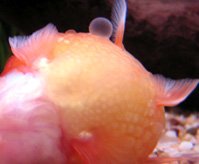
|
Betta fish, and a rather old email you replied to...
dis., Dropsy... nonsense 10/12/07 Hi, I assume this is the right
Bob Fenner... your> email address was pretty hard to track down,
you> didn't put it up on your FAQ pages! <Ah, no... we have
been forced to change ISPs, lost our old WWM email addies...>
Anyways, you answered a question entitled "Bettas keep dying>
8/25/05" on the page>
http://www.wetwebmedia.com/FWSubWebIndex/betdisfaq7.htm> I know it
was an old question, but I thought I should> share something
I've read before concerning Dropsy... on more than one website,
I've read that Dropsy is> actually a very tough disease that
does not go away> even with bleaching and drying of tanks. <...
Dropsy, dropsical conditions are symptoms... with a few etiologies...
NOT a specific disease/causative mechanism> It may or may not be
true, but if you can, you should let the person who wrote the email
that they need to throw that tank away and not allow healthy Betta fish
into that tank ever, nor allow a Betta that has been into that tank
into a new tank (unless they can afford to get a new tank after that
Betta dies). If you can no longer email the person, you should
definitely mention this on another of your websites, and if you've
already addressed this problem (since it was over two years ago, haha),
I'm sorry to have taken up your time. Thank you for reading this
anyways! -Ryan <What? BobF>
Betta/any fish question; relating to tanks and the
'dropsy' disease - 11/13/06 Hello! I really enjoy your site
and have learned quite a bit by reading through it. I have a question
that I hope you will be able to answer for me. I don't own any
Betta (though I'm interested in getting one of two soon) but my
friend has owned them. She has had 2 Betta at one time for a while now.
One of them is named "Donnie" who has been with her for about
2 years. Over the span of those 2 years, she has had another male in a
tank next to Donnie's. The first one was named "Frank".
He somehow got the disease called Dropsy and died. Later, she got
another (using the same tank) that she named "Remy". She
cleaned the tank very well before getting him but he, too, contracted
Dropsy and died after seeming being fine for over a year. This time
however, she purchased a new tank and is hoping the best for her newest
family member "Clay". We were wondering if it was possible
that there was something in the tank's plastic material or fake
plant or gravel or anything, that caused this disease, or if it was
just a random coincidence that they both got it in the same tank?
<Good question... "Dropsical Conditions" are "brought
on" through a few plausible influences... the bloating, scales
appearing at odd angles are due to fluid leaving cells, increasing
pressure in the intercellular spaces... some folks believe the root
cause here to be bacterial... this in turn allowed/triggered by such
factors as "poor water quality" (mostly unfiltered, high
bacteria count situations, not pathogens per se), and/with a
nutritional component... avitaminoses likely... there are other
theories, possible epidemiologies> Thanks for any help or advise you
can give! ~Miranda <Mmm... Please read here: http://wetwebmedia.com/FWSubWebIndex/bettadiseases.htm and
here http://wetwebmedia.com/FWSubWebIndex/dropsyfaqs.htm and
the linked files above. Bob Fenner>
Community Tank With Bloat/Pop-Eye Issues
5/27/06 Hi there, You guys have been an awesome resource! And,
it's time for another question from me. I have a 35g that's
been set up since February with a Penguin 300 bio filter. I have 1
White Tetra, 2 Pristella Tetras, 10 Harlequin Rasboras, 10 Neon Tetras,
3 Black Mollies (1M,2F), 3 Platies (1M,2F), 1 Pleco and 1 Gold Snail. I
do water changes every 2nd week of about 25-30%, but my last couple
changes have been closer to 50% to try and combat my problem. Ammonia
is 0, Nitrites are 0. I don't know the pH or Nitrates (no test kits
yet...just ordered them). 1 female platy seems to have dropsy or some
type of bacterial infection. Her scales are sticking out a bit on one
side, she doesn't seem to "poop" often, and I can see a
white spot at her vent (constipated?). 1 female molly appears to have
the same condition, but has a much larger belly. 1 rasbora has a little
(white?) bump on his bottom lip and has been this way since Feb. 1
rasbora has a slightly bulging right eye. With these different
conditions, I don't know how I should treat the tank. Any
ideas/suggestions are welcome! Please help a novice trying to get this
right. Thanks. Donna < Sounds like bloat on the livebearers and
pop-eye on the rasboras. The white lower lip thing is probably a benign
growth. Do a 50% water change, vacuum the gravel and clean the filter.
As few ways to go here. The bloat/pop-eye may be caused by the same
organism. If it is bacterial then it may respond to a double dose of
Nitrofuranace. This will affect the biological filtration and you may
need to get it restarted. If it is a protozoan infection then either
Clout or Metronidazole may work. The trouble with small fish like this
is you probably only get one guess. If you guess wrong the fish is
rarely around long enough for a second try. If it was me I would place
the infected fish in a hospital tank and treat them with he double dose
of Nitrofurazone and with the Metronidazole. Add a teaspoon of salt per
5 gallons to help get the medication into the fish.-Chuck>
Green Terror With Bloat 03/9/06 I have a 3 ½
year old Green Terror in a 40 gallon tank. His stomach is bloated and
he has a white bubble that sometimes comes out of his "area"
which is enlarged. I don't know what he has and I don't know
how to treat him. This has been going on for about a week and a half
and now he just stays at the top of the tank and he only moves around
when we go to check up on him. Do you have any suggestions? Jenny Van
Tubbergen <You green terror has an intestinal bacterial infection.
As the infection swells and grows it actually may push out some of the
intestines. Do a 50% water change , clean the filter and vacuum the
gravel. Treat with Metronidazole and Nitrofuranace. The key to a
successful treatment is to catch it early.-Chuck>
My poor tetra... dropsy 1/17/06 Hello I have a question
regarding my tetra. For the last 5 days or so my fish has been in the
bottom corner of our 10 gal tank. It can swim for a second then falls
right back to the bottom of the tank. I have two other tetras in the
same tank and they are fine. I don't know what a pregnant tetra
looks like but this one is very fat and the scales are sticking out,
<... Ascites... in pet-fishing called dropsy, or a dropsical
condition... aptly called "pinecone disease" in Japanese>
the side looks red. I have read about the different diseases and it
seems like the fish might have a disease but the others ones don't.
I had my water tested when I took it into the pet shop and it is OK so
I am stumped. Would a fish not be able to swim if it had a disease and
Say the fish is pregnant how long does it take to lay the eggs?
<Depends on species... days to a few weeks> Should I take the
fish out of the tank? IF so what is the best way? I am not to sure on
fish stuff but I don't like to see fish suffer. <If you sense
this fish should be sacrificed, placing it in a plastic bag with a
little water and putting this in the freezer will painlessly euthanize
it. Likely the "cause" of the dropsy here is not
"catching"... Bob Fenner>
Pleco With Bloat 1/14/06 Hello, I have a pleco that isn't
well. He(?) is about 7 years old & about 8-10 inches long. The
other day he started to swim to the top of the tank more often than
usual. Now (3 days later) he is violently swimming up and down. I
noticed he can't stay down. He struggles and fights and gets
comfortable on the glass then his tail slides up to the surface. He has
been holding himself down with the heater and return from the filter to
just keep under the water. I am very concerned, I don't want him to
die, but I'm not sure how to help him. I've read all of the
Q&A's on your website, which are very helpful! The water tests
fine, no major changes recently. The other fish are all fine. Water
quality appears normal. I have recently (3 weeks ago) added a Cory
catfish to the tank? I feed them discs regularly and cucumber every now
and then. Note from reading your Q&A's, I do not have any live
plants or driftwood in the tank? I've never had any? Is that a big
issue? Besides the buoyancy problem, I believe he is slightly bloated.
Also I have noticed he always had waste hanging from him, but none at
all this week. I believe his anus is enlarged/swollen and pinkish in
color. I have added some additional stress coat and stress zyme hoping
that might help him. I'm trying not to disturb him too much. Any
suggestions? Thanks Nicole < You pleco is suffering from an internal
bacterial infection. Probably found an algae wafer in some form of
decomposition and the long intestines of the pleco just could not pass
it through in time. Do a 50% water change vacuum the gravel and clean
the filter. Try treating with Metronidazole. When they are this bloated
it is difficult for them to recover.-Chuck>
Old Oscar With Bloat 1/14/06 I have a 13 year old albino
Oscar that about 5 days ago started hanging on his side in the tank.
Now I notice he has a large lump on the side that is pointed to the top
of the aquarium. He does appear to have some hole in the head. I did a
30% water change. He is in a 60 gal tank. His tank mates are 2
Plecostomus, 3 clown loaches, and 1 Pimelodella catfish. What could be
wrong? Can I use Epsom salt and other meds with his tank buddies?
Thanks for any help. < Your old Oscar has an internal bacterial
infection. Do another 50% water change, vacuum the gravel and clean the
filter. Try treating with Metronidazole as per the directions on the
package. Your Oscar has lived a very long life and may not recover from
this infection, even after he has been treated.-Chuck>
Oscar With Bloat II 1/14/06 I have a 13 year old albino Oscar
that about 5 days ago started hanging on his side in the tank. Now I
notice he has a large lump on the side that is pointed to the top of
the aquarium. He does appear to have some hole in the head. I did a 30%
water change. He is in a 60 gal tank. His tank mates are 2 Plecostomus,
3 clown loaches, and 1 Pimelodella catfish. What could be wrong? Can I
use Epsom salt and other meds with his tank buddies? Thanks for any
help. He also has some black-greyish him that isn't normally there
in the are where is spots are. If is us Epsom salt because is blocked,
how long do I leave it in the water before a partial change? Also his
normal diet is Oscar floating pellets. < Continue with the Epsom
salts until you see some improvement. Replace any salt after a water
change.-Chuck.>
Need help my goldfish Oranda has I think dropsy Part 2
12/20/2005 Hello, I was wondering if you can help me out with
something. Am not sure if my goldfish Oranda has dropsy or not. His
symptoms are: Floating on the top of the tank, still eats regularly,
lifeless sometimes, if you look close enough you can see the scales
kinda popping out, and he's getting bigger. <Mmm, yes... this is
a "dropsical" condition...> Water quality: Nitrate: 30
<A bit high> Nitrite: 3.0 <Three times more than toxic...>
Total hardness: 200 Alkalinity: 180 Ph: 7.8 I'm not sure how my
nitrite spiked. However, I recently moved so I <I> had to empty
out my fish tank and start it up again. It's been nearly a week
already and those where my reading. I know I have to do water changes
which I will do tomorrow, but please can you help me with my Oranda and
his dropsy what do you recommend me doing? and what should I do? thanks
you for your kind ASAP help. Ryan <Help yourself... Please read on
WWM re FW water quality, Nitrite, Cycling... Bob Fenner>
Molly With Dropsy 12/7/05 Hello there. Your site is
wonderful. I can't tell you how many hours of schoolwork have been
sacrificed so I could read as much as I could. I'm new to
fishkeeping and feel very lost in the sea of information available, so
to speak. I'm having problems with a black molly that I bought a
little over a week ago. My tank is brand new, so it could be a cycling
problem. When I first got her home, she was very reclusive and just
sort of floated in the corner of the tank. Three days later, her belly
started to swell a little bit, so I looked up how to sex mollies to see
if she was indeed a she (which she is) and see if she might be
pregnant. I moved her to her own 5g tank, and her belly continued to
grow. Four days after that, it started to look like her scales were
sticking out a little bit, almost as though there weren't enough
scales to cover all of her skin and I started to worry. They aren't
sticking straight out like some of the pictures I've found, but
they aren't like lying flat either. I had just read about dropsy,
so I researched it as much I could, but I have no idea what to do, if
it is. Since I moved her, she started to move around a bit more,
swimming in lazy circles at the surface of the water. She doesn't
have much of an appetite. Another strange thing about her... she's
got a strange white lump on or in her rectum, kind of like someone
stuck a little white stone in it. I tested the water.. PH was 7.2,
Nitrates and Nitrites were 0, Ammonia was 0.5 (As soon as I finish this
email, I'll be doing a water change to try and fix that). I added
some salt to the water (about 3 tsp), but I don't know what else to
do or try. Please help, if you can. Michi < Do a 30% water change,
clean the filter and vacuum the gravel. Add the salt back from the
water you removed. Stress from the move has caused your molly to come
down with an internal bacterial infection. Treat with Metronidazole and
Nitrofurazone as per the directions on the packages.-Chuck>
Let Them Eat Rocks? Platy, Dropsy.... 11/29/2005 I have a 10
gallon fish tank in my classroom with three fish in it: one silvery
Mickey Mouse platy, a 10 month old orange MM platy, and a small algae
eater (don't remember the species name). The silver platy is the
oldest...I think I've had her for about a year and a half.
She's definitely been the hardiest -- I'm quite an amateur at
keeping fish, and she's seen many newbies come and go in her time.
Anyway, I fed the fish some flakes and some algae disks (both part of
their regular diet) before Thanksgiving Break (Wednesday) and today
(Monday) when I came in Miss Molly was a swollen as a blowfish.
She's evenly swollen all the way around, not just her abdomen, and
her scales are poking out (yeck). <Yikes. A very bad sign.> Her
stomach area looks dark, but I can't remember if it always looks
like that or not. The other fish look normal. After internet research,
I figured she has dropsy <Mm, "dropsy" is a collection of
symptoms.... not a disease in and of itself. In this case, the symptoms
are likely from an internal bacterial infection.... perhaps something
she's had since "day 1", or perhaps from one of the fish
she's seen come and go (might want to consider quarantining new
fish before adding them to your tank). It may have been entirely
unavoidable.> and called my local fish store to get their opinion on
what to do. My local fish store thinks the fish has swallowed some
gravel and will die since she can't pass it. <Uhh, no. HIGHLY
unlikely. Though it IS possible that a fish can get a gut blockage from
swallowing a piece of gravel, I have never, ever seen nor heard of a
platy doing so.... Furthermore, the scales sticking out (pinecone
fashion?) are a sure sign of fluid buildup in the fish - typically a
result of bacterial infection.> I can't imagine why she would
suddenly pick up a rock-swallowing habit unless she just got really
hungry (in which case I feel awful that I didn't put it one of
those time release tabs). <No - actually - it's best not to use
those time-release feeding blocks, as they can alter your pH.... Most
fish can go many days without food. You didn't cause this by not
feeding, no worries.> Long story short, should I try the Epsom salt,
the antibiotic flakes, or anything else? <If you can locate the
antibiotic flakes (preferably medicated with Oxytetracycline, in my
experience), I would try both Epsom and the flakes, yes.> Will any
of the above hurt my other fish? Should I try to set up a
"hospital tank"? <I would definitely try to get her into a
hospital tank - though the Epsom and antibiotic flakes won't hurt
your other fish, she may be contagious. It's safest for the others
to remove her. I will also tell you that her prognosis isn't great.
It really is very rare for a fish to "come back" from such an
advanced state.... I do hate to bring bad news, but needed to let you
know this. When/if she dies, the other fish are likely to
"pick" at her. This could be bad indeed, if they were to
"catch" what she has/had. Please do separate her if you
can.> Thanks, -Janice <All the best to you, -Sabrina>
Sabrina, Let Them Eat Rocks? Platy, Dropsy.... - II -
12/06/2005 <Hi, Janice.> Thanks for your reply. I really
appreciate the advice! <Glad to be of service.> I am glad that I
was not totally nuts to think my fish was an unlikely rock-eater.
Unfortunately, your prognosis was correct, and she only lasted two days
after your email. I treated for a bacterial infection, but as you said,
it was a bit late for her advanced stage. <I am so sorry to hear
this....> Is there anything I should do for the other two remaining
fish, or are we past the point of preventative measures? <Just
maintain optimal water quality - zero ammonia and nitrite, 20ppm or
less of nitrate, steady, stable pH....> I am curious as to the cause
of the infection. I know that you said that it could be from exposure
to her other former tank mates, and that's certainly a possibility.
I'm wondering though if a drop in temperature could stimulate an
infection. <Can.... but I have to admit to you, the heater in my
upstairs tank failed last weekend - a 20 degree (or more) drop in
temperature did in everything but the platies, which are still all
going strong. Go figure. Platies are pretty tough when it comes to
temperature changes.> I have a feeling that our A/C system went on
standby over the Thanksgiving break, letting the temperature drop lower
than normal. I haven't yet bought a heater for the tank, since the
room usually stays at a fairly constant temperature...or so I thought.
Now that the weather has cooled, that will be a priority. <Good
plan.> That brings me to my next question, if you have time for
another. <Time? Whassat? No worries; this is why we're here!>
Every Christmas break, I am left in a quandary of what to do with my
fish. I am typically gone for almost 3 weeks, and in the past, I have
brought my fish home with me and put them into a smaller tank.
Unfortunately, this is very time-consuming, <And hazardous/stressful
for the fish, no doubt!> and I always have a problem finding a good
place to put the tank. Would it be feasible to leave them in their tank
at school with a heater, provided that I go in periodically to feed
them? <Oh, certainly. Aim for twice a week at a minimum, if you can;
or, you could even get a battery operated feeder - a device with a
"hopper" type bin, or compartments that you fill that will
release food for them periodically. Don't use the
"tablet"-style time-release feeders that you put right into
the tank - these can cause more harm than good.> Are there any other
preparations and/or supplies that they would need for this? <Just as
above - they'll probably be just fine with your good care.>
Thanks again, -Janice <All the best for you and your fish on the
holidays, -Sabrina>
|
|