|
FAQs on Freshwater Aquariums & Ammonia 3
Related Articles: Ammonia, Freshwater Aquarium Water Quality,
pH, alkalinity, acidity, Treating Tap Water, Freshwater Maintenance, Frequent Partial Water
Changes, Establishing
Cycling, Freshwater
Filtration, Know Your Filter Media, A Concise Guide to
Your Options by Neale Monks, Setting up a Freshwater Aquarium, Tips for Beginners,
Related FAQs: Freshwater
Ammonia 1, Freshwater Ammonia 2,
& FAQs on FW Ammonia: Importance,
Science, Measure, Sources,
Control, Chemical Filtrants, Troubleshooting/Fixing, & Freshwater Nutrient Cycling, FW H2O Quality 1, Aquarium Maintenance, Environmental Disease, Treating Tap Water for Aquarium Use,
pH, Alkalinity, Acidity,
Biological
Filtration, Nitrogen
Cycling, Establishing Cycling 1,
Nitrite, Nitrate, Freshwater
Algae Control, Algae Control,
Foods, Feeding, Aquatic Nutrition,
Disease,
|
MD.JPG) All fishes, invertebrates are mal-affected
by any detectable level of ammonia. Some much more than
others.
|
Extremely high ammonia during cycling
12/12/18
Hello Crew! Hope you all are doing very well.
<All good.>
Got a brackish nitrogen cycle question for you. I have recently
set up a 5 gallon biotope aquarium for some Opae ula shrimp.
There is a tall tower of lava rock (held together with aquarium silicone glue)
to provide a hypogeal environment. There is also additional lava rock mixed with
some reef "dry live rock" pieces in the rest of the tank. Specific gravity is at
about 1.010.
<Understood.>
First evening after filling the tank, I added a few (very few!) flakes of fish
food to begin cycling. After 24 hours I tested for ammonia using an API Ammonia
test kit, and the result came back at 8 ppm! Since 8 ppm is as high as the test
goes, the ammonia level is anywhere from 8 ppm to who knows what. No way this
came from those teeny flakes!
<Possibly not. Hard to say without knowing how much protein was in the flake and
how much water (actual, not nominal) is in your 5 gallon tank.>
So, the ammonia could only come from one of three places: my tap water, the salt
mix, or the rocks. I tested my tap water after treating with Prime water
treatment, and it came back at between 0.25 and 0.50 ppm ammonia, likely from
the chloramine. Then I mixed in some of the marine salt mix and retested - came
back the same as the tap water.
<Indeed, as should be the case.>
I still had some lava rocks left over so I put a few in some fresh water and let
them soak a few hours and then tested. Yep, it was the lava rocks.
<Yikes! I'm not a huge fan of lava rock, which not only affects water quality in
this case, but more regularly, affects pH and water colouration too. It's
vaguely acidic in many cases, causing pH to drop, and the minerals contained can
stain the water reddish brown.>
After 48 hours the ammonia level was still high and beginning to look a little
cloudy, so I did a 2 gallon water change.
<Correct action here.>
At this point I'm assuming it will be continue to cycle the tank as usual, am I
correct? Or are these levels too high even for cycling? I'm also guessing I will
need to do a fairly large water change after the cycle
completes as there will likely be pretty high nitrate levels.
<Yeah, but if there's no livestock in this system, the ammonia spike shouldn't
do any lasting harm. If the shrimps are there, and have survived, wow!!!>
At any rate this was a good lesson to learn - don't just throw new rocks into an
established aquarium! Even if you have tested for carbonates, you never know
what might be lurking in there.
<Sage advice.>
Thanks for your input on this!
Joanne
<And thank you for sharing. Neale.>
Re: Extremely high ammonia during cycling 12/12/18
No, definitely no livestock in here yet. Just doing the cycling.
<Understood.>
The reason for using the lava rocks is because I am trying to recreate a
biotope. In the case of Halocaridina rubra (Opae ula) this is definitely lava,
with a sprinkling of carbonate rocks. I did a lot of research on
scholar.google.com on the Hawaiian anchialine pools - fascinating stuff!
The lava rocks I purchased are not *exactly *the same as the lava where they
occur, but it is as close as I can get.
<I am fairly sure the "lava rock" traded is a byproduct of glass making or some
other industrial process, rather than actual pumice stone.>
Based on your comments about these rocks changing the pH, I will give this tank
an extended cycle period. Once the nitrogen cycle has completed I will continue
to monitor the pH and other parameters, while keeping the cycle "fed" with the
use of flake foods. If there is a trend toward acidification, I will remove some
of the lava rocks and replace them with some limestone and/or dry live rock to
help keep things buffered.
<I do think Tufa rock, or Texas hole-y rock, might be better.>
I'll see how things trend before adding any live creatures. Hopefully things
will tend to stabilize as whatever soluble materials are in the rock get leached
out.
<Hopefully!>
Thanks again!
Joanne
<Most welcome. Neale.>
Ammonia, Nitrite & Nitrate Units of Measure
4/10/18
Hello Crew,
<Hey Ray>
I have a 210g, probably considered overstocked, mixed Malawi tank. The
tank is filtered by a submerged media sump with a six times turnover. I
use Hanna meters for my chemistry checks. The ammonia, nitrite and
nitrate
meters all measure using the -N unit of measure (NH3-N, NO2-N &
NO3-N).
The unit of measure for ammonia and nitrite are not relevant since the
goal of both is to maintain 0ppm. Nitrate is the one causing me some
thought. The tank consistently runs 10 - 30ppm NO3-N and I use this
value to determine water changes, as it approaches 30ppm I do a 50% WC
usually every other week. But if I apply the conversion factor
(4.4) to these numbers my ranges are 45 - 130ppm in which case my WCs
should be happening probably twice per week. I recently read
the article, Nitrates in Freshwater Aquarium Systems
by Bob Fenner, which stated "Do check your test kit though almost all
are nitrate ion types on the market nowadays..." I'm guessing doing the
conversion on NO3-N > NO3 is what I should be looking at.
<Yes; agreed>
The tank has been running in its current configuration (mixed Malawi)
for 2 years, before that it was a planted discus tank for maybe 8 years.
Being retired gives me time to think, maybe too much. Should I take the
attitude, "if it ain't broke, don't fix it?" Looking for
confirmation/disagreement.
Thanks,
Raymond M Sugel Sr
<Were it me, mine, I would increase the number/frequency of water
changes as you state (twice a week; with pre-mixed (for pH, salts if you
use them) stored water. I encourage you to look into the possibility of
tying this
tank in with a good size/volume sump as well, perhaps growing live
plants there, incorporating a deep sand bed for denitrification;
utilizing and out-gassing the excess NO3. Bob Fenner>
|
Just a few aquarium questions... <20 some Megs...>; residual NH3,
U1 zots, Crypt melt, moving pH 8/7/16
Please re-size and re-send all... Your files are more than an order of
magnitude too large.
Re: Just a few aquarium questions... 8/7/16
Yikes...I was wondering why they were taking so long to upload, didn't even
notice they were that big.
Resized in PS, hope this is a little better!
<Yes; now just need you to delete the carats (<<<<) in the text below and
re-send. BobF>
re: Just a few aquarium questions... 8/7/16
<Oh, found the original text here>
Hello crew! I just started up my old aquarium and I have a fair amount of
questions about water quality, some of my old plants, etc.
My tank is a 10 gallon. Started it up a little over 2 months ago, let it
cycle through, and added a single Betta after the cycle was finished.
The parameters are
pH: 7.5
nitrates: 0
nitrites: 0
ammonia: .12? (it's not exactly at 0 and not at .25 on the test kit, so I'm
assuming it's right in the middle)
<Toxic; and am wondering wherefore/why the residual ammonia here?>
temp: between 74-78 degrees
My first question is about the ammonia. Both in the past and currently, I
cannot keep the ammonia at 0 for the life of me because my tap water has a
small amount of it.
<This should cycle through though... And you should eliminate w/ water
conditioner use ahead of placing it in the tank>
It's not at a terribly dangerous level but it's enough to be worrying,
<Debilitating.>
I've tried using ammonia-removing products, including prime, on the water I
store away for water changes, but the ammonia tests as 0 and then has a huge
spike occurs a few days later. Is there any way to get it down and
stay down?
<Yes... a few ways. Let's have you review here (as I/we have no way of
knowing what you already know):
http://www.wetwebmedia.com/fwsubwebindex/fwammf3.htm
and the linked files above>
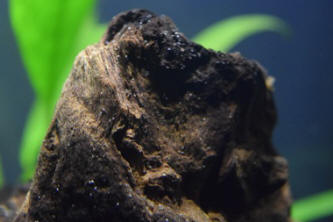
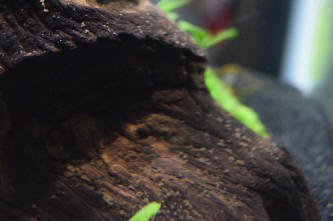
My second question is about this strange white and brown stuff growing on my
driftwood. I'll attach some pictures, some of them I couldn't get to focus
but I hope they're good enough. There are brown chunks of what looks like
fish feces or a kind of fungus, mostly on the bottom half of the driftwood.
It's kind of tough to remove so I had to scrub it off with a
toothbrush, but it just comes back anyway. Along with that are white specs,
mostly on the top of the driftwood.
<This appears to be bits of decomposition... the wood, likely food, feces>
I can't tell you how many pages I've checked trying to find out what these
are. The only answers I come back
with are black beard algae/brown string algae and white fungus/Nerite snail
eggs, but whatever's on my driftwood doesn't look like any of those. The
white specs even look like they're starting to spread to one of my crypts.
My Betta seems to be unaffected by either of them, but I've had a baby
Bristlenose in a hospital tank and I wanted to move him in soon. I'm worried
that this stuff could make him sick if he eats it. Any ideas what either of
them are?
<As stated... you might benefit from more circulation, filtration here>
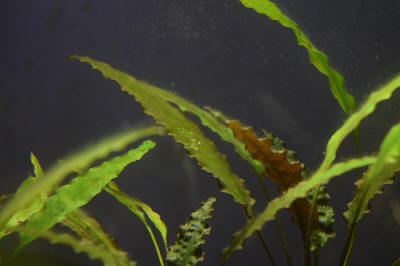
Third question is about the crypts (also in the pictures) I was growing them
in a large bowl for a while and they were doing very well with API leafzone
and some natural sunlight. They shot out very nice, healthy green leaves,
but when I transferred them to the tank, they started turning a reddish
brown and getting ruffles. I read that this happened to a few
other people that changed the way they were fertilizing their tank, though
they stated that they were still very healthy. Mine are kind of getting this
weird translucent reddish-brown look and a couple of the leaves have
completely melted, but the leaves had been bright green and strong before.
<Crypts are susceptible to this sort of decomp. under stressful and varying
conditions>
I have an LED light strip but others have been able to keep crypts just fine
with them. Is there another reason they're not doing as well?
<Can't tell w/ the data provided. There may well be a nutrient deficiency
going on here... N, P, K, Fe....>
My final question (phew) is about the pH. It's always been at 7.5 (or
higher, not sure if it even shows up on the test kit..) I want to lower it
to around 6.8 or 7,
<I would NOT do this. Leave it as it is... will drop a bit in time. See WWM
re pH and Alkalinity for a bit of background>
but just like the ammonia, I've tried two or three pH altering products and
they drop the pH rapidly and spike it a few days later.
<... yes... alkaline reserve is buffering it back up. Common >
I was thinking I could try Indian almond leaves or wood, but they would
release a lot of tannins and I'm not sure if it would add to the ammonia or
not. Have tried adding distilled water as well and there is no affect (but I
do have 20 empty gallon jugs laying around) Do you have other suggestions of
how to lower it safely?
<Time going by is the very best. Don't fuss w/ pH here, period. 7.5 is fine
for what you have livestock wise>
I'm very sorry this is so long, I was debating on whether I should divvy the
questions up into different emails but I thought it might be more
troublesome to get them each separately. But I thank you very much for your
services. I always go to this site first if I'm having any problems and it
has been extremely helpful and informative! I greatly appreciate any answers
and advice you can offer.
Jenevieve
<Glad to be (hopefully) of assistance. Please DO write back if all is not
clear here after reading. Bob Fenner>
|
  |
Re: Is our tank possessed by an ammonia demon???
9/4/16
Thanks for your response, Neale.
<Welcome.>
We use well water, no chlorine, but we still add conditioner to it to
help keep the skin coating on the fish.
<Well water can, does absorb ammonia and other pollutants from the
surrounding ground, especially in rural areas (nitrogenous compounds are
often very high near farms that use fertilisers or rear livestock). So
you should absolutely be using water conditioner, and a good one at
that, even on well water.>
Our tap water is zero for ammonia, nitrates and nitrites. We've tested
it many times. And the water itself was tested by the water softener guy
and was clean.
<Do you use water from the bypass tap, or water that's been through the
water softener? You should be doing the first, not the second. NEVER use
water from a domestic water softener. Introduces all sorts of variables,
including high sodium and zero carbonate hardness that can cause
problems.>
We (well, Maria - I'm in the sidelines with a herniated disk in my lower
back) are doing multiple 50% water changes until the ammonia is gone.
We've done two today and will do a third tonight and again in the
morning until the numbers are down. All the gravel is being washed in
both tanks.
<Good.>
We are using that bottled bacteria, we don't have any other option.
<Is this refrigerated before purchase? If not, it's useless. Franky,
even the refrigerated stuff is pretty ropey. I'm not a fan. I'm going to
ask Bob's opinion on this, but I've come across FAR too many problems
with tanks cycled without fish but with store-bought bacteria potions.
My preferred method is to clone an existing filter, which is pretty much
foolproof done right. Do you live near anyone with an aquarium? If they
can donate half their mature media, which any mature filter can without
problems, your tank would be instantly cycled. Hence, "cloning" a
filter.
The donor filter can have 50% of its live media replaced with brand new
sponges (or whatever) and experience NO noticeable drop in water
quality.
Bacteria double in numbers every 20 minutes, the scientists tell us, and
when you have a gazillion per cubic cm on a mature block of sponge, that
means the donor filter will make up any losses very quickly. The
problem, as you may realise now, is when you have none or just a few
bacteria per cubic cm.>
Thanks again for your help and time.
<I do think things should settle down. What fish do you have now? If you
change all the water, clean the filter as indicated (taking care not to
over clean and kill the bacteria) and then feed sparingly, if at all,
for a couple weeks, hardy fish (Danios, peppered Corydoras, 'feeder'
guppies, etc.) can, do sail through the cycling process without much
trouble if you change some water every day or two. Old school approach,
and not widely recommended, but does work. The addition of floating
aquarium plants, especially floating Indian Fern, is another 'magic
bullet' from days gone
by. Cheers, Neale.>
re: Is our tank possessed by an ammonia demon??? (RMF?)
9/4/16
1. We have been using softened water. We'll switch, but we're going to
replace another fifty percent. Should we use the bypass tap for that? Or
half half, if they're used to the softened water?
<I'd go the latter route, maybe 25% bypass/75% softened for the first
water change, and so on across a week of water changes. Domestic
softener water isn't good for fishkeeping for all sorts of reasons, and
it's a shame that
the idea of "softening" water means different things to different
people.
Please do check with the installer of your system, but most work by
leaving general hardness as it is, but replacing carbonate hardness
(limescale) with sodium ions. That's why people with blood pressure
problems, for example, are told not to drink softened water. On top of
that, with zero carbonate hardness your pH might not be stable between
water changes, and a low pH (anything far below 7) will
absolutely hammer biological filtration.
Indeed, some reports suggest it stops working completely below pH 6!>
2. We use Aqueon filters - a mesh bag with carbon in it. I guess you are
talking about the mesh part of the filter?
<Nope. Take the carbon and throw it in the bin. Useless for freshwater
fishkeeping. Actually, there are VERY SPECIFIC situations where carbon
is handy, like removing leftover medication from a tank, but other than
that... useless. Similarly anything labeled "ammonia remover" (Zeolite)
is also useless for a normal tank, and again, chuck in the bin. Or at
least lay down for use some other time! What your filter needs is plenty
of biological media -- usually sponges and/or ceramic noodles. That's
where the bacteria live.>
If we can find someone with a filter, would we just put that in the
tank?
<Well, pretty much, yes. Easier to have that filter donate some sponges
or ceramic noodles, and put those inside your new filter. Should
jump-start it a treat.>
We have one white skirt tetra, one platy, and one Pleco in the tank. We
DO have a second 20 gallon tank. Could we use the filter from that?
<Any filter more than a couple months old should be mature
enough to donate some live media. That assumes temperature and
water chemistry aren't very different. Obviously taking filter media
from a hard water tank and sticking it in a soft water system would be
nasty to the bacteria and likely to stress them (though not kill them).>
No, we just changed the filter in that, but I have that filter - it
didn't dry out, so maybe use that? Should we not change the filters?
<I'm a bit concerned here. What do you mean by "change the filter"? You
never "change" a biological filter. All you do -- every six weeks to six
months depending on how well flow rate is holding up -- is rinse the
live biological media under a lukewarm tap to get rid of the muck.
Periodically (every five years or so) you might want to replace a really
irredeemably grubby sponge, and every ten or twenty years you might
change some of the ceramic noodles. But even then, you'd only change,
say, a quarter to a half of the media at any one time. Really, a
biological filter should be left
alone as much as possible, and the golden rule is "if in doubt, and
water is still flowing through it, leave it alone". You should
absolutely NOT be changing media every time you change water! For sure
the manufacturers will want you to change carbon and ammonia remover
every week or two, and they're right to recommend that -- such media
needs frequent replacing. But those media are totally unnecessary in the
average freshwater aquarium.
Some filters are designed around carbon and Zeolite modules, but they're
a con, and I spurn them! Focus on sponges, noodles, and perhaps a small
layer of filter floss to trap silt (and the filter floss will need
replacing or cleaning quite frequently, if it bungs up).>
If we put the fish in another tank, how would you suggest that we
restart the 38 gallon tank as new tank? From scratch?
<See above; I'm a bit worried you're doing something to the filter
that's preventing it from maturing. Perhaps I've misunderstood? Neale.>
Re: Is our tank possessed by an ammonia demon??? (RMF?)
9/4/16
sigh. You have not misunderstood.
<Oh dear.>
We have been doing what they told us to do: using the carbon filter for
the Aqueon pump and changing it out when dirty.
http://www.aqueonproducts.com/products/filtration/
<Got you now. I don't know these filters, so can't be sure about their
design. But usually these small internal canister filters have two or
three 'chambers' inside them. Ideally, the water passes through a
mechanical medium first to trap dirt, a second stage of biological media
to clean the water of ammonia and nitrite, and finally (and optionally)
a chemical medium (such as carbon, peat or Zeolite) to chemically change
the water somehow. This last stage is a total waste of filter space in
most freshwater tanks. Furthermore, the mechanical and biological stages
can be combined if you're limited with space. Sponges and ceramic
noodles will trap silt as well as house bacteria, and so long as you
only rinse them gently in aquarium-temperature water (even a bucket of
old aquarium water during water changes) then you'll keep the bacteria
on that medium in tip-top condition as well as rinsing off the dirt.
Make sense? Now, I don't
know which filter you have from their range. But I'd suggest looking at
the instruction leaflet or packaging, or heck, just email me the make
and model number. Once we know which filter we're talking about, we can
plan accordingly. One option though is that if your filter has simple
empty chambers that you're meant to put proprietary cartridges into,
those chambers can still be stuffed with filter floss or ceramic
noodles. Filter floss is cheap and crams nicely into awkward shapes.
Don't over pack it though or you'll stop the flow of water. Also, the
other problem is that it clogs up quickly and isn't really washable more
than once or twice, so you have to be careful about replacing no more
than 50% per month. Ceramic noodles are more expensive, especially the
really good brands (such as Siporax and Eheim Substrat Pro) which hold
the most bacteria per cubic centimetre. Being a loose but solid medium
you can stuff it into a
compartment without worrying about clogging up the flow of water. So
it's a better medium in all but the smallest and most awkwardly shaped
filters. Of course your particular canister filter may have proper
biological cartridges on sale, and these are the ones to use if that's
an option.>
We are using the Aqueon pumps and I don't know if they have a filter
like the one you are talking about. If you don't like their products
what do you suggest? These things get pretty dirty. Maria can go get the
new media now, but we don't know what to get. We THOUGHT we did, but
obviously we were listening to the wrong people.
<Possibly. Since you already have an existing aquarium, cloning that
tank's filter should be easy. Can some media be removed from that
filter? Or even, worst come to the worst, scrape off the top 1 cm gravel
from the old tank
and add it to the gravel in the new filter. The top layer is where some
filter bacteria live, so while it's not as good as cloning a filter,
it'll provide a heck of a jump start to any new aquarium, speeding up
the cycling process a lot. As mentioned before, adding a handful of
floating plants is another good way to get things moving. Hope this
helps, Neale.>
Can't get ammonia under control
8/10/15
Hi Crew! Your site is fantastic and very helpful. Thank you! I am hoping you
wouldn't mind helping me with an ammonia spike that has lasted for the
last 3 days. I'm getting a 4.0 ppm
<?!!>
reading in my 29 gallon freshwater tank
using the API master test kit. The NH3 is at 0.2 (so I assume this means the
spiked reading is caused by NH4).
<? What is the pH of the water here?>
Nitrites are 0, nitrates are just under 40 ppm.
<Too high by twice. WATER CHANGES for now>
Up until this point I was just about to complete the cycling process(ammonia and
nitrites were consistently down to 0.25, nitrates at 20). I should note
that I was using SeaChem stability to help speed the process, but recently cut
down on the frequency.
<Good; stop period now>
I may have jumped ahead of myself thinking the tank was "as good as cycled", and
added 3 Kuhli loaches just 3 days before the sudden ammonia spike. Along
with the loaches I have 7 Corydoras, 6 tetras and 3 Danios.
<Do NOT feed these fishes.... change half the water... with conditioned new, and
be patient: WAIT till there is NO, ZERO, ZIP Ammonia>
The tank has mostly live plants and sand substrate. There's an internal filter
that (supposedly) filters 144 gallons per hour. I added an additional sponge
filter yesterday. I do small water changes every other day of about 10-25%. I
siphon visible detritus almost daily. Even after changing about 60% of the
water, the ammonia was still at 2.0 ppm. The loaches are pretty good at hiding
and I've only been able to spot 2 at one time for a while now. I searched the
tank but couldn't find the 3rd (dead or alive, however there isn't a fish in the
tank with a mouth big enough to have eaten him). In the last 2 days I've
raked the sand, cleaned the filter, treated the water with prime and stability.
Still got an ammonia reading of 4.0 ppm today. Forgot to mention
that pH stays at a steady 7.8.
<Yikes....>
What am I missing??
<I fully suspect your API test kit is "off"... inaccurate here. Else at
this high pH ALL your fishes would be dead. DO "check the checker"... i.e., have
the water tested with another kit... likely a friendly LFS will do this for you.
In the meanwhile.... water change and no food>
Thanks in advance!
Danielle
<Welcome. Bob Fenner>
Re: Can't get ammonia under control
8/11/15
Hi Bob,
Thank you for the prompt response and advice. I will stop feeding and
continue water changes.
<Good>
The test kit is in fact working
correctly(unfortunately)! I also have a 20 gallon tank for my apple snails.
When testing their water with the same kit I am getting ammonia - 0,
<Ahh>
nitrites - 0, nitrates - 20, and a pH of 7.6. These are the same steady
parameters this tank has had since I started it.
Back to my 29 gallon community tank with the outrageous ammonia reading, the pH
has always been at 7.8 in this tank. It started to descend at one point,
reaching 7.2, but with water changes it gradually climbed back up to 7.8.
I added a medium sized piece of driftwood a week ago. Could this have anything
to do with the ammonia?
<Yes! I would remove it (but keep it underwater somewhere else and check the
water chemistry there over time). It could be decomposing, causing issues>
Thanks again.
Danielle
<Welcome. BobF>
Re: Can't get ammonia under control
8/11/15
Just to clear up any possible confusion - the reason my snail tank has been
stable since I started it is because it was branched off of the 29 gallon
community tank. I borrowed some filter media, a bit of sand, water, etc.
Both tanks remained stable and then suddenly the 29 gallon took a turn for the
worst. Thanks
<Good technique (moving media, sand, water...). Bob>
Water quality, FW 12/23/12
I have asked for your advice before and the crew has never failed me.
Now I need your help again with something that really baffles me.
I set up a 29 gal. tank 9 weeks ago. After 4 weeks, I added 2
small angels, and 2 more small angels 1 week later, for a total of 4
angels. That is the population of the tank. Ever since I set
up the tank, ever since I added the angels, and right now, the ammonia
level has never, and I mean never, been below .25. Most times it
is at .50, and has spiked to 2.0 once. I do many water changes of
30-50%, and the level is still .50. I then put Ammo-Carb Filter
Media in the outside filter. Virtually, no change. I have
since started using AmQuel Plus Ammonia Detoxifier. Again,
virtually no change. What I can’t understand is my angels are
thriving. They have grown in size, they eat vigorously on a diet
of brine shrimp, beef heart, Glassworms, and blood worms. They
live peacefully with each other. There is no gasping for air at
the surface or unusual behavior. They swim all over the tank.
Their fins are full and erect. From all that I have read, they
should be dead, yet they thrive.
Can someone shed some light?
<First try some tap water, add water conditioner, stir well, then test
for ammonia about an hour later. If you get ammonia there, you probably
have ammonia in your tap water or else chloramine (water conditioners
can neutralise both, but resulting in false positives. The ammonia is
technically there, wrapped up in water conditioner molecules, but not
freely floating about such that it can harm your fish. Next up, grab a
nitrite (not nitrite) test kit. Is nitrite zero? If it is, then filter
is probably doing its job adequately, especially if your tap water
ammonia test delivered a false positive. To be honest, ammonia
test kits aren't the best way to track water quality -- I'd recommend
nitrite every time because it's less likely to be a false positive. Make
sense? Cheers, Neale.>
Ammonia Spike - Over/Mis-Stocking A 29g Tank - 12/01/12
I set up my 29 gal. tank 5 weeks ago, dechlorinated it, and added 2
platys for cycling.
<Not too terribly kind to the platies.... Cycling can be done
without fish; much more humanely.>
After 3 weeks, slowly added small angels,
<Though a pair with few or no other fish would be nice for a tank this
size, be aware that more than that will ultimately result in a pair
forming and kicking the snot out of other tank denizens some time in the
future.
Once this happens, you'll have to make come choices, either to nix the
pair or the rest of the fish.>
small clown loaches,
<Unsuitable for a 29.... Small clown loaches do not stay small.
These will outgrow the tank (slowly) and eventually require a 5 or 6
foot tank. At least they'll be happily compatible with the
angels!>
and a small red tailed shark,
<Also will stay neither small nor friendly.>
ending up with 4 angels, 3 clown loaches, and 1 Redtail shark. I
gave the platys to my grandson. My ammonia level was at about .25
or less from the chart with my test kit.
<Expected.... Do water changes to combat this.>
The fish seemed to be happy, no bullying, no frantic swimming all over
the tank, no gasping for breath at the surface, etc. I feed them
brine shrimp and bloodworms without overfeeding and they eat eagerly.
I change about 20% of the water weekly. I have an outside power
filter which seems to be working fine. Temp. 80 degrees.
A few days ago, my ammonia level went to 2.0.
<Toxic....>
I immediately changed about 30% of the water, and changed the charcoal bag
of the filter. The fish seem to be acting as always, no stress or
unusual behavior. They eat vigorously.
<This is temporary, to be sure. Although many hardy fish will
tolerate a slow rise in ammonia, it does cause them damage and even if
they're not showing trouble yet, they are being damaged.>
My question: What do I do about the ammonia rise?
<Water changes. The most annoying rhyme you'll ever hear/read (and
good luck getting it out of your head once it's stuck): "The
Solution To Pollution Is Dilution". Water changes, my friend.
That is all. Bear in mind that many Chloramine removers bind
Ammonia after breaking the Chlorine/Ammonia bond and will cause a false
Ammonia reading after a water change, as well. >
Thanks for any help you can give me.
<Note also that if you are unable to maintain Ammonia at zero parts per
million, the tank may be overstocked. I wouldn't expect that now,
while the angels and loaches are small, however. You should have
some months before troubles develop from the angels pairing, and longer
than that for the loaches to get uncomfortably large. And keep an
eye on that Redtail, they can get a bit nasty when they get big, but I
don't think he'll cause too much trouble.>
Joe Messina
<Wishing you well, -Sabrina>
Ammonia
4/12/12
Hello Guys!
First I want to thank you so much for an awesome website and your
dedication to helping fish keepers!
<Thanks for the kind words.>
I have a question on ammonia. I've never had a problem with ammonia
before in either of my 20 gal or 5.5 gal tanks. Now I have a 55 gal.
Been set up for weeks, actually close to 2 months. There are 4 fish in
it, a male & female swordtail both young and 2 mollies also fairly
young. I cannot get the ammonia and nitrites to zero.
<To be honest, I'd suspect the test kits. With that few fish in
it, assuming you know how to set-up and maintain a biological filter,
ammonia and nitrite should be zero within 6 weeks, and certainly within
8. If the fish seem fine, and they're happily feeding and growing,
I'd not be too bothered. Do the usual 20-25% water change at the
weekend, but otherwise don't fuss.>
I've done water changes, 10-15% every 4-5 days. The water is clear.
There are nitrates as well btw 5.0-10 ppm. The ammonia reads btw
.50-1.0 ppm and the nitrites btw .25-.50 ppm. The pH has been stable at
7.8 and my water is hard to very hard. I use cycle by Nutrafin and
stress coat by API as a water conditioner.
<All sounds fine.>
Also added wonder shells at set up. 2 are almost completely
dissolved the other 2 are a little more than half dissolved.
<Pointless products, but not doing any harm. If you have soft water
and want to keep hard water, there are better, more efficient ways to
ensure proper water chemistry. Do read:
http://www.wetwebmedia.com/fwsubwebindex/fwh2oquality.htm
Rift Valley salt mix at about 50% should be fine for Central American
livebearers. You can tweak the proportions of each ingredient up or
down as needs be, too.>
I let the tank cycle through for 3 weeks with no fish before adding
them.
<How did you cycle the tank? What ammonia source? If you didn't
add ammonia (or some organic source, like fish food flake) then cycling
didn't start until the fish were added.>
When I did add the fish the water tested fine. Zero ammonia &
nitrites and minor nitrates. pH the same. Any advise on what else I can
do besides water changes would be great. Thanks so much!
Tracey:)
<Cheers, Neale.>
Re: Ammonia 4/12/12
On your question about cycling the tank I used flake food daily.
Tracey:)
<Indeed. Cheers, Neale.>
Ammonia Levels???
1/4/12
Hi there!? I have a 40 gallon aquarium with a Whisper 30-60
filter and a long air stone buried in the gravel.? Now
I'll admit that I was ignorant about tank cycling, as the last time
I've had an aquarium was when i was around 12.. I set the
tank up and was told a product called Stability would allow me to add
fish immediately. I let the tank run for about a week ( did
not have a water test kit ).? I started to add the Stability and then
bought three mollies.? After a couple more weeks, adding the Stability
as instructed, I bought more fish.? 2 guppies, 3 panda cories, 3
platies, and 3 Chinese algae eaters.? These were not bought at the same
time but over the course of a couple weeks.
Throughout this, the fish have had fry and there are about 60 tiny fry
in boxes suspended in the tank.
I had also been doing more research and started learning A LOT about
cycling these last few weeks. I bought a test kit ( strips ) and tested
the water and found high nitrites.? Did some water changes but the
levels were the same.? After doing more reading I bought a freshwater
master test kit to be more accurate and tested again.? Had traces of
ammonia ( 0-.25 ), high nitrites and high nitrates too!? Couple water
changes ( I always use conditioner ) and the ammonia went away but the
nitrites were at 5.0.? I panicked and posted in a forum and was told to
do 50-75% water changes each day and it took two days but everything
evened out.? No ammonia, no nitrite and 20 nitrates.? The water from my
tap comes out with about that much nitrates...I thought.."Yes!? My
tank has finally cycled!"?
Evidently not..
Had a fish become listless and die.? Lost a guppy and two Oto's.?
No outward blemishes or anything.? Two mollies right now seem listless
and are suspended in corners but will come out to eat.? Feeding very
little to nothing the past week to cut down.
I tested the water yesterday and ammonia was .25.? 0 nitrite and 20-40
Nitrates.? Did not do a water change thinking they might be consumed by
Nitrite.? Today ammonia has jumped to .50 with 0 nitrites and 20-40
nitrates.? I added some Stability hoping it will help till I'm off
work today and can do a water change.
Should I keep up the heavy water changes?? I'm worried about the
ammonia but I don't want to keep the tank from cycling.? I also
don't want all of my fish to die...
I also want to thank you for your patience with idiots like me who make
so many mistakes...I've read many, many of your questions and
answers.
<In a word, yes, you need to keep up with the large, regular water
changes.
Something like 20-25% every 1-2 days should be fine. Minimise feeding
to just 2-3 times per week, and don't feed at all if ammonia is
above 0.5 mg/l. Believe me, fish can go a long time without food, weeks
even, and ammonia kills them much quicker than starvation! After 3-4
weeks of this your tank should be sufficiently well cycled to allow you
to switch to a regular 20-25% water change every week or two. But if
ammonia and nitrite aren't zero, then carry on with the more
frequent water changes for another week, then try again. Next up,
review stocking. Otocinclus are delicate, difficult fish and best
ignored for the first 6 months. They need cool conditions, 22-25
C/72-77 F, so aren't easily kept in all community tanks.
But there's hope. Corydoras and Platies are both reliable fish, and
also prefer cool water, so if you get them settled in, you can
eventually add Otocinclus should you want to (and do read up on their
quite demanding needs in terms of food -- most specimens die from
starvation if poor water quality doesn't kill them first). Mollies
are hopeless fish for immature freshwater fish. They're arguably
poor choices for freshwater tanks regardless because they're easier
to keep in slightly brackish water. Oddly enough, in brackish and
marine aquaria Mollies are bullet-proof and even used to cycle such
tanks, but in freshwater, no, they're delicate and prone to all
sorts of diseases when stressed. I'd skip them entirely. Do
read:
http://www.wetwebmedia.com/fwsubwebindex/fwset-up.htm
http://www.wetwebmedia.com/fwsubwebindex/fwlivestk.htm
http://www.wetwebmedia.com/fwsubwebindex/mollies.htm
Hope this helps. Cheers, Neale.>
Ammonia Woes... 8/1/11
Hello! I am so glad to have found your website!
<Glad to help.>
I am a new fancy goldfish owner, nearing a month now
with 3 in a 29 high tank.
<Just about adequate here, so you really do need to [a] minimise
feeding and [b] ensure you have a very generous (preferably external)
filter.>
I have terrible ammonia levels and the guys at the fish store say it is
pretty normal because the tank is establishing itself-growing bacteria-
and also these chubby fishies are big waste producers ...etc.
'¦
<Yes.>
Anyway, they had been doing quite well, despite it all but today one of
them was quite suddenly acting dropsy!
<Oh.>
Now I have read all the great info you have on these guys, I think he
might have had signs of constipation perhaps or the swim bladder
issue!
<The "swim bladder disease" thing is reported by aquarists
far more often than it actually occurs. Constipation and systemic
bacterial infections are far more probable.>
Not having read about these issues until an hour ago, I did a 50% water
change and the fish has regained it's upright position & seems
much better.
<Good.>
Also I think the water temp went up over the last few days, because I
decided to open the windows and give the AC a break-I just read on your
site, the summer heat can give them problems
<Wouldn't worry too much about this, provided the water is
well-circulated around the tank.>
I was only feeding them the pellets, twice a day so I bet they really
could use some peas and various veggies so I am not sure what the big
& sudden problem was!
<Cut back the use of pellets and/or flake to once per day. If they
need more food, offer either cooked peas, cooked spinach, or dump some
cheap aquarium plants in there for them to graze. Indeed, while ammonia
isn't zero, don't feed them at all.>
All the fish now and especially the one who was dropsy earlier seem to
be chillin under the "waterfall" of the filter...and closer
to the surface than normal. The tank has an air stone& a much
larger filter than needed!
<Yes, they're swimming towards the oxygenated part of the tank,
which will be closest to the bubbles and waterfall. This could mean
that your filter isn't big enough.>
I have an ammonia sponge in my filter ,add "nite-out" to the
water every few days, change the water 1/4 every week....
Since I am not sure what made my fish swim so poorly earlier today, I
am trying to consider all the various things that may have gone awry!
But should I be doing more water changes? Perhaps everyday? at least
until my ammonia levels improve? Thanking You for your time &
wisdom!
Erin
<Do read:
http://www.wetwebmedia.com/fwsubwebindex/goldfish101art.htm
http://www.wetwebmedia.com/fwsubwebindex/gldfshmalnut.htm
Hope this helps, Neale.>
ammonia problem 7/24/11
OK ... I have read almost all of your questions and answers but I think
I'm a little dense. I have a new 30 gal tank with a filter system
on the outside of the tank ( I am new to this so I hope this
doesn't sound dumb). It's freshwater with gravel, 3 plastic
plants and some kind of floating live plant and several large to small
rocks.
<All sounds fine. So long as you mature the water before adding
fish, you shouldn't have problems.>
I purchased all of this from a local pet store and with their advice.
(I didn't know you were available at the time)
<Fair enough!>
I filled, treated with a chlorine removing product, started up the
heater, pump and air stone and let it run for 2 weeks as suggested.
<Now here's your problem. Running the tank with water is a good
idea in the sense of making sure the tank doesn't leak. But unless
you add some source of ammonia, the tank isn't maturing. In other
words, the filter bacteria aren't getting established. There are
various approaches to cycling tanks, including adding a small number of
hardy fish (generally not recommended these days), adding small pinches
of flake food every day or two, or adding sufficient household ammonia
daily to raise the concentration in the aquarium to 2-4 mg/l. Whichever
method used, it takes at least 3 weeks to cycle the filter, and
potentially as much as 6 weeks. In general terms, if you cycle without
fish for three weeks, you can then add a few hardy fish to finish off
the process, secure in the knowledge that the worst part of the process
is over. You stop adding ammonia of course, but do feed the fish, and
providing ammonia stays well below 0.5 mg/l, and nitrite well below 1.0
mg/l, then hardy fish like Zebra Danios should get through the final
part of the process without harm.>
The Ph was 7.0 but I didn't know to check ammonia, nitrate and
nitrite.
<Test kits, either liquid (accurate but slightly fiddly) or dip
strips (less accurate but easier to use). All aquarists should, at
minimum, own a nitrite (with an "i") test kit and a pH test
kit.>
I stocked with 7 Neons, 3 guppies, 1 albino catfish, 3 hatchets, and 2
gouramis. Within 2 days all the hatchets and 2 guppies were dead. I
felt horrible. I went to a different store and they recommended I check
the levels of the trates, trites, and ammonia.
<Nitrates and nitrites I assume they mean. Nitrates are largely
unimportant in freshwater community tanks, provided you do weekly water
changes. Even levels as high as 50 mg/l won't harm the common stuff
beginners keep. As stated, nitrite test kit is essential. Ammonia test
kit nice to have but not essential.>
Unfortunately they failed to tell me not to add anymore fish,
insinuating it was the other stores poor fish quality that caused the
holocaust in my tank.
<It's all about making the sale, sometimes.>
I added 1 Gourami, 1 African frog,
<Not a wise choice in some tanks, and will be nipped by Puffers and
some Barbs.>
a small puffer
<Puffers cannot be kept in community tanks -- even the so-called
Dwarf Puffer, Carinotetraodon travancoricus. Plus, some species need
brackish water, for example the widely sold Figure-8 Puffer, Tetraodon
biocellatus.>
and 3 barbs and 2 other small fish I can't remember the names
of.
<Not good. Many common fish sold at small sizes become very big,
very aggressive, or both.>
I tested the water after I added the new fish and found: 0 trites, 0
trates and .25 ammonia (using a test tube kit?)
<This ammonia level is high, and if nitrite is 0, then you're
either massively overfeeding or else the filter hasn't started to
mature.>
Have I sentenced my fish to painful death?
<Quite possibly, but not inevitably. Take back the Puffer, and scold
them for selling you this fish because EVERY knowledgeable fishkeeper
and fishkeeping book says not to keep them in community tanks. I'd
take back everything save the Corydoras catfish, and these are
schooling fish that must be kept in groups of at least 5. Buy 4 more,
keep them together in the tank alone, and do 25% water changes every
day for the next two weeks. Feed with one small portion of food every
second day. An adequate portion would be one sinking catfish pellet
about 5-6 mm in diameter. After two weeks, you can then add some
midwater fish. Good choices would be Zebra Danios as these get along
with Corydoras, are very hardy, and need the same environmental
conditions -- 2-20 degrees dH hardness, pH 6-8, and temperature 22-25
C/72-77 F. Adding lots of fish, like you've done, without
forethought and in an immature tank will very likely end in
deaths.>
I've fed them once a day with food eaten in 1 minute.
Thank you Debbie S
<Do read here, buy an aquarium book, and take things slowly.
http://www.wetwebmedia.com/FWSubWebIndex/fwset-up.htm
http://www.wetwebmedia.com/FWSubWebIndex/fwlivestk.htm
http://www.wetwebmedia.com/fwsubwebindex/bookswwmsugg.htm
Cheers, Neale.>
Re: ammonia problem 7/25/11
Thank you, I'm on my way to the pet store.
<Glad to help! Cheers, Neale.>
Ammonia question 7/5/11
Hello! You helped me out not too long ago when I had an Ick problem, so
thank you again!
<Welcome>
Now I seem to have a new problem. My ammonia levels have been really
high lately (fluctuating between .5 and 2.0).
<Yeeikes!>
I know you recommend ACE but I couldn't find this at either of our
pet stores so I tried a product called AmmoLock which did absolutely
nothing.
This is a newer tank (up and running only about 5 weeks) - I had 3
Mollies from my previous tank that I now have in my new tank along with
a new Swordtail. Based on many of your articles, I figured that the
high ammonia levels could be due to the tank being new and not yet
going through an entire cycle.
<Yes>
Despite several water changes and adding AmmoLock, I could never get
the ammonia levels below .5.
<There should be no livestock present here>
Now I'm wondering if the high ammonia could possibly have been
caused by a dead snail in our tank. We went on vacation and had a
pet-sitter. Upon returning, our snail was dead. So I estimate that the
snail had been dead on the bottom of the tank for about a week. Would
that be enough to cause such high ammonia levels?
<Could be. Do read here: http://wetwebmedia.com/FWSubWebIndex/NH3ContrF.htm
and the linked files above. I would cease all feeding...>
Now for my tricky question... perhaps due to the high ammonia levels,
my tank also started producing a lot of algae starting about yesterday
(as a side note, I'm a total clean freak, so my tank is normally
pristine!).
<Mmm, cleanliness is not sterility in biological settings>
Today I took my fish out of the tank, put them in a bowl of new water
and completely cleaned out my tank, filter, gravel and plant decoration
(I tested the water right before doing this and it was at a 4.0 for
ammonia!
<Zounds!>
I'm not sure how my fish are even still alive?!) I added water
conditioner, some aquarium salt and a product called SafeStart by Tetra
that my fish lady highly recommends. I just tested my new tank water
and the readings are perfect for every category. Just out of curiosity,
I also tested the water in the bowl where my fish have been resting the
past couple of hours.
The ammonia reading of that water is 1.0!
<Not surprising... not much effective means to convert...>
This was brand new water (not from their tank) that I added right
before moving my fish. I used a net with the fish so there could not
have been that much, if any, tank water mixed in. Can fish
"store" ammonia on their bodies?
<Mmm, no... to some degree w/in their bodies, but are constantly
producing, ex- and se-creting it>
Could it just be a slime layer perhaps that then washed off into the
bowl? I just have no idea how this brand new water could have such a
high ammonia reading?
<Normal metabolism>
Unless the fish are stressed about being in the bowl and that's
causing a spike in ammonia levels?
<Yes>
I would love to hear your thoughts. I haven't yet added them back
into the tank as I'm confused on this whole ammonia problem. Thank
you!!
Tiffany
<Welcome Tiff, BobF>
Re: Ammonia question, rest... 7/7/11
Thank you! So far all is good with my new water, and my ammonia reading
is finally at 0. I read online that the product I added to my new
water, SafeStart, is a replacement for Bio-Spira by Marineland.
I'll stick with this from now on as it seems to work much better
than my previous products.
Thanks for your great website!!
Tiffany
<Thank you for this follow-up. BobF>
|
ammonia query (Goldie Children Care)
6/21/10
Hello Crew!
<Hello again,>
I've written previously and spoke to Neale about my Calico
Ryukin, Pepper (aka- Peppie No Pew). He has what seems to be a
swim bladder issue.
<Do read here:
http://www.wetwebmedia.com/fwsubwebindex/gldfshmalnut.htm
>
Since then Pep have not improved or gotten worse. He's always
been a strong swimmer despite his "balance"- or lack
there of. He eats like he's never seen food and occasionally
nibble on my finger when I'm cleaning his tank.
That was the update...
I've since found another question to ask.... (I read your
site during the slow hours at work and now have read everything
that pertains to goldfish and can't figure out a good
solution for my specific situation) Here's my next question-
You'll have to pardon me if the answer is straight forward
and I have not figured it out. I'm new to the hobby. :)
<Indeed.>
Details First-
I have 3 fancy goldfish in a 20gal. tall planted tank. They are
still small (roughly 2"-3 1/2") so I figure I have a
little time to plan for my 40gal. long tank.
<Cool.>
I am buying parts at a time due to budgeting.
<This is the most expensive way to do things, but I understand
things aren't always as easy as we'd like.>
I have an Red Cap Oranda (Candy Cane- mainly just
"Cane"), an bright orange Oranda and/or fantail
(she's still young I can't tell if she's a cross as
of yet) Mandarin (Mandy), and of course Pepper. The twenty gallon
system
currently has large smooth gravel, moth balls, driftwood and
rocks (from a local lake here in Florida) and a fake cavernous
ceramic tree trunk I added to give them something to swim and
explore (less boring).
<OK.>
I have two older Aqueon 20 gal. filters for the tank. I also have
a BioWheel Penguin 200 ready for the 40gal. and in addition
bought a Fluval U2 just in case. (the smaller filters are on the
20gal instead of the BioWheel and Fluval because I recently
upgraded from 10gal. to 20gal. and am keeping them running in the
20gal. for safe measure.)
<Often these manufacturers say a filter is for a 20 gallon
tank, but don't tell you that assumes the tank is
understocked with small fish. I would always recommend buying the
filter "one size up" in the range you're looking
at.>
I feed them anything from peas, rice, dried bloodworms, Bok Choy,
Omega One goldfish formula, Aqueon goldfish pellets, Hikari algae
wafers, dried brine shrimp, blanched -whatever green in
fridge-,seaweed, frozen omnivore's fish food concoction-
every time I find something I think is healthy and give the trio
a variety for their diet I buy it.
<All sounds great.>
I feed them once a day around 8 or 9 in the morning. The lighting
system is said to be a light for plants (it came with the 20gal.
Aqueon aquarium kit) I've held off on buying a better bulb
since I will be upgrading soon anyways.
<Understandable.>
The water in the aquarium is very clear and the fish look perky
and clean, shiny scales, swims and eats strongly, fins raised,
very inquisitive, and the water has no smell. Their poop is short
and kelp green at times, but what concerns me is- sometimes they
are also kind of thin and stringy although there are no sign of
parasites. I change 25-30% of the water twice a week and vacuum
each time. I use treated tap water with a high PH (8.0 if I
recall correctly). I would change their water with tap water
(which I store in 1 gallon drinking water containers) then refill
the containers add Aqua+ treatment (1 ml/gal) and leave it out in
the sun until the next water change (every 2-3days).
<Why out in the sunshine?>
I rinse out the filters and let it sun dry and put an already
dried filter in from the previous water change (I switch them for
about 6 weeks then throw them out and get new ones) I also add
liquid plant food for the plants (Kent freshwater brand
1ml/gal).
<Likely unnecessary if the plants are growing slowly/not at
all. Some of those plants don't look like aquatic plants
anyway. Google "Dracaena" for example -- a commonly
sold non-aquatic that dies in, and thus pollutes, many
beginner's aquaria.>
I have in the other filter a couple of bags of ammonia absorbers
that I switch off and throw out every month ....am I forgetting
any details that might help.....hm.....OH! the temperature is a
constant 76 degrees F and they are away from a window (I know it
should be cooler however here in Florida......yeah....)
<Not a problem for Goldfish.>
Sorry for being "long winded" I'm trying not to
miss any details. Anyway, I am doing all that I can/know in the
20gal. tank at the moment to keep the ammonia level down but it
is always at least .25mm no matter what I do.
<Does tap water measure ammonia 0.25 mg/l before it's
added to the tank? If it does, then you likely have either
ammonia or chloramine in your tap water. No big deal. Use water
conditioner that removes both of these, and
ignore the any ammonia readings 0.25 mg/l or less. Only if the
ammonia goes above that of dechlorinated tap water do you need to
worry. So if the tap water has zero ammonia, but the water in the
aquarium is 0.25 mg/l, then
yes, you have a problem. Overfeeding, under-filtering, bad filter
maintenance, or too many fish. Perhaps some combination.>
I test with the liquid API Master Freshwater test kit. The color
chart is difficult to read since the color always indicates the
water is between .25mm and 0 (light green and yellow) I have to
really strain my eyes to read, but assume it's a .25mm
reading just to be safe. Nitrate reads .2mm and Nitrite is 0.
<That nitrite is zero is a good sign.>
the ammonia is the only thing I'm constantly battling with.
Like I said the fish "look" healthy and are active,
however I want to be safe. I don't want any long term damage
to their gills. The tank is cycled. I am wondering if this is a
classic clutter case. I don't over feed (they are fasted once
a week and feeding(s) are once a day)...or at least I try not to.
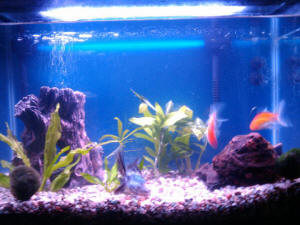
I will try to attach a picture of the tank so you can see the
aquarium. I'm looking for anything less than obvious that
I'm missing here. should I do more water changes?
<25-50% weekly should be ample.>
Would it mess up their bio-filter?
<In itself, no, you can do more water changes if you want. But
I don't think justified in this instance.>
Should I wait and see if the bio-filter and can break down the
ammonia more considering it is a newer tank?
<Possibly, but see above.>
(the fish wasn't in when it was cycling and I added a good
amount of old media from the 10gal. tank) I want to keep away
from using too much chemicals....so can I add something different
from the ammonia absorbers I'm using? (gravel looking chips
of a sand color is a mesh bag) May be take out one Aqueon filter
and put in either the Fluval or the BioWheel? (the turnover rate
is a bit high for the 20gal. though...) Is the PH a bit high?
<It is fine.>
Oh and I was wondering if there's anyway I can add a cooler
that doesn't involve huge industrial sized machines
that's bigger than the tank? :)))
<Make sure the tank isn't in direct sunlight. Also, you
can open the hood and place a fan to blow air across the top.
That will increase evaporation, cooling the water. Or, you can
freeze some water in a Tupperware, and when
solid, float the Tupperware in the tank. That'll cool the
water down. Don't go crazy with this though or you'll
chill the fish! A one-litre Tupperware should be ample for a 20
gallon tank.>
Thank You so very much for looking over my e-mail. As always best
regards to everyone and thank you for a good solid info.
source.
HAPPY DAD'S DAY!
Cordially,
Dawn
<Glad to help. Cheers, Neale.>
Re: ammonia query (Goldie Children Care)
6/21/10
Thank you Neale! The ammonia reading at .25 is from the aquarium
not tap.
<If the ammonia reading of your tap water after adding water
conditioner is zero, but the ammonia reading of your aquarium is
not zero, then you have a problem.>
Are the moth balls ok for the aquarium?
<Moss balls you mean? Yes, they're fine.>
I had a suspicious feeling about one of the plants after reading
your "out of my tank" article however I wasn't
sure. Is the stringy poop something of concern if the are
healthy?
<If the fish are fine, I wouldn't worry unduly.>
Thank you do much Ashton
<?>
for the reply!
<Cheers, Neale.>
|
 |
|
Re: ammonia query (Goldie Children Care), bier
payments 6/23/10
Hello again Neale.
<Dawn,>
Thank you again for you prompt response.
<No problem.>
I tested my water yesterday after switching out their filters and
came across some peculiar findings...The water in the aquarium is
in adequate conditions (Nitrate 0.2, Nitrite 0, and ammonia
0).
<Good.>
However you called my attention to testing my tap water and thus
I did.
<And...>
The ammonia level in my tap read to be 2.0 ppm. Is this
common?
<Far from it, but do remember, aquarium ammonia test kits can,
and often do, give misleading results. You may indeed have
ammonia in your tap water.
But you might not. Chloramine will register as
"ammonia" on an ammonia test kit. So too will
chloramine that's been safely neutralised by water
conditioner. So, the thing to do is to use a water conditioner
that neutralises ammonia AND chloramine. You can then ignore the
tap water reading! So long as the aquarium level is zero and the
nitrite level is zero, you're fine! This is one reason I
recommend aquarists use nitrite test kits rather than ammonia
test kits -- much less scope for misunderstanding, and except for
the first week or two in an aquarium's life, in the filter
isn't working properly, you should get both ammonia and
nitrite levels that aren't zero, so they're both fair
indicators of
problems.>
It grossed me out quite a bit. To answer you previous questions
about the water being left outside in the sun, I heard somewhere
that by leaving the water outside it will help remove chlorine
and the like.
<Not as such. Letting water stand will allow chlorine to
"evaporate" but not ammonia or chloramine or copper, so
generally doing this pointless.
Much better to use a good general-purpose water
conditioner.>
Also sorry for the "ashton" thing it was a spell check
with me and my phone.
<Oh.>
Thank You again!
(sorry if I'm abusing my privileges here with the
Q&A)
Dawn
<There's a tip jar on the front page. Feel free to buy me
a beer! Cheers, Neale.>
Re: ammonia query (Goldie Children Care)
6/23/10
Well what part of the green planet are you on and what type of
currency?
<I'm in the English countryside at the moment, but on the
internet, it's all good! So feel free to use whatever's
local to you.>
What is the cost of a twelve pack of your favorite refreshment?
I'll get right on it asap. The least I can do.
<We're happy to help. The beer's just a bonus!>
cheers, dawn
<Likewise, cheers and thanks, Neale.>
|
Detectable ammonia in an established tank
6/21/10
Hi Crew,
<Daniel,>
I have an issue with ammonia / test kits / pH that I'd like to run
past you. I have a 65G planted tank that I use to grow out angels. I
hadn't actually tested the water in some time as it has been
running for 4 years and keeps growing out big, healthy fish. I do
monitor pH though because I keep the pH below 7 and I soften the water
a little with peat. It has been stable at 6.4 which is a little lower
than I'd like it but I've never had a crash.
<Indeed. I'm not a big fan of low pH systems except for very
specific applications. For general community tank work, pH 7 is
adequate, even for the majority of South American tetras. Hardness is
rather more critical than pH.>
When I ran out of reagent I treated myself to an API Master Test Kit
just out of curiosity. Nitrate and Nitrite were both 0ppm but I had a
moment of panic when ammonia read at 0.25ppm. I assumed that with a pH
of 6.4 almost
all of that was ammonium but I was still worried. Some frantic Googling
explained that salicylate test kits give false positive readings for
ammonia in the presence of Seachem's Prime (which I use). I calmed
down but decided to purchase Seachem's MultiTest Ammonia which is
supposed to give a true reading in the presence of Prime.
<Supposedly so.>
The free ammonia reading was 0ppm but the total ammonia reading was
0.04ppm. This doesn't seem to be a critical issue for the tank but
I don't understand why I have any detectable ammonia.
<Oh, could be any number of reasons. At that very low level, margin
of error is going to be a factor. Remember, scientific-grade
colorimetry kits that are truly accurate down to hundredths of a part
per million will costs hundreds of dollars. Anything sold to hobbyists
will be a much more rough and ready alternative. It's the same
problem with things like pH meters and marine aquarium refractometers.
In any case, there will always be tiny amounts of ammonia/ammonium
present in aquarium water. Provided nitrite was zero as well, and as
you say free ammonia is zero, I wouldn't worry unduly.>
My tap water has chloramines but I obtained that reading 72 hours after
the last 10% water change. Is it possible that the low pH is limiting
the effectiveness of my filter (Fluval 305)?
<To a degree, yes, is possible; filter bacteria are
"happiest" between pH 7.5 and 8, depending on the bacteria
concerned.>
I understand that biological filters don't really work below a pH
of 6
<Apparently the case, or at least, the filter bacteria we normally
culture in biological filters aren't multiplying rapidly at such
low pH levels. Below 6, they all but stop.>
and (I have read) Nitrosomonas and Nitrobacter prefer a pH above 7.
<Certainly true.>
I also wondered if I could need more filtration but at the same time
my
nitrite reading has remained at 0ppm. I assumed that if there was a
problem with the filter I would see a nitrite spike.
<Indeed, though the ammonia bacteria and the nitrite bacteria have
slightly different optimal pH levels, so may respond
differently.>
I add and remove fish on a monthly basis on average but the bioload
stays approximately the same. I haven't changed my maintenance or
feeding routines. My plan at the moment is to continue monitoring
closely and begin
to slowly raise the pH.
<Well worth doing, with the focus placed on hardness rather than
pH.>
I'd be really grateful to hear any thoughts or recommendations.
<No simple answer here, but I suspect nothing to worry
about.>
Thank you,
<You're welcome.>
Dan
<Cheers, Neale.>
15 gallon FW; non-zero ammonia; death, destruction;
the need for reading... - 4/19/10
I have a 15 gallon aquarium that has a problem with its ammonia!
<This tank is far too small for Mollies and Black-Skirt Tetras; and
marginal for Platies.>
Ever since it cycled it has been at 1.
<Then it isn't cycled.>
Now the past couple of days it has been getting in the 3-5 range! I
don't know what happened. I feed them once a day(I have 7 small
fish) (2 black skirted tetra,
<These are schooling fish and kept badly, as you're doing here,
they get frustrated and commonly becoming nippy. Furthermore, their
water chemistry requirements are completely different to those of
Mollies. Like most tetras, Black Skirt Tetras prefer soft, slightly
acidic to neutral water chemistry. Mollies generally do best in hard,
basic water with at least a little marine salt mix added, and if kept
in unsalted, freshwater conditions are very sensitive to low
temperature and non-zero levels of ammonia, nitrite and
nitrate.>
2 Sunburst platy in which one looks kind of pregnant, 2 Dalmatian
Lyretail Molly and 1 black molly)
<Mollies and Platies need hard, basic water. Mollies need quite warm
water though, around 28-30 C, whereas Platies need cool water, 22-25 C.
They aren't compatible. Long term this won't work.>
and I don't know what to do about the ammonia.
<Sure you do. You just haven't done it yet. Ammonia is
essentially controlled in three ways: reducing the number of fish,
reducing the amount of unnecessary feeding, and increasing the
quality/size of the biological filter. Your tank is overstocked for
what it is, and I'll bet the filter is badly maintained and you
overfeed the fish. There may even be ammonia in your tap water you
don't remove before using it in your aquarium. So there are four
things to review. I can't offer any better advice without more
detail on your system, e.g., filter size, how you clean the filter
media each month, how much food you add, etc.>
I do regular 1/4 water changes once a week and 5 gallon water change
once a month. 1 of my Dalmatian Lyretail Molly died yesterday...but
only one died and the rest of my fish have lived longer than 2
weeks.
<Two weeks isn't much of an achievement to be honest. How did
you cycle this aquarium? Cycling is the 4-6 week period BEFORE you add
any fish. Did you do this cycling by adding household ammonia or by
adding fish flakes
every day or two. I'm guessing you did neither, and just let the
tank run maybe overnight. A lot of folks think an empty tank can cycle.
It cannot. There needs to be an ammonia source. If you didn't cycle
the tank properly,
then it's cycling now, and that's why you're killing these
fish.>
I got a new one today and she is eating just fine.
<Stop. Do not buy any more fish until you have read about the needs
of each species. Clearly you haven't or you wouldn't be adding
these fish together in one too-small aquarium. Read:
http://www.wetwebmedia.com/FWSubWebIndex/fwset-up.htm
http://www.wetwebmedia.com/ca/volume_5/volume_5_3/stocking.htm
http://www.wetwebmedia.com/FWSubWebIndex/fwlivestk.htm
http://www.wetwebmedia.com/FWSubWebIndex/mollies.htm
>
I also have one more question. Can my Dalmatian Lyretail Molly mate
with my Black Molly if one is male and one is female?
<In theory, yes. Whether they live that long in this tank is a whole
other question.>
Thanks, Ally
<Glad to help. Good luck, Neale.>
Re: 15 gallon FW; non-zero ammonia; death,
destruction; the need for reading... 4/20/10
I cycled my tank for a week, not overnight and added food in it twice a
day for a week before getting any fish. I dont know what to do about
the molly's and platy's but they seem fine together. Thank you
for your help!
Sincerely,
Alex
<It takes more than a week to mature a tank, so while a step in the
right direction, you're very likely still going through the cycling
process. As for the Mollies and Platies, for the time being they're
happy, but that may not last. We get a gazillion messages about sick
Mollies, precisely because they're difficult to keep in community
tanks. Maintained together at 25 C in slightly brackish conditions, 2-3
grammes marine mix/litre, you might be okay. But I wouldn't bank on
it, and you obviously can't keep tetras and other salt-intolerant
fish in such a system.
Cheers, Neale.>
My test results :)... FW something
3/20/10
Hello Melinda!
<Hi Jordan!>
I have done my weekly water test and I have bad or good news. Okay
pH 7.0
Ammonia 8.0ppm!!!!!!!!
<Your fish are still alive?>
Rite 0ppm
Rate 0ppm
I see the ammonia is really high!!! Is it normal I think the tank is
still cycling I'm guessing I am going to do my weekly water change
tomorrow morning I haven't added any new fish.
<Water changes should be done more frequently during the cycling
process.
This Ammonia reading is either an error (have you re-tested to be
sure?) or means that your fish are suffering badly the effects of toxic
ammonia. You want to keep ammonia as low as possible during this
process.>
And the water is crystal clear, and I added 1 live plant thank you!
<You're welcome. I would have these results double-checked just
to be sure.
--Melinda>
Algae eater/ bottom feeder with Glofish... Uncycled
sys. issues 3/4/10
Dear Wet Web Media crew,
<Hi!>
I have a 20 gallon tank with live plants and a sand substrate to which
I added 6 Cory catfish and 8 zebra Danios 5 days ago.
<I think your problem lies here. You've added too many fish at
one time, causing a "mini-cycle." I have made this mistake in
the past, and can affirm that you'll probably only make it once --
after that, if you're anything like me, you become overly cautious
about adding fish to a newly cycled tank.>
Prior to this I had let the tank cycle for 2 weeks.
<I know you mentioned that you were adding substrate from the pet
store, and I'm guessing that you meant this was seeded substrate
from an established aquarium. However, this period still seems a little
short to me. In the future, if you'd really like to
"rush" cycling, I'd suggest obtaining filter media from
an established system, rather than gravel, since filter media is in a
more direct line with water flow in the filter.>
During the cycling period I kept testing the water and also got a
neighbouring pet store to test it and everything seemed to have settled
down. As soon as I added the fish the ammonia level has gone to 0.5 ppm
('stress' on the testing strip). <<Deadly toxic.
RMF>>
<I really like the test kits that use the liquid reagents a lot
better than strips. The strips aren't always very accurate.>
I do 25% water changes daily but the ammonia levels are stuck at the
0.5 ppm. I tested the tap water in my house and that reads 0 ppm.
<Good information to have. You're lucky -- I have ammonia in my
tap water!>
The other parameters are of the tank are:
1. nitrate: < 20 ppm ('safe' on the strip)
2. nitrite: 0 ppm
3. total hardness: 300 ppm ('very hard' on the strip)
4. total alkalinity: between 120-180 ppm
5. ph: 7.8
<Okay, so everything else looks okay. The water is a little hard for
Corys, so it might be a good idea to look into their needs, as far as
that goes, and see if you can adjust this so that they're more
comfortable.
Please read here about Corys, as well as the linked files above the
title of the article:
http://www.wetwebmedia.com/FWSubWebIndex/callichthyids.htm>
I lost one Cory catfish (the smallest one) pretty suddenly 2 days after
adding the fish. She was swimming around and eating in the morning, was
listless in the evening and gone by the next morning. I could see no
reason
for the death (I examined her carefully).
<This may have just been a weak specimen, but the ammonia certainly
didn't help. The ammonia should be going down when you do water
changes, at the very least, but your strips aren't going to show it
unless it returns to zero, I'd imagine. You should see this problem
clear up in a few days, when the biological filter has had time to
'catch up' with the bioload. I think that, rather than adding
all fishes at once, it would have been better to, at the very least,
add the Danios, and then a couple of weeks later, the Corys, or even to
split each group up, and only add half of
each group every week. The fact that you stocked all at once, plus the
immaturity of the tank, and the speed of this cycle, caused an unstable
situation.>
The other fish seem fine now, but, I am concerned and do not know what
to do for the ammonia. Please help.
<I think that when you're changing water, you're reducing
ammonia, but these strips aren't showing it. In any case, within a
couple of days, you should see that ammonia go away, and turn into
nitrite. I think this process was just rushed a little too much, which
caused some problems, but the biological filter should recover. If
you'd like to see evidence of what your water changes are doing for
ammonia, I'd suggest getting a liquid test kit. Then you'll be
able to see more of a difference.>
Thank you.
<You're welcome. Good luck, and please write back if you have
any more questions.>
Meenakshi
<--Melinda>
|
Re: African clawed frogs...
Cycling Update: Ammonia 1.0, Nitrite .25,
1/18/10
<Ammonia at this level is very toxic, so I wouldn't feed
at all for two days out of three, and I'd be aggressive with
the water changes. Do make sure your tap water has zero ammonia
(some water supplies do contain some
ammonia) and if your tap water has ammonia, be sure to use a
water conditioner that removes ammonia as well as chlorine and
copper.>
pH 8, Nitrate 0 The frogs are active, eating well, and look
healthy. The 3 remaining Tiger Barbs are showing some signs of
distress.
<Yes, Barbs are very sensitive to ammonia and nitrite.>
You can see they are gasping a bit. As for the Green Corys, they
look fine.
<I bet they're unhappy with the cobblestones though! Have
tried decorating with cobblestones, and while pretty, eventually
I changed to sand or fine gravel. Why? Firstly most fish hate the
cobblestones. They can't burrow
nicely. Secondly, the cobblestones trap detritus and quickly make
the tank messy. Best avoided.>
My tank looks extremely clean from the decreased feedings and
daily water changes.
<Do remember water clarity and water quality are quite
different things.>
Thoughts or comments?
Thanks, Alex
<Cheers, Neale.>
|
  |
Re: African clawed frogs...
1/18/10
Thanks again Neale. Well you are correct. I tested the tap water
before and after adding my chlorine/chloramine conditioner and
received 1.0 ammonia readings.
<Do note that you will get a "false positive" AFTER
treating water with chloramine in it, so do check the water
*before* adding water conditioner or dechlorinator. That's what
matters. Chloramine, as its name suggests,
breaks down into chlorine and ammonia when it reacts with some
water conditioners. If a water conditioner says it treats for
chlorine, chloramine, and ammonia, then this isn't a problem.
But if the water conditioner only treats chlorine, not chloramine,
then the ammonia sits around afterwards. More of a problem. So, to
recap, test your water without any conditioner added. If it
contains ammonia, or if you want to be careful, simply choose a
water conditioner that treats chlorine, chloramine, and ammonia,
all at the same time.>
So any recommendations on the product to buy?
<Many brands; all should work fine.>
I'm sure the product you advise will take care of ammonia as
well as chlorine in my tap, so maybe I should just stop using this
generic conditioner altogether. Kind of hard cycling out ammonia
when every water change, I'm adding more.
<Again, do make sure you don't have a false
positive.>
Thanks.
<Cheers, Neale.> |
|
Fishless cycling, Freshwater 7/8/09
Hi crew, the following is an Email I attempted to send Chris Cow
Ph D.
author of http://www.tropicalfishcentre.co.uk/Fishlesscycle.htm
.
Apparently his email is not working.
<Unfortunate.>
Does anyone at WWM have experience with fishless cycling?
<Yes, it quite popular with the crew.>
Greetings , I read with great interest the Fishless Cycling
article and wanted to share my diary with you and possibly get
some feedback. My wife is the fish person while my involvement is
setup and cycling.
I have a broad mechanical/fabrication background and am enjoying
learning about aquarium plumbing and function.
<Good>
We already have a 10 gallon setup that we will use as a hospital
tank that currently contains 2 Cichlids.
<Ok>
It turns out our well water is a natural for them ( Non
chlorinated, high hardness/high pH).
<Ok>
We recently acquired a 2' x 2' x 8' 200+ gallon
aquarium free (should have been my first clue) from our
neighbor.
<Wow, nice.>
It was up and running until I moved it to our home on 6/1. After
2 weeks of work refinishing the base, building a new canopy,
beefing up foundation, polishing scratches in acrylic tank, re
plumbing pump and filters and overhauling the under gravel filter
it was time to fill and cycle.
<Lots of work.>
Added 2 1/2" fine gravel over filter(filter covers the
entire bottom with 3 evenly spaced 3/4"suctions in bottom of
tank).
<While under-gravel filters work just fine they are sort of
out of favor currently, they do have some pitfalls to be aware
of. See here
http://www.wetwebmedia.com/FWSubWebIndex/fwfiltration.htm and
here
http://www.wetwebmedia.com/FWSubWebIndex/fwfiltrmedart.htm for
details.>
Added 15- 6" x 8" x 4" rocks along with 2 dozen
fake plants and a 48" air wand.
<The rocks may cause filtration issues with the UGF as
detailed in the above articles.>
Twin cartridge filters (plumbed in Parallel) with a tested pass
thru rate in excess of 600 GPH
<Ok>
This aquarium will be an all Cichlid No live plant setup.
<Can't offer much on the Cichlids as I have never kept
them, but we have many dedicated cichlid keepers on the
crew.>
Lighting is 3- 24" Dual compact fluorescent (3- 10,000K 65
Watt white and 3-Actinic Blue 65 watt for a total of 390
watts)
<Overkill here if you do not plan on keeping plants, but
should work fine,
although it might encourage algae growth.>
All test kits are by API and ammonia is 10%. Tank temp set AT 80
degrees.
Due to time constraints all tests performed once daily at 7
AM
<Ok>
Tap water : 0 Amm(ammonia) , 0 Ni(nitrite) , 0 Na(nitrate) , 200
ppm KH(carbonate hardness) , 200 ppm GH(general Hardness) , pH
8.2
<Ok>
KH , GH , pH did not vary from beginning to end so I have omitted
them from the daily readings.
<Ok>
6/12 filled tank added 4 tsp(Teaspoons) Amm to achieve 5 ppm
6/13 Amm 4.0 , Ni 0 , Na 0 , added 4 tsp Amm
6/14 Amm 5.0 , Ni 0 , Na 0 , added 4 tsp Amm
6/15 Amm 5.0 , Ni 0 , Na 0 , added 4 tsp Amm
6/16 Amm 10+ , Ni .25 , Na 8 , added 4 tsp Amm
6/17 Amm 10 , Ni 1 , Na 10 , added 4 tsp Amm
6/18 Amm 8 , Ni 5 , Na 10 , added 4 tsp Amm
6/19 Amm 2 , Ni 1 , Na 8 , added 4 tsp Amm
6/20 Amm 0 , Ni 5 , Na 7 , added 4 tsp Amm
6/21 Amm 0 , Ni 5 , Na 8 , added 2 tsp Amm
6/22 Amm 0 , Ni 5 , Na 8 , added 2 tsp Amm
6/23 Amm 0 , Ni 5 , Na 8 , added 2 tsp Amm
6/24 Amm 0 , Ni 5 , Na 8 , added 2 tsp Amm
6/25 Amm 0 , Ni 2 , Na 8 , added 2 tsp Amm
6/26 Amm 0 , Ni 1 , Na 8 , added 2 tsp Amm
6/27 Amm 0 , Ni 1 , Na 7 , added 2 tsp Amm Cartridges changed
6/28 Amm 0 , Ni 1 , Na 8 , added 2 tsp Amm
6/29 Amm 0 , Ni .5 , Na 8 , added 2 tsp Amm
6/30 Amm 0 , Ni .5 , Na 8 , 50 % water change & added 2 tsp
Amm
(thought we were done, my mistake) Green algae and brown algae
(Diatoms ?)appear
<Common in new tanks, water changes to keep it in
check.>
7/1 Amm 0 , Ni 1 , Na 8 , added 2 tsp Amm
7/2 Amm 0 , Ni 1 , Na 8 , added 2 tsp Amm
7/3 Amm 0 , Ni 1 , Na 8 , added 2 tsp Amm
7/4 Amm 0 , Ni 1 , Na 20 , added 2 tsp Amm
7/5 Amm 0 , Ni 1 , Na 10 , added 2 tsp Amm
7/6 Amm 0 , Ni 1 , Na 15 , added 2 tsp Amm
7/7 Amm 0 , Ni 1 , Na 10 , added 2 tsp Amm
Green algae and brown algae(?) multiplying to cover all large
rocks.
<More water changes will help, 10-15% weekly ideally in my
opinion, biweekly at least.>
Sooo I'm a little confused.
Hardness and pH haven't changed, Ammonia has crashed, Nitrite
seems to beholding at 1 ppm, and Nitrate seems to be wallowing
around 10 to 20 ppm.
<Nitrates are the end product, and need to be removed by water
changes, more filter material may be necessary to get the nitrite
down to 0.>
Am I missing something or is this on track and just not done
cycling ?
<Is not done, although hopefully will be soon, usually takes
less than a month but with this sized tank and it may take a
little longer.>
Will the brown algae(Diatom?)die off or do I need to take
action?
<Nutrient control should keep it in check, pretty hard to
eliminate completely especially without live plants to compete
for resources.>
Still having fun just want to make sure I'm not spinning my
wheels.
<You seem to be on track here. Enjoy, you have a nice start
here and a tank that gives you lots of options.>
Thanks, Chris
<Welcome>
<Chris> <<Stop pouring in the ammonia. You're
forestalling establishment of nitrification... RMF>>
|
 |
|
Re: Fishless cycling 7/9/09
Hi Chris
<Hello>
Thanks for the input. Your site and forum are far and away the
best resource on the web.
<Thanks>
It has been in the back of my mind for a while that the amount of
Ammonia I add every day could be overwhelming the biological
filer, so unless you have reason to object, I think it is time to
shift gears. The article says to do a 80% water change before
adding fish so I'm thinking I could do this and at the same
time reduce the ammonia added daily to 1 tsp.
<Ok>
I will continue to test daily and also take your recommendation
of 15% water changes weekly.
If the Nitrite drops to Zero that should support the idea that
the biological filter is either to small or not completely
developed ( I lean toward the latter).
<Agreed>
My wife ordered (on hold) 60 juvenile - 1" Mbuna Cichlid :
12 Demasoni, 12 Electric Yellow, 12 Red faced Mac, 12 Rusty and
12 Obliquidens Zebra's from www.livefishdirect.com. According
to the article the amount of ammonia we have been adding is well
in excess of what a fully stocked tank will produce.
<Probably, but I would still not try to introduce all these
fish at once, small groups least to most aggressive.>
If this is true 60 juveniles should be a small percentage of what
the biological filter will eventually need to support.
<Most likely.>
Assuming I do all the above how long should I wait to stock the
tank ?
<Once nitrite hits 0 and stays there you should be ok.>
I knew when I built the canopy that the lighting was overkill but
I didn't want to build it twice and I wanted to allow for
future possibilities.
<Good idea.>
I will continue to research the under-gravel filter (thanks for
the links).
Assuming that the UGF stays what would your recommendations be
for possible live plants to combat the Diatoms/Nitrate ?
<Live plants are often problematic with UGF, could try some
floating plants, or set up a sump/refugium to grow plants
in.>
We have a standing order on hold for
<Stock slowly, patience is key here.>
<Chris>
Re: Fishless cycling 7/12/09
Hi Chris Saw my previous post(with your inputs) on WWM
website.
At the end of the post "RMF" added a comment to the
effect that I should stop adding ammonia altogether.
<Yes... adding ammonia at this juncture is very likely
poisoning your beneficial microbes>
If I interpreted this correctly then I either have to add fish
immediately or the biological filter will die for lack of
ammonia/waste.(?)
<Neither my friend. I would simply add a "pinch" of
some dried food at this point... the protein therein is
sufficient to supply nitrifying microbes>
A brief update : After an 80% water change and reducing daily
added ammonia to 1/2 Tsp ammonia,
Tests on 7/10 thru 7/12 show 0 ppm Nitrite and 5 ppm Nitrate. If
this continues it is my intention to stock the tank on 7/17.
My question for you or any crew member with Cichlid experience is
about the manner in which I stock.
My wife and I have researched this extensively and the consensus
seems to be that if we are going to have an all Cichlid tank,
then the proper method is to Purchase "All juveniles"
of varieties known to
coexist successfully and to introduce them all at once.
<This is the best approach>
From what we read this leads to less aggression and attrition.
What are we missing in this equation?
<Perhaps to start with all individuals of about the same
size>
Once again I thank you for your patience and help.
Chris
<Welcome. Bob Fenner/RMF>
Re: Fishless cycling 7/13/09
Thanks so much! Will go with adding flakes starting tomorrow. And
yes, the plan is to stock all 1"/1.5" juvenile
fish.
Once again, we think that you have one of the greatest sites
around for information.
We spent many hours reading WWM prior to doing anything to setup
this tank and I am certain that the information we have gleaned
will keep us out of trouble.
Thank you again and have a great day!
Regards,
Dawn & Chris
<Thank you D & C. BobF>
|
|
Ammonia problems in pond, trop. 9/22/09
Hello Crew--
My husband and I are having some problems with ammonia in our
pond, and we don't know why. I really hope that you can help,
because it's so frustrating to have built this indoor pond
for these fish, only to have them be subjected to ammonia! That
really wasn't the point! This is in our 1,000 gallon pond
with the two Pacu and one Red-Tailed Catfish. About a month ago,
I noticed a slight ammonia spike (.5, at the most).
<Yikes!>
I immediately assumed that it was time to increase water flow
through our filter, as we were only running about 4,000 gallons
per hour, and I know that 10x is recommended. So, we ordered
three new pumps, and they're 5,000 gallons per hour each, so,
after the plumbing (elbows and such) we should be getting around
12,000 gallons per hour. The filter is approximately a 7 ft by
1.5 ft by 3 ft area, and it is
filled with Matala filter media pads, just stacked one on top of
the other. Tucked onto the very top of the pads is a layer of
filter floss. We're still experiencing ammonia problems.
<Unusual... By what measure?>
The only chemicals used in the pond are Prime, and now, Organica
Pond Clarifier, because it absorbs ammonia. However, we were not
using this product prior to the ammonia presence, and I have
never heard anything about Prime causing a false positive on
ammonia tests, so I think we have ruled out a false positive,
especially considering we use Prime in all of our tanks. Our
ammonia tests come in at zero when I test the other tanks, so I
know it's not a bad test. We have no nitrite, which is
strange, because there's always a little ammonia, except in
the couple of days after we add the Organica. It's like the
cycle is "stuck." Though I didn't like it, at
first, I did not add Organica. I didn't want to arrest the
cycle, so I waited. Ammonia climbed to 1 over a week and a half,
and I started doing water changes and adding the Organica.
However, I would think that within this time, we would have seen
nitrite. Nitrate is between 10 and 20. We do 30% water changes
(just changing water) once per month, and also rent a pond vacuum
and vacuum the gravel
<I would skip a month or two and see if this ammonia
disappears>
once per month, which removes roughly the same amount of water.
Prior to the initial ammonia spike, we didn't do any of the
things that usually kill off beneficial bacteria -- no
non-treated tap water was used to clean anything, no
over-cleaning, and no medications have ever been used in the
pond.
The only thing I can think of that's left is pH, which is
6.0. Could this be crippling the biological filter?
<Yes... it could>
I have read in various replies on the site that bacteria
don't function as well at this low level, but since we have a
180, 125, and 75 gallon tank with no problems, I'm not sure
this is the cause. What do you think?
Should I work on raising the hardness? Our water comes out of the
tap at 6.6.
<I would be buffering this up to about neutral, 7 or
so>
We are in the process of setting up a 50 gallon stock tank with
water lettuce and a fluorescent fixture with grow lights to
slowly pump water out of the pond, through the stock tank, and
pour back into the pond. We're hoping this will help (it
should be up and running tonight). The water lettuce has about
twelve to fourteen inches of roots on it, so we have our fingers
crossed that we'll see some sort of change.
<Might well help>
I'm sorry for the novel, but I wanted to give you as much
information as possible. I appreciate any help that you can give
me, because I'm stumped, and the situation is frustrating!
Thanks again for all you do.
--Melinda
<Thank you for writing so completely... I would do what you
have planned and look into bolstering both the pH and alkaline
reserve. Please read here re:
http://wetwebmedia.com/FWSubWebIndex/fwph,alk.htm
and the linked files above. Bob Fenner>
Re: Ammonia problems in pond -- 9/22/09
Hello Bob--
Thank you for your reply. We will stop gravel vac'ing the
pond for a couple of months, and will begin to add Neale's
Rift Valley Salt Mix at the dosing he suggests for community
aquariums. We'll probably do this very slowly, monitoring
hardness and pH constantly, and only add enough to get to a pH of
7. Hopefully, we'll see some improvement. Again, thanks.
--Melinda
<Thank you Melinda. Please do report back with your findings,
results. Bob Fenner>
Re Ammonia Problems in Pond... Resolved!
10/4/09
Hi Bob--
I'm writing back to update you on an earlier e-mail, in which
I explained that ammonia levels were present in our pond. We
began to add Neale's salt mix slowly. In order to avoid doing
250 gallon water changes over and over, we mixed up a batch which
would "treat" 500 gallons in a 55 gallon barrel.
<Good>
Then, we added half of the barrel every few days, testing each
time. We have now treated 75% of the water at Neale's
community fish suggestion.
Our pH is up to 7.2, and KH is at 3. Best of all, ammonia has
been 0 for six days! Our nitrates are up, so we'll do a large
water change tomorrow, and, obviously, replace what we take out,
but this worked so fast, and it was so easy, and so cheap.
<Ah yes... like moi>
I really appreciate your help in this -- it would have taken me a
lot longer to come to the conclusion that you suggested.
We're going to begin using this mix in our other freshwater
aquariums, as well. I have one more question -- do you suggest we
go ahead and add the rest of our solution in the barrel to the
pond, thereby treating 100% of the volume?
<I do>
Or, should we add the rest, and raise KH levels higher? Will this
raise pH more (we are a little above what you suggested to me in
your e-mails)?
Thank you again!
--Melinda
<Should raise pH only slightly. BobF, who will share with
Neale>
Thanks for your help with the indoor pond!
10/4/09
Hi again Bob--
We'll definitely add the rest of our solution of the salt mix
to the pond. Thanks for your speedy reply, and please pass along
thanks to Neale for coming up with the mixture!
<Will do so>
I just wanted to provide a photo of the fish that WWM has helped
so much.
And, no, your eyes are not playing tricks on you... there are 3
Pacu now.
The last, and final, Pacu was 20 inches long, and living in a 55
gallon tank before he came to us.
<Imagine its relief! To go from a world 13 inches wide to your
home>
I have promised myself, the fish, and my husband that no more
fish will be added! Thanks again for all of your help throughout
this process.
--Melinda
<Thank you for sharing. BobF>
|
 |
Re: Ammonia Problems in Pond...
Resolved! 10/5/09
<Should raise pH only slightly. BobF, who will share with
Neale>
<<Thanks for the update. Yes, Bob is correct, raising the KH
generally doesn't raise the pH wildly. the minerals responsible
are buffers, steadying the pH in both directions. For pond fish,
something around pH 7.5 is ideal. The pH will go up and down
through the daytime cycle, depending on photosynthesis, even as
high as pH 9, but this doesn't seem to cause pond fish
problems. But a pH drop, much below 7.0, is much less tolerable,
especially for carps (e.g., Goldfish) which don't like
soft/acid water.
Cheers, Neale.>
re: Thanks for your help with the indoor
pond! 10/5/09
Hi again Bob--
We'll definitely add the rest of our solution of the salt mix
to the pond. Thanks for your speedy reply, and please pass along
thanks to Neale for coming up with the mixture!
<<Glad to have helped. The mixture certainly *isn't*
mine. I'm trying to think where I got it from. If I recall,
from the excellent The Krib site?
That sticks in my mind for some reason. Anyway, credit where
credit's due.
Enjoy your fish! Cheers, Neale.>> |
... fish sitting down... SW, FW?... Ammonia present...
6/23/09
Dear Crew,
Two of my fish have been sitting down at the bottom of my tank and one
of them has already died. And the ammonia level is low. Their
doesn't seem to be anything wrong.
What should I do?
<? Keep reading>
Ammonia Issue 05/23/09
High Ammonia Issues In Goldfish Tank
Hello, A month ago I upgraded from a 10gal to a 40gal tank. I've
had the 40gal tank set up for a few weeks now and I have 2 lionheads, 2
calico Ryukins, 1 black moor, and 1 common goldfish in there. For a
while the ammonia in the water was ok, until I checked it again a week
ago and the ammonia spiked to 8.0ppm!! I put in ammo lock, and I've
done several water changes but I am unable to get the ammonia down at
all. There are signs of nitrites and nitrates.
The API liquid tests read
Ammonia: 8.0ppm
Nitrate: 5.0ppm
Nitrite: 0.25ppm
I do not know why for the past week there was the ammonia spike, and
why I am unsuccessful in getting the ammonia lowered. It's
stressing me out, and I'm sure it's stressing my goldfish out!
I'm assuming the tank is cycling but again the ammonia is extremely
high. I have yet to lose a fish but I'm worried that soon I will if
I can't figure this out. I've tested the tap water for ammonia
and it tested 0 ppm. I do treat the water with AquaSafe and make sure
it is at room temperature before I put it back in, I've siphoned
the rocks to clear the debris. During the day the fish are swimming and
active, however during the evening they seem to hangout at the top of
the tank. Again I've used ammo lock to neutralize the ammonia in
the tank. Perhaps get an air stone to help put more oxygen in the tank?
I don't know what else I can do to alleviate this ammonia problem.
Any help would be great. I'm running out of ideas, and I am bound
and determined to not lose any fish. Thank you, Annie
< You should have transferred the gravel and the original filter
media with the additional nitrifying bacteria to the new tank to help
it get cycled. You are starting from scratch so you are experiencing
new tank symptoms. Add Dr. Tim's One and Only as per the
recommendations on the bottle. In a couple of days the ammonia and
nitrite levels should come down to normal levels. Then you can start to
do water changes to keep the nitrates under
20 ppm.-Chuck>
Re: Ammonia Issue 05/23/09
High Ammonia Problems When Upgrading Tank
I did transfer the old gravel over, and I did transfer the old filter
media and we did add cycle. I don't know if cycle works but I did
make sure those steps were followed. I will use Dr. Tim's and
follow the directions! Thank you for the advice, it's been the most
resourceful information on this problem. Thank you, Annie
<I have found that Dr. Tim's products to be very effective in
getting tanks started again. Many tank maintenance pro's use it
when setting up new tanks. The filter media and gravel may not have
been enough for the bigger tank or something may have happened to these
materials during the upgrade to slow down their
progress.-Chuck>
No change in ammonia level, FW, reading
9/24/08
Hello again,
Is there some reason a 20-25% water change would have absolutely no
effect on the ammonia concentration levels in the tank?
<Mmm, the sensitivity of your test gear, assessment of reading, the
constant production of this metabolite...>
Here are the details:
55 gallon long tank with an Aquaclear 70 HOB filter (the media are a
sponge, carbon, and something they call a "BioMax" bag for
promoting beneficial bacteria growth)
4 Apple Snails and what they've left of Ceratopteris Cornuta
(inconsequential amounts)
The tank's only been set up since September 8.
.50<NH3/NH4>1.0
NO2 0
NO3 0
Chlorine 0
GH 75
KH 120
pH 7.6
NH3 readings did not change after the water change???
<Mmm, and the water change may have "set back" the
nitrifying bacteria...>
I was under the
impression that changing the water would dilute the ammonia
concentration.
<Does initially...>
I've tested my tap water and the ammonia is 0. My concern is the
snails.
They're eating and growing but they've also got their siphons
out a lot.
They're not specifically going to the surface to use the siphon,
but they're putting it out. I read somewhere that only when oxygen
supplies in the water were optimal would the snails NOT use their
siphons. Plus we all know the ammonia is damaging. It's why I tried
to cycle fish(life)less to start with. So, should I be concerned
here?
Thanks
Laura
<Mmm, concerned? Yes... and patient. Please read here:
http://wetwebmedia.com/FWSubWebIndex/fwammfaqs.htm
and the linked files above. Bob Fenner>
Re: No change in ammonia level-Follow Up
9/24/08 Mr. Fenner, Thanks for your response this morning.
Acting on your advice, I read the FAQs regarding cycling and ammonia.
After reading, I decided it might be beneficial for the livestock if I
added BioSpira to the tank. <Ah, yes. If you can still find this
fine product w/in "freshness date"> A friend of mine noted
that I'll need to raise the temperature of my tank in order for the
BioSpira to work, but if I do that it'll work perfectly. Well, as
you are well aware Apple Snails (of which there are now 4 residing in
the tank) don't really like temps warmer than 77F. Currently the
temperature is around 75F. <I would not raise it> Will it harm
the snails to spend some time at more of a tropical temperature with
lower ammonia, or should I forego the BioSpira and risk some real
toxicity? <Monitor the ammonia period... and the pH importantly, not
to let it get any higher... do not feed at all if the free ammonia is
0.5 ppm. or higher... It will "go down" in time I assure
you> (The answer seems obvious now, but I'm learning that not
everything in this hobby is as logical as it seems it should be) Thanks
for everything. Laura <Welcome. BobF>
Ammonia vs. temperature 9/17/08
Is ammonia less toxic at 69 degrees F. than it is at 74 degrees F.
?
<Makes no difference. Ammonia is dangerously toxic at any
temperature. Cheers, Neale.>
<<Mmm, more so with elevated temperature, but do agree otherwise.
RMF>>
|
The tank won't cycle! Never ending ammonia. 8/1/08
Hello, <Hello,> I have a frustrating problem that I brought
upon myself. I went a little crazy when cleaning an established
15 gal. freshwater quarantine tank. At the time, it was hosting
seven young fancy platys. They had been there just over a week.
When I did the regularly scheduled water change (I change 20%
every other week in all my aquariums), I noticed there was quite
a bit of Pleco dirt on the bottom left over from a previously
quarantined fish a month before. You guessed it. I over-vacuumed
the gravel which siphoned off two-thirds of the aquarium water
and, like a fool, I had changed the filter pad that week too. A
couple days later I had three dead fish, tested the water and
found the ammonia spiked at 2.0 <Removing water has ZERO
impact on how well a biological filter operates. There are
virtually no bacteria in the water. If you want to change 100% of
the water, then go ahead. Just did this myself yesterday with my
180-litre system because I emptied it to redecorate. All I did
was make sure the temperature and water chemistry weren't too
different from the water I'd taken out. Likewise rinsing or
vacuuming filter media (including gravel) does no harm provided
the media doesn't dry out and isn't exposed to water with
much different temperature or water chemistry.> Still kicking
myself, I pulled the surviving fish and stuck them in temporary
hospital tanks and waited for the 15 gal to start cycling and
balancing out. That was five weeks ago. The ammonia is still at
.5 and nitrite and nitrate are still not showing up at all.
What's going on? Should I be doing something besides waiting?
Where's that nitrite? <To be honest, I suspect the tank is
under-filtered, overstocked, and/or overfed. Platies are too big
for a 15 gallon tank once they're mature, and while you might
have been fine when they were younger, as they grow they will of
course put more strain of the filter. Undergravel filters can
work very well, but their capacity depends on how deep the gravel
is, how fast the water is moving, and how small the gravel
particles are. In any event, if you are finding your ammonia
isn't going down, then one of these issues is to blame:
review the filtration, stocking, and feeding.> I thought about
trying bio-Spira but I did not have any luck with it when I
bought it once before. Any advice is appreciated. I really miss
having that big quarantine tank always standing ready. I'm
almost considering tearing the whole thing down and trying to
start the cycle up again. The java moss and crypts are growing
beautifully, BTW. ~Mars <Hope this helps, Neale.>
Re: The tank won't cycle! Never ending ammonia.
8/2/08 Thanks, Neale. I doubt overstocking is an issue here.
<The filter is inadequate/immature, or the tank is overfed.
The ammonia comes from decaying organic matter, and that comes
from fish and their food. There's really no argument over
this linkage, so if you have ammonia in your aquarium that never
goes away, then your problem is one of these issues. My gut
feeling is under-filtration, or at least improper maintenance of
the filter or perhaps bad choices re: media. Review these topics,
and address any problems.> The seven platys were quite small
and, as it is a quarantine tank, only destined to stay in the
tank for 2-3 weeks. The Pleco that resided there the month before
had been long removed to his new home. There were no other fish
in the tank. However, judging from the amount of debris, it's
clear I hadn't vacuumed properly after the Pleco was moved.
<OK.> The filter isn't an undergravel but a Penguin
Bio-Wheel 100 which is supposed to filter up to 20 g. <Not a
fan of going by the recommended capacity of a filter. I much
prefer the turnover rating.> I was looking at it yesterday and
wondering if this filter might be the cause. The tank is a 15
tall and the intake does not reach all the way to the bottom so
there is likely a lack of circulation on the bottom. <Sounds a
good analysis. I'm just not wild about these hang-on-the-back
filters. I know they're popular in the US, but you hardly see
them in the UK, and I don't miss them! If you're on a
budget, then a properly set up Undergravel filter or a sponge
filter will work much better, with less to go wrong and much
easier maintenance. For breeding tanks, sponge filters are
particularly good because the gentle water current helps the baby
fish, and the baby fish love nibbling on the algae and
micro-organisms that grow on the sponges. Bubble-up box filters
can also be very good for the same reasons.> I mocked up an
extension and will give it another week to see if that helps.
It's odd as I have not had water quality issues with this
tank before. It's been set up for a year and a half. <The
filter may well be mature but just inadequate for some reason. Do
consider that filter cartridges containing carbon are basically
wasting space that could be used for biological filtration. When
push comes to shove, biological filtration must always be the
priority. Again, that's why I like sponge filters for small
tanks.> ~Mars <Cheers, Neale.>
|
|
Mbuna and Ammonia Problems 7/7/08 Hi there.
Wondering if you may make a couple of suggestions regarding
filtration, etc. <Sure thing!> A number of months ago, I
read Ad Koning's book on African Cichlids. Since I was
experiencing ammonia levels in my 55 Mbuna tank, I followed his
advice and fed the fish once every other day (vs. 2-3 times per
day). This brought on a great deal of aggression and I lost a lot
of fish. So I went back to feeding them twice per day - an amount
they can consume within 30 seconds. <I have to say I agree
with your experience. Whilst in theory feeding fish less than
once per day may have distinct advantages, on balance I'm in
favour of the "multiple small meals" approach. All my
day-active fish get two meals per day, but small ones. One in the
morning, another in the evening. The catfish get their pellets or
wafers at night, after lights are out. This way you spread out
the ammonia and problems with uneaten food.> I then commenced
doing 10% water changes every other day which did nothing to
abate the ammonia levels. <Ah; well, if you're getting
ammonia present "in real time", then there's three
things to consider -- overfeeding, under-filtering, or
overstocking.> I am back to conducting 30-40% water changes on
Saturdays. Despite taking ammonia tests, which show no trace of
ammonia, a few of the fish still flash. I've been treating
the water with Amquel which neutralizes ammonia and I have found
this effective. I also have a canister and a large hang on filter
equipped with ammo chips. I change the filter media once per
month (not at the same time intervals). <Chemical ammonia
removers only work up to a point, and once a dose has been used
up, any new ammonia produced by the fish is left untreated.
Amquel is of no value at all in this context; it is exclusively
for removing ammonia from tap water prior to adding fish.> I
understand bio media aid in the nitrification process. Both
filters are loaded with the stuff. What to do? I must be doing
something wrong? <As outlined above. Given the tendency for
Mbuna tanks to be overstocked, filtration has to be profound.
I'd reckon on a big canister filter at least 6 times and
ideally somewhere between 8-10 times the volume of the tank in
turnover per hour. So adding a second big canister might be just
the ticket.> Look forward to hearing from you. Lisa Mae
<Hope this helps, Neale.>
Re: Mbuna and Ammonia Problems 7/9/08 Hi Neale, thanks
so much. With both filters (canister and hang on) I'm turning
over an equivalent of 685 gph which meets the needs of the 55
gallon tank. The canister is only filtering 185 gph which is
rather weak. Looks like I need to seriously upgrade the canister.
What about media Neale? Is Zeolite effective if changed/recharged
once per month? What do you use to combat ammonia levels and
spikes? Thank you very much! Lisa. <Hi Lisa. The problem with
combining multiple "weak" filters on a single big
aquarium is that unless you position their inlets and outlets
carefully, it is very easy to end up with corners of the tank
with minimal water movement. Adding powerheads can help, as will
an undergravel filter. But in all honesty, with fish are big and
messy as Mbuna, filtration needs to be robust. If you are
detecting ammonia, then you clearly don't have enough
biological filtration. I wouldn't bother with Zeolite --
realistically this will be very expensive, and removing some
biological filtration media from one filter to replace it with
Zeolite makes no practical sense at all. So, what I'd look at
is something like a couple of Eheim 2217 'classic'
filters. These aren't expensive, have lots of capacity for
biological media, and are extremely reliable. At about 260
gallons per hour turnover, two of them would give you well over
10 times the volume of the tank in turnover per hour. You could
of course simply add one and use that alongside what you already
have, or combine one filter with a reverse-flow undergravel
filter that would take care of carbonate hardness as well as
ammonia. While old school, reverse-flow undergravel filters are
inexpensive to set up and extremely effective at dealing with
ammonia and solid waste. Either way, fill with good quality
ceramic media or sponge for biological filtration. That should
take care of your ammonia. In properly maintained, mature aquaria
with suitably sized filters, you shouldn't get ammonia spikes
or problems. It's as simple as this: if you detect ammonia,
you either have too many fish for your filtration system; put too
much food in the system for the filter to deal with; or just
don't have enough filtration for the overall bioload. Cheers,
Neale.>
Re: Mbuna and Ammonia Problems 7/9/08 This is great
info - thank you so much! My problem has to be poor filtration -
I only have about a dozen Mbuna in the 55 gallon so I'm not
overstocked. I'll swap my current canister for the Eheim
2217. Thank you! <Hi Lisa. The concept of "being
overstocked" is a practical rather than theoretical one,
which is why I am leery of these inches-per-gallon rules. If you
have a system where ammonia never gets to zero, you're
overstocked. As you say, on paper at least a dozen 10-15 cm Mbuna
should comfortably fit into a 55 gallon system. But in practise
these fish are so active and have such high growth rates that it
is very easy to find the otherwise reasonably sized filter being
overwhelmed. I have a 40 gallon system in which I keep a few
smallish tetras and glassfish along with a 15 cm Panaque
nigrolineatus. Although water quality is perfect, the tank itself
gets dirty very quickly simply because the catfish eats wood and
produces masses of brown faeces. So it has two canister filters
offering water turnover of almost 10 times per hour. Seems
ridiculously over-filtered on paper, but actually the least I can
get away with! In other words, one should go by empirical data --
ammonia tests for example -- rather than what is stated on the
box the filter came in. Cheers, Neale.>
|
Water problems... ammonia, cycling, treating tap... --
6/11/08 Hi! <Hello,> I bought a 20 gallon aquarium about
a month ago. I put some fancy goldfish in it to try and help cycle
it. <It's a lot easier (and nicer on the fish) to use a
"fishless method". The best of these is merely to grab
some filter media from one aquarium and stick in in the new
aquarium's filter.> About 3 weeks into owning it I ran into
an ammonia problem (obviously part of the cycling process I take
it). I started frequent water changes (every day) because the
ammonia level was in the stress-harmful zone (lost a fish).
<Yes, ammonia is likely the problem here. There are commercial
products that can jump-start the filter by adding live bacteria.
The most popular seems to be Bio Spira, though I admit to never
having used any of them. I prefer to "seed" filters using
media from other tanks. 100% effective, zero cost!> My question
is this ...my tap water even after conditioning it with
dechlorinator is still in the safe range but not ideal. <Meaning
what? It has ammonia? First thing -- there is no "safe"
level of ammonia; it's like being pregnant, it's a binary
state sort of thing. So, you either have zero ammonia in the water
(which is good) or not zero ammonia (which is bad). Some water
supplies do contain traces of ammonia, which can be fixed using
products like Ammo Lock or even many dechlorinators. Secondly, do
remember that if you use some (older formulation) dechlorinators on
tap water that contains chloramine rather than chlorine, you
actually *make* ammonia.> Obviously, when doing a partial water
change the ammonia level goes up after a couple days because the
tap water isn't ideal to begin with. <Hmm... the quantity of
ammonia in new tap water should be zero or very low; if the ammonia
concentration goes up or at least fails to go down, then the
problem is more about lack of filtration, overfeeding, or both.>
Any ideas of what to do to remedy this problem (without buying
expensive bottled water)? <Tap water, particularly hard,
alkaline tap water, is ideal for Goldfish. Use an
ammonia-neutralizing conditioner on all new water, and that should
take care of the small (typically less than 0.5 mg/l) ammonia in
the tap water. Your job now becomes ensuring the filter system
handles the ammonia produced by the fish.> I was thinking to try
a double dose of the dechlorinator? Currently I am using
"AquaSafe" (1 teaspoon to every ten gallons) <Not
familiar with the brand. In any case, use the dose as indicated on
the package. If it says it neutralises ammonia, then fine. If not,
you'll need to switch to (or supplement with) another
conditioner that neutralises the ammonia in tap water. Understand
this: no "ammonia removing" conditioner will do ANYTHING
about the ammonia produced by your fish. As far as you're
concerned, these are utterly different issues.> Any advice you
could give me will be greatly appreciated as I would like to get
away from changing water every other day <I understand. First,
make sure you're treating new water correctly to remove tap
water ammonia. Secondly, review filtration/feeding to see if the
ammonia produced by the fish is excessive. Do have a read of the
'setting up' articles we've got here at WWM, perhaps
starting with these:
http://www.wetwebmedia.com/FWSubWebIndex/fwset-up.htm
http://www.wetwebmedia.com/FWSubWebIndex/fwfiltration.htm Cheers,
Neale.>
Re: Water problems 6/13/08 Thanks for the
informative advice! <You're welcome.> I went today and
bought a larger filter instead of the 10-20 I bought a 20-40
Ammonia levels dropped almost immediately after I put on new filter
and changed water. <Very good.> One fish has ammonia scars on
his little tail (not bad I've seen way worse) He keeps flashing
around tank. Anything I can give him that will ease him? <Treat
for Finrot. He'll recover. Provided the damage is superficial
and limited to the fin membrane rather than the body, fish tend to
recover quite well.> Thanks Oh, also the tank I have I bought at
a garage sale for a buck and it seems to be a homemade one as it is
much taller than wide (not like in stores). The tube from filter
doesn't really go down to the middle of the tank. Any Ideas on
how to extend it? <What sort of filter is this? One of those
hang-on-the-back ones? Not sure they can be adjusted as you
suggest. This does cause a problem that the bottom layer of water
could be relatively stagnant. Adding an airstone would help, or
even another little submersible electric filter or air-powered
sponge filter placed closer to the bottom of the tank.> I
checked with PetCo and they sell nothing. I was thinking maybe a
piece of plastic tubing from Menards to attach? Could that have
been one of the problems? (The tube goes down around a foot and a
half) about 3-4 inches from middle of tank) <Well, it could
help. But the pump mechanism might not work so well if the inlet is
located that much further away from the impeller. I'm not an
engineer though so can't comment with any authority here!
Cheers, Neale.> |
Chronic Ammonia? 5/10/08 Hey y'all, Love the site, it has
helped me more times than I can count. This is my first time writing in
as I cannot find the answer anywhere else. I have had my fresh water
aquarium up and running now for about three months. At this time It
contains a silver Arowana- 8in, a clown knife- 8in, a jewel cichlid-
3in, a common Pleco- 4in, and two crayfish. My dilemma is that the
ammonia has registered around 4 ppm for about a month now. I figured
the test may have gotten old so I replaced it with a new one and the
readings are still around 4ppm. Now for the puzzling part: My Nitrites
have consistently been at zero since the cycle finished, my Nitrates
are around 10ppm consistently, I do bi-monthly water changes of 25%, I
do not overfeed my fish, my aquarium is bare bottom, and no one in the
tank exhibits labored breathing, scratching, or any other stressful
behavior. As I monitored the cycle the ammonia spiked (as it should),
and never dropped below 1 ppm. Then I noticed in the months that
followed the ammonia would not drop. Now it has apparently skyrocketed
to 4 ppm just in the last month as I said. Could there be an inhibitor
for the ammonia eating bacteria, or could there be something in my
aquarium giving me false positives? I would have to assume that if my
ammonia was really this high for any length of time my fish would at
the very least be acting funny, and my crayfish would definitely be
dead. Any suggestions or advice would be greatly appreciated. Regards
James <Hi James. As you seem to understand anyway, ammonia comes
primarily from the fish, either as an excretory product or else because
of the decay of uneaten food. So you could review your filtration and
consider whether an upgrade (or perhaps a service) is in order. For
fish of the type you're keeping, I'd be recommending turnover
rates of 8-10 times the volume of the tank. Things like carbon are (in
my opinion) a waste of filtration space, so removing carbon the make
space for more biological media may be in order. Water changes of 50%
weekly would also be recommended for this type of system, but
that's not really relevant to this particular problem. More
important might be the size of the tank: unless the tank is
fundamentally big enough (in terms of volume) to dilute the ammonia the
fish produce, the combination of a too-small tank with too-weak
filtration system can result in persistent levels of ammonia. Or put
more simply, the filter never gets enough time to remove the ammonia in
the system, and the tank isn't big enough to dilute what remains.
For these types of fish, the aquarium will need to be 750 l/200 gal in
size once the fish are adult, though juveniles might get away with a
somewhat smaller system. Now, the other issue is servicing the filter.
Filters need a certain amount of care, in particular cleaning. Removing
the filter media for a rinse is fine, but some folks overdo this and
end up killing the filter bacteria. Conversely, if the filter gets
clogged, the lack of oxygen lets the bacteria die as well. One last
consideration is your water. Some water supplies come with a certain
amount of ammonia; others are treated with chloramine, and this can
split into chlorine and ammonia when treated with traditional
dechlorinator. So test your tap water. Cheers, Neale.>
Problems with ammonia, Goldfish in too small a
world, reading 4/28/08 I have two fancy goldfish who are
currently living in a 10 gallon aquarium. <Stop! This is the real
problem... Need more room than this...> I am now aware that ten
gallons is not sufficient and I am looking into upgrading to 30
gallons, hopefully in the near future. In the meantime, I am trying to
cycle my tank <!? Fish should not be present during> and I am
very concerned about the ammonia levels. Unfortunately, I did not know
about cycling ahead of time. <Take the fish back> The pet store
did a quick water test of my two day old aquarium water and said I was
"good to go." I knew that a biological filter would have to
develop, but I thought it was OK to do that with the fish in there.
<No> I didn't know how hard it would be on them and that I
would have such trouble addressing the issues with ammonia. Regardless,
I now have two adorable fish looking to me to provide a safe
environment for them. I added the two small goldfish (one Oranda, one
Ryukin) 17 days ago and I have been trying to keep the ammonia levels
down by doing daily partial water changes of 25 to 40%. <Mmm... the
changing of water will forestall the establishment of cycling> This
does not seem to be providing adequate relief from the ammonia,
however, and the tank does not seem to be cycling yet (Nitrates and
Nitrites are both at zero and the ammonia does not decrease
significantly). I am extremely concerned for my fish. I just can't
get the ammonia down to an acceptable level. Today, I placed them
temporarily in a fishbowl with water that is similar to what they have
in the tank (regarding temperature, pH, etc.) just to give them some
relief from the ammonia while the aquarium cycles. <Won't work
either> I plan to change the water daily (at least partially) and
closely monitor ammonia. At least I can change the water in the fish
bowl and let their aquarium cycle without them. I just could never get
the ammonia down to zero in the aquarium. Is this OK? How long can they
stay in the fish bowl? I just want them to be somewhere safe while
their home undergoes all the ammonia and Nitrite, etc. spikes. I want
them to go back in as soon as the aquarium water is safe for them.
Please help. I love these little guys <Then return them
temporarily... use a real cycling product or other means... see
below> and I know a fish bowl is not where they should be but I
don't know what else to do. Thank you so much. Sincerely, Laurie
<Read here: http://wetwebmedia.com/FWSubWebIndex/fwestcycling.htm
and the linked files above. Bob Fenner>
HIGH AMMONIA >>> EMERGENCY PLS HELP!
Hello, I will start off by saying that I have a 60gal freshwater tank
which has been up n running for about 2 1/2mo now ... I have 14 1"
baby piranhas, 1 3" Pleco, and 1 3" black lobster ... I have
about 10 live plants and 2 whisper 60 filters (660gph total filtration)
... <Not sure about mixing Piranhas with the other stuff, and
obviously once these fish get even more than 3" long, they will
need a massively larger aquarium.> My nitrites & nitrates are
always at 0 (I would assume due to the live plants) and my ammonia is
always in an acceptable range. <There is NO ACCEPTABLE AMMONIA
RANGE. Let me be crystal clear about this! If you can DETECT ammonia,
you've got problems. Period. End of discussion. Piranhas are
notoriously sensitive to ammonia, and any exposure to the stuff is life
threatening.> Well I tested my ammonia lvl one day and it was at
8.0, so I decided to clean all my filters and get the gunk out of them,
rinse/change my filter media, and I also added 2 3"x8" bags
of carbon/ammonia reducer pellets. I vacuumed my gravel thoroughly
twice and did a 50% water change. I did not find any type of dead fish
or decaying matter other than what was in the gravel. I also tested my
tap water and its ammonia reading was 0 ... <If you have this much
ammonia in the system, you have MAJOR problems. Let's take this one
step at a time. Carbon is neither here nor there, and in most
freshwater tanks is a waste of space. Anything carbon can do, 50%
weekly water changes can do better -- and without the need for the
carbon to be replaced every month. Or the risk of removing medications.
Next up, ammonia remover is irrelevant here. Ammonia remover is for
fixing very specific situations, e.g., hospital tanks or breeding
tanks. You'd need huge amounts of the stuff for fish on a
high-protein diet, and you'd also need to replacing it all every
few days. So don't waste your time with it. Finally, if you have no
ammonia in the tap water, but lots in the fish tank, it means only
this: overstocking, overfeeding, under-filtration. Pick and choose from
these. Likely more than one.> so after doing my water change, I
tested it and my ammonia WAS STILL AT 8.0!!! I don't get it at all
... and not to mention my water looks dirty and my water smells???
<Almost certainly overfeeding and/or under-filtering.> I took out
all the deco fake trees and everything too ... I don't understand
what is causing such a large ammonia reading ESPECIALLY after doing a
water change and cleaning all the gunk out of my filters ... like I
said I did not find any decaying matter at all so I do not understand y
after such a large water change my ammonia is still high ... PLS HELP
ME bc I'm going nuts trying to figure out what's going on! Thx
for your help, I look forward to your knowledge ... thx again! <You
need to [a] stop feeding; and [b] remove everything but
mechanical/biological media from the filters; and [c] insure those
filters are mature/adequate to the task at hand. Simple as that! Hope
this helps, Neale.>
How to clear 0.5 Ammonia Level? -- 03/07/08
Hello, My 20cm Flowerhorn who is in a 55-gallon tank has stopped eating
and changed swimming behaviour for a week. The pet store tested the
water, everything is OK except ammonia level (0.5) and I was
recommended to clean and use Ammo Chips for the filter . I did as
recommended but today when the pet store tested again. the ammonia
level is the same without improvement. I usually change water every
day, about 1 gallon every 1 or 2 days to remove fish feces. I don't
know how the tank got that ammonia level. Please show me how to remove
the ammonia or any solutions to use for ammonia removal. Thank you.
Sophie <Greetings. Ammonia-removing chemicals won't work in a
situation like this. Ammonia-removers are designed either to remove
ammonia from tap water or from small, lightly stocked aquaria where
biological filtration can't work. In your case, the problems are
one or more of these: overstocking, under-filtration, or overfeeding.
Pick and choose. I'd recommend a program of major water changes per
week, at least 50%. The filter needs to be providing at least 6 times
the volume of the aquarium in turnover per hour (i.e., the filter used
in your tank needs a turnover of not less than 6 x 55 = 330 gallons per
hour). Reduce the amount of food you are providing; fish need no more
than they can eat in a couple of minutes. Big fish only a need a single
meal per day, and skipping a meal once a week will do no harm at all.
Lean towards green rather than meaty foods to provide energy with less
protein, as this will also help. If you fail to manage the aquarium as
I've described, this fish will soon be dead: cichlids have very
little tolerance for ammonia. Cheers, Neale.>
Guppies... hlth., use, dis-use of ammonia removing tap/source
water treatment products 02/29/2008 I'm sorry for being a
nuisance but I wonder if you could give me a bit of advice, I purchased
2 male guppies and 2 female guppies yesterday to go with the other
guppies in my tank but two of the males have since died, I checked the
water and found that the PH, Nitrate and Nitrite were smack on the
correct level, but the ammonia gave a reading of 8.0. <Means one of
two things. Firstly, the filter could be completely immature (i.e., the
fish produce ammonia, but not ammonia gets converted to nitrite, let
alone nitrate, so you detect zero nitrite and whatever nitrate level
you have in your tap water. Alternatively, you have a source of ammonia
above and beyond what the filter can cope with, e.g., ammonia in the
tap water, or a lot of decaying organic material. Either way, extremely
bad news.> I added some "Ammo Lock" to the water but when
I checked it this morning it was still high so I changed a third of the
water and added some "Tap Safe" I have just checked the water
again and whereas all the other readings are correct, the ammonia is
still between 4.0 and 8.0 so I added some "Interpet Ammonia
Remover" <OK, you're misunderstanding what these Ammo
Lock-type products do. They do not remove ammonia produced by the fish
or from decay. All they do is neutralise small (typically less than 0.5
mg/l) amounts of ammonia that sometimes are found in tap water. If your
tap water has ammonia, then obviously adding it to an aquarium would be
bad, so these product render than ammonia harmless. What they CANNOT do
is remove masses of ammonia constantly being produced by livestock or
decay in the aquarium. If it was that easy we wouldn't bother with
filters! So put them away; they are as much help here as a bottle of
mineral water would be for putting out a forest fire. You need to
establish why your aquarium is generating ammonia (because it is).
Review: stocking, feeding, filtration. Do also check you are using the
correct dechlorinator: if your local water supplier uses chloramine,
but you use a dechlorinator that doesn't treat chloramine, you end
up with a measure of ammonia in each bucket of treated water. Stop
feeding the fish, for a start. Check the filter is running and mature.
Do 50% water changes DAILY until things get down to normal. Ammonia is
incredibly toxic to fish, and anything above zero will kill them
quickly.> Do you have any suggestions on why all the readings are
fine apart from the ammonia. <Outlined above.> The other thing
which puzzles me is that although the guppies have died, all the other
fish are thriving, including two very small molly fry which are between
a third and half the size of my neon tetras. Many thanks for your help.
<Hmm... fish that have been in deteriorating conditions will adapt
(to a point) whereas new stuff added from a clean tank to a dirty tank
will just keel over and die. But the short answer is if you have
ammonia in the water, then chances are all the fish will die.>
Regards, Gaynor <Hope this helps, Neale.>
|
|

