|
FAQs on Freshwater Stingray
Disease/Health 1
FAQs on FW Stingray Disease:
FW Stingray Disease
2, FW Stingray Disease 3,
FW Stingray Disease 4,
FAQs on FW Stingray Disease by Category:
Diagnosis,
Environment,
Nutrition,
Trauma,
Infectious
(Virus, Bacterial, Fungal),
Parasitic,
Social,
Treatments
Related Articles: Freshwater Stingrays,
Related FAQs: Freshwater Stingrays,
FW Stingray Identification, FW Stingray Behavior, FW Stingray Compatibility, FW Stingray Selection, FW Stingray Systems, FW Stingray Feeding, FW Stingray Reproduction,
Potamotrygonids don't "like" metabolite build-up... poor water
quality.
|
|
|
please help 5/5/11
Please help me I need answers! I have 2 freshwater
stingrays mine are "A.K.A" teacup or
reticulated stingrays! At least that's what the store I
bought them from sold them to me as... I have had them for about
8 months with no problems! They were housed in 125 gallon but we
updated to a 180 gallon! About 3-4 days after moving them to a
bigger tank I noticed white blotches first on
the male on his disc below his eyes and that is the only spot on
top of him! But under him they r more... 1-2 days later I noticed
the female has the blotches all over her top as well as under! I
been doing salt water dips
<I would not do this. Read here: http://wetwebmedia.com/FWSubWebIndex/SaltUseFWArtNeale.htm
Potamotrygonids have a low tolerance...>
(I was told to try by local pet store) which was keeping them
from spreading but it don't seem to be healing or clearing up
just keeping them from spreading.
<You need to identify and solve the source...>
Needless to say I'm not to sure this is safe for my rays! I
been told this maybe a secondary bacterial infection due to an
abrasion which in turn has caused these blotches "a
bacterial infection"? Is this true?
<Likely so; at least the former>
Also I been racking my brain trying to figure out what would have
caused the abrasion!?!
<What is in this system decor-wise? What re the
gravel/substrate? Is it soft, smooth? Or the hood/canopy
they've been jumping up against?>
From my observation I have noticed there is a chunk of my females
disc missing which I have researched and only came up with this
happening during breeding. So I believe they might have tried
breeding sometime at night (while I was sleeping). Might this be
true?
<Possibly>
Another thing when I bought my rays and got them home I put them
in my tank and they adapted very fast and very well...! They had
been very active ray since day one! Very very
ACTIVE!!!
<Perhaps stray electricity. I would be checking this as well.
Is all aquarium gear that is thus powered wired through
GFIs?>
Since I put them in the new tank and they got this funk they have
stayed in the sand and wont come out with the light on.
<Something's(') very wrong here... What re water
quality tests?>
But in the morning when before I turn on the lights they r out
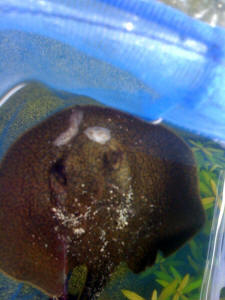
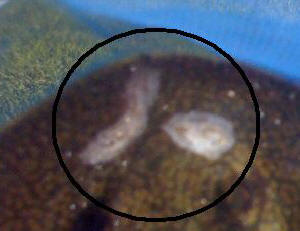
and about?!? I posted a picture of my female who is the worst
off. There are 2 of them same picture but in one I have circled
the infected area.... PS my rays r housed with 1 black Arowana, 1
discus,
<Social animals>
and 1 clown knife.
<Not really compatible.>
I have 2 very small bristle nose Pleco's that I got like 2
months ago to clean up algae we had and I have never seen them
bother my rays ever... But you never know cause it could
happen... Anyway I plan on rehome my Pleco
<... Please read here: http://wetwebmedia.com/FWSubWebIndex/fwraydisfaqs.htm
and the linked files above; particularly systems. Write back w/
data requested. Bob Fenner>
|
|
|
FW Stingrays and Jungle Aquarium Plant Care Solutions -
10/21/10
Hi I've had a stingray for six months and decided that I wanted to
plant some plants in the aquarium. I have two Peacock Bass and a Retic.
Stingray in the tank, the tank is 90 gall. I will soon be upgrading to
at least
180-210 gall, the tank is run by a Fluval FX5 filter. My question is,
are Jungle Aquarium Plant Care Solutions fizzing tabs ok to use with
the stingray? Because I know rays are touchy about chemicals used in
the aquaria and I don't want to do anything rash and hurt or kill
the ray. I have searched the web and have come up empty hopefully you
guys can help.
Thanks,
Ron
<Hello Ron. This is a pretty easy one to answer. Don't use the
fizzing tablets. Not only are they pointless so far as plant growth
goes -- the CO2 will bubble out too quickly to be much use -- messing
about with CO2 will lower pH and stress your fish. It's hard to
imagine any situation where the high oxygen, high water turnover
conditions stingrays need would be maintained alongside the high CO2,
low turnover conditions plants prefer. Plus, stingrays uproot delicate
plants anyway, so you're best using epiphytic plants on bogwood
roots, such as Java Fern and Anubias, and these couldn't care less
about CO2. Likewise, floating plants such as Indian Fern, which would
be extremely worthwhile in a stingray tank as nitrate removers, get
their CO2 from the air. So far as trace minerals like iron go, you can
use liquid fertilisers to add these with each water change, should they
be required. Hope this helps. Cheers, Neale.>
FW Stingrays and Jungle Aquarium Plant Care Solutions
<PS. You should either have no substrate or a very thin layer of
smooth silica sand, and in either case, rooted plants couldn't be
grown. Deeper substrates are hard to clean and tend to promote
infections on the ventral surfaces of stingrays, at least under
aquarium conditions. Cheers, Neale.>
Re: Stingrays and Jungle Aquarium Plant Care Solutions -
10/21/10
Thanks Neale,
I was planning to plant on bog wood anyway I guess I failed to mention
it. What other plants besides java fern and the Anubias would grow well
on the bog wood I have been doing more research on fertilizers that are
safe to use with rays then actually the types of plants that I would
like to use.
But I have read in my research that everyone uses black cotton thread
to attach plants to bog wood, is this just for looks or does it matter
if another color is used such as white, sorry for all the tedious
questions.
Thanks again,
Ron
<Hello Ron. Java Fern (both the regular kind and
"Windelov") and the various Anubias species (there are
several) are the best bogwood plants. Bolbitis heudelotii is another
option, but it's a finicky species that's difficult to grow.
Java moss is another epiphyte but when kept with big fish tends to get
destroyed, so I wouldn't spend a huge amount of money on Java moss
before trying out a small clump first. Because all the epiphytes grow
slowly, you almost don't need to use fertilisers; simple water
changes, plus the wastes from fish, should produce enough mineral
nutrients. Yes, black cotton is used because it isn't
noticeable
underwater. You could use red, white, blue or any other colour if you
wanted. I've used rubber bands and lead strip as well. Sometimes
you can simply wedge rhizomes or stolons into cracks on the bogwood.
Cheers, Neale.>
Re: Stingrays and Jungle Aquarium Plant Care Solutions -
10/21/10
Much thanks,
Ron
<Most welcome. Cheers, Neale.>
Teacup Sting Ray Sore Near Hump 8/19/10
Hello-
I have a 125 gallon tank containing Discus (8), Ram (6),
<These both need much warmer water than the Stingray, so either
they'll be too cold or the rays too warm. Remember, the warmer
water is, the less oxygen it contains, and the warmer a fish is kept,
the faster its metabolism. That's a double whammy because it means
the fish has less oxygen available despite wanting more, and because
its metabolism is progressing faster than normal, there's more
ammonia in the aquarium, meaning water quality worsens more quickly.
Even if the filter handles the ammonia and nitrite, you're still
getting more nitrate by the end of each week. So the golden rule is to
keep fish towards the low end of their temperature range. For most
Potamotrygon, the standard 25 C/77 F is perfect. By contrast,
Symphysodon spp and Mikrogeophagus ramirezi need warmer water,
28-30/82-86 F. In other words, there's no overlap.>
Stingray Tank (2),
<Not sure what you mean here? Two Stingrays in this tank?>
Bushynose Pleco (1) and Clown Pleco (1).
<On the whole Suckermouth catfish are BAD choices for Stingray
tanks; the risk is that they'll When feeding today, I noticed a
fairly large fleshy open sore on my female stingray.
<Indeed.>
It is a little larger than a quarter located on her back near the hump.
I am so nervous and do not know what to do.
<As little as possible. With Stingrays the use of either salt or
vet-prescribed antibiotics are generally safe, but everything else --
copper, malachite green, Methylene blue, formalin, tea-tree oil --
should be treated with extreme distrust. Even antibiotics should be
used with great caution, and only if you are 100% sure they are safe,
which usually requires consultation with a vet or a demonstrably
experienced ray-keeper.>
I have searched everywhere and am unable to locate any information
about this. She is eating and then stays under the sand (usually very
active). I am concerned that the sand will further irritate her
wound.
<It could very easily be a bite from the male, since males
"hold onto" females with their teeth. If the wound is on the
top of the head or the back itself, then that's where I'd put
my money. Otherwise, Suckermouth
catfish can and do latch onto Stingrays periodically, whether
accidentally or deliberately is hard to say. Injuries are almost
impossible to treat, and it's really a question of relying on the
fact that these fish heal very quickly given perfect water quality. If
water quality is even slightly below perfect, then the wound will
likely get worse.>
Yesterday I added a medium sized, flat, semi course rock to my tank
(since removed). I am thinking the ray may have grazed against the rock
causing the wound/sore and irritation.
<Possible, but does depend on where the injury is. If the scratch is
on the belly or possibly the edges of the fins, then abrasive rocks can
be to blame. But injuries to the head and upper surface of the disk are
almost always caused by other fish.>
Everyone else in the tank is fine. Are there any diseases I should
worry about or do you think it was the rock?
<The only diseases to worry about are secondary infections. If water
quality is optimal, then the risk is small and the Stingray will heal.
But on the other hand Stingrays die very quickly from secondary
infections.>
I am concerned with an infection setting in. Do I need to quarantine (I
heard rays don't handle tank changes well)?
<Let's be crystal clear, the Stingray aquarium SHOULD BE
effectively a quarantine tank. No tankmates are advised. None. Zip.
Nada. You will find very few experienced Stingray keepers advising
tankmates, and ALL agree that beginners should keep them on their
own.>
I am also concerned that treatment will harm my discus (as they are
sensitive to chemicals).
<Modern Discus are as tough as old boots compared to your
Stingrays.>
Any advise you can give is very much appreciated.
Thank you,
Christine
<Do make sure you have read up on the needs of these fish. 125
gallons is too small for Stingrays, and realistically the tank should
be at minimum a couple of metres in length and about half that in
width, in Imperial units about 6 feet long and 3 feet across. Depth is
unimportant. Water volume for two specimens needs to be at least three
times what you have. Water quality needs to be superb: 0 ammonia and
nitrite obviously, but also near-zero nitrate, and that means
you're doing 25% water changes weekly using RO
water or similar with just "Amazon" salts added (or a 10-25%
dose of Rift Valley cichlid salt mix as required) for water chemistry
around 3-10 degrees dH, pH 6.5-7.5. Almost all Stingrays die within a
year because people buy them without the faintest notion how much work
they are. If you don't own Richard Ross' excellent
"Freshwater Stingrays (Complete Pet Owner's Manual)" or
the Gonella & Axelrod "Freshwater Stingrays" then you
aren't properly equipped, if you ask my opinion. Either of these
books is
as essential as water and a filter. I hope this helps. Cheers,
Neale.>
motoro rays... Fdg., nutr. dis. 7/13/10
Greetings Crew,
I have two Male Motoro rays. They are about 10' disks now. Both
have lived in a 1200 gal tank since they were 4" disk. They have a
complete Life support system, reservoir, sand filter, chemical filter
,bio filter, R.O., UV sterilizer, chiller the works! I Back wash the
system 2-3 times a week.
They live with discus and an Arowana and a few Blood Parrots they are
in an aquarium we custom built in a local Casino. Within the last week
they have slowly lost their appetites. They seem to have lost their
desire to swim.
One has been bumping into walls and is now showing a lot of trauma to
his disk. He swims upside down and has been puffing from the top. All
my water tests are perfect.! They eat krill, bloodworms and any small
schooling fish they can catch. I feel the bloods are taking advantage
of them. Though the owner doesn't want to let them go! Ughh! To my
question...I retrieved the Rays last night and isolated them in their
own tank. I don't know what to treat them with. They are swimming
about a little more today but the white (picking) areas look bad. And
still not eating. Any and all suggestions are much requested.
Thank you
Ginger
<Hello Ginger. The reasons why Stingrays refuse food are varied. As
you correctly surmise, environment is the commonest issue. So yes,
checking water quality, water chemistry, and water temperature are all
important.
Consider any possible toxins: paint fumes, insecticides, etc. Make sure
no-one has been doing anything silly to these Stingrays like feeding
them human food "treats". Next up, the use of feeder fish.
This cannot be
stressed too strongly. If you have predatory fish and you want them to
die, feed them feeder fish. Never, EVER use store-bought feeders.
http://www.wetwebmedia.com/fwsubwebindex/fdgfdrartneale.htm
Goldfish and Minnows are the worst because they not only contain
parasites but they also contain large amounts of Thiaminase and fat,
and used regularly will cause [a] vitamin B deficiency and [b] damage
to the internal organs. Thiaminase is common in some types of seafood
and fish, notably prawns, shrimps and mussels. Use Thiaminase-rich
foods no more than once or twice a week, and all the rest of the meals
must be Thiaminase-free foods. Until quite recently most aquarists had
never heard of Thiaminase, but it is now reasonably clear that this is
a major source of ill-health and premature mortality.
http://www.wetwebmedia.com/ca/volume_6/volume_6_1/thiaminase.htm
If you've been using feeders or not taking care of the Thiaminase
issue, the damage may be done. A vet trained in handling cartilaginous
fish may be able to offer some help, but otherwise there's little
you can do. Next up, there's monotony. Stingrays need a varied die,
and surprisingly, it needs to include some green foods for fibre.
Cucumber, cooked peas and lettuce leaves are nibbled on by hungry
Stingrays, and whether they're a major source of nutrients
isn't clear, but their value as fibre does seem helpful. Zoos often
create mixes with things liked cooked brown rice and carrots! If they
won't take greens, then live earthworms are nearly as good, having
guts filled with decaying leaves. Finally, there's harassment.
Stingrays generally mix poorly with other fish, and Suckermouth catfish
in particular can harass them. As for their injuries, if these are
nothing worse than scratches, these should heal fine assuming water
quality is good. There are no completely reliable medications for
treating Stingrays, which is why avoidance of sickness is so important.
Potamotrygon spp. tolerate salt quite well, at least for periods of a
few weeks, so in some instances slightly saline water may be helpful
for external parasites, but generally that isn't necessary. If the
Stingray can recover, it will do under its own steam. Cheers,
Neale.>
Re: motoro rays [RMF, any ideas on medications?] <<Furan
cpd.s RMF>> 7/13/10
Thank you, unfortunately I lost one of them earlier today after writing
to you. The other fellow is still struggling with himself. I have
offered bloodworms twice to no avail. Is there no treatment to help the
healing I could add to his tank?
<No. As stated, a vet who treats sharks and rays may be able to
help, but adding "potions" as you'd do with regular fish
won't have any positive effects at all. An antibiotic might be used
safely, but you'll need to check with your vet or the manufacturer
first.>
I have him now isolated in a 500 gallon holding tank. With a soft sandy
bottom. The wounds are pretty much all white and some dark patchy areas
on his upper side. Thank you for your time with me.
<As stated, if you have ever used feeder fish, you've basically
thrown all your chances out of the window. Feeder fish are hands-down
the single best way to kill predatory fish short of hitting them over
the head with a priest. If you've offered Thiaminase-rich foods too
often, again, the damage is already done. It really comes down to this:
if water quality is excellent, and the internal organs haven't been
damaged by Thiaminase or parasitised by the use of feeder fish, sick
Stingrays can get better under their own steam. But if the damage is
done, there's really nothing left but praying to the Fish Gods.
Cheers, Neale.>
|
Help. Bruised FW Ray... reading
5/28/10
I recently purchased a Motoro stingray. Had ghost shrimps Monday
and Tuesday blood worms wed thurs'¦
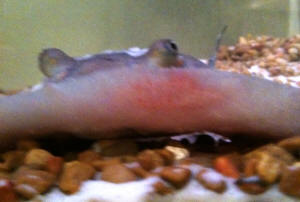
This am I noticed it had a spot this afternoon I noticed it had
another one in its body'¦
Everything is in range ph temp and water is new Tried your search
engine but cant find anything similar
Ty
<Hello Ty. Can't help without more information. Yes, this
looks like physical damage, and yes, this could very quickly kill
your Stingray should the infection spread. So let's be sure
you have the right environment for your Stingray, namely: an
aquarium measuring well over 200 gallons, a filter operating with
a turnover not less than 8 times the volume of the tank per hour,
zero ammonia and nitrite levels, nitrate below 20 mg/l, and water
chemistry that is extremely stable. One last item you MUST have
is Richard Ross' book on keeping pet stingrays; if you
haven't spent the ten dollars on that, then everything else
you're spending money on is a total waste. I cannot stress
too strongly how crucial that book is to successful stingray
keeping, given how 90% of the stingrays sold get killed by their
owners within a few months of purchase. Cheers, Neale.>
|
 |
|
Re: Help 5/28/2010
Awesome advice!
Will get with the pet shop today
Crossing my fingers on this one
Thanks Neale
<Glad to have helped. Good luck! Neale.>
|
Motoro Stingray Internal Parasites 1/5/10
Hello WWM Crew,
<Jeffrey>
First off I would really like to thank you for the database of
information you have on this website - it has been invaluable.
<Welcome>
I have had my 4-5" Motoro pair for roughly 3 months now. After a
couple of weeks of ownership, I have found that the smaller male had
white stringy feces. The larger female had the signature earthworm
looking (a.k.a. healthy) fecal matter. I did not give much thought to
it but kept an eye on the situation. However, in the past month the
situation has gotten worse. I have started treatment with Prazi for the
past two week and the problem still persists.
<Mmmm>
This is the regimen for Prazi that I am currently using as per
thegab.org's instructions:
Remove carbon.
Add 2.5 milligrams per liter of water.
If you are using the powdered version, it is difficult to dissolve.
Predissolve in tank water by shaking it up in a small container.
Dosing
Day 1 -- remove carbon, perform water change with vacuuming, and add
Prazi to tank
Day 2 -- add Prazi
Day 3 -- do nothing
Day 4 -- do nothing
Day 5 -- do nothing
Day 6 -- add Prazi
Day 7 -- add Prazi
Day 8 -- normal partial water change with vacuuming
Day 14 - normal partial water change, then add Prazi
Day 21 - normal partial water change, then add Prazi
Day 28 - normal partial water change, then add Prazi
Day 35 - normal partial water change, add carbon, treatment is
complete
The rays have a black Arowana as a tank mate and it appears as if he
has HITH and also Finrot that I cannot rid of.
<Tackle this nutritionally, and...>
I have used Binox Nitrofurazone on the black Arowana with no resolve. I
also have two NTT Datnoides and have observed extremely white stringy
feces from it as well. Water parameters are pristine with zeros across
the board and weekly 50% water changes.
I am beginning to think that these issues are all related to
Hexamita.
<Yes!>
The only problem is that all the fish in my 240G tank are eating live
Blackworms with the exception of the black Aro, who currently eats the
Hikari Carnivore sticks. I'm not sure how I would administer the
Metronidazole to them.
<Via the food... shaken in a bag... altogether>
I can soak the Blackworms but I'm sure a lot of the medication will
be lost in the water. I also figured that dosing the entire tank will
not be as effective in entering their digestive tract.
<Enough will get into them to effect a cure>
How do you think I should approach this matter? I am running out of
options.
I have heard others recommend Panacur, but have also heard a lot of
horror stories associated with them.
Any help would be greatly appreciated as my options are exhausted; as
am I.
Thanks again!
A long time patron eagerly awaiting your response,
Jeff L
<Use the food/s. Bob Fenner>
Re: Motoro Stingray Internal Parasites 1/8/10
Good Evening WWM Crew,
<AM here now Jeff... power outage. Sorry for the delay>
Thanks so much for the prompt response. I have some follow up questions
in regards to the Metronidazole dosing.
1) What would you recommend the ratio of Blackworms to
Metronidazole?
<Mmm, not really important... If the drug is in capsule form, just
tip out "a little" (maybe a quarter capsule) per
"feeding portion", mix together w/ the worms 5-10 minutes
ahead of feeding. If the drug is in a tablet, use a pill splitter or
single edge razor blade to chop into quarters and grind that bit down
per feeding...>
2) What is the frequency that I should feed them the medicated worms? I
am currently feeding them twice a day - morning and night.
<I would feed at both times for... Please read here:
http://wetwebmedia.com/metranidazole.htm>
3) Also, since I am feed them the medication and not dosing the entire
tank,
would I still need to perform a water change after a 24 hour
period?
<I would, yes>
Medicating through ingestion for fish is completely new to me. You help
and information is always greatly valued.
Thanks in advance for your time and help!
Best,
Jeff L
<Welcome. Bob Fenner>
Re: Motoro Stingray Internal Parasites, & Flagyl use
f' 1/11/10
Good day WWM Crew,
<Jeff>
I read over the Metronidazole page that you provided me and I still
have a few questions that need some attention.
<Go ahead>
Quoting the web page:
*Soaking frozen or live foods in 1% solutions for a few hours in a
refrigerator is a very good idea. Actual dosages are best at about
0.25% Metronidazole fed at a daily rate of 1% of body weight. Feed just
once usually, no more than thrice.*
Does that mean that I would complete the Metronidazole treatment after
feeding my fish the medicated food three times?
<Yes; this is the S.O.P., dosing>
Or does it mean that it
would complete one of the three courses of treatment. in a three day
treatment period?
<Yes>
This is what I mean is this:
Day 1: Feed Metro laced food 2-3 times a day
Day 2: Water change.
Day 3: Feed Metro laced food 2-3 times a day
Day 4: Water change.
Day 5: Feed Metro laced food 2-3 times a day
Day 6: Water change.
Sorry if I am scrupulous with the details, but I love my rays. Thanks
in advance for all the help!
Best,
Jeff L
<Mmm, to paraphrase (Whaley & Francis-Floyd, 1991), there's
evidence that one time oral administration of Metronidazole may be just
as effective as three water-borne treatments... No more than the three
should be done. Bob Fenner>
FW Ray... hlth. 12/30/09
Hey guys I was checking around your site for some information before
wasting your time with questions so I'll keep it short. I have a P.
reticulata ray and it seems to have lost a lot of its tail during
transportation (the stingers are basically a cm from the tip of the
tail).
It's not injured any more, but I was wondering if the tail would
ever regenerate?
<Often times can/does... "if" the area is not
"too" decomposed back>
The specimen is still small around 5 inch disc diameter. The other
question was I need to design a final custom tank for her and had a few
questions. I've heard acrylic was lighter than glass but hard to
work with,
<Not hard, just different to cut, anneal (rather then glue)... have
done extensive work w/ both>
plus I like the no shattered glass aspect. Are acrylics hard to
seal?
<No>
Would you recommend acrylic or glass for a large shallow ray tank
6'x3'x18"?
<Acrylic over glass myself>
Finally would a tank this size be able to be supported by a standard
floor (1st or second story) due to the surface area spreading the
weight or would I be better off on the concrete basement floor?
<Yes... think of the weight per square foot, inch of a lady in high
heels... may need to have the stand/base shimmed to level. See WWM re
both material use in tank construction and stands...>
.....Thanks in advance for your time.
Sorry I just remembered one more thing...Does Potamotrygon
reticulata
possess 2 stingers or is the second one a replacement for the 1st as it
is shedding off?
<... One... are you referring to claspers? Bob Fenner>
Re: ray...sorry last email was an accident... Acrylic tank
const. 12/31/09
Thanks alot
<There's no such word>
for your help..sorry for confusion I accidentally sent the last
email
before typing anything. You better be getting paid for answering
questions
<Nope. Something of much greater and lasting compensation; the
knowledge of having help others of earnest need, desire>
because you obviously know what you are talking about. When you say
annealing acrylic tanks I have a few questions. Would this be
accomplished with a heat gun?
<No; solvent. Read here: http://wetwebmedia.com/diyacrylic.htm
and the linked files above>
The FAQs I've read about acrylics involve sealant
<Not sealant... as in, there's nothing "left" between
joints>
rather than heat. I'm assuming attaching them by essentially
melting them together would create a much better seal (assuming I
don't end up creating gross melted uneven corners).
<There is such a process as "sonic welding" of large
acrylic panels... as in for large, mainly public aquariums; but in your
case solventing is what will be done>
I forgot to ask would a 6'x3'x18" acrylic need center
bracing <... depending on the thickness of acrylic used>
or is there enough surface area already?
<Enough for what?>
And finally to clarify "> Sorry I just remembered one more
thing...Does Potamotrygon reticulata
> possess 2 stingers or is the second one a replacement for the 1st
as it is shedding off?
> <... One... are you referring to claspers? Bob
Fenner>"
I meant the stingray is apparently female but has two stingers on
it's tail. Is this a species I.D. characteristic or can many
species possess more than one stinger during part of the shedding
process (i.e. will she lose the second stinger). The further back
stinger appears to be partially unsheathed from stinging or maybe the
stinger shedding process that I'm not 100% familiar with. Once
again thanks so much -Nigel
<Yes to the shedding of multiple stingers. Usually there is one
functional, with one more growing to replace it. BobF>
Emergency! My Motoros are in danger :[ (RMF, second
opinion?) -- 11/10/09
Hello!
<Hello,>
After probably about a year of reading your site and procrastinating, I
decided to purchase some beautiful p. Motoro Stingrays.
<Hope you bought a book first. And a gigantic aquarium. And an R/O
filter.
Seriously, only about 1 in 100 aquarists have the funds to keep these
fish properly, and the sad truth is that most Stingrays end up dead
within a year, often within 3-6 months. There's an excellent book
by Richard Ross on Stingrays published by Barron's that sells for
less than $10. By my reckoning, if you can't afford this book, you
can't afford Stingrays.>
I've owned them for about a year now, and they've been thriving
in their 6'x4'x1' tank.
<Cool. But after a year, they're ready for a bigger
tank.>
I use 3 "heavy duty" sponge filters, for lack of a brand name
on the item.
<Fair enough. But this should probably be augmented with some type
of canister filter that can remove solid waste on a continual basis.
Organic matter that collects on the substrate is a have for bacteria,
and this in
turn makes it more likely infections will develop. There's a
ongoing argument about whether the tank should even have a substrate,
some suggesting a clear glass bottom is easier to keep clean. While
that may be
overkill (and isn't much loved by the Stingrays) there is certainly
much to be said for a canister filter with massive turnover (8-10 times
the volume of the tank in turnover per hour). This will remove silt and
debris
quickly.>
I do 30% water changes every 3-4 days, and sometimes a 50% at the same
rate, depending on how messy their tank looked.
<Hmm... pre-emptive maintenance is critical here: you clean the
water such that there never is any mess in it.>
Perhaps a silly way of doing things. PH 7.2, Ammonia 0, Nitrite 0,
Nitrates always low, sand substrate. There are no plants or rocks. Just
filters, sand, and fish.
<OK.>
I feed them 1-2 Nightcrawlers a day, and small amounts of Krill at
night.
Once every 2 weeks I give them each 2-3 Ghost Shrimp to play around
with.
<Fine.>
Well on to the subject, sorry for the rambling. I woke up one day, and
my tank almost looked like milk.
<Eek! Likely a bacterial bloom thanks to excessive organic material
in the water.>
I could see about 5-6 inches into it, but nothing more.
<Can we assume this wasn't silt (from the sand) or a diatom
bloom?>
When I finally found my stingrays they were alive, but having a lot of
trouble breathing.
<Does sound like a bacterial bloom. Silt and diatoms are harmless,
if unsightly.>
I instantly water tested and everything looked fine, but I did a water
change nonetheless (it'd been about 2 days since the last one).
<Your water tests don't measure bacterial counts, and that's
the issue.>
This seems to have only made it worse. I rushed up to the store
who's employees I've trusted for a long time, and they said
everything should be fine just wait it out.
<Almost never a good idea with Stingrays. The best approach is to do
a series of water changes across the day, maybe 25% every couple of
hours, so that you can totally flush out the system. Obviously, water
chemistry must be identical, so check the pH of both old and new water.
Don't do this if you're using tap water that experiences pH
changes after it's been drawn.
If you're using RO water and hardening it with, for example, a
small quantity of Rift Valley salts (the ideal approach) then this
shouldn't be an issue.>
I come home and my female is floating on the top breathing through her
spiracles!
<Not sure they can do this. Do you mean she's gasping at the
surface?
Again, suggests a bacterial bloom; bacteria consume oxygen, creating
eutrophic conditions, removing oxygen from the water, suffocating the
fish.>
At this one I did another 50% water change (2 in one day) and loaded
the tank up with dechlorinator. I had feared I wiped out my bacteria
colony, because apparently my city adds chlorine at this time of
year.
<The RO filter you should be using should sidestep the
issues.>
I'm not really sure where to go from here, and I really don't
want to lose my stingrays :[
<Indeed. I really cannot stress too strongly that the problem is
likely environmental, and more specifically, a tank too small for these
fish. In the short term, massive water changes while keeping water
chemistry stable
will help, and adding a sump to the tank may increase the volume
adequately to get you through the next few weeks or months. But longer
term, Potamotrygon motoro needs a much bigger tank than you have, and I
suspect eutrophic conditions in the tank are at fault here, and noxious
to your livestock. Cheers, Neale.><<I do concur w/ all
you've stated Neale. BobF>>
Re: Motoro Stingrays in danger! -- 11/10/09
I really hate to spam you guys, and I apologize for this.
<Not a problem.>
I somehow forgot to add this to my last query. My female Motoro also
has a large hump on her rear right side. It's raised higher than
the left sides hump, and it appears to be causing her rear to float.
She's been
constantly fighting to get back to the sand.
<Can't be specific, but likely a reaction to anoxic, or poorly
oxygenated, conditions in the tank. Especially at the bottom of the
tank (which is why Stingray aquaria need massive water circulation that
pulls water down and across the substrate). Treatment options are very
limited with Elasmobranchs generally, so would concentrate on
optimising water quality and chemistry. Do read here:
http://www.wetwebmedia.com/FWsubwebindex/fwraydisfaqs.htm
Cheers, Neale.>
Re: Emergency! My Motoros are in danger :[ --
11/10/09
Thank you so much for the quick and informative reply!
<Happy to help.>
Yes she was gasping at the surface.
<I see. Fish do that when oxygen levels at the bottom are
insufficient, and given the cloudiness of the water, there's good
reason to assume that there's either insufficient circulation or
else something in the tank using
up the oxygen. Bacterial decay is the classic example. Look for organic
matter, clogged filters, uneaten food, stuff in the substrate,
etc.>
Aside from water changes is there anything else I should be doing? I
can afford whatever it takes at this point to keep them alive. Would
adding some airstones help?
<Extra circulation, including airstones, would help, but whether
they'll fix the problem I cannot say. Your immediate concern is to
change the water as quickly as possible without exposing the fish to
dramatic water
chemistry changes. You also need to clean the aquarium, check the
filter, sift the substrate, and check for any other problems. Cheers,
Neale.>
Dying Stingray
Hi There,
My neighbor's house flooded and they had nowhere to keep their 2
stingrays.
<Yikes!>
They are smaller than my hand. It was an emergency situation and all I
had to offer was a 10 gallon. (I have 2 reef tanks and one fresh plant
tank).
<My fish ended up in a bathtub when this happened!>
We put the 2 stingrays in the 10 gallon and the female was dead within
hours.
<Oh dear.>
We used sand, water, and media from their original tank. This is day
two and the male swam up then went upside down. I freaked, flipped him
gently back over, and did a 5% water change. He is currently sitting
flat, right side up, with labored breathing. (has been this way for
about 5 hours now) His skin is patchy white (could be the white sand) I
added Amquel and a more powerful filter. My question for you is: I just
brought home a 220 gallon reef ready Starfire tank. It is currently
brand new, never been used. Should I try and set my 220 gallon up for
him or do you think he's just going to die?
<More chance of surviving if the 220 was set up. Sheer volume of
water would mitigate against likely problems.>
I would love to save him and give him back to my neighbor in 2 months
when he's allowed back in his house. If it's futile, I
don't want to set it all up for fresh water since we will be
starting to cycle it as a reef tank down the road. I just read up on
them and found out how incredibly sensitive they are to ammonia etc...
I have not got the water parameters done yet as I am just in the
process of getting more chemicals to use for testing. Please, please
give me any advice to save this poor little guy.
<Your instincts are sound here: set up the 220, get the Stingray in
there STAT, and then plug in filters, heaters as/when you can.>
Thank You SO Much,
Karley
<Was away yesterday fossil collecting, so didn't get too read
this message until this morning. Hope not too late! Good luck,
Neale.>
FW Stingrays: Sudden Death\Neglected Tank\Toxic Water\
Textbook example of
how NOT to keep a stingray 6/27/2009
<Hi Zeep.>
I had a Motoro stingray for roughly 10 months now, and an Arowana as
its tank mate for about 7 months.
<I hope this tank is huge...>
They co-existed fairly well for the most part.
<Not the best choice of tankmates. Stingrays are best kept in a
species only tank in my opinion.>
The ray got a little nick here and there every now and then, but for
the most part she was left alone.
<and stressed...>
She was a very active ray, always moving around, digging in the soft
sandy bottom. Every now and then she would swim up the side of the
tank. She ate bloodworms from my hand and never showed any signs of
death curl. I never had any issues with feeding her either.
<OK. Hand feeding isn't really advised on a ray that is
classified as "A dangerous venomous fish".>
As far as I could tell, she showed no signs of illness. Her underside
was a very light pink, borderline white.
<Normal>
Nowhere near as red and blotchy as when I first got her, so I figured
it was just her normal underside coloring. She had one black spot in
the middle of her underside. I cant remember a time that I have not
seen this spot, and I have seen a few other pictures of peoples
stingrays with the spot before, so I assumed it was normal.
<Could be.>
My tank is set up with a nice Eheim Pro II canister filter which does
the trick perfect.
<Hmm.... how big is this tank? An appropriate sized tank for a
Motoro ray needs a lot more filtration that one Eheim.>
I have a UV sterilizer hooked up in the tank as well to help with the
water a bit more. Even with the set up however, I still had rather
rapid brown algae growth on the sides.
<Excess nutrients.>
However, I figured it was just because of the blackwater extract that I
put in there every now and then.
<No, that will not cause excessive algae growth.>
The place I bought her from said they added a little bit of that to her
tank every week, and she enjoyed it.
<Likely so.>
I had a few live plants growing over in a corner of the tank. They
thrived and she left them alone for the most part. I only had to
replant them about three or four times when I first got them. After
that, she left them alone just fine.
<OK.>
At first I use to change about 25% of the water every other week.
However after a few months of that I got lazy,
<...and the downhill slide starts...>
I know shame on me. I proceeded to do it about once every two months
for awhile. Every water change I would add some Seachem Prime, and some
Tetra AquaSafe.
<Why both? They perform the same function? Also, stingrays should
have soft acidic water.>
Every other water change I would give the filter a little bit of a
cleaning as well. I'd give the sponges and media a little rinse.
Nothing too much though, just enough to try to keep the filter in
check.
<So you produced a nitrate factory.>
I also place a Hagen Phos-X bag in with the media of the filter. I
replace that every time I clean the filter. For the past 3 months
however, I have been adding small doses of API Algaefix.
<Ouch>
After reading your site a bit, I now realize this was toxic, and I
shall refrain from using it again, but at the time I knew nothing of
it.
<Research before adding anything, particularly for difficult
species, like Stingrays.>
Well a little bit ago I hit a real lazy streak and went roughly 4
months without cleaning the tank.
<The downhill slope is getting steeper and we can see the
cliff...>
Every now and then I would top off the tank with tap water treated with
the prime and aqua safe.
Today was the day I ended that streak and cleaned the tank. At 10 AM I
started to clean the tank, and I did about a 40% water change on it. I
also did the filter maintenance today, and that includes putting in the
new Phos-X bag.
<What else? How did you clean the filter?>
However, I also added one more step into today's cleaning. See, I
have always had hard water in my area, and no matter what I tried, I
could never fix it.
<Use Reverse Osmosis water.>
So I decided to try the API Water Softener Pillow. It was more of an
experiment then anything, I just wanted to see if it would possibly
help even a little bit. Not having much hope in it however, I bought
the
smallest one I could find, one for a 20 gal tank.
<Not knowing how large your tank is, I cannot say for certain, but
this is unlikely the cause.>
I wanna say at about noon I was done with it all, the tank was back up
and running and I was done disturbing the waters. Everyone was just
fine, she acted normal as she always has. I continued to periodically
check up on the tank throughout the day, and everything was fine every
time I looked.
I am a night owl who is currently job searching. With that said, when I
checked up on them to feed and shut off the tank lights at roughly 2:20
AM, much to my horror she was upside down on the sand and stiff. The
last time I Saw her alive was roughly 9 PM, and she still looked just
fine.
<...off the cliff and into a free fall.>
I took her out and bagged her up. I examined the body for any sort of
clues to her death. The only 'battle wounds' she had were the
ones she has had for some time now.
<From the Arowana?>
Nothing too serious, and they were healing up just fine. I failed to
find any fungus growth, parasite infestation, or any sort of oddities
like that.
<Not likely to find anything like that. There is very little that
kills that quickly.>
The only thing I found (which I guess would make me a liar, cause it
does qualify as an oddity) was near that black spot on her underside.
Her skin had started to turn a tint of green next to that black spot on
her underside.
<Could be morbid lividity>
I know my water conditions were nothing desirable, but I did what I
could when I could, and she always seemed ok. took a reading of my
water shortly after I disposed of her body. NO3 was reading at about
30, closer to 20.
My NO2 was at .5 and ph was sitting at a solid 7.
<So the water was toxic. What about ammonia?>
Like I said before, my water has always been hard no matter what I
tried to do. With that said my KH was at 240 and my GH was at 180.
However, those are as high as the test strips went, so they very well
could have been higher then that.
<Test strips are notoriously inaccurate. Buy a regular test
kit>
So with my novel now done, I was wondering if someone could help
pinpoint the cause of her death.
<Unfortunately, very easy to determine. Toxic water conditions
caused by neglect.>
Was it the water quality that killed her?
<Yes>
Could it have been the water change that did it?
<You likely destroyed the biological filter when you cleaned the
canister filter out.>
Did the Algaefix take its toll on her?
<Not likely.>
Do you think one of my plants are toxic and she ate it?
<No, Stingrays are carnivores>
Possibly some of the chemicals I am adding, aside from algae, caused
her death?
<They certainly weren't helping, but no.>
I'd like to get another ray, but I'm going to wait for a few more
months till we move.
<I would not recommend it. They need huge systems, hundreds, if not
thousands of gallons and pristine water quality Read here:
http://www.wetwebmedia.com/FWsubwebindex/fwstingrays.htm and then read
every linked page at the top.>
So any advice for next time would be highly welcome.
<Unless you are prepared to invest the time and work required to
care for one of these animals, I would go with something easier and
more forgiving.>
<Do read the articles on the following pages related to maintenance
and biological filtration.
http://www.wetwebmedia.com/FWSubWebIndex/fwmaintindex.htm
>
Thanks for any advice, Zeep.
<MikeV>
|
Reticulated Stingray 6/27/09
I have some questions regarding my female reticulated stingray.
She is about 5.5-6 inches in diameter.
<Still a pup!>
First off, I should mention that I am the aquatics manager at a
local pet shop. I am very knowledgeable about freshwater fish
(still learning about salt which I don't have at my store).
Water parameters: Ammonia 0 PPM, Nitrite 0 PPM, Nitrate 10 PPM,
PH 8.0, using API liquid test kit.
Temperature is 80F.
<All fine, though the pH is a bit on the high side.>
I live in an area where our tapwater is pretty hard and alkaline,
(about 140-150 PPM). I will soon begin doing water changes with
RO water to dilute that down.
<Very good.>
The tank is a 140 gallon with 2 Aquaclear 70's and a Magnum
350. I don't use any carbon filtration currently.
<While carbon is generally redundant in freshwater tanks,
there's probably an argument for using it in Stingray tanks,
at least as a precaution, and provided it wasn't used at the
expense of biological media.>
I currently have only 2 pieces of driftwood in the tank with fine
gravel.
Tankmates include 5 small (for now) angelfish, 3 clown loaches
(also small for now), 3 German blue rams, and 1 black ghost
knife. I feed once daily with HBH rainbow color flake food, New
Life Spectrum Thera+ 1MM sinking pellets, and my choice of live
earthworms, krill (frozen), bloodworms (frozen), and brine shrimp
(also frozen). I also put in about 10 or so ghost shrimp and
replace them when they are all gone (she really has to work to
catch them!) I alternate the earthworms and krill every other
day.
She loves the live and frozen both, and I think she may eat some
of the pellets, but its hard to tell.
<All sounds very good.>
Ok so on to the question. I ordered her for my store about 4
months ago.
By the time I get fish here, they have already been acclimated to
the type of water we have here in MO. I instantly fell in love
with her and decided to buy her. It took me 2 weeks to get her
eating anything (at the store, where I might add I have almost
identical water quality in my systems).
She slowly went from worms only to the variety I have her on now.
After about 5-6 weeks, I noticed some unusual bumps had appeared
on the top side of her disc.
<Potamotrygon species do develop additional spine-like
structures called denticles on their bodies, usually around the
middle of the back towards the region where the tail and body
disc meet. These denticles look like little teeth and should be
arranged in longitudinal rows, making it quite easy to tell these
normal structures from the symptoms typical of underweight
Stingrays.>
They almost seemed to appear overnight (or in a very short time).
They are almost symmetrical only appearing about 1/2 an inch from
the outside of the disc on both sides from head to tail. Each
bump (about 2-3 MM in diameter)
look to be made up of 3-5 smaller bumps all pushed together
(kinda like a bunch of grapes). They are semi-transparent but
retain some of her skin color (which I should mention, has always
been a little on the pale side compared to some of the other
specimens I have seen). These bumps don't ever move and have
not increased or decreased in size since I first noticed them.
However about 3 weeks ago, another set of bumps (about the same
size as the others) appeared just behind her left eye (once
again, seemingly overnight). She is a great eater and her
behavior has not changed any through all of this.
<Again, I suspect that this is all normal ontogeny.>
She seems as active as I have read they will be, she actively
forages for food, and pounces quickly when she finds it. I have
had her home for about a month now.
<Usually, lack of appetite is the first sign of problems, so
if she's eating, that's good.>
Earlier this week I treated the tank with Quick-cure in the hopes
to rule out external parasites. I did 2 treatments, but on the
third day I noticed that my water was a little cloudy, and there
was no change whatsoever in the bumps. She did however darken in
color a little on the second day.
None of the other fish in the tank have shown any sign or
symptoms of illness, and if it weren't for the bumps I would
call Chloe (that's her name) a perfectly healthy and active
stingray. Is this anything you have seen or heard before
regarding FW rays (or any FW fish for that matter)?
What can I do to make them go away and improve her color other
than get the PH and alkalinity down?
<Before doing either of these things, do make sure you can
keep them both stable; Stingrays are more bothered by water
chemistry that changes between water changes, rather than the pH
not being precisely optimal for the species.>
Is this problem going to threaten to kill her? I thank you very
much for your time. I have referred to your website countless
times both at work and at home to answer questions that I
don't know. I have been researching this problem for months
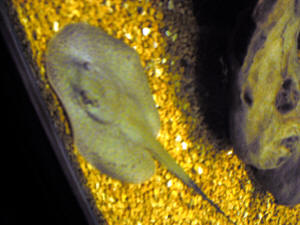
now and can't find an answer. This is the best pic that I
could get to turn out. The darker spots closer to the outer edge
of the discs are the ones I am referring to.
-Doug
<Cheers, Neale.>
|
 |
|
Re: Reticulated Stingray
6/28/09
How much water would you suggest I change out at a time and how
often to achieve my final water, which I hope to hold at about
60-70 PPM with a PH of 6.7-6.8.
<In theory, you can change as much water as you want per water
change, provided pH and hardness stay constant. But in practise
it's wisest to do relatively modest changes, around 25% per
day, one or more times per week, as required to keep nitrate
levels at the low levels you're after. If you're also
changing the water chemistry from one set of values to another,
this is even more important, so do small, frequent water changes
that nudge the pH and hardness levels rather than dramatically
change them. Cheers,
Neale.>
|
Question about Motoros... fdg... hlth.... env.
6/19/09
Hello!
I have a 8 month old stingray. My question is simple. He ate well this
am i feed him ghost shrimp. Tried to change him to live red wigglers
this weekend and he ate about 3. But not he seems disinterested in
food. This evening i gave him his 10 shrimp and he didn't even
bother to catch them. I check the water and everything was normal
ph-6.0 am-0 n-0. So i know its not the water. I know they go on hunger
strikes but i was wondering should i be worried?. I looked at your web
site to see if other people have the same problem but it didn't
really answer my question. He does this i notice only when i try to
change his food. Is he just spoiled? Or is he sick?.
Don't know what to think hope you guys can help me out a bit.
THANKS!!!
<Maria, you absolutely *should not* rule out water chemistry or
water quality issues! These are BY FAR the most common reasons
Stingrays stop eating or otherwise behave abnormally. Because you have
a very low pH, 6.0, your biological filter will be working at a very
low efficiency, so nitrite and ammonia spikes through the day are
possible. In case you're wondering, biological filter bacteria
prefer pH to be in the range 7.5 to 8.5, and the lower the pH goes
below that range, the less they work, and below pH 6.0 they don't
usually work at all. A very low pH also implies minimal carbonate
hardness (what you measure with a KH rather than GH test kit) and that
means that pH may well vary through the day, so again, take pH readings
several times: before you turn the lights on in the morning, around
midday, and sometime in the evening, at least. Ideally, you would be
keeping a Stingray in water with a moderate amount of carbonate
hardness
(4-5 degrees KH) and a pH around neutral (6.5-7.5). But as you
hopefully know, making sudden changes to water chemistry will stress a
Stingray, so if you do decide to alter water chemistry, you need to do
so very carefully and in small steps. If for some reason your Stingray
doesn't particularly want to eat the food you're offering him,
then try starving him for a couple of days and see what happens.
Besides earthworms and river shrimps, Stingrays should receive a
variety of foods so that shortcomings on one are balanced by the
others. Frozen seafood often works well, and things like squid and
cockles are particularly nutritious and lack the Thiaminase found in
mussels and prawns. Small pieces of white fish are good, too, and you
can buy frozen lancefish that can be used whole. This said, earthworms
and shrimps are favourites, so be critical of environmental conditions
and fix them, rather than missing this "early warning" and
not realising something
was wrong until the Stingray got sick. Cheers, Neale.>
|
Possible Motoro Parasite/Feeding Frustrations (RMF,
second opinion please) 3/10/09 Hello, <Hello
Kyle,> Before I ask my question I think it's important to
note that my 7 inch Motoro was purchased and acclimated 3 days
ago, so he is still undergoing the typical acclimation stress
(and the underside of his disk is reddish). Now that he has
become more acclimated and begin scrounging for food, I noticed a
small brown spot on the underside of his disk in the shape of a
butterfly, with a little raised light-colored bump in the center
of the spot. I have attached the best picture I was able to get
of the spot (my ray swims fast on the glass), but I was wondering
if this could be a parasite that hitched a ride on my ray; and if
so, where can I find instruction to remove it as safely and
stress-free as possible? <It isn't clear to me what this
is, and I'm asking Bob for advice here.> <<Isn't
clear to me either, but at largest amplification, cleaning up...
and the position of this mark... it appears to be more of a
"bruise" to me than anything else. Not parasitic.
RMF>> In case it helps, my tank is registering nitrates at
5 PPM, with everything else at 0. I have a fine sand substrate
and filtration to turn 10 times the volume of the tank. In
addition, I was wondering about feeding. I have read and heard of
stingrays on "feeding strikes" or "not accepting
food" but mine seems to be very fickle about his food,
neither accepting nor rejecting it in any predictable way.
He's nearly always blowing the sand around looking for food,
but if he does pick up a worm or small piece of raw shrimp, he
will sometimes spit it out of his mouth even if he's accepted
it from me greedily before... only then to further swim around
the tank looking for something else to eat. One example is just
an hour ago, I put half a live nightcrawler in there, and he
sucked it out of my hand hungrily, then spat it out. For the next
half hour he would gnaw at it, spit it out and then swim around
the tank, eventually eating it. So far, I have tried bloodworms,
red wigglers, nightcrawlers, and ground raw shrimp; all which
have been accepted and rejected in an unpredictable fashion.
Thank you for your time and advice, I look forward to hearing
back from you. Kyle <While these fish are finicky, one key
thing about their appetite is stress. So your Stingray may simply
be settling in and not ready to feed consistently. But it could
equally easy be an issue with water quality or water chemistry
stability, so think about these factors too. Review tankmates,
and see if there's anything that might be stressing the
Stingray. Take care not to overfeed; when we bring home a new
fish, it's tempting to keep feeding the new fish to check
it's healthy and happy. Cheers, Neale.><<Totally in
agreement. RMF>>
|
  |
|
Re: More: re: Possible Motoro
Parasite/Feeding Frustrations (RMF, second opinion please)
3/12/2009
Hi, guys- thank you for your help and quick responses. I tried to
see what might be stressing him, but the water seems stable,
<"Seems"? You don't get this latitude with
stingrays; the water MUST be stable. Keeping them in huge tanks
helps, as does performing very regular (ideally, daily) water
changes so that background acidification doesn't get
a chance to occur. The carbonate hardness should be reasonably
high; while soft water fish in the wild, pH variation is much
more harmful than moderately hard water.>
he has no tank buddies, and the temp is kept at 80 degrees.
<Too warm. The usual 25 C/77 F is ample for these and indeed
most Amazon Basin fish (with a few exceptions, like fish from the
Xingu River which do like things a bit warmer). The warmer the
water, the more active a Ray will become, but the cost of higher
metabolism is increased demand for oxygen and a heavier workload
on the filter. Unless you're breeding fish, it's usually
best to keep them at the cooler end of their preference range.
Not cold, by any means, but verify their preferred temperature
range from Fishbase or similar, and work from there.>
And I have decided to call that brown spot a "beauty
mark" and will continue to do so until the moment (if and
when) it appears to be a trouble spot.
<OK.>
I have noticed since my e-mail before that there is a small
amount of regularity in his feeding. He seems to have no trouble
accepting one nightcrawler in the morning and evening, but
anything after that he will not eat. His belly also appears to be
getting less and less red each day (although this may partly be
wishful thinking more so than objective observation)... so I am
taking that as a sign that he's getting better
acclimated.
<Yes.>
It's still a little weird to me that he is spending a lot of
time blowing sand around looking for food, but won't eat
much, and then spends a lot of time swimming in the same pattern
around the glass.
<What kind of sand are you using? Anything likely to irritate?
Many aquarium sands are too sharp for benthic fish. If in doubt,
plain vanilla "smooth" silica sand is fine.>
I actually had to put a book on the corner of my tank, because it
appears as though he keeps trying to jump out that corner (I wont
worry about a tank cover until I see him trying to jump out
anywhere else).
<Normal behaviour if they're stressed. Again, this may
stop if the fish settles in, but if it persists, then review
conditions and act accordingly.
The usual problems with Stingrays are insufficient water
volume,
insufficient filtration (water turnover), and unsteady water
chemistry.>
Is it possible, since the tank at the store was decently
decorated, that adding some small decorations would help him with
his level of comfort, or are rays not as concerned with decor as
some other fish?
<Wild fish hide by digging into the sand. Floating plants will
certainly be welcomed for the shade they provide, but bogwood,
rocks, etc are redundant and indeed undesirable if they trap
dirt.>
Well, it seems this 'thank you' has turned into a
"holiday mailer" so I will cut it off here. Thanks
again for all your help,
`Kyle
<Cheers, Neale.><<Excellent resp. Neale... content,
format wise... Have nothing further to add. BobF>>
Re: More: re: Possible Motoro
Parasite/Feeding Frustrations (RMF, second opinion please)
3/12/2009
With regard to the substrate, it is a very fine sand. It may be
that the granules, although small, are sharp if the sand is an
issue.
<Feel the sand; smooth sand feels velvety, sharp sand feels
otherwise.>
If upon further investigation of his habits, I determine that the
substrate
is causing him irritation, would adding a small layer of a
different, smoother sand work?
<Replace all the old sand with smooth sand. No point being
cheap here; for the sake of a few dollars' worth of sand, you
could end up with an infected Stingray. Dump the old sand in the
garden. Mixed with soil, it helps improve drainage. So no
waste.>
I am trying to avoid ripping out the bio-colonies in the sand by
replacing the substrate altogether.
<No useful bacteria in the sand.>
Perhaps replacing the substrate over time, bit by bit? What would
work best for that?
<Replace all.>
Now that I read what I wrote, I realized "seems"
doesn't fit what I am observing with the water. That was my
way of saying I am checking it daily, levels are fine, so unless
there are fluctuations in the water source here in ways I
can't measure, then water quality isn't the issue. So, in
this case, seems=if something's wrong, it's going to
catch me off guard.
<Right, I see.>
Sorry to be such a bother with all these questions and trouble.
This is (quite obviously) my first ray, so I am erring on the
side of cautiousness, which may not be an err in ray-keeping at
all.
<Very wise indeed. Do invest in one of the several books on
the topic. Some are inexpensive (like the Barron's one) and
will save much money in the long term.>
`Kyle
<Cheers, Neale.>
Re: More: re: Possible Motoro
Parasite/Feeding Frustrations (RMF, second opinion please)
3/15/09
I thank you again for your assistance. I don't know what the
problem could be anymore, because the substrate feels soft and
smooth to me, not scratchy like some sands I have used.
<Well, that's good.>
Water quality is fine and I have been changing at least 10
percent of the water every day.
<Define "fine". The thing with Stingrays is that 99
times out of 100, problems are down to water quality and/or
chemistry issues. Obviously you need zero levels of ammonia and
nitrite, but nitrate also needs to be very low, realistically as
close to zero as is practical. The water chemistry should be
stable; ideally soft and slightly acidic, but regardless of the
hardness level, the pH should be rock steady.>
He simply is refusing to eat anymore.
<Was he feeding at the aquarium shop? What were they feeding
him? For all the usual reasons, I'd never recommend buying a
specimen that was fed feeder fish, particularly goldfish. But if
it was consuming earthworms and other safe foods, it should be in
good shape. Assuming he's eating something, and has hitherto
taken a meal every couple of days, he can be "starved"
for a week or more without problems. But the flip side is
this:
Stingrays tend to be greedy feeders for things like earthworms
and live river shrimp when happy, but refuse to feed point blank
when stressed in some way.>
There seems to be a connection between me coming into the room or
near the tank to do maintenance and him going to hide in the
substrate.
<Some degree of nervousness is common initially after
purchase, but fish generally settle down within a few days to a
week. Do review the general environment though: loud televisions,
slamming doors, busy corridors can all make fish much more
nervous than otherwise.>
I am honestly getting a little frustrated with this guy; I really
only try to feed him morning and evening. Maybe I just need
clarification on what people mean when they say "feeding
strike." Obviously, there's an element of non-eating,
but if he's on such a "strike" then why does he
spend the whole day searching for food?
<To some degree you must dissociate foraging behaviour with
actual feeding; fish will instinctively forage for food all
through their day (or night) activity cycle. They don't need
to be eating constantly though, and simply because they're
foraging doesn't mean they need to be fed.>
Most times, he finds what I give him and greedily begins to suck
it down but then spits it out or leaves it, and then goes to
hide.
<Maybe he doesn't like it? What are you offering?>
I'm afraid I am going to lose this guy, and it just feels
wrong because I have been doing everything that I have been told
either by people or by my very deep research (I did get the
Barron's book before I bought him).
<My gut feeling here is this: [1] Review environmental/water
conditions; [2] Double check them! [3] Turn the lights out for
the next few days. [4] Don't feed him for at least 3 days.
[5] Get some nice, fat, juicy
earthworms and offer one of them late in the evening on the
fourth day.>
I am sorry there wasn't much of a question in this e-mail. I
guess I figured I may have said something about his behavior that
may show something we haven't noticed before.
`Kyle
<Cheers, Neale.><<I do agree with your probable
prognoses... advice Neale... If none of these can be found to be
at fault, when-corrected, restore this fish to feeding, I would
return it to the store. BobF>>
Re: More: re: Possible Motoro
Parasite/Feeding Frustrations (RMF, second opinion please)
3/15/09
Hm... thank you for the distinction between searching and
hungriness. That has helped me a little. When I bought this one,
I was actually in the LFS looking at another stingray that they
tried to feed an earthworm and he didn't go for it, but this
guy came speeding up to it and started to eat it down; he looked
healthy and obviously hungry so I got him instead.
<An excellent way to choose Stingrays.>
He did have a little trouble eating the whole thing because
he's a smaller ray still, but he did (and still does) get the
whole nightcrawler down eventually. I have also tried breaking
the worms in half or 3 parts but he loses interest or only eats
the front-worm part. Thank the Lord I care for an African clawed
frog who will eat what my ray rejects. Other foods I used are
glass shrimp and raw supermarket shrimp, and red wigglers.
<Do try something very small, like bloodworms. Shrimp are fine
up to a point, but because they contain a lot of Thiaminase, it
is sensible to use them in small amounts, no more than 25% the
weekly food input. Earthworms are very nutritious, in part
because they are 'gut loaded' with decaying plant matter
and soil. While that sounds icky, it does mean they provide lots
of useful vitamins, minerals and fibre.>
I will try not feeding for a couple days. My only worry is that
he's already looking very malnourished from his rejection of
food (hip bones showing, dent in forehead, etc). I will do that
if he can last the couple days without food even like this.
<Well, if he's not eating, he's not eating. So whether
you put food in the water or not, it hardly matters. I'd
certainly stop offering food he shows no interest in. A day or
two starving should make little difference, though I agree, a
"skinny" Stingray is at risk.>
Water quality (ammonia/nitrite/nitrate) is still stable, nitrate
at 3 PPM and I am going to change 20% of the water again
today.
<The nitrate is fine; the nitrite is zero though?>
I honestly do not know about PH... maybe I made an unsafe
assumption that using the same water source each time gives the
same PH.
<Ah, yes, this matters. A lot of people in the US seem to have
water that has been treated in various ways by the water company,
presumably to improve its potability. But the chemicals used,
such as flocculants, cause the pH to change dramatically within
24 hours of being drawn from the tap.
Try testing the pH of some tap water now, and then leaving the
same water for 24 hours and seeing what the pH is then. You might
be surprised. Also, do of course remember the basics: don't
use water from a domestic water softener, do use dechlorinator,
and do use a dechlorinator that treats ammonia and/or chloramine
if either are issues with your local water supply. You might also
want to check for copper in your tap water supply.
If your pipes are made from copper, it is possible for tap water
to become contaminated. Copper is highly toxic to Stingrays, and
such water supply will need to be treated with a water
conditioner than neutralised copper.><<And copper ion
presence would definitely send them off feed. RMF>>
`Kyle
<Cheers, Neale.>
|
Question about freshwater stingrays 11/6/08 Hi I am
new to this site and I had a question. I have two freshwater stingray
and a Arowana in a 75 gallon grow out tank with a hydro filter and two
penguin bio-wheel 350s. I have had one ray for 4 months the other for 2
1/2 months and the Arowana for about a month. I have noticed odd
behavior by the rays they are breathing faster than usual, just sitting
upright on the side of the tank and trying to jump out of the tank and
they have never acted like this before. The one ray will eat blackworms
and chopped night crawlers and the other will only eat blackworms. I
have tested the water a bunch on time the ammonia is 0 the nitrates and
nitrites are 0 and the ph is 6.5. I do 50 % water changes every 2
weeks. I was just wonder what might cause this weird behavior and the
rapid breathing. Thank you in advance. Amber <Hello Amber. Your tank
is too small and too poorly filtered for Stingrays, and what you're
seeing are general signs of stress. These are indications that it's
time to move them to their next aquarium. Even if the only fish you had
was an Arowana, the tank would be too small and inadequately filtered.
Depending on the Stingray species you have, you'll need at tank at
least 90 cm wide from front to back and 200 cm in length from left to
right. (The width of the tank should be at least 1.5 times the maximum
width of the "disc" of the Stingray species in question;
since the common species are 60 cm in disc size, 90 cm is a good
baseline width.) Depth isn't critical. Filtration needs to be a
serious external canister filter. Hang-on-the-back filters have little
value in serious freshwater fishkeeping; they're really only suited
to small community tank species. You need something with lots of space
for biological media, and offering water turnover 8-10 times the volume
of the tank in turnover per hour. So if you use a 200 gallon tank, the
minimum for a Stingray, your filter (or more likely, pair or trio of
canister filters) will need to be rated at 1200 to 2000 gallons per
hour. There's no getting around this fact: Stingray aquaria are
insanely expensive to set up. People who try to economize end up with
dead Stingrays. Many books on the topic now available; I'd heartily
encourage you track down one or two of these at your local library or
bookstore. Cheers, Neale.>
A worm question (Horsehair worms; stingrays)
10/17/08 Hello, <Hi,> was just wanted to know I
notice some of my ghost shrimp have worms in there intestines are to
believe they are Gordian Worm, a.k.a. Horsehair Worms...one died bc the
worm killed it but I never notice them b4 on my shrimp I feed these
shrimp to my Motoro stingray which I have had for about a week I know
they are prone to roundworms and tapeworms but I was wondering if I did
feed some shrimp that had these in them can they kill my ray I called
the pet store where I got my ray and they never really heard of these
worms really and are not sure if they will harm the ray they feed there
ghost shrimp to there rays and had no prob but they never looked at
there shrimp to see if they had worms so they could be feeding ones
that do so I don't know what I should do I don't want my ray to
die and I don't know if I should get new shrimp the other ones seem
to not have these worms in them..should I continue to feed them to my
ray or go and get new ones?????? <Sheesh... not even a period or
comma. Do please review our very modest "fee" before writing:
we expect e-mails to be spell checked and written with proper grammar.
Not much to ask, and the point is that we depend on properly formatted
messages so that we can share them with other site visitors. The better
Google can index our pages, the more people will view our pages, and
the more revenue our advertising generates to pay for bandwidth.
It's a simple deal really.> HELP!!! PLEASE KINDA SCARED FOR MY
RAY I LOVE HIM!!! <Horsehair worms are not likely to cause your Ray
any harm. Most parasites are species-specific, and while they may be
harmful to the shrimp, they are unlikely to adapt to the particular
anatomy of your Stingray. If you're really that bothered, don't
use the shrimps. Earthworms are a very safe food if collected from an
area that is "organic", i.e., not sprayed with chemicals.
Most rays love earthworms. There's no reason to use live food with
most Stingrays anyway, and a varied diet of mussels, prawns and squid
is easily provided using foods sold for humans.> thanks Maria
<Cheers, Neale.>
Stingray Issue 8/21/08 Hey Crew I recently
purchased a 5" Motor stingray. Having the experience from
saltwater fish, I asked the LFS to feed the fish in front of me, and
waited a week after arrival. Their display tank had large surface area,
but not height, so only problem was that while I was there, I never got
the chance to see its underside. After taking it home, I found out
this. There were reddening parts of the abdomen and parts of the
claspers. I immediately thought that this might of been caused by the
substrate, but the LFS has only fine gravel in there, no rocks or sharp
objects. Can the marks eventually heal? Here is a picture: <None
attached> <Mmm, oh yes to the healing... the reddening could
easily have been "caused" by other factors... time prior...
in collection, holding, shipping... likely "water quality"...
Can/will heal in time with your good care. Bob Fenner>
FW Stingray fungus 11/30/07 Hi there,
<Hello> I have a problem. I have a 90 gallon freshwater tank with
2 back river stingrays. <A good species for such a size tank:
Potamotrygon orbignyi only grows to about a foot across> They are 3
inches long in body width w/ 3 more inches additionally on the tail. My
pH is 6.8 nitrite 0, nitrate 0 and ammonia 0. I am using very fine sand
along with a small lava rock <Mmm, all reads as good till here...
Lava rock is too sharp, may have metal contaminants> setup in the
corner. Filtering the system is an Eheim 2128 and Fluval 404. The
stingrays are the only fish in the tank. They have been in there for 4
days and have not been eating, however they are active, so active that
one of them decided to go into the caves, I presume, and injured/cut
his little foot. <? Foot?> I noticed the cut yesterday. I read on
your site it's good to raise the temp, which I did and it now sits
at 27.2 degrees Celsius. Today he is a growing a white fungus (looks
like cotton) on his foot. Also he is curling his fins upward, 95% of
the time. He has swam a bit, but mostly to glide along the tank, water
and leaps up. I am confused as I do not know what to do as the fish
store is telling me to use fungus treatments (use half of the
recommended dosage) but I don't want to remove the stingray into a
quarantine tank because they are so new and stressed. Please help
me.........I can be emailed back at XXXX Thanks again.. <Let's
see... it is not unusual for new FW rays to not feed, and these are
quite small, likely traumatized in being handled, moved... I am leery
of suggesting any "fungus remedy" here as most are outright
too toxic, more harmful than helpful. IF you felt it was worthwhile one
comprised of nothing but "Sulfa" drugs would be my choice...
otherwise, removing the lava rock, placing a pad of Polyfilter (to
remove possible metal) in your filter flow path, would be my course of
action. Do keep proffering foods... perhaps some small ghost shrimp,
live worms... Bob Fenner>
(FW) Stingray lethargic/not swimming properly
11/5/07 I awoke this morning to my stingray in what appeared to be
a death curl, turned out he was just resting his fins on the glass and
a rock. but I changed 30% of the water as per my usual Sunday regimen,
<We share this task, timing in common> but he is extremely
lethargic and seems to be dormant after attempting to swim a short
distance. He hasn't come up on the side of the glass as he
sometimes used to. He seems to be swimming as though he's about to
die, like a regular fish with a gas bladder problem would be swimming
on its side or upside down on the bottom of the tank. I know he
isn't eating as much as he should, he's been extremely thin,
but I attempt to feed him at least 3 times a day. The only thing he
seems to readily accept is frozen bloodworms. I've been trying live
earthworms (both cooked/chopped and live whole/chopped), frozen brine
shrimp, fresh cooked chopped mussels, krill, but can't seem to get
any acceptance. I suspect the malady aforementioned is directly related
to his feeding habits, but what can I do, or is it already too late?
<This is a freshwater... Potamotrygonid... I fully suspect goiter...
an iodine deficiency here, perhaps other nutritional avitaminoses...
Please put the term "ray, goiter, iodine" in the search tool
here: http://wetwebmedia.com/WWMAdminSubWebIndex/question_page.htm and
read the cached views. Bob Fenner> Thank you, Josh
Stingray issue 7/22/07 Hi there, My question is
about my fw stingray. I currently am housing 3 fw stingrays, 2 Motoros
and one reticulata (teacup). Motoros are 12 in and 6 in and teacup is 6
inches . I have had them for about a year in a 265 gal with a large
Pacu and 14 in silver Arowana. As of late the smaller Motoro has been
swimming above where the air bubble wand and filter outtake meet. Its
def out of character for her. I am using a Fluval fx5, an emperor
BioWheel and Eheim canister for filtration. One of her eyes seems
cloudy and closing. I lost the first ray I had a year ago and he showed
some similar signs. Ammonia 0 nitrate 0 ph 6.0. Temp about 82. I feed
rays jumbo night crawlers I get from bait shop and once in a while
feeder goldfish but not to much. I added Pimafix. She also has a little
red around her mouth. The swimming funny really has me thinking
somethings up. She eats and has not lost any weight. Any helpful hints.
I would really appreciate any help your site is the best. Oh and
substrate is sand very easy on them. <Greetings. As you probably
realize, freshwater stingrays are exceptionally difficult fish that are
only suitable for very advanced, highly experienced fishkeepers. When
it comes to disease, the problems are that [a] we don't really have
a textbook list of stingray diseases yet and [b] many of the
medications safe with bony fish are dangerous to cartilaginous fish.
Now, as a general rule, when fish swim into the filter current it is
usually because this is where the water quality is highest and the
oxygen concentration highest. Likewise, when fish show red patches on
this skin (signs of irritation) then again, water quality is something
to think about. In your case, you need to be reviewing a variety of
things. Ammonia and nitrite obviously (you say the former is 0, but how
regularly do you test it? try testing over a week and at different
times of the day, especially shortly after feeding). Nitrate needs to
be as close to zero as possible, which you say is the case. But water
chemistry is also important. Stingrays aren't that fussed about pH
and hardness, but they are bothered by changes. So if you're
manipulating your water supply to get the low pH and hardness levels
you have, check to see you're being consistent. Another issue is
air or water pollution: it's easy for things like paint vapours and
tobacco smoke to end up in the aquarium, and these will irritate/poison
the fish. Yet another issue is filter turnover. For a stingray, I'd
recommend not less than 8x the volume of the tank in turnover per hour
(i.e., marine quality filtration and twice that for regular small
community fish like guppies and tetras). Given your aquarium is 265
gallons, that means you need filtration around 2120 gallons per hour,
minimum. Your Fluval delivers about 600 gallons per hour, the Emperor
280 gallons per hour, and the Eheim I don't know how much because
you don't say the model. But it needs to be *at least* 1240 gallons
per hour to even make the baseline your stingrays need. Since even a
really big Eheim like the Professional 3 is only producing a
"mere" 450 US gallons per hour turnover, your tank is very
likely (almost certainly) under-filtered. Some more general advice.
Melafix and Pimafix are largely useless as treatments. While they
sometimes work for some people under some conditions, they're too
inconsistent to be relied on, and therefore of no value with expensive
fishes like yours. Another problem is diet. Stingrays feed on a variety
of animals in the wild including small fish, but never Cyprinidae. The
nearest Cyprinidae are hundreds if not thousands of miles away from
where they live. Why do I mention that? Because Cyprinidae -- things
like goldfish and minnows -- have high quantities of Thiaminase that
breaks down Vitamin B1 over time. They also contain a lot of fat. Fish
that eat them in the wild, like pike, presumably are adapted to this,
but most other predatory fish do not seem to be, and long term both
these issues cause damage. Bob Fenner has written at length on the
issue of feeder goldfish and marine predators like Lionfish. Since your
stingray is, basically, a marine fish that happens to be living in
freshwater because it got trapped on the wrong side of a newborn
mountain range, your stingray likely will react the same way to a high
fat, high Thiaminase diet as any other marine predator (i.e., poorly).
On top of this, feeder fish are the Number 1 best way to introduce
parasites and bacteria into your nice clean stingray aquarium. To be
honest, whoever advised you to feed cheap "parasite time
bombs", sorry, feeder goldfish, to something as delicate and easy
to kill as a stingray deserves to spend some quality time on the
Naughty Spot. The ideal foods for stingrays are either terrestrial
foods (like earthworms), marine foods (like mussels and prawns), or
"clean" frozen foods (like bloodworms and lancefish). All
these will be safe because they have no chance of introducing parasites
or bacteria into the aquarium likely to harm a freshwater stingray.
Over here in the UK, live estuarine river shrimp are widely used with
success and these match very closely the preferred staple diet of
freshwater stingrays in the wild: large crustaceans. As you realize,
stingrays have teeth adapted not for catch fish but for crushing
shells. Finally, the whole sand issue in aquaria for stingrays is
debated endlessly. There's some good evidence that dirty sand can
trap bacteria and cause infections. This has been observed on catfish
barbels for years (erroneously put down by some people to
"sharp" gravel wearing the barbels down). Catfish generally
shrug off such infections and re-grow their barbels when conditions
improve, catfish being, fundamentally, very hardy animals usually
adapted to swamps and other horrid environments. Stingrays do not have
this level of robustness. So double check the sand is spotlessly clean.
You should be stirring it weekly and siphoning out any detritus. Many
stingray keepers prefer to keep their rays in tanks without sand to
side-step this issue. Finally, do check the fish aren't able to
burn themselves. It is *extremely* common for stingrays to burn
themselves against the heater. The heater should be either inside the
filter or covered with a plastic mesh of some kind (called
"guards" and these often come with the better heaters
anyway). Hope this helps! Cheers, Neale.>
Another stingray question, beh., no useful info.
6/3/07 Hello again <Howdy> You helped me the other day in
confirming that my little stingray is a girl. <Ah yes> I am
hoping I can ask you another question. It is so hard to find someone
who knows what they are talking about when it comes to the little
beauties. <More commonly kept nowadays... but...> Anyways, the
little girl was really shy at first, but she has been eating well so
far. Over the last few days she has been doing loop-di-loops in her
aquarium, wanting me to rub her tummy when she is upside down. This
morning she was acting funny, with decreased appetite and it looked
like her breathing was a little labored. She is holding the tip of her
disc, the "nose" up in the water, higher than usual. It
almost looks like she hit something and is sore, but do you have any
experience with this? <Yes... can be a bad sign... Indicative of
something amiss with the system, water quality, metal-poisoning... the
presence of infectious, parasitic disease...> She is still eating,
but not quite as much as before. She is moving around, but more slowly
and along the bottom. Thank you Stefanie <... Please read here:
http://www.wetwebmedia.com/FWSubWebIndex/fwstingrays.htm and the linked
files above. Bob Fenner>
Angel stingray -- 06/04/07 She decided to get her
wings this morning. She seemed so much better and ate when I got up,
but an hour later she had checked out. I still don't know what
happened, no fin curl at all, just the apparent injury to the
"nose". Thank you for all of your help. Stefanie <Please
read where you were referred. BobF>
Re: another stingray question -- 06/05/07 Hello
<Stef> Thank you for sending the article. You have an amazing
amount of information on your website. I am sure you have saved
thousands of wet creatures by teaching their humans the right way.
<It is our hope...> The only thing that I can see that was
different was the PH. It was running a little high, with 7.6, although
I was working on bringing it down with water changes with better water
and "PH down" every few days. <Mmm, good... Do look into
longer-term solutions here... starting with water of less alkalinity,
alkaline reserve... Perhaps an in-home Reverse Osmosis device...>
Before I bring another little ray home, I will change out most of the
water so that the PH is right, <Mmm, do this slowly... as
related...> and let it cycle again with new bacteria. I currently
have some snails in the aquarium, and they just gave me a dozen babies.
Would you like some snails?? :) <Heee! No thank you> Also, in
reading your site, you have suggested some prophylactic meds when
bringing home a new ray. Where can I get those meds and what dosage
would you suggest? <Mmmm... wish I was a bit more careful here... I
do endorse the preventative treatment for "worms" and
Protozoans for these (Potamotrygonids) and wild-collected
Discus/Symphysodon, and a few other groups, but I would urge you to
rely on the "chain of supply" to have done such medicine work
ahead of your reception, unless you have adequate, separate quarantine
set-up...> Again, thank you for your help. I am still sad the little
girl passed away, but I am hoping that it teaches me enough to make
sure the next one will live for many many years. Stefanie <Thank you
for sharing your efforts, inspiration, experiences. BobF>
Freshwater stingrays getting body slime (water cloudy)
3/28/07 first here's info on the stingray tank: INITIAL TANK
SET UP: 125 gallon tank installed on December 15, 2006 with RO water and smooth/fine gravel. Added BioSpira and the following day
added
around 20 small African Cichlids to cycle tank. <Mmm, mistake... I
encourage folks NOT to cycle with livestock... for a few good reasons:
Principally the very real chance for introducing pathogens (disease,
parasitic organisms). Secondly, the production of fright chemicals
there from... And lastly, because it's unnecessary to the tanks
development and stress to the life involved...> One month later: Low
PH = 6.0; Ammonia = 0; Nitrite = 0; Nitrate = 0 More set up info: 175
gal wet/dry filter, Mag Drive Water Pump 1200 gph, dual T5 Light
Fixtures, black magic 12x12 carbon pad, white/blue filter pad, 8W UV
sterilizer, 2 ChemiPure, two 250W heaters (hidden) <Good note>
set at 82.5 degrees, RO Unit for water changes/top off. <Mmm, the
low pH... what was the start? What does your alkalinity test/s
show?> Added air bubbles at the back of the tank wall on 3/16 using
a Rena Air 400 pump and added 2 plastic plants to hide the tubes. No
other decorations in the tank. LIVESTOCK: Removed Cichlids. Added 2
Potamotrygon Motoro Rays (4" and 6") on Monday, Feb 5, 2007.
Rays were very active and eating. Added 4" Silver Arowana on March
12. Arowana hardly ate. <Typical... and a bit hard to train to do so
in such a large system> MAINTENANCE INFO: I do a 25% water change
(30 gal) weekly. I also add 30 ml RO Right and 5 ml Prime during water
change (RO water is aged in a 40 gal bucket at 82.5 degrees to match
the main tank water). I add 60 ml Waste Control weekly to tank. <I
would skip this last... unnecessary and perhaps a source of trouble
here> I clean filters and all pads (replace when nec..). <And
only do "about half" of these at any given maintenance
interval... To preserve nitrifying et al. useful microbial activity>
Water was perfect until March 21 when the ammonia reached 2 <More
than deadly toxic> and nitrates 40. <Danger... this is way too
high, by at least double... your bio-filtration, perhaps circulation
are inadequate...> PH is still 6.0 and nitrites 0. Performed 20%
water change on 3/21 with 25 ml RO Right and 10 ml Prime. Performed 25%
water change on 3/24 with 60 ml of Amquel Plus & NovAqua Plus + 30
ml RO Right. The tank seemed cloudy after the 3/24 water change.
<Not good. Likely bacterial... rather than just chemical,
physical... From? Excess food? Inadequate circulation, filtration?>
Performed another 25% water change with the same additives (60 ml
Amquel Plus & NovAqua Plus + 30 ml RO Right) on 3/26. Ammonia went
down to 1 <Very dangerous... needs to be zip, zero, nada> and
nitrates to 10 but water is still cloudy. On 3/27, water is still
cloudy and the stingrays are less active with body slime. I performed a
35 gallon water change on 3/27 with 30 ml RO Right and went back to
using 12.5 ml Prime. Rays are a little better but the water is still
cloudy hours later. Did I do something wrong by changing from Prime to
Amquel Plus and NovAqua Plus? <Mmm, no... but if it were mine, I
would not add any of these water conditioners... period. You're
using RO water? It has no sanitizer, excess metal et al. in it to
remove...> This stingray tank is at my work and my boss was
overfeeding the ray a variety of frozen silver sides, prawns, blood
worms, krill, shrimp which caused the ammonia and nitrate spike. I
instructed him to lessen the feedings to 2 very light feedings a day
(recently did not feed the stingrays Sat thru Mon). The Arowana started
as a picky eater and we tried live crickets and feeder fish which also
might of caused the ammonia and nitrates to go up. We will no longer
feed live foods. <Mmm, or move this Bony Tongue fish for a few
months into a smaller system, where it will be easier to train to take
offered foods... This IS what I would do> What can I do to fix the
situation? How can I clear up the cloudy water? <First, stop with
the water conditioners, over-feeding... look to (GET AND USE) BioSpira
to boost your nitrification, rid the system of measurable ammonia)...
LOOK INTO and GET more biofiltration... perhaps a nice large Eheim
canister filter... packed with their bio-media... See WWM re... a nice
one-time investment...> Should I add Melafix and/or Pimafix for the
body slime/fungus? <No... these are worthless "Melaleuca
Leaf" extracts... that will do more likely harm here than good...
You don't want to forestall nitrification any more...> Am I
doing too many water changes and/or adding the wrong additives (RO
Right, Prime vs. Amquel+/NovAqua+)? THANK YOU IN ADVANCE! - Michael
<Please read here: http://wetwebmedia.com/FWSubWebIndex/fwestcycling.htm and the
linked files above... And I take it you have read my article on
Potamotrygonids archived on the site, and our FAQs files on FW rays.
Bob Fenner>
Re: freshwater stingrays getting body slime (water cloudy)
3/28/07 Thank you for replying. <Welcome> I have "Bacter
Boost" a Marc Weiss product. I used this in my home tank back in
Sept 2005 and kept it refrigerated since then (I don't see an
expiration date on the bottle). <I would not use this... or actually
any of this companies products...> Can I use this product or should
I just buy BioSpira? <Only the Marineland product is endorsed (oh,
obviously by me) here> For the product you recommend, do I add
directly to the sump or in the tank? <Directly to the sump is
best> Should I continue 25% water changes to remove the ammonia or
just use Bacter Boost or BioSpira to increase the beneficial bacteria?
<Please see WWM re... there is a not too fine line between the
benefits of such dilutions versus the stultifying effects on
nitrification, other stress caused therein> Are the bioballs in my
175 gal wet/dry not enough where I need to get an additional canister
filter? <I would remove the bioballs period... Again, all this,
including the rationale is archived on our sites> Thank you again.
I'll start reading your article while I await your answer. <Real
good my friend. Life to you. Bob Fenner>
Freshwater stingray problem 03/22/07 Hi, I raise fresh water
stingrays currently in a 400 gal. tank. I have had about five litters
of Marbled Motoros in the last two years. <Neat> My problem is
with my Leopoldi Rays. Last year I had a large male (14") started
to do flips in the tank and then end up upside down. <Mmm,
wild-collected...> It would stay like this until I would flip him
back over. He did this on and off for about three weeks, then stopped
eating and passed away. Now I have another Leo doing the same thing. I
need to save this Leo, it is my only male left and you can't get
any black rays in the USA any more. My rays are fed every day with a
mix of shrimp, silversides, scallop and sometimes earthworms. I do huge
water changes once a week. <Good> PH is about 7.5-7.8. <Would
be better if the water were more acidic... and likely softer... See
fishbase.org re this species water quality in the wild: http://fishbase.sinica.edu.tw/Summary/SpeciesSummary.php?id=53766 >
If you have any comments on what to try would be great, There is not
too much information about ray problems in the States. Thanks for your
time, Jim <I do suspect some sort of internal parasite problem
here... And do encourage you to isolate, possibly (if this were me,
perceiving what you have in mind... breeding these species long-term...
I would) treat them prophylactically, through quarantine on arrival...
for worms and Protozoans... Anthelminthic/s (my choice here:
Praziquantel) and anti-protozoal (Metronidazole)... It will cost
somewhat, but I would likely treat all in the 400 gallon at this
point... Much more on Potamotrygonids, these compounds' use posted
on WWM. Bob Fenner>
Freshwater stingray illness 3/20/07 Hello, I read your
website often and really appreciate the help you provide. I have
researched for over a day and still can't find anything that helps.
Local pet stores are completely clueless. I have a Potamotrygon
ocellata freshwater stingray (about 6" diameter) that I've had
for about a month now. He has been acting extremely weird, turning on
his side in the middle of the tank, and even flipping upside down.
<Not good...> He does try to eat when I put frozen brine shrimp
in, but he seems to struggle moving and is breathing heavily. Obviously
he is typically active, swimming up the bubbles and around the walls. I
have recently done a 25% water change, and the water is testing pretty
normal, except for ph (ammonia and nitrites nil, nitrates around 5
ppm). The ph was way out of whack after the change (a little over 8).
<Much too high as you seem aware... these fishes (the entire family)
live in soft, acidic settings> I used a small amount of ph decrease
to take it down around .4 over the last 24 hours, <Dangerous... such
changes need to be made much more gradually... and not in the main
system, but by way of water change water that has been adjusted
outside...> I know you can't change too much at a time. His skin
looks alright, with the exception of a small lighter discoloration
between his eyes toward his front. <Also a bad sign> He has some
small black dots toward his rear and tail but I believe those have been
there (I'm grabbing at straws here). I am 24 and have kept fish
almost my whole life, especially freshwater, but I'm totally lost
here. If you could provide any help I would really appreciate it.
Thanks. Chad <... Something else likely is amiss with the
environment here... There is much to discuss, make known... most of it
you can surmise by reading here: http://www.wetwebmedia.com/FWSubWebIndex/fwstingrays.htm and
the linked files above. Read... Now. Bob Fenner>
Motoro sting ray... RMF rant on the new trade, poor env.,
poisoning, lack of useful info. - 02/15/07 Hello, I have a motoro
stingray with a sand substrate. <Hopefully not silicate... but
smooth...> I was using new Tetra Tec filters with internal heaters
to protect the ray but the impellers kept failing. <What is
happening with the "new" Tetra? And while we're at it...
Aquarium Systems salts? Oceanic Tanks...? What gives with the
"consolidation" of the pet-trade anyhow? The big owners are
doing a crap job of "managing"...> I switched to Filstar
Canistar filters <Am not a fan of...> and had a mild algae bloom.
I treated the tank with a small amount of "algae fix"
<NO!!! Toxic...> which corrected the algae issue but now she
refuses to eat. <Poisoned...> It has only been three days and I
have tried bloodworms, ghost shrimp, and krill all of which she used to
love. All levels are fine <... worthless> and she seems fine but
I would like to know if there is anything I can do to get her back to
eating regularly? <...> I do not think that the filter change is
the problem because I changed the filter on another ray tank at the
same time and that teacup ray is eating normally. I did a water change
but she still refuses to eat. Bob Fenner had some great advise which
helped in setting up for both my ray tanks and I hope that he or anyone
else can help with this question. Please advise, Thanks, Joe <Please
take the (re)read here: http://www.wetwebmedia.com/FWSubWebIndex/fwstingrays.htm and
the linked files above. I would do a series of water changes to remove
the algicide, make sure the water is warm, soft, acidic per this
species requirements... and be patient at this point. BobF>
Re: motoro sting ray 2/18/07 Bob, THANKS! She is again eating
and doing well. Joe <Ahh, thank you for this good news, update.
BobF>
Sick Stingray, post-Argulus 2/13/07 Hi, Wet Web Crew--
<Erin> The general info and FAQ pages on your site have been
really helpful to me! Now I have a specific question about a sick
stingray. I'd really appreciate any info that would help me help
her! <Will help you in whatever way I can> I've been keeping
four freshwater stingrays (P. schroederi, I think) for about a month
now--each in a separate 30 gal breeder tank (I'm a grad student
doing research on the way they swim). <Ahh!> They have a soft
non-silica sand substrate, <Mmmm...> and are kept at 81 degrees
F. I'm waiting for my pH decreaser to arrive, since the water's
currently too basic at about 7.4. <Mmmm... needs to have been
adjusted ahead of their arrival...> Water quality otherwise
(nitrates, ammonia, hardness, nitrites, etc) good. The rays came in
with a little fungus near their spines, <Very common... shipping
damage... from rubbing against each other in transit> but that has
cleared up and all were looking great, feeding very well on live
blackworms (a pipette-full, about 12 worms, twice a day). Then last
week I noticed a couple Argulus fish lice on one ray-- <Mmm...
I'd be getting out the Yamaguti references...> looked &
looked but couldn't see any on the others. This same ray has also
failed to put on weight, and recently is *losing* weight. <These
fish were wild-collected but not prophylactically treated?> I
removed the Argulus with forceps yesterday, but am concerned as they
have left the front of her disc hemmorhagic (I've read this can
result from Argulus) and with some (secondary?) fungus. Worst of all,
she's holding that part of her disc curled up from the substrate
(bad news!!) though she can still bring it down to feed. Yes, she's
still eating hungrily! <Good sign> Obviously I'm worried
about internal parasites, or a systemic infection causing this
emaciation. I'd also like to so something to help the front of her
disc heal, but I'm not sure what treatments to use. From what
I've read, a salt dip (~4%) could help with any remaining
Argulus... <Mmm, not advised... Potamotrygonids don't
"like" salts either> I also have access to tetracycline
and erythromycin, as well as Methylene blue (which I used to treat the
initial tail fungus with some success). <Good safe cures for what
they can do> Sorry for the long message, just trying to be thorough!
~Erin <Mmm, do take the long read on WWM re Flagyl/Metronidazole and
Formalin (dips/baths)... Rays, Chondrichthyous fishes period do not
tolerate copper and other metal salts, nor organophosphates (actually acetylcholinesterase inhibitors period)... Avoid these last two classes
of medicants... and consider (seriously) the first two... We'll be
chatting, Bob Fenner>
Re: Sick Stingray, post-Argulus 2/13/07 Hi Bob, <Erin>
Thanks so much for your reply. Her disc is a bit worse today (though
not as bad as I'd feared) and she's definitely listless and not
really eating. *worries* <Yes> I'm reading up on formalin
baths right now, but haven't been able to find good info on dosage
for stingrays. <Mmm... in round numbers, one "capful" of
37% per a gallon of system water... for a bath... with you in
attendance, brisk aeration...> I'll definitely keep looking, but
obviously I'd like to treat her as quickly as possible. I've
never done a formalin bath before, so if you can recommend a
concentration I'd be most grateful. Thanks! ~Erin <And I would
avail myself of a Furan compound (likely Nitrofurazone... 250 mg. per
ten gallons of system water)... after. Bob Fenner>
Re: Sick
Stingray, post-Argulus 2/13/07 One source recommends 1mL
formalin/gallon for marine ray species... Is that appropriate for
freshwater? ~Erin <Yes my friend. BobF>
Hystrix Stingray Not
Eating? 1/23/07 To Whom It May Concern, <Okay> I have had a
Hystrix Stingray in a 250 gallon tank for approx. 9 months and she has
now stopped eating?? <Mmm, you tell me... Potamotrygonids, in fact
all cartilaginous fishes do periodically seem to go on feeding
strikes... generally no problem> I checked the water quality
(ammonia = 0, nitrates = 0)and have even performed two water changes
(approx. 20%) over the last 4 days, but to no avail? <Was I there
with you?> She was eating shrimp (4-5 per day), <Mmm... I
wouldn't feed this much, and not daily> bloodworm cubes,
earthworms, salmon, but is no longer accepting any of the above. The
water temp is approx 80-82 degrees and the PH is 6.0-6.2. I am unsure
what to do, but she has not eaten in approx. 5 days and is looking very
thin and weak. <Do you administer vitamins? Iodine/ide?> In the
past, she was very aggressive when eating and would accept food as
often as I would put it into the tank. Is there some type of medication
that I should add to the water? <The aforementioned supplements>
Thanks in advance for your help. Regards, Steve <Please read here:
http://wetwebmedia.com/marine/fishes/index.htm The second
tray... Batoids Disease, Potamotrygonids Feeding... Bob Fenner>
FW Reticulated Stingray - Eye problem Hi, <Hello there>
I purchased a FW reticulated ray from my LFS about 2 weeks ago. He has
been doing well, apart from a small appetite. In the last 24hrs
I've noticed what looks like a small cotton ball/fuzz (looks like
pocket lint) on top of his left eye. At this point I'm not sure if
it's ich <No...> since it appears to have grown over night.
I've done 25% water changes twice a week and water quality is
normal. Any Ideas? Drew <Perhaps resultant from a scratch in
capture, moving... Maybe summat to do with the environment... size of
the system, what's in it, the substrate... or water chemistry
(soft, acidic?)... Likely transient... You have read on WWM re
Potamotrygonids in captivity? Bob Fenner>
Motoro ray health 9/28/06 Can you help me with a problem I
noticed with my motoro stingray? I've had it for 2 1/2 years, and
it's size is approximately 7" round with a 6 or 7" tail.
I just noticed a depression in between its eyes (on top of its head).
He eats fine and swims fine and haven't noticed any changes other
than this depression. There appears no injury to the outside tissue.
Any idea what this may be, and is it a big concern? Any help with this
is appreciated. Rob <Mmm... most likely an endocrine/nutritional
deficiency centered around iodine... Do you supplement this animals
foods with such? Use Vitamin inserts in its foods? Please read over WWM
re Goiters of Cartilaginous fishes and Mazuri.com's site re. Bob
Fenner>
You can call him Ray (FW) cuz' that's what he is
I've had my ray for about a month now. He is a fresh water ray from
the St. Johns River in Florida. He used to eat from our hand during the
first week, however, we can't seem to catch him eating now. It
doesn't look like he's touching the stuff we leave in there.
We're giving him tetracycline that our pet store ray specialist
gave us. We've been keeping the filter off because the medicine,
but have been doing 10% water changes every other day. His pH is at
about 8, he's got a glass bottom (no gravel). The problem is that
he doesn't seem to be eating, and his Left eye is clouded over.
He's been on his medicine for about four days now. He looks a lot
better than he did a week ago except for his eye and eating problem.
Please Help us, thank you. <Hi Luke, Please head over to this link
and do what you can to provide the conditions mentioned there. http://www.wetwebmedia.com/FWSubWebIndex/fwstingrays.htm
Make sure you read down to the bottom of the page to see the disease
section. These guys need a lot of room, filtration, low pH (below 7)
and are sensitive to some meds. More at the link above.
Craig><<This is actually not a permanent freshwater denizen...
RMF>>
FW Stingrays & Ich If you can help that would be great.
We have a 180 Gallon Tank that we are getting ready to put in 3
freshwater stingrays. <Three may be too many for this tank. It's
recommended that you have at least a 100 gallon tank for a single ray
so you will probably want no more than 2 in the tank you have. To keep
the tank from looking bare you can add some larger mid to upper water
column fish that like the same water parameters.> We are trying to
cycle the tank now but we have a small problem. The fish that we have
in there one of them got Ick and died the others that are in there have
maybe one spot on the fin, but they are ok. The water that we have used
to set this tank up was stingray water as well as drinking water
delivery. We are treating the tank with the Ick medicine and we have
been doing this for the last 4 days. We were told that a stingray is
immune to this disease, <Unfortunately, you were misinformed. These
fish can and do get Ich and once they have it it's very hard to
treat successfully. Please read http://www.wetwebmedia.com/FWSubWebIndex/fwstingrays.htm
and the related FAQ's for more info.> but what we want to know
is if we put the ray in there now with the med would anything happen to
him and with the fish having a small dot on him would that be a
problem? <Yes, it will be a problem.> We don't want for him
to die but since he has a film on him and we are also treating the tank
with salt as well. Please help me on your opinion everyone tells us a
million different things so what we are looking for is an outsiders
thought. <See the above link, it should answer your questions.>
Thank you, Suzanne Dubman <You're welcome! Ronni>
Re: FW Stingrays & Ich Good morning, <Greetings>
I'm very sorry for the bother, but I do have other questions for
you. We went to the pet store and found out that one of the blk and
white cat fishes in the tank was also scratching on the walls as well
as very few dots on the Garibaldi's fin... They said to us that all
you have to do is scrap it off. <That's not true. The fish need
to be treated for Ich, scraping it off isn't going to do the job.
With advice like this, I would be finding another store to buy
from.> He also did just buy an armored catfish, is there anything
that he needs to understand about this fish that is different.
<There are a lot of different 'armored' catfishes so I
don't know exactly what you have. But you can find a wealth of
information on all of them by simply searching the web with your
favorite search engine or by using the Google search box at http://www.wetwebmedia.com > Plus,
would you happen to know anything on the Asian Longtail stingray this
is the one that he is buying as well as the Florida one with the
pointed nose the eyes are very realistic he is just way to kewl.
<See above, you should be able to find oodles of info on these by
searching for them.> I have to say with all of the research that I
have been doing I will be a pro in stingrays soon... <Ronni>
Re: FW Stingrays & Ich Thank you Ronni... He is also
treating them as well he did a full dose of CopperSafe on Friday and
just got the other fish on Sunday so it is ok cause he was in the same
tank as the others at the store with the ick.. So now he is being
treated as well... Also, what other place in IL has stingrays for sale?
I do feel as if we should go to a different place as well but we
don't know of any... Can you help me on this one as well?
<Sorry, I'm in MT so don't know of any reputable stores in
IL. Ronni>
Re: FW Stingrays & Ich Wow! Thank you for all of your
help. So tell me one thing why is Scott's pets shop saying that
they are immune to these diseases and why did he say they live in these
through their life? <Unfortunately, many stores are only interested
in making their profit and will tell a prospective buyer pretty much
anything. Many other stores also have untrained staff that will answer
a question without actually knowing the proper answer. However, it is
true that they live with the disease to a certain degree throughout
their life, all fish carry this disease and it's present in every
system but only at certain times does a true outbreak of it occur. And
unfortunately, there's no way of knowing what is going to bring it
on. The best thing to do is fully research (via books, the web, etc.)
any prospective purchases before committing to them.> We are using
Ick cure for the treatment right now is that ok? <Should be fine as
long as the stingrays aren't in there yet.> How long should we
treat it? The bottle does say that we go a teaspoon per gal but I was
told only do half? <If you have scaleless or small scaled fishes
then a half dose is correct. Always treat as long as the bottle says
to.> We have the Eheim filter took the carbon out so when we are
done treating the tank in which should we treat until gone or only what
the bottle says which is 3 days and how should we take the medicine
out. <If the fish still have ich after the 3 days then you will need
to do a partial water change (25%) and treat for another 3 days. Once
the fish no longer have the disease, do another partial water change
and replace your carbon.> Should we just put in the carbon filter
and let that do the trick and if so how long until we can actually wait
to put in the fish? <Even with a water change and replacing the
carbon you should wait at least 3 weeks before adding any new livestock
to the tank. This is to make sure the ich doesn't come back. And
all new additions should be quarantined in a separate tank for 2-4
weeks to prevent them introducing a disease to the main tank.>
Should we also consider this part of the cycle? <The three week
period between the cure of the disease and the time it's safe to
add fish can be considered part of the cycle time. Just make sure your
ammonia and nitrites are at 0ppm before adding any new livestock.>
Please help me out. .. That web site is great. I told him and he was
thankful but mad at the entire situation due to he is getting
impatient. <Don't let his impatience rush you into your
purchase. Your ultimate goal here is to have a healthy and happy tank
that you can enjoy. This won't happen if your LFS rushes you into
things. If he keeps pushing let him know very clearly that you will buy
and add the stingrays when you are certain that they will be safe and
if he continues to push let him know that you can always take your
business elsewhere. A store should be concerned with the welfare of
their stock above all else.> Any help for the patience.... <Good
luck and if I can help more please let me know. Ronni>
Re: FW Stingrays & Ich Hello there, <Hello> One
more question. Will that medicine really hurt the ray and if he does
put the ray in now after the carbon filter takes place over night what
do you think the chances will be to live. Again it is a brand new tank
and he did take the bad fish out when he was sick as the other ones
seem fine except for one spot on two of them. That is actually it. So
tell me please. He is very frustrated with this whole situation cause
he feels as of he got shafted from the place. They should have not
given him any other fish that where from a different tank then the
stingrays to cycle the tank. Really he spent a lot of money on this.
<I certainly wouldn't try putting the ray in this quickly. You
are running the risk of the ray being killed by the medication and/or
the ray getting ich. Even if the remaining fish only show one spot they
are still infected. A healthy fish will not have any ich spots.
Patience is the key here. Ronni>
Re: FW Stingrays & Ich
Believe me I do agree with you on that patient work, but he just does
not seem to have any at this point. This is something that he really
wants and is working towards here but the problems just keep on coming.
What else can he put into the tank and maybe help the tank to go
faster? <Until the disease is cleared up and has been gone for
several weeks it is not advisable to add anything at all. And anything
that is added after that should be fully quarantined for several weeks
to prevent this happening again. Ronni>
Freshwater stingray disease/injury Dear Sirs I have 6 Motoro
stingrays in my home aquarium (I am currently keeping 6 tanks at home).
2 of my stingrays have developed some scratches in the edge of the
disk. I have another 2 whose edges have become whitish (the skin around
the edges of the disk). <Usually evidence of falling/inappropriate
water quality or mechanical injury. Do you have "sharp"
gravel or rocks in their tank?> For both cases I have tried adding
salt to the water, rising the temperature (from 26 centigrade to 30
centigrade), y also used CHLORAMPHENICOL, MALACHITE GREEN, FUROXONE,
etc. but nothing seems to work. They don't get worse; but they
don't get well either. <What tests for water quality do you
have? I would check pH, ammonia, nitrite and nitrate for sure. Also, I
don't encourage salt additions to these fishes water... not much in
the Amazon period> Please let me know which would be the way to cure
my stingrays. Or if they will have to live with this problem for the
rest of their lives... <Not a good idea to ignore this warning sign.
Check your water quality for metabolites... is the water soft, acidic?
Have you read the materials posted on WWM re FW stingrays? Please see
here: http://www.wetwebmedia.com/FWSubWebIndex/fwstingrays.htm
and the linked FAQs (above, in blue) re this family> Your kind
assistance will be highly appreciated Best rgds, Carlos <Be
chatting, Bob Fenner>
Motoro ray with cloudy eyes Hello, I am first
time user of your service and fairly confident in my abilities as an
aquarist, but happened to be reading your section on stingrays and
thought maybe you could help me in determining whether a film (very
light) over my motoro rays eyes could be dangerous.... this condition
just appeared today and to most people would not even be noticeable...
<Anything that deviates from the norm is cause for concern, or at
least research.> I pay very close attention to my fish and as he is
one the more expensive fish I am always concerned about his safety...
<Understood! And what an incredible animal - one of my
favorites.> He is housed in a 100gal tank with a wet dry and a
magnum 330 canister he has been in there for about two years and was
treated twice for ich due to bad feeder stock that didn't seem to
have it when they were introduced into the tank... <Ugh.... Do try
to find suitable foods aside from 'feeder' fish - all too often
illnesses do move from feeders to the fed - as you have experienced.
This is often the death of large predatory fish. Either breed your
feeders yourself so you know they're safe, or find suitable
alternatives (of which there are many).> Tankmates are an albino
Oscar that was introduced very small and has never picked on him a fire
eel and a small (new) Bala shark that exhibits no signs of illness
<This really is a bit much bioload IMO - and not quite the greatest
mix of species, at least for the ray, which does best in a pH of lower
than 6.0, to even as low as 5.0, really, too low for the other species
you have. Rays really do best in species-only tanks, or at least with
fish that tolerate or thrive in such low pH as well.> the water
quality is good and the second treatment for ich will be finished in 2
days... neither time he was treated for ich did he actually show signs
but it was preventive.... <May I asked what med you used? Rays are
scaleless, sensitive fish, and many/most meds are pretty harsh on them.
If you never saw ich in the tank, I don't believe it should have
been necessary to treat for it. Cloudy/filmy eyes are usually the
result of some water parameter being out of whack - specifically, what
are your pH, ammonia, nitrite, nitrate readings? Extremely sensitive
animals such as these rays will show effects of environmental factors
being out of whack at even extremely low levels. A water change is
probably the very best remedy available for you.> as far as Popeye I
honestly don't know of that ever affecting a ray but I suppose its
possible... I will be paying very close attention to him for the next
few days and if there is any information you may have for me it would
be greatly appreciated... as I'm sure you well know many common
fish medications can harmful to rays and if he does have Popeye do you
think a broad spectrum like maracyn2 would be safe for him <I
seriously doubt that you're dealing with Popeye. Truly, cloudy eyes
usually clear up after a good water change or two. I'm guessing it
might be related to a nitrate problem, in this case, as you already
mentioned feeder fish and have large predators in the tank. Check your
water, fix if necessary. -Sabrina> Thank you.
Possible growth on Fresh water Stingray (URGENT)
Hello my name is Thomas Merrill. I have had two Motoro Stingray for
about six months now. Everything has been great. Today I noticed a
small red sac attached the anus of my male stingray. He is still acting
healthy and eats when ever food is presented. Attached are a couple
Photos I just took. Do you have any idea what this is, and if not do
you know where I might ask? If you do know what it is could you please
tell me about it and how I could possibly treat it? Thanks, Thomas
Merrill <Thomas, sorry to say the attachments did not make it
through (please resend). These "goiters" or tumors are not
uncommon in captive freshwater rays... and almost always can be
corrected with the addition of iodine/iodide to the animals foods.
Please look to the fish stores, online suppliers for such supplements
and administer them to the fish's foods ahead of feeding. Bob
Fenner>
Possible growth on Fresh water Stingray (URGENT) -
Follow-up Thank you so much for your reply. Here are the attached
files. <Mmm, on viewing the image, I'm more inclined to think
this may be a case of a prolapsed colon... I would cut back on this
fish's food and offer it only smallish meaty food items (bite size
or smaller). Bob Fenner>
Freshwater Stingray Hello, <Howdy> I have two
freshwater stingrays (not exactly sure what kind), male and female. My
male is continuingly swimming in circles and has not eaten in two days. Is this normal or should I be concerned? <Not atypical for these
fishes to go on periodic hunger strikes... if it doesn't eat for
more than a week I'd be concerned, try other foods, soaking them in
an appetite stimulant solution. But the swimming in circles is not a
good sign. How long have you had these fishes, and how are they housed?
Bob Fenner> Roy D. Gray
Re: Freshwater Stingray Unfortunately the male stingray died
1/16/04. The female stingray I have had about three months, and the
male about 2 months. The female seems fine and very active. Roy
<Sorry to hear of the loss... these fishes are almost all
wild-caught (some public aquariums have had live births that get
distributed)... and sometimes die of apparently "anomalous"
causes. Have you seen the article and FAQs on the family posted here:
http://www.wetwebmedia.com/FWSubWebIndex/fwstingrays.htm
Bob Fenner>
Help with FW stingrays I have read through your site on FW
stingrays and need some information I can not find. I just received two
Potamotrygon castexi one is thin and has two wounds on its belly,
obviously the distributor should not have sent it to me, but too late
for that. <Very common for FW stingrays to "come in"
injured> You suggest we do not medicate them with Dylox (which our
distributor did suggest) or add salt, but you do not state what you do
recommend we do use. <I would use only about a teaspoon per gallon
of any salt type here> My second question is...the distributor was
feeding them live black (blood) worms, are you aware of any way to
adjust them to frozen foods instead of live? Thanks for your attention
to this. Kim (Fishy Business, Montana) <I would NOT feed these rays Tubificid worms (e.g. "Black"), but Blood "worms"
(actually insect larvae) are fine. Other foods can be substituted by
mixing the two together for a few days. Bob Fenner>
Part of stingray's tail turned white Hi We have a
stingray whose tail had a white tip, yesterday about an inch down from
the tip we saw another small white area. Today between the two white
areas turned white and then fell off. Can you explain to us whether
this is normal or if not what do we need to do. He seems to be acting
normal and eating fine. Thank you Lori <Mmm, not normal in
general... possibly this fish had a part of its tail smashed or picked
on by other life in the system. Do keep your eye on it for possible
(reddish) infection, consider bolstering its immune system with
vitamin-laced foods, and do the requisite check on your water quality.
Something is/was amiss here. Bob Fenner>
A hurt sting ray My sting ray (freshwater) was
just recently cut up pretty badly. We have an algae eater in with her
because the fish store owner said we should have him. He's big
enough so that she can't eat him. We also have a decorative ship in
the tank. Sometimes our ray will go inside the ship and it takes her a
while to finally come out. She seems to like to go in it. Lately the
algae eater is also inside the ship with her. We found her cut up with
flesh and blood the other day. We don't know if she got attacked by
the algae eater (I've finally read that they can suck on their
skin) or if she got stuck in the ship and got scraped up when trying to
get out. She's gotten out before, so it's just really hard to
tell. Which scenario do you think is more likely? What should we do
next to help her? Thank you, Jessica Maurer <I'd remove the
ship, and the algae eater... raise temperature to the mid 80's F...
and observe the fish for signs of secondary infection. Bob
Fenner>
Re: hurt FW sting ray Thank you for your
response. She seems to be doing well. We got medicine for her wounds
and she's eating good. She only seems to like to eat ghost shrimp,
frozen bloodworms and little fish. <Yes... meaty foods> We've
tried other things, she won't eat them. Is it ok if we buy a lot
(say around 100) ghost shrimp at a time and just put them in our 85
gallon tank? She eats a lot at a time and we go through them so fast.
Will that mess up our tank or will they die easily? <Mmm, would be
better to house the food separately... you could even establish a
breeding colony... Are hardy animals... am just fearful that your
fish/es might eat too many at once> Thanks again for your help.
Jessica Maurer <You're welcome. Bob Fenner>
Re: hurt sting ray Thank you. What's too many
at a time? Also, how about fish.? How many fish at a time should we put
in? She likes the rosy reds. Thanks, Jessica <I would only feed this
fish about twice a week... and not to the point where "it's
tummy is bulging out". Bob Fenner>
Freshwater stingray I have a freshwater stingray for 2 months
she is eating great. I just saw her swimming upside down and doing
weird things . Her breathing is a little rapid what is wrong with her,
I like her and don't want anything to be wrong. >> Check your
ammonia and nitrite levels. Sometimes rays can swim in strange ways in
the current of the filter. Is she doing this all the time? Is she still
eating? Thanks, Oliver
Freshwater Stingray She died 8 minutes later. She was eating
great. Everyday about 1-2 dozen grass shrimp. She was about 5-6 inches
round. I really enjoyed her and want to get another, but I want to know
why or what happened so this doesn't happen again. I got her from
the local pet shop. She was just gray with the yellow spotted tail. I
researched everything and thought I set up good. she would only eat the
shrimp, I tried worms, krill, she killed two molly's i had in the
tank with her 3 day's before she died (didn't eat them though)
Any suggestions, or places to get another one when I am ready
(different Kinds of stingrays) . Also, any information to help in the
future. Thank You Joy (I live in Florida, I don't know if that has
anything to do with it) >>Dear Joy, rays are sometimes a bit
sensitive, if the fish was eating well at your place for a while it
seems you were doing things right. A ray would not kill fish without
eating them, so something in your tank was wrong enough to kill your
mollies as well. Maybe they died of ammonia or nitrite poisoning.
Feeding shrimp can foul the water quickly. On another note, now that
you mention you are in Florida: All freshwater stingrays are prohibited
in your state and as far as I know can not be sold in Florida or kept
by Florida residents. You may want to research this with your local
USFW department. Good Luck, Oliver
Sting Ray Needs Help... You leave me... breathless, Ahhh!
11/21/05 our <The beginning of sentences words are
capitalized...> <<I'm correcting.. MH>> sting
ray has not been eating for the past two days. we noticed he has a
little bite on his tail. so we put some MelaFix <Worthless> in
the water to help heal the wound. Also the stingray seems stressed out.
<... What re water quality? History, make-up of system?> He is
swimming upside down sometimes and really just sits at the bottom of
the tank. This is not normal for him at all. He is very lively. He
swims up and down the tank splashing water. Very fun to watch.
<Whee!> We have had him about 8 months. I have done a water
change and carbon filter change and just what him to get better. We
lost our hippo tang in our salt water tank 2 weeks ago to ich and it
was very upsetting. We want to stop the losing of the fish as quick as
possible. Please help <You're joking, right? You haven't
even mentioned whether this is a marine or freshwater animal. I suspect
it is FW and that you haven't read the materials archived on WWM
re: http://www.wetwebmedia.com/FWSubWebIndex/fwstingrays.htm
and the linked file above. Bob Fenner>
I have a sick ray... 12/13/05 Hello, I found your email
online and thought you might be able to help me. <Sorry for delayed
reply. Have been away> I have a motoro freshwater stingray. about 10
inch disc. He has been healthy for over a year since I've had him.
He quit eating 3 days ago, this was the first time he has ever refused
food. I checked water conditions and they seem fine, nothing out of
ordinary. His stomach seems enlarged on his underside and a little
enlarged and uneven on top side. <Is likely a tumor from a lack of
nutrient... very possibly a goiter from iodine deficiency> His left
clasper also has some sort of white/red thing in/on it... The man I
bought him from recommended partial water change (I do regularly) and
that was it. Do you think there is anything else I might be able to do
to help him? Thanks for any info, and sorry if I'm bothering you
Mike Wagner Charlotte, NC <Please search WWM re Ray Health,
Nutrition... for marines as well as freshwater. Bob Fenner>
| Motoro Disease? 4/29/06 My babies are almost three years
old and I'm hoping they will breed this next year. I've
noted raised spots on the female this week and wonder what it is
and how to treat her. <Don't know what these are...>
You're invited to view these photos online at Kodak Easy share
Gallery! Just click on View Photos to get started.
http://www.kodakgallery.com/I.jsp?c=eeke81v.8theg3gj&x=0&h=1&y=-lgfh6t
If you'd like to save this album, just sign in, or if
you're new to the Gallery, create a free account. Once
you've signed in, you'll be able to view this album
whenever you want and order Kodak prints of your favorite photos.
Enjoy! <Thank you. Have saved to active desktop and will post
small copies. What little I know re this species, its family is
posted on WetWebMedia.com. Bob Fenner> |
|
|
Question about FW ray disease 4/26/06 Hi, I found your
website online because I was looking for a diagnosis for my motoro ray.
This morning I was looking at and the front part of its disk on top,
from its eyes to the front are covered with about 20 white dots/ grows.
But the grows don't' look like ich? <... perhaps flukes>
the dots seem to have volume, are white, seem to be about 1 mm in
diameter. they are just on the top 1 inch front of the ray near its
nose which seems weird. Is this some sort of fungus? <Not likely>
It seems like it. I was wondering if you knew any sort of treatment,
your website basically states that all treatment is harmful to rays. =/
Thanks in advance, Victor <... You will need microscopic examination
to determine what this is... and maybe staining as well... There are
reference works on fish pathology... I would at least seek out Edward
Noga's survey work (Fish Disease; Diagnosis and Treatment) here.
Bob Fenner>
|
|