|
FAQs on the Selection of
Platies
Related Articles: Platies, Poeciliids:
Guppies, Platies, Swordtails, Mollies by Neale Monks,
Livebearing Fishes by Bob
Fenner,
Related FAQs: Platies
1, Platies 2, Platy Identification, Platy Behavior, Platy Compatibility, Platy Systems, Platy Feeding, Platy Disease, Platy Reproduction, Livebearers, Guppies, Swordtails, Mollies,
|
Mmm, need space... a ratio of 2 or more females per
male
|
|
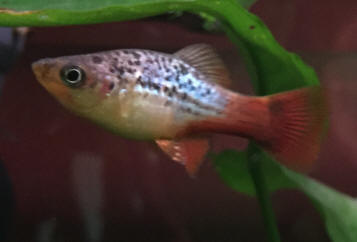
Have I been sold a female Platy? 6/5/16
<Yes>
|
 |
|
Platys; beh.; stkg. 3/11/16
Hi I have 4 platys and 4 mollies 1 male of the platys and 1 male of the
mollies. My high fin platy (male) is chasing the female around who is a low
fin and keeps rubbing on her so I'm presuming that he is mating but she
isn't retaliating or she just swims of can she still get pregnant even
though she isn't retaliating thanks.
<Identified the issue correctly here. Male livebearers will try to mate with
anything. Do try and outnumber males with females, ideally at least 2
females per 1 male. Make sense? Cheers, Neale.>
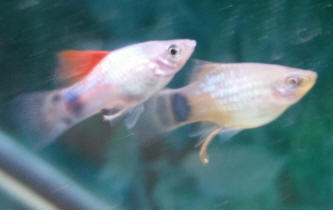
Picture of my platys (5 megs..... child) 3/11/16
<So far as I know, Mollies and Platies won't hybridise, but that won't stop
the male trying!>
|
 |
Issue with platies 11/5/2015
A few weeks ago I bought a female sword tail and a male Redwag platy.
<Be sure to outnumber males at least two to one with females. Since Platies and
Swordtails are so closely related (the farmed kinds are hybrids of the two) you
can add them all up, e.g., three male Swordtails and Platies, plus six female
Swordtails and Platies, would be about right.>
Both were doing well until I bought 3 guppies and 3 more platies. One platy is
green (female), one is spotted (male) and the other is a yellow female.
Ever since, for the last few days or so, the Redwag has been going after the
yellow female platy in an aggressive way. He will chase her away and nip her
hind fun any chance he gets. So she hides in an ornament I have inside the
aquarium.
<Male Swordtails and to a lesser degree male Platies are aggressive, towards
each other AND towards the females. They're aggressive suitors, if you will,
that will try to mate with any female in the tank. That's why you need to either
keep just females (easiest approach) or else keep many more females than males
(so the males can't pester one female all the time).
Adding floating plants is an excellent idea because it provides hiding places
for the females and/or weaker (bullied) males.>
I don't think she is sick. The Redwag doesn't go after any other fish -until
today. I thought maybe he was being aggressive because there were only two
females, so I bought 2 more. One is spotted, and one is yellow like the poor
female he's been bullying. Well, now he's going after my new yellow female and I
can't figure him out. I have a 20 gal tank.
What should I do?
<Read; starting here:
http://www.wetwebmedia.com/ca/volume_4/v4i3/Livebearers/Livebearers.htm
Peruse the links at bottom at your leisure. Increasing the ratio of females to
males will likely be the solution, and do also bear in mind your 20 gallon tank
is relatively small, I'd say too small for Swordtails, so you can keep adding
fish. If this was my tank, something like 2-3 female Platies alongside just 1
male Platy would be the optimal, giving you plenty of space for other fish. If
you were just keeping Platies, then 8-9 females and 3 males would be fine. I'd
recommend against two males of either Platy or Swordtail species because what
tends to happen is that one male becomes dominant and bullies the other male;
keep three males and the one bully can't hurt either one of the two other males
too seriously. Cheers, Neale.>
Stocking a 15-gallon Platy Tank
3/5/15
Hello, WWM Crew!
<Kelly>
I am hoping you can provide some guidance on what would be considered a
healthy and reasonable stock of female platies in a 15-gallon aquarium.
<Yes; six to eight individuals; a good idea to have some live plant
material present>
I have been looking for some conclusive information on this for several
weeks, but every source has a different recommendation. After spending
two hours reading through your site, I can see that you are well-versed
in platy care, so I'll give you the final word! I understand the
importance of excellent filtration for this type of fish, regardless of
number, but
would really like to make sure they have the space and conditions that
will best suit their natural behaviors. Can you help?
Your time is much appreciated!
Sincerely,
Kelly
<Welcome. Bob Fenner>
Re: Stocking a 15-gallon Platy Tank
3/5/15
Thank you so much for your incredibly fast response! I am very grateful.
:-)
<A pleasure to assist you. Bob Fenner>
Mean blue platy 12/3/14
I started with two blue platies and latter learned they were both males.
One is mean to the other and relentlessly chases him around even though
there are other variety platies that are female in the tank.
<Is what they do. Strong males try to monopolise access to females so
only *their* genes are passed on, not those of demonstrably weaker males
they can bully. Evolution at work!>
I latter bought three female blue platies thinking that may help but no
such luck. There are a total of 16 fish in a 56 gallon aquarium plus
three babies. When I try to net it to put it into isolation it sees the
net before it's in the water and hides in the decorations and fake
coral. The other fish seem to ignore the net. Makes me laugh as they act
like they all know I am after the bully for being mean. This repeats
every time I try to capture the bully. He will hide till I move away
from the tank. Any suggestions?
<Adding more males makes it harder for the bully to chase just the one
fish, so trying adding more until you have some larger odd-number of
male Platies: 3, 5, etc. (for some reason odd numbers work better). Else
remove the hapless male to another tank. Be sure to outnumber males with
females, at least two females per male works best.>
I thought platies were friendly fish.
<Up to a point, yes. Very friendly to other species. But males are
programmed to be antagonistic towards one another.>
All the other platies are but this one.
<Females are more sociable but you do find the odd grumpy female too.
Cheers, Neale.>
Platy or swordtail; stkg. Poeciliids in sm. vol..s
8/26/13
Hi there,
<Hello,>
I spent a long time reading and can't find answers to the following
questions. I have a 70 litre tank and 2 X 20 litre tanks but
only a heater for the 70 litre
<18 US gallons, i.e., not a lot of water, so stock carefully.>
and one of the 20 litres.
<5 US gal., barely suitable for fishkeeping at all; at most, either a
male Betta, some Dwarf Aquatic Frogs or a shrimp aquarium.>
I have only had my aquariums about 3 months.
<Stock slowly, and read carefully!>
I went away on holiday and used the 5 day feeder gel formula food and
came back and all fish were well.
<Good. Just for the future, if you're going away for a week or less,
feeding isn't necessary, and in most cases, properly fed fish are fine
for two weeks without food. Safer than adding holiday food. Why? Because
if something goes wrong, like the filter stops or gets blocked and slows
down, there's less waste to pollute the tank.>
After being home a couple if days I did a 30-50% water change and then
next day I saw a baby fish and realised ketchup my red platy was a lot
thinner.
I also have a fat pregnant swordtail female in the same tank(Tiger).
Over the next week I collected 6 more babies from the stones and plants.
The first fish is slightly larger and plain and the others are all
striped like the swordtail mother.
<I see.>
Do you think the plain one that is much bigger could be the lone
survivor from the platys litter (or what ever you call a brood in fish)
and the striped ones are swordtails like their striped mother?
<Possibly, but hard to say. Livebearers of all kinds can delay the
development of fertilised eggs, which means that a female can produce
fry anything up to 6 months after mating with a particular male. That
means the father of your baby fish could have been one of the fish in
the pet store.
Hence fish breeders who want particular sorts of offspring use virgin
females, i.e., they take some female fry when only a few weeks old,
isolate them, and only put them back with a specific male as/when they
want to breed from them.>
I also wonder if my swordtail is still pregnant as I haven't found any
more fry for a few days but she still looks pregnant.
<Possible, but again, be open minded. Ensure diet is adequate (these
fish are largely herbivores, so need a greens-based diet, e.g.,
Spirulina flake) otherwise constipation is common. Water fleas (Daphnia)
are a good laxative. Also be aware of what Dropsy looks like, and keep
an eye open for it. It's a common problem when fish aren't kept
perfectly well.>
I also just want to mention tiger the swordtail female started off being
really bossy and aggressive with everything else in the tank and my
first swordtail male hid from her and eventually died.
<Swordtails are aggressive, and your tank is too small for them. Bear in
mind Swordtails are fast fish from flowing water habitats, and they can
get to around 8 cm/3 inches in length, sometimes even more. I'd keep
them in tanks not less than 70, 80 cm long, so realistically, tanks in
the 110 l/30 gallon size range upwards. In smaller tanks aggressive fish
will often
whittle their population down to a manageable size, and that may well be
what you're seeing here.>
I since replaced with a new one who can just barely cope with her. I
know this ratio of 1 male to 1 female is not normal but it seems right
for her.
What do you think?
<See above; Swordtails are aggressive and chase each other a lot. Keep
two females per male, in a suitably sized tank, and either one male or
three, never two because that number seems to end up with one bullying
the other.
To be honest, in small tanks Platies are better bets.>
I got a lyre tail molly female to be boss and she started off hiding
from tiger.
<Mollies definitely do not belong here!
http://www.wetwebmedia.com/fwsubwebindex/mollies.htm
Do read up on these difficult fish.>
I had to replant and move everything around to give all new territories
play and this helped them to fit in better and now the 2 play and
thankfully mainly leave the smaller fish alone. I must say I don't like
the idea of having just one lyre tail molly but think this is working
for the individual fish involved.
<Mollies don't get lonely.>
I think I might sell 6-7guppies and just keep the named male (Albie).
He doesn't seem to Fin nip like the others do but would I have an issue
with having 1 male guppy without a female or 2 to hassle in with the
other fish?
<Stop. Your tank is already VERY overcrowded.>
The guppies are brothers and sisters so I don't want these
particular girls as I don't want to inbreed them any more as I got them
from someone who has inbred them heaps. I would want a new gene
pool even though they are very pretty.
8 neon tetras
2 female platys
1 male platy
1 female swordtail
1 male swordtail
1 female lyre tail molly
2 peppered Corydoras
1 bronze Corydoras
2 Bristlenose catfish
7-8 nearly grown Guppies including named male
Thank you so much for your help
Angie
<Do read:
http://www.wetwebmedia.com/fwsubwebindex/poeciliids.htm
http://www.wetwebmedia.com/ca/volume_5/volume_5_3/stocking.htm
http://www.wetwebmedia.com/FWSubWebIndex/fwlivestk.htm
http://www.wetwebmedia.com/fwsubwebindex/fwset-up.htm
And follow the links. You have a very small tank overstocked with fish
with different water chemistry requirements (e.g., Neons need soft/acid
while Mollies and need hard/alkaline and possibly even brackish). Some
of these fish are quite hardy (e.g., Corydoras) but others are
notoriously difficult for beginners to keep successfully (Neons,
Mollies). Cheers, Neale.>
Re: Platy or swordtail 8/26/13
Hi Neal
<Angie,>
Thank you for your advice. The only thing that I can't really
understand is whether one guppy is okay in the communal tank rather than
the current 6-8 or whether I need to keep a female to keep him happy?
<Guppies are fine on their own when kept with appropriate tankmates.
Adding females (plural) per male Guppy is of course doable, but not
necessary, and males harass the females in small tanks.>
The 20 litre tanks are 1. for raising babies and 2. for breeding food
for my tank i.e. brine shrimp or Daphne.
<I see.>
What is Dropsy? Is there a link about it?
<It's a symptom rather than a disease. Fluid retention inside the body.
Indicates all sorts of different things, but typically bacterial
infections and/or organ failure. Difficult to treat unless caught early.
Very characteristic of Dropsy is the "pine cone" effect seen from above,
as the scales of body stick outwards. Do start here:
http://www.wetwebmedia.com/fwsubwebindex/dropsyfaqs.htm
>
Take care
Angie
<Will do, Neale.>
Male and female platy
ratio 9/30/11
Hello:
I was wondering if I have a 46 gallon with two male swordtails and one
male platy if I could put four female Platies in there??
<Do bear in mind Platies and Swordtails have somewhat different
preferences, Swords coming from streams and Platies from ponds. Also,
Swordtails tend to be much more aggressive as well as physically
stronger and faster, so they can harass the other species. Of course
both share some traits, including the need for cool water (22-24
C/72-75 F) and hard, alkaline water, so they're often kept
together. It's just not a sure-fire success.>
Would the male swordtails make the female Platies lives miserable??
<Could well do so. The minimum ratio here will be two females (of
whatever species, they don't differentiate) to each male (again, of
whatever species).>
I have the four females in a 20 gallon tank on the kitchen counter and
I was thinking of taking it down due to space. Thank you!!
<Cheers, Neale.>
Blue Wag platy question, sel., genetics f's
1/16/11
Hello:
I recently discovered the Blue Wag Platy. It is a beautiful fish, but
it seems that it is really hard to find. Many people on fish discussion
boards are asking others about it and no one knows where to get them,
unless you live in a place that has a LFS that happens to sell them. I
was wondering why they are so hard to find. My spouse says it is
because blue must be a recessive gene. I was wondering why there
isn't more blue freshwater fish??? I guess the other colors make
them easier for a mate to find them. Thank You!!!!
<Hello John. Blue Wagtail Platies are an artificial form not a wild
type, so evolution doesn't really come into the explanation. Farms
could easily produce lots of them if they wanted, but for one reason or
another the red and orange forms seem to sell better. That's the
basic reason you don't find them so often in the shops. Personally,
I prefer natural-looking fish, so I'm most excited when I see the
plain green Platies. Each to their own, I guess. There actually are
quite a lot of blue freshwater fish, including such favourites as the
Malawi Blue Dolphin Cichlid (Cyrtocara moorii), the Lake Kutubu
Rainbowfish (Melanotaenia lacustris), and the Blue Tetra (Boehlkea
fredcochui). But you are quite right in that blue isn't a very
common colour. In fact most freshwater fish are green, brown, or some
combination of these two colours. Why? Because most freshwater habitats
are quite murky and contain lots of mud, wood and aquatic plants. Fish
living in such places have greens and browns that help them blend in.
Mottled brown is particularly common among those fish that lurk among
the shadows, for example. For the most part though, unless you're
an advanced aquarist interested in unusual fish, these cryptically
coloured fish won't be the ones you'll be keeping, though there
are some exceptions, Common Plecs for example, and African
Butterflyfish. Those fish with bright colours such as Guppies and Neons
are very much in the minority, and a great many of these have been bred
over the generations to be even brighter now than they were in the
wild, Guppies being the classic examples. The colours on farmed Guppies
are far different to those of wild Guppies. With that said, because
males tend to have the colours and not the females, it's widely
assumed that bright colours evolved because females selected males with
bright colours, such males having had to be strong and smart simply to
stay alive long enough to reach sexual maturity. Anyway, to summarise,
your Blue Platies are uncommon because they don't sell well; there
are lots of blue freshwater fish; and the reasons why fish have
particular colours are complex and have much to do with issues such as
camouflage and sexual selection. Cheers, Neale.>
Question: Cloudy Water, Snail, Freshwater 15 gal
4/26/10
Hello WWM Crew,
<Hello,>
I have a situation here that has me stumped a bit. I absolutely love
your site by the way. I have tried searching around, and have read tons
of your FAQs (which are extremely addicting by the way) and haven't
quite found
anything that would help explain this so here it goes.
<OK.>
I have a 15 gal freshwater aquarium (landlord won't let me keep
anything larger) with an Aquaclear 30 power filter with sponge, carbon,
and ceramic ring inserts.
<Fine. But do understand the limits 15 gallons places on your fish
choices.>
Water Parameters have been steady the whole time:
Ammonia - 0
Nitrite - 0
Nitrate - less than 5
GH - 160
KH - 180
PH - 7.8
Temp - 80 deg F
<All fine for a wide range of species.>
This tank has been set up for about 6 weeks and has had fish in it for
4 weeks.
Stocking:
3 Platies 1.75"
<Borderline for a tank this size; watch the aggression of the
males.
Actually, keep one male, two females in a tank this size.>
2 Peppered Corydoras 1" (babies!)
<Do add a couple more; they're gregarious fish.>
1 Black Mystery Snail 0.75"
<Your tank is far too warm for all these fish. Aim for 24 C/75
F.>
My question is that, while I know that my tank is still cycling, and
the cloudy water is more than likely due to a bacterial bloom,
<Correct.>
it seems to have coincided with the addition of the snail which I added
about a week ago. Now I've read dozens of times that dead snails
pollute the water to horrendous levels very quickly, but what about
live ones?
Does adding live snails spur a bacterial bloom?
<Certainly can. Apple/Mystery snails -- which I DO NOT recommend you
add to aquaria generally -- to indeed promote the growth of Protozoans
in the water. They used to be maintained precisely for this, for
creating the infusoria required to feed baby fish. Whether that's
the issue here is difficult to say, particularly since adding any
animal can tip things in the favour of bacterial blooms.>
When I look at the water it just looks cloudy from a distance (sitting
on the couch). But looking at it really closely I can see literally
millions of microscopic specks floating around, and if not for these
particles, presumably bacteria, my water would be crystal clear.
<Do make sure you cleaned the substrate and have rinsed or replaced
mechanical filtration media.>
Am I even right here? Is this a bacterial bloom? Or is there a
possibility of something else... parasite perhaps?
<Not this, no. Generally, if you can see it, it's
harmless.>
All the fish are happy and healthy, eating, swimming and being
themselves.
I just hate cloudy water and would like to know if there's a chance
this could be something that needs to be dealt with (parasite).
<More mechanical filtration, plus time, will work.>
Thank you in advance.
Angela
<Cheers, Neale.>
Re: Question: Cloudy Water, Snail, Freshwater 15 gal
4/26/10
Hi Neale,
Just wanted to say thank you for such a quick reply, its much
appreciated.
<No problem.>
I will started lowering the temp over the next few days as you
suggested,
<Can switch it down at once; it's take a few hours for the tank
to cool down the couple degrees.>
and just went out and bought some filter wool to replace the carbon in
my filter, since I don't have any driftwood in the tank (just
plastic plants and a few caves) the carbon's pretty pointless.
<Indeed.>
As far as the Platies, I sexed them all when I got them, they are all
male.
With the exception of establishing a pecking order over the first week,
I haven't noticed any aggression between them, in fact they have
become quite buddy-buddy at this point. Do you think this will
last?
<Might do.>
Or would you suggest getting females anyway?
<If you do add females, the males will become more feisty, and
you'd need at least 6 females for 3 males, and 9 Platies would be a
lot for a 15 gallon tank. See if you can't trade-in one of the
males against four females.>
One last question, as far as the Corydoras go. I was planning on
getting a couple more. Should I wait till the tank rights itself or
just get them now? I know if I wait, then the addition thereafter could
potentially cause another bloom. Just wondering what the best route
would be at this point.
<By all means wait for things to settle down. The Corydoras will be
fine on their own for a few weeks, but long term, the difference
you'll see with 5-6 specimens (of the same species, obviously)
compared to just 2 will be
dramatic. Again, try and get a mix of males and females, though most
Corydoras species are rarely aggressive. I have 6 Peppered Corydoras in
a tank about this size, and they scoot about across the sand most
contentedly. If you can, keep them with a smooth silica sand --
they're so much happier than with gravel, and their whiskers become
super long.>
Thanks again for all your help.
Angela
<Cheers, Neale.>
Male Platy Behavior, sex-ratio sel.
1/31/2010
Hello!
<Hello Andrew,>
In a previous email, I mentioned how I had a platy mysteriously
disappear from my tank.
<Indeed.>
I have since added more platys (female). I used to have 3 blue Mickey
mouse platys (1m, 2f) before the disappearance and now have 4
platys:
2 blue Mickey mouse platys (1m,1f)
a sunset wag platy (f)
and a blue wag tail (f)? (here is an image
http://www.tropicalfishintl.com/images/enlarge/Platy/WagtailBluePlaty.jpg)
<OK.>
The female blue Mickey mouse platy is now showing outward signs of
pregnancy (typical).
<Quite. But do be sensitive to both constipation and dropsy,
diseases that can cause similar external symptoms.>
The male blue platy constantly follows her around the tank, and takes
no interest in the other 2 female platys. He will also chase the other
2 platys away from her, especially during feeding time. Will this cause
undue stress on her/ the other platys?
<Yes, it will stress her, and will increase the risk of
miscarriages. Do make sure you have lots of floating plants, ideally
covering 75% of the surface. Indian Fern is the default and idea.
Females will hide here, and the males will harass them far
less.>
Should I attempt to exchange the two wagtail platys for more female
blue platys?
<Anything that ups the number of females relative to males helps. Do
bear in mind all these varieties interbreed, so you'll end up with
fry that don't have one particular colouration. You might not care
all that much, but if you plan on selling the fry, selling one
particular variety will go down better with the shop.>
Thanks again for your invaluable help,
Andrew
<Cheers, Neale.>
All-male tank?? Platies 7/25/09
Hi, my family recently decided to try to become fish owners after we
won 2 goldfish at a fair.
<A very common (includes me) of how many of us get started in the
hobby... but Goldfish are not easily kept it turns out...>
They both died about a month later. We think they had contracted a
disease from the fair tank. Our second attempt at a fish tank is going
fairly well.
We bought three fish; two platies (one female Mickey mouse and one male
red wag) and a molly (male black). The female platy died recently after
giving birth. We think that she died of stress of birth and from the
other two
males messing with her. She didn't seem to have any other medical
problems.
Now we have the two males.(none of the fry lived) Now for the question.
We are wondering whether we could keep an all male tank?
<Yes... can be done. Actually is the practice for the business of
raising many livebearing toothed carp species for the ornamental
trade>
We would like to buy more fish because we know they are schooling fish,
but we are unsure whether we can just buy more males as then we
wouldn't have to deal with the stresses of breeding. We are not
sure if that would
cause aggression problems etc...
<Actually much less than with females present>
We are even interested in upgrading to a 20 gal. tank.
<Ah much better for your fish/es and maintenance>
(we have a 10 gal. tank) We just need to know what gender fish to get.
Thanks
<Welcome. Bob Fenner>
Freshwater Stocking Question, Corydoras and Platy Sel.
11/26/08
Hello W.W.M. Crew!
<Jake>
I am trying to help some friends with their aquarium, and would
appreciate some stocking advice. Here is the setup: They have a 20
gallon aquarium, that is 24 inches long. It has ordinary
(non-calcareous) aquarium gravel, with plastic plants, and is filtered
by a Hagen AquaClear, that turns the water over 7 or 8 times per hour.
I have that filter stocked with Hagen's bio-ceramic media and
synthetic filter floss. These ladies follow proper procedures for
cleaning the filter and doing weekly, partial water changes.
They vacuum half the substrate each month.
<I'd do this every week or two>
They also know how to feed properly, without over-feeding. Their tap
water comes out of the faucet at ph 7.8, and is hard, but not VERY
hard.
(I can't recall the dh numbers right now.) They use Cycle on their
tap water, and allow it to sit for three days before placing it into
the tank.
This tank and filter are already "mature"/cycled, as it has
been up and running for a year, with some other fish. (Those fish will
NOT be in the tank, though, with the new fish.) After much
consideration, trying to agree on fish that would be interesting for
them, but appropriate for the water conditions and size of the tank, we
have agreed that they will stock with Corydoras and female platies. So
here are my questions: If they stock five Corydoras, then how many
platies would be the most that they should stock,
<A dozen or so... A comment re the all female selection. Very likely
some individuals here will reproduce... these and many other
livebearers are able to "store" sperm in their tracts... So,
unless isolated from males at a very small size...>
and are there varieties of Corydoras that should be avoided, because
they will not adapt, (as well as others), to the hard water?
<There are some that are better than others... you could do the LONG
read on fishbase.org re the genus' constituents known natural
ranges here... Or "just shoot for" tank-raised
species/specimens... as all these will "stretch" to this pH,
not too hard water>
Their water parameters will be kept at healthy levels, but I am
concerned about things such as "psychological space/crowding"
for the platies. Also please tell what you believe the IDEAL
temperature would be for this mix of
species. Thank you, so much, for what you do! Have a great, fishy
day!
Jake D. (Wisconsin)
<And you as well Jake. Bob Fenner>
Re: Freshwater Stocking Question 11/26/08
THANK YOU, Bob! And I would like to tell you, quickly, that it is
because of YOU and the W.W.M. website, (and the effect that it has had
upon how I keep fish), that I originally stepped forward to ASSIST
these ladies, when their tank looked like a failed chemistry
experiment, and they were about to leave the hobby. It has been a
privilege to be able to help them to succeed, and to remain in this
great hobby/pursuit. I continue to look for opportunities to assist
others in a similar way. THANK YOU, one hundred times, for all that you
do. Have a blessed Thanksgiving! Jake
<Ahh Jake, deeply gratifying. So glad to find ones efforts inspiring
others to help. Cheers, Bob Fenner>
Adding baby platy to tank 12/2/07 I
have a 10 gallon tank in my classroom with one male and one female red
wag platy. I thought I had all females when I bought them from the fish
store because the sales clerk told me they only had females, but
evidently she was wrong. After looking at pictures on the internet
later, I realized the smaller one was most likely a male. Anyway, while
doing a water change a couple months ago, I found one fry. The fry
stayed in a breeder net (box-shaped) within the 10 gallon tank for
awhile but then I set up an Eclipse 3 gallon aquarium for him/her so
he'd have more room. Now he's almost 2 cm long now. I want to
put him/her in my 10 gallon tank with the other 2 platys now so I can
keep the 3 gallon tank for any new fry I may find.? Will the other two
platys pick on him/her since he would be the stranger in their
territory??? Is there some particular way I should add him to the tank
so he would not be picked on by the grown platys?? Thanks! Carolyn
<Carolyn, Platies are essentially schooling fish and the more the
merrier. The only possible problems come from males, which will
sometimes chase one another. If there are a surfeit of males, the males
may also harass the females in the anxiousness to mate. That's why
experienced Platy keepers always recommend keeping two females for
every one male -- it's the only way to ensure peace, in small tanks
especially! In fact, in small tanks, I'd always recommend keeping
just female Platys, since they're no less attractive than the
males. In any case, Platies are easy to sex: Only females have
triangular anal fins; males have rod-shaped intromittent organs called
gonopodia. If your store clerk can't tell the difference, he/she
must have very poor eyesight! One good idea with Platy tanks (and
livebearer tanks in general) is to use lots of real/plastic plants,
especially ones that float at the surface. Not only to they provide
hiding places for the fry, they also allow picked-upon fish to get out
of the line of fire when they want to. Cheers, Neale.>
Stocking first tank with platys
9/3/07 <<Greetings. Tom with you.>> I'm new to
this. I have set up a 10 gallon aquarium in my classroom and, after
reading a bunch of stuff on the internet, I think platys would be good
fish for me. <<Quite possibly.>> I do not want fish fry,
though, as I think I will be challenged enough just trying keep my
aquarium in good condition without worrying about raising babies and
what to do with them. <<You can always let Nature take its course
but I understand your reservations.>> So, I either need to get
all male or all female platys. <<And hope the females, if these
are purchased, haven't mated before you get them. ;) >> I was
thinking all male would be the best choice since there is the
possibility that a female could be pregnant when I got her or that a
immature female might be misidentified as a male.
<<Exactly.>> However, I want my fish to get along with each
other. Will I have aggression problems by having all males?
<<Potentially, yes. Even without females to vie for, your males
will likely attempt to establish a 'pecking order' among
themselves. Given the temperaments of these fish, however, I
shouldn't think this would pose too great a problem.>> Also,
what would be the best plan for stocking my tank? Should I get 3 platys
to begin with and, after the tank has cycled for a while, then get 2
more? <<First, don't add any fish until the tank has
completely cycled. In a classroom setting, this is a wonderful
opportunity to educate your students on the proper way to establish an
aquarium. No need to turn this into a course in Science but the
question will almost certainly arise as to why the tank has no fish in
it. You might take a look at these articles:
http://www.wetwebmedia.com/FWSubWebIndex/fwestcycling.htm
http://www.wetwebmedia.com/FWSubWebIndex/fwfiltration.htm When
you're ready to add your fish, it would be best to add the five at
the same time. Though not noted for being territorial in the same
fashion that some other species are (Cichlids, for example), adding all
of them together will start all on a level playing field, so to speak.
Another means of alleviating possible aggression.>> Is a total of
5 platys too much for a 10 gallon tank? <<No. You might even
consider adding a few of the Corydoras species -- belonging to the
Catfish family -- as these fish, along with being a particular favorite
of mine, are non-stop scavengers and will aid in cleaning up uneaten
food. They'll need their own diet, of course, but will continue to
scour the bottom of the tank nevertheless.>> Thanks! <<Good
luck with your venture. Tom>>
Re: Stocking first tank with platys
9/3/07 <<Hello again, Carolyn.>> Thanks so much for
getting back to me so quickly! <<Happy to do so.>> I
can't wait for my tank to cycle so I can finally add some fish!
<<I understand completely.>> About adding the Corys, what
would be a good number to get for a 10 gallon tank if I do have 5-6
Platys? <<Since the Corys will inhabit the bottom of the tank,
for the most part, and not really compete with the Platys for food at
mid-level, you could easily add five or six. One admonition? Hold off
for a couple of weeks before adding the Corys after the Platys have
been introduced. Two reasons for this. First, you don't want to
overload the bio-colonies by adding too many fish at one time. Second,
you're not set up for quarantine and a couple of weeks will give
you time to make sure the Platys are in good health. (Corys are
'scaleless' fish and would require a different treatment
regimen should something unforeseen arise.)>> If I get more than
one, should it be a combination of male and female? <<Corys are
very social toward each other -- the more, the merrier in the case of
these fish - so getting males and females strictly for
'companionship' isn't truly necessary. Likely that
you'd wind up with some combination of male(s) and female(s)
anyway.>> I don't want to overcrowd my tank with fish.
<<You won't be overcrowding, Carolyn. Keeping up on regular
water changes (50% or better each week) and maintaining your filter
properly will easily handle the numbers of fish you'll have. The
Platys and Corys are both smaller species of fish that you should have
little, if any, difficulty keeping well in your 10-gallon tank.>>
Carolyn <<Tom>>
Re: Stocking first tank with platys (follow-up) --
09/05/07 <<Sorry for being a little tardy, Carolyn.
Holiday's over and it's back to the day job!>> Thanks so
much! <<You're quite welcome.>> I meant to ask you what
to add first but forgot so I'm glad you put that info in there!
<<By way of explanation on this -- and for the future -- Platys
are much easier to detect problems with than the Corys would be.
I've kept Corys for years with varying degrees of success (some
varieties are simply hardier than others) and rarely have I been able
to successfully treat one with an illness. They simply don't
'display' illnesses the way other species of fish do. A Platy
laying on the bottom of the tank is a sure sign of trouble. For a Cory,
this is totally normal. They don't tend to 'clamp' their
fins in the more obvious manner of other species which makes early
detection of health issues problematic. The upshot here is that I'd
rather see you add the Platys first to 'get your bearings' and
add the Corys afterward. They're extremely social among themselves
and oblivious to most anything/everything else in the tank (other than
what they can scavenge). Aside from poor water conditions/quality,
there's not much to stress these little guys and gals.>>
Carolyn <<Tom>>
Platy m/f ratio 5/10/07 Over the course of adding
fish a few at a time to my tank, I decided to get some platies. At the
time of purchasing the platies, I read that you should have at least 2
females for each male, so my intent was to buy 2 or 3 females and one
male. However, the guy at the fish store said he couldn't find any
male platies in the tank, so I just got 3 females to start with, with
the plan of getting a male later. So, today I went back to get the
platy and some other fish, and after having the sexing of platies
explained to me and arriving back home and examining my fish, I am
fairly sure that 2 of the 3 "females" I bought previously are
actually males! <Mmm, yes... happens... can/do change sex... where
there is a need, opportunity> So now I have 3 males and 1 female...
I know this is not optimal, but I'm afraid that if I buy the 5
additional females needed to get the ratio right, my tank will be
overcrowded. Current inhabitants are: 4 dwarf gouramis, 2 African dwarf
frogs, 4 platies, and 4 black-/white skirt tetras in a 20-gallon tank
(not planning to add anything else other than possibly platies). Should
I get some more females, and if so how many? <I would just stick
with what you have here> Should I try to get the fish store to take
back some of the males they sold me (it's not like I have proof of
what they told me about the sexes)? What is likely to happen if I leave
the current platy sex ratio? Thanks in advance for any advice, Suzanne
<Likely all will be fine here with the "batch" you have,
the setting... I would leave this mix of platies as is for now. Bob
Fenner>
Platy question 2/9/06 I recently
bought a 5 gallon aquarium (I've had aquariums most of my life, but
I had to move and had to leave my old one behind.) I have 2 platies to
start with, and as it turns out they are both males. One is
a Mickey mouse platy and the other is red tail sunset
platy. The red tail sunset has taken to picking on the
Mickey mouse platy. The Mickey mouse platy doesn't seem
to care, he just swims off, and he gets plenty of
food. I'd like to stop the red tail sunset from chasing
him, so I'm going to buy more platies...however, I don't want
babies. If I buy a few more males, will that
disperse the territorial behavior that I think I'm witnessing?
<Quite possibly, yes> Will they all decided to just live
peacefully or will they all pick on one another? <At some point in
crowding, the tension should be diffuse> I'm willing to buy a
few females, but I really don't want a bunch of fry to deal
with. I know that the platies are cannibalistic and will eat
their fry, so I guess I could just let "nature take its
course," but obviously that seems rough. What would you
recommend, that I buy more males or some females? <Up to you>
Also, should I be using an air pump for a 5 gallon
tank? They seem to be doing okay without one, but I do have
one I could use. Thank you so much, Lindsey <Well, do need aeration,
circulation from some source... Bob Fenner> Platies, all male
stocking? - 2/4/2006 Hello...I'm a new at this...I have a
new 15 gal tank that is ready for adding more fish....I like platies
for their ease of care and color....I am not interested in
breeding....Can I put just males because they are smaller and brighter
color or am I messing with mama nature by not having the recommended
male and two females.... <Can just have all males> I realize this
question is a bit basic but like they say "No question is too
stupid to ask"....Thank you for your consideration....Bill B.
<Mmm, nope... All earnest questions are welcome... discourtesy is
not. Cheers, Bob Fenner> Red Mickey mouse platy I just
purchased a red Mickey mouse platy, and I have a 3 gal.
aquarium. I was wondering how many platies can I have in my
3 gal. aquarium. <<Basic rule of thumb for freshwater is 1 inch
of fish per 1-1.5 gallons of water. The 1 inch should be based on the
adult size of the fish, not necessarily on the size it is when you buy
it. This rule changes depending on the nature of your fish but will
work as-is for Platies. Platies reach an adult size of approx 2 inches,
so going with that, I would put no more than 2 in your 3g tank. You may
want to also make sure that you get two of the same sex as Platies do
tend to breed quite easily and while the parents will eat most of the
babies it's still possible for your tank to get overrun.
Ronni>>
New tank and platy choices Hello, I recently got my daughter
a tank (Eclipse 12 system) for her 11th birthday (Aug. 18)- added water
and Cycle and let run for 4 days. Her Aunt then got her fish (wrong
kinds for a beginner tank- 3 hatchet fish, 3 cardinal tetras, an Oto
and a frog). Well, 2 days ago the last tetra died. I did a 90% wc,
re-filled and added Bio-Spira yesterday. Today I got her 2 platies
(turns out one male and one female). My question is: should I get
another 1-2 FEMALE platies- and if so, how to hand the fry that I am
sure will eventually show up? I have some live grass and java moss in
the tank, so I guess the fry will have some places to hide, but I do
not have any other tanks at this time. Also, how do you get a
"nursery tank" set up and cycled with out any fish in it
constantly? Sorry for the long post- but don't want to got through
any more "funerals"! (I do w/c about 1x week and do test for
ammonia, nitrites, and nitrates about 1-3 times a week). < Another
female will take some of the stress off of the single female by the
male. If you want to save the fry then you need to set up another tank.
The fry from the platies are going to be small and either eaten by
other fish or sucked up into the eclipse's powerful filter intake.
If you see the female is pregnant from the large size then you can
always put he in a breeder net device designed to separate the mother
from the fry. They can then go into another tank until they are large
enough not to be eaten by the adults. In a new tank with the fry you
can do small water changes to keep the ammonia in check. Add some
gravel from the main tank to get things going.-Chuck> Marcell
(Alaska)