|
FAQs on Asian Freshwater
Biotopes
Related
Articles:
Biotopes -
Part 1 by Alesia Benedict, Biotopic
Set-Ups, pH,
alkalinity, acidity, Treating
Tap Water, Freshwater Aquarium
Water Quality, Freshwater
Maintenance,
Related FAQs: Freshwater
Community, African
Biotopes, N. American
Natives, Amazon Biotopes,
Planted River Biotopes, Small System Biotopes & Treating Tap Water for Aquarium Use,
pH, Alkalinity, Acidity, Freshwater Algae Control, Algae Control, Foods, Feeding, Aquatic Nutrition, Disease,
|
 |
|
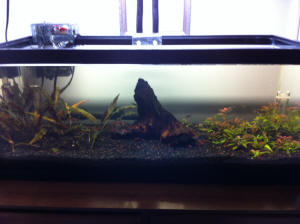
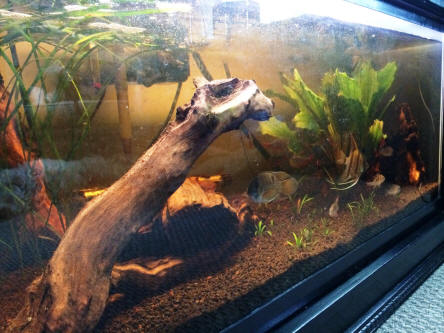
Asian river and Amazon 6/11/14
Hi guys,
<Phill>
Just wanted to share with you my final setups for my 40 gallon Amazon
and my son's 20 gallon Asian river. Some of the plants still need some
growing and are recent adds but you get the general idea. Thank you to
Neale
<Sent to him>
especially for making this a very enjoyable hobby for my son and I!! I
tried to make the tanks as pure as possible but some of the plants were
admittedly disputed as to area of origin but hey....can't take all the
fun out of it can I :)
Asian river
Cryptocoryne Wendtii
Blyxa japonica
Heteranthera Zosterofolia
Nymphaea Zenkeri
Betta splendens (Betta)
Kryptopterus minor (Ghost Catfish)
Trigonostigma heteromorpha (Harlequin Rasbora)
Stiphodon semoni (Cobalt Blue Goby)
Pangio semicintus (Black Kuhli Loach)
Amazon
Vallisneria Americana Gigantea
Sagittaria Subulata
Echinodorus 'ozelot'
Cleithracara maronii (Keyhole Cichlid)
Pterophyllum scalare (Angelfish)
Hyphessobrycon columbianus (Blue/red Columbian Tetra)
Gasteropelecus sternicla (Common Hatchetfish)
Mikrogeophagus altispinosus (Bolivian Ram)
Ancistrus cirrhosus (Bristlenose Pleco)
Phill
<Ah, very nice. Bob Fenner>
Re: Asian river and Amazon 6/11/14
I'm not sure how I forgot but thank you as well Bob! I've definitely
gotten your help more than a couple times.
Phill Shubert
<Ah, cheers. BobF>
|
 |
|
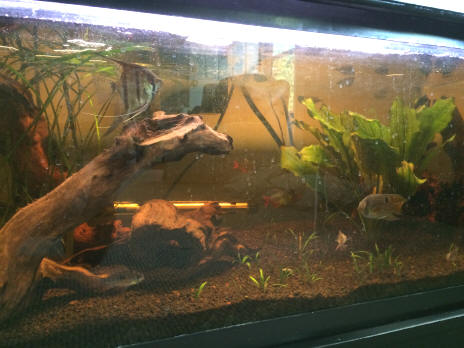
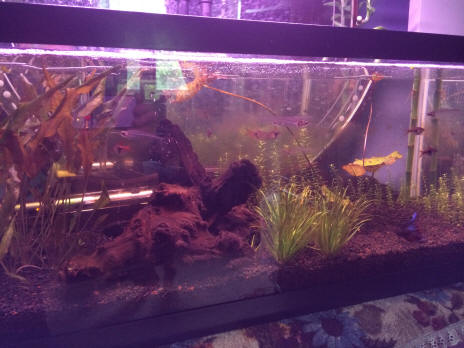
Asian river and Amazon 6/11.5/14
Hi guys,
<Phill,>
Just wanted to share with you my final setups for my 40 gallon Amazon and my
son's 20 gallon Asian river.
<Looks good! A wipe of the front glass might be a plus before taking photos,
though! Squirt the window cleaner onto a paper towel (not at the tank!) then
wipe.>
Some of the plants still need some growing and are recent adds but you get
the general idea.
<Indeed. Abacus aquatics in Sidcup recently got some Vallisneria nana. Like
all Vallisneria it's relatively easy to grow, and spreads well once settled.
It's an easier alternative to Hairgrass type things, having the
usual Vallisneria tolerance providing you DO NOT bury the white crown under
the substrate.>
Thank you to Neale especially for making this a very enjoyable hobby for my
son and I!! I tried to make the tanks as pure as possible but some of the
plants were admittedly disputed as to area of origin but hey....can't take
all the fun out of it can I :)
<Pretty much the idea.>
***Asian river***
Cryptocoryne Wendtii
Blyxa japonica
Heteranthera Zosterofolia
Nymphaea Zenkeri
Betta splendens (Betta)
Kryptopterus minor (Ghost Catfish)
Trigonostigma heteromorpha (Harlequin Rasbora)
Stiphodon semoni (Cobalt Blue Goby)
Pangio semicintus (Black Kuhli Loach)
***Amazon***
Vallisneria Americana Gigantea
Sagittaria Subulata
Echinodorus 'ozelot'
Cleithracara maronii (Keyhole Cichlid)
Pterophyllum scalare (Angelfish)
Hyphessobrycon columbianus (Blue/red Columbian Tetra)
Gasteropelecus sternicla (Common Hatchetfish)
Mikrogeophagus altispinosus (Bolivian Ram)
Ancistrus cirrhosus (Bristlenose Pleco)
Phill
<Well done. Neale.>
|
Re: Asian river and Amazon 6/13/14
Lol good call. I was excited after adding my driftwood and didn't notice
the spots. I'll get you a better one. I feel after all your input you're
essentially part creator of these anyway.
<Kind of you to say so! Neale.>
Phill
Re: Asian river and Amazon
Hi Neale,
As promised...sans water marks.
<Ah yes, "clearly" superior! Cheers, Neale.>
|
 |
|
Carinotetraodon irrubesco
5/28/13
Hi crew,
<Jo,>
Wanted to make a quick enquiry. I've kept three red eye puffers for a
few years in a mixed community with success.
<Is indeed a nice, relatively tolerant species of puffer.>
I would now like to move them into a 40gal biotope based on
Borneo/Sumatra.
What would be your recommended fish for this setup?
<Ah now, Fishbase says this: "Specimens typically caught along bank
vegetation in large rivers. The specimen from Sambas were obtained
amongst submerged bank vegetation. The water was murky brown, with pH
about 6.0.
Syntopic species include Rasbora tornieri, R. bankanensis, Doryichthys
deokhatoides, Brachygobius doriae and Dermogenys sp." So there you go:
schooling cyprinids, pipefish, bumblebee gobies (!!!) and wrestling
halfbeaks. I'd certainly go along the lines of a school of midwater
cyprinids such as Harlequins being about right in terms of size and
personality. Some small barb species like Cherry Barbs could work too. I
have kept C. irrubesco with Celebes Halfbeaks which are a bit bigger
than Wrestling Halfbeaks but, in the UK at least, much more widely sold.
I'd be leery of mixing Gobies given the problems getting Gobies to feed
in community tanks, but I suppose if you were desperate to try then
something like the Black Toraja Goby might work.>
My puffers have never bothered the Kuhli loaches or garra in with them.
I'd like bottom dwellers and fast shoalers. Also how might you decorate
the tank? I've been looking at ideas but am keen to hear your expertise.
<Again, see the comment from Fishbase, above. Carinotetraodon irrubesco
inhabits dark, acidic streams that lack aquatic plants but have lots of
vegetation growing from the riverbank into the water, which could be
mimicked using a mix of bogwood roots, a few rocks, and perhaps floating
plants that grow downwards, like Indian Fern.>
Thanks in advance.
Jo
<Welcome, Neale.>
|
Biotope build outs, ex.s 1/16/13
Hi guys,
I wanted to thank you for your input and send you some updates as to how the
Asian and South American biotopes are coming. I have attached pictures of
both.
<Phill... hundreds of Kbytes, not Megs of pix/files please>
The Asian tank is a 20 long with the following:
Betta
Harlequin Rasbora
Celestial Pearl Danio
Red Cherry Shrimp
Christmas Moss
Cryptocoryne Wendtii
Hygrophila Sunset
I have 1 T5HO 24W bulb about 10" above tank and dose with Seachem
comprehensive, Excel, and Nitrogen. Very pleased with this tank so far.
<Looks nice>
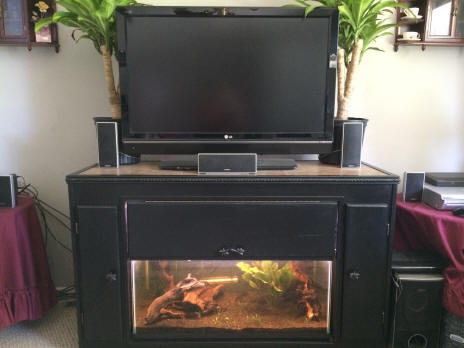
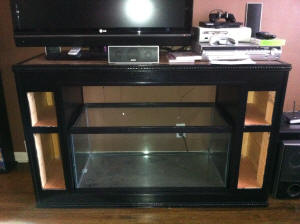
The South American tank will be going into the attached
build which I thank you for all your input. The doors are going on tonight.
The T5HO dual 48W will hang in that open space above tank 10" above. There
will be a door hiding the light and filter. I will send an updated picture
when it is done. It will contain:
Blue Acara
Bolivian Rams
Emperor Tetras
Bristlenose Pleco
Ozelot swords
Dwarf swords (parviflorus)
Dwarf Hairgrass
I just really wanted to thank Bob, Neale, and the rest of the crew who
helped me with this. My family and I are truly enjoying this experience and
it would not have happened without your aid. Truly appreciate your site and
what you guys do for us hobbyists.
Sincerely,
Phill
<Thank you for sharing. Bob Fenner>
|
Biotope build outs 1/17/13
Hi guys,
I wanted to thank you for your input and send you some updates as to how the
Asian and South American biotopes are coming. I have attached pictures of
both.
The Asian tank is a 20 long with the following:
Betta
Harlequin Rasbora
Celestial Pearl Danio
Red Cherry Shrimp
Christmas Moss
Cryptocoryne wendtii
Hygrophila Sunset
I have 1 T5HO 24W bulb about 10" above tank and dose with Seachem
comprehensive, Excel, and Nitrogen. Very pleased with this tank so far.
<Indeed, looking good. Do wonder about the Hygrophila though; looks a bit
leggy and while it's nice to see the red colour on the leaves, pale green to
red plants are often very light-hungry. Would expect them to look bigger and
bushier if they've been there a couple months or more.>
The South American tank will be going into the attached build which I thank
you for all your input. The doors are going on tonight. The T5HO dual 48W
will hang in that open space above tank 10" above. There will be a door
hiding the light and filter. I will send an updated picture when it is done.
It will contain:
Blue Acara
Bolivian Rams
Emperor Tetras
Bristlenose Pleco
Ozelot swords
<A nice plant.>
Dwarf swords (parviflorus)
<Never had much luck with this…>
Dwarf Hairgrass
<…or this! Both need more light than I've ever provided, I think.>
I just really wanted to thank Bob, Neale, and the rest of the crew who
helped me with this. My family and I are truly enjoying this experience and
it would not have happened without your aid. Truly appreciate your site and
what you guys do for us hobbyists.
Sincerely,
Phill
<Sounds like you're having fun; we're glad to help. Cheers, Neale.>
|
Archers with Asian community tank
3/4/12
Hey everyone! Well my 65 gallon tank with my 5 Toxotes microlepis are
dong great however i was wanting to change around the stocking a bit
and was wondering if some of these ideas might work with the
archers,,,
1. Was really hoping for possibly a school of full grown tiger barbs,
as the archers are still young lings (not for long) but it gives the
tigers a bit of time to grow as large as they can. Since i know the
archers will attempt to eat most anything in their mouth i thought the
tigers would be all right since their body shape isn't as narrow
and are a bit chunky..
<And fast and quite smart. Should get along>
2. Possibly along with the tiger barbs, a singe rainbow shark (actually
not a shark I'm aware) or a red tailed black shark (more aggressive
I've read)
<And this>
Let me know what you think! thanks!
<Welcome. Bob Fenner>
Re: archers with Asian community tank
4/4/12
Thank you very much Mr. Fenner! Would you recommend one over the other
in regards to the rainbow shark and or red tailed black shark?
<Both/either can be territorially aggressive, but I like the Red
Tail better for looks. BobF>
Re: archers with Asian community tank
4/4/12
Sounds like a plan! Im sure the tiger barbs could hold their own, and I
definitely know the archers are more than tough enough to bite back if
threatened. Thanks again Mr. Fenner!
<Welcome>
oh ok one last question, would you say that's about it in terms of
keeping in a tank of this size? Being the 5 archers a school of tiger
barbs and a red tailed black shark? If there's still a bit more
room I guess ill u the tiger barb count... how many might you
recommend? Somewhere around 15?
Possibly 20?
<Mmm, I'd stick w/ seven or nine... the Archers really
need/appreciate more free room... much better for your enjoyment of
their behavior. BobF>
new fish tank, stkg., FW,
Asian... 1/5/12
Hi, I am going to set up a new 20 gallon long tank. I
have everything planned out down to the substrate except for the
stocking. I am wondering if my planned stocking will be to much for a
20 gallon long tank.
<Let's see!>
The problem is I have searched far and wide for the answer to my
stocking problem but just couldn't find the answer. So I knew I
could count on the experts to help me. The stocking I
currently plan on getting is 6 tiger barbs,
<A bit boisterous, so might be trouble in 20 gallons. There are more
peaceful, smaller barbs that would be safer. For example, Puntius
rhomboocellatus and Puntius pentazona. Or, if you can keep the
temperature down to around 18-20 C/64-68 F, Puntius gelius is a
beautiful, if shy, little fish.>
4 Kuhli loaches,
<Good for tanks this size.>
a shoal of white cloud mountain minnows ( I don't know what the
ideal number would be. I was thinking 11),
<A good number. But they are subtropical fish, so would be better
with subtropical or low-end tropical species. On the other hand,
they're easily bullied, most notoriously by Danios, so choose
midwater and surface water tankmates carefully. Puntius gelius would be
an excellent choice; Puntius tetrazona not so much.>
1 SAE,
<Potentially, but does get quite large, and in a tank this size, a
bunch of Nerite Snails and Cherry Shrimps would make infinitely better
algae eaters.>
and 2 pearl Gourami.
<Too big.>
I would easily only get one but I thought it would be good if he had a
buddy. This tank is going to be an Asian biotope tank (hence
the Asian species of fish).
<If you have soft water, yes, an Asian biotope is a great way to
go.>
I think I am going to do a river bottom theme. If you have any other
fish that would be more suitable for this tank than the ones I have
listed I would appreciate any suggestions. Thanks
<The White Cloud Mountain Minnows won't do well about 22 C/72 F,
so do think carefully about whether you want a tank for them or a tank
for tropical fish. You can't really have both. White Cloud Mountain
Minnows are great fish, and in a 20 gallon tank they'd be
wonderful, mixing great with Cherry Shrimps and small, subtropical fish
that stick to the bottom of the tank. If you want barbs and gouramis,
then you will need to skip the Minnows. Hope this helps, Neale.>
Re: new fish tank, stkg.... "Asian"
1/5/12
Thank you so much for the speedy response. But now I am wondering if I
can have 11 white clouds, 6 Puntius gelius, and 4 Kuhli
loaches.
<Possibly, but you'd have to keep the tank at 22 C for the WCMM
and the Puntius gelius, which would be a bit cool for the Kuhli
loaches. There are some small, subtropical loaches and catfish from
Asia (e.g., Hara hara and Akysis vespa) but they aren't widely
traded so you may have trouble locating them outside a big city or
without the use of mail order.
Hillstream Loaches could work, but they need cool, fast-flowing water,
which would be great for the Minnows but wouldn't be appreciated by
the Puntius gelius which prefer (need!) shady, well-planted tanks or
they don't colour up properly. Minnows, Shrimps and Hillstream
Loaches (e.g., Pseudogastromyzon myersi and Sewellia lineolata) would
look great together in a pebbly, rocky mountain stream-type aquarium
with some sand or gravel and a few plants attached to driftwood (e.g.,
Java ferns). Beef up the water turnover rate to at least 6 and ideally
8 times the volume of the tank per hour, and ensure there's lots of
oxygen because Hillstream Loaches don't like stuffy, overcrowded
tanks. There are some oddball Danio species such as Danio kyathit that
could work, but these bully Minnows so choose one or the other. On the
other hand, the Celestial Pearl, Danio margaritatus, can work well with
White Cloud Mountain Minnows. Do also look out for the gorgeous
Vietnamese Mountain Minnow, Tanichthys micagemmae.>
Sorry about all the questions I just want to get everything right for
this tank.
<Sounds like a good way to approach this aquarium. Cheers,
Neale.>
Re: new fish tank 1/5/12
You said it would be a little cold for the Kuhli loaches but would they
not come out and not be as active as they usually be?
<They are extremely shy (read: almost never seen) in regular
aquaria. But if kept too cold, they're also be more prone to
disease.>
And how common are Celestial Pearl in the aquarium trade?
<Quite common. They're not farmed and here in England at least,
easily purchased.>
If I do need to use mail to order fish what is a good source that you
like personally?
<Where are you? I'm in England and trust a couple of retailers
to handle mail order well. Elsewhere in the world you'll have to do
your own research. But generally, mail ordering is safe. Be sure to
choose a company with a promise to replace livestock that's dead on
arrival (rarely happens, to be honest, if shipped properly). If all
else fails, ask your local aquarium shop. Any retailer worth their salt
should be able to specially order a given species. They shouldn't
be much more expensive per fish than a mail order vendor, plus you
won't have to pay for shipping, and you can choose precisely the
specimens you want! Cheers, Neale.>
Re: new fish tank 1/5/12
Well I only have a few questions left. My current planned tank stocking
is 11 WCMM, 6 Puntius gelius, and whatever number of celestial pearl
Danio would be best.
<These fish need to be kept in schools, and they're so small,
you really want ten or more. In a 20-gallon tank you could easily keep
10-12 of each of these species. With a tank like this, it makes more
sense to keep a few species really well, rather than try to cram in 6
or 7 species that would just look like a jumble of fish anyway.>
Also I live in NC,USA so I guess I will have to do my research.
<Pretty much! The WWM forum might be a place to start, but there are
lots of places you can canvas opinions.>
But anyway is the Celestial Pearl Danio a schooling fish or like the
WCMM which should be in a shoal?
<Yes, it's a peaceful schooling fish.>
And can you think of any fish that is an oddball like the Kuhli loaches
to replace them?
<I mentioned a couple of catfish in my last e-mail; they'd be
good. Most Corydoras species also prefer coolish water, so they're
be good choices if you can't find small Asian species. On the loach
front there are Hillstream loaches, but they're very demanding.
Gobies might be an option, specifically Stiphodon species, and
they'd do well at 22 C/72 F, but they're somewhat fussy about
their diet and like Hillstream loaches need clean, clear, oxygen-rich
water to do well. Shrimps are a no-brainer here -- Cherry Shrimps would
thrive in this tank, eat algae, and multiply fairly quickly, giving
your tank a "reef tank" feel. Cheers, Neale.>
Re: new fish tank 1/5/12
Thank you for all the advice I found a loach that is Asian. The dwarf
chain loach. I read a little on it but any information would help I
think I might get 6 or 7.
<Yes, I was aware of this species, but it needs warmer water (25-28
C) that the White Cloud Mountain Minnows or the Gelius Barbs. It is
indeed a schooling species that needs to be kept in a group. Somewhat
delicate, but a nice fish otherwise. Cheers, Neale.>
Re: new fish tank 1/5/12
Wow I just looked up the goby species you recommended I found the blue
neon goby and it looks beautiful and now I can't decide between the
dwarf chain loach and the neon blue goby.
<Do read up in Stiphodon carefully. They are demanding fish in some
ways, and their success record in aquaria is mixed. They do need cool,
fast-flowing water with lots of oxygen, and eat mostly green algae and
very small meaty foods like bloodworms and chopped shrimp. Don't
tend to eat flake, freeze-dried foods, etc. Cheers, Neale.>
Re: new fish tank 1/6/12
What type of loach would you recommend that is coldwater and active
like the dwarf chain loach?
<There really aren't any Botiine loaches that will work this
way. That's why I've been mentioning Hillstream Loaches. Some
of the Nemacheiline loaches may also be relevant, e.g., Schistura
balteata and Nemacheilus fasciatus, but they're quite delicate and
sometimes aggressive, so read up on their needs; they may well need
more than 20 gallons, in all honesty.
Cheers, Neale.>
Re: new fish tank
I just saw that the golden dojo loach is a coldwater loach.
<More subtropical, but yes.>
And the site says they reach 6" max and I was planning on having a
group of four so I don't know if this is to much for my 20
gallon
<Yes; they are quite large and rather messy in terms of uprooting
stuff, so a 30, 40 gallon tank is better for them.>
because of my planned stocking which is 6 dwarf golden barbs, 12 white
clouds,( I couldn't find any celestial pearl Danios but I will go to
my LFS and see if they can special order for me)12 celestial pearl
Danios, and 4 golden dojo loaches. Do you think that is to much for a
20 gallon long tank?
<Yes. Cheers, Neale.>
Re: new fish tank
What if I didn't get the celestial pearl Danios? Then do you think I
would have enough room?
<Dojo/Weather Loaches need an aquarium at least 90 cm/3 ft long, and
your 20 gallon tank won't be big enough. Don't underestimate
how big these loaches get. They can reach well over 15 cm/6 inches, and
are chunky, messy fish with it too. Cheers, Neale.>
Re: new fish tank 1/6/12
That is if I only get 3 golden dojo loaches. I read golden dojo loaches
are like goldfish and they need 10 gallons per fish.
<Rubbish. Goldfish need at least 30 gallons for the first two, and
another 10-15 gallons per additional Goldfish.>
And since the 20 gallon long tank has the same dimensions for
everything except the height of a 30 gallon it is basically 30
gallons.
<What? If the tank is 20 gallons, it's basically a 20 gallon
tank. What on Earth makes you think it's more like a 30 gallon tank
than another 20
gallon tank?>
So I think there will be enough room for 3 golden dojo loaches.
<You think wrong.>
I will only have big plants like the java fern which I here they
don't uproot. There will be a lot of hiding spots so they will feel
comfortable.
<That's not the problem. Water quality and the sheer mess these
big fish make will be the problems.>
Thanks for all the help with the tank questions I really appreciate it.
And now I know what my stocking will be 6 dwarf golden barbs, 3 golden
dojo loaches, and 12 white cloud mountain minnows. Thanks again.
<Dwarf Golden Barbs are small, nervous fish. They'll be
terrorised by the Dojo/Weather Loaches. Cheers, Neale.>
Re: new fish tank 1/8/12
Then I'll get Odessa barbs and only 2 golden dojo loaches.
<In the 20 gallon tank? Wrong/bad choices. In a 30-40 gallon tank at
least 90 cm/3ft long, sure, could work, provided water temperature
wasn't higher than 25 C/77 F. Cheers, Neale.>
Re: new fish tank
What is another fish to replace the dwarf golden barbs because I really
want the golden dojo loaches. I would only get two.
<Look Bradley, I thought this was about a 20 gallon tank? Dojo
Loaches are far too big for 20 gallons. End of. I don't really
think you're grasping how big and messy these fish become. The
Dwarf Golden Barbs are neither here nor there. Cheers, Neale.>
Re: new fish tank
And in one of my previous emails when I said that the 20 gallon long
tank is basically a 30 gallon.
<No, this doesn't make sense. Does the tank contain 20 gallons
or 30 gallons? If 20 gallons, then stock as for a 20 gallon
tank.>
By that I meant for a bottom dweller. Because the dimensions are the
same for the length and the width. The only difference from the 30
gallon is 13cm on the height.
<The measurements may well work this way. But the volume of water is
what matters. You see, a 30 gallon tank has 50% more water volume than
a 20 gallon tank. Waste products are diluted 50% more effectively, and
there's 50% more oxygen in the water.>
So if you are a bottom dweller fish it would hardly be any different
from a 30 gallon.
<Uh, no. If you're a territorial dwarf cichlid, the footprint of
the tank, i.e., the width x length, is important, yes. That's
because such a fish claims areas on the bottom and largely ignores what
goes on more than a few inches above its head. But even for a dwarf
cichlid, if it needs 10 gallons, a 5 gallon tank won't work, even
if the two tanks had the same width and length but different heights.
For a Dojo Loach, this is even less relevant because they swim at all
levels of the tank, albeit clumsily in midwater, and resting on the
bottom much of the time. Cheers, Neale.>
Re: new fish tank 1/8/12
The bottom dweller is bugging me I just can think of one that is a
beginners fish and doesn't need to have tons of filtration. If
there isn't one I might just make a tropical Asian tank.
Could a panda Cory work?
<Corydoras, plural, can work extremely well with low-end tropical
and subtropical species. You need 5-6 of each Corydoras species, and in
a 20 gallon tank, a swarm of "dwarf" Corydoras such as
Corydoras habrosus is a real possibility. Bronze and Peppered Corydoras
do well from 18-25 C/64-77 F, while most of the others including the
dwarf species are best around 22-25 C/72-77 F. The main exception here
is Corydoras sterbai, a species that prefers warmer water. But most of
the others, including Pandas, are
happiest in slightly cool conditions. Planet Catfish is a great website
for researching *accurate* needs for each Corydoras species. Cheers,
Neale.>
Re: new fish tank
Thank you
<Most welcome. Cheers, Neale.>
Planned SE Asian biotope re-scape, and tank
stocking 9/15/11
Hello to the crew, greetings from Australia, and can I first say how
valuable it's been to be able to read your website and feedback?
Been a great help in planning/setting up my tank.
<Thanks for the kind words.>
Okay, now on to my tank. This is the first time I'm doing a heated
"tropical" tank (we had a 3ft community tank when I was in
primary school, but seeing as I grew up in Malaysia, there wasn't
much heating requirements! It wasn't planted either, nor were we
too informed on proper stocking, so it was overflowing with guppies,
mollies, Platies, swordtails, a handful of Plecs... you name it!
Eventually it got turned into a paludarium with terrapins, and they had
much fun chasing the guppies around for food, actually balanced out
nicely with the guppies breeding... but I digress.)
<Indeed.>
Anyway, my tank. It's a 130L "Tall" - approx 60(W) x
33(D) x 70(T) cm - unit I purchased it off a friend, who was running it
as a community tank.
It ORIGINALLY was an all-in-one unit (AquaOne 620T) but all the hood
internals have since failed (including a mildly spectacular blow of a
brand new compact fluorescent (*not happy*) I suspect the ballast was
faulty/shorted - friend had never run it with both lights going so she
couldn't confirm if it was!)
The filter I inherited is an internal filter rated at 1200L/hr (AquaOne
103F) - any thoughts on this? Good (almost too turbulent, but can be
cranked down) water flow, but I'm guessing it doesn't
aerate?
<It's a perfectly adequate unit for a medium-sized tank, up to
around 100 litres. For your tank, I'd use it alongside something
else, perhaps a small external canister filter that provides more
mechanical filtration.>
Initial stock from friend, came with tank 3 goldfish (1 common/comet, 1
fantail, and 1 smaller one with telescoping eyes - the first 2 were
about 3" and the small one's about 1.5" length), 1 male
Betta, 2 blue three-spot Gourami (I think, pretty sure it looks like T.
trichopterus) about 5-6cm, 2 rosy barbs, about 2-3cm 1 'albino'
tiger barb (orange with gold/cream tiger markings, she sold it to me as
a rosy, but noticed it was definitely different when I got it home!)
same size as above barbs 2 dwarf (I hope) Ancistrus spp, about 2"
each
<Goldfish don't really belong here, and do bear in mind both
Rosy Barbs (a subtropical species, by the way) and Tiger Barbs are
schooling and sometimes nippy species. Keeping them with Goldfish and
Gouramis and Bettas doesn't make much sense.>
The fish lived happily in a 40L foam box with the heater and filter for
a few weeks while the tank cycled, with frequent water changes, and
then had to quickly bring the tank water up to heat by floating hot
water bottles for an hour or two (another long story, I only had only
one heater, and that was in the foam box with the fish for the three
weeks), then added the fish and part of the water they were living in
to the bigger tank to top it up.
Heater is going at 25-26C.
<Bit warm for Rosy Barbs and Goldfish.>
Prior to cycling and adding fish, I half planted the tank using a
substrate of approx 40% Fluorite Red with the remainder being standard
aquarium gravel, a chunk of Malaysian driftwood, with a bit of wisteria
and some dwarf hairgrass, and am waiting on some Rotala, crypts and
java fern, and some more driftwood to finish the planting. The hood has
been ditched completely since it no longer serves a purpose - I'll
probably get an aftermarket lighting system to provide higher WPG for
plants anyway.
<Fair enough.>
The two larger goldfish have been relegated to an outside trough approx
70L, as they're coldwater and there was no way I would be able to
keep the tank planted with them chomping away!
So, the plan is now (since I don't have a hood anymore) to lower
the water to approx ~50cm (essentially turning it into a highish 2ft
standard), and leaving it uncovered with suspended/clamp on lighting,
allowing some plants to break the surface. And the lower water level in
relation to the tank walls will hopefully stop any fish thinking of
carpet surfing.
I was originally thinking of going with: 6+ glass catfish (Kryptopterus
minor) 5-6 Kuhli (Pangio kuhlii) or dwarf loaches (y. sidthimunki) and
keep the 2 dwarf Ancistrus/Plecs and the Betta (and maybe the fancy
goldfish, though it could get relocated too - just might be a bit cold
outdoors for him) ---- is this overstocked?
<It's a lot for 130 litres. Overstocked? Nope, probably not, but
you do want to keep filtration robust and do regular water
changes.>
Other option is instead just keeping the barbs, and increasing their
numbers to about 10-12 Rosies (will they grow too big? Some people say
they cap at 3-5cm, others say they get up to 10-12... ?).
<It's true they don't get the full 15 cm in captivity, or
even in the wild, but they are bigger than 3 or 5 cm. Expect them to
get to about half their maximum size, maybe 8 cm.>
I have to say I'm not a fan of Rosies myself though, so either way
this would be a second (though cheaper and easier) option.
Thoughts on the Gourami? Would it suit either stocking option
above?
<Is vulnerable to nipping by some barbs. Good with the catfish,
loaches, etc.>
And if I did go with my original plan, would it be better for me to
ditch the three barbs, or would they happily coexist with the cats and
loaches?
<Would be more worried about the Glass Cats; do look at peaceful
barbs like Pentazona, Cherry, and Snakeskin Barbs.>
Thanks in advance for reading this, and apologies for the long
post!
PS. Don't have water chemistry handy atm, I can bring some water to
my LFS for a test, but don't have a kit handy at home right this
minute.
<Will make a difference, so the values are important. Hope this
helps, Neale.>
S.E.A. biotope, stkg. 4/18/11
Hello WWM,
<Hi,>
I have found WWM extremely useful in helping me plan for a new
aquarium. So I have bought one and l set it up. However, I still have
some queries.
I have a 39x28x43cm (more or less 10 US gal) tank that is almost done
cycling. There is no heater as I live in Singapore. The water stays at
a constant 28 degrees Celsius.
<Nice.>
My 'MASTER PLAN' is to make it a South East Asian
biotope. The lighting is two 8 watt fluorescent lamps. The
plants in there are:
3 clumps Java ferns
2 clumps of java moss
The proposed inhabitants are:
20-24 Harlequin Rasboras.
<Wouldn't be my first choice for a tank this small. There are
numerous "micro" Rasbora species out there, Boraras spp, such
as Boraras brigittae, that would be MUCH better. These are widely
traded now. Possible alternatives could include Celestial Danios and
Glowlight Danios, though neither would be perfectly happy in such warm
water. The same holds for the Vietnamese Cardinal Minnow, another
stunning little species.>
My questions are:
1. Is the lighting too much for the Java Ferns? I heard they die if the
lighting is too strong.
<No, they can do well in bright light, but filtering the light
through floating plants does help. Strong lighting can encourage algae
to grow on Java fern leaves, and they look pretty tatty once that
happens. Riccia or Ceratopteris would be nice options.>
2. Are there too many fish in the tank, given that the Harlequin
Rasboras are the only fish in the tank?
<Not so much the stocking density, though that's an issue to be
sure. I'd be more worried about swimming space. To look good you
want your fish schooling together and moving about. Adult Harlequins
would look cramped in a tank this small.>
3. if the above answer is 'no', can I, as long as the nitrates
stay low, put in a Betta?
<Sure. But given your locality, I'd be looking for something
more fun, like Betta imbellis or Betta rubra (we have an article on
these going into the next WWM Digital magazine which should be up later
today). Another option would be Trichopsis pumila, a group of which
would be very entertaining. They make noises!>
I appreciate any advice.
Joe
<Cheers, Neale.>
Southeast Asian Blackwater - 10/09/10
Hi,
I was wondering if you could help me? I have a Southeast Asian
blackwater tank with 2 Gourami.
For the plants I have chosen, Blyx japonica, Nomphilia stricta and some
Cryptocoryne wendtii (although the latter is not from blackwater which
I found out after planting!) What I can't seem to find out is a
floating plant that would come from this same area? I have done a lot
of research but not sure if there is even such a thing? What about
Indian fern? Anyway I really don't know but I would like some
floating cover for the fish.
Thanks in advance.
Gemma
<Hello Gemma. Blackwater habitats tend to lack plants of almost any
kind because the low pH is created by organic decay. So while the
plants you mention thus far certainly occur in soft water habitats,
they aren't going to be common in peat bogs and the like. Among
other issues, the darkness of the water cuts out light, making it hard
for plants to grow. Do bear in mind that most gouramis don't occur
in blackwater habitats. Colisa and Trichogaster species, for example
Dwarf Gouramis (Colisa lalia) and Opaline Gouramis (Trichogaster
trichopterus) come from soft water streams, ponds and lakes. These
often are thickly vegetated, and gouramis are adapted to precisely
those conditions, using their flat body shape to slip between plants.
In Asia, the floating plants in such habitats would include Indian
Fern, Pistia, Salvinia, Azolla and Lemna, among others. Of these,
Indian Fern is probably the easiest to grow and the one that provides
the best amount of cover, colour and nitrate removal. The others are
problematic for one reason or another, so research their needs
carefully. All should do well in moderately soft water, around pH 6.5,
5-10 degrees dH. Unless you have a darn good reason, don't make the
water any softer or more acidic
than that: very low pH and hardness levels are unstable and provide
poor conditions for filter bacteria, most fish, and many plants.
Cheers, Neale.>
Re: Southeast Asian Blackwater - 10/09/10
Thank you so much for such a fast reply!
<No problem.>
I wondered then If I could ask what would be the correct setting for my
Gourami?
<These little fish come from ponds, rice paddies, ditches along the
sides of roads, that sort of thing. Shallow water, lots of aquatic
plants. Water chemistry middling, a bit on the soft side, but not
super-soft. Colisa lalia is intensively farmed, and unfortunately
hasn't done well over the generations and tends to be prone to
viral and bacterial problems. But good specimens are adaptable, and
provided they're kept fairly warm, 26-28 C is about right, they
shouldn't pose too many problems. The difficulty is getting healthy
specimens!>
They are Colisa lalia. I was originally creating the blackwater setting
for my female Betta, who sadly died. After many hours and days or
research, I concluded that this would suit the Colisa lalia.
<Soft water and blackwater aren't the same thing at all.
Blackwater is what you get when rainwater flows onto a peat bog.
Because the rainwater has no carbonate hardness, there's nothing to
buffer against pH changes. So the water absorbs the tannins and other
acids from the bog, becomes extremely acidic, in some cases below pH 5.
Relatively few fish tolerate these conditions. Among the Gouramis,
it's things like Chocolate Gouramis and Liquorice Gouramis that
come from blackwater habitats. Colisa lalia, by contrast, comes from
ordinary ponds and ditches where the water will have absorbed at least
some carbonate hardness. Perfect conditions would be 5-10 degrees dH.
Here in Southern England for example the tap water is about 20 degrees
dH, so mixing it 50/50 with rainwater produces moderately soft
water ideally suited to Colisa lalia and indeed a wide variety of
tropical fish. You don't need to worry about pH too much, provided
it's stable; pH 7-7.5 is ideal for Southeast Asian fish as well as
filter bacteria (which don't like pH levels below 7 and essentially
stop working below 6).>
Now after your kind info, I am slightly confused. If I am going to
create a natural environment for these fish, I want to get it
right.
<If all else fails, try Fishbase. In this case, read here:
http://fishbase.de/Summary/SpeciesSummary.php?id=4774
>
Are the plants I have still correct for the soft water streams, lakes
and ponds you mention? Were they even correct for the Betta?
<Oh, yes. Blyxa is a notoriously difficult plant to grow so unless
you had a burning desire to grow it, I'd skip it. And
"Nomaphila" species grow much too fast for large tanks. I
kept some in a windowsill tank and they grew at least a meter ABOVE the
waterline within a few months. These are huge plants. Good choices for
a Southeast Asian tank include Hygrophila polysperma, Cryptocoryne
wendtii, Cryptocoryne beckettii and Vallisneria spiralis, as well as
Java Fern and Java Moss. All these are fairly adaptable, though
Hygrophila does need a lot of light to do well, otherwise it becomes
gangly, more stem than leaf.>
I am doubting everything now, lol. Would there be leaf litter?
<I'm sure there would in the wild, but I wouldn't worry in
the aquarium.
Gouramis live at the top, so floating Indian Fern produces precisely
the kind of canopy they enjoy. Smooth silica sand (sometimes called
smooth silver sand) from a garden centre makes a great substrate,
though you can use plain gravel too.>
Thanks so much for your more than helpful advice.
Gemma
<Always glad to help, especially when it's something a bit
different to sick goldfish! Cheers, Neale.>
Re: Southeast Asian Blackwater - 10/09/10
Thanks, so helpful.
I am really sorry to bother you again, but when I went upstairs just
now I have noticed that 1 of the Dwarf Gourami has built a huge bubble
nest!
There are just 2 males in the tank, shall I do anything? Is this normal
even though there are not any females present?
<Yes, quite normal. Do watch that the males don't become
aggressive towards each other, as is very likely.>
Sorry to ask a 3rd question today!
Thanks
<You're welcome. Cheers, Neale.>
Thailand Biotope/Fish Compatibility Questions
7/27/10
Hi there,
<Hello Jason,>
I've been thinking about setting up a new tank in the vein of a
Thailand biotope as I like a lot of the fish from the country and
thought it would be fun to have a theme.
<Certainly Southeast Asian tanks are eminently doable; look for
example in Peter Scott's excellent 'The Complete Aquarium'
for some biotope ideas and what you need in terms of rocks, plants and
fish to create something authentic.>
Said tank would be a 55 gallon with a Marineland Penguin 350 for
filtration. My main question is if you think some of the fish I've
been considering would be compatible.
<Okay.>
I know that mixing Anabantoids can be tricky,
<Yes. Best avoided.>
but I also know from browsing your FAQs that in some instances/with
some species it can work.
<Within limits.>
With that in mind, would it be ok to have a group of Betta Imbellis and
a Moonlight Gourami together?
<Ah, these should be fine. Moonlight Gouramis are very peaceful, and
their sheer size should dissuade the Betta imbellis from anything
silly.>
I love the colorful look of the Betta Imbellis but would also like a
large centerpiece fish like a Moonlight Gourami and they are both found
in Thailand. My initial thought is it might be possible considering the
relatively peaceful nature of both.
<Agreed.>
Other fish I'd like to potentially include are a school of Dwarf
Chain Loaches and maybe a couple of Siamese Algae Eaters for some algae
control.
<Yes, should also work nicely, but I will make the observation that
Loaches especially like more water current than Betta imbellis, and
creating the floating plant canopy you need for Betta imbellis
won't be easy with a strong water current. You might eschew the
Loaches and SAE in favour of species more adapted to a still or slow
water environments, like Kuhli Loaches or the Glass Catfish
Kryptopterus minor.>
I was thinking maybe a school of some form of Danio as well as some are
found in Thailand and they're also a good fish to initially cycle
the tank.
What do you think of this stocking?
<Danios need cooler water than Betta imbellis, so I'd suggest
looking at something like Harlequin Rasboras or perhaps Puntius
pentazona or Puntius titteya.>
Also any recommendations on plants for a Thailand biotope? I know some
Crypts are common there.
<Indeed. Also Crinum thaianum, as its name suggests! Blyxa japonica
is a classic pond plant from Southeast Asia, as are many of the dwarf
lilies sold as aquarium plants, such as Nymphaea stellata and Nymphaea
caerulea,
though these latter absolutely must be kept away from strong
currents.
Hygrophila species would be good too. Be sure to include some floating
Indian Fern for the sake of the Betta imbellis.>
Thanks for your help.
Jason
<Hope this helps, Neale.>
OK - Neale - here it is 05/24/09
Hi Neale,
Here is what I meant to write:
I am, by profession, a grant writer/fundraiser for nonprofit
organizations. I write for my kids' school as a volunteer. We
have been looking for a few grants for the science classes. Grades 4
and 5 are taught together as Cluster II and 6,7 & 8 are taught
together as Cluster III. When doing research for possible funding, I
will send available RFP's to the teachers or they will come to me
with project ideas and I will try to find funding to match. The school
is very involved in the science community and participation in science
fair is mandatory for the students from grade 4 forward.
Anyway, we are interested in planning a classroom/school aquarium and I
wanted to get an expert's opinion and advice about a few things.
This will more than likely be a project for which we will seek funding
over the next few months and will not be actually set up for the next
school year as we are in the last year of our lease and will be in a
new facility in the fall of 2010 for the 2010-2011 school year. I know
that is a year away, but it's really not that much time, as you may
already know. If we set up for the classroom, it will likely be set up
in the grade 4/5 room. If it is set up in a public area to benefit the
whole school, we will post changeable info posters for the different
age groups to do "hallway" learning. Some for younger grades,
some for older grades relating to chemistry, biology, etc....
Weekly activities could include water testing and graphing results and
figuring out what's going on in the system if there is anything out
of the norm on a given day? Perhaps if we get enough grant funding, we
could set up a webcam and broadcast on the web - the kids could write
the weekly updates, etc....
Our local area is made up of many small lakes and water conservation
and water quality is a big deal here - as it may be elsewhere, but
it's a big deal for our school. The school has adopted a nearby
lake and the kids do regular clean ups and monitoring, and study the
ecosystem there. This would be a nice element to add to that
curriculum.
We also want the kids to understand why we didn't just put a bunch
of different fish and purple or blue gravel to match the fish,
etc....More background on the school's commitment to science
education in the attachment (offline, please) which I have
included.
<Didn't work/open; would suggest/ask you send plain vanilla RTF
files rather than proprietary file formats.>
You will note a quote attributed to you there.
Questions: As far as an Asian biotope goes, what other fish and
fauna would you suggest to go along with Celebes Rainbowfish?
<Celebes Rainbowfish, and indeed Rainbowfish generally, mix well
with each other as well as other stream-dwelling species: Horseface
loaches, Cherry-fin loaches, Glassfish, freshwater Archerfish (Toxotes
microlepis) would all work well. For whatever reason, relatively few
small, Asian catfish are traded. >
Another thought was to introduce the kids to the Galaxy Rasboras, so
they could discuss live-caught endangered species vs. farm-raising and
they could also try to breed them and return them back to a LFS. What
other fish or livestock would you suggest including with these
fish?
<Wouldn't; best kept alone if for breeding purposes, or with
Cherry Shrimps and snails if you want a multi-species set up.
They're just too small to work well with other fish; Danios for
example would likely bully them. They're also quite specific in
terms of water chemistry and temperature.
With Galaxy Rasboras and Cherry Shrimps you can create very fun, very
busy aquaria by providing a thin sandy substrate below, clumps of Java
moss and Java fern for vegetation in midwater, and floating plants
above. Both species will breed freely in such an aquarium, and the
Cherry Shrimp "babies" at least are easy to rear with minimal
intervention on your part, so you can quickly have a tank filled with
shrimps of different sexes and ages.>
I am not at all opposed to a single species tank, but would like to
include a clean up crew - Otos, snails, shrimp, etc.
<You don't need a "clean up crew" in ANYTHING other
than a reef tank with corals. It is ALWAYS better to manually clean a
tank/remove algae than to add another animal to the system in the
(false) belief that will fix the problem.>
I will be pushing for a larger tank in order to better ensure success
and will do everything possible to acquire high quality parts - filter,
lights, etc...
Big question - Would you, or perhaps one of the other WWM Crew Members,
consider being the classroom advisor for the kids regarding their
aquarium throughout the school year? It would be so wonderful to expose
them to someone at your level - perhaps 10 minutes a week? It would be
so great for them if they could Skype with their expert. The teacher
could have them submit questions to her and she could pick 1-3
questions to discuss each week in their 10 minutes.....not carved in
stone, but something like that.
<Well, I'm in a whole other hemisphere, so anything
"live" isn't an option, and I already spend about an hour
a day volunteering here at WWM. I also have my own teaching commitments
to deal with. So while I'd welcome any questions for students --
within reason -- I can't volunteer for anything more, or for that
matter volunteer anyone else. Do review fish magazines for the
addresses of local clubs, and you may well find someone from those
prepared to visit your school. That's perhaps the ideal.>
When these kids think fish tank in the future, they won't be
thinking of a Betta or a Goldfish in a bowl!
<Quite so.>
Any other suggestions you can offer would be most welcome.
<Do look for "The Compete Aquarium" by Peter W Scott as
one of the best books on biotope aquaria out there. It's filled
with 6-page spreads on lots of different habitats, each one describing
the rocks, plants, fish and substrate you need to pull the thing off.
It's a very good book.>
Thanks again,
Sandy
<Cheers, Neale.>
|
|