|
FAQs About Xenopus laevis,
African Clawed Frogs, Reproduction
Related Articles: Keeping African Clawed Frogs and African
Dwarf Frogs by Neale Monks, Amphibians, Turtles,
Related FAQs:
Xenopus in
General, Xenopus Identification,
Xenopus Behavior, Xenopus Compatibility, Xenopus Selection, Xenopus Systems, Xenopus Feeding, Xenopus Disease, & Amphibians 1, Amphibians 2, Frogs Other Than African and Clawed,
African Dwarf Frogs, Turtles, Amphibian Identification, Amphibian Behavior, Amphibian Compatibility, Amphibian Selection, Amphibian Systems, Amphibian Feeding, Amphibian Disease, Amphibian
Reproduction,
|
|
Deformed ACF tadpoles/froglets
3/14/19
Greetings,
<Hello!>
I am breeding a batch of ACF tadpoles and I began noticing that the
albinos (in particular) would start growing legs that were crossed and
if they made to the froglet stage they were crippled.
I want to know the best practices for handling this. I am conflicted:
should they be eliminated or should I let nature takes its course??
Thank you.
<Tough call, I know, and I'm in a similar situation right now with baby
Axolotls, having hundreds more at one point than I could possibly rear.
Ideally, and probably most practically, cull any specimens less than
perfect. Deformed specimens are going to have problems competing with
healthy specimens for food, so unless kept on their own, would probably
starve and be bullied to some degree. It's easier to cull them when
young, using the method used for small aquarium fish; namely 30 drops
Clove Oil (cheaply bought from health food shops and used for toothache)
stirred into a bucket or tub containing 1 litre of aquarium tank water.
Immerse the
tadpoles, and after a minute or two they will be completely sedated and
immobile, and after at least 10 minutes (I'd suggest half an hour) they
should be completely and utterly dead. Once air-breathing, things become
harder because they would need to be culled as per amphibians, which I'm
not expert in, and if you're dealing with froglets that size, I'd
suggest calling a vet for advice on the best method. Clove Oil may still
work, but I can't speak from experience. Hope this helps, Neale>
Re: deformed ACF tadpoles/froglets
3/16/19
Yes. This helps a lot. Thank you for your quick response!
<Most welcome. Cheers, Neale.>
|
3 y.o. Albino African Clawed Frog, Pinky 14 megs...
2/16/19
Hello,
<Hello!>
My female frog laid eggs twice last month and seemed lethargic before and after,
which is her normal behavior during this time.
<And not uncommon among amphibians, post-egg-laying.>
The lethargy didn't go away and her tank was pretty filthy, but she was eating,
as far as I know.
<Always a good indicator of overall health; if you see your frog eating, it's
probably okay, or at least treatable even if there are signs of injury or
disease.>
This past Monday when I came home and went over to her and looked at her face to
face, the tip of her face (nose and mouth area) looked cyanotic. I panicked and
figured her tank water was possibly poisoning her or asphyxiating her, so I
quickly took her out of her tank and put her in her temporary tank with straight
tap water.
<When amphibians (or for that matter fish) look oxygen-starved, a good approach
is to lower the water level so that splashing from the filter is increased. This
raises oxygen level. Since water quality might also be a factor, doing a
substantial water change is always a good idea too. Physically transporting
stressed animals to another tank might be worth doing, but only if the new
aquarium has otherwise identical conditions (water chemistry and temperature in
particular) or at the very least you slowly adapt them (which might be necessary
if the home aquarium was too warm, for example, and while cooling the frogs down
is necessary, you'd need to do so in stages to avoid shock).>
There was no time to let the water air itself out for 24hrs. I figured it
couldn't be any worse than the water she was in, which seemed to be hurting her.
<Unfortunately this isn't always a good approach. Sudden changes, even to the
better, can cause shock. Best to make small, incremental changes across a long
period of time. For example, you could lower the waterline to increase splashing
from the filter, while changing 10-20% of the water every couple of hours.>
I also remembered talking to a worker at a PetSmart who said he had the same
species frog and kept it in a small tank in the bathroom and always just
replaced the water with straight tap.
<Unwise. Chlorine will cause stress. Some water contains ammonia too, and again,
severe source of stress.>
I then proceeded to clean the entire tank, complete water and media change in
the filter.
<Do not change all of the filter media please, ever! No more than 50% at any one
time, and at least 6 weeks before changing more media. Chemical media, such as
carbon, is the exception. But filter wool, ceramic noodles, sponges, etc. should
not be changed too often.>
I did leave the slightest, slightest water at the bottom of the tank with the
gravel. Cleaned her plants, rocks, and cave by hand under tap water, didn't
scrub them clean like I usually do to remove the greenish stuff that grows on
them. I figured there was some good bacteria on there for her safety, since I
did a 99% water change. There was a lot of old ReptoMin pellets and about 3 old
shrimp mixed with the rocks, also some loose skin. The tank definitely needed a
good clean.
<I dare say. But keep changes to a minimum. Cleaning out muck (e.g., with a net,
or by removing rocks for cleaning under a tap, or by using a turkey baster to
pipette out muck will all be fine). But doing a deep clean where you remove
everything, even the water, is really a risky move. In theory it's fine if the
new water is identical (water chemistry and temperature) to the old water, and
the biological filter media is left intact, but these are things you should plan
around before you get started. Otherwise, the risk is you'll remove the
filtration bacteria and/or expose the frog or fish to dramatic changes in water
chemistry and temperature.>
I had expired ammonia and nitrate/alkalinity strips which I used and the water
indicated to me within normal limits. The cyanotic appearance on her face looked
like it was worsening, and when I used the test strips in her temporary tank
they didn't come out as good as her newly cleaned permanent tank, so I placed
her bank into her permanent, full time tank, all within about 4 hrs. She seemed
to settle back into her tank, but didn't eat anything. That was 3 days ago and
still hasn't eaten anything at all.
<Looking at the photos, your frog looks bloated, very bloated. Chances are
you're dealing with a bacterial infection. I'm going to direct you to some
reading, here:
http://www.xenopus.com/disease.htm
You're going to need antibiotics alongside aquarium salt (at a dose of around 2
gram per litre of water). The antibiotic will help deal with the infection,
while the salt helps remove some of the bloating, reducing the symptoms.>
The clean tap water has now had a chance to air itself out, with her in the
tank. Could it just be that everything was to shocking to her system?
<Could indeed.>
I would also say that today her face looks normal again, no more reddish purple
appearance, thank goodness! The only thing she has ever eaten are ReptoMin
pellets and freeze dried shrimp (which she normally LOVES, but wants no part of
now), she doesn't eat anything at all. I just noticed that she's laying on top
of her tall plant, which goes to the top of her water. She loves laying at the
tippy top, but hadn't been doing that either, until now for a short while. She
seems better today then yesterday, except for the not eating anything. I read in
a website that they can go for a month without eating, so that would give me
time to see improvement. What could be wrong, what can I do?
<See above.>
Should I wait and keep observing her, or should I take her to the animal
hospital?
<Some vets can advise, but chances are they'll simply recommend antibiotics and
salt as mentioned above. Xenopus are widely kept in labs, so there's a good
literature available on their healthcare. This is unlike the situation for most
other amphibians, which is one reason Xenopus are a good choice for hobbyists.>
They have specialists which specialize in exotic pets...I've never taken her
anywhere. She's always been great. I'm attaching a few photos. I appreciate any
help and guidance, thank you in advance.
Mary Luz
<Do hope this helps, Neale.>
|
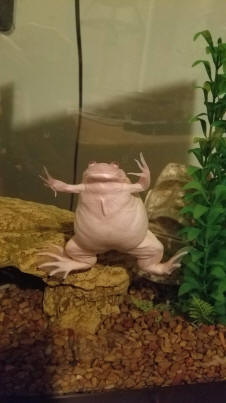 |
|
Re: 3 y.o. Albino African Clawed Frog, Pinky
2/16/19
Hello Neale and thank you for your thorough response, I really appreciate
everything you wrote.
<Glad to hear it!>
I know she may appear bloated to you, but not to me.
<Maybe not, but I do believe she looks bloated. If you very carefully handle
her, you would feel she's a bit "puffy" to the touch, but I would not recommend
trying this unless you understand how easily amphibians are damaged when handled
roughly.>
She's normally bigger up top and her thighs are usually a lot more chunky.
<Understood.>
She's definitely thinned out a lot along the bottom side of her back, I can see
a thinner waist with the end of the ribcage I imagine. I mean, you know a lot
better than I do as to what a bloated ACF looks like, so I don't really know.
<Do look on Google for some photos and make your comparisons. After all, you're
best placed to judge, not me!>
If she takes the antibiotics and the salts and didn't really need them, can they
hurt her?
<No, if used as stated. Xenopus tolerate salt very well, so 2 gram/litre will
have no negative impact on her health. Wild specimens even occur in brackish
water! The antibiotics will hopefully treat whatever underlying problem you're
dealing with.>
Also, can she live up to a month without eating?
<Yes. Easily, if she was in good shape beforehand. Of course I'd still offer
enticing meals every 4-5 days, and with luck, the medication and salt will kick
in, and she'll be ready to eat a few days after you start treating her.>
By the time I order the antibiotics and salts and get them, it will be a few
days. It would probably be quicker if I took her into the hospital?
<If you are prepared to do that, and a vet is willing to treat a frog (do call
them first, some don't) then yes, a visit to the vet is always the best possible
move.>
And hopefully they will have everything at hand. Do you have these supplies?
<No. I'm in England, where antibiotics are prescription-only, so I'd be visiting
a vet for them. Salt, of course, is sold anywhere, and non-iodised (sometimes
called "kosher") table salt will do the trick just fine. Just be sure to
thoroughly dissolve the required dose in warm water first, then add it to the
aquarium, a little at a time, across an hour or so. If your tank contains 60
litres for example, you'd dissolve 120 grams into a kitchen jug of warm water,
and then add that in stages across an hour. With each subsequent water change,
add the necessary amount to each bucket, so if you change 9 litres (a typical
small bucket) then you'd add 18 grams to that bucket, dissolve thoroughly, then
add to the tank.>
Are you in NJ by any chance.
<No.>
Is she going to die?
<I hope not. Xenopus are extremely tough animals, which is why they're such
popular lab animals. But amphibians are difficult to treat since we're not
really clued up on their medical needs. So I'd be optimistic, but can't offer a
guarantee.>
On Monday, when I put her into the temporary tank, I also remember the back of
her left thigh starting to appear darkish purple under the skin. I was wondering
if there was an organ there that was being affected at the time.
<Dark patches on the legs might be bruising, but do also be aware of Red Leg,
described on the webpage on Xenopus health I sent you last time.>
That went away that night after I placed her back into her permanent cleaned
tank. The only thing that stands out to me now, is a faint blemish she has on
her chest/belly area, slightly to the left of her midline. It's very minor, but
that's the only thing that stands out to me, except for her looking thinner.
That blemish I have to say was there before Monday when I came home and she
looked cyanotic. I thought maybe she had hurt herself somehow, but is still
there. Could that be a sign of a bacterial problem?
<Could be; or bruising from rough handling.>
Thank you again for your help.
Mary Luz
<Most welcome. Neale.>
Re: 3 y.o. Albino African Clawed Frog, Pinky.... crashed our mail
svc.... Another 17 plus megs... TOO LARGE FILES/Deleted Sorry to all
else who tried to write in; this person didn't follow our guidelines
2/16/19
I forgot to include this picture, I tried to get the blemish, but didn't come
out to clear. Also, I took about an inch level of water tonight after reading
your email, so the water has more splash and gets oxygenated better.
<That should help. Neale.>
Re: 3 y.o. Albino African Clawed Frog, Pinky
2/17/19
SHE ATE!!! She just snatched a freshly placed pellet and pulled it into her
mouth!! So happy I could cry.
<Good news indeed.>
She only took one, but that's such an improvement. I often wonder if she has
trouble seeing. Thank you again for all the feedback, so appreciated.
<Welcome.>
I will continue corresponding regarding her progress if you don't mind, until
she's back to normal.
<Sure thing.>
It's like consulting with your mom when you have your first baby and feel lost
and scared when they're sick and you have no idea as to what to do.
<Understood. Cheers, Neale.>
Re: 3 y.o. Albino African Clawed Frog, Pinky
2/17/19
Hello again....thought of another question. Pinky laid eggs twice recently.
Every time she lays eggs, she ends up eating them, and I let her. After the
first time she laid eggs 2 yrs ago. I read online that they could be removed
from the tank or left and the frog would just eat them. Do you not recommend
this?
<I remove the eggs from my Axolotl tank, and would remove doing so from a
Xenopus tank too. Unlikely to cause ill health, but they are extra protein in
the tank that will affect (negatively) water quality by placing additional
workload on the filter. Whether alive or decaying, eggs will also be consuming
some oxygen from the water. Cheers, Neale.>
Re: 3 y.o. Albino African Clawed Frog, Pinky
3/2/19
<PLEASE stop the madness!~ ONLY small Kbyte files. Yours have been deleted. B>
Regarding Pinky 3/3/19
Hello Wet Web Crew,
I sent out an email last night and was wondering if it had been received.
Thank You,
Mary
<Hello! Nothing arrived last night that I saw. Cheers, Neale.>
<<RMF deleted due to too large file size. Did send note Re>>
Re: 3 y.o. Albino African Clawed Frog, Pinky
Hello Neale,
<Hello Mary. Please don't send big files like videos, and if you send images,
please resize them to less than 1 MB. The reason for that is that we're all
around the world and often rely on phones (or even dial-up modems) to access
email. That way we can look for emergency messages even when travelling, as many
of us do. But it does mean that big files make it impossible for us to access
email or even move files. It's very frustrating. Thanks for your understanding.>
Pinky has made a turn for the worse. :'-(
<Sorry to hear that.>
Not sure what has happened. Last time I communicated with you I was taking her
to the vet. I took her, they weighed and examined her, they swabbed the 2
lesions on her chest to check for bacterial infection - was negative, and took a
sample and sent it out for a possible fungal infection they say frogs can get.
<All sounds helpful.>
I'm actually still waiting for the results of the fungal infection test. They
force fed her, since she was going on 2 weeks of not eating. The vet said Pinky
was not considered bloated, since she had been shaped like this for 3 years
since I've had her.
<Good to know.>
They suggested x-raying her and doing an ultrasound, but that would have come
out to over $1000, the visit was expensive enough.
<Indeed. At some point with these small animals you do the best you can with the
budget you have, and if it's more complicating and expensive, euthanasia is the
best thing. I agree, spending hundreds, let along thousands of dollars on a
small frog would be ridiculous.>
They sent her home with 2 medications, an antibiotic "Baytril" and an antifungal
"Sporanox."
<Good choices.>
The instructions were to give both medications for 14 consecutive days as
follows: Baytril - 0.05ml by mouth once a day, Sporanox - add 0.5ml to 5L water
and place Pinky in bath for 5 minutes once a day. The Baytril was started at the
vet's office on 1/17 so they could show me how to administer it, the next day I
gave her both medications and continued to do that daily until I left for
vacation on 1/20. My good friend who accompanied me to the vet and is an animal
lover and vegetarian most of his life, babysat Pinky and continued administering
the meds to Pinky on 1/21 and continued until 1/25. On 1/25 my friend noticed
that Pinky was swimming like a top, spinning around pretty quickly. He thought
it seemed strange, but he didn't know, so he administered the meds that evening.
The next day when he arrived at night, he noticed that Pinky seemed off and was
still twirling around, so he discontinued giving her meds. Every day he gave her
Reptomin pellets in the morning and at night. My friend said up until she
started swimming erratically, she seemed calm and seemed to be eating because
some of the pellets went missing eventually. I came home from vacation at
11:30pm on 1/28 and when I saw Pinky she was unrecognizable. I turned the lights
on and walked up to her tank and she started swimming so fast, but her torso is
disfigured and contorted and it basically looked like she was tumbling in a
clothes drier. Sometimes she swims in tight twirls in every direction possible,
even upside down and backwards, sometimes her legs flap almost entirely
backwards as she's moving around quickly. She's not symmetrical anymore, so when
she floats at the surface, she floats lopsided, pretty much on her side.
<It's unlikely the medication has caused the symptoms you are seeing. This is
one of those times you have to trust the vet. But it does sound as if she's in a
bad way. Perhaps the situation is terminal already, to be honest.>
She looks like she had a stroke and when she gets going, she looks like she's
having a seizure. I don't know what to do. I feel terrible for taking her to the
vet and am wondering if the meds made her this way.
<As I say, this is unlikely. Antibiotics shouldn't normally do anything harmful,
and Sporanox is generally regarded as safe. So while it is possible the frog is
reacting to them, it is very unlikely.>
What should I do?
<I would on principle always follow the vet's instructions. Especially with
antibiotics, there's the problem of antibiotic resistance that happens if you
don't follow the full treatment. On the other hand, I would do everything
practical to ensure the frog is not stressed: water changes as often as
practical, darkness, warmth.>
I wish I knew if she was suffering.
<As do I.>
I believe she has been eating.
<Good.>
I got a little video of her swimming around erratically, but am afraid to send
it and cause your server to crash.
<It may indeed, or at least make it very difficult to manage the email. It
doesn't take much for the email account to "fill up" (I think it's 50 MB) and
once that happens, new messages are bounced back to the senders, crew members
can't move emails to their folders, and other annoying things.>
I am including some pictures I took on 2/29.
Thank You,
Mary
<Hope this helps. If things don't improve in the next couple days, and the
symptoms become worse, I'd certainly be considering euthanasia at this point.
Cheers, Neale.>
|
|
ACF Tadpole Die-off 10/13/18
Over the last few months I decided to raise around 80 African Clawed Frog
tadpoles and for the most part, things have gone fine. 3 days ago, I was down to
my last 4 tadpoles, in the 10 gallon tank, within 2 days, 3 of the
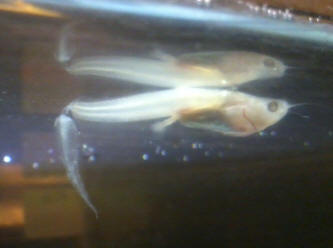
last 4 had died off and my last tadpole looks like this (see attached image).
<I see.>
In the last day, the end of the tail went limp like the other 3 before they died
but in this case, the tadpole's tail end has essentially just rotted off, it's
the only occupant of the tank nothing could have bitten it. All of the water
parameters are normal, no ammonia, nitrites, nitrates,
<I doubt nitrates are zero. So if your test kits are offering these numbers, you
probably should distrust them. Zero ammonia and nitrite are certainly possible,
indeed, preferred; but since nitrate is the end product of filtration, it should
accumulate over time between water changes.>
the GH and KH are constant.
<Constant what? As a reminder, neutral, medium hardness water is the ideal.
Water temperature should be around room temperature, 18-20 degrees C being ideal
for the classic Xenopus laevis species most widely traded. Avoid excessively
high temperatures, and similarly, avoid chilling and/or exposure to cold air.
Xenopus tropicalis is less commonly traded, and requires warmer water (24-28 C)
and prefers softer water chemistry.>
About 2 weeks ago, when there were 7 left, I altered the water change schedule
to 50% every 3 days since the parameters were staying constant.
<Do remember water changes need to be more or less daily, and ideally twice
daily. Xenopus tadpoles, like baby fish, are very sensitive to 'old' water,
especially in small tanks. The easiest approach is to reduce the number of
tadpoles per tank, which puts less pressure on water quality, and in turn makes
it easier to rear them successfully. Trying to rear huge numbers can be an
overwhelming task. Do be ruthless about removing uneaten food and
dirt (turkey basters are ideal for spot cleaning) while also ensuring more,
small meals rather than 1-2 big meals.>
The only issue I've had was the heat going out in the house for 3-4 days but the
lowest the house dropped to was about mid 60s (F).
<Might be a bit cold, especially if there were cold draughts of air as well.>
As of 2 days, after the first tadpole had died and the others were acting
sluggish, I restarted daily 50% (looking back, I would've gone with 30% but I've
been a bit burnt-out these last two weeks) changes on the 10 gallon. My
thinking was that perhaps the water wasn't being properly oxygenated on the
every 2 days water change schedule but now with this tadpole's Finrot-like
symptom, I'm just baffled - each of the others had the same tail tip droop
but none of them lasted long enough for it to progress to more than a droop.
(Note: the final tadpole just died early this morning but I'd still like to
figure out what on earth happened to prevent anything like this in the future
should I decide to raise more tadpoles at a later date).
<While the tail-drooping is remarkable, it may be more a reflection of general
failure to thrive rather than some specific disease or problem.>
Additionally, I've fed them Xenopus express tadpole food daily for the past
160-odd days since the tadpoles hatched. Over the last few days, after the heat
went out, the last 4 tadpoles all became lethargic and stopped eating/actively
swimming. Each of them were receiving about 0.3ml of the tadpole suspension a
day in the week prior every afternoon, Xenopus Express' feeding instructions
assume you're raising the tadpoles in bulk and don't translate well to smaller
numbers. I had almost no issues while I was dealing with a large number of
tadpoles but once I was under 20, I found myself a bit uncertain of a good
feeding schedule/amount, I'd welcome any suggestions on how much to feed a
single tadpole.
Thank you for any advice.
--A
<Hope this helps. Neale.>
|
 |
African Clawed Frogs 1/30/16
I have two African Clawed Frogs, both males, and in their hornier moments will
mate with each other; my main concern is that on the Albino Clawed Frog I’ve
noticed ‘bruising’ from where the other has grabbed it.
<Yes; do read up on "amplexus" and the horny pads male frogs develop on their
hands in time for the breeding season. So yes, there'll be some chafing!>
Is this something I should be concerned about or is it as normal as I suspect it
is?
<Normal enough I suppose. But keep a close eye on them, and ideally separate
them while one or other heals. E.g., with some egg crate cut to size and slotted
in the aquarium, shored up with a bit of gravel. Cheers, Neale.>
Re: Xenopus toad
query
3/13/12
thank you for your help, sorry for the late reply. Im moving them into
double the space soon, as they are growing quite rapidly haha. it could
be that they are pads, but don't males also develop a small tail
structure as well? thanks very much x
<Hmm… no, males don't have a tail, but the area around the
urogenital opening extend a bit during breeding time. Is that what
you're talking about? Do Google images of male frog cloacas for
more. Cheers, Neale.>
African Albino Clawed Frogs,
last nonsense of the day 2/13/11
I have been reading your site and found it to be most helpful with most
of my questions and I first wanted to say thanks for all the info you
have and post.
I have two African Albino Clawed Frogs. They were given to me about 15
mos. ago. I didn't know what they were or how to care for them. I
had just put them in my aquarium with everything else, that being three
fan-tailed goldfish, and a Pleco.
<... not compatible>
This was in my 10 gallon tank.
<...>
( I also have a 100 gallon tank with an Oscar and another cichlids but
I knew they'd be eaten there.) The frogs are now pretty good size.
They managed to eat the goldfish and kill the place.
<.>
I had no idea they eat such. They have been eating goldfish pellets all
their life, because I did not know what else to give them. They ate
what the goldfish ate, so I figured that was fine. The place where they
came from had no clue. Imagine that!
<... the Net, books...>
My question is coming. Two weeks ago, I woke up one morning and there
were eggs ALL OVER the tank. I had no idea I even had a male and a
female. What are the chances?!
<Really?>
I was excited and completely clueless. I knew, like most other things,
that they'd probably eat them if I didn't move them. So, not
knowing anything to do, I went and bought a small (1.5 gal) tank and
took out the plants, which had the most concentration of eggs and I
thought my best bet for saving some, and put them in the new tank. All
the eggs became tiny tadpoles, and there must have been 50 in there. I
was looking for info on what to do, but wasn't finding anything
about raising babies. All were good for about a week. I had dropped a
couple flakes of food in there b/ cause I had no idea what they
needed.
<?! Then why not search, read?>
I got up day before yesterday and they were all gone. There was not one
left swimming around. I cleaned out the tank. The frogs, in the mean
time, have had eggs all over the tank every couple of days. So
yesterday, I took out some more eggs and am going to try again. Please
can you explain what is the best way to have some babies live to be
frogs.
<Posted>
I did read an article a couple days ago that said if I left the male
and female together, that they would constantly breed, which has been
the case, and that too much breeding would make her I'll and could
kill her? Is that right?
<Not really>
I don't want anything to happen to her, so I did go and get her
own 10 gal tank and separate them just to be sure till I find out. Any
advice on the babies would be greatly appreciated. I can't seem to
find what I'm looking for about raising baby frogs. I had no idea
what I had or how to care for them, but I want to take care of them the
right way now, I just didn't know.
<Keep reading>
Thank you in advance.
Sent from my iPhone
<Not sent by iPhone. Bob Fenner>
|
Double checking I'm doing things right; Xenopus
and "eggs", not -- 11/03/10
I do have tadpoles and I've discovered a number of egg
clusters.
<Indeed?>
The baby snails appear unfazed when the toads kick them around
the tank - I guess growing up with big toad feet kicking them
helped a little on that. The snails just continue on as if
nothing happened. The poor cameras have had the worst time
getting a picture of the egg clusters, but I got a good shot...
well, it's not completely in focus, but the best of the ones
I've taken. These eggs are incredibly small - much tinier
than the head of a pin. The poor camera really had the worst time
focusing on the eggs since they're backlit by my window,
transparent and very tiny!
<I don't think these are Xenopus eggs. They look too
small. Xenopus eggs are quite large -- 2-3 mm across -- and laid
singly, not in jelly-like masses. They aren't transparent
either. I think these are Physa or Physella eggs. Do use Google
to see pictures of Xenopus eggs.>
I think I'll just let nature handle how things work out now.
I really only need to maintain the water level and clean the
filter unless I want to risk the babies' lives. The plants
(which have no actual roots) have been growing like crazy on the
surface and even some that the toads did not uproot on bottom
have been doing well.
<Floating Indian Fern is the best for Xenopus tanks.>
At best, I'll keep a close eye on the tadpoles and move the
adults to a separate tank if things start getting out of hand.
I've got a spare tank on standby - filter and all should the
need arise. Thus far, they haven't even noticed the tadpoles,
but I think I need to do further research on the metamorphosis of
the toads for timing. I discovered the eggs last Thursday and
clusters have shown up since... Sage has been busy. It would
appear the adult snails left eggs of their own before dying, but
apart from the already hatched babies, there hasn't been a
whole lot of activity for those eggs up above the waterline in
three separate clusters of their own. Jennifer
<Cheers, Neale.>
Re: Double checking I'm doing things
right
Well, somebody's been busily laying eggs. There's at
least 12 clusters all over the tank. I'm pretty sure I've
seen tadpoles in there, too. Jennifer
<Hello Jennifer. I don't doubt that your frogs have been
breeding; I just don't think those eggs are Xenopus eggs.
There's an easy test: stick some in a breeding trap, let them
hatch, and see if you find tadpoles in there or snails. In the
meanwhile, use Google to compare the eggs of Physa snails against
Xenopus frogs, and come to your own conclusion. Good luck,
Neale.>
|
|
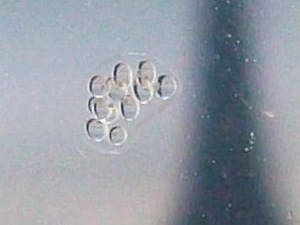 Look more like snail eggs
to me! Look more like snail eggs
to me!
|
|
Re: Double checking I'm doing
things right - 11/7/10
Actually, now that I think about it, the egg clusters you
saw in the picture didn't begin appearing until
after all the adult snails were long gone and I'm pretty sure
the babies are too young to lay any eggs yet. Besides, you said
the mystery/apple snail has to lay their eggs above the waterline
- these are below... mostly well below the waterline. The highest
cluster I can find is about an inch below the surface. Probably
won't know for sure for a couple months, though. Any tadpoles
are presently too small for the cameras to catch. At least we
know the toads and snails get along when the snails are born in
the toads' tank. One of the toads kicks at least one baby
snail daily and the snail just keeps going about its business as
if the toad's foot means nothing to it. Jennifer
<Hello again Jennifer. As I said last time, the only way to be
100% sure is to isolate those egg masses in another tank and see
what emerges. Five seconds on Google should show you what Xenopus
eggs look like, and they don't look anything like blobs
containing bunches of near-microscopic eggs. On the other hand,
that's exactly what Physa and Physella spp. egg
masses look like. Again, as I'm sure I've stated
before, apple snail eggs are pink and laid above the waterline,
and I never said that these egg masses were produced by Pomacea
species. These egg blobs have nothing whatsoever to do with your
apple snails so forget about connecting the appearance of these
egg masses with the happiness (or otherwise) of your Pomacea spp.
snails. Look up Physa and Physella on Google and you'll see
what these snails look like and what their egg masses look like.
As for the happiness of your apple snails, the problems usually
occur once the snails are about 12-18 months old, which is when
most specimens die. Keeping them alive for 3-4 years so they
reach their full, tennis ball size is the hard part. I've
never said apple snails are difficult to keep alive for the first
year! Cheers, Neale.>
|
ACF tadpoles
8/2/10
Hi, I have a batch of 9 day old African clawed frog tadpoles. All seem
to be doing fine except one - - it somehow lost half of it's tail.
It is much too early for metamorphosis to be happening, so I am
concerned about the chances of this tadpole surviving.
<Does it have arms and legs yet? If so, not a big deal. But if not,
then this chap really will have trouble feeding. Unless you separate it
off into a breeding trap and put food right in front of its face,
it's going to lose out against the others.>
The injury happened two days ago, cause unknown, and the tadpole has
been unable to swim about the tank.
<Likely cannibalism or perhaps damage from an over-strong
filter.>
It manages to "flutter" from area to area, but spends most of
the time on the bottom of the tank. I figured it would have died by
now, but it is still alive. Can they regenerate their tails?
<Nope.>
Is there a chance it lives long enough to morph?
<If fed, yes.>
If it does morph, is there a chance it could morph into a deformed
tadpole?
<Minimal likelihood of that, I'd imagine. With luck, and some
feeding, he should mature nicely. Cheers, Neale.>
Re: ACF tadpoles
They will not start to develop arms and legs for a couple weeks - -
they are filter feeders so it wasn't an act of cannibalism.
<Indeed, but under the confines of aquaria it is not uncommon for
tadpoles to act aberrantly in this way. So do keep an open mind.
It's otherwise hard to imagine how a tadpole could lose its
tail.>
They are in an unfiltered tank due to their size (now a little over
half an inch).
<I would use an air-powered sponge filter nonetheless. If nothing
else, it will keep the bacteria count in the water low, and that will
inhibit secondary infections, the most likely cause of death following
physical injuries. Sponges also culture all kinds of algae and
Protozoans that tadpoles and baby fish consume. Well worth having, and
far more convenient and reliable that daily water changes.>
Daily water changes, an aerator and live plants keep the water to
level.
<Live plants growing rapidly under intense light can help, but they
aren't normally a replacement for filtration. Frogs are acutely
sensitive to poor water quality, both in the wild and in aquaria. A
filter really isn't an option, it's essential.>
Thank you for your swift response!
<No problem. Cheers, Neale.>
Help!!! ACF... molly... Repro.
Et? 2/26/10
I have been searching for the right answers to my questions and I am
getting lots of different answers!!!
<OMG!!!!>
So I don't know what to do!!
<Like, totally!!!>
I have 2 African clawed frogs and 2 dwarf frogs!!
<Not in the same tank, I hope. They have very different temperature
requirements, and the coldwater Xenopus (the big frogs) will eat the
tropical Hymenochirus (the dwarf frogs).>
But, my one clawed frogs belly is getting bigger and bigger!!
<Oh noes!!!>
I am believing that she is going to be laying some eggs.
<Perhaps.>
She's not as active as the rest of my frogs and she lays and kinda
hides out like she is nesting.
<Not nesting. They don't sit in nests.>
But, the one other kind of frog always follows her around and gets on
her and like hugs her here and there.
<It's called amplexus. Male frogs mount the backs of females,
and use horny pads on their hands to hold on. As the females extrude
their eggs, the males fertilise them.>
I don't know if there is anyway you can help me or not!
<She may not need helping.>
She was never this big and it just kinda came and I don't know what
steps I should take!
<Do check you're keeping these animals correctly, here:
http://www.wetwebmedia.com/FWSubWebIndex/FrogsArtNeale.htm
In particular, review aquarium size, water chemistry, temperature, and
water quality.>
I also have 2 molly fish and they are 2 different kinds I know the one
is a sunset molly and the other one is red with a black fin tail.
<Presumably in their own aquarium, and not with the frogs?>
Now, she has a big belly and it's pretty much the same story as the
frog!!
<These are livebearing fish. Females will become quite big shortly
before birth.>
She lays at the bottom of the Fishtank and kinda goes into places and
hides out. She never did this until I noticed her belly getting much
larger! I don't know if they are or not????
<Mollies are finicky fish that need very specific things to do well.
A large aquarium, lots of warmth, and hard, basic water, preferably
slightly brackish. Do read here:
http://www.wetwebmedia.com/FWSubWebIndex/mollies.htm
>
But, the things I have been reading says I need to separate them from
the others so they don't get ate.
<"Don't get ate"? You mean "won't get
eaten" presumably. Indeed, other fish may well eat newborn
fry.>
But, here is another question can I put them both in a separate tank
until they hatch or should I get 2 extra tanks for each one??
<Do read here, re: breeding:
http://www.wetwebmedia.com/ca/volume_4/v4i3/Livebearers/Livebearers.htm
>
I know they say about the nursery nets but if they both are going to
have babies that is not going to work right???
<Putting the female in the net will stress her, and can lead to
miscarriages. Best to let the baby fish hide among floating plants, and
when you see them, move them into the breeding trap.>
I really hope that they are and I hope as well you can help me with
this I am a first timer at this and am freaking out!!
<No way!!!>
Because I don't know what to do I want to learn about this as well as
understand this!! I don't know if this matters or not?! But, I have 4
big goldfish,4 frogs, algae eater,2mollies,2tiger barbs I believe that
is what they are called.
<Not all in the same tank, I hope. Unless it's a HUGE
tank.>
So I really hope that you can assist me with this matter because I
greatly appreciate your knowledge and helpfulness!!!!!!!! Thanks for
taking your time to read this!!!
Sincerely, Maloree Peck
<Totally. Neale.>
Xenopus; reproductive behaviour;
physical damage 11/15/09
My juvenile male African clawed frog was trying to convince my female
to mate - he was in position holding on to her waist and when she just
decided to lay there, he started reaching up with his hind legs and
kicking her in the head.
<This is what they do...>
This doesn't concern me - I have seen it before...often with the
female tapping her foot in annoyance and disinterest.
<Not sure the foot tapping is "annoyance" -- it's
always important not to put human emotions onto animal behaviours. But
yes, females may not be ready to mate, in which case they can become
stressed. Adding a second mature female will divide up the male's
time, and this is hugely helpful.
Adding some floating plants, such as Indian Fern, will give the female
some hiding places, and that helps too. Obviously, in the wild the
female can swim off, but in a very small tank that isn't possible.
Think about the size of the aquarium, and whether it is adequately
large for the specimens you have.>
But this last time, my male kicked so hard that my albino female is now
covered with scratches! Near her eye and near her armpit...
<The males develop specific horny pads on their hands used during
mating, or amplexus, as its called with frogs. These horny pads grab
the skin and make it possible for male frogs to hold onto what are
slippery, slimy animals. Any damage done should be slight, and
naturally heals up assuming good water quality. Your should see what
male sharks do to their lovers...>
I added some aquarium salt in the water
<Wouldn't be my first thought, but Xenopus is reasonably
tolerant of salt so no harm will be done. Not much good will be done
either, it has to be said, and the old idea salt prevented infection is
nonsensical (and mostly put about by the manufacturers of boxed salt).
Strong salt solutions are antiseptics, that's true, hence gargling
with salt when you have a mouth ulcer. But a teaspoon of salt per
gallon? Useless. Much, MUCH better to concentrate on providing optimal
water conditions (0 ammonia, 0 nitrite) and water chemistry (moderately
hard to hard, basic water; 10-20 degrees dH, pH 7.5). Make sure your
filter is adequate and working properly, and that you do regular
(weekly) water changes. Keep the temperature sensible, not to high and
not too low. Room temperature, between 15-20 degrees C is
ideal.>
What else can I do to help the female heal?
<Do read here:
http://www.wetwebmedia.com/FWsubwebindex/FrogsArtNeale.htm
Cheers, Neale.>
Albino cave frogs, beh...
9/10/09
Hi I have 2 albino frogs, I have had them for about 3 years and have
had no problems with them. Yesterday I found that one had escaped (the
larger of the two frogs).
<They will do this from uncovered tanks. So be warned!>
I have no idea how long it had been out of the tank but it was covered
in fluff from the carpet etc and where ever else it had been. I put it
in a holding tank to try and clean it up, I then returned it to its
normal tank
and made sure the lid was firmly shut.
<Good.>
The other (smaller) frog then swam and clung to the frog that had
previously escaped, it remained holding on until I went to bed. I woke
up this morning to find the larger frog on its back with the smaller
one still holding on but to its belly. I thought the larger one was
dead but its legs twitch every now and then, also they are making a
weird sort of noise that I have never heard before.
<Sounds like amplexus, the mating "clutch" males do to
hold onto females.
Males will indeed sing. Males are smaller than females, and males
develop little rough patches on the palms of their hands for holding on
tightly.
Xenopus breeding is rare but not unheard of if home aquaria (in labs
it's stimulated with various chemicals).>
Any ideas, is one dying or drowning the other one?
Many thanks
Dave
<Cheers, Neale.>
Albino ACF laying eggs without a
mate 1/4/09 Hello WWM Crew; <Hello!> I am new to
the aquatic world. In late August we bought 2 Albino ACF's.
<African Clawed Frogs, Xenopus laevis?> The pink, larger one is
definitely a female. We think the other one, who was smaller and an
aqua green color was male. He died on October 10th and we are not sure
why. The female has been thriving. We did a water change yesterday and
she is in a tank with a filter so we change it about every other week.
This morning we noticed a lot of tiny white dots. They almost looked
like Styrofoam. <Eggs!> She is also acting strange. I have read
that ACF's can lay eggs without having a mate. <Can indeed
happen, and indeed was why they were used as a pregnancy test kit in
the past: add a little urine from a woman to the tank, and the female
frog will lay eggs if the woman was pregnant!> My questions are 1)
she is eating these eggs-will they make her sick. <No. Many animals
will do this, in effect "recycling" the energy for their next
breeding attempt.> 2) I am assuming they are not fertilized-will
they become tadpoles? <Indeed. Frogs generally perform external
fertilisation, with the male shedding sperm over the eggs as the female
lays them. No male, no tadpoles.> 3) should we take these eggs out?
<Yes. Think of the eggs as rotting bits of food right now: long
term, they're going to ruin water quality.> Any additional
information you could provide me with on this topic would be
appreciated. <Get a male! Breeding these frogs isn't too
difficult, and lots of fun to do. The tadpoles are quite hardy and easy
to rear, and most shops will accept good quality tadpoles without much
fuss. Do remember these frogs are subtropical animals, and part of the
art of keeping them is to allow them to cool down (around 15 C) in
winter and then warming them up in spring (around 20 C). When
they're warm, they should spawn readily. The usual mistakes with
Xenopus are to keep them too warm and to overfeed them. A basic rule of
thumb is that what's comfortable for us is comfortable for them, so
room temperature in most homes is just about perfect. Feed them no more
than 3-4 times per week. Less in winter when they're cool, more in
summer. Do this, and you'll find them very hardy and long
lived.> Thank You; Dawn <Good luck, Neale.>
Mating season for ACF
11/10/08 Hello. I was just wondering about the male African
clawed frogs. I've had mine since he was a wee little froglet.
After about 3 months or so he began to develop what I like to call
"black gloves". Now I know that these are meant for mating
but he's continuously had them since he was about 3 months old.
He's now almost a year old. Is he confused? Does it have anything
to do with the temp of the water? Or do these guys always have them?
Please get back to me with information. Thank you. <Are these
Xenopus frogs? When sexually mature the males do develop what are
called "nuptial pads" for the breeding season. These help the
male grip the slippery females during amplexus. Sexual maturity is
attained at about one year of age. There is a vague breeding season in
spring (these animals being subtropical, not tropical, in the wild, and
so exposed to a cool winter and a hot summer). In reality though
commercial breeding is almost always done with hormones. In the
aquarium, the best you can do is let them cool down slightly for a few
months in winter (around 18 C would be good) and then warm it up a bit
in early spring (to the usual 22-25 C). Good conditioning will help,
i.e., make an effort to provide live/frozen foods rather than pellets
or freeze dried foods. Cheers, Neale.>
Many questions about ACF and
tadpole care... 9/13/08
Hello,
<Hi,>
I've been raising 7 ACF tadpoles for two weeks as of today, and
just when I think I couldn't possibly have any more questions,
another one pops up. Add to this that much of the information on the
net is conflicting and I'm at something of a loss. After reading
all the posts in your FAQ, it seems like you guys are going to be my
best shot at some straight advice. (By the way I've NEVER owned any
kind of aquarium before.)
<That's OK. By and large, keeping aquaria is easy if you do
things precisely by the numbers. Where people go wrong is doing stuff
before they've read up on things.>
So, here's hoping.
1) These tads came in a kit with VERY poor care instructions (they
didn't even tell me what species they'd sent) so I'm
fumbling some in the proper care department. They've always been,
and still are, in a 1.5g container.
I was feeding once a day and skimming the uneaten food off the top
about 2 hours after feeding.
<Very good. When raising any small animal, the golden rule is this:
little but often. Tadpoles and larval fish have short alimentary
canals, and after the first couple mouthfuls, anything else they eat is
going to pass through pretty much undigested.>
I was doing 100% water changes daily, removing the tads (gently with a
cup), rinsing the gravel, tank, plants etc.. and putting it all back
with fresh de-chlorinated tap water.
<All sounds like a bit of waste of time really. Is this some sort of
Science Shop kit? Every once in a while we get messages about these
things, and the sad truth is that these kits are very much gimmicks,
sold to people who have no idea about rearing frogs (or Triops, or Sea
Monkeys, or whatever).>
I was advised by the FroggieFriends yahoo group that I wasn't
feeding enough and to step it up to twice a day.
<In the wild they'd be eating more or less constantly, but tiny
tiny meals. When rearing baby fish, I like to put clumps of Java Moss
or algae in the tank. This traps food particles like a sponge, giving
the baby animals someplace to graze. I can then add small amounts of
food without worrying it's going to get lost in the tank or
filter.>
I was further advised I was cleaning too much, to remove the substrate
and fake plants, and add an air stone set on low. In addition I was
told to stop skimming, but to use a turkey baster to get the yuck off
the bottom and do about a 50% water change every day.
<All good calls, but a total waste of time in the big picture.
Here's what you really need before wasting time/money on this.
Start with a 10-20 gallon glass or plastic tank. Get an air pump and an
air-powered sponge filter. The latter looks like a cylindrical block of
sponge built onto a plastic U-shaped tube with some suckers. You stick
it on the tank, connect to the air pump, and switch on. This will clean
the water and also become a breeding ground for tiny animals
(infusoria) that the tadpoles will gleefully eat. For the first week or
two you'll want to do 25% water changes every day or two while the
filter becomes mature, but after that weekly 25% water changes will be
ample. The good news is that not only will this work fine for the
tadpoles, it'll keep working for the frogs as well!>
So I started doing that, then tested the water for ammonia just to see
what it was. Well it was 1ppm, so I promptly did a 100% water change.
Today when I tested for ammonia it was about .50ppm so I did a 90%
water change. About 3 hours later I tested again (I'm a freak about
whether or not they're suffering) and it was between .25 and
.50ppm.
<Now, the ammonia comes from decaying food and from the tadpoles
themselves (which produce ammonia for the same reason we produce
urine). A biological filter will handle this, and I refer you back to
my sponge filter!>
So I turkey basted the bottom. Then, I noticed that, today, everyone
developed a crook in their tail!!! What's that about? I know the
tail will go away, but is this some indication that they're doomed
already?
<Difficult to say; sometimes under poor conditions larval fish and
frogs will develop deformities. But for now, hope for the best.>
Well, I'm sure they suffering, but I can't get a complete cycle
because that would likely kill the little guys. But
aquaticfrogs.tripod.com says one wants the tank not too dirty or too
clean.
<This refers to the need for algae and infusoria for the tadpoles to
feed on; again, my sponge filter will do the trick!>
So I'm at a loss as to what to do to get my little buddies to
adulthood in one piece. All help will be appreciated.
2) I'm currently cycling a 55g tank into which they will eventually
move, but have a few questions about this as well. First question is
about filtration. I currently have an Aquaclear 70 waterfall filter on
the tank.
The research I did indicated that most waterfall filters are fine for
the frogs BUT.. I found out the frogs have motion sensors in their skin
and water turbulence is VERY disturbing to them, so now I'm
questioning the waterfall filter bit.
<Depends. Are these fully aquatic frogs or frogs that jump about on
land? If the amphibious kind that spend only some time in the water,
I'd not worry too much. But I'm assuming "ACF" are
African Clawed Frogs, Xenopus laevis, a big, subtropical species that
never ever leaves the water. These are very hardy and will be fine with
whatever filter you prefer. They're standard lab animals.>
BUT I also read where one absolutely could NOT use ANY kind of under
gravel filter for them because this would be like subjecting them to
living with a jackhammer 24-7..
<Never heard of this. Undergravel filters are in fact very gentle,
and widely used with delicate fish. I suspect this factoid was dreamed
up by someone with much interest in frogs but little understanding of
their actual biology. It is true frogs are sensitive to vibrations, as
are fish, underwater is a hugely noisy place because sound carries so
much better there than in air. So I'd worry much more about water
quality than whether or not the tank was noisy.>
BUT then I read in your FAQ that under gravel filters are GREAT for
these frogs. HELP!???
<I'd actually eschew undergravels for amphibian tanks. Instead
I'd use a simple air-powered sponge filter or electric canister
filter where possible, and use smooth sand for the substrate. Less
likely to cause damage to their delicate skin.>
3) Food questions: Right now they're getting the powdered food that
came with the kit. They seem to like it, everyone's growing and
seemingly happy.
Is this food good for them all the way to the froglet stage?
<No idea; but personally I'd be expanding their diet as they
grew to include things like live daphnia and frozen bloodworms. Dried
food loses its vitamin content within a few weeks of opening, so
"old" packages become steadily less useful as a sole food
item.>
I've been advised that there should always be food in their tank at
this stage because they're filter feeders.
<Most tadpoles feed on algae, though whether that makes them filter
feeders is up for debate.>
On the one hand, that makes sense to me because it's not likely
that there's no food in the water in the wild.
<Tadpoles invariably live in shallow water where there aren't
fish. What they do when young is skim across solid objects, feeding on
"aufwuchs", the combination of algae and tiny invertebrates.
As they mature they tend to become more omnivorous, and at least some
tadpole species become carnivorous, even cannibalistic. Before they
turn into froglets they will be completely carnivorous, and as frogs
feed entirely on smaller animals.>
On the other hand, food in the water all the time will cause more
ammonia, which at some point will kill them won't it?
<Correct; which is why we moderate the food that goes in, and
provide a filter to remove the ammonia produced.>
So where is the balance between over feeding and under feeding at the
tadpole stage. At the froglet stage what do they get? Can pellets or
tadpole bites be their staple at this point? Once they're adults,
the information about what to feed them and how often is just as
confusing.
<Xenopus laevis is carnivorous when mature. Being subtropical it has
a lower metabolism than tropical frogs, and so doesn't need daily
feedings. Earthworms are a particular favourite, but bloodworms and
other frozen foods given to fish make ideal staples.>
You guys are definitely of the opinion that the food that comes in
pellet form should NOT be their main source of nutrition. Others say
that's fine. So if I don't feed them pellets as their main
food, should I just be feeding them live things like brine shrimp and
crickets?
<Neither brine shrimp nor crickets will be appropriate to this
species. Adult brine shrimp are the fish equivalent of popcorn -- empty
calories with no useful nutrition. Crickets will be too hard for them.
Go visit your local aquarium shop and buy a blister pack of (wet)
frozen bloodworms; these will do the job nicely.>
Why are frozen bloodworms okay, but freeze dried aren't?
<Freeze dried food is overpriced for what it is, and not all animals
will take it. Aquatic animals sometimes get problems with constipation
when fed freeze dried to excess. Wet frozen foods are the aquarium
equivalent of sushi -- nutritious, popular, and clean.>
How often to feed them as adults is also confusing. Some say 3 or 4
times a week. Others say once or twice a week.
<Depends on the quantity. I always advocate "little but
often". If you want to feed small daily meals, that's fine.
Really, all that matters is that the ammonia is zero. Frogs (or fish)
don't explode when they're overfed -- what happens is the
excess food decays, and produces ammonia, and THAT poisons them. In
tanks with generous filtration, overfeeding isn't really an issue,
so you can play it by ear and see what it takes to keep your frogs
gently rounded but not fat.>
I guess that would depend, though, on how much you're giving them
at each feeding, right? So how much should I be feeding them as adults,
and how often? Oh, and in the 55g tank I've put about a 1.5"
layer of substrate down. They're small stones, not really gravel.
Someone told me that I should clear a space in the corner, and put a
small bowl or plate in it so the frogs could get the food from there.
They said with the substrate in, they wouldn't be able to get to
the bottom to feed. Apparently, this is something they like to do. Do
you agree with this?
<All sounds dandy. Xenopus laevis is really very easy to keep once
metamorphosed, and I doubt that there's any single best way to keep
them. I'd go with a bare tank with a sponge filter only because
it'd be easy to clean. But feel free to improvise. Just make sure
you can remove uneaten food and that there's adequate water
circulation. Floating plants are good with this species, but I'd
add some plants-on-bogwood too (Anubias, Java fern, Java moss).>
4) Separation: Tadpoles develop at different rates. I learned from your
site that this is an evolutionary protection of the species kind of
thing, in case the pond dries up, and a bunch of the more mature ones
get eaten right away. (very interesting by the way) I've read that
you should "separate tadpoles that are at different developmental
stages". Does this mean I should separate big tadpoles from little
tadpoles, or does it mean I should separate tadpoles from froglets?
<It's really about cannibalism; if the size differences
aren't great, I'd not worry overmuch. If you want, put the
smaller ones into a floating breeding trap or equivalent.>
5) Froglet stage: I've been told that once they're froglets and
the tank is done cycling, they can go in the 55g tank. It seems like
they will still be pretty small as froglets. Can they still be sucked
into the filter at this stage? Because it would really stink to get
them all the way to froglets only to lose them to the filter!
<A sponge filter will not "suck up" baby frogs.>
6) Cycling the tank: I've done my research about this as well and
we've started a fishless cycle on the 55g tank using raw shrimp.
We're testing for ammonia, nitrite, and nitrate every day (as part
of a science project for my 8 yr old.) We're getting a steady rise
in ammonia, and expect to see nitrite sometime in the next week or so.
No problems really except the STINK. My house smells REALLY funky!
<Too much shrimp! Too much shrimp! You only need a little!>
I've got a huge hepa-filter running next to the tank on TURBO
speed. We can't find ammonia without surfactant in it. I've
looked everywhere. We've decided to put new shrimp in every other
day, and take old shrimp out the day after we put new shrimp in. Will
that work or will it mess up the cycle? Do you guys have any
suggestions on a less offensive way to do this? (We aren't going to
cycle with live fish, it's just not an option for us.) Most of the
information out there says that it'll be about 6 weeks for the tads
to become froglets. This works out, because most of the information
also says it'll also take about 6 weeks for the tank to fully
cycle. However, if the tank is ready for life before the tads are
froglets, we thought we'd put some mystery snails in the tank.
<I'd remove the shrimp, do a great big (90%) water change, and
then add the Apple Snails. They'll keep the filter in good
order.>
Well, actually we're planning on putting the snails in the tank
regardless.
My question is, if the tank is cycled and we put in 3 or 4 mystery
snails will that be enough of a bio-load to sustain the bacteria until
the froglets can go into the tank?
<Yes.>
What I'm trying to avoid is a re-cycle once I add 5 to 7 froglets
(assuming I can get them all to that stage). So if the tank is ready
before the frogs are how can I KEEP the tank ready? Well, believe it or
not, I think that's it. You said not to worry about the length of
the email. ;-) Thanks. I really appreciate you all taking the time to
help me and my
little buddies out.
Laura
<I hope his helps, Neale.>
Re: Many questions about ACF and
tadpole care... 9/13/08
Neale and crew,
Thanks so much for taking the time to answer all of these questions!
You guys are the best. I really appreciate it.
<You are most welcome, and we're glad to help! Cheers,
Neale.>
Re: Many questions about ACF and
tadpole care... 9/13/08
Hello again,
I wonder if I could trouble you with a couple of follow up
questions?
<Sure thing.>
1) I asked if the froglets would be big enough to put in the 55g tank
without getting sucked into the filter. And Neale advised that they
wouldn't get sucked into a sponge filter (one he advised me to
get). I'm wondering, though, since he mentioned I should be ok with
any kind of
filter, how the froglets will do with the Aquaclear 70 that's
already running on the tank?
<I'm not wild about these "hang on the back" filters
for a variety of reasons, not least of which are the fact the inlet and
outlet are in the same part of the tank, and that they are designed to
use "modules" the manufacturer locks you into buying rather
than giving the option to choose whatever media you want. All this
said, assuming that the froglets swim at least as strongly as a small
fish, the Aquaclear shouldn't cause any problems.>
2) Apple snails and vegetation: Neale mentioned getting some floating
plants, or "plants-on-bogwood too (Anubias, Java fern, Java
moss)". I understand that the snails do well with vegetation, but
I was under the impression that African Clawed Frogs (ACFs) would
pretty much destroy any plant in the tank. Is this not so? Do I feed
the snails something other than what I'm feeding the frogs? Is
there anything special I need to do to make sure the frogs aren't
hogging all the food? Can I get those plants at the local pet store?
Will the fact that my aquarium is securely lidded cause any problems
for the plants?
<My experience of Apple snails is that they eat most plants, so
I'd experiment with a few plants first to see how things go. Java
fern should be a good starting point, being ignored by most things,
supposedly because its toxic. Java moss and Anubias sometimes get
damaged by grazing animals, so I'd buy one of each and see how they
did before stocking up on them. I can't imagine your frogs doing
any harm to these plants -- they are tough enough for use with cichlids
and catfish!>
3) Regarding cycling my tank, Neale said, "<I'd remove the
shrimp, do a great big (90%) water change, and then add the Apple
Snails. They'll keep the filter in good order.>" Does he
mean to do that now, or once the tank is finished cycling? As of today,
we're at 3ppm ammonia, 0 nitrItes and 0 nitrAtes. It's only
been 6 days.
<I'd do this now. The snails should be fine in a 55 gallon tank,
particularly if you took care to ensure the ammonia stayed below 1 ppm.
The reason it's so high is the excessive amount of rotting shrimp!
With the snails on their own, it should drop to almost nothing. Add a
pinch of flake food every couple of days, and the snails will produce
the ammonia from that.>
If he means we should change to the snails now, won't the ammonia
spike hurt the little guys? I think he might have made this suggestion
because I was complaining about the smell using
raw shrimp. He said we had too much shrimp in the tank but we only have
one in there, except when we're going to change out the really
gross one for a fresh one. Then, there are two in the tank together for
about 16-24 hours. But if we can cycle with snails and they're
somehow impervious to the pain and damage the ammonia spike causes
other aquatic life, then I'll do that.
<It's not that the snails are impervious to ammonia, but that
they'll produce so little in the context of a 55 gallon tank that
the level won't be high enough to cause harm. I'd be surprised
if three or four Apple snails in a 55 gallon tank raised the ammonia to
even 0.25 mg/l.>
Just one last follow up question on this subject. Neale said (and
I'm not doubting him) that 3 or 4 Apple Snails would be enough of a
bio load to maintain a bacteria colony large enough to prevent a
re-cycle once the froglets are added. There will be 5-7 froglets (I
hope). Will the re-cycle be prevented because the froglets will be
small at the time of their addition?
<I'm assuming the froglets will be quite small, Neon-tetra
sized. This being so, yes, the filter will be plenty mature for them.
Let's say the Apple snails are on their own for a month; that will
cycle the biological filter, meaning that once you add the froglets
from the tank their in now to the 55 gallon system, all the filter has
to do is "step up" the amount of biological filtration.
Filters do this incredibly quickly (remember, bacteria can double their
numbers in 20 minutes). The tricky bit with filters is going from zero
to mature. That takes a few weeks. Going from a mature filter adapted
to a few fish to a mature filter adapted to a few more fish is easy.
All you need to do is take care not to overfeed, and then to check the
nitrite for a couple of days after adding the livestock just to make
sure everything is fine.>
Thanks, AGAIN, for the help.
Laura
<Cheers, Neale.>
Xenopus Breeding and Care
6/10/08 Hello, <Hi there> I have 4 ACF's that are at
least 1 year old. I have 2 males and 2 females. One of the females is a
little bit older and quite a bit bigger than the other. Although the
males have attached themselves to the females in the past, they have
not laid eggs until this weekend. The big female laid approx. 1000 eggs
Saturday and at least 80% were eaten. This morning (Monday), the same
male and female were "at it" again, and she was laying more
eggs. My question to you is twofold. First, what should we do with the
eggs to care for them properly? Should we move them to a separate tank?
<Yes, this is best> Should we net them off in the parent tank?
Second, do we need to separate the males from the females now that they
are mature? <If you don't want them to reproduce... more,
yes> Will it kill the females to mate too often or too much?
<There is speculation that their lifetimes are shortened by too
much/reproduction> (I cannot seem to find a lot of information
regarding the breeding of Xenopus and how to care for the
eggs/tadpoles) Thank you very much for your help. Rachel <Mmmm,
please search with the terms: Xenopus laevis reproduction, culture,
care... There are thousands of citations. This species has been used in
many scientific experiments over decades time. Bob
Fenner>
African Clawed Frogs mating 3/14/08 Hi,
<Hello there> First off, thank you for your site!! I found it
searching for my question and have gleaned a wealth of information.
<Ah, good> I purchased 2 Albino ACFs from Wal-Mart a couple
months ago as froglettes. I bought 2 because I've read that they
are social creatures. Turns out that I have a male and a female.
I've been reading quite a bit about their mating behaviors but
still have the following concerns. First, I only want 2 frogs and do
not have the time or equipment to raise a bunch of tadpoles... <Mmm,
I'd be trading one in for another of the opposite sex...> and if
I did what would I do with them all once they were grown? <Mmm,
either destroy (Xenopus are incredibly invasive...) or selling
to/through local to national outlets> Second, I'm a bit
squeamish about letting them mate and then letting them eat their own
eggs (I know, it's nature, but it just really creeps me out).
I've read through searches that they mate 4 times a year mostly
during the spring. The mating rituals have begun on our tank. The male
has black nuptial pads, is calling during the evening/night and is
grasping the female around the waist (and the even stranger thing, he
undulates on top of her... umm... like mammals do... I didn't think
amphibians did that). <Mmm, yes> They are not doing the flips at
the top of the water yet and the female doesn't seem very
interested and actually swims away from the male often when he's
calling and gets near her. I'm not completely sure what series the
events go in for mating, but she's not all fat with eggs as other
sites have shown. So I'm not even sure she's ready to mate.
<Maybe not> So my question is, do I separate them and if so, when
and for how long? <Really... indefinitely> Is there any way to
make mating not so attractive (I read about water temp for priming
mating)? <Not practically> Also, I noticed that her cloaca is
red, is that part of the mating or is there something wrong with her?
<Mmm, no, not likely... hormonal, physical...> I know I sound
pretty clueless, but I haven't found too much info on ACF mating
out there. Thanks in advance for your help. Stephanie <Trade either
the female or male and get/keep two of the same sex... Bob
Fenner>
|
|

