 |
Aquatic Gardens
Ponds, Streams, Waterfalls
& Fountains:
Volume 1. Design & Construction
Volume 2. Maintenance, Stocking, Examples
V. 1
Print and
eBook on Amazon
V. 2
Print and
eBook on Amazon
by Robert (Bob) Fenner |
 |
|
Algae Growth on Water Lilies... New pond, and ponder
5/19/17
Greetings, Crew!
<Fuz>
It's Fuzzi here, again, with a question I can't find answered on WWM, or
anywhere on the web, so I decided to ask!
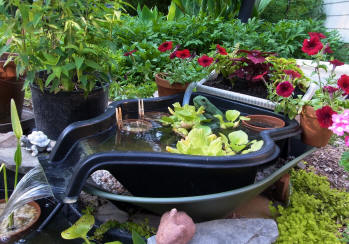
I installed a 100 gallon preformed pond this April, adding water on
April 16th, then adding filtration a week later, on April 23rd.
<So; just a month back>
I'm running a 330gph submersible pump, a skimmer with basket and filter pad,
and the waterfall is full of floating plants doing their best to filter out
the less-than-clear water, see photos. It is not noticeably green
until you collect some in a jar, when a slight yellow/green coloration is
evident.
<Happens... a sign of life... not to worry>
Since I added filtration, I have been steadily adding plants in pots, as
well as floating plants (water lettuce and hyacinth), and then two hardy
water lilies about two weeks ago. The weather has remained cool until
recently.
No fish have been added.
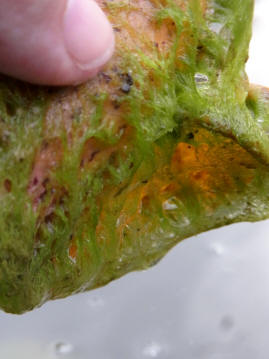
I noticed that the water lilies have a green slimy algae-type of growth on
their stems and under the pads (see photo).
<See this>
The water tests as uncycled, high (above 7.6) pH, ammonia, nitrites, and
nitrates as zero.
<Uncycled... these should be some nitrogen present>
I believe the algae growth is due to new pond syndrome, but would love your
input:
1. If the algae growth is part of new pond syndrome, will it pass once the
water cycles?
<Maybe>
2. Will it hurt the water lilies?
<It will not>
3. If it will hurt the water lilies, what can I do about it?
<Patience at this point. Your pond may well "green out" for a while... best
to shade a good part of it>>
The lilies are planted in clay dirt in plastic baskets, with paper lining
the inside and pea gravel on top to keep the dirt from leeching out. Each
lily has one fertilizer stick shoved down deep in the pot, on the side away
from the rhizome.
<Good>
Thanks for your advice and thoughts on the algae situation.
Fuzzi (Lor)
<Don't get desperate and chemically treat... algicides are toxic; directly
and in their effects. Bob Fenner>
|
 |
Algae Blooms in Naturally Hard Water and No UV
3/5/17
I have a 40 gallon oval pond. It's made of Ldpe Plastic. I checked to be sure it
was safe to use. It measures 27" W x 40" L x 13" Height. I got a Tetra
submersible flat box filter good for 200 to 2,000 gallons for it. I got a
Superflow 1300 pump for it. It has a gph rate of 306 gph. How do I get
rid of green algae blooms in naturally hard water without a uv sterilizer?
Thank you.
<Please learn to/use the search tool on WWM; on every page... for such general
questions. READ here:
http://www.wetwebmedia.com/pondsubwebindex/pdalgcontrol.htm
BobF>
It's Me Again (Algae Bloom Prevention and Treatment)
3/5/17
Hello. It’s me again. I have a new question regarding algae blooms.
Here is a repeat on the specifications on my pond and its system. I have a 40
gallon oval pond. It's made of Ldpe Plastic. It measures 27" W x 40" L x 13"
Height. I got a Tetra submersible flat box filter good for 200 to 2,000 gallons
for it. I got a Superflow 1300 pump for it. It has a gph rate of 306 gph.
I cannot afford an aerator or a UV at this time.
My question is, does water flow and circulation help with green algae blooms?
<Some; yes. Though if there are other predisposing factors... light, nutrient,
water quality.... favoring the algae bloom, they won't solve it much>
And Do you have any other suggestions on what I can do about algae blooms
without an aerator or a UV?
<All gone over where you've been referred. Sigh... BobF>
Thank you.
Re: It's Me Again (Algae Bloom Prevention and Treatment)
3/5/17
Thank you so much Bob! You are awesome.
<Just m'self Cam. B>
Pond Newbie - Pea Soup! En Espana
8/1/16
Hi all!
<Hey Nik!>
This is a long one as I want to explain the situation fully in the hope I
can get some informed answers... and save my fish!
I am a complete pond newbie but bought a property in Spain that had a 2300
litre pond apparently thriving with life... lilies, various fish and
frogs/toads. Alas also mosquito larvae in the top section as the pump and
filter was not functioning and had been standing still for many many months
(quite possibly over a year).
<Do look for "Mosquito fish"... see WWM, the Net re... a reliable biological
control>
I have been renovating extensively and in an attempt to keep the pond
relatively healthy in the ever increasing heat I have been topping it up - I
resolved to clean it out however it was not a priority. I have never owned a
pond and so had never experienced the joy it can give.
<Not hard to keep up once you know what to do; establish a routine. Please
read here:
http://wetwebmedia.com/PondSubWebIndex/pdmaint.htm and the linked (blue)
files above>
I have grown to love the pond very much over the last 6 months but also
grown very concerned with it's health. As temperatures rose the level went
down more and the water greener. After heavy rainfall 2 weeks ago I lost 3
of the larger fish (I assume goldfish but may have been Koi? large at around
7"). It was then that I knew I had to take action.
The following Sunday when my partner joined me in Spain I netted out the
fish, frogs and as much of the life I could find. I placed them in a huge
bucket of their pond water in the shade. We pulled out all the plants and
placed them in large buckets of pond water.
We emptied the pond by hand (sheesh that's a lot of murky water to shift!)
and my partner scrubbed the walls of the pond clean... while he did that I
washed and separated the lilies, washing away algae and thinning out the
roots and throwing out those that were damaged or sludgy and rotten.
We bought around 20 litres of bottled water and poured this in (ha! 20
litres in the 2300 litre pond!). We added the plants back in and the
rocks/pots....we added the water from the plants. We topped up bucket by
bucket until the rocks and pots were comfortably covered then I took some of
the water and added it to the bucket of fish. I did this occasionally in
an attempt to acclimatise the fish. Then I sat the bucket in the pond and
gently tipped the fish out into their new pond...... it was a thing of
wonder...
I have 3 large goldfish and at least 30 smaller black fish - all very lively
now! The frog comes and goes!
I also have food for them not and give them a handful every 2 days.
I was always afraid that I may have stressed the fish but they seemed so
happy... and I fell in love with it all a little bit more :)
Since that clean I have lost no more fish :)
The pond itself is in two sections - the old filter box was placed under low
palms next to the top section which is small but deep. This section has a
waterfall to the lower section where the fish and plants live. The original
pump sat close to the bottom at the furthest end from the top section -
around 3/4 meters away from the filter box.
Seems to be a well constructed pond.
Now my problem is this. I still don't have a pump or filter and am searching
for the correct one.
<There are many choices, avenues to go here; low/no tech. to quite
involved... w/ concomitant expenses. Again, you must decide. I have three
books available through Amazon.com that cover all this, or you can just sort
through what is archived on WWM:
http://wetwebmedia.com/PondSubWebIndex/Pond%20Sub%20Web.htm
Scroll down to "Filtration" and read from top to bottom>
There are many and I am trying to learn what is best for my pond. I have not
filled it completely (the top section is still empty) but while I am
learning, looking things up and searching for the correct filtration/pump
set the pond is going green again.
<Oh yes; it will>
I have been emptying some water and adding new - a little each day - in an
attempt to keep on top of it. I have sometime 'sprayed' the hose onto the
water to aerate it.
<Good>
So, my questions are:
1. How do I best keep the water healthy while I wait for the filter/pump?
<Shade the pond as much as you can, give it a spritz by hand every hot day>
2. Is there any easy way to clear the algae?
<Mmm; "easy"... no. Control is only achieved via a long term plan...
avoidance of factors (light, nutrient, foods), use of competitors,
predators... maintenance>
3. For a 2300ltr pond with fish, is a 2500ltr per hour pump ok?
<... depends on what you hook it up to>
The 'Velda Eco Filter 12000' set seems ok but it only has a 2500ltr per hour
pump and I was told I need around 4000ltr per hour. If its ok I will buy
tomorrow and get ready for installation! (Alas it is still likely 2 weeks
until delivery!).
<The reading for now>
So sorry for the long email but I wanted to ensure the full story was here
and am in need of swift informed advice.
<No worries re length. Important for me, for you to understand what you're
up to (in life as well as ponds!). >
Thank you for your time and excellent website!!
Nikki
<And, we'll be chatting. Bob Fenner>
Re: Pond Newbie - Pea Soup! 8/2/16
Bob thank you so much for your quick reply and pointers for where to read now -
this will be my bedtime reading tonight ;)
<Heeee! A few nights!>
One thing I was not sure about: "3. For a 2300ltr pond with fish, is a 2500ltr
per hour pump ok?
<... depends on what you hook it up to>
The 'Velda Eco Filter 12000' set seems ok but it only has a 2500ltr per hour
pump and I was told I need around 4000ltr per hour."
<There are ranges for such pumping... and again VERY important to do your
research here.... as some cost many times more to operate at low pressure... >
~ so originally the 2500l/h was for the 12000 filter set. Is it worth me getting
the 4000l/h pump for the same set?
The pond is in sunlight for much of the day (i heed your advice while I wait for
the filter/pump) and there is no easy way to shade other than plants
which I will swat up on now.
<These are fine as sources of shade... should cover a good 3/5 plus of the
surface>
There are trees etc around so debris will fall into it. Today i found a 4000l/h
pump which I can buy in addition to the set - rendering the 2500l/h a 'spare' -
so I'm guessing the 4000l/h pump is the better option.
<... to do what? IF you want, must have clear water, look into UV, O3... and
enough pump/ing to service that... for ornamental effect... whatever floats your
boat. Read. BobF>
Thanks again,
Nikkk
natural pond question; maint.
3/22/16
we live in Westchester NY and have had a pond for many years- issue-
algae and cleaning-
we have used an anti algae product but summer seems to bring little green
budding plants to the water surface( 2 rounded leaves attached to a short
stem) - don't know if it is pollen that now grows in pond or another matter.
<Need to address root causes... nutrient availability, sunlight...
algicides are a poor idea>
***Also husband wants to clean our pond (we have water lilies and some
invasive grasses). We have rotting leaves and matter at bottom of 18-2ft
deep pond- much more shallow 50% of the pond. Is there a product you
recommend after we get rid of water and power wash the boulder/stone that
makes the basin to line this natural rock so the muck at bottom doesn't stay
- clogs the waterfall pump every now and then.
<A few products.... look into Nualgi and Tim's "Waste Away".... Need
circulation, oxygenation... many possibilities. READ here:
http://www.wetwebmedia.com/pondsubwebindex/pdalgcontrol.htm
and the linked files above.>
we have had koi but the blue herons go them- we were fortunate that they
reproduced but the birds got all the fish over 2 summers.
Is there a number I can call to speak with you?
<Mmm; no... I do at times consult, but not over the phone.>
Laura Lavan
<Bob Fenner>
help with converted pool; algae
7/2/15
Dear Bob Fenner and Crew,
>Howsit Lou Anne?<
I converted my 20,000 gallon swimming pool into a pond for my 8 red-eared Slider
turtles (all medium to large) and a bunch of goldfish. A pond company put in a
new pump and sand filter, as well as an island for the turtles. I run it 24
hours a day, and have been adding bacteria every two weeks. The pond is in full
sun in Pasadena, California.
<Okay>
I didn't put anything (gravel, rocks, etc.) on the bottom to bring the depth up
to 4 feet, according to Bob Fenner's advice, but as a result the pool is 8.5 ft.
deep in the deep end.
<Some depth now!>
The turtles are doing fine and seem to love the large swimming area, but I have
a big problem with water clarity. I bought ultra violet? light for the
filter system but it made no difference.
<Mmm; well; depends on the size of the unit... and to a degree the "efficiency"
of its design and arrangement there>
I don't know if I need an aerator, a bog filter, a waterfall, etc.
<Well; we could start a dialogue re daily or even electronic measures of pH,
alkalinity... There are a bunch of avenues to explore in the way of aiding water
quality>
Before I spend any more dinero, I'd like to know if it is even possible to get
pond water clear down to 8.5 feet.
<Yes it is....>
I am worried about visibility for safety reasons, but also be cause it's pretty
boring looking. The turtles eat every plant I've put it so there is no
vegetation except what I feed them. The turtles and fish are only visible when
they come for feeding or are basking.
I'm considering buying a 8 ft. diameter galvanized stock tank for the turtles
and converting the pond back to a pool, but am concerned that 2 feet deep is not
enough depth to keep them healthy in the winter.
<Should be... in Pasadena... Am going to ask our resident Emydid expert Darrel
to chime in here re... >
I know I have too many goldfish (they were a mistake! They keep on breeding) and
cause part of the algae problem, but I'm unable to find a home for them and
can't kill them. Would a few catfish help reduce the problem?
<No to the catfish... most types are more carnivore than cleaner upper>
Any advice or ideas you have would be appreciated. And thanks for being the best
advisors on the internet.
Regards,
Lou Anne
<A few things to cogitate furiously re for right now, the present pool...
Possibly shading a good part of it; the use of a really fab product (for ponds),
called Nualgi (really); and the measuring again of pH/Alk.... need to know how
much this is vacillating diurnally... to help in devising a mgmt. strategy. Be
chatting, Bob Fenner>
Re: help with converted pool
7/2/15
Dear Bob,
Thank you for the quick response and good ideas. I went online and ordered the
Nualgi.
<I think you'll be pleased... the product acts by boosting diatom growth...
their use excluding nutrient availability to other noisome algal types....>
I'll test the water every day for a week and let you know the results.
<Ah, thank you>
I will get a sun shade for the pond's deep end this week.
<The shallow/er end would be better to shade>
I look forward to chatting with you. Do you still live in California?
<Most of the time; yes. In San Diego>
Thanks again,
Lou Anne
<Welcome! BobF>
High ph and pond algae
I am having trouble with a high ph and pond algae in my pond.
<Ah yes; very common in the warming months... esp. given filtration technology
and maintain practices that allow/promote the accumulation of fertilizing/wastes
(N, P, K)... the one drives the other. That is, higher pH is beneficial to
noisome algae proliferation, and they in turn drive the pH UP!!!>
My pond is 758 gallons with a ph of 9.0 It was higher before I put in a little
new water a week ago. It is better now, but still high. We have naturally hard
desert water. The fish in my pond are pond goldfish. Being summer I am feeding
the fish every day. We did a total pond cleaning and put in new water about 3
weeks ago. The water is now brown and cloudy again. Would a beneficial
bacterial additive help?
<Mmm; am a (new) fan of the Nualgi product for ponds... I'd try this...
Otherwise shading, use of chemical filtrants to remove nutrient, water
change-outs... Have you read on WWM re Pond Algae Control? Do so>
Would algaecide help?
<No to this; again READ>
Would a phosphate filter help?
<Yes; likely so>
Would feeding less often help?
<You are correct here... less volume/weight of food and better foods (like
Hikari) are of use>
Should I muck out the whole pond again?
<Some weekly mucking in warm weather months is of use. Not too much though...
Cleanliness is not sterility>
What can we do to fix the problem?
<Further reading on WWM>
Thank you.
<Welcome. Bob Fenner>
Re: High ph and pond algae 6/15/15
Thank you Bob! :)
<Welcome!>
How do you get algae off a EPDM Liner Pond?
3/17/15
I have a pond made of .45 mil EPDM pond liner. How do you get algae off the pond
liner? Thank you.
<... in the pond itself? See WWM re pond algae control. BobF>
re: How do you get algae off a EPDM Liner Pond?
3/17/15
Thank you! Your advice was very useful. :)
<Always search, read on WWM first, then write us if there are specific
questions, concerns. BobF>
Kickstarter... Nualgi 11/25/14
Hello Robert,
<Anil>
I wanted to share our story that could have ground breaking impact on
our water and food resources.
Nualgi is the first nano-technology based product that promises to
address nutrient overload in our waters.
Nutrients from intensive agriculture and animal husbandry as well as our
back yards are washing into our drinking water reservoirs,
causing harmful algae blooms in our waters.
To get to Nualgi adoption, we are trying to fund University level
research so it can be certified as safe for our drinking
water and aquaculture applications. Here is the link:
https://www.kickstarter.com/projects/nualgi/nualgi-natures-solution-to-water-pollution-and-tox
A press release is also attached.
I would appreciate very much if you can take a few minutes to review the
video and share it with your associates.
Best
Anil
Anil Nanda,
President
http://nualgiponds.com/
https://www.facebook.com/nualgiponds
100E San Marcos Blvd, Ste 400, San Marcos, CA 92069
Nualgi.Ponds@gmail.com
<Will share on WetWebMedia.com. Bob Fenner>
Alg. eaters/ponds 6/6/14
Hi I just got back from a local fish store. They told me Flying fox are good
to help control Algae in planted tanks
<Indeed. Flying Foxes (Epalzeorhynchos kalopterus) are best kept singly
because they are intolerant of one another under aquarium conditions. They
are quite active and boisterous, only slightly useful as algae eaters
(eating some green algae and diatoms) and generally considered less good
than true Siamese Algae Eaters, SAEs, with which they are VERY often
confused. They are quite pretty fish though, and fairly suitable for life
with community fish that aren't shy or delicate. Danios, L-number catfish,
Barbs, etc. Unlike SAEs, Flying Foxes have black and red patches on their
fins as well as two pairs of whiskers (SAEs have just one pair).>
Could you give me the low down on these fish and if they are right for my
tank, a 55 gallon with two rams, two south American bumblebee cats two
keyholes and a school of red eye tetras.
<Should be fine, provided the cichlids have hiding places of their own, as
both Flying Foxes and cichlids will want shady nooks or caves.>
I was thinking of getting 4 is this a good number? How big do they get? the
guy at the fish store said they wont outgrow my setup.
<Nope, get one. Adult size is around 15 cm/6 inches. They grow to that size
within a couple years. They live for ages, 10 or 20 years even! Cheers,
Neale.>
Effects of Algae on Goldfish in Outdoor Pond
5/10/14
Hello,
<Howsit Mike?>
I have a plastic preformed in-ground fish pond. During the winter, while
there were no fish in the pond, a thick layer of algae accumulated along
the sides of the pond. As the temperature warmed up, the water in the
pond became murkier, to the point that the bottom of the pond, which is
about 2-feet deep, is no longer visible.
I purchased a dozen small (1 1/2-inches in length) Goldfish a couple of
weeks ago and so far five of them didn’t survive. Consequently, I was
wondering if the algae in the pond could be causing problems for the
fish.
<Could well be. Use the search tool, indices on WWM re. Bob Fenner>
Sincerely,
Michael E. O’Boyle
Re: Effects of Algae on Goldfish in Outdoor Pond
5/10/14
Bob,
<Miguel>
Hi. I discovered that there are treatments called algaecides.
<Troubles mate... PLEASE search/read ahead of writing>
I’ll see what Tetra has and give that atry.
<... read first. BobF>
Thanks again.
Mike
Re: Effects of Algae on Goldfish in Outdoor Pond
5/10/14
Bob,
Troubles? Do you have a link?
Mike
<USE the tools on the site.... B>
Re: Effects of Algae on Goldfish in Outdoor Pond
5/11/14
Copy. Regards.
<Do write back if you have specific concerns, questions. BobF>
Controlling Pond Livestock Levels, algicides
7/11/13
I plan to have a small, shallow, sunken, round pond. It will be 3.4' in
diameter by 3' deep. The pond will be 195 gallons. The pond will have 10
sq feet of surface area. The pond will have a submersible flat box
filter filled with pea gravel. The filter will be rated for 50-250
gallons. The filter will be attached to a 306 gph submersible pump and
fountain kit. I plan to use a plant and fish safe algaecide
<There is no such thing... Might I ask, what is this magic material?>
to control algae. Possibly add a uv later. I plan to scrub the algae and
do a partial water change once a week. Water ph will be 8. I plan on
keeping 3-8 comet goldfish. I plan to clean the whole pond once a year,
in the spring. I plan to clean the filter once a week to once a month.
I live in the Arizona desert.
My question:
What do I do when the fish in my pond become too numerous?
<Remove them... trade them to a local fish store, other hobbyists>
I already heard of these solutions:
1. Using spawning mops to collect eggs, then boiling the spawning mop to
kill the eggs, then feeding the eggs to the fish.
<No; don't do this... won't work and will pollute the water>
2. Giving the fish to a store that sells them.
3. Giving the fish to a breeder or trader.
4. Giving the fish away to people who want them.
5. Euthanasia. I really do not want to try this one. Especially if the
fish is healthy and surviving well on its own.
I cannot put them in another aquarium inside my house either.
Any other suggestions on what to do with pond fish I cannot keep in my
pond?
Thank you.
<Numbers 2-4. Bob Fenner>
Re: Controlling Pond Livestock Levels... NOT algicide, but preventative
7/11/13
The magic substance is a Tetra brand pond algaecide.
<Ah, thank you. Searching on the Net re active ingredients I find this
disclosure:
"It is made of the effective natural substances (peat and barley
straw)"... Can be seen here:
http://www.pdf-user-manual.com/algaecide-tetra-1102-7771-manuals
It comes in a green bottle. Doctors Foster and Smith website has it for
sale along with other pond and pet products. And thank you for your
reply.
<These materials are "magical"; in that they do help prevent algae
proliferation AND do appear "safe" in many settings. I encourage you not
to wait till there are such, but to use the product per instructions, as
a preventative. Bob Fenner>
Algae, pond, reading 11/24/12
Hi After using Drylok to repair small cracks in my above ground cement
fish pond I now have algae that I never had before. I used Drylok
Etch, Drylok Plug, and Drylok Extreme inside and out.. The leak has been
fixed. I tested the PH factor which seems to be okay. I have
changed the water five times and the goldfish do okay, but the algae
gets so bad the water turns green
<Nutrients, light... no competitors and/or predators>
and you can't see the fish after about a week. I have moved the fish
to another container and put a Algae Control product by Tetra into the
pond, but it looks like the algae is growing again. Please tell me
what I can do. I have had this small pond for 40 years and enjoy
the fish. Thank You for any help. Elsie
<... read here:
http://www.wetwebmedia.com/PondSubWebIndex/pdalgcontrol.htm
and the linked files above; beyond where you lead yourself. Bob Fenner>
Pond Algae in March
3/13/12
Hi Crew,
<Irene>
I live in Rhode Island and have a 250 or so gallon pond, <Mmm, small
for this part/weather of the world. I do hope/trust it's protected
somewhat>
established about 7 years ago. It contains goldfish and one Koi. I
never had problems with green algae this early in the year. Usually I
get the pond started in mid- to late April, and have never had a
problem. This year we had a very mild winter and my pond is full of
green algae. Last week the temperatures were in the 30's and 40s,
although this week it will be warmer. I don't know what to do about
the algae. I can't see the fish at all. Is it too early to get the
filters and waterfall going and put in the Algaefix?
<I wouldn't use this or any other algicide. Too
toxic>
And if yes, what alternatives do I have to get the water
clear?
<There are a few. Please read here: http://www.wetwebmedia.com/PondSubWebIndex/pdalgcontrol.htm
and the linked files above. Bob Fenner>
Thank you very much for any advice you can give me.
Irene
18' round Koi pond
that gets full sun from 10 a.m. until sunset during the summer months
in Boston, MA. Alg. f' 8/15/11
fyi: I have 10 good size Koi fish that range in length from 10 to 20
inches.
They've had babies. I caught a glimpse of a 1" baby a couple
of days ago, a 2" in the spring/early summer, and two 5" that
I think were there last year but the water was so dirty I couldn't
see them.
It's been 3 years since I installed my Koi pond. I finally can see
the bottom which is 38 " deep in the center now that I've
installed a 4' UV sterilizer (last year it was a bio filter /UV).
The company that sold me the UV sterilizer said it wouldn't hurt
the good algae because it attaches itself to the bottom and sides of
the pond. I called the manufacturer and they also said it doesn't
kill the good algae. They both said it doesn't need to be in-line
to the filter (wrong! it was spewing dead algae back into the pool, my
filter couldn't keep up with it and I believe it was the cause a
low level Nitrite reading. Now that it's in-line life is good and
my fish are acting happy, I'm backwashing daily and getting out a
lot of brown gunk.
<I see>
I've read so many articles I don't know if I have the good
algae or not (translates into I don't know who to believe anymore).
Do you have an opinion?
<Define "good algae"... the UV will kill a good deal of
"water borne" micro-organisms...>
Should I add some good bacteria on a regular basis?
<IF your filter is large enough, the media employed suitable, you
should not have to add bacteria>
To reduce the huge amount of free floating green algae, I'm
thinking of adding die <dye>; three parts black and one part blue
to reflect the sunlight which is supposed to reduce the algae growth.
Will this have any
impact on the effectiveness of the UV sterilizer?
<It will not>
(I did search with an 'and +) and looked at several sites that sold
them but I couldn't find any info on this combo.
You have an awesome web sight! I was never that good at Googling,
you've taught me a lot of neat
techniques! Too all of you who share yourselves and your valuable
insights, a very sincere thank you!
Warm regards, Gayle
<Please do review my articles on pond filtration, pond algae control
and foods/feeding posted on WWM... You may well benefit from attaching
a "plant filter" to your overall system here; as well as
covering/shading a good percentage of the surface>
p.s. I'm a QA system's tester and I'd be happy to volunteer
some time each month or once in a while (when it's not a release
month at work). I work for ING and if I volunteer 50 hours a year
they'll send you (I think you only have to provide your non profit
number) $500.00.
<Thank you for this/your offer. Bob Fenner>
Re: 18' round Koi pond that gets full sun from 10 a.m. until sunset
during the summer months in Boston, MA.
8/15/11
Bob,
Thank you very much for your advice and time. I'm sure I'll
learn a thing or two from those articles.
If you ever need a free QA... feel free to call me at XXXX
<Mmm, don't do calls. B>
Sincerely, Gayle
Re: 18' round Koi pond that gets full sun from 10 a.m.
until sunset during the summer months in Boston, MA.
8/15/11
Hi again.
I just noticed the spelling correction <dye> (most days I'd
get it right)
I'm sure you were being nice and letting the first <KOI> slip
by. This new medication is making me spacey. Some QA huh?
I'm sorry! Have a great day
<Did correct early this AM. Cheers, B>
String Algae in a
<pond> filter 8/5/11
Dear Crew,
<Hi Allen>
In lawns and gardens, the definition of a weed is simply any plant that
grows where you don't want it to grow. My pond filter basin is
growing a healthy coat of bright green string/hair algae that would be
terrible if growing in the pond itself, but it doesn't bother me in
the filter basin. I know that people often brag about fields of
"lush green algae" when growing in the right places.
<Ah yes>
So my question is this: is that bright green string/hair algae
inherently detrimental? Or just a weed when it grows where we don't
want it?
<The latter in almost all cases. There are some quite toxic algal
species (esp. some of the Blue Greens), but their preponderance in
healthy pond settings is exceedingly rare. Better by far to have
desirable species proliferating in an area where they cause little
visual distraction, are easily harvested...>
Thanks for your great service.
Allen
<Welcome. Bob Fenner>
question, Pond algae, no
reading 7/9/11
I have muck/algae or something that floats up in clumps from the middle
of my Koi pond, 4000 gals., when I try to dip it out it falls apart and
most of it goes right back in and falls into a thousand little tiny
pieces.
<Siphon this material out to waste>
my water is clear but if I don't keep dipping what I can out it
doesn't stay clear. I just bought a PUV 6000 pressure filter and
3/4 hp 4,860 pump about a month ago.
<Mmm, this will clog very quickly... a bit less so depending on
alternative filter media perhaps. Read here:
http://wetwebmedia.com/PondSubWebIndex/pdfiltmedia.htm
and likely the linked files above>
what and why is this stuff coming up from the bottom?
<Mmm, "mulm"... take a look under a 'scope w/ a good
reference work/s. Surfacing from rapid photosynthesis...
"air" making the mass less dense than water...>
I used a vac on what I could reach and got a lot of stuff out and was
wondering if I messed it up by stirring it up.
<Mmm, no; this is part of the SOP for regular pond maintenance. Read
here:
http://wetwebmedia.com/PondSubWebIndex/Pond%20Sub%20Web.htm
scroll down to maint.>
can you help with answering and solution? I have used Algaefix
<... a poor idea. See the pond Subweb re...>
and now I just put in today some MicrobeLift hoping it will help.
<MicrobeLift makes some useful products... Read for now. Bob
Fenner>
green water in my
outdoor pond 6/25/11
Dear Crew,
<Hiya - Darrel here>
My approx 100 gal black plastic pond water turns green a few days after
I clean the pond and replace the water.
<Yes>
I have a water softener that uses salt and my outside faucet which I
fill my pond with uses this water. Would that contribute to green
water?
<Not really a source of the problem>
Also I have 4 big goldfish and about 7 midsize fish is that too many
fish?
<'Medium'? Medium-sized Mollies? Or medium-sized
Muskellunge? There's a wide spectrum of 'medium' but in
general, yes, 11 fish may be approaching an upper limit here>
Also I live in the country and I have frogs that I have to fight
because they lay their eggs and I get hundreds of tadpoles.
<I have this mental image of fighting with frogs - and now matter
how hard I resist, I keep envisioning a combination of a Hitchcock-ish
"The Birds" done in a weird James Lynch style {ribet-ribet
everywhere I run!!!}>
I try to scoop out the tadpoles but that is almost an impossible
task.
<Yes - the solution is to prevent the eggs from being laid in the
first place>
The pond is in direct sunlight also but I have purchased a large
umbrella which I am setting it up to shield my pond.
<Aha! Now we approach the heart of the problem>
I have used Tetra Algae Control but it doesn't seem to work.
<Well, it works but it can't overcome Nature Itself>
I am at my wits end trying to control the green
<I'm just plain at my wit's end - in fact, my wits ended 3
answers ago>
but I am ready to fill in my pond (which I love )
<Every pond owner knows the feeling>
I also have an ultra-violet light. My filter is a box that has 2 foam
layers in it, 1 is fine and the other is coarse layer.
Please can you help me?
Verah
<I'll try.>
<Verah, 100 gallons of water in direct sunlight is going to grow
algae, period. No amount of Algae Control can prevent it for long. And
any typical filter system, even if it had filter socks fine enough to
collect the algae, would soon clog -- you'd be changing or rinsing
the filter media every day.>
<Where there is light and organic food material, Algae will grow.
What the pond owner has to do is reasonably limit the amount of both.
In the case of your goldfish, members of the Carp family, they
appreciate cooler water anyway so they will be appreciative of the
umbrella preventing direct sunlight. The more sunlight you shield, the
less Algae problem you will have. What I mean by that is with some
experimentation you can probably get the algae to the point where the
UV lamp and the occasional Algae Control additive can handle it.
Another possibility is the sun shade material sold at the home
improvement and building supply stores. Several (maybe even 4) layers
of that material can block out a significant amount of sunlight. It
requires a construction project to build a framework of course, but as
part of the landscaping for the pond it can all be incorporated into a
larger garden area or some such>
<As far as the frogs are concerned, Goldfish & Koi usually eat
tadpoles and even the eggs, so maybe what you have there are toad eggs.
Not that it matters, of course, since there is no separate way of
dealing with toads, either. The single luxury a 100 gallon plastic pond
may have is the ability to place a tight-fitting screen (window screen)
directly over the pond during the frog's egg laying
season.>
Adding Flag Fish to a Koi
Pond 4/20/11
Hi Bob,
<Hello Allen>
With Koi all coming from reputable breeders in my area and seeing them
being quarantined and medicated for weeks prior to going on sale, I
usually take in a new Koi and put it in quarantine for 2 weeks, mainly
just to observe it.
<Good>
Next week I am getting 12 Flag Fish to help with algae control. Would
you suggest any other quarantine procedure or prophylactic medications
prior to introduction into the pond?
<I would isolate these for two weeks as well; whether they are/were
tank-reared or not. For observation, and just in case they are
parasitized>
I'm guessing these fish won't have quite the pedigreed origin.
As always your opinion would be appreciated.
Sincerely,
Allen
<Bob Fenner>
Hair Algae in a pond
3/16/11
Hi Crew,
I finally have my remodeled pond up & running. The sides of the
pond are hosting a fairly lush growth of a filamentous green algae,
mostly due to the amount of sunlight the pond gets. There is a canopy
structure 10 feet above the pond that is covered with the black
sunscreen material found in building supply stores, with a double layer
directly over the water outline. The morning sun is blocked by a fence,
so the only direct sunlight comes from the afternoon sun that gets in
at an angle.
<Ah, good>
I'm trying to balance the needs of the surrounding garden with the
desire for smooth black pond walls, so my last ditch answer is to block
out more sun, yet every other avenue seems to be a dead end.
<There are other means, fronts>
The repetitive addition of Algae-Fix or anything that chemically treats
the symptom rather than the cause will just cost money and upset the
natural balance and from researching your site I see that there are no
real biologic solutions.
<Actually, there are... predators and competitors abound... But I
would first look to the chemical make-up/balance here... Do you have
sufficient alkalinity to stabilise pH diurnally? Are you familiar w/
RedOx, its measure, manipulation (in most ponds via UV use, Ozone
addition...)>
If I understand your articles, algae-eating fish either won't eat
any algae that Koi won't eat as well as adding to the bio load and
snails don't appear to be a solution to anything.
<Mmm, not really. I'd try platies, other Xiphophorus species if
there's room here... Jordanella if you'd like to try summat
more exotic>
I have a UV sterilizer with excellent dwell time,
<Ahh, good>
the water is crystal clear, I feed the fish all they can eat in 5
minutes between 3 & 4 times a week.
Am I going to have to block out the sun to the detriment of the
plants?
<I hope not... at the very worst, I'd adapt/adopt a scrubbing,
cutting routine to your weekly maintenance here... best to make your
own tools...>
Thanks for a great site
Allen
<Thank you for sharing and your kind words. Bob
Fenner>
Is there an algae eating fish ? For
ponds 2/27/10
Hi Crew !
I am asking this for a friend and will get you more info if you need
it.
My friend in southern California ( high desert , 29 Palms ) has a small
back yard pond with Koi. They are having a terrible algae problem and
want to know if there is a suitable algae eating fish to put in with
the Koi.
Thanks,
Sooz
<No, there isn't. A very VERY common misconception among
aquarists is that ADDING an animal of some kind will REDUCE algae. It
will not. Every time you add another animal to the aquarium, conditions
tip in favour of the algae. So, algae control is about tipping
conditions against the algae. In the case of a pond, this usually
involves reducing natural lighting, e.g., with a pergola; the
introduction of plants that will out-compete the algae, such as
fast-growing oxygenators; and the use of a UV steriliser to kill
floating algae, the stuff that makes water turn green. The ponds most
likely to have blanketweed or green water are those that are
overstocked, overfed, receive too much direct light, have too few
plants, and aren't properly filtered. Do read here:
http://www.wetwebmedia.com/PondSubWebIndex/pdalgcontrol.htm
Essentially what Bob is saying is that it's easy to characterise
the ponds that don't have algae problems, and if you do have algae
problems, your task is identifying the differences between your pond
and an algae-free pond, and adjusting your set-up accordingly. Do also
try to understand eutrophication as a natural process, since that's
the prime issue here.
Since ponds are outdoors and comparatively difficult to maintain
compared with an aquarium, you really do have to get the natural
balance right.
Cheers, Neale.>
Re: Is there an algae eating fish ?
Ponds 2/28/10
Thanks, Neale ! I'll forward this to my friend in California. I had
suggested to her to put up shade cloth but she said there is too much
wind so perhaps a pergola would be more suitable. She does have "
some" plants however, this being winter, even in the desert, there
are not as many as what would be in the summer. BTW, her pond is 200
gallons and the stocking level is 12 adult Koi of which had 12
surviving youngsters this past summer for a grand total of 24 and is
located on the south side of the house ( a bad place, I think.) She
says she doesn't test the water but does run filters.
So, I'll pass this on to her and hopefully she will get it together
and I'll direct her your way so she can talk to you.
Thanks a Bunch
Sooz
<Glad to help. Pond does sound way overstocked to me, and that's
likely the immediate problem. Cheers, Neale.>
Help, please
2/9/10
As retired senior citizens, we find the cost of pond
algaecide exorbitant,
<And also pointless.>
and hope you can help us find something less expensive, which won't
kill our goldfish. It's an outdoor pond, about 30'x40' with
waterfalls and a bubbler.
Our current product, Algaefix, from Aquarium Pharmaceuticals, Inc., PO
Box 218, Chalfont, PA, contains as its active ingredient
4.5%Poly/oxyethylene(dimethyliminio)ethylene(dimethyliminio)ethylene
dichloride).
<Here's the thing. Sure, you can kill algae, but unless
conditions in the pond change, the algae will be back within weeks. So
why bother? Moreover, a bunch of dead algae will rot, remove oxygen
from the water, and likely
stress, perhaps kill, your fish.>
A friend said that's similar to Lysol's ingredients, but we are
afraid to try anything for fear of harming our fish or aquatic
plants.
<The "similar" is the thing. Plus the dose. A very, very
dumb idea this.
Leave the household cleaners in the house, and use only approved
medications and treatments in your pond.>
We have a similar question for our 'Hydrostat Dry Pond
Bacteria" a natural blend of beneficial bacteria and enzymes that
help keep pond water clear.
Safe for fish and plants."
<Again, pointless.>
Would appreciate any advice you might be able to give us. Many
thanks.
<Ellen, in this case you need to find out why your pond has too much
algae.
Some algae is inevitable, and indeed beneficial, since algae is a major
part of the diet of your fish, and when the water gets cold, should be
their exclusive diet. On the other hand, if you have too many fish in
too little water, too much direct sunlight, and you don't have
fast-growing plants to outcompete the algae, algae can become a
problem. Fixing the pond conditions will help, and UV sterilisers are
extremely helpful at eliminating algae that turns water green (does
nothing for blanketweed and other attached algae types). Do read
Bob's excellent summary, here:
http://www.wetwebmedia.com/PondSubWebIndex/pdalgcontrol.htm
Cheers, Neale.>
Black Algae - Pool\Pond black algae
elimination 12/16/2009
<Hi>
Is there a way to completely eradicate heavy black algae that has
established deep roots in the plaster or concrete?
<The only way that I am aware of is to drain the water and allow the
concrete\plaster\gunite to dry, then use direct application of
chlorine
(i.e. a chlorine soaked rag resting on the plaster and allowed to
penetrate).>.
If you don't know, nobody does.
<I had a small patch in my pool and it worked for me. After I killed
it, I kept the chlorine levels in the pool very high for a week, I then
switched
to bromine and kept it high It never came back. I've heard
anecdotally, that if you see it appearing, if you scrub with a chlorine
tablet, that
helps as well.>
Thanks,
<My pleasure>
Dick
<MikeV>
Cyanobacteria in pond
7/22/09
Hello, Crew!
<G'morrow Anita>
I read your site everyday, soaking in the plethora of educated answers.
I hope you now have one for me!
<I as well>
I have a one year old, 500 gallon pond, stocked with goldfish (mostly
comets). It has a waterfall box and bio filter combination opposite a
skimmer box. My problem is Cyanobacteria in the pond, and I have read
the WWM article on this with great interest. This article explains why
I have it; however, I'm not sure why I can't get rid of it.
<There are a few steps... all best approached together... nutrient
limitation, competition, predation, shading... perhaps the use of UV,
ozone...>
About 60% of the pond's surface is covered with plants (water
lettuce, water hyacinths, parrots feather, and lily pads). I have
submerged Anacharis and hornwort, which is growing wonderfully.
<Good, and good signs that your system itself is viable>
I also have some marginal plants (bog lily, umbrella palm, blue rush,
Louisiana iris and sweet flag). The water lettuce is pale and yellow,
and the water hyacinths are browning.
<Oh!>
The marginal plants are just not growing, and they have been in the
pond since May (spring here in zone 5). The hardy lily is growing
great, and I have had several flowers this year.
The average pond water temperature is 75 degrees F, and it gets sun for
about 8 hours during the day. I add bacteria once a week.
<Mmm, this shouldn't be necessary... Once the system is
established... I would not add such product/s>
My water is crystal clear in the very early morning and in the late
evening. During the day, it is cloudy. This water clarity cycle has
been going on for several weeks.
<A natural phenomenon seasonally>
Here are the water test readings:
Nitrate/Nitrite = 0
Ammonia = 0
Ph in the early morning/late evening = 8.2 (water is clear)
Ph in the afternoon = 8.8 (water is cloudy)
<Also a natural "swing", though high period...>
Phosphate = 4.0
<Yikes! Way too high>
I realize the BGA is feeding off of the phosphate and enjoying the high
ph.
I have been performing daily water changes of about 5% for two weeks
now to lower the phosphate and ph readings. My tap water's ph is
7.4, phosphate is 0. The water changes are not working. I also think
that the marginal plants are suffering from the high ph reading by not
being able to absorb nutrients, resulting in lack of growth.
I feed my fish once a day, and not every day.
I thought I was doing everything right, but obviously, I'm doing
something wrong. Any advice and/or suggestions you can give will be
greatly appreciated.
Thanks very much!
Anita
<I'd check your source water, other inputs (plant fertilizer?,
Runoff into the pond?) for the HPO4 and dilute (through water changes
mostly)... and look into the possibility of adding an ultraviolet
sterilizer at the most extreme end... Please (re?) read here:
http://wetwebmedia.com/PondSubWebIndex/Pond%20Sub%20Web.htm
the fourth tray up from the bottom. Bob Fenner>
Fertilizing mistake in pond =
overabundance of string algae due to phosphates 5/15/09
Hello, WWM Crew!
<Anita>
I really need some help with a "newbie" ponding mistake.
<Ok>
My 500 gallon pond is just under 1 year old and contains goldfish and
plants. I live in zone 5, Northeast Ohio.
I planted a few new marginal plants about 3 weeks ago in aquatic
planting media (NOT clay) and fabric planters. Well, the string algae
starting growing and showing up like crazy, taking over the pond and
choking out the submerged plants (hornwort, anacharis).
<Happens in such settings... newly unestablished ponds...>
I found out (the hard way!) that you cannot fertilize plants that are
planted in aquatic media and fabric planters, as the fertilizer tabs
leech into the pond, resulting in SUPER HIGH phosphate levels, which
string algae just love!
<Ah yes>
Here is my dilemma: My phosphate levels are at least 10 ppm
<Yowzah!>
(the test kit tops out at this level). 2 days ago I added 1 dose of
Phos-Out, and the level did not change. Yesterday afternoon, I
performed a 30% water change and added another dose of Phos-Out. I
tested the water again this
morning, and the phosphate level is still 10 ppm.
<... time to...>
What is the best, safest and quickest way to lower the phosphates?
<Take some water out, remove the fishes, dump all and re-pot the
plants>
I did take the fertilized plants out of the pond, and I was planning on
flushing them with water to (hopefully) get rid of the remaining
fertilizer tab.
<Oh! Good>
On a positive note, I hope posting my mistake keeps someone else from
making it.
<I as well>
Thanks very much in advance for your help!
Sincerely,
Anita
<As stated, the best course of action here is to simply dump, rinse,
re-fill the basin... and change out the potting medium, use less
soluble source of nutrient for your plants. Bob Fenner>
pond clarity question
5/13/09
Hello.
<Howdy>
WetWebMedia helped me last year with my pond. Many thanks for that.
<As many welcomes>
I have a new question: My pond is cloudy. I wouldn't say it had too
much algae, and taking a glass of water from it, the water seems clear.
But, it's hard to see more than 6 inches into the pond. Right after
winter
broke, I could see clear to the bottom of the deepest areas of the pond
-4ft or so. I've tried pond clarifier.
<Mmmm>
I have a UV light.
<How old are the lamps? Is it sleeved? When's the last time you
had it apart and cleaned these?>
I have a good filter -tetra 4000 pressure filter- that matches the size
of the pond and corresponding pump -also tetra. I don't feed overly
much. And, I several plants. I clean the filter out every week to 2
weeks.
<All sounds good>
Recently, the power went out for 5 days... and the water cleared up. It
was not so clear that I could see straight to the bottom as I could a
month ago, but visibly clearer than when the pump was running.
<Ahhh!>
Why/how is that happening? What am I doing wrong?
<Likely nothing you're doing... but seasonal succession...
bacteria, algae et al. profligating... I would be checking your water
chemistry...
principally your pH, alkalinity (making these stable), and any measure
of nutrient you can (NO3, HPO4) and making the last limited... through
competition mainly... Perhaps shading>
What should I do with my pressure filter after it sat for 5 days with
no oxygen?
<Backwash it thoroughly to waste... for several minutes... test some
of the discharge water for free ammonia before setting it back on to
your system>
Regards,
Martin
<Cheers, Bob Fenner>
Re: pond clarity question
5/13/09
I will do that. Thanks Bob.
<Certainly welcome. Do make it known if you have questions,
concerns.
BobF>
straw types available for pond use... Alg.
cont. reading 8/19/08 Hi, <Hello there> I was
wondering if other types of straw can be used in keeping ponds clean,
besides barley. <They can... either by themselves or in
combination...> We are looking at a 20,000 gallon pond x 3. Barley
would be very expensive and, and it would take a lot of it. Thanks,
Warren Johnson <Mmm, where would you like to start this
conversation? There are many avenues for limiting, controlling pest
algae... Depending in turn on many factors, principally water quality,
the ready presence of simple nutrients, the overall purpose/desire of
the keeper... Maybe start reading here:
http://wetwebmedia.com/PondSubWebIndex/pdalgcontrol.htm and the linked
files above. Bob Fenner>
Green water, pond... UV use 6/17/08
Hello again, I have another concern. The water on our pond is greenish
in color, we tested the water and everything seem to be fine. It is a
fairly new pond, and we have been running it for about 2 weeks now. Do
you think we'll be able to see the bottom even if it is 4 feet
deep? Our filter is an Ultima model (bead filter) which I am sure is
sufficient for my set up. I am wondering if maybe it is the UV that
needs to be replaced/addressed? <Green water is often a good sign
that the UV tube in a UV steriliser needs replacing. Do bear in mind
the tubes in these devices lasts around 12 months depending on the
model (check the instruction manual that came with yours for the
precise details). UV tubes aren't expensive, and changing them is
usually a 10 minute job, if that. Cheers, Neale.>
Pond Ozonator 4/24/08 I have a two
ponds connected by a small creek and circulated by a biofilter and
small waterfall. The total water volume is approx. 2,000 gallons. It
does get direct sunlight, however, i have plenty of vegetation (mostly
lilies) to shade the pond in the summer. The top pond is larger and
contains several Koi and goldfish. The lower pond is smaller. This is
where most of the waste and sediment ends up. I am having a problem
with overgrowth of string algae in the creek, lower pond, and on the
waterfall. <Not atypical...> I do not have the time or money to
rip up the pond and start from scratch to try to get rid of the algae.
<You've read on WWM re ponds and algae?> My pets like to
drink out of the pond so I do not want to add any extra chemicals other
than the dechlorinator and bacteria. I have read bits and pieces on the
internet about ozonators and their success in eliminating nitrites
which cuts back on the algae growth. I have been to several dealers
even hot tub dealers) trying to get information on how to install or
build one for my pond. No one seems to have any information in the area
where I live Colorado). Any chance there is an article out there that
you know of called "Ozonators for Dummies?" If you could give
me any information on materials and installation I would greatly
appreciate it. Thanks, John Kobza <Please use the search tool on
WetWebMedia.com Bob Fenner>
Pond... algae treatment sans chemicals
4/25/07 Hello, I have a question I have not seen
addressed yet. We put in a small decorative pond at the beginning of
the spring. Two water lilies are in the bottom and have a small
waterfalls on the other end. My problem is the algae is just beginning
to grow in the falls. The really big problem is I have several cats
that seem to think this is their private watering hole. Is there any
way I can treat the water organically or without chemicals so I
don't harm my cats. I don't think there is any way I can keep
them away from the water. I appreciate any help you can give me. Thank
you, Kathie Phipps <... To treat it for the algae w/o
harming your cats, is this what you're after? Yes... through
nutrient deprivation, physically (UV, Ozone...) and biologically...
Please read here: http://www.wetwebmedia.com/PondSubWebIndex/pdalgcontrol.htm
and the linked files above. Bob Fenner>
New Pond, algae concerns -
08/15/06 Hello again, Just sent an
email about my marine tank. <Saw this... but don't
see it transferred here... please resend to WWM> Now for the
pond. Actually this is for my parents' pond, and I would like
to help them improve it. They are complaining of the algae
and are almost regretting putting it in. <Pond algae problems are
almost as common as ponds themselves!> They have worked way too hard
to give up now, so I would like to give them some advice with your
help. They have an upper pool that flows down a 2 to 3 foot waterfall
at 1500 to 2000 gph to the main pond. I would estimate it has
between 600 to 1000 gallons total. Sorry can't be more
accurate. I have only seen it twice. The depth is about 3-4
feet in the main pond. They used a liner to construct the
pond. My dad says it seems to lose about 2-3 inches of water
every few days. Is this a leak or evaporation from the hot summer
days? <Mmm, this volume... could be either... should
slow down with cooling weather if just evaporation...> The algae is
green and growing on the rocks. I know algae is to be expected,
especially in a new pond. They live in northwest Iowa which does
gets in the 90's often in the summer. The pond is also in
direct sunlight. <Yikes... Have you/they read here: http://www.wetwebmedia.com/PondSubWebIndex/pdalgcontrol.htm
and the linked files above?> They have no livestock
yet. They are smart and waiting. They do have some sort of
a large canister filter that has bio balls and probably some
other mechanical media in it. Is this ok, or is this a nitrate
factory? <Helps, but will not solve algae issues...
nitrates are not likely a large part of the issue here... the exposure
to sunlight, high temperature, lack of photosynthetic
life/competitors...> I am thinking they
should add surface plants to cover about 60% of the surface.
<Yes> They like lilies. Any other suggestions? <Posted
on WWM... floating "bunch" plants, Water Hyacinth, Lettuce...
exposed plants will not likely overwinter in Iowa> I have
also read that barley straw will prevent algae growth.
<Can in some circumstances> I will also tell them to minimize any
nutrients including lawn fertilizer that may get into the pond.
<Yes, very important> I don't think they have done any
or enough water changes, only top off. <Ahh, also need to
remove some water in this process... lest a sort of "Dead
Sea" effect ensue> What is the best
way to remove the algae or kill it before removing it?
<Mmm...> Does hydrogen peroxide work here? <Not worth
trying... the root causes will "re-constitute" the useful
molecules back into algae soon enough...> Does this dissolve the
algae allowing you to do a mass water change to remove the
nutrients? <Not effectively, however...> Would you
use copper? <Mmm, no... not unless I knew much more re this
system, the make-up of the water... what life they intended to keep...
and the system was much larger... Copper is too limiting in its use
here> I assume that they could drain and pressure wash the
pond to clean it since they have a pressure washer. Or since this is
the first year should they just leave it? <I would
"wipe" the sides, rocks down on part (half?) of the system
and remove some solids along with the water changes, re-top-off you
mention... maybe weekly while the weather is warm>
I have a couple better ideas that they
might be able to use. I was going to show my dad your design of
the up-flow filter with the crushed rock. Or would they be better
off using the upper pool as a some sort of bio filter? <Either
would be good additions here... the latter more expensive, but
"faster" to get, institute...> Will the up-flow filter
prevent algae? <Only to some extent...
Now... my ideas. We're this my pond, or my parents, in addition to
the mentioned countervailing approaches... water changes, solids
removal on a regular basis, using some live plants, adding more
biological (including purposeful anaerobic) filtration, I would
definitely consider adding either a good-sized Ultraviolet Sterilizer
or Ozonizer in line with the water flow... after the new filter would
be best. There are a few makers of these... But do want to mention,
sing the praises of Vecton units (made in the UK by TMC, distributed in
the US by Quality Marine, near LAX...)... as being very sturdy,
practical for outdoor/pond use... This would/will be the shortest,
most-assured improvement to ridding your parents pond of free-floating
algal problems... and do a great deal more to assure good water
quality... with the least amount of labor...> Thanks again,
Joe Bosch <Thank you for writing, sharing your concern. Bob
Fenner>
Sick fish? Green pond... no useful data, cogitation
7/14/06 I have a 300 gallon pond. My 1st problem this year has been
keeping the water clear. It insists on turning green (I only have about
4 hours of sun a day.) I have tried all suggestions to fix (from
chemicals to plants) but nothing has worked. <Can be a bugga boo!
Hope you're going to relate water quality tests... and your
investigation of UV, Ozone...> I didn't have fish in the pond
last year and before I got any this year I totally cleaned it to get it
ready. Could it be going through some natural process and should I just
let it be? <Mmm, yes> I only have 4 fish (goldfish/comet
varieties) and I lost one of them yesterday. My 2 biggest, one orange
and one, a white fantail with beautiful red spots, are acting strange.
<Very likely there are enormous vacillations in pH, dissolved
oxygen, even toxins produced via the algal event> They normally hide
either under the hyacinth or at the bottom behind the filter but the
past couple of days they are going to the more shallow, upper level,
being very still either next to each other or practically on each
other. They are so still you would think they are dead. If you go to
touch them they will take off very fast, but eventually come back to
that spot. I had my water tested and it all looked fine except for a
slightly low Ph which I have also been battling this year. Any help on
any of this would be much appreciated. Thanks!!! <What? Where's
the boeuf? Please read here: http://www.wetwebmedia.com/PondSubWebIndex/pdalgcontrol.htm
and the linked files above... Bob Fenner>
Copper fountain/water-effect algicide
use - 03/27/06 Dear Sir, I wonder if you can kindly help me.
I have recently purchased a small indoor waterfall, and I wish to
prohibit algae growth. Please see link below. The unit has a solid
copper base, which contains the water - someone has told me that the
copper is a good agent to eradicate algae. Could you tell me if this is
true, or, do I need to take other precautionary measures ? I would
greatly appreciate your advice, Thanks Steve Davies
http://www.amazon.com/gp/product/B00015D7JU/qid=1143500993/sr=1-1/ref=sr_1_1/103-0412159-4974247?%5Fencoding=UTF8&m=A200W35O5U03O&s=home-garden&v=glance&n=1055398
<Mmm... I would not use a copper-based algicide here... nor the
conventional halogen-based chlorine, bromine... too likely to stain,
ultimately corrode the unit itself. You might look for Simazine-based
"aquarium" algicides (e.g. Algi-gon) or Jungle Pond Blocks
(Di-methyl urea calcinate) or equivalent... Whatever you use, I would
take care to not have the water splash on, or incidentally be poured on
living plant material... and I would frequently (twice a month or so),
dump completely and re-fill the unit with new water. Bob Fenner>
Re: Advice please - 03/27/06 Hi Bob, Thanks a lot - that
is very kind of you. However, the water containing tray of the
waterfall is itself made of copper - I was wondering if that would be
sufficient to prevent the algae. <Mmm... depending on the water
quality, principally pH and alkalinity, very likely so... Turns out
that copper is much more soluble in lower pH and alkaline water...>
I do not understand the chemical make up of these things - would
Fountec be suitable ? <Not familiar with this> The unit has no
live plants - it is only a small decorative unit , with a copper base,
water pump, and slate backdrop. I greatly appreciate your time, Thanks
Steve <I do think you'll be fine in any/all cases here... not
hard to maintain. BobF> Green Pond Water, ongoing mistakes, lack
of info. 9/22/05 I have now carried out three partial water
changes, each time changing 3/4 of the pond water, and this has cleared
it. <Okay> I have however encountered a problem. I have added
pond salt and a substance recommended by my local supplier, which I am
assured, will guarantee that the water remains clear. <Not okay...
what is this substance? A flocculant? A binder of some sort, an
oxidant? What is/are the component/s?> I now find that one of my
smaller koi is in distress. Whether this is because of the action I
have taken or whether it is purely coincidental I do not know. <Me
neither...> Regarding the salt addition I put in one third of the
recommended amount for the volume of my pond, as it stated in the
instructions that it should be added in equal quantities over a period
of three days. Is there anything I have done wrong? <A bunch... Bob
Fenner>
Regards,
Ken.
Re: green water 9/23/05 Hi Bob,
<Ken>
The
substance I have added is manufactured by Kusuri Products and is in
powder form. It is called Eco-Pure and the information on the packaging
states that it is a special <Love that word... and the word
"love"> biological powder encapsulating environment
friendly beneficial bacteria. Designed as a maintenance product for
regular application in any aquatic pond. 100% non chemical <Is it
made of energy and vacuum only?> and virtually impossible to
overdose! The product will bio-degrade [which it has done] and
flocculate suspended solids increasing water clarity. Lower nitrates
and phosphates inhibiting algae and blanket weed growth.
It also
states that any chemical added is detrimental to good bacteria as used
in Eco-Pure. <But/and you had stated you added salt to the
water...> It is recommended that should any chemical treatment be
carried out Eco-Pure is added twice a week for two weeks to compensate
for the loss of beneficial bacteria.
It is clearly
stated that it will not kill blanket weed or algae but will assist in
resisting their development. <Yes... an important distinction...
> It seems
perfectly okay and I have just noticed something else on the packaging.
It states that it contains Saprophytic micro-organisms, conforming to
EC EFB class 1 and have never been described as casual agents in human
illness and pose no threat to the environment.
It does not
appear that this was the cause of the problem and the fish seems much
better to-day. <Good>
I failed to
mention that on each of the water changes carried out a de-chlorinator
was added as I used tap water. Consequently there should, in theory,
have been no adverse incidents from this. <Sounds good>
I will be
interested in your
comments. Ken.
<Please peruse WWM re pond algae control, the linked files there.
Bob Fenner>
Pond in serious trouble... poisoned at least by
algicide 8/27/05 I have been going to my local pond supply
store and trying to get help on this problem. I
would love to hear your advice. First the
pond started getting a lot of green slimy
algae. The store said to add barley so I
did. No help. Then after a week or so they
suggested adding more plants. So I did no
help. Then the store suggested algae fix, and a
white powder that you put on top of the water after removing all of
the plants and letting this powder sit with the filters off
for 20 minutes. This did nothing. Now the
pond smells really bad the fish are dying and I still have
both green and brown algae. You can't walk in the pond
as the bottom is very slippery. Do you have any
suggestions? <... yes... study... What is it about your
pond for instance, that inspires such algal profusion? What is your
water quality... particularly nutrient levels like nitrate and
phosphate? Do you have an adequate biological filter? Circulation? The
algicide you've used is toxic, and is killing your livestock... I
would start a series of large water changes to dilute this, or move
your livestock out entirely...> I have lost 2 3.5 to
4" gold fish and 3 or 4 small babies. I don't see
any sign of disease, <... environmental disease,
poisoning...> but I have noticed that all of my fish have stopped
eating. They also seem to be very
lethargic. Please send any help that you
can. Thanks Sissy <Start by reading
here: http://www.wetwebmedia.com/PondSubWebIndex/pdalgcontrol.htm
and the linked files above. Bob Fenner>
Green water in small pond
8/23/05 My wife was having a yard sale, and 2 paramedics stopped
and saw green water in my pond, and told her all i needed was some
Peroxide and it would clear up, they said that's what they
use.....any truth to that? <Mmm, some... Short term H2O2 can
"burn up" free-floating algae to some degree... Trouble is,
the nutrients that were the algae can and will (quickly) re-grow...
Please read here re algae control in ponds: http://www.wetwebmedia.com/PondSubWebIndex/pdalgcontrol.htm
and the linked files above. Bob Fenner>
CopperSafe... 8/4/05
I sent an email to another address and since I haven't heard back,
found this other one from your home page...pretty nifty! You
have presented things in a way that is very personal. So,
onto the repeat question.... I read the help you gave on your web page
about keeping a fountain clean by using Mardel
CopperSafe. We just came back from the pet store and are
really confused and so is the help there! This is for itch,
velvet, and other external parasites for FISH! Is this really the
product? It is that versatile??? Waiting to hear about this one! Carol
Woodinville, WA <Copper can indeed be put to good use in such
features... Please read here: http://www.wetwebmedia.com/PondSubWebIndex/cuusepds.htm
and the linked files above. Safe... for birds, surrounding landscape...
and effective for algae control. Bob Fenner>
Goldfish behaviour
7/4/05 Hi <Hello there> I have a very large garden pond -
twenty foot by forty plus foot, four feet plus deep at one side, lots
of goldish which do breed and so on. However they do this
every year and I now feel I need to know why. They are mostly just
hanging suspended in the water, like they were asleep, although they
did consent to eat a little yesterday and in the post dawn period they
make little bubbles on the surface which linger most of the day.
<Ah, yes> Can anyone tell me what they are doing and
why? No filter or oxygenator alas but I have lived here for
more than ten years now and have managed so far okay. Thanks very much
Angie Watts <They are experiencing changes in the pond due to the
season... in essence being poisoned... changes in pH, mixing of bottom
water... You might consider adding aeration, biological filtration...
that will make this system overall more homeostatic throughout the
year. Bob Fenner>
Re: Pond Goldfish behaviour 7/5/05
Thanks very much for your reply. I found the credit note
from the water company when we had to have the concrete pond relined
with a butyl liner as it had cracked (September 2003) and I found I
reclaimed for 35metres3 not put back into the sewage system. <A good
note... in the States we also can at times realize such a saving from
notifying our water/sewage service provider> Add to that the
contents of 2 x 45 gallon containers, one large fish tank and a
paddling pool (for the marginals) I think that works out a pond approx
7,800 gallons, am I about right? <Mmm, 35 cubic meters
of water is about 9,409 gallons...> About a hundred goldfish
(although most of them have bred black). I have ordered a
solar powered oxygenator to help things & use barley straw in old
tights (last added about three weeks ago) but I guess 2 and half inches
of rain the other day really upset my systems. Although I have to
confess I was in there the week before taking out some
weed! At the moment I am just spraying the water a little
each day to add oxygen. <All good techniques> The fish seem to be
okay but after looking through your web site I am resolved to feed them
less often than the several times a day they have got into the habit of
begging for. It's a great site - I have learnt so much from looking
at it. Cheers Angie Watts <Thank you for your kind words, caring and
sharing your experiences. Bob Fenner>
Green Pond, Atrocious English 7/4/05 hi
sorry to trouble but could you please help me, i have a fish pond 5
foot by approx 5foot with a filtration system which has a UV
filter we have put barley straw in the pond and the water
is dark green and you cannot see through the water. the
pond is 12mnths old we have changed the UV bulb a couple of
weeks ago and this has not helped, any advise gratefully
received, thanks <Please learn to use your spell- and
grammar-checkers... and read here: http://www.wetwebmedia.com/PondSubWebIndex/pdalgcontrol.htm
and the linked files above. Bob Fenner>
Very Large Pond Question, WetWebMedia
Hello Bob, Let me start by saying that I am a huge fan of the
"conscientious marine aquarist" book for my 90 gal marine
aquarium at home, and of the WetWebMedia website. I thank you very,
very much for all the advice you give us there. <A great pleasure my
friend> We are real estate developers in central Mexico (city Leon,
moderately warm climate), and in one development we have a sort of a
small "river" with about 300 koi carps in there. The
"river" or pond, measures some 400 feet long, one foot deep
and about 6 feet wide, with some variations in with up to 15 feet. I
estimate it holds some 30,000 gallons of water. It is mostly under the
shade of many trees, which also means it gets a lot of leafs and grass
in it. <Yes> Along the 400 feet, the water starts out coming out
of 2 waterfalls, each about 4 feet tall. and then finds another 3 falls
of about 1.5 feet along the way. The water currently flows some 10
hours a day, the rest of the time the pumps are shut off. We take out
about 5,000 gallons of water every day from this river for watering the
gardens, and add the same 5,000 gallons of fresh water (plus
evaporation top-off) from a water well we have. <Good plan,
practice> Every month, we take out about half the water volume and
replace it with fresh water, and have a beautiful looking river. for
about 2 days. Then the water turns a cloudy brown-greenish. until you
can't see the fish anymore. This despite the daily water change.
<Yes...> We are currently not feeding the koi, as my LFS guy told
me they would simply eat mosquitoes, bugs, or algae that grew there.
<To some degree this is so... the fish won't be as robust,
colorful...> I don't have plants in it yet, but I've now
read we could use quite a few. <Yes, definitely worthwhile adding
here> The question is regarding filtration: What sort of biological
filter should we use? (an open one, I read. but size? Materials?),
mechanical? and, would a UV help, or is it simply too large for one?
<In this size, type system, the plants and ozone would be all I
would use... all else are impractical... too expensive to install,
operate...> How many watts would I need? <Again, I would look
into corona discharge type (not UV lamps) from a larger company here.
There are a few that make these for industrial applications...> Can
I buy something that large at a reasonable price? <Would have to
define "reasonable"... Again, the plants... lilies, some
hyacinths (keep these corralled)... will get you likely 80-90 percent
of where you want to be, at low cost...> I greatly appreciate any
advice, Eduardo <Glad to offer it. Bob Fenner>
Pond green water problem HELP
I have a 125 gallon pond which gets morning shade afternoon sun, I have
water lettuce and water lilies and some parrot's feather for
plants, <Good choices> 3 feeder goldfish in the pond I am using a
Cipro bio force 500 filter and 2- 600 gph pumps 1 to work a
water fall and fountain for aeration and the other to the bio force
filter ( I have a valve inline to the bio force filter to control
<Nice gear> thru flow of water), I have been treating the green
water problem with Algae fix (3 teaspoons twice a week) Eco fix (3
teaspoons once a week) Accu clear (3 teaspoons twice a week) <Bad
ideas... toxic... not useful here> and just started using barley
straw extract last Saturday (1 oz for the first 2 week's per the
directions). The test strips that I have been using show everything in
the good range except the water is hard. Tuesday I did a partial water
change (20 gallons which I left outside in buckets for 4 day's to
let the chlorine evaporate), <Good> the water is still green I
have even put some beach umbrellas over the pond <Good idea> to
provide more shade aside from a dye to color the water what else could
I try and if a dye is the only answer will it work with the water
already green? I live in Northwest Indiana and we have had some unusual
warm temps for this time of the year. <Mmm, am hesitant
(almost) but will suggest you look into using an inline ultraviolet
sterilizer, some flow through this by one of your pumps... or resolve
yourself to seasonal green (algae) water problems. Please read here:
http://www.wetwebmedia.com/PondSubWebIndex/pduvs.htm
and the links above. Bob Fenner>
Algae Eaters In a Horse Trough Hello I
have seen several questions about fish in horse troughs but
have never seen any of them answered. My question is... Is
it safe for the fish and the horses to put the fish in the
trough? I have 18 horses and algae is a big problem in their
troughs. Thank you in advance. Carla in Delaware < WOW! Wouldn't
that be nice to just throw a couple of fish in the horse trough and no
more algae problems. Unfortunately most pleco's are from tropical
areas and require warm water and some aeration. If the water stayed
into the 60's then you could try some Garra sp. with a common name
of African stone lapping fish. American flagfish would eat the hair
algae and take care of mosquitoes too. There are a couple of people
catching pleco's in the far South American continent that have
found pleco's that actually come from cool areas. These are not yet
available in the hobby but the pond people will love it if they ever
become available.-Chuck>
Algae/Fish Killer Help Sir, I picked up
your name on ASK.com. I am having trouble with an outdoor
fish pond. I obviously put in too much Algicide, and killed
all of my fish. Is there any way that I can neutralize the
chemical without draining the pond? <Not practically... most
expedient to do a series of massive (tens of percent) water changes
here> I have a 5000 gallon pond, without a drain so I would have to
pump it all out into the street. Any help that you can
give me would be greatly appreciated. Thank You!! Jan
Shepherd <Mmm, if there is any change in elevation, you may well be
able to siphon the water... better from the bottom, along with mulm...
Bob Fenner>
Pleco in pond I always hear of goldfish
and koi in ponds, but never hear of Plecos. I have a 12" long
pleco that I think would be happier in my 750 gallon pond than my 55
gallon tank. What would make me not want to put him in there?
<Really just the chance that the temperature would dip below about
sixty degrees F. (depending on the species)> I would think that the
pleco would help out with some algae problems, but would he attack my
hyacinths and lilies? <Should leave these alone. A few species of
loricariids (Pleco family) are bred, raised in ponds... in Florida,
elsewhere... Bob Fenner>
| Algae...I think Have a pond, put in in
June, live in Florida. Pond has a
bio-falls filter with a skimmer, a two stage waterfall,
pond is about 20' X 6' at it's widest
and 3'-4' at it's deepest. I have
about a dozen comets and shubunkins, largest is about
6", and a lot of mollies. several water lilies in
pots, and a few bog plants. Everything has been going
well, but over the last couple of weeks I have noticed
the water lily pads have been getting smaller and
turning yellow faster and just looking unhealthy in general
(but still blooming) , there is brown slime on their
stems and all over the rocks, and the water, although
clear is brownish colored. <Good descriptions... the lily pad
size change may simply be a matter of change of seasons, but also
an indication of a lack of available nitrogen... you may need/want
to feed your lilies... can be done in a few ways... likely
pelletized approach is best here> I feed the fish,
but only a few times a week, as the weather is turning
cooler. I also feed the water lilies
monthly. <Oh! Should have read ahead> The fish
all look and act healthy. Water tests are all
within normal limits. There is limited sun
exposure, less than in summer when we had full sun, so I
can think of no reason for algae bloom, there is also
hair algae coming off the falls rocks which
I remove. I have had ponds before and know
that they go through seasons but the brown slime coating
everything and the unhealthy pallor of the lilies
is concerning. Any help you can offer is
appreciated. Thanks <What you show in your image and
descriptions sounds and looks like blue-green algae, aka
Cyanobacteria... though it's brown in color here. There are a
few approaches to limiting its profusion... Please read here:
http://wetwebmedia.com/PondSubWebIndex/pdalgcontrol.htm
and the Related FAQs (linked, in blue, at top)... consider testing
your water and source water for nitrate, phosphate, doing what you
can to increase dissolved oxygen, circulation... consider the
possibility of adding a U.V. sterilizer, perhaps an ozonizer IF the
degree of "dirtiness" bothers you. Otherwise,
"normal" maintenance should keep this pest to acceptable
levels. Bob Fenner> |
|
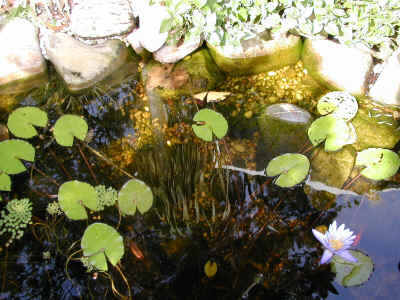
|
Unknown pink substance on rocks near
pond I have a fish pond in my backyard. I have noticed a
pink substance on the rocks around the pond. This has a
consistency of bubblegum when touched. When it dries it dries to a
white powder-like substance. Can you identify this for me?
Thanks, Donna <Maybe... most likely a type of algae... but could be
a combination of other organisms, mosses, lichens and such... You could
tell if you either took a look under a microscope at a bit, or had
someone else do this. Bob Fenner>
Algae in pond 30 Aug 2004 I just added
two Plecostomus to the pond; all the algaecides that claimed they were
plant and fish "friendly" indicate that they are hazardous to
people and domestic pets. Well, I know better than to drink
from the pond, but my three dogs don't have a clue. <I'm
surprised they don't have a fish snack to be honest.> And since
they have a doggie door to the back yard, allowing them free reign to
drink from the pond if they choose, the algaecides didn't seem like
a real good idea. <Definitely understand.> So, I'll see if
the Plecostomus can help matters any and hopefully they won't get
too big. <About 18 inches when full grown. They probably won't
winter in the pond well, you'll need to pull them out.> If they
do, I guess I'll be purchasing a tank (don't have one, even as
a confinement facility at this time) so I don't have to choose
between any of the fish. Do you have any recommendations for
any algaecides that are both fish, plant, people and pet friendly?
<I think the pet friendly is the problem, sorry to say.> Also,
I'd like to maybe clean the walls and "vacuum" out the
muck left behind but am not sure what the best way to do that would
be. Any suggestions there would also be
appreciated. There are times when it just isn't
effective to "skim" the crud from the bottom of the
pond. Thanks again for your input and
guidance. It's been a pleasure having the fish in the
pond; I hope to winter them without too much trouble. <Good luck
Jamie and keep us up to date. MacL>
Why has my previously clear pond turn
green? I recently built an 11x17 pond that is almost 3 feet deep in
a couple of pools and about 1 foot deep on a 4x3 area. I
have two 7 in koi and seven 4 in goldfish. There is a
waterfall that falls about 1 foot to the first shelf and another foot
to the pond. I've got about 20 different plants in my
pond with 2 of them being water lilies. My
problem(s) is: About 2 weeks ago my pond turned
green. There is some string algae but not an
overabundance. I have tried a couple of different biological
bacteria liquids but still have not been able to clear is
up. Could my water be too hot? <Could be a factor...
warmer weather goes hand in hand with algae blooms> Also I can not
keep water hyacinth or water lettuce alive in my pond. Can
you believe it?! <Yes. Happens... some conditions disfavor their
growth, presence> Within 2 to 3 weeks after I put it in the pond or
the Bio-Falls, all of the above water foliage turns brown and all of
the roots turn black. I have tried plants from 3 different
places. I do feed my fish. They get about 1/4 cup
of floating fish sticks each day. Do fish need to be
fed in ponds? <Yes, but this is too much... I would cut back to at
most half of this amount. This is another factor in your algae
growth.> I had a great supply of toad tadpoles when my pond was
first built. But I have not seen any for a couple of months
or so. Also, my water lily leaves are extremely
small. The largest leaf so far has been about 2 inches
across. One of my varieties is a large one
also. Thank you so much for your help. <Please take a
long read through the Pond area of our site, www.WetWebMedia.com. It
appears that the "bacteria" products you've been adding
are doing you no good... and some of your plants harm... You may need
to consider your overall picture here: the amount of direct sunlight,
water chemistry, the amount of biological filtration you have, the flow
of water through it... Bob Fenner>
| An undergravel filter for a
water feature? Dear Bob: I am having some fun in my retirement.
I live in So California, and it's dry and hot (Riverside
County). To alleviate some of the fire hazard in my canyon I've
put in gardens, and for an aside, a pond/waterfall (perhaps 250
gallons) . <We live in San Diego about half the time> The
pump that drives the waterfall is solar powered, about 10 gallons a
minute with a 2 foot fall. <Neat> It occurred to me that
instead of installing expensive filtration I might use an under
gravel filter just like my fifty gallon aquarium. It works. Kinda.
The solar pump is like a sump pump, drawing water from the bottom
but on top of a stainless steel screen with a gravel overlay,
(about 4 inches of gravel, fairly coarse gravel) To keep mosquitoes
at bay I put in some guppies. Some guppies now number a hundred!
<Do look into Mosquitofish instead... available from
"County Operations" for free... better at keeping aquatic
insect larvae controlled, relatives of the Guppy (livebearers
also)> The pond is in all day sun, and so I expect the water to
be green,( the water temperature runs around 80 degrees).
everything is fine but I would prefer the water somewhat more
clear: the depth is about a foot and a half, and I cannot see the
bottom. It might just be a seasonal 'bloom,' I don't
know as this is just the first year. Maybe some finer sand on top,
( it's like pea gravel), Any help you may offer will be
appreciated, because I had so much fun the first time that I'm
building another. But this time it's 1,000 gallons with a 14
foot fall off a giant boulder! <Ahh, much better> Thank you,
Paul Hoppe PS Found your site under Thoroseal. <Worked on and
built systems with in-place UG filters... they do work, but a pain
to service... and yours being exposed outright to the sun, being
small... will likely continue to suffer seasonal algae blooms. Do
continue to read through WetWebMedia.com re seasonal pond
maintenance and algae control... Adding some floating and
submersed/non-rooted plants, adjusting water chemistry (preventing
nutrient availability through using filtered water mainly and pH
adjustment...), possibly the addition of a small in-line
ultraviolet sterilizer, are all appropriate methods for reducing
the severity, likelihood of algal blooms. Bob
Fenner> |
|
|
Clams and Green Water Hello crew<Hi, MikeD here>,
I'm having a problem with green water in my outdoor pond, I was
wondering if freshwater clams could help in this
matter?<Actually, they just might. The green water is caused by
unicellular algae that finds the sunlight and fish waste a perfect
growing medium, and this is just what many clams would order if
possible.> I have a lot of fingernail clams in a creek where I live
would these small clams help?<First off, it would depend if the
creek temperature is the same as your pond temperature. In order to
make a difference, you'd need a substantial number, which could
present some problems such as 1) what would they eat after they cleared
the water, 2) if they starved, you'd then be looking at a
substantial amount of decaying animal matter, which could cause a
bacterial bloom much worse than your current problem and 3) many native
fish parasites utilize clams as an intermediate host, giving you the
potential for an outbreak that could, again, be more serious than your
current problem.> thank you.<You're very welcome>
Controlling Pond Algae 7/20/04 We have a pond about 1/2 acre in
size by 2 to 3 feet deep. How much rock salt and how often
to control our algae? Thank You, George. <salting a pond this size
may not be helpful or even lawful in your area (contaminating
ground/water). More importantly, it does not address the real problem
causing algae in your pond - excess nutrients. Your best long term
solution for this is natural plants to absorb the nutrients year after
year. Do stock with attractive lilies and bog plants instead. Reduce
fish feeding if you are at all... and have patience :)
Anthony>
Brown Freshwater Pond Algae Our large Koi pond has a
coating of golden-brown colored "velvety "algae.
To my eye it looks dead, but our pond maintenance service insists that
is simply an alternate form of healthy algae. Every reference I can
find to brown colored algae describes something much heavier bodied
such as kelp. Is there such a brown algae as the pond man says? Or, am
I correct to smell something in the air other than brown
algae? Thanks for your
help! James Wohrman <There are indeed
algae found in ponds of many colors, sizes, textures... including brown
as you describe. Furthermore, most algae can/do change their apparent
color depending on nutrient, light and to an extent water quality,
circulation dynamics... You might want to remove some of this algae,
place it in a good size (one gallon or so) "pickle jar" and
add some tap water to about half of its pond water... and see what
happens by growing same on a window sill. Bob Fenner>
K Tea, pond algae control, and lessons in human nature
Help! I have been trying to find out how to contact you via the phone
without any luck. The entire web site does not have a phone
number which is unfortunate. <Mmm, actually... as this endeavor is
"all volunteer", we don't have the time, flexibility to
handle phone calls> My problem is this: Last year I had
someone build a small pond (approx.. 15 x 25 feet, 5 feet at its
deepest point, in a bean shape. It was lined with a rubber
lining due to the porosity of the soil. After March it starting growing
these long and matted tentacles from the bottom. They then
began to float but mostly disappeared when I turned on the water
fall. I then added gold fish. They are still there. However
a haze of green algae has overtaken the pond and I cannot
see to the bottom. <Not atypical> Reading articles tells me that
what I need is K-tea, but it doesn't tell me how much and for sure
it does not tell me where I can purchase it. I live in the Northwest
corner of Ct. Please help me. Jose Orraca <... do you have a means
of filtering this system? Are there live plants? I strongly encourage
you to investigate your options further here rather than trying a
chemical approach... Far better to avoid these issues through prudent
design, filtration and maintenance than risk poisoning your livestock.
Please read through the Pond subweb posted on www.WetWebMedia.com Bob
Fenner>
Re: K Tea, pond algae control, and lessons in human
nature Thank you for your quick reply. Actually, I
don't have livestock because I am not a farmer. <... okay, what
sorts of life do you have in this pond?> It is mostly a
decorative pond. The filtration system is part of the
waterfall and it worked quite well at removing the floating algae, but
the water is still very murky, in spite of the fact that I clean the
filters quite often. <What sort of filtration?>
There are no plants growing in the pond, other
than the algae, primarily because of the rubber liner. I do plan to
plant decorative plants around the pond. <No potted plants... do you
have any floating types?> I have checked the options and in fact the
Connecticut Department of Environmental Protection recommended K-Tea
but they did not inform me where to obtain it. As it is, the pond is
very displeasing and I may have to drain it and find other ways to
improve my landscape, Thank you again. Jose
Orraca <Please read here: http://www.wetwebmedia.com/PondSubWebIndex/Pond%20Sub%20Web.htm
Your system is "unbalanced" in general terms... you can seek
to "re-balance" it in favor of clearer water through a few
methods... trying to selectively poison it with "K tea" is
not one of these. Bob Fenner>
Koi consumption of phytoplankton Hello Bob, John here.
I'm not getting much of an algae bloom this year so far, so I was
wondering if large Koi will consume large amounts of phytoplankton.
Thanks again for your time.-John <They don't eat any as far as
I'm aware... very small/fry ones do consume some. Bob
Fenner>
Water Wizard (pond algal control device?) Dear
Sir/Madam. Herewith a link to a product we manufacture that assists
with excessive algae control. Use of it will contribute to increased
business and larger client base. Regards, Charles Sterzel
www.waterwizard.co.za <Umm, I see you have "testimonials"
on your site. Do you have any actual "test data" that explain
"what" your product does, the actual experimental
"effects" the device exerts on water? Bob
Fenner>
Oxygen depletion from Algae killer - 7/14/03 Hi Bob,
<Anthony Calfo in his stead> Well, our goldfish are gone except
one shubunkin, probably due to that heron, raccoon or the snakes,
however the four Koi that we added have survived and are now 6 to 7
inches long and fat! Here is my new problem. We put Algae Fix in our
pond and the following day the Koi were lethargic, gasping for air and
migrated to our bogs. <Arghhh... do check the instructions too
(dreadful either way if the warning is there or not): a sudden kill of
algae/greenwater when water temps are high can cause a sudden and rapid
depletion of O2... the decomposition of clotted algae from the product
can do the same thing. Dose timing, aggressive water changes and extra
aeration are always recommended with such products> They seem to be
struggling a bit. We added salt and a bunch of ice to the pond and they
seem to be doing better. My question is, should we move them
to a kiddy pool for a while or just leave them alone? Thanks in
advance! Jennifer <I believe its best not to move them. Do a sound
water change (siphoning detritus) and be sure to exploit aeration
features (never turn any off at night either as is a common habit). We
may escape the treatment unscathed. Best regards,
Anthony>
Pond algae eaters I live in Washington State
and have a hot tub sized pond with 7 young Koi. I would like
to introduce an algae eater and I'm not sure what kind or how
many. Thank you for your great service. <There are a few
cold/cooler water fishes you might try... of the minnow family (same as
Koi and goldfish)... but if it were my system of this size, shape... in
an area that gets this cold, I would look to other means of algae
control. Please read here re: http://www.wetwebmedia.com/PondSubWebIndex/pdalgfaqs.htm
Bob Fenner>
Pond Algae Control Hello, I would like
to get an algae eater fish for my small pond. What
would you suggest as I cannot find any articles other than
loaches. Would a Plecostomus survive close to freezing
temperatures? In my limited knowledge I am thinking
some type of cat fish species would do? Thanks for you
help.............. Frank <Hey Frank, I have heard of people having
success with Plecos in outdoor ponds, but I think near freezing would
be a little too cold for these fellas. I would avoid
catfish, most catfish will grow large and eat any other inhabitants in
the pond. Maybe the Dojo Loach to help scavenge the pond,
but I think freezing temps would kill these guys too
(10-25C). Maybe a different method of algae control is in
order, please read below. Best Regards, Gage http://www.wetwebmedia.com/PondSubWebIndex/pdalgcontrol.htm
>
Removal of clumped algae Good Morning, I have a 1500
gal outdoor pond with Koi. My filtration system consists of a Tetra TP3
filter. I have a 25 watt U.V. sterilizer after the filter, as
recommended by my local aquarium. My problem is algae is being clumped
on my pond floor and sides. 3" thick. When my fish move it totally
clouds the pond until the fish settle in one place. My question is
this. What is the best way to remove this clumped algae which is on my
ponds wall and floor. My water is crystal clear, and the fish are
healthy. Please advise. <Best to scrape, otherwise entangle this
attached algal material on a brush and remove... as a means of
permanently removing bound-up nutrients... A note: don't be too
fastidious about removing all the algae... better to crop it and have
it about rather then free-floating types. Please read here: http://www.wetwebmedia.com/PondSubWebIndex/pdalgcontrol.htm
Bob Fenner> John Laurice
Earthen Pond Question I own 7 acres have a pond 100 ft
in length by 65 feet wide. I need Oxygenators! but have a few problems.
<Okay> 1. This pond is in my back pasture and I cannot afford to
run electrical wiring for pumps etc 7 acres back so I am wanting
Oxygenators. <As in plants?> 2. I have Rosey Reds and Albino
Channel Catfish in this pond already. 3. I have Welsh Harlequin ducks
and African Geese who swim in this pond. <I see... plant
eaters...> 4. My livestock also utilize this pond to cool down and
drink from although they do have their own water troughs. The animals
in question are: Alpacas, Cows, Pygmy and Nigerian Dwarf goats as well
as the before mentioned ducks and geese. <Okay> I'm wanting
something that is along the lines of a wildlife habitat but must be
safe and non-toxic to my livestock as well. I can't find any
information anywhere that states what can be used as water plants,
mainly oxygenators, that won't harm livestock. Elizabeth Bonin
Bedias, Texas 77831 Grimes County <Do check with your local wildlife
agency/ies... but I would try Hornwort/Coontail, Ceratophyllum demersum
here... grown in some areas where you can control it from spreading (if
possible). This plant will absorb a great deal of nutrients, grows
under a wide range of chemical and physical conditions, is relatively
unpalatable to waterfowl, non-toxic to livestock... Please see here re:
http://www.wetwebmedia.com/PlantedTksSubWebIndex/ceratophyllum.htm
Bob Fenner>
Cold water algae eaters
Hello, I'm not
sure if I'm going about this is the right way but your website is
one of my bookmarks and I think if anyone could help me you can!
I own a horse farm in WV (hence cold winters). In our fields we
keep several water troughs for the horses. They are all 100
gallons. In one of the many magazines we get (horse related of
course) they casually mentioned the idea of keeping fish in troughs to
cut down on algae growth. This struck me as wonderful. As
well as horses, I am a long time fish lover with three very large fresh
water tanks. Sadly they went into absolutely no detail. The
troughs are all hooked to automatic refillers and so there is a
constant (if not slow) changing of water (my thought was a nice source
of air for the fish). My first thought was of pleco's or some
sort of small catfish that would be fairly hearty and clean things up
nicely. But the more that I thought about it and as time passed I
wasn't sure. Have you ever run into a topic such as
this? Do you have any ideas. There are a few things I would
like to be aware of before I go any further... (I've tried to read
up on all of this but strangely can't find a "Fish in Water
Trough" book. lol) Things I need to know: In your
opinion would this work and be safe for both fish and horses since I do
not wish to harm either? I would most likely tank the fish during the
winter and so that is to be kept in mind as well. Which fish in
your opinion would be hearty enough but not out grow the tanks?
Thank you for your time and I hope to hear from your staff
soon...
Algal Info. Search I wanna know where can find
information about organismal called pond Mat and Spirogyra. I want to
know the habitat, how they live, how they do everything about these
organisms. I hope you answer my question, because I have to show a
project of these next Wednesday. Thank you. <Time to do a bit of
searching... at a large College library. Please read here:
http://www.wetwebmedia.com/litsrchart.htm re literature searches, then
off to see a reference librarian for help with the "how" to
find what is known re these algae. Bob Fenner>
Cryptic algae... questions... BGA in lakes What do you
suspect would be the best way to kill Cyanobacteria (blue-green (algae)
in a larger body of water, such as a lake, without harming the other
life forms in the pond? Is there a way to break down the photosynthetic
process, for instance? Katie <How big of a body of water are we
talking about (gallons?)>. Your best bet is to figure out what is
causing the excess nutrients that are fueling the Cyano. Is there any
filtration set up on this lake/pond? Maybe add some algae, plants, reed
system, to compete against the Cyano. Let us know, Thanks,
Gage.>
Moss (Filamentous algae in a new pond) I am new with
the computer and the pond/water fall ownership. <Lots of
excitement!> My son and I put in a water fall and a 1500gal. pond in
the front of our house. It has nine gold fish and two bottom feeders.
All seem to be doing well including the various plants. This water
feature has been completed for about three months However, I have a big
moss problem. This stuff is long stringy and is hanging from the water
fall and is all over the pond liner and plants. My oxygenator plants
look like a ball of this moss stuff. how can I get rid of it and keep
it clear of this stuff? I live in Cincinnati and the pond is on the
east side of the house. <Many ways to counter these pest algae
problems. Please read here:
http://www.wetwebmedia.com/PondSubWebIndex/pdalgcontrol.htm and
consider what your possibilities are... perhaps more filtration,
circulation, pH adjustment, shading... Bob Fenner>
re: Moss (Filamentous algae in a new pond) Sorry to
bother you again. I read the article you recommended and have learned
that I need some type of filter in my system. I didn't realize that
a filter was necessary for control of the chemistry, I thought that the
filter controlled particulates. Thanks so much for your comments!!
<Yes to having a filter... and you're so correct re its impact
on the overall health and appearance of the system. As you'll find,
many folks build the filter for ponds first and foremost (it IS that
important) and build the rest of the system, landscape around it. Take
a read through the many design, construction and filter materials
posted on the Pond Subweb:
http://www.wetwebmedia.com/PondSubWebIndex/Pond%20Sub%20Web.htm Be
chatting, Bob Fenner>
Pond Algae Problems I really hope that you can shed
some insight on what I need to do next in my pond. I have 2 ponds,
equaling 235 g. of water. I have talked to the aquatics department at
the local pet store, and I have gotten no results from all 6 people I
have talked to. In my pond which I have had for 2 years prior to
putting fish in, I have 3 plants now and only 7 fish left out of 15.
<If these are goldfish, do not add anymore. You have a fairly small
pond and goldfish get large.> The major problem is the algae. My
pond gets 85% of the days sun, and I think I have tried everything to
control the algae. Here's a list of the products that I have been
told to try: Stress Coat (only with new water), Pond Zyme, EcoClear, pH
down, Pond Salt, Barley squares, Pond Blocks, Algae Destroyer. I have
recently cleaned the pond 4 days ago, and only used the Stress Coat for
24 hours prior to putting the fish back in, and I have used the Pond
Block (2 of them), and the Barley Squares, and I have a lot of algae
again. The only other thing I have been told to use is algae eaters. My
plants are numbered to 3 now, unfortunately, they have not made it
through all of the chemicals. Please help me find some type of solution
for my problem. <You will not get any quick fix solutions from me.
To me, it comes down to minimizing algae by proper use of plants. You
have sun and nutrients, you will either grow plants or algae. All the
various bottled product are unable to give you a long-term solution. Do
make use of the extensive writings on WWM starting here
http://www.wetwebmedia.com/PondSubWebIndex/pdalgcontrol.htm and
following on through the blue linked FAQ files at the top of the
page.> Thank you, Gina Goss <You are welcome. -Steven
Pro>
Blanket Weed HELLO BOB, I WAS WONDERING IF THERE IS A
QUICK FIX FOR BLANKET WEED OTHER THEN A FORKED STICK AND A COUPLE OF
HOURS TO SPARE? I HAVE SEEN "MAGNETIC GADGETS" THAT ARE
SUPPOSED TO DO THE JOB BY BEING PLACED IN/AROUND THE FILTER OR IS THIS
A FANCIFUL IDEA? CHEERS CHRIS. <nutrient control is generally the
key (water changes, small frequent changes of chemical filtration
media)... and a pond skimmer with a little salt in the water also does
the trick too. Anthony>
Algae and their Control in Biological Pond Dear sir :
We are the marine shrimp farm owner in Thailand. Having read from your
Algae and their Control in Biological Pond we are very interesting.
Especially in your Mechanical Control Method. Could you please tell me
more about your two favorite method. Now we have the problem of the
blue green algae blooms in our shrimp pond and hardly for us to
control. Thanks in advance. B/Rgds Pairoj Simaroj <I suspect you
utilize lime treatments in your culture ponds intermittently to oxidize
wastes, eliminate disease... and organic fertilizers for boosting food
production to your shrimps (penaeids? Macrobrachium?). If you are sure
that your current algae problems are due to eutrophication I would
strongly advise boosting air exchange by introducing air (as in
bubblers) into the deeper parts (centers) of your ponds... and possibly
check your alkaline reserve (especially at early morning and mid
afternoon... and possibly elevate this (use pH as an indicator)...
slowly (with bicarb of soda... calcium oxide... careful here, slowly,
if you must)... Do keep an eye on dissolved oxygen, and if the BGA
becomes too prevalent, consider moving the ponds stock to another pond
system. Bob Fenner>
Re: alum Hi Bob, Well, someone had tried to use alum of
some form to remove phosphates from our ponds. The results were not
good as we lost several Koi. But in reading I see that alum should be
ok if used correctly. What other methods of removing phosphates are
available. Is just manually harvesting the best way? Thanks, marc
>> In all honesty (what else have I got?) you've hit the
proverbial nail on the head. Other than doing what you can to prevent
their introduction (design, construction to prevent suspicious run-off
from getting into the system, maintenance (no fertilizer overspray, or
overfeeding, over, easily-soluble fertilization for "other"
photosynthetic life....), using controlled plant growth to
"bioaccumulate" nutrients like phosphates and removing them
via biomass (okay, no fancy terminology here, trash removal) is the
very best (safest, surest) approach... Be chatting, Bob Fenner, not
associated with the old Weco Corp. who used to sell Alum as...
PondClear... and maybe still does.
Re: alum Hey Bob, Any recommendations on controlled
plantings? We have approx. a 400,000 gallon pond. 1200 Koi, 100 birds,
ducks, etc. some run off from grounds fertilizer. Is there perhaps an
additive that can be used with the fertilizer to help it settle in the
ground rather than run off? Thanks again, Marc >> All
sorts... and this is a tall order... the best would be to
"shoot" concrete/shotcrete and some sort of supporting wire
(like stucco or light cage material) in the basin(s) themselves..
during a drawdown period (i.e. with the water lower...) and contain the
plantings there with sand, small grade gravel over their bases... and
utilizing a slow release No-phosphorus type fert. tablet food source
(if, where desired).... Alternatively, a very likely
suggestion... make an adjunct basin in the way of a shallow
"swamp" area to grow sedges (typhaceans... cattails,
tules...) and possibly other amphibious true plants for nutrient
uptake... And/or the issue of aeration/destratification to lower
bioload, overburden... do you have a compressed air type unit on this
feature? I would definitely install one and operate it continuously...
The waterfowl... I'm sure you've heard this, and would hear
much more... but try to get rid of as many of these as possible...
They're a maintenance and health (yes) risk... Take a cursory read
of the pieces from "Water Feature Design... " I have posted
on the site: Home Page for a fresh beginning... some general
understanding of your possibilities.
|
|
Aquatic Gardens
Ponds, Streams, Waterfalls
& Fountains:
Volume 1. Design & Construction
Volume 2. Maintenance, Stocking, Examples
V. 1
Print and
eBook on Amazon
V. 2
Print and
eBook on Amazon
by Robert (Bob) Fenner |
|

