|
|
| Home | Marine Aquariums |
Freshwater Aquariums |
Planted Aquariums |
Brackish Systems |
Ponds,
lakes & fountains |
Turtles & Amphibians |
Aquatic Business |
Aquatic Science |
Ask the WWM Crew a Question |
| Please visit our Sponsors | ||||
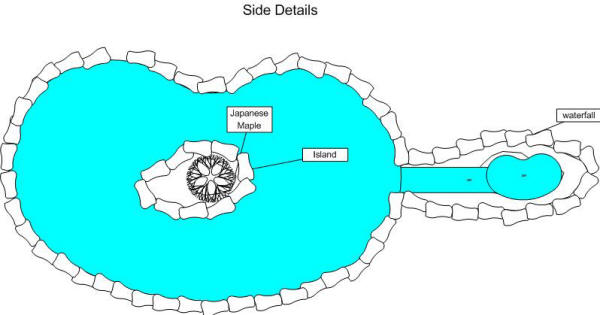
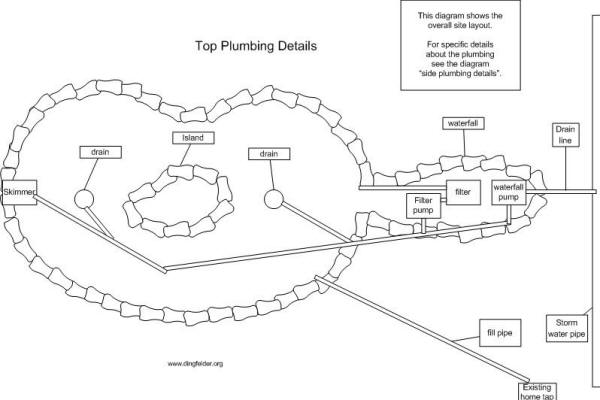
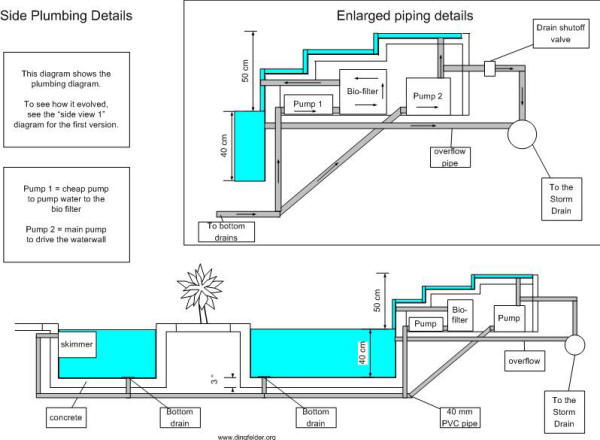
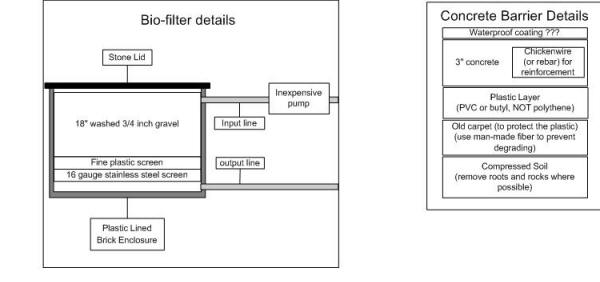
Re: pond advice Thanks for the feedback! I have a couple of follow-up questions and have listed them below, next to your comments: >> I posted an overview of the project > <Ahh, very nice illustrations> Thanks for the kind words. >> 1. how much of a biological filter is needed, since >> I have a waterfall (I heard a waterfall does >> some bio filtering) > <A good ten percent of the volume of your pond > itself, plus. Have you perused my old pond pieces > and the FAQs posted on WWM? I have been through those pages and am going to try and draw a diagram to illustrate how to build the bio filter, to make sure I am getting it right. I will send you a link to the diagram when I finish it to make sure you agree with my interpretation. <I look forward to seeing this> >> 2. what kind of skimmers would catch leaves etc >> but not small fish? > url to --> /PondSubWebIndex/pdplumbing.htm I have read through that page and found the plumbing info very useful but didn't see much if anything about skimmers on it. <Most folks use (and often modify) swimming pool, spa skimmers... with a berm or a bit of wire mesh to prevent fishes from getting swept over and into them> >> 3. any feedback on my diagrams or plans in general >> would be most appreciated. > <I would definitely leave out the newspaper layer in > your shell construction... I agree with that. Another member responded to my forum post and said that as well, but also added that carpet was a bad thing for padding a liner because it would rot and leave a gap, possibly then allowing the concrete to crack. <Mmm, not likely... but most folks do dispense with carpet or other underlayments unless the area has a good deal of sharp rock, protruding roots that might puncture the liner... the purpose is to protect the liner itself> I had heard (from this site and others) that carpet did NOT degrade which was why it was good to use. Can you confirm if carpet is good? <Is useful in some circumstances, rarely harmful> > and use a PVC, butyl... not polythene liner... On your website, you state that --> " 'Poly' liners can be used effectively as concrete underliners"... <Am sorry for the confusion... Poly refers to PolyVinylChloride... PVC, or other PolyVinyl that is flexible and far more permanent than Polyethylene... aka Greenhouse plastic...> I am assuming that an reasonably thick plastic liner would work as an "under concrete" liner, since there would be no walking on the liner (reduced chance of puncture) + no sunlight contact (to degrade it). <Actually no... though sun et al. does more rapidly degrade polyethylene, it does degrade too quickly, even underground> I was planning on spending most of my $ on plumbing, pumps and concrete, rather than an expensive liner... your thoughts are appreciate here though if I am getting ready to make a mistake on the type of liner. <A decent liner should cost you no more than about a dollar a square foot... much less per unit if the pond is very big> > <And to make a statement re: JasonC and I are > (finally) going to crank out a water feature > book/title... hopefully with as nice of graphics as > you've presented here. Bob Fenner> That sounds great, I cant wait to see it! If I can help with your diagrams, let me know :) <Outstanding. Thank you for your offer. Am going to CC Jason here... am mailing him twenty pounds of the materials for the book today. Bob Fenner> East Bay Pond Help Hello, <Hi, MikeD here, standing in for Robert> I am looking for someone to help me with a pond in the yard of a home I will be renting in the next couple of weeks. The home is in the East Bay area.<In the East Bay area of what city?> Do you have any contacts? <As we have an East Bay area here in Clearwater, FL, my first response was to say of course, before I realized that there are "East Bays" located everywhere!**grin** Checking your local yellow pages for pond maintenance, pond supply, etc. ought to yield good results. If by some extreme circumstance you ARE referring to this area, check Pet's Unlimited on Drew St. as they've been specializing in that area longer than anyone I know> Thank You Koi Pond - Do I need a pump? Dear WetWebMedia crew: <Hi there Brad> I am a reef aquarist who has lived in apartments my whole life. I wanted a Koi pond, so I bought a house (ok, there were other motives too). <I'll bet!> WetWebMedia has lots of good info, but: Do I need a pump? I would never consider setting up an aquarium without one, but most articles seem to connect having a pump to having a waterfall or fountain. I don't want visible moving water, but I don't want a dead/dying/stagnant pond either. <Almost assuredly yes... you will need/want to circulate, aerate AND filter your system> WetWebMedia (and other sources) always mentions a drain at the bottom of the pond. For those of us on level ground, where should the other end of the drain go? <To waste> The bottom of the pond will be lower than anything else. Do I need to put water up and out of the pond if I drain it? <If you have no drain, yes> Thanks, Brad Bellomo <Do look into all of these issues more... make a check-list and draw up plans for your pond now, not later. Investigate your pump options... and get one that won't run you into the poor house...they can be costly to operate in the long haul... and need to run 24/7. Bob Fenner> Re: B&B <Mark, are the folks moving ahead with the water feature project? About where are they at this point? Excavating? Trenching for conduits, plumbing? Will look later today for info. on filter containers, ozonizers. Bob Fenner> Bob, I think they're working on pump sizing, etc., the tour of the existing places went well, now they're thinking biological again, but bob still wants crystal clear water too. So, still planning stage right now. I have to wait a week or so to get the well tested, the power is off right now due to building construction. I'll know more when Jim gets back next Wed. Thanks, Mark <Real good. Appreciate this. Bob Fenner> Fish Ponds in Cold Places Dear sir, I tried signing up to WetWebNews but was unable to do so. <Alas, this WWM feature is no more. We had anticipated having a full-length "online zine" by now.... but its debut is much delayed> Also, I have a question about ponds. I live in northwestern Minnesota. The ground where I live can freeze to the depth of eight to ten feet. I lived in California most of my life and have built several fish ponds out there so the pond building is no problem. I read where I can buy heaters that float on the pond, but what about the pump house with all the plumbing, even leaving the pump running continually in that severe cold? <This must either be protected from the water freezing in it (plumbing and mechanicals) or turned off during freezing weather/seasons) and drained> Are there any books or other reading material out there that I can put my hands onto to try and solve this problem? I will await your reply. Thank You, John Dachauer <There are a few strategies for preventing loss of life and gear during very cold times... including draining all, moving the livestock into a non-freezing setting. The books on water feature design, construction and operation I am familiar with are cited on our Pond Subweb in the articles dealing with such topics. http://www.wetwebmedia.com/PondSubWebIndex/Pond%20Sub%20Web.htm Bob Fenner> Re: Playmate for goldfish? <Hi! Ananda here tonight> Hmm... Mum and Dad have wanted a pond in the back yard for a while, but that also happens to be where the septic tank is. We live in the Pacific northwest, so the water really doesn't freeze much during the winter, which is how some family friends have a pond. <Okay... you could have a pond even in the back yard, I think, as long as you use a good pond liner... you might want to look for a local Koi-keepers group and talk to them about how deep a pond you would need.> How much bigger is a 'mucho larger' tank? <Depends on how long you want to keep her in the tank. I have a bunch of smallish tanks, and I'd suggest you skip the small stuff and go straight to a 55g tank.> Should I turn over my 3 or 4 inch long little fishy to the slightly overcrowded family-friend pond? <Putting her into a "slightly overcrowded" pond would make the pond more overcrowded, which isn't good for any of the fish.> Could I make an above-ground pond-ish type... thing...? <I'd much prefer an indoor pondish-type thing for the winter. In the summer, sure. But it's probably going to get too cold to keep her outside in a smallish above-ground pondish type thing.> Would I be better off putting her in a pond and getting myself something that stays manageable and dinky? <Eventually, perhaps. But you'd need to build the pond, first.> George's tank is currently on a table in the living room, and I don't know how much weight the table can take, so if the 'mucho larger' tank is going to be mucho heavier... I think we'll need to figure out a housing alternative. <I wouldn't recommend anything bigger on that table if you aren't certain about its sturdiness.> O yes, Mum posed an interesting question before going to wrestle some last-minute garden weeds: If George is already too big for her tank, then aren't -most- goldfish out there poorly housed? <Yup.> My last comment: A frog would eat my goldfish?! Anything that can fit in their mouths, eh? <Pretty much.> I'll be sure to keep my fingers in my pockets next time I go past their tanks at the LPS! ;-) <You could always just wave at them. ;-) > Thanks for the help, and I look forward to your wise reply! ~Elspeth "Elf" Spencer <Wise-crack-filled reply, you mean...! --Ananda> Monster pond for monster tropicals? I am building a large pond approx. 20' L x 12' W depths ranging from 12" to 40" in Santa Rosa, CA. North of San Francisco. We have average temperatures ranging from 35 to 85 F and records of 20 to 110 F. I guess I have 2 questions. 1. Can I put tropicals like Pacus and Oscars in the pond? <Unfortunately, no. 35 degrees would very quickly do in these tropicals. Fishsicles, they would be. Better to find and stick with fish native to the area.> 2. What are a few good sources for construction of this pond? I intended on using a pool liner from a high grade soft side pool its very strong material I originally got it so that my large dogs could get in the pool. <Do check out the pond construction articles/FAQs on the WWM site; much good info there.> Thanks For any help you can provide. Ron <Sure thing - and good luck with your project! -Sabrina> Pond design and construction help Aug. 23, 2003Greetings: I started excavation for a 100'x50'x 3-5"deep backyard pond. After reading some of your articles, I realized that I need some expert advice and guidance, if not construction of the pond itself. I only want to have to do this once. <A good idea IMO for all folks... the savings in re-doing, lost time... makes this very worthwhile> I would like some names of pond contractors in the san Diego area including yourself if you are in the area. thanks for your help. <Been a good while since I was actually "in the life/trade"... and don't know the folks who are currently. My approach would be to contact the contractors in "the Yellow Pages"... interview them (ask "what can you do for me here", "what are my possibilities")... and a list of their "selected customers" you can contact re their work... Is the pond to have livestock in it? Is it on private property (only?)... there are some other sources of help that you might avail yourself of (like the SD Koi Club)... Bob Fenner> Scott Jordan Re: Pond Question Greetings WWM crew from Washington, DC, <Hi there> I'm doing some research for a pond I plan to build/have constructed within the next couple of years. <Okay> I'd like to construct a pond that's 11 feet long (east to west) by 5-6 feet wide (north to south.) 18 inches of it will be in ground with another 24 inches above ground. The eastern end of the pond will be the lowest part of the pond. As you head west, the land starts to slope up and become a hill. I haven't measured in a while, but I believe I could make the pond 15-16 feet long before the hill really becomes an issue. I plan to use landscape timber to terrace some of the ground and make it level. I will also use landscape timber to support the above ground portion of the pond. <So far so good> Last year, I tried to hire some of the local pond and landscaping companies to do this project. They all wanted to make the pond totally in ground surrounded by tons of rock and include ridiculously tall waterfalls. I believe rivers have water falls, and ponds aren't usually surrounded by boulders. <Very few that I've seen> Splashing sounds and dropping water is cute and all, but not the reason I want a pond. I argued with one or two of the contractors who seemed to want to include a waterfall just to increase the cost of the project. I kept hearing about non moving water becoming stagnant and losing oxygen. I'd constructed one or two container gardens indoors with just fish and plants and gravel. These containers had no filters or moving water and the goldfish, minnows, and white clouds were all doing fine and growing. One contractor who saw my container garden, said that I couldn't get away with a setup like that outdoors, because of leaves and a few other things. <I disagree. There are many reflecting pools that are "successful"> So after not finding one person who would build what I wanted, I purchased a 300 gal Rubbermaid water trough (rough measurements are 5.5 ft X 5.5 ft by 2 ft deep.) I placed it in a location not too far from where I want to build my pond. I filled the bottom of the Rubbermaid container with a 300 lb mix of gravel and unscented kitty litter. I also had about 30 lbs of Schultz aquatic soil so I threw that in too. Everything was going fine until I discovered that 2 of the bog plants I'd purchased wouldn't survive being at the bottom of the container. Pulling them up released a lot of kitty litter into the water column. It eventually cleared with the help of a pump, filter and fountain. Once the water was clear, the pump and filter were removed from the pond. My Anacharis is growing nicely along the pond bottom. In pots set on top of cinder blocks, I have golden club, water clover, and lizard's tail. Pushed into the gravel/kitty litter substrate, I have a pot that contains water Hawthorne. Along the bottom I have water lilies, but they were put too deep too soon. When the water clouded from the kitty litter, the lilies didn't die, but they never reached the water surface either. I also have some watercress floating along the surface. <Maybe they will this coming season> This setup has been running since Aug/Sept 2002. With the exception of 2 goldfish jumping out of the container, I haven't lost any fish. The other goldfish have grown, and the minnows spawned. I normally don't feed the fish. When the pond was new, I feed some freeze dried shrimp once or twice. As the temperature started to drop, I'd occasionally feed 1 crushed cheerio to the pond. I haven't lost any fish so far during the winter, and the plants are all holding up. Now I'm just waiting for Spring to see if a disaster strikes once the water warms up. <Best not to feed pond fishes when the temperature is below 55 F> Assuming there is no disaster with the Spring thaw, is there any reason I wouldn't be able to have the same kind of success with a larger pond? <None that I'm aware of> Thanks for reading through this long post, and thanks for your help, Lewis <A pleasure. Bob Fenner> Lake/Pond in the Vineyard Bob... Thanks for your response. I wouldn't feel comfortable imposing on you for free services/advise. I would, however, like to take advantage of your offer to post my requirements on your site for review by your colleagues that do these type of projects. I really am looking for someone experienced in projects of this type. <I understand, and have posted> Our plans are to put in a reservoir for the vineyard so we thought that it would be nice to have it serve two purposes, one, as a water source for the vineyard, and second, as an astatically pleasing lake. <Of course... and maybe an emergency source for fire suppression> Based upon the topography I would imagine the area to be in the five acre range with a depth at the deepest point to be about fifteen feet. At one end of the reservoir it will be necessary to construct a dam. Apart from these parameters we haven't made any plans. <Have you had the soil tested for percolation? Composition (for contaminants, nutrients)? Need to assess the likelihood of losing the water... and make provision should it "get loose" (as on others property)> Thanks for your help in locating an experienced company. Sincerely, Marty Meeker <A pleasure to be of service. Bob Fenner> Re: Lake/Pond in the Vineyard Bob... Wow! That was a quick reply. I usually do my email in the late afternoon after the dust has settled in the vineyard. <Ahh, I want to confide in you... for many years I've wanted to try my hand at Vinca cultivation (pvt. consumption only... which is considerable!)... but we have a dusty half acre (nosebleed) cyn. lot in mid- San Diego... with plenty of deer and rodents (not to mention expensive water, sigh) that would likely munch a bunch... Ohh, so when at home, am looking and working on these infernal machines most all waking hours> Comments: Good idea relative to the source of water for fire suppression. We are far enough out of town that should we have a fire the house would probably be destroyed before the trucks arrived. <Yikes... point taken. There are some really handy pumps (gas powered) that can spray good volume and pressure in a jiffy... you might want to look into such> At present, these needs (legal) are met by our 10,000 gal. storage tanks. We haven't done anything regarding soil testing. I thought that would be part of the overall project. <Good idea to do soon... including a test cut to the grade you intend... hopefully you can "go on the cheap", possibly dishing in a little Bentonite clay...> A major factor I will consider will be evaporation in the summertime, for as you know it get very hot in the Paso Robles area and I don't want to have the ag well running all the time just to replace water lost through evaporation. <Understood. You might be happily surprised to find how little water actually leaves still basins (much less than a cultivated area, like grass...> I would imagine that this is a relatively simple calculation knowing the surface area and the average temperatures. <Mmm, yes... with factors for wind, surface disruption...> I'm guessing that the soil, which isn't clay, won't hold water very well, so I was sort of figuring that we would need to use a liner in the construction. <... five acres worth? Again, have the perc. tests done, and look at all your options... there are some newer admixture technologies that should save you here> There isn't a problem with water "getting loose" as it would drain into a stream bed and further down into a neighbor's reservoir. <Thank you for this... a relief... and a question you understand I needed to bring up.> Thanks for posting my general requirements. Regards, Marty Meeker <Bob Fenner> The Bell Jar I'm circulating this note because I think I've had a fairly original idea which I hope people will be interested in. My ambition is to see companies manufacturing products based on my concept (I'd be willing to help in development and introduce other ideas I'm playing around with). So, here's my prototype for what might turn out to be an innovative new range of elegant, awe inspiring pond features. The Bell Jar: a.. The fish can swim freely from the pond up into the Jar and back again without restriction. In this version, I've simply put the jar on top of a strawberry planter. Previously, I used an upturned plastic plant pot with a few holes cut in it. b.. The Bell Jar can be made in various sizes and materials. This one is Pyrex. However, I think various plastics may also be viable. c.. The fish seem to love it! I don't know how well they can see out of the jar but it's almost as if they enjoy seeing the world around them. d.. The concept seems to defy gravity. Of course it's just basic physics. However, people do ask "How does the water stay in the jar?". I'd love to hear feedback on what people think. If there is interest, I could put together a website with more detailed images and maybe a vid. I'm also happy to help anyone who wants to build something similar for their own pond. <Interesting... how do you clean this thing? Get the water into it (good suction/vacuum pump from a hole underneath?). Have you measure dissolved oxygen in the water space inside over time? Bob Fenner, WetWebMedia.com> Yours truly Jonathan Re: The Bell Jar Interesting... how do you clean this thing? Get the water into it (good suction/vacuum pump from a hole underneath?). Have you measure dissolved oxygen in the water space inside over time? Bob Fenner, WetWebMedia.com> Thanks for the prompt reply Bob. <You're welcome> This particular jar is quite small and easy to empty and clean. I then simply submerge it in the pond to fill completely. Of course, if it was bigger, the weight of water might be too much to fill it this way and then turn it over to position on a stand. Therefore a pump would probably be the best solution. <Yes... I was... a physics and chemistry instructor at the H.S. level years back...> I haven't measured the oxygen content. However, the fish seem content to spend much of their time in there during the day (I wonder if they like the sunlight falling on the jar?). <Neat.> Regards Jonathan <Over the years there have been similar aquarium applications of this technology (water-filled arches above, between aquariums...), but have never seen one in a pond. Good luck with your ad/venture. Bob Fenner> Hi again Bob it's the Canadian pond guy. Hi Bob, <Anthony Calfo my friend while Bob is away traveling> You probably do not remember me but a Few years ago we spoke on the phone about a dozen times. Let me try and refresh, I manufacture pond filtration equipment up here in the sunny north. I first contacted you about a clown fish breeding book that took forever to complete (although it was worth the wait). It was through these conversations that we discovered our mutual interest in ponds. You said that you were called the boy who cried pond. Periodically I would call and we would talk about different water quality issues and from time to time we would relate back to things that we had written. Then one fateful day you said that I should write a book about pond water quality issues (At least that's what I think you said, It may have been "Get off the phone and stop wasting my time you damn Canadian"), <take off you hoser, eh! he really said that?!?> what ever the inspiration I went ahead and self published a book on ponds called the pond rescue manual. <awesome... congratulations on this great feat! And a topic that is quite popular and deserving of your/our attention> <<And a very good title to boot, eh? Sorry about that>> I would like to get you a copy and see what you think of it I really think you would enjoy it and would really like to here your honest opinion it is only 80 pages long but is packed full of information and very funny to read. This is not a solicitation for a published book review on your part. In fact I don't think you could do it anyway because I mention you in the credits. If down the line you have any suggestion as to what I should do with it of course your comments would be appreciated, but first take a look at it if possible and see if you really were telling me to get off the phone. <a very special kudos to you from one self-published author to another <wink>. I'll be sure that Bob gets this message. He should be back online in days to a week> Thanks David Korhonen <best regards (and sales!)... Anthony Calfo> <<Ah, yes. Am just back. Please send it along. Bob Fenner, 8586 Menkar Rd., San Diego, CA 92126> PS, I did breed the clowns but in the end it was too much work to keep it going. Looking for a Pond Book source... I am interested to purchase
the "Garden Pond" compiled by Miller. Could you please e-mail
me how to buy it? Thank you! Ying Zhang Ocean Park Hong Kong <Have
you tried Amazon.com? Barnes and Noble (.com)? Need more information to
help you... like the Publisher's name, the rest of the Author's
name... Bob Fenner>
|
|

|
Features: |
|
| Featured Sponsors: |