|
FAQs on Anemone Behavior in Marine Aquariums
2
Related Articles: Anemones,
Bubble Tip
Anemones, LTAs, Cnidarians, Coldwater Anemones, Colored/Dyed Anemones,
Related FAQs: Anemone Behavior 1, Cnidarian Behavior, Anemones 1,
Anemones 2, Anemones 3, Anemones 4,
LTAs,
Bubble Tip
Anemones, Caribbean Anemones,
Condylactis, Aiptasia Anemones,
Other Pest Anemones, Anemones and
Clownfishes, Anemone
Reproduction, Anemone Lighting,
Anemone Feeding,
Anemone Systems, Anemone Identification, Anemone Compatibility, Anemone Selection, Anemone Health, Anemone
Placement,
|
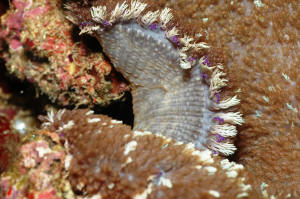
A Close-up of an Actineria sp. pic by DianaF in N. Sulawesi.
|
 |
New Print and
eBook on Amazon:
Anemone Success
Doing what it takes to keep Anemones healthy long-term
by Robert (Bob) Fenner
|
|
Shrinking Anemones; beh.
6/14/19
We visited several tide pools in BC Canada on Vancouver Island. At one tide
pool, the anemones when touched would shrink into a donut looking shape. See
picture of one on the right as a “donut”, one on the left starting to curl up
and the others fully opened. If we touched all of them, we had a cluster of
“donuts” Is this normal? Why did they do it?
<Yes, it is normal, . Anemones shrink when touched because they feel threatened,
usually by natural predators, your hands are a possible predator in this case;
shrinking is a defense mechanism to protect their tentacles.>
Thank you for any reply. Carol Hecox.
<Welcome. Wil.>
|
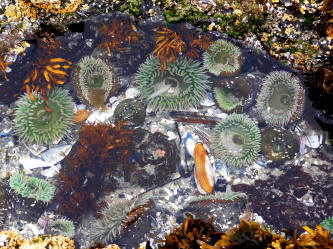
Anthopleura... xanthogrammica? elegantissima? Nice pic. B |
Vanishing Anemone 4/23/12
Dear WWM Crew,
<Eric>
I have a sad story to share and hope maybe you can help with some
suggestions. I am new to the hobby. I started with a 55
freshwater. I loved it so much i started a 10 gallon salt water.
It only took me a few months to realize that the size of that tank was
much too small and i wanted a larger saltwater tank. So back to the LFS
to trade in my freshwater fish and convert the 55 gallon tank to
saltwater. After a great deal of money, and a four week cycle i was very
excited to see the cycle on my tank complete, and start transferring my
livestock to the new larger home i had built for them. I spent the
entire day slowly drip acclimating all my aquatic friends to their new
home, and watching to make sure everyone was okay. After 3 days of
constantly watching I was very pleased to see that everyone looked very
healthy and happy. However, on the third night I noticed that my Long
Tentacled Anemone was moving. I was not very concerned as i know they
are prone to do this. I observed for awhile and it seemed to be alright.
I checked before i went to sleep for the night and it had placed its
foot down again and seemed content. When i awoke the next morning it was
gone!! I have studied your articles on anemones. I know that this
particular species likes to hide in the sand. I gently probed the sand
bed with my finger tips and cannot locate it.
<Can shrink down to almost nothing... a few percent>
I also looked up through the glass bottom to see if i could locate its
foot and again no luck. Now if it was just hiding i would not be over
worried but i found a dime-sized piece of what appears to be my
anemone on the front of one of my power heads.
<Ahh; this is likely "it">
I am concerned that it is laying somewhere dying and getting ready to nuke
my tank. I would be very thankful for some suggestions on where to
proceed from here from WWM as i value your experience and input.
Tank: 55 gallon
ammonia: 0
Nitrite: 0
Nitrate 5 ppm
PH: 8.2
SG: .025 <1.025>
Temp: 78
Lighting: 4 T5 fluorescent tubes, 10000k each, 2 actinic, 2 white, 4 led
moonlights, all on a ten hour timer with a morning and evening period.
Live rock: approx. 70 lbs.
Sand: Live sand, fine grain size
Filtration: Sump with macro algae growing in it, HOB filter with
charcoal and an additional pad that filters particles as well as
phosphates.
Current: 1 Hydor Koralia 550, 1 Hydor Koralia 1050
Residents: 2 Clarkii clowns ( one which attentively hosted the anemone
), 1 yellowtail damsel, 3 blue-green Chromis, 1 Linckia starfish, 1
banded serpent star, 1 lawnmower blenny, 1 coral banded shrimp, 10 blue/
red legged hermits mixed, 1 thin stripe hermit, 1 sand sifting star, 4
trochus snails, 2 bumble bee snails, and 1 very pretty invisible
Long Tentacled or Corkscrew anemone.
Prior to the disappearance everyone was eating well. Everyone seemed
happy, active and healthy. Colors were good and even the two clownfish
had come to some sort of truce it seemed. The anemone was very healthy
and much happier in the new tank. It was sticky and inflated. The color
was a very nice tan highlighting the stripes on its disc. The mouth was
closed. The foot was pink. There were no sores or tears anywhere on it.
It was eating well. I fed it some Mysis, brine, krill, and plankton the
day it disappeared. The food was a commercial frozen mix. It was opening
during the day nice and wide and then closing at night cuddling its
clownfish whom sleeps tucked away in its tentacles.
I have tried moving some rocks to find it. I have checked all my intakes
and filter boxes. I have taken all the covers off of my power heads to
make sure it was not sucked into one. I don't know what else to do
except wait and see if everything dies. Any suggestions will be most
gratefully appreciated and thank you for listening to my story. I always
know i can count on WWM for good information. Oh and i should mention
one of my Chromis seems quite distressed this morning. It looks as if it
might not make the day.
Sincerely,
Eric
<This anemone is likely gone... dead, decomposed... are high ninety some
percent water... Anemones are not easily kept in captivity,
despite their popularity. I would hold off on a replacement...
the Clowns will do fine w/o a natural host. Bob Fenner>
Re: Vanishing Anemone 4/23/12
Thank you for your quick reply Mr. Fenner. If i could trouble you to
expand a bit on your reply.
<Certainly>
They can decompose overnight?
<Ah, yes>
I did not realize it would dissolve so fast. Also i had seen it shrink up
to a very small bulb before when being moved. When i had witnessed this
the smallest i had seen it contract was around golf ball sized.
Is it likely that it could still have gotten smaller?
<Yes it is>
It was approximately 3" across the disc when expanded. Assuming it has
dissolved in my tank what should i do to insure the safety of my other
residents?
<At this point/juncture, nothing I would do... the bit of protein that
was this animal is likely of no consequence>
A partial water change I'm sure, but is there anything else?
<Not really; no>
I am sorry for all the questions, but I try very hard to keep everyone
healthy and am quite distressed over this. Thank you again for all your
help and attention.
Eric
<Do please read here:
http://www.wetwebmedia.com/AnemCompF4.htm
and the linked files in the FAQs series (above). BobF>
|
Picture of anemone turning inside out? 12/12/11
Hello,
I have been searching your website for a picture of an anemone "turning
inside out" but have not found a clear representation. I have attached a
photo; can you please tell me if this is what it looks like?
Thanks, Michael
<Mmm, don't really turn inside out so much as evert their gastric
cavities.
Bob Fenner>
|
|
|
|
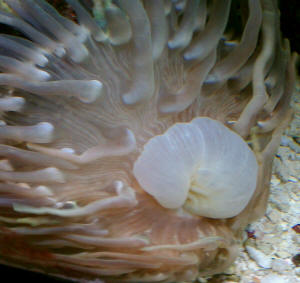
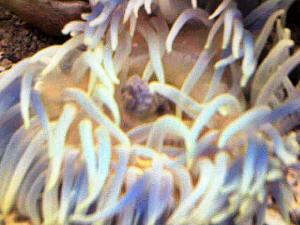
My Anemone: Anemone Health\Diet., beh. 7/4/2010
Hey there,
<Hi Brooke>
I know there are a ton of questions about anemone on the website, but I'm
not seeing the answer that applies to my anemone.
<Hmm... Ok.>
Me and my sister bought the anemone about 4 days ago, and he's been very
healthy and happy. Just today though, I noticed a very strange object in
the center of the anemone (where its mouth is) and I do not know if it's
normal or not.
<Normal. - It is expelling waste. There is only one way in and out...>
Just some background information, we have a 125 gallon tank that contains
live rock and limestone. We have 2 goldfish <Clownfish?> that haven't
completely warmed up to the anemone and about 11 Damselfish. We
constantly check the salt levels in the tank and make regular water
changes. I've just checked and he is nice and sticky and most of its
tentacles are inflated, but it still has the foreign object in the
center.
<I wouldn't worry for now.>
I have attached a picture of the anemone, and we seem to think it is its
insides like maybe its stomach. Is that normal? I hope I have provided
enough information, and thanks for the help!
<Have a read here:
http://www.wetwebmedia.com/cptanembehfaqs.htm
>
<MikeV>
|
 |
Anemone Study... beh.... 3/15/10
Good afternoon!
<Hello,>
I am a first year Biology student at a university in British Columbia, Canada
<A lovely part of the world.>
For the next three weeks we have all been assigned an animal to analyze and
study behavioral attributes to certain organisms.
<Sounds a fun assignment.>
I am looking at an anemone for the next three weeks and I've been doing a bit of
research on them prior to the physical study.
<What have you learned?>
Your website has been incredibly helpful.
<Glad to hear it.>
I was wondering, since your team spends so much time with these organisms, if
you would have any tips to find the best behavioral attributes?
<Likely yes, we do have some experience of these animals and do know about all
sorts of interesting behaviours. However, and this is the bit you're not going
to like, we're not going to tell you any of these things before you tell us what
you've learned. You see, some of us, including me, are or have been college
professors. We know precisely the point to this assignment, and for that reason,
won't do anything at all to diminish the learning experience (i.e., your
workload). So, let me turn this question around and ask *you* some questions.
What behaviours exhibited by anemones interest you? Second question. In what
ways do anemones make worthwhile organisms for study? Third question. In what
ways does the neurobiology of anemones differ from that of "higher" animals? If
you can answer these three questions, yes, we can probably nudge you towards
some specific behaviours you might explore or test.>
There are so many experiments I could conduct, and I know what to look for now,
from all the information on your site, but I would prefer being more humane.
<This is terribly vague, so I can't possibly guess what things have interested
you and what you've learned from visiting our site. In fact you could send this
precise e-mail out to any one of dozens if not hundreds of scientists or
research groups. As a science PhD myself, let me tell you right now that
"scatter gun" approaches DO NOT work!>
Thanks for your time,
<Always a pleasure to help, and once you've formulated something a bit more
specific, and a bit more focused towards what we do here at WWM, please do write
back. We're all very nice, helpful people -- but some of us are old enough to
know not to spoon-feed undergraduates! Doesn't do them any good, and doesn't
make best use of our time either.>
James
<Cheers, Neale.>
Re: Anemone Study, beh. 3/17/10
Hello again,
<<Hello James,>>
Neale thank-you very much for replying to my past e-mail, here are some answers
to the questions you asked in response to my Mondays questions.
<<Great!>>>
Q: I am looking at an anemone for the next three weeks and I've been doing a bit
of research on them prior to the physical study.
A: <What have you learned?>
I have learned about the four types of asexual reproduction and sexual
reproduction. I have learned about their two types of locomotion, and how they
will not settle until they are in an environment that satisfies their inner
drive. I have learned the difference between Polyp (first stage) and the medusa
(second stage), their inner structures and feeding habits (toxins used to poison
pry). I have learned about their hosts, primarily the clown fish, and the
history of anemones. I have read how sensitive their pedal disk is, and how
significant a difference their life spans is between in a tank versus in the
wild (less than two years versus over a hundred). I believe I have covered most
aspects that one can learn through materials online.
Q: I was wondering, since your team spends so much time with these organisms, if
you would have any tips to find the best behavioral attributes?
A: <Likely yes, we do have some experience of these animals and do know about
all sorts of interesting behaviors. However, and this is the bit you're not
going to like, we're not going to tell you any of these things before you tell
us what you've learned. You see, some of us, including me, are or have been
college professors. We know precisely the point to this assignment, and for that
reason, won't do anything at all to diminish the learning experience (i.e., your
workload). So, let me turn this question around and ask *you* some questions.
What behaviours exhibited by anemones interest you? Second question. In what
ways do anemones make worthwhile organisms for study? Third question. In what
ways does the neurobiology of anemones differ from that of "higher" animals? If
you can answer these three questions, yes, we can probably nudge you towards
some specific behaviours you might explore or test.>
1. The behaviors that interest me most cannot be examined in the three hour time
slot I am given. We are supposed to compose two hypotheses and take three hours
to conduct these experiments.
- I wanted to look stimuli of the anemones, primarily light and sound. Light in
regards to the tentacles, and how they act different times of the day (morning,
afternoon and after the sun goes down) and to see how the time of day, or light
source changes their behavior and if a light source other than the sun will
produce similar results. Sounds in regards to tapping on the glass and trying to
provide a controlled predatory environment. How will they react to shifts in the
water, will loud music affect them at all. Both of these are seemingly
impossible to conduct with the lack of time and opportunity to analyze my
specimens and the dish they are in when I am actually able to analyze them.
<<What you're talking about is habituation: how animals "tune out" repeated
stimuli that they learn aren't dangerous or rewarding. Animals only have so much
processing power, and if they react to every stimulus they'd soon be
overwhelmed. One way to test this is to train animals to respond to a stimulus
with the expectation of food, and then remove the food, and see how long it
takes them to forget the importance of that stimulus.>>
- The second experiment I wanted to conduct would be in regards to their
environment: to change the different queues around and see which environments
are favorable, in regards to, again light, water circulation, rocks etc. But
again, this is not practical because the dish that my anemones are in while I'm
analyzing them.
<<I agree. Reef anemones really aren't worth testing this way because they take
days to readjust to being moved from one tank to another. Intertidal anemones
like Actinia equina might be a bit more interesting in seeing how long they
recover from their resting, above water state to being submerged in seawater.
You might try exposing them to different salinities, and see if they recover
quickly at marine and near-marine salinities, but stay closed up when exposed to
brackish water. Since you won't have time to readjust the same anemone within
three hours, you'd have to try ten anemones against maybe five different
salinities, and average out the results to deduce the trend.>>
- The third experiment I wanted to conduct was to keep an eye on the waste that
they produce, and keep a daily log of those wastes. However, the anemones are
kept in a circulating take while not out with the students, and it will be
impossible to tell what wastes are from my specimen and not produced by the
crabs and other salt water critters.
<<Place a net over the anemone that traps solid wastes but lets water pass
through. Remove the net only for feeding.>>
So, I've decided that I will feed the anemone and keep track of the food it
eats, how long it eats, and if the food (brine shrimp) are delivered at a
distance, is there any means that the food is attracted to the anemone.
<<Why do you think this would be the case? Moreover, given the water current and
the way anemones orient themselves, will the Artemia be swimming into the
anemone or simply being washed into it?>>
I will be given three anemone, they are 1.5 cm, 0.5 cm and 0.2 cm in size. I'll
watch their feeding habits under a dissecting microscope and see if there is a
significant difference between the eating habits of the three sizes. I'm curious
to see if the smaller anemones will eat faster, fewer tentacles -- and whether
the larger anemone will eat with more than one tentacle at a time.
<<Interesting idea.>>
I'm at a loss for my second experiment. The three listed above are not possible
for my environment. For all other experiments I'm concerned that I will be able
to find the answer online without even having to conduct anything. I trust
online sources more than the environment my anemones are in right now.
<<Defeats the object of experimentation! When doing the experimental design, you
need to argue why Species X is a suitable lab animal, so that any data it
delivers is [a] reliable and [b] accurate (these two criteria are distinct but
essential). Would be better to sit down, think about what you can do with an
anemone, and create experiments around that. For example, how would these
anemones react to different salinities, or oxygen concentrations, or
temperatures? Would the addition of minced fish juice cause them to extend their
tentacles more than, say, shrimp juice or spinach juice?>>
2. Anemones are amazing invertebrate. The ways of reproduction, and the inner
need that they satisfy when their environments are not acceptable. The fact that
they have the gastrovascular cavity, mouth and anus in one. They are beautiful
creatures with an intriguing lifecycle that takes place over a span of 100 years
in the wild. But seriously, I am more of a geological person; the anemones that
interest me have an ancient feeling to them as fossils: the phylum
Echinodermata, with my tabulate and rugosa fossil specimens.
<<Ah! Speaking my language. My PhD was in ammonites.>>
3. Anemones feel no pain. Their nervous system pulses out a network of nerves
both chemical and electric that respond to environmental stimuli. Motor nerve
cells contract to move the anemone in their medusa stage. A brain and central
nervous system are not required.
<<Which makes the fact they react at all interesting. Some anemones move away
from lights or react to shadows, yet they don't have eyes. Would suggest
researching the "coelenterate nerve net" a bit to see if it sparks any good
ideas.>>
Sexual reproduction produces free-swimming ciliated larva. There is an outer
body of cells and an inner body that serves as intestine, gut and circulatory
system. They are the most 'basic' critter of the invertebrates.
I hope I provided enough efficient information this time and I would like to
thank you again for replying.
- James
<<Cheers, Neale.>>
Anemone Clone Behaviour
1/1/10
Hello WWM crew,
<Morning Cnid>
how's it going?
<Okay>
I have had some thoughts recently about Clone behaviour.
Is it possible for Clone Anemones of the same Recent ancestor to sting one
another
<Mmm, yes, but...>
or are they benign towards each other?
<They do tend to ignore each other greatly>
I know its a rather broad question and is likely not to have a clear cut answer
but I thought this might be worth knowing.
Thanks.
<I "worked on" a "clone anemone" species (Anthopleura elegantissima) for a
marine zoo. college class years ago... This species shows a great ability to
recognize, ignore genetic alikes... and dis-alikes. Bob Fenner>
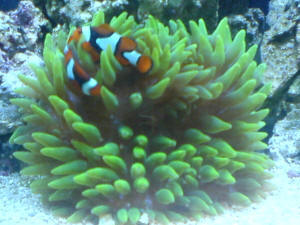
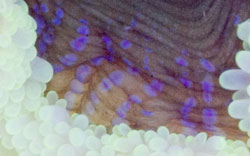
| An ID Question (flatworm) and Anemone Behavior Issues
6/27/08 Crew- <Craig> May I please get a positive ID the first
attachment? From what I have read, it appears to be an Acoel flatworm of the
genus Convolutriloba. <Is a flatworm evidently> If possible, can we confirm
what behavioral info you might have and point me to it? <Mmm, not following
you here... what beh. info. re what?> Additionally, can you speculate that
these flatworms would be suitable prey for Chelidonura varians, the "Blue
Velvet" sea slug? <Might be... but if they're numbers are low (enough) I'd
ignore them> For some time I have wanted to purchase one of these animals,
but have never went down that path since I knew they were specialized
predators that I could not feed on a consistent basis. <Correct... and when
prey numbers are low... it/they "disappear"...> Right now, these flatworms
are in the midst of a population bloom in an aquarium that only has a pair
of percula clownfish in a BTA. I have added a pair of peppermint shrimp, but
they have not had an appreciable impact on the population of flatworms.
<Many are unpalatable... as you likely are aware> Also, if these guys pose
any risk to my aquarium inhabitants or even my copepod population I would
rather introduce a predator or siphon them out. It seems that is the
consensus of the responses on WWM. <Okay; glad to find you've searched> The
second attachment is of a BTA I purchased about a month ago. I wanted to
contribute to the knowledge base about some observations I have had with
this animal. It is probably the 10th BTA that I have owned - the others I
have sold to other aquarists after pairing various clownfish species and
getting the pair to host in the anemone - it's just something I enjoy doing.
It's often a challenge to pair clowns up (especially maroons) and even more
so to create to commensal relationship between clowns and their host
anemones. <Interesting... that you state/find this symbiosis to be such,
rather than mutualistic> I believe I have read on the site that the behavior
of BTA is more sedate than other anemones; meaning that while all anemones
can/do wander, BTAs tend to find a rocky crevice and lodge their foot
inside. <Mmm, most so with successive asexual clones here> I have found this
behavior to be true of all the BTAs I have kept until I brought this one
home. THIS anemone wandered around all night for about the first two weeks.
Each evening it would fill itself up with water at the end of the day and
then it would go on trips around the aquarium. Each morning I would move it
back to the place I wanted it to occupy and it would attach itself there for
the day. I thought, "Well, evidently the anemone will tell ME where it wants
to stay and I will like it." <Yes to the former, hopefully so for the
latter> Interestingly enough, the LFS had it in its display tank and it had
never moved the whole month or so they had it; in fact, we had to chisel it
out of the rockwork just to get it home. Both my tank and the LFS run MH
lighting: theirs a 250W at 10K, mine a 250W at 14K. I have about 15X water
flow per hour, the LFS had about half that. About a week after bringing it
home, I knew something was amiss with nocturnal roaming of the BTA, so I
went back to the LFS to check their water parameters. It turns out they run
their SG at 1.023 and my tank was at 1.025. When I lowered by SG to 1.023,
the anemone promptly returned to the place I had been trying to keep it and
it hasn't moved since! <Interesting as well. Coincidence?> The third
attachment is of a carpet I bought the same day as the BTA. Could you
confirm whether it is S. gigantea, as I suspect? <Looks to be... on the
basis of the pedicle> It is in a different system than the BTA and currently
hosts a pair of black ocellaris clowns.... which is very sweet. The SG of
the system I found this guy in measured 1.028. I took most of the day I
bought it acclimating it to 1.026 SG, which is the highest I feel
comfortable keeping the tank at. It was under a single 10K VHO bulb in a
plumbed in 29G tank at the LFS, <Much too low> now it's under 400W of MH in
a 92 corner bowfront. Apart from its weak coloration, it looked great at the
LFS and I have to say it does look a little less turgid these days than when
I bought it (its tentacles are longer and not as "plump", but it eats weekly
and has NOT moved once since I introduced it to the tank. I found this
ironic since the guidance on WWM indicates that carpets tend roam
excessively. <Some do when first brought in from the wild, but exceedingly
rare once settled. Heteractis magnifica are the kings of travel> I guess we
can try to observe general tendencies among species of aquatic life but
there will always be exceptions. <Well-stated> At this point, I have a
pretty keen eye to catch the behavioral cues that anemones exhibit to show
how they are doing in a captive system. Would you suggest gradually letting
the SG increase to 1.027-28 and see if the carpet really does prefer such a
high SG? <Mmm, no> Part of me feels like it should have settled in by now
and be looking better - I can say its coloration has darkened significantly
(since it has better lighting) but it doesn't seem to be as large as it once
was and I suspect the SG may be a little too low for its liking. I am not
worried it would die tomorrow, but I am thinking long term here about what
parameters I need to stick to. <Near natural seawater, NNS> I am sure that
had I not been reading WWM for years now and researching some of the
overarching principles of marine aquaria I would have at least lost the BTA.
I remember back in my early days I probably would have been desperately
trying to FIX something instead of focusing on stability and incremental
changes, if needed. <Ahhh!> I definitely wouldn't have suspected SG. I
wouldn't have even considered that my instrument might need to be
calibrated. I definitely would have thought about ammonia, or even nitrate,
as a culprit....but not SG. So many thanks to all you at WWM for your
contributions to the many of us hobbyists out here. We are all definitely
made better for your efforts in what we do. Thanks! Craig <Thank you for
sharing as well. Cheers, Bob Fenner> |
 |
  |
Anemone Losing Tentacles -- 2/28/08 HI <Hello Lewis,
Brenda here!> I have a 100gal reef tank and an extremely large anemone that
measures about a foot in diameter. <Is large, but they can get much bigger.> It
has been in my tank for about 3 or 4 months now. I've noticed that it sheds
quite a good amount of tentacles then re-grows them. Is this common for a Sebae
anemone? <No, this is not normal. There is likely something bothering this
anemone. What else do you have in your tank? Such as fish, crabs, shrimp, etc.
To be safe, please give me a list of your water parameters and equipment. There
is more information found here: http://www.wetwebmedia.com/anemhlthfaq6.htm >
Thanks, Lewis <You're welcome! Brenda>
Anemone Activity... beh... misplaced... 2-12-08
Hi WWM Crew! <Good Evening.> My husband and I have a 65 gallon, live rock tank
that has been up and running for over a year now. We recently made the mistake
of purchasing a puffer fish (without researching first) that ate both our
cleaner shrimp and banded shrimp. <Yes, they have quite the taste for
invertebrates. I have about 15 here.> Our (and their) terrible mistake as we
really enjoyed these small creatures and had actually trained them to eat out of
our hands and our grandchildren loved to feed them. So, we thought we should ask
lots of questions and read what we could find before adding an anemone and clown
fish to the tank. We were assured that none of the fish we had would bother the
anemone. <Good.> Well we brought home our new fish and friend just 3 days ago.
The day we brought the anemone and clownfish home they were a very happy couple.
They were both healthy and feeding right away. They are housed with a blenny, a
green bird wrasse, the puffer, three humbugs, 2 damsel fish and a star fish. <A
little too overstocked I think. What kind of puffer do you have?> The problem,
day 2 at their new home and the anemone was shrunk down as far as it could. The
clown fish could not convince it to open and continued to try and feed it. Today
we came home from work, and there was the anemone wide open and looking happy
and healthy again. We went out for the evening, and once again...the anemone is
shrunk even smaller than before. <What kind of lights are you running and how
often?> We have checked the water quality and all levels are very good to
excellent. We were told, and have not been able to find anything to the contrary
on the internet or in our books, that the puffer and wrasse would not be an
issue with the anemone. Is this true or is it likely one of them is picking at
it? <It is not likely due to the stinging factor that the anemone has. I have
heard of puffers having a taste for them though but have never experienced it
myself. If something did pick at it, they would receive a very unpleasant
surprise. Puffers and anemones are not compatible though because puffers are
very inquisitive and there is a chance that they can get stung to death. > Is
this normal behavior for an anemone? We haven't been able to find the answers
anywhere else. Please help us, very soon, as it is such a beautiful creature we
would hate to have anything happens to it. <Anemones contract and expand during
the day depending on mood and lighting. When it gets dark they rear back and at
the brightest light they are wide open. What kind of anemone is this? Check this
link for more information on anemones:
http://www.wetwebmedia.com/marine/inverts/cnidaria/anthozoa/anemones.htm;> Will
you only post this to your site or will you email us personally as well? How
long will it take to get a response? We are concerned that if too much time
passes we will lose the anemone. The pet store we deal with will take back any
fish, etc. we discover don't mix well. If we know the answer to these questions
we might be able to solve the problem before it's too late. <Not life
threatening, just normal behavior. --Yunachin> Karen & Randy
Re: Anemone Activity, beh. 2-12-08 Hi Folks the answers to
your questions are below and follow **** <A little too overstocked I think. What
kind of puffer do you have?> ****The False-eye Puffer, Canthigaster. ******
<What kind of lights are you running and how often?> ****Two Lights both 46"
****1st Make GLO Power GloT5 High Output 54w ****2nd Make GLO Marine Glo T5 High
Output 54w **** Both lights run 11 hrs a day.. Come on at 11am shut off at 10pm
on a timer. <Everything sounds just fine to me. Like I said, anemones expand and
contract during the day normally. They also contract when eating a delicious
meal and also while digesting. They will also position themselves in the tank to
where they will receive ample lighting or to get away from it. If you think it
is contracting too much, cut down on the lighting in your tank and see if that
helps.> Thanks for your quick response. <You're welcome.--Yunachin> Randy
Roaming Anemones, Zooxanthellae -- 1/13/08
<Hello, Brenda here> I need help with my anemone. <Okay> I've had it for over
six years with no problems ever. It has divided six times but recently I did an
h2o change and it was havoc. One of the guys disappeared completely. I have a
trickle down sump system with bio balls. <Bio balls can be a nitrate factory.> I
never found her anywhere. Then they all started moving all around and haven't
stopped. <If the anemone has died in your system, this can cause toxic ammonia
levels.> The h20 I use is always the same from a RO/carbon filter. <Is it time
for the filters to be changed?> The only difference with this h2o change was, I
used stress coat that was a little old but it didn't stink or wasn't even brown.
<Why did you use the stress coat? It is not needed. I would discontinue its
use.> Two of the anemones escaped and I found them in the bio balls, one looked
dead and was stinky the other one didn't stink but I didn't think would live so
as hard as it was I through it out. <Yikes! I would have given it a chance. Many
anemones have recovered from incidents like this.> I then did another h2o change
and all but one stopped moving. Then the original anemone turned stark white and
has stopped moving but is still white. <It has expelled its zooxanthellae.> My
tank is not at my house due to the fact that I don't live on grid so I some
times don't see them for a few days and probably don't feed them as mush as I
should. <Healthy anemones do not need to eat everyday. However, I would feed the
bleached anemone tiny portions daily.> I don't want to loose my host it is the
home to a mutant clownfish that I have had for 9 years. My clown fish is so mean
that it has killed every fish except a Dragon Goby. Recently I found a matching
clown fish that he accepted and lives with. My tank is very healthy and never
has any levels of anything bad I haven't tested my ph in awhile so I'll do that
tomorrow. <All levels need to be tested immediately.> I feel very confident in
my skills and have worked at marine labs, have a custom aquarium business and
have had two salt h2o tanks for over 10 yrs. but blah blah blah. I just want to
save my anemone and am looking for as much help as possible, can you think of
anything that I might not know or have over looked? <I need to know more about
your tank. I need to know the size, and equipment you are using. I also need to
know the amount of flow, amount of lighting, age of bulbs, and exact water
parameters including temperature, salinity, pH, nitrate, nitrites, ammonia,
calcium, and alkalinity. What do you feed the anemones?> Thank you so much for
your time. <You're welcome! For future reference, please correct you grammar and
spelling. I have corrected it this time, but can not continue to do so. See
here:
http://www.wetwebmedia.com/WWMAdminSubWebIndex/question_page.htm Brenda>
Anemone normal behavior or do I have a problem? 11/18/07
Good day WWM, <Hello Josie, Scott V. here.> My name is Josie. I'm so glad
your site is there for me to search; however, I am having trouble navigating
the site. I love reading through the FAQ's and the articles but sometimes I
just can't seem to find what I'm looking for. I have a question on Anemone
Behavior. First thing's first though. My tank equipment and parameters are
as follows: 55 g show tank with 20 g sump with refugium and deep sand bed
about 5-6" thick (sugar fine sand) in both the tank and the sump refugium
that has now been set up for about 6 months (we cycled the tank using
BioSpira for about 4 months before we added any inhabitants as we wanted to
ensure the parameters were stable first.) Lighting: 342 watt total with
1-150 watt HQI (10000K); 2-96 watt (Dual 460nm/420nm) actinic by Current/Sun
Pac Protein Skimming: Corallife Super Skimmer Needle Wheel 125 g Canister
Filter: Marineland Magnum 350 Pro (350 gph) (I also have PolyFilter in the
canister for phosphate removal as well as other bad stuff) Refugium: Two
bundles of Chaetomorpha and One Grape Caulerpa and lots of copepods. <One
algae will likely choke out the other in time.> Water Circulation in Tank: 2
Hydor Koralia 2 Water Circulation Pumps (600 gph) Tank: 90-100 lbs of live
rock, 1 smooth leaf red kelp Tank Inhabitants: 1 - BTA (E. quadricolor) 1 -
Condylactis sp. Anemone <<... trouble. RMF>> 2 - small Maroon and Yellow
Stripe Clownfish (observing larger one being more matriarchal and smaller
one being more the "slave") 1 - Duncanopsammia axifuga (Whisker) 6 -
Nassarius snail 6 - Dwarf Scarlet Hermit Crabs 12 - Margarita Snails 2 -
Fighting Conchs 3 - Peppermint Shrimp Tank Water Parameters: Calcium - 380
ppm Alkalinity - 15 dKH <On the high side.> pH - 8.2 Nitrates - 0 Nitrites -
0 Ammonia - 0 Temp - 78.8 Magnesium - 1300 ppm Maintenance Regimen: 5% Water
Change every Friday and Monday (vacuum sand every Friday) <Should not need
to vacuum the sand, only a very occasional stirring perhaps. Your livestock
list should provide quite a bit of stirring in a 55 gal.> Clean all filter
media, sponges, etc. weekly. <Good.> Moonlights on in morning 30 min, then
add actinic on for 30-45 min, then add metal halides on for 10 hours; then
the MH are turned off, 30-45 min later the actinic are turned off and then
the moonlight is turned off about an hour later. Water test for pH,
Salinity, Magnesium, Nitrite, Nitrate, Ammonia, Calcium, Alkalinity every
Friday Supplements: Purple Up every 2 days; Liquid Calcium daily; Iodine
daily; Essential Elements weekly; Strontium & Molybdenum every 4 days;
Micro-Vert every 3 days <Not a fan of so many supplements (especially the
Purple Up). With your livestock list your water change regimen should be
sufficient for trace element supplementation. If anything you will need
calcium/Alk additions, and only according to your test kits. The iodine can
reach toxic levels if not monitored.> Feeding Schedule: Mysis with garlic
supplement to Clownfish daily; Mysis with Phytoplankton to whisker every 3
days; Mysis to both anemone's every 3 days <I would feed the anemones once a
week at most.> I have had a BTA in the tank for about 3 weeks and everything
seemed to be doing fine. The Clowns have been taking great care of him and
feeding him Mysis as I fed them and then 3 days ago I added a Condy Anemone
to my tank (upon advise from the LFS as being OK. ARGH) and now the BTA has
gone into hiding and been curled up into a ball most of the time. The
clownfish are doing everything they can to take care of the BTA and coax him
out of the cave he shoved himself into. I did not know at the time that
Condy's were not necessarily a good choice for the type of tank that I have.
The two anemones have not contacted each other; however, I'm not so stupid
to think that they don't know each other is there. At least the BTA seems to
be reacting to the addition in a negative way. Is this something that I
should consider removing the Condy and returning him to the LFS or will this
pass? Josie B <I would remove one or the other; anemones don't play well
with others; corals or other anemones. Some water changes should help, as
well as some new carbon. I would lay off the supplements, if you don't test
for and monitor it, I wouldn't add it. It makes for more work, expense and
adds more paths for things to go wrong. Water changes are the best way for
trace element addition with your livestock. Good luck Scott V.>
Re:
Anemone normal behavior or do I have a problem? 11/18/07 Hello again
WWM, <Hello.> Thank you very much for your advice. <Welcome.>I am
considering purchasing the test kits for phosphate, iodine, silica, boron,
copper, strontium, and dissolved oxygen. What are your thoughts on the
electronic methods using probes instead of the reagents? <The electronic
monitors are nice, but by the time you account for calibration times and
cost you might as well stick with traditional test kits. All the testing is
generally not necessary, especially once your tank is well established, but
I am also a nut about knowing what is in my water, it is kind of fun.> I
found a site that offers these tests in a laboratory setting:
www.aquariumwatertesting.com weekly, monthly, or one time for a fairly
nominal fee. <Interesting.>Which macroalgae would be best, Chaetomorpha or
the grape Caulerpa? I would think the Caulerpa would be best but it seems
there are mixed feelings on which is really better, if any at all. I have
ensured that it gets light 24/7 to prevent it from going "sexual" as I have
seen it called, and disintegrating. <I personally prefer Chaetomorpha, but
either works fine.> The alkalinity is high and the only thing that I know
that I can do that will bring that down is water changes. <Yes.> Should I do
a few 10% instead of just 5% water changes? <The amount of work is about the
same. If you don't mind the extra expense in salt the 10% wouldn't hurt.
Keep up on the water changes, this is where many aquarists start to slack
off thinking everything is going fine.> Thank you for the clarification on
not needing to vacuum the sand, I would much rather stir up the top a little
every once in awhile rather than vacuum it. The reason we do vacuum it is
the detritus that can accumulate on the sand and makes it, well,
unattractive. I worry that that it will harm the animals so I remove as much
of it as we can. <Good circulation and eliminating dead spots will keep this
in suspension to be filtered or skimmed out. The idea with the DSB you have
is to leave it undisturbed as much as possible to get anaerobic activity
going on in the bottom layers.> We have considered getting a calcium reactor
to minimize the amount of calcium that we need to add and also to regulate
the alkalinity a bit better. <They are a nice addition and big investment.
You can also see good results with a two part additive such as B-Ionic by
ESV which includes most of the required trace elements.> It might have to be
an after Christmas purchase ;-) We have temporarily moved the Condy to the
refugium until tomorrow when I can take him back to the LFS. The carbon was
changed last week. We will probably change it out tomorrow when we do the
water change. Again, thank you for the assistance. <You are welcome, I too
would have chose the BTA. Happy reefing, Scott V.> |
Anemone and a Big A** Clam are Attached! 10/22/07
Guys, <Ya got one of the girls tonight!> Any idea how I can get a big bubble-tip
to separate off of a big clam shell that I have in my tank? <Sometimes a little
gentle persuasion with a credit card can do the trick but you must be very
careful as not to injure the foot. If you can, under careful observation (so
that the anemone doesn't get injured, i.e. sucked into an overflow/powerhead
etc, which you hopefully have covered to prevent this in the first place or
damage any other creatures in your tank) you can figure out a way to make the
anemone unhappy with its' current location, such as shading it, you might get is
to detach on it's own.> it seems the base of the anemone has its base attached
to the shell, so my clam will only open about half-way, and it's (the clam) just
plain not looking good? <Yes, you should address this. How can I safely get that
sucker off of there? <Can be a challenge! I wish the in-house anemone expert was
available, she may have more suggestions, but she is unavailable because of a
death in her family.> You guys are awesome! <Thank you for your kind words.>
thanks, Aaron <Welcome! Mich>
|
Making Friends With His Anemone! Anemones lighting and
positioning 8/13/07 My anemone, Medusa, was seemingly doing
well and perhaps he still is but he has recently moved to the top of the
tank which is obviously closer to the lighting but also closer to the
water flow from the Penguin filter. <When anemones move, they are
generally telling us that something is not right for them in their
present position. Typically, this is related to water flow and/or
lighting.> When he was in the lower position, he looked happy and he was
eating. Should I be concerned that he has moved so close to the top?
What do you think this movement means? Is he not getting enough food?
Light? <As you suspect, this is usually a response to some parameter
being not to the anemone's liking. Observe the anemone's behavior in
it's new position. In particular, pay close attention to the animal's
orientation to the lighting and flow. Is it closing up? Is the animal
trying to orient itself into the flow, or away from it? Is the animal
feeding, has color changed, etc?> 2nd subject: Algae. I recently bought
the Nova Extreme fixture and ever since I have had an awful time with
red algae on my rocks. I've tried to limit the lighting time but that
still hasn't solved the problem. Do I need to increase the water
changes? <Typically, algae blooms are a function of nutrients in
conjunction with lighting. Increased lighting intensity and/or longer
photoperiods alone do not cause such blooms. Be sure take into
consideration the entire picture. Could your source water be high in a
nutrient that algae favors? If so, the increased lighting could result
in such a bloom. If you're using RO/DI water, do check the
membranes/prefilters to assure that they are not saturated. If they are,
of course, replacement would make a big difference. Water changes with
properly conditioned water are never a bad idea, of course, so do keep
them up. Frequent, consistent small (like 10% of system capacity) water
changes are never a bad idea.> Happily, my water parameters are all
good. Thanks in advance. My tank: Blue Regal Tang Yellow Tang Coral
Beauty Dwarf Angel Tricolor Fairy Wrasse Royal Gramma Mandarin Dragonet
Scissortail Dartfish Redfire Shrimp Green Fluorescent Mushrooms Sand
Sifting Sea Star Snails: Bumble Bee, Super Tongan Nassarius, Mexican
Turbo, Zebra Turbo Lots of rock, decorative and live Equipment 55
gallon, 48x12x18 Penguin BioWheel 350 SeaClone 100 Skimmer Nova Extreme
T-5 Fixtures w/Lunar Lights (48" - 216 watts) 2 SlimPaq 460nm Actinic
and 2-10000°K T-5 HO lamps 18 watt turbo twist UV sterilizer <If it
were me- I'd keep up the water changes, observe the anemone
continuously, and be prepared to take action, if necessary for the
anemone. Do review those water parameters regularly (particularly
phosphate, silicate, and nitrate)...these parameters can give you some
clues about what may be causing the algae bloom. Continued success to
you! Regards, Scott F.>
|
|
|
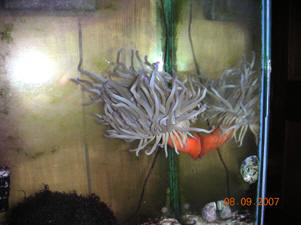
H. crispa... "owner" -- 07/24/07 My white anemone are
starting to turn brown. What might be the cause? they were white with purple
tips <Read here: http://wetwebmedia.com/sebaebehfaqs.htm and the linked files
above. RMF>
|
Washington contacts, Clone Anemones - 7/20/07 Hey guys! <Howdy> I'm
on a trip to Seattle, and I plan on visiting the U of Washington up
there to check up on their eligibility as a school for me to attend. I
was wondering if any of you guys know a professor of marine biology that
I could speak to get to know what the marine science programs are like
at the school. Thanks for your help! <No longer know any of the staff
there... but is still regarded as an excellent fisheries school...> PS
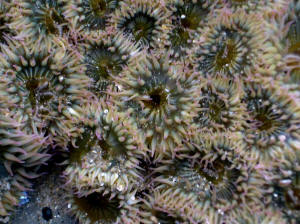
Here's a pic of some anemones that I saw today on the beach on the
Oregon Coast...reminds me of the tide pools back in California! <Mmm,
because they are... Anthopleura elegantissima... you are experiencing
ecoclinal variation... these actinarians are larger, more robust going
northward... Larger still off of WA. Bob Fenner>
Re: Washington contacts, Anthopleura
7/20/07 Ah, you're right! They are bigger! And it seems like the
Puget Sound's fauna is always gargantuan... <Ah, yes. The congener A.
xanthogrammica gets to about the size of small trash can lids there...
This "Giant Green Anemone" off San Diego, is palm-sized at best. Cheers,
Bob Fenner>
Re: Washington contacts 7/20/07 Yes, that is
about as big as I've seen them in the SoCal. I just came back from the
Oregon Coast Aquarium and the OSU Hatfield Marine Science Center. The
aquarium reminded me of Scripps! Excellent crustacean exhibits,
especially the O. scyllarus tank and the spiny lobster tank, oddly
enough sharing space with a Salarias blenny. A big one at that! <That or
food!> The Marine Center was quite excellent as well. A little more
academic, but I can appreciate that...looks like OSU is now a choice for
some marine bio studies! I hugely recommend these two institutions to
any visitors of the Newport / Yaquina Bay area. Good speaking to you,
Mr. Fenner. <Just Bob please. And thank you. BobF>
|
|
|
How do I handle an Anemone? -- 6/24/07 Hi <Hello, Brenda
here> I just started a SW tank up and was thinking about purchasing a BTA. Is it
ok if you touch it when you put it in the tank? Will it sting me? What other way
could I put it in? <Your tank should be six months old minimum before adding an
anemone. Anemones need established environments. Anemones can sting you. I have
been stung a few times. It is best to wear gloves when handling an anemone.
Brenda>
Hawaiian Condylactis, Anemone beh. 6/6/07 Hi there - I
recently got a Hawaiian Condy. <... Really? Have never seen this genus out in
Hawaiian waters.. nor have any authors of my works on marine life there> It took
immediately to my tank and only moved slightly from the spot I put it (guessing
that means he's happy there). <Mmm, not necessarily> I feed him very small
pieces of shrimp every 3rd day or so, which he takes without problem. I've
noticed that he seems to stay open all night, and then close up at some point in
the early morning. (I leave for work around 3:30am, he's open then; and return
around 9am when I find him closed up) Is this normal? <Can be, yes> From what
I've read on your site, anemones tend to close when the lights go out, correct?
<As a general rule, yes> My actinic lights are on for about an hour before my
daylights go on - could he be reacting to this in some way? Any thoughts? <May
simply be acclimating to this setting... takes weeks to months...> Thanks so
much - LOVE your site, a wealth of great information! -Chris <Please send some
pix along if you would. Bob Fenner>
Shrinking Anemone -- 5/13/07 Hi there, <Hello, Brenda
here> First I have a 159 gallon tank with two 150 watt metal halides and two
actinics, salinity is at 1.024 I bought an anemone a few months ago. <You're
salinity is a bit low, gradually bring it up to 1.026.> I think it is a
Heteractis sp. <Which one?> or, gelam. <Not sure what that one is. Your lighting
is a bit low for keeping anemones in that size tank.> It lives in a rock that I
bought with the anemone. It doesn't look very good it seems to be shrinking and
the tentacles don't inflate anymore. I feed it frozen brine shrimp twice a week.
<Brine shrimp has little or no nutritional value to anemones. Try feeding it
some silversides. You can also try krill, raw frozen shrimp, Mysis shrimp, or
lance fish. I suggest keeping the silversides as its main diet. You can also try
soaking the food in Selcon for some added vitamins.> I have a clown fish that
cohabitates with the anemone. I also have been feeding it frozen plankton. This
last week it didn't seem to hold on to the food very well. Pleas help what is
wrong with my anemone? <Sounds like you have a few things going on here. I would
definitely consider upgrading the lighting soon. Good luck! Brenda>
My new BTA is Shrinking, Entacmaea quadricolor -- 2/28/07
<Hi Josh, Brenda here> I just got a bubble tip anemone 4 days ago on a Friday
evening. Sunday morning 10:30 it looked great, then I left and came home around
2:00 and it was shriveled up to about 1/4 of the size and excreting a
white/clear slime. <It is expelling waste.> Also, the mouth was enlarged and
looked inverted with some curly stringy stuff coming out. <Yikes! Is the
anemones mouth tightly closed the rest of the time?> For all practical purposes
it looked about 10 minutes away from death. <I have seen that often. I remember
being in a panic the first few times. My anemones have me trained now.> I
checked all my water parameters and everything was great, I did a 10% water
change anyway. We then left again around 4:00 and came home around 8:30 and he
looked great, completely re-inflated and actually the overall body looked bigger
than the day before. <Great!> He did well all day Monday until about an hour
after I got home and he started shriveling up again and this time was excreting
a brown substance which I am assuming was waste. <Yes, anemone waste is not
always the same color.> He then continued to shrivel up as bad, or worse, than
Sunday morning. I though he was a goner this time for sure. Nothing I could do
at this point but to just wait it out. He was still that way when I went to bed
around 11:00. I got up the next morning and checked him before I went to work
around 6:30 and he was completely re-inflated again and yet still looked even
bigger and perfectly healthy. What is he doing? <Possibly acclimating to your
lighting. Do you know what kind of lighting it was kept under previously?> From
what I understand, anemones don't typically shrivel up that bad right? <Wrong,
they can shrivel up to almost nothing.> I know it is hard diagnosing without a
picture. <Yes, but we still try.> I don't know if it is just still acclimating
to my tank or what. <Yes, it is likely still acclimating to its new home, but
will still expel waste from time to time.> Does the anemone coming back what
seems bigger each time have any significance? <Not necessarily, would need to
see a picture. My guess is that it is still part of the acclimation process.> I
have yet not even seen a picture on the web with one shriveled up as bad as mine
was. <I can fix that. http://www.karensroseanemones.net/deflating.htm Great website! Be sure
to read through all of it.> Any ideas? <Most of what I'm reading seems normal.
The curly white appendages you are seeing, is not typically seen externally on
an anemone. Are you over feeding? I suggest meaty foods, no bigger than the
anemones mouth 2 -- 3 times a week. Make sure you have adequate lighting,
filtration, and water parameters. Also make sure your anemones color is up to
par, meaning no loss of zooxanthellae. If you have any more problems or
questions, please give us your exact water parameters, including salinity and
temperature along with your equipment list, age of your setup, other tank mates,
and a picture if possible.> Any help would be greatly appreciated. Thanks very
much - your website is extremely helpful for so many other things I want to
learn about. Josh <You're welcome! Good luck with your new anemone! Brenda>
Sea Anemones/Acclimation 2/16/07 Hi guys, Hi Billy> I have
recently placed two sea anemones in my reef tank. They are lying on their side,
and one looks like its fingers have been sucked dry. Will they puff back out and
stand up. <If water conditions/lighting are to their liking, they should soon
bloom. Going through an acclimation stage right now. Do search Sea Anemones on
the wet web for more info. I'd post a link here, but that file doesn't want to
come up right now.> Thank for all your help <You're welcome. James (Salty Dog)>
Billy
Disappearing anemone 12/11/06 Hello <Hey Kirsty,
JustinN with you today.> Recently I purchased an anemone, a week or so later it
split in two. <Not uncommon for an anemone to split, but it usually doesn't
occur this quickly..> We knew they did that, but we noticed yesterday that one
half of the anemone had disappeared, it was no where to be seen. <Curious> I
have woken this morning to find that the other one has gone. Could something
have eaten it. All we have in the tank is a shrimp, two clowns, Fiji devil and a
possum fish. Do they disappear? <Mmm, no> Kirsty <If I were to guess at the
cause here, I would assume that either conditions in your tank, or initial
shipping alone, was problematic for the anemone, causing stress. This led to the
early splitting of the anemone, and subsequently, both halves likely were
already on the downfall at that point. After dying, they could have been
consumed as well. Are you testing for toxin levels in the water? These may tell
you more than looking would... Hope this help! -JustinN> <<Mmm, could be
"hiding" as well... RMF>>
Is anemone looking for a fight 11/28/06
Hello everyone, DiAnn here. <Greetings to you! Mich here.> First the basics: 55
gal tank, approx 45 lbs of live rock; live substrate; bio-filters; protein
skimmer; UV sterilizer with Fluval filter; ammonia, nitrate and nitrite 0; ph
8.3; alkalinity 8; temp between 79-80 degrees. <OK> Livestock: 1 yellow tang; 2
percula clowns, 1 rusty angel, 1 cleaner shrimp and 1 coral banded shrimp; also,
anemone (I assume some type of long tentacled) live rock with green star coral
and one bunch of pulse coral (all doing fine,) My question: the anemone which
seems to be getting bigger by the week seems to be slowly making its way toward
the star coral <Not uncommon, it may grow quickly, it may act strange and then
cleave itself into. It may be perfectly content where it's at, but one day it
may decide to wander around your tank...sometimes with very unpleasant
results...have seen overflows blocked and entire systems wiped out.> Is it
looking for a flight <What airline services your tank? It will win any fight,
and may relocate at any time>. Should I move the star coral to another part of
the tank? <Yes, but realize the anemone can go any where it wants.> Any
information regarding this problem would be greatly appreciated. <Please keep
reading, start here: http://www.wetwebmedia.com/marine/inverts/cnidaria/anthozoa/anemones.htm
Thanks. <You're welcome.>
Anemone mouth missing, no useful info. 8/22/06
This morning I checked on our anemone and found it looked like a donut. The
mouth was missing. <Mmm, just folded in on itself> I thought it was dead and
reached it to take it out and it closed up. Is it splitting? <Not likely> It has
been having problems. Bleached color. I research your web site and found my
lighting was wrong. The fish store people were more than happy to sell me a
better lighting system and apologized for telling me I only need a skimmer. I am
now not sure how bad the anemone is damaged and if it will survive. Thanks for
any info you can provide and thanks for a great website. <... not much to go on
here. Not even the species of anemone involved, water quality, set-up notes, the
old/new types of lighting... Please read here: http://www.wetwebmedia.com/marine/inverts/cnidaria/anthozoa/anemones.htm
and the linked files above. Bob Fenner>
Anemone Beh. 8/18/06 WWM Crew, Howdy from Alaska, I have a
question in reference to a E. quadricolor. I have had this anemone for a little
over a year, it has grown very well, and play host to a A. frenatus, Tomato
clown. Yesterday I found a detached tentacle on the bottom of the tank and one
floating in the water (still inflated). Overall health of the anemone is normal,
i.e.. color, attached, eating. My question is simple, why? Could this be a form
of propagation, a initial turn towards death, or just something that happens
every now and then that is unexplained behavior? Water quality is fine, and
lighting adequate. Thanks, Bryan <Mmm, have seen anemones "excise" tentacles at
times... don't think this has a reproductive function/aspect to it... as not
"enough" mesoderm is transmitted to form a G.I. tract, no pedicle... Might be
somewhat akin to some lizards tails... a reactionary behavior to predation. Bob
Fenner>
How sticky should an Anemone be? 6/25/06 - I have a 75g tank,
50lbs LR, all water params good for an anemone. The tank is approaching 6 months
old, and everything is very stable. I picked up two green BTA's last week --
they look great, moved around a bit but settled in after 2 days and haven't
moved in about 3 days. They look full, respond by retracting when I have to
reach in the tank, etc. I've waited a bit to feed them (as I've read on other
sites), but since have tried several times to give them frozen squid bits as
suggested by the LFS. The pieces are small (under ¼'), and thawed. The bits of
food seemed to stay within the tentacles for a bit, but eventually floated away.
Today I tried thawed Mysis, soaked in garlic flavor enhancer -- given to them
gently with a baster. Most of it just floated away, even after making contact
with the tentacles. Some of it seems to have stuck to the bottom of the disc,
and now they're retracting a bit, I assume to work the food towards their
mouths. 1) Should the food be sticking better to the tentacles, 2) if so, is
this problem a sign of a) bad health, or b) acclimating to my tank? TYVM! Scott
S. <<Scott: It can take several days for an anemone to adapt to your tank.
During that time, they may not be that interested in eating. BTA's are nowhere
near as sticky as other types of anemones. In the past, if my BTA's were not too
interested in food, I have placed a small chuck of food (say a part of a
silverside) right into the oral disk. Usually, the anemone will retract and
consume the food. You can try to feed them a little bit every day until you are
confident that they are eating regularly. Most likely, you don't have anything
to worry about. I feed my anemones about 1/2 of a silverside every few days.
Best of luck, Roy>>
Anemone excreting stuff - 06/22/2006 Hi < Hello! > We have a long
tentacle anemone in a 40 gallon reef tank. We successfully are keeping alive 2
other anemones', several fish and invertebrates. The water levels are all
excellent and we do water changes once a week or once every 2 weeks. < Sounds
like good husbandry to me. > He seems to be healthy, eats well, is staying put
in his little spot between rocks. But, a few times now, he seems to throw up. <
Definitely not an attractive bodily function, (not that many are!) > This
bubble, about the size of a quarter is secreted from his mouth. It looks
brownish-pinkish, it is like a bubble gum bubble. Like a mucus bubble, but with
water inside. We have this white with black dots crab that lives on him and
cleans him. He eats this stuff when it comes out, so it's not there for long. I
think he has done this 3 times in 3 weeks. Do you know what this is a sign of? <
It is most likely defecation or regurgitation of uneaten or unprocessed food. It
is a fairly natural occurrence, if you have not noticed this action/reaction
before from your other anemones, it may just be that the quantity of food this
particular anemone is getting is too much! > <<There may be something going on
twixt these anemone species... not compatible in this size volume. RMF>> Thank
you! < I hope I was of some help. RichardB > Thank you, Sarah Leslie
Re: Anemone excreting stuff 6/26/06 This puts me at ease. I
truly appreciate you taking the time to respond to my email. < You are very
welcome! > Your site is great!!! < I cannot take credit for it, these guys do a
great job around here! > thanks again Sarah < Anytime! RichardB >
Green BTA Triple Split - 03/12/2006 Hi guys! <Robin> Two months ago I
bought my first anemone, a 6-7 inch diameter Green Bubble Tip Anemone. I've been
feeding him/it a thawed Formula One gel cube about once every three days and he
has seemed pretty happy. I did the usual 20% bi-monthly water change over the
weekend and it was uneventful, but now in the past 24 hours something
interesting has happened to him. When I went to do the usual B-Ionic dosing this
morning I discovered that overnight my BTA had split in two! <Happens> I thought
to my self, "Cool!" and went off to work. Gotta pay for this aquatic addiction
after all. When I got home from work tonight I was very surprised to see that I
now have THREE anemones! <Bonus!> The larger of the two clones had split again.
Have you ever heard of a BTA splitting itself into thirds like this? <Yes...
usually under some "stressful" cue...> Am I correct to assume that my anemone
reproducing like this means I'm really starting to get the hang of this reef
tank thing? <Mmm, actually the opposite... this "fission" is most often a
"means" or function of dangerous influence reaction... the animal dividing to
"hopefully" (teleological but instructive), live by "doubling its chances" in
two varying environments. Bob Fenner> Thanks! Robin
Anemones/Behavior 2/18/06
Hi, <Hello Dori> I have been reading non stop about anemones and have been
unable to locate the information I need. Could be panic is setting in? <Maybe.>
Anyway, I hope you can help. I have had this bubble tip anemone for a few months
and after the first week of adjustment he settled in quite nicely and the clowns
took up residence. About two weeks ago he began to behave differently. His tips
shriveled and his mouth extended. He would close up and later emerge, mouth ok,
but his tips never achieved their original form. A few days ago he decided to
relocate, and has not stopped since. He has made his way all around the tank and
up the glass to the top. He is currently hanging upside down on the front glass
part of the tank. ok - I stand corrected - he just launched himself. He is not
torn, nor is he oozing anything. his mouth is relatively tight and his tips are
very tiny now. Is he dying? should I remove him to prevent the rest of the tank
from issues? the clowns still follow him most of the time, but on occasion they
hang out in the torch. (so much for loyalty). <Dori, when anemones are on the
move it generally indicates they are not happy with the conditions present. It
may be lighting, water quality, too small of a tank creating constant parameter
shifts, etc. Provide a little more info please. A good article for you to read
on BTAs. Gives some insight as to keeping BTAs.> Any advice? Thanks in advance
<You're welcome. James (Salty Dog)> Dori
Anemone on it's Side... need ID,
info... 2/7/06 Hello, We recently, two weeks ago, purchased an anemone for
our aquarium that has been set up for over a year. In the shop, it looked great.
It was embedded in the sand and the owner of the store took great care in
removing it from the tank. <Good> Once we got it home, we put in in our tank and
just waited. For two days he embedded himself in the sand, just like in the
shop. Then on the third day, he came up and began laying on his side. <Not good>
He's still as beautiful as on the first day, not shriveled up or anything. We
have feed him only twice since we've had him. He eats readily and seems to enjoy
being in with our clown fish, but he only lays on his side. We have sent our
water for testing and we have better water quality then in the shop!! Yeah for
us!! Our lighting is also suffice. The store owner says that anemones are
sometimes picky, <Yes> but since it's eating and not dying, we shouldn't worry.
I would just feel better if it found a spot and took root. Any ideas? Thanks
Brian <... see WWM re Identification... need to know the species here... its
preferences, habitat in the wild... and match it. Bob Fenner>
|
|


 Tealia? Coldwater