|
|
| Home | Marine Aquariums |
Freshwater Aquariums |
Planted Aquariums |
Brackish Systems |
Ponds,
lakes & fountains |
Turtles & Amphibians |
Aquatic Business |
Aquatic Science |
Ask the WWM Crew a Question |
| Please visit our Sponsors | ||||
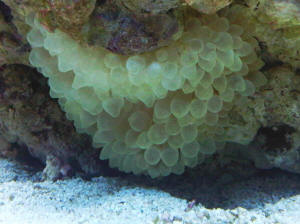
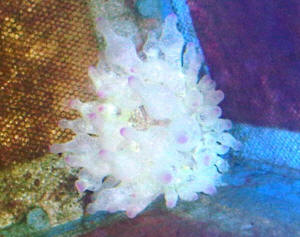
Anemone bleaching New Bulbs Shocking the Anemone, Clownfish Fighting -- 6/4/08 Hi WWM <Hello Joe, Brenda here!> I love this site it is so helpful every time I come across a problem. <That is good to hear, thank you! > I have a reef tank that is about 3-4 years old. I was neglecting it to an extent this past year and it has the same power compact bulbs in there for 2 years! <Yikes! These should be changed out about every 9 months. > I have a couple corals, flame angel, six-line wrasse, sand sifter goby, and a BTA. The BTA was doing fine under the lighting I had, it was brown in color and was looking healthy. I just replaced the lights (thank god) and added 2 false Percs. They are hanging out near the anemone and for the first week they were fine. Now they will not stop fighting, locking jaws and spinning around. Constantly they are battling and this has been going on for about a week. <You may have two females. If so they will fight to the death of one or both of them. > I have also noticed my anemone is now starting to turn whiter towards the top of it. Could this be from replacing the lights? <Yes. > Should I only have them on half of the normal cycle? <I recommend putting some window screen over the tank for a week or so to get the anemone used to the light. What size tank is this on, and how many watts of PC do you have? How much is day light and how much is actinic? > What can I do about the clownfish fighting? <If they are both females you can't do anything except remove one. How big are these clownfish? It is not uncommon for newly introduced clownfish to fight. However, you will have to be the judge and decide if they need to be separated or if they are possibly working things out. > Thanks Joe <You're welcome! Brenda> Lighting, Anemones I have a 55 gallon set up with a Fluval 404 filter, undergravel filter with 2 powerheads, a hang on protein skimmer (which hasn't produced anything yet due to the tank only being around two months old), <Hmm... curious... in almost all cases the skimmer should have been producing collectant... would have someone come by and check your install> 60 lbs of live rock, and 4-20 watt bulbs (2 Actinic blue, 2 50/50) I have recently purchased 4 long tentacle anemones that looked great (very large and wide open). For around two days the anemones remained wide open but on the third day they have started to shrink a little and their tentacles don't seem to be as full as they were. <You don't have enough light for these...> They still have great color but just don't seem to be blooming. They have all positioned themselves at the bottom of the tank and one has even crawled back in between some of the live rock. They are getting adequate flow from the powerheads. All my test parameters are fine and the damsels I have in the tank are all doing well and eating exceptionally. What could be the problem causing these anemones to shrink? I have done extreme amounts of reading through the web on this subject and I can only draw one conclusion - not enough light. <Bingo> The problem I have with this conclusion is that if they are not getting enough light why are they hiding at the bottom of the tank. Shouldn't they be trying to move to the top? <Good question, point... what defensive mechanism might be served by this behavior? I can imagine that the specimens that might retreat in the face of diminished light might survive storms that might preceded the lost intensity... other possibilities...> If I do need more light I have been considering buying an additional 96 watt CSL light to install in the front of my cover (the only place I have any room left). What color temperature should I shoot for and is it possible to buy the ballast from a hardware store as long as it handles the wattage and has the same type of connector. <In front? Needs to be "above", on "top" of the water... and reflected down... And the ballast question depends on the lamp, fixture... must be matched... and temp., anything above 5,000 Kelvin... Please do read through all the "Anemone" and related "FAQs" sections and the link to the Breeder's Registry treasure trove posted on our website: www.WetWebMedia.com> The reason I'm asking is that I've spent heaps of money so far on this tank and my wife has just about had it so I would like to keep the cost down. <Hmm, I would/do discuss personal spending allotments with my wife... and even have separate and together checking, savings, stock trading accounts... You might consider the same. Bob Fenner> What's Going On? (Light/ing, anemone, coral health effects) Bob, What's new my friend? I'm a little perplexed on my end. I have searched through the information on WWM, but I couldn't find anything that really pertained to my situation. <Not too surprising... will never cover all...> Let's review. I have a 75 gallon reef tank with a 20 gallon sump. Protein skimming is handled by an ETSS Super Reef Devil. Water back to the main tank is handled by a Mag 5. Two powerheads provide circulation in the tank. Four 96 watt powercompacts (2 actinics/2daylights) provide lighting. My tank consists of 95lbs of Fiji live rock (I'm sure you must remember my mid-December nuclear meltdown). Inhabitants include two cleaner shrimp, 2 Green Stripe Clown Gobies, 1 Six Line Wrasse, 1 Bicolor Blenny, 1 White Sand sifting Star, and various Red-leg and Left handed hermits. Invertebrates include 2 Open Brain (1 Large/1 Small), Fungia Plate Coral, Yellow Polyp, Solomon Green Zoanthid Polyp, 1 Small Blue Maxima Clam, and 1 Bubble-tip anemone. All water parameters (Ammonia, Nitrate, Nitrite, Phosphate) are registering "0". pH is around 8.15. Now to my question/problem. <Okay> Because of the recent temps here in the East, I have opened my canopy just a tad. A small free standing fan blows across the lights to provide cooling. To keep the heat down, I just (for a while) ran 1 daylight and 1 actinic. When I acquired my Bubble-tip anemone, I went back to using all four lights. The Bubble-tip found a nice home in the light, but out of the direct current until now. <Hmm> Recently (in the last week to 10 days), the Bubble-tip has closed up, my Open Brain do not fill with water, even though they do have good color. The Fungia Plate Coral seems to have a washed out look. Again all water parameters are within acceptable ranges. What's going on? As always, you help is greatly appreciated! <Likely what you describe is mostly due to the light/lighting change (there is a lag time to be expected here), and secondarily to the change in temperature... I would start to leave your lights on more in the evening (all of them for a good six, eight hours)... check on water quality otherwise, and not worry> On a side note, I have told the Baltimore watering holes to stock up. Believe me, I owe you a few!! <Looking forward to this! See you in August. Bob Fenner> Bob Wrigley Re: H. Crispa Hi Anthony, <<cheers again>> <are you a lawyer... or do you just play one on TV?> Damn, you found out! <<you spouted Latin twice, it had to be>> <nice, but how deep is the tank? If more than eighteen inches with standard fluorescents, this won't be of much help.> It's 18 inches - I also removed the glass cover over the water last night, having relocated all the ballasts out of the way in the cabinet. <<excellent...every little bit will help. Fluorescents should be protected but as close to the water as possible (assuming you have water proof end caps)>> <do read about bleached sebae anemones if yours is white tentacled> Well he's sort of off-white, the tips seem a more pure white colour. <<natural color is dark brown/green>> <if it begins to move around the tank, it is often an indication of inadequate lighting> He isn't moving around the tank, but he makes some interesting shapes with his stem, sort of inflates the top half, then rolls this down to the base, also seems to make a cleft in his base. <<sounds like Bob Fenner on the dance floor...hehe>> He seems fairly happy position wise. <<its definitely Bob if it never puts its beer down>> <when tentacles are retracted, I assume> Tentacles have not been retracted since he went in. Outer ring still flopping down stem, but majority seem upright, can see his mouth now, nothing nasty coming out of it, top of stem seems flared outwards. <my friend... the leopard wrasse, mandarin, yellow sebae anemone (dyed color!) and a regal angel... you are killing me!!! Somebody is giving you awful advice! I truly hope the retailer of these inappropriate (to the uninformed/novice) animals is a single location and not a plethora of stores in your area> Two shops, one is better than the other, but there are not that many marine vendors over here. <<dreadful...sorry to hear it. Do research livestock before buying from these stores>> <a lousy idea that has historically failed. Try an Aqua C if you need a unit with a narrow profile> <hehe... just a few good months of reading my friend will be fine. Do try to locate some local aquarium societies to get some great and free unbiased information. I recently began selling books to a fellow in the UK who was telling me about a few regional aquarium societies. I think most of them are listed in Practical Fishkeeping Magazine (UK). > I'll go right out and buy the magazine, check the adverts for skimmers and the listings of clubs! <<yes... many wonderful advertisements for networking/contacts>> Many thanks for your quick response! Cheers - Tim. <<cheers, my friend across the pond. Anthony>>
Ritteri anemone moving away from light Hello, <cheers> About two months ago I purchased Ritteri anemone for my 90g FOWLR tank. She is about 9" in diameter (was half the size at the LFS). There are three retrofit kits under the canopy with 35" light strips as follows: 3 96W 10K white, 2 96W 7100 actinic and a 96W 6100 white (all intended for future reef). <wow... this light scheme is not even remotely adequate to keep a ritteri anemone, my friend. Especially is the anemone is below 12" of water depth. As good as the these PC lights can be in light quality... they are poor in penetration. Very poor. MH lighting is quite necessary for this most demanding anemone. In fact, Ritteri anemones are more demanding than almost any coral in the trade for light. Thus the reason why most die within a year... if not 6 months> Before I got this anemone I would only use 1 10Kwhite and 1 7100 actinic for the fish. Now I am running 2 10K white and 1 actinic. <indeed heavier daylight is necessary for this animal... little actinic needed or useful here> I placed the anemone at the top of the rock in the current, about 9" away from the lights. <excellent> Anemone did not like it there and slowly moved to the middle of the tank (18" away from the light) as if trying to move away from the light and wedged herself in between the rocks. Is it possible that I have too much light for her (this sounds not right)? . <not even remotely possible. Anemones move for many reasons: dynamics of water flow, sensation of a neighboring Cnidarian (polyp, anemone, coral, etc), etc> She also developed a second mouth about a month ago, but is not dividing. <now that is interesting! This anemone may begin to look peaked because it is about to divide. Please continue to feed well with very finely shredded ocean meats (never chunks) if it will take it. Maintain very good water clarity in the meantime (carbon use, water changes, etc)> Is there anything that I should change in this setup to maximize her health? Thank you. P.S. There is a mated pair of maroons that feed and clean her every day < a marvelous site to see although not a mutualistic relationship. Clownfish in captivity are generally a burden or detriment to anemones and many in the wild live without any clownfish whatsoever. Still... enjoy the beauty of it all. Anthony> |
|

|
Features: |
|
| Featured Sponsors: |
.JPG)