|
FAQs about Asterina (tiny, white...) Sea Stars,
Identification
Related Articles: Asterina Stars, An Introduction to the
Echinoderms: The Sea Stars, Sea Urchins, Sea Cucumbers and
More... By James W. Fatherree, M.Sc.
Related FAQs: Asterinas 1, Asterinas 2, & Asterina Behavior, Asterina Compatibility, Asterina Selection, Asterina Systems, Asterina Feeding, Asterina Disease, Asterina Reproduction, &
Sea Stars 1, Sea Stars 2, Sea
Stars 3, Sea Stars 4, Sea Stars 5, Seastar Selection, Seastar Compatibility, Seastar Systems, Seastar Behavior, Seastar Feeding, Seastar Reproduction, Seastar Disease, Chocolate Chip
Stars, Crown of Thorns
Stars, Fromia Stars, Linckia Stars, Linckia Stars 2, Sand-Sifting Stars,
|
|
|
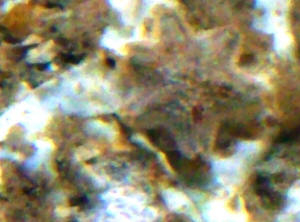
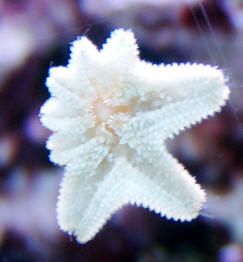
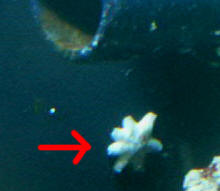
Itty-Bitty Starfish ID...is it a 'good guy"?
12/2/16
My son noticed this starfish in our 29 gallon holding tank and I remembered
seeing something about some small whitish starfish eating corals... Should I
flush him or put him back and be grateful?
<Up to you... appears to be an Asterina sp.... worth the possible, potential
damage?>
Right now he's in a Ziploc floating in the refugium just to be safe. Just
in case it matters, in the holding tank I have small frags from a few Zoas,
green fuzzy mushrooms, a couple GSP, a daisy polyp, and a couple leathers.
<Mmm; I'd likely keep it if there not too many. Please read here:
http://www.wetwebmedia.com/asterinaidf.htm
and the linked files above. Bob Fenner>
|
 |
|
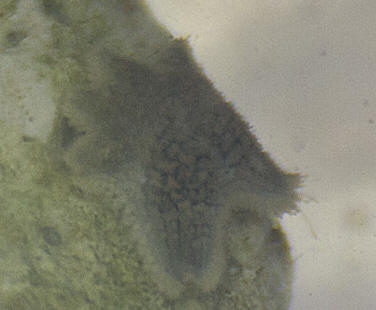
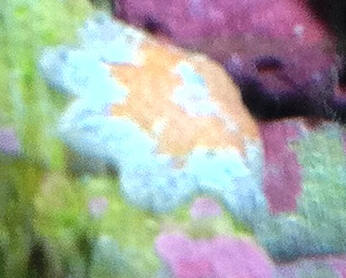
Starfish ID 9/17/13
Hi, I was wondering if you'd be able to ID this starfish for me. It has
about 10 legs with an orange centre and is bluey/purpley around the edges.
<I see>
So far the closest thing I've seen close to it is a common sea star but I
think it's smoother than that is and may be a species of Asterina, I'm not
sure though.
I've attached a couple of pics I got of it.
Thanks, Ryan.
<I too make this out as Asterina sp.. Predaceous on some Cnidarian groups.
Do see/read re the genus on WWM.
Bob Fenner>
|
 |
|
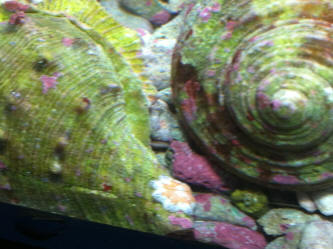
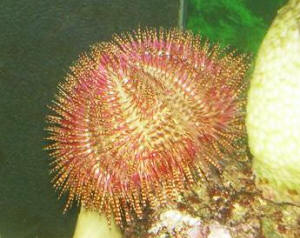
Names: Salmacis spp. Urchin and Likely Asterina Stars
-- 10/4/10
Hi
<Hello, Lynn here today.>
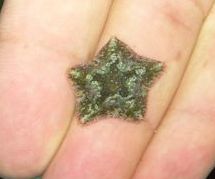
Please advise what the name of the urchin and small sea stars
are.
<The urchin looks like something in the genus Salmacis,
possibly S. bicolor (family Temnopleuridae). As for the stars,
all but the bluish individual look like Asterinids (family
Asterinidae). I can't see the bluish one's shape/surface
texture well enough to determine whether it's another
Asterinid or something else entirely (like a cushion star, family
Oreasteridae). Either way, I wouldn't trust any of these
stars around corals. For more information on sea stars, please
see the following link: http://www.wetwebmedia.com/seastars.htm
Urchins: http://www.wetwebmedia.com/urchins.htm
>
Thanks
<You're welcome. Take care, Lynn Z>
|
  |
|
Starfish ID: Asterina -- 3/2/10
<Hello Mike, Lynn here tonight.>
Sorry to bother you folks again but I'm new to the saltwater
world and want to take no chances of having a dangerous species
of hitchhiker.
<I can certainly understand that.>
Attached is a picture of a starfish that was spotted tonight.
<I see it, thanks.>
After looking through about 15-20 pages on your website I decided
to just go ahead and ask because once again there were too many
pics for me to be able to get an exact match as to what my
species might be. I assume its some sort of Asterina Starfish but
would love confirmation.
<Yep, it looks like an Asterina spp. to me as well (family
Asterinidae). Unfortunately, there's no way I can ID it to
species level though. There are just too many to choose from and
the differences can be slight, requiring close examination. You
can't simply differentiate based on color because it can
vary, even within a given species. For instance, Asterina folium,
a small (max size ~1' across) species from Bermuda, Florida
and the Caribbean, varies in color from mostly white to yellow,
orange, or red, as well as blue or blue-green. I'd say that
little star pretty much has the spectrum covered!>
My LFS gets their live rock off the coast of Florida so I assume
it hitchhiked from there or possibly on a purchased coral. The
pictures are attached.
<Thanks. I'm guessing that you'd like to know if this
star poses any sort of threat to future livestock, namely corals?
If so, the answer is yes, unfortunately it's possible.
Asterina stars can go either way. Some seem to be content to
graze on algae, while others prey on corals. Sometimes they even
start off grazing on algae, then move on to corals. I just
can't give you a concrete answer either way as to how
'safe' this little star might be long-term. Personally, I
tend to see hitchhikers (except for crabs) as innocent until
proven guilty, but it's up to you. For more information,
please see the following links starting at WWM:
http://www.wetwebmedia.com/asterinaidf.htm
http://reefkeeping.com/issues/2004-06/ac/feature/index.php
Thank you!
<You're very welcome!
-Mike
<Take care, LynnZ>
|
|
|
Re: Starfish ID: Asterina --
3/3/10
Thank you Lynn.
<You're very welcome, Mike.>
And that's my thoughts also, innocent until proven guilty!
<Yep, most hitchhikers are beneficial or at least fairly
innocuous, so I like to give them the benefit of the doubt until
proven otherwise.>
The little guy/gal will stay for now unless I see it bothering my
corals.
<Sounds good>
Thanks for the quick reply as usual. You folks are a great asset to
all of us saltwater enthusiasts.
<On behalf of Bob and the rest of the crew, thank you very
much!>
Keep up the good work!
<Will do>
Cheers, Mike.
<Take care, LynnZ> |
|
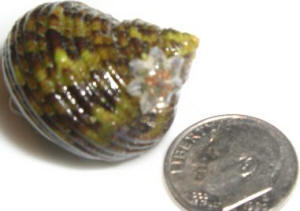
Unknown Starfish ID? 6/1/09
WWM crew,
<Daniel>
I got a couple small frags of Anthelia from a local reef store
yesterday, and this morning when repositioning one of the rocks
they're attached to I found an interesting little hitchhiking
sea star I was hoping you could help me identify. I've
attached a picture (sorry it's not too clear, best I could
manage).
<Looks very clear to me.>
The star is about 0.4 inches across, has 7 arms, all fairly
symmetrical, the top of the starfish is red/brown in the center,
purple down the top of the arms, and white along the edges and
underneath. I have a small
number of Asterina stars in my tank, but they look quite a bit
different to me than this little creature.
I've got it quarantined in a little floating Tupperware
container with a shell to cling to for the moment. I've very
interested whether its likely to be harmful (I do have a few
types of small polyps, some pulsing xenia, a frogspawn, etc.) or
beneficial; and whether it's a 'baby' or full-size
for it's species.
<What you have is an Asterina Starfish. They are very prolific
breeders and soon, there will be many of them. Some species are
known to eat corals, so do observe, and if this occurs, remove
the starfish. Other than that, they are harmless.>
Thanks,
<You're welcome. James (Salty Dog)>
-Daniel
|
 |
Unknown Starfish ID?
6/1/09
Asterina is a pretty big genius,
<They are not that smart.>
which includes a few hundred species, guess I shouldn't be
surprised my 'Asterina-like' star is another species of
Asterina. I know that some of these small Asterinas can be harmful
to corals, particularly the 'vampire' and blue varieties.
Are purple & red Asterinas known to typically be of the
beneficial variety, or simply unknown?
<I really do not know for sure, but in my experience, I'd
say more are coral predators than not. You would have to Google as
I would and we just do not have the time to do this. I suggest
reading our FAQ's on Asterina ID
here. http://www.wetwebmedia.com/asterinaidf.htm , and you might
want to take a gander here. http://www.garf.org/Star/starfish.html >
Thanks again,
<You're welcome. James (Salty Dog)> |
Sea Star ID 1/31/09 Hi!
<Hello> I'm a biologist working on asexual sea stars
<Interesting.> and I'm curious about the little tan/white
hitchhikers so common in aquaria. Specifically, I am trying to track
down where they are coming from as I am convinced that they are an
undescribed species. I have been working with these animals for 5 years
and am fairly certain they belong to the genus Aquilonastra (its a new
genus- 2004), but having gone through the diagnostic characters for all
the species yet described, nothing matches. I also suspect that there
are several undescribed species in aquaria around the world from
examining photographs on-line. New species from the wild are being
described every year. Obviously they are hitchhikers on live rock, but
my question is where is that live rock coming from? The Philippines?
Fiji? Tahiti? My local retail supplier cannot say and will not give me
his wholesale supplier's contact information. <By your short
description, my first guess would be Asterina stars. I can tell you
what I know about them if that is indeed what you are tracking down.
Class: Asteroidea Order: Spinulosida Asterina starfish, commonly known
as Fiji starfish are generally dime sized or smaller with a large body,
irregular arm length, and an irregular number of arms. They tend to
hide among corals and in the crevices of the live rock during the day.
This type of starfish has been known to eat coralline algae and some
corals; specifically Acropora, xenia, green star polyps, Zoanthids, and
several types of soft leather corals. These starfish divide across the
main body with two or three legs of varying lengths and multiply
rapidly. Fiji is one area where they are found, Bob may input other
areas. Take a look at the photos in this link for comparison.
http://www.wetwebmedia.com/asterinafaqs.htm > Any help would be most
appreciated! <You're welcome. James (Salty Dog)>
Re: Sea Star ID 1/31/09
Thank you James! <You're welcome.> I got interested in them
as I had a reef tank and got curious. I am now in the process of
publishing several papers on the factors that control their
reproduction. <Interesting. Do keep us posted.> I never had any
problems with them eating corals- not even the coralline algae and they
seemed to eat only the diatoms and green algae on the coral substrate
and glass walls of the aquarium. <I'm sure not all species eat
corals.> There are about a dozen described species of asexual
Asterina stars from the Indo-Pacific, but none described from East of
Palau/New Guinea. So I'm thinking there are likely many more
species out there. <Yes.> If some of these animals are known from
Fiji, I would very much like to get my hands on some but they have to
be from a known location. The animals that I have been using came from
the university aquaria and the local reef tank supplier. I would like
to be able to compare the two stars to see if they are the same. Then
at least I'll know where they come from! But I would need to be
able to talk with a supplier- and maybe their supplier- to get this
information. Might anyone you know be able to help? <I'm sure
Bob has many contacts, he may input/help here.> I really do
appreciate the information you have already shared. Thank you!
<You're welcome, and do share your progress with us. James
(Salty Dog)>
Ken
|
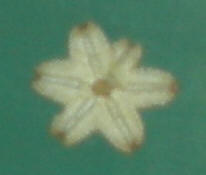
What do you think it is? Asterina star --
10/20/08 Hi <Hi, Dee> I have had my tank for only
about 8 months. While in the process of removing an aggressive
fish, I noticed what appears to be a baby starfish. I have
attached pics. I have one Chocolate Chip Starfish but I have
only had him/her for about two weeks. I'm confused as to what
it might be. Let me know what you think. <It looks like a
fairly common hitchhiker known as an Asterina star (Family
Asterinidae). The species we most commonly see as hitchhikers are
generally harmless/beneficial, stay fairly small (under
1/2'), and reproduce asexually by means of fission/splitting.
Although there are occasional reports of these stars damaging
corals, they're usually associated with high density, out of
control, population situations. Again, for the most part these
are harmless, so until/unless you see evidence otherwise, I'd
enjoy the little star! Please see the following link (as well as
the associated links at the top of the page) for more
information: http://www.wetwebmedia.com/asterinafaqs.htm >
Thank you Dee <You're very welcome, -Lynn>
Re: What do you think it is? Asterina star --
10/20/08 Thank you and thank you for the site.
<It's our/my pleasure, Dee. Take care, -Lynn>
|
 |
|
Sand-sifting Starfish'¦
Reproduction'¦ Doubtful'¦ Likely Asterinas
3/12/08 Dear WWM: <Hi Suzanne, Mich here.> First of
all, thank you soooo much for the wealth of information that you
provide. It has been invaluable to me. <To me too! Is how I
learned as well.> My son-in-law got me started on saltwater
fish and I have thoroughly enjoyed it. <Congrats! Welcome to
the club!> I had a 30-gallon tank (have since graduated to 75
gal.) and in it I had a Sand-sifting Starfish among other things.
The Star was about 3.5 inches in diameter and was so much fun as
I watched him disappear in the sand and climb the sides of the
aquarium. <And decimated your sand bed?> After about 8
months he started to look thin. <Starfish generally starve to
death in captivity, sand sifting included.> I gave him to my
son-in-law and it did better for several months and then wasted
away and died. <Starved.> Not long after that he started
noticing these tiny white specks in his tank - hundreds of them.
As they grew, we realized that they were Starfish! Some had five
arms, others had three or four (fish probably were munching on
them). Now they are about 3/8 inch in diameter and it looks like
someone poured a can of Campbell's Chicken and Stars soup in
the tank! <Just as likely to be Campbell's as baby sand
sifting stars.> When the tank is dark they are all over the
front and sides of the glass. It is incredible. What is more
incredible is that there was only ONE Starfish to start with. How
in the world did that Starfish reproduce?? <It didn't.>
I read all that you had on Starfish on your site and it talks
about mating. There was no mate to mate with. <I would be
shocked if it wasn't an entirely different species, likely
Asterina by the sounds of it.> I took six home and put in my
tank. When and if they get bigger I will give the surviving ones
to our LFS and keep only one for my tank. <Mmm, do they look
like this? http://www.wetwebmedia.com/asterinafaqs.htm
http://www.wetwebmedia.com/asterinaidf.htm > What are your
thoughts on this phenomenon? <I don't think it's a
phenomenon.> What is my son-in-law to do with all those
starfish. <Mmm, Harlequin shrimp? Just kidding. I don't
recommend to anyone who is not seriously committed to keeping
these beautiful shrimp that only eat live starfish. Please
don't go buy one to combat your starfish issue.> There are
certainly not enough nutrients in his sand bed for all of them.
<Might be for Asterinas, they are generally self limiting.>
Should he wait and see how big they get assuming they may not
survive for very long of get them out of the tank now? That will
be no small chore!! <Lets determine what is actually in the
tank before crossing this bridge.> Sincerely Suzanne <Any
chance of getting a picture? Cheers, Mich>
Sand-sifting Starfish'¦
Reproduction'¦ Doubtful'¦ Likely
Asterinas'¦ Is Asterina 3/13/08 Dear Mich: <Hi
Suzanne!> Thanks for your response. <Welcome!> I have
four pictures for you. <Excellent! Thanks for capturing some
images.> I would have liked to have gotten you a view when he
(she? it?) was on the glass, but I haven't seem them on the
glass in my tank in about a week. <No worries.> In fact I
though they might have died. <Not necessarily a bad thing per
se. Some folks report some species of Asterina to be predatory on
Zoanthids> It looks exactly like a miniature sand-sifter to me
and he moves very sloooow like one. I can see why you would
question that. What do you think from the picture? I wasn't
familiar with Asterinas. <You have Asterina stars.>
Thanks,
Suzanne
<Welcome! Mich>
|
|
|
Micro Brittle Stars? Zoa Woes
2/21/08 Hello, <Hi Kent, Mich here.> I have been having a
problem with a colony of Zoanthids. I did a fresh water dip to remove
any pest. I found what I thought was three (very small) spiders (also
several polyps fell off like they had been eaten on). <OK.> But,
after searching to ID the creature I believe they may be micro brittle
stars or some other type of micro stars. Is it possible to have
hundreds of these "micro stars" living in your live rock (you
can see their legs sticking out of the live rock)? <Yes.> Is it
likely that they would be harmful to my Zoanthids? <No.> If not,
maybe it some other pest; <Is possible.> but I found nothing else
in the water after the dip. <May not have been on the rock when you
did the dip.> I don't remember if they had six legs or five.
<Micro brittle stars can have either, more likely to see 6 legged
ones if they reproduced by fission.> Do all micro stars have five
legs? <No.> If they have six legs, are they likely spiders?
<No.> They do not look like any of the Zoanthid Eating Spiders
that I found on your site or anywhere on the web. <A good resource
here: http://www.zoaid.com/index.php?module=Gallery2&g2_itemId=384
> Thanks, Kent
<Welcome, Mich>
|
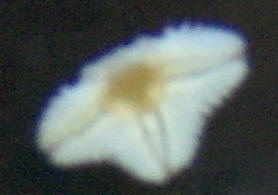
Is this a starfish? 2/17/08 Our saltwater aquarium is now
about 7 weeks old, I've added hermit crabs and one star polyp
to start. <Mike I here. Good start - I hope it matures to
bring you years of enjoyment!> This tiny fellow appeared two
days ago, but I can't find out what it is. It s quite mobile
and we are amazed at the size and how much it moves around on the
glass. Obviously I used a magnifying glass to get this picture.
<<Neat technique! RMF>> <Thanks for the picture,
although it was quite large. Do try and re-size downward next
time. Anyhoo, to the pic, and it appears indeed to be a starfish,
of the Asterina variety. Have a read through this section for
more information:
http://www.wetwebmedia.com/asterinafaqs.htm Hope that helps, Mike
I>
Re: Is this a starfish? Asterina ID f' 2/19/08 Hi
Mike <Marilee> Wow, that was a quick reply. Thanks so much
for the information, I've followed the link and I'm
keeping detailed records of everything, with the picture it will
be fun to see the changes. Your site was very highly recommended
by the store owner in Hanover, Ontario where I purchased my first
additions. <Good to hear, I highly recommend this site
too!> With all the question and answer you post I'm
spending a lot of time reading Thanks for being there, Marilee
<Reading, research and respect (for the life we keep), the 3
Rs that will take you far! And thanks for the thanks! Mike
I>
|
|
|
|
Sea Star ID: Likely Asterinid -- 2/2/08 Hi Crew! <Hi
there, Kirk!> I found this little hitchhiker on some live rock
I recently acquired. <Wow, is that ever a pretty little
thing!> I've been looking all over but can't seem to
find anything with this coloration (purple center, blue ring and
purple legs). <Neither can I, but sea stars can vary quite a
bit in color/pattern.> It was sheer luck I even spotted him
because he blended right in with the rock and is only 1/4"
around right now. Any thoughts on what it might be? Friend or
foe? <Hmmm, well I'm not sure. I discussed this little
star earlier with a fellow crewmember, Brenda. She mentioned
right off the bat that it looked like an Asterina and I agree
with her. It looks a lot like Patiria miniata or Patiriella
regularis, but they're cooler water, temperate species. As
far as it being reef safe, Asterinids can go either way. I'd
keep an eye on any corals you have. If he stays off of them,
he's safe, at least for now.> (sorry the image is a little
fuzzy but I couldn't get the camera to focus very good
between the rocks) <Can be frustrating, I know!> I
can't even express how much help your site has been, I've
been in the hobby for over 10 years and feel like I've
learned more in the past 1 since I discovered it. <Thank you
so much! I just wish I could have done more to help with this
ID!> Thanks for all you do! Kirk Willmann <You're very
welcome! Take care. -Lynn>
Re: Sea Star ID: Likely Asterinid -- 2/2/08 <Hi
Captain, I mean Kirk!> Ooh! Thanks ladies. <On behalf of
Brenda and myself, you're very welcome!> I was thinking it
might be a Fromia at first just because all the Asterina images I
found showed neutral colored specimens but the body type seems
right on the mark. <Aye, sir.> After a bit more searching I
came across some brightly colored ones on the web so I think we
may have a winner! <Yay, we have warp drive!> I just really
hope it behaves itself because I agree, it is quite attractive
and I would really like to keep it around. <Most definitely.
It's a very pretty little tribble, I mean sea star.> Best
regards, Kirk <Heeheee, please forgive me for messing with
you. I'm a trekkie at heart and simply don't run across
enough Kirks to get calling them 'Captain' out of my
system <G>. Take care. One to beam out --Lynn.>
Re: Sea Star ID: Likely Asterinid -- 2/2/08 <Hey,
welcome back to the Bridge, Captain!> You may call me whatever
you wish as long as you keep answering my starfish questions! ;-)
<Heeheeee! Anytime -- just let me know. You'll notice that
I at least waited until the second email to say anything. At that
point, I just couldn't hold it back any longer! <G>>
I need more power Scotty! <Aye sir, we'll be working on
it!> Capt. Kirk <Take care Capt., and have a great
Superbowl Sunday! --Lynn>
|
|
|
|
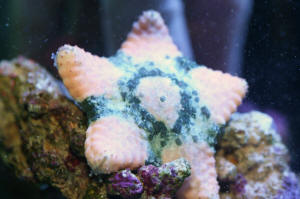
Starfish Identification: Cushion star? - 12/31/07 Hi Bob
and Crew <Hi Claire. I sincerely apologize for the delay in
responding!> Got this lovely starfish as a hitchhiker, but
don't know what species it is, or if it is coral friendly -
any ideas?? <It is indeed a lovely little sea star!
Unfortunately, after going through every resource at hand,
I'm stumped as to what species it is. It could be a juvenile
that looks very different from its mature counterpart, or simply
a species that hasn't been photographed/identified in my
sources. It does look a bit like a Cushion/Biscuit star, however,
so I'd keep an eye on it and your corals.> Thanks Claire
<You're very welcome! I just wish I could have been more
help! --Lynn> <<Mmm, maybe an Asterina sp.... A.
phylactica? http://www.asturnatura.com/photo/photogallery/galerias.php?photo_id=583
RMF>>
Re: Starfish identification -- 1/2/08
<<Mmm, maybe an Asterina sp.... A. phylactica?
http://www.asturnatura.com/photo/photogallery/galerias.php?photo_id=583
RMF>> <Thanks, Bob! I spent way too long yesterday
looking for that little guy. I finally found something that
looked about right, but it was a photo at a dead link. Talk about
frustrating! I wasn't happy with the general answer I gave,
but thought I'd exhausted all possible sources in the search.
Well, I got up this morning with that little star still on my
mind, so I cued up Bob Marley, and did a little more digging.
This time I found the current link for that photo. I'm not
sure if what's shown is the same star, but the similarities
are promising. They have the same general coloring, same markings
between the arms, and what looks like at least a partial ring on
some. It's hard to believe all those are the same species,
but I guess they vary quite a bit. Here's the link: http://www.bluering.org.au/chpt17b.htm . What do you
think? -Lynn> >Does look like Tosia australis...
RMF<
|
|
|
Re: Mystery Starfish A friend of mine has a
55g F/LR/SC tank that is a real pleasure to watch. His tank has a
number of different mushroom anemones, Xeniids, Zoanthids and
things I've forgotten their names. No hard corals - not enough
light. The place is just a little crowded along those line and I
haven't mentioned the fish (though the Pseudochromis will eat
out of his wife's hand.) Very recently we discovered that he
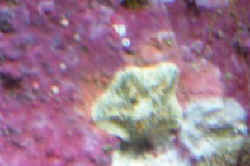
has several "volunteer" starfish, origin and specie
unknown. The largest of these has reached about 1 cm across.
Attached is a jpg of the fellow slowly crawling across one of the
pieces of live rock. As you can see, despite my poor photography,
these asteroids have five arms and a rather significant margin.
They are almost reminiscent of a "sand dollar", except
that the arm spines are raised and pronounced. The obvious
questions are, what is the species and should my friend be
scavenging these out? Are they, as I suspect, a danger to their
more sedentary tank mates? <Asterina sp. Not an uncommon LR
"recruit". Please see here re: http://www.wetwebmedia.com/seastarf.htm
and the related FAQs (linked, in blue, at top). Bob Fenner>
Regards,
Charlie H. |
|
|
Little Dingy White/light brown
starfish What are the little (1/4 inch) brown starfish that are so
abundant in my 180 gal reef tank? <likely you have an Asterina
species. Do use this name to do a 'Net search for photos to
confirm. They are prolific and actually useful for eating diatoms
(algae). Some people culture these to feed the magnificent Harlequin
shrimp which can live well and breed in captivity if provided a natural
diet of sea star tube feet. As you have noticed, they can reach plague
proportions. Some say they can eat coral... this is very rare. Aside
form being prolific, they are quite useful. SPS keepers just like to
use them as an excuse for why their corals are dying ;) These sea stars
are merely scavenging the necrotic tissue of an already dying/infected
coral. Best regards, Anthony>
Teeny Sea Stars I have a question
about some teeny starfish I recently acquired-- they are about 4
millimeters across, most are missing limbs and I have been told they
only get to the size of a dime and multiply like crazy. I have been
trying to find out their species and nature...we have a brand new reef
tank, 7 weeks old. Thanks for your help, Lizzi <I would agree with
all of the above. Look up Asterina species here in our WetWebMedia.com
archives and beyond. Any references you see about them eating coral are
mostly bunk in my opinion. Very rare. They are only a nuisance for fast
propagation. Great algae eaters and little harm else wise. Best
regards, Anthony>
| Starfish ID 8/23/05 Hi There: <G'morning> Just
a quick question in hopes you can identify (photo attached) what is
growing in my tank. We assume that they are baby starfish (there
are about 5 that we've seen), but not knowing for sure is
driving us crazy. Also, just for your enjoyment, attached is a
photo of one of our starfish's arms growing a new starfish.
That is sooo cool! Thanks! D. Kelley <Very nice. Thank you for
sending it along. Likely a species of Asterina... Please see here:
http://www.wetwebmedia.com/asterinafaqs.htm Bob
Fenner> |
|
|
| Starfish? 30 Jun 2005 I have just recently
started a SW tank. I had put in one piece of live rock in a week
ago. Today I noticed this grey thing with seven arms (I think). Is
this a starfish and do I have to worry about it? what does it eat?
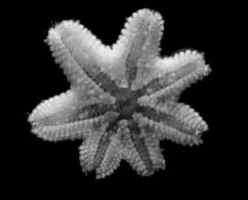
Thanks <Hi Julie. Looking at the picture, it appears to be a
hitchhiking Asterina starfish. They are generally harmless algae
eaters although some do eat corals. Do a search for
"Asterina" or see this URL http://www.wetwebmedia.com/asterinafaqs.htm . Good
luck on your new setup and keep us posted on the progress. Cheers -
Ted> Sorry I forgot to add a pic of the starfish thingy.
<Looks like an Asterina starfish. Generally harmless. You may
find this URL helpful: http://www.wetwebmedia.com/asterinafaqs.htm Cheers -
Ted> |
|
|
Sea star ID Hello, In my reef
tank I have found a tiny sea star which I have been looking up in the
web but I have seen no pics at all, the more similar pic was one of a
Asterina sp but from the bottom. <Very common> Unfortunately I
have no pic of it but hopefully with the description it would be fine.
The animal has no more than 2cm width, from top is of a blue grayish
colour with a red/orange ring around the madreporic plate, it has 5 or
6 legs depending on the reproductive stage, which is very often. And I
have tens of it. Any idea which species is? <... some Asterina
species fit this description closely... Please see the Google Pix here:
http://images.google.com/images?q=asterina&hl=en&lr=&sa=N&tab=wi>
By the way I have white tiny sponges that I have seen pics of them in
the web any idea about the name? <Nope> Hope you could help me,
as soon as I get pics I will send them to you Lots of thanks <Even
photos make it hard to discern these groups of animals to much more
than family level... even for experts in their fields (of which I am
not)... Require microscopic examination, sacrificing (taking apart).
Bob Fenner>
Archaster Babies?....Or Asterina? (11/1/04)
Believe it or not, MORE Archaster craziness! Anthony, you are a patient
man for answering all my questions. Bless you indeed! :) <I will
pass this on. Steve Allen responding since Anthony is out.> To add
to the insanity, one of the Archasters had BABIES. I've got a
few, literally, the size of an eraser head. I tried to take a picture,
but it was incredibly difficult as it was far back in the tank, glass
distortion, very small, etc. So everything around it looks HUGE.
Here's the pic: http://65.124.75.190/babystarfish.jpg
I'm not really sure how many I have as only two were visible, now
only one. Hopefully some of these guys will survive and won't
suffer from predators so I can pass them on. :) <Looked at the
picture. Sorry to rain on the parade, but I doubt that this is a baby
Archaster. Looks more like an Asterina to me. These common hitchhiker
mini stars seldom exceed 1 cm in diameter. Look at some pix on our site
and elsewhere to compare and be more certain.>
Re: Asterina 9/6/06 Dear Bob, <Derek>
Thanks so much for the info. These little starfish seem to be
multiplying fast... I found another just after receiving your reply
with the ID suggestion. So I now have a 3 legged, 4 legged, and
this 6 legged one (the largest of them so far). I've attached a
photo to help ID, and in case it might be useful for your FAQ
section; it came out fairly clear, given the small size of the
starfish. Is this an Asterina? <Does appear so to me> If so I
presume they'll be fine just chewing on the algae in the
tank... will they? <Likely so> From the pictures I found on
your FAQs I'm sure the lesser limbed ones are Asterina
(I've only ever seen the lesser limbed ones from below (as they
stick on the front glass) and they match one ID'd in your FAQ).
<Do come in a variety of leggi-ness> Also, on another
subject... Some signs in my tank of other possible hitchhikers -
Clicking noises (single not rapid clicks) mainly after lights out
and holes appearing in most of the loose shells on the sand...
Mantis Shrimp? Pistol Shrimp? <Possibly> FYI I have a
sensibly stocked 150litre tank, 1 Maroon Clown, 1 Splendid Leopard
Wrasse (which I'm happy to say will even eat granules now!), 1
Boxer shrimp (Cleaner-Shrimp murderer!), <Ahh, yes> 1 red
Starfish, and the usual hermits and snails. BTW, I don't know
what the red starfish is, but I got one of its legs in the attached
picture so if you've any ideas? <Mmm, no> I don't
directly feed it (tried but it refused), it's lived happily in
there for a few months; it's very active and seems to just
graze algae. I realize one leg isn't much to go on ;) So if
it's no use I will get another picture sent another time. Love
the site! Many thanks again. Regards,
Derek
<Again, very welcome. Bob Fenner> |
|
|
| Methinks its a Limpet (but not sure)... Methinks
it's Hard to ID Without Photos! 6/9/07 Greetings to all!
<And a hardy hello to you Anthony, Mich here.> I recently
bought a decent sized piece of liverock that currently has 12
mushrooms (all purple colored, ranging from dime-sized to
half-dollar), and one Ricordea floridae about the size of a silver
dollar. The first night I was checking for hitchhikers, and found
at least 2 serpent stars (really small), <Likely Mini Serpent
stars (Amphipholis) or Striped Micro Brittle stars (Ophiactis) both
beneficial scavengers, which will hopefully reproduce in your
system.> another starfish (its white with very pale brown
markings, 5 legs). <Perhaps an Asterina star.> And what I
know is definitely a gastropod of some sort.. <OK.> an ID of
the mystery starfish would be greatly appreciated, as well as if
it's bad or beneficial to the aquarium. <Umm, how? No pics,
minimal descriptions, and I'm still standing here waiting to be
beamed up to see your tank there Scottie!> Also, I would like an
ID of this snail like creature... I can give a lot better
description of him! <Well, give me something to work with!>
it has a flat/domed shell on top, but the shell looks more like a
clam shell (asymmetrical). It also has a pearlescent shimmer to it.
The animal itself is odd though. For one, it seems like its too big
for the shell (about twice as big as the shell, or maybe even
bigger), and for a snail, it moves FAST! It has 2 long antennae
coming out of the front, and what seems to be 6 other, smaller ones
running along the side (3 on each side) of the animal. <Sounds
like (I almost feel like I'm playing Charades here...) a
Stomatella snail to me... a welcome addition to your tank.
Reproduces readily in captivity and an excellent member of the
clean up crew. A couple of photos on this page:
http://www.wetwebmedia.com/snailid9.htm > Since I can only find
both of these animals at night, I can't get a picture. <Uh
huh... sure... because it's dark... that why there's no
photos... I think your just trying to challenge me...> But
should I pull them out of the aquarium, or are they safe for my
current and future inhabitants (I plan on having more mushrooms,
polyps, Zoas, and some LPS). <They are likely safe, if not
outright beneficial.> I don't think the starfish is
Asterina, because all of the Asterina I've ever seen have 7
legs, and half of those legs look as if they've broken off and
are regrowing. <I've seen Asterinas with 2 legs, 3 legs, 4
legs... Here's a pic of one I took at IMAC with 8 legs! You can
see the 3 old legs and the 5 new. OK, I guess I'm not able to
attach it you this email, perhaps it will be posted on the daily
FAQ's.> Also, would you have any pics that resemble what
I've described, so I can compare? <Anthony... allow me to
introduce you to Google Images... http://images.google.com
...Google images...Anthony. There you've met, now become
friends! Hee!> Thanks a ton! <Welcome! Mich> Anthony Cagle
<Please for future reference it is: "I" not
"i"> |
|
|
|
|