|
|
| Home | Marine Aquariums |
Freshwater Aquariums |
Planted Aquariums |
Brackish Systems |
Ponds,
lakes & fountains |
Turtles & Amphibians |
Aquatic Business |
Aquatic Science |
Ask the WWM Crew a Question |
| Please visit our Sponsors | ||||
Looking after Starfish 9/7/2010
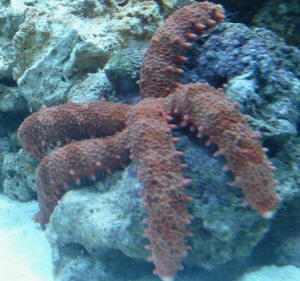
Protoreastor linckii feeding - 02/03/09
Greetings WWM gurus; <Hey John.> First off, thanks to you all for
your very informative site. I've come back to it again and again
for information backed up by experienced aquarium hobbyists. <Thanks
for your kind words.> Now, onto the question. We have a 50g FOWLR
setup that has been up for a few months. (It's our first saltwater
setup after many years of successful freshwater tanks.) Current
inhabitants are two percula ocellaris <These are actually two
different species. There is Amphiprion ocellaris and there is
Amphiprion percula.> and one Nemateleotris magnifica along with a
peppermint shrimp and a voracious little zebra hermit crab. Our current
water parameters are: temp 79-80 degrees, Ph ~8.3, specific gravity
~1.0235, ammonia and nitrite 0, nitrate <5ppm, barely gets a
reading. Lighting is 2x 39w HO compact fluorescent tubes, one daylight
and one actinic blue. The tank is driven by a canister filter with a
second powerhead for increased current and a hanging power filter
(carbon & sponge) for additional mechanical filtration.
<Mmh… no skimmer? I'd replace at least one power filter
with a skimmer in the long run. Perhaps both if enough live rock was
purchased.> Normally I am a very cautious hobbyist. I always
research before I buy and I make sure I have what I need to keep my
pets happy and healthy. However, we were in the local fish store the
other day and my fianc? fell in love with a Protoreaster linckii they
had recently received in stock. At first I resisted, but the store
employee assured me that the sea star was hardy and could be cared for
in my tank. I trust her judgment. She'll steer me away from any
purchases that would be unwise (like the gorgeous Synchiropus
splendidus I wanted) and suggest better stock. So I bought it on
impulse and brought it home. It was acclimated via a slow drip (~3
hours) and placed on the glass. It seemed to try to leave the tank at
first, continuously sticking one leg partially out of the water. I did
some research on the internet and I could only figure that something
about the water chemistry was bothering it. I retested and all my
parameters were good. Then I figured that the thing had probably not
felt sand since it was taken from the ocean, so I gently removed it
from the glass and placed it on the sandbed. It put a couple of legs on
the live rock and settled down finally. Overnight he's managed to
scoot over to a quiet corner of the tank where detritus tends to
gather. Hopefully he's begun to find something to eat. But I know
that my bioload isn't sufficient to provide for him so I'll
need to supplement his diet if I'm to keep him happy. Do you have
any suggestions on what he should be fed and how often? I'll care
for him as long as I am able. If I can't, I have a cousin with a
well-aged 250g setup where he might be better off. But for now,
I'll take any feeding suggestions you have so he doesn't go
hungry in the meantime. <Protoreaster stars are truly hardy (for sea
stars) and they are omnivores (in contrast to Linckia sp. with which
they are sometimes confused, because their generic scientific name is
similar to the P. linckii's species name). Most specimens eat
everything they can get including smaller stars, slow urchins, many
corals, sponges, feather dusters, tunicates, dead fish and
inverts… oh and yes: they also eat detritus if nothing else is
available. Protoreaster can be fed with all types of meaty foods like
mussels or small shrimps, also with processed pet fish foods that hold
together. I have one developing tremendous speed when smelling
freshwater wafers for bottom dwellers. It's good to keep the diet
varied. I'd feed a piece as large as one or two finger nails every
two days maximum. You can place the food at the bottom of the tank and
put the sea star on top of it. You can also try fixing it with a small
piece of live rock and wait until he smells it and gets it by himself,
at least if the shrimp does not take it. Also, keep an eye on water
quality, because this star may start to clean your life rock of what he
considers as delicious. You may also want to extend your search on
Chocolate chip sea stars, which are very similar in terms of care.>
Thanks a mil, -John <Welcome. Marco.> Feeding Nardoa novaecaledoniae, Seastar 12/5/08 Hi <Vanessa> What is the best way of feeding Nardoa novacaledoniae? I have live rock but they are eating the algae so fast that I can't keep up with demand! I have tried minced mussel and shrimp, but they are not interested. I have also tried crumbling small frozen algal blocks into the tank so that small pieces settle on the rocks and sand, in the hope that the sea stars would eat that as they moved over the rocks and sand, but this doesn't seem to be working either. Any help would be greatly appreciated. <Mmm, your Nardoa may be misplaced here... this species feeds variously on "bio-film" and algae on hard surfaces (and seagrasses (where available) in the wild)... consuming a good quantity of calcareous material in the process... And needs a good-sized area/space of well-established, well-overgrown hard surface in captivity to sustain itself in captivity. You may have some success offering "sinking tablet or pellet" foods (see Tetra and Spectrum brands here especially), but otherwise, this animal may need to be moved elsewhere. Bob Fenner> Question about Fromia Sea Star, fdg. - 08/31/07 Hello WWM Crew, I am writing to ask your advice regarding the best way to care for a Fromia sea star that I recently purchased for my reef system First, an overview of my setup is provided below for your information. System Overview Display: 135 Gallon Tenecor Acrylic Aquarium (72" W x 18" D x 24" H) with 1" fine aragonite sand bed (vacuumed frequently) and approximately 120 lbs of Live Rock. Recirculation rate is about 1300 GPH. Refugium: Ecosystem 3616 Mud Sump with active Chaetomorpha and roughly 15-20 lbs Live Rock. Two large overflows with Durso standpipes add roughly 30 gallons "fishless" volume. Lighting: Three 150 W HQI pendants (12K) and Four 160 W VHO (1 AquaSun, 2 Actinic White and one Actinic). Lights are on timer sequence with MH's running about 8 hours/day and maximum wattage peaks at around 930 W. Filtration: Eco Reef CS 135 which runs continuously and produces about one cup (very dark and smelly) skimmate every 2-3 days. Also employ four (1 cup each ) bags of activated carbon in the in the sump which are rotated/replaced one bag per week. <Good technique> Chiller: 1/4 HP Aqualogic "drop in coil" type <Are you happy with this unit?> Water Parameters Temperature: 81 (+/- 1) F Ammonia, Nitrite and Nitrate not detectable per Salifert test kits Salinity 35.5 (+/- 0.5) ppt pH - 8.4 Calcium ~ 400 ppm, Alkalinity ~ 9 dKH Inhabitants Fish: Flame Angel, Bicolor Blenny, Purple Firefish, Sunrise Pseudochromis, Neon Goby Corals: Pocillopora, Plate Montipora, Encrusting Montipora Inverts: Two Cleaner Shrimp, Blue Legged Hermit Crab, assorted astrea snails and a Tuxedo Urchin LR Hitch Hikers: Zoanthids, Star Polyps, Unknown Encrusting Stony Coral, assorted sponges and small clams. Macro Algae: Assorted small Halimeda and Caulerpa (removed manually). After a thorough review of your invaluable website (along with Mr. Calfo and Mr. Fenner's "Reef Invertebrates" book) I decided to take on the challenge of keeping a Fromia sea star. After several months, I finally came across an exceptionally beautiful Fromia specimen and introduced it into quarantine about three weeks ago. The quarantine is a 10 gallon glass tank with several "grapefruit" size pieces of live rock from the display, along with a "mature" sponge filter and a couple of powerheads. <Sounds good> To acclimate the Fromia, I took water from my display, then adjusted the salinity so that it matched the "bag water" (32.5 ppt). I then drip acclimated the sea star to the quarantine water over a period of a few hours to minimize shock to the animal. Incidentally, I also checked the bag water for phosphate and nitrate level of the LFS water, which measured 3 and 50 ppm respectively (which I assume was quite stressful to the animal). <Mmm, maybe> I let the salinity slowly go up to 35 ppt over a few days by topping off the tank with salt water. I also change out 1gallon of water every day using display water as make-up. <Very good> I watched the animal closely for the first week or so for signs of tissue necrosis and so far it appears very healthy. But for the first two weeks or so the animal just stayed in one place in the tank (hardly moving at all). It has since started to move about a bit which I take as a sign the animal is acclimating to its surroundings. So at this point I believe it would be a good idea to introduce the Fromia into the display within the next week or so. <Okay> Now (finally) for my question - based on observations over the last three weeks, I am unsure about the best strategy for feeding this animal. After my reading in "Reef Invertebrates" my original thinking was to let the animal "graze" on the live rock fauna and any food left behind from fish and coral feeding. Alternatively, I am considering putting the star in the refugium, where there appears to be a higher density of potential food items. <I would try the tank first... if the animal moves around a bit every day, it is likely fine, getting enough food...> There seems to be quite a bit of contradictory information on the subject and I would greatly appreciate learning your thoughts / suggestions on the best feeding strategy based on your experience? Are you aware of any supplemental feeding that may be worthwhile to try for this species? <Given your excellent set-up and good relating of same, I don't think that supplemental feeding will be necessary. Fromia stars actually consume very little... though I'd like to comment that there are some carnivorous species for which this does not hold> As always, I want to thank you for your website and the assistance you provide. Scott <Thank you for sharing. Bob Fenner> Culcita sel., fdg., 03/25/07 Many thanks for all
the info that you've posted. I have questions about a starfish that
doesn't seem very popular, <They are difficult to keep, and
require care that is beyond the capabilities/commitment/finance of most
aquarists.> a pillow (pincushion) star, Culcita novaeguineae.
<Hmmm.> We have a well-established 135 marine tank, full of live
rock and 4-plus inches of sand, but no corals in this tank. <These
eat coral.> We have always purchased livestock from a trusted local
store, but we keep a fairly light load. We recently acquired a large (5
inch) pillow star ("Lumpy"). We were told that he wasn't
reef-safe but that he would like the live rock and be easy to keep.
<Actually no they are not really easy to keep. See above.> We
were told to feed him algae wafers and cube food (formula1). <They
might eat this, but will likely waste away slowly. You need to vary
this diet as much as you possibly can. If you could occasionally get
coral for this creature that would be a plus.> He seems to have
acclimated well, but I have been researching him online, and I
can't find any references that confirm the diet. <Again, this is
why they are not really popular. I have seen studies that indicate that
they prefer certain Scleractinians.> Are there other indications for
feeding? <Bivalves, fish meat, snails, tablets, and coral.> Do
you have any other suggestions for care? <Very high water quality,
and constant salinity.> His tank makes consist of an Annularis, a
Passer angel, a sail-fin tang, a yellow tang, a Royal Gramma, a
"rainbow" wrasse, a tomato clown and a bubble tip anemone.
(Except for the Annularis, which we got last year, they have all been
together for many years.) <Quite a few very large fish in a
relatively small volume. I would consider purchasing a larger tank for
the Zebrasoma.> We feed a mix of frozen food (meat, sponge &
algae), plus some specialty food. Many thanks for any suggestions <I
hope that I have given some that help.> - we want to do what it
takes to make Lumpy happy. <Good luck with this. Brandon.> -
Peggy Archaster typicus, sys., dis. 8/13/06 Hello WWM: Thank you for posting this life saving web site! <Welcome> I was "sold" a rather small Sand Crawler Starfish for my 20 gal. <Yikes... too small to sustain a specimen of this species food-wise> I was shocked to see the tips of this poor invertebrate decaying. Thanks to your FAQ section, I immediately ran out and purchased a turkey baster (sorry no syringes available) and loaded it up with "Mysis" frozen shrimp. Injected the thawed mixture, under the sand, near the starfish. What are the odds of survival if I continue this process through perpetuity?? Feeling guilty in Fishers, IN. <Better than without your careful, compassionate input here. Do keep close tabs on your water quality. I wish you life. Bob Fenner> Re: Archaster typicus-addendum It's "Mysis" shrimp, not "Mysis". Sorry about the miscue on the food. <No worries, understood> Data on tank: 20 Gallons-Hexagon Rena Canister filtration Aquarium Systems skimmer Blue Damsel Purple and Yellow Damsel Cardinal Fish Small live rock All fish healthy: Brine, Bloodworm and Mysis diet. Help save "Star" the Starfish (my 10 yr. old named him/her/it)! <Bob Fenner> Poor Skimmer Design Woes/Fromia Sea Star - 05/24/06 Hello, <<Hi Josh!>> I am pretty new to the marine environment. <<Much reading/researching ahead of you then>> Right now I have a nice 20 gallon tank set up and everything is doing fine. My ammonia level is at zero and everything else checks out too. Today I just installed my Sea Clone 100 protein skimmer, and I tried adjusting the venturi valve and I get massive amounts of tiny bubbles. I read their tech documents and they mention that some de-chlorinators are gel like and also serve as a protective slime coating for fish and that to run the skimmer for 1 day or up to 3 weeks with the venturi valve off. <<Mmm, defeats the purpose of having the skimmer doesn't it?>> The de-chlorinator I use is TetraAqua AquaSafe Water Conditioner. I am wondering if anyone has had experience with this product and how long it should be until the AquaSafe is broke down enough that when I adjust the air intake I don't have any micro bubbles flowing into the tank. <<Though it is true that some water conditioners will cause a skimmer to "foam" excessively, "micro-bubbles" entering your tank does not sound like this is the problem. It seems to me this is more an issue with trying to tune a poorly designed skimmer. You will likely need to contrive some sort of bubble trap...or better yet...get a better skimmer>> Normally I would not mind but I am afraid of too much oxygen in the take may harm or kill my starfish. <<Too much oxygen is not an issue...but excessive micro-bubbles can be problematic to some organisms>> I am not sure of the type of star it is. It's red with black tips; I think it's a Red & Black Sea Star (Fromia milleporella). <<Hmm...these are "all red" in my experience. Perhaps a geographic variant...or a different specie altogether>> The guy at the fish store told me this star does not so well with salinity changes, too much air and other stuff. <<Mmm, can be said of many things>> Also any advice on feeding this star and caring for it would be great. <<Please start reading here: http://www.wetwebmedia.com/fromiastarfaqs.htm >> The fish store told me to feed it some zucchini. It will go to it and lay on it but after removing the zucchini after 30 minutes there is no evidence that the star is feeding on it. I also purchased some frozen food the recommended Formula One. Any suggestions on these topics would be much appreciated. <<The Fromia sp. sea stars are generally considered detritivores but will benefit greatly from supplemental feedings of marine based "meaty" foods (shrimp, krill, mussel, clam, etc.). Thank You Josh <<Regards, EricR>> Seastar... beh., dis., fdg. 4/20/06 First I'd like to say NOBODY has enough information on sea stars as you guys... <Okay> i just purchased a sand sifting star and a couple days later a red general... the sand sifter was very active the first day i purchased him, he would go under the sand and come out an hour later and go to the glass, it was exciting to watch him move.... i hadn't seen him what so ever for a couple days... is it possible he may have go out? <Mmm, not likely> i do have dogs, I'm sure would eat a fallen starfish... i have a top but with all the cords and tubes it's far from being inescapable... my red general hangs out on the top of the tank exposing himself to the air (purchase from the pet store today), i realize this is normal for some star fish, but is it for the general... <Not normal... something is amiss here. Likely environmental> and my final question I've heard of "target feeding" can you explain how to do this? <Placing likely palatable foodstuffs right next to the intended consumer. Bob Fenner> Nate Gourami beh., rhizomous plants, asteroid nutrition... - 03/11/2006 Hello! I've got just a few questions for you that I've been collecting for a while now. <Okay> How do I get a plant with a rhizome, like Anubias nana, to attach and grow on a piece of bogwood? <Best to find a bit of a notched area, tie the rhizome firmly to this with a bit of thread or light fishing line... it will adhere in time> How do I test for water hardness? <Mmm, most easily with a "aquarium" type colorimetric test kit... these are made... for GH, KH by many companies...> Can you suggest some small plants to put in the front of the tank that will survive in hard water? <Yes... there are members of the genus Sagittaria that are excellent here... and others... posted, labeled for use on WWM> (this is a guess here, I'm just assuming my water is hard) My dwarf (sunset?) Gourami has not been eating and is hiding in the corner behind a piece of wood. Now that I think of it I don't ever remember him (or her) eating in the month or two that I've had him. I've tried both flake food and frozen brine shrimp. Sometimes he comes out, but the other fish aren't picking on him, so I don't know why he hides (he did not hide right after I bought him, it's been recently). Do you think he's sick, and if so with what and what should I do? <Mmm, likely "just" normal behavior. Is a shy, retiring species... does best in a grouping (in large enough setting) of its species> How do I know if my starfish is eating? I don't feed him specifically but I've read on this site that I should. <Depends on species. The best indication of health is active behavior... that the animal is moving about daily... Again, some species of Asteroids are predaceous... need to/eat large food items... others lean to being more detritivorous...> I don't know what kind of starfish I have so are there any general foods that can be fed to any starfish? <Unfortunately no> I siphon the gravel in my freshwater tank for dirt, should I do this to the saltwater tank too? <Likely so> I'm thinking no, but is there anything I'm supposed to do to keep it clean besides a water change? <... please see Marine Maintenance on WWM> I've been trying to give my fish a varied diet, but all my snakeskin Gourami will eat is flake foods. I've tried feeding him peas and brine shrimp but all he touches are flakes! Is a varied diet strictly necessary? <Not necessarily. There are some complete nutrition prepared foods on the market. The "Spectrum" brand is one of these> Sorry I've got some many questions, but they've been on my mind a while. The people at my LFS aren't too helpful and books/internet articles don't answer everything. Thanks for the help! *Kim* <Retain that open, inquisitive mind Kim... is valuable. Bob Fenner> Chocolate chip starfish We just got a Chocolate Chip Starfish and I have been reading the info on your site. Some people talk about hand-feeding them. But there is no description of how. Can you tell me? <I did use the Tetra Tabs and stuck them on the glass near the star and he soon found them. You could try putting a small piece of clam or shrimp on the bottom, then place the star over the food. Do the last method if the star is on the bottom, don't pull him off the glass if he is on there, you may damage the locomotion tubes. James (Salty Dog)> Hungry Stars (2/21/05) I just had a question as to what to do about my snail population. I have 4 chocolate chip starfish. <How big is your tank? Over 100G, I hope.> I never had a problem with feeding them. I guess they mostly ate the algae or whatever in the tank. <They cannot survive without being fed.> Lately they have been on a feeding binge. <That is to be expected. These carnivorous stars have big appetites and grow to 8+ inches in diameter.> One starfish ate my anemone right through the bottom of it. I had about 25 turbo snails in the tank and I might have about 5 left. <They'll eat pretty much any sessile (non-motile) or slow-moving animal they can.> They each eat one snail a day. Usually not the small ones but the big ones are eaten. What can I do? <Feed them or take them back. They are not reef-safe, BTW. They love to eat soft corals.> I don't know what to feed them. <Chunks of marine origin meats such as raw fish flesh, shrimp, mussels, squid, scallops or octopus, all of which can be purchased at the seafood counter of the local market. I get mine as a "gumbo mix" at Albertson's for about $3 per lb.> Its not that easy to feed them the frozen krill <Why not?> and even then, I think they prefer the snails. <Even if you feed them, they may eat your snails. I have no other invertebrates in my carnivorous star tank. I only have fish that leave stars alone and that are left alone by stars.> Please help. <There are two ways to feed them. Use a pair of plastic grabbers (See here for example: http://www.marinedepot.com/md_viewItem.asp?idproduct=HG11012 ) to place meaty food next to or under stars on the bottom. I often grab my stars, put the meat over their mouths and gently press them to the front glass. They will stick to the glass and eat--kind of cool to watch as they evert their stomachs around the food.> Thanks, Jen <Hope this helps, Steve Allen.> Starfish and Other Questions (1/11/05) Hi there! Recently found your website--very interesting and helpful, particularly for the new tank enthusiasts! Thanks! <Steve Allen with you tonight and glad to be of service.> We set up a 46gal. tank the first week of September '04. Had problems with algae (to say the least--it looked like an algae farm, or forest), so sought help from [all] our local shops. We are now proud owners of innumerable snails, hermits, emerald and other crabs. <Many crabs are not reef safe, and many do not eat algae.> Also 2 gobies and 2 sand sifting stars sand-colored). We were told these critters would control algae and help keep natural balance in tank, and no need to worry about special foods. <Not true. As mentioned above, many crabs do not eat algae. Some hermits do, but not generally effective for control. Many snails are helpful. Sand-shifting stars not at all. Your tank is too little substrate to sustain two of these, if even one. It will strip you substrate of all beneficial micro-critters as well. Serpent stars are better scavengers, and I much prefer a fleet of Nassarius snails for stirring sand.> One star died within 2 weeks. We are learning you rarely get responsible or thoughtful answers or advice. <Regrettably, not a few LFS employees are more interested in your wallet than your success.> Apparently, by purchasing them, we unknowingly agreed to starve some if not all of our new pets. Unacceptable. There must be SOMETHING we can do....? <Read up on this site and elsewhere about the requirements for each of your critters. I heartily recommend Fenner & Calfo's "Reef Invertebrates." Also, for algae ID and control, try Julian Sprung's "Algae: A Problem Solver Guide." Anyway, I noted someone else asked you about feeding stars already in captivity, but there was no definitive answer regarding whether, once the deed's done and you have a star, there's anything at all that can be done to keep it from starving. <It may take frozen Mysis and other frozen marine foods placed on the sand.> If needed, I'll release it in the wild, but would prefer to feed it, as apparently the waters off the east coast of South Florida are contaminated and dangerous...? <PLEASE, PLEASE, PLEASE, NEVER, EVER, EVER release any captive critter into the wild under any circumstance. This is illegal in most places and terrible for the environment. Such critters can overrun and destroy native species. Have you not heard of the mussels in the Great Lakes, bird-eating snakes in Guam, or the Northern Snakehead in eastern US lakes? Please visit www.invasivespecies.gov for info. It is far better to humanely kill a critter you can't find another owner for than to release it. Can't you just return the star to the LFS where you bought it? I see no harm in trying to feed it in your tank. Just be careful not to put too much food into your system as excess nutrients are algae fertilizer.> Please let me know if there's anything I should try, and also if there's some limit to the amount of other sorts of tank cleaners one should keep? We were told the more the merrier, but we are obviously having doubts now... <The more the merrier for the LFS's bottom line. You will notice on the internet that all recommendations for large "cleaning crews" come from folks who make money selling them to you. A couple of dozen effective snails, maybe a dozen hermit crabs, and a couple of serpent stars (not Ophiarachna incrassata) would be a good start for your tank.> Thanks! Marina <Hope this helps.> Purple "Linckia" Questions (11/30/04) Hello. <Hi! Steve Allen, echinoderm enthusiast, with you tonight.> First off I love your web site, I can't tell you how many hours I've sat here reading and gaining tons of info. <Thanks, me too.> OK, that said my current concern is the addition of a purple Linckia starfish <actually, usually Tamaria stria.> (I know these are hard to keep but I have it (thanks to the wife) and want to try to keep it). I have a 40 gal tank with 2" of live sand, live rock, lots of polyps, a finger leather, 3 clams, a plate coral, 2 sponges, some snails, some blue leg hermits, 2 feather dusters, I think that's close to it. As for fish I have a Nemo fish (ha ha), a Flounder, 2 Damsels, and a Mandarin Goby. My water parameters are all good and stable. I change 5 gal a week. Ok that said my question is (knowing my tank is too small and young (6 months) for a Linckia to survive on it's own according to what I've read on your site.) can I spot feed this star or is it doomed? <How long have you had it? Most die in the first few weeks from mishandling prior to sale or failure to acclimate over a sufficiently long period to the new tank. If you can get past this, you're off to a good start.> And if so what can I feed it? <Small bits of organic matter deposited at the base of an arm may be eaten. Here's another good reference: http://www.advancedaquarist.com/issues/may2002/toonen.htm. You may also want to post on the WWM chat forum to see if others have had experience with this species surviving. Googling gets a lot of hits.> Thanks for your help and all the help I've gotten from reading the posts. <A pleasure. Hope this helps. Keep us posted.> Karl Feeding a Chocolate Chip Star (8/6/04) I have a 29 gal tank with only a choc chip sea star (my fish died from ich or velvet and can't put more in for 6 weeks),<sorry to hear> He is about 4 inches from foot to foot. My levels are ammonia 0, ph 8.2, nitrite 0, and nitrate 10. I have a heavy growth of green and red algae which the star snacks on and I feed him small amount of freeze dried brine shrimp every 2 days or so. Is this enough food to keep him healthy? <I'd say this is not an adequate diet for this creature.> I gave him a piece of shrimp from grocery store once and he swelled up for 2 days and scared me to death. <No worries, it merely ingested the chunk whole, just like a snake bulges when it swallow a whole animal. Just feed smaller chunks from now on.> However it was great hand feeding a starfish! <I agree.> (By the way, tank is about 8 weeks old.) <Rather immature yet. Go slow.> Please any help is appreciated as I have grown quite attached to "Cookie" and I didn't have a clue when I got him. (Local pet store has steered me astray last 8 weeks on what I was getting into) <Find a new one. As for the star, I have had great success with chunks of seafood (shrimps, mussels, squid, fish, etc) a few times per week. For your size star, 1/4-1/2 inch should be a good size. Here in UT, Albertson's sells a nice seafood mix that works great. I feed it to all of my predators, echinoderms and fish.> Thanks in advance, Beth <Hope this helps, Steve Allen. BTW, do study the ich articles and FAQs as well as those about quarantine, so you can avoid ich from now on. Buy a good starter book such as "The New Marine Aquarium," by Michael Paletta.> Feeding a Knobby Seastar (6/23/04) We recently bought a star fish and I wanted to know what to feed it. <Wonderful creatures. BTW, it is better to know the care needs before you buy. Odd that the seller had no advice.> I did not see a picture that looked like it. It is kinda like the chocolate chip one. It has 4 horns in the center and they are black tipped. It is brown in color with dark edges. <There are many such seastars, and only a handful of species have been named. Many are just named down to genus. Form your description, I would suspect it is of one of the genera Protoreastor or Pentaceraster. These are omnivorous/carnivorous stars that eat a lot and are not reef safe. The best way to feed them would be to place a chunk of a variety of meaty marine foods (pieces of shrimp, shellfish, fish flesh) in their path a few times per week. Mine are thriving on Albertson's seafood mix. Steve Allen.> Linckia In Trouble (5/11/04) Hello, <Hi. Steve Allen tonight.> I need some help with a starving starfish (I think). <OK> I bought an orange Linckia starfish about a week ago from an online website. It seemed to be fine until today. I think it is not getting enough food, but what I found out in reading about them was that they only eat algae. <Well, they eat pretty much any organic detritus, and generally do not require (and may not accept) supplemental feedings in a well-established tank. Placing a small bit of shrimp or other meaty marine food next to the star may result in it moving onto and consuming the offered tidbit.> Do I have to feed them anything else? <Worth a try.> It has seemed to shrink and only some of its legs are sticking to the glass and the little legs underneath have seemed to close up. A couple days ago he moved to the bottom of the tank and then back up to the top, so I thought everything was ok, but I feel he is in real trouble now. <These are concerning symptoms. Are you aware of the fact that probably more than 90% of all Linckia stars die within days or weeks of introduction. Most are already doomed on delivery due to shipping stress. How long did you acclimate it for. Stars require slow acclimation over a period of hours. Otherwise, they die (slowly over days) from damage due to osmotic stress. At this point, there is little you can do other than maintaining pristine and stable water conditions and waiting to see what happens. Trying to feed it is not a bad idea, but it may not be interested.> Other "critters" in the tank are: 1 Yellow Tang, 1 Flame Angel, 2 Percula Clowns, 1 yellow tail damsel, and 2 cleaner shrimp. 55 gallon tank been up and running for about 6 months. <Your Yellow Tang requires a minimum of 75 gallons eventually, preferably more.> Thanks for your help. Joey <Hope this helps.> Mystery snail and starfish question Hello all! <Steve Allen> I have a mystery snail in my reef. What kind is it? It's not in any of my invert books. I removed it tonight, and moved it to a tank without any complicated rockwork, so I could find it again if I needed to. <Does it bury itself in the sand? Looks like some sort of Nassarius (or similar subsurface) snail to me. Generally harmless cleaner of sandbeds. Search WWM & other web sources for pix & info.> Also, do you know if Linckias are known sponge eaters? It seems that's all my orange Linckia likes to eat. <Well then yours is, right? The are generally opportunistic scavengers. No real surprise if it eats sponges.> Everyone I know who has tried one has seen it die fairly quickly. <Yes, which is why I think they should not be sold. Lost a few myself before switching to Fromias> So far, after about a month, mine's still looking chipper. Could it be the sponge diet? <Perhaps. A month is a good start. Kept your water clean & stable and maybe you will succeed where most fail. My fingers are crossed for you.> Thank you! Vicki Madison, WI <A great town. I travel there twice per year on business. Next trip in 3 weeks.> Starfish Stomach Eversion (2/24/04) Sir, <Just Steve tonight> Sorry, the last email I sent I forgot the pic. Anyway, what is this starfish doing? I have 2 other chips in the tank. These 2 hang together all the time. What is that stuff in the middle of it? This "stuff" got a lot bigger than this pic shows. This is wild!! Thanks, Craig Cornett <Your starfish has everted its stomach. This is how they eat. I'd bet it found something on the glass it wanted to eat. They evert their stomachs around the food and do a good portion of their digesting outside of the body before sucking everything back in. I suppose this could also be a response to stress, but if conditions in your tank are good, I would expect this star to pull it's stomach back in and move on within 24 hours.> Feeding a Sand-Sifting Star (1/26/04) Hi Bob, <Steve Allen pitching in tonight.> I have read over the info that I could find on the website and other sources but didn't really find my answer, probably just missed it. I have a sand sifter starfish that doesn't move around a whole lot...does from time to time. I noticed one morning that it was up at the top of the tank doing its thing. Then later in the evening I found it at the bottom up against the glass looking all droopy...not rigid...kinda like a dying plant. <Sometimes they'll do this, but you might want to test your water quality parameters.> I talked to my local aquarium pet shop...and was told to feed it some cooked/uncooked shrimp...just shrimp from the grocery store. <uncooked is preferable for nutrient value.> I tried this but it didn't even attempt to eat it...but it did get better...moved to a new location. I tried to feed it again but my Coral banded shrimp, recently purchased, steals the bit of shrimp from the starfish. <Yes, an aggressive feeder.> Is there a better way to feed the starfish? Do I need to feed the starfish? - I've been told I don't; just doesn't seem right. <How big is your tank? Only the sand bed of a rather large tank has enough life to feed one of these. I'd try some other marine foods like chopped clams, mussels, squid, etc & place it very close to the star.> Will this harm the shrimp? <No, they'll eat just about anything organic. Mine are quite bold at stealing from slower inverts.> Just worried that everyone gets properly fed!! <Keep trying.> Thank you very much, <You're welcome.> Todd Hawman Starfish Eating Shells 2 (1/25/04) My tank is only a ten gallon, so it's pretty easy to keep track of the different things in there, which is how I could tell he swallowed one of the shells. Amazingly, he seems to be perfectly normal now! <Glad to hear it.> Thank you for your quick response! Sincerely, LeeAnne Strohmann <I hope all remains well, Steve Allen> -The incredible shrinking Linckia- I have a blue Linckia that is orange in color. <Isn't that an oxymoron? :) > I have had it for over six months. She moves around actively has no sores of any sort. The problem is that she keeps getting smaller and smaller, I feel that she may be starving what can I do, I don't want to lose her? <Unfortunately, this is all too common with Linckia stars, especially larger ones. Since their diet consists of mainly microfauna, it takes a pretty large and well established tank to keep them truckin'. You can hand feed them by placing bits of seafood (got any sponge based marine angel food?) on the substrate in front of it's path or literally drop it right on top. Try this a few times per week or more. Good luck! -Kevin> Feeding the Star >Hello, >>Greetings, Marina today. >My friends on my birthday give to me sea star, they told me she is BLACK TIP star. How do I feed this star? Thanks. Laimis >>The variety of sea stars is so vast that I couldn't venture a guess. A photo would be helpful, or find a book with a general description, and go from. Marina Water Quality and chocolate chip star >I am about 6 weeks into my first SW endeavor. I purchased a water test kit...PH, Ammonia, Nitrate, Nitrite...and I already have a hydrometer...Are there any other things I need to test for on a regular basis? >>This would depend in part on what you plan to keep. Seeing as how you've already got the chocolate chip stars in there, I see you aren't planning on keeping any corals (soft or hard), though you can keep some other invertebrates with these stars such as shrimps and the like. The only other kit you *might* need (this isn't imperative) is phosphate, and possibly oxygen. But really, for a beginner, this would be overkill. >Also...I have 2 small chocolate chip stars that I am attempting to feed clam...these guys are pretty slow, and have a tough time chasing down the food...should I be hand feeding them? >>LOL!! You mean they can't chase down a clam? I wouldn't worry too much about it, my friend. They'll find the food bits, and if you think they really need to be fed, then wait till they're in a convenient place and simply place food very nearby. If it's being stolen then just place a cup or the like over them until they've covered it, that should be more than sufficient. Best of luck, Steve! Marina Blue Linckia Starfish >Hello! >>Greetings, Marina here. >Like others, we should have read more information before purchasing a blue Linckia starfish! Now that we have, however, we are not sure if it is doing well or not. We acclimated it very slowly adding about 1/2 cup of our tank water every 30 minutes to it in a bucket over about 4 or 5 hours before putting it in our 92 gallon aquarium. It sat on the rock (attached picture) for about 10 minutes and then decided to travel. It bumped our elegance coral crossing the sand and went behind some of the live rock (behind finger coral in photo) and has not come out since. Is this something to be concerned about? >>Not at all. >How long should we wait for it to move out from behind the live rock before we try to get it out (we don't want to stress it but don't want to find out too late if it is not doing well)? We can see parts of a couple of its legs and it still appears healthy. >>I really wouldn't worry about it too much, folks. Do NOT try to remove it, it's too easy to tear off its legs, leaving a good entry point for infection. Even if a couple of weeks went by, I wouldn't worry too much, it may simply be finding much of what it prefers behind the scenes, so to speak. You can *try* leaving it some tidbits in a more open area, but don't be surprised if someone else takes you up on the offer. Try a mirror on a stick to look at undersides and areas not otherwise easily visible, I think it will turn up sooner or later. Best of luck, and nice tank! Marina Re: Blue Linckia Starfish >Thanks Marina! >>My pleasure. >Since we emailed you, it has stayed behind the rocks but is definitely moving around. I think you are right that it is finding plenty to feast on back there! I will try to use a mirror per your suggestion, that is a great idea! This is my husband's second reef aquarium (he had one over ten years ago) and my first, and I have to say that it is one of the best most rewarding things I have ever done! I am so obsessed :-) so I really appreciated your "nice tank" comment. >>Good, because they don't come easily. ;) >One other question I have, I have been hand feeding the open brain, doughnut, hammer and elegance corals with cut up fresh shrimp a couple times a week and they seem to be doing very well, is this the right amount or should I be doing it more or less often. I am most concerned about the elegance coral since we have heard that they can be very difficult to maintain. >>You may want to add phytoplankton to their diets, but they sure looked pretty good to me. I would only suggest finding a good supplement specifically for corals (I like Selcon for fishes), and adding some variety to their diets as well (squid, octopus, and the like). Glad all is well, Amy! Marina - Seastar Feeding - dear Madame/sir, I have been looking for ages to try and find a photo of a starfish feeding, as i have read in several places that they can eat with their stomachs outside of their bodies, which I think is really cool. <This is true.> So, do you think you could find me a photo of a Seastar with its stomach "removed" please? <I am sorry to say that we do not currently have such a picture in our library. This type of shot is easily staged.> that would be very nice of you, <If only...> Sara Mela <Cheers, J -- > What do Seastars Eat <<Hello, JasonC here filling in while Bob is away diving.>> Is the starfish Fromia monilis totally reef safe? <<Bob has it marked as such in his article: http://www.wetwebmedia.com/seastars.htm >> I finally found one and bought it before researching it. I have a Derasa and a Crocea in my Reef. What do they eat? <<probably meaty foods and anything else they run unto.>> Are these clams food for them? <<IF your Seastar were large enough and hungry enough, I wouldn't put it past them, but you can avoid this by keeping it fed/make sure it is getting food elsewhere.>> Also, what do the Tiny Red Reef stars (Fromia Elegans) eat. <<micro fauna>> They are the tiny Bright Orange one's. I have never seen them do anything bad but want to find out more about these two species specifically. <<read that link I included.>> Thanks, Michael Koenig <<Cheers, J -- >> Re: smallest zebra moray, expensive Harlequin Shrimp meals So do I, he seemed to be in good shape, but we know how deceptive that can be. While I consider them a somewhat high price wise, they do have excellent livestock. No dead or sick animals in the tanks, everybody bright eyed and bushy tailed. <Commendable> I didn't have the time to check up on him though. If the condo sale goes through (I have someone interested!) I might get back and reserve him, as long as he's healthy. I'm not sure if the next one was intentional or not, but they had a harlequin shrimp (a lovely blue) in with a "scarlet" starfish, the harlequin was going to town on it. since they were asking $27 for the starfish, I'm not sure if they set it up as a feeder or if someone just didn't know better. <Suspect the latter. Bob Fenner> Re: Hey Bob ;) (Seastar predation, more) Mr. Fenner! How have you been? <Fine my friend> Things with me are -- fine, I guess. I recently made A LOT of changes/additions to my reef. First are from the LFS. I added two more corals. One was a Leather Coral (my first one) and the second was a rock full of Colored Button Polyps. Both are doing mediocre at best. The Leather spent its first 24 hours open and happy and has since (for 48 hours now) closed its polyps! <This happens... don't panic just yet> I don't know what to do and the LFS guy has offered NO help at all. The second is even scarier. . . The polyps on the Button are (what appears to be) being devoured by my Orange Knobby Starfish!! The one that I received in my "reef relief" package from FFExpress!! I'm way worried here. . . <This unfortunately also happens... these stars are not "picker uppers"> In other news, I added my refugium! For now there is about 5 pounds of aragonite in it with a lamp and a few live rocks. I'll make other steps with it this weekend. And I'll have a bunch more questions about it as time goes by (it is so nice to have you as a reference Bob, thanks again!!) Also more stocking problems. . . This time from a FFExpress order. I added another Banggai Cardinal to the previous pair that were in there. He was assaulted and killed within 6 hours by the biggest of the previous pair in the tank. <Best to have just one male... once established... definitely> I also added a flame angel and he had three white spots on his face and this morning the spot number has increased to 5-6 spots! I have two cleaner shrimp, will they take care of this? <Perhaps> I don't even want to say the "I" word. I have been sooo blessed this far not to have to deal with it. . .What can I do? <Please read through the Marine Disease sections on our site, www.WetWebMedia.com here> The rest of the stock looks so healthy and happy. Is there a chance that this guy could kill off my whole crew???? <Hmm, yes, a chance. You don't routinely dip, quarantine new livestock?> I also received a Sebae Anemone. He was about 2 inches across when I got him, he has since inflated and spreads about 6 inches across, he is awesome!! But my clownfish in there (a true Perc) seems to not even know he (the anemone) exists?! How long until he finds his (what I hope to be) new home?? <Maybe soon, maybe never> Also, how long should I wait before I attempt to feed the anemone? <A few days> I also received a HUGE piece of brain coral, he barely has room to sit in the bottom of my tank. Is there anywhere else you'd suggest I could put him? <A new, larger tank?> Finally, (I told you I stocked the tank a lot) I got a Samoan Blue Rim Derasa Clam. He looks great. Can he sit on the bottom of the tank and still get enough light (recall 4 x 96 PCs in a 75 gal)? <I'd place it midway up> Again, thanks so much Bob. I'll be hitting "refresh" on my browser all day long in anticipation of your wise responses. Thanks so much!! Your friend, Rich <No wisdom my friend.... only scant knowledge. Bob Fenner> Feeding scooter blennies and starfish Hi Bob, <Howdy> I have a 40 gallon reef tank. I put in a scooter blenny two months ago after the tank had been establishing itself for 6 months. He/she now looks quite emaciated, since I haven't been feeding him, thinking that scavenging would be enough. What is the most convenient food for the scooter? <A healthy culture of infauna (critters like worms and crustaceans) living in a large enough system (a forty is small) with live rock and/or a living sump/refugium... without too much in the way of competitors for these foodstuffs...> I put in some frozen brine shrimp today, which he paid no attention to. <Try other live foods, even of freshwater origin... placed near the front of the animal... and consider adding live rock, a sump... possibly trading this fish to someone with a suitable reef setting...> I also just introduced a small Archaster starfish, will the starfish need to be fed? with what? <Not likely if the tank isn't overly cleaned...> When putting in the frozen foods, does the tanks circulation or the protein skimmer need to be turned off? <Possibly a good idea to cycle off the filter pumps for about fifteen minutes... best done with timers so you don't forget to turn them back on> If I do need to feed the starfish could I get away with just putting the food in the tank, rather than placing it right near him as you suggest on the website? <Yes... the Archaster is a detritus feeder. Bob Fenner> Thank you. Regards, B.Brown Starfish I am thinking about adding a starfish or two to my 29 gallon tank (It is sort-of a reef tank. I have live rock in it but only about 17 pounds so far. I'm building vertically as money permits.) What do starfish eat (can I feed them frozen foods) and how should I feed one? I read that they are carnivorous. Will a starfish eat my damsels (yellow tailed and two striped)? My tank is eight months old and has 4 damsels (three yellow-tail and one two stripe), your clean-up crew, some crabs, an anemone, and a dark green rock hard, yet fuzzy blob with a weird twisting pattern on it that came attached to a piece of rock. (I have no idea what it is. It isn't just algae covered rock and I think it might be something alive so I just let it be.) Also, my yellow tang used to live in this aquarium but someone at the fish store told me that I had too many creatures for a 29 gallon tank, esp. with live rock. So now she (the tang) lives in another 29 gallon aquarium with some two stripe damsels. How many fish am I allowed to have in a tank? I know from my freshwater tanks that as long as I am good about the housekeeping and keep the oxygen level up in the water that I can overload the tank with no problems whatsoever. (The rule-of-thumb for freshwater that I've heard is one inch of fish per gallon of water.) Please help--I'm so confused. What books do you suggest? <<Thanks so much for writing... And I do wish I had a copy of the Baensch Marine Atlases (vs. 1,2,3) to send you... you'd like and greatly progress from reading these. The principal authors are Hans Baensch and Helmut Debelius... v.1. Start here, and hold off on the starfish at this point. We'll be talking, Bob Fenner>> Starving Sea Star?? Dear Bob- (or Anthony...) <cheers, mate> I have been reading your FAQs and I emailed the other day about my orange Linckia. Exactly what kind of greens and meat do I need to feed him so I don't overfeed the tank or underfeed him? <tough to say... we first need to ID the genus of the star. Numerous genera are collectively shipped as "Linckia sp". Please scour the web, this site, Indo Pacific Field Guides, other books etc to get a genus and species of possible. In the meantime, simply a wide variety of frozen foods like you would feed a Marine angelfish to be specific> (29 gal reef tank, 2 months old, 2 clowns, 2 cleaner shrimp, 1 horseshoe crab (3"), 1 orange Linckia and 35 lbs of live rock! <for what its worth... I'm certain that the horseshoe will die in their tank in 6-12 months despite your best efforts. They need a lot of food and a lot of room to grow, scavenge, bury/forage. They need huge tanks!> (seems like the Linckia goes around the rocks once, ends up on the glass and sits there. I clean the front glass so I can see the tank whole idea of reef tank!) and he sits on the clean glass. <alas... not indicative of anything specific, my friend> After reading your info, I figure I need a protein skimmer, is the SeaClone™ Protein Skimmer ok for me? <ahh... do read through the FAQs on this topic. Or visit the message boards. You'll find that most people like me won't even take this skimmer for free! You can add Prisms, Berlin and Nautilus to this category for me. I like to get a lot more bang for my buck... my strong advice without spending too much money would be an Aqua C Remora (for hang on the tank <H.O.T.>) or Tunze's smallest unit (model 210)... see here at General Aquatics: http://www.generalaquatics.com/myProducts.cfm?CFID=382338&CFTOKEN=23764741 &parentcategoryid=1%7Cprotein%20skimmers&categoryid=1|protein%20skimmers& vendoridtoDisplay=21|Tunze&collection=1%7Cprotein% 20skimmers > I don't want to take all the food out of the water for the star, but I notice it is getting cloudy! <not sure that I follow the last comment? In reference to skimmer efficiency? If so... no worries... seastars are deposit feeders. If in relation to target feeding... no pieces should be left more than a few hours to rot and cause cloudy water> Please help and thank you very much!! Ron <I sincerely thank you for caring, my friend. I truly believe that your empathy will make you a fine and successful aquarist. Best regards, Anthony> Re: Orange Linckia (Target Feeding Deposit feeders/ Sea stars) What is the best way to feed these guys ? 29 gal tank with 2 bags live sand and 35 pounds of live rock. Tank only a couple of months old. <hmmm... going to be challenging here to be honest. Most would say the tank is too small to conceivably support a sea star. If possible, small daily feedings of a great variety of foods (green and meaty). Perhaps consider making a homemade food recipe (many on the net and in Bob's book, on WetWebMedia, etc)... freeze all in party cube trays and offer the star a food cube daily (mixed nutritious fare with vitamins) from the substrate> Have 2 clowns, 1 horseshoe, <Doh! er... Horseshoe crab? Forgetting the adult size of about 12" in diameter... there will be no easy way of providing enough food in the sand to keep this crab alive in such a small tank. Too bad... indeed a fascinating creature. My string advice is to get this crab to an aquarist with at least a 200 gallon tank and DSB. In the meantime, bury mysids in the same place daily just under the sand (other meaty foods too of course for variety)> 1 linkia,2 skunk cleaners shrimp. I feed spectrum daily as well as Mysis shrimp (every other day), I have a few shrimp left on the sand when creatures are done eating. Can I hand feed a Linckia??? <yep> Small children perhaps?? <only if they misbehave or seem inclined to vote Democrat in the future> Thanks a lot for your response. Ron <my great pleasure... best regards, Anthony> Blue Linckia, leopard wrasses and angels Good evening Bob! <cheers, bub... Anthony Calfo in your service> Well, I know you've probably heard this a hundred times now.... I bought something for once without doing any research, a blue Linckia~ I was at a wholesalers and it was $5 and I've always wanted one. <impulse and cheap price... a recipe for death> Don't shoot me! <oops...sorry. I jumped the gun on the harassment> As soon as I put it in the tank it promptly disappeared into the woodwork, "Great! I just bought a lovely blue star that I'll never see!" hehe. <or worse... it will starve, dwindle and die back in the rockwork and wipe out the while tank when you go on vacation. Have a nice Holiday! <G>> He's being more social nowadays and hanging around the clams. (Been in the tank about 2 weeks now) I read the FAQs and he's relatively healthy, he was kind of a grey/blue when I bought him, but he's not "cob webbing" or anything. Ok, my question is do they have any food requirements other than detritus and micro creatures? <wow... these starfish like most sea stars need a lot of food. If you do not/cannot target feed them weekly if not daily, then they need very large aquariums (over 100 gallons) and very mature displays (well over 1 year old with a lot of live rock). Else they will slowly starve over a period of months like most. Surely not to live beyond one year, I am truly sorry to say> Currently he's in one of the most beautiful/healthy 58gal tanks in Miami that has been established for over 5 years. ;] It has a 3"+ fine sand bed, tons of little benthic critters, etc. <awesome... the maturity of the tank is a tremendous help. Still... spatially... it is a bit small in surface area to sustain this deposit feeder. Especially if you have any blennies, gobies, tangs, etc that graze the rock competitively> Other than fish food (Spirulina flakes and pellets) I feed the tank Dt's concentrated plankton every other night, which the brittle stars seem to love. Also, are Linckias nocturnal? <yes> It doesn't seem to move around during the day at all, like the brittle stars. Is it normal for Linckias to stay in the same position for a day and a half or more? <common for imported ones...duress> Do they feed on diatoms that accumulate on the glass as well as feeding on stuff in the sand? <not only diatom algae per se> His suckers seem to be in good shape, nothing looks irregular. <good to hear... a good sign> Just they move really slowly, so a person tends to worry. <understood> And he doesn't seem to get all excited like the brittle stars when I add plankton. ;] <true... he is a strict detritivore... no suspension feeding at all> On another note, (thanks for reading all this, I have a special skill at rambling!) would a leopard wrasse and a yellow Coris wrasse be compatible? <likely not... and you truly must avoid putting a leopard wrasse in a tank this small. They are categorically very difficult to sustain for more than a year or two. Best success is in huge aquaria (over 200 gall) with few other fishes> And would they be compatible with a bicolor blenny? <stick with the yellow Coris and you will likely be fine... although there is always a chance of territorial aggression from the blenny> (My bi-color is currently in my 10gal nano, where he is king, I can't wait to see his expression when I put him in the 58g that I'll be moving to once my boyfriend has the 75g setup, heehee Two reefers living under the same roof is a dangerous combination. ;]). Also, are Rusty Angels reef safe, hardy, okay for keeping w/ above mentioned fish? <now that's a hardy choice :) Seriously... a fine angel. Reasonably hardy and easy to feed... tends to be long-lived in captivity. As far as reef safe... eh... as reef safe as dwarf angels get (nibbler)> If so, should I keep a pair or single? Okay, that's it I swear!! <oh... you are headed for a smack <G>. You do recall that you have a 58 gallon aquarium, don't you :) > Oh, can you sex bicolors? <is this a trick question... Ok, I'll bite: yes... the male is the one wearing the smoking jacket and the female wears a silk Kimono> The males are so pretty during mating time. <OK> Thanks so much for everything, I think you guys are awesome and I hope to know as much as you do someday. Sweet dreams~ Morgan Moore <ha! Thank you for putting up with the wise guy in your luck if the draw. Best regards, my friend> Starfish and crab questions - 02/21/03 <Ananda
here today...> I have a quick and easy (guessing) question this
time. What does a sand-sifting starfish eat? I read on your website
most starfish eat mollusks or shrimp once or twice a week but thought
this sand-sifter may be different because of #1, its name, #2 because
it is so small (probably 2.5 inches from top to bottom).
<Sand-sifting stars are called such because that's how they get
their food: they sift through your sand bed looking for goodies to
eat.> I have a 55 gallon FOWLR that has several different fish,
snails, and two cleaner shrimp. I fed the fish frozen foods such as
Formula one, two, brine shrimp plus, plankton, and krill. The only
problem is the fish obviously eat all the food before it could settle
for the starfish to crawl over it. Should I, and if so what, feed the
starfish individually? <The best way to keep these critters fed is
to have a good sand bed full of the stuff they normally eat. A
critter-producing refugium can help supplement this.> I also have a
closing question. I saw an emerald crab in the LFS with no claws, just
two legs on one side and four legs on the other side. Will it grow
claws in time or not? Will it be able to eat without claws or will it
die? <When it molts, it should regenerate the claws and legs.
Whether it will live to do so is another matter. This crab uses its
claws to bring food to its mouth -- so unless it molts very soon, it
may be out of luck.> As always, thanks. Ray |
|

|
Features: |
|
| Featured Sponsors: |
.JPG)