|
Related FAQs: Bryozoans,
Related
Articles: Water Flow, How Much
is Enough,
/The Conscientious Marine
Aquarist
Moss Animals
& Lace Corals, the Bryozoans (or Ectoprocts if you
will)
|
|
| Bob Fenner |
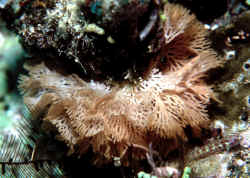
Reteporellina graeffei, Fiji
|
Most aquarists will never see this group (Phylum) of advanced
invertebrates. Not only are they small and cryptic by nature, as a
consequence of these qualities and the vagaries of wild collection and
shipping, bryozoans just "don't make it" from reefs to
homes. Just the same, because there are folks who endeavor to keep and
culture most everything, and there are cases where these "moss
animals" have survived the rigors of the trade, we will discuss
them.
Often looking more like algae than animals the
Bryozoa are small, encrusting or branching colonial animals. Colonies
are made up of individual zooids of about 1/16-1/25 of an inch in
length. This basic building block (the zooid) builds a chitinous or
calcareous house around itself and between its kin. The resultant
structures look bushy, like webs, fans, branches... and are flexible to
rigid.
Like some closely related groups/phyla the zooids
filter feed by way of a tentacular crown called a lophophore. The
bryozoans other scientific name refers to the placement of their anus
(unlike Sponges and Cnidarians, Bryozoans have a complete digestive
tract). Food is directed by cilia on the tentacles into a mouth,
through a simple digestive tract (one-way), and exits outside the ring
of tentacles. Notable for the group are specialized defensive zooids
termed avicularia (like aves, bird for their beak-like heads).
Along with groups like sponges, sea squirts,
barnacles and many hydroids and worms, the Bryozoa are important
components of "fouling communities"... living in silty
harbors, boat bottoms... Due to such tolerance and beauty, there should
be a future in advanced marine aquarist's tanks for this group.
Range:
Worldwide in tropical to temperate seas, some
freshwater. About 5,000 described species.
Species on Parade!
Genus Aetea:
| Aetea truncata (Landsburough 1852). A tentative ID of
colonies come upon in the upper Sinai diving 2019. |
%20MD.JPG)
|
Genus Alcyonidium:
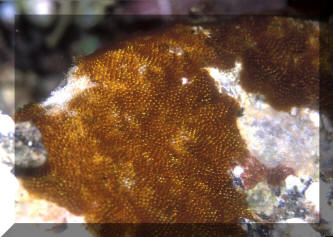
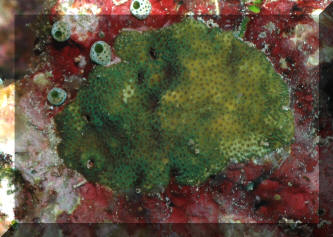
| Alcyonidium sp. Nuka Hiva, Marquesas,
Polynesia., another possibility... from N. Sulawesi. |
|
Bigger PIX:
The images in this table are linked
to large (desktop size) copies. Click on "framed" images
to go to the larger size. |
|
|
Genus Bracebridgia:
| Bracebridgia subsulcata White Tangled
Bryozoan. Looks like a bleached out brown algae, summat like
Dictyota, but looking closely you can see zooid characteristics.
Made up of thin white tubular branches... that being calcareous are
rigid, easily broken. Found out of the light in deeper water. Here
in Cozumel 08. |
|
Genus Bugula:
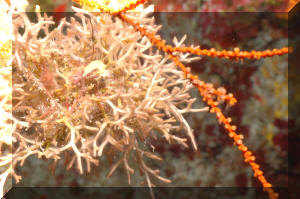
| Bugula dentata (Lamoroux 1816). Delicately
branching... minute spines along the colony branches... Indo-West
Pacific; South Africa to Australia, Japan and Atlantic; Cape Verde
Isl.s. In Wakatobi, S. Sulawesi. |
|
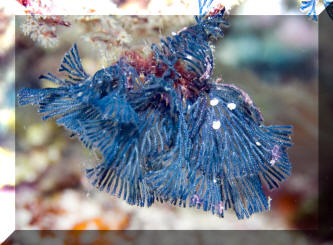
| Bugula minima. Purple Reef Fan Bryozoan.
Spaced stalks with red tips and only occasional cross barring. .To 2 in.
Tropical West Atlantic. Here in Roatan, 2016 |
%20MD.JPG)
|
Bigger PIX:
The images in this table are linked
to large (desktop size) copies. Click on "framed" images
to go to the larger size. |
|
%20MD.JPG)
|
Genus Canda:
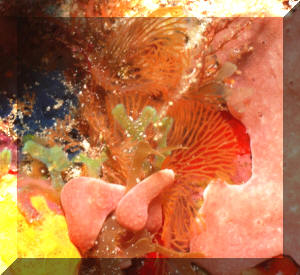
| Canda simplex. Brown
Fan Bryozoan. Flexible with red tips and occasional cross barring.
.75-1.25 in. Tropical West Atlantic. Here in Cozumel. |
|
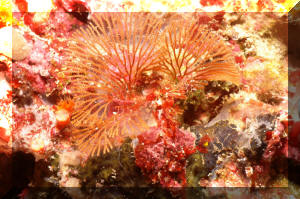
| Canda sp. Single plane
colonies with many small interconnections between adjacent
branches. Raja Ampat. |
|
Genus Celleporaria:
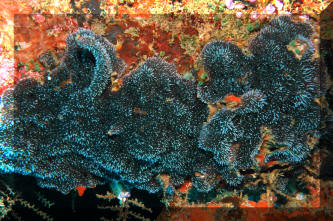
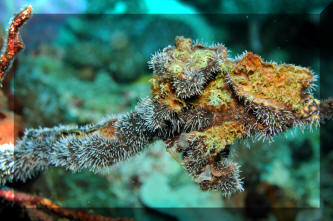
| Celleporaria sibogae Winston & Heimberg
1986. Easily missed or misidentified as something other than a
Bryozoan. Crustose, flat colonies, comprised of elongated polyps of
zancleid hydroids growing commensally. Calcified, hard to the
touch. Western Pacific; N. Australia to Malaysia. N. Sulawesi
pic. |
|
Bigger PIX:
The images in this table are linked
to large (desktop size) copies. Click on "framed" images
to go to the larger size. |
 |
Genus Cheilostome:
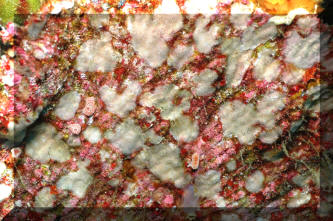
| Cheilostome sp. Variously colored zooecia,
found mainly encrusted on dead coral skeletons and rocks in the
shallows. In S. Sulawesi. |
%20MD.JPG) |
Bigger PIX:
The images in this table are linked
to large (desktop size) copies. Click on "framed" images
to go to the larger size. |
%20MD.JPG)
 |
Genus Crisina:
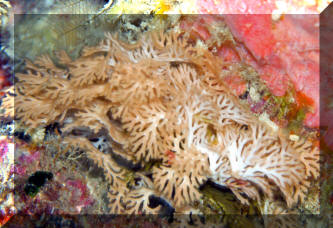
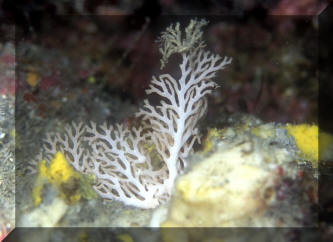
| Crisina radians (Lamarck 1816), the Tuning
Fork Bryozoan. A calcareous species found on hard surfaces and
seaweed blades. Ends of colonies look like tuning forks. To about a
half inch across. Kona, Hawai'i. images. |
|
Bigger PIX:
The images in this table are linked
to large (desktop size) copies. Click on "framed" images
to go to the larger size. |
|
|
Genus Hippodina:
| Hippopodina feegeensis Pearly Orange Bryozoan.
Bright orange calcified zooids. Colonies to 3" diameter. Roatan 2019. |
|
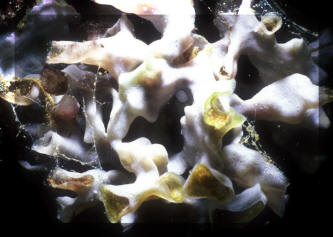
| Membranipora sp. Nuka Hiva, Marquesas,
Polynesia. |
|
Genus Reteporellina:
| Reteporellina evelinae, White Fan Bryozoan.
Fan shaped, 2 inch colonies. Uniplanar. Roatan 2016 |
%20MD.JPG)
|
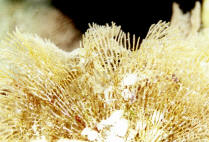
| Reteporellina graeffei (Kirchenpauer
1869). Tentative ID. N. Sulawesi. |
|
Genus Scrupocellaria:
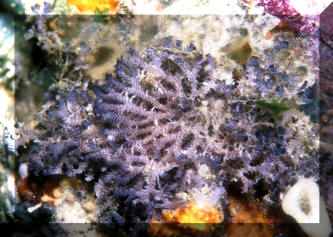
| Scrupocellaria sp. 1.25 inches max. Highly branched
and cross-linked branches. Nuka Hiva, Marquesas,
Polynesia. |
|
Bigger PIX:
The images in this table are linked
to large (desktop size) copies. Click on "framed" images
to go to the larger size. |
|
%20MD.JPG)
|
Genus Trematooecia:
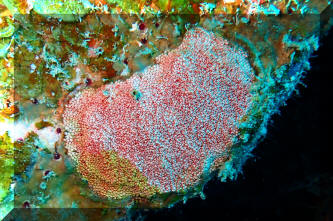
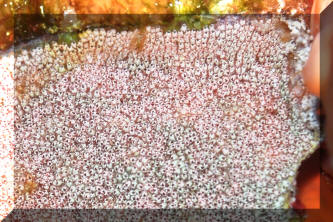
| Trematooecia aviculifera, Bleeding Teeth Bryozoan.
Encrusting laminar to massive zooids. Reddish w/ pale margins. To 8 inch
colonies. Roatan 2016, TiffB pic. |
|
Bigger PIX:
The images in this table are linked
to large (desktop size) copies. Click on "framed" images
to go to the larger size. |
|
|
Genus Triphyllozoan:
Bigger PIX:
The images in this table are linked to large
(desktop size) copies. Click on "framed" images to go to
the larger size. |
|
.JPG)
MD.JPG)
|
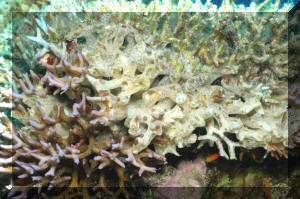
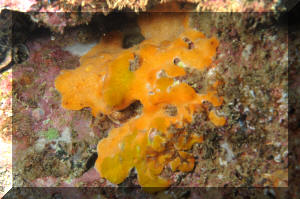
| Unidentified Bryozoans |
Bigger PIX:
The images in this table are linked
to large (desktop size) copies. Click on "framed" images
to go to the larger size. |
 |
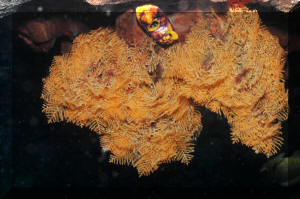 Raja Ampat Raja Ampat |
Bibliography/Further Reference:
Gosliner, Terrence M, Behrens, David W. & Gary C.
Williams. 1996. Coral Reef Animals of the Indo-Pacific. Sea
Challengers, Monterey, California. 314pp.


MD.JPG)
%20MD.JPG)