|
FAQs about Genus Fromia Sea Stars
Foods/Feeding/Nutrition
Related Articles: Fromia Stars, Asterina Stars, An Introduction to the
Echinoderms: The Sea Stars, Sea Urchins, Sea Cucumbers and
More... By James W. Fatherree, M.Sc.
Related FAQs: Fromias 1, Fromias 2, & FAQs on: Fromia Identification, Fromia Behavior, Fromia Compatibility, Fromia Selection, Fromia Systems, Fromia Disease, Fromia Reproduction, &
Sea Stars 1, Sea Stars 2, Sea
Stars 3, Sea Stars 4, Sea Stars 5, Seastar Selection, Seastar Compatibility, Seastar Systems, Seastar Behavior, Seastar Feeding, Seastar Reproduction, Seastar Disease, Asterina
Stars, Chocolate Chip Stars,
Crown of Thorns Stars,
Linckia Stars,
Linckia Stars 2, Sand-Sifting Stars,
|
|
What do Seastars Eat <<Hello, JasonC here
filling in while Bob is away diving.>> Is the starfish Fromia
monilis totally reef safe? <<Bob has it marked as such in
his article: http://www.wetwebmedia.com/seastars.htm
>> I finally found one and bought it before researching it.
I have a Derasa and a Crocea in my Reef. What do they eat?
<<probably meaty foods and anything else they run
unto.>> Are these clams food for them? <<IF
your Seastar were large enough and hungry enough, I wouldn't put it
past them, but you can avoid this by keeping it fed/make sure it is
getting food elsewhere.>> Also, what do the Tiny Red Reef
stars (Fromia elegans) eat. <<micro fauna>>
They are the tiny Bright Orange one's. I have never seen them do
anything bad but want to find out more about these two species
specifically. <<read that link I included.>> Thanks,
Michael Koenig <<Cheers, J -- >>
Poor Skimmer Design Woes/Fromia Sea Star
- 05/24/06 Hello, <<Hi Josh!>> I am pretty new to the
marine environment. <<Much reading/researching ahead of you
then>> Right now I have a nice 20 gallon tank set up and
everything is doing fine. My ammonia level is at zero and
everything else checks out too. Today I just installed my
Sea Clone 100 protein skimmer, and I tried adjusting the venturi valve
and I get massive amounts of tiny bubbles. I read their tech
documents and they mention that some de-chlorinators are gel like and
also serve as a protective slime coating for fish and that to run the
skimmer for 1 day or up to 3 weeks with the venturi valve off.
<<Mmm, defeats the purpose of having the skimmer doesn't
it?>> The de-chlorinator I use is TetraAqua AquaSafe Water
Conditioner. I am wondering if anyone has had experience with this
product and how long it should be until the AquaSafe is broke down
enough that when I adjust the air intake I don't have any micro
bubbles flowing into the tank. <<Though it is true that some
water conditioners will cause a skimmer to "foam"
excessively, "micro-bubbles" entering your tank does not
sound like this is the problem. It seems to me this is more
an issue with trying to tune a poorly designed skimmer. You
will likely need to contrive some sort of bubble trap...or better
yet...get a better skimmer>> Normally I would not mind but I am
afraid of too much oxygen in the take may harm or kill my starfish.
<<Too much oxygen is not an issue...but excessive micro-bubbles
can be problematic to some organisms>> I am not sure of the type
of star it is. It's red with black tips; I think
it's a Red & Black Sea Star (Fromia milleporella).
<<Hmm...these are "all red" in my
experience. Perhaps a geographic variant...or a different
specie altogether>> The guy at the fish store told me this star
does not so well with salinity changes, too much air and other stuff.
<<Mmm, can be said of many things>> Also any advice on
feeding this star and caring for it would be great. <<Please
start reading here: http://www.wetwebmedia.com/fromiastarfaqs.htm
>> The fish store told me to feed it some zucchini. It
will go to it and lay on it but after removing the zucchini after 30
minutes there is no evidence that the star is feeding on
it. I also purchased some frozen food the recommended
Formula One. Any suggestions on these topics would be much
appreciated. <<The Fromia sp. sea stars are generally considered
detritivores but will benefit greatly from supplemental feedings of
marine based "meaty" foods (shrimp, krill, mussel, clam,
etc.). Thank You Josh <<Regards, EricR>>
|
Question about Fromia Sea Star, fdg. --
08/31/07 Hello WWM Crew, I am writing to ask your advice
regarding the best way to care for a Fromia sea star that I
recently purchased for my reef system First, an overview of my
setup is provided below for your information. System Overview
Display: 135 Gallon Tenecor Acrylic Aquarium (72" W x
18" D x 24" H) with 1" fine aragonite sand bed
(vacuumed frequently) and approximately 120 lbs of Live Rock.
Recirculation rate is about 1300 GPH. Refugium: Ecosystem 3616
Mud Sump with active Chaetomorpha and roughly 15-20 lbs Live
Rock. Two large overflows with Durso standpipes add roughly 30
gallons "fishless" volume. Lighting: Three 150 W HQI
pendants (12K) and Four 160 W VHO (1 AquaSun, 2 Actinic White and
one Actinic). Lights are on timer sequence with MH's running
about 8 hours/day and maximum wattage peaks at around 930 W.
Filtration: Eco Reef CS 135 which runs continuously and produces
about one cup (very dark and smelly) skimmate every 2-3 days.
Also employ four (1 cup each ) bags of activated carbon in the in
the sump which are rotated/replaced one bag per week. <Good
technique> Chiller: 1/4 HP Aqualogic "drop in coil"
type <Are you happy with this unit?> Water Parameters
Temperature: 81 (+/- 1) F Ammonia, Nitrite and Nitrate not
detectable per Salifert test kits Salinity 35.5 (+/- 0.5) ppt pH
- 8.4 Calcium ~ 400 ppm, Alkalinity ~ 9 dKH Inhabitants Fish:
Flame Angel, Bicolor Blenny, Purple Firefish, Sunrise
Pseudochromis, Neon Goby Corals: Pocillopora, Plate Montipora,
Encrusting Montipora Inverts: Two Cleaner Shrimp, Blue Legged
Hermit Crab, assorted Astrea snails and a Tuxedo Urchin LR Hitch
Hikers: Zoanthids, Star Polyps, Unknown Encrusting Stony Coral,
assorted sponges and small clams. Macro Algae: Assorted small
Halimeda and Caulerpa (removed manually). After a thorough review
of your invaluable website (along with Mr. Calfo and Mr.
Fenner's "Reef Invertebrates" book) I decided to
take on the challenge of keeping a Fromia sea star. After several
months, I finally came across an exceptionally beautiful Fromia
specimen and introduced it into quarantine about three weeks ago.
The quarantine is a 10 gallon glass tank with several
"grapefruit" size pieces of live rock from the display,
along with a "mature" sponge filter and a couple of
powerheads. <Sounds good> To acclimate the Fromia, I took
water from my display, then adjusted the salinity so that it
matched the "bag water" (32.5 ppt). I then drip
acclimated the sea star to the quarantine water over a period of
a few hours to minimize shock to the animal. Incidentally, I also
checked the bag water for phosphate and nitrate level of the LFS
water, which measured 3 and 50 ppm respectively (which I assume
was quite stressful to the animal). <Mmm, maybe> I let the
salinity slowly go up to 35 ppt over a few days by topping off
the tank with salt water. I also change out 1gallon of water
every day using display water as make-up. <Very good> I
watched the animal closely for the first week or so for signs of
tissue necrosis and so far it appears very healthy. But for the
first two weeks or so the animal just stayed in one place in the
tank (hardly moving at all). It has since started to move about a
bit which I take as a sign the animal is acclimating to its
surroundings. So at this point I believe it would be a good idea
to introduce the Fromia into the display within the next week or
so. <Okay> Now (finally) for my question - based on
observations over the last three weeks, I am unsure about the
best strategy for feeding this animal. After my reading in
"Reef Invertebrates" my original thinking was to let
the animal "graze" on the live rock fauna and any food
left behind from fish and coral feeding. Alternatively, I am
considering putting the star in the refugium, where there appears
to be a higher density of potential food items. <I would try
the tank first... if the animal moves around a bit every day, it
is likely fine, getting enough food...> There seems to be
quite a bit of contradictory information on the subject and I
would greatly appreciate learning your thoughts / suggestions on
the best feeding strategy based on your experience? Are you aware
of any supplemental feeding that may be worthwhile to try for
this species? <Given your excellent set-up and good relating
of same, I don't think that supplemental feeding will be
necessary. Fromia stars actually consume very little... though
I'd like to comment that there are some carnivorous species
of seastars of other genera for which this does not hold> As
always, I want to thank you for your website and the assistance
you provide. Scott <Thank you for sharing. Bob
Fenner> Re: Question about Fromia Sea Star
9/1/07 Hello Bob, <Welcome Scott> Thank you very much
for your reply. I will move ahead as you suggested and introduce
the sea star to the main display. <Ah, good> I wanted to
reply to your question about the drop in filter. I have had the
unit in service for about six months now and so far I would have
to say I am happy with the unit. Prior to installing the chiller,
the tank would reach temperatures of over 84F by late afternoon
(tank is located adjacent to an exterior wall in Southern
California). <Ah, yes... Thank you for your input... many
folks have stated their antipathy for such drop-ins... am glad to
hear a positive comment> I have the drop-in coil placed in the
third chamber of the Ecosystem sump, with the set point adjusted
to come on at 81F, and chill the water down to 80F. The
compressor is located adjacent to the cabinet and kicks on for
about 30 minutes every 2 hours or so. The room gets a bit warm
but noise is really not a problem. Generally speaking, the unit
has been very reliable in maintaining the tank within the
temperature set points. I have also been able to significantly
increase lighting intensity and duration in the tank (to the
benefit of the coloration of my Pocillopora). I have noticed some
scaling on the coil, and figure that eventually I will need to
clean the coil in a vinegar solution, but so far the scaling does
not seem to significantly impede heat transfer. <Okay> You
also mentioned that some species of Fromia are carnivores.
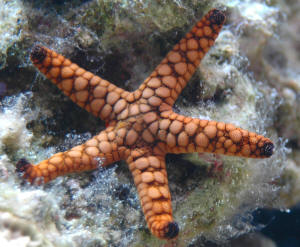
<Mmm, on smallish animals...> I have attached a photo of my
Fromia and wonder if you could help further ID this animal (my
LFS was of no help). I am curious if you are aware of and
particular requirement of this species. <Pretty sure this is a
F. indica... very nice pic and specimen> As always, I very
much appreciate the insights and information you and your crew
share with novices such as myself. Scott
<A pleasure to share. BobF>
|
|
|
|
|