 |
|
| Home | Marine Aquariums |
Freshwater Aquariums |
Planted Aquariums |
Brackish Systems |
Ponds,
lakes & fountains |
Turtles & Amphibians |
Aquatic Business |
Aquatic Science |
Ask the WWM Crew a Question |
| Please visit our Sponsors | ||||
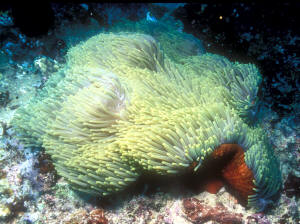
anemones. H. crispa, fdg.
2/8/13 Anemone Ate Hermit Crab - 7/18/07 Hi!, <Hi Sol!> Today I bought some tiny hermit crabs, no more than 1cm across. When I put them in they started to walk around the tank. Before long one of them had found <it's way(?)> in into the tentacles of my anemone (Heteractis magnifica). It has now completely consumed the hermit crab into its mouth (about 4cm across). Is the anemone going to be ok? <Should be fine. The anemone will regurgitate the shell/what it can't consume.)> I'm not so worried about the hermit crab, but I don't want it to start eating from the inside out. Can you please offer your advice. <See above.> Thanks a lot in advance. <You're very welcome! -Lynn> Regards, Sol Jennings H. magnifica, Lighting, Feeding -- 7/3/07 Ok, here is the story: In the past I have lost 2, H. magnifica's that arrived in perfect condition. I kept them in my tank under T5 with independent parabolic reflectors. Many people will blame it on the light. However my light is keeping the most demanding SPS under perfect conditions. <I would have to agree this is not adequate lighting for this species. This anemone needs higher lighting than the most demanding SPS. I also don't recommend keeping corals with this anemone.> My LFS who build my tank and is a total expert, said that he kept an H. magnifica for 3 years under T8s! The anemone finally died because some idiot put in a fish that had been washed with a copper solution. <I'm not convinced this was the only factor involved in the anemone's death.> He said then the secret was not so much on the light but on the water quality and the diet. <Lighting, water quality, flow and diet are all huge factors in the survival of this anemone.> The diet consisted on mixing good brand of flake foods with water until it became liquid, then he would grab a syringe without needle of course, and pour the liquid food into the anemones mouth. <Ouch! Force feeding an anemone is not recommended. This can be very stressful on an anemone. Flake food is not an adequate diet for any anemone. They need small portions of meaty foods.> This seemed interesting because my H. Magnifica's never ate the pieces of shrimp I gave them, I placed them inside its mouth and it just threw it out. <Again, never place food in an anemones mouth. Their tissue is very delicate, if torn, your anemone may quickly parish. If your anemone won't willingly take the shrimp, try something different. Small portions of Silversides, Mysis Shrimp, Lance fish, etc. That syringe should only be used to get the food to the tentacles of the anemone, without actually touching the anemone. An anemone will regurgitate what it is unable to digest. Force feeding or too large of portions was likely the cause of it regurgitating. Start out with tiny portions and never feed anything bigger than the anemones mouth.> So has anyone tried to feed liquid foods into a delicate anemone's mouth?. Do they accept it this way? <I'm not aware of anyone force feeding liquid foods.> I blame their deaths on the fact they were rather large and never ate. <Anemones are considered difficult to keep. This anemone is considered most difficult to keep. Collection and shipping alone can be deadly for this species. It is probable that they wouldn't eat because of the stress caused from the collection and shipping. Many, including myself, believe this anemone should be left in the ocean. This anemone is dieing at a faster rate in captivity than it is reproducing in the wild. I hope this helps! Brenda> Feeding new Ritteri anemone I apologize for sending this as
you have so much information already on your site, but I'm finding
some conflicting information from other sources. <no worries> I
recently ordered a Ritteri anemone from Flying Fish. <a
beautiful anemone, but rarely to be recommended (poor import and
captive survivability... never to be mixed with coral or other anemones
either). This anemone, after proper acclimation over days/weeks...
needs brighter light than even the most demanding coral. Metal halides
for aquaria over 20-24" for this species> It arrived and is
beautiful and appears healthy. It quickly climbed to the top
of the tank, where it has stayed for several days. <very
typical Ritteri behavior... they starve for bright enough light> It
is a large specimen 8-9 inches across. My question is what to feed this
beast. Your site references finely shredded marine meats in
several places, but I find other sites that say pieces of shrimp or
squid the size of the anemone's mouth. <no harm in
feeding the minced pieces... possibly (likely in time) damage from
tears with too large chunks> Could you clarify what types of food
would best support this new addition to my system?
<Mysis shrimp, Pacifica plankton, shredded raw food shrimp, minced
krill> Thanks much as always, Scott <lighting is most important
here bud. Very bright and maintain water clarity (weekly carbon, water
changes, etc). Anthony> Heteractis magnifica anemone Good morning! <Howdy> I have a 65G with 4x36" VHO lamps (4x95watt). 75lb of LR and a few corals, but growing. The water quality is very good (no ammonia, nitrites, nitrates) and I add the SeaChem supplements (Reef Plus, Reef Complete, Reef Calcium, Reef Advantage Calcium, Reef Builder). I have a "happy" pair of Amphiprion ocellaris clowns and I would like to add an anemone. <I almost hope that you do not. Anemones generally do not fare well in captivity for hosting clowns and the are sure to fail if you also keep other corals or anemones in the tank. They generally require more lighting to survive than a full blown reef tank and most people are not willing to spend that kind of money. If you are truly endeared to the thought of keeping these cnidarians... then please set up a species tank with only the anemone and these clowns IMO> The only reason I want the anemone is so I can watch my clowns. <again... most anemones in captivity suffer for so many reasons... not the least of which is the unnatural feeding of large foods by you and the clowns to the host, the lack of light (halides needed here) and the repetitive contact. Field studies show that there are fare more anemones living in the wild without guests than with> My understanding is that this type of clown does not always "take" to an anemone. <correct... have you read through our archives here? Many pages of articles and FAQs. Begin here: http://www.wetwebmedia.com/marine/inverts/cnidaria/anthozoa/anemones.htm and notice all of the links for this group down the page here: http://www.wetwebmedia.com/marine/inverts/index.htm > My first choice for an anemone would be a Heteractis magnifica, but specifically either a blue or purple one. I've read that there are 3 anemones that ocellaris clowns prefer: Stichodactyla gigantea, Stichodactyla mertensii and Heteractis magnifica. Here's my question: Is the Heteractis magnifica a good choice for my clowns, <it is compatible... but one of the most difficult anemones to acquire healthy and keep healthy in my opinion. A brown carpet anemone would be a much better choice> will the color affect the chances of them "taking" to the anemone, <nope> and how do I encourage them to "take" to an anemone? <in will come naturally or not. No tricks needed> Thank you in advance for your help. <with pleasure and hope that you succeed> I saw on your site that you recommend reading Dr. Ron Shimek's pamphlet called "Host Anemone Secrets". <just one of many references to consider> Where can I find it? <numerous places on the web. Some of our sponsors on wetwebmedia.com carry it... but have you also simply tried a keyword search on a general search engine for [buy "Host Anemone Secrets"]? Be resourceful bud. Amazon.com also sells it I'm sure.> Regards, Jeff <kindly, Anthony> Ritteri Anemone Not eating Hello Again, I purchased a Ritteri Anemone 2 weeks ago, I have been trying to feed it silversides, Krill Mysis, and other food. It will not eat for some reason. <Mmm, something important to impart to you re: other animal groups and subjectivity of reality... You are very likely familiar mainly with other warm-blooded animals... e.g. birds, dogs, cats... Anemones are different in a fundamental aspect... in their rate of reactions, acclimation to new settings... Your addition is just starting to settle in... I might've used the comparison between your referent to time going by, with that of a Galapagos tortoise and a hummingbird...> There are a pair of clowns that made it their home. <Oh, and these are likely feeding it... foods, scraps, their solid and liquid wastes... many anemones actually need very little offered "food"> It's in a 29 gal tank, 0 ammonia, 0 nitrite, 30 nitrate... <This is a very dangerously small volume of water... the changes that take place in little bits of water/aquariums, the changes that anemones and other cnidarians effect in their immediate environments (greatly diluted by larger systems, the seas) can create a deadly, unstable, toxic situation... in short order. I would NOT keep this animal in less than a hundred gallons of water.> Water changed every week. I add all trace elements, 130watts PC lights. I spoke to the LFS they stated they do not know why it will not eat. Another strange thing is, I had one before and it moved all the way to the top of the tank, But then I only had about 80 watts lighting. The mouth is tight and good color, the toe has no signs of rips, tears or any damages. It looks healthy and tentacles are all out. Do you have any Ideas? Thanks. Kim <Lots... sorry for Anthony to see the Steelers go down in flames... but re your anemone, you have a bit of studying and soul-searching to do... its husbandry is too difficult in the present circumstances... You would do well to read over our archived materials, starting here: http://www.wetwebmedia.com/marine/inverts/index.htm scroll down to "Anemones, Actinaria"... and read my friend. Bob Fenner> Ritteri Anemone Hello Mr. Fenner, <James here for Bob> I addressed this to you because my wife wrote you a while back ago about a Ritteri we purchased. It is still alive and of course did okay for awhile. The anemone is in a 29 gal with 2 Maroon clowns at this time. I am putting finishing touches on my 300 gal. (Let it cycle). I change water every week. Parameters are fine. There is 130 watt P.C. on it right now. It has attached to the side of the tank (Which I know this is normal) but it never did climb to the top like they do. It stayed in the main flow of the pump which is about 400gph. When purchased, it Had a good looking toe. No rips or tears or signs of healing from tears. When purchased It was on a flat rock. I wouldn't take it with out it. The mouth was tight and closed, no gaping. The mouth is still in great shape. I tried feeding it , it eats once in awhile for me, but the clowns spit Mysis, and Spirulina flakes in the middle. It closes up and digests and then opens up. Now here is the problem, The toe started to turn whitish, on the part that sticks to the glass. Then it got concave like ( In the middle it is detached from the glass, but the ends are still attached to glass). The past dew days it has not fully opened and falls almost all the way off the glass. (Here is the funny part- not so funny) At night 30 minutes after the main lights are out, moon lights on, it re- attaches to the glass all the way. It stays there until the main lights go back on during the day time. It is almost like the light is too much for it, I did not think that was possible. Ammonia 0, Nitrite 0, Nitrate 20. I do add Iodine,<you need to test for levels of iodine. Too much can be harmful. It is hard to know how much of this the animals absorb.> Vitamins (To water) and Iodide. I have a sump rated for 180 gal. and a protein skimmer. I do notice the Maroon clowns, especially the female, really is very rough with it, but boy you stick your hand in there for cleaning and forget it. She broke my plastic spoon, and before she laid eggs last month she re-arranged the tank moving rocks 3x her size. I called my local fish store and they have no clue. They told me when it dies they could get me another one. That's a real great response!, how does that help this one. Anyway do you have any suggestions, I have never seen a anemone act like this. <I do think your lighting is borderline for this anemone. They do require strong lighting and water motion. They generally do poorly in the home aquarium but with care and proper conditions some have lived for years. What I would start doing is a 10% water change with an enriched salt mix such as Reef Crystals, make sure that iodine level is safe and keep the light on for 12 hours per day. Cut out direct feedings for a while since it sounds like the clowns are giving it enough. The anemone does provide a great deal of it's own food by photosynthesis providing the lighting is intense enough. What type of filtering are you using? James (Salty Dog)> Thanks, Scott Ritteri Question Hi! <Hello! :D> Could you explain why my 3 percula clown fish keep knocking and taking the pieces of cockle I place in my anemone out of it? <Simple - they want the food!> I had a magnifica anemone which I only had for a month before it suddenly died and have just bought another similar anemone 2 days ago which looks great. <Problem with these guys is they require extraordinary amounts of light (I know of several specimens that have parked themselves directly under 400w halides) and require tons of flow (in the thousands of gallons per hour). They're very difficult to keep in captivity and I usually never recommend attempting one without years of anemone keeping experience> The clowns took to it within minutes of it attaching to a rock in the tank but keep knocking any cockle it has in its tentacles out. Should I leave the feeding of it solely to them and it's reliance upon whatever it gets floating in the tank or persevere with trying to hand feed the cockles? <Definitely not - keep the fish away from the anemone while it eats, and feed it well while it's acclimating> I also have a problem with feeding my white blue-tipped Malu any cockle etc, before it gets chance it's whipped away by my coral beauty angel fish-any suggestions? <Scare the fish away with a net or your hand while they are ingesting their food. Please read our archives regarding Ritteri (magnifica) anemones, and see the sticky posted under the anemone & clownfish forum at reefcentral for more info> Many thanks in advance <You're welcome, good luck!> Mandy <M. Maddox> Moorish Idol Survivability (Poor), feeding a big Ritteri anemone
- 10/12/05 Hello All, <<Greetings>> I want to try to
get two topics for the price of one. <Alrighty>> All is well
nothing sick, just general questions of curiosity. <<ok>>
The first is my Moorish Idol. <<Mmm...>> I have had him for
about 6 months. When I bought him he was a little under weight and had
a cut on him. He is doing awesome. <<For now maybe.>> His
color is vibrant, cut has been gone for months. He is about 6-8"
so he is good size. <<agreed>> He is eating, Seaweed
Selects, frozen Mysis, live worms, alga wafers, you name it he eats it.
<<Sadly, this usually still proves to be insufficient with these
fishes.>> He is the first one in line when I feed, also eats
flakes. When I first got him all he would eat is wafers. My question
is, I was reading a article that stated no matter how good they do,
they will perish. Something about a enzyme they eat in the wild, that
we can not produce in an aquarium. Is this true? <<Not familiar
with the "enzyme" theory, though it does go with what
I've heard/read as far as not being able to accurately reproduce
the dietary requirements for long-term health/vigor. I've been in
this hobby a long time and tried; albeit unsuccessfully, to keep
Zanclidae more than once (has been more than 10 years since my last
attempt). They all would eat, seem to be healthy...but then one day,
two or ten months down the road, you come home or get up to find it
dead in the tank for no "apparent" reason. All you have to do
is look around you...how many Moorish Idols do you see on display, or
in other hobbyists tanks (long-term)? It's not because they
don't have appeal/are not available to the trade. I wish you luck,
but this is another specie best left in the sea.>> Secondly,
about 2 months ago I purchased a Heteractis magnifica. It has a
extremely deep, colorful purple base. Never have seen one like this. It
is about 24" wide. It is huge! <<And will likely get
bigger.>> I have read conflicting articles on FAQ's and
others. Some say to not feed it at all, let the clowns do it (They do
but not much). <<Mmm, nope...needs to be fed.>> Some say to
feed it chopped silversides 1-2 times per week. <<Not the best
diet...do provide some variety...chopped table shrimp/fish.>>
Others say once a day. <<Maybe more like 2-3 times a
week.>> Due to the anemone being so large, I have been feeding it
chopped silversides and shrimp daily. It seems to be doing well.
<<This might be fine (small portions). Let the anemone's
health/appetite be your guide.>> I just am trying to be pro
active and not reactive. <<Does pay dividends.>> Thank you
for your valuable time. <<Happy to assist, EricR>> |
|

|
Features: |
|
| Featured Sponsors: |