Become a Sponsor

 
Home
Information Pages:
Marine Aquarium
Articles/ FAQs
(enter words you'd like highlighted in this page)
Freshwater Aquarium
Articles/ FAQs
Planted Aquarium
Articles/ FAQs
Brackish Systems
Articles/ FAQs
Popular Pages:
Features:
Daily FAQs
FW Daily FAQs
SW Pix of the Day
FW Pix of the Day
Conscientious Aquarist Magazine
New On WWM
Helpful Links
Hobbyist Forum bb.WetWebMedia
Ask the WWM Crew a Question
Calendars
Search Feature
Admin Index
Cover Images


FAQs on the Hydrozoan Identification 5

Related Articles: Hydrozoans, Cnidarians, Fire Corals, Stylasterines, Hydrozoan Jellies,

Related FAQs: Hydrozoan ID 1, Hydrozoan ID 2, Hydrozoan ID 3, Hydrozoan ID 4, & Hydrozoans 1, Hydrozoans 2, Hydrozoan Behavior, Hydrozoan Compatibility, Hydrozoan Selection, Hydrozoan Systems, Hydrozoan Feeding, Hydrozoan Disease, Hydrozoan Reproduction, Medusoids/Jellies (Ctenophores, some Hydrozoans, Scyphozoans): Jelly Identification, Jelly Behavior, Jelly Compatibility, Jelly Selection, Jelly Systems, Jelly Feeding, Jelly Disease, Jelly Reproduction, Fire Corals Lace Corals, Stinging-celled Animals

Hydroids? 10/2/2009
Howdy folks!
<Wilhelm!>
What are the critters in the attached pictures? Evil stinging hydroids that will destroy my tank and try to eat my kittens?
<Nice looking cats>
(Ok, I'm being a bit extreme) Or am I lucky and they are something more benign that will leave the kittens alone, and not wipe out my tank. I hope the kittens don't wipe out my tank :)
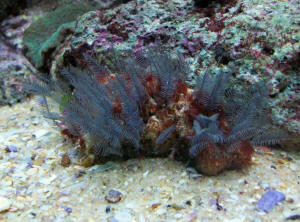
One of the pictures has my cleaner shrimp in the back to give some perspective. There is a cluster of tubes with brown heads, the tubes are only a few mm long. Would I be so lucky that these are cluster dusters?
<Could be...>
You can find the full size pictures at
http://william1034.smugmug.com/Aquariums/Hydroids/9821207_PoQQT/1/667248278_oPb46
Thanks,
William
<Might be Hydropolyps... but are small, interesting even... I'd leave them on the one pc. of isolated rock. Bob Fenner>


Distinguish Between Hydroids And Bispira Cluster Dusters 9/12/09
Hello,
<Hi Vivian>
First of all I would like to thank you for this wonderful resource. I have and continue to learn SO MUCH in this great (but addictive hobby).
<You are welcome my dear, glad you enjoy.>
In any case, I have been searching through all your pages, but I cannot resolve this issue. I have little beasts in my LR which, according to pictures from some web sites are described as beneficial Bispira fun worms . On the other hand, in some of your pages you do show pictures of hydroids that look awfully similar to photo 1 (see photo).
<What photo?>
Do you have any pointers on how to distinguish between hydroids and Bispira?
<Hydroids are any of numerous, usually colonial marine coelenterates having a polyp rather than a Medusoid form as the dominant stage of the life cycle. Hydroids have a simple cylindrical body with a mouth like opening surrounded by tentacles. Most species form colonies with individual hydroids branching off from a common hollow tube that is probably used for sharing ingested food.
Bispira are basically a tubeworm and/or feather duster where the "duster" is the crown of a worm that lives in a tube, and it is both a feeding apparatus and a breathing gill.
Hydroids do not have or retract into a tube. I nice pic of a smaller colony of Bispira for comparison can be seen here.
http://commons.wikimedia.org/wiki/File:Bispira_sp._(Tubeworm).jpg>
Thank you SO MUCH
<You're welcome. James (Salty Dog)>
best,
Vivian

Re Distinguish Between Hydroids And Bispira Cluster Dusters 9/13/09
Thank you SO much James.
<You're welcome.>
That is a beautiful picture! From the practical point of view, given that my Bispira or hydroids are so very tiny (I have to get a magnifier glass) that I can not really go through the description with the necessary detail, Do you think that then, an easy way to tell would be to touch the prospective crow/ tentacles to see if they retract?
<Do try, if they are dusters, the crown will retract instantly, revealing the tube..>
As an aside, I HAVE seen these tiny jellyfish kind of thingies beating around the tank ( I do not have a camera good enough to show, but they look like brown transparent umbrella shaped creatures of about
5mm.....I guess that would be consistent with hydroid medusas (no?).
<Can be, dusters/fanworms do not roam.>
all the best,
<And to you. James (Salty Dog)>
Vivian

Worm ID and pics.   7/27/09
Hello crew!
<Duane>
I've been keeping fish (fresh and salt) for about a year and a half now. I discovered your site fairly quickly after getting into the hobby, and it has been an invaluable resource--thanks for all you do. I also have Bob's CMA book, Bob and Anthony's Reef Invertebrates book, Borneman's Aquarium Corals. I have several other texts, but these are my key references.
Between these and the FAQ's on WWM I've never had a need to send an email to the crew before.
<Welcome to the camp!>
I'm wondering about the identification of a type of worm
<Mmmm>
I have in my chain of little reef tanks. I'll spare you (many of) the tedious details except to say that the system is comprised of a 20 gallon long that is partitioned into a small settling chamber/skimmer pump compartment, overflowing into a slightly larger refugium with DSB and Chaetomorpha that goes to the surface, overflowing into a ~13 gallon display portion with LR, multiple filter feeding organisms, soft and LPS corals, a purple Firefish, and one fat, happy spotted mandarin. This overflows into a 12 gallon Nano Cube with more rock, soft corals, gorgonians, Corallimorphs, a Wheeler's shrimp goby with tiger pistol shrimp, and a Banggai Cardinalfish. A powerhead in the sump of the cube sends water back to the skimmer compartment to flow back down again. The skimmer is rated for a 75 gallon system and runs about 17 hours a day. I feed fairly heavily including a wide variety of frozen and dry foods, live BBS, and Phyto-feast Live. The system has been established for about 16 months now and has a very healthy and diverse microfauna population including spaghetti worms, (friendly) bristleworms, pods galore, etc.. Even the portion with the mandarin has pods crawling all over the glass at all hours.
There is one worm in particular that has had a strong presence in the tank for some time now that I find very interesting and have not seen in any of my books. I've been through all of the Worm ID FAQ's here now and have found a couple possible matching descriptions and blurry photos, but not enough for anyone to make an ID. I recently managed to get a couple decent photos of one and they are attached.
<See them>
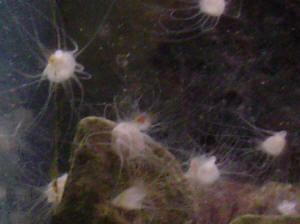
This worm is white with small appendages all over it's body; it has an appearance kind of like a feather boa. Single specimens are maybe .5 cm in length when fully retracted, but can stretch out to maybe 10 times that length. They tend to attach at one end to rock or to macro algae--I first noticed these among the strands of Chaeto in the 'fuge. They stretch out into the water at the mercy of the currents, apparently feeding on suspended organics, and contract every now and then in quick, jerky motions. Then they slowly stretch back out to feed some more . The photos show the worm extending from some c Caulerpa on my blue tuxedo urchin. It's at about center frame, extending to the right of the urchin. It's shown at near full length in one shot, and not quite as near its shortest length in the other. I'm not worried about these guys' presence, I'm sure they're good for water quality and all that , but I am hoping these pictures are good enough to give an ID more specific than "some kind of worm". I was thinking maybe they're nemerteans of some sort, but I'm not even sure of that. Any ideas?
Thanks again for the great site,
Duane Harvey (near Detroit)
<I am strongly leaning to the side of this being a Hydrozoan... Please see here: http://wetwebmedia.com/hyzoanidfaq.htm
and the linked files above... I would try to "tweezer" it out. Bob Fenner>

Re: Worm ID and pics. 7/27/2009
Bob,
>DH<
Thank you for the quick reply (original exchange copied below) . I never would have guessed these to be hydrozoans, I'm glad I asked! I have had transient populations of Hydrozoan jellies in the past, and there is a small spot on one of my rocks that intermittently sprouts a half-dozen or so tube-dwelling hydroids, but they have never spread beyond that spot or been a problem so I've left them alone.
<I think this is wise>
The white guys I sent the photos of are solitary, not colonial, and their appendages are randomly placed rather than pinnate or bilateral; those two things threw me, I guess.
<Perhaps I as well>
I said they have a "strong presence" in my system, but that was overstating things a bit. A small but persistent presence is more like it.
I've never seen them close enough to any of my corals to touch them, and individuals seem to come and go fairly quickly. It may be that the Lysmata wurdemanni I keep in the display areas to control Aiptasia are also munching on the hydroids. In any case, I'm not really inclined to go plucking them out just yet, but I'll keep an eye on their numbers for sure--I have been warned. These have been one of my favorite micro-critters in the system since I first spotted them for their otherworldly appearance and behavior.
My nitrates have been unmeasurable (API test kit) for some ten months now, a plague of hydroids seem unlikely to me if I stay on top of things. Of course, I could be wrong...........
Thanks again, and I was happy to see one of the photos made it into the FAQ.
Take care,
dh
<You as well Duane. BobF>

Re: Worm ID and pics. – 07/28/09
Hello again Mr Herr Sen or Fenner!
<Heeee! Just Bob will do Big D>
I think I have identified the genus of the mystery hydroid--this is getting REALLY fun! It appears to belong to the genus Candelabrum, formerly known as Myriothela. See Julian Sprung's article at:
http://www.advancedaquarist.com/issues/june2003/invert.htm
<Ah yes>
Dr. Ron Shimek covers the genus in his Marine Invertebrates book on page 33, but the photo shows a fully contracted specimen, which is not the state in which one normally spots these things in the tank. After a closer look at those in my tank when fully contracted, the photo is actually pretty darn close. I find his descriptor of "finger-like" projections when extended to be somewhat misleading as well; I think the phrase "worm-like" is a bit more like it. My annoying nitpicking aside , some digging around shows that there is not a whole lot of knowledge on this (mostly temperate) genus, though descriptions of Myriothela in the literature can be found well back into the 19th Century. Some hobbyists have reported plague populations with corals suffering and the hands (or nematocysts) of these animals, while others report only small populations that come and go without incident. Most seem find them as interesting to watch as I do.
<Outstanding!>
If you have any use for it, I can try to remove one from my tank intact and get some pictures of it under a microscope we have here at work.
<Mmm, no thank you>
Thanks, Danke, Gracias,
dh
<D'oh tashi mashiite my friend. BobF>

What is it question 01/22/09
I have posted this on a couple of forums and have gotten various responses.
My tank is about 6 months old. I have added rock, sand and frags from several different tanks and locations. They showed up one time and thinking they were aiptasia I used pickling lime on them.
<Not aiptasia>
They have shown up again and in two different locations so I thought I should ask what they are.
<I believe they are hydroids.>
They are pretty small, about 1/16 in diameter to give you a scale. Two pics: one is under 20k MH with 460n actinic (darker one) the other is with same lighting with flash bounced in from the top. What is it?
<I'm 95% sure they are some type of hydroid (the brown proteinaceous tubes give them away).>
Thanks, Steven
<De nada,
Sara M.>

Well done. RMF
<I agree with Sara, these are likely colonial Hydroids, probably family Tubulariidae, possibly even of genus Tubularia or related. Should not touch sensitive corals, may become a pest or simply vanish someday within a short time. Nice pictures with great detail. Thanks for sending. Marco.>

Hydroids? Maybe Not – Possible Spirorbids? 1/21/09
<Hello there>
I have these strange white spots that started on one side of my 125g reef tank and have started to spread across the whole tank, including the LR. I read on another forum that it very well may be hydroids.
<Unfortunately, I can’t see any individual well enough to determine exactly what you have. They could be the extremely common and harmless Spirorbids (filter feeders) or Hydrozoans. Take a close look at one with a magnifying glass. If it looks like a very small (no larger than a couple of mm) hard white spiral, then it’s a Spirorbid. If it looks like a soft white blob with tentacles, then it’s likely a Hydrozoan. Please see the following links for more information/photos:
Spirorbid (see photo on the right at FAQ titled “Oh Mich.... ID Spirorbis spp. and possibly Collonista spp. – 09/29/07"): http://www.wetwebmedia.com/snailid12.htm
Hydrozoan (see FAQ titled “Help identifying 2 pics? 06/21/08”): http://www.wetwebmedia.com/hyzoidf5.htm
I have had coral, Zoas and mushrooms, for about 6 months. I have attached links to the photos. If it is hydroids, I have read that tear down and sterilization is the only way to eradicate them. Am I, and my coral, doomed?
<Not necessarily! Let’s first confirm exactly what you have and go from there!>
http://s488.photobucket.com/albums/rr249/mantisman51/?action=view&current=hydroids003.jpg
http://s488.photobucket.com/albums/rr249/mantisman51/?action=view&current=hydroids001.jpg
<I’m hoping that you do indeed have Spirorbids instead of Hydrozoans, but if not, let me/us know. Take care, -Lynn>


Brown Plant Growth 11/27/08
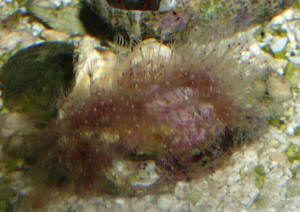
I have a 300 Gal reef, established over one year, lightly stocked. (3) 400 Watt 10K MH, all parameters look good. This brown plant growth on the rock comes and goes in cycles every two weeks or so. About 1/2 inch growth, with fine thin leafy tops. I brought a sample to the LFS, they could not find any critter who would eat it.
Thanks, Steve
<Hmm... I could be wrong, but these look like hydroids to me.
http://www.wetwebmedia.com/hyzoanidfaq.htm
Best,
Sara M.>


Deep Water Coral Identification 11/16/08
Hi There. I was wondering if you guys would have any insight to what kind of coral this might be? I was fishing off of the Florida Keys where I live. We were fishing a large hump that comes up from 1300 ft. to about 600 ft.. On top of this hump we snagged this big coral on our line, which we thought was a fish at one point. when we got if to the surface It was something I have never seen before. I work for a company down here which supplies Caribbean life to zoo's and aquariums all over the world, and it has stumped everyone.
<I do think it must be a hydrocoral of some kind. A close-up pic of the polyps would make it easier to ID with more certainty. I would also be careful not to be breaking the law here. If it's a protected species, it might get you into trouble taking it home... but I'm sure, with your job, you know about all that. :-)>
Any suggestions on whit it is and maybe the best way to try and keep it alive?
<If it is indeed a Hydrocoral from 600ft then it likely doesn't need much, if any, light. It will need quality feeding... they are not too difficult to care for if they were healthy when you get them (which this one appears to be).
Best,
Sara M.>

Hydroid, ID, control...   11/14/08
Hello all!
<Mariusz>
I was hoping you could give me an ID (ie. scientific/common name) on this Hydroid. It was taken from: http://www.wetwebmedia.com/hyzoanidfaq.htm (i have also attached the same pic). I have a bunch of these in 120 tank with about 140lbs of live rock.
<Mmmm... can't tell the species from this small pic>
I recently took all fish out of the tank to let run fallow after a parasitic infest. Most corals have been removed (for other reasons). All that is left are a few mushrooms and leathers, peppermint shrimp, hermits.
The tank has been running fallow for 6 weeks now and I'm in no rush to put my livestock back in. Also for 6 weeks I haven't put any food in the tank either, it's just been running with Deltec skimmer (which hasn't produced much as I have almost no livestock and no feeding).
So questions:
1) are these hydroids a danger to fish? not sure how potent the sting is.
<Could be... if they're unaware, get too much exposure>
2) How can I rid these with out manual removal as I've been trying for almost a year. Not sure if these guys are worms of some sort and if de-wormer will work, possibly Prazi or other. Is there any biological alternative? Without proper ID its been difficult moving forward towards a solution.
Thanks
<Can be very difficult... frustrating up to the point, extreme, of making it reasonable to bleach/kill all LR, start over with some new LR material placed over, amongst, using the killed rock as base... Otherwise, you might be lucky to discover a predator (perhaps an Opistobranch...), but even here, they wouldn't eliminate all... "So many chickens, so many foxes"...
Bob Fenner, who would bleach, nuke>

Re: hydroid 11/15/08
I've attached 2 pics of these hydroids (pulled out of the aquarium and place them on paper). Is it possible to identify them now? Are they some type of worm?
<Mmm, much more likely tube snails... though could be Sedentariate Polychaete worms... You can tell if/when they're "open" underwater>
Will Prazi or some type of anthelminthic work? Any suggestions besides nuking my system?
Thanks once more
<Mmm, I'd ignore them... not deleterious... you could likely get a crustacean that would predate these... I would not use chemical controls.
http://www.reefs.org/library/aquarium_net/0897/0897_8.html
Bob Fenner>

re: hydroid... snails  11/15/08
Thanks for the link. However, the link describes a mucus string/web produced by these worms but there is no mention of sting. I've had mushrooms die and retract if they are touched by these strands.
<Surprising...>
Would these strands have some type of sting?
<Not as far as I've ever run into>
The link describes animals larger than the pics I sent. Animals in my system have diameters of 1mm or less. So I take it they are not hydroids?
<Not hydrozoans, Cnidarians... are Mollusks, Gastropods. B>

re: hydroid 11/15/08
I'm in complete agreement with you after further surfing...just have to figure out why the mushroom died and why any softy kinda retracts when the mucus strands are out. Perhaps its something else I haven't noticed. I'll be keeping a close eye. Thanks for all the help!
<Certainly welcome! BobF>

Re: Question about hermit crab growths  10/6/08
Thanks for the reply. I got a somewhat better picture of it, still not GREAT but hopefully helps you out a little more than the last one.
Grant
<Ahh, thank you for this pic... do look "Polypoid"... am more sure these are indeed Hydroids/Hydropolyps... There are many "kinds" as you will see... as long as these don't spread to your hardscape, I would count your Hermit lucky to have such a built in defense. Cheers, BobF>

Oh yeah

Purple Feather Weed? Could Be Feather Hydroids! 9/13/08
Hi Guys and Gals,
<Hi there, Andrew>
While snorkeling today (thank God it’s warm enough to get in the water again!) I came upon this fascinating (to me anyway) feather-like organism.
<it’s neat looking, that’s for sure.>
I couldn't help but lift a small piece off the rock for an experiment in my 20Gal.
<Were you wearing gloves at the time?>
Tank is currently about 2 months old, cycled with 6Kg semi-cured live rock, and live sand. Ammonia, Nitrite @ 0, and Nitrate is at about 10 at the moment,
<Just keep an eye on the nitrates, don’t let them get above 20ppm.>
temp steady at 26 Deg C, and salinity is 1.022
<Salinity’s a little on the low end, but okay.>
Stocking is 1 bicolour Dottyback, 2 tiny blue/green chromis, 1 even smaller yellow coral goby, 3 small hermits, and about 8 snails. All very happy in their current home.
<Good>
Which brings me to my actual question.... What the heck is it!?
<I sincerely hope I’m wrong, but those sure look like feather hydroids to me (Family: Plumulariidae). If so, they’re not the best addition to a system, to say the least. Also, after going in for a close-up, that red macro-algae on the right side of the rock looks very similar to a variety that can be invasive and very difficult to control.>
I found it in full sun at a depth of about 9' (growing on a football sized tunicate)
<Wow!>
..in a bed of sand held together with fine hair algae. It came away in a nice clump about 2" across. It now graces the front of a lightly stocked tank. Each "feather" is separate from the next, and grows just like a real bird feather would,
<Yep>
looking side on, you can see a single "tap" root about the length of the feather itself.
<That long “tap” root along with the unusual color is what’s keeping me from being absolutely sure those are hydroids.>
I'm pretty sure in between the main subject of the pic is some juvenile Dictyota,
<It looks like a Rhodophyta/red algae of some sort, but I can’t see it well enough to narrow it down further. Dictyota is a brown algae (Phaeophyte) that’s usually green, yellow/brown, or even blue. I’ve never seen red. It could be something like Scinaia.>
..but cannot find any reference to the feather like growth (which I find most attractive),
<I find it very attractive as well. By the way, I couldn’t find any similar looking macro-algae in that color either - and I was hoping I would!>
..but am a little cautious of!
<Good call! Hydroids can sting the living daylights out of you. Please see the information and species “Gymnangium” half-way down this link (as well as associated links at the top): http://www.wetwebmedia.com/hydrozoans.htm
Here’s a good close-up of a feather hydroid. Note the similar, almost bumpy/broken appearance of the “branches”. Those bumps are actually individual feeding polyps that have little stinging tentacles surrounding them: http://www.poppe-images.com/images/image_info.php?picid=929540 .>
If you could help identify it, I would be most appreciative.
<Well, I’m pretty sure those are hydroids, but I’m hoping Bob will confirm or deny.>
I make an effort to Identify everything I can myself,
<Good for you! Not only do you get the satisfaction of solving a mystery, you also learn quite a bit along the way.>
..but find it difficult to locate images on your site unless I know the name of the organism I am looking for.
<See below>
Is there an image library somewhere grouped in broad categories like fish, algae inverts etc. that I am yet to find on your site??
<Not a specific image library as yet, no, but it’s been discussed. In the meantime, Bob has the site organized/sectioned off into topics that include many terrific articles with photos of representative species in the most commonly seen genera. Usually that will give you enough information to help narrow things down a bit. Here’s the main page for marine topics: http://www.wetwebmedia.com/marine/index.htm . Just pick a subject, start with the articles for an overview (with photos) and go from there.>
I would love to help myself in future where possible.
<I’d try the above and/or use our Google search engine: http://www.wetwebmedia.com/WWMAdminSubWebIndex/question_page.htm >
Thanks for your time. All the best.
Andrew.
<You’re very welcome, Andrew. Take care, -Lynn>

  Hydroid. RMF
Is this Ich? - 07/13/08
Hi crew -
<Hello Joel.>
Along with all of your other truly valuable services, I am very fond of your ability to educate me by identifying various biological life forms.
<I’ll give it a try.>
I have a silver-tipped pulsing xenia that has been in QT for 21 days as of tomorrow
<Very good quarantine practice.>
, is pulsing quite happily, and I plan to move to the main display tomorrow as well. However, I don't know if these guys are tomonts or just some white filter feeder.
<The latter.>
These images are all at 10x magnification, and image 2553.JPG shows what they look like under normal viewing conditions. Any idea what they are?
<Hydromedusae, also called hydroid jellyfish. See http://www.wetwebmedia.com/jellyidfaqs.htm.>
I hope not tomonts.
<Nope. Tomonts are even smaller. They are 300-500 micrometers and look totally different.>
Thanks, Joel.
<Cheers, Marco.>

Sponge ID... uhh, worse  7/6/08
Hi Bob and Crew,
Can you help us identify this thing (we think it's a form of a sponge) growing from under our Goniopora. All of our parameters have been good, we just noticed this one night when the Goniopora had gone in. Picture is at:
http://photo.evasionoftruth.com/g1/aquarium/IMG_0849cropped Its directly in the center growing from under the frag disc. We are wondering if we should remove it, it appears to be a filter feeder as it does not retract when we touch it.
<... is a Hydrozoan... and is stinging the bejeesus out of the Poritid... needs to be removed, scrubbed clean (with vacuuming if done underwater) entirely. Please read here: http://wetwebmedia.com/hyzoancompfaq.htm>
Keep up the great work on the site, we use it daily to find out things about having a reef tank.
Thanks,
Buster
<Thank you for sharing Buster. Bob Fenner>

Help identifying 2 pics? 06/21/08
Dear wet web media,
I have searched way too many hours on these things growing in our saltwater aquarium (120 gal). It's been established for a couple years now, but I am noticing these things multiplying recently. I've attached a pic of some of them. They seem to be mostly at the bottom of the tank on the glass. Their tentacles seem to move.
<The pics are really too blurry to make much out... but from your description below, I'd say they're likely harmless Spirorbis worms.>
In the second pic I have many tubes of different shapes. They seem to be growing larger. Some are long & skinny, where this one is kind of boot shaped with an obvious hole in it.
<They look like sponges to me.>
One thing I notice is white specs all over the glass at times. If you look really close they look kind of spiral shaped. I sort of think it looks like a snail (and I have hundreds of different sized baby snails that just keep showing up). Cold they be reproducing?
<Could be... are these things stationary or mobile?>
Thank you for your help.
Kristie
<De nada,
Sara M.>

Re: help identifying 2 pics?   6/22/08
Just to clarify, I have two things I am trying to identify. One is the specks that show up on the tank glass, that develop into spirals. I'm just
curious about these. Was wondering if they were snails reproducing.
<possibly...>
The one I am most concerned with is the tentacle like things that are multiplying on the glass near the bottom of the tank. Please let me attach
one more pic that is a little more close up. Maybe you can identify it better. These don't seem to move at all, although the tentacles or arms
(like hairs) seem to be alive & moving (not just with a current). They worry me that I should be getting rid of them. I probably have 20-30 of
them that have developed in the last month or two.
<Ah, now I can see them... looks like Hydroids.
http://www.wetwebmedia.com/hydrozoanfaqs.htm>
Thank you for your time.
Kristie
<Best,
Sara M.>

Ohh, Hydrozoans. B

Identification – likely Hydroids – 05/27/08
First off, thank you all for being so kind as to help identify a coral I have asked about before, and now have a larger image of so you can get a better look at the rooting/matting system of it.
<Please send earlier correspondence along when mailing follow-up questions.>
I have been told that this is anything from Hydroids to Clove Polyps, none of which I believe it is.
<Add me to the ones saying Hydroids.>
It grows really well.
<Hydroids do so, especially nasty ones.>
I took the first clump out in November, and here it is again creeping onto the rocks.
<People have left the hobby because of these things.>
It does not sting, and it doesn't suffocate anything that I can tell...
<Can possibly hurt and eventually kill corals.>
I really like it, but I don't want to harm anything, so if someone could please help to properly ID this, I'd greatly appreciate it.
<Likely hydroids of the family Tubulariidae, possibly even genus Tubularia (compare to internet and literature pictures) or related. Should not touch sensitive corals, may become a pest or simply vanish someday within a short time. Cheers, Marco.>

Gorgeous pic. RMF


Featured Sponsors:
Google
 
Web www.WetWebMedia.com