|
FAQs on Marine Infectious Disease
(Bacterial, Fungal, Viral) 4
Related Articles: Infectious
Disease, Understanding Bacterial
Disease in Aquarium Fish; With a gallery of bacterial infections,
a discussion of 'Fish TB', and a listing of major
antimicrobial medications with examples available to
fishkeepers By Myron Roth, Ph.D.,
Related FAQs: Infectious
Disease 1, Infectious Disease 2, Infectious Disease 3, & FAQs on
Infectious Disease: Identification,
Causes/Etiology, Cures/Medications, Case Histories:
Bacterial, True Fungal & Biological Cleaners, Cryptocaryon,
|
|
|
Mycobacterial Infection
3/26/20
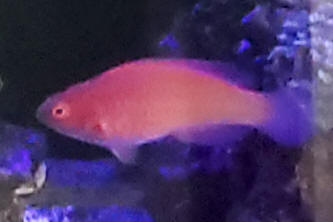
Over the last month this wrasse started to get a really big belly. I thought
it was just to being overfed a pellet diet as I was trying to gotten up a
skinny Kole tang. Its looks a little hump backed though right? Obviously
with my past experience Fish TB is always on my mind.
<Mmm; well... don't know re Myco- or other bacteria here... could be some
sort of retention (fluids?), an internal growth (tumor?)... I would (myself)
not move or "treat" this fish in any way; but continue to maintain it as
you're doing. Bob Fenner>
|
 |
|
Re: Mycobacterial Infection 3/26/20
Did you mean not remove the fish?
<Ah yes. Correct. B>
Re: Mycobacterial Infection 3/27/20
Thanks. I am going to try and fast the fish or limit the feeding of the tank
for a few days. May also try feeding some peas and using some Epsom salt in
case its bloated from eating. Otherwise it's still acting 100% normal and is
the most aggressive eater in the tank.
<Sounds good Eric. BobF>
|
Re: Mycobacterial Infection
6/27/19
Bob,
<Eric>
Sorry to open this inquiry back up. Not sure if you recall but I had
also
sent you an email regarding polyp extension on my Acros. I was actually
going move all my soft corals and anemones out and setup a new tank for
them giving me more space to increase flow space out some of my sps
corals. This entire myco infection has got me concerned about
contamination of the new tank even though I know mycobacterium marinum
is
omnipresent to a degree.
<Yes; but varying in "potency".... infectiousness if you will. As long
as
your livestock is healthy, system optimized and stable; not much chance
of
expression>
Would removing the coral not attached to rock and anemones likely result
in contamination. I have read for hours and most of what I have been
able to find pertain to zebrafish studies. I haven't seen any studies
that apply to the casual aquarist in situations like mine.
<Not much science per hobby conditions, no. I would do your best to
provide
good maintenance and try not to worry re Mycobacteria. Bob Fenner>
Thank you! 10/20/17
Needed info on bacterial infections and read
article by Myron Roth. It was both detailed and helpful. Very
much appreciated.
Best Regards,
Adrianna Laszlo
--
<Have sent on your kind words to Myron. Bob Fenner>
Queen angel fin rot; using WWM 2/4/15
My queen angel was doing well and I had a bit of an ich outbreak. So I
put all my fish in a quarantine tank and treated with Cupramine. Now the
Queen angels front fins are disappearing. Could it be fin rot and if it
is how do I treat this?
<... see WWM re Finrot, AND Cupramine use, copper poisoning. Bob Fenner>
|
Watanabe Angelfish Emergency - Diagnosis Please!
4/1/13
Hello,
<Nicole>
First off, thanks as always for the great site and great knowledge!
<Welcome>
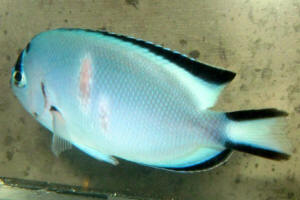
I was given this Watanabe angel by a LFS since she had black
Turbellarian worms and Amyloodinium.
<And a very bad apparent bacterial infection>
Needless to say, she was near death when I got her, but she's come around.
Now...she has this horrific thing. What is it? I thought it was
either Vibriosis
<Could be>
or Uronema. More details below.
First night...(Thursday)
- Acclimated
- Freshwater dip w/ Methylene blue @ 30 minutes (worms seemed gone)
- Placed into QT tank w/ formalin
- No appetite
<... more weight to gastroenteritis from Vibrio>
- Gasping at surface...breathing rate around 180 breaths/minute
<Stress period... osmotic shock/imbalance, hemolysis due to FW
immersion, handling>
Second night...(Friday)
- Freshwater dip w/ Methylene blue @ 10 minutes (velvet lessened)
- Placed into new QT tank w/ formalin
- No appetite
- Breathing slowed to ~70 breaths per minute
- Noticed lighter patch on her side
- Very twitchy
Third night...(Saturday)
- Freshwater dip w/ Methylene blue @ 10 minutes (skin nearly clear)
- Placed into new QT tank w/ Furan 2
- No appetite
- Breathing is good
- Patch worsening...grows noticeably larger w/in hours
- Very twitchy
Fourth night...(Sunday)
- Added second dose of Furan 2 as per instructions
- No appetite
- Breathing is good
- Patch is really bad...might've hit the blood stream?
- Noticed second patch starting
- Very twitchy
So... at first I thought Uronema, but I would've thought the 3
freshwater/Methylene blue dips plus the formalin baths would've curbed
it.
<Yes; agreed>
Then I thought Vibriosis, but the Furan 2 isn't helping either. Did I
start the Furan 2 too late? Any other ideas on what it might be?
<Too many to list... I would likely just hope and pray at this
juncture... unless subcutaneous injection (intramuscular) of Furan,
Sulfonamides is not beyond you>
The scary thing is that I had three Anthias in the same quarantine tanks
(they were brand new setups at the time.) They all developed the exact
same thing and died.
<Ahh, bad>
I thought they were fighting and that the wounds were inflicted by the
others. I tried treating with erythromycin (all I had on hand at the
time), but that did nothing.
<... some affect of gram negative bacteria... but not useful w/
Vibriosis>
After they died, I bleached all
the tanks, dried them, and let them sit for about a month before setting
them up for this fish.
What's going on and how do I deal with this???
<Have just quickly reviewed Noga 2d ed. pp. 193-196, and the few
scholarly pc.s via Google on Vibrio in ornamental marine fishes... and
the real answer: "not much". The situation bodes poorly for this
specimen>
I've attached a photo of her
wound. She's the only fish in the QT tank, and this issue started
in the QT tank. Temp is 78 degrees, salinity is 1.025, and ammonia
is maintained at 0 with tank transfers or Amquel.
<I would not move or manipulate this fish further>
Thanks again for all the help!
<I wish I could offer you a/the "miracle cure". Not yet. Bob Fenner>
|
 |
Re: Watanabe Angelfish Emergency - Diagnosis Please!
4/2/13
Mr. Fenner,
<Nicole>
Thank you so much for your timely and expert advice. Unfortunately,
injections are currently beyond my hobbyist-level experience. The
Furan 2 has definitely slowed the progression, but it has still worsened.
I'll continue the Furan 2 treatment and just hope and pray.
<Ah good>
Thanks again - your help really means a lot.
Nicole
<Am glad to share with you. BobF> |
Re: Itchy Fish. SW... disease diagnosis
8/21/12
Bob, I am writing not to argue but it seems we were both wrong here. I
looked extensively on the internet in regards to disease symptoms none
of which that I could find matches bacterial or fungal infections and I
decided as my copper levels were very low and the symptoms did not
resemble Ich or Oodinium I was at a loss, the only symptoms were large
grey blotches over the body and loss of appetite.
<... Microscopic examination...>
Sadly the Regal Angel died. What I found strange is that
descriptions for bacterial and fungal infections listed
symptoms like stringy white matter, red fins etc. I decided to treat
with Mardel Maracyn Plus which contained a part description
matching and after 4 days the Emperor is eating and the blotches are
gone.
<Ah good>
The reason I write is to hopefully help others where the symptoms are
the same without the fast breathing of Ich and Oodinium. Regards,
Adam.
Marine Columnaris? 4/10/12
Mr. Fenner,
Thanks as always for the fast response! However, it left me a bit
confused... Please read my comments below in " {{.}}".
Thanks!
Lindsey
<<Hotay>>
Subject: Marine Columnaris?
Mr. Fenner,
I just found out today that you will be speaking at our local SCRK
meeting this Sunday! I am so excited to get to meet you and hear
you speak! I wasn't able to make it to MAX and was so sad to
have missed seeing you there!
<Ahh!>
{{Funny, is this b/c you're scared to meet me fearing more
questions?
Lol}}
<<Heeee!>>
I'm in need of help once again and greatly appreciate your help in
the past! I recently acquired 6 new fish from another reefer and had
them all in QT together since they all came from the same tank
originally. The second day, the Blue Tang broke out in Ich and
within the next 24 hrs, the Sailfin Tang and Flame Hawkfish also had
white spots. We moved the 3 with symptoms to a 30gal QT and began
the tank transfer method of treatment with FW dips when transferring
between the tanks every 2-3 days. We have kept water params
perfect, the only problem being stray voltage that we discovered the UV
sterilizer was putting off about 3 days ago (got zapped when I put my
hand in to get the algae clip! And the multimeter said 107 volts... 9
when UV was unplugged!)
<Yikes!>
Needless to say, we are no longer using the UV... The Ich seems
to have been kicked! YAY!!! But I noticed today that the Blue Tang has
a cottony looking growth on his mouth. I immediately got on the
internet and started reading and it seems like Columnaris! But almost
all information on this bacterial infection (WWM as well as other
sites) seems to be about FW fish and nothing on Marine fish.
{{Am I crazy or do you think this could be Marine Columnaris?}}
<<Not crazy; may well be bacteria-related... but likely
secondary... some other primary cause/s... like trauma>>
This is my second war with Ich and thankfully, I have learned so much
from the last experience which was HORRIBLE and we made many newbie
mistakes.
I feel like the copper had too many side effects and might have been
worse for the fish than the Ich so I decided not to go that route
again! It was between the tank transfer method and hyposalinity
but since I was going to be gone a lot during the next couple of weeks
and worried that I wouldn't have the time to devote to doing hypo
safely (keeping up with evap and maintaining the right and exact
specific gravity) I decided to go with the transfer method, and it
seems to have worked GREAT... The last time we had Ich and treated with
copper, we had several fish that started having more problems and
eventually died AFTER treatment. One of them was a beautiful
Koran Angel and I wrote to you for help about it... It died the next
day and I was too depressed about it to write and update you on the
status. It had several symptoms and I believe that there was more
than one thing going on at the same time with him since there
didn't seem to be any one disease that the symptoms all
matched. One symptom, though, was a cottony like growth on his
mouth. He had lymph so I just thought it had started growing on
his mouth until it started to "rot" and turn red where the
cottony growth had been. This was only a day or 2 before I wrote
to you about him and then he died. Now, I have what seems to be
the same looking growth on a couple of these new fish. To make it
worse, (what I didn't yet state above) I just put the Mandarin and
2 Banggai Cardinals into the DT 2 days ago since they never did show
any signs of Ich for weeks, and today I noticed that the small cardinal
has a little bit of the cottony substance on his mouth, too!
If this is Marine Columnaris and it is in my DT now, it sounds really
bad from everything I've read online. What should I
do!? Please help! I am about ready to give up on fish
completely and just have corals and inverts!
Worst part about that is, my husband doesn't care at all for the
corals and LOVES the fish. He would never support my coral
"addiction" if there were no longer fish involved!
Thank you again for being there for all of us hobbyist who'd be
lost at times without you!!!
Lindsey in SoCal
<I would do my best to just maintain good water quality here...
{{Water quality is pristine and will continue to be! Even PO4=0
& NO3=10!}}
<<Ah good>>
leave some outside light on so these fishes don't damage themselves
further...
{{What do you mean damage themselves further? From/without
light? Sorry, I'm confused...}}
<<Damage, physical, from... bumping/swimming into somethings
hard... the light left of to allow vision, calm the
livestock>>
and as soon as you are more assured that the Ich/Crypt is gone,
dip/bath and move the fishes to their permanent system.
{{I'm pretty sure the Ich is gone now... Was actually planning on
putting them in the DT yesterday but got busy with Easter
festivities... so today was the plan until I noticed the cotton growing
on the Hippo's mouth.
Like I said above, I can't find anything except for scientific-like
research documents online about Marine Columnaris and they are not
written in lay men's terms and do not address treatment, etc... but
in cases of FW it seems
like medicating with a gram-negative antibiotic is the thing to do.
<<Mmm, in actual practice, almost always of no to very little
worth. More possibility of negative effect, e.g., interfering w/
nitrification>>
Do you not think I should attempt this before putting them into
the DT since they are already in QT?
<<I would not>>
And do you think I should try catching the cardinal that I put in the
DT yesterday and treat him in HT, too?
<<Ditto>>
I feel like you may have missed the fact that I was not really
writing to you with questions about Ich, but instead Columnaris (at
least I think that's what it must be).
Sorry if I confused you with too much background. Since it seems
that Columnaris is so very contagious, and I apparently added it to my
DT yesterday via the Banggai, is there nothing more I can do but just
sit and wait till all my fish get infected and die, or try and catch,
treat, and give all of them away to someone else since my DT is
infected?
<<Again... these microbes are typically present; the state of
resistance of the hosts, issues of environment leading to their
becoming pathogenic>>
If there is a ray of hope, please enlighten me as I am feeling really
down about all of this right now. Thanks! ~Lindsey}}
Bob Fenner>
<<Please read here: http://www.wetwebmedia.com/mardisease.htm
Of all things, the topic of my talk on Sunday! BobF>>
|
Bacterial infection on sunrise dotty?
11/23/11
Hi bob!
<Ry>
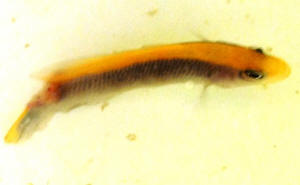
Two weeks ago I got a sunrise Dottyback and its in quarantine
right now with a few other fishes.
<Mmm, what species? Looks like something has bitten your
Pseudochromid>
A couple of days ago, i noticed a weird lesion near its tail so i
separated it from the rest and its now in its own container and i
began treating for bacterial infection with furan 2 after reading
up on what it could be on wwm. I thought it was most likely a
bacterial infection of some sort.
<Resultant from an injury, break in skin... from
somewhere>
Unfortunately, it doesn't seem to be helping and as you can
see from the pic, its like someone took a bite from his tail area
and there's now an open wound. I've been following the
instructions on the furan box and since it hasn't been
working, I've been thinking of switching to erythromycin.
He's still pretty active but his appetite isn't like it
used to be.
What should i do? I moved him to a smaller container in the pic
so i could take a clearer photo and the dirt you see at the sides
are the flakes i tried to feed him.
<Try to keep this fish in a suitable, stable setting (with
habitat, even just plastic pipe to hide in) and optimized water
quality. Bob Fenner>
|
|
Re: Bacterial infection on sunrise dotty?
11/23/11
Hi Bob,
<Ryan>
Its actually a sunrise Dottyback. Yeah that could be the case, it
was in a 50g QT with 2 other sunrise Dottybacks
<Uh... they don't get along>
but the other two seem totally fine and this one is actually the
biggest one. The skin wasn't like this at first, it was like
a lesion that exploded and is now continually rotting away or
something. Im not sure how else to
describe it.
<You just have>
Should i continue treatment with Antibacterials?
<I wouldn't... see my opinions/reflections re the use of
such poured into marine systems. Largely a waste of
time/resources... more often more destructive than no treatment/s
whatsoever. B>
Thanks!
Ryan
Re: Bacterial infection on sunrise dotty? 11/24/11
Alright thanks bob! Ill do a water change and run carbon on his
tank ASAP!
I hope he recovers!
<Me too>
Thanks again for all the advice!
Ryan
<What we do. Cheers, B>
|
|
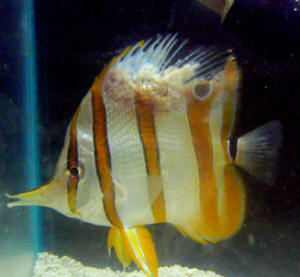
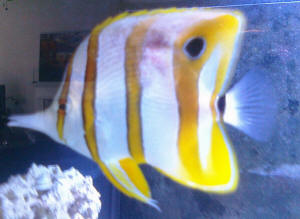
Copperband Butterfly with Bacterial
Infection 7/31/11
Hello WWM Crew,
<Carolyn>
After many years of reading through your wonderful website, I now
have a question that I think needs a more direct answer.
<Am answering this immediately due to the critical nature of
this condition>
I obtained a healthy Copperband Butterfly (Chelmon rostratus)
about 4 months ago. Wednesday night I noticed a small spot on his
side where it looked like the scales were protruding with a
slightly red tint. I wasn't overly concerned as the fish was
acting normal, but I thought it best to get another opinion. I
posted a picture up on my local reef club forum and was told by a
knowledgeable fish store owner that it was likely a bacterial
infection.
<It is>
It was too late to go to any stores so I started mixing up some
saltwater in case I had to get my QT set up. Thursday morning I
drove to the fish store and picked up Seachem NeoPlex and Seachem
Focus, which was recommended to me by the owner. Since my fish
was still eating I decided to try treating orally and leave it in
the display tank. I mixed the Neoplex and Focus in with my usual
mix of frozen and fresh foods, fed my fish, and froze the rest. I
have been feeding this medicated food to my fish about 3 times a
day starting on Friday.
<Mmm... the first not likely to be of use; the second... Furan
cpd.s can be efficacious... depending on the source of (stress)
as causative agents here... Was this Chelmon exposed to copper?
What other tankmates are there?>
Yesterday, it looked like the fish's scales were peeling
away, but there didn't appear to be much redness and the fish
was acting normal (still eating and foraging through the rocks).
This morning, the spot looks even worse and the redness is back.
I have attached some photos. Sorry about the quality, I had to
use my cell phone camera. I know antibiotics take a little time
to get into the system, but I am thinking at this point the
medicine should be working?
<These are worthy products, but this condition is almost
impossible to arrest...>
The fish is still eating and swimming around but seems a little
less responsive and hides in the rocks more often. Should I
continue with my current treatment or try something else?
<Well... I do suspect this is Vibriosis...
Oxytetracycline can be tried (in foods best) or potentiated
Sulfonamides... Unfortunately, this fish will very likely succumb
soon>
My tank is a standard 6' 150 gallon tank with plenty of live
rock and a deep live sand bed, a sump with more live rock,
carbon, and skimmer. Last water test was performed on Friday and
results were: no detectable ammonia, nitrite, or nitrate and pH
of 8.3. Temperature has been a little high but stable at 82-83
degrees. Other inhabitants include: 5 Blue/Green Chromis (Chromis
viridis), 1 Ocellaris Clownfish (Amphiprion ocellaris), 1 Coral
Banded Shrimp (Stenopus hispidus), and a mix of soft, LPS, and
mushroom corals.
All other fish appear healthy. A 29g QT is setup and ready to go
should it be necessary.
<I would not move this fish>
Thank you for taking the time to answer my question. Any help you
can provide is greatly appreciated.
Carolyn
<Please do inform us as to your actions, the disposition of
this fish. Bob Fenner>
|
|
|
Re: Copperband Butterfly with Bacterial Infection
8/1/11
Thank you for the quick response. The Copperband has not been
exposed to any copper, at least not in the 4 months that I have
had it. The chromis follow the Copperband around but I have never
seen them pick on him. My tank has a low bioload and I am very
diligent with water changes so my water is fairly stable. I am
willing to try one of the medicines you recommended. Would these
only be available through a vet?
<Mmm, depending on what country you're in;
possibly>
If the fish continues to decline I will euthanize it but I would
like to try everything possible before giving up. This is a
beautiful fish and quickly became my favorite and I hate to see
this happen.
<I am of the "don't give up" habit... Have seen
fishes recover from these bacterial "break down"
syndromes; but it's rare>
Thank you again for all your help.
Carolyn
<Welcome. Bob Fenner>
Re: Copperband Butterfly with Bacterial
Infection 8/1/11
Thank you for all the help. Sadly the Butterfly did not make
it.
<Ahh, as suspected/mentioned. One last but important statement
I should have made: DO thoroughly wash your hands, arms after
they've been in this system, or after handling this dead
fish>
He was eating and swimming around last night, although a bit
lethargic. I woke up this morning to find him dead.
I did find a source for tetracycline
<Oxy...>
so hopefully I can someday use what I have learnt and aid other
fellow hobbyists. I am blessed to have a wonderful local reef
club (Atlanta Reef Club)
<Ah, yes. Have met w/, spoken to them a few times>
with great people always willing to help out. In fact, if you
ever find yourself in the area I am sure we would love to have
you as a guest speaker for one of our meetings. The Georgia
Aquarium is definitely worth a visit if you haven't been.
:)
<Have done both, would do again>
Thanks again for everything you contribute to this hobby and for
taking the time to help others.
Carolyn
<Welcome. Bob Fenner>
|
SW, "Finrot"...
aggression, natural, misplaced/crowded fishes...damage, fixing
12/7/10
Hi,
I have looked through your site and I could not find FAQ's on
saltwater fin rot.
<Did you try the search tool with these three words? Put them in
here:
http://wetwebmedia.com/Googlesearch.htm
and read the cached views. Otherwise, the sections on bacteria and
marine disease: http://wetwebmedia.com/infectio.htm
and the linked files above>
I recently bought a Flame Angelfish a week and a half ago. My tomato
clownfish was attacking him, and even arranging the aquascape and
taking away the item he was hosting did not stop this aggression.
<Not atypical... likely exacerbated by being in too small a
volume>
On the second day, I took the clownfish to the LFS. My Flame Angelfish
had his back fins (The purple ones) a bit shredded by the clownfish and
was scared, but soon after they grew back and he was swimming around
normally.
Since he is the biggest fish in the tank, no one is aggressive to him
and there have been no fights. He is eating like a pig.
However, a day or two after, the Angelfish's right eye swelled up
and now it is huge. I have read on your site that if it is only on one
eye, then it is probably mechanical. I suspect the clownfish damaged it
while he was trying to attack him. I added 1 tablespoon of Epsom salt
to my tank per 10 gallons (55 gallons)
<Too small...>
yesterday to reduce the swelling. I have also been adding garlic Xtreme
to his food for the last 4 days.
<Tasty>
However, during the course of the last week, I noticed that a while
film grew over the Angelfish's pectoral fins. They are now
ragged/shredded, and I noticed that this white film has started growing
on his tail fin too! Is this fin rot?
<Of a sort...>
Do you think that the Popeye and fin rot(?) have something to do with
each other?
<Oh yes. Stress, physical damage...>
I have been changing the water very regularly and the parameters are
good.
He is still eating a lot and acting normally.
Will this spread to the other fish? Should I separate him into a
hospital tank and treat him with Maracyn 2? If not, what else should I
treat him with?
<... No, no, no... and nothing. This fish should be moved/placed
elsewhere...>
Thank you,
Dom
<Read on. Bob Fenner>
Re Flame Angel... Finrot... BobF needs to find where he placed the
prev. corr. -- 12/08/10
Hi again,
Thanks for the response and for pointing me in the right direction! In
your reply, you advised me that "This fish should be moved/placed
elsewhere... or alternatively the antagonist/Clown." Maybe I
forgot to mention it in the email, but I did give the Clownfish to the
LFS on the day after I got the Flame Angel due to the aggression
problems. Bye-bye, bully!
<Ah good>
The angelfish is in the tank along with a Melanurus wrasse (Very
intelligent and beautiful fish) and a peaceful, small Sixline wrasse
that minds his own business. The only inverts I have are 3 hermit crabs
and a turbo snail. Nobody has been bothering him since the Clownfish
was removed. The Angelfish is still eating voraciously
<A good sign>
(Normal food and nipping at LR) and coloration is bold, has had no
fading.
Parameters are: ph 8.2, Ammonia 0, Nitrites 0, Nitrates 10, salinity
1.024 and water temperature is 78 degrees.
I'm fairly certain that his shredded fins and tail are rotting away
on their own, not being nipped, since the shredded-ness came right
after the white film appeared on his pectoral fins. Yesterday this same
film started to appear on his tail fin, and today that looked shredded
too.
I was told that this species could be housed in a 30 gallon tank,
<... not so... Please read the article, FAQs on this species posted
on WWM>
so I thought that he would do well in the 55 gallon tank. You mentioned
that this is too small, I will start to look for a larger tank. (Which
I was thinking about getting anyway, bigger tanks are always nicer.)
However, the time it takes to purchase/buy/set up/cycle a new tank will
be long. I fear that if I do nothing, the Angelfish will pass away
during this time.
The fin rot has been looking noticeably worse each day.. I imagine
this, combined with the Popeye, is very uncomfortable to him.
I took today off to look through the FAQ's in the Google search.
Most of them were on freshwater fin rot (I assume it's more common
than in SW?), but this is what I learned:
"Finrot isn't a disease as such; it's what happens when a
fish is sufficiently damaged and/or stressed that opportunistic,
otherwise harmless, bacteria can breach the fish's normal defenses
and cause
infection."
"Eventually the bacteria will infect the organs in the body cavity
and treatment will most likely be unsuccessful."
So now I understand why you said it won't likely spread to the
other fish.
<Not likely no>
The "Understanding Bacterial Disease in Aquarium Fish"
article was very helpful, especially since I decided to take Physics in
high school instead of Biology or Chemistry. Not a good choice! I now
understand the difference between Gram-Positive and Gram-Negative
bacteria, and that a Gram-Negative bacteria is most likely causing the
fin rot. I think that the stressor that cause the Angelfish's
immune system to lower its' defenses was the Clownfish, since the
water quality has been fine and he seems to have enough space in the
tank, for now. (He is about 3 inches)
<Good size for starting, and for this four foot tank>
I looked for Gram-Negative antibiotics, but there are many!
Which would you recommend? I now have plans to move the angelfish to
larger quarters, but I'm afraid that this fin rot will progress and
spread to his organs faster than the time it will take me to acquire
and setup a larger tank. I think it would be best for me to treat
him.
<Again, none... You might want to try boosting the fish's immune
system by supplementing its foods... Selcon, MicroVit... HUFAs and
Vitamins... this is all I would do. Adding antibiotics to the water is
dangerous to all, not likely efficacious... injecting, feeding not
likely helpful either>>
Sorry if I went on a rant and thank you for the help,
Dom
<No worries. As long as this fish is eating, it is highly likely
"on the mend". Be patient. Bob Fenner>
|
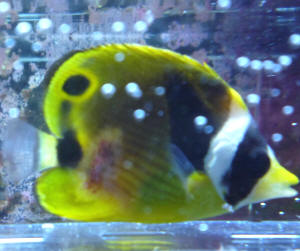
Urgent - Raccoon Butterfly disease ID
11/24/10
Dear Crew:
<... four megs for one pic?>
I would like to ask your help identifying this disease (please
see attached picture).
<Very bad news... extremely poor prognosis...>
I bought this Raccoon Butterfly 5 days ago. It started as a small
spot on the scales towards the tail and I thought that he just
scratched himself on the live rock but the spot is growing (it is
about 3/4 of an inch
by 1/4 of an inch as of now) and it appears that he is losing
scales where it's pinkish so I guess it's not just a
scratch. Last night I put him in the plastic container floating
in the main tank and applied Bio-Bandage Powder by Aquarium
Solutions (active ingredients: neomycin sulfate, cyanocobalamin
(vitamin B12), binders and adhesion agents). It did not seem to
get better overnight so I applied Bio-Bandage again this morning.
Can you please let me know how often should I apply this
medication for this type of wound?
<Have had very little success with these sort of bacterial
breakdown syndromes... Culture work will likely find a number of
gram-negatives... In the trade, extensive, high concentration
"Furan" (cpd.) baths are at times efficacious... But
almost all fishes at the shown stage perish>
Is there anything else I can do to help him heal?
<Not likely unfortunately>
Thank you very much for your help!!!
Sincerely,
Peter
<I do wish I could give better news. Please read here:
http://wetwebmedia.com/infectio.htm
the linked files above. Bob Fenner>
Re: Urgent - Raccoon Butterfly disease ID
11/24/10
Dear Mr. Fenner:
<Peter>
Thank you for your prompt reply! I called a couple of LFS trying
to find "Furan" but they do not carry it and seem to
have no idea of what it is.
<Ahh, Nitrofuranace is the more common/available of
"Furan Compounds".
Sorry for the lack of clarity>
Is it sold under a different name or should I contact local
pharmacies rather than LFS? I do have
Metronidazole at hand. Do you think there is a point in trying to
use it if I cannot get Furan ASAP?
<There is not... this is an antiprotozoal...>
If so, what concentration should I use and how often/how long a
bath should I give the poor fish?
Once again, I greatly appreciate your help!
Peter
<Please use the search tool here: http://wetwebmedia.com/Googlesearch.htm
re Furanace, baths... BobF>
|
 |
Re: Urgent - Raccoon Butterfly
disease ID 11/24/10
Dear Mr. Fenner:
<Just "Bob" will do Peter>
I was able to find it but, unfortunately, it was too late.
<Ahh... as usual>
By the time I got home he was breathing but already laying on his
side. I proceeded with the bath but it did not help - to my deepest
regret he perished a few minutes ago. Should I be concerned with my
other fish catching this disease?
<Mmm, not so much... the etiology of this involvement is quite
often "subject specific", or if a given species is
crowded in poor conditions, already challenged health,
species-specific>
The tank is an established (1 year +) FOWLR and all water
parameters are good.
I never had any problems in this tank before but the perished fish
was in the tank when I noticed the appearance of the spot and the
plastic container that I put him in had tiny holes in it to allow
for water flow between the container and the tank. Thank you very
much for your advice.
Peter
<Welcome. BobF> |
http://wetwebmedia.com/infectio.htm
9/9/10
Webpage Maintenance:
Your webpage http://wetwebmedia.com/infectio.htm has a paragraph twice
as highlighted below.
************
Viruses:
Viral infections are caused by particles that by some definitions are
non-living. Virus organisms are only able to metabolically function and
reproduce as parasites; using the cellular machinery of their
hosts.
Lymphocystis is a viral disease that looks like white to grayish
cauliflower-like clumps, typically at the base of fish fins. It's
origins, "cures" and spontaneous remission are somewhat
mysterious. The condition may just "show up" even in
meticulously clean systems.
Is a viral disease that looks like white to grayish cauliflower-like
clumps, typically at the base of fish fins. It's origins,
"cures" and spontaneous remission are somewhat mysterious.
The condition may just "show up" even in meticulously clean
systems.
By itself, Lymphocystis is rarely a damaging or fatal problem. In most
cases it "cures" itself by disappearing on the individuals it
has "shown up" on in a month or two of it's
appearing.
Some authors suggest chemical treatments, biological cleaners, removing
the clumpish growths from the fish by scraping with your fingers, even
the use of the anti-viral compound Acyclovir. I would suggest isolating
"infected"
specimens and let them self-correct.
***********************8
Thanks for all you do,
Aquarium Masters
www.Aquarium-Masters.com
Thank you for this. "The process of removal continues"
(Dune). BobF
|
Dispar Infection 1/20/10
Hi Guys
<Allan>
I Have a question for you regarding bacterial infection on
Anthias. I have been through the FAQ and I would like to show you
the specific problem I have as its not talked about in depth. The
Pictures are attached.
<I see one>
The tank is 3000L, and I have 4 x bicolour Anthias which have
been unaffected, eat anything given. The 4 x Dispar have been in
the system for 3 months, and also did eat according to what the
bicolour Anthias have shown them.
<Well-stated and related>
All the sudden, without warning, they developed a bump/line down
their right side, in the same spot on all fish, and then it went
red within a day or so, and now they are dropping off 1 by 1. As
I said the Bicolour are unaffected.
<Yikes>
I have a few tangs in there, but I dont suspect a wound first and
then infection, as the damaged area is exactly the same spot on
the dispars, and I doubt this coincidence. Is there some sort of
bacteria that affects these fish, that seems to arise in the same
area or maybe internal organ?
<Mmm, I don't think so... given the time frame... having
these 3 months as you state>
I had a square block Anthias months ago which developed the same
red line, on the same area as this as well.
<Mmmm, me no likee>
They contract this problem very quickly and die within days.
Any thoughts?
regards
al
<Am tempted to suggest some sort of "rapid onset"
(bacterial) necrosis syndrome... borne of "stress"...
the markings (though hard to make out) do remind me of
Mycobacterium (marinum)... DO take extreme care if/when placing
your hands/arms in the tank in any case... and DO see the Net,
WWM:
http://www.wetwebmedia.com/ca/volume_6/volume_6_2/mycobactera.htm
re. As to "cure"... perhaps improvements in the
environment (aspects like ORP are greatly useful as measures),
boosting the immune systems et al. nutritionally (have you tried
Spectrum pelleted foods?) may be of use here.
Otherwise, I do encourage you to prepare, save, and share the
deceased specimens with a fish pathologist... There are a few
about... Have you access to a large library, college, with a life
science dept.? A cursory read through Ed. Noga's "Fish
Disease, Diagnosis & Treatment" is highly recommended.
Bob Fenner>
|
 |
|
Bacterial infection... Mmm, no... more likely
Protozoan 7/6/08 I have a 600 gallon saltwater tank with the
following fish: queen angel, emperor angel, French angel, panther
grouper, Volitans lion, lunare wrasse, harlequin tusk wrasse,
niger trigger, blue cheek trigger, Naso tang, powder blue tang,
gold banded maroon clown fish, and an anemone. All the fish are
between 4 inches and 8 inches in length, with most around 5-6
inches right now. Tank is about 3 months old and has 650 lbs of
live rock that has a thin covering of brown/greenish alga. The
alga does not look like hair alga and actually looks good because
it makes the rock look natural. <Ok> All the fish are
eating Dainichi and spectrum marine and veggie pellets EXTREMELY
well, <Good> as well as PE mysis shrimp, squid, frozen
krill, and Prime flake food. I add Selcon vitamin solution to the
food also. They all are voracious eaters and all are quite fat
and plump looking. In the last 2-3 days I have noticed the queen
and French angel and even the grouper have a cloudy swollen left
eye (yes, it is the left eye only on each fish).
<Interesting... and frightening> Have done two 15% water
changes each month since the tank was set up. All fish were added
together except for the niger which was added 2 months after
setup and adapted immediately. <... were these animals
quarantined? How acclimated otherwise?> Nitrite is 0, nitrate
is about .10-.15, <Mmm... an interesting number... what units
here? Not ppm, mg./l... are you sure this is Nitrate?> spec.
grav. is 1.023, pH is 8, water temp is 80 degrees F. BIG UV
sterilizer as well as an auto regulated ozonizer, <Ah, good...
what setting is this unit set for in pH, micro Siemens per
cm.?> and two protein skimmers rated for a total of 900
gallons. The affected fish are acting completely normal with the
exception of some slightly increased amount of aggression toward
the other fish. The two affected angels seem to pick on the
grouper more than the other fish for whatever reason. I know it
is best to use a quarantine tank, <Oh my friend... in a system
of this size... for what you have invested monetarily,
emotionally... it IS mandatory> but since it is nearly
impossible to capture these fish in this tank, is there any
product that I can add to their food rather than just add to the
water? <Mmm, possibly "Garlic"...> I know it may
be better to just not add any meds and do more frequent water
changes, <Uhh...> but I was just checking all options from
you guys. Sorry for the long description, etc, but I am just
trying to give you guys all the info (hopefully I didn't
leave too much out) Steve <Actually need more info., not
less... It may well be... scratch that... it is almost a
certainty that you have a pathogen at play here... Hopefully it
will not become "hyperinfective"... so virulent that it
outright kills your fish livestock... Much that we can chat re...
but where to start here? Am hopeful the Premnas is protecting the
anemone from being consumed by your Pomacanthids... Please read
here: http://wetwebmedia.com/parasittksfaqs.htm and the linked
files above. Bob Fenner>
Re: bacterial infection 7/7/08 Bob (or whomever could
respond), <Am here> I read your comments to my last
question yesterday about the swollen, cloudy eye on my French and
queen angels in my 600 gallon system. My mistake on the Nitrate
values, that should have been 5-10 and not .15 (sorry), <Ah,
thank you for this clarification> pH of the water is around
8.0 and nitrites are not measurable. You had questioned as to
whether my maroon clown protects my anemone from the angels, etc
and the answer is YES. <Good> I can't even try to move
or touch the anemone myself without the clownfish trying to kill
me and the anemone is doing great (not certain of the species).
All the fish were quarantined in multiple "hospital
tanks" prior to going into the main system for 3 weeks (I
had to rent multiple tanks from the LFS due to the aggression and
no. of fish involved so I could still add them around the same
time). The niger was the last fish added. None of the fish showed
any evidence of ich, Lymphocystis, cloudy eyes, or anything else
during that time. My ozonizer is set to keep the ozone level at
350-400 (not certain of units here) which is set up based on the
instructions with the device. <This is about right> The LFS
uses multiple ozonizers on their tanks and they also help set
this one up. I am planning on getting a refugium for this tank
also in the near future. <Good> My main question was: do I
have any option to treat for these probable bacterial or fungal
diseases on these angels with some kind of medicated food (I
don't really believe in garlic stuff, and I am currently
supplementing with Selcon) if I am unable to catch these guys in
this tank to place into quarantine. <Mmm, a tough choice to
make... I don't think antibiotic laced food would do any harm
here... store bought/commercially made or DIY, but also am
dubious re how much good it might do as well> Some of the
pieces of live rock in this tank weigh between 90-100 lbs. To
have to get these fish out, I think I would have to get a good
portion of the live rock out too and I think that will be pretty
stressful on the fish also. I have read about using a non barb
fish hook to capture fish like this, but how do you avoid some of
the fish you don't want captured from getting on the hook?
<Maybe only by being "a good fisher"> They all go
after food very aggressively. <A good sign> Also, even if I
get these "affected" fish out and in the quarantine
tank, how will I know that my system is not still
"infected". So wouldn't I have to just get all the
fish out to put in quarantine to somehow treat the tank itself
anyway in addition to just treating the fish? <A bit of
reading re infectious agents... your, all systems are
"infected" to degrees, kinds... A/the larger issue is
whether the preponderance of given likelihood weighs toward
action or no> And if so, how do I keep these 11 or 12
aggressive fish from killing each other in a small quarantine
tank for several weeks? When I initially added the fish, I had
rented several quarantine tanks from the LFS, but I just
don't have room, capability to have all those around all the
time. I guess I could rent them again from the LFS. (and yes, I
do clean the tanks well before using them) <I would not move
these fishes myself...> I am actually wondering if this could
be trauma related, because the angels love to turn sideways to
get at certain areas of the rock at the water surface to pick at
algae <Mmm, are quite agile...> and I wonder if that could
be why the left eye only is affected in both fish? <A
coincidence surely> It would be the left eye that is close to
the rock when they are in this position which is what makes me
think of this. If it were bacterial/fungal, wouldn't both
eyes be affected? The fish don't have any other marks on them
and no visible signs of ich that I have seen anywhere. <...
again, depending on root cause/s> In any event, should I still
tear the tank down, removing hundreds of lbs of live rock, etc
and get all these fish out even if they are acting and eating
normally? <I would assuredly not do this> None of them are
hiding or acting irregular and they continue to eat any foods I
put in the tank for them. The two angels are eating very well and
do actively graze around all the time. They sometimes show
aggression toward each other or their tankmates, but nothing
causing any fin damage or long term problems. <Fine> And
finally, realizing that consistent water changes and water
quality is of paramount importance (and water quality is great at
this time), what would prevent this from happening next month or
6 months from now, even if I don't add any other livestock
(which I don't plan on doing as I feel the tank is fully
stocked given the potential size these fish could attain)? I just
don't want to be tearing my whole setup down that frequently
if you know what I mean. This is a little tougher than a 30 or 50
gallon system to catch the fish and do all that. Thanks, Steve
<Really just time going by here... should see this situation
rectify itself. I would do nothing overt. BobF> Re:
bacterial infection 7/7/08 Bob, <Steve> Thank you for
the very quick response on my problem. I will keep an eye (no pun
intended) on the eyes of my angels and hope for the best right
now. <Good. Is what I would do as well> Let me ask your
opinion on a different matter with this 600 gallon system:
Assuming this cloudy eye problem resolves and everything is
"back to normal", there were a few more fishes that I
was considering for this tank in the future. My current
"crew" is as follows: niger trigger (3 inches), blue
cheek trigger (4-4.5 inches), Volitans lion (6 inches), panther
grouper (6 inches), maroon gold banded clown (3-3.5 inches),
lunare wrasse (7-7.5"), harlequin tusk wrasse (7"),
porcupine puffer (4"), French angel (4"), queen angel
(6.5-7"), emperor angel (4-4.5"), powder blue tang
(4.5"), and Naso tang (9"). I have been wanting to add
an epaulette shark and a snowflake eel to the group at some point
but my LFS can't find an eel large enough that won't slip
through the overflow box slits and the shark is just hard to find
period. <And likely hard to feed here... too much
competition> The guy at my LFS also thinks the eel (and maybe
the shark as well) would not be a good idea because they can dig
enough in the sand which may cause the BIG pieces of live rock to
topple or become unsteady and maybe hit the glass in front or
back. Your thoughts? <Mmm, a minor matter here in my
estimation. Am sure you've set the larger rock down first,
before the sand... that it's stable...> I would also like
to get a Picasso Trigger in several months to give these fish
even more time to "establish dominance" in the tank and
if I did I would get him quite small because I know they can get
rather mean with age. <Less so than the Niger almost
always> My LFS guy says he would NOT get the Picasso Trigger
due to its attitude later in life. He says it would be fine early
on with the other fish being in there a while and it being small,
but over time it would become too mean. Your thoughts?
<Posted... see WWM re the Balistids. BobF> Steve
|
|
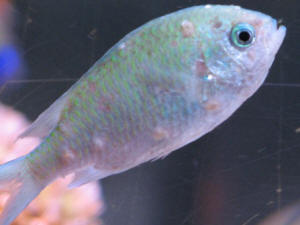
Is this Marine Ich? 6/5/08 Dear WWM Crew: Would you please
look at this picture I just took of my green chromis and tell me
if this looks like ich, velvet or ???. Thank you kindly. Diane
<Mmm, neither... If Amyloodinium this fish would be very soon
dead... the creeping eruptions here... might be secondarily
pathogenic... but look to be of environmental origin. Bob
Fenner>
Re: Is this Marine Ich? Infect. dis f'
06/06/2008 If I understand you correctly, you saying it's
some sort of bacterial infection? <Yes> I guess it's
good news that it's not ich or velvet - but what does this
mean? <That something is/was amiss re this specimen at
least... the treatment, prevailing conditions...> Will it
affect my whole tank? <Possibly, yes> For the past couple
of months, I thought one of the other fish might be picking on
the chromis because it seems to be hiding all the time and it has
little nips on it. <Bingo. This condition is borne of
over-stress really... opportunistic pathogens... that exist...
everywhere> The nips have now increased and become these
"creeping eruptions". I've not seen anything
actually attacking it though. What do you suggest I do?
<Remove this fish... if necessary, summarily destroy it...
otherwise, isolate away from other fishes> Other inhabitants
are two clowns, one six line wrasse, a lawnmower blenny, a small
mimic tang, three blue-eyed cardinals and a diamond goby. The
tank is 55 gal. Thank you so much for your assistance Bob. Diane
<A pleasure to assist, inform you. BobF... whose wife is also
named... "the huntress">
|
|
 Bacteria...
2ndarily... Bacteria...
2ndarily...
|
Fin & Tail Rot 3-31-08
Hello, A few days ago my Firefish and white sleeper goby started
showing signs of fin & tail rot. (They live together under one of
the rocks.) I have not introduced anything new into the aquarium for a
couple of months except for some macroalgae plants (maiden's hair
& red grape kelp plants). I did not bother to quarantine the
macroalgae. The nitrates, nitrites, ammonia, chlorine is zero and PH is
8.4. The tank is 90 gallons w/ a wet dry filter & prefilter,
skimmer, UV, and activated carbon in the filter. <Sounds good> I
have some corals, 70 lbs of live rock, a clownfish and a Lemonpeel
dwarf angel. The Lemonpeel often chases after the Firefish looking to
nip him but I have never seen the Lemonpeel come close as the Firefish
is way too fast for him. Yesterday the Firefish seemed to be healing
and today he looks almost 100% healed. His tail and dorsal fins (not
the antenna-like fin) were tattered. The sleeper goby however looks
worse as a third of his body (his tail, essentially) is now gone. Yet
he moves about gobbling sand as if unbothered. I mixed in tetracycline
which I am taking for myself currently, with some mysis shrimp and fed
the tank with this yesterday. However later on I read that tetracycline
is almost useless in marine aquariums. So I'm wondering what to do
now and if it's worth treating. Is it too late for the goby? Will
his tail grow back? What do you think caused this? The stress from the
Lemonpeel? Also, do you recommend adding Chemi-Pure into my filter
instead of the activated carbon? Thanks and all the best. <Something
has likely tattered the fins, and/or is stressing your afflicted fish,
and the only thing that's immediately obvious is the angel. I would
keep an eye on them, and if their fins aren't healing, move them
into a quarantine tank and treat them with one of the commercially
available medications for this malady (Seachem makes excellent
products, and Mardel makes good medications as well). I've never
used Chemi-pure, but I've heard good things about it, so it's
worth a try if you're so incline. M. Maddox>
|
Dying Copperband -- 1/04/08 Hi guys! <Holly>
I've never been to this site before, but I was directed here
but a blogger on the PNWMAS.org website (pacific northwest marine
aquarium society) I hope you can diagnose this disease!
<Mmm... yes> I have a Copperband that started out with a
darkish bump at the base of its dorsal fin last week. It's in
quarantine with Organi-Cure (copper-based) and "kick
fungus" in the appropriate doses but nothing helps. The
fish's flesh is literally disappearing and the bone is
exposed. <This fish is being digested... microbially> I
can't believe the fish hasn't died yet, but it's
acting completely normal (besides not eating for many days now).
I figured it was a fungus the way it's been eating up the
flesh, but I can't be sure. I know this particular fish is
certainly a lost cause already, but for future reference, I'd
like to identify whatever this is that's eating its flesh so
I'll know how to treat it next time. Meds don't seem to
do any good. The pics were taken this morning. Thank you so much
for any info you could provide! Holly Sachs PS I don't know
how to navigate around your site yet so please let me know if you
respond. I'll keep trying to check the site but it's a
huge one, and I'm kinda at a loss how to get about! Thank
you! <I doubt if this condition can be reversed at this
point... are you "friends" with a veterinarian in your
area? Please have them contact me through this email address. A
shot or two of Chloramphenicol might save this animal... but I am
dubious. Bob Fenner>
Re: dying Copperband 1/5/08 The Copperband
finally died yesterday (thank god--it looked horrific).
<Yes> I wasn't so much trying to save the fish--it was
obviously a goner--as find out what did this. Do you have any
idea what kind of infection would eat flesh like this, and at
such an alarming rate? <Can only be a guess (otherwise
culture, microscopic exam, food and staining characteristics...
to ID)... but Vibriosis, perhaps Aeromonads might well have been
involved here> In less than a week it went from normal to
half-digested and dead. Is it fungal or bacterial? <The
latter> Any ideas? In case I ever see it again, I'd like
to know the proper way to treat it, since the usual meds did no
good whatsoever... (The only vet I know is the typical one that
sees our cat and dog annually, and I don't know them on any
significantly personal level.) Thank you for replying so swiftly!
Holly Sachs PS Love the site - so much information. <Do take a
read through Ed Noga's "Fish Disease; Diagnosis and
Treatment"... Bob Fenner>
Re: dying Copperband 1/5/08 Ed Noga's
"Fish Disease; Diagnosis and Treatment" Will do. Thank
you very much for your help. Holly Sachs
<Welcome my friend. BobF>
|
|
|
|
|

