|
FAQs about Non-Vertebrate Animal
Selection
Related Articles: Marine Invertebrates, Marine Invertebrate identification,
Marine Invertebrate
Compatibility, Marine
Invertebrate Systems, Marine
Invertebrate Disease, Marine
Invertebrate Reproduction, Quarantine of Corals and
Invertebrates, Feeding
Reef Invertebrates, Lighting
Marine Invertebrates, Water Flow, How Much
is Enough,
Related FAQs: Marine
Invert.s 1, Marine Invert.s 2,
Marine Invert.s 3, Marine Plankton,
|
|
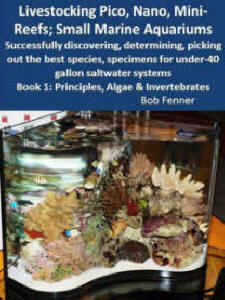 |
New eBook on Amazon: Available
here
Livestocking Pico, Nano, Mini-Reefs; Small Marine Aquariums
Successfully discovering, determining, picking out the best species,
specimens for under 40 gallon saltwater systems.
Book 1: Principles, Algae, Invertebrates
by Robert (Bob) Fenner |
Online Ordering 9/1/08 Hello, <Kayla> I am
looking to purchase several invertebrates for a new tank and was
searching online retail sites. What are your recommendations for
ordering online? <I personally used to order quite a bit of my
livestock online. I now don't mostly due to finding great local
dealers nearby.> There is one site that is significantly lower in
price than others (saltwaterfish.com); is this a red flag? <Hmmm,
not really, I have ordered from them a few times and have been
satisfied.> I would like to research the sites and see what others
who have ordered have said, but cannot find an effective way to do
this. <Do check in the online forums, small and large. You can see
what many people are saying about the different online vendors, not
just the experience of one.> Thanks for the help, Kayla <Welcome,
Scott V.>
Bristleworms and amphipods disappeared?!
6/22/08 Hi All, I thought all was going well in my 46 gallon reef
tank, but I just realized that some time in the last several months my
bristle worms and amphipods have disappeared. I have been keeping an
eye on my fish (a tank raised clown, a blue chromis, and a royal Gramma
as well as my corals, some mushrooms, green torch, colt coral, palm
coral, and a very slowly (not sure why) dying flowerpot coral. <Very
common... see WWM re the genus Goniopora... all polyps need to be
fed...> Somehow I forgot about the arthropods and bristle worms
which used to be in abundance in my tank! Just did a water chemistry
test, and nitrates are 0-5, s.g. is 1.022-1.024, ph slightly on the low
side but kinda a chronic problem 7.8-8.0. Adding buffer with ro water
top offs. I have a UV sterilizer that I added several months
ago...might have coincided with the disappearance of these critters not
sure. I have a protein skimmer with a surface skimmer box, and plenty
of flow, a rio 2100 and a maxijet1200. Oh and 80 lbs live rock. I have
three little red crabs and two turbo snails and two really large snails
(I forgot their name-very common). Anyway, just wondering if I should
worry that these critters disappeared or not? <If they are of
benefit...> I feed flake formula two in the am and marine cuisine
about 1/4 of a cube in the evening. One thing...I do live in Phoenix.
its 115 degrees here now I keep my house at 78 degrees though the tank
consistently reads 82. <I was out there last weekend giving a
pitch... hot!> One other interesting development there seems to be a
new soft coral forming. I'll describe. Pure white many almost
clear/opaque tubules about the size of a wad of gum and kinda has the
shape of a wad of gum. I scraped some of it off the crevices of my live
rock and it came right back. It doesn't seem to bother anything in
the tank, but do you have any clue what it is? Hope I gave you all the
info you need and I hope you can help. Looking forward to your reply.
Thanks, Erika <Mmm... "they come and they go"... Likely
the dwindling water quality, too-low spg has summat to do with the
disappearance of some of this life. I urge better maintenance,
observation/attention. Bob Fenner>
|
Possible sea cucumber problem 6/18/08 Hello,
<Hello, Jack!> I've searched and searched, and cannot
find any specific answers, so out of desperation I'm asking
my very first question! <Sounds good. Thanks for
searching!> In one of my labs, I've got a 4 month old,
75gal marine tank (w ~20gal sump) which...until this
morning...held only a cleaning crew (snails, hermits, and two
peppermint shrimp), live sand, live rock and gobs of green algae.
I just received two "Marine Invertebrate" sets and some
jellyfish from Ward's Scientific, <mm...yes> and within
an hour of introducing the various species (I know, too many at a
time, but it's the only tank we've got...I still need to
get a quarantine tank going) BOTH peppermint shrimp were in the
open, on their sides, twitching. They died about 2 hours later.
http://wardsci.com/product.asp_Q_pn_E_IG0013628_A_name_E_Invertebrate+Living+Specimen+Set+1
http://wardsci.com/product.asp_Q_pn_E_IG0013629_A_name_E_Invertebrate+Living+Specimen+Set+2
http://wardsci.com/product.asp_Q_pn_E_IG0013404_A_name_E_Jellyfish+Living+Specimen
I took great care to minimize introducing very much foreign water
to the tank. <Okay. How did you acclimate them? Did you slowly
transition the water in the bags to system water, or did you just
release these organisms into the tank? Simply dropping them in
would most likely kill them promptly.> Especially, from the
sea cucumber bag! I called Ward's, and they could only tell
me that the genus/species was "Cucumaria".
<Generic...> Nevertheless, I suspect the Cuke got freaked
out in transit and spewed some toxins upon arrival. <Much more
a predation response than environmental> Are there any other
possible explanations, given the long list of newly introduced
critters (check the ward's links, above)? <Be advised that
the animals sold by Ward are not compatible with each other, and
are rarely properly identified by the company. In my experience
with these sets the instructions for care are poor, and the
animals sick or doomed upon arrival. The jellyfish, for example,
are completely unsuitable tankmates for the other offered
specimens, and will require special aquaria to house them. Most
of the echinoderms sold by Ward simply cannot be kept without
intensive feeding and water change regimens- not what a zoology
or invert. phys. class needs!> I've done a partial water
change. What other precautions should I take? <I would test
your water parameters and see if something is seriously out of
whack, and review acclimation procedures. Perhaps consider paying
a bit more for some select, research specimens from another
source.> I promise, to never introduce so many animals to the
tank, ever again. Thank you! <No problem.> -Jack
<Benjamin>
Re: Possible sea cucumber problem - 6/18/08 Thanks for
the prompt response. I've had a few hours to further research
the situation, here's an update: 1. Acclimation occurred over
the entire morning yesterday: a) each bag was floated for 1 hour;
followed by b) adding tank water to the bag (1 pt tank : 2 pts
bag volume) and another hour of floating; followed by c) emptying
1/2 of that water (into sink), topping off w tank water, and
floating for another 1/2 hour; and finally d) adding critter to
tank while minimizing the introduction of baggy water. Snails and
hermit crab were rinsed under tapwater too. <If anything, this
might have been too long, but since you had them floating
temperature shouldn't have been a problem. I doubt
acclimation was the problem.> 2. Nobody else was dead this
morning. Yay! <Glad to hear it!> 3. I no longer attribute
the shrimps' demise to the cucumber. A more likely suspect
would be the jelly's. They'd shed lots of slime
(nematocysts?) in transit, and 2 out of 3 had actually LOST THEIR
MANUBRIA...incidentally, the injured jelly's and detached
mouth-pieces are still pulsating on the tank's floor. I now
hypothesize that the shrimp were knocked off by free-floating
nematocysts. <Very possible! Cnidarians can shed a lot of
stinging cells under stress.> 4. I consider the
Cassiopeia's doomed if they remain in this tank, and a hazard
to whatever strolls past them. <Both correct.> I'm
setting up a temporary 10gal w/ steep live sand "banks"
on either end, and setting up a weak submersible filter on the
bottom to create a pseudo-circular, vertical current. I've
got some high-power full-spectrum fluorescents (used on lizards)
I can put on a timer, too. Meanwhile, I'll see if anyone
around here wants em (LFS, Bio dept, aquarium...) and, worse case
scenario, I'll preserve them for our teaching collection (I
waste NOTHING around here!). <Sounds like a good plan.> 5.
More research has me concerned about the Featherdusters and
predation from: red and blue-legged hermits, brittle star, and
the urchin. Real, or paranoia? Time will tell... <There is
certainly risk, but they should be fine. Hermit crabs will eat
just about anything, given the chance, but as long as there is
easier food to be found, they probably won't be going after
something the have to catch.> The determining factors in
choosing Ward's over the LFS: very good prices (surprising,
actually), guaranteed delivery, a 20% off coupon and an
established tax-exempt account. <Understood.> The lack of
documentation was acceptable, since I'm quite capable of
researching various problems, <Clearly. You definitely did
your homework before you wrote this reply!> but I'm
ashamed to have assumed that their sets were compatible...and to
have created this Darwinian situation. <Selective pressure
notwithstanding, compatibility and mortality are perpetual
problems in aquaria. I wouldn't lose too much sleep over your
assumption- it is reasonable to expect that sets of specimens
from a reputable supply company would be compatible...that said,
often time accuracy is sacrificed to Mammon in this hobby.> I
should have known better, given that they included Aiptasia
anemones in one set! <Probably helps keep the price
down...and, given they aren't overfed they can be
fascinating. You might be interested in information re aiptasia
culturing/filtering...use of aiptasia to clean water.> Best
regards, -Jack <The same! Benjamin>
|
Inverts... title please... sel. 04/11/2008
Hello <<Hi, Andrew today>> I have a 72 gallon FOWLR tank.
My stocking list looks like this: 2 Ocellaris clowns 1 Blue-green
Chromis 1 Royal Gramma 1 Neon goby 1 Yellow tang 1 Scott's fairy
wrasse 1 Flame Angel 1 Black brittle star 2 cleaner shrimp 30 Nassarius
snails 5 Cerith snails I still have not purchased the wrasse or angel
for my tank yet. <<I would suggest you don't have anymore
room for more fish>> Fishwise my tank is pretty stocked and
lately I've become interested in the inverts for my tank. I have
been looking to add some but I am starting to get worried that I might
overload the tank or worse off starve them to death as I do not like to
overfeed my fish. I am looking to add 3 camel shrimp, an urchin
(probably a pincushion) an emerald crab for my hair algae and a pink
sandsifting cucumber. Would this be to much for my tank? <<I
would add all besides the cucumber, its personal preference, but i have
seen too many tanks go bad because of an issue with these, and to me,
its not worth the risk. With regards to feeding / bioload...Its all
fine, you should not experience any issues>> Thanks, Adam Law
<<Hope this helps, thanks for the questions. A Nixon>>
|
|

