|
Related FAQs: Pomacanthus Angels, Marine
Angelfishes In General, Angelfish ID, Selection, Behavior,
Compatibility, Systems, Health, Feeding,
Disease,
Related Articles: Pomacanthus imperator (Emperor Angel),
Pomacanthus paru (French Angel), Pomacanthus semicirculatus (Koran Angel),
Pomacanthus maculosus (Yellow-Band Angelfish), Marine
Angelfish family, Pomacanthidae,
/A Diversity of Aquatic
Life
Genus Pomacanthus
Angelfishes
|
|
|
By Bob Fenner
|
Pomacanthus arcuatus
|
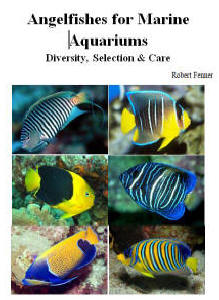
Angelfishes for Marine Aquariums
Diversity, Selection & Care
New eBook on Amazon: Available
here
New Print Book on Create Space: Available
here
by Robert (Bob) Fenner |
 |
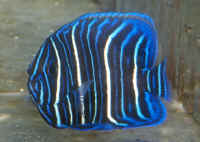
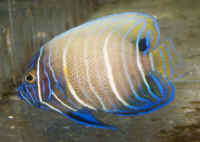
Genus Pomacanthus: Thirteen species.
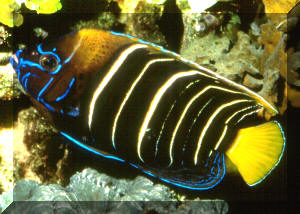
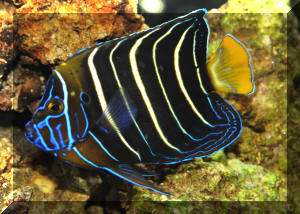
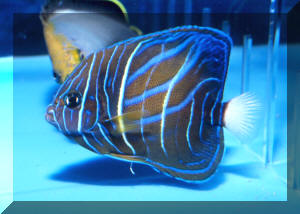
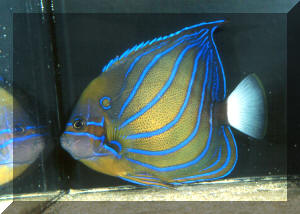
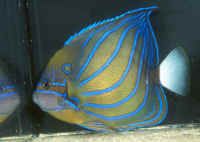
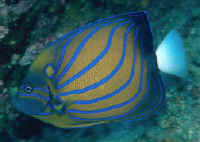
| Pomacanthus annularis
(Bloch 1787), the Blue-Ringed Angelfish (1). An oft-neglected
beauty, that is surprisingly (to some) hardy. Indo-west Pacific and
east African coast. To about eight inches overall in captivity, to
about twice this in the wild. Changing juvenile, sub-adult in
captivity, adult in Pulau Redang, Malaysia. |
Bigger PIX:
The images in this table are linked to large (desktop size) copies.
Click on "framed" images to go to the larger size. |
|
|
|
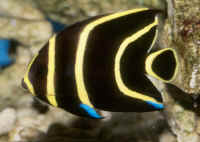
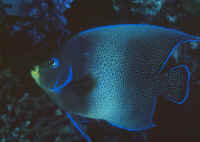
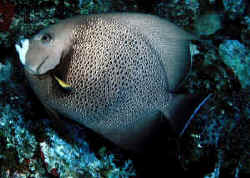
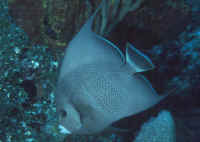
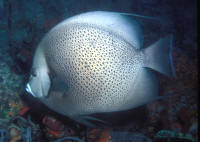
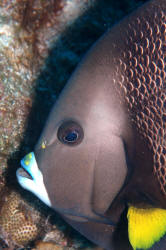
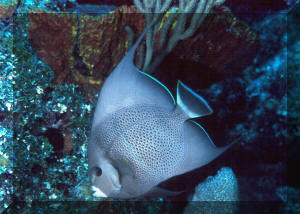
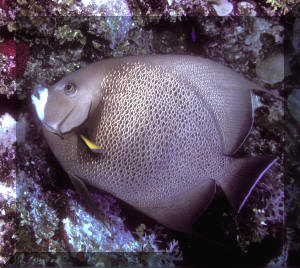
Pomacanthus arcuatus
Gray 1831, the Gray Angelfish (1). A beauty as a juvenile
(shown). Tropical west Atlantic, Bahamas to Brazil. To a foot and
a half in length, friendly and long-lived in captivity. Juvenile (with
square edged caudal fins as opposed to similar P. paru, French Angels)
and sub-adult, and adult in the wild.
|
|
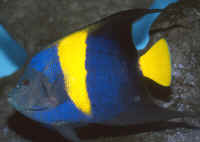
Pomacanthus (Arusetta) asfur (Forsskal
1775), the Arabian or Crescent Angel (1). A fabulous beauty and
centerpiece for very large systems. To sixteen inches in the
wild. Red Sea on down to Arabian Sea and around Horn of Africa to
Zanzibar. Juvenile and adult in captivity. Link to Bigger Pix
|
|
|
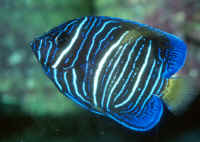
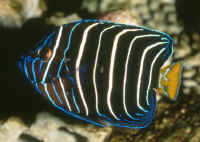
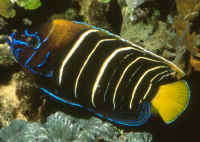
Pomacanthus chrysurus
(Cuvier 1831), the Ear-Spot Angelfish (1). Found from the
southern end of the Red Sea, down Africa's east coast to
South Africa, but rarely in the trade, and that's a shame. To
about thirteen inches in length. Below, juv.s in aquariums
(7, 8 and 12 cm.), photos by Hiroyuki Tanaka.
|
|
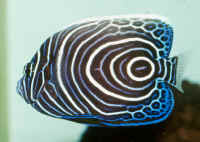
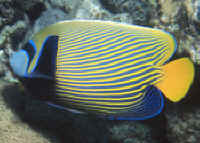
| Pomacanthus imperator (Bloch 1787), the
Emperor Angel (1). Widespread in the central and western Pacific
into the Indian Oceans coasts and Red Sea. To fifteen inches total
length. Shown are a juvenile of about four inches in captivity and
an adult in the Maldives. Link to Bigger
Pix |
|
|
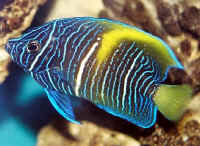
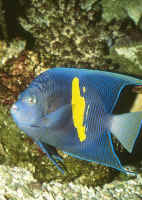
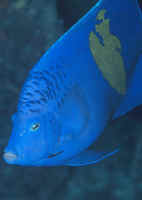
Pomacanthus (Arusetta) maculosus
(Forsskal 1775), the Yellow-Band Angelfish. Very similar as
adults and juveniles to Pomacanthus asfur, with told apart
from their clear tails and smaller yellow body patch. To eighteen
inches long. Red Sea, Persian Gulf to east African coast.
Juvenile (7 cm.) in captivity by Hiroyuki Tanaka and adults in
captivity and the wild pictured by RMF. Link to Bigger Pix
|
|
|
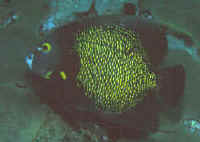
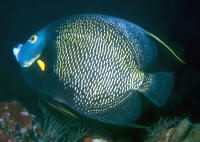
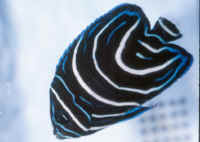
Pomacanthus
paru (Bloch 1787), the French Angelfish (1). Another
standard in the aquarium trade. Beautiful and hardy, and large
(to fifteen inches in length and a foot tall). Tropical west
Atlantic from the Bahamas to Brazil. Pictured: a three inch
juvenile in captivity, foot long adult in Belize, and sixteen
inch individual off Boynton Beach, Florida. Link to Bigger Pix
|
Bigger PIX:
The images in this table are linked
to large (desktop size) copies. Click on "framed" images
to go to the larger size. |
|
%20MD.JPG) %20MD.JPG)
|
|
Pomacanthus rhomboides
(Ruppell 1835), the Old Woman Angelfish (?). Rarely seen in the
trade... not attractive as adults. From the lower third of the
Red Sea down the east African coast to South Africa, around
Madagascar. To eighteen inches long.
|
Where's Mombasa? Zanzibar, JLB Smith?
|
|
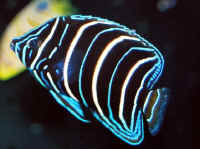
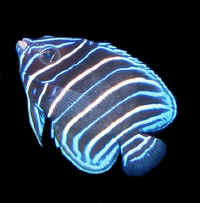
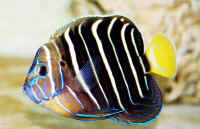
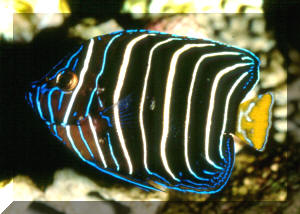
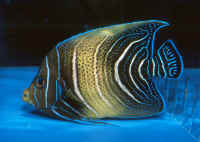
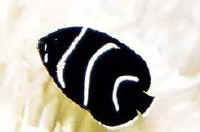
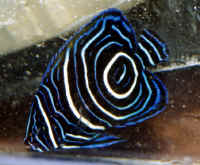
Pomacanthus
semicirculatus (Cuvier 1831), the Koran or Semicircle
Angelfish (1). A beauty from throughout its wide range, Indo-west
Pacific eastward to Africa, but not the Red Sea. To about
thirteen inches in length. At right, 1 and 7 cm. individuals by
Hiroyuki Tanaka. Shown below: two, five and twelve inch
individuals, the first two in captivity, the adult in Fiji.
Link to Bigger Pix
|
|
|
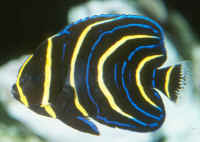
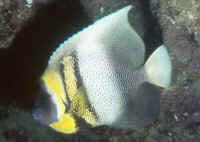
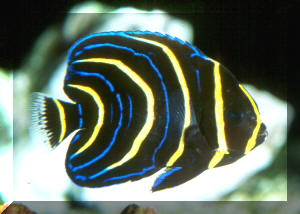
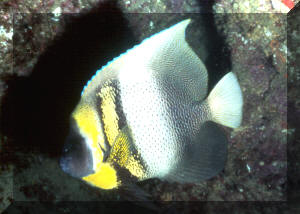
Pomacanthus zonipectus (Gill 1862), the
Cortez Angelfish (1) Susceptible to the scourge that is HLLE, but
a beauty as a juvenile to mid-adult. To about fifteen inches
total length. Tropical east Pacific, from upper Sea of Cortez
down to the Galapagos. A juvenile in captivity and adult in the
Sea of Cortez.
|
|
Bigger PIX:
The images in this table are linked to large (desktop size) copies.
Click on "framed" images to go to the larger size. |
|
|
Subgenus
Euxiphipops
Is the heartbreak subgenus (of
the genus Pomacanthus) of the family. Of the Six-Barred Angel,
Pomacanthus Euxiphipops sexstriatus, Blue-Girdled or -Faced,
Pomacanthus Euxiphipops xanthometopon, and Majestic,
Pomacanthus Euxiphipops navarchus, none has historically had
much of a success rate in aquariums. If you're going to throw your
money at trying this sub genus, I strongly,
suggest demanding that it be fed in your presence, placing a deposit on
the animal, and leaving it for two weeks with the dealer. They are
expensive, generally don't adapt at all, and usually refuse all
foods.
|
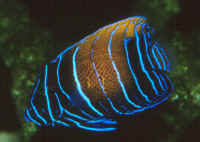
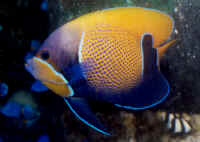
Pomacanthus (Euxiphipops)
navarchus (Cuvier 1831), the Navarchus, Majestic or
Blue-Girdled Angelfish (3). Found throughout the Indo-Australian
Archipelago. To ten inches in length. Juvenile (2") and
adult (6") in aquarium shown. Link to Bigger Pix
|
|
|
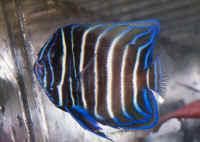
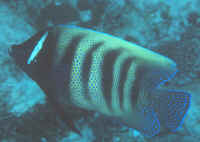
Pomacanthus (Euxiphipops)
sexstriatus (Cuvier 1831), the Six-Striped/Banded Angelfish
(3). One of the largest angelfishes at some eighteen inches
maximum length. Also found throughout the Indo-Australian
Archipelago. Juvenile in aquarium (3") and adult
(10") in Australia shown. Link to Bigger Pix
|
|
|
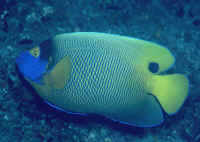
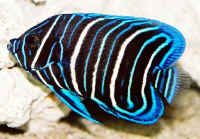
Pomacanthus (Euxiphipops)
xanthometopon (Bleeker 1853), Yellow-Mask or Blue-Face
Angelfish (3). Indo-west Pacific to the Maldives. To thirteen
inches in length. At right, a 7 cm. individual in captivity,
photo by Hiroyuki Tanaka. Below: Juvenile (3"), changeling
(4") in captivity and foot long adult in the Maldives
shown. Link to
Bigger Pix
|
|
Bibliography/Further Reading:
Allen, Gerald, Roger Steene & Mark Allen. 1998. A Guide to
Angelfishes & Butterflyfishes. Tropical Reef Research/Odyssey
Publishing, Singapore/San Diego. 250pp.
Pomacanthus
Campbell, Douglas G. 1978. Pomacanthus annularis, the blue
ring angel. FAMA 9/78.
Campbell, Douglas. 1981. Marines: their care and keeping;
Pomacanthus. FAMA 9/81.
Miklosz. John C. 1972. When is a Koran, not a Koran? Marine Aquarist
3(4):72
Euxiphipops
Burgess, Warren E. 1982. The blue-faced angelfish. TFH 7/82.
Dewey, Don. 1978. Euxiphipops, a delicate challenge. FAMA
8/78.
Angelfishes for Marine Aquariums
Diversity, Selection & Care
New eBook on Amazon: Available
here
New Print Book on Create Space: Available
here
by Robert (Bob) Fenner |
|
|
|



.JPG)
.jpg)
%20vert%20MD.JPG)
%20MD.JPG)
%20MD.JPG)