|
|
| Home | Marine Aquariums |
Freshwater Aquariums |
Planted Aquariums |
Brackish Systems |
Ponds,
lakes & fountains |
Turtles & Amphibians |
Aquatic Business |
Aquatic Science |
Ask the WWM Crew a Question |
| Please visit our Sponsors | ||||
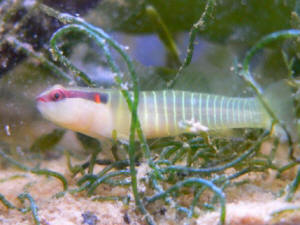
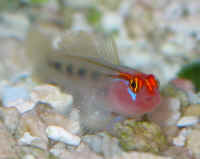
Neon Goby Species I have a panther grouper and have noticed that the black spots are breaking up. Is this normal? Also, my local fish store says there are two kinds of Neon Gobies (Fiji and red sea) The red sea one is blue and the Fiji one is black and white. Mine is black and white and looks exactly like the picture of a marine catfish in my book. What do you think I have? It has no whiskers. Any help would be greatly appreciated. Thank you. >> ... Well... patterns on Panther Groupers (Chromileptis altivelis) do sort of break up and re-coalesce into definitive spots with early growth... And there are many species of neon gobies (Gobiosoma)... but if yours doesn't look goby-like... and is more like a Plotosid catfish, you may well have a convict cat/goby/blenny (though it is none of these) of the genus Pholidichthys.... most likely P. leucotaenia. Take a look at the images of this species by searching the genus on www.fishbase.com Bob Fenner, who has yet a few other tricks up his sleeves Fish Question Hi Bob, I hope you can answer a quick question for me. In the past, you recommended getting some Gobiosoma gobies to treat some parasitic diseases, so I went out and bought two fish which were sold as gold neon gobies. In my recent net-surfing, I have seen many pictures of different neon gobies, but I can't seem to find the ones that I have. Most of the pics I see show fish with colored lateral stripes down the entire length of their flanks. The ones that I have are about an inch long, with solid gray flanks, and gold markings on their heads. They spend most of their time stuck to the sides of my tank. My parasite problems have cleared up (mostly) long ago, and these little guys are certainly welcome in my tank. I was just wondering if they are really Gobiosoma, and will they help if I have any future outbreaks of parasites. Thanks in advance, Dan >> There are several species in the genus Gobiosoma, and I do think these are amongst that group... They do have different colors, markings depending on species. Bob Fenner Gobies / Elacatinus Dear Mr. Fenner, I just came across your web page on gobies of the genus Gobiosoma and Elacatinus. While I am grateful that you have useful information on these wonderful gobies on the web, I wish to point out a basic flaw with the information on your page. <Please do so... there are regrettably many...> You use both Gobiosoma and Elacatinus, stating that Gobiosoma contains 29 species and Elacatinus contains 7 species. The problem is that Jordan described the genus Elacatinus in 1904, using Elacatinus oceanops as the type species for the genus. Thus, by the rules of taxonomic nomenclature, you can only use the genus name Elacatinus if you include E. oceanops as a member of the genus. On your page, you use Gobiosoma oceanops. While this is not necessarily incorrect in and of itself, the name becomes unavailable for E. puncticulatus and the other six species you include. Thus, they would all be recognized as the genus Gobiosoma (i.e., Gobiosoma puncticulatum (note the change of the last letter of the specific epithet to maintain the proper gender combination). If you use Elacatinus oceanops, then E. puncticulatus is valid, but all the other species you list on your page should also be listed as Elacatinus (i.e., E. randalli, E. evelynae). <Yes... a crude compromise (made consciously nonetheless) to serve the extant hobbyist literature (still using the nomen nudum Gobiosoma, sometimes as a "supergenus"...) and the fishbase.org standard (for lower tax. which I default to)...> Gobiosoma is still a valid genus but, if you choose to recognize the genus Elacatinus, would contain only a few species (e.g., G. bosc, G. robustum). <Yes... have seen this recently... in going over this group...> I know you'll merely have to take my word for this, although significant research on your part would show that I am correct. I have considerable training in systematic biology, and am currently working on my Ph.D. at Louisiana State University on the genus Elacatinus. Note that I recognize the genus Elacatinus as valid. Right now, Elacatinus contains 26 described species in two subgenera, Elacatinus and Tigrigobius. All of the species listed on your page are currently recognized in the subgenus Elacatinus. At least three additional species of Elacatinus, all in the subgenus Elacatinus, are being described. <Outstanding... Will review what you have so valuably provided here and add your comments and insights to the slight coverage offered on the WWM pages on the genera of "Cleaner Gobies" of the genera Gobiosoma/Elacatinus> -=- On another minor note, the all yellow specimen that you have listed as E. evelynae (left photo) is in fact either E. randalli, E. xanthiprora or E. figaro. I can't tell from the picture which of the three it is. <Perhaps I can post a better resolved larger version when I'm back on the mainland. Visiting in Hawai'i currently><<In reviewing the originals have this identified in honor of Dr. Jack...>> Note how the blue stripe on the right photo of E. evelynae (correctly identified) fades into a yellow "V". The all yellow form of E. evelynae also has a yellow "V" on the snout and not a separate vertical bar. If you have access to Bohlke and Robins 1968, they clearly show the different snout patterns among the different species (except for E. figaro, which was not then described). Pat Colin's Ph.D. dissertation, published by TFH as "The Neon Gobies" also clearly shows the differences for all the species, again with the exception of E. figaro. <Ah thank you.> By the same token, the E. randalli individual (left photo, duplicated at the top of the page) looks like E. evelynae. It's hard to tell for sure from the angle whether that is a V or bar on the snout. You could swap the two pictures and no one would be the wiser, I'm sure. <Hmm, again, will check> Finally, the "Elacatinus evelynae" photo at the top of the FAQs on Neon/Cleaner Gobies is also E. randalli, E. xanthiprora or E. figaro and NOT E. evelynae. <Yikes> Please do not hesitate to ask if you have additional questions. Thank you for listening. <And thank you again for your help. Please make it known if I may be of assistance to your work in turn. Bob Fenner> Mike 2 quick questions (microdesmids, Gobiosoma) Hi Mr. Fenner, Two quick questions tonight. First, will the Firefish Nemateleotris magnifica sometimes, or ever launch themselves out of the tank, or is it more the Dartfishes? <Both... launches itself out of the tank all the time, and IS a member of the family Microdesmidae> Second, does the neon goby Gobiosoma Evelynae always stay bluish with a yellow head, or can they become like the Gobiosoma randalli, and turn only with the yellow markings? <Not as far as I'm aware...> I ask this because I think one of the local LFS is selling G. Randalli as a sharknose goby, and is charging $20.00 more then the G. Oceanops that they also have. Should the sharknose be more expensive? Greg N. <Where's my Gobiosoma specialists when I need them!? Have seen (and yes, identified), G. randalli as G. evelynae (sigh) myself... Think I've finally had them sorted out on the WWM site. The non-oceanops gobies often sell for quite a bit more, not being widely cultured (that is, instead being wild-collected. Bob Fenner>
- Livestock Questions - Hi all. A few questions for you: I have a 25 gallon FOWLR setup (the tank/lighting/filtration system is an eclipse 3 version if you've heard of it) with ~13 lbs of live rock and a few pieces of dead rock with pretty holes to swim through. My current inhabitants are two true percula clowns and a neon goby, plus my cleanup crew of 3 tiny hermits, 3 snails and 1 enormous scarlet hermit who is currently in solitary confinement so he won't eat the others (plan to return him later). What is a good ratio of hermits/snails to gallons? <For a tank like yours, a half-dozen or so.> I plan to add a pair of skunk cleaner shrimp to this setup, but I have heard that they cannot tolerate high nitrate levels. Is my reading of 5ppm considered high? <I wouldn't consider that high... the shrimp should be fine.> Next--Can a flame angelfish be added to this setup without problems? <No... I predict problems.> I read the article on flame angels http://www.wetwebmedia.com/marine/fishes/angels/centropyge/loricula.htm and saw that the should be kept in a larger tank than the one I have. If I got one, <A larger tank?> would he be able to live a natural and healthy life & be able to get along with everyone? <Not in your existing tank.> Also, would I be pushing the bioload with this addition? <Yes.> Next question--I watched my neon goby for about a week at the LFS to make sure he was in good health before buying him, he looked great, actively swimming about, darting away when I came up to him, and eating. The only thing about him was that he did not have the characteristic 'neon' blue on his sides, more of a white color. I followed the advice of a book I read that said not to judge a fish by the color it displays in the LFS tank and bought him, as they are supposed to be much more vibrant after they settle down into a more permanent home. Is this right? <For some fish... with these gobies, sometimes there are hybrids available which are typically crosses of the yellow and blue gobies, and the offspring of these are often pale blue.> Can I expect the goby to live up to his name? <Maybe... give it some time.> Thanks for any answers <Cheers, J -- > Gobiosoma bosc Hi, I've recently returned from a vacation on the Caribbean coast of the Yucatan Peninsula and have tentatively identified a goby I found in a cenote as G. borc. This is mainly due to it's distribution and approximate size ( 4 " ). Other information is extremely lacking, I would be very grateful if you could provide some background information. The fish was black in colour and was inhabiting the sink hole with an Astyanax species and also Thorichthys, Gambusia and Mollies. Thank you, Glenn Owens. <Mmm, well fishbase.org has a bit on the species (see above spelling correction)... otherwise it's "off to the library"... a college with a bio./zoo. dept. will have a reference librarian who can help you search the literature, including the original description... Bob Fenner> New Goby on the Block? Crew of the Millennium: >Which one? Okay, so I have researched the "Lime Stripe" Goby (LFS name) from my previous email, and it turns out to be a Green banded Goby (Gobiosoma multifasciatum), and I have attached a picture. >WOW!!! Those are some BEAUTIFUL fish. I can tell you right now that I, personally, have *never* seen these fish. Gorgeous, just gorgeous. Now that we have taxonomical nomenclature, let's do some research, shall we? This is the one that was referred to as "rare". I understand the LFS is in the business of selling fish, and this sounds like a commercial that says "quantities are limited" or something like that. It is a beauty, and I have never seen it in my limited experience, but is it rare? >From my research, I would have to give you a resounding NO. Check the links! Also, the other fish is called a White Ray Shrimp Goby (Stonogobiops yasha) (picture attached too)! Do I really need a shrimp to go with it? >It really would be best to get one that is already paired up with its own little shrimp-buddy. Sometimes fish like this can be artificially paired up, but it's difficult and RARE. Anything else you can add to these two choices for my 55gal FOWLR/DSB + inverts, I really appreciate it. Thanks, Rich. >You're welcome, let's see what links I can dig up for ya, Rich. >This first hit on the S. yasha (general Google) specializes in rare fish, FYI. http://www.cosmos.ne.jp/~acropora/l/l91.htm this is the hit for the White Ray shrimp goby, and according to the little I can decipher (most of this is in Japanese, Bob and my sister Michelle are the only Japanese speakers I can lay my hands on at the moment) it is only very recently described. http://www.fishbase.org/Nomenclature/FamilyRefList.cfm?FamCode=405 http://www.aquatic-specialists.com/Catalog/gobies.html >Only two pages of hits for the S. yasha, and now for the G. multifasciatum... http://aq-designs.com/LS_Salt.html LOOKY HERE! You can buy it TANK RAISED! (WOO HOO) http://www.fishbase.org/Country/CountryFishList.cfm?Country=Trinidad%20and%20Tobago&Group=aquarium http://www.thereeftank.com/article/januaryarticle.htm PS: if I pray for RI book to arrive at my door, will it come any faster? >NO! LOL!!! But don't let me dissuade you from the power of prayer. Press runs being what they are (aside from last minute tweaks) there's just no telling. Seriously, however long it takes, we will wait patiently! >Me, too, my friend, me too. Marina
|
|

|
Features: |
|
| Featured Sponsors: |