|
Bristle/Fireworms, Polychaete Behavior
FAQs
Related FAQs: Worm
Behavior, & Bristle/Fireworms 1, Bristle/Fireworms 2, Bristle/Fireworms 3, Bristle/Fireworms 4, Worm
Identification, Polychaete Identification, Polychaete Compatibility, Polychaete System, Polychaete Selection, Polychaete Feeding, Polychaete Disease, Polychaete
Reproduction,
Related Articles: Worms,
Polychaetes, Flatworms/Planaria,
|
|
To Bob Fenner... A bioluminescent Eunicid!
8/4/15
Hello Mr. Fenner,
<Hey Vic!>
I´ve read this thread recently:
http://carolinareefers.com/showthread.php?4747-Crazy-hitch-hikers-Bioluminescent-Eunicid
<Really neat; and big>
... and I´m writing you because I´ve been able to record the bioluminescence of
an *Eunice sp.* worm.
Here´s the link to the video:
https://youtu.be/lbkU2DIXiwU
<I see this... and... it appears voluntary... >
It´s a pity because when it was in the aquarium, the light was so powerful that
it seemed some kind of electric powered device. It even released a luminescent
mucous.
Regards from Spain,
V. Tovar
<Thank you for sharing. Bob Fenner>
How do bristleworms attack?
3/29/13
Hi there
<Camille>
I've been 'attacked' by a Bristleworm in my tank. I was moving
rock and corals between tanks with gloves on this morning and saw one
more rock I could grab and was too lazy to put the gloves back on.
It hurt a bit when it happened but it's OK now as long as I don't play
with the hairs. I thought I'd show my kids and they freaked out
thinking I was contagious! After they calmed down a bit my
son had a good look then asked if they shoot out the hairs or do they
actively stab you?
<More the latter... not active, but your mechanical contact and pulling
brought out these>
I had no idea! So whilst I'm waiting for PVA glue to dry I thought
I'd ask the question here… How *do* they attack? Do they see you
coming and aim for you or do you actively have to jam your fingers on
them?
<Mmm, there may be some positioning, but most all encounters I've had
were passive on the worms' parts>
One more question…Am I a real reefer now I've been electrocuted
(mildly), stabbed by a urchin, spent all my money, been bitten by a
clown fish, flooded the house and stung by a Bristleworm?
<Heeeeee!>
Or do I need to be cut by my tang first?
<I'd say you're part of the club already!>
Thanks heaps!
Camille :)
<Thank you for sharing. Bob Fenner>
Eunice worm question, ID, bioluminescent
beh. 4/12/11
Hey Crew!
Quick question regarding a Eunice worm I found in my Nano tank. I'm
looking for a specific (as possible) ID so I can accurately match up a
threat level that this creature poses.
<... Ok>
I am not able to snap a photo but there are a couple characteristics
that may narrow it down.
<Mmm>
The color on the worm's plated back is primarily dark brown/black
with a hint of metallic red that really shines with a flash light. That
in it's self is neat, but the cool part is that when you harass the
little bugger, his head flashes blue. The flash holds for a full second
then fades away.
I tapped him with a spoon two nights ago and he "flashed me"
in a quick retreat. I then tapped the hole that he was burrowed into
and the entire hole glowed for the same amount of time. The blue is
very similar to a blue actinic 453nm LED. It's pretty awesome.
I'll NEVER be able to catch a still shot of that, but I will
definitely try to video the blue flash..
<... there are about 200 species of Eunicids. Do search on WWM
(we've ID'd a few) and the Net in general... and/or college
level invertebrate zoology texts>
The tank is a 14g Biocube with ~15 pound of live rock (origin is The
Coral Sea if that further narrows down the possibilities).
<Nope>
I am on the fence. Anyone that has read up on Eunice Worms know the
potential terror that they can cause. This tank will host primarily
corals. I have about 4 or 5 prominent colonies of Zoos, some GSP, 6
colonies of Acan, and some other random mushrooms that I am basically
growing to trade. None of these have been touched in the 4 months that
the tank has been running. There's one clown and the average
cleanup crew.
I've lost one snail, but again, that's not necessarily
uncommon. I barely feed the tank so I imagine the thing would be
getting hungry and attack the corals if desperate by now.........
<Some Eunicids do eat coral...>
Any thoughts on an ID or potential risk?
<I'd remove it/them if they're of size, such concern to
you>
Thanks everyone!
-Jon
<Welcome. Bob Fenner>
re: Eunice worm question 4/12/11
Thanks Bob! I appreciate the response!
<Welcome Robert>
I have searched high and low for information and I'm not finding a
lot of reputable info on bioluminescent Eunicid..... is that flash of
blue a common defensive feature across the line of Eunice worms or is
this a unique characteristic?
<Mmm, not especially... Could well be bioluminescent bacteria in the
water or on the worm's exterior>
Also, do you know of any specific university studies that are the
"end all" on Eunicid? I'd love to look it up and maybe
pick their brain on the subject.
Thanks!
<Heeee! I "spent" a few years as a college student
"sorting and identifying Errantiate Polychaetes" for
bioassays... but that was decades ago. Am sure that a cursory search
(BIOSIS, the Zoological Abstracts) perhaps w/ the help of a reference
librarian... at a college with a bio./zoo. dept., will show if there is
such a tome/study. B>
re: Eunice worm question 4/13/11
Thanks for the direction..... I'm in NC a little ways east of
Raleigh.
<Ahh, have visited there>
I know of at least one marine biology offshoot in Morehead City
(it's either Duke or UNC, I don't remember). Maybe I'll
look them up and see if anyone can spot me a lead.
<Real good>
Question regarding the bioluminescence. The blue flash was very
isolated on one particular region of the worm's head and it only
flashed in response to my physical threats via long handled spoon. If
it were bacteria in the water or externally on the worm, is the worm
acting in a certain manner or doing something to trigger the flash
response (assuming the flash could be bacteria)?
<Can/could be triggered... most folks think by movement alone. Am
not so sure>
Perhaps some sort of symbiotic trade? Has a relationship like this ever
been noted or is it more on the lines of theory?
<Either not so theoretical or yet another instance of my faulty
recall>
I don't know why I am fascinated / dragging on this conversation
about a worm.... but nonetheless, I appreciate your insight/website/and
thoughts on the subject!
I'll bet this won't be the end ;)
<I do hope not>
Till next time
-Jon
<BobF>
Re: : Eunice worm question. LynnZ chimes in
4/13/11
Hi Bob,
<Hey Lynn>
Sorry, I saw this query earlier but was not able to answer it the way I
wanted.
I was on the way to yet another doctor appointment! Anyway, I don't
know about Eunice worms and blue emanations, but I have read of
bioluminescence in Chaetopterus spp./family Chaetopteridae worms, Scale
worms/family Polynoidae, and some Syllids/family Syllidae.
Chaetopterids in particular have been reported to release a luminescent
mucus, when threatened, that results in a bluish light. Unfortunately,
I don't have any links to list right offhand, but an internet
search should prove fruitful for Jon. Hope that helps!
Take care,
-Lynn
<Thank you Lynn. Have cc'd JonH here. BobF>
Follow-up Re: Eunice worm question -- 4/14/11
<Hi Jon, Lynn here today, sticking my nose into this worm situation
again!>
Well, I have some research to do!
<Yes indeed! The good news is that at least I can offer a few links
today to help you on the way.>
Right when I feel I have exhausted every search query possible with
every synonym or scientific name I can find, someone uses
"emanation" and "Chaetopteridae" in a sentence and
I realize I've barely busted the surface. It's about to get
nasty.
<Heheee! I know the feeling well! Try 'Polychaete +
bioluminescent' or 'Polychaete + luminous'. Once you have a
list of potential candidates, explore each and narrow the
possibilities. I've done a bit of research but haven't been
able to connect Eunicids with any sort of blue light. I've only
found it associated with Chaetopterids. That doesn't mean it's
not possible. It could be that it's buried somewhere in a book or
else it's in a study that's not available online to the public.
It's also possible that it just hasn't been discovered, or
formally studied and presented yet. Beyond that, it's possible that
what you have isn't a Eunicid at all, but something else entirely.
By the way, of note is that the Syllids I know that release luminous
secretions, do it while spawning. I don't know if they're also
capable of releasing any glowing substances when threatened.>
Ok....... maybe I am going about this in the wrong fashion and I'd
like to exhaust another avenue. It is very likely that I am
mis-identifying this creature.
<It's very possible. It surprised me yesterday when you said
that you were able to tap the worm with a spoon. Typically, you'd
never get that close to a Eunicid without trapping it first.
They're pretty fast when it comes to erupting from, or disappearing
into, their 'homes' (burrows, tubes, crevices, etc.).>
Again, no photo makes this a bit of a goat rodeo..... a photo could
simplify the process immediately....
<Hopefully it would allow us to at least narrow the list of
possibilities.>
..nonetheless, are there any type of worms (common or scientific name)
that you could see as easily being mis-identified as a Eunice?
<If the ID is based on multiple antennae and a roundish body, then
there are many possibilities, including Syllids, Phyllodocids, Nereids,
etc., etc. Those are just the ones that occur to me offhand. I'm
not even going to try to pretend to know all of the other
possibilities! Your best bet is to explore several good ID sites, like
Bob's page (http://www.wetwebmedia.com/polychaetes.htm ), as well
as that of a friend of mine's (Chuck's Addiction): http://www.chucksaddiction.com/hitchworms.html
.
Try to narrow the possibilities and go from there. If that proves
unfruitful and you really want to dive headlong into the ID, please try
the following site. It's a Polychaete Family Identification Key
with some fairly complex terms but each has a link with drawings and a
description/explanation:
http://www.nhm.ac.uk/research-curation/research/projects/taxinfo/key/family_key.htm
This terrific site also has a handy "Family Browser" section
located here:
http://www.nhm.ac.uk/research-curation/research/projects/taxinfo/browse/family/family_browser.htm
>
It's round-ish, less than a 1/4 inch thick, plated,
<When I hear this term, I picture a scale worm (Polynoid) because
they look like they're plated with scales. Their body, however,
tends to be more flattened than round.>
..millipede like, 5 tentacles or so
<Chaetopterus spp. are tube-dwellers with two grooved feeding
tentacles ('palps') and that's it. They're also
filter-feeders, not scavengers.>
..(no pinchers like the classic "bobbit" videos on
YouTube),
<Heheee! Yep, those videos are enough to keep a person awake at
night! Interestingly enough, I've had Eunice worms in my tanks for
years and never had any problems. They do a bit of scavenging and
probably grab a pod, or other worm, here and there but that's it.
I've also never seen any jaws. They stay tucked inside the mouth
until ready for use.>
..and has a red metallic hue......
<Pretty>
Thank you so much Bob! You and your network of information providers
continue to serve me and the community well! I am very grateful and
I'll continue to preach the gospel of WWM!
<Woo-hoo!>
(PS, the worm made another appearance last night but did not venture
far from his dwelling.
<That's typical of the Eunice worms I've had as
well.>
An interesting observation.... he is clearly using a network of
passageways in said rock and seem to use 2 exits primarily for his
scavenging. The "main" exit (used most) had the arms of a
micro brittle in it for the day yesterday, into the night and still
this morning. There was no struggle or anything and the star appeared
to simply be doing what brittles do.... sit there and flap their arms
in the current.
<Yep, that's typical.>
During my observation during lights-out, I watched a star go in the
hole that housed the worm, hang out, and literally brush up against the
worm as he bobbed his head in and out.
<Neat. I've seen one in a crevice with a Bristleworm but
that's it.>
I can't jump to any conclusions based on that, but the lack of
aggression from the worm has been minorly reassuring.
<Yep, apparently the worm doesn't have a taste for Brittlestars
at least.>
I think I can get a dim light on the rock tonight or tomorrow and
capture some video and still shots.
<I'd love to see it/them.>
If I can grab any documentation I'll be sure to share)
<Excellent! I look forward to it!>
Thanks again Bob! WWM is my go to source on fact, theory, and
everything else involved with aquaria! I appreciate everything!
<On behalf of the two of us, you're very welcome Jon, and thank
you! Take care, Lynn Z>
Re: : Eunice worm question 4/14/11
Lynn (and Bob)
<Robert>
Wow! Awesome, awesome stuff!
I've spent a lot of time reading. Who knew worms could be so
fascinating?!
<Oh yes>
Ok.... it's late and I'll cut to the chase. I have video :)
Here on YouTube
As of 12:31 am Eastern the YouTube site is still
"processing"..... I'm not sure if it is 100% live and
ready. I probably looked like an idiot while filming..... I'm right
handed and used my left hand to film.... it's shaky at times and
the auto feature takes over in spots, so bear with me..... it also
takes me a second to master my coordination with the left hand, but
trust me, there are some extended shots with a clear picture.
There is a micro bristle near the worm so you can have a size
reference.
In a second video I tried to harass him a bit with a butter knife (I
don't plan on uploading it because for the most part it doesn't
show a ton more than what I am describing here). I cut the flash light
off and was able to get a blue response, but he was in his hole. He
actually extended a bit towards the knife as I approached him as if to
check it out. While doing this is exposed a very "white"
underside..... I think this may be where the bioluminescence is coming
from...... based on his actions I think I can get this on video on
another night....... I kind of scared the crap out of him while
knocking on his hole and he hasn't come back for about 10
minutes..........
Ok, off to bed.... if I missed details I apologize..... must
sleep.........
<We'll have to wait for the link/ref. BobF>
Re: : Eunice worm question 4/14/11
Hey Bob,
I thought I hyperlinked the "Here". If that
doesn't work I'll email you when I get back to a desktop.
Thanks!
<Mmm, no link. B>
Re: : Eunice worm question -- 4/14/11
http://www.youtube.com/watch?v=VLjmc-WmcgE
<Ahh!>
There's a part where the worm shows a little curiosity to the
neighboring starfish..... the starfish responds with a "love
tap" just after the 2:20 mark
Thanks!
<Interesante. BobF>
Re: : Eunice worm question -- 4/14/11
You're killing me Bob! Your virtual screams show no signs of
reassurance ;)
<Heee!>
Eunicid or not? The more I look at it & compare with photos,
the more I'm convinced that it is a Eunice. I also will humbly
declare my amateur status and leave the final decision to you and
Lynn.
<This could well be a Eunicid>
The worm showed a lot of curiosity towards a butter knife last night. I
found the tripod for my camera. I'm going to lure him out and spook
him a bit to catch that blue flash on video. It's really cool.
Type with you soon
-Jon
<Little doubt. B>
Re: Eunice worm question -- 4/14/11
<Hi there, Lynn here again.>
http://www.youtube.com/watch?v=VLjmc-WmcgE
<Neat! That critter has Eunice worm written all over it. You can see
the similarities here:
http://www.nhm.ac.uk/research-curation/research/projects/taxinfo/browse/family/eunicidae.htm
>
There's a part where the worm shows a little curiosity to the
neighboring starfish..... the starfish responds with a "love
tap" just after the 2:20 mark
<Yep, I couldn't help but snicker when I saw that. I guess the
Brittlestar had finally had enough!>
Thanks!
<You're welcome and thank you for the terrific video! Take care,
Lynn Z
Re: : Eunice worm question -- 4/15/11
Ok..... hypothetical question. This worm has a fairly developed head
(for a worm anyway). If The Queen of Hearts declared "Off with his
head!", would the remaining body have the ability to regenerate
that complex of a structure or will the injury kill the body? From what
I've read there is actually a lot of neuro activity going on at the
front end of a Eunicid and I question the regenerative capability.
<Mmm, anterior losses of size, other than tentacles... are more
problematic than losses further back>
I will continue to try and capture this guy via humane efforts.
I've found someone with a dedicated Eunicid tank in Raleigh so I
know I can give him a home..... and if it's not killing any wanted
livestock I'm really not concerned with his presence. But, if this
thing gets creative with his diet and push comes to shove, well,
I'll have to have a talk with the Queen....and we all know her
favorite line......
<Usually quite easy to bait/trap... all gone over on WWM.
B>
|
Constructive worm 4/7/2011
Hello!
<Hi there Carissa>
I have some kind of unusual worm that I can't find a similar
description anywhere! I've only seen its head once for a few
seconds just before turning off the lights as it appeared to be
grazing on some algae-- a kind of grasshopper like head with
short antennae. He seems sizable, the head was about 3/8 inch
wide. So he could be a Bristleworm,
<Very likely so>
but this worm seems to have a talent of moving small rocks and
attaching them to the rock he lives in (see attached picture--
his home rock is like a piece of Swiss cheese, so I can't
find him during the day). The white rocks on the left side were
brought up about 5 inches from the bottom of the aquarium just
last night, and as a reference for size, the one at the front is
about 3/4 inch long! They are very light weight aragonite, but
I'm still thinking, how big is this worm to bring up these
pieces of gravel?
<Good sized, strong>
Then the rocks are connected to the 'home rock' with
strands of silk-like substance (seen in the middle section just
under the red macro algae). And the pieces at the right are
attached and hanging from the rock. The rocks aren't in any
particular tube shape, either; just placed in-between the two
rocks.
<A good clue. Perhaps this is a Eunicid... see the Net
re>
I'm not too concerned about the worm harming anything else in
the tank.
I'm just wondering what it is and if it will grow into a
giant. I've had my tank for 2 months and the live rock with
the worm for about a month.
Specs: 26 gallon saltwater, canister filter, skimmer, 76 degrees,
ph 8.3, ammonia 0, nitrite 0, nitrate <5ppm, 2 green Chromis,
1 Firefish goby, frag of brown Zoas.
Thanks for any help!
Carissa
<Could be trouble for the Firefish if this worm is hungry. Bob
Fenner>
|
|
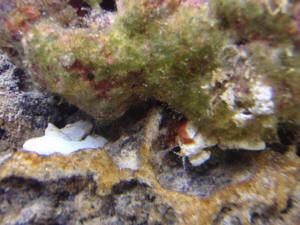 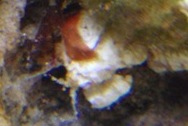 worm head? worm head?
|
Bristleworm eating substrate
2/1/11
Hello! I've taken the plunge and bought an already established 58
gallon reef tank a little over 2 weeks ago - nitrates were a little
high temporarily but everything seems to be amazingly fine despite a
mid-winter move.
<Ah good>
I noticed a Bristleworm (one of several) this morning, about 1/8 inch
wide and 2-3 inches poking out of his crevice. He slithered partway
out, sifted through the substrate, grabbed a chunk with a wide open
mouth, and took it back to his hole. It's CaribSea Special Grade
Reef Sand to give you an idea of size. I returned to the tank a number
of times throughout the day and could always count on seeing him doing
this. At one point I noticed he was swallowing 2 or 3 pieces before
taking a chunk back to his hole. He was actively "eating" all
day long. It was like watching a python devour prey.
I could see the substrate inside him. I haven't been able to find
any information on why a worm would behave this way.
<Interesting. I too have not seen, nor read reports of such
ingesting>
There are numerous hitchhikers, a couple of hermits, a couple of
urchins (one too many in my opinion) and several snails - plenty to eat
without having to resort to the substrate! Have you ever seen such
behavior?
<I have not>
The substrate looked "clean" - we mixed in about 20 pounds of
new sand to the existing sand when we set the tank back up. It's
about 2 inches deep for what it's worth.
Thanks for your time! WetWebMedia has satisfied my curiosity countless
times - including today when I discovered I had a few survivors
(Galaxea) of what I thought was a dead coral skeleton!
<Ahh!>
Have a great day!
Ashley
<Will do, and thank you for reporting your observation. I suspect
this (gravel) "too shall pass". Cheers, Bob Fenner>
Re: Bristleworm eating substrate 2/3/11
Thanks so much! I've since determined that it's a type of
Eunicid (and he has at least one good-size friend I've also
spotted). The live rock was from Tampa Bay Saltwater and I've heard
that they are not uncommon finds in their rock.
<This is so>
A trap hasn't worked - I'll remove the rock and flush them with
seltzer. I believe what I witnessed was the worm building a den as
sometimes he just picks up rock and "arranges" it around the
entrance, but I'm still puzzled as to why he would swallow it.
<Maybe to "coat" it with material for fastening into a
tube>
Maybe it's easier to carry that way! I'm sure it won't be
the last unexplained thing I witness in the tank - may as well sit back
and enjoy. Thanks again, and have a great day!
Ashley
<Thank you. BobF>
Bristle worms spewing 08/12/09
I have a 33 gal tank. Moved a few rocks around tonight and noticed a
giant bristle worm (pinkish-peach) expelling something pink into the
water. Then seconds later another... Then another... and even more
still, including a feathery looking one that was caterpillar like !?
What the heck? Is it toxic? And I have some giant worms... Should I be
plucking these critters out?
<They are likely spawning. No need to remove them. This is a good
thing (usually).
Cheers,
Sara M.>
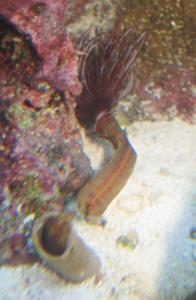
Relationship between hermit and spaghetti
worm 4/29/09
Hello all!
Is it common or well-known for a spaghetti worm to "host" or
form some kind of symbiotic relationship with a hermit crab? I have a
Mexican red-leg hermit using a Cerith snail shell with a small hole
bored in it (I assume made by the predator which killed the original
snail). There are two long tentacles coming out of the hole that to me
look identical to a spaghetti worm. They wriggle about and withdraw
just as you'd expect them to. Have you seen this before?
Thanks,
Emily
<Hello Emily. It's actually pretty common for Hermit crabs to
form symbioses of various types with a number of different animals. One
of the European species, Pagurus bernhardus, has been quite well
studied in this regard. It routinely forms a symbiosis with sea
anemones (several species) that it actually moves from old shells to
new shells as it grows. Inside the shell there is a Polychaete worm,
Nereis fucata. The crab and the anemone are assumed to benefit one
another, the anemone by being moved about and perhaps collecting food
from the crab, and the crab gets the benefit of the anemone's
sting. As for the worm, there's no particular benefit to the crab,
but the worm certainly snatches crumbs of food and lives somewhere
relatively secure, defended by both the crab and the anemone. As for
worms living inside burrows through the shell, the hermit crab likely
doesn't notice or care about these, any more than you do the
thousands of mites living in your eyebrows. There's little to no
interaction between the two of them, though perhaps the burrowing worms
might benefit from crumbs of food that drift about when the hermit crab
feeds. Those worms would be in that shell regardless of whether the
shell was occupied by a snail, a hermit crab, or was just sitting about
on the substrate. As such, it's not really a symbiosis _per se_.
It's better to think of a symbiosis as a situation where animals
make particular efforts to interact with one another, and when doing
so, at least one partner benefits. Cheers, Neale.>
Re: Relationship between hermit and
spaghetti worm
Thanks for the info, Neale!! I think it's kinda funny, this crab is
hauling around a freeloader! Pretty neat :)
<Some 10% of your (dry) body weight is bacteria. On top of that,
there are mites in your eyebrows, amoebas crawling around inside your
mouth, yeasts on your skin, and more besides! The only thing unusual
about the "freeloader" you're seeing on your Hermit is
that it's visible; most aren't. Cheers, Neale.>
Feather duster lost head 01/16/09
I noticed I hadn't seen my Hawaiian feather duster show any display
over the last two days, and today I found his head laying in the bottom
in the corner of the aquarium. Do you think he's dead, or is this
normal? <I think you mean that it has shed its crown (the feathery
part). This is sometimes "normal"... but it could also be a
sign of stress. If the worm is healthy, it will regrow its crown.>
Thanks, Pat <De nada, Sara M.>
|
Feather duster cut in half? 01/16/09 Dear
Crew, I have only had need to write WWM once since setting up my
first saltwater tank two years ago. I am enormously thankful for
the information here, read daily, and want to kick those who are
intentionally ungrateful or rude to the staff of volunteers
there. Thank you so much for your site, I have successfully
stocked 3 tanks (lightly) with sick or dying corals from others,
and all have regrown beautifully. <good to hear> Currently,
I have a large feather duster that appears to be dying in my 60
gal LPS tank. (Tank houses much live rock, Chaeto, a small Tomini
tang, algae blenny, and a falco Hawkfish, as well as a 'non
aggressive' clean up crew. I change five to ten gallons with
aged water twice a week [RODI], use an Aquaclear 110 for
Polyfilter and ChemiPure, as well as a cheap skimmer modified
which pulls an enormous amount of disgustingness out of our well
fed water. Flow is provided by two Koralia 2s and an intermittent
Koralia 3, and the lighting is power compact [320 watts]. I do
not have a refugium or sump connected to this tank.) He has been
in the tank for more than eighteen months, and has grown and
behaved like your average feather duster (in a fabulous
environment with plenty of food). However, his morning it was
extended out of its tube by three inches. Within an hour or two,
he crawled out, and to my surprise, appeared to be cut in half
about three inches below the crown. The two ends of the
'cut' appeared relatively clean, but with one small piece
of flesh holding them together. So, now I have a feather duster
tube, with the lower end of the worm in it, and a free floating
(and protected, for now) top half of a feather duster in my tank.
I am inclined to remove the upper portion, but would hate to do
so if it has even a slight chance. <No, no... just leave the
worm alone. They sometimes do this. Just let it be.> My water
parameters tested as they normally do (nitrates 0, pH 8.2,
ammonia 0, calcium 410, dKH 11). I changed 15 gallons anyway, and
everyone else in the tank appears to be happy and healthy. I have
no idea how this could have happened, and while I have a few tiny
hermits, as well as the normal population of bristle worms- I do
not see how anything in my tank could have mechanically injured
the feather duster. <It might likely not be mechanical. The
worm might have done this to itself.> So, my questions for the
Crew are these: 1) Is it possible that either 'end' of
the feather duster can survive given the chance? <Yes> 2)
Do feather dusters normally expose several inches of their
bodies? <Not "normally"... but it does happen.>
Or is there a predator in my tank capable of entering a feather
duster worm's tube (tiny hermit, etc)? <I think something
might have irritated it enough to want to "escape" its
tube, possibly to move elsewhere. But I couldn't tell you
what that irritate might be.> 3) Is it possible that this is a
reproduction strategy? (While I queried this, I myself have never
seen a large feather duster snip itself in two.) <This is
possible.> I do all that I can for my tanks, which mainly
consists of convincing myself to leave them be and not tinker,
but I do not want to foul my tank or hurt this guy in any way.
Any advice or thoughts would be much appreciated! <I would
just leave it alone and see what happens.> You guys/gals are
truly awesome. Thanks you so much. --Carolyn <Thanks and De
nada, Sara M.> Re: Feather duster cut in half?
01/16/09 Sara, Thanks so much for taking the time to
answer, and so quickly! I suspected that I should leave him be,
but I was too caught up in freaking out. <Hehe, I know the
feeling!> The upper portion has buried itself alongside the
rock which houses its original tube. <That's good! It
might likely be rebuilding its tube as we speak.> I really
hope both pieces survive. <Let us know if they do. :-)>
Thank you to You, and the rest of Crew. --Carolyn <Cheers,
Sara M.>
|
 |
Bristleworms... Observations... Reproduction and
Removal 10/21/07 Hey Team: <Hi John, Mich here.>
Not really a question today, just more of an observation. I was
scraping my tank walls and creating quite the amount of wave action ;).
During the process tons of red bristle worms came out and began hanging
half way out of the rocks and then releasing a red (pinkish) fluid into
the water <Possibly reproductive materials.> I am sure they do
this all the time, however, it was the first time I had witness such
occurrence. <Neat!> Also was a great opportunity to pick out some
of the longer ones. <Thanks for sharing. Mich> John
Night of the Triffids... Polychaete repro.
event 4/25/07 Tonight (April 24, 2007) before the
lights went off watching my tank (200 gal, 7 years old) I saw something
truly strange. Water started changing into milky colour, very quickly.
Worms, light pink, between 1-2 ", looked like bristly (but
I've a doubts - I use something similar for fishing) <Yes>
sticking their heads from all over and spitting white sperm-like
matter. <This and eggs> Didn't know so many in my tank.
Hundreds of them! Bottom - No sand - shells only and rocks.
Fishes were bothered a little by the whole situation; corals and
anemones not at all. During the day, when I vacuum tank's bottom,
always get a good bunch of them. If that what happened is what I think
it is - I'm in trouble: in the near future there will be
infestation of these worms in my tank. One good thinks - they have to
eat what is left on the bottom after snails, crabs and shrimps. After
few hours water is still white cloudy. What in the world
what that? Night of the Triffids? I presume. Marcin Mankowski
<Please read here: http://www.wetwebmedia.com/polychaebehfaqs.htm and the linked
files above. Bob Fenner>
Bristleworm and Cat Shark Issues - 4/17/07
Hello. <Hi there!> We recently hatched a small banded cat-shark
in our 90gallon tank. (Don't worry, when he grows he will be
destined for a much larger 240gallon) <Mmmm, hopefully that will be
soon as these sharks grow very quickly in their first year. I
wouldn't have recommended anything smaller than a 125g to start -
for the shark alone!> Last night I had the flashlight out watching
him feed on ghost shrimp, as his appetite has been hit or miss in the
first few weeks. <Not unusual in a very young shark. Am concerned
though, about its well being in a crowded community tank. Sharks,
especially just out of the case, are vulnerable and in need of some
quiet and care. A situation such as this could be very
stressful/detrimental. Please watch for aggression (picking/nipping)
from other fish, along with any signs of decline.> While
doing this, I noticed a few large orange puffs appear in the tank. I
watched, and found some large (~3inch) bristle worms would stick one
end in the air and "discharge" a milky orange looking cloud.
I managed to film one of them doing this. <Neat! By the way, thank
you for sharing this experience with us. It helps us all!> Then I
noticed several of the smaller ones doing it on a much smaller scale.
The entire tank became as cloudy for a bit. Now, my
questions are 1) What were they doing? <Likely releasing
gametes/spawning.> 2) Was it harmful to the tank? <No, just added
to the nutrient load.> 3) Our population seems to have really
exploded since our arrow head crab died. <Yes, rapid population
increase likely due to a nutrient problem, combined with the loss of a
predator. Decrease/export nutrients and the Bristleworm population will
fall on its own, to more normal levels. Please see this link regarding
nutrient control: http://www.wetwebmedia.com/nutrientcontrol.htm.>
I am hesitant to get another, as we have a fire shrimp and a red
striped shrimp that I am worried would be no match for an arrow head.
<Given the chance, the shark will eat these first, then go after any
slow fish you have (mandarin).> What would you recommend
as a population controller in our tank? <(See above) Unfortunately,
your tank is more than overcrowded, which is putting a strain on your
system's ability to process the bio load (and it's only going
to get worse as the shark grows). It's also not an ideal situation
for the inhabitants. Please read these links for more information on
shark keeping and compatibility: http://www.wetwebmedia.com/sharkcompfaqs.htm
http://www.wetwebmedia.com/sharkslvgrm.htm>
FYI, in addition to the shrimp and cat-shark we have the following: 2
blue damsels, 2 silver damsels a coral beauty, and angel, a yellow
tang, a large clown fish, and a mandarin goby. Todd Aston <Take care
and good luck! -Lynn>
Re: Coco Worm with
"heads" that change color!
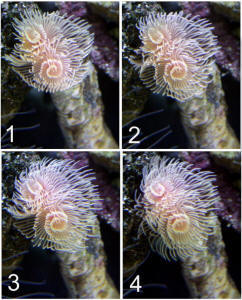
1/30/07 Here are some sequential pictures taken about 1 to 2
seconds apart. It did this for several weeks then sort of settled
into the pink color until it shed it's "heads". After
it grew a new pair of heads, the color switching began again and is
still changing colors now. It is getting close to full size again
so I don't know what's next! <Call the News Channels!
Yes, I'm serious> The color changes are very easy to see any
time of day under any lighting. We also have video documenting
color change in real time. Don't know if we have the only one
or they are common but I've never seen anything quite like it.
Thanx! For your time Rick Oppermann
<Thank you for sharing. Bob Fenner> |
|
|
Electric worm in my reef tank!
9/4/06 Dear Mr. Fenner, <Derek> This evening I decided to
have a look in my reef tank while the lights were all out, in the hope
I might see one of the many creatures that spend the day hidden in
holes in the rocks. <Is really a fun, neat time for observation>
Well, I saw my boxer shrimp behaving a bit odd, looking like he'd
caught something, so I looked closer hoping it wasn't one of my
fish. At first I couldn't see anything in his claws but he seemed
to be wrestling with something. A moment later two thin strips of vivid
electric blue lit up between his outstretched claws and he jumped back
like he'd put a pincer in the mains socket. <Ah, yes,
phosphorescence... not uncommon in the wild> I continued to watch,
trying to adjust my eyes to the dark water, and again a flash of blue,
the shrimp jumped back again. Eventually I could see he'd caught
what looked like a 2.5" long worm. It was too dark to make out
properly, and I didn't want to suddenly light the whole tank up,
but the worm looked thin and flat, and while the boxer tried to eat it
the worm shot lines of really bright electric blue along its body.
<A type of reflex defensive mechanism> it looked like the shrimp
was chewing on a live wire, but the most beautiful blue glow. The glow
clearly hurt the shrimp, though he didn't give up, and at this
moment the boxer appears to have won and is slowly eating the worm. Now
that the glowing has stopped the worm looks very plain and could easily
be a bristle worm, but do they glow like that? <Can, yes>
Whatever this is it has me very excited, I'm amazed to see an
unidentified glowing creature in my little reef. I almost wanted to
stop the boxer killing it but short of pulling every rock out there was
no way I'd separate them, and I also wondered if this worm could be
a danger to the fish anyway. I'm a big fan of Wet Web Media and
have spent many hours reading through your FAQ's, so when I saw
this unexpected and unidentified creature I thought of contacting you
first. Have you any idea what it was? <Yes... an instance of
(observed) bio-phosphorescence...> Did I get all excited about
something common? <Mmm, not commonly seen in captivity> I'm
fairly new to reef keeping but to me this felt like some kind of
discovery ;) I tried to get it on my digital video camera but it was
too dark to see anything. I'd love to know your thoughts. I've
tried looking for similar things online but turned up no clues at all.
Thanks in advance for your time, and thanks for the great site.
Regards, Derek <Do take a look/see on the Net with the term:
"biological phosphorescence/luminescense in the sea" in your
search tool/s. Bob Fenner> Re: Electric worm in my reef tank!
9/4/06 Dear Bob, <Derek> Many thanks for your
reply. I feel very privileged to have seen this if it is not commonly
observed in captivity. Now I'm trying to find out what the tiny
star shaped white things are on my glass, they look sort of like tiny
white starfish (in shape only) but with only 4 stubby 'legs'...
they're maybe 5mm in diameter. <Mmm, likely Asterina sp.>
I've only ever seen two in the tank (at one time). Any ideas would
be very welcome...I'll continue my search on that. <Look up this
name> I'm completely fascinated by all the unusual
creatures/organisms that appear in or grow on my reef unexpectedly.
It's great to have WWM as a resource to help identify them, and to
have your personal replies is just fantastic. Thanks again for your
time. Best regards, Derek <Welcome. BobF>
Feather Duster - 03/11/2006 Hello, my
fishy friends! <Hi> Thanks for all the help - and the confusion
(bristleworms, good or bad? 6-line wrasse, "really" reef-safe
or not?) ;-) <Mmm, welcome> I think I have found the
answer to my question in the FAQ's, just trying to
verify. A couple of weeks ago I bought one of the small
feather dusters (red/white head, tube about 3" long, smaller in
diameter than a pencil). I drip-acclimated him like I do
everything, then put him in a crevice where the bottom of the tube
would be in the substrate. I never once saw him come out of
his tube. A few days later I noticed that he wasn't
getting much light where he was so I was going to move him, <Mmm,
best not to> but when I removed the tube it seemed
empty. I didn't actually watch the guy at the LFS bag
him, but I left the tube in my tank just to be sure in case he was
still in there. <Good> Now, this morning when I turned the lights
on in my nano, there was a tan lump about the size of an M&M
sticking out of one of my pieces of live rock. Once the lights went on,
it started pulsating and eventually disappeared. The tank is about a
month old and everything in it either came out of my 60-gallon tank or
I bought as a frag. Is that thing my feather duster?
<Could very well be> I have a lot of small feather dusters in my
other tank, but since the heads come directly out of live rock I
don't know what their bodies look like. If that is him,
will he decide tube-life is not for him and make his new home in my
live rock? <Will actually generate another "tube"... What
a planet eh? Bob Fenner> Thanks!
Spaghetti Worm? 8/23/05
Thanks for providing this excellent service. <Welcome> I've
learned an incredible amount browsing through your FAQs. My
question has to do with what I believe is a spaghetti
worm. It never shows itself, and never changes position, but
it sends out about 8 long, white tentacles, about 6-8 inches
long. My problem is that every so often, it emits a dense
cloud of what looks to be organic material that eventually clouds my
tank. <Ahh! Likely waste and/or reproductive products> Sometimes
it's yellow-green, other times it is black. Is that stuff
harmful? Or could it be beneficial? <Likely a bit of
both, but not very dangerous> I have a flowerpot coral, brain coral,
couple of small starfish and a coral beauty angel. My
tank is 50 gal, with about 35 lb. live rock, and I'm using the deep
sand bed method. Thanks very much. Bob <Thank you for
writing, sharing. Bob Fenner>
Really Weird Things Happening In My Tank:
Bristleworms? - 06/11/05 Hi Crew! I have tried to find
out on your site and in my books about what happened in my tank 2
nights ago; if you can direct me, I would appreciate it!
<<Can...and will.>> I was just admiring my 75 gal. tank
which is over 1 year old, but I had just bought it off a friend who was
moving and have been living the Life Aquatic for only 2 months now: I
am really new at this, but I Love it! <<Me too! Much
wonderment to be discovered.>> I have a serpent star, lots of
little blue-leg hermits, huge turbo snails, 2 conch snails, 2 blood
shrimp, 2 Perc clowns and a yellow tang in with ~90lbs live rock and
crushed coral sand bottom. The parameters are tested weekly (which are
stable and healthy) and water changed every other week. I
have added a torch coral, frogspawn coral, a gorgeous bubble tip
anemone, pompom coral, Ricordea mushroom, candy cane coral, green star
polyps and pulsating xenia. As I was admiring the beauty of
the tank after work at about 7pm, Suddenly!: there was an explosion of
milky-white liquid shoot up from behind the rock in the center of the
tank. I tried to see where it came from and then noticed
another shot of white liquid shoot from the end of the tank, and a
couple minutes later another shot from the other end! I
turned off the flow to see if I could find out what was happening from
above over the rock. It was coming out from the holes in the
live rock! And it continued to spurt from all over the tank
in random places, clouding the water, but not appearing to affect the
fish or the corals. Then I saw "IT": A
HUGE-ENORMOUS bristle worm slithering thru the rock (maybe 6" long
and 1/4" diameter) and when the tail end got to the opening in the
rock, blasted out another shot of white liquid! Then I saw here and
there other small pinkish coloured bristle worms poking out of rocks
here and there: they were ALL doing it! So I Think I know
the WHO part of the scene. My questions are: WHAT were they
doing and WHY were they doing it, DO they Do that ALL the time/WHEN
will they do that again? Should I try trapping them and getting rid of
them or is this a good thing that is happening??? I turned
the power heads and skimmer back on and added 2 jugs of R.O. water and
the cloudiness cleared up and I have watched and waited for 2 days, and
everyone looks fine and don't appear to have suffered any ill
effects and it hasn't happened again since: not that I have been
around to witness anyway...Nature never ceases to amaze me! Thanks for
any information that you can steer me to! Rita (of RnR) <<Well
Rita, it would seem you have witnessed a spawning
event. Little to worry about as you have
discovered. Much more info to be found here, and at the
links in blue: http://www.wetwebmedia.com/bristlewrmfaqs.htm Regards,
Eric R.>>
Feather Duster Lost Its Crown - 06/07/05
Hello, <<Howdy>> I bought a feather duster from my LFS 3
weeks ago. Its seems to be doing fine during those
weeks. This afternoon, I noticed that the whole crown has
fallen down and got itself stuck between my LR and my
sand. I looked at the crown and the crown seems to be
intact. I thought it maybe in pieces like shedding hair but
it seems to be a full crown intact. <<Not uncommon.>> The
tube opening has folded close a bit but no feather/crown on
site. I am afraid to pull the tube out since I am not sure
if the worm is still in the tube or not. <<Don't pull out the
tube. The worm has dropped its crown for any number of
reasons (have a read here and at the blue links listed at the top of
the page: http://www.wetwebmedia.com/feather.htm). If
it's not being picked on or suffering from damage/poor water
quality it will likely reemerge in a few days/week with a new
crown.>> Read some article about the worm occasionally losing its
crown but I thought it would be more like losing someone's hair, in
many pieces, not one big crown. <<Nope..."many pieces"
usually indicates predation.>> The question that I have is that
the crown is that attached to the worm? Is my worm still in
its tube or is it attached to the crown. <<In the tube...give it
a few days.>> thanks Louie <<Regards, Eric
R.>>
- Strange Bristle Worm Behavior - We have a
265 gallon coral tank. We have noticed for many months that
we have some very large bristle worms and have been trapping them
whenever we can. <If I could encourage you to keep these... most
bristle worms with the exception of the super-large ones [12" or
better] are harmless and in the larger sense desirable, part of the
natural order of things, and fill a vital role in marine systems.
Better to get a fish that would prey on these and keep the population
under control.> We also have 2 large sumps full of live rock that
are also attached to the main tank. We were moving around
the live rock in the sumps and when we went upstairs to the main tank
the water was cloudy. That is when we noticed that the
bristle worms (more than we knew we had) were behaving
strangely. They all came out of hiding and began to
wiggle. Then they discharged this orange color
stuff. We caught about 18 bristle worms with just tweezers
within about 15 minutes. It seemed that whatever they were
doing was more important than getting caught. We have never
seen this before and I have tried looking up bristle worm behavior and
have not found anything like what we have seen. Would you
know what this is and why all of them were doing this at once? <I
can take a guess.> They all came to the front of the tank to do this
almost like they wanted to be in the main flow. <It occurs to me
that many invertebrates have an amazing chemo-sense... the ability to
detect certain compounds in the water, and these mostly relating to
food items. My wild guess is that your disturbance of the rock in the
sump likely let go detritus that the worms would normally construe as
food.> Thanks for any help in advance. Kevin M. <Cheers, J --
>
Feather Duster Hello, <Hi, Graham at your service.>
We finally found your wonderful site of information.
<We're glad that you find the site useful!> We have a 75 gal.
that has cycled. It is about 1 month old. We just
recently added 2 Hawaiian feather dusters. This morning we
saw that one of them has completely left his tube with
crown. It also had a web like matter coming from
it. What could be the problem? <Many times
tube worms will leave their tube due to stress- possibly something is
bothering it, too much current, or poor water conditions.> We are
feeding it DTs phytoplankton. We have a crushed coral
substrate. Will it be able to re-build its tube with that
substrate? <Fortunately, in a healthy environment, the worm will be
able to regrow its tube within weeks or months.> Thank you!!!
<Take Care, Graham.> Joan Tipton
Fat Bristle Worms I read your questions and
answers every day and I can not tell you how much help you have been to
me. I think I have avoided a lot of problems by reading the daily facts
and questions every day. <I know I have by trying to respond> I
do have a question about bristle worms. I read several of Jason's
answers (while you were diving) to various people about the fat bristle
worms and they were not desirable. I have seen fat bristle worms in my
tank, but to date they have posed no problems. I do also have the
spaghetti sized bristle worms. I have a flame hawk and a long nosed
hawk as well as a six line wrasse. What is the problem with the fat
bristle worms. I never read anything that told me why they were not
desirable? Maybe I missed something but I want to learn. <The fear
is that larger (fatter) species, individuals might prove too
predaceous> I have a 30 gal w/protein skimmer, (2) 301 power heads
w/quick cartridges and 1 Penguin Bio Wheel outside filter 300. I have
the above mentioned fish and 1 skunk clown as well as 1 blue
yellow-tailed damsel. I have various fragments of soft and hard coral.
My water parameters are very good. I don't know whether to be
worried or not. <I would not worry> Thank you for all you do for
this very enjoyable hobby! <You're welcome> I intend to
purchase you book! I do spend a lot of time printing your articles so I
have them for reference. Susan in Atlanta <Ah, I hope they help you
as much as they have helped me in their production (leading forward).
Bob Fenner>
Bristle worm behavior Hello Mr. Fenner,
<Actually Steven Pro (part of the www.WetWebMedia.com crew) in this
morning.> My name is Tori and I work full time with fish in the
aquarium trade as head of a large fish room here in Washington. My
question to you is, have you ever actually seen a bristle worm eat?
<Not really eat per se, I have seen them scavenge around. Most that
I have witnessed are rather small.> (I have the classic bristle
worms in every picture, the red with the black ends, and white, spaced,
bristles) I have a fifty gallon reef that's been up for
approximately one year. I have a few fish (no more then seven inches
total) coral, clams, shrimps and lots of filtration (as I said, its my
business ;)). I have just embraced the bristle worm invasion in my
system, and just decided its my little eco system no matter what, and
if its nothing but Caulerpa, rock, and bristles, so be it. <I find
most bristle worms to be harmless to beneficial scavengers. The seem
most prolific in tanks that are over fed, as there is then an abundance
of food for them to scavenge.> That said, tonight I was sitting
looking at the tank, and noticed one of the very largest of my
"pests" (9 3/4 inches because I measured him) <A rather
large individual.> and all of the sudden it took a huge
"bite" of Caulerpa! <Interesting! You would not have
happened to photograph the event?> The mouth looked similar to a
snails mouth with the disk teeth. Then it seemed to avoid the large
copepods moving around it in the sand, and the little brittle stars
too, and went back to the exact same branch of Caulerpa after
painstakingly searching it out and finished it off! <A series of
pictures of this would be great!> I was just floored! <I am a bit
surprised, too. They are omnivorous, though.> I thought they eat
clams and coral. <Mostly detritus, extra/uneaten food, etc.> So,
I was hoping you may know of at least on other person who has actually
seen one eat. <I have seen them swarm dead fish, but nothing like
what you are describing.> Thank you again for all your time. live,
swim, grow ~Tori Craig <I try to do the living and swimming part as
much as possible, but I do have to try to stop the growing (mostly
width-wise) now. -Steven Pro>
Feather Duster Question 3/8/04 Hey: I
have a feather duster question... I have had one for about
two weeks and now he starts coming out of his tube... but he goes back
in if he gets scared... Looks like he gets out and his crown
is out and he looks around with it or something... Is
something wrong with him or is this normal.. Thanks a lot
<It is probably normal. Feather duster tubes are often
damaged in transport. It will be reconstructed in time if
the animal is healthy and getting enough food. Losing
"feathers" from it's crown would be a bad
sign. Best Regards. Adam>

