|
|
| Home | Marine Aquariums |
Freshwater Aquariums |
Planted Aquariums |
Brackish Systems |
Ponds,
lakes & fountains |
Turtles & Amphibians |
Aquatic Business |
Aquatic Science |
Ask the WWM Crew a Question |
| Please visit our Sponsors | ||||
epoxy coral putty... Concern re poss. tox. 1/18/14
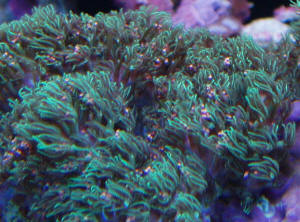
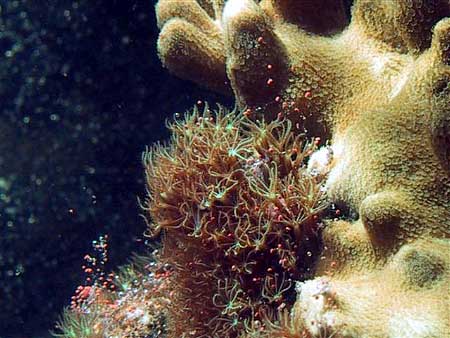
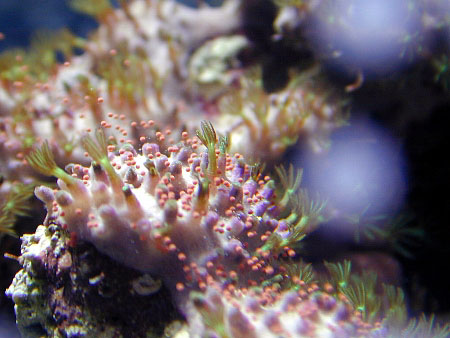
Green Star Polyps Spawning 12/7/06 My Green Star Polyps are spawning. <Your polyps do not spawn, no eggs involved.> <<? Sexually? Perhaps so... RMF>> I'm not sure if I should do anything, but I'm concerned about having green star polyps taking over the whole tank. It's been up 2.5 years and the various corals have grown to fill most of the available space. Do the spawn usually live? Should I vacuum them out? <I think you've got something else going on here. Try to get a pic if you have a camera with macro capability and resend, may be very interesting. James (Salty Dog)> I realize this is somewhat rare, special, etc. But I'm just seeing dozens of planulae and envisioning GSPs sprouting everywhere. - Ben Re: Green Star Polyps Spawning 12/8/06 I don't
have a digital camera with macro capability, however it looks a lot
like this, from an Eric Borneman article: http://www.reefkeeping.com/issues/2003-06/eb/images/image016c.jpg
<Cannot see any pics on these links.> A different shot from the
article shows the eggs with a colony of green star polyps much better,
but looks less similar to my own colony, due to the polyps being
smaller and many being retracted: http://www.reefkeeping.com/issues/2003-06/eb/images/image022c.jpg
The whole article: http://www.reefkeeping.com/issues/2003-06/eb/index.php The
article as a whole has several pictures of green star polyps that have
spawned, and my own research via Google indicates Pachyclavularia
violacea are external surface brooders. My wife watched the
eggs exit the individual polyps and they are now attached to the polyp
mat via what appears to be very fine strings of mucus. I don't know
if it requires a separate colony to fertilize these eggs, but I have
very little doubt that they are eggs. I did not watch them
come out of the polyps as I was at work, but my wife called me and
described it to me as it was happening yesterday afternoon about 2:30
PM Central time. This would have been near the middle of the
day for the tank. <Ahh, now I am seeing the light, now that you
provided me with the scientific name of the coral. Yes, your
coral does spawn in the form of egg/sperm packets along with encrusting
the entire rockwork they are on. The only prevention from
carpeting the tank is by removing rock they are attached to, perhaps
selling or trading them to your dealer.> Thank you, <You're
welcome. James (Salty Dog)> - Ben Yellow polyps
Hello again. <Cheers, Anthony Calfo in your service> Just
wondering about my yellow polyps/anemone colony. They are budding
often, and quite quickly. <delighted to hear it!> Is it
hard to keep these guys under control? I really enjoy them because of
how easy they are to care for. <agreed...and yes, they do grow
well when given good current and food. Without such they grow slowly
and some may wane/starve. You may control their growth by placing
rubble around the main colony and replacing as the pieces become
covered. Do trade, give away or sell the pieces locally to LFS,
aquarium society friends, etc. That means less "coral" that
will be collected wild for having done it> When one animal that is
part of a group, or buds that are all attached, catches some food, does
the entire group benefit? <very good question. No...they are
not interconnected so intimately but rather they are colonial. You may
cut away any number of individuals without harming the rest of the
colony. I should be placing an article on such coral propagation or an
excerpt from my book on our site here soon> Thanks lots! -Becky |
|

|
Features: |
|
| Featured Sponsors: |