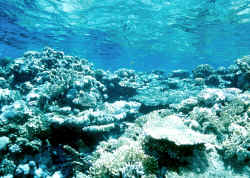
Back to: Part 1 Red Sea Reef Flat
Biotopes
Genus Montipora: Again fifteen nominal species are
described for the Red Sea. Of these only a couple are commonly found on
the reef flats.
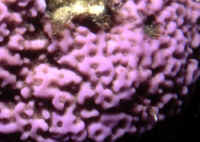
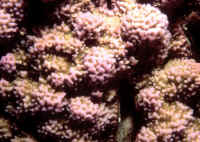
| Montipora meandrina (Ehrenberg 1834).
Colonies made up of irregular surface verrucae that aren't
fused into a pattern. Shallow reef edge. Red Sea
images. |
|
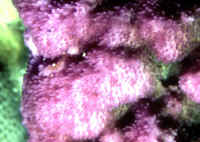
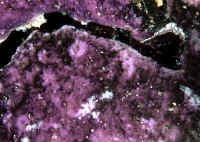
| Montipora monasteriata (Forsskal
1775). Colonies as massive encrusting forms or uni- or bifacial
plates. Most corallites immersed; coenosteum covered with
tuberculae or papillae. Light brown or blue in color with white
margins. Common on upper reef slopes in its range. Red Sea
images. |
|
Family Pocilloporidae:
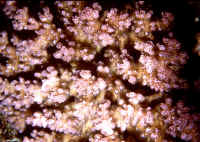
| Pocillopora damicornis (Linnaeus 1758),
Cauliflower Coral. The most common member of the family offered to
the aquarium trade. Compact clumps of up to a few meters height.
Verrucae and branches blend together. Of varying branch thickness
(thinner in greater depths, less water motion areas). Several
colors: overall brown, pink cream, greenish. Red Sea colony. |
|
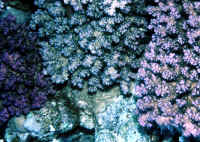
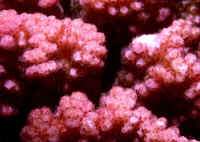
| Pocillopora verrucosa (Ellis & Solander
1796), Cauliflower Coral. More blunt, bump-like branches and
much more common than P. damicornis here. Red Sea
images. |
|
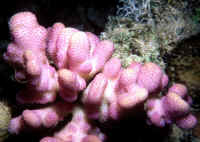
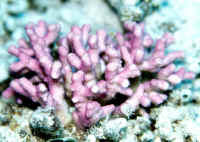
| Genus Stylophora of the four genera of
pocilloporids found in the Red Sea is the most common on the reef
flat; particularly S. pistillata (shown in higher water
circulation and deeper water morph) which occurs down the slope to
about 25m in depth. S. wellsi is common on the flats but not
very beautiful; being more encrusting in appearance. S.
subseriata is also found here, is similar in
appearance. |
|
Family Poritidae: Porites, is especially
important at the reef crest of the slope as a principal reef
builder. The genus is typified by having small (1-2 mm.) honeycomb-like
corallites that assemble as fine to the point of smooth boulders of
tan, brown to pink color. Ten plus species here.
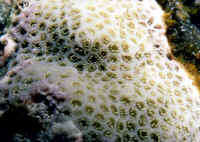
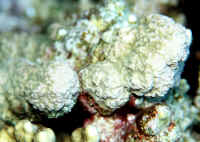
| Porites solida (Forsskal 1775). Massive,
generally hemispherical boulders of up to meters across. Smooth to
undulating surface appearance. Large polyps for the genus. Very
common in the Red Sea, so much so that in calmer waters the reef
crest is often termed the "Porites Zone" of this species.
One inch macro framer and small colony in the Red Sea. |
|
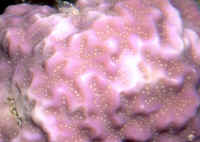
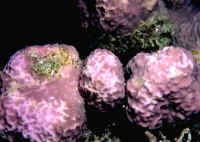
| Porites rus Forsskal 1775, Plate and Pillar
Coral. Variable in shape as its common name points to. Upright
columns more shallow to gorgeous plates deeper, more calm waters.
Gray to brown in color, often with yellow polyps that have wider
spaced calyces, raised areas between polyps. Red Sea
images. |
|
Other Stony Coral Families: Less common but
periodically dominant are other scleractinian families members.
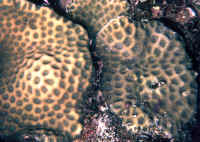
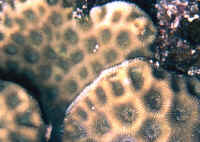
| Goniastrea retiformis (Lamarck 1816), family
Faviidae. Common species in its wide range. Colonies encrusting to
hilly to columnar to boulder-like. To over a meter in diameter.
Corallites four to six sided, with alternating series of septa that
are thin-walled and straight. Fiji images. |
|
Spiny-Skinned Animals, phylum Echinodermata. About
the only echinoderm species that regularly brave the vicissitudes of
the Red Sea Reef Flat are Pencil Urchins, that hunker down in rocky
crags during the day and emerge to scrape algae by night.
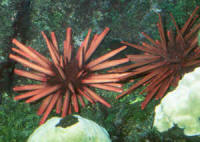
| Heterocentrotus mammillatus (Linnaeus 1758),
the (Red) Pencil Urchin. Indo-Pacific; Red Sea to Hawai'i.
Nocturnal, hiding in crevices by day in depths to thirty feet,
emerging at night to rasp rocks. To one foot overall diameter.
Hawai'i picture. |
|
Principal Fishes of the Red Sea Sandy
Reef Slopes: (Species commonly available, and useful for
aquariums.)
Surgeonfishes, family Acanthuridae: There are 15 species in
the Red Sea. The Sohal is the undisputed "King" of fishes of
the reef flat, occasionally found with the most common Naso and Purple
Tangs in "supporting" (but subdominant) temporary roles. See
the Reef Slope section for more.
|
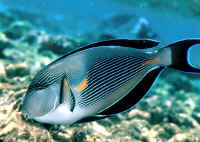
Acanthurus
sohal (Forsskal 1775), the Red Sea Clown or Sohal
Tang. One of the best Surgeonfish of the genus Acanthurus for
very large systems, though some individuals get quite aggressive
with age and size. As long as they're "Kingfish",
problems are few. Red Sea image.
|
|
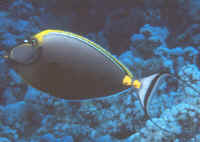
| Naso lituratus,
the Naso Tang to most aquarists; it is
also known as the tricolor or lipstick tang. There are some who
claim that "blonde" and "streamer" versions are
different species; they're all Naso lituratus. To
eighteen inches in the wild. Below, a Naso in the Red
Sea. |
|
|
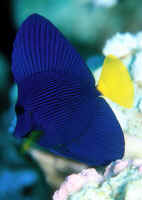
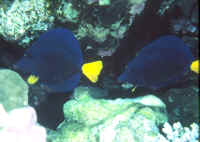
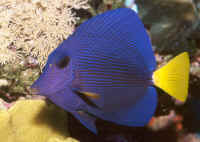
Zebrasoma
xanthurum (Blyth 1852), the Yellowtail or Purple (though
more blue than violet) Sailfin Tang. Collected from the Indian
Ocean and Red Sea, this is a supreme aquarium fish. Hardy and
gorgeously bluish purple with yellow pectoral and caudal fin
highlights. A 2 inch juvenile and adult couple in the Red Sea
and an exemplary aquarium specimen shown.
|
Damselfishes, family Pomacentridae: Of the forty species of
pomacentrid species found in the Red Sea, a couple spend almost all
their time between the reef side edge of the Flat/Plateau and just
"over the edge" of the reef slope.
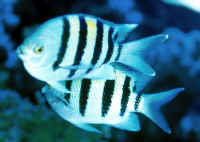
| Abudefduf vaigiensis (Quoy & Gaimard
1825), the Indo-Pacific Sergeant Major. Eastern coast of Africa and
Red Sea out to the Line and Tuamotu Islands. To six inches long.
Fourth black body bar originates after hard dorsal fin. Individuals
and their group pictured on the reef flat/slope border. |
|
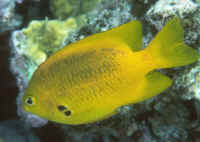
| Pomacentrus sufureus
Klunzinger 1871, the Sulphur Damsel. Western Indian Ocean,
including the Red Sea. To three inches overall length. This fish
has become a steady offering in the pet trade. It's a gorgeous
golden yellow overall as an adult and only slightly less so as
juveniles. Red Sea image. |
|
Wrasses, family Labridae: Of the sixty nine species of Red
Sea wrasses, only a few are "resident" on the reef flat,
though a dozen or more do visit here.
|
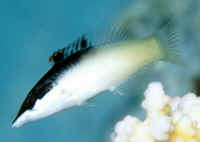
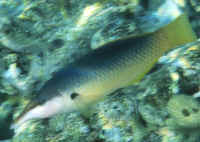
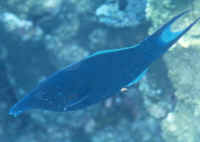
Gomphosus caeruleus Lacepede 1801, the Blue,
or Red Sea Bird Wrasse (1) is found in the Indian Ocean and Red
Sea. Males are dark azure blue, and females white to yellow below
and dark greenish blue above. To one foot in length. Below: two
inch juvenile, four inch female, seven inch male. Images made in
the Red Sea.
|
|
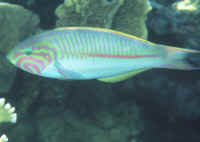
Thalassoma rueppellii (Klunzinger 1871),
Klunzinger's Wrasse. To eight inches maximum length. Formerly
and often still misidentified as T. klunzingeri.
|
|
Back to: Part 1 Red Sea Reef Flat
Biotopes
Or on to/down to the next level: The Red
Sea Reef Slope