Biopellet reactor = sponge food?
1/10/15
Hello! First off, thank you for the great information available on your
website. It has been a great help to me so many times!
<Ahh; so very glad to read>
Now for my question: I run a biopellet reactor on my reef aquarium. I
have often read that you should position the reactor so that the reactor
outflow immediately gets pulled into the protein skimmer so as to remove
the majority of the bacteria being flushed from the reactor. That's the
way I have things set up.
However I have been wondering, since the majority of non-photosynthetic
sponges feed on dissolved organic matter (DOM) and bacteria, could a
biopellet reactor be a good source of food for sponges?
<I do think such use would be of benefit>
Perhaps by placing the reactor at the opposite end of the tank from the
skimmer. Or might these be the "wrong" type of bacteria for sponges?
<Likely not a "bad" source; selected by size mostly>
What do you think? I would love to keep more colorful sponges but have
avoided adding them (except for the ones coming in on live rock) because
of care and feeding concerns.
<I share your concern; and direction here>
Thanks so much,
Joanne
<Worth trying moving the reactor; perhaps looking into how you might
measure carbon, bacteria here.
Bob Fenner> Just an observation... The loss of sponges,
PolyFilters, and
nutrient export. 09/15/09
Hello all!
<Hello Rob!>
I am a huge fan of your site and appreciate all that respond to our
queries.
<Nice to hear.>
There is a wealth of knowledge to be gained from others experiences in
the hobby. This is the most organized by far, and it certainly contains
the most information!
<I definitely agree on the most information part!>
Just thought I would write about an interesting thing that occurred in
my tank recently. I have had the same 108#'s of Beautiful live rock
in my tank now for about four years. About a year ago, out of no where,
I began to see these super bright chartreuse sponges growing all over
my rock. They did great although never reached a size above 3/4 of an
inch. I have decided to rid myself of the one leather I have and make
the full conversion over to sps. I did a larger than normal water
change and added a poly filter. I change about 10 gallons a week on
this tank. It is a 65 gallon with a 55 gallon sump that is 2/3 refuge
and 1/3 skimmer chamber/top off/return chamber. I did about a 20 gallon
water change and added the poly filter which, aside from the skimmer,
was the first chemical filtration I have used in about a year. Anyway,
since adding the poly filter, all the sponges have disappeared!
<Not sure this is cause and effect specifically with the Polyfilter
(which I am a fan of), I rather suspect it may have more to do with
less available nutrients in the water.>
This is really the only factor I can attribute to this. This speaks
volumes for the effectiveness of this materials ability to remove
organics and so on. But to what cost? I still believe that the benefits
out way the loss, but this was pretty blatant to me!
<A very interesting observation to say the least.>
I wonder what we are still missing in this hobby.
<A lot.>
We have grown by leaps and bounds in the past decade.
<Yes.>
We can, and should study there natural environment to duplicate as
closely as we can.
<I am in agreement in many ways.>
But our little fish bowls are very different worlds when it comes to
compatibility, chemical reactions/interactions.
<And absolutely in agreement with you here!>
So much to still learn!
<Amen.>
It's great isn't it!!!!
<Never stop learning is my philosophy!>
Just thought I would share,
<Thank you! We very rarely see comments like this it is indeed
refreshing.>
Happy Reefing!
<And to you.>
Rob
<Mich>
|
Sponge question; sys., fdg....
8/18/09
Hi everyone (I don't know who I might get and it seems to
change every time!),
<Whomever is here, picks up...>
I'm a big fan of your site, I cannot tell you how much time I
have spent reading over your pages.
<Even just a guess-timate?>
They are very informative, thanks for putting all of the effort
in. Anyway, I imagine you would like me to get to the point so
here it is. I recently decided to try a foray into the world of
sponges (I've always thought them fascinating!). So I
purchased an orange fan sponge for my 12 gal JBJ nano deluxe.
<Mmm, such non-photosynthetic (by colour in general here)
species are hard to keep in most captive settings... starve
usually, if not outright too-damaged from collection, exposure to
air enroute>
The tank is fairly well established and I have a large amount of
live rock and soft corals (and a few LPS).
<And mixing diverse species, groups of Cnidarians in such
small volumes is tenuous as well>
My corals include an assortment of Ricordea (yuma x2 and
florida-lots), a variety of Discosoma, an orange Fungia, a colony
of Rhodactis and my LPS includes a few heads of candy cane and
one frogspawn coral. My other inhabitants include a Darwin clown,
a cleaner shrimp, a scarlet hermit, and a small species of pistol
shrimp (hitchhiker small green little guy).
Anyway, I would really like the sponge to do very well, so far I
have primarily been relying on weekly water changes, but have
also just bought a small skimmer. I feed the tank weekly (varying
by week) enriched brine shrimp, Cyclop-eeze, and reef roids. I am
not sure if any of these foods are suitable for a fan sponge (too
big??)
<Foods are size-specific w/in a pretty narrow range, and all
of these by themselves are too big for sure... however, bits and
pieces, the liquid itself may be of some nutritional value
here>
so I also bought a can of UltraMin F which is described as being
a sponge food which I spray directly on the sponge every other
day with the flow off. Have you heard of it?
<Just read re>
Will this be enough to sustain the sponge?
<Mmm, not likely, no; not of, by itself>
Any suggestions on what else I should do for it.
<Well... could be placed in a much more established, larger
system... in a "cryptic zone" per its requirements of
nutrient, flow... perhaps a sump/refugium if you had such, in a
larger volume, perhaps one sans skimming, much in the way of
mechanical filtration... But at this point, better likely to hope
and wait/see... Generally these circumstances result in slow
death, shrinking in size, rather than outright catastrophic
mortality of the sponge, its tankmates>
Obviously its a small space right now (its also small, 3 inches
tall), but my plan was to grow it out to go into a larger tank
that I am soon to purchase.
<Do wait till this new system is "well seasoned"...
In the meanwhile, determine the species of this Poriferan, its
habitat...>
I currently have it positioned just above the middle of the tank,
but the light seems largely uniform in such a space.
<... not likely photosynthetic... and more food on
"average" to be found near the bottom...>
Any extra help or advice would be greatly appreciated. Thanks
very much!
Alex
<Please read here: http://www.wetwebmedia.com/sponges.htm
Bob Fenner>
Re: Sponge question 8/19/09
Hi Bob (and friends),
<Yo!>
Thanks for the info and good advice. Looks like I have some hard
work ahead of me.
<Mmm, not so hard>
I did watch this sponge's health in the store and waited
several weeks before buying it to make sure it did not suffer in
transport or have air exposure, so at least that is something. I
just have a couple more quick questions, if in addition to the
ultra min F, I also spray the sponge with the liquid left over
from when I thaw enriched brine shrimp, do you think this would
help?
<I do>
I have also read on the web that stirring up the sand bed can
help is this true?
<Can help, yes>
I have spent a fair amount of time trying to ID this sponge, but
can't seem to do better than ascertaining its a fan sponge, I
have attached a picture of it, do you have any suggestions?
<Mmm, yes: try here:
http://www.spongeguide.org>
Thanks very much, I really would like this sponge to do well,
I'd hate to think I condemned it. Are there any types of
photosynthetic sponges you would recommend that are hardy enough
to do well under compact fluorescents?
<Yes... posted:
http://wetwebmedia.com/spongeselfaqs.htm>
To answer your question about reading your pages, I really
can't say for the total (its a LOT), but I can say at least 4
hours in the last two days lol
Best fishes,
Alex
<And you. BobF>
|
 |
| Question on sponge... hlth., fdg.
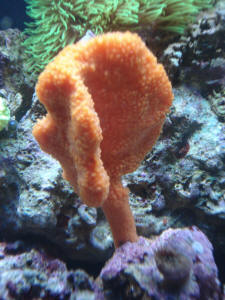
11/1/07 Hi, <Sammy... my bro-in-laws name...> Photo below
shows my red sponge that is developing dark fringes. I had this for
about 4 weeks now. Is this a good thing or a bad thing? <Mmm, a
bit of both... sponges do often have some (in this case) algae
growing on their outer margin areas... and all sorts of other
animal groups members in and on them... but this specimen has a bit
too much "new" material... I'd cut down on the light
intensity/move the specimen... to a less bright setting> If the
ladder, what can I do? Also, can you tell what kind of sponge this
is <Can't... need bits of material... treated, look under a
scope... Did you collect this specimen, or know about where it came
from?> and what food and lighting it prefers. Thanks, Sammy
<Again... a matter likely of experimentation... for
size/particles... Please read here:
http://wetwebmedia.com/spongefdgfaqs.htm and the linked files
above. Bob Fenner> |
|
|
Cryptic refugia I am setting up a cryptic refugium. It will
be part of the sump. The sump itself without the dividers is
28"x28"x14"H. I want to put 5-6 min. of seafloor
aragonite 1-2mm plus some live rock. For lighting I have a standard NO
fluorescent (blue). My thinking for this is to create a DSB and NNR. I
Hope the live rock will inoculate the sand with worms and copepods and
the likes. On a chance that any sponges survived of the rock it could
grow and help in filtering the water. Plus since it is a low light
refugium it might be what they need. Is this a good plan? What kind a
flow will be needed and what do the sponge eat? DOC? This is for a 175
gal. reef. <Sounds fine, sponges can utilize dissolved
non-biological nutrients, but mainly feed on plankton of various
sorts... likely don't require "extra" feeding. 2,3,4
volumes per hour for flow rate is about right. Bob Fenner> I am
eternally grateful. Stephan
Breaking in with Live Rock Dear Bob, <Diane> Thank you
for your help. I purchased a small package of cubes of frozen food to
feed the crabs and sponges. I believe it was too large for the sponges,
so will try phytoplankton in a couple of days. <Try running some of
these cubes in a blender with a bit of seawater... and applying this
blend (can be re-frozen) with a turkey baster or such... with your
filter pumps, skimmer turned off for fifteen-twenty minutes...>
Nitrate and Ammonia are nearing zero. Two small crabs were found dead
in bottom of tank, but two large and a small are still hanging in
there. I think that the larger crabs may have eaten the smaller
ones <Typical> because when I removed the shells from the
tank, they were empty... no meat, so to speak. That is why I purchased
the frozen food. I love the web site and am reading the Conscientious
Marine Aquarist. I was able to borrow it from my local library, which
is good because of the expense in beginning this wonderful hobby.
Again, your time and expertise has been appreciated... and quite
helpful. Be chatting with you again in the near future I am certain.
Diane <Indeed. Bob Fenner>
Encrusting Sponge? Here's a third try at this. I think my
previous e-mails have disappeared into the "ether". I am
copying more addresses so perhaps one will get the mail. I have not
received any messages about bounces at the wetwebmedia.com address.
Perhaps some firewall or other security setting is eating e-mails.
Henry <Not sure what is going on, but we have suspected that there
maybe a problem. Just that none of our internal communication between
WWM crew members has experienced any problems and we have sent several
test emails and all have showed up. Today all three of your messages
came through no problem, but I do not recall seeing any of them
previously. Very strange indeed. -Steven Pro>
----------------------------------------------------------------------
Hi! Last Friday I got 75 lbs of Florida aquacultured live rock and 120
lbs of live sand. My tank has now cycled and there is a lot of life on
the rocks that I'd like to try to keep for the long term, if
possible. In particular, there is this bright orange growth that seems
to be some kind of sponge. Do you have any advice on what I can do to
care for it? <Not much written on sponges. I did get a chance to
leaf through a prerelease copy of Steve Tyree's book on sponges
when Bob was at my housing and editing it. It seemed nice enough for a
early self-published work from the little I saw. Sponges are filter
feeders and need dissolved organics. Feed your fish regularly and
experiment with some of the phytoplankton products on the market. Buy
fresh and follow the directions explicitly or they are nearly useless.
See if you cannot track down something written by Rob Toonen on their
use.> Attached is a picture of some of the growth. To the left is
another rock that has a similar life form but it is a burgundy color,
just a little darker than the pink coralline algae. I assume it is
something similar to the orange "stuff" and would need
similar care. There is some similar growth on other rocks that is more
of a drab yellow color. Also, would you have a source for live Mysid
shrimp and copepods that I can purchase to place in the tank? <I
know I saw one of the various e-tailers selling packages of pods,
mysis, spaghetti worms, etc. Try Inland, Indo-Pacific, etc.> There
may already be some amphipods in the sand but I haven't seen them
yet and I want to get a colony started. Thanks for your help. -Henry
<You are welcome. -Steven Pro>
Re: Tree Sponge For feeding, in the past I have been
providing a frozen food from Ocean Nutrition called "invert
food" that contains Zooplankton/Phytoplankton mixture. My LFS says
this food is no longer available, so I have been stirring the sand bed
once per week creating a mini-storm. <this is a much better
feeding strategy for filter feeders... please continue> Recently I
found "DT's live Phytoplankton" and have been feeding
this once or twice per week, and still stirring up the sand once per
week. <OK> Is the 8 months with no deterioration a sign
that I am on the right track, or does this sponge last for a year then
fade away from starvation? <the latter for most my friend.
Sponges do not lose weight apparently like humans do. Still, you might
succeed... more time is necessary> Would you suggest other foods to
feed? I have had a silver gorgonian for about 1 year and I figured they
both would benefit from the sand stirs and plankton feeding.
<the silver gorgonian is likely photosynthetic (dirty/ off-colored
polyps? Not pure white right?) and can easily live for decades with
proper care in captivity> BTW I have a Red Sea Berlin skimmer that
works O.K. on my 125G, <sorry to hear it> it pulls about
1/3 cup per week of very dark liquid out of my tank. <not even
remotely adequate, but if you are not having problems with nuisance
algae, do regular water changes and tend to keep aposymbiotic creatures
(non-photosynthetic) then it is just as well> From my reading a good
skimmer should do this daily, < a full cup daily should be
easy... hardcore reefers/skimmers can draw more than a cup daily with
well designed skimmers. Very high water quality here> maybe the poor
skimming is inadvertently contributing to my success with this
sponge? <exactly my friend. Now do yourself a favor and be
sure to stick with a them in the tank... either photosynthetic corals
or non-photosynthetic animals. If you try to do both... one is sure to
die. Yes, it may live a year or two... but this is sad compared to the
natural lifespan of many decades (if not over 100yrs) for many>
Thanks, Larry
<best regards, Anthony>
|
|