|
|
| Home | Marine Aquariums |
Freshwater Aquariums |
Planted Aquariums |
Brackish Systems |
Ponds,
lakes & fountains |
Turtles & Amphibians |
Aquatic Business |
Aquatic Science |
Ask the WWM Crew a Question |
| Please visit our Sponsors | ||||
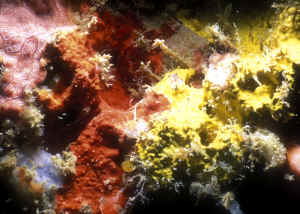
Brown sponge?? Hi, Bob Hope you are doing well, your site has been invaluable to me over the past three years of reefkeeping. I just have a quick question. I have a dark brown substance (almost diatom color) growing on one of my live rocks, under and around a Ricordea, At first I thought that it was some time of algae, but I let it alone and as it has grown, it now appears to be some type of encrusting sponge, with water in/out openings. What are your thoughts on what this is (i.e. have you ever seen sponge this color?) <Yes... in fact I don't think there's a color or mix in sponges that I haven't seen...> and should I let it grow or scrub it off? <I'd leave it as is... very likely much more beneficial than detrimental> it doesn't appear to be bothering the Ricordea at all. I know you guys are busy and I appreciate all the hard work you do saving our inhabitants from our otherwise bad/fatal mistakes. Thank You for your time, Thom Stephens <Thank you for writing. Bob Fenner> Chicken Liver Sponge- invasive 6/4/03 I have a 180 gal. reef tank that's been set up for 1 1/2 years. Most of it's contents came from two other tanks which where running for about 4 years. I had purchased a Turbinaria coral from my aquarium club auction (Brooklyn Aquarium Society) about 3 years ago which had a small brown sponge on the rock. At the time I thought it was a great deal, 2-for-1. Unfortunately I`ve been battling the spread of this sponge-from-hell for the last couple of years. I've done everything from removing rocks to injecting Kalkwasser/Muriatic acid to pulling it off the rocks. <Yowsa... look out for the flamethrowers and napalm, next!> This stuff just will not die. I have tried to ID the sponge, the best I can guess is it looks like chicken liver sponge (Chondrilla). <Doh! that sounds like the invasive bugger> I was hoping you might know of a natural predator e.g. Nudibranch, sea star or reef safe fish that I might try to control this sponge? Thank you. Kevin Moriarty (aquanut) <try some urchins instead, my friend... truly lawnmowers on a reef. May or may not help here... sponges are certainly noxious... and chicken liver sponge does have a horrible reputation. Best regards, Anthony> Cotton ball looking things in my tank Follow-up 5/31/03 I have a 40 gal salt water setup and in the past month I've noticed little cotton ball looking things with small tentacles growing on my rock and some of my corals I have 2 bigger ones 1 in round growing under a polyp rock should I be concerned<They could be a number of things my guess would be sponges but couldn't say for sure without a picture. There's probably a picture on the WetWebMedia.com site. Cody> <<Anthony Calfo with the follow-up. Do a google search of our website and beyond for Sycon or Syconoid sponges. IN our FAQs there are a couple of pics of a small Sycon species that is quite common... dingy white and pillowy. Do consider. Best regards, Anthony>> Sponge Muncher? Hello, <Hi there! Scott F. with you today!> I have a quick question about my flame angel. I am interested in buying a piece of live rock with some blue sponge on it (I believe that it is encrusting sponge). Would my flame angel eat it? I have included a picture. Thanks so much. Sincerely, Andrew Powell <Well Andrew, it's a really tough call. Just like with corals- the fish may show no interest at all in the sponge, or it may decide to snack on it continuously...Centropyge angels are not heavy sponge eaters, like Pomacanthus and other "full-sized" angels are. They do nibble on some sponge materials, but you're more likely to see them nibble on algae and detritus. You'll just have to make the decision and go for it! Try a small piece of rock first to see if the fish shows any interest in the sponge...It's probably the best way to find out, unfortunately! Good luck with this combination! My personal, gut level feeling? I'll bet that it will work out (but don't hate me if it doesn't!) Regards, Scott F> Soaking Up Information On Sponges! Dear Bob, I am hoping that you have seen something like this and can tell me if it is harmful or not. <Scott F. here tonight> On the underside of some of my live rock there is a whitish grey flat smooth growth. In one area it is 5 inches in diameter. My reef is about 4 yrs. old and I started seeing this several years ago, but didn't think anything of it. It appeared harmless and I didn't know much about what was normal and what wasn't. Most of my knowledge since has come from your book and talking with other reefers. This growth seems to be spreading to different areas of the reef. Do you have any idea what it is or what I should do about it? <Hard to be certain without a picture, but it sounds to me like it may be some form of sponge or other cryptic organism. I don't think that you should be concerned about the animal...It's all part of the wonderful diversity that arises from healthy live rock in an established system...I'd enjoy it! You might want to get a copy of Steve Tyree's book "The Porifera (Living Sponges)", which will provide a lot of information about these interesting animals> Thank you for taking the time to educate those of us who have a lot to learn. Your knowledge and education is invaluable to us. Phyllis <Glad that you find the site so helpful! We have as much fun bringing it to you as I hope you have visiting it! Good luck! regards, Scott F> Dried Sponges For Food? Hello there, <Hey there! Scott F. with you today> I am the proud owner of a Majestic angel who is doing very well as the sole inhabitant of a 120 gallon tank. Unfortunately in the UK few people have heard of Angel Formula type foods based on sponges and as far as I know there is no retailer stocking any. I spoke to the main wholesaler in the country and they told me that there are restrictions re the import of such foods, therefore I can't have it imported, particularly in its frozen form. I want to try and give my angel some sponges and I read somewhere that I can get dried sponges/tunicates from an oriental food store. Questions: Is it worth my trying? Are dried sponges good enough? Do they make an adequate substitute? <Honestly, I don't think that it is necessary or worth the effort to secure dried sponges for this fish. Number one, I'm not sure what types of sponges they would be, and, number two- I'm questioning what, if any, nutritional value dried sponges would have. Also, P. navarchus does not eat a great deal of sponge material in nature, when compared to say, the Rock Beauty or Regal Angel, so it should be very easy to get this fish to eat other prepared foods. Hikari makes an excellent "Angel" food, which seems to be more "tubeworm based" (although it does include sponge in the ingredient list), and is a great food that may also be available in the UK. Also, Gamma frozen mysis is one of the best foods you can feed to angels, IMO, and is eagerly accepted> Do they (the sponges) have a special name, in other words can I be sure that they have not been treated for human consumption? <Honestly cannot say- which is yet another reason to pass on these items, IMO> Thanks for your help, Massimo, Brighton UK <And thank you for stopping by, Massimo! Enjoy your wonderful Majestic Angel! Regards, Scott F> Look Out, Sponge Bob! Could I buy live sponge and cut it up and freeze it then thaw little pieces for feeding for my Regal Angel? <Yikes! I sure wouldn't! First, it would be a shame to slice up a living sponge that basically went through hell just to get to the LFS! Second, some sponges may be toxic, so you'd have a hard time knowing which one to chose. Finally, I think it would just be cost-prohibitive. Much better idea to purchase a supply of a frozen food containing sponge, like Ocean Nutrition's "Angel Formula". It's readily available at most aquarium shops, or can be ordered on line from some of our WWM advertisers> I was thinking of taking the little pieces and placing them in a veggie clip mounted on the side of the tank. Do you think he would feed off it? Would I gain success? Please respond back soon. <Well, I really think that your fish would be better served (no pun intended!) with one of the prepared frozen foods, as mentioned above...You certainly could place it in a clip, but it may be easier just to chop up the cube of food and feed it carefully with a toothpick...> P.S. I am the guy with the Philippine Regal which is already starting to feed on frozen food. Sincerely, Chris Faiola <Ahh, yes- I remember! If this guy is eating frozen food already- then you're almost home free...Definitely, try the "Angel Formula"-I think it's a great food! Bon Apetit! Regards, Scott F> Live Rock Question (dead sponge removal) I recently purchased some live rock and the LFS did not send it home with me submerged in water. . . just wet and wrapped in newspaper then put in a plastic bag. <This is S.O.P.> When I put this one particular rock in the tank it had a beautiful light orange sponge on it. Now that sponge is turning white and smells horrible. I called the LFS and they said it was dying because it was exposed to air and there is no way around it. Is this true? <Simple answer, yes. Please see here: http://www.wetwebmedia.com/sponges.htm> Is there any way to revive it? Should I remove it from the tank -- is it truly dying off? <No, yes, yes> Thanks a lot for your help! Elizabeth K. Birdwell <Bob Fenner> Re: Live Rock Question Thanks for your help. Would I have to remove the entire rock or could I just take the portion of sponge out? Thanks. <Just the sponge. Best to scrub this portion (like with an old toothbrush) over the sink with some running (freshwater). Bob Fenner>
Creature from the Black Aquarium... 2/21/03 Hi Phil,<Hey Jim!> I just got a better pic for you on the invert I was trying to ID. Thanks Jim <Well Jim, even with the pic we were a little stumped. My friend/fellow WWM Crew member Anthony contacted me about this creature. He wrote this: "The creature you were asking about is a very common sponge of the genus Sycon (commonly referred to as a Syconoid sponge). They are prolific harmless filter feeders that flourish in tanks with high nutrients. People often describe them as "puffs" or "pillowy". They have a dingy off white color." So this is harmless and should go away after nutrient levels drop. Use a protein skimmer and weekly water changes to help control nutrients. Hope this helps! Phil/Anthony> Syconoid sponges of the genus Sycon - 2/24/03 Just e-mailing to thank Phil & Anthony on the ID of the invert in question. After reading the email I checked out the sponge FAQ and saw the description that other hobbyists had given and fits the creatures I have in my reef tank. <glad for the ID. It is a common and innocuous creature, rest assured> And yes the air intake into my skimmer had clogged and was giving little skimmate and yes I was adding a little too much "food " additive for my ailing Lemnalia. <no worries... predictable and easily remedied to be sure> One hobbyist described it the best .. " like the end of a Q-tip". By the way . Would these sponges be a good source for pygmy angels? <not significant... but no harm either. Its the standard angels (not dwarf) that favor sponge in the diet> Thanks again for your help.. truly appreciated. Jim/Long Island <our pleasure. Do be sure to stop in and say Hi at the BAS and Long Island aquarium club meetings Bob and I will be giving in May (9th and 11th respectively). Best regards, Anthony> http://www.wetwebmedia.com/upcoming.htm Keeping Blue Sponge- Haliclona sp. 2/16/03 Hello everyone, <cheers> I just had a question about Blue Sponges...Are they hard to keep what kind of lighting and water flow do they like... <They are unique among Poriferans in that they like very high light, very (!) strong water movement and they are both calcareous and heavily photosynthetic. Basically, treat them like an sps coral. The big catch is that they cannot be exposed to air for long or at all. Bag them completely underwater and release them underwater> Do they need phytoplankton or what do they need to eat? <Little or no phyto needed. They are symbiotic with BGA> I was thinking about getting one but wanted to make sure I knew about it before I do this. I have attached a picture for you. <If you have metal halides and reef quality water... go for it. Notice the "rock" that the sponge is attached to in your picture? That is Porites nigrescens... a living sps coral that is getting killed by the sponge. Steal the branches of living coral away and you've got a 2 for 1 deal <G>> Oh by the way thanks for the info on the cleaner shrimp and how often they shed their shells. Kit <Always welcome :) Best regards, Anthony> Blue Sponge & Flame Scallops-up - 2/16/03 Thanks for the prompt response. I have power compacts 50/50's (10K and blue actinic) Yes I had read about not exposing them to air. OK so since I don't have metal halides I should not get one. <Truthfully, the lack of halides doesn't totally exclude you fro keeping blue sponge. Under fluorescents, if you can get the sponge within the top 10" of water with mostly daylight lamps and not so much actinic blue (just like you will have to do for sps corals)... this sponge can live well. Be sure to change your lamps every 6-10 months. Definitely an expense/bummer about PCs/VHOs. Halides though are a much better value (cost of light produced, PAR per watts, life of bulbs at 2-5 years each!, etc) and they would be better for growth in this sponge> I don't have the coral yet in my 90 gal reef getting one on Tuesday. But I plan to have mostly LPS and SPS and a few fish... <try to go with mostly LPS or mostly SPS... the two together are incongruous (low vs. high light and heavy vs. no-target feedings... not to mention heavy chemical warfare in the long run... post 1 year)> Right now I have a Regal Tang, Domino Damsel, Cleaner Shrimp, Flame Scallop,1 hermit crab and some snails...I plan to get a few more fish (On Tuesday getting 2 Perculas and a bubble coral) Let me know what you think. <I think you should find the jerk that sold you the flame scallop and kick him in the jimmy <G>. Poor bugger (the Fileclam- AKA "scallop") is doomed to die of starvation within a year if it even gets that far. Unless you have a live phytoplankton reactor... seriously. A very difficult animal and most starve to death slowly. Sorry to be a buzz kill, my friend. But you needed to know/asked <G>. Best of luck. Anthony> How About a Sponge? - 2/15/03 Hello again: 55 gallon FOWLR here. So far 25 pounds of LR. I have nice coralline algae on rock, but no sponge life. Are there any that are easy to keep? Thanks, Rich <Some sponges are heavily photosynthetic (symbiosis with BGA), but most sponges are decidedly heterotrophic and need huge amounts of food that we cannot produce or provide for the aquarium. The common red, orange and yellow tree and finger sponges of the Atlantic are still shamelessly promoted for cheap in the industry. Few survive months if even weeks of import. There are just a few hardy exceptions. The yellow/orange Moon/ball sponge (Cinachyra sp.). Even still... sponges are some of the most toxic creatures in the sea. Their death in the aquarium can easily kill fishes and some invertebrates. Not recommended for casual keeping. Anthony> Callyspongia - 2/13/03 Do you have any information on Callyspongia its for science class. The project is due on the 14th <There is mention specifically on this page to begin your search: http://www.wetwebmedia.com/sponges.htm Anthony> Re: Callyspongia - 2/13/03 Anywhere I look on the web there's only pictures I'm looking for mostly info can you recommend any sites I have no info. and yes the project is due on the 14th <Try a keyword search on Yahoo or like search engine with the phrase "vase sponge". I tried it and saw a lot of links with data on habitat. Beyond that, I cannot offer more. They have no practical application in aquaristics (too large and too difficult to keep presently). Anthony> Sponge developing in 500 gallon tank - 2/11/03 Bob, when I normally think of sponges, I think of low illumination. <You are mistaken, my friend. Most all sponges have symbiotic BGA and a few are nearly 100% photosynthetic. The reef is covered with many sponges in full sunlight. The common macro-species (red/orange tree, ball and finger sponges... doomed to die) are lower light> Ironically, this is near the top and in an area of relatively good circulation. <Have you referenced the sponge called "chicken liver sponge". Rubbery and just dreadful... variably colors too> As far as any current chemicals, only Kalk for makeup water and a Kalk reactor. Very confusing to me. I know you can not offer a magic wand, but should I be alarmed and is this longer term a problem. <Still limited in part by nutrients... start there> My rocks are glued in and difficult to scrape. I have recently introduced an Imperator angel and have had a yellow tang, purple tang, flame angel, potters angel, Sailfin and Desjardin tang and a bicolor angel. None are interested. I think even they would have a hard time getting this stuff off. Any steps you would advise taking. Thanks again for your time. <Definitely nutrient control and export. Small things can make a huge difference here... like never allowing the thawed frozen pack juice into your aquarium (always strain meats through net and discard juice)... else it feeds nuisance algae, sponge, feather dusters, etc to bloom. Daily skimmate, weekly changing of carbon, larger weekly water changes, etc. Best regards, Anthony> Strange algae? I have been slowly developing what looks like a black, hard, rubberized growth on some rocks and apparently weaker stinging corals. When I scraped it off , it kind of felt like rubber as well. Any thoughts on what it might be and if I should try to scrape it all away. It started to grow on a birds nest coral. It does not seem to grow very fast and I can not recall seeing it or hearing about what it may be anywhere else. It is not easy to scrape, in fact you have to use a razor. Fish or crabs are not interested. Thanks in advance for any thoughts you may have. If you need, I will try to send a picture later. Thanks. <Sounds like a blue-green algae, but might be a type of encrusting sponge. It's rare that either takes over, as in coating live corals in an otherwise well-run marine aquarium system. Do you measure nutrients like phosphate, nitrate? Would help to know re your lighting, filtration make-up. Please take a look on: http://www.wetwebmedia.com/ re Cyanobacteria, sponges (articles and FAQs). Bob Fenner> Re: Strange algae? I appreciate your quick response. I had also thought perhaps a type of sponge. To me it did not seem like a blue green due to its rubbery and hardened state. It has spread since first noticed and covered what was coralline rock. My tank is 500 gallons using an ETS 2000 skimmer, 6 250 watt metal halides. 10% water changes every 2 weeks. I do have some blue green on some other rocks and am trying to improve circulation by adding 3 sea swirls. Have you ever seen or heard of this black rubber type growth before? <Oh yes. Bob Fenner> Re: Strange algae? (sponge) Bob, again thanks for your reply. Should I get worried and start scraping where possible. Any near term concerns. Terry <Mmm, I would move any stony or soft corals that are in the path of this sponge (higher up, to areas of greater circulation). Typically, "something" will become rate-limiting, a predator will arise in a captive sponge population, reduce or restrict its over-growth... in a period of weeks to months. Again, I would check on some source of food (likely a chemical supplement) that is favoring this type. Bob Fenner>
Lifespan of wild sponges Thank you for your kind response. I am not a marine or any other kind of scientist myself, just love the ocean, so no, I have never done either paper or web library searches for marine science articles. Because the speaker I heard presented the unusual life span of sponges as a common fact, I did do a web and general encyclopedia search, which yielded nothing at all, not even a mention. <I see> I asked you because your comment indicated that the idea was relatively new and speculative. <I believe I lifted this idea principally from Robert Barnes volumes on invertebrate zoology> Is there anything you recall from your Porifera bibliography, which I have printed out, or was there a friend who relayed it to you? I'm happy to explore more searches, but if I could get a time frame, or an author, man, that would speed things up. <Have seen this stmt. in print elsewhere, but no higher source than Barnes and Barnes to my memory> Appreciative of your good work on wetwebmedia.com. <Glad to find it so. Bob Fenner> June Vayo The average lifespan for a sponge? Hi, I was wondering if you could tell me the average lifespan for a sponge? Thank you! <Mmm, in captivity probably just a few days to weeks (most folks kill them off... or they're just too beat to recover from collection and transport from the wild)... but in the wild some folks think they may be immortal... only perishing due to predation, changing physical circumstances... not by senescence. Bob Fenner> Re: Lifespan of wild sponges You mentioned that some persons believe that sponges in the wild do not necessarily die of senescence. I understand you to mean that the "accident" rate (including changing environmental conditions), may give them a measurable lifespan, but they do not have a genetic time clock. <Yes, well put> I heard the same thing only two days ago in a lecture at Scripps, but the visiting now disappeared speaker held that this was established fact. Could you please steer me to any references or research, particularly genetic, that supports the immortality of Porifera? <Would have to "go to the library" to find originality here. Please see: http://www.wetwebmedia.com/litsrchart.htm if you're unfamiliar with such searches. Bob Fenner> - Critter ID - Hello guys... <And hello again.>
I forgot to mention one other critter. Poking
out of several pieces of my live rock are these tube shaped white fuzzy
looking things that appear to have a "hole" at their
top. They get kinda tall, maybe 1/4 inch from rock to tip
(so far as I can tell anyway) and they appear to have
"antennae" like things at the very top. They never
move and nothing seems to bother them and they don't appear to
bother anybody. I'm just curious as to what they
are. I have 7 different size pieces of live rock and they
appear on just about every one. <They are a type of sponge, although
once again, the name escapes me - very common, and again, a sign that
things are progressing well in your system.> Maureen
Re: unidentified marine pest Hi. Over the last week, an incredible number of an organism I can't find an identification for has taken over my fish only marine setup. It is roughly egg shaped with a tab on one end which sticks to the glass/rock/coral skeletons and a tuft on the other end. The organism is completely colorless and appears to have a soft body. Most are no bigger than 3 or 4 mm, but one rock has a clump of these animals with individuals around 1 cm. They do not match pictures or descriptions of Aiptasia or various sorts of worms from the Wet Web Media site. Any insight as to what these are, their danger (or lack thereof) to the system, and/or what I can do to rid the tank of them in the form of tank inhabitant additions would be appreciated. The 55 gallon tank currently houses a Monodactylus argenteus and 2 Neoglyphidodon melas as well as 2 unidentified hermit crabs (collected from the Gulf Coast of Florida). I am considering the addition of a Chaetodon auriga to the setup...is this a bad idea given the infestation or do you think the butterfly may help eat the things? <Patrick, sorry it took so long to answer your email. Unfortunately my internet service has been down. About this critter: The scientific name is alluding me at this moment but what you are describing is a small type of sponge. They are absolutely harmless. Eventually their shape will change somewhat and they will take on a flat appearance. Frequently I see these animals in the overflow box of my aquarium. I wouldn't really call what you are describing as an infestation...this critter is not the least bit harmful to anything. Normally, these guys appear with a rise in nutrients (DOM or DOC). I would be surprised if the butterfly doesn't make short work of these sponges> Thanks, Patrick. Preserving dead Sponges I just made a visit to my family's home in Florida, and a storm brought some sponges to the shore, which I collected. How do I preserve them? I'm not sure if I should use bleach and what dilution. Thank you. <I would try sun-drying them (to preserve color, mass) and not chemicals. Place them on your roof or other area where if they're "stinky" for a while it won't bother anyone. Bob Fenner> Virginia Re: Preserving (dead) Sponges I searched "preserving dead sponges on your site and came up with nothing. Can you give me a specific article link? <Mmm, not w/o getting out to a large reference service (as in through a college library). The only information, piece we have that comes close concerns preserving algae: http://www.wetwebmedia.com/algasart.htm Bob Fenner> Virginia Williams Invertebrate ID- Syconoid sponges Greeting gentlemen - <Holiday cheers, my friend> the attached pictures (I hope they come through okay!) were taken from my 120 gallon FOWLR tank. The little white invertebrates that I tried to capture in the pictures have begun to take over my live rock. First of all, what are they? <harmless, helpful filter-feeding syconoid sponges... their proliferation is evidence of a slight nutrient control problem. Likely a lack of protein skimming (daily or almost daily dark skimmate?) and/or weak water change schedule, overfeeding, overstocking, etc> I have tried to ID them in various books, etc, but haven't found anything that I would consider a match. Second of all, will they pose a problem to my fish (Naso Tang, Yellow Tang, Huma Huma Trigger & Lunare Wrasse)? <nope... harmless> If there anything I could add that might help "thin them out"? <with the above listed heavy fish load... I suspect that you need to may thin out your fishes in the future, my friend. Even if they are young/small... their cumulative adult sizes about 36". We need a serious tank to house these critters... 300 gall would be nice (the Naso and the lunare are the deal breakers here... potential of 16-18" for Naso and around 10-12" for wrasse).> Any advise/suggestions would be, as always, much appreciated. Happy Holidays! Aaron Paget <with kind regards, Anthony> Creature ID continued Encrusting sponge huh? If it is, they will over run the tank in no time....as far as not giving a good description...there's not much to describe...about 15 to 20 black round dingle berries about 3/8 of an inch and these did not grow that large over a period of time...they just appeared. The rock they are on was barren except for the few polyps and in time it developed a good growth of hair algae which my tang ate away and then they showed up shortly after the haircut. What say you now? <I say that I hope you are a better story teller if you have children than descriptive of your reef. I'm hoping your not a cop either or employed in a vocation that requires keen perception. Ha! For starters... what is the texture like? Smooth or rough, does it shrink at night or always stay the same size, any hairs, pores, tentacles or polyps, mucus ever sloughed, which if any fish will graze upon it, occurs only in light, only in shade or in both, does it change in shape or color, respond to light or movement... just for starters. Better yet... here's a good question: know anybody with a digital camera <G>. Best regards (and appreciative of you being a good sport <G>). Anthony> Sponge Report for school I'm doing a report for school on sponges. I have to tell how to take care of sponges in an aquarium, where to find sponges to buy and where to buy food. I also have to tell the temperature, salinity, what size tanks they need, and what they eat. Those are just a few basic things. If you could give me a site or two, or some where exactly on your site where I could find these things. Thank you so much. if you could just e-mail those to me that would be really appreciated. <Please start here: http://www.wetwebmedia.com/sponges.htm Bob Fenner> A student in need Sponge always die Hi WWM Crew, <cheers, Cy> I know my system not suit for sponges. But I just wonder why they could be kept at least two week healthy in the shop. But some turn white just next day in my tank? Don't even start starvation! <ahhh... yes. Understood and agreed. Not old enough to starve. There is no doubt then that they have simply been mishandled by the collectors or other people in the chain of custody on import> I use the Marc Weiss's SPECTRA VITAL to feed the sponge and my Co Co worm. And I heard the shop was using Marc Weiss's BLACKPOWDER to feed them. <Quite frankly, I have very little respect for Marc Weiss products. I have concerns about quality and marketing claims. Here in America, this is not an uncommon sentiment among experienced aquarists> I want to try it but they are smelly. Is this book , The Porifera (Living Sponges), from Steve Tyree you are mention? <yes, my friend> Could I order this book in WWM with the new book "Reef Invertebrate" to Hong Kong? <unfortunately, we have no affiliation with each other, other than mutual respect for each others work. I suppose that we may have a mutual distributor in the Spring however that may be able to ship you both. Perhaps Marinedepot.com can help you/us. I recall that they ship often to Hong Kong> Thanks so much. CY <thank you, my friend. Anthony Calfo> Sponge Always Die Hi Bob, <Anthony Calfo of the WWM crew in your service> I want to know any reasons other than air trap inside the sponge cause they die. <easy question... almost all that survive import simply starve to death in the home aquarium. They are obligate filter feeders on phytoplankton, other nano plankton and dissolved organics that cannot be replicated easily if at all by most aquarists. I strongly advise that you do not purchase these sponges. Their collection kills most prematurely> My fishes/corals (include xenia)/shrimps are fine in my 50g reef tank. I had a very small refugium tank. <like most systems, your cannot produce the food that they need and prepared food from your hand is too large> I requested the shop do not lift the sponges out of water and every time I acclimate them and lower them in the tank with the bag of water, (prevent air trap and I also trust the shop's water quality). <very wise my friend. If you are truly interested in modifying your system to keep sponges, do consult Steve Tyree's works at dynamicecomorphology.com He has written books on this subject and is a strong proponent> But the sponge will soon turn white and then die. <as most do> I had tried the common blue sponge, orange tree sponge, orange ball sponge. All die. So, what's wrong in my tank if my SG is <the blue sponge is partly photosynthetic and is also calcareous. Given VERY bright light and VERY strong water movement, they can be kept and even grown. The red orange and yellow sponges however are nearly impossible. Most folks watch them die within months> 1.024, Ca is about 400, temp is about 80F, kH is about 11. Thanks CY <best regards, Anthony> Syconoid sponges Just a quick question. I have recently noticed small objects that appear like small white tuffs of cotton. Like the ends of a Q-tip. These things are everywhere. After a few days they pop open and become a small mound of transparent tubes that seem to quickly fade away. So, what are these awful things ,and how do I get rid of them...Thanks for your help. Warren <not really awful at all... they are Syconoid sponges and they appear in mature tanks with live rock. Booming populations suggest a nutrient control issue (overfeeding, skimmer that does not yield a full cup of skimmate 5-7 times weekly, etc). But the syconoids themselves are quite beneficial filter feeders. Best regards, Anthony> Syconoid sponges I forgot to ask you in my last e-mail if you could tell me what the following described (things) are in my reef tank. When I purchased my last live rock I noticed some small white things on the rock when I put it in my tank. They look almost like small balls of cotton with a small hole at the tip of them. I looked in my coral book and they almost look like Nutting's Sponges. What ever it is they are multiplying quickly and starting to overtake my one large piece of live rock. <they are syconoid sponges, desirable filter feeders and present no harm or danger. Their proliferation indicates a nutrient export problem in your tank though. Most commonly from a skimmer that doesn't yield dark daily skimmate (every day!) or a simple lack of water changes . Overfeeding too. Likely poor skimming though> Do you have any idea how I can get rid of them since they are multiplying so quickly. <simply nutrient control and they will wane/starve> If I have to take them out by hand it would take me so long that I would be better off destroying the whole rock. <good heavens no! Do you work for the military? Killing everything in sight as a first response <G>?!? These are harmless and helpful creatures that are thriving because of a flaw in your maintenance schedule> Thanks for all your help! Now I am helping others with the expertise you are giving me. <very good to hear! Thanks kindly, Anthony>
Haliclona Hello, I read your very interesting article on sponges and have a simple question. I recently acquired what I believe is a Haliclona blue sponge. <A common species... well, one of the few collected for the trade... from the Indo-Pacific> The sponge appears to have been handled correctly and seems to be in good shape. You note that this sponge requires intense lighting in the article. I knew this sponge was partially photosynthetic but this raised my eyebrows. How much lighting do you think is necessary? <A/the question of the hour... have just reviewed the literature and all my image work (last few days, many cups of coffee, tea)... and "intense" for these animals and their Blue-Green Algal (Cyanobacterial) symbionts is not the same as "intense" for SPS Corals, Tridacnids...> Currently it is 14" below a 250W halide in what I would call moderate light appropriate for Porites and Montiporas. <And more than what I, it is meant by "intense" for sponges... the best advice (really) is to try this animal where you have it, under your extant conditions, and if you notice algae growing on it... to "move it over" to a less lighted setting.> Secondly I am curious about feeding. Currently I feed Cryopaste, 20-60micron, 60-100micron, and 100-200micron Golden Pearls perhaps 3 times a week. I'm going to make my own "tank" food which will include the above in lowered amounts as a daily additive. Any comments regarding feeding? <Likely not very necessary (for this Sponge)... do just watch it, maybe take, save a digital pix... see if it's "shrinking"... otherwise, I'd be more concerned with the effects of declining water quality (increasing nutrient levels) and the ill-effects of encouraging pest algae growth on the Haliclona. Bob Fenner> Thank you! Cheers, Chris (aka newkie) Breaking in with Live Rock Dear Bob, <Diane> Thank you for your help. I purchased a small package of cubes of frozen food to feed the crabs and sponges. I believe it was too large for the sponges, so will try phytoplankton in a couple of days. <Try running some of these cubes in a blender with a bit of seawater... and applying this blend (can be re-frozen) with a turkey baster or such... with your filter pumps, skimmer turned off for fifteen-twenty minutes...> Nitrate and Ammonia are nearing zero. Two small crabs were found dead in bottom of tank, but two large and a small are still hanging in there. I think that the larger crabs may have eaten the smaller ones <Typical> because when I removed the shells from the tank, they were empty... no meat, so to speak. That is why I purchased the frozen food. I love the web site and am reading the Conscientious Marine Aquarist. I was able to borrow it from my local library, which is good because of the expense in beginning this wonderful hobby. Again, your time and expertise has been appreciated... and quite helpful. Be chatting with you again in the near future I am certain. Diane <Indeed. Bob Fenner> Unknown life forms, Syconoid sponges I've got a 55 gal F/O tank running for about 4 months now. The inhabitants include a Yellow Tang, a few damsels, a few hermit crabs, a snail and a pincushion urchin. A week ago I noticed a colony of organisms growing on some of my coral skeletons. They are oblong shaped, translucent, and on the end that's not attached to the coral they have an upside-down lamp shade (mouth?) <excurrent siphon> .....I guess? I would venture to say that they're some kind of filter feeder. <a Syconoid sponge. Delightful, harmless> They don't move at all, even when I touch them. Can you Identify them based on my description? <yep> are they beneficial? <yepper> and what are they eating? <filter feeding (nanoplankton) and dissolved organics> I tried to draw it in the attached BMP. <a d=fine drawing!> |
|

|
Features: |
|
| Featured Sponsors: |