 |
|
| Home | Marine Aquariums |
Freshwater Aquariums |
Planted Aquariums |
Brackish Systems |
Ponds,
lakes & fountains |
Turtles & Amphibians |
Aquatic Business |
Aquatic Science |
Ask the WWM Crew a Question |
| Please visit our Sponsors | ||||
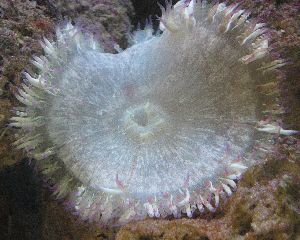
Epicystis crucifer 12/7/17
Condylactis & Epicystis anemone care 11/26/03 I've inherited a Condylactis and an Epicystis anemone. Can you tell me a bit more about their needs? <hmm... what questions do you have beyond what is posted on the web sight for history, selection, husbandry? Lighting for cnidarians, etc> From reading your web site & Bob Fenner's CMA book, it appears the Condylactis does need fairly bright light, but I have trouble finding other info (e.g. water movement & feeding). <feed the standard meats of marine origin finely minced/// 3-5 times weekly as a zooplankton substitute> I've got the Condylactis placed on some LR about 6-7" below the water surface (420W of VHO lighting) with moderately light flow. <the lighting is good... but the water flow should be moderate to strong random turbulent (not laminar)> The Epicystis is rooted in the gravel (I think) about 17" below the surface, with very light flow. Any hints? <rather typical for this hardy genus... fed regularly here and it likely will be fine> If I need to move the Epicystis to either a brighter or more rapidly flowing location, how do I do it with little stress? What do I feed them & how frequently? Thanks! Hy <do refer to the article we have posted on WWM for feeding reef invertebrates... it regards corals and anemones in kind. Anthony> Anemone (potentially temperate) husbandry... My daughter came home from sea camp in North Carolina with a sea Anemone. It looks like a Heteractis malu, from your website. <Well, if she found it in the ocean, it can't be a H. malu because these are only found in the Pacific. Maybe she bought it at a store? If she did take if from the ocean, it's either a Condylactis anemone or some sort of temperate anemone (not sure what the water temp off of NC is year round).> It has high sentimental value. We first tried to house it in a very small 3 gal tank, along with a few algae eaters and a mussel-that it was attached to. We were convinced to invest in a larger tank-10 gal. We did the live sand and mixed up Instant Ocean. Each time we moved it, we took whatever water it was with, and added however much we needed. We bought a heater and put it on low. The temperature quickly got "too high", 80 deg F, so we shut it off. It is now about 70 F, The Anemone does not seem to be stressed out. It is spread out and has moved location to a purchased rock. However despite the water conditioners and stress aides, the anemone seems to have contracted ick. <Only fish can contract ich, what is it that makes you think it has this disease?> What do we do now, what do we feed this, do we need reef lighting? <Yes, at least a pair of 32w power compacts or more assuming it's a bought H. malu, few standard output fluorescents or more if it's a Condylactis, and if it's a temperate anemone you'll need a bunch more light as well but I doubt it will survive for more than a few months.> The tank is from Marineland and has a "wheel, wet dry filter on the top. <This makes it difficult to impossible to add the additional lighting that this guy needs.> I would very much appreciate some quality advice! <Need more details about where this critter came from! -Kevin> Haitian Reef Anemone Good day. <How goes
it? M. Maddox here, earning his keep> I've
read your site and thoroughly enjoy your wealth of knowledge.
<Thanks, so do I> I recently started a second marine tank (my
other is a 75g Reef). My wife wanted an anemone and a pair
of clowns in the bedroom. <Spiffy ;]> So I went to my
local LFS and purchased a Haitian Reef Anemone (yes I now know a poor
choice *gasp*). <Do you mean Condylactis spp? If so,
they're not difficult to keep, as anemones go. If not,
scientific name, please?> I placed the anemone in my
cycled tank after the acclimation process. <Unless you're using
a significant amount of LR\LS from your main tank I wouldn't add an
anemone for several months or more> The next morning I
found the anemone dead and in pieces all over the tank. A
classic epic of Anemone v. Powerhead. <Why is it that everyone who
has an anemone insists on using powerheads? I see\hear this
all the time! At least cover the intakes with foam> Needless to say
the powerhead won. <They usually do> My question is
this: What steps do I need to take before putting anything
else in the tank? Did the untimely death pollute my tank?
<Probably not much> Is so what steps, if any, can be taken to
render it safe for marine life again? <Wait a few months, research
anemone care, cover the PH intake with foam, or preferably, get rid of
them in exchange for better means of flow> Thanks Marc <Anytime -
M. Maddox> Lighting/skimming/anemones Hello Bob Jen here from Logan Utah. First of all, here is my set up: I have a 75 gallon tank (fish only for now), a wet/dry filter, a protein skimmer (the Berlin triple pass brand), about 20 pounds of live rock, crushed coral as the substrate (about 1/2 inch thick), 1 actinic, and 2 full spectrum lights (48"), and a "penguin"(350 Mag) canister filter. I'm sort of a beginner at saltwater and I've had my tank set up as a marine tank for a year now. I am thinking about introducing a anemone. Is my lighting sufficient? <Mmm, for some species, yes... but for the larger, naturally symbiotic (with Clownfishes) ones no> If not, what do you recommend? <About three times the amount of light intensity that you now have... for this size, shape, type system either cramming in more normal output to boosted types of fluorescents, T-12's (compact fluorescents), or at least some metal halide (over the anemones area) illumination> I've had my eye on a Epicystis crucifer (pet store calls it a flower anemone). So far, I haven't found any info. on this species. Is it a hard one to keep? what does it require? What do you recommend? <Oh... this is an "easier" type of anemone for captive use... needs some lighting, feeding (twice a week or so, meaty, chunky foods)... S.O.P. in water quality, upkeep. My image, input on WWM: http://www.wetwebmedia.com/twaanemones.htm> Also, as for the protein skimmer, I keep reading everywhere that most people don't use a protein skimmer properly, yet the articles I read don't bother to explain the right way to use one, or to explain what most people are apparently doing wrong! <Mmm... some skimming is better than none... there is such a thing as "over-skimming"... Please see the marine index on WetWebMedia.com or the search feature/tool there re skimming...> I was told to run it for a few days every month. Could you please help me to clarify this? Thank you for all your time and commitment to this wonderful hobby! Jen M. <Run it continuously my friend. Bob Fenner> Stichodactyla helianthus I have read your book "The
Conscientious Marine Aquarist". I have posted to WetWeb, Reef
Central and Saltwaterfish.com. I need information specific to this type
of carpet anemone so that I can create a microhabitat in which it will
thrive AND figure out what to feed it. I got it as a gift and really
want to do it justice. <I understand, and agree> Do you know
anything about this species? Can you point me in a direction where I
can find the info I need? Thanks - Jeanne <You can find what little
we have posted on the species by going here:
http://www.wetwebmedia.com/ and posting the scientific name in the
search tool at the bottom... This is a shallow (a meter or two
generally) tropical West Atlantic species. |
|

|
Features: |
|
| Featured Sponsors: |