|
|
| Home | Marine Aquariums |
Freshwater Aquariums |
Planted Aquariums |
Brackish Systems |
Ponds,
lakes & fountains |
Turtles & Amphibians |
Aquatic Business |
Aquatic Science |
Ask the WWM Crew a Question |
| Please visit our Sponsors | ||||
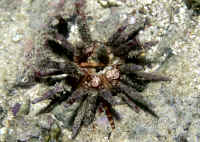
Sea Urchins Dear Sir, I am a graduate student working on the taxonomy of sea urchins in my locality. I have been looking for materials written about Philippine Sea Urchins but I have been unfortunate in finding them. On this regard, I am seeking for your help in terms of sharing me some of your literatures on sea urchins or a guide for me on where to obtain them. Sincerely yours, Geraldine Andas, Libron <You need to develop a search strategy (for scientific literature on the topic)... and visit a library (or computer hook-up) that can get you to Biological Abstracts, The Zoological Record... Please see here re literature searches: http://www.wetwebmedia.com/litsrchart.htm Bob Fenner> Species and Group Hello Sir Fenner! <Hello> Among the sea urchins I have collected are pencil urchins. I need to validate as to whether they are Eucidaris tribuloides or Eucidaris metularia or Heterocentrotus mammillatus. Another regular sea urchin that I have collected appears to be Tripneustes gratilla or Lytechinus variegatus but I don't have enough literature on such species. All of which have been gathered in my locality, Davao City, Philippines. <As far as I know, all of these are to be found in Philippine waters. What little we have content and reference-wise on urchins is posted here: http://www.wetwebmedia.com/urchins.htm Perhaps a literature search: http://www.wetwebmedia.com/litsrchart.htm is in order. There are likely survey works on the echinoids that cover the area. Bob Fenner> Geraldine Update I know that it might be in the least of your concerns but I would just want to update you on the development of my research. I have successfully identified the specimens that I have collected. I am going back to the sampling site to gather more specimens (with bigger and better containers this time). Thanks for your help. Our written report will be due this October. Wish me luck! Geraldine Andas-Libron <I do wish you luck. Very exciting. Bob Fenner> Astropyga radiata Dear Bob Fenner: I am writing to you about
the urchin Astropyga radiata. <Okay> We run a dive charter boat
in Morehead City, NC. Yesterday I collected an urchin at 130' deep,
40 miles offshore and I now believe it is an Astropyga radiata. No one
we know has ever seen this particular urchin around here before. At
this particular wreck site there were 4-5 colonies of 10-15 urchins
each. Huge groups of these large urchins. <Neat> We gave the
specimen to Paula Whitfield with NOAA, but at first glance her
colleagues don't seem to think it is unusual for these waters. (She
is also still looking for a more positive ID). Our first
guess was Astropyga magnifica: based on the book "Reef Creature
Identification" by Paul Humann. However, the photo does not match,
and the description of the adult is inconclusive. The Audubon Field
Guide North American Sea Creatures does not have anything resembling
this urchin in it. <Don't know much re this echinoid... other
than Humann's id you list> However, after an Internet search
which turned up your photo and description...my suspicion is that it is
a Pacific urchin (radiata), and may have arrived here the same way the
Lionfish got here 3 years ago. (We have Lionfish inhabiting our reefs
and wrecks now). <So I'm given to understand (groan!). Would be
unlikely that someone would buy, dispose of two or more individuals of
the Pacific congener... but a possibility> Can you
positively ID the urchin you labeled as radiata in the photo here:
http://www.saltcorner.com/sections/zoo/inverts/echinoderms/urchins/Aradiata.htm
and here: http://www.wetwebmedia.com/urchins.htm
(Some other websites have the Astropyga radiata and magnifica photos
interchanged, and I would like an absolute positive ID on the
red-colored urchin from your photo). <Unfortunately the saltwater
corner site doesn't load> I would appreciate any assistance you
can give me. Attached are 2 photos of the urchin I collected yesterday.
Thank you very much for your time. -Renate, for Atlantis Charters
<... and can't locate your attachments. Please do re-send. Bob
Fenner, just back from Indo... where of all things, spent an inordinate
amount of time searching an urchin (Asthenosoma varium) at similar
depths to make pix of a commensal shrimp (Coleman's) w/o
success> Urchins destroying reef Hallo! <And you Glen> I'm
living in Papua New Guinea. I'm about to be spending a lot of time
in and around the water diving and catching fish for export. I want to
gain some tools and advanced knowledge in reef stewardship. I have
moved to an area right on the water where there was dynamite used to
build a wharf and also to kill fish. So there is plenty of work to be
done to help the area recover. <Yes, well put.> My biggest
concern I have noticed is the incredible abundance of black long spined
sea urchins, who seem to be attacking the rejuvenating reef with
ferocity - and seem to be winning.. <Only seem to be... these are
likely Diadema savignyi... and their population will abate once the
blasting, construction are over... there are natural mechanisms that
will come into play to delimit their numbers... have experienced this
first hand in Mabul and Kapalai, Malaysia> I want to eradicate these
pests along with the crown of thorns and help educate the people about
the importance of the reef and rejuvenating it to the abundant resource
it once was. Are these urchins exportable? <Not really... are
sometimes traded as ornamentals as very small (less than palm size
overall) individuals... if you're going to destroy these and
Acanthaster, #1 BE CAREFUL! Very sharp (and toxic) animals... secondly,
you'll need to develop and implement a scheme to bring them ashore
and let them dry out in the sun (don't just smash them on the
reef... this will likely just speed up their distribution> I have
been killing a few underwater by smashing their shells, and then fish
come in and eat the insides. Does this cause any further problems??
<Yes... can greatly increase their numbers through aiding
reproduction> Can you suggest any good reef organizations that may
be able to help with educational materials? <There is a huge amount
of older data on the Crown of Thorns, some on urchin removal... that
you could reference through libraries, many "pro-reef"
organizations... but I assure you, better (really) to ignore them...
they will die back in due course and provide valuable service in the
meanwhile. Better to focus on the "human"
"software" issues... perhaps getting folks to place rubble,
rock around where the wharf is being created, develop permanent
moorings... for dive, anchoring purposes...> Thanks for any help you
may be able to give Glen Butler <Good luck, life to you my friend.
Bob Fenner> Re: Urchins destroying reef Thanks again Bob,,, I'll do my best and take notes of the eventual outcome.. Glen <Would appreciate seeing your input as time goes by. Bob Fenner>
Urchin Question Howdy, Crew! <Cathy> I have a question
that I can't find the answer for, and hope you can help. I have a
spiny urchin, possibly a Diadema savignyi - well, it's a Diadema,
anyway. Which of the three is hard to say. My question is - this guy
eats a lot of green coralline. (Fine with me, I'd rather have
purple.) However, now HE is turning green! The spines are changing
color from the body upwards. When the spines started being striped in
color, I wasn't too concerned. But now his 3" spikes are
definitely green, for at least 1/2" or so, though the rest of the
spikes are each purple. The tiny blue spikes near his body are just
fine. He seems fine, too, but is this color change normal? Anyone ever
seen a GREEN purple spiked urchin? <Yes. Urchin coloration is
something that not much is known about, much debate has occurred over
UV blocking pigmentation, attaching shells as an apparent radiation
shield, and color changes during maturation (most likely what you are
seeing). I wouldn't be too worried> BTW, his name is Get The
Point. :-) THANK YOU! -Cathy <>< Fort Worth, TX
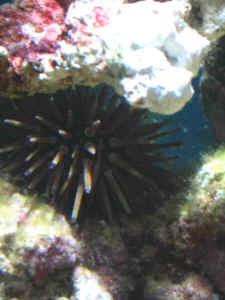
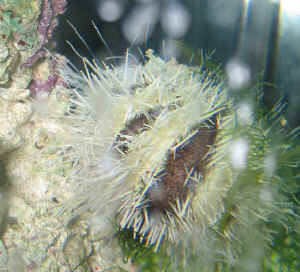
-Dented urchin- Hi, We have a tuxedo urchin that has developed a dent in it. It is eating and cruising around he tank just fine, but has this dent. We have a total of 3 urchins in the tank, none of which had dents when we got them. The other 2 are just fine and all of the tanks parameters are in check. Any ideas what happened to him? <Was probably in the wrong place at the wrong time and had a rock shift right into it. Unless there's an open hole, I don's foresee a problem. -Kevin> Thanks, Jennifer Urchin blowing chunks! I have had my long spine urchin for some time now. I soon realized after buying that what I thought was his eye was the anal sack. <Such pretty bum, no?> He has almost doubled in size now and is very interesting to watch when he's moving about. <They grow very fast when they're little. I just recently removed mine because he grazed a path across a Montipora. Make sure it gets enough algae food!> Today however, he started spewing out this white material all around his sides while still moving all over my rocks. What is this white material? <Not sure, could be regurgitating stuff out of its mouth if it ate something it shouldn't have. Doesn't sound like something to worry about.> Is it a defense mechanism? <As far as I know, no.> Should I be worried? <No, just watch him for now. -Kevin> thanks, ART KOUNS Club Urchin Spines Hello! I enjoyed your dissertation on sea urchins on the web. Thanks! I have used up all my club-spined urchin spines by making them into jewelry, and selling them! All I have left is a collection of spines that are .5 inches and down, nearly of no use in jewelry. Can you tell me where to find more larger ones? The ones I started with were up to 7 inches long... Thanks ever so! Jim <Mmm, there are a few urchins whose principal spines are club-shaped. My fave species is most common in Hawai'i... but have not come across places where the spines are not attached to the living animal. You might try Tideline (in Los Angeles), a wholesale supplier of shells, coral skeletons... 310-641-9106, Ask Marty Beals if they carry dried pencil or slate urchins. I suspect they do. Bob Fenner> Echinothrix calamaris- Venomous purple urchin (pic attached) What type of urchin is this. <Echinothrix calamaris> I recently bought it from my LFS and they said it was a short spine white tip. <OK... many common names <G>> Can you tell me its scientific name and common name and any other info that would be useful to me. Venomous? <it is indeed venomous/toxic to people. The spines are hollow and open at the tip. This species is an indiscriminate feeder on green and meaty matter. Actually fairly well-behaved in reef tanks but not recommended by me for casual aquarium use> Thanks Terry Rickman <best regards, Anthony> Question on pencil urchin is it possible that my pencil urchin will eat my mushrooms and brown button polyps?<Yes> i read that they will but i don't know if its true? thanks JM <Cody> Question on sea urchin diet Hi again, I was told by the LFS that a pencil urchin which i already bought only eats algae and sometimes coralline algae. <neither is true at all... although more urchins than not do eat microalgae nicely. The pencil urchin is too often sold for algae control and it starves instead in most aquaria... it has decided carnivorous inclinations. Eating thawed meaty foods and sinking pellets is much better for it> Today i woke up to enjoy my tank and too my horror my urchin was eating my starfish leg?! Is that normal hope he doesn't die seeing as the star fish was 19.99 and the pencil urchin was 6.99. <although I'm a bit "put off" by your valuation of creature's lives in relation to how much money you've spent on them, I can tell you that the urchin did not attack and kill your starfish... the urchin is merely a meaty scavenger. Your starfish aborted a leg or is dying for another reason altogether. If the starfish is new and/or has not been quarantined then you may have your answer already>> will the urchin do this to my mushrooms and polyps? <not likely... and please be sure to research these animals needs in advance of a purchase. Merely taking the word of a clerk that is trying to sell you something is not your best route as a consumer.> I hope not anyways tell me what you think so i can get rid of it. thanks JM <wow... please do browse the archives... and consider getting a good book or two to keep on hand. Mike Paletta "New Marine Aquarium" is a good start. Fenner's :Conscientious Marine Aquarist" will put you on an even better track. Borneman for corals ("Aquarium Corals"). Best regards, Anthony> Re: question on sea urchin Thanks so he wont eat my soft coral i have lots of algae in my tank green hair that he eats as far as the starfish he's still alive and scavenging the bottom with a hub for one leg where can i buy Fenner's book? I've always wanted a book is it packed with reef info or only certain animals? thanks JM <many places to buy Bobs book... signed copies can be found here: http://www.disaquatics.com/Merchant2/merchant.mv?Screen=PROD&Store_Code=DA&Product_Code=TCMAS best regards, Anthony> Sand dollars... not for aquariums... at all Hey Bob. This is my first time writing to you. <cheers, Travis> I have 2 tanks currently. First is a 55 gallon tank. 85 lbs. live rock, 60 lbs. live sand, two emperor 400 and a Bak Pak 2 skimmer. I had a dragonet but I don't think he is with me anymore. <indeed... very difficult to keep long term (especially in a smaller tank) without fishless refugiums producing plankton. Most starve to death in a year or so... a few hang on longer> I had a fish that would pick on anything he could. I have since removed him, do you think it would be good or bad to try again? <not at all> My other tank I have set up for sea horses but no horses. 10 gallon, Sea grass and dead hardened sponges for there tails. Well, My little girl thought it would be a good idea to keep three small sand dollars south Florida) they are currently in the small tank pretty much alone. <oh, no :( > Are they safe? Can I put one or more in the big tank? <sand dollars should be left in the ocean, my friend. They are extremely difficult deposit feeders to keep alive in captivity requiring staggering amounts of aged live sand to even have a chance to survive. Some of the most common figures bandied about include sand beds that are 6" minimum and 6 ft square! per single sand dollar. Such sand needs to be aged more than a year too. Truly an animal for XL aquaria and experts. Yours will starve to death slowly (6-12 months usually) without a change of residency> The big tank has three sand stars. Do they have poison which could be dangerous? <not likely... but do ID by species to be sure. Also, know that some brittle or serpent starfish will attack and kill/eat seahorses like the Green brittle starfish (incrassata)> What about when I put the horses in there? and anything else you can think of. Thanks so much Travis Morris <your seahorses will benefit tremendously from a refugium... do research the aspect mate. Kind regards, Anthony> Question on pencil urchin Hello does my pencil urchin eat algae because I've heard that they will eat my coralline algae? is this true? Also does my decorator crab eat algae? Thanks you WWM Crew. < Your urchin does eat algae along with any thing he can forage. There is a very good chance he will eat your coralline. The crab is a omnivore and will eat a wide variety of foods. Cody> Urchin We have an urchin that has seemed to have come with the live rock that we bought. It has been about 1 1/2 years since we purchased the rock, so it has been a while. I cannot seem to tell from the pictures on your site what types of urchin it is. It is a black urchin, the "needles" on it are long and skinny, and the very end of the tips are white. Is this a white tip urchin, and is it poisonous? Thanks so much! < Sounds like a long spine urchin (diadema antillarum) to me, and yes he is poisonous. Cody>
Urchin ID Hi WWM, I was just hoping someone there could help me with the ID on this sea urchin. It was labeled a rainbow sea urchin at the LFS. I didn't think I would have any trouble finding out more about it. This is one of the few items I couldn't find on your site, Then I couldn't find it on any site. If you know what species it is could you give me a better knowledge of care, That is if it's different from all other sea urchins. Thanking you in advance, David P.S. Love the site, I'm another daily reader. <Mmm, don't know this common name. Have you checked through the few species and pix we have posted on WWM?: http://www.wetwebmedia.com/urchins.htm Maybe your dealer has an invoice for this animal listing its scientific name. Bob Fenner> Bob! just got pricked.... Hi Bob, hope your vacation was nice (sure it was), I was just doing a water change and foolishly moved my hand onto my long spine black urchin (the one with the blue and orange eye looking thing in the middle) got a couple pricks on the side of my finger, anything to worry about?, just don't tell me I'm dying, lol.....thanks for your time.... <Do soak the area in warm water (as hot as comfortable) and put a dab of Neosporin (or equivalent) over the puncture and a bandage... and call me in the AM! Oh, and read here: http://www.wetwebmedia.com/Wound.htm Bob Fenner> Spawning urchin event hi again Bob, something odd, when i pulled the last of the bio balls from my 130 FOWLR tank the other day, there was an immediate cloudiness in the tank, brushed it off as a bacteria bloom, it was gone in the morning along with the nitrates as i mentioned, I traded in my lion and Naso for a couple urchins and some emerald crabs today, I just tossed the floss in my now sump as i did always every few days when i had the bio balls and my tank is a white cloud again now, I am noticing that a new black urchin is spewing some sort of white stuff front the center of him, looks like long strings of white hair, then if spreads out like smoke and disappears, wondering if this is the cause or some bacterial thing going on, he is doing this constantly, should i not be tossing the floss as often now without the balls?, don't want to goof this up. thanks again.....Riot... <The urchin is releasing gametes... may be related to the change in water chemistry... you should check your mechanical filter media, clean it as often as you see it accumulating wastes. Bob Fenner> Re: Urchin Howdy folks Do you consider the Mespilia globulus AKA blue tuxedo urchin "reef safe"?? <Some of us here do. Please see the coverage of this species on WetWebMedia.com Bob Fenner> Thanks again Joe Grunstad Sick urchin? My tuxedo urchin is losing small spots of its "blue velvet", showing the dark gray skin underneath. Otherwise, it seems normal - not losing spines, plenty of rubble still encrusting it, moving about the tank as before. It used to love Wardley's Spirulina wafers, but refuses them now, it seems to prefer coralline :( <Not uncommon> Should I be worried? <Maybe> The only things I can think of are salinity changes during top-offs and ploughing into the BTA, but these have never been a problem before. <Do make sure the spg is about the same, pre-mix, store water ahead of use per here: http://www.wetwebmedia.com/water4maruse.htm> Temp 80 F Spg 1.025 pH 8.2 Alk 3.75 meq/l Ca 360 - 400 <All seem fine. Bob Fenner> - Urchin Spawning - <Greetings, JasonC here...> I recently purchased a fire urchin (I believe it is an Asthenosoma spp.) and last night all of a sudden it started expelling a white chalky substance out of the top. It looked like a tube of toothpaste oozing out of five tiny holes. The substance then was picked up by the current and distributed throughout the tank. Everyone seems fine including the urchin, anemone, and all of the fish but I am curious as to what occurred with the urchin. Can you shed any light on the subject. <Yup... likely an attempt to spawn by the urchin. Was either sperm or eggs.> Thanks, Ken Felix. <Cheers, J -- > Sea urchin sick? Good evening, I have couple sea urchin with many spines one more them they other. Until about week ago, seems like the spines are falling off. Would this be indication to me the urchin is dying or shedding. Please reply. Thanks Rob!!!! <Alas, my friend... shedding is fairly inconspicuous. It sounds to me like your urchin is stressed, sick or dying. Remove it to a hospital aquarium and maintain stable water quality and feed well with hope of recovery. Read more here: http://www.wetwebmedia.com/urchins.htm best regards, Anthony> Urchin & Crab Hey guys- I got a fairly large red hermit crab, has black hairs, white spots and fits in a large Mexican turbo snail shell. my question is, I picked up a small "orange eyed" black urchin, and it looked like the crab was going after him last night. this morning I can't find the urchin, but did see about 10 spine clippings in the sand were the hermit crab was. Are crabs natural <Many are> Is it possible that the crab killed the urchin, or is it more likely the urchin is hiding? <You can look about...> should I remove the crab? (the crab is ill tempered, eats all the snails and what not). Thanks for all the help, Justin <If you intend to have such animals... Bob Fenner> Book: Sea Urchins of Australia and the Indo-Pacific It's finally available! Sea urchins of Australia and the Indo-Pacific Ashley Miskelly December 2002 180p. soft cover full colour throughout ISBN 0 9577455 6 7 The first full colour book ever published on Sea Urchins of Australia and the Indo-Pacific, this book describes and illustrates 85 of a known 220 species that occur throughout Australia and its offshore territories. Most of the species likely to be found from low tide to about 20m deep are included. Discover the variety of sea urchins that inhabit Australia and the Indo-Pacific as each sea urchin is described in a format that is not over-scientific nor too simple. Beachcombers, naturalists, divers, professional and amateur marine enthusiasts will all find this book useful. Each species is described in detail and illustrated with a number of colour photographs, showing, in most cases, the live urchin, and four different views of the test If you have previously ordered a copy, you do not need to do so again regards Patty **************************************************************************** ********** Worldwide postage A$10 per order! Bookshop: http://www.booksofnature.com **************************************************************************** **************** This is a once-only mailing to people dealing with the study of sea urchins. I am sorry to have disturbed you if you do not appreciate this information Dr. Patty Jansen Bookshop: http://www.booksofnature.com Publishing and info site: http://www.capricornica.com Books of Nature P.O. Box 345 Lindfield NSW 2070 Australia phone/fax: 02 9415 8098 international: +61 2 9415 8098 E-mail: capric@capricornica.com or books@booksofnature.com <Thank you for this notice. Will post on our root web. Bob Fenner, WetWebMedia.com> Echinoid shock Thanks for the help. Not even thinking about it I did use some different salt when I ran out. <do let us know which brand... I bet I could guess :) I've heard this one too many times> Thanks. The starfish I'm having to fish out of the tank but the "nudibranchs" all 3 came out ok. They are back to cliff hanging now and seem ok, think I'm going to hospital thank them anyway then slowly acclimate back into main tank. <sounds like a good plan> (Nudibranchs=3ea.-white and brown Dendrodoris "Dendrodoris albobrunnea from the family Dendrodorididae. I have had them for about 7 months now, hey hitchhiked on some rock I acquired. I had heard the same thing so I left them in solitary for about 4 weeks before putting into main tank. They eat other branches from what I'm told but they seem to be doing fine so far and I don't see anything amiss unless their eating sponge from the undersides of my rocks. <hmmm... some obligate specialized feeders take a while to starve to death. Some concern here about toxicity on their demise. More from another fish eating them than exudations into the tank> P.S. I lost one long-spined, banded urchin also. Damn I hate when I lose critters, I've always prided myself on having a fairly respectable success rate. Guess ill always encounter new hurdles so ill just learn and improve. <a good way to live> Mahalo from Maui Bill <Mahalo my friend. Anthony> Tuxedo Urchins Hi Guys ! I have read that tuxedo urchins do a good job of pruning hair algae......and that is STILL my biggest problem in my 300 gallon reef tank. Although my new skimmer (Aerofoamer 848) that replaced my ETSS 1400 is doing a great job (algae is beginning to die off after 2 weeks of new skimmer operation) I still have been siphoning out a lot of hair algae. This garbage has killed many of my beautiful hard coral frags and some larger colonies ;-( ...... I also read that this particular species of urchin is smaller than most and is less destructive than most as far as plowing things over. Anyway, my question is: Would it be wise or appropriate to introduce a tuxedo urchin into my system at this point to help with the hair algae extraction (PLEASE , please say yes ....manual extraction is a pain !) ? Or are there any negative consequences that would outnumber the advantages of this algae eater ? Thanks, and I love Anthony's book ! <Me too> Chuck Spyropulos <Hey Chuck, you could give this Urchin a shot, but I would feel better if we got down to the bottom of what is causing this algae, there is a ton of info on the site. http://wetwebmedia.com/algaeconMar.htm They will dine on algae nuisance or otherwise, and would have no problem poking and knocking things over. http://wetwebmedia.com/urchinfa.htm - Best Regards, Gage> Urchins III Unfortunately that wasn't much use, or perhaps I was too vague. Would Mespilia eat macroalgae as well as microalgae? <Your macroalgae are probably safe.> *Does this include calcareous macroalgae (Halimeda, Penicillus)?* <<More than likely, they would be safe.>> The page says that corallines are eaten but does not mention macroalgae. I understand Mespilia to be safe with sessile invertebrates? <No urchins are completely safe with sessile invertebrates. Urchins are the bulldozers of the aquarium and can/will knock over just about anything. This would include your corals.> *What about if I used Milliput to secure the corals to rocks? Is that very effective to stop them being dislodged?* <<I don't know what "Milliput" is, but I am going to guess it is some sort of epoxy. That should hold the corals in place, but not protect them from getting jabbed. Many LPS or soft corals could be damaged from the spines.>> *I hope these questions are not too silly, but I just want to make sure. I think the snails are doing a good enough job with the green microalgae on the rocks and glass as it is!* <<If you really do not want or need the urchins, perhaps you should reconsider their addition. -Steven Pro>> The Urchin's New 'Do (Pt.2) What would I do without you guys? <Hey- What would we do without YOU?> A quick search for Bryopsis on google netted enough photos for confirmation. I would just pull the stuff off, but I've heard that removing a Tuxedos camouflage can damage their tentacles (the proper name for their "tube feet" has slipped my mind). I tried to remove the few strands he had when I purchased him a month ago, but after dislodging the urchin before any algae come off I figured best to leave it alone. Any ideas? <I agree- just leave it alone. I'd only pull this stuff out from areas in the tank where it's becoming a problem. It will probably do more harm than good yanking it off of the urchin... > Now, you have me concerned that my skimmer is not producing cups full of junk weekly. Please review my specs and let me know if there is something I am missing. Skimmer produces about 1/4-1/2 cup of the worst smelling stuff weekly, and I do weekly 10g changes with RO and Instant Ocean. Over the past 4 months since setup nitrates have gotten as high as 20ppm due to semi-cured LR and over feeding (my mastery of clown loaches didn't guarantee a perfect transition to a marine tank:)), but in the past month they have dropped from 10-15ppm to under 5ppm. Ph 8.2, sp 1.0225, temp 78-80, DKH is 10, phosphates are unknown but I do know that my RO supplier has undetectable phosphates. <Well, I'm very glad to see the downward trend in nitrates. Sounds like you're getting a good handle on the husbandry associated with this tank! If you want to try to get more product out of the skimmer, you may need to adjust air or water flow. At the very least, if you're pulling some stinky junk out weekly, that certainly is better than nothing, particularly with improving nitrate levels. Just for the heck of it, you may still want to check those phosphates, just to see if they are indeed undetectable. Sometimes, commercial RO providers can be a bit lax in changing membranes, and detectable levels of phosphates, etc. are present in the product water.> Current setup is: 55g glass tank, Red Sea Berlin HOT skimmer with RIO 2500, Emperor 400 (until the refugium planned for early next year), and 2 Rio 600 powerheads for circulation. Lighting is a CSL hood with 2 65w actinics and 2 65w 8800K bulbs running a timed 12 hour cycle. Trying to build up my coralline algae, otherwise could possibly cut back on lighting time. I plan to move my skimmer to the sump when it is installed. Any pointers on enhancing with my current setup? current skimmer setup, old picture: Thanks again, Emo <Well, Emo, sounds like a nice setup there! One of the things that you may want to do is change and/or clean the filter pads as often as possible. Mechanical/chemical media like these can become nutrient traps if not maintained diligently. Also, have you investigated a deep sand bed? There is some compelling evidence that a 4"-5" sand bed can measurably reduce nitrate in closed systems. You'll really like the results the refugium will deliver, too! Keep up the good work! Good luck! Regards, Scott F.> Sea Urchins To whom can answer our questions: Hello my name is Christine and my partner and I are going to use sea urchins for our science fair project. We were wondering if anyone could assist us by answering a few questions we haven't been able to answer ourselves or by other means. Many of my questions have to do with finding an inexpensive way to keep the sea urchins and their eggs alive. 1.) What can we do instead of buying a "shaker" to keep the water moving in a small containment? <I don't know what a "shaker" is, but Urchins require fairly standard marine aquarium husbandry.> 2.) How and what can we feed sea urchin eggs? <I don't know, but I do know that urchins and their reproduction are routinely studied. You should be able to find literature at the library.> Is there a recipe we can make ourselves to feed the sea urchin eggs? <I would have to guess either phytoplankton or rotifers, but the references at the library should help you.> 3.) What can we do to keep the sea urchins alive, since we heard it is quiet difficult to even keep sea urchins for more than 3 days? <Very incorrect, given an appropriate environment urchins can be rather long lived.> If anyone can answer these questions we would be very much appreciate it. <Do take a look here http://www.wetwebmedia.com/urchins.htm and the linked FAQ files for a start. -Steven Pro> Beginner Sea Urchin Hi! I was wondering if there is a sea urchin that you might recommend as a beginner's species? I have a 65 gallon fish/invert system with several hermit crabs and starfish. There is not much algae in my tank, I believe due to low light levels. Does this preclude any species of sea urchin? Are there ones that are better scavengers than other? I am interested in the Mespilia globulus and Eucidaris tribuloides. <I think the Eucidaris is going to be your best bet. They do not eat exclusively algae, which is bad for reef tanks, but good for your situation. You should be able to feed it a variety of meaty items and keep it healthy. Please take a look here http://www.wetwebmedia.com/urchins.htm for additional information.> Thanks, Steve Thornton MD <You are welcome. -Steven Pro> Green urchin Dear WWM crew, I have bought an urchin that I believe is a green urchin, that was labeled as a pin cushion in the shop. My problem is that it seems to be taking an unhealthy interest in my blue hermit crabs and snails, picking up their shells. Should I be worried? Is it venomous? It has a white body, with green spines changing to purple at the tips. It has 5 main white segments, and 5 smaller white segments in between them. Any idea what it really is? <My best guess from your description is a Lytechinus variegatus, harmless, but be sure to double check me here http://www.wetwebmedia.com/urchins.htm> Thanks in advance, James <You are welcome. -Steven Pro> Safe Urchin? Dear WWM crew, Thanks for the reply. I think you are right, it is a Lytechinus variegatus. Please could you tell me if it is venomous, and if so how bad it would be for me if I got stung. Is it the spines or the podia that are venomous? Many thanks, James. <James... as Steve mentioned, it is harmless. Lytechinus is known as a collector or decorator urchin for its habit of collecting bits of debris to cloak its visage on the reef. It feeds mostly on algae but will accept meaty foods. Once established, it is a useful and innocuous aquarium inhabitant that is quite tolerant of its own kind. It poses little or no risk to corals as a predator but may knock specimens over clumsily. Best regards, Anthony> Urchin - losing spines, looking small. Allo All, <Cheers
friend> My long spined urchin doesn't seem to be doing well, I
have had him for about a week now, and he is looking quite a bit
smaller than when I got him. <hmmm...> The tips of his spines are
turning light brownish (normally black) and seem to be breaking or
falling off. I can see them on the substrate. It is as if he is
shedding. Suggestions? Will <your urchin is likely dying. The
shedding of needles is a sign of great duress... do offer small amounts
of finely minced meaty foods with hope that it will eat and recover.
Likely it will fail I am sorry to say. The rigors of importation or
mishandling. If possible... see that your LFS holds such creatures for
more than a week before you buy them. Best regards, Anthony> |
|
|||||||||||||||||

|
Features: |
|
| Featured Sponsors: |