 |
|
| Home | Marine Aquariums |
Freshwater Aquariums |
Planted Aquariums |
Brackish Systems |
Ponds,
lakes & fountains |
Turtles & Amphibians |
Aquatic Business |
Aquatic Science |
Ask the WWM Crew a Question |
| Please visit our Sponsors | ||||
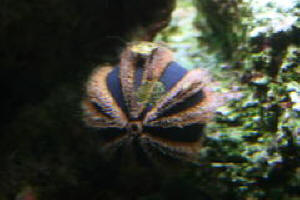
Pencil Sea Urchin; hlth.
3/13/15 Tuxedo Urchin Shrinking 12/6/13 Sea Urchin, spine loss
4/12/12 Black Spined Urchin/Urchin Behavior 2/23/12 Need help with my urchin!!!
10/29/11 Urchin losing needles -- 10/07/11 Dying urchin :( turning white.
5/2/11 Urchin Breaking Spines -- 3/9/11 Sea Urchin Accident/Sea Urchins/Health
11/26/10 Pincushion Urchin problem
11/13/10
Help! Is my sea urchin dying? 8/22/08 Help please! I have a long-spined black sea urchin that has been doing great and eating any algae it comes across. It has been in my tank for several months and its spines seem to be growing very quickly. Tonight to my horror it started spewing this white milky stuff into the water! It wasn't coming out of the clear "anal sac" where granules (waste) always come out of. This stuff was being discharged from all around the main portion of its body, especially near the white "eyes". <Hmm... still sounds like spawning (potentially). Perhaps the current around the animal just made it look that way?> Normally I wouldn't worry, but there was a TON of it!! The water was a little cloudy for a while but fortunately it's beginning to clear up. <Is the animal ok now? If it's otherwise behaving normally, I'd just assume this was a spawning event and not worry too much about it.> None of my fish seem affected and neither do my corals - but what the heck was this stuff? Toxins? Eggs? Sperm? <Again, my guess is a spawn...> Thanks John <Best, Sara M.> Re: Help! Is my sea urchin dying? 08/22/08 Hi Sara, Thanks much for such a fast response to my "cry for help"! The sea urchin is doing fine right now, and so are the rest of my critters. I was only worried because I have a small tank (AquaPod 24) and was concerned if I should do a water change... <You're most welcome... and yes, this is a very valid/prudent concern in a small tank. Some spawns can spoil your water rather quickly (especially in a small volume). If you haven't already, I would do a large water change just to be safe.> OK, so it may have been a spawn. Do sea urchins procreate asexually? If so, does this mean that I should expect hundreds of "urchinettes" in my tank soon (LOL)? <Haha, no. They are sexually reproducing animals. To get baby urchins, you'd have to have a male and a female. They would have to spawn at the same time... and even then, it's highly unlikely the resulting larvae would survive in your tank.> Thanks John <De nada, Sara M.> Coral Beauty & Sea Urchin Demise - 06/02/08 Hello, <<Howdy>> It has been awhile since I have written with a question. <<Welcome back>> Recently my 125 gallon saltwater tank has been taking a few casualties. <<Uh oh>> Last week I lost my long tentacle sea anemone which I was expecting, <<…?>> and today I found two more losses. <<…!>> First I lost a short spine sea urchin. I don't know why it happened my pencil tip seems fine and there is plenty of algae in the tank to graze on. The urchin was introduced about eight months ago, before the tank had lights, and algae, and it suffered and lost a lot of spines. After I got the lights it improved, at least to my eyes. Is it possible it never recovered from this? <<Maybe… But I find these creatures often require more than just "algae" to survive (variable among species)…especially the nuisance alga found in hobbyist's tanks. In my experience, a good supply of live rock with plenty of calcareous alga and other emergent life upon which the Urchin can graze is essential for long-term health>> The second body pulled from the tank was sadly my coral beauty. I bought this about two months ago but had never seen it eat. <<This is not an uncommon event. This species often suffers badly during collection/transportation>> The first month it was very secretive, but lately it was out a lot more. I assume it was living off algae in the tank since it seemed to have a full stomach and was in good health. <<It was likely browsing the live rock, yes>> I think since it never took to the foods I offered (tropical marine flake, freeze dried bloodworms, freeze dried plankton, marine-one pellets, and frozen squid), and that it only lived off algae for two months, it died because of nutrition deficiency, sound probable? <<A probability, yes…as a secondary result of trauma/stress/inability to adapt…and leading to its refusal of the foods offered. Speaking of which…I notice three what I consider "essential" food items missing from your list. These would be frozen glass worms (great for enticing finicky eaters), frozen mysis shrimp (another good enticement and over good food item), and New Life Spectrum pellets (and amazing food supplement for ALL your fishes)>> Your input is greatly appreciated. <<Happy to share. EricR>> Re: Coral Beauty & Sea Urchin Demise - 06/02/08 Thank you for your input. <<You're very welcome>> Should I be worried about my pencil tip perishing? <<Difficult for me to say…but without the other Urchin present to compete for the same foodstuffs maybe it will fare well>> I do have live rock in the tank for it to graze on and it seems healthy/active and has all its spines from when I bought it. <<If dying slowly from starvation, you likely won't know anything is amiss until it is too late>> Also should I remove the algae from the urchin that makes it look like a moving forest? <<Mmm, no but…algae is growing upon the Urchin? Perhaps you have water quality issues that need attention>> As for the coral beauty I didn't expect it would have perished from shipping as it was feeding at the LFS store for about a month and I requested seeing it fed. <<I see… If the fish was not harassed then do certainly look to your water chemistry/quality and ascertain this is not the issue. Do also refer to this article and the linked files at the top of the page: http://www.wetwebmedia.com/watrqualmar.htm >> One more thing, is there any info out there as to the captive care of sand dollars? One thinks they would be interesting sand stirrers. <<Ah yes, likely so… I don't know of any info specifically, other than what Google might stir up, but captive care would likely involve a good-sized (100g+) mature reef system with strong water flow and a large exposed area of deep fine substrate…along with a large plankton generating refugium to help keep the sand bed "populated">> Thank you. <<Happy to share. Eric Russell>> Sick Sea Urchin 5/17/08 Hello everyone, <Melissa> Thanks for all the help you have provided me in my quest to have a beautiful reef tank. I have had my tank set up for about 3 or so months. I have a 55 gallon tank with at least 55-60lbs of live rock, 2 clowns, 1 flowerpot coral (I know bad mistake :( ), 1 torch coral, 1 coral beauty, 2 cleaner gobies, 2 fire shrimp, and 1 cleaner shrimp along with turbo snails and hermit crabs. I also have a black spiny sea urchin. I have had him about 3 weeks now and I fear he is a bit ill. My water was tested last Tuesday 5/13/08 tested out 0 nitrites, 0 ammonia, <10 for nitrates, salt 1.023, calcium 350, phosphate .05-.08, PH 8.1, and Magnesium 840. <Mmm, oh, I see this below... Mg should be about three times Ca conc.> They told me at the LFS that the magnesium was low and I should supplement. We have been adding Seachem's Reef Advantage Magnesium to the tank as per the directions on the bottle. I had read all about Urchins on your page and I am pretty sure that the magnesium is playing a role in my now sick Urchin. Let me describe his symptoms. First of all we have our halides on and he is out in the open which is not typical of him. Second, his mouth is just hanging out which may or may not be typical we usually don't see his mouth unless he is on the glass. He is not loosing spines and still moves them if something gets near him. But he does have what appears to be a whitish film under him. His little feather hair like appendages seem very limp and he is just sitting in the corner not doing much of anything. I called the LFS and they told me to stop the Magnesium and give it a week to see if he gets better and they offered for me to take it in and they would watch him. I was just wondering what I should do with him as I find him the most intriguing part of my tank. Thank you for all your help, Lisa <The addition of the Magnesium (and most all other supplements) should be done with/through water changes, not directly to the tank. This urchin is in bad shape... do keep an eye on it, or better, move it elsewhere if you have another established system (without exposing it to air). Bob Fenner> Urchin anemone battle 5/1/08 I have a 20 gal tank with a couple snails 2 rock boring urchins and an anemone. <Mmmm. Is there enough room here?> Unfortunately my small purple urchin got caught by my anemone, luckily I found him and got him out without hurting the urchin or anemone. Its been about 3 weeks and the parts that were caught turned lighter and then disintegrated, I wasn't that worried I figured it was because of the anemone but they keep getting shorter, the water has been stable and the other urchin is perfectly fine. What's happening and what can I do? <Collateral damage, time going by> P.S. Its still moving and eating fine for now. <More time going by, good water quality, feeding... can/will repair. Bob Fenner> Death of a Sea Urchin, no data of use, or reading - 03/10/08 I purchased a long spined sea urchin for a 40 gallon tank, currently inhabited by a small porcupine puffer <... too small a volume for this species... and they eat Echinoids...> and a clown fish, which has plenty of live rock (at least 40 lbs). I bought him tonight, acclimated him for about 45 minutes and he was doing just fine but about 20 minutes after being in the tank he was dead. Any idea what might have caused this? <Mmm, in a word, shock... different, too much so, conditions twixt previous, the wild... Likely alkalinity, biomineral....> I just had the water tested today and all the levels were fine. <... this statement is of no use... how could someone "tell" what is fine? Data please... and reading: http://wetwebmedia.com/urchins.htm and the linked files above. Bob Fenner> Dead urchins 2/23/08 Hi, <Francesca> Thanks for all your help in the past, it has been invaluable. Unfortunately today we have made a fairly horrific discovery, two of our previously perfectly healthy urchins have been cracked open and the contents removed. <! Check the local sushi bar... Is uni on sale?> There have not been any very recent additions other than a pistol shrimp. The other possible culprits we have come up with are a zebra moray, a green brittle star fish or our sohal tang (we have many other fish but these seem the most likely from our research). The Moray has been in the tank for nearly a year so I think this unlikely. Are any of these known predators on urchins. <Mmm, not usually... are crab/crustacean eaters...><<Yikes... I stand, ok, sit in correction: http://fishbase.org/Summary/speciesSummary.php?ID=7880&genusname=Gymnomuraena&speciesname=zebra Gymnomuraena zebra DOES eat urchins... Sorry re. RMF>> The urchins in question are a blue tuxedo urchin and a purple pincushion urchin. We also have a long spined urchin who has so far been unharmed should we be looking to move him to another tank? What are the known predators of urchins in reef tanks? <Triggers, large puffers, some larger Labrids...> Thanks Francesca <Mmm, highly coincidental, but maybe the two urchins perished from other than predation? Bob Fenner>
My Urchin seems to have a worm attached 12/20/07 Hi Bob. Hope you can help as have looked everywhere for the answer then saw you on a web search. Bought a Pincushion Sea Urchin at the weekend. The first thing in our tank apart from the live rock & a coral. Noticed yesterday he now has a red coloured hairy worm looking thing attached. Is this part of him or is it a parasite? <... Uhh... could you send a pic?> Any advice would be appreciated Kind regards Keeley <I doubt if this is a worm... perhaps a "large" pedicellariae... see the Net re... Echinoids rarely have such surface phenomena. BobF> Urchin question, hlth. 12/9/07 Good morning crew, I purchased a tuxedo urchin last night from a LFS. I floated the bag for 30 minutes and then every 10 minutes for two hours I added about a shot glass of water from my tank. I have been looking over your website and I understand that if the urchin is in poor water it will start loosing its needles. <One symptom, yes> My question is are there any other signs that an urchin is not doing well? <Mmm, yes... that the spines and pedicellariae droop downward... a lack of motion of these body parts and the external (aboral) mouth parts especially> It has not been loosing any needles. After I set the urchin on some live rock it only moved about 2 inches over night and I haven't noticed it moving this morning. Would it fall off the live rock if it was dead? <Not necessarily...> I just tested my water. Nitrite=0, Ammonia=0, Nitrates less then 5.0ppm, PH= 8.2, temperature 78.5 degrees. <These measures look fine> This is an established 60g tank with a small clean up crew, a dwarf lion that I have had for over 2 years and a coral beauty. I am concerned about the urchin releasing toxins into the water. <Some species can, do... not "the" Tuxedo: Mespilia globulus... can foul water if dead/decomposing however> Thanks for your help Jeremy <There might be something else amiss here... like alkalinity, ratio of calcium/magnesium... Please read here: http://wetwebmedia.com/urchindisfaqs.htm and the linked files above. Bob Fenner> Pincushion Urchins, Spine Dropping 9/5/07 Hi. <Hello> I have two pincushion urchins in my 55 gallon tank. I have had them about 5 months and they have been doing very well. However, following our last water change they began to lose spikes. I think it is because of summer, it got hot in the room where the tank is and the temperature went from 78 degrees to 84 degrees in less than a day, when I wasn't home. <Most likely the cause, they are very sensitive to environmental changes.> I of course made sure the water was the same temperature at the time of the water change as what was in the tank (it was 78 at that point) and the salinity is fine. All other water tests are fine as well. I know that losing their spikes probably means they are going to die, but I am wondering if anything can be done for them. <Provide good water quality, stability is about all.> I am currently treating some new fish in my quarantine tank so I can't move them to that tank. <Moving them now would probably do more harm than good.> Also I have a maroon clownfish I got at the same time and he has been burrowing in the sand for the past 2 weeks. He doesn't appear to have white spot or velvet and neither does the other fish in the tank, a lawnmower blenny. He still eats very well and seems to be doing fine otherwise. Is there something wrong? <Clowns dig, Maroons more than most, is a natural behavior.> Thank you for all of your help. It is appreciated! <Welcome> <Chris> Black long-spined urchin. Urchin Dropping Spines 7/12/07 Hi, my name is Angie. <Hello> We have owned Fresh and Brackish tanks for many years but recently had to give them away as we moved out of state and could not guarantee their safe travel. <Tough to move tanks, especially over any great distance.> We are now settled again and began a Salt tank. After about 4 weeks we got a Black long-spined urchin. <Probably too soon, they are very sensitive to water quality/changes. Also, there are many urchins that go by this name, see if you can determine the species so that it does not outgrow your tank.> The dilemma is that after we had him about one week he began dropping spines and literally has about 7 larger ones left and a few lil ones that are new. (This has been going on for almost two weeks now). We don't have much in the tank with him. We have an 80gal tank. About 20lbs of live rock which has begun turning pink on one whole side and has some green spots. <This is probably not enough to sustain him long term, think about adding close to 50lbs. for both the tank and urchin's health.> About 20 lbs of live sand and we also have a very archaic cleaning crew of snails and crabs. There are no fish in the tank with him yet. The brine shrimp we have been feeding him are the frozen cubes. <Switch to something better than brine, is the potato chip of the sea. Mysis is much better.> Our LFS told us that feeding him Algae tabs (like you would use for Plecos) would be fine and I was also going to get him some dried krill. <Will help.> He is still very mobile but drops spines constantly. We have tested our water several times and also had the fish store test it to be sure and ALL the levels are fine. <What is fine, numbers please.> They aren't sure why he is dropping spines, but they know it can't be good. About two days before he began dropping his spines we noticed some spots on the glass that we found out were hydroid jellyfish. We have been told repeatedly that although no one knows why 'Spike' is losing spines, it isn't because of the hydroids. <Unlikely.> The hydroids are pretty much gone now, and Spike is still losing spines. One actually broke off while he was eating some dried seaweed and he began eating the spine! I have looked at him very closely and I don't see anything on him, like a bug or parasite. If you have any suggestions we would so greatly appreciate them. We just don't know what to do with the lil guy and we really don't want to lose him. Thank you so much for any help you can give! Angie <Losing spines is never a good thing, usually caused by stress or illness. Double check your water parameters, and make sure your pH and SG are stable, small swings in these can negatively effect the urchin greatly. Otherwise take a look at our urchin FAQs and see what applies. http://www.wetwebmedia.com/urchinfa.htm .> <Chris> Urchin question 8/20/06 Hello WWM Crew, <Sara> I have a few of questions regarding a Lytechinus variegatus urchin ( I was able to id from your site), I hope you can help me out with. My first question is if a Lytechinus variegatus urchin is in the process of dying, or not doing very well, is there any chance it could release toxins in to my tank? <Mmm... yes... this species is a member of the Family Toxopneustidae... toxic to even the touch... to fishes, humans> Should I remove this urchin from my main tank? <Unless it were very large (hundreds of gallons), exceedingly well circulated and filtered I would not introduce a member of this family> I had noticed that my urchin had been losing spines at an alarming rate recently and had stopped moving around the tank. When I turned him over there was a brown/tan worm on him. This worm was not a bristle worm, rather it looked more like a common earth worm (only much, much smaller.) It had small bristles on it's side, but the bristles were not near as large as a bristle worm's. <There are actually thousands of different species...> I also have noticed that there are deep red spots on the outside of the urchin it almost looks like blood. After I removed the worm from the urchin he immediately improved and began to slowly move around the tank again. So, I guess my main questions are should I remove this urchin from my tank and quarantine him? <Yes, I would. Don't use your hands in contact... scoop into a container... i.e., don't expose to the air...> Is there any risk he will poison my tank if he dies or is dying? <Again, yes> Lastly, are there any know worms that are parasitic to urchins, or was this worm just a result of him dying/not doing well? <Could be either/both> Thank you so much for your help, Sara <Welcome. Bob Fenner> Urchin Death - 08/15/06 Not a happy tale, I suppose you could gather from the title, but I woke up this morning to find my globe urchin Jack, dead at the bottom of the tank, all his spines littered on the ground around him. <<Sorry to hear...>> This is the tank's first official tragedy, and I was wondering if you could help me figure out what killed jack, and what I should do to clean up the aftermath. <<Okay, I shall try>> First thing I did this morning was to check the levels. Ammonia: 0.3, or maybe a little bit higher. Nitrite: 0.1-0.2 Nitrate: 25-30 <These elevated readings might be consequent/due to the urchins demise. RMF> <<Mmm, these readings indicate water quality issues...likely what killed the urchin>> Don't know how jack died, or why he died <<see above>>, but it's too bad because the other fish in the tank (2 damsels, and a porcupine puffer) left him alone. One of the damsels was returned to the store this morning because he got all uppity and angry about the water conditions and was nipping the fins of my puffer... stupid really cause the puffer is easily twice his size, but he's gone now (was usually overly aggressive anyways, just pushed his luck a little too far). <<Indicative of the species>> Upgraded my protein skimmer, which was a SeaClone... slightly modded as per instructions, but still not working that well, to one that is way oversized at the moment for the tank (currently 55gal, will be 180 in 1 month's time). <<A necessary upgrade for the puffer's sake>> Just trying to reestablish equilibrium in the system, and get things back to normal, is there anything I can do to help ensure the safety of the fish? <<You need to determine/address the cause of the elevated ammonia/nitrite/nitrate readings. In the mean time a couple large water changes can bring these down, but you need to strive to maintain readings at "zero" for the first two and less than 20 for the nitrate...unless you plan to keep more inverts whereas nitrate should be less than 5ppm. EricR>> Tuxedo Urchin, example of RMF rudeness, impatience 7/20/06 I have recently set up a 175 salt reef tank with the help of your book and the LFS. <Hope/trust all is going well> I have a tuxedo that has been very happy, going around decorating himself and eating well. Two days ago, the branch of pulsing Xenia he carries around on his back sucked up into a powerhead, he refused to let go. <Mmm, will, should in time> I turned the head off and waited until he moved away. Yesterday he shed all of his decorations. Today his blue strips are turning brown. <"Bummed"> I decided to turn to your web site which I have always found helpful. Sometimes I think the people don't read the writer's entire message before responding with insults but I have just tried to overlook that. <Heee! Okay> Today, however, while researching information about the Urchin I came upon this: I Sea urchins just ate my feather duster and leather coral... poor English, lack of planning 9/28/05 Hello. you have a very informative site. I love it. I have 2 pin cushion and 1 pencil urchin, the other day, I noticed the pencil urchin was on top of the feather duster, and I didn't think anything about it. the next day he was still there, so I pulled him off, and the feather duster was just a pile of mush. his pipe was all soggy and it just fell apart. there is a small piece in there still, but I am positive it is dead. I sat the urchin in the back of the tank. later that day, I looked at the tank, and he was on top of a small new sprout of leather finger coral. now that am <There is no such word> paranoid, I moved him and he ate it too! it was gone! so now am constantly moving them around, the pin cushion ones too. cause am worried. I always keep a leaf of romaine lettuce in the tank, ok the glass w/ a veggie clip, and the LOVE it. they will devourer a leaf in a matter of hours. so any advice about the urchins eating my duster and coral? <Learn to spell, use your grammar checker to learn... and use resources ahead of time to check the compatibility of the organisms you intend to buy. Bob Fenner, too short of patience with ignorance today> Since you hear from a lot of people from other countries I am surprised you would take such a stance and be so unfriendly. Sincerely, Kathye <Can generally tell if a writer is penning something from a distant country, or a person is of limited capacity, or a child... But do indeed admit to a limit of patience with laziness on peoples' parts who are in turn so rude as to send us poor efforts. What you/the public sees is "fixed"... there are a hundred or two "corrections" in most any given days FAQs... and I tire of fixing these 15, 20 or more minutes daily... But "courtesy is contagious", and I do agree with your sentiment, that I should be more patient. Thank you for your note. Bob Fenner> Collection and Transport of Urchins - 04/19/06 Hello Bob, <Actually Nicky this is Adam J with you tonight filling in for the Bobster.> My name is Nicky, a Philippine resident located in Manila. <As I mentioned above I am Adam, and I'm in SoCal, nice to meet you, I mean talk to you….I mean write to you….never mind…how about just a "HI!" - there that works.> In the past months, I have been trying several times to get sea urchins into my 50-gallon tank but failed at all. <I'm sorry to hear that.> I used to get them from those far places away from Manila about 6-8 hours traveling by land, most of them couldn't survive after this travel and the rest stayed alive just hours only. <Something is causing trauma during collection and or transit, how do you collect them, and what are the quarters in which you transport them? Also what is your acclimation procedure once you arrive home?> What I suspect, the problem probably was the handling and packaging that I did not in a proper way. <Possibly, these creatures are sensitive to drastic changes, and whatever receptacle you transit them in appears to be fouling or becomes contaminated in some way….I would be interested in as many detail as you can offer of your "process" of moving and collecting these creatures, and exactly what species they are?> Could me give me some guidelines or any source that I can find those info. <Read here, http://www.wetwebmedia.com/marcoll.htm , http://www.wetwebmedia.com/movelvstkfaqs.htm , I think your problem may be that you are using the source water (ocean water) to transport your specimens.> <<Might be that these animals are being lifted into the air... even just this... RMF>> Thanks, Nicky <Adam J.> Just a shell of his former self 7/14/05 This morning all I could find of my tuxedo urchin was a hollow shell, completely intact, no spines or anything else. <!> It was fine last night before lights out. Did it molt? <Heeee, sorry, no> Did it die and get completely devoured by emerald crabs? Thanks for any insight into this mystery. <It's gone... all you have is the test, exoskeleton... echinoids don't have much actual biomass... so you likely won't experience an "ammonia spike", what have you. Could have perished from numerous causes... Bob Fenner> Research And Dedication, Sea Apple - 05/04/05 Hi Eric, Hope al is well. Regarding the three-year-old Sea Apple Pseudocolochirus violaceus and the husbandry techniques, I can't say I actually do anything extraordinary. It has always been kept in a system that houses fish, the first two and a half years with a breeding group of 10 Banggais Pterapogon kauderni, and for the past year with 1 Blue/yellow tang Acanthurus coeruleus and 5 wreck fish Pseudanthias squamipinnis. Very small amounts of brine/Mysis/Gammarus shrimp etc are fed pretty much every day. Once weekly the system is feed on newly hatched brine shrimp which is always targeted on the Sea Apple. I do this by siphoning the brine shrimp through an Artemia sieve… well to be truthful a hanky, and place the contents into a 50ml syringe with a 3 mm wide 20 cm long catheter tube (clean from the vets of course). The syringe is then filled with tank water and a bit of phytoplankton (5-10ml) and the contents are gently released around the tentacular crown. This took a bit of practice, not only for me but also for the Sea Apple. The timing and pressure of the flow has to be right and the animal has to 'learn' that you are trying to feed it and not harm it, other wise it will retract into a tight ball. I leave the protein skimmer of whilst feeding, and for about an hour afterwards. Any way hope this may help anyone having trouble with this species. Best wishes Andrea <Hello once again Andrea! While I still can't recommend this creature be kept at all, you seem to have gone the extra measure to research/learn something about it/them, as well as going to the trouble to provide extra care for its survival. If others learn to apply the same caring and effort to keeping other "easier", more appropriate creatures, our hobby will be well served. Thanks so much for sharing. Regards, Eric Russell> Sea Urchin/Dying Bob, Awesome site, <Thank you, James here today> I have a 72 Gallon Salt water tank with 45 pounds of live rock, a bunch of wet pets, but my urchin seems to be drooping a bit, and since I moved my rock around I have noticed more spines on the substrate. <It also is not uncommon for urchins to lose spines by maneuvering into rocks and the like. They can be mini bulldozers.> My levels are OK (pH, Nitrate, Nitrite, Ammonia) and he has been quite happy in his new home for about 3 weeks. Only recently have we noticed him sort of drooping slightly, and broken spikes. Were about 8" spikes, now only about 3 or 4, and sometimes the tips of his spines look grey. He is a black sea urchin with blue dots and an orange ass-eye. Do you have any ideas whether or not he is dying or just going through a "phase"? <Sounds like you have a Diadema. I'm thinking it isn't getting enough food, don't know what your algae supply is. I'd try putting some dried algae under him daily and see if it improves, but keep in mind they do lose spines from time to time. Here is a link on urchins you might enjoy reading. http://www.wetwebmedia.com/urchinbehfaqs.htm . James (Salty Dog)> Thanks for your help. Stressed in Saskatoon CANADA <You're welcome> Urchin problems Hi, all I got a quick question for you, I have a 130 gallon aquarium, and 55 I took my purple sea urchin out of the water for a couple seconds and all his little purple pokey things have fell out did I kill him??? << I doubt it. >> I hope not I have been feeding him Nori seaweed on a veggie clip, to make sure he was getting enough to eat, please help, I don't know what I can do to help I feel awful about this he was my buddy he always would eat it I loved watching him do so it was neat, << I don't think it would kill him. They are more susceptible to water quality changes and things like that. But being out of the tank shouldn't be too much stress. >> thanks << Blundell >> Urchin troubles Dear crew, <Steve Allen tonight> Half year ago we purchased Diadema savignyi & Mespilia globulus. The latter one now begun to lose its spines, whereas the former one is healthy. Could it be a different relation to the hydrochemical/physical parameters? There are: SG.=1,023; pH=8,1; phosphates and nitrates both are zero; t = 82,4 degree of Fahrenheit. <this is a little on the warm side, but not too bad. If ammonia and nitrites are also zero, then these are not issues. The SG and pH are reasonable and long as they don't vary much. None of these numbers strikes me as worrisome.> Currently we don't receive test kits for the calcium and alkalinity measurement so, they are still unknown. <Not as big of an issue to echinoderms as to corals.> Could you indicate their optimal range for the sea urchins? P.s. Could it be the first reaction on the bacterial/fungal infection, <This is always a possibility (more likely bacteria), as is some sort of nutrient deficiency.> and what is the lifespan of pincushion urchin into aquarium? <They have been know to live several years, but I don't think anyone knows for sure.> Sincerely, Interzoo, Odessa, Ukraine. Best regards, Interzoo <This may just be a temporary problem. I would be more concerned about a big problem if both urchins were showing symptoms. If the one that is losing its spines still moves and eats, it may be a temporary problem and they will grow back. I'd keep an eye on it for now without any drastic action. Hope this helps.> Urchin Death (6/23/04) My long spine urchin just died. <SO sorry> He's been in my tank for 9 months, since my initial setup. He came as a hitchhiker inside my live rock <many LR surprises are good things>, lived through the cycling of the tank (I didn't even know he was there for a few months) <things do tend to pop up after a long time>, and has survived quite a few fish losses over that time. These fish losses were sometimes due to temporary water quality issues, but the urchin never suffered. He gradually grew larger and slowly moved all over the rocks, so he must have been eating well. Yesterday he was crawling on the aragonite substrate, which I can't recall ever seeing (he was always on the rocks). This morning he shed his spines on the sand and died. All the fish are healthy, so I don't suspect any water quality problems (parameters are normal). He seemed to have some small white balls on his body, which may or may not have been grains of aragonite. Any ideas what may have killed him? Could he have just lived his full lifespan and died naturally? <This is a toughie. All echinoderms are sensitive to changes in water parameters, especially pH and SG. The little white balls could have been a bacterial infection. I'm not certain as to the lifespan of urchins. It could be that although he was eating, some needed nutrient was missing. The speculation is endless here. If nothing else appears sick or dies, I'd say your system is OK. Hope this helps. Steve Allen.> Doing the Fluoro Salsa.. or Was It a Rumba? >Good afternoon! For Bob Fenner and other marvelous WWM FAQ crew. >>Good day to yourself as well. How goes it? >Recently, my full-spectrum (daylight) fluorescent tube had been out-aged and cannot be used for more. After that, I ask my assistant to buy a daylight tube (I know this is seems to be not wise, because handling an knowledgeable task without supervising can make a wrong choice and creates one more problem) but I haven't much choice, I'm too busy for my stacking homework. >>Understood. >So, when he go home and I see what type of lighting he bought, I see it's a little bit different from the previous one. The light wasn't white-colored, but rather violet hued and seems not too strong to support autotrophic organisms in my aquarium. For example, my two Tridacna derasa clam (sorry -- it's not Tridacna maxima, I realized the species shortly after sending you the email) still exposes their broad mantles, but I'm not sure if the zooxanthellae can tolerate another type of lighting. >>I like T. derasa myself, my friend. >Do you know the type of lighting and is it good for my clams? >>I'm afraid not, my friend. What you would need is to look for the manufacturer's specifications on the bulb. I am guessing that you may have what is called a "warm white" bulb, in which case it will be too high in the red end of the spectrum. You should be better getting a "cool white" bulb, or better yet, possibly calling the shop where your assistant bought the bulb, tell them what you HAD, and ask if they have that same bulb. >And also for my intertidal urchin, Colobocentrus atratus who seems to love the atmosphere and always tries to creeps out of water. I'm afraid if they will develop air bubbles in their test cavity, and slowly dies. >>No, I doubt they would harm themselves in that way. >Should I constantly replace the urchin back to water or just leave it alone? >>As long as it cannot escape from the display completely (and get lost?), leave it alone. They know where the water is (DOWN!), and will go back when they feel the need. >Thank you very much for previous helpful emails !! Sincerely, Anargha. >>Alas, I, Marina, cannot take credit for those, but will offer that you are welcome all the same. Marina Urchin - losing spines, looking small. Allo All, <Cheers friend> My long spined urchin doesn't seem to be doing well, I have had him for about a week now, and he is looking quite a bit smaller than when I got him. <hmmm...> The tips of his spines are turning light brownish (normally black) and seem to be breaking or falling off. I can see them on the substrate. It is as if he is shedding. Suggestions? Will <your urchin is likely dying. The shedding of needles is a sign of great duress... do offer small amounts of finely minced meaty foods with hope that it will eat and recover. Likely it will fail I am sorry to say. The rigors of importation or mishandling. If possible... see that your LFS holds such creatures for more than a week before you buy them. Best regards, Anthony> Re: Urchin - losing spines, looking small. Thanks for the reply.. I think I may have figured the problem. Unfortunately it might be too late. For about a 24 hour period my pump was churning air with water and spewing crazy amounts of micro-bubbles into the display system (the night I am away of course) anyhow, my frogspawn was closed up and nothing was looking too good when I came home to the giant white cloud of bubbles. <hmmm... yes. Very irritating to coral and some fishes> Anyhow, after more close inspection, it seems as if the skin on the urchin's spines has become compromised where bubbles had become attached. <interesting> I think this was the source of all the trouble, and that all this loss may have taken place, literally, overnight. <rare but possible... supersaturation of water with oxygen like nitrogen "the bends" in divers> As it was only this morning that I noticed the problem. Anyhow, I have fixed the bubble issue, and my frogspawn is open again, and my xenia is pulsing. Lets hope this little guy can recover. <will do> I'll watch him today, and see if anything happens, though unfortunately I think the recovery time is going to much greater than overnight. <correct> Do you agree that this could have been the problem? <yes... possible. But do consider th e common scenario of shipping duress and the critical need to QT all new livestock for 2-4 weeks before putting into the system for fear of pest/predator or disease transmission> Will <best regards, Anthony> Echinoid shock Thanks for the help. Not even thinking about it I did use some different salt when I ran out. <do let us know which brand... I bet I could guess :) I've heard this one too many times> Thanks. The starfish I'm having to fish out of the tank but the "nudibranchs" all 3 came out ok. They are back to cliff hanging now and seem ok, think I'm going to hospital thank them anyway then slowly acclimate back into main tank. <sounds like a good plan> (Nudibranchs=3ea.-white and brown Dendrodoris "Dendrodoris albobrunnea from the family Dendrodorididae. I have had them for about 7 months now, hey hitchhiked on some rock I acquired. I had heard the same thing so I left them in solitary for about 4 weeks before putting into main tank. They eat other branches from what I'm told but they seem to be doing fine so far and I don't see anything amiss unless their eating sponge from the undersides of my rocks. <hmmm... some obligate specialized feeders take a while to starve to death. Some concern here about toxicity on their demise. More from another fish eating them than exudations into the tank> P.S. I lost one long-spined, banded urchin also. Damn I hate when I lose critters, I've always prided myself on having a fairly respectable success rate. Guess ill always encounter new hurdles so ill just learn and improve. <a good way to live> Mahalo from Maui Bill <Mahalo my friend. Anthony> Sea urchin sick? Good evening, I have couple sea urchin with many spines one more them they other. Until about week ago, seems like the spines are falling off. Would this be indication to me the urchin is dying or shedding. Please reply. Thanks Rob!!!! <Alas, my friend... shedding is fairly inconspicuous. It sounds to me like your urchin is stressed, sick or dying. Remove it to a hospital aquarium and maintain stable water quality and feed well with hope of recovery. Read more here: http://www.wetwebmedia.com/urchins.htm best regards, Anthony> Sick urchin? My tuxedo urchin is losing small spots of its "blue velvet", showing the dark gray skin underneath. Otherwise, it seems normal - not losing spines, plenty of rubble still encrusting it, moving about the tank as before. It used to love Wardley's Spirulina wafers, but refuses them now, it seems to prefer coralline :( <Not uncommon> Should I be worried? <Maybe> The only things I can think of are salinity changes during top-offs and ploughing into the BTA, but these have never been a problem before. <Do make sure the spg is about the same, pre-mix, store water ahead of use per here: http://www.wetwebmedia.com/water4maruse.htm> Temp 80 F Spg 1.025 pH 8.2 Alk 3.75 meq/l Ca 360 - 400 <All seem fine. Bob Fenner> -Dented urchin- Hi, We have a tuxedo urchin that has developed a dent in it. It is eating and cruising around he tank just fine, but has this dent. We have a total of 3 urchins in the tank, none of which had dents when we got them. The other 2 are just fine and all of the tanks parameters are in check. Any ideas what happened to him? <Was probably in the wrong place at the wrong time and had a rock shift right into it. Unless there's an open hole, I don's foresee a problem. -Kevin> Thanks, Jennifer Hi Bob My Sea Urchin is sickly Bob, I have had 2 sea urchins in my 90 gallon tank. Recently one of them has been dropping its needles and has what appears to be a red/purple sore in one spot. The other one is fine however. what should I do? Thanks, Adam >> I would pull out the one that is dying... (in a container, don't lift the animal into the air), and place it in a quarantine set-up... Bob Fenner Purple pin cushion hi bob, how are you? thanks for all the great advice you have given me. I have a question about a purple pin cushion I have. no one seems to know much about them. I noticed all over the tank a bunch of little needle's. I thought they were coming from the crabs waste. then this morning the pin cushion was down on the sand and it looks like it has lost half of its tentacles. it moves around the tank three or four times a week. is this normal or is it dying? james <Not good for this animal to be losing its spines... something doesn't suit it... temperature (some are from cool/coldwater... alkalinity, biomineral off... lack of nutrition? Take a look through v. 3 of the Baensch Marine Atlas, other works for i.d. and plug this scientific name in your search engines. Bob Fenner> Unknown species and an urchin Dear Mr. Fenner: <Hi
Samantha, Lorenzo Gonzalez standing in for Bob, who's on
fish-safari in Indonesia> I had written to you sometime ago
regarding an unknown (to me anyway) species of sedentary mollusk. I
have since taken a few pictures of the creature, but unfortunately my
scanner is not working and so I'm presently not able to send photos
via the net. However, it is possible for me to send the photos via
snail mail if you have an interest (I think the resolution of the
photos is much better than the scans anyway). If you are interested in
receiving pictures, then just let me know an appropriate address.
Otherwise, I'll pass them along when I have a new scanner. <Bob
seems to get digital shots or scans occasionally via email, and usually
they're good enough to identify an animal. But sedentary mollusks
can be particularly hard to ID. I'll let him decide... he's
back on the 12th> A second question that I had is whether you know
the approximate life span of sea urchins. <I've seen them
several years old, and a nearly foot across...> I don't know the
precise designation of the species I have, but it is deep
purple/blackish from Florida, with long spines. It has been living in
my tank for a little over a year now and seems quite happy.
<They're usually pretty easy, most chemical treatments will kill
them in a flash, though. So will a hungry triggerfish... :-) >
However, since it is getting quite large and my tank is small (15gal)
I'm starting to worry about its natural life span. Any info you
could give would be very helpful. I'm going to be setting up a
larger tank towards the end of the summer and I could move the urchin
to that tank once it is set up. <That'd probably be fine.>
Current tank info: 1.25 yr old, 15 gal, ~35 lbs live rock (aquacultured
from Florida), CPR back pak filter, maxi jet powerhead, lots of
mushrooms and assorted soft corals (e.g. star polyps, etc), 3-4 xmas
tree worms, a colony of little white feather dusters, 2-3 Chitons, a
sea urchin, several small brittle stars, 3 hermit crabs, 2 tank raised
ocellaris clowns (> 1 yr old), and one female spotted mandarin (>
6 mo.s in tank, she eats lots of stuff including frozen brine shrimp).
<Boy, that sounds like a VERY nice little tank. Definitely a
success, and certainly nicely balanced, if it can support that
mandarin. And you're lucky to get one that eats frozen food. (Be
sure she eats a variety, and/or you feed a vitamin-boosted brine...
brine-shrimp are to fish what sunflower seeds are to birds, and
Twinkies are to humans... Best regards! Lorenzo > Samantha Harris,
Ph.D. Postdoctoral Fellow Department of Physiology 1300 University
Avenue University of Wisconsin-Madison Sick urchin, missing fish Hi Bob, <Actually, you have reached Steven Pro. Anthony Calfo and I are helping Bob with some of the daily questions.> I have had a blue variegated urchin for over a year, and it is losing its spines. I also have a royal Gramma, and it is nowhere to be seen. The Gramma is an extremely good hider, however, so I don't know if it is dead and eaten (hard to believe in this short a time) or if it's feeling sick and hiding. Yesterday, the fish was out and about and I noticed nothing untowards with the urchin. Yesterday, I installed a new Maxijet 1200, and I topped up the water levels to compensate for skimming (about 2 gallons added). 10 days ago, I installed a new lighting canopy, and it has caused temperature to fluctuate from 72 (low) to 78 (high) when it is on; my old lighting system did no such thing. <A daily 6 degree temperature swing is going to be highly stressful to your animals. I would address that first and begin to look at water quality parameters; pH, ammonia, nitrite, nitrate, etc.> Five days ago, I purchased two new snails, nothing fancy, and a giant Fanworm. Those are all of the changes I've made, and now I have an urchin in danger and a lost (?) fish. I wonder if you have any ideas what it might be? <See above comment on temperature> Again, this happens shortly after installing a Maxijet 1200. I know you routinely put these into service without intensive rinsing, but I'm starting to think twice bitten... I'm including the email I sent you the last time this happened. Is it possible that there could be a manufacturing poison on the Maxijet? <I find this doubtful.> Are any of the other changes suspicious? I hate losing valued pets like this, it really makes me sad. <If you respond, please include exact numbers for the water quality parameters you checked.> Thanks for any help, Paul <You are welcome,> <Steven Pro> Urchin question from Steve Bob, I have a question about one of m y customers tanks...she is a doctor doing research on human cancer studying sea urchins. One of her test subjects is a 55 gallon tank housing 25 Strongylocentrotus purpuratus. <A local (Southern California) species... the most common (Purple) Sea Urchin off our coast> They came in last Wednesday and everything was fine through Saturday, but on Monday everyone was dead. <A very common test subject and too common occurrence> My gut feeling is that the chiller (20 yr. old Aquanetics unit) may have gone bad and killed the urchins, but could it have been the acclimation process? <Yes... I suspect a "residual" damage effect from the shipping process itself> The urchins come in with ice in a Styro packed between wet newspaper- so I can't drip acclimate them. Would that have done them in? Being active for four days and then just dying? <They could even have drowned... much to say here... next time, move the ice to your pre-made synthetic (best from the system...) and do airline siphon drip this onto the "warming" urchins... eventually rising over them (does take a couple of hours)... add airstones and let water warm to the system temp. overnight if necessary... throw away this acclimation water... moving the urchins underwater in a jar to the main system> I (Deb) am typing this for Steve while he is at this clients office. Whenever you have the chance to answer, I will call him. <Real good. If he has questions, problems, wants to bounce suggestions about, have him call, email me.> Have a great day, Deb (and Steve) <You as well my friend. Bob Fenner> Urchins Follow-up Deb missed one part in relaying the story from me to you via email. The urchins were shipped dry. <I understood this to be, know it to be so> There was regular, tap water ice in a plastic bag laying in the bottom of the Styrofoam. Then a layer of wet newspaper, then urchins, and then more wet newspaper. Do you know how hard it is picking newspaper pulp off of pointing urchins? <Yes... have done it many times> I was concerned with these deep water animals being exposed to air, but the Dr.'s said it was ok and normal for their shipping. <Yes> The reason I mentioned the chiller was last week before the urchins came in we had some weird weather and it got up to 80 degrees out. The lab temp rose to 82 because the AC was not on yet. The old chiller had a hard time keeping up and allowed the temp in the tank to go from 46 to 54. I was concerned that the chiller was going to be a goner, but the urchins were already being shipped by the time it was discovered. The weather has returned to normal now and the temp was back to 46 by the time I unpacked the urchins. Talk to you later, Esteban <Do keep my notes re a drip/acclimation protocol on hand... about the best "any-arrival-shape" procedure... as you'll find. Bob Fenner> Chiller, lighting, and sea urchin question!
<<Greetings, Kevin, JasonC here... >> My tank is about
80-82 degrees and I was thinking I need to get a chiller or maybe some
cooler lights cooler lighting unit). <<80-82 isn't really out
of hand compared to conditions in the wild.>> I have a 150g tank
with 2 fluorescent hoods and they don't have any ventilation. Can I
get a good light that has ventilation? <<Why not do a retro-fit
and add some ventilation, fans, etc?>> I was looking at the power
compact lights, any ideas on those kind or any other kinds of lights, I
need something soon! <<All lamps produce heat, it cannot be
avoided.>> Is a chiller necessary to reduce my tank temperature
just a couple degrees, they're very expensive, but in case I do get
one, do you recommend one? <<I don't generally recommend
chillers unless you live in a desert or are attempting to do a low-temp
system; something less than 75F. Usually a one or two degree pull-down
can be easily accomplished with one or more fans blowing over the
surface of the tank to produce evaporative cooling, or placed in the
light hood to evacuate the warm air.>> I liked the idea of the
coil that sat in the sump! <<Honestly, those are a very poor
design and not worth the money.>> And lastly, I have a sea urchin
that I've had for a couple years and he's losing his spines.
I've heard that when this happens it means they are going to die
and they should be removed from the tank. <<certainly a sign of
declining health.>> He only has the bottom half of him that have
the spines! What should I do? <<Perhaps crush it and feed it to
the fish if you have triggers or wrasses, or just toss it out.>>
Thanks for all your helpful advice you always give me, you're the
best! -Kevin <<Cheers, J -- >> |
|

|
Features: |
|
| Featured Sponsors: |

.jpg)
.jpg)
 Full
size image.
Full
size image.