|
FAQs about Xanthichthys Triggerfishes,
Health
Related FAQs: Xanthichthys
Triggers 1, Xanthichthys Triggers
2, & FAQs on Xanthichthys
Identification, Xanthichthys
Behavior, Xanthichthys
Compatibility, Xanthichthys
Selection, Xanthichthys
Systems, Xanthichthys
Feeding, Xanthichthys
Reproduction, & Triggerfishes
in General, Triggerfish: Identification,
Selection, Selection 2,
Compatibility,
Behavior, Systems,
Feeding,
Diseases,
Triggerfish Health
2, Reproduction,
Related Articles: Xanthichthys
Triggers, Triggerfish, Red Sea
Triggerfishes,
|
|
Triggerfishes for Marine Aquariums
Diversity, Selection & Care
New eBook on Amazon: Available here
New Print Book on Create Space: Available
here
by Robert (Bob) Fenner
|
 |
Blue Face Trigger Fish
4/28/20
Good Day,
<Hi Adrian>
I recently came across your website seeking answers.
<I hope you find them>
I have a part of my question answered by the community blogs, however I
would like specific answer for my issues. I have a 50 gallon
tank from Waterbox.
The tank contains, 3 tangs,
<Which species/size?>
2 clown fish, a cleaning crew which consists of snails, blood shrimp,
peppermint shrimp and cleaner shrimp, hammer coral, torches and a few
hard coral. The water parameters are 78 degrees, Alkalinity is
between 8 and 8.5, Calcium is between 480-465,<A bit high> nitrites are
zero, nitrates are at .10 ppm based on my over feeding and I have a
bio-pellet reactor to help. The ammonia was at .25 ppm
but I did a 50% water change to help this and the salinity is at a
consistent 33 ppm but got up to 36 recently.
<Could you tell more about your filtration and water circulation?>
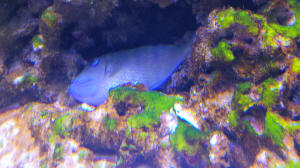
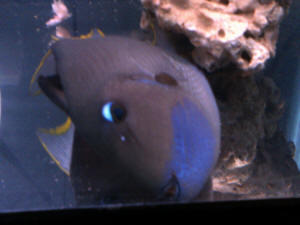
The issue I'm having with a male blue face trigger. He's been a member
of the tank for about a month and he is the only trigger in the tank. He
started off with a great appetite but now he has stop eating and hides
in the rocks. He has some dis-coloration in his face but reading the
message board, he possibly got stung by something.
<Could be the case...¿have you noticed the presence of Polychaetes worms
in your tank?>
What are my options for this trigger?
<If it got stung, it should heal on its own.>
I have also read it's possibly a digestive parasite or his teeth are
over-grown?
<I don’t think this is a parasite issue, neither the overgrown teeth
possibility, I suspect more of your water quality, try to keep ammonia
levels at zero and watch the trigger for the next days to see if it
resumes feeding.>
Thanks
Adrian
<You’re welcome. Wil.>
Re: Blue Face Trigger Fish
4/28/20
Thanks for returning my email quickly.
<Welcome>
I have a yellow, sail and Scopus tang. My return pump is a Hydor
universal pump and I have ice cap 3k flow pump. I checked the parameters
of my water and they are good.
The trigger most likely will not make it as he can't swim upright, arms
paralyzed, and is just riding the flow pump.
<Oh, sorry to hear that, it was likely poisoned by whatever that has
stung it, nothing much to be done at this point. Wil.>
I do water changes weekly and change filter socks. My skimmer is also an
ice cap nano. I have not seen any worms.
Thanks
<<WAY overcrowded... reads like not cycling. RMF>>
Bizarre swimming of trigger MOVie
Link 5/3/19
Hello!
<Hello Zackery!>
I need some help...My blue throat trigger started doing this
very bizarre corkscrew swim pattern today. Appetite decreased 2 days ago. He has
been fine before this and strong eater. All my water parameters are testing in
the perfect range.
<I need more information about your system...size, tankmates, filtration, water
data (test numbers), temperature.>
He seems to ‘get worse’ with this when attempting to feed..it’s almost as if he
starts the twirling/corkscrew movements when trying to go after food but
he’s ‘missing’ the food.
<It appears to be disoriented; this could be due to numerous factors; water
quality, nutritional deficiency, a genetic anomaly... read here:
http://www.wetwebmedia.com/marine/fishes/triggers/faqs.htm and the
linked files above.>
Other times, he appears fine swimming as usual with only occasional bouts of
this ‘swirling’.
Attached is a video recorded during feeding this morning showing the erratic
behavior.
<Could you please place the video in the cloud or other server like YouTube and
send us just the link?... our server doesn’t support very large files.>
Any thoughts on a diagnosis or treatment would be greatly appreciated.
Thanks,
Zackery
<You’re most welcome. Wil.>
Re: Bizarre swimming of trigger
5/3/19
Wil,
Here is the video link on YouTube for you:
https://www.youtube.com/watch?v=Enf9WZFyaBs&feature=youtu.be
<Ahh...thanks! >
I have a 90-gallon fish only tank with just the trigger (5 inches) and 2 small
Clarkii Clownfish (1 inch each). The tank is 3 months old.
Filtration: Eshopps sump 1000 GPH
<Sounds good, It appears to be stable an uncrowded.>
My water parameters are as follows:
Temp: 78 degrees F
Specific gravity: 1.022
pH: 8.0
<A bit low, aim to 8.3-8.4 by adding a buffer>
Ammo: 0
Nitrite: 0
Nitrate: <10
Phosphates: 0
<I suggest focusing on its nutrition. Even though Blue throats tend to be a
little more finicky than other triggers, try to feed it a diet as varied as
possible including vitamin supplements. Keep an eye on it and give a few days to
see if this condition is reverted. Please read the links I sent you and keep us
posted.>
Thanks,
Zackery
<Cheers. Wil.>
|
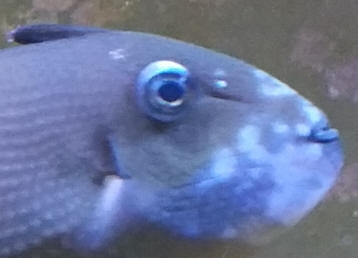
Hope you can help. My blue throat trigger suddenly developed some
discoloration on his face. 12/21/17
WetWebMedia,
Hope you can help. My blue throat trigger suddenly developed some discoloration
on his face.
Can you tell what it is?
<A "burn" of some sort. What other life is present here? Hydroids?
Bristleworms?>
Thanks,
Derek C.
<Nothing to do treatment wise... Just time going by should see this fish
improve. Bob Fenner>
|
 |
|
Re: Hope you can help. My blue throat trigger suddenly developed some
discoloration on his face. 12/22/17
A lot of Bristleworms and he is new to the display tank and he is
hiding behind the rock a lot.
At least he is not sick. He seems to swim and eat fine. That is comforting and
this morning the "burn" seems to fade away.
Thanks, Bob
I will put your comment on ree2reef.
<Real good Derek. I do fully suspect this fish was feasting on the Errantiate
Polychaetes here... and got a bit more than it bargained for. As prev. stated,
this will heal on its own. Cheers and happy holidays, BobF>
Re: Hope you can help. My blue throat trigger suddenly developed some
discoloration on his face. 12/22/17
Thanks again.
https://www.reef2reef.com/threads/what-is-on-this-bluethroat-trigger-face.345087/
<Welcome. B>
|
|
Blind crosshatch trigger - Urgent
1/12/17
Hello
<Sandip>
I've been an avid and appreciative fan of your website and its direct and sage
advice for over 10 years.
<Glad to hear you like our site. Thanks for choosing WetWeb>
This is my first question to you. Sorry for the urgency.
<No worries. Hopefully I have responded in time>
I have a crosshatch trigger that has been in my tank for about 3.5 years direct
from LFS and seemed happy until it slowly seems to have lost its sight
to the point in the last few days it stays hidden in different spots
than its favorite spot and when it comes out it is bumping into everything and
is not eating (I hand feed it).
<What have you been feeding? Any thoughts as too what happened? Did you witness
any trauma?>
I'm very concerned. It used to really enjoy the MP 60's and swim in front and
the full length and width of the tank (78x36x28). Last few days it tries but
knocks into everything including corals and glass. It is starting to look banged
up.
<Yikes>
I've thought of catching and setting up in a portable hospital tank but I am
concerned of over stressing and don't know what to medicate. I have a 3 ft long
35 gallon hospital tank.
<I would QT as soon as possible in an empty tank, i.e. no decorations or
excessive rock work. This will prevent further injury>
My mainly SPS 340 gallon display tank has been running for about 4.5 years.
Some fish and coral and water were transferred from by 90 gallon mixed reef set
up for 9 years. I also have an 80 gallon refugium with Chaetomorpha, 60 gallon
sump, 80 gallon frag tank all plumbed into same system.
<Sounds like a nice setup>
I QT and medicate all fish entering my tank for 4 weeks minimum (PraziPro and
Cupramine) and make sure the fish are eating well before they are introduced to
the DT. About two years ago I pulled out the trigger to a 90 gallon QT and feed
it medicated food hoping it would clear up one of its eyes that appeared cloudy.
I ended up keeping it there for 7-8 weeks and the eye didn't get better. So I
returned it to the DT hoping for the best.
<So it sound like this problem started a few years ago? If you dosed for eight
weeks, the eye should've gotten better if it were a disease or infection. Could
be an issue with the fish that it was born with or had some sort of physical
trauma beyond repair>
Water parameters: Alkalinity 7.5-8.5, calcium 350-450, magnesium 1350-1450,
nitrates 6 ppm, phosphates 0.16 ppm, temp 76-80 (winter and summer), salinity
1.025-1.026.
<Sounds like the water is fine>
Water changes with regularly maintained RODI every 7-10 days 10 percent of total
water volume. I vacuum the substrate in the DT when I do a water change. On
average 1/2 to 3/4 of substrate in the DT. About 80-100 lbs of
live rock with some very large colonies of SPS. I use a calcium reactor and
Kalkwasser stirrer and have started dosing Randy's baked baking soda for
magnesium. I have also started to supplement with calcium chloride after each
water change. I use a large skimmer. I occasionally use carbon in a high flow
sump area until I replace monthly when I'm using.
<All sounds good>
The only time I've ever medicated my tank was about a year ago with sentinel (3
treatments a week apart) to get rid of red bugs. It was successful and I didn't
notice any ill effects on the fish or coral.
Snails were fine but I certainly lost as expected a lot of micro fauna.
The trigger has generally been in apparent good health and has not had any
symptoms of disease. Eyesight is the only thing that has gradually gone and more
rapidly in the last few months. Now to the point I'm very concerned as the fish
won't even accept food when it is held directly in front of its mouth (last few
days).
<Is it not accepting the food, or is it not seeing the food? It could be
battling some other type of disease on top of the blindness>
Trigger was almost 4 inches when I got and is about 7 inches now. I hand
feed him daily Selcon soaked squid and scallops and the tank is fed New Life
Spectrum pellets 6 times a day on auto feeder. I hand feed to the tank
Spirulina and other flake food and Nori every 3 days. He doesn't eat the other
food as he cant see it (this has been in the last few months, prior to that he
would eat everything.)
<Keep trying to hand feed. You might try soaking the food in garlic as well.
This should help>
None of the other fish bother him except for a captive bred male percula clown
fish if trigger ventures too close to his space. Other fish in tank (and size in
inches): purple tang (6), yellow tang (5), regal tang (7), powder blue (4.5),
two dwarf angels and a majestic angel (4). Also Mandarin, Shrimp goby, two
Banggai cardinals, a leopard wrasse (5), and a pair of captive bred clownfish
and a skunk clown with a bubble tip anemone.
<All sounds good. The tangs may be bullying the trigger. I'm surprised you
haven't had a problem with all of them yet>
Lighting is 250 w de MH fixtures with a couple of T5's and 3 ReefBrite LED's.
<Sounds good>
Thanks for reading through this lengthy email and look forward to your advice.
Sandip
<Sandip, it sounds like your Trigger experienced some sort of physical
trauma that can't be helped by medication, as it isn't an infection or
disease. I suggest you either put it in QT or make room in another tank for it.
Use minimal rock and decorations. Unfortunately, there isn't much you can do for
the blindness, but you can prevent more injury due to bumps and bruises by
moving it. Again, minimize decorations so there is less to bump into. Let me
know if you have any more questions. Cheers, Gabe><<Perhaps Thiaminase poisoning
here. RMF>>
|
.JPG)
.JPG) |
|
Re: Blind crosshatch trigger - Urgent 1/13/17
Gabe thanks for your help! Thanks team also in case anyone else responds.
Really appreciate your dedication to helping us out!
<My pleasure, Sandip. I'm glad I could help>
Sorry for long response!
<No worries :) It gives me something to do during boring school lectures>
I think even in another tank trigger will bump into the glass constantly though
admittedly not sharp coral.
<It will bump into the glass no matter what, but it won't crash into sharp
corals and rocks if the tank is mostly free of decorations>
This fish needs a lot of flow and wants to swim all the time.
<I am well aware of this, and it will be important to maintain a good flow rate
if/when you move it>
I wonder if it's giving up in a way.
<Possibly. I have had fish that have done this in the pas. It is unfortunate,
but it does happen>
I haven't seen a trauma event occur.
<It may have/probably happened when you weren't around>
I will try moving to another tank and garlic.
<Great choice. This will be better for the Trigger to spend its final time in>
The tangs have from time to time shown aggression to establish pecking order
with each other (purple with yellow, purple with PBT when it was introduced a
few months ago) but not current tangs with the trigger.
<This is all about body shapes with tangs. Sailfins fight with Sailfins (Purple
and Yellow), and Naso-shaped fight with Naso-shaped. Powder Blues on the other
hand fight with everything. I had a PBT go after a grouper one time, and the
grouper was almost twice its size. PBTs are evil...>
I feel like the purple may keep the PBT from becoming a tyrant.
<Maybe, I have witnessed fish keeping PBTs in check so to speak, but the peace
time usually ends when the peacekeeper dies>
It's stopped picking on the PBT. I've seen TOTM and large tanks on RC with more
tangs in smaller tanks with a lot more other fish too.
<Yikes!>
They seem ok for the moment.
<Emphasis on the MOMENT>
I may move some out as I've been thinking of a small imperator (I realize they
get big! This would be the largest in my 340) and want to reduce potential
aggression.
<They get enormous! I have a juvie in my tank right now that has grown three
inches in about four months>
I also wanted to get Tinkeri or a few butterfly potentially.
<Tinkeri are expensive, so make sure you find a healthy specimen. They also
enjoy picking on corals>
I love the dwarf angels and would like to get a midnight black in addition to
the flame and potters I already have. I'd also like to keep the PBT.
Do you think it would make a difference to remove purple, yellow and regal tangs
( the yellow and regal do a good job of cleaning the rocks...)
<It could. Depends on where you put them. It would make the PBT more of tyrant,
but if that's what you want you're good>
I had a Sohal which grew from 3 to 10 inches which used to get picked on but
became the alpha. One day I saw a clear bite mark the shape of the triggers
teeth on the Sohal and had to lol. I guessed Sohal took a swipe at trigger and
found out it shouldn't have.
<Never mess with a trigger>
I moved the Sohal out as it would purposely take a bite out of my arm and draw
blood when I vacuumed the tank. Never bite the hand that feeds!
<Haha! I wish my eel would learn this. My Tesselata moray bites me all the time.
That's why I bought some chainmail-Kevlar gloves. Moray teeth aren't the most
comfortable things to have touching the bones in your hands>
Your thoughts appreciated!
Sandip
<Hope everything goes well with the trigger. We'd love some pictures for the
site. Let me know if you have any other questions. As always, thanks for using
WetWeb. Cheers, Gabe>
Re: Blind crosshatch trigger - Urgent 1/13/17
Gage See comments below please
Here are some pics of tank (not great just iPhone) since you asked. Hope not too
big I will send in another email too.
Thanks
Sandip
Sent from my iPad
> On Jan 12, 2017, at 12:50 PM, WetWebMedia Crew<crew@wetwebmedia.com> wrote:
>
> Gabe thanks for your help! Thanks team also in case anyone else responds.
> Really appreciate your dedication to helping us out!
> <My pleasure, Sandip. I'm glad I could help>
> Sorry for long response!
> <No worries :) It gives me something to do during boring school lectures>
what are you studying?
> I think even in another tank trigger will bump into the glass constantly
> though admittedly not sharp coral.
> <It will bump into the glass no matter what, but it won't crash into sharp
> corals and rocks if the tank is mostly free of decorations> right I will move
him
> This fish needs a lot of flow and wants to swim all the time.
> <I am well aware of this, and it will be important to maintain a good flow
> rate if/when you move it> will do
> I wonder if it's giving up in a way.
> <Possibly. I have had fish that have done this in the pas. It is
> unfortunate, but it does happen>
> I haven't seen a trauma event occur.
> <It may have/probably happened when you weren't around>
> I will try moving to another tank and garlic.
> <Great choice. This will be better for the Trigger to spend its final time
> in> agreed
> The tangs have from time to time shown aggression to establish pecking
> order with each other (purple with yellow, purple with PBT when it was
> introduced a few months ago) but not current tangs with the trigger.
> <This is all about body shapes with tangs. Sailfins fight with Sailfins
> (Purple and Yellow), and Naso-shaped fight with Naso-shaped. Powder Blues
> on the other hand fight with everything. I had a PBT go after a grouper one
> time, and the grouper was almost twice its size. PBTs are evil...> I've had my
eye on a blonde Naso for a few years but I've read they just get too big and I
think it would be hard to part with and the wrong thing to do knowing a 340 sps
tank is too small? I would love one though!
> I feel like the purple may keep the PBT from becoming a tyrant.
> <Maybe, I have witnessed fish keeping PBTs in check so to speak, but the
> peace time usually ends when the peacekeeper dies> or leaves the tank so maybe
I shouldn't remove purple .... I just didn't want to create a
stressful place for imperator as I've read they are sensitive
> It's stopped picking on the PBT. I've seen TOTM and large tanks on RC
> with more tangs in smaller tanks with a lot more other fish too.
> <Yikes!>
> They seem ok for the moment.
> <Emphasis on the MOMENT>
> I may move some out as I've been thinking of a small imperator (I realize
> they get big! This would be the largest in my 340) and want to reduce
> potential aggression.
> <They get enormous! I have a juvie in my tank right now that has grown
> three inches in about four months> wow! I was also planning a juvie 2-3inches
as I've heard they might adapt better than an adult. Though I've heard if I can
get a small adult with its colours already showing it would guarantee the
spectacular adult colour which is not guaranteed with a juvie turning adult?
> I also wanted to get Tinkeri or a few butterfly potentially.
> <Tinkeri are expensive, so make sure you find a healthy specimen. They also
> enjoy picking on corals> yes this might be a pipe dream based on cost. Bryn
Roberts TOTM July 2015 has them and says they pick a bit but no damage like my
dwarf angels and possibly large imperator.
> I love the dwarf angels and would like to get a midnight black in addition
> to the flame and potters I already have. I'd also like to keep the PBT.
> Do you think it would make a difference to remove purple, yellow and regal
> tangs ( the yellow and regal do a good job of cleaning the rocks...)
> <It could. Depends on where you put them. It would make the PBT more of
> tyrant, but if that's what you want you're good> don't want a tyrant so maybe
I'll just keep the tangs as they appear peaceful to other fish and each other
until they stop
> I had a Sohal which grew from 3 to 10 inches which used to get picked on
> but became the alpha. One day I saw a clear bite mark the shape of the
> triggers teeth on the Sohal and had to lol. I guessed Sohal took a swipe at
> trigger and found out it shouldn't have.
> <Never mess with a trigger>
> I moved the Sohal out as it would purposely take a bite out of my arm and
> draw blood when I vacuumed the tank. Never bite the hand that feeds!
> <Haha! I wish my eel would learn this. My Tesselata moray bites me all the
> time. That's why I bought some chainmail-Kevlar gloves. Moray teeth aren't
> the most comfortable things to have touching the bones in your hands> LOL
you are braver than me!
> Your thoughts appreciated!
> Sandip
> <Hope everything goes well with the trigger. We'd love some pictures for
> the site. Let me know if you have any other questions. As always, thanks
> for using WetWeb. Cheers, Gabe>
|
|
Blotchy White Spots on Trigger 12/30/16
Dear WWW Team:
<Dan>
Happy holidays and I hope all is well.
<Thank you; yes>
I recently purchased a 7in crosshatch trigger, but I was only able to quarantine
him for 5 days. The water quality in my QT was bad. So, I decided to dip
him with Safety Stop (2 parts dip - 45min in formalin and another 45min
in Methylene blue) before putting him in my 120 reef tank. In the last couple of
days, I noticed several white blotchy spots on both of his fins (pics attached).
They are different sizes and shapes - I don't think is ich.
<Agreed... this looks like "burns" from the dip exposure to me. Should heal on
its own in one-two weeks>
I decided not to catch him and QT him again because it would cause an extreme
amount of stress to him and all other inhabitants in reef tank.
<We are in agreement>
Besides he looks well and eating well.
<Ah, good>
A couple of days ago, I began to give him Dr G's bacterial frozen food plus
soaked Selcon in the pellets 3x a day. The trigger and all other tank mates are
behaving normal, happy, active, and eating well. All the other fishes are
currently not showing any signs of the blotchy white spots.
My water parameters are: ammonia 0, nitrite 0, nitrates 2-4, temperature 77-79,
and ph is steady at 8.2.
My questions are: what is afflicting my trigger?
<As stated>
And I am on the right direction in terms of treating him or do I need to do
something differently/aggressively?
<I would continue as you are doing; no worries>
Your advice, insights are greatly appreciated.
Kind regards and Happy New Year
Dan
<And to you. Bob Fenner>
|
.jpeg)
 |
|
diseased triggerfish... six megs of pix
5/29/15
I have attached some pictures of our triggerfish. My son and I are not sure if
the fish has Ich, a bacteria, or both.
<Looks like Crypt; only way to tell: sampling and 'scope>
There are white spots like Ich and it has gone through three cycles now.
But there are very clear white lint-like particles (like a little thread) that
are attached to the scales and that fall off in the morning typically.
I haven't seen this in any description of Ich but I also haven't found a
description of any bacteria. We have been treating with an
anti=bacterial food
<Of no use>
that doesn't seem to be working. We are worried about trying to take the fish
out of the reef tank as I/it will be exceedingly difficult to catch; and ii/we
are worried about keeping it alive in quarantine, but perhaps we should do that.
The background is that we had a disease outbreak two weeks ago that killed seven
of thirteen fish in the tank. The trigger survived this and five other fish seem
untouched. I was out of town then and my son didn't take photos so can't say
what happened except that it happened quickly. I would be grateful for any help,
Terry Martin
<Simply search, read on WWM re the causative organism; treatments for Balistids.
Bob Fenner>
|
 |
trigger fish 5/18/15
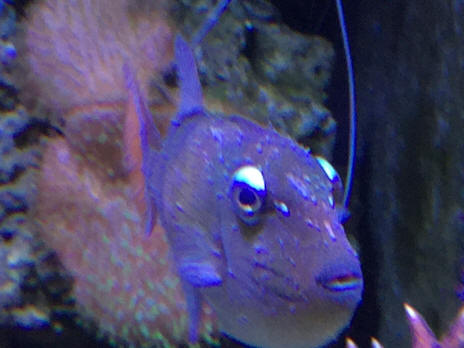
Hi guys
I have a blue throat trigger he is about 3 inches in length. I have had him for
several months. Right now he is in a 60 gallon mixed reef. He was in a 125 that
was running about 6 years and I came home to find the bottom glass cracked and
almost all 125 gallons on he living room floor.
<Yikes; no fun>
So he, a 4 inch yellow tang and 5 Chromis and a skunk cleaner shrimp went into
the 60 gallon for now. It took over a week to recover from that mess and every
empty aquarium I had (3) are now holding the salvaged Liverock and sand. That
was two weeks ago.
He looks great, swims openly and has been eating normally. Tonight while feeding
some Mysis shrimp he pooped a long trail of many thin white threads. They looked
like spaghetti and were sticky and several inches long. it took quite a while
for the mass of threads to finally drop off bit by bit. Any Ideas?
<Mmm; well; could be simply stress; but perhaps expression of a lumenal worm
infestation. Let's have you read here:
http://wetwebmedia.com/mardisindex.htm
Scroll down to worm diseases, treatments
Bob Fenner>
|
Trigger eye 1/6/15
Good evening bob,
<BH, a proper noun, capitalized>
About a week ago I notice this on my durgeon trigger.
<See in your pic.... a trauma... banged into something... SEE/READ on WWM re Eye
Injuries>
No other fish have it, and it is only one eye. He still eats, but hides more so
now than before. He is housed with a niger trig,
<Not... a happy place>
asfur angel, guinea fowl puffer and a big volitans.
<Might have gotten poked... and this Lion will be killed in time here...
incompatible w/ Balistids, large Pomacanthids>
As well as achilles and sailfin tang. It's been this size (eye) for about four
days now. Being one eye, and the fact I just prazied my tank with 3 consecutive
treatments , I doubt it could be flukes.
<Nope>
Attached is a pic from tonight. Seems like one Nasty injury, in your
experience will this Heal, eye fall off, lead to infection and death?
<Some of one or more of the above>
Is a freshwater dip worth it at this point?
<For what? READ>
Thank you
Oh and param.s: 79 degrees f, 1.023 sg, 0 a and nitrites. 40 nitrates. Ph 7.9,
150 gallon tank
<Need about twice this>
with 125 lbs of live rock, sand, skimmer and bio pellet reactor.
<Again, what for?>
Only use r/o with max 10 tdsr reading.
Thanks
<Keep reading! Bob Fenner> |
 |
|
Re: Trigger eye 1/6/15
Just got this pic. Decided to lay down facing glass. Hope this helps !
<Not me; you? The reading. B> |
 |
|
Re: Trigger eye
1/7/15
Yes this is what I thought. I will work on rehoming one of the triggers. As
well as volitans.
<Ah, good>
The lion was given to me when my neighbor took down his tank and moved.
Thanks
<Welcome. B> |
|
Trigger stung? 4/12/13
Hi Guys,
<Aly>
First a little about the tank although I'm pretty sure it has
nothing to do with the situation. We have a 330 gallon tank with
a 200 gallon sump.
There is currently 2 Blue jaw triggers, a Goldflake Angel, Chevron tang,
a mystery wrasse, 4 black ice snowflakes (We've had all these fish for a
year to 3 years depending on the fish). We also have added a sailfin,
yellow tang and about 10 lyretails in the past couple of months. The 330
gallon part of the tank is about 3 months old and was cycled with water
and rock from the 200 gallon sump that had been running for about 9
months prior and this is where the older fish lived. (Before that we had
a 90g).
<Ok>
Today we added a Magnificent Foxface that is about 7 inches long
at around 8pm. At this time my male trigger (6 inches) was
swimming fine and everything appeared normal. By 10 pm the trigger had
wedged himself into a small cluster of rocks, not really hidden and not
his normal hiding place as he has a little cave in a big cluster of
rocks. At first I thought maybe he was afraid of the Foxface
<Mmm, no>
but I knew something was wrong when he didn't come to eat. (They are such
gluttons.) We thought maybe he was stuck as he looked very stressed,
color a little yellow and breathing fast but still very aware. My
boyfriend tried to nudge him out of the rock
<Mmm, leave this fish be. It will come out when it is ready>
and he started to make a violent loud clicking sound and swam a little
further into the rock. When the Foxface swam into the area he seemed
very agitated and tried
to wedge himself in even more. His tummy looks a little bloated and
yellow to me. I could be wrong. Is it possible he was stung by the
Foxface? If so is he going to die?
<Could easily have been stuck by the Siganid... or one of many other
potentials in the system... Bristleworms, Alpheids...>
Any help would be appreciated. All other fish are normal.
<Not likely to perish. I urge just patience here.>
Cheers
Aly
<And you, Bob Fenner>
|
 |
Bluethroat Trigger Going Blind?
12/22/12
Hi and Happy Holidays.
<And to you and yours Michael>
I have a 6" Bluethroat Trigger for around 8 months in my 150 FOWLR tank.
Around a month ago during feeding, he did not come out and just hid in
the rocks. He did swim around, but not during feeding. This lasted
around 2 weeks. I thought it was aggression by a Blue Hippo Tang
so I moved the tang to my QT. He then started to come out more.
I am not sure if this was coincidence or from removing the tang.
<Could be many "things" that might have spooked this fish. Not to worry>
Then for the last few weeks, he does come out at feeding and tries to
eat but he misses the food as if he cannot see it. He now is
basically biting into the sand to find things. I also
noticed that he is bumping into things too.
Could he be blind? Or "blurry" vision?
<Could be>
I see no signs of any Ich, flukes, or anything else on any of the fish.
The Tang did look a little beat up with frayed fins and the start of
what I think is HLLE, but I have thought that was due to aggression by
others or HLLE caused by carbon, high nitrates or other HLLE causes.
Since I moved the tang to the QT the HLLE is getting better.
<Likely coincidental; but for all's sake I would start adding vitamins,
HUFAs to your foods... add Spectrum pelleted food as a staple>
All fish were QTed and treated with Cupramine or Quinine Sulfate as well
as PraziPro in QT. I have even treated the display with three back to
back doses of PraziPro back in July out of concern that the tang's
frayed fins were due to flukes or something, but the Prazi did not
change anything so I concluded the tang is just getting picked on and
the HLLE is probably the cause of the frayed fins.
I feed Mysis, silversides, prawns, clams, and squid and now recently
soaking in garlic guard and vita-Chem or Selcon.
<Ahh>
I typically feed every other day, but for the last several weeks I have
been feeding every day hoping to get more to the trigger.
My concern with the trigger is if he does not get enough food, he will
wind up dying due to not eating.
<Not likely>
Other Fish in tank currently include:
30" Snowflake Eel in tank for 2 years 9 months
7" Porcupine Puffer in tank for 2 years 7 months
7" Red Breasted Wrasse in tank for 1 year 8 Months
6" Banana Wrasse in tank for 1 year 1 month
4" Blue Hippo Tang moved to QT, had in tank for 10 months (had it in a
smaller tank for 2 years before)
My parameters are:
Salinity 1.0235
PH: 7.95 to 8.05
Ammonia: 0
Nitrate over 80 (trying to lower now with biopellets running for
the last 2 weeks).
<Do see WWM re... this might well indicate or be the principal
trouble... You need to fix this, keep under 20 ppm>
Temp 78-79
I have been using Instant Ocean Salt for around 6 months. I was using
Coralife salt before that and switched to Instant Ocean Reef Crystals
around 3 weeks ago (I have a 29 biocube so easier to do the same salt).
I change around 15% to 20% of water every week and have been doing
closer to 25% weekly for the last 3 weeks.
I have around 80 pounds of Pukani LR (around 60 in display, 25 in sump
in smaller pieces) and 20 Liters of Seachem Pond Matrix (in sump). I do
use a filter pad in the sump on top of the rock that I change every week
with water changes.
I have an Octopus XP2000sss skimmer.
I typically ran a Jumbo Reactor mixed with GFO and ROX carbon and change
every two weeks but stopped that 2 weeks ago and now running around
½ a cup of biopellets in a single reactor.
<Am not a fan of such... search my name and this carbon product on WWM>
Any ideas of what could be the issue with the Trigger? Could he be
going blind? Any way to try and fix?
<Fix the environment... and the fish/es will be fine.>
thanks,
Mike
<Welcome. Bob Fenner>
Re: Bluethroat Trigger Going Blind? 12/22/12
Thanks Bob.
<Welcome Mike>
I do feed spectrum pellets now and then. All fish eat them except
the eel and the Bluethroat trigger. I wish the trigger would eat
them. In fact, that is all I am feeding the tang in QT.
Do you think those spectrum pellets are better than frozen food or a
variety of frozen and pellets is even a better idea?
<I do>
Should I try a couple weeks of just pellets and see if the trigger and
eel will go after them? The puffer and both wrasse eat them like
candy.
<I would do so>
I will work on the nitrates. Water changes do not do it. I
probably am feeding too much and will try and cut that back too.
<Again, see WWM re... there are many approaches... am a bigger fan by
far of the biological, slow-steady than the "motorboat mentality" means>
Also, what are HUFAs?
<Highly Unsaturated Fatty Acids... see Wiki re?>
thanks again.
Mike
<Again welcome. BobF>
Re: Bluethroat Trigger Going Blind? 12/22/12
thanks again.
I will try just the pellets for a couple of weeks. They are easier
to feed than frozen anyway.
To help lower the nitrates sooner than later, do you think doing three
25% water changes every other day is too much?
<... not too much, but not of much use... Have already prompted, urged
you to read... DSBs, RDP refugiums, macro-algal culture, nutrient export
techniques...>
I will be reading the WWM site again today.
<Ah good>
thanks
Michael M. Rossi
<Oh! Have friends (Rob, Mary) of your family name in San Diego. BobF>
|
Re: New Yellow Tang and Rigens Triggerfish.
11/30/12
Bob,
He is out and about and eating well, active too. As I just noticed today, he
has some white spots on his side and some on the fins.
<I see these; sort of. Your pics blurry>
Eyes are clear. I removed a vicious yellow tang last night and the whole
tank took a big deep breath of relief. The tang nearly sliced a new fox face
and harassed the trigger. So, could these spots be stress related?
<Oh yes>
As he swims, they seem to get smaller
<Interesting... likely (just) body slime/mucus... that's sloughing off w/
movement>
Water parameters are great. Hope it's not Ich, or worse because I
will never be able to get him out of his cave area. Advice?
<The same ole simply keeping on keeping on... w/ good nutrition and water
quality. Bob Fenner>
Dan Callaghan
Fwd: New Yellow Tang and Rigens Triggerfish.
11/30/12
Bob
<Dan>
One more question: will UV sterilization help?
<Mmm; yes; indirectly by improving water quality, raising RedOx>
Thank you very much for your help!
Dan
<Welcome! BobF>
|
|
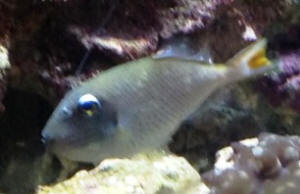
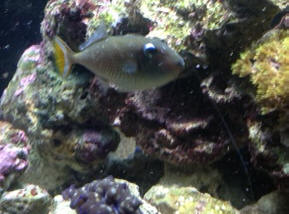
Possible Ich, ongoing... also Xanthichthys hlth. f' -
12/01/2012
Bob,
<Dan>
This is a better view.
<Better resolved, but the subject is way too small in the frame...>
Please excuse the feeding debris. I installed a good UV, which I did not
have Prior. Performing 10-15 percent water changes weekly as
usual, keeping good parameters. 1.023, 79 degrees. Skimming, filter sock
frequent changes. I hope you can see the body spots and cloudy
stuff on the top fin. Again, he eats well, and we added garlic to
the food. We use Rod's food.
<A good product in my estimation>
There may be a Coral Beauty with Ich as well. He has white spots.
<... these spots could be evidence of parasitic infestation to nothing
but mucus irritation... W/o sampling and microscopic examination I'd do
nothing treatment-wise>
The tank seems happy. The beauty and trigger will be tough to catch.
Any reef safe treatments or suggestions other than what I'm currently
running?
<There are no such thing/s as effective AND reef-safe treatments>
Do fish always die with Ich, or is a complete recovery possible?
<The latter, assuredly>
Thank you for your time. Dan
<Certainly welcome. BobF>
|
 |
|
|
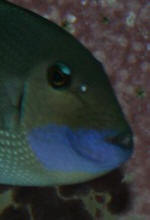
triggerfish abscess/tumor 10/7/12
There are a few articles and discussions regarding triggerfish obtaining
abscesses and/or tumors.
<? Is this a continued correspondence?>
There is a picture of a pink tail trigger from 2004 with the exact same thing my
blue jaw has. He developed this over the past 5 weeks. It seems to be increasing
in size over the past week. Parameters in 125 gallon are good, 0 ammonia, 0
nitrites, nitrates at 1.0, ph 8.2, dKH 10. The tank has been up for a year. The
trigger has been in the tank for 9 months. He is still an excellent eater and
swims around the tank like nothing is wrong.
He lives with green Chromis (4), Kole tang, swallowtail angel, maroon clown,
male and female sunset wrasses. mix of soft and LPS corals all doing well. There
is no aggression with the fish. The angelfish was the last to enter the tank 5
weeks ago with evidence of Lymphocystis that is almost completely resolved.
There are a few discussions about these tumors or abscesses but no discussion on
treatment. Any follow up on what happened to the pink tail from '04?
<Not that I'm aware of... any responses, further communications, I do my best to
match w/ previous. Such tumours/abscesses either seem to heal on their own, or
the fish succumbs. Bob Fenner>
Thanks. Tricia Keefe
Re: triggerfish abscess/tumor 10/7/12
Do you think it is worth trying to treat with food soaked in antibiotics?
<Mmm, no; have become less and less a "fan" of anti-microbials as the years have
gone by... not only of not much use in most petfish circumstances, but often
more harm (to nitrifiers in particular) than they're use warrants.
BobF>
Re: triggerfish abscess/tumor
10/29/12
So, definitely an abscess for this blue jaw. I have forwarded some pictures.
I would be in favor of trying to put a needle in the live fish to open this
and drain it when it is smaller.
<Worth trying>
After he died trying to open this with a razor blade was really difficult.
The scales were so tough. I don't think you could open this with anything
that would be able to cut it without killing the fish but maybe a larger
needle would work; like a 21 to 23 gauge needle might work. Nothing along
the pus pocket appears to be tumor like. If this were a human it would have
drained on its own a long time ago. I suspect it doesn't drain spontaneously
due to the tough overlying scales. Due to the location I wonder if they
don't get some sort of minor trauma in the mouth that extends into the
"cheek" then cannot drain from there.
<Mmm, don't know re this. Balistids put some very tough, pointy things in
their mouths>
I'm unsure how well the pictures will email. The first one is early on,
second one as it got a lot bigger, then post-mortem abscess cavity. I don't
know if this will help anyone else but hopefully.
<Thank you for your input. Bob Fenner>
|
 |
|
Dry Sargassum Trigger 1/11/12
Good evening WWM Crew.
<Nate>
Two days ago my newly acquired Sargassum Trigger jumped
out of my 240.
<Yikes, no fun>
I don't know how long it was out but when I woke up I found
it pretty well dried out.
When I picked it up I noticed its lower jaw move just a tiny
little bit.
I tossed it back in the tank and about 30 seconds later its gills
started moving and after a few minutes the entire body was
twitching and it was trying to move. After about an hour it was
out swimming around again.
<Ah good>
Fast forward to today (2 days later). Its eating like a horse
<Good sign>
however is looking pretty bad on one side. It may be the side
that was on the carpet when I found it but Im not certain.
Its almost a brown color and looks like some of the skin or
scales may be coming off. Its only on one side and pretty well
runs right down the center of the fish. Im including a couple
pictures but my camera isn't very good.
Do you have any idea whats going on or how I can help it?
<Physical trauma... just good care and nutrition>
Also, do you think this discoloration is permanent or there will
be any scarring?
<Can't tell... likely not much scarring>
Thanks a lot for your time,
Nate Slocum
Sioux Falls, SD
<Welcome. Bob Fenner, San Diego, CA>
|
|
|
Re: Dry Sargassum Trigger
1/12/12
Hello again.
<Nate>
Thanks for getting back to me.
<Welcome>
I wanted to give a quick update.
Tonight the darkened side scales/skin is all peeling off
like a very bad sunburn. I'm very worried about an
infection now that there's no slime coat and no scales
to protect it.
Nate
<Not to worry... the skins of Balistids (& related
Monacanthids... "Filefishes") used to be employed
as "sand paper"... they're very tough.
Bob Fenner>
|
|
|
|
Re: Blue throat Trigger Fish
Losing weight 1/7/12
Hi Bob, I moved the trigger to my quarantine tank on Monday. He has
been eating like a pig, but not gaining weight. I ordered Prazi from
Foster and Smiths. It wont be here tell next week. Could I treat with
copper?
<... I would NOT. Not likely to cure anything, and highly likely to
poison this fish, make it anosmotic, go off feed>
I also did water change in my main tank. Ph was 8.2 before, after 7.8.
Its got to be the salt combined with needing some new sand and rock. I
am trying to recover from Christmas hoping to get my tank in order by
mid February. Money is tight and unfortunately, my Kids comes before
the Tank.
BOO!. Jim
<Take your time here. BobF>
Re: Blue throat Trigger Fish Losing weight Bob (unfortunately not
losing weight) and Angel comp. 1/24/12
Bob, So I kept the Trigger in quarantine for three weeks. I treated him
with Prazi. He ate fine put weight on. I put him in my main display
yesterday and now he looks like a Ethiopian again! He freaked out over
my blue face and he is not even bulling him. I am hoping when I upgrade
tanks this weekend that he eats better.
<Me too>
I have had lots of triggers and this by far the first time I have ever
seen a Trigger act like this. Is this normal?
<Not normal>
He's like 5". All my shrimp, crabs, and snails are alive. From
whats left of my reef that my blue face made me get rid of. I read that
its normal that he wont eat them, but damn.
<Mmm, no; Balistids will/do eat these>
Be a trigger and kill the crustaceans! I love my Blue Face, but its
starting to get old with his aggressiveness.
<Try more room>
He is getting a extra two feet of swim space so hopefully he will take
a chill pill. Are Scribbled Angelfish as aggressive as Blue face and
Emperors?
<Are not nearly so... esp. tank-bred individuals>
Is that pretty much what to expect with Large angels? Been thinking of
switching Angels. Live Aquaria got a female for $199! Thanks for the
all the info, Jim
<Cheers, Bob Fenner>
Re: Blue throat Trigger Fish Losing weight Bob, not!
1/25/12
Bob, I have read many of your articles. A Cruiser and A Bruiser, The
Clown Trigger, Balistoides conspicillum. That's my favorite by far.
Very funny and informative. I truly think Disney could make a movie out
of it. I think I am going to put him back in quarantine and sell him.
He needs to be just dart fish, Chromis for a while. I ordered another
one, hopefully this one did not get neutered. Thanks, Jim
<Be chatting! BobF>
|
Blue Throat Trigger, env. hlth.
10/17/11
I have a 5" Male Blue throat trigger in a 55 gallon bare QT
(just two 4" PVC, one piece of rock, and two HOB
filters).
<This species, specimen needs more room than this... At least
twice>
He seems to spend most his time lying on his side trying to wedge
against one of the 4" pvc fittings. Attached are some
images. sometimes he swims like this too. I hardly ever seen him
swim normal after the first few days to a week of having him.
I read this can be normal behavior for triggers.
<When they're frightened, yes>
After around 2 weeks, I treated with Prazipro.
<? For what?>
After another 2 weeks, I treated with 6 days of Quinine
sulfate.
<I don't see evidence of a protozoan infestation. Why are
you doing this?>
My last treatment of QS was 4 days ago. 3 days ago I did a 25%
water change and also started running carbon in a reactor.
<Good for the last>
From the start to now, I see no signs of sickness. No spots, no
frayed fins, etc... just not moving or really eating.
He ate a little at first, but does not eat now and is looking
thin. Last night I tried soaking some prawns and one silverside
in garlic guard and it did not change anything.
Ammonia and Nitrite are zero. PH is around 8.2-8.3, Salinity is
around 1.024
Should I just wait it out with no more meds or could there be
something internal that the Prazipro and QS did not get? Or could
it be from the QS?
thanks,
Mike
<Needs a bigger, better world. Please read here: http://wetwebmedia.com/xanthtrigsysf.htm
and the linked files above. Bob Fenner>
|
|
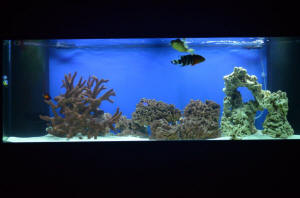
Re: Blue Throat Trigger
Thanks. I treated with meds cause thought I should to make sure
there is nothing I do not see before I put in my display.
<I see>
My display is a 150 gallon (pic attached). However, he is thin
and not eating, do you think I just put him in the display?
<Yes. I definitely would>
I have a 6" porcupine puffer, 6" red breasted wrasse,
3" coral beauty angel, and a 24" snowflake eel in
there.
The only one that may harass the bleu throat trigger is
puffer.
<I doubt it>
Do you think his chances are better in the 55 gallon Quarantine
longer or put him in the 150. I have had in in the QT for around
5.5 weeks now.
<Move this fish>
thanks,
Mike
<Welcome. BobF>
|
|
Re: Blue Throat Trigger
10/20/11
thanks again.
<Velkommen>
I put the trigger in the display on Monday night. He hides
mainly, but I do see him come out once in a while.
<More as time goes by. Traumatized, starved>
Attached is the spot he sits mainly.
In the last few feedings he is hiding. The other fish do
not leave much.
I have fed some Mysis hoping some will remain for the
trigger to come out and find.
Any suggestions on the fish not eating. He is still very
thin.
<http://wetwebmedia.com/trigfdgfaqs.htm
B>
thanks,
Mike
|
|
|
|
|
Re: HELP female Crosshatch Trigger carrying parasites?
7/29/10
Dear WWM Crew,
<Will>
I have had a 6-7" male Crosshatch Trigger in my QT for 3
weeks now and I decided to pair him up with a female so I got a
6" female on past Tuesday.
I divided the tank in the middle with egg crate so he
wouldn't harm her since I want them to check each other out
for the duration of the QT and because a 55 gallon may not give
her enough room to hide.
After drip acclimation, I put her in and minutes later I see a
hundred or so tiny things swimming all over. I do have some LR in
the QT so what could these little things be? The swim erratically
and under magnifying glass, they looked like they had eyes and
oblong shape with a tiny bit of color towards one end.
<Mmm, sounds like Trematodes, flukes... Actually quite common,
generally not-too-deleterious parasitic worms of marine fishes.
Not hard to treat...
Please read here: http://wetwebmedia.com/fshwrmdisflukef.htm
and the linked FAQs files above>
Is it some parasitic hitchhiker that came with my female or some
invert had babies from the LR?
<On the Xanthichthys themselves almost assuredly. Trematodes
tend to be pretty species-specific>
Sorry, too small to photograph and they are now all dead anyway
since they got sucked up into the hang on back filter. If
parasitic, what treatment do you recommend?
<See the referred files>
Also, how do I know when to take out the divider?
<When you can be there to observe these fish full-time>
I have a 300 gallon circular tank that will be ready for fish in
2-3 weeks (going fallow, in it's 8th week),
I plan to put the female in 1st and then the male, leaving them
separated till moving them into the 300 tank. Is that smart or
should I take out the divider beforehand?
<I would wait, introduce to the main, larger system at the
same time... Very likely there will be no problems there>
Thanks.... you guys are GREAT !!
Bill
<Welcome. Bob Fenner>
Re: HELP female Crosshatch Trigger carrying parasites?
7/29/10
Dear Bob,
<W>
Thank you for your quick reply. I thought flukes detach from the
host only when you dip the host in fresh water
<? What? Where did you get such an understanding from?>
so how can it be flukes if I never gave the female Crosshatch a
fresh water dip? She went from drip acclimation straight to the
QT tank and that's when I saw all the free swimming things.
flukes looks more flat right?
<... see the Net or books re>
These things didn't look flat, they looked like some kind of
baby invertebrate.
<What?>
If you still think it's fluke, I do have PraziPro but I want
her to be eating before I start the treatment, is that ok since I
understand they lose appetite when on treatment. I got her on
Tuesday and she still has not eaten.
What do you recommend?
<Keep reading. B>
Thanks again,
Bill
Re: HELP female Crosshatch Trigger carrying parasites?
7/30/2010
Dear Bob,
<WW>
I definitely trust your opinion and after reading up on this
subject I started dosing PraziPro in my QT tank.
<Mmm, naught to do w/ trust... Really, the only means of being
(more) assured of what these are is microscopic examination.
Symptomatically I suggest/ed they might be monogenetic
Trematodes... If so, likely a treatment w/
Praziquantel will rid your fishes of them>
Going to do 2 rounds of treatment and maybe even do a Formalin
dip.
<Mmm, I'd hold off on the Formalin>
Thanks a lot,
Bill
<Welcome. B>
Re: HELP female Crosshatch Trigger carrying parasites?
8/2/10
Dear Bob,
<Will>
I was able to catch a couple of these free swimming things in the
tank. I put them in a glass cup and I first dosed it with
PraziPro but that did not kill it.
<Won't kill immediately...>
Then I put then in fresh water for like 4 minutes and that slowed
them down but they survived. I can see little legs moving
<?! Not flatworms then>
so I added Methylene blue to the water and that didn't do
much either. I'm using a jewelry loupe to look at them from
underneath the glass.
So what kills these things?? Formalin 3 baths?
<Formalin kills all forms of higher than viral life...
crosslinks peptides>
My female still has not touched any food in QT, I assume that the
PraziPro treatment is not working so what next?
<Determining "what" you are dealing with
here>
Leaving for vacation in 10 days, need to take care of this
urgently.
Thanks,
Bill.
<Photographs... borrow a close up lens, or a dissection
'scope... I use a cheapy QX series for such. BobF>
Re: HELP female Crosshatch Trigger carrying parasites?
with PHOTOS 8/2/10
Dear Bob,
<Woo>
Here we go, got pics from using a loupe and a good camera.
<Ah, good>
I hope these are the things I was talking to you about. The Blue
is from Methylene blue I used.
Please i.d this bug for me so you can tell me how to treat my
female Crosshatch.
Thanks,
Bill
<Appears to be copepod-ish... For sure crustacean. Read
here:
http://wetwebmedia.com/crustdisfaqs1.htm
re organophosphate et al. cures.
B>
|
  |
|
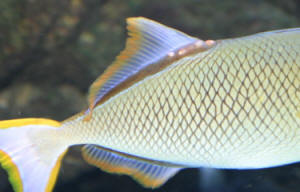
disease on crosshatch trigger 6/14/10
Hello,
<James>
My female crosshatch trigger has developed these small pink bits
under her top fin. It is also a bit swollen along the brown bit.
Do you know what it is and how I should treat it?
<Would have to have a closer look... but this might be viral,
Protozoal or even some sort of Worm parasite... I might venture
to have you read re the use of Metronidazole, Praziquantel... in
food>
She is eating fine
but she is not 100%. Her colour is lighter than normal. My male
crosshatch is fine.
Many thanks,
James.
<Bob Fenner>
|
 |
|
trigger disease -- 06/10/10
Dear sirs:
I've searched the web and your site and cannot find out what
this disease is.
Is this Lymphocystis? It look like it might be.
<Does appear so>
The only problem is the fish has had this for 6 months and I
thought it should go away in weeks. He doesn't have any other
symptoms just these unsightly warts and strange bulge at base of
dorsal fin. The warts appear to migrate from the lump and radiate
out towards the edge of the fin and then disappear . They also
pop out of the bulge and then disappear.
The tumor(?) varies in size as well as the # of cysts
(warts).
If it's not Lymph what is it? None of my other fish show any
signs of disease. How should I treat this?
Thanks
Sincerely: Paul Clampitt
<Read here: http://wetwebmedia.com/virdiscures.htm
and the linked files above... No "treatment" called
for, necessary or advised. Bob Fenner>
|
[1]%20lymph.JPG) |
Re: trigger disease
Thank you for such a quick response, you guy's are
terrific.
<Certainly welcome. BobF> |
|
Crosshatch Trigger Fish, chewed 3/9/10
I would like to say thank you for all your help in the past!!!
Today I noticed my Crosshatch Trigger fish had a sore/open wound
on his back and stomachs were his fins attach to his body, It
looks like he tried to squeeze through a tight cave and possible
got caught.
<Chewed>
He is showing no sign of irritation and he is eating normal. My
levels are all at zero including my nitrates. I'm treating
with Melafix,
<Worse than worthless>
which I removed my carbon and turned off ASM-G4 skimmer. My
question is, is there anything else I should be doing?
<Looking for the perpetrator>
I have a refugium so I am not sure what other medication I can
use,
<None needed or advised>
if I even need to use something different.
<Differently>
I think he will be fine with time but I would rather be safe than
sorry! Any advice? Thanks alot,
<No such word>
Terry FL
Sent from my iPhone
<What other livestock are present here? Something is chewing
this fish. Bob Fenner>
|
 |
|
Re: Crosshatch Trigger Fish, injury
3/9/10
Thanks for your reply, I have two Nemo, 3" Blonde Naso Tang,
4" powder blue tang, 6" Magnificent Fox Face, a Cleaner
Shrimp, Coral Banded Shrimp and a small Zebra eel. The Crosshatch
is 6-7", the biggest fish in the tank, I
have had the Crosshatch going on three weeks, any advice would be
thanks!!!
<... well, could be any of the Acanthuroids or the CBS beating
up the Xanthichthys... You will likely discern the culprit by
closely observing your system. BobF>
Re: Crosshatch Trigger Fish, CBS comp.
3/11/10
Thanks again for your reply, my Crosshatch seems to be recovering
well! I removes my CBS and placed him in my 100gal. I have been
noticing the CBS late at night trying to catch my nemos when the
lights are out,
<Yes... Stenopids can be quite predaceous>
I'm thinking he was the problem, I did a little research and
I read that they have been know to rip the fins off of smaller
fish to eat them, not sure if there is any truth to that
<There assuredly is>
but I can not imagine something that small trying to attack a
6-7" trigger,
<At night time, when this fish is wedged into the rock,
sleeping... this is entirely possible>
I would of thought the trigger would have eaten it if it did such
a thing.
Thanks again, Terry
<Welcome Terry, BobF>
|
Quarantine, Xanthichthys hlth. 1/11/10
Good day crew! I have a quarantine question. I have been quarantining
all wet things that go into my tank (225 softy tank) for the well over
three years in a 29 that is always running 'just in case'
after
learning the hard way.
<A good general practice, though not per species, specimen strictly
the route to go in all cases>
All the info stuff: the display has 5-6' DSB and about 150 lbs of
LR.
It runs at 78-79 degrees, 1.024 SPG, 0 NH3, 0 N02, 0 N03, 0 P04,
8.0-8.2 PH, Calcium 370-390, and 8-9 dKH. 48 gallon (actual water
volume) refugium with a DSB and Chaeto, and a 35 gallon (a.w.v.) sump
with a GS3 skimmer using Ozone, and a MR1 reactor that I run RowaPhos
in one chamber, changed every four months, and cut up Polyfilter in the
other, changed every month, continuously. Carbon is used for two days
every second week in a separate filter and 48 gallons gets changed once
a month with RO/DI water. The last fish I put into the main tank was
well over a year ago. I keep a clown fish, Bert, in the quarantine
tank, that goes into the refugium until the tank is free again, water
changes come from the main tank which I have been doing 20% every third
day since the new fish arrived, even though the water tests perfect
daily using Salifert tests.
I purchased two blue jaw triggers (Xanthichthys auromarginatus) to be
the 'show' fish along with the current fish, a 3' Purple
Tang, a Percula clown, 4 B/G Chromis, and a pair of Pink and Blue Spot
Gobies. The two triggers, male and female, came from Blue Zoo Aquatics
and were/are in incredibly healthy looking and plump condition,
4.5'-5.5' true body size. These are to be the last fish in the
tank.
One of the triggers started feeding after the second day in quarantine;
I have not seen the other eat in 12 days now. She stays
'locked' in a piece of PVC pipe.
<An example of a fish I would summarily dip/bath and place in your
main display. It is too likely to perish through the quarantine
process, and very likely to be "clean">
I can only see her face and the front part of her body. I see them both
out occasionally if I surprise them, but when I walk into the room,
both hide, the male will come back out if I have fed them and I go sit
on the other side of the room. I have not seen any harassing by the
male when I do see them both out.
(Picture a crazy fish owner peaking around corners for tens of minutes
at a time.)
<I can, do>
Neither fish has shown any symptoms of disease, but I am worried about
the lack of feeding by the female.
<I as well>
I have tried live brine shrimp, Mysis soaked in Selcon - which is what
I have stuck with for the male, NL Spectrum, and Emerald Entree. I was
planning on 21 days in quarantine, but am concerned the small space and
lack of hiding places is stressing the one trigger.
<Is so>
So, should I stick with the 21 days for both, or move the male after 21
days and try to get the female feeding, or move both after 14-15 days
if I can see no signs of disease in the hopes the large space, hiding
places, and my school of Blue-Green Chromis will act as dither fish and
the female's stress will drop and she will start eating in the
display?
<I would move both, or at least the female now>
Thank you and have a wonderful New Year!
<Let's not limit ourselves William. Have had a wonderful life
thus far... let's both continue to do so. Bob Fenner>
Re: Quarantine, Xanthichthys hlth.
1/11/10
Dear Bob,
Thank you for the response. I waited too long, found it dead this
morning. I will move the other to the main display as soon as I get
home. I will try again, this time just doing a fresh water
dip/bath.
Continue to have a wonderful life,
William
<Ahhh, thank you William. BobF>
Bluejaw Triggerfish Male and female.. 11/20/09
Hey there, got a quickie for you. Basically a QT question. Should I or
shouldn't I.
<"When in doubt, keep them out">
My display tank is a 125 gallon reef ready tank. I have a MarineLand
model 4 sump and a MarineLand 300 skimmer, works awesome by the way. I
have 120 # 's live sand, and 140 # 's live rock. I have a
4" Blonde Naso tang,
<Will need more room in time, or perish>
3" regal tang, 2" juvy imperator angelfish,
<This also>
5" Foxface, a percula clown along with it's anemone,
<Which the Pomacanthus may well consume>
and a small Firefish, along with several snails, and crabs. I have a
Colt Coral, Stylophora, mushrooms, and some polyp's. Tank is
populated with copepods and other life... All parameters are good,
nitrates stay around 5-10, water is at 1.024, temp. is 77.5-79, PH 8.0,
do about 25 gallons a month for a water change. My question is that I
just ordered a Male and Female Bluejaw triggerfish.
<Your system will be over-populated psycho- and physio-logically all
the sooner>
My QT tank is a 29 gallon tanks with the same specs as my display. With
live rock. Question is should I QT these two together in the small QT
tank.
<I would, yes>
The last fish that I got was my Foxface and he didn't like it in
there at all, he just stayed in a corner with his fins spiked up and
all spotty colored.
<Good description>
He was very stressed and I thought I may be doing more bad then good.
So after he was eating in a couple days, I put him in the display and
he was fine. Swimming, and eating with the others. Will this be too
small for the two triggerfish.
<Only experience can/will tell>
I know they are somewhat resistant to disease from what I've read,
peaceful (For a trigger), and pigs... I am just concerned if I would do
more harm than good by putting them in the QT or should I just put them
right in the display, or QT one and not the other. What are your
thoughts.
You've helped me out a lot in the past and I always read here
first. But not a whole lot of info on the Bluejaw. Do you have any
links for more info on them.
<Nope; but there is always the library of a sizable college>
Thank you so much for all your help.
P.S. My Foxface (very fat and healthy) constantly eats at the sand, and
in always pooping out sand. I'm assuming she is eating algae that
is on the sand, but is it normal for her to actually eat it and be
pooping it out all the time.
<Is this a question? Yes? Yes.>
It's not bothering anything just wandering if it was normal
behavior or not.
You guys (and ladies) rock. You are by far the superior research
site.
Thank you much.
Aaron
<Welcome. Bob Fenner>
Re: Bluejaw Triggerfish Male and female..
12/13/09
Just an update. I've had the Triggers (Male and Female) for about 3
weeks now. I had a 55 gallon tank in my basement and changed the 29
gallon to that.
<Still too small if these fish are exhibiting territorial
aggression>
I used the same filter, water, and rock. Water is near perfect. It took
a lot of patience but they are both eating very well now.
<Ah, good>
The Female started about a week in, and the Male about 2 weeks in. Now
the hit everything I put in there. Mostly frozen Krill, Mysis, and
cocktail shrimp, and even flake foods. I've been soaking in
vitamins and garlic most of the
time. It took a while for them not to dart into a hiding spot whenever
I walked into my room. The female is still a bit shy, and the male will
dart recklessly about the tank if he gets startled. I try to be as
gentle as I can, but I have 2 kids so I want them to get used to
someone coming along the tank suddenly. In my display when I come up to
the tank everyone will follow me from one side to the other. It's
pretty neat. Anyway my question is I'm going to QT them for about
another week or so and first was just wandering
<and wondering>
if there is an easier way to net them without them darting all over the
tank and hitting there faces on the glass and possibly jumping.
<Two nets, moving slowly but deliberately, scooping upward...
Perhaps moving out any structure ahead of time>
I'm a little concerned about that. Then should I put them both in
the display at the same time, or add one first then the other a couple
days later.
<At the same time>
I was planning on just acclimating, and adding them both at the same
time.
<This is what I would do as well>
They were shipped in separate bags, but I acclimated them together in
the same container, and they've been together every since, and seem
to like one another just fine. They sleep right in the same spot next
to each other. Just afraid that if I separate them for an amount of
time that they may not take to each other again. What would you
suggest.
<Time going by; careful daily observation>
I am really excited to get them in the display, they are such a neat
couple. I've grown very fond of them. I've read everything that
I could on your site about them, and am always looking for more info.
Seems to be somewhat limited on the blue throat trigs.. Anyway thanks
for all your help. You all are great.
Merry Christmas, and Happy New Year...
<To you and yours, good will, peace Aaron. Bob Fenner>
Restocking Following Bluechin Trigger Death --
07/02/09
I recently had a Bluechin trigger die suddenly in a 125g FOWLR that for
over the past 16 months has also peaceably (no real
aggression/predation) housed a 4' purple tang, 2' melanopus
clown, 2.75' flame angel, 4.5' Foxface, Longnose hawk, neon
Dottyback, pistol shrimp and a coral banded shrimp. Basic water param.s
post-mortem checked out okay (8.3 pH, 1.022 SG, nitrate at 10,
everything else at 0) and the other 6 fishes are still fine and eating
a variety of frozen/flake/pellet food, although they've been a
little skittish on a couple occasions lately.
<<This may or may not be related>>
This is the second Bluechin I've lost (first one died
12/28/08).
<<Perhaps the 'source' of these fish is at issue here. By
far, the best specimens for aquarium use will come from
Hawai'i>>
Both had a similar demise -- acting normally for many months, then
suddenly one day hiding in the rocks and not eating.
<<I have seen this before, with this and other
species'¦and suspect an internal parasite to be the cause.
Unfortunately, by the time the symptoms manifest there is really
nothing you can do at that point>>
However, the first one took 2+ weeks to succumb, while this one was
dead in only 2 days.
<<Perhaps the one had a weaker constitution>>
I actually wrote to WWM in January about the first trigger death and I
believe Bob said it could've been a parasite or something else
entirely.
<<Indeed.>
In your opinion, does the current amount of livestock allow for adding
another fish?
<<That depends on what you have in mind but, yes, I think
so>>
And if so, what species would work, without killing/being killed?
<<There are probably quite a few possibilities if you think about
it. Why don't you work up a short-list of what you think you would
like to add and then we can discuss>>
I decided against getting another Bluechin out of concern that I'm
either not caring for them properly or my tank conditions just
aren't conducive to their survival.
<<If the Triggerfish had a place to retreat (this species can be
quite shy and requires a place where it can feel safe), it wasn't
being harassed, and if it was eating well'¦the problem could
well be the source/shipping/handling process these fish endured before
you acquired them. Perhaps you merely need to look for this species
elsewhere (and/or special order one from Hawai'i). Though changing
vendors/the source for obtaining this fish is certainly no guarantee of
success'¦but is worth a try>>
Conventional wisdom says that the fishes I've got now do poorly
with conspecifics, right?
<<Very often this is the case, yes>>
For instance, avoid other tangs/surgeons because of the purple
tang.
<<I'm not 100% with you on this. Being 'established'
for so long may be problematic, but you might get away with adding a
Tang of a different genus. If you were to try this, my suggestion would
be either Acanthurus japonicus or Ctenochaetus strigosus'¦both
are hardy aquarium species that won't get too large for your
system>>
No other dwarf angels because of the flame.
<< I have kept multiple species of these fishes in similarly
sized systems. I think there is a small chance you could introduce
another dwarf of a different species here>>
Same goes for other Pseudochromis, Siganids, clowns and Hawkfish.
<<These are probably best left alone, yes>>
And the fact that these guys are all well settled surely makes it even
more difficult.
<<Agreed>>
Would the 125g tank size (plus approx. 100lbs live rock) make a
difference, pro or con?
<<Tank size and amount/quality of available 'cover'
always make a difference>>
Also, I enjoy the coral banded's antics, so I wouldn't want it
to become a meal to a wrasse, hogfish or harlequin tusk, either.
<<Okay>>
I'm curious what fish (or invert) might be a good risk
here'¦or should I just stick with what I have? I guess I'd
be fine with that, too.
<<I have no real idea what you might be wanting here. Do a little
research in to what you think you would like to add to the tank, and
then come back with a list and let's discuss the merits
re>>
On another note, my light fixture is a 72' Coralife compact
florescent with 2 96W 10,000K's and 2 96W actinics. Is this
adequate lighting for an anemone (specifically, a rose bubble tip)?
<<It is marginal in my opinion. Metal Halide lighting would be my
choice/suggestion'¦but I think you could get by just replacing
the Actinics with two more 10,000K bulbs'¦will be far better
for an Anemone>>
Sincerely,
Chris
<<Regards'¦ EricR>>
Re: Restocking Following Bluechin Trigger Death -
07/03/09
Thank you for your prompt reply, Eric.
<<Quite welcome Chris>>
The first Bluechin trigger was from LiveAquaria. I don't remember
if it was of Hawaiian origin, but they seem to have decent quality
livestock (my tang, angel, Siganus, and Dottyback were also purchased
from LiveAquaria).
<<Ah yes, I do agree'¦one of the better vendors
re>>
The second trigger was purchased at my LFS, and I admit their quality
is inconsistent.
<<Likely taking what they can get-where they can get
it>>
I did notice this trigger had slightly cloudy eyes when I first bought
it, but since it was very active and eating well, I wasn't
concerned at the time.
<<Hmm'¦>>
As to adding another fish: The purple tang and the flame angel are
definitely the "alpha dogs" of the tank.
<<I would think so>>
However, there are adequate caves/hiding places within the rockwork (2
structures on opposite ends of the tank) to prevent any serious
bullying.
<<Does help'¦as does keeping everyone well
fed>>
I'm also thinking of adding another 75+ lbs of live rock.
<<Do be careful not to overly restrict swimming/growing
space>>
Your suggestion of the C. strigosus was one I considered before (also
C. truncatus), but I'd read they were peaceful,
<<Mmm, relatively speaking maybe'¦don't know that
I'd class any tang as 'peaceful'>>
and therefore might not be able to hold its own against the purple
tang.
<<The purple Tang would likely 'take-out' any other tang
it had a mind to, regardless of the new addition's aggressive
nature'¦but I'm thinking a specimen of a smaller size and
a different genus may have a chance. After the Purple lets it know
who's boss, of course>>
Alternatively, the A. japonicus you suggested would appeal to me,
too.
<<A superb aquarium species>>
By the way, I looked on LiveAquaria and they identify A. japonicas as
'powder brown tang' and A. nigricans as 'white cheek
tang'. At WWM, it's the reverse.
<<Just goes to show the problem with 'common'
names'¦and why I try to not use them, at least not
exclusively, when recommending fishes>>
I know Bob's book says the white cheek is hardier, no?
<<A. japonicus, yes'¦not A. nigricans>>
With regards to angels, would another Centropyge say, acanthops, eibli,
argi, or flavissimus be incompatible with the flame?
<<I have kept C. loricula and C. flavissimus in the same tank
(and do consider the latter the best choice of those
listed)'¦that's no guarantee, but I think you would have a
good chance for success re in your 6-ft tank>>
When you say small chance of introducing another dwarf, are we talking,
like, 10% chance of success?
<<Mmm'¦upon reflection, I think I would give you a 50-50
chance here>>
Are there any Thalassoma sp. wrasses that wouldn't be a direct
threat to the coral banded shrimp?
<<Not in my opinion'¦at least eventually>>
In lieu of an anemone, I was contemplating soft and/or LPS corals in
this tank down the
road as well, possibly as a test,
<<Would be better suited to your existing lighting>>
I could frag a couple from my coral tank and place it in the 125 to see
if they get chewed by the Foxface or flame angel. Your thoughts?
<<There's always the exception, but I have always found both
fishes to be fairly well behaved re. Again'¦that 'well
fed' thing>>
Regards,
Chris
<<Keep me posted'¦ EricR>>
Compatibility And Overstocking (env. dis.), Sargassum
triggerfish 1/20/09 Hi, <Hello Mark> I have had my
Sargassum Triggerfish (2") in my 55gal community tank (2 Percula
Clownfish, Bicolor Blenny, Goldenhead Goby, Lubbock's Fairy Wrasse,
Small Snowflake Moray) and it has been behaving normally as far as I
can tell. I have no quarantine tank setup currently since I have not
had any fish die or become sick immediately after introduction.
<Mmm, you must roll 7's quite often.> In his first week or so
he showed some white spots and his fins also became a little tattered,
however he <he is the moray or triggerfish?> didn't show much
weak or abnormal behaviour and continued to eat whenever fed. The only
strange behaviour I noticed was a bit of twitching which I am guessing
can be attributed to the ich. Since then the white spots have totally
ceased except for occasionally showing on the dorsal/anal fins and his
behaviour, if anything, has improved as he is out swimming more often
and is friendlier towards me when I approach the tank. The twitching
has ceased also. Aside from performing regular partial water changes
and striving to maintain high water quality, I haven't done
anything to try to medicate the trigger <OK, "he" is the
trigger.> and I am hoping that these symptoms are just the result of
being introduced to a new tank and will go away on their own.
<Likely caused from environmental stress as your tank is too small
for the amount and types of fish you have. This fish needs to be
diagnosed/treated. Do read here and linked files above.
http://www.wetwebmedia.com/ichartmar.htm And an index re diseases is
provided here. http://www.wetwebmedia.com/mardisindex.htm> I was
wondering if a fish, namely a triggerfish, could ever really recover on
its own from fin rot (not sure if that's exactly what it was)
and/or ich, or if I must medicate it in a QT tank to prevent my next
fish (a Sohal Tang) from getting really sick and dying when I introduce
it to the tank next month. <Yikes, another fish! Do not do this, you
are full now. If your trigger does have ich, it is very unlikely to
recover from ich on it's own, especially with the stocking levels
you have. This fish needs to be treated in quarantine. Right now you
are risking the lives of the other fish keeping the trigger in your
main display. The compatibility of the fish you have is not good.
Snowflake eels by nature are nocturnal hunters and can/will ambush and
eat any fish it can swallow and can grow to 2' in captive systems.
Much too large for your tank. The Red Tail Triggerfish or Sargassum
fish is also aggressive and is not safe with small clownfish, Basslets,
blennies, gobies, and the like. This fish can reach a length of up to
10", again much too large for your space. Sounds like you have
chosen these fish based more on appeal rather than compatibility and
space requirements. You would be much better of keeping smaller
compatible fish in your 55 gallon tank rather than fish which can
quickly pollute their environment and reduce their immune system which
is low to begin with. Learning more about fish and their requirements
can all be found on this site. Research/learning needed, not impulsive
buying. Do start here. http://www.wetwebmedia.com/marine/index.htm>
Thanks! <You're welcome. James (Salty Dog)> Mark Harvey
Crosshatch Trigger- HELP 9/29/08 I purchased three
days ago a crosshatch trigger male. He is 6" long and has a very
good appetite. When he arrived I noticed he has white spots on both
eyes and is twitching like trying to shake something off his face. I
have him in a quarantine tank with a skimmer running BioWheel 1 piece
of live rock and some pvc pipe for cover. I also have two powerheads
for good waster movement inside a 35G tank. Anyway I was suggested it
was probably flukes so I purchased some Prazipro. <Mmm, not
Trematodes> It was suggested to do a freshwater dip. <... not w/
replacing this fish in the infested QT> I did that with temp
adjusted and ph adjusted to match the QT. Anyway I proceeded with that
for 4 minutes and placed him back in the QT. A couple of hours later I
feed him and he ate lots of krill. <Mmmm, not the best diet. I would
NOT feed exclusively> I then proceeded to do a half dose of
Prazipro. <No sense using half doses... are you seeking half a
cure?> We left to go to my in-laws and returned 4 hours later. Upon
return he was sitting on the bottom of the tank and wouldn't move.
I became quite concerned and did a 50% water change added some carbon
and turned the skimmer back on. <Good moves> Not supposed to use
a skimmer with Prazipro. Today he is back out and about and eating well
again but seems to be still showing symptoms of some kind of disease.
Spots still remain in both eyes. I thought Prazipro was supposed to
work well and not harm the fish but I am very hesitant to dose again.
Thanks for your insight! Ian <The "spots" could be
"just" environmental... I would not treat for this/them
alone... Could be parasitic/Protozoan... WOULD read on WWM re:
http://wetwebmedia.com/mardisindex.htm Bob Fenner>
Sargassum Trigger Fish - 07/18/2006 Hi
guys/girls <<Hi.>> Quick question for you if I may :)
<<Go for it.>> I have a Sargassum Trigger Fish.
<<Cool.>> I have had him for a few months now. Slowly
over this time he has become progressively skinnier. Not really
skinny, he eats a huge amount, but just does not put on weight. I
am just thinking he may have worms. <<An internal parasite of
some kind is likely.>> What would be the best thing to worm
him with? <<I use Levamisole, a commonly available pig
de-wormer.>> We don't have a huge range of meds over here
either, can you just use cat wormer? <<I'm not familiar
with cat meds.>> How much? How do you get it into them? Soak
some freeze dried krill in a solution of the Levamisole and tank
water. Do this for a few days.>> Thought of mixing with food,
but he tends to only eat whole things like mussel, white bait etc.
<<See above.>> Any ideas?? There is a photo of him
(attached) when I first got him. Thanks again
Tim
<<Glad to help. Lisa.>> |
|
|
Sick Trigger (Xanthichthys auromarginatus) --
01/17/07 Greetings, <<Hello!>> First, I want to thank
you for the work your doing helping us make insightful decisions.
<<Most welcome...truly a pleasure to share>> I have a Blue
Jaw Trigger, Xanthichthys auromarginatus, <<Me too!>> that
has not been well for two weeks; it is very immobile, propping himself
up on or over something continually. <<Hmm, it's not unusual
for this fish to occasionally stop roaming/peer out at the world from
its favorite cave...but it shouldn't be lying around all the
time>> He has been eating, but only when fed directly and does
not seek food. <<Mmm, should be active/interested at feeding
time>> A couple of days ago he began spitting back out the large
plankton, so I made a batch of food in the blender of: shrimp, oyster,
clam, Selco, formula II, and daphnia; it is eating, but again only when
basting directly toward his mouth. The fish's colour is about a six
out of ten; there is yellow outlining the tips of the fins with a dark
band on the body at the fin's base. <<The yellow margin on
the fins is naturally occurring on a male X. auromarginatus...but the
dark band is possibly a sign if distress>> Its distinctive dots
and blue jaw are still clear. <<Good>> I QT'd the fish.
He was housed with a Sebae and its GSM since May (8 months). The tank
is too small; it is a 70-gal bow front and has four feet in front and
back of the rockwork to swim with two or three nice caves underneath in
which he'd sleep. Many sites put the limits for this fish at 75
gal, and I knew Bob recommends at least 100 gal. <<Yes...or
larger>> Occasionally needing to keep the money maker happy I
ordered the fish. There are no signs of trauma, or tumor. Are these
symptoms of small tank syndrome or something recognizable/treatable?
<<If the fish has not suffered some physical trauma, then this
sounds to me like an internal protozoan infection (lethargy is a
telling symptom here). These are difficult to treat, and often by the
time the symptoms manifest it is too late. The fact the fish is still
eating is a good sign and I suggest you try some foods post-haste made
for treating internal parasites (New Life Spectrum has such a
food).>> My wife is a veterinarian having many
medications/antibiotics available. <<Then perhaps try soaking
some thawed frozen food (mysis shrimp, chopped krill) with
Metronidazole. See here for information on dosages, cautions, etc. :
http://www.wetwebmedia.com/metranidazole.htm >> Lastly,
I've read to moderate length about hyposalinity, and while probably
not a cure, will reducing salinity ease fishes' metabolic demands?
<<Though it can be of use in some situations (dips/baths), I am
not a fan of long-term hyposalinity for the 'stress' it places
upon the fishes. They have evolved to live within certain saline
parameters, changing those parameters requires them to make
adjustments/work harder to maintain their osmotic balance >> I
maintain a salinity of 35ppt. <<Excellent...do keep it
there>> Thank you, Robert <<Good luck Robert...and please
let me know how the treatment goes. Eric Russell>>
Trigger Update... lost Sargassum -11/27/2007 Good
evening Bob & Crew, <Mike> Snowing here now, so feel good if
you're diving in Hawaii, <Was ayer... very nice... about 82F.,
clear... Neener, neener, neeeener> or anyplace warm. Alas, the
Sargassum did not make it. Man, that's a few this year! Up until
now I could have said that either another fish killed them, or I did,
but I "think" this one was different. I could say I lost him,
but in hind sight, I'm not sure I ever really had him. He was
already slightly pinched in at the LFS, so I watched him for over a
week. He was still active, alert, eating and seemed stable enough
(although still pinched). I thought I would just have to fatten him up
at home. No such luck and another lesson learned - "Buy ones that
are already fat"!! (hmmm... where have I read that before?) R.I.P.
Sergeant Gas-em, and my nine year old son is no longer impressed with
my skills. <A hard, but necessary lesson> After many hours (and
hours... and hours - before, during and after) of reading WWM articles
and FAQ's, at least this time I can't come up with a list of
"would have, could have and should have" things that I missed
(other than buying a fish that was thin, of course - everyone wants to
be Mother Theresa in this hobby it seems- even guys). <Mmm, yes. And
we are neither infallible, nor immortal either> The only thing I
could come up with at all was if I had, perhaps, treated for the
"possibility" of an internal parasite while in QT. I've
often read that you should not medicate when you are not certain what
you are trying to treat. <Both approaches have adherents. There are
VERY large facilities that treat prophylactically...> There was no
sign of weight loss while in QT and when he started to go south on me
in the display tank, he went down in a hurry. By the time I really knew
there was something wrong, I would have needed some dynamite and a
crowbar to get him out of a hole in a rock at the bottom of the tank. I
did manage to get him out the next day when he was lying on the
substrate (when I e-mailed you - thank you for your response) but he
was gone by the next morning. Is there such a thing as treating for
internal parasites during QT "just in case"? <Yes> Is
this ever a preventive measure? <Yes> Other than a freshwater
dip, is there anything else that could be / should be considered as
routine during the QT stage? <Some folks use anti-protozoals
prophylactically... some add Vermifuges... there are other protocols...
but I'd rather not post them in this public address... for
"fear" of encouraging others too much/inadvertently in
pursuing such...> Another reason I'm asking is I have a
beautiful 2" Flame Angel (brilliant colour and not at all thin or
with any signs of problems) in one QT tank with LR and sand - and
another really beautiful specimen of a Copperband Butterfly (not quite
4" - spotless and as smooth as silk - alert and active) in another
tank with LR and sand (after I read hours of material on the challenges
of keeping this particular Butterfly prior to purchasing - I actually
added a rock with Aiptasia on it to his QT tank as an experiment - now
how crazy does that one sound? <Not at all... are food for this
species... used often enough as "chemical filters"...> -
another experiment of mine like QTing some fish with a cleaner shrimp
to help distress them - hey, that one seemed to work - we'll see
about this one). Just wanted to know if there is anything else I should
/ could be doing for these fish while in QT? I'd try soft music if
I thought it would help. <Might... at least calm you> One last
point, if I may. The Flame was a bit of a no-brainer choice in fish
(mind you, only a no-brainer because I have your book and burn the
midnight oil on WWM), but the amount of information available on your
site regarding selection, compatibility, behaviour, disease, the
feeding challenges etc., etc., "specific" to a Copperband
Butterfly was phenomenal (forgive me but I have to admit to liking
Anthony's trick of feeding the clam and then stuffing the empty
shell after with prepared food the best - that is a great trick).
<Is an oldie, but goodie... Pre-dates Antoine, myself even!> I
have yet to find another resource (and I do look) that comes even close
to what WWM has to offer. You just can't buy that volume of
information on a single type of fish (well... you could read WWM and
then donate through Amazon I suppose - ok, ok I'll make another
donation - I'm probably due again anyway). <Heeee! Thanks>
Just in case you need any more reminders that you are all doing wonders
for this hobby, I originally just wanted a small freshwater tank with a
few floaters and a couple of bubbles - then I read Bob's book and
found WWM - and now I'm up to four established tanks (including QT)
with Tangs, Angels, Puffers, Clowns, Hawks, Butterflies, Corals, and a
host of other living things that I have to check my notes just to
remember their names, not to mention enough equipment to land one of my
tanks on the moon. I have referred quite a few people to your site and
they are equally impressed - and strangely enough, some of their tanks
are getting bigger too?! <Madness, madness, I call it madness...>
It's not always easy (or successful), but it's always worth it
- and you all help a great deal. Thanks again, eh. <Thanks again...
you hoser!> Mike from Canada
<BobF, in Kona>
Triggerfishes for Marine Aquariums
Diversity, Selection & Care
New eBook on Amazon: Available here
New Print Book on Create Space: Available
here
by Robert (Bob) Fenner
|
|
|
|

