|
Crayfish, Crawdads, Ditch Bugs
Compatibility
Related
Articles: Forget Crawfish
Pie, Let's Make a Crawfish Tank! By Gage Harford,
Invertebrates for Freshwater
Aquariums by Neale Monks, Freshwater Shrimp, Crayfish,
"Lobsters", Prawns Freshwater to Brackish
Crabs
Related FAQs: Crayfish 1,
Crayfish 2, Crayfish ID, Crayfish Behavior, Crayfish Selection, Crayfish Systems, Crayfish Feeding, Crayfish Disease, Crayfish Reproduction, Freshwater Invertebrates/Use in
Aquariums, Freshwater Crustaceans for the Aquarium,
FW Crustaceans
2, Fresh to Brackish
Water Crabs, Hermit
Crabs,
|
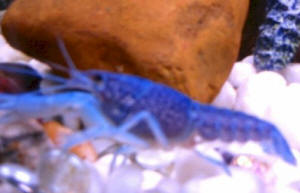
Blue Boy sez: "I eat all"
|
With: Goldfish? No, not with any small, unaware fish
species
With Shrimp? Yummy!
Plants? Might well be pinchy time!
With large, aggressive fishes? Maybe as meals |
Dwarf Crayfish Tankmates? 12/21/17
I know dwarf crayfish are much more peaceful than the larger crayfish
species, and thus more suited to being housed with fish, provided
nothing is large enough to eat the crayfish and they aren't housed with
anything that's to much smaller than them or has flowy fins.
<True, but most folks choose to bred as well as keep them, given their
relatively short lives, a couple years, tops. That being the case,
they're normally kept on their own.>
However, I can't find any information as to whether fish that have
reputation as "nippy" but are otherwise peaceful and are of an
appropriate size are suitable tankmates for dwarf crayfish.
<They can be kept with surface to midwater fish that are active enough
not to be viewed as prey, but small enough they're not a direct threat.
Minnows and similar sorts of fish should work.>
Obviously, providing suitable hides for molting would be an even bigger
concern than normal, but other than that, would nippy fish be likely to
bother and/or injure dwarf crayfish?
<Can do, yes. Nipping in some fish is similar a way of 'sampling' their
world -- they don't have hands, after all, so a certain 'suck it and
see' mentality is to be expected. Small crustaceans can be damaged even
if the fish ultimately chooses not to bite, so it's best to avoid
anything that forages this way. As I say things like White Cloud
Mountain Minnows, Japanese Ricefish, etc. should be about right. Cheers,
Neale>
Comp. Crays, shrimps 5/14/16
Hello again,
<Big B>
Did a search on your site, did not find the answer for my latest
problem.
I have three dwarf Cajun crayfish in my 55 gallon tank. They are doing
awesome, co-existing nicely with 12 zebra danios, 8 guppies, 10 bleeding
heart tetras and 4 sterbai Cory cats.
<Glad to hear/read that your Crayfish aren't going after your fishes>
I have algae due to lots of plants and probably over fertilizing. That
said, I have three questions about adding cherry or similar shrimps:
<Mmmm>
1. Will the crays eat them?
<If they can get hold of them, yes>
2. Will they help eat and control the algae?
<Possibly; depends on what type/species of algae you have here. MANY
kinds are unpalatable>
3. How many can I add?
<A dozen or two; hoping that they'll establish a breeding population>
Thanks as always for assistance and guidance.
Briggs
<Have you read on WWM re algae control? There are a few approaches...
other biological controls.
Bob Fenner>
Re: Comp. Crays, shrimps 5/14/16
I will read up on algae control thx. They are dwarf X-rays by the way,
only about an inch long claws to tail.
<Neato! These may well not be able to catch such small shrimp in as
large a
system as you have. BobF>
Re: Comp. Crays, shrimps 5/14/16
Meant to type dwarf crays, not x-rays. That would be neeto indeed. Dang
auto correct. Thx again.
<Heee heee hee>
Daphnia in Crawdad Tank 10/10/13
Hi! My son has a tank with apricot Charax' crawdads and he had a sudden
explosion of daphnia. I know some owners feed them to fish but there are
no fish in this tank and my son is concerned they will be detrimental to
his crawdads well being. Should he worry?
<No; not a worry. He is fortunate to have such an experience, and a
conscientious father>
If so, how can we be rid of them without harming the crawdads?
<Best to simply net out excess; but they will "pass" on their own in
time>
Thanks for your time!!! Brad Hunt
<Cheers, Bob Fenner>
Re: Daphnia in Crawdad Tank 10/10/13
Thanks for the info, Bob! You are very kind to get back to us so
quickly.
My son is relieved. Again, THANK YOU!!! Brad Hunt
<Ah, glad to be of assistance to you both. BobF>
Dwarf Crayfish, comp. 7/15/13
Hi there!
<Ryan>
I currently have a 55g planted tank inhabited by eight Harlequin
Rasboras (max 2 inches) and two Yellow Tail Spiny eels (Macrognathus
Pancalus, max 7 inches). I do intend to double the amount
of Rasboras and get a school of Dwarf Neon Rainbowfish (max 3 inches)
eventually. I am looking to add some interesting bottom dwellers
to my tank that will get along with the eels and not out-compete them
when feeding time rolls around. I was hoping that a few
Dwarf Crayfish (Cambarellus patzcuarensis) might be suitable companions.
<Mmm, I'd look into catfishes of various sorts instead... too likely
your Mastacembelids will tussle with, eat the Crays>
I have read that they remain small (1.5-2in) and are neither aggressive
nor nocturnal, though there seems to be a bad stigma attached to mixing
crayfish and fish in general.
<Yes>
I was wondering if you might have any experience with these small
invertebrates as well as whether or not they would be peaceful AND safe
from predation in this tank.
<Not with this species; but extensive with some Procambarus and Astacus
spp.>
If these dwarf crayfish are indeed a poor match for the eels, can you
recommend a suitable and/or interesting alternative bottom dweller?
<There are MANY... Siluriform/Catfish choices... I'd have you peruse our
Cat area; see here:
http://www.wetwebmedia.com/FWSubWebIndex/fwlvstkind1.htm
scroll down; read the "Compatibility" and "Stocking/Selection" FAQs
files>
Thank you for your time,
Ryan
<Welcome. Bob Fenner>
Procambarus Clarkii, stkg. comp.
2/25/13
Hello,
I purchased seven large Procambarus Clarkii a few days ago and placed
them in a 55 gallon aquarium.
<Mmm, I did a report in college re this species "substrate size
preference" and have kept them as pets, and eaten quite a few at
"crawdad bakes"...
They will attack and eat each other... till there is an ongoing balance
re space, hiding areas and food availability>
The aquarium has aeration, filtration, and places for hiding.
On the second morning I noticed that one of the crayfish had been half
eaten.
<Ahh!>
The tail was eaten first then the rest of the crayfish was consumed over a
24 hour period. The next day I noticed two more met the same fate.
<AH yes>
I have provided food in the form of vegetables and shrimp every day. I
am becoming concerned about this behavior because I have lost 3 of the
original seven to date.
I would like to know what is causing this behavior and how it can be
prevented. Any help that you can provide would be greatly appreciated.
<Tis natural... folks who raise this species for human consumption
purposely add fertilizer, make conditions that obscure water clarity, to
reduce this sort of aggression. I would add more clay flower pots, PVC
pipe/parts et al. to slow down the rate of attrition. You may be "at it"
w/ the present stocking level. Enjoy the remaining individuals>
Richard
<Bob Fenner>
Re: Procambarus Clarkii, stkg. 2/26/13
Thank you for your help. I have modified the environment and hope this
will correct the problem.
Richard
<Ahh; I do hope so. B>
Crabs and crayfish, incomp. 2/6/13
Hi guys,
Sorry if this has already been asked and answered before. I have look
but could not find reference to this question. So here it is.
Can crayfish and crabs live together if they are the same size? I'm in
the process of setting up a four foot tank and was wondering if they are
compatible?
<Not really. Most of the "freshwater crabs" in the hobby are either
brackish water (Red-Claw Crabs, Fiddlers) and/or amphibious (Red-Claw
Crabs, Fiddler Crabs, Rainbow Crabs) so don't belong in a freshwater
aquarium at all. Crayfish generally don't inhabit brackish water
environments, so won't do well in water conditions things like Red Claws
and Fiddlers need in the long term. Being fully aquatic, Crayfish aren't
going to work in a vivarium set-up with just a few inches of water. So
as you can see, there's no overlap between the two groups, which is
pretty much what you see in the wild. The only possible exception I can
think of might be Paratelphusa spp. and related species, which are
almost entirely aquatic and truly freshwater, but they're very rare in
the trade. But even then, being cannibalistic, it'd surely be a matter
of time before one or
other killed its tankmate. Cheers, Neale.>
Re: question regarding crayfish and elodea. Sys., comp.
2/6/13
Morning Bob :)
<Cath>
The algae wafers aren't holding together as long as I'd hoped. And I
don't know the likelihood of the crayfish being able to eat them once
they've disintegrated to a certain point. Thinking I'd better beef up
the cleanup crew a bit. I could do some more snails, but I was wondering
if I'd be ok with some Plecos or little Otos?
<An appropriate species/size "Pleco" would be best of all the choices
here (and/or just more mechanical filtration). Snails are very likely to
be eaten, Otos are too sensitive to water quality issues. B>
Didn't know if that's just setting the fish up for becoming dinner, or
if the Crays would ignore them? I know the little Otos can be pretty
quick... What're your thoughts??
Talk with you soon
Cathy
Re: question regarding crayfish and elodea
2/6/13
Thank you, thank you! :)
Cathy
<Welcome>
crayfish and barbs? 12/25/12
Hi there, I recently moved cross country, and gave away most of my fish.
I've got a plakat Betta, a pair of orange dwarf crayfish and a ton of
cherry shrimp (I swear those things breed faster than rabbits!)
I've got a 10 gallon tank that the Betta and shrimp will be living in,
and I asked my roommate to choose between fish species for my 30 gallon.
She liked tiger barbs best out of the fish that I was considering, so
I'll be keeping those in my bigger tank. I know that the crayfish
are fish safe (they've been with the Betta and shrimp for months, and
the worst damage I've seen was a nipped fin where the Betta got a bit
too close in the first week they were all together.), but I was
wondering if the barbs are crayfish safe.
Everything I've found online seems to mention that the barbs would
destroy my shrimp (which I was never planning to keep with them anyway)
or that the crayfish would attack fish, but the articles seemed to be
referring to full sized crayfish, and not the fish-safe dwarfs. If
they've got spaces to hide in my tank, would it be okay to keep the
crayfish in with my tiger barbs, or should I plan to add a few more
rocks to my 10 gallon and keep them with my Betta instead?
Thank you, as always I believe that your expertise is incredibly
helpful!
Danae
<In theory, Cambarellus species are "community safe" so can be mixed
with all sorts of small, active fish. But they are so infrequently kept
that we can't be 100% sure about every combination. I think it would be
safe, certainly safer than mixing Cambarellus with Betta splendens, but
keep your eyes open for trouble nonetheless. One risk would be the
fairly large adult Tiger Barbs molesting the Dwarf Crayfish when it
moults. Cheers, Neale.>
|
Crustacean ID, Cray... incomp. 12/13/11
Hi Crew,
<Laura, four plus megs in pix? We're at near-half of our
email capacity...
See the instructions re writing us please>
I do not know what I would do without you wonderful people. I was
wondering if you could tell me what kind of crustacean I have
rescued.
<Some sort of Crayfish... predaceous>
It is in a 29 gallon tank with a bamboo shrimp, 3 ghost
shrimp and 4 apple snails.
<Not for much longer. This Cray will consume these in
time>
This poor animal was being kept in a Betta dish without so much
as room to turn around. He has algae on his back, and one of his
claws has been either chewed off or broken off. He gets shrimp
pellets, algae wafers, and veggie rounds to eat. He seems to have
a good appetite, or he is not getting enough to eat because he is
always foraging. I am sending along a picture of it (not sure if
it is female or male). Am I doing right by this animal or should
I find a home for him? I do not have any way to make the pictures
smaller,
<Oh! Use your search tool on whatever computer/device you have
re such...
easy to do... you likely have the tool/s for it already
downloaded...
Otherwise, there are simple share-ware programs to download for
free>
so let me apologize for that.
Thanks as always
Laura
<And do read here:
http://www.wetwebmedia.com/FWSubWebIndex/crayfishcompfaq.htm
and the linked files above. DO move this animal or sequester it
in an escape proof trap in this system. Bob Fenner>
|
|
.jpg) .jpg)
|
Electric blue crayfish, incomp.
8/30/11
I have two Electric Blue Crayfish and when home for lunch today I
checked on them and one was missing an eye on the left side, but had
two eye balls on the right. I promise I am not making this up! Have you
ever heard of such?? Thanks, Heather
<Yes, Heather, I have. Crayfish do not get along. Fighting is
common, as is cannibalism. When one moults, the other will try and eat
it. In between moults they'll simply fight for limited space. Give
each specimen its own aquarium, at least 8 gallons in size. Problem
solved. Cheers, Neale.>
Nice Crayfish???
6/9/11
Hello Crew!
<Hey Kyle!>
In a departure from my usual questions, I have a crayfish story I would
like to share. I have always had a soft spot for freshwater inverts,
and about a year ago after much research I had decided to transform my
driftwood filled tropical community tank into a crayfish paradise. I
ordered an Electric Orange Procambarus Clarkii
crayfish
<Oh! I studied this species for a while in college>
from the LFS that was around 1 inch when I received him, and I decided
somewhat recklessly to wait for any fish casualties before completely
dedicating the tank to the Clarkii alone.
Well it has been a year, the crayfish is going on seven inches thanks
to an over filtered tank with nothing but low nitrates detectable and
weekly doses of iodide, and I have yet to lose a single fish to the
Cray. He is a voracious eater, snacking on the constantly available
Anacharis in the tank and still begging for the daily algae wafers and
whatever treats I can find him, but either he has high moral standards
or he just doesn't feel like taking the time to chase fish around!
:)
<Perhaps just unaware of how tasty its tankmates are...>
In a search to see how far my luck would go I added some Kuhli Loaches
and two apple snails, and they have been living together with no issues
whatsoever for months. Now I have read about and seen countless acts of
crayfish carnage, and would never recommend keeping them with fish, but
I just wanted to share my "winning the invertebrate lottery"
crayfish story, and say that there are at least a few crayfish out
there that if given a proper environment just MAYBE will mind their
manners with their tank mates like mine does. Also, for anyone reading
this who is thinking about attempting to add a Cray to their peaceful
community tank, do as I say and not as I do! I have never met anyone
who has had the same success adding a crayfish to a community tank that
I have. Of coarse I am still always prepared for a sudden change of
attitude from my Clarkii, but at this point I'm feeling pretty good
about the tanks future. I also feel pretty lucky!
Thanks for your time and questions you have answered in the past! You
guys and gals run an awesome website.
<Thank you for sharing! Bob Fenner>
|
Can you identify, please? 3/15/11
Hi,
I have found lots if great info on your site, and was hoping you
can tell me what species my lobster/crawfish (not sure) is?
Thanks!
Elaine
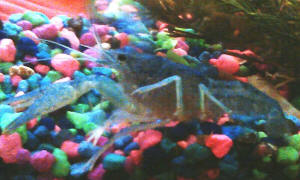
<Looks like the Electric Blue "Lobster" to me,
Procambarus alleni. It is in fact a crayfish,
despite the name. Doesn't do well at tropical temperatures,
usually succumbing to a bacterial or fungal infection; keep
at room temperature instead. This species is primarily a
scavenger that consumes a good mix of plant foods alongside
carrion, but under aquarium conditions will attack fish and
shrimps during the night -- do not mix with fish or other
tankmates! Dose the tank with iodine as per marine aquarium
requirements, but at 50% the dose stated on the bottle. Without
iodine these crayfish often fail to moult reliably. Cheers,
Neale.>
|
|
|
|
Re: Can you identify, please? Crawdaddy, now incomp.
3/16/11
Thanks; I suspected he was an electric blue. I do add iodine,
started adding shortly after discovering your site, just after I
acquired the crayfish.
<Excellent.>
Just to let you know my experience with him - I got him when he
was just under 2" (he's molted once that I know of, its
been a few months that I have had him), & added him to my
community fish tank. I have a mix of guppies, platys, tetras,
Danios, & mollies; 'Krusty' and the fish seem to get
along well - the platys actually hang out in his cave with him,
and he doesn't seem to mind them visiting.
<Cool. But don't trust him completely! Any signs of
physical damage, especially to the slow-moving Guppies, and whip
him out. Yes, these animals are largely herbivorous in the wild,
but they will catch small fish given the chance.>
I do make sure I drop food at the entrance to or just inside his
cave, as the fish tend to not leave much for him otherwise. He
cruises the tank at night, sometimes in the morning as well,
provided I leave the light off.
<Indeed, they are very nocturnal.>
All that being said, I don't think I would recommend anyone
add one to their fish tank, unless its a large enough space with
sufficient shelter and cover (I have lots of live & plastic
plants, so even when not in his cave my crayfish has plenty of
hiding places).
<Are indeed fascinating pets, but on the whole, best kept in
their own tank. Cheers, Neale.>
|
Re: re: Crayfish changing
colors? Now Pleco comp. 1/30/11
Thank you for your response. About the Plecos I had three. Two were
about 4 inches. The third is 8 inches.
<Whoa! Big boy! These are generally fine w/ larger crustaceans, as
long as the latter have sufficient hiding spaces to get away during
molts>
I gave a friend the two smaller ones. They I think are Sailfin Plecos.
Will the big one cause problems with the Cray.
<It might... I'd keep the two smaller ones, give the larger
away. Please
read here re: http://wetwebmedia.com/FWSubWebIndex/BigPlecCompF.htm
And thank you again very much I highly enjoy your site. It has helped
me diagnose and save many fish.
<Ahh! Deeply gratifying to read/understand that we've helped
you. Cheers, BobF>
Three questions? Re Cray, lg. Plec... 1/31/11
Sorry about the two emails. Kids like to mess with stuff. Anyway how do
I get the Pleco and crayfish to leave each other alone?
<Separate them>
The Pleco has rips in her tail from the Cray. She is living behind a
filter tube while the Cray patrols the bottom.
In the tank is
4 barbs iam getting more soon I know they like to school
8 inch Sailfin Pleco
2 Chinese algae eaters I now know they get huge and mean.
1 4inch Cherax quad.
Again I am so sorry about the split email and for being a pain in the
ass.
Thank you again
C. Conner
<Different systems. B>
Three questions? More re Crayfish, Pterygoplichthys
1/31/11
Hello again thank you for your answers to my previous question. I found
out my Cray is for sure a female Cherax quad.
My first question is purple up safe to use in freshwater aquarium to
supplement crays calcium and iodine requirement?
<It is>
Secondly my crayfish and Pleco seem to fight? Its not all the time and
mainly concerns caves. The quad changes caves almost daily. And the
Pleco gets evicted from her driftwood
<... these animals need more room... and/or different containers.
B>
Re: Three questions? More re Crayfish, Pterygoplichthys
2/1/11
Thank you yet again for your response. I wish I knew as much about
these critters as y'all do.
<Oh! You could... with study, time... application. Great to have a
tool such as the Net for all to share what they "know" as
useful, pertinent...>
I wont bug you again with such common sense questions.
Thank you again for your time and patience.
<Not a bother. BobF>
large snakeskin Gourami turned
black and is jumping- help! Crayfish incomp. 10/7/10
Hi!
<Hello!>
I'm so glad I found your site!
<Indeed'¦?>
I have a tank that I believe is 30 gallon, it might be bigger but not
by too, too much.
<Okay.>
Anywho, I have had a Pleco for close to 2 years.
<I take it we mean one of those massive species like
Pterygoplichthys multiradiatus. My point being that after two years
this fish should be 30-45 cm/12-18 inches long, and far too large for
30 gallons. At least one problem will be this. Even if the fish looks
fine, it will be producing so much waste that water quality won't
be good, and that can stress this and all the other fish in the tank.
Such catfish need 55 gallons, minimum. Replace this catfish with a
Bristlenose Plec (Ancistrus sp.) if you want something that eats algae.
Bristlenose Plecs only get to about 12 cm/5 inches, and they're
ideally suited to community tanks.>
He's now close to 10 inches long.
<Oh, somewhat small for its age, which in itself says something
about environmental conditions. In any case, still far too large for
this tank.>
He was left over from the last batch of fish I had in there and was
alone for over a year. I then bought two large snakeskin gouramis
(which from really reading about them I wish I hadn't).
<Actually, Trichogaster pectoralis is rather a nice species, but
quite big, and yes, the males are mutually antagonistic.>
They got along fine for a while then one started bullying the other
one.
<Two males, more than likely. In a 55 gallon tank they'd divide
up the tank between them, but your aquarium is a bit small for
that.>
Shortly before they started fighting I had purchased a blue lobster
(crayfish'¦).
<Repeat after me: Thou shalt not keep Crayfish and Fish in the same
aquarium.>
The lobster was small and not a match for the other fish so he found
his little cave and just hung out. Well, one day my daughter started
screaming and I ran to the tank. One of the gouramis was having some
sort of seizure and was violently flipping about the tank until he
finally crashed to the bottom.
<Yikes!>
Took about 2 minutes for it to stop 'breathing' and perish. I
had the water tested, changed it out, cleaned the filter, etc. I did
everything I could think of to fix whatever caused that, unless it was
the other Gourami.
<Hard to say.>
Well, that was about 2 months ago and now my Gourami is really acting
up and I'm not sure why. He used to sit and watch me at the
computer for hours while I wrote papers for grad school, and would put
his feeler up to my finger on the glass and just sit there watching
me.
<Cool.>
Now, I'm lucky if he'll even stay on that side of the tank if I
come over.
<He sounds scared.>
He has started flipping out of the water (it is sealed with a lid).
<Gouramis are "jumpers" when alarmed.>
I checked the tubes to make sure bubbles were still coming in good and
it could use a little more, I need to get a new tube but I don't
think that's it. I also just noticed how dark he has turned, I mean
he's black!
<Stress.>
But, right now when I noticed it, he's by the house that the
lobster now lives in. The lobster almost never comes out now, but
he's a lot bigger than when we got him. Do you know why my Gourami
has turned dark and is jumping?
<Could be one of two things. Firstly, he's being attacked by
something. Plecs can be "mucous eaters" that latch onto
flat-sided fish and hold them down while they scrape away the mucous.
Sounds horrible doesn't it? This isn't a common behaviour, but
it does happen, particularly when the Plec is starving. Bear in mind
that a 10-inch Plec needs A LOT of food. We're talking constant
supplies of cucumber, zucchini and sweet potato, together with chunky
seafood like prawns and mussels 3-4 nights per week. Likewise, algae
wafers should be regularly offered. These fish are massive eaters. Even
if the Plec hasn't been successful at getting to the Gourami, the
attempts at nighttime would be terrifying. Likewise the crayfish could
be trying to catch the Gourami. Crayfish are primarily herbivores which
is why you need to feed them green foods every night, but in the
confines of an aquarium they will try to catch fish. That would almost
never work in the wild, but a crayfish can catch a sleeping fish in an
aquarium so much easier. The second reason your Gourami might be
stressed is water quality and/or chemistry. As with all fish, zero
levels of ammonia and nitrite are crucial. Given the size if your Plec,
I'd be surprised if that's the case here. You're also after
a steady pH and moderate hardness, in this case around pH 7 with 5-15
degrees dH general hardness.>
He's not trying to mate b/c the other Gourami isn't in there
and I can't see him trying to take on that lobster!
<Quite the reverse'¦>
They've had their run ins and the Gourami does have a battle scar
every now and then, but nothing ever bad so I'm just not sure
what's going on.
<Again, "battle scar" is very alarming and I'd caution
you not to trivialise that observation. If fish look damaged, they ARE
damaged, and your job is to establish why. Problems in life rarely go
away by themselves!>
If it's going to die like the other one did, I need to transfer him
so the kids don't have to see it again. Oh, and he's not going
from black to gray and back and forth, just staying black.
<Hmm'¦>
I just remembered, the Pleco has been barging in on the lobster's
house too. It's literally a little cottage that is his cave. He has
rearranged all of the rocks, brought in a ton more and just hangs out
in there. But the doors and windows are just open so after 2 months of
having it, the Pleco has begun to barge in there and do his business.
lol
<What do you mean by "his business"? Defecate? Least of
your problems. Bear in mind that once this Crayfish moults it'll be
Plec food.>
Do you think maybe the Pleco and Gourami are teaming up and are tired
of the lobster snapping them?
<No.>
Sorry if I sound crazy! But I appreciate your help.
Lisa R.
<Get rid of the crayfish and the catfish. Keep the Gourami, and
choose some peaceful tankmates, such as Peppered Corydoras, Rasboras,
and Bristlenose Plecs that would be suitable for this size tank. All
these problems are caused by poor stocking of the tank on your part,
and easily fixed by removing the animals that shouldn't be there.
Hope this helps. Cheers, Neale.>
Re: large snakeskin Gourami turned black and is jumping- help!
10/8/10
<Repeat after me: Thou shalt not keep Crayfish and Fish in
the same aquarium.>
I wish I had known that when I got it!
<<Indeed!>>
Oh [the snakeskin Gourami] is awesome! He's so sweet and has such
personality!
<<I would agree; although big and not especially colourful, this
species is a very nice one in terms of being a pet. Most of the ones
captured end up being eaten though. They're a food fish rather than
a pet fish.>>
<Gouramis are "jumpers" when alarmed.>
Is that the only time they jump? He seems to do it all the time!
He'll be just hanging out on his little bridge (that he claimed),
come out and fly up then just sit on the bottom like nothing happened.
The first two days of him jumping we thought he was following suit from
the other one and was having some sort of seizure-like thing.
<<Mostly they jump when they're unhappy.>>
I will go and test the waters again.
<<Very good.>>
the bridge that the Gourami has claimed used to be the crayfish's
cave when it was smaller, so maybe the lobster is trying to keep both
caves???
<<Perhaps. Crayfish dig burrows into river banks. Their instinct
is to dig and generally move stuff about. One of many reasons why they
aren't good additions to community tanks. Fun animals in their own
quarters, though.>>
<What do you mean by "his business"? Defecate? Least of
your problems. Bear in mind that once this Crayfish moults it'll be
Plec food.>
He goes in there and cleans. He is upside down cleaning the inside of
the cottage or sucking on the stones. The lobster usually is in the
corner but he's so big- could the Pleco really eat him? I know
he's not safe when he molts, but he's pretty big'¦
<<Maybe. But a soft crayfish is a seafood dinner. I have seen
very large but recently moulted crustaceans taken apart by hungry fish.
It's just not worth the risk.>>
Now, how do I get rid of something that my kids just LOVE? I think they
would be alright with the crayfish gone, but what do I do with it?
<<Depends on where you live. Here in England at least there's
a chain of aquatics stores called Maidenhead Aquatics that will take
back even livestock they haven't sold, and will rehome such animals
as best they can. There may well be other similarly ethical retailers
in your corner of the planet. In the meantime there's a good
summary here:
http://www.wetwebmedia.com/ca/volume_5/volume_5_3/crayfish_basics.htm
They can be kept safely without any great expense.>>
He's so big I don't know anyone who would take him or who has a
tank that he would flourish in. And I surely don't want to just put
him out 'to die'!
<<Indeed not.>>
I know pet stores aren't the best source of information for tank
stocking, but I have read on fish sites that the Pleco and gouramis get
along fine.
<<Usually do. But at the same time this is a very small aquarium,
and SOMETHING is rattling your Gourami, and there are only two other
animals in the tank. That kind of narrows down the range of
possibilities. As I said before, either someone is scaring him, or
something in the water is making him stressed.>>
I figured everyone would be alright with the Cray since they were so
much larger than him, but I also didn't anticipate him getting so
big! (I know I keep referring to all of them as males, but I'm
pretty sure they are all males)
<<Oftentimes females are bigger than males. Humans are quite
unusual in being the other way around, and in nature the standard thing
is for females to be bigger since their part of the reproductive
process is harder work. Usually bigger males only evolve in species
where males defend multiple females -- lions, elephants, sperm whales,
cows, gorillas, and, it would seem, humans.>>
I do appreciate you getting back to me and apologize for so many
questions!
<<Always glad to help, and don't worry about asking
questions.>>
Lisa
<<Cheers, Neale.>>
Re: large snakeskin Gourami turned black and is jumping- help!
10/8/2010
Ok, so if I am able to find a new home for Thomas (the Cray) but want
to keep the Pleco and Gourami, what type of fish can I put in
there?
<The Plec is really much too big for this tank. It *will* cause
problems and *must* be rehomed, whether in a 55 gallon tank in your
house or such a tank elsewhere. But for what it's worth, the best
tankmates for Plecs are either fast-moving tetra-type things that they
ignore completely, or boisterous cichlids like Firemouths and Blue
Acara that can hold their own. But please let me stress that in a tank
this small, a Plec will be a stressful companion, like sharing your
home with an elephant.>
do they have to be large or can small fish coexist with them at this
point?
<Both can work. But avoid slow-moving things with big, flat sides
the Plec can latch onto. Discus, Angels, Oscars and things like that
tend to be the ones molested by wayward Plecs. There are some Plec
species that never do this, including Bristlenose Plecs at the small
end and Royal Plecs at the larger, these two species being almost
completely herbivorous. But the Common Plec is an omnivore, and when
it's hungry, it samples anything in the tank, whether aquarium
plant or slow-moving fish.>
I promise I'll leave you alone after this!
<Not an issue. We're happy to help.>
Thanks,
Lisa
<Cheers, Neale.>
Mbuna and Crayfish (Species
specific advice needed)
Crayfish and Cichlids 9/15/10
Hi, I am looking at stocking my new tank (48"x15"x20")
with these critters;
15x Pseudotropheus Demasoni
5x Labidochromis Caeruleus
1x Crayfish.
I am going to put a crayfish in the tank, the question is; which one
has the better odds of co-existing relatively peacefully in my setup? I
plan to plant the tank with Java Fern / Java Moss tied in amongst
large/medium rocks and driftwood. A sheltered area and a substrate that
will allow for the crayfish to burrow will be provided.
As far as my research indicates my crayfish options are;
1) Cherax Destructor
2) Procambarus Clarkii
3) Cherax quadrinatus
I am currently favouring Cherax Destructor as the information I have
found indicates this species to be shy, primarily veggies although
opportunistic and of a medium size.
I hear the Procambarus Clarkii have been introduced to Lake Malawi, are
small so more can be kept and are more likely to be the victim of Mbuna
attack. However, I think they are a bit ugly.
I worry the Cherax is a bit to carnivourus and well adapt to catching
fish, also too large to work well.
What crayfish would you choose (if you had to) from those mentioned, or
from your own experience? I am well aware of the risks of keeping crays
with fish.
Also how do you think Pomacea bridgesi will fair in this setup? Thanks
for reading! Stu, Cumbria.
< All crustaceans need to molt or shed their outer skin to grow.
When they do this, they are unprotected for a few hours while the new
exoskeleton begins to harden. Cichlids seem pretty smart and can sense
when this happens. The poor crayfish soon becomes a banquet block for
the cichlids.
If you drill a hole just big enough for the crayfish to hide in the
driftwood you might have a chance. I have never had good luck with
crustaceans in my cichlid tanks. The cichlids always seem to find them
or eventually out compete them for food.-Chuck>
Re Mbuna and Crayfish (Species specific advice needed)
Mbuna and Crayfish 9/16/10
Thanks for the response chuck.
All crustaceans need to molt or shed their outer skin to grow. When
they do this, they are unprotected for a few hours while the new
exoskeleton begins to harden. Cichlids seem pretty smart and can sense
when this happens" I was aware the molt was the 'risk
point' although I did not know cichlids where that aware of it
happening!
I am going to create the crayfish a sufficient hiding place/burrow, I
am more concerned with which species of crayfish, if any specific
species, will aid the equilibrium of the tank.
The only indication of which species is best from your reply was maybe
a smaller species since I can create an entrance to it's cave too
small for the Mbuna to get in, is this right? It's just
Pseudotropheus Demasoni will likely get into any nook that will
accommodate any of the previously mentioned Crayfish species, so maybe
Cherax Destructor, which burrows is my better choice? This also could
indicate the need to stock only larger Mbuna.
To recap the specific species of fish I aim to stock;
15x Pseudotropheus Demasoni
5x Labidochromis Caeruleus
To recap the specific species of crayfish I may stock;
Cherax Destructor or,
Procambarus Clarkii or,
Cherax quadrinatus
Are you able to shed any light on my questions;
"What crayfish would you choose (if you had to) from those
mentioned, or from your own experience?"
"Also how do you think Pomacea bridgesi will fair in this
setup?"
My apologies if I was unclear in my original post, I am new to the
hobby and written communication is not my strong point.
Thanks!
< All the species you have mentioned have large claws that will be
used to capture sleeping cichlids. As the crayfish feeds it will need
to shed its outer skin when it molts. At this time it is susceptible to
attacks by
cichlids. The yellow Labidochromis has tweezer like teeth that
specializes in picking off crustaceans between the rocks. All the
species you mentioned range from 4 to 10 inches in length. A three inch
cichlid would have no trouble pulling a crayfish out into the open for
all to feed on. If you wanted to try one then try the cheapest one.
That way you are not out too much money. If it looks like it is going
to work and you are satisfied with the results then get the one you
like the most. The apple snail will also have problems in an Mbuna set
up. When the snail extends its antennae they usually get picked off.
The cichlids like the taste of snails and will continue to pick on it
until it dies.-Chuck>
Re: Mbuna and Crayfish (Species specific advice needed)
Crayfish Companions 9/17/10
< Mbuna are not recommended to be housed with crayfish.>
I will take your word for it and look into different combinations, I
don't want to watch a crayfish become dinner.
To say the least it is getting a bit frustrating trying to find
anything that can exist with a crayfish!
The only definite I have is White Cloud Mountain Minnows, which look a
little drab in my opinion.
Are you able to suggest anything with a little colour would make a
better tankmate for a Crayfish?
< Try rainbows, tetras, barbs silver dollars, Basically anything
that is fast moving and stays in the mid to upper water column.>
Are small Tanganyika Cichlids an equally bad choice?
< Mbuna have rasping teeth for scraping algae off of rocks. These
same teeth do a pretty bad job on other fish and tank mates. Lake
Tanganyika cichlids, like julies and lamps would not be as bad. They
still might become dinner for the crayfish.>
Maybe Guppy's or Molly's or if there are any Apisto's that
can handle pH 7.0-8.0?
< The male guppy's flowing caudal fin makes him an easy target.
Mollies may be worth a try. Apistos, like most cichlids like to stay
close to the bottom to be safe with a crayfish. A. steindachneri and A.
cacatuoides are two species that can handle hard water. But I still
wouldn't trust the crayfish.>
I really want something a little 'different' so have skimmed
around these options.
I have literally spent the past few months 'writing off'
various options due to incompatibility in one way or another.
Thanks for the advice! It is really appreciated.
< Once again, think fast moving, mid to upper water column schooling
fish. I would go cheap at fish to see how clever the crayfish is at
catching fish before investing too much money.-Chuck>
Is there strength in numbers?
Crayfish torture 4/11/10
Hi there.
I have about 25 crawdads in a 10 gallon tank but none of the crawdads
will hurt the other crawdads. I know that the crawdads are supposed to
fight others but they wont fight and they are standing on the rocks out
of the water and 3 of them have eggs.
I have no idea what to do!!!!!!!!!!!!!
Please help me!
<Why do you want your crayfish to fight? As for coming out of the
water, yes, they sometimes do that if the water is poor in oxygen. Your
tank is rather overstocked and I imagine water quality is pretty dire,
hence their behaviour. You would be wise to move them to a much bigger
aquarium, and use this little tank for rearing the babies, should you
want to. Do read here:
http://www.wetwebmedia.com/ca/volume_1/cav1i4/crayfish/crayfish.htm
http://www.wetwebmedia.com/ca/volume_5/volume_5_3/crayfish_basics.htm
Cheers, Neale.>
Re: Is there strength in numbers? Crayfish... incomp., repro. sys.,
referral? 4/14/10
I didn't want my crawdads to fight it is just that they are suppose
to but they didn't so I wanted to know what was wrong. And for the
eggs why wont the females lay the eggs. The eggs are already fertilized
over spring break but the crayfish wont come out I have no idea why.
please tell me step by step on what to do for raising eggs starting
from introducing the male and female to introducing the next
generation. thank you.
<Females don't lay eggs. They carry the eggs around with them
until they hatch, and that's when the miniature crayfish appear. In
a tank with adults those baby crayfish have virtually no chance of
surviving. So take a female
"in berry" (i.e., carrying eggs) and put her on her own in a
10+ gallon tank with a filter and lots of rocks and plastic plants.
Eventually the babies will leave the eggs, scuttle under the rocks and
plants, and you can remove the female back to her original quarters.
The babies are notoriously cannibalistic, so you'll need to keep
them well fed and segregate them as they mature, so the bigger ones
don't attack the smaller ones. Make sure there are adequate caves
to go round as well, otherwise the baby crayfish are very vulnerable
when moulting. Cheers, Neale.>
Crayfish/Koura incomp.
4/9/10
hey there,
<Hello,>
I'm from New Zealand and have just seen some native fresh water
crayfish (locally known as koura) I was wondering if they would be ok
in a large outdoor pond with Goldfish, Guppies, Paradise fish, Corys
and a large
Pleco?
<Well, up to a point, crayfish have been kept alongside fish. But
crayfish can, will eat any fish they can catch.>
I am aware that they are mostly scavengers
<"Mostly" being the operative word. Crayfish are total
opportunists, and feed on whatever is available. Most of the time
that's decaying vegetation and carrion, but within the confines of
a pond or aquarium it's a lot easier for them to find a sleeping
fish.>
and would prefer algae and vegetation to fish, mostly wondering about
compatibility with the Pleco as spends all his time on the pond
floor.
<Some folks have kept crayfish with Plecs, and not had any upsets.
But some have ended up with a dead catfish.>
the Pleco is about 12" long, (about 2 - 3 times larger than most
of the freshwater crayfish), any idea how well they will get along?
<No way to predict. To a degree it depends on the crayfish species,
some being more prone to eating fish than others. Some crayfish
specimens are also shyer than others. But really, the basic rule is
always this: crayfish and fish don't mix.>
there is lots of plant cover and rock caves in the pond for both Pleco
and crays to hide. I think the Corys will be fine as they are very fast
and are also active at night also so should be able to keep there
distance.
<I suspect the Corydoras will actually be among the first to
go.>
cheers, Mike
<Cheers, Neale.>
Hello... Crays and Cichlids
comp. -- 11/16/2009
Hello how you doing? Once again want to thank you for all the great
advice. I have another question I have a blue fresh water lobster do
you think it is all right to put it in my 75 gallon cichlid tank? Thank
you
ahead of time
Sal
<I wouldn't. I tried this once before with a crab in a Central
American cichlid system, and all was well until the crab moulted, and
then it was torn apart. Conversely, while crayfish are herbivores in
nature, in an
aquarium they will not overlook easy prey. So while they rarely catch
healthy fish, any fish having a bad day could end up as someone's
dinner.
Crayfish generally are best kept on their own, in their own
quarters.
http://www.wetwebmedia.com/ca/volume_5/volume_5_3/crayfish_basics.htm
http://www.wetwebmedia.com/ca/volume_1/cav1i4/crayfish/crayfish.htm
Cheers, Neale.>
Comment on Crayfish, incomp.
9/2/2009
Hello this is a comment instead of a question, no need to reply. I have
read a lot of questions about crayfish companions as many people want
something other than crayfish. I also got mine without researching
them
(learned my lesson). The pet store said if they are well fed they
won't eat your fish.....
<!?>
WRONG lol one of mine will drop the pellet out of his claw to hunt, if
he so much as sees movement, (the other one mostly eats all the
vegetation) he ate 12 fish overnight no remains. However I have found
that you can keep a school of white cloud minnows they are interesting
stay mostly out of the way and cheap enough that the occasional missing
fish is not going to break the bank. Make sure they (the minnows) have
some floating plants and the crayfish don't have easy access to the
surface, such as very large rocks.
You WILL have to replace the floating plants periodically. I grow some
water "weeds" in a windowsill jar. Good luck everyone!!!!
<Thank you, Bob Fenner>
Blue Lobster and Dinosaur Eel
(Polypterus; crayfish), comp. 7/9/09
Ma'am or Sir,
<Actually, it's Dr., but "Sir" is very nice,
too!>
Greetings,
<Hail and well met.>
I have tried to research on my own whether or not dinosaur eels and
blue lobsters would get along but I have come up empty.
<By which you mean Polypterus spp and tropical crayfish species?
Polypterus are neither dinosaurs nor eels, and the "blue
lobsters" of the hobby are not lobsters but crayfish.>
I found one result which pertained to the two species but the dinosaur
eel that this result referred to was huge.
<Big Polypterus will view small crayfish as food.>
The eel I am inquiring about is the small little dinosaur eel which is
sold at a certain superstore chain.
<Likely Polypterus senegalus, and excellent species that gets to
about 35 cm in length, and makes a nice community tank resident when
kept with fish too large to be swallowed whole. Congo tetras for
example are about the right size and personality. Anyway, can it be
kept with a crayfish?
Possibly, since crayfish are primarily plant-eaters, and the bulk of
their diet needs to be plant material as well as a certain amount of
carrion (lancefish for example being ideal) and things like bloodworms
and krill.
http://www.wetwebmedia.com/ca/volume_5/volume_5_3/crayfish_basics.htm
The problem is that crayfish are completely opportunistic, and if they
can catch and eat a fish, they will. Simple as that. So no responsible
fishkeeping writer will ever recommend you combine crayfish with other
types of fish. Yes, some people do, but of those, many lose their fish
to these armoured omnivores. Polypterus senegalus isn't an
aggressive species, and it is easily bullied by other fish; I've
seen remarkably small fish strip away the poor bichir's fins when
the species were combined in one tank by an unthinking retailer.
Conversely, when moulting, crayfish are extremely vulnerable, and a
since Polypterus have very poor eyesight and instead hunt by smell,
it's possible a moulting crayfish might get nipped, and lose a leg
or whatever. And again, if the size difference is very great, an adult
Polypterus senegalus would certainly eat the juvenile or dwarf
crayfishes. So could they be mix? Maybe. Should you mix them? No.
Good tankmates for Polypterus senegalus could include a school of Congo
and other medium-sized African tetras; a small group of Synodontis
nigriventris; and the superb (and adaptable) African "leaf
fish" Ctenopoma acutirostre, an easy-to-keep species that thrives
on frozen bloodworms and other such foods. In case it wasn't
obvious, all these fish come from Africa, so you'd be creating a
very nice biotope tank. Do see here for some inspiration:
http://www.wetwebmedia.com/FWSubWebIndex/pltrivrtk.htm
Cheers, Neale.>
help please, Crayfish
incomp. 7/7/09
I have a 10 gallon community tank with live plants, I recently caught a
very small pond crayfish and put him in the tank. I also have 2 grass
shrimp who are both actually larger than the crayfish. I was wondering
how they might get along, so far I haven't noticed any
violence.
<Yet... although largely herbivorous, crayfish will eat anything the
can catch: moulting shrimps, sleeping guppies, whatever!>
I was also wondering if there should be much worry for this crayfish
eating my fish because he is so tiny. I am more than willing to put him
back where I found him at any time, I just thought it would be an
interesting experience for a bit.
<Might be fun for a while. But do read here:
http://www.wetwebmedia.com/ca/volume_5/volume_5_3/crayfish_basics.htm
Although hardy and interesting creatures, crayfish are not ideal
residents for community tanks, and most people find keeping them on
their own much more reliable. Do also note that once captured and taken
home, crayfish must NEVER be released back into the wild. In many
states (including here in the UK) this isn't just good animal
husbandry, it's the LAW. Once brought into contact with pets,
crayfish can carry diseases into the wild.
Since yours has been with community fish, releasing it into the wild is
NOT an option. Much harm has been done by unthinking aquarists
releasing such animals into the wild. Cheers, Neale.>
|
Crayfish, cichlids; health ... English... "Buttons are
not toys" 7/31/08 ok so I have had my electric
blue crayfish for about 5 months now. he's appx. 5 inches
long. <Cool. Now, make sure you don't keep him with any
fish.> doing well until I accidentally introduced a seemingly
well cichlid into the tank. <Oh dear.> he blew up and died
about a week ago. I think the Cray may have eaten it! <Well,
fish don't "blow up and die" for no reason.
Crayfish can catch living fish and eat them, and they certainly
will consume fish that are sick/dead for other reasons.>
he's pretty lethargic now and he sits cocked up to one side
and his legs on top just sway back and forth. he really wont eat
and I know he's dying. is there anything I can do?? <No
information here to work from. How big is this tank? What filter
are you using? What is the water chemistry (at minimum: the pH)?
What is the water quality (at minimum: the nitrite
concentration)? Almost certainly water quality is an issue, if
not THE issue.> pet smart gave me 'gel Tek' 'ultra
cure PX' <Pointless, unless you know what's wrong and
how you cure it. Since you have no idea what the problem is, how
can you treat the animal?> they said it would be ok for him to
eat too, but he really wont. and now my other cichlids are
getting blown up looking too. <Ah, definitely water
quality.> I noticed when the other cichlid died her scales
were like coming up. don't know if any of that helps, but
what can I do to save my Cray and my cichlids!??? I know by the
way everyone looks I don't have long! thank you! <I'm
assuming this is an overstocked, under-filtered tank, quite
possibly with the wrong water chemistry for the species being
kept. Without names for these cichlids, it's impossible to
say what conditions they require. Some (e.g., Mbuna) need hard,
alkaline water. Others (e.g., Severums) need soft, acidic water.
All cichlids need spotlessly clean water with zero ammonia, zero
nitrite, and ideally as little nitrate as possible, certainly
less than 50 mg/l. In any event YOU CAN'T MIX CRAYFISH WITH
FISH. Cheers, Neale.>
Re: crayfish, cichlids; health 8/2/08 well the cichlids
are African Kribensis, and ive had them since birth. still have
the parents in a diff tank. the water is fine, for all, checked
it over and over. <If you say so!> the cichlid I introduced
was already sick, I know that, now) and when he died, the kribs
ate it and I think so did the crab. <Letting fish eat dead
fish is asking for trouble. Many diseases are spread that way.
Remove fish as soon as they die, and ideally isolate them when
they're sick.> they were all fine till about 3 days after
the Wal-Mart fish died. he seems to be fine with my fish, ive
never seen him raise a claw to them. not that it wont or cant
happen! <Indeed. Many cichlids become territorial only once
sexually mature, which may take 6-12 months, depending on the
species.> I am well aware of that. so total in the tank I have
2 cichlids, and 5 small tetras, and the Cray. the cichlids are
still juvenile, only about an inch and a half. all were fine
until I put the seemingly fine Wal-Mart fish (which I didn't
buy, a friend did.) in. <If you can't quarantine new fish,
then you should be very carefully about selecting additional
livestock -- so accepting fish from friends really isn't a
good idea.> I have a 50 gal tetra filter, with two filters,
and a 20 long, which will soon be a 30 long. I know I need at
least a 50, but funds are low right now. there's plenty of
room for them, the Cray doesn't seem to mind, he's
usually busy and healthy, molted about 4 times successfully.
<Seems as if you're aware of the potential problems but
depending on luck. While we've all done that one time or
another, it's hardly the best strategy.> its definitely a
sickness from the Wal-Mart fish. <Why do you say that? Post
hoc ergo propter hoc? Unfortunately, there's no guarantees
that just because you've _added_ a new fish, the aquarium has
_developed_ problems because those new fish were sick. While it
can happen, it can also happen that the additional fish overwhelm
the filter, or break up the social structures, or a variety of
other possibilities.> I think by eating the dead sick fish
they got sick. <OK, if you say so. Can't say I'm
convinced.> the tetras I don't think ate any because they
are fine and Im sure the cichlids didn't let em get to eat
any of the dead fish. <Hmm...> I noticed though that the
cichlids scales look funny too. this just started. they seem to
be itching on the rocks. no ich though. can you think of
anything??? <Many things. If they're itching themselves,
then Ick/Velvet are both possibilities, and both can make a fish
sick *without* obvious external symptoms, because both diseases
attack the gills before the skin. If the fish are breathing
heavily, for example, as well as itching, that's a good clue
that Velvet is in the tank. Saying the "scales looks
funny" doesn't help much. Are we talking excessive
mucous, making the body look cloudy? That's usually a water
quality/water chemistry issue. Are the scales sticking outwards,
like the scales on a pine cone? That's Dropsy (oedema) a
symptom of a variety of things from internal bacterial infections
through to inappropriate use of "tonic salt". Cheers,
Neale.>
Re: crayfish, cichlids; health 8/2/08 ok so Im not god,
I don't know for absolute sure that the Wal-Mart fish did it
but here's my evidence... got 2 cichlids (don't know what
there were, just they were yellow.) <Likely Yellow Labs,
Labidochromis caeruleus. A smallish, fairly well behaved
Mbuna.> kept em quarantined for month and a half. one got fat,
and died. <Right. If this happens *in the quarantine tank*
then you obviously don't put the survivor into your display
tank. You run through all the possible diseases, or ideally, and
what I would have done, you take them back to the store. This of
course assumes the water conditions in the quarantine tank were
appropriate to the species in question. For a Mbuna, that would
mean hard, alkaline water with zero ammonia/nitrite, and low
levels of nitrate (less than 20 mg/l if possible). There is
*absolutely* no point quarantining in a tank that isn't
cycled or doesn't have an appropriate chemical filter to
remove ammonia directly. You can't just stick in a new filter
and hope for the best. If new fish are exposed to a cycling tank,
OF COURSE they're going to get sick and die. You may known
this, but I'm just putting this out here fair and square so
other people reading this can understand things.> thought it
was because of the water, they were in with goldfish, I know, but
it was the only thing I could do at midnight (drunk friends do
dumb but thoughtful things). I wasn't going to risk putting
em in my good tank. not fair for the goldies I know, but what
else could I have done??? <Hmm... no idea.> so when one
yellow fish died, after being fine for a month I figured it was
indeed the water. <Why "the water"? Think about this
logically for a moment. Fish live in water. They like water. So
why would water kill them? There are really only two ways that
water *conditions* can kill them -- either the wrong chemistry or
poor water quality. Pick and choose. If 50% of your new livestock
die, then your plan of action is firstly to see if the
environment was right. At minimum, you check nitrite and pH. In
the case of Mbuna, you'd need zero nitrite and a pH around
8.0. If this tested fine, you would then look for possible
symptoms of disease. But you would absolutely NOT move the
remaining "healthy" 50% into the show tank until
you'd at least checked off all the possible diseases and
perhaps treated proactively.> so I moved the last yellow
cichlid to my good tank in hopes it wouldn't die too. after
about a week he did die, at night. <I'm concerned that
these "mystery yellow fish" are Mbuna, and you're
exposing them to completely inappropriate water chemistry and
quality. Just to reiterate, Mbuna need water with a high level of
carbonate hardness and a high pH. Adding "tonic salt"
will not work. Kribs will tolerate -- but don't appreciate --
such conditions, and South American cichlids will be positively
stressed by them.> nothing I could do. by the time I woke up
he was already being consumed...Im not depending on luck, but Im
tryin to do the best I can with what I have. <We've all
been here. Which is why I'm stressing research and water
chemistry/quality so strongly. You have very little scope for
error and seemingly no Plan B, so you have to get things right
first time. This demands a slow, methodical approach rather than
hoping for the best. In other words, carefully identify all your
livestock. Write down what conditions they require. Determine
whether you can provide those conditions. We can help with all of
these things. But so too will a good book. Libraries are full of
them.> I did not ask for these fish nor did I want them. like
I said drunken present at midnight. not something I would have
ever done. didn't need any more fish. now, the velvet thing
sounds like what I have. a lot. would this cause my Cray to be
sick too?? <Crayfish won't get sick from the disease, but
they certainly can carry the infectious stages of the parasite
life cycle on their bodies. In any event, any Velvet medication
can, likely will, kill the crayfish because they contain formalin
and/or copper, both highly poisonous to invertebrates.> and
what do you recommend to fix it? <Remove the Crayfish to a
quarantine tank. Treat the tank with a Whitespot/Velvet combo
medication. Nothing tea-tree oil based! Remember to remove carbon
from the filter (if you use the stuff).
http://www.wetwebmedia.com/FWsubwebindex/fwfishmeds.htm Once
I'd finished that course of medications, I'd perhaps run
something for systemic bacterial infections, for example
Maracyn.> thanks for being prompt, I don't think I have
much time! <Cheers, Neale.>
|
Crayfish question, no reading, using
WWM... incomp. - 3/21/08 Hello- <Patty> About a month ago a
friend gave my son 3 baby crayfish to put in their fish tank (25
gallons). The have been doing very well, eating, growing, and molting.
This weekend we went away and when we returned we found that the larger
of the 3 crayfish was eating one of our Plecos. We were uncertain if it
died while we were away. <Mmmm> Yesterday morning we went to feed
the fish and found that the larger crayfish was eating one of the other
crayfish, and then this morning we watched it attack the only other
remaining crayfish and begin eating it too!!! <What they do> This
was pretty traumatic for my 3 year old. Why are they eating each other?
Should I be concerned about the other fish in our tank? <Yes>
Please respond soon so we can try and save the other fish in our tank.
lol Patty <Read here:
http://wetwebmedia.com/FWSubWebIndex/crayfishcompfaq.htm and the linked
files above. Bob Fenner>
Oscar with lobster, comp. 8/12/07 I'm hoping
this email will go through at this address, I can't find the
address to write to you but I see thousands of FAQ's on your sight
where people have emailed you. My question... my 2" Oscar is going
from his 40 gal tank into a 90 gal next week. I'm looking for a
different or unusual tankmate. The blue cobalt lobster gets to 5"
in a freshwater tank and is said to be non-aggressive to fish too big
to eat. Do you think I'd have a problem putting a 2" blue
cobalt lobster in with my 2" Oscar? I don't want my Oscar hurt
but I also don't want to treat him to a $50 meal either, I'd
like them to become tankmates. Is it a good idea? I've been reading
your sight non-stop for 3 days and I love it! Thank you so much, Mitzi
Potter Oklahoma <I do think this could work out splendidly... Do
make sure there are plenty of rocky spaces for your Lobster to hide
while it periodically molts (lest it be eaten by the Oscar then).
Cheers, Bob Fenner>
Re: Oscar with lobster 8/13/07 I appreciate your
answer more than you know, Bob. I've also researched the Blue
Knight Lobster (a 2" one) to put in with my 2" Oscar. Said to
get about 12", have smaller claws and seem not to chase fish
because they're too slow to catch them. If that's actually the
case I'd like to go with one of them instead based on your opinion
My concern is whether a 90 gal is big enough for an adult Oscar and an
adult Blue Knight Lobster (no other inhabitants). If you think 90 gal
isn't enough, I'll go with the Blue Cobalt. <Is large enough
for either combo.> One thing I've gathered about your sight is
that you all will actually know whereas other places often don't.
So while I hesitate to bother you again, I value your opinion. Mitzi
Potter Oklahoma <No worries. Bob Fenner, who has kept a few species
of Crayfish...>
Re: Oscar with lobster 2 8/13/07 Don't bother
answering this message I sent earlier. I've decided I don't
want a lobster as big as my Oscar (slow & small-clawed or not).
That's just too big of a risk to my Oscar. Thanks for your time and
have a great day! Mitzi Oklahoma <Okay... RMF>
Oscar with blue crayfish 8/18/07 I'd asked
your advice last week about adding a 2" blue crayfish to the 90
gal tank I was moving my 2" Oscar into. You were quite helpful and
said it should work nicely. I bought a 2" blue crayfish who's
in quarantine right now. I asked the fish shop owner if the iodine
(that crayfish need) would hurt the Oscar. She told me #1 that crayfish
don't need iodine and #2 that yes-it would kill my Oscar. Ok....so
now I'm thinking I don't really trust what the fish shop said
because I do know crayfish need iodine (or am I wrong?) I've looked
on your sight and can't find whether the iodine would hurt my Oscar
or not. Could you tell me whether iodine would hurt my Oscar? Also, how
much iodine does my crayfish need? I want to do this right but I'm
having a heck of a time with getting the correct information from
different fish shops. Your sight is truly the only one I trust. Thank
you for your time, I know you're in high demand :-) Mitzi <Hello
Mitzi. I'm going to disagree with whoever told you an Oscar and a
crayfish will get on. They won't. Guess what Oscars mostly eat in
the wild? Correct! Crayfish. Also crabs, shrimps, and snails. Basically
anything with a shell. Contrary to popular belief, wild Oscars
don't eat a lot of small fish. They are too slow to catch them. But
their excellent eyesight and very strong jaws are perfect for finding
and crushing shelled invertebrates. So, sooner or later, your Oscar
will view a crayfish as food. (Of course, this also tells you another
thing: the correct diet for Oscars is not based on fish, but on
crustaceans and molluscs. But don't get me started on how unhealthy
feeder fish are as a diet for Oscars!) Anyway, I have no idea why you
need to add iodine to the aquarium. Crayfish are omnivores, leaning
towards herbivores. In the wild they feed principally on decaying plant
material and algae, supplementing that with carrion, i.e., the odd dead
fish. A similar diet in the aquarium should give them all the nutrients
they need. Using foods based on algae, such as Sushi Nori or algae
wafers, should provide ample iodine. Giving your crayfish some marine
invertebrates or fish, like krill or lancefish, once a week will
provide the other minerals they need as well, such as calcium. What
does matter is that the water is at least moderately hard and not
acidic. Crayfish, like other shelled invertebrates, are more prone to
problems in soft and acidic water. Bottom line, your crayfish needs its
own ~10 gallon tank, where you can feed it plant material six days a
week and a meaty treat on Sunday. Cheers, Neale.>
Re: Oscar with blue crayfish 8/19/07 Hi Neale.
Bob Fenner is who said they'd be good tankmates (the crayfish gets
to about 5" and they're both starting off at the same 2
size-too big for the Oscar to eat). They'll be in a 90 gal tank.
And Sabrina (on your sight) is who has stated many many times that they
need iodine, she has crayfish. With all due respect the crayfish gets
far too big (in my opinion) for a 10 gal tank. My water is perfect for
both crayfish & Oscars straight out of the tap (lucky me). So
I'm back to square 1 it seems, aren't I? Not sure where to go
from here aside from more research. Thank you for your time :-) Mitzi
<Hello Mitzi. There's plenty of scientific research on rearing
crayfish, since they're a valuable crop in many parts of the world.
So finding out objective information about rearing these animals should
be easy. I have absolutely no doubt about Oscars eating crayfish --
please visit Fishbase and you can read that yourself. It's the
second item on their list of preferred prey! Obviously what matters is
the size difference, if any. But the common species of crayfish sold as
pets stay quite small, but Oscars get quite big, so sooner or later...
The problem isn't so much day to day, but when the crayfish moults.
When that happens, it has no defence, and the Oscar might decide to
have a nibble. As for the size of the tank, that naturally depends on
the species being kept. There are small crayfish and there are big
crayfish. I cannot possibly know which one you have. But the small
Astacus type things widely used as lab animals are fine in 10 gallon
tanks. But a 20 cm Cherax quadricarinatus will obviously need something
bigger. I have no idea why Sabrina reckons they need extra iodine. But
I imagine the major problem experience by aquarists keeping crayfish
may be dietary, and specifically problems with lack of green food. But
crayfish are incredibly easy to look after, and in their own tanks are
basically indestructible. Where people go wrong is the lack of greens
and, in the case of coldwater species, too much heat. (A lot of the
supposedly tropical species are actually subtropical or coldwater, so
get the Latin name of your species to confirm this either way.) Bottom
line, I'd consider mixing any fish with a crayfish a gamble at
best, with both the fish and the crustacean running the risk of being
attacked and/or eaten depending on the circumstances. Your move.
Cheers, Neale> <<RMF is still of the opinion that (given cover
for hiding during molts) that these species could co-habitate. Oh, and
do need iodide>>
Re: Oscar with blue crayfish -- 8/19/07 Hello,
Crew, Neale, you'd asked the Latin name for this crayfish, it's
Procambarus sp. <Mmm, will send this along to Neale as well... Maybe
Procambarus clarkii... the most common (of a few hundred) species of
Crawfish in N. America... and the principal animal of human consumption
by this name.> Bob, thanks. I'm of the opinion they'd be
good tankmates in a 90 gal also. <Mmm, maybe not "good",
but good-enough odds for a likely mix... I do agree with Neale re the
penchant for most Astronotus to ingest such shellfish... but given the
starting size of both, enough space and cover... I would give better
than 50% odds of them getting along> The crayfish will have his
choice of 8-10 rock caves and holes too small for the Oscar to get into
for when he molts. I wanted some sort of 'living creature' in
there with my Oscar so he wouldn't feel totally isolated. But not
another fish he felt the need to compete with. I think a blue crayfish
is a good choice and will go ahead with that. I guess it's a matter
of getting opinions, weighing the pros and cons, making it safe for
both then going ahead with what each person believes is a good move.
Sounds too much like "life" to me <g>. Thanks all,
Mitzi <Do please keep us informed re the ongoing... BobF>
Crawfish and Shrimp -- 06/14/07 Howdy. <
Ave.> > I have 2 10 gallon tanks. One of them holds my
4"inch crawfish, Bojan and four (used to be 5) guppy
"friends". He is happy and healthy and hilarious. < So,
you have discovered that crayfish can and do eat small fish, given the
chance.> > The other tank holds 3 Cory catfish, a couple of
guppies and three TINY crawfish (one temporarily named "grain of
rice") which I know will get bigger and will need to be either
moved to separate tanks, or returned to the creek from whence they
came. < Returning animals "to the wild" is at least the
wrong thing to do, and at worst illegal. If in doubt, <<My value
systems switch these. RMF>> consult with your local Fish &
Wildlife Bureau. The problem is that those crayfish have no been
exposed to pathogens and bacteria than native crayfish (and other
aquatic organisms) may have no resistance to. American crayfish got
loose in the UK, likely from farms, and carried a fungal disease that
has basically wiped out our native crayfish. The American crayfish is
somewhat resistant, and so takes over vacated territory. See here:
http://www.defra.gov.uk/fish/freshwater/crayfish.htm . Moral of the
story: never, ever release captive animals back into the wild.> >
Here is my question. My friend has the cutest little ghost shrimp. I
was thinking of getting some to put in with the Corys and baby
crawfish. I am guessing that ghost shrimp and crawfish are not
compatible, but thought I would ask you guys and gals to see what you
thought. If these two are not compatible, are there any shrimp that
would be compatible with baby crawfish or would I need to choose
between having crawfish or having shrimp? (What a delicious question!)
> Thanks! < Crayfish and small shrimp are indeed incompatible.
Crayfish are omnivores, feeding primarily on plant material and
detritus, but small animals are also on the menu. In the confines of an
aquarium their clumsiness isn't a problem, and eventually they
corner smaller tankmates, usually at night. Obviously baby crayfish
smaller than the shrimps won't be much of a problem, but as the
crayfish grow, expect them to become more predatory *and* more
territorial towards one another. The only shrimps I would keep with
crayfish would be large Macrobrachium spp, (Freshwater Tiger Prawns)
because they are pretty nasty animals themselves. Given crayfish
don't move about much, I personally think they look best kept in
their own small aquarium. Cheers, Neale.>
Goldfish and crayfish -- 05/16/07 I have
two goldfish in with my crayfish. The goldfish are much larger then the
crayfish. The question will he still try to eat them? <While
crayfish are primarily plant eaters and scavengers in the wild, given
the chance, they will eat any fish they can catch. In aquaria they can
and do trap fishes in the corner of the tank. In a sufficiently large
(deep) aquarium regular goldfish might be speedy enough to avoid
problems, especially when fully grown, but fancy goldfish are much more
vulnerable because they can't swim well. On balance, I'd
suggest keeping them separately. Cheers, Neale>
Question about Crayfish and their compatibility with
Cichlids 5/15/07 Hello, <Hi there> We just purchased a 20
gallon aquarium (no fish yet) and were interested in purchasing a
Crayfish - <You are aware of how predaceous these are?> a woman
at my work has one and it sounds like a really fun and very interesting
pet! The blue crayfish in particular has caught our attention. We would
like to get other fish for the tank but since crayfish are known to be
aggressive toward slower and smaller fish, we wanted to be careful with
what other fish we got. Cichlids in particular seem to interest us,
<Not enough room here for a crayfish and any Cichlid species that
would likely survive its presence> and we read that they are
aggressive fish as well which supposedly is compatible with
crayfish's personality. Would these actually be compatible with a
crayfish? <Some could be mixed in a much larger volume... Not twenty
gallons though> Also, we hear that Cichlids are best purchased in
large groups, and so we were also wondering if 6 + a crayfish in a 20
gallon tank would be overcrowded? <For most all species available
(there are hundreds worldwide, even hundreds described just in the
U.S.), you'll end up with one, maybe two... and a bunch of
parts...> Thank you so much! -- Laina VanDyke <Please read here:
http://www.wetwebmedia.com/ca/cav1i4/crayfish/crayfish.htm
and the linked files at the bottom. Bob Fenner>
Blue crawfish, comp. 5/9/07 Hi! Just a quick
question. I have recently been given a blue crawfish from someone who
bought it and then had second thoughts-thus, we I have inherited it! We
have a 30 gallon tank with a few guppies, a few danios, 6 tetras, and a
6 inch plecostomus and an 8 inch plecostomus. The crawfish seems okay
with them all, <Will in time consume all...> but chases the large
plecostomus' out of their fake log hiding place. We have put a few
rocks for the crawfish to burrow under but he goes in the other
guys' house. Do we need more shelters? Thanks a lot! Diane <You
need another system to separately house this crustacean... Please read
here: http://www.wetwebmedia.com/ca/cav1i4/crayfish/crayfish.htm
and the linked files at bottom. Bob Fenner>
Re: blue crawfish 5/10/07 Thanks so much for the
information. A new setup will be good, for I don't want to lose my
other fish! Thanks again! <Ah, you're welcome. BobF>
Cherax destructor Help - Yabby Fight - 04/04/2007 I recently
bought a Yabby, a Cherax destructor I believe, <One of my
favorites!> and put it in a tank with another Cherax destructor
thinking they would get along just fine. <Oh, no.... Most all
crayfish are aggressive, even with their own species.... The only way
the two wouldn't fight is if they were prepared to mate. With the
original crayfish having the whole tank as his own territory, he had
the advantage....> A few nights ago the new Yabby got into a fight,
it now is missing both antennas, one claw, 3 legs on the right side and
4 legs on the left side leaving a total of 3 legs... It can't walk
or balance itself. <Yikes....> I have taken it out and put in
into a smaller tank with a couple small Yabbies, (its claw is bigger
then the biggest Yabby in the tank) <It really needs to be in a tank
of its own, if it is to recover from this at all....> it now wont
move at all, it just stares at you endlessly if you look at him and I
have to turn him over myself when it mysteriously flips upside down
because it can't turn over itself and it can't eat either.
<Very, very disconcerting.... I am sorry to say that it doesn't
look good for him if he's not eating.> I read the site and it
says it can molt and regenerate its legs, is there anything I can do to
help him molt because it doesn't seem to want to molt any time
soon. <Well, though you can't force him to molt (he won't
until he's ready), you can help him out a bit by making sure
he's in a tank by himself and has PERFECT water quality; perhaps
adding a bit of iodine (I use and recommend Kent marine iodine at a
rate of one drop per 5 to 10 gallons, weekly - NOT the marine dose
printed on the bottle) will help him and may even encourage him a bit
to molt. Try placing VERY tempting foods (raw, frozen/thawed
human-consumption fish, shrimp, etc., "stinky" foods like
krill or shrimp pellets, etc.) directly in front of him to see if he
might be able to eat it. If you can get him to eat, he should have a
chance.> Thanks in advance. <Best of luck to you and your Cherax,
-Sabrina>
Salamanders: 1/19/07 These guys came from the same stream
(empties into large lake) and one is more developed at ~4 inches, tiny
white spots riddle his black skin. We're in Georgia so I can't
figure out what kind he is (Dusky? Eastern?). While I know the
variations must be incredible, but lets say he is a common eastern
salamander - no color on fingers or underbelly, just the white
speckling - what do you think he could be? <Mineral deposit maybe,
perhaps decomposition from being moved into too-warm setting/out of
season> Three younger ones accompany him and still have their
aquatic lungs exposed and paddle-like tail. They are about ~2 inches
each. The last one I caught actually resembles the grown salamander
which led me to deduce they may actually be the same species, but
separate in amphibian maturity. <Maybe> Will these guys fare well
in captivity (with the four baby crayfish)? <Not indefinitely...
unless there is a good deal of room, habitat> Given the same
environment I tried to recreate, the cascading waterfall filter,
aeration, native water, rocks, moss, and inhabitants, will they be able
to fend for themselves given we feed them regularly and keep the
conditions clean? <For a while> We recently caught some
minnows/guppies (feeder size) from the same environ (downstream of lake
- amphibians and crayfish were upstream), would the salamanders ever be
able to catch one of these? <Not likely> Also, I caught two grubs
(ginormous, condensed to an inch long fat grub and extended to over 2
inches of sprawling larvae mass) and thought they'd make good food
for the carnivores. <Mmm, none of the animals listed are
"very" carnivorous when young/small...> But then, I was
experimenting, and fed them all (within first couple days captivity) a
bite of raw ground turkey. I placed a tiny morsel at their hiding spot
entrances and they devoured it. How much should I feed them for a daily
(or every other day) dose? <Depends on temperature... but very
little daily... do monitor water quality...> I'm less worried
about them. The matured salamander, I am afraid, is the more picky the
eater. Should I attempt crickets? <No> Also, how much terrestrial
space should I provide? As of now, there are but 3 islands (larger
rocks jut out (with moss encropped) around the waterfall, and another
smaller at opposite end juts out next to a floating stick from their
environ. Should I provide more? <Mmm, not in this size/volume> I
was hesitant to expand for fear for trapping someone in hiding, but
know they are all well equipped and evolved to find another way out. I
wanted to bring in a few more larger stones to extend the terrestrial
portion so he will have at least a foot (1 foot by .5 foot) length of
crawl space. <Not much land space needed, advised> Any vegetation
they prefer? <What you find in their wild environs> I put in some
green moss last night and he's been buried under it ever since
(before he was hiding out of the water behind the filter). I like
seeing him more comfortable under the moss and in and out of the
rock/water crevices than pinned against glass and plastic filter
backing. Also, please expand any further on suggestions to make sure
they have a good stay or what other inhabitants they'd like (more
minnows or bugs per chance). <Wish I could... a matter of your
investigating... the Net, books... on local fauna... ecology>
Question regarding Yabbies and tank size. 1/10/07 Hi.
I've been furiously reading your website and am thoroughly
impressed at the information you have. <Like your use of adverbs>
Just thought I'd ask for a bit of advice regarding our Yabbies
(hope you don't mind). <Not at all> After losing our two
original pet shop bought Yabbies fairly quickly to some disease that
I'm sure came from the pet shop with them (the pet shop denied this
but I noticed they stopped selling Yabbies altogether shortly after my
purchase) we decided to catch our own from a local water hole (we live
in NSW Australia... and catch our native Cherax destructor). We ended
up with one female Yabby (Marge) who has lived with us happily for over
a year. <Good> Last weekend, after an encounter with a 2 year old
(of the human variety), we had to get her a new tank. Which we have
done but it is quite a bit larger than her last. It is 2 foot long, 1
foot wide and deep (I think.. used to metric here). So we decided that
she might enjoy some company at last. <Mmm> Today we went
yabbying again and came home with a mix of males and females to put in
with her. <A mix?> They are not large (smallest female over 2 1/2
inches... largest is a male not quite 4 inches) however now I am
worried we are overcrowding them. <If the dimensions are what you
state, you are correct> The tank now contains 3 females and 2 males.
I think it holds about 56 litres (15 gallons??), however we only have
it a little over half full so that they can climb out of the water onto
the rocks if they choose to. I have plenty of hiding places for them to
get away from each other. Do you think I should get another tank and
pull a couple out? <Yes, I would... and even then... you need to
keep an eye on all for signs of overt aggression... particularly during
molts> It is a bit hard at this stage to tell how they are getting
along as the only one who isn't frightened of us is Marge. And
while she doesn't mind us and will come to the side of the tank
when she sees us, she is hiding as well... wary of the new arrivals in
her tank I assume. <I sense you are correct here> As an aside,
and not a question at all, it has finally dawned on me just how badly
in drought we are. The water hole we went to today was probably an
1/8th of the size it was at the same time last year. All of the smaller
holes around it are gone. I don't know what happens to the Yabbies
when that happens. <Mmm, hopefully some "walk out" to
somewhere propitious, survive> I guess they just get awfully crowded
and become much easier pickings for predators. Sad though. Many thanks
for taking the time to read this. Kind regards Tascha Marshall NSW
Australia <Thank you for sharing. Bob Fenner> Treatment for a laceration injury; crayfish compatibility?
11/8/06 Hi-- <Hello Erica - Jorie here> Our pictus cat has
suffered a ~5mm gash on one side of its abdomen, probably thanks to
Pinchy, our resident speckled crayfish. <Probably so. Pinchy will
likely continue to damage your catfish, as well as other tank
inhabitants, depending on what you've got in there...he will likely
need to live in his own tank if you don't want to hurt your
fish...) I'm wondering whether and how to treat the wound. The cat
has been pacing a bit (swimming back and forth) and its abdomen is
slightly swollen. Otherwise, its color and appetite appear to be ok.
<I would suggest isolating the injured fish, keeping water
conditions clean and clear, and adding MelaFix to promote speedy tissue
regrowth. Keep a very close eye to ensure no secondary infection
develops at the wound site - if it does, a broad spectrum antibiotic
such as Spectrogram will help. So long as the fish is swimming, eating,
and otherwise behaving OK, I don't suggest anything but quarantine,
clean water and MelaFix.> Thanks in advance, -Erica <Jorie. Do
try to find an alternative home for Pinchy.>
Re: Treatment for a laceration injury; crayfish
compatibility? 11/12/06 Dear Jorie: Thanks so much for the
information! The cat's doing much better now and seems to be on the
way to a full recovery. <I'm glad to hear that.> Yes,
we're looking into alternate arrangements for Pinchy. <Love the
name!! You must be a Simpsons fan, also...> She's been rather
crabby and aggressive since having her first set of unsterilized eggs.
Perhaps a new, dedicated home and a boyfriend will help. :-)
<Unfortunately, I know nothing about keeping crayfish, so I
can't advise you here...do read up on proper conditions, incl.
whether or not a mate would be suitable prior to purchasing...>
Thanks again, -Erica <You're welcome. Jorie>
Crayfish Compatibility and Breeding - 08/08/2006 Hello again,
<Hello! Sorry about the delay....> Everything has been going
perfectly, the ghost shrimp we got from the store are surviving with
the crays, and Mavra has molted again after 17 days. <Awesome!>
She is now as close to Vladimir as she will ever be. I think now would
be a good chance to attempt to mate them, after giving Mavra a few days
to develop her shell. My mother only has one concern, that there will
be around 200 baby crayfish that will grow up to become 5+ inches.
<Heeeeeeheeeeee!> If there would be triple digit babies, <NOT
highly likely.> is there any way to keep the numbers maybe to the
double digits? <They will probably limit themselves.... unless
conditions are absolutely incredibly entirely perfect for them every
step of the way. And what to do with them? Friends, family, fish
stores, wholesalers! Fun....> We plan to purchase a new tank, move
her into it so she is alone, then after a while, introduce Vladimir,
and see what they do. <Don't forget to dim the lights, put on
some soft music....> We will keep a spatula handy if they start to
fight. Afterwards if they do mate, we would put Vlad back in the 15
gal. tank, which would now be 100% his. I have read that it could be up
to a week before the eggs appear and around 3 to 4 weeks for the eggs
to develop. I have researched heavily and am trying to get as prepared
as possible for this huge event. <How exciting for you!> Crayfish
owner and possibly new stepfather, -Colin <I hope to soon be
congratulating you on crayfish babies! All the best to you, Mavra, and
Vladimir, -Sabrina>
Crawfish and the community tank 5/8/06 I recently found a
crawfish on the road and seeing how it is Missouri and the creeks will
soon be dry I took him home. I want to put him in my 20 gallon tank but
curious as to how well he will survive. <He'll do fine, his
tankmates will not.> He is only about 3 inches long ( not including
pinchers ) but I have mollies, <crawfish food> a Plecostomus?,
<food unless larger than the crawfish> and an African claw frog
<food> in there already. I don't want him to kill my fish nor
do I want him hurt. <He will eat whatever he can catch.> Also do
they have to be able to get out of the water or can they live totally
submerged all the time? <Submerged> My twenty gallon tank is tall
not long. Also I have live plants in my aquarium will they hurt him?
<No.> Thanks <Welcome.> Julie O. <Chris> Crayfish
In A FW Tank - 04/27/06 Hello, I contacted you the other day about
my 55gal setup and had a few more questions to ask. My blue crayfish
hasn't bother any other fish yet unless they actually come into his
cave. He doesn't seem to be worried about any of the other fish as
he will even sometimes roam around during the day and I make sure he
gets fed. Sometimes my shrimp are in the cave with him filtering the
water and he usually doesn't mind them. He is slightly bigger then
them but he is only about an 1 3/4in. Will he become more aggressive as
he gets bigger? <He will always try to catch something to eat. Just
because he can't catch them now doesn't mean he will give up
trying.> I am assuming being a crustacean he molts as he grows and
was wondering if you need something to add calcium or iodine to aid in
the molting or if he will do fine alone. < Usually the minerals in
the water are enough. Sometimes iodine needs to be added but this all
depends on diet and water chemistry.> I don't use a reverse
osmosis filter and I use freshwater salt at the recommended 1 tbls per
5 gal of water. Also, he has a habit of eating the roots of my smaller
plants. He eats my algae wafers but still goes after my plants. Would
something thing like lettuce or zucchini help? < Try it. Lettuce has
very little nutritional value.> I was also curious of my disc and my
silver tipped cat stretching their mouth and fins every now and then.
Could this be a problem down the road or have something to due with
water quality? < This is a way that fish realign their jaws. It
could be more of a result of the food then a problem.> I am
appreciate your help very much since the locals don't seem to know
much except how to sell them. Even other resources on the web either
don't answer or take over a month to reply. Thanx again for your
time. :-) Jason < The WWM crew are all aquarists and know how
important time is when you need a reply. We are all volunteers and try
to get to as many questions as we can. Thanks for the kind
words.-Chuck> Mixing Crayfish And Bichirs 4/09/06 Hi, thx in
advance for answering my question. I have a 40 gallon tank with (1) 4
½' Australian blue crayfish, (2) gold gouramis, (2)
pearl gouramis, (1) Bala shark, (1) pleco. I would like to make a
Bichir the final addition to my tank, but of obvious reasons there may
be a clash between my crayfish and the Bichir. Do you have any thoughts
on how this setup will work? Sincerely Chad < The crayfish will try
to eat the Bichir at first depending on the size of each. As the Bichir
gets bigger there will come a time when the crayfish will molt and the
soft new shell will leave the crayfish vulnerable to attack by the
Bichir.-Chuck>
"A Craw-Fish by any other Name would Chew
Plants..." Mr. Fenner: I am in the early stages of preparation
for building my first community tank. I am planning a 35-Gal tank with
many live plants and two species of schooling middle fish, one species
of surface fish, and an additional species of bottom-feeding/pleco-type
fish. Is this feasible? <Sure> My main concern is this: I feel
that in the future I may be unable to defend myself against the
irresistible charms of lobsters and crayfish. <They are delicious...
prepared properly!> Is there a place in a perfectly harmonic
community tank for one of these invertebrates? <Mmm, no, not really.
There are some fresh to brackish crustaceans that are
"better"... please read:
http://www.wetwebmedia.com/shrimpfw.htm> I hear that they have picky
tastes in water pH and temperature, are destructive to aquatic
landscaping, and can be determined to bust out and go AWOL. Is there a
way to have fish AND yabbies? <Again... not really... their tastes
are actually "too cosmopolitan", and many species are known
to be quite "eury" condition... adaptable to widely varying
conditions... but most all what folks call "lobsters",
crayfish, crawdads, ditch "bugs"... are all too destructive,
fish-eating to be "harmonious" in a community tank... Maybe
two tanks? Bob Fenner> Please advise.
Freshwater Lobster <Lorenzo Gonzalez standing in for
Bob-in-Asia> Hi, about three weeks ago I bought a blue freshwater
lobster, and I know that it needs fairly hard water, do you know of any
suitable tankmates for it? I hope that there are some hard water
cichlids that will be suitable for it, but I'm not too bothered if
they aren't cichlids. <Almost any Rift Lake Cichlid that
won't get too big to eat it, and isn't too small to get
eaten... will probably do fine. The larger S. American cichlids will
happily eat the lobster, besides, most prefer softer water than their
African relatives. Either way, most of these cichlids, and probably the
lobster too, will likely be just fine with tapwater, if it isn't
softened with a household softener (anathema to all fish, really)
-Lorenzo>
Yabbies, Pet Crawfish? Hello - I am a huge fan of crawfish,
Yabbies as I have heard them referred to. However, I prefer them
steeped in a spicy stock and served up with potatoes, corn, and
sausage. (Sorry to all those who disagree) Here's my question....my
son (he's 11) usually helps me when I cook outside (BBQ, fish fry,
crab boils, etc.) This weekend we had a crawfish boil and he managed to
keep a few hidden from me. Now he would like to keep them as pets. he
has a tank with platies, and a swordtail. I am certain the crawfish
would eat them as soon as he could get his claws on them! So tell me,
PLEASE, what could I do or should I do to keep them in captivity and
keep them alive? He has 3 of them about 3 inches in length each. <I
have kept crawdads for years as a kid and never really had any problems
with them. One per tank is best because they will just fight with one
another. They are scavengers and will eat anything including the other
fish you mentioned. The are messy to and will require a good filter and
lots of water changes to keep the water clean and to help reduce
algae.> I currently have an African Cichlid tank with lots of rocks.
It's a 35 gallon tank and has 15 Cichlids about 2.5 - 3 inches
each. Would they be compatible with them? I know the Cichlids are
aggressive, and so are the crawfish! Who would eat who? < The
African cichlids would be too fast for the crawfish to catch them. In
the wild they live with large crabs so they know their way around. When
the crawdad sheds its exoskeleton it will become a living breathing
mobile banquet block and be eaten by the cichlids and never seen
again.> What do you recommend? What kind of water conditions do they
prefer? What kind of filtration is necessary? What size of tank is
needed? What types of substrate is best? What kind of set up is needed?
I would like to get away as cheaply as possible. These crawfish were
not bought at a pet store, so I don't think they were bred to be
kept as pets. My guess is they won't live for too long, but I
don't want to break my sons heart. I would like to put forth some
effort to keep them for him. (By the way, I had to get him a happy meal
while we ate today!) Thanks so much for all your help! < Get one of
those 10 gallon starter kits that you see at the fish store all the
time. You don't need the heater though. Place about one inch of
inch of washed sand on the bottom and somewhere for him to him. Watch
for chlorine in the water and copper from any new plumbing. They will
any type of sinking pellets. Just make sure to not overfeed and pollute
the tank. He will need to change a couple of gallons of water every
week until the bacteria get established. -Chuck>
Lobster Attack Hello, I recently purchased a black ghost and
enjoy him. I had him with a pair of tiger barbs and a pair of
iridescent sharks, and 1 lobster. When I went to check on him I saw the
lobster had the knife fish in his claws. I separated them and the tail
of the knife fish is badly injured. He is resting on the bottom on the
tank on its side and sometimes on its back. I took the lobster back to
LFS and got an channel catfish. The Knife doesn't seem very well
and was wondering what I can do to help him. Thanks Pat <<Dear
Pat; good job on taking back the lobster. They are aggressive and are
quite capable of trapping live fish in their claws. For the black
ghost, you need to be sure to test your water. Test for ammonia (should
be zero), nitrites (should be zero) and nitrates, as low as possible,
around 20-60ppm is best. You need to be sure the water is clean to
prevent secondary infections of the wound. You can also add some
Melafix to the tank water, to help him heal up. I hope he was not
internally damaged. How big is the tank? That channel cat will grow 2
feet long, almost as big as the iridescent sharks. -Gwen>>
Here comes another one, just like the other one Hi I wrote to
you last week but did not see an answer posted. <Wow, my deepest
apologies! We do try to get everything answered right away, I'm
sorry this one fell through the cracks.> My question is... can
lobsters and snails live in the same tank? The reason I ask is because
two days after I put a snail in the tank with my lobster my lobster
died. He died on his feet, but the night before he died he had flipped
over onto his back twice. Could it have been the ph? <Woah....
Dude.... De ja vu and a half! I'm sure this is related to a
correspondence I just had with another person about the exact same
topic, but just in case, all the info again: Assuming that the snails
and 'lobster' are freshwater, as I was told in the other
correspondence, I feel that the 'lobster' death is likely
unrelated to the snails. Test the water for ammonia, nitrite, nitrate,
and pH; if any of these are out of whack, it could be what did in the
little crustacean. Your little lobster (actually, either a
Macrobrachium shrimp or a crayfish) may possibly have just suffered a
bad molt. Sometimes, when they shed their old skins, the new shell
doesn't harden properly or tears, or has some other sort of
complication. This is one of those things that can 'just
happen'. The best way to avoid it ever happening in the future is
to dose the tank with iodine (I use Kent marine) at a rate of one drop
per ten gallons every week. Beyond this, the only risk in keeping these
two animals together is to the snails - I wouldn't put it past the
shrimp/crayfish to decide to dine on escargot some day.> I would
greatly appreciate any input. Thank you in advance! Deysha Rivera
<Hope this gets to you properly, this time! Wishing you well,
-Sabrina>
Murderous snails? dear sir, <Or maam? ;) Sabrina here
today> my boss has requested me to ask you for some information
regarding snails and lobsters. <First chunk of info I need here -
are we talking freshwater snails and lobsters, or saltwater snails and
"lobsters" (crayfish, Macrobrachium shrimp)??> You see,
she recently put two snails into the same tank as her lobster. <Do
you happen to know what kind of snails, and what kind of lobster?>
Three days later, the lobster was dead. The day before he died, he was
exhibiting sluggish behavior and even turned himself over onto his back
twice? <Two things come to mind; one, that he had a 'bad'
molt and didn't survive it, or that water parameters were out of
whack - what are/were your readings for pH, ammonia, nitrite, and
nitrate (and salinity/specific gravity and calcium, if we're
talking saltwater)? Is it possible that the slugs murdered him with
their deadly pH? <Uhm, I'm a touch confused, here.... snails, or
slugs? And by "their deadly pH" what do you mean, exactly?
Did the pH change after you added them?> I would appreciate any
input you have on the occurrence. Thank you for your time. Cricket
McLeod p.s. it was a little blue lobster. <Just a touch more info
(FW or SW, water parameters) will greatly help us to help you. Wishing
you well, -Sabrina.>
Murderous snails? continued He/she was a fresh water little
blue lobster (well that is what the pet store told me anyway) about
four inches long. <Likely either a Macrobrachium shrimp or a blue
crayfish then; a few species of these are often sold under the name
"blue lobster".> Fresh water snails also. I don't know
what kind light brown in color, does that help? <Since we're
talking freshwater, I think the type/species of snail is irrelevant;
there are a few marine snail-types that are quite venomous; although
it'd have been a long shot, it was a thought.> Not sure if the
water was out of whack. I did not test it after adding them. Could the
snails have altered the ph, ammonia, etc..? <If one died, yes, but
other than that, I'd think it far more likely that the water
quality was going downhill (do you change water regularly, vacuum
gravel, etc.? how big of a tank?) or that the 'lobster' simply
had a bad molt. This threat can be avoided (though not completely
eliminated) by dosing the tank with Iodine (I use Kent marine) at a
rate of one drop per ten gallons every week.> But if all ph,
ammonia, etc. is normal is there any reason they can not live together?
<Well, these (both the big arm shrimps and the crayfishes) are
really equal opportunist eaters. I remember as a kid feeding crayfish
in a friend's pond stale potato chips (not a good idea, though!). I
might be concerned that the 'lobster' would decide to munch the
snails, but that's the only issue I see with it.> thank you
again! <Sure thing! -Sabrina>
"Lobster"/snails continued The "lobster"
lost it's shell about two weeks prior to the addition of the
snails. It ate it and all appeared fine after that. <I would
probably suspect water quality issues, then.> If I do choose to
purchase another one do I add the iodine after it losses the shell?
<Add the iodine weekly, every week, one drop per ten gallons.>
Surprisingly enough the "lobster" did not bother with the
snails. <It may be one of those things that it's just a matter
of time, or they may live in harmony forever.> Once again thank you
I won't bother you any more. <Not a bother! That's what
we're here for. Wishing you well, -Sabrina.>
Blue Water Lobster Dear Bob <Hey there - I'm not Bob,
but I am the freshwater invert-obsessed Sabrina - hope I can shed some
light on your new critter.> We have a Blue fresh water Lobster but
are having a few tiny problems with him/her and wonder if you may have
any answers? <Hmm.... I've seen a few different animals that
fall under this name, any of which might be the critter you've got.
It could be any of a handful of Procambarus species (crayfish) that is
blue or has a blue form; or could be either of two blue Macrobrachium
shrimp species - M. rosenbergii from Thailand or another species from
Mexico. A picture would go a long way to identifying it, if you've
got one.> He is attacking the big Plec and ripping the Pleco's
fins. He has also started recently to kill the smaller fish by grabbing
them with his claws. <For any of the species above, this is quite
normal.... they don't play well with fish.> Is there any way we
can stop this? <No, not really. Separating him from the fish is
pretty much the only way to end the carnage.> We have now put in a
ceramic pot and cave entrance to give him a safe cover, will this help
combat the problem? <No, unfortunately. Regardless of which of the
above critters it is - they're aggressive, and fish-hungry.> We
feed him on prawns <Excellent food for 'em> and specially
bought crab cuisine which states is ok for Lobsters. Should we be
feeding him anything else? <Ocean Nutrition's frozen Formula One
is a good food choice.> We have looked everywhere for a book on
Lobsters but have had no luck. <Do some google searches on 'blue
crayfish' and 'blue prawn', as well as the above Latin
names.> He is now about 4 inches long without counting the claws.
<And will grow about twice that> He is shedding about every three
to four months and eats his shell afterwards. We have had him now for
ten months and has shed three times. He is showing signs of being due
for another shed as he is constantly laying on his side and acting as
though he is dead, which we have noticed he does this just prior to
shedding in the past. <I don't think that's a good sign....
perhaps try adding iodine to the tank (use Kent's marine Iodine
supplement); one drop per ten gallons every week.> He is constantly
shoveling the stones about, we have had to change from a sand bottom as
he kept blocking the filter with the constant moving of the sand. We
now have an undergravel filter. If you have any information that will
help our Lobster Rocky to have a good life, would you please be so kind
and inform us? <I am sorry for the news that he'll be always
incompatible with most fish; he may warrant a tank of his own. There
are a few fish compatible with these animals; do some google searches
to try to find out exactly what you've got, and hopefully
that'll help you out some. Wishing you well, -Sabrina> Thank you
in anticipation. Yours sincerely Mr. John Edwards
Crayfish in a Pond Hi, I was reading some articles on your
web. My husband and I have put in a pond in our back yard and were
wondering if we could add a few crawdads and what we do if we can. Is
it possible and what would we need? <Certainly this is possible. If
you have any slow moving or small fish, however, they'll likely
become food for the crayfish (crawdads, crayfish, po-TA-toe,
po-TAH-toe.... same difference). They're pretty equal-opportunist
eaters; I'd suggest feeding with something that sinks quickly, to
prevent your fish from getting the food before the crayfish, which
would starve the crayfish and force them to snack on your pond
fish.> Do they crawl out? <Not really; it'd be a good idea to
keep the water level a touch low, just in case.> Could you give us
some ideas? We live in the Eastern Sierra Mountains in Ca. <Look
into what species are native in your area, for best results.>
Thank-You Sandi <Any time. -Sabrina>
|
Feed Me or Else <"Blue Navy, Blue
Lobster..."> So far just about everything in my 30
gallon tank has fallen prey to my blue lobster, or whatever you
want to call it. <I'd call it history> The Gouramis,
the goldfish, some small bottom cats and spotted and striped
Rafael's (sp?), a Plecostomus, etc. The only two survivors in
there are a large Plecostomus and an albino algae eater. Are
there any compatible fish that I can introduce to the tank that
he won't kill? Perhaps something that just swims at the top
of the tank? I'd just like to have something swimming around
in there that I can see. Any suggestions? Thanks, Terr
<I'm wondering what you feed him. Most crayfish would not
try to catch living fish if well fed. Try a small piece of shrimp
or other human seafood. If he continues his murderous ways, a
life in solitary may be called for. Set up a little 5 gallon tank
and enjoy. You could try some fast swimming fish like Danios. But
they will go to the bottom at times, where death is lurking. If
he continues to hunt after a good dinner, confine him. BTW have
you researched what species you have? There are several crawfish,
and a few crayfish looking shrimp, that have a blue morph. Some
eat nothing but fish. Others more plant matter. A little research
may shed some light. Don>
|
| Feed Me or Else part 2 <"My blue lobster said ship
ahoy! And ate the Naa Aaa Vee"> Don, I vary feeding him
shrimp pellets, frozen bloodworms and live worms, algae discs, some
tetra flakes, sometimes Oscar pellets. I'll try the frozen
shrimp, and perhaps get some Danios. I'll also try feeding him
a little more. I have attached a picture in case you happen to know
what kind he is. I'll research it out and see if I can figure
out if he's a fish or plant eater. Maybe if that's the
case, I should put some live plants in the tank. What say you to
that notion? Thanks for you help. Terri <Since you are already
feeding a good, varied diet I doubt the shrimp would help. More
plants may work, if for no other reason that the fish will have
more hiding places. Personally, I would set him up in a tank of his
own. Sorry, picture seems to have been lost. Don> |
|
|
Plastic Plants and Crawdads 6.11.05 Hello, I found you
website using Google when I searched for crawdad pet info and was
amazed at what I found here. I spent the a couple of hours enjoying the
info you and your members had to offer. I am writing because I just
received six - 1 inch crawdads from a local pet store. they now reside
in a 15 gallon tank with only four feeder goldfish. I assume the
conditions are fine for both groups. my concern is, in all of the
material I have read so far I have not come across wither plastic
plants will be eaten by crawdads, and if so can they be harmful? If you
have any info on this subject, or can suggest a source for this info I
would appreciate it. <As your crawdads grow they will most likely
fight and kill each other, they are very aggressive towards each other
and a 15 gallon tank is not terribly large. I had that problem in a
20gallon tank with 4 crawdads. Provide a lot of hiding spaces to reduce
the aggression. I have been keeping crawdads for a few years now and
have never had a problem with them eating plastic plants, I am sure
they know it tastes like plastic and is not yummy. Your crawdads and
goldfish both would appreciate some Anacharis (also known as Elodea),
it is pretty cheap both critters would be happy to munch on it. Best
Regards, Gage> thank you, Ryan
Crayfish Reputations? - 09/11/2005 We have a 70 gallon fresh
water tank. About a year or so ago we bought a small blue lobster
(Procambarus alleni?) <Likely, but other possibilities as well.>
about 1.5 inches long. It's now a least 3 times that big and
tremendously fun to watch. <They're great, aren't they?>
Although there are said to not catch fish, <Who said? These and
other crays are quite capable of turning fish into food....>
I've started to notice that fish sometimes disappear. Do we have to
choose between having fish or the lobster. <Mm, possibly; otherwise,
have fish that are large enough (or fast enough) to not interest the
Cray as meals.> If we no longer have fish, what and how much do we
feed the lobster? <Greens (aquarium plants like
anacharis/elodea/Egeria), thawed frozen uncooked shrimp, sinking fish
foods.... lots of options. I would feed once every two or three days,
probably.> I'd appreciate any advice you can give us. <You
might consider getting him/her a mate and enjoy the fun of breeding
these guys. Our crewmember Gage (awesome guy) wrote a great article on
Cray behaviour, feeding, breeding, etc.: http://www.wetwebmedia.com/ca/cav1i4/crayfish/crayfish.htm
.> Susie <Wishing you well, -Sabrina>
Crayfish Reputations? - II - 09/13/2005 Thank you very much
for your fast response. <You bet.> Gage Hartford's article
was great. <Ah! Glad you enjoyed it; I'll tell him.> The only
thing I still had a question about is the ph level they like.
<Extremely variable.... Don't drop 'em below 6.8 if possible
- they can go above 8.0 with no real adverse reactions. Wishing you
well, -Sabrina>
Crayfish Food? - 09/11/2005 I saw some crayfish at my local
PetCo and was considering picking up one. I have read about them, and
for the most part there is ample warning that crayfish are
semi-aggressive <Not exactly "aggressive", just
"hungry".> and will eat any fish small and slow enough for
it to catch. <True.> I need a bit more information than that.
Would Otocinclus and other bottom-dwellers like clown loaches or
catfish count? <Yes, especially the otos.> I also have some
Singapore (aka wood, bamboo, etc) shrimp. How would they fare? <Less
apt than the otos to become food, but still potential Cray food.> I
have a 75 gallon tank and there's plenty of room. <You could try
it, but realistically, you will probably lose some fish to the Cray.
You could try other peaceful shrimp, though, like Atya gabonensis
(another filter-feeder like the wood/Atyopsis moluccensis). Be sure to
avoid those loveable "blue prawns", Macrobrachium
rosenbergii, as they will decimate anything and everything in the tank
that isn't large enough to eat them first. Definately take a look
here: http://www.wetwebmedia.com/ca/cav1i4/crayfish/crayfish.htm -
I know Gage's crays never bothered his common guppies. Wishing you
well, -Sabrina> Crawfish With Other Fish-Not For Long
11/11/05 I was wondering if crayfish pose any threat to fish or
dwarf frogs, <Absolutely> both are smaller than the crayfish by a
lot. < Crawfish are excellent hunters. Those large claws aren't
for show.> I also have goldfish which are slightly bigger. Also, is
there anything you can tell me about crayfish, Are they territorial?
< You can keep more than one in a tank. They will fight too. The
biggest problem is when they shed their exoskeleton. For a while after
they shed their outer shell they are very soft and tender. Other
crawfish will go after them and try to eat them before their shell
hardens up and they are able to defend themselves.> Can you keep
more than one in a ten gallon tank? < I think one would be
plenty.-Chuck>
Crays and Crabs? Nope. How 'bout Coldwater Flounders? -
11/27/2005 Hello. <Hi.> I have been thinking about setting up
a 10 gallon aquarium for a blue Marron. I would like your advice on
whether the crayfish would be compatible with one or more fiddler
crabs. <Nope. Fiddlers all require fully marine conditions to
survive long-term. It is truly a shame that they are sold (doomed) as
freshwater animals. Though they'll keep tickin' for a few
months with only freshwater access, it's not something that can
last. More importantly, though, they absolutely MUST have land
access.> I am also wondering if the two species are fairly easy to
keep and if they are hardy since the blue Marron is very expensive in
my area. I do have one more question for you Mr. Fenner. <Whups, you
got me, Sabrina, today. Bob's out of the country right now.> I
have purchased a fresh water flounder (very small less at most 1/2 inch
long) today at my LFS and the worker told me it was from British
Columbia. <Mm, I find this rather unlikely. The
"flounders" available for sale in the aquarium trade are
typically tropical animals, though a quick search on freshwater
flounders of BC brought me this:
Oregon State University piece . Here's the fishbase on this
animal:
Fishbase on a flounder. But probably, your animal is one of these:
http://www.wetwebmedia.com/FWSubWebIndex/fwflounders.htm
. If it IS the fellow from BC, an aquarium in your refrigerator might
be ideal - this animal would not survive long at all in the
temperatures needed for tropical aquaria.> She also told me it will
only grow up to 4 inches long. <Better be hoping it's not that
P. stellatus, then. That fish gets about three feet in length. I'd
keep your fingers crossed that it's the one species of actually
freshwater tropical flounder that we see often in the trade.> My
question for you is do you know what this fish will eat, what kind of
environment it likes, if it truly is like she said a freshwater
flounder and finally if it will kill the rest of my fish (tetras and
white clouds minnows)? <If it isn't obvious yet, please
understand that you really must research an animal PRIOR to purchase,
so you can be prepared for these things. The tropical flounders offered
in the trade rarely take anything other than live foods, though you
might have some luck getting them onto frozen meaty foods like
bloodworms. As to its environment, I'd recommend you look at the
species mentioned in Bob's article above and look them up (in
Fishbase, Google, wherever you like) to find out more about each.>
Thank you for your time. <Sure thing.> -Marcin. PS. I would like
to clarify that the worker in the store told me that the flounder is
interesting because it can be acclimated to freshwater, brackish water,
and marine water. I did not take this too seriously because it sounds
like this is highly unlikely. <Apparently the fellow from BC starts
in freshwater, but by the time it's several inches in length,
prefers increasingly brackish conditions. Again, I'm holding out a
hope that it's not a large coldwater animal, or it and all the
others the store is selling are, like the fiddlers, pretty much doomed.
Please learn, and pass on the information you find so that others may
learn - soon, you may be teaching the folks at your fish store. All the
best to you, -Sabrina>
Blue Crayfish mis-mixed with African Cichlids 1/25/06 Hi
there, <Hello> I just bought a blue crayfish from my local fish
store this past Friday. He is in a 20 gallon tank with 4 smaller
African Cichlids and a small pleco. <Too small...> For the first
three days after I put him in the tank he really seemed to enjoy
wandering around the tank and exploring the decorations. The fish
bothered him a little bit at first, but they are starting to learn
their lesson. When I came home today I realized I could not find the
crayfish. I checked his usual hiding spots and when I lifted up the
castle (which has an opening just large enough for him to fit through)
I found one of his antenna in the gravel. I freaked out thinking one of
my fish had ate him. I turned the castle on its side and eventually
found him curled up where I could not see him. He has not come out of
the castle at all today. Is he molting or is he just being shy? Should
I be concerned? <I would be concerned... the Africans are harassing
the crustacean... and will likely do so to its demise. It needs other
quarters. Bob Fenner>

