|
Aquatic Gardens
Ponds, Streams, Waterfalls & Fountains:
Volume 1. Design & Construction
Volume 2. Maintenance, Stocking, Examples
V. 1
Print and
eBook on Amazon
V. 2
Print and
eBook on Amazon
by Robert (Bob) Fenner |
 |
Some of the More Commonly Available Freshwater
Crustaceans Used in Aquariums: Shreemps!
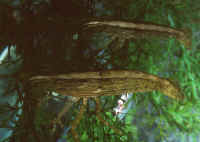
| Atyopsis species, Wood, Bamboo, Singapore
Shrimp. Up to three inches in length. Filter/suspension feeders,
good for green water conditions. Tropical, temp.s. in
mid-70's to 80's. Shown: Atyopsis moluccensis. Have
two pair of specialized sieving appendages. http://userpages.umbc.edu/~rrhudy1/shrimp.htm#wood |
|
Bigger PIX:
The images in this table are linked to
large (desktop size) copies. Click on "framed" images to
go to the larger size. |
|
 %20MD.jpg)
|
Bigger PIX:
The images in this table are linked to large (desktop size) copies.
Click on "framed" images to go to the larger size. |
|
 %20MD.JPG)
|
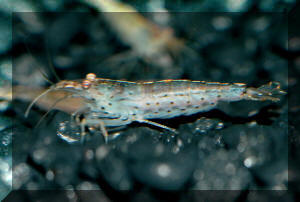
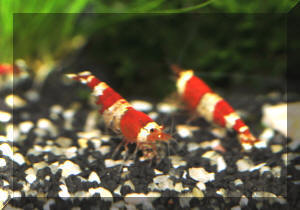
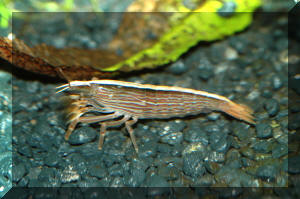
| Caridina multidentata, formerly known as
C. japonica. From the Yamato River area of Japan.
Reclassified in 2006, this is aka the Amano Shrimp.
http://en.wikipedia.org/wiki/Caridina_multidentata |
MD.JPG)
|
Bigger PIX:
The images in this table are linked to
large (desktop size) copies. Click on "framed" images to
go to the larger size. |
|
%20MD.JPG) %20MD.JPG)
|
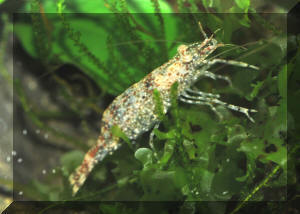
| Caridina zijangensis, Interzoo
2010 |
|
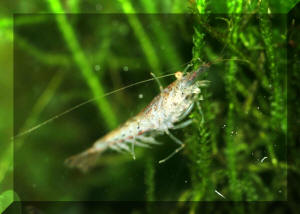
| Euryrhynchus sp., Interzoo 2010 |
|
| Neocaridina heteropoda "Yellow
Fire". Interzoo 2010. |
%20MD.JPG)
|
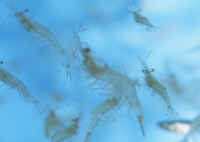
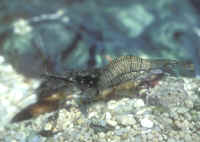
| Palaemonetes sp. Ghost Shrimp. Maximum
size, about one inch. And shown at far right, one of the
"Grass Shrimp", Palaemonetes kadiakensis picture
taken where it was living in a marine system. |
|
Crayfish, Crawdads, Dirt Bugs: See
articles and FAQs files listed on FW Livestock Sub Index II, copied
below
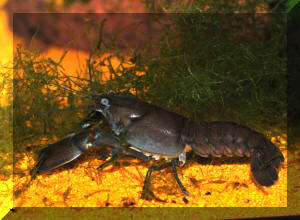
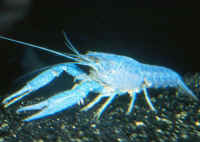
| Cherax tenuimanus, the (Blue, cultivated)
Marron. Found naturally in Southwestern Australia. Natural habitat
is calm water under ledges. Territorial, one to a tank. Nocturnal
feeders on plant material, animals, detritus. Males distinguished
by genital papillae on fifth pair, females with openings on third
pair of walking legs. Cool to tropical water. Escape artists! Keep
tank covered. |
|
Bigger PIX:
The images in this table are linked to
large (desktop size) copies. Click on "framed" images to
go to the larger size. |
|
|
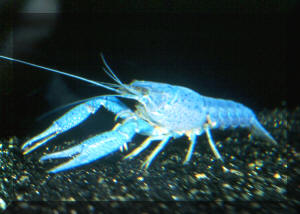
Cherax sp. "Zebra", another Yabby
crayfish. Interzoo 2010
|
|
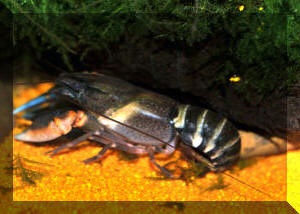
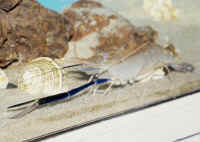
| Macrobrachium rosenbergii, the Giant Blue
"Lobster" or Prawn. An opportunistic eater of most all
living things it can get its claws on. |
|
Some unknowns:
|
Bigger PIX:
The images in this table are linked to
large (desktop size) copies. Click on "framed" images to
go to the larger size. |
|
%20MD.JPG) %20MD.JPG)
|
Crayfish Basics
by Justin
Pierce, Forget
Crawfish Pie, Let's Make a Crawfish Tank! By Gage Harford &
FAQs on: Crayfish 1,
Crayfish 2, & FAQs on: Crayfish ID, Crayfish Behavior, Crayfish Compatibility, Crayfish Selection, Crayfish Systems, Crayfish Feeding, Crayfish Disease, Crayfish Reproduction,
Freshwater & Terrestrial Crabs, & FAQs on:
Freshwater Crabs 1, Freshwater Crabs 2, & FAQs on: FW Crab Identification, FW
Crab Behavior, FW Crab Compatibility,
FW Crab Selection, FW Crab Systems, FW Crab
Feeding, FW Crab Disease, FW Crab Reproduction,
Freshwater to
Brackish Crabs by Bob Fenner & FAQs on: Fresh to Brackish Water
Crabs,
Terrestrial Hermit Crabs & FAQs
on: Terrestrial
Hermit Crabs 1, Terrestrial Hermit Crabs
2, & FAQs on Terrestrial Hermits:
Terr. Hermit ID, Terr. Hermit Behavior, Terr. Hermit Compatibility, Terr. Hermit Selection, Terr. Hermit Systems, Terr. Hermit Feeding, Terr. Hermit Disease, Terr. Hermit Reproduction.
& FAQs on Marine/SW:
SW Hermit ID, SW Hermit Behavior, SW Hermit Compatibility, SW Hermit Selection, SW Hermit Systems, SW Hermit Feeding, SW Hermit Disease/Health, SW Hermit Reproduction,
Small Freshwater Crustaceans Groups, by Genus: Triops, the Amphipods Which Are Gammarus (Scuds),
Cyclops, Branchiopods: Clam Shrimp (Ostracods), Daphnia (Water Fleas), Fairy Shrimp,
Branchinecta,
Bibliography/Further Reading:
http://www.wirbellose.de/arten.html
http://www.shrimpcrabsandcrayfish.co.uk/
http://www.aquaticlounge.aquariumplants.cx/shrimp.html
Cochran, Gary. 1989. Louisiana lobster. FAMA 12/89.
Dow, Steven. 1982. Breeding Crayfish in the home. TFH 1/82.
Grazulis, Vic. 1995. Freshwater Invertebrates: The Blue Marron. TFH
5/95.
Hovanec, Timothy. 1991. Am I blue? Lobsters in the tank
(Macrobrachium). Pet Dealer Magazine 10/91.
Richter, Hans Joachim. 1982. A freshwater shrimp, Macrobrachium
niponensis. TFH 6/82.
Spotts, Daniel. 1981. Introducing Macrobrachium rosenbergii.
FAMA 7/81.
Stavinchuck, Justin. 1986. Giant Blue Lobsters. An introduction of a
freshwater prawn, Macrobrachium rosenbergii, to the aquarium
trade. FAMA 12/86.
Taborsky, Petr. 1982. The White Prince. TFH 8/82.
Volkart, Bill. 1989. Live Foods: Craving crawdads? FAMA 5/89.
Watson, Thomas T. 1976. Crayfish in captivity. TFH 4/76.
Watson, Thomas T. 1980. Ghost Shrimp. TFH 5/80.
|
|
Aquatic Gardens
Ponds, Streams, Waterfalls & Fountains:
Volume 1. Design & Construction
Volume 2. Maintenance, Stocking, Examples
V. 1
Print and
eBook on Amazon
V. 2
Print and
eBook on Amazon
by Robert (Bob) Fenner |
|


.JPG)
.JPG)
%20vert.JPG)
.JPG)