|
Crayfish, Crawdads, Ditch
Bugs Foods/Feeding/Nutrition
Related
Articles:
Forget
Crawfish Pie, Let's Make a Crawfish Tank! By Gage
Harford, Invertebrates for Freshwater
Aquariums by Neale Monks, Freshwater Shrimp, Crayfish,
"Lobsters", Prawns Freshwater to Brackish
Crabs
Related FAQs: Crayfish 1,
Crayfish 2, Crayfish ID, Crayfish Behavior, Crayfish Compatibility, Crayfish Selection, Crayfish Systems, Crayfish Disease, Crayfish Reproduction, Freshwater Invertebrates/Use in
Aquariums, Freshwater Crustaceans for the Aquarium,
FW Crustaceans
2 , Fresh to Brackish
Water Crabs, Hermit
Crabs,
|
MD.JPG) JBL produces
an excellent leaflet on crayfish you can download from their web
site, here:
http://www.jbl.de/factmanager/index.php?lang=en
JBL produces
an excellent leaflet on crayfish you can download from their web
site, here:
http://www.jbl.de/factmanager/index.php?lang=en
|
|
Crawfish has a white film on him?
2/12/19
My younger brother has a fairly new 10g tank (settled for a couple months or so)
and added an orange crawfish. He recently had his first molt, but he now has
this peculiar white/clear film developing all across his body.
Tank specs wise, everything looks good; only nitrates are a little high ~40ppm?
And I add iodine weekly. Calcium may be the only issue, but he did consume his
past exoskeleton. My guess is that this film is a fungus? What are my options to
help him?
<There are some odd crayfish parasites out there, but my guess is that this is
indeed some sort of 'aufwuchs'; i.e., rotifers, fungi, and other harmless
organisms. In the short term at least, optimising water quality will be
important, and I would also be providing a rich source of calcium for him to
eat, such as unshelled shrimp. The exoskeleton is a mix of calcium minerals
along with proteins, and if there's insufficient calcium in his diet, there's a
risk the exoskeleton might become soft and prone to fungal infection. Regular
water changes and brisk filtration should ensure good water quality, and yes,
I'd be aiming to lower that nitrate level a bit. Make sure the food you offer
him is not too high in protein -- crayfish are very much omnivores rather than
carnivores. Algae-based pellets would be suitable as a staple, along with things
like cooked peas or blanched lettuce. The only meaty foods offered should be
"whole" rather than fillets, so that there's plenty of calcium. As mentioned,
unshelled shrimp are good, but also offer things like frozen lancefish or bones
from whole white fish you've used in the kitchen, such as tilapia. Smashed up
crab legs, snails and mussels could be used too, so that the shell is mixed in
with the meat. Cheers, Neale.>
|
.jpeg)
 |
my crayfish has lost his appetite, pls help
3/19/15
Hello,
More than a week ago, I bought a couple of Blue pearl Yabbies (which is not
common in my area - Vietnam). They are the same in size (6-7cm), and had been
kept in the same tank. The pet store's owner reassured me about the health of
them.
<Ok>
I keep them in 2 tanks separately, which are 24 litres in size. The tank of male
has a bio-foam filter only, and latter tank has bio-foam and a canister filter
in addition (cause I keep fishes (for food) in this tank).
I use same water source, same base setup.
Then the problem seems to appear. The female, after moulting, has been healthy
up to now, she eats 2-3 fishes a day. On the contrary, lack of appetite is with
the male. He shows no interesting in eating, even his old shell (he moulted the
second day at my home, about 4 days up to now). Even if i drop the food (shrimp
pellet, dried shrimp, fresh shrimp, fish, Artemia, .etc)near him, he just
ignores. I don't even know how long he can survive this situation. I've tried
mineral shrimp product,
<Which and for what? Do you have tests for hardness...>
sporadically put 1 drop of iodine,
<Iodide-ate... see WWM re the difference>
regularly check the pH of water (between 7-7.5), but it does not get better.
Beside hate eating, he keeps walking, digging,
crawling around, which seems normal to me. Water of his tank is crystal clear,
and no odd smell could be found. I can't figure where the problems, please
help..
<Do read through what we have archived on Crayfish Systems and Feeding on WWM.
Bob Fenner>
|
Crayfish leans on sides. No data, poor nutr., no rdg.
6/21/14
Hi! I'm from Singapore. About a month ago, my cousin gave me a yabby.
But I'm not sure where it is from. I've been feeding him peas,
corn and a bit of luncheon meat.
<Poor... Read here:
http://wetwebmedia.com/FWSubWebIndex/crayfishfdgfaq.htm
The first few days he was very active crawling, trying to escape as days
pass by, he becomes less active. He would lean on his sides. Currently,
he is in a tub as my parents did not want to spend money on tank. I
change the water everyday. Today, he seems not to eat. He would scratch
his body and as usual, he does cleans. Sometimes, he leans in his side
for a long time.
At a point of time, I thought he was dead! I sprinkled some water and he
swing its claws. He did not moult at all.
Hope that you can help me.
Best regards,
Ann
<... What re water quality? Need some small gravel... for a statocyst,
substrate/filtration... You NEED to READ:
http://wetwebmedia.com/ca/volume_1/cav1i4/crayfish/crayfish.htm
and the linked files at bottom. Bob Fenner>
|
.jpg)
Re: Crayfish leans on sides. Didn't read....
6/22/14
Hi, WWM crew. Yesterday, I've tried feeding him some seaweed
<... READ where you were referred. B>
but he did show interest in that but he did not eat it. What should I do?
Today, he seems to be weaker, he is not responding to anything. Could you
please help me? Thank you.
Best regards,
Ann
|
Blue Crayfish lying on side and not eating
2/8/14
Dear WetWebMedia
<David,>
I have searched for days all over your website and others but find a few
possibilities on what the "problem" might be. Could you assist?
<Possibly, but crustaceans tend to exist in a binary state so far as
healthcare goes: they're either fine or dying. That's because we have
virtually no understanding of how to use medicines to help them. The one
exception here is Iodine, which can be a "silver bullet" in some
situations, specifically prevention of moulting-related problems. Other
than that, about all you can do is optimise the environment and hope the
crustacean pulls through under its own steam. Many do.>
I am from the UK and I have had a Blue Crayfish for around six months
now.
"His" name is Baldrick (he says hello).
<Hello.>
Lately Baldrick has been lying down, intentionally, not falling or
getting pushed over by anything on his side which is what prompted my
search.
<I see.>
A bit of history: He was extremely active as a "baby". He would jet
around the water, dig, wreck and climb the plastic plants. All sorts.
<Sounds normal so far.>
As he got bigger he did less but I figured that was natural. He hasn't
shed for quite some time - I think two-three months now whereby before
it was monthly.
<Again, not unusual; as crayfish age, moulting becomes less frequent,
and eventually may stop altogether if the crayfish is very old.>
I always left the shells in there as he seemed to like eating them.
<Correct analysis; recycling the calcium. Not essential you do this (old
moults are a way for crustaceans to get rid of heavy metal poisons like
copper, for example) but crayfish should certainly have some source of
calcium available to them, whether a moult or something like a unshelled
prawn to eat instead.>
He would go through his normal cleaning cycles but lately, the last few
days I've noticed he is almost constantly cleaning himself, almost
violently (before it would be the occasional big clean and maybe just a
little rub here and there). He is almost always jamming his back legs
where the swimmerets are. I thought there might be a problem or eggs
(some how) but it looks normal under there.
<He may be having a problem moulting; do you use Iodine?>
Today he was really having a go around his eyes and opened his face
(like something out of predator) up for a "full" clean - I'd never seen
that before. Lately he quite often will tuck his tail underneath himself
and scuttle around as if he is about to be eaten, then lay down on his
side and not move for a little while. I thought he was dead until I
tested him by dropping a bit of food in there. He jumped up in his usual
way and scoffed the food instantly. However, the last two days he's
barely eaten. He responds to fresh food as always - but only eats maybe
one pellet. He brings other pellets to his mouth, tries them and then
drops them which is very out of character for him. I have food two days
old just sitting on the bottom of the tank - he is completely
disinterested. When you think it's all doom and gloom and he is about to
die, he will untuck his tail for around 10 minutes and wander around
without any problems - however the feeding hasn't rectified.
<If you don't use Iodine, do so; you can inexpensively buy Iodine
supplements for marine aquaria, and dosing at one-half the amount quoted
on the bottle will be ample. Iodine is essential for proper and regular
moulting, but unless we offer crayfish Iodine-rich foods (primarily
seaweed like Sushi Nori as well as certain seafoods) they often are
starved of Iodine. Without the Iodine the moulting process sometimes
"jams", and crayfish can find themselves in all sorts of trouble. Using
Iodine is a quick, cheap fix (and preventative) to these problems.>
He is alone in a large tank. I have changed about 40% of the water and
cleaned the glass - no effect.
Thanks in advance
Yours
David
<Hope this helps, Neale.>
Red claw crayfish.
1/11/14
Hi,
<Muller>
I recently got a red claw crayfish, and put him in a 60litre tank with a
small bream, 3 red eye barbs and a bottom feeding sucker type fish in
it.
I have removed all the plastic plants and have made two caves using
river pebbles, as well as put in a milk jug for him to hide in.
He's been in the tank for 4 days now and has settled in one of the
caves. I have not noticed him eating as yet, how long can he live for
without feeding?
<Weeks>
And why do you think he is not eating?
<Can't tell w/ the information provided. Perhaps the wrong food/s, poor
water/unsuitability. What species of Cray is this? Is it tropical?>
I have given him grated carrot and a piece of ham, but up to now has
shown no interest.
<Poor choices... See WWM re foods/feeding of these animals>
He also has his tail curled up under him, even when he walks around, is
this normal?
<For most species; yes>
He is a juvenile, measuring about 15cm long. I say "him", but have no
clue what sex "he" is.
<... see WWM re reproduction>
The water temp is 26 degrees Celsius, and has an airstone as well as an
under gravel type filter.
The bottom is covered in small stones approx 6-10mm in diameter, and no
sand.
There are no live plants in the tank.
I look forward to hearing from you.
Kind Regards,
Muller Ferreira.
<Search, read ahead of writing us. Bob Fenner>
Crayfish diet question 12/12/13
Good evening,
<Joel>
I am in the process of setting up a tank for a crayfish. The local store
had one in stock (looks to be a Procambarus fallax or a close facsimile)
that really caught my eye. I have a 10 gallon tank at home, currently
cycled (0 Ammonia, 0 Nitrate, 5 Nitrates or so) acting as a quarantine
for some Anubias I bought a month ago. The plants, of course, would get
moved to another tank.
<Ok>
For reference, the local water tends to be around pH 7.6 and dH
10. I may decide to supplement with some Malawi salt mix to increase the
hardness.
<This water is fine as it is for all Procambarus spp.>
I also have a separate tank that houses pond snails. Originally, I set
up a small tank with pond snails I picked from my 55 gallon tank, mostly
just to see how quickly they reproduced and determine how fast they eat
aquarium plants. It took about 21 days, but 2 snails turned into around
100...
guess that's not too terribly surprising.
<Nope>
All that background for this question: I was planning on introducing a
fair amount of the snails into 10 gallon tank and see if I can't start a
breeding population to act as a calcium/protein supplement for the
crayfish. All the snails I own have hatched at home so I am less worried
about any pathogens being introduced into the tank this way. Is there
any reason why this may not be a good idea?
<Up to you to try, decide... I'd be reading... >
The diet would still be primarily
(75% or so) herbivorous.
Thank you for your time!
Joel
<Mmm, have a read here:
http://www.wetwebmedia.com/FWSubWebIndex/crayfishfdgfaq.htm
and the linked files above. Bob Fenner>
Crayfish feeding and habitat
5/28/13
Hi Crew
<Cathy>
My sons recently asked if he could bring a crayfish home from school.
To be honest I wasn't too keen on the idea of having a crayfish to look
after.
One day he can came home saying that one of the baby crayfish was
being picked on by a larger crayfish in the tank.
<Very common. Crays fight, kill, consume one another in too small,
starved settings>
He named him Martin, and pleaded to bring him home (as he only had
3 legs left). I had agreed, and I got to tell you, I have
become very attached to the little guy. But being that we
never had a crayfish before, I think I have become a little overly
concerned about his needs. We have had him over 6 weeks, and he has
molted approx 5 times. Is that normal?
<Can be>
When we first got him he was a little guy, and we have him in a
critter tote (10 inch long - not sure of the actual size?) with no
filter or air tubes. I do a partial water change about every
3 -4 days, and a tank cleaning about once a week. With the water
level about 4-5 inches deep. I have read that you don't need to feed
him daily, but when we go to visit him, he seems to greet us. I'm
thinking he's hungry, so feed him. Usually a frozen pea,
carrot, or corn (usually 1 item at a time).
We also give him Crab cuisines pellets, a few fish flakes, dried
shrimp, as well as some type of aquarium grass....of course this
is not all at the same time, we alternate what we give him. He
usually grabs the treats up and eats till its gone. He always
seems hungry, but am afraid of over feeding him. I also feel that
Martin is out growing his tote. Do they really need a
filtration system?
<Is better, easier...>
I was thinking of just getting a larger tote being that he seems to
be happy in the current set up, but now perhaps a 5 gallon tank
with a filter would be better?
<Yes>
Also, if we go with a tank, do we fill the water all the way to the
top?
<No>
Martin has gone from a little light gray colored baby crayfish about
1 inch long, to a crayfish that is getting a red color and about 3
inches long. Sorry I don't know the species, but he seems to be
doing well.
Thanks you so much for your time
: )
Cathy
<Have your son read here, or read to him:
http://www.wetwebmedia.com/ca/volume_5/volume_5_3/crayfish_basics.htm
and the linked files at the bottom. Bob Fenner>
Re: Crayfish feeding and habitat 5/28/13
thank you so much..
Cath
<Certainly welcome. BobF>
Re: Crayfish feeding and habitat 5/29/13
Hiya Bob
<Cath>
Thank you for your patience. We had gone down to Petco and after
pricing the aquariums, we decided to go with a larger critter tote and
an internal filter (Tetra Whisper In-Tank Filter 3i) Martin
(our Crayfish) seems to enjoy hanging sideways on the rocks at the
edge of the water line in the old set up. It seems that the
internal filter has to have water all the way to the top of the
filter in order for it to work properly.
<Yes>
Which means the critter tote is almost completely full, and he
will no longer be able to do this.. Will that be OK for him?
<Depends on the species... some are amphibious, need to get out of the
water>
Also what about the vibration from the filter unit, wouldn't that
bother him?
<Mmm, not so much>
I have tried reading up on this, and even looking for pictures of
other aquarium set up, from what I have seen some have only
a few inches of water, I cant tell which type of filter they are
using..As of right now, we have the filter running in the old
container to have it process through...
<Good>
Martin is now in the new larger tote without any filtration.
I guess the other option is to have an air stone with no filter
system, and I can just be changing water like I have been doing.
<I wouldn't do this; unless the airlift was attached to a filter...
perhaps a sponge type>
I know I am probably putting way too much thought in to this, but this
is what happens when I get a pet. I want to make sure it is
not in any uncomfortable situations.
<I understand, and agree>
Thanks again
: )
Cathy
<Welcome. BobF>
Question regarding crayfish and elodea <growing>
1/28/13
Hi Bob I work at a school district, and we are currently having problems
feeding the overabundance of crayfish that we house for use in the
classrooms. I am aware that we can use things like kale, potatoes, peas,
etc., but I’ve found that those terrestrial food sources begin to decay
and foul the water really quickly.
<Will eat/consume most all foods. I suggest a good pelleted food as a
staple.>
So I’ve been trying to use exclusively elodea. Unfortunately, we’re
finding the elodea is quickly becoming cost prohibitive. Therefore I’ve
decided it’s in our best interest to attempt to grow the elodea, to at
least offset the cost some. In my department I have a large 2
sided industrial kitchen-style sink, and only one side gets used (and
only water is ever in that sink, we attach the siphon setup for fish
water changes to that faucet). When I started working here my
predecessor was keeping crayfish in the sink, but I questioned the
safety of that, and went and purchased a 100 gallon pond to put them in
instead. Ever since then the sink has sat empty. But with my current
need of elodea, and lack of space, I decided to try to plant the elodea
in the sink. I have a standard florescent task light above it, but I
also added a light fixture from an old 10 gallon tank I had with a plant
grow light bulb in it. I have aquarium gravel to add, but really wasn’t
clear on whether I would get better growth from burying the elodea in
the gravel, or simply letting it free float?
<Floating is better for faster growth... though doubtful you'll be able
to "keep up">
I also have some oyster shells in there from when there were crayfish
using them as “houses” that I’d planned on leaving, as I read it could
help with pH (accurate?).
<Yes>
So I’m wondering what thoughts you have on that setup?
<Can work>
My second question is regarding the addition of fish to the setup. I have
about half a dozen white clouds in a tank here that I was thinking of
adding to my makeshift elodea growing tank/sink. But I wasn’t sure if
that’s safe for them?
<Is likely fine... as long as no one pulls the plug!>
I look forward to hearing your thoughts J
Cathy
<Cheers! Bob Fenner>
Re: FW: question regarding crayfish and elodea 1/28/13
Thanks for the quick response! :)
So you don't think that we'd have the issue of fouling the water if we
went with a pelleted food?
<Much less so than w/ the foods you listed>
A pelleted pond fish style food, or shrimp pellets?
<These would work fine>
Or back to it doesn't matter because they'll eat anything and everything?
<More close to reality, yes. I'd opt for something low/er protein (under
20%)>
And no worries about pulling the plug. It has a special stopper in there
that actually requires a wrench to remove it :)
<Ah good. Cheers, BobF>
Cathy
Re: FW: question regarding crayfish and elodea 1/28/13
Super, I'll get started with the project. Thanks again for your help :)
Cathy
<Ah, welcome. You have seen the bits on WWM re Elodea/Egeria/Anacharis I
take it. BobF>
Re: question regarding crayfish and elodea <as food for>
1/31/13
Hi Bob
<Cath>
I was out of the office yesterday, so I wasn't able to respond to this.
I have read about Elodea from several sources, I can't honestly recall
if WWM was one of them, but I tend to end up on WWM when trying to
research all things aquatic, so I probably did. I'll do another search
though, just to make sure.
<Ok>
Why do I want to opt for a lower protein in the food?
<Slower growth is desirable, and lower protein is likely to include more
vegetable material... better for your animals and maintenance>
I ask because I spent some time trying to locate a sinking stick/wafer
food (didn’t want tiny pellets, as I don't want them falling through the
cracks amongst the PVC and oyster shells I have littering the bottom of
the crayfish tanks, and not getting eaten, and fouling the water) that
was under 20% protein, and I didn't have much luck. I think the lowest I
found was in the 30-35 range...
<This will do>
Thanks again!
Cathy
<Welcome. Bob Fenner>
Re: question regarding crayfish and elodea 1/31/13
Hi,
<Big C!>
For now I've ordered some "Omega Veggie Rounds" wafers at 34% protein
(http://www.arcatapet.com/item.cfm?cat=11091 ) , and some "Ken's
Premium veggie sticks with Calcium" at 35% protein
(http://www.kensfish.com/moreinfo/kens-premium-veggie-sticks-calcium.html ) I read good things about the Omega's not "dissolving" as quickly as
some of the other wafers. Guess we'll see.
<Should be fine>
And the order of elodea I ordered for feeding and for setting up our
little grow tank experiment just arrived today as well, so hopefully
we'll be in good shape. I've had the dechlorinated water sitting for a
good week now, and I just added a bunch of elodea and our 5 little white
clouds. So we'll see how it goes.
Thanks so much Bob, I'll let you know if I have more questions :)
Cathy
<K! BobF>
Re: question regarding crayfish and elodea. Sys., comp.
2/6/13
Morning Bob :)
<Cath>
The algae wafers aren't holding together as long as I'd hoped. And I
don't know the likelihood of the crayfish being able to eat them once
they've disintegrated to a certain point. Thinking I'd better beef up
the cleanup crew a bit. I could do some more snails, but I was wondering
if I'd be ok with some Plecos or little Otos?
<An appropriate species/size "Pleco" would be best of all the choices
here (and/or just more mechanical filtration). Snails are very likely to
be eaten, Otos are too sensitive to water quality issues. B>
Didn't know if that's just setting the fish up for becoming dinner, or
if the Crays would ignore them? I know the little Otos can be pretty
quick... What're your thoughts??
Talk with you soon
Cathy
Re: question regarding crayfish and elodea
2/6/13
Thank you, thank you! :)
Cathy
<Welcome>
white and blue crayfish, beh., fdg.
8/19/12
I have a white crayfish and a blue crayfish in a 90 gallon tank I also
have a common brown crayfish. The tank has lots of caves and plants but
the white crayfish and blue crayfish are sharing a cave. They have built
a wall in the entrance of the cave and haven’t come out for 2 weeks.
<Odd. But do bear in mind Crayfish are largely nocturnal, and prefer to
feed at night.>
I have seen them mate several times and they never fight. I recently
knocked some of the wall down to see if they are alive and they are. I
thought that crayfish would fight is it normal for a blue and white
crayfish to live in the same cave together?
<Not at all normal! You are lucky. Of course, the acid test is what
happens when they moult; that's often when fatalities occur.>
I am also worried that they are not eating. Should I just leave them
alone?
<Yes. Naturally, check the aquarium is working properly in terms of
water quality (is the filter okay) and water chemistry (shouldn't be
soft or acidic). Review diet, and remember they need green foods, a
source of calcium (unshelled shrimp are good) and some use of iodine
(you can buy iodine-enriched foods for crayfish, but adding iodine drops
as sold for marine aquaria at 50% the quoted dose seems to work best).
There's a good review here:
http://www.wetwebmedia.com/ca/volume_5/volume_5_3/crayfish_basics.htm
Cheers, Neale.>
Feeding Marmorkreb, AKA marbled crayfish
7/19/12
Hello,
Its me again! I had a quick question about the marbled crayfish. I wanted
some action when i breed my convicts, and i wanted to get one of these
crayfish to keep with my convicts cichlids while they breed.
<A really bad idea. Crayfish and fish don't belong in the same
aquarium.>
I hear they eat plants,
<Among other things.>
but i do not have many, is there a healthy leafy veggie i can feed one
if i get it?
<Almost anything will work. Cooked, squished peas are a good start, plus
spinach, blanched lettuce, and generic algae wafers. Augment with a
source of calcium (whole krill, shrimps) plus marine aquarium iodine
supplement drops.>
I don't want my cichlids eggs eaten or any fish, will this be safe?
<No.>
Will the cichlids defend the babies against the crayfish or will they
leave each other alone?
<Chaos will likely ensue, or at least, the crayfish will be alive until
such time it moults, then the cichlids will kill it. As Bob likes to
say, "read" -- all this has been gone into over and over at WWM. Want a
crayfish? Great! Set up a 10-15 gallon tank you can set aside to its
needs.>
Thank you
<Welcome. Cheers, Neale.>
Re: Feeding Marmorkreb, AKA marbled crayfish (Bob, second opinion
requested!) <<>> 7/24/12
Hello again,
<Hello!>
I am re emailing you because I'm trying to get a specific species, if
you read the subject it says "marmorkreb".
<Apparently a Procambarus hybrid of some sort; a horribly invasive,
parthenogenetic species that let's hope doesn't become established in
the trade. The UK crayfish fauna has been essentially exterminated by
non-native Signal Crayfish, and the European fauna more generally is
also under immense pressure; just imagine what a parthenogenetic
crayfish could do if that got loose as well! Situation wouldn't be any
better in the Americas or Australia.><<Agreed>
The person who is selling them says they are completely peaceful,
<Wishful thinking.><<This genus, the crayfish period are not
"peaceful"... will eat most all tankmates, pull plants up, apart>>
and I emailed you asking if that's true, not if all crayfish are
peaceful I know the answer to that.
<Correct.>
You know as well as me that not all crayfish are the same, so I need an
answer to confirm if their species is compatible.
<It's a Procambarus species. They're all opportunistic feeders. For
sure, they mostly feed on plants, benthic invertebrates, organic
detritus and carrion -- but given the chance, they'll eat a sleepy or
weak fish. Marmorkrebs have a *reputation* for being less overtly
aggressive or predatory than other Procambarus species, but would I
*trust* them… no, that would be foolish. They're crayfish, and the only
"safe" crayfish are the mini species like Cambarellus patzcuarensis.>
If I need to speak to Sabrina, or Bob, or someone else part of the
community feel free to forward it to someone else. Best regards, Tavian
<Have asked Bob to comment if needs be. Cheers, Neale.><<And you, BobF>>
Are there any ways to encourage specific colours
in Yabbies? (and lots of other questions), diet, sys...
2/7/12
Good Morning/Evening/ Day (please read which ever is applicable in your
part of the world)
<Early evening here in Blighty.>
For the past few weeks I have owned a stunning blue yabby (Cherax
destructor) whom I named Darling. Darling is an absolutely stunning
colour and I want to do what I can to keep him that way. I know that
The colour of yabbies is affected by their environment and their diet,
and while I've been doing a bit of reading I can't find
information about how to encourage specific colours in yabbies, in fact
finding any in depth information about their care is a difficult
task!
<Colours are as seen! Generally, juveniles have brighter colours
than adults, and the more mixed the diet (especially the more algae and
crustaceans) the richer the colours will become. But you can't make
a grey-blue Crayfish electric blue if its genes aren't that way
inclined.>
As far as his diet goes, I feed him on a staple of two
"yabby" pellets a day. Unfortunately I don't know what
these yabby pellets contain. The pet shop I bought him from was closing
down and he was the last yabby in stock, so the cashier gave me the
stores supply of pellets to use, which were kept in a ziplock bag.
I've combed the internet for commercial "yabby pellets"
which has led me to believe that the pellets are actually axolotl
pellets.
Will these be harmful to him?
<Nope. Crayfish are a mix of herbivores and scavenger, so anything
that includes suitable fresh greens, algae, and dead animal (ideally,
shelled or bony) animals will all be useful.>
I supplement his diet with fresh fruit and vegetables every day and
I've ordered some algae wafers from the internet (along with marine
iodine, why did I never hear about that stuff before I visited this
site?) ,
<Good question!>
so is it alright for me to continue feeding him the pellets until the
wafers arrive in the post?
<Yes.>
I've been giving him a wide variety of fruit and veg and so far his
favourite foods are sweet corn, strawberries, green grapes, garden peas
and chick peas. I've given him lots of other things but he seems
reluctant to eat leaves or beans (except for live Anubias plants, those
he loves to shred up and munch on). But I notice that he also likes to
chew on the silk plants, even when fresh fruit and veg is available. Is
this something I need to address?
<It's instinct.>
At first I thought it might be a vision problem, because he is often
sitting right next to the food and seems to have put the wrong thing
into his mouth, he always spits them out again and will eventually find
the real food, but I've seen other users on your site complain of
similar things and they have been told that they need to provide their
yabbies with more veg, so should I give him more? Or should I simply
give him something a little chewier than what he's used to, such as
whole snow peas?
<Sure.>
Whoa, sorry for drifting so far off topic there, what I would like most
of all is how this diet affects his colouration, will the high levels
of keratin cause him to become more purple? And how can I best adjust
his diet to retain his blue colour while also keeping him in good
health?
<You really can't beyond giving a *good* diet.>
I'd also like to ask another question about mineral levels, your
site heavily endorses the use of marine iodine.
<Correct.>
Before I knew about that stuff I was trying to find a way to put more
calcium in his diet, and eventually started him on chick peas
(according to Wikipedia they are very high in calcium and other
minerals) and he loves them.
<Cool.>
But another source recommended that I put sterilized eggshell into the
water, have you had any success with this?
<Seems redundant and messy, but sure. Otherwise smash up some pond
snails, buy some unshelled prawns, offer a chunk of cuttlebone.
Whatever seems easy.>
I don't see why he would want to eat something like eggshell, but
he won't eat prawns so I need to find some sort of alternative
source of iodine until my order arrives.
<He will eat unshelled prawn skeletons if he needs the calcium.
Frozen krill is a good alternative.>
I'm not even sure if iodine is in eggshell, but it was inferred in
the source I read, can you confirm or disprove that?
<I doubt it'll be sufficient or useful.>
And finally (this is the last question I swear!) how does the colour of
the substrate affect the yabbies colour?
<Not much.>
I found one source that said dark substrate and clear water would
promote blue tabbies.
<Never heard that before. Good, clear water will certainly promote
good health, and that, in turn, would be a plus.>
Can you verify that?
<Nope.>
I have attached an image of my setup, it is lit (with uv lighting) for
12 hours of the day and it has a high current producing sponge filter.
I've attached an image of my setup so you'll know what it looks
like, I've added more silk plants and hidey holes since that photo
was taken, but the colour scheme is still the same.
Thank you for your time and the infinite patience needed to go through
all of that!
Kind Regards
-Emily
<Best, Neale.>
|
Cherax tenuimanus listless and not eating - no
it's not moulting, env.
11/24/10
Hi WetWebMedia,
History: I have a blue (well it used to be) marron (Cherax
tenuimanus) that is approx 2years old weighing around 50g. I got
it from a marron farmer whilst doing experiments during my
honours year at university (the thesis was on marron
nutrition).
Problem: The marron has not eaten for 3-4 weeks, it is listless,
doesn't lift it's claws in response to my presence,
doesn't get 'excited' when food is introduced into
the aquarium. Has small brown patch on each of it's
claws.
Water parameters: Ammonia - 0.0, Nitrite - 0.0, Nitrate -
0.25ppm, temp - 23-25 degrees Celsius, pH - 8.4
Water changes: 50% once weekly, gravel vacced
Additives: I add bicarbonate soda (1 tablespoon per 24L), triple
does Wardleys dechlorinate (we have high levels of chlorine in
our tap water and there is also Chloramine), rock salt at 1
tablespoon per 24L, Easy-Life fluid filter medium (10ml per 30L).
I have read on WetWebMedia that iodine needs to be added to
crayfish tanks so I am getting SeaChem iodide as well.
I will not put rock salt into the aquarium once I start adding
the SeaChem product.
Food: Crayfish (Cherax spp.) formulated food, zucchini
(blanched), sinking fish pellets (treat once weekly), algae
chips, lettuce, kelp paper (used for making sushi wraps).
Filter: No filter, just aeration.
Tanks size: 24L
Thanking you in advance for your help!!! Please let me know if
you require further information.
Philippa
<Hello Philippa. The problem here is that this crayfish is
being kept in a tank that is too small and not properly filtered.
I'm writing this as someone trained as a zoologist and who
spent years ferreting about university aquaria and labs as an
undergraduate. I've visited many zoology departments over the
years, and by and large, the way animals are maintained in labs
is very variable. Despite laws ensuring good welfare with regard
to mammals and other vertebrates, invertebrates tend to be
treated much more poorly, and even fish and frogs commonly suffer
from neglect of all types. I won't name names, but I've
been to world-class universities and walked away in a state of
shock after seeing how some of the animals were maintained. This
is especially the case with the "expendable" animals
given to undergraduates and masters students. I'm about as
pro-science as anyone on the planet, and flaunt my PhD with
pride, but a lot of zoologists have not the least idea how to
properly maintain "lower" animals in the long term.
What I'm getting at here is that the way your crayfish was
maintained at the lab should not be taken as the model for
maintenance at home. Quite the reverse in fact! The problem with
invertebrates generally is that we know next to nothing about
their healthcare. Essentially they exist in a binary state: happy
and healthy, or sick and dying. Medicating them just isn't an
option in most cases. So you need to provide tip-top conditions
right from the start. Because crayfish are extremely hardy
animals, they take a long time to sicken -- and yours is clearly
sick -- but on the other hand when returned to good conditions
there's a very good chance your crayfish will recover. So
let's start from the top. A crayfish the size of Cherax
tenuimanus needs a fair amount of room. I'd say 20 gallons/75
litres, and certainly not much below 15 gal/55 l. Heating may or
may not be required depending on your ambient room temperature.
But filtration is essential. As I'm sure you realise, Cherax
tenuimanus is losing out to Cherax cainii because of its lesser
tolerance for poor environmental conditions, including stagnant
water. So you're definitely after a brisk water current, lots
of oxygen, and clear, neutral, moderately hard water chemistry.
If there's no filtration I just don't believe you have
zero ammonia and zero nitrite all the time, and 0.25 mg/l nitrate
is so trivially low and outside the range of aquarium nitrate
test kits, I don't believe that result either. Be sure
you're using your test kits properly. Most tap water has a
nitrate level around 0-50 mg/l, and in cities especially nitrate
levels below 30 mg/l are very unusual. Given this range, aquarium
nitrate test kits tend to detect amounts from 0 to 100 mg/l, with
five or so steps between those extremes. Salt isn't essential
as such, but I would use a proper Rift Valley salt mix if you
have hard water, like the one described at the link below, though
perhaps at half the recommended dosage. Bicarbonate of soda
raises carbonate hardness but not general hardness.
http://www.wetwebmedia.com/fwsubwebindex/fwh2oquality.htm
I hope this helps. Cheers, Neale.>
|
|
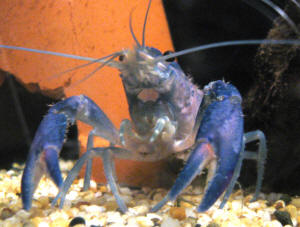 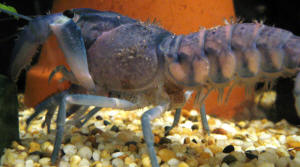
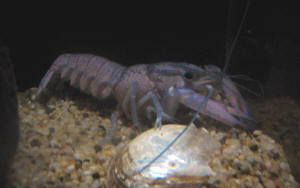 well, well, and sick Chompy well, well, and sick Chompy
|
|
re: More info on iodide use with Crayfish
9/4/11
Thank you for your response but I require WHERE you get your
information from i.e.. references, web links etc
Thank you,
Philippa
<I get them from experience and talking with other experienced
aquarists.
That's why I write the fishkeeping books and magazines other
people quote from! Cheers, Neale.>
re: More info on iodide use with Crayfish 9/5/11
So can you please give me the reference to your book?
<Which one? As for crayfish and iodine, read here:
http://www.wetwebmedia.com/ca/volume_5/volume_5_3/crayfish_basics.htm
http://www.wetwebmedia.com/fwsubwebindex/crayfishdisfaq.htm
Cheers, Neale.>
|
crayfish food - any US sources? -- 01/03/10
I have a signal crayfish that I found in the street near my house this
past Sept. I recently saw several references to JBL and another brand
of food that is good for crayfish on your site
http://www.wetwebmedia.com/ca/volume_5/volume_5_3/crayfish_basics.htm
Is there a US source for this food? The Brit sources either don't
ship to the US or charge more for shipping than the product costs.
I've Googled it to death.
Any info will be most helpful.
Thanks kindly, Linda
<Linda, Crayfish are entirely omnivorous, with the accent on plant
matter (cooked peas, sushi Nori, algae wafers etc.) and carrion (e.g.,
small bits of white fish fillet). Snails, shrimps, krill and so on make
good supplements, but the key thing is to add a source of iodine.
Marine iodine supplements work well, but you only need a half dose
relative to what you'd add to a marine tank. Iodine helps the
crayfish moult properly, something that doesn't seem to happen
reliably otherwise. Cheers, Neale.>
Re crayfish food - any US sources? 1/3/10
Hi Neale,
<Unfortunately "out" 3-5th>
I have given peas and romaine lettuce. I've read that too much
protein is not good. I tried algae wafers, but they dissolve as soon as
they get wet--so nothing much for the crayfish to get to.
<Mmm, the list of useful foods is very long... and is posted on
WWM>
I have started the marine iodine. The crayfish hasn't molted since
I got it, but don't know how often they do. It is about 5"
long right now.
<Do slow down in molting with age, growth... but still do so, given
enough food, "proper" range of water quality>
Since I rescued it I figure I am responsible for giving it proper care,
which includes giving it proper nutrition for ultimate survival and
health.
<Agreed>
Thanks for your reply.
Linda
<Do look into pelleted sinking foods... for fishes... these are
useful for freshwater crustaceans. Bob Fenner>
Blue Crayfish not eating... same ole referral, reading
11/9/09
Hi. I have a quick question concerning my blue crayfish that lives in a
75 gal tank with Danios, catfish, black shark, green Pleco and silver
dollars.
We purchased our little man back in June and he quickly made a home in
a shelter that I bought for him.
<Nice prose>
Over the next 3 months he went through 3 molts all the while having a
wonderful appetite. We felt that he was outgrowing his shelter so we
purchased a new larger "home" for him to live in, even put it
in the same spot as the last one, as he had dug out much of the gravel
in that area.
Since that time he has not been eating. I waited a week before going to
the local fish store where an employee recommended we test the water. I
brought back a sample and found the ammonia and nitrites were
mod-high.
<How high?>
As per the employee, we did a 40% water change and cleaned out the
gravel.
It has been almost a week since that day and he still is not eating
well if at all.
When he was eating, he would eat a variety of food from freeze dried
krill, algae chips and any type of sinking fish food. Now we have tried
a whole variety of sinking fish food and blood worms but still the
little guy won't eat.
Please any information that you can offer us would be greatly
appreciated!
<Very likely the "stock" reply/reason... a lack of
biomineral and/or alkalinity and/or iodide/ate... Please read here:
http://wetwebmedia.com/FWSubWebIndex/crayfishbehfaq.htm
and the linked files above... particularly "health" &
"feeding" & "systems". Bob Fenner>
Crayfish Questions - 05/03/09
Hello crew,
I am going to say about two months ago I came home to find something
hiding behind a plant in my tank. I quickly asked my father if he had
put anything in there and he said he had put a royal blue
'lobster' in there.
<Oh dear... fun as Crayfish are, they aren't really good
additions to aquaria with either fish or plants, since they view both
as food! Do make sure you read here:
http://www.wetwebmedia.com/ca/volume_5/volume_5_3/crayfish_basics.htm
It's a great primer to these interesting animals.>
I was ecstatic since I did not know you could keep such a pet and had
always wanted to keep a lobster as a pet (in freshwater
anyway'¦I later learned that it is not a true lobster but a
crayfish from reading many sites devoted to this type of thing).
Anyway, he lives in a 10 gallon tank with 1 beta (which he has attacked
the other night), 4 ghost catfish, 1 bright yellow cichlid (which is
separated off since he attacked the beta before the arrival of the
"lobster"), 2 mollies, and 2 guppies (was three but he ate
one of these before I noticed he was in there).
<Way overstocked for 10 gallons! Mollies need much more space than
this, and Guppies, well, I'd sooner keep them in 15-20 gallons.
I'm assuming the cichlid is Labidochromis, which really has no
business being in this system at all, and yes, by community tank
standards it is far too aggressive. It's actually a fairly mild
Mbuna, and a good one for beginners... but not a community
fish.>
I realize this probably is a crowed tank for him but like I said I did
not know I was getting one so there was really nothing I could do since
the other three tanks in the house were not acceptable homes for them.
The five gallon tank was full of goldfish, the 55 gallon is saltwater,
and the 75 is freshwater with very large Oscars, Pacus, parrot fish,
upside-down catfish, and etc, which would have eaten all of my fish in
one swallow.
<Hmm... okay....>
The last water change was two weeks ago and another one is going to
happen today. When my father purchased the 'lobster' he also
purchased Spirulina discs for him which the lady at the store said he
would eat.
<Indeed; an ideal food for them, though fresh greens and the odd
whole lancefish or unshelled prawn is even better.>
He did eat them but then I learned through my research that they also
like other types of food which contain protein.
<Plenty of protein in algae wafers. Turn the bag over and look at
the nutritional breakdown; if it's the same as the wafers I'm
using, there will be around 25-30% protein in there, far more than
these animals would get in the wild. Just as a reminder, Crayfish are
largely herbivorous animals that do some scavenging on the side. Mostly
they eat algae and organic detritus, but once in a while they'll
find a dead fish or something. Their requirements for food are not
major, and it's actually calcium and to some degree iodine you need
to worry about, not protein.>
So my mother said I should go out and get some of the Pollack from the
freezer and give him some of that. So I went out and cut off a tiny
piece and gave it to him. He quickly grabbed it up and devoured it.
<I bet!>
The next day I gave him an algae disc and he did not eat it. I figured
he was probably just not hungry after eating the fish the day before.
So the next day I did the same thing and have been doing so for the
last few days. I have not seen him eat an algae disc since his first
experience with the fish I gave him, but will eat fish when I drop it
in. Is the fish just more filling or should he be eating something
different?
<He certainly doesn't need daily feeding.>
What is the ideal diet for him?
<Anything, provided it's varied, rich in calcium, contains fresh
greens, and is fed SPARINGLY. Do see the linked article mentioned
above.>
Also, I noticed the other day that his tail was red where it is
normally white, but when I came home that night he was back to normal
so I didn't think any more about it until the next morning when he
was redder than the day before and then when I came home that night he
was back to normal again. Is this something that should be taken care
of or nothing to worry about?
<Difficult to say; assuming water quality is good, the main health
issue is iodine, and you want to be adding some to the water, otherwise
moulting tends to go wrong. Buy some iodine supplement from your local
marine aquarium pet shop, and add at half the quoted dose.>
He does not act like anything is wrong with him. He is very active and
attacked one of the fake plants in the tank last night when I went to
turn out the light. Any help with these matters would be greatly
appreciated.
Thank you,
Dee
<Good luck, Neale.>
Help for crayfish 8/21/08 I've searched
the site for additional information on this topic and haven't found
anything that could help me at this point. Maybe you can help me. I
have a rusty crayfish that I recently collected from the local lake. He
was fine until he molted. I found him repeatedly upside down. Since
then, his claws don't seem to work right. They hang under him and
when he lifts them (took him two days to do this), it looks like
he's punching himself in the face. He also has white feathery
things hanging out from the sides since he molted. He eats the goldfish
flakes and bloodworms that make it to the gravel. Is there anything I
can do for him? -Nate <Nate, assuming water chemistry and water
quality are good, then the thing that may be critical is diet. German
aquaristic company JBL produces an excellent leaflet on crayfish you
can download from their web site, here:
http://www.jbl.de/factmanager/index.php?lang=en Among other things, it
makes the point that crayfish that are given too much protein in
captivity moult prematurely, and this fails, causing problems. So what
you've described is not at all uncommon. The key thing is that we
often give crayfish the wrong food: they are HERBIVORES more than
anything else. High-protein food like fish flake and bloodworms may
seem nice, and they certainly eat them, but they are VERY BAD for them.
Instead concentrate on plant matter, or better still, foods formulated
expressly for crayfish (JBL make a couple of such products, and so
likely to other manufacturers). Also remember not to feed them daily,
but perhaps every other day. These animals have a low metabolism, and
during winter especially may be hardly eating at all. Sabrina (another
member of the WWM crew) recommends adding iodine (sold for marine
tanks, e.g., Kent Marine Iodine) to the water as well. Iodine is
related to the moulting process, and may be another way to help
regulate moulting frequency and make sure that when it happens, it
happens in the right way. She recommends a rate of one drop per ten
gallons each week. Hope this helps, Neale.>
Re: Help for crayfish 8/21/08 Thank you so
much! -Nate <Happy to help. Cheers, Neale>
Itchy electric blue lobster... using
WWM 5/5/08 I am now housing my second blue lobster. The
first lobster molted after a month and lost every one of her legs/arms,
even the very small front ones that they use the put food in their
mouths. She was just a torso, head and tail. <... something/s
missing nutritionally, perhaps water quality wise as well> It was
very tragic! When I got her I was not educated enough on water balance
and the nitrites were toxic for about a week, I feel this could have
been the cause. I got a new one yesterday and he is pretty active but
spends most of his time itching and scratching himself all over his
little body, head and tail. He is in a 10 gallon tank, with filter and
air pump. His house mates are 2 Neons, 2 rosy reds, and 4 ghost shrimp,
all of which have been with me for a month and I understand he may eat
all of them which is fine. I tested the water, nitrate about 10 in safe
range, nitrite 0, water hard, chlorine 0, alkalinity about 160 which
says ideal, and pH about 80. The water temp. is about 78 degrees. I do
not see any parasites. Should I be concerned? Any other suggestions so
I can keep little Liam healthy? I have added about 2 drops of iodine
once a week for 3 weeks and will now reduce it to 1 drop. I also use
API stress zyme once a week since the aquarium is only 2 months old.
Your site is wonderfully insightful, thank you for all that you do.
Dena <Have just skipped down. You obviously have not followed
directions, read... Here:
http://wetwebmedia.com/FWSubWebIndex/fwlvstkind2.htm scroll down to the
articles, FAQs on Crayfish, health... systems,
foods/feeding/nutrition... BobF>
Clawless Yabby; beh., fdg. 12/20/07 I am looking
after an Australian Freshwater Yabby for a friend who is overseas. Two
days ago, he escaped from his tank & fell off the kitchen bench
onto the floor, & was found about 4 metres away from his tank.
During this trauma he lost both of his claws. Once returned to the
tank, he has been floating upside down, but still alive. My question
is- if he stays alive, how do I feed him without his claws to grab the
food? Or will he die? Any suggestions would be greatly appreciated.
Kind Regards, Jodi O'Connell <This crustacean can, will consume
foods of use still... really only uses the large claws for defense and
seizing prey items... Maceration and manipulation are done via other
smaller elements closer to the mouth. If this animal can be recovered,
kept nourished, well-maintained, it will regenerate the larger claws
with time, successive molts. Bob Fenner>
My blue lobster/crayfish, fdg., beh. -- 9/29/07 Hi. I have a
blue lobster/crayfish, which i brought some time in march. my
lobster/crayfish was eating fine, until he/she shelled on Monday (24th
September), now he/she just doesn't seemed interested in anything
food what so ever. is there something wrong with my lobster/crayfish?
any suggestions please. thanks. <Greetings. Crayfish tend to be
extra-shy immediately after moulting. This is natural. For a couple of
days their exoskeleton isn't strong enough to provide useful
defence, so they stay hidden in their burrows. So give it a couple of
days, and then see what happens. Do remember to vary the diet. Crayfish
are primarily herbivores in the wild, and a lot of their diet is algae,
soft plant matter, and decaying organic detritus. So you could try
tempting your pet with something different. Sushi Nori would be ideal
and especially rich in iodine, which crayfish apparently need for good
health. You can pick this stuff up at any Asian food market or decent
grocery store, and it's very cheap (over here in the UK, around
£1 for 10 large sheets). Algae pellets (of the type sold
for catfish) make a good alternative. Top this off with the other major
part of the crayfish diet -- carrion. A nice bit of frozen whitebait or
lancefish would be just the thing. The bones in these little fish would
be a handy source of calcium. One last thing: crayfish, like most
freshwater invertebrates, are sensitive to water quality. Check the
nitrites are at zero and the nitrates fairly low. There must be no
copper in the water (e.g., from fish medications) or salt. Not all
species are tropical animals, so check which species you have, and if
required adjust the temperature accordingly. Do also read this and its
related articles: http://www.wetwebmedia.com/FWSubWebIndex/crayfishfaqs.htm .
Cheers, Neale>
My new pet Crayfish 11/27/06 Hello. I work at PetSmart, and
every now and then, strange animals will show up in the shipments of
feeder fish, <Ah, yes... always a delight, adventure> and I
usually enjoy taking one or two home with me. Usually the stow aways
are tadpoles, but yesterday, I picked up a Crayfish that I named Garth.
<"He's got friends in lowww places...."> Right now,
he is living in a tiny little bowl, but after reading up on your page
and others, I am ready to purchase and set up a tank for him tomorrow.
<Ah, good> I was wondering a few things, and if they are on your
page and I missed them, I apologize for the inconvenience. 1. Do you
have any idea what he may be? I was trying to find pictures of several
species, but after reading up on them, I think he may be a juvenile. He
is probably 2 inches long, and he is a light tan color, but he has
speckles all over him, including his pinchers. They themselves are very
small and thin, but they are long. I live in Colorado, but our fish are
usually shipped from Arizona. Any species around that area that he may
be? <There are some 300 plus species that occur in N. America, but
the vast majority of those seen/used (for consumption as well as
ornament) are Procambarus clarkii> I was just wondering, because I
wanted to know about how big he would get. <Do place the above name
in your search tool... likely some 3-4 inch body length maximum> 2.
Exactly what/when should he be fed? I have read different things. Some
say stick to mainly vegetables, and don't feed too often, while
others say feed mainly meats, and feed frequently. What would be a good
feeding/diet schedule? <A mix of these... animal and vegetable
foods... prepared or fresh will serve you both well here> 3. How
much space should he have? <A ten gallon system would be perfect...
with some rock work...> I do not have the room for anything HUGE, as
I already have a ten gallon fish tank and a large critter keeper for my
hermit crab. Would a large Critter Keeper (15.875" x 8.375" x
12.083" ) be enough? <Yes> I know some aquatic animals
don't need a lot of room, and some do. <You are correct here>
Thank you so much for your help. I apologize again if I've asked
anything that was available on your web site. Sometimes Im not the best
at searching for information, lol. Thank you for your help. ~Amber
<Thank you for writing, sharing. Your genuine concern and
intelligence are refreshing, obvious. Bob Fenner>
Red lobsters I have a red lobster which was very happy but
just recently he has stopped eating. he normally eats cockles and that
crab and lobster food but as I say he has just stopped. he has shed his
shell once and keeps climbing up the plants to the top of the tank.
could you please help.<I would check your water quality (check for
nitrates, nitrites, ammonia, and copper) invertebrates are sensitive to
copper (which could come from your tap water) if this is the problem
you will have to purchase RO/DI water if you want your lobster to live,
otherwise just keep trying to feed him different types of meaty
foods...like silversides, krill, mussels etc, Good luck, IanB>
thanks, mark, United kingdom
Blue Lobster - Not for Eating.. >>Hi, >>Hello,
sorry for the delay, it seems that the folks best suited to help you
aren't available at this time. >Hope you could assist me..
>>Me too. >My freshwater lobster has not been able to eat
lately; it puts food to its mouth with its claws (legs I think) and yet
the food seemed unable to go into its mouth. It had molted a few times
since I bought it - the tank size is quite small but it is the only
occupant as it will attack other fishes like the tetras, goldfish or
even the Betta. >>Oh, yes it WILL. However, (be prepared, this
may seem cruel, but I assure you it is not), should you wish to house
it with fishes, the large claws can be pinched off. It is still able to
feed with the small claws, though. >Is this quite common as it did
not eat before it molted some time ago? >>Not unless there are
water quality issues to the best of my knowledge. >But then this
time around , it did not molt and cannot eat its food. >>This is
problematic indeed. I do know that iodine (the lack of) can cause
molting problems with many crustaceans, but do not dose/add any unless
you can test for such. Have you tried searching our site? Start here
(but this may not be the entire inventory on site) http://www.wetwebmedia.com/FWSubWebIndex/crayfishfaqs.htm
>Thank you so much. Cheers - Ho [from South East Asia]
>>You're welcome. Marina in the Northern Sierra Nevada
Mountains.
Yabbies Fighting Over Dinner I have 3 small Yabbies about 2
inches. They are fine but when it comes to feeding they fight. 2 have
lost limbs from this. So I started taking 2 out of the tank and letting
1 feed at a time. I do this about every second day. How many hours can
they stay out of water? Also occasionally I've feed the others
outside of the tank. Is this safe letting them eat on land? <I would
not rely on taking them out for any length of time. In nature they can
come on land for a short time but how long they can stay out depends on
the temperature and humidity of the air. Try and feed each one its own
little piece of food in their own corner of the tank or add lots of PVC
piping so they can hide and get away with their

