|
FAQs on Discus
Stocking/Selection
Related Articles:
Plants +
Discus = Wow! by Alesia Benedict, Planted Aquariums: Plants and Discus: What They Need To
Thrive By Alesia
Benedict, Discus Divas, Glitz,
Glam and Lots of Demands by Alesia Benedict, Juraparoids, Neotropical Cichlids, African Cichlids, Dwarf South American Cichlids, Asian Cichlids, Cichlid Fishes in General,
Related FAQs: Discus
1, Discus 2, Discus Identification,
Discus Compatibility, Discus Behavior, Discus Systems, Discus Feeding, Discus Disease, Discus Reproduction, Cichlids of the World, Cichlid Systems, Cichlid Identification, Cichlid Behavior, Cichlid Compatibility, Cichlid Selection, Cichlid Feeding, Cichlid Disease, Cichlid Reproduction,
Purchases should be "bright", feeding... and still
quarantined, critically so if they're wild-collected or bred/reared
overseas.
|
|
Replace discus ? Selection, comp.
9/6/19
Hi Team,
<Shriram>
Trust you guys a doing well.
<Thank you; yes; well enough>
Recently my canister started to leak in the middle of the week and I had
to make alternate arrangements for my 50 gallon discus tank, until I fix
it this weekend.
In the process I lost few of my guys, and now I have two big discus who
are the leaders and a few 4 smaller ones, out of which one of them seems
to be quite timid and likes to hide behind the rock and comes out very
rarely and is not very active when it comes to food.
Now I have a few questions.
Is it a rule that you need to keep discus of the same size for a good
bonding.
<Mmm; well, close to same size is a good idea. IF too different and
there are "problems", in small enough volumes (less than hundreds of
gallons), the larger one can/may damage the smaller>
In that case do I need to replace my bigger ones for ones of smaller
size, so my hiding discus gets normal.
<May be; or move all to a larger system>
Odd One Out.
What is your suggestion in replacing my discus and move on to a set of
monster fish as in: Oscars, walking catfish, etc. I understand this is a
question of personal preference, but do you think its easier to maintain
the monsters and that they would not need filtration like the discus
need, and still look good in the tank.
<Yes to other fish species being more "poor water tolerant", but they
will still require robust filtration, water movement, frequent (weekly)
partial water changes. Bob Fenner>
Please advise.
Thanks and regards,
Shriram Natarajan
Discus strain selection advice /RMF
4/30/15
Good morning! After many years in the hobby I am finally taking the plunge and
will be getting some discus. I've done my research and realize that the
best thing will be to get captive bred rather than wild caught discus.
<Ah yes; by very far!>
That being said, I really prefer the wild discus coloration over the many fancy
varieties available. That's just my personal taste. Which of the many captive
strains of discus would be most similar to wild discus when they reach
adulthood?
<Mmm; rather than breed... as like domestic dogs and cats, almost all
captive-produced discus are the same species, I encourage you to make your
selection from a given, proven breeder (that has made the effort to track their
genetic lines). To name one singly, Jack Wattley here in the US sells to the
public. http://wattleydiscus.com/
is his co. site; or you may well be able to order through a LFS, or buy in turn
from a local breeder in your town>
I'm aiming at combining the advantage of hardiness and wild appearance.
<Ah, good>
As always, thanks for the help and advice!
Joanne White
<Welcome. Bob Fenner>
4ft tank with discus
3/30/15
Hi I have set up a 4ftx2ftx18 inch Juwel tank, and bought 12 3 1/2inch discus
from China discus (lovely fish) they have settled in really well how big can I
expect them to grow I feed them on frozen blood worm/brine shrimp etc would be
grateful for your reply,
<That's about 75 imperial gallons. You should be fine with 6 adults in there,
but I wouldn't keep more than that. Do bear in mind Discus are acutely sensitive
to dissolved metabolites (ammonia, nitrite AND nitrate) and won't do well if
they're overcrowded. Short term, rearing them for the next few months should
work, but really, much above 10 cm/4 inches you'll find them pairing off and
they will need much more spacious living quarters if you wanted to keep them all
together in the one aquarium -- 75 gallons isn't enough for 12 adult Discus.
Cheers, Neale.>
Re Discus
Hi thanks for quick reply, when I contacted Chen's discus to <sic> disgust about
buying fish he assured me that 12 would be OK in the Juwel tank, and that it is
350 gallons the fish are doing well and feeding good
<Hmm... well, 4 x 2 x 1.5 ft is 12 cubic feet, right? According to my computer,
12 cubic feet is 74.7 Imperial gallons (1 cubic foot is a bit over 6 Imperial
gallons). So by the measurements you gave me, 4 ft x 2 ft x 18 inches, that's a
75 Imperial gallon tank. Agreed? Now, there is a Juwel 350 aquarium, but it's
350 litres, or 77 Imperial gallons. Juwel do not make a 350-gallon aquarium. I
think you've told Chen it's a 350 tank, and he's assumed you meant 350 gallons,
but in fact it's 350 litres, a much
different aquarium! A dozen adult Discus in 350 litres is not a good idea!
As your teacher might have said at school, "go back and check your working out".
I've no doubt your fish are fine now, but as they get bigger, you'll need to
rehome them. Hope this helps. Cheers, Neale.>
Re Discus 3/31/15
Many thanks for your swift reply
<Glad to help.>
many I should get another tank and put half of them in there,
<A 350 litre aquarium would work for 5-6 adult Discus, provided you were very
careful about water quality.>
good to know there's someone out there for advice,
<Lots to read about Discus on WWM! Cheers, Neale.>
Hey Crew. Symphysodon stkg. 12/24/13
Hi You Awesome people!
I need some help, I want to stock Discus into a yet to be built tank.
The discus will be an average between 14 cm and 16 cm. Is there a
general rule of thumb?
Regards
<Hello Yasfir. With Discus, the general rule is either (a) buy a
singleton; (b) buy a matched pair; or else (c) buy a group of six or
more. In groups of 2-5 the risk is that Discus tend to be aggressive. A
singleton or matched pair can be kept in as little as, say, 150 litres,
even less if you just want them on their own for breeding purposes,
while a group of six specimens will need at least 250 litres. The bigger
the better. Do remember that Discus are sensitive fish, so a spacious
aquarium will help them feel more settled. A big aquarium also helps to
dilute their waste, keeping nitrate levels low between water changes.
Cheers, Neale.>
Wild discus; stkg., sel.
12/4/13
Hi
How are the crew? Well I hope, I have very bravely decided on keeping
wild Discus. I have done a lot of reading on the subject of keeping
them. About half say they are not very difficult while others say they
are hard and very demanding. I have kept discus for most of my life. So
I'm a bit used to a routine with my discus and all my other fish, in
turns of maintenance etc. What I'm worried about are how "hardy" are
they, in comparison to commercially breed Discus. Are there any books or
reference that you can recommend? As I always take your advice and it
usually ends well, you have my trust.
Any help or suggestions will be appreciated.
Regards
Yasi
<Hello Yasi. Wild Discus are not especially difficult to keep --
provided you quarantine them first and understand they have VERY
SPECIFIC water chemistry and temperature needs (and of course, the same
need for excellent water quality as any other South American cichlid).
Quarantining is pretty standard with wild Discus, with de-worming
probably essential. During the 6+ weeks you quarantine them, you also
want to be getting them fattened back up after what has likely been a
stressful period. Discus aren't fussy
feeders (far from it!) but they do seem to do best when given the
"little, but often" approach to feeding. The old school approach used a
combination of shredded beef heart (you can buy this frozen) alongside a
good quality flake or pellet food. More recently a wider variety of
foods has been tried, but there's some agreement now among hobbyists
that bloodworms as well as Tubifex should be avoided, even though Discus
love them both. The best approach I believe would be to use pellets,
beef heart, and whatever human foods you decide are suitable, such as
shredded prawn and tiny bits of white fish fillet. You can, of course,
buy specially made Discus foods, but do avoid the frozen blends as these
often contain bloodworms and other freshwater insect larvae that do seem
risky foods. As for water chemistry,
compared to farmed Discus (which are pretty adaptable really) wild
Discus really do need very soft, moderately acidic water. It probably
doesn't matter too much the pH, but remember biological filtration
becomes quite unreliable below pH 6, so around 6-6.5 is probably best,
together with a hardness level of 1-5 degrees dH, ideally, towards the
low end of that range. You will probably need to acclimate your wild
Discus to your aquarium pH/hardness carefully, unless you can match the
water chemistry of your supplier. Otherwise there's no much different to
farmed Discus. Same high temperature (28-30 C), same requirement for
space, and the same social behaviour (keep singly, in matched pairs, of
groups of at least 6 specimens). One last thing: Keep completely
isolated from any farmed Discus and/or other South Americans (e.g.,
Angelfish, Severums) because the risk of contamination by parasites and
other pathogens is very high. By
isolation I mean avoid mixing buckets and nets, not just keeping them in
separate tanks! Hope this helps, Neale.>
Re: Wild discus 12/4/13
Hey Neale
Thank you for the reply. :) Do you have any idea of a very slow gradual
way to acclimatize them when they arrive? with my other Discus I use a
drip system, is this O.K. or is there a better way?
Regards
Yasi
<The drip system will work just fine, Yasi. Just go slow, maybe across
an hour or more. Depends a lot on the differences in pH and hardness.
Going from pH 8 to pH 6 will be much more stressful (potentially) than
going from pH 7 to pH 6.5. Cheers, Neale.>
Symphysodon... stkg. 6/12/13
Hi,
my name is Lena and I recently acquired four juvenile Discus fish, a
White Swan, two Blue Diamonds and a Checkerboard Discus. After having
some difficulties with just three juveniles, as the checkerboard and the
diamond were picking on the white swan, I bought the second Diamond.
Since then all issues within the group have resolved themselves, however
overnight the checkerboard has begun to show stress bars, and
one of the Diamonds has become darker in color.
<Bad>
The Swan, which had slight damage to it's fins, has begun clamping one to
its side and appears to have a singular, red streak running through its
left pectoral fin. It is also the only of the four to have begun
clamping it's upper fin down. The other three still have
perfect form in the way of fins, and are nervously beginning to accept
food. I've done three 25% water changes
<I'd change more... daily>
over the last three days despite the water seeming acceptable, with a
temperature of 30, ph of 6.8, nitrite and ammonia both at 0 and Nitrate
below 20,
<Want to be near zip, zero, nada>
in the hopes that it might flush out some undetectable toxin. The tank has
been established for about eight months, and the discus have been
settling in over the last week. Their tank-mates are a school of Burmese
Rummynose, a handful of cardinal tetras, and three L168 catfish which
have always been in perfect health, the catfish even laid eggs at one
point, although regrettably nothing came of it. The only thing that I
can think of that might cause stress it that I have recently cleaned the
filter material, in water from the tank so as to not damage the
bacteria, although I really don't see how that might have made anything
worse. They are in a 250 liter planted tank. Any suggestions?
<Mmm, a few... need to know re foods/feeding; to a lesser degree, though
important, the history of any med./treatments here... Would move the
damaged, harassed fish elsewhere>
Thank you, Lena.
<Welcome. Bob Fenner>
Re: Symphysodon mix 6/17/13
Hullo, just wanted to thank you for your quick response! I have
begun doing larger water changes daily, which all the fish seem to have
benefited from.
<Ah, good>
The Burmese Rummy nose have begun displaying breeding colours and look
magnificent! I am however still having issues with the four discus. I
have been feeding them high quality Spirulina flake food, small and
large bloodworms,
<See WWM re these... I'd skip>
Daphnia, Artemia and Mysis shrimp, and colour enhancing pellets. I've
been feeding them twice a day, pellets and flakes in the morning, and
frozen foods in the afternoon. Should I attempt to feed them
more often in smaller amounts?
<Yes I would>
The three healthier discus have begun coming up to me and taking food
directly from my hands. The Checkerboard is still displaying stress
bars, although the Nitrate now comes up as no higher than 10.
<I'd keep it lower... by half>
I have noticed that his bars tend to fade when he feeds. What could this
mean?
<Happier then>
One of the blue discus tends to push the others around, it flares up its
fins and seems to intimidate the others, could this be affecting stress?
<Oh yes>
How do I resolve issues within the social hierarchy?
<Isolate the bully for a while...>
The three healthier discus have also begun to gain weight, in that they
are no longer 'sucked in' and skinny. None of the four fish show any
indications of worms, which was an initial concern of mine, but I
believe they were underfed when I acquired them. The fourth discus
however, has shown no signs of improvement in terms of weight. I have
relocated it into a 60 liter bucket (with heater and filter) which has
the same water quality as the larger tank, and it is still skinny,
skittish and refuses to lift up its fins.
<Not surprising... in a bucket>
This is only the second week they have been in my tank, and although three
of the four have settled in to a reasonable degree, I am concerned about
the fourth, which is also slightly smaller than the others. I have so
far not used any medication, hoping to rectify the problem through water
changes and nutrition. Should I consider medication, if so, what do you
recommend?
Regards, Lena.
<That you keep reading. Have you gone over the Discus materials on WWM?
Do so. Bob Fenner>
Discus Bullying
Problem! 2/10/12
Last year I purchased 5 discus from Chens discus. When I bought
them they were roughly sized; 1 being 2.5-3.5" and the other 4
being 3.5-4.5". In hindsight this was a very bad choice as
the smallest is 2.5" and the other 4 are just over 4"!!
Sadly I lost one of my larger discus rather quickly, so now there are 4
in my tank. They're in a 3ft tank with 3 Siamese fighters, 8
guppy/endler hybrids, a Bristlenose and a whiptail catfish.
From the beginning the hierarchy was obvious. My Alenquer Red
ruled the roost, although it was not aggressive, it was never bothered
by any other fish and would very occasionally peck them. My
Brilliant Turq was number 2, he would actively chase the other 3 a lot
but particularly the one that sadly died, and the smallest one (my
Leopard Spot). He was also first to eat and would chase any that
tried to steal some (except the Alenquer)!!
The next in line is my Mosaic Turq who seemed to be able to stick up
for himself, and of cause the little Leopard Spot was bottom rank.
Now I have to admit that I left my tank cleaning a little late on one
occasion (just over a week), that may not be relevant? But when
cleaning it next, I done a large water change and moved some plants and
re-arranged the ornaments to make it look tidier (I seem to struggle
with keeping plants alive, even aquatic ones!! And they were a
little sparse) I also added a small amount of salt to the tank as
my little discus was looking a little fragile, he was dark and
reclusive (he's now got all his colour back but is still a little
shy of the others). This new set up seemed to cause the Alenquer
to turn almost immediately in to a bully. Again he seems to leave
the Brilliant Turq alone and will constantly chase the Mosaic and the
Leopard Spot. The new layout means that there are less hiding
spots due to the plants being laid out thicker but all together at one
end, they were previously along the back of the tank (there are more on
their way to add hiding places) and the other 2 are getting harassed a
lot! The other odd thing is that the Brilliant Turq who was
originally my problem is now completely placid and will pretty much
leave the others alone? The bullying gets quite bad at feeding
time so I have come up with 2 options I would like your opinion on.
I was thinking of getting more discus to add to the group. As my
local fish store only sells small discus (around 2") I was
thinking of getting 2 and putting them in a separate tank with my
Leopard Spot until they've grow a bit. The other option is to
put them in (after quarantine) to my big tank but as they're small,
they may just end up being bullied. I'd like to know if you
think any of the above would work, or if you have any more
suggestions? I'm also curious as to what you think of the
sudden change in character of the 2 top fish. They don't seem
to be making any signs of pairing (and I really hope they're not!)
but these are my first discus.
Thanks for your time and help!
<Discus should be either kept singly, in pairs, or in groups
of NOT LESS than six specimens. The fact you're
keeping 5 of them, and then in an aquarium far too small for Discus,
will practically ensure bullying! Six Discus need at least 60
gallons/275 litres of water, and preferably twice that much space, so
your 36" tank is bound to be far too small for them.
Fix both these problems and you should find things improve. Cheers,
Neale.>
Re: Discus Bullying Problem! 2/13/12
Hi Neale,
Thanks for the response -
<Most welcome.>
That only really leaves me with the option to sell 2-3 of my
Discus. Would a pair or a single discus be okay in this sized
tank??
<Either.>
It contains 200 litres.
<The tricky part if you keep two is ensuring they're a mated
pair.>
Thanks again.
<Cheers, Neale.>
Can I keep one Discus in
a tank 7/28/11
Hi:
<Hello Marilyn,>
I bought 2 discus about a month ago and put them in a planted 40 gallon
tank with a Bristlenose Pleco, 11 cardinals, 4 Oto cats and 2
Apistogramma cacatuoides. One of the discus quit eating and had the
white stringy poop so I assumed it had worms and moved it to a hospital
tank and medicated it with Metronidazole but I must have waited too
long to treat it and it died yesterday.
<Too bad.>
Can I keep the remaining discus by itself or do I need to get another
one?
I don't know if it is a male or female. I have been reading on your
site that discus should be kept in larger groups but I think my tank is
about at capacity. What do you recommend I do with my remaining
discus?
<Yes, you can keep Discus singly. Obviously they won't do well
kept with more aggressive fish, such as Angelfish, but on their own,
kept with small tetras and whatnot, they can do very well.>
Thank you for your advice. You guys do a great job!
Marilyn
<Thanks for the kind words. Cheers, Neale.>
our link to each other
7/20/11
Greetings, We have had a link to you for years and I noticed on the
general links business page, freshwater livestock sources, your link to
our site does not work, appears to have a & instead of > at the
end of the address in the code.. We are http://www.rockymountaindiscus.com/Default.htm
Can that be fixed? We have enjoyed our relationship with you for
years.
Thanks, al, owner
<Will take a look, try to fix. Thank you. BobF>
Link Exchange Request,
Symphysodon etailer 4/6/11
Dear Webmaster,
<Okay>
I am a webmaster. I found your site is interesting and felt that it is
relevant to my site subject. I extend forward a proposal of partnership
for mutual benefit. We would be very much interested in exchanging
links with your site.
My Link details are below:
Title: Wild Discus fish for Sale
Url: http://www.wilddiscususa.com/
description: We have the most advanced collection systems. Web presence
and Online exposure is essential. You will shortly see Wild Discus Fish
USA all over the World Wide Web when you are searching for Wild Discus
Fish for Sale in the U.S.
<Will post/share. No need to reciprocate. Bob Fenner>
I can place your link at here: http://www.alltourpackage.com/fishing-hunting.html
Or http://www.apropos-conservatories.com/resources/Pet-Home
<Not pertinent>
So, if you are interested, then please add my link at a page of your
site and let me know about that.
In exchange, please send your link information and also let me know
from where you want link back. If, you want to add your link first,
just send your link information and your link page where you will add
my link. I will add your link
within 24 hrs.
<Will be on our freshwater links page.>
discus fish, stkg....
2/25/11
I have been searching the internet for weeks and can't find this
specific question answered. I hope you will be kind enough to help
me.
<Let's see!>
I have 4 discus that I bought together.
<Not a good number. Discus groups are not always stable if fewer
than 6 are kept. They work best either in mated pairs or groups of
6+.>
They were supposed to be 2 inch, but one was bigger than the others
when they arrived.
<I see.>
They are healthy and beautiful and I have had them for 4 months. Of
course the biggest one is in charge and picks on the second biggest a
lot.
<Yes, does happen.>
He doesn't bother the other two much.
<So far. Could be a male/female thing, the two biggest ones being
males.>
But even though the second biggest fin is nipped, he is healthy and
active and eating well and over all ok.
<Okay, but this could change at any time. Discus are finicky fish,
and stress quickly manifests itself through things like Finrot and
Hexamita infections.>
But in the meantime, a friend had baby discus and I got 2 one inch
ones.
They are in a separate tank and doing well. How big should they be
before I think about putting them with the others.
<How big are yours?>
The others range in size from 3 inch to four inch. The baby ones are
growing and one is almost two inches, the other is still smaller.
<If the smaller ones are 2 inches, and yours up to 4 inches,
that's a bit of a size gap, but should work. Discus school together
when young, becoming territorial pairs once sexually mature. So long as
your biggest ones aren't actually spawning, you should be okay with
the smaller ones, though personally I'd wait until the smallest
ones were at least 3 inches long.
Maybe try it with a divider such as egg crate so the fish can see each
other. If all seems well, you can remove the divider after a few
days.
Alternatively, remove all the fish, move all the decorations out, and
then introduce both bigger and small Discus at the same time, so none
of them feel as if the tank is their own private territory. Cheers,
Neale.>
Calculations, Discus
stkg. 2/20/11
Dear Crew,
You have a wonderful site. I'd like to thank you for all your time
and energy.
<Glad you enjoy.>
I'm doing the planning for a 55 gallon tank now - South
American, mostly small fish, looking to one day grow discus
from babies to adolescents perhaps. The tank is too small to adequately
house many adult discus, so half the fun is better than none. The tank
itself is not ideal - smallish, tall, skinny and visible from both
sides, but we have to work with what Providence gives us.
<Indeed, but do bear in mind that growing juvenile fish properly
generally requires lots of food and low nitrate levels, things that are
hard to do in community tanks. While what you want to do *could* work,
you will find that if you don't keep nitrate levels low, and if
filtration isn't up to the 3-4 small meals growing fish need per
day, the growth rate of your Discus will be less than anticipated, and
if fish don't grow quickly during their first months, they never
reach full size as adults.>
My questions concern filtration : you give figures of 4 to 6 times
water turnover per hour. But browsing around the web I find huge
discrepancies between advertised water delivery and actual water
delivery for various canister filters. Do you make your recommendations
based on actual numbers or are they high for safety sake, knowing that
the figures people will be working with are artificially low ?
<Pretty much. If you go by the numbers offered by a reputable filter
manufacturer like Eheim or Fluval, you should find that a 220
gallon/hour filter keeps your 55 gallon tank nice and clean. In fact
the reason why many aquarists like me stress the turnover approach is
that it's a very generous estimate that makes allowances for things
like how clogged the filter media is, or what types of filter media are
used. Manufacturers tend to say their filters are suitable for tanks in
some nominal size range, say, for up to 55 gallon tanks, without giving
you any information on how filter performance will vary depending on
the media used, how big the fish are, how much food goes into the tank,
and so on. At 4 x the volume of the tank per hour you should have a
filter able to provide useful amounts of circulation while keeping the
water sufficiently clean, assuming the fish you're keeping are
small and not too dirty. Higher turnover rates make allowances for fish
that are messier, need more circulation, or simply prefer stronger
water currents.>
Second, if we imagine that both options were set up perfectly, would
you prefer a canister filter or a sump ?
<Both can work well. Each has its advantages.>
I am tending towards the sump because, although it seems messier, it
also looks to be better for aeration
<Yes, because canister filters remove oxygen from the water. Sumps
mix air with water as it comes down the chute, so generally don't
affect oxygen concentration that way. The flip side is that water
splashing down a chute drives off CO2, and that's not what you want
in a planted tank with CO2 fertilisation.>
and to a lesser degree, water volume and the opportunity for some
plant-filtration. Aquaponics, even ?
<Yes indeed, "vegetable filters" using bunches of
fast-growing plants like Indian Fern under intense lighting can
dramatically improve water quality by removing nitrate and
phosphate.>
But in real life, would a good canister filter work just as well ?
<Yes. I've used both, and enjoy both. A good quality canister
like an Eheim unit is something you install and then largely forget
about, potentially going months between cleanings. They're easy to
install, hide nicely in cabinets, and most have adjustable taps so you
can change the flow rate up or down if you find your fish don't
like the water current at full blast.>
They do look cleaner and I'd be limited to around twelve-fifteen
gallons in the sump, which might make it not so worthwhile ?
<Why not try both? Canisters and sumps mix well together. Connect
the canister's in and out hoses to the sump, and use the sump for
biological filtration and the canister for mechanical filtration. Best
of both worlds!>
Thanks for your help, I'll go back to reading the gallons and
gallons of information you have now :)
Jon
<Hope this helps, Neale.>
Re: Calculations 2/24/11
Nothing to print, just a quick thank-you to Neale. Interesting
suggestions, merci beaucoup :)
Jon B
<Glad to help. Cheers, Neale.>
discus pecking order question
12/28/10
Hi! I have a 125 gallon planted aquarium and a couple of months ago I
decided to make it a discus tank again (had a discus tank a few years
ago before a big move). I purchased 8 juvenile discus from Jack
Wattley. While at the facility buying my fish, it was mentioned that
larger discus emit a hormone that inhibits the growth of other discus
in the aquarium. Once made aware of this occurrence, I realized this
was my problem previously when I would acquire a new smaller discus and
add it to my tank with larger adults, as they just never really grew
and never knew why. So, I thought I would avoid this problem by buying
8 all basically of the same age. However it seems that 4 of the discus
are growing well but the other 4 are seemingly stagnating in their
growth, even though they are all eating and should have plenty of room.
I am assuming this is due to this growth inhibiting hormone? Is the
only way to get the smaller 4's growth to pick up is to separate
them? I am willing to set up another aquarium if necessary, but I would
eventually like to put them all back together in my larger display
tank. Is this a feasible goal? Thank you for your help!
Andrea
<Hello Andrea. My understanding is that growth in cichlids depends
on five key factors: diet, gender, genetics, dissolved metabolites, and
social stress. Diet should be uniform among your cichlids and not an
issue here.
Gender is simply that males grow faster than females in most cichlid
species. Genetics is more of an issue with "fancy" varieties
than the natural sorts -- the more different the cichlids are from the
wild-type,
the more inbred they will be, and the more inbred they are, the less
well they generally grow (among other handicaps). Dissolved metabolites
are what some people refer to as "hormones" but really
aren't. Dissolved metabolites cover all those things that come out
of fish and accumulate in the water.
Ammonia, nitrite and eventually nitrate are well known, but there are
others. As these build up in the water they tend to suppress the growth
of fish, particularly those lower down the pecking order. Frequent
water
changes will help dilute these metabolites, and under experimental
conditions at least, 100% daily water changes have allowed quite large
fish to grow rapidly even at high stocking densities. That leads us to
factor five, social stress. Dominant fish can bully weaker fish, and in
doing so, not only prevent weaker fish from eating as much, but also
cause build up of stress hormones inside the weaker fish that slow down
that fish's growth rate. Do remember that the growth rate of all
fish is time dependent. In the case of medium-sized cichlids it will be
very fast between ages 0 to about 6 months, somewhat slower for the
next 6 months, and very much slower thereafter, likely imperceptible by
the time the fish is 18 months old, and
slowing down all the time after that. So while fish grow their entire
lives, the rate at which they grow is variable. In other words, if your
Discus are a year old now and half of them are quite small compared to
the other, you'll likely never get those smaller ones to catch up
with the bigger ones. Hope this helps. Cheers, Neale.>
|
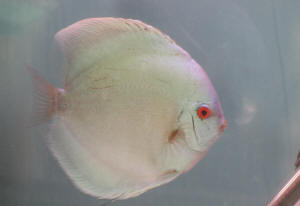
2nd Discus club Singapore international show, from
friend Perry Chong 12/6/10
> Bob
<Per>
> Its the time of the year for the local Discus club to hold a
show. I am not familiar with the various classes in Discus shows
so I will only email you one photo at a time so that I don't
get the photos mixed up.
> 1st prize winner in the Class 1 Solid Blue /Green Cat
<Beauties! BobF>
|
|
 .JPG)
|
nervous discus? 5/18/10
Dear All,
<Hello,>
Really hope you can give me some suggestions as to what may be
bothering my discus. I have a group of 5 juveniles (approximately 3.5
inches) in a 550l heavily planted tank.
<Five isn't the magic number with Symphysodon, six is. Discus
are best kept in either mated pairs or groups of 6 or more.>
Ammonia, nitrite both 0, nitrate barely detectable and temperature is
82.4F (28C). Lighting was originally using LED solid state lighting
however as I was concerned about the brightness for the discus I
reduced the lighting so
now the tank is lit with two fluorescent T8 lights.
<Floating plants will help a lot, or at least tall vegetation with
leaves that cover the surface. Discus come from dark, gloomy conditions
and don't like bright light. They can settle into planted aquaria,
but a lot depends on their tankmates, the size of the tank, water
current, etc. Do read:
http://www.wetwebmedia.com/ca/volume_1/cav1i2/plants_discus/plants_discus.htm
http://www.wetwebmedia.com/ca/volume_1/cav1i4/plants_and_discus2/plants_and_discus2.htm
http://www.wetwebmedia.com/FWSubWebIndex/discusfish.htm
>
The tank has 20% water changes twice a week and all parameters have
been stable for at least a year. The discus were bought from a breeder
about 4-5 months ago and since then have grown but are rarely seen.
<Is their wont.>
They tend to stick to the very back of the tank and only come away from
the back if no-one is around and there's no movement near the
tank.
<Very typical. Check for things like noise levels in the room and
vibrations. Discus aren't happy in "busy" rooms.>
As soon as you approach it they all dive for cover and look fairly dark
a lot of the time which makes me concerned that somethings stressing
them.
<Indeed.>
The other fish in the tank are a mixed shoal of tetras (Neons,
head-and-tail-light, Congo and Pristellas), hatchet fish and a small
group of juvenile Bristlenose catfish.
<Congo tetras could easily be too large and active for Discus, and I
wonder if removing them would help. Discus expect to be "top
dogs" in their aquaria, and anything larger than Cardinals are
often viewed with suspicion.>
I've kept discus previously so know they can be skittish fish, but
they've always settled down after about one month or so and come to
recognise me as the food provider... these fish just don't seem at
all happy and I'm at a loss as to what could be the problem? The
only thing I can think of is that at the breeder they were in bare
tanks with lots of other discus - however, I'm loathed to add more
discus due to the potential aggression problems.
the last thing I want to do is stress these poor creatures even
more!
<Indeed. If you haven't already, do real Paul Loiselle's
'Cichlid Aquarium' book, especially his sections on dither fish
and the requirements of Symphysodon spp.>
Any suggestions would be gratefully received,
Carolyn
<Cheers, Neale.>
Discus success story (stkg., fdg.) and lionfish
treatment (hlth.) 11/21/09
Hello crew, today I am writing about a success story of mine, a
question, and concerns about the treatment of my black volitans
lionfish, Lucifer.
First of, I am now the proud owner of my first discus,
<Symphysodon spp. are social animals... really only do well in
groups, mated pairs>
a fish I have always wanted to take a hand at. I am happy to report
that the discus has oddly enough adapted quite well to my rather busy
community aquarium and has been happily feeding off all dry/frozen
foods
<Mmm, need more than this>
for the 5 weeks I have had it. I am now planning on saving for a 125
set up of maybe 6 discus and once those are nicely set up mature and
established perhaps try adding 6 altum angels.
<Ahh, I wouldn't mix these. See the Net, library re>
My question is that on your site I have read angels and discus
generally are not compatible, yet my discus is thriving alongside 3
angels that do not hassle it or out compete it.
<Perhaps you are/were lucky, but time will tell>
This leads me to believe that in certain circumstances the mix might
not be so bad. Would it be safest to try adding angels or discus first
to try to make sure everything goes along smoothly?
<Up to you, but I would not>
My last question is in regards to my lionfish. Not even a week ago my
lion was eating healthily and all seemed well. Then over the course of
2 or 3 days his eyes clouded and he stopped eating. I at first thought
it was blindness like you mentioned in your article on lions but I just
have standard fluorescent light bulbs, nothing intense. Several
employees at the LFS I work at agreed that it sounded like a bacterial
infection and should be dosed with Maracyn.
<Possibly>
I dosed the aquarium (125 gallons) with both Maracyn 1 and Maracyn 2
since we were not sure if it was internal or external. Now two days
later, his eyes look a bit better but he is still not eating and
appears to be covered in a fungus that my puffer had. It looks like
marine ick I suppose and I added Maroxy to the water as well. Is there
anything else I can do? I read that lions can last a while without
being fed but I am really worried about losing him. -Thanks Ray
<Really only able to "tell" what this might be through
microscopic examination... I might try pH-adjusted freshwater bathing
this fish, moving it to other quarters if you have such. Please use the
search tool on WWM re. Bob Fenner>
Discus... stkg., sys. 9/30/09
Hi, I'm interested in keeping discus in a 45 gallon corner
aquarium.
<Not an ideal aquarium for these fish. For a start, they're
quite big animals, some 20 cm/8 inches at most, and usually at least 15
cm/6 inches.
You also need *at minimum* six specimens if you want a group, otherwise
bullying will very likely occur. For a group of six, you really need at
least 55 gallons, and realistically 75 gallons.>
My questions are how many full grown adult discus can I keep?
<You could of course keep a pair, but not a group.>
What are suitable take mates?
<Almost anything peaceful that tolerates the very warm water
conditions Discus require. The standard 28-30 C/82-86 F is far too warm
for most community fish, including most tetras, Corydoras, barbs, etc.
Only
exceptional species will tolerate such conditions permanently, classic
examples being Cardinal tetras and Corydoras sterbai. Pearl and
Moonlight Gouramis can also work well. In big tanks, Clown Loaches work
well, but they get even bigger than the Discus and need to be kept in
groups of 5+ specimens to be happy, so they're not ideal. Some
dwarf cichlids may work, notably Mikrogeophagus ramirezi, but
that's a delicate fish and the quality of the stock in the trade is
very variable. I tend to recommend against this species, unless you can
secure locally bred specimens. Angelfish should work, but in practise
often become bullies, and there also appears to be a problem with
Angels introducing certain diseases that Discus succumb to very
readily.>
What are the best foods to feed them?
<The usual. A good quality flake or pellet to start with, augmented
with wet-frozen bloodworms and mosquito larvae. Occasional offerings of
cooked peas, live brine shrimp, and live daphnia will help avoid
constipation.
Discus, like all cichlids, are prone to Hexamita infections, and a
balanced, vitamin-rich diet seems to be a key to avoiding this.>
Thanks for all the help. Great site by the way.
<Kind of you to say so. Good luck, Neale.>
|
Discus questions... ID, fdg., beh.... gen.
2/20/09 Hi crew, sorry to bother you again? However, i
have 3 discuses, that i got 1 week ago, in a 40 gallon tank and 1
of them (the orange discus) only eats bloodworms. I try feeding
flakes and brine shrimp but she/he showed no interest. The other
two eats everything. How do i teach the orange discus to eat
different types of foods? The dominant discus does bully both of
them, but i don't know if it is temporarily because i just
got them. Does the bullying effect what they eat, because when i
feed bloodworms, the orange one goes crazy. They all seem pretty
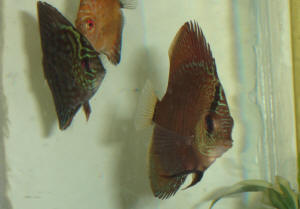
healthy. Here are some pics of them. And do you know what type
they are? thanks
http://s724.photobucket.com/albums/ww244/fish111111/?action=view¤t=DSC02493.jpg
http://s724.photobucket.com/albums/ww244/fish111111/?action=view¤t=DSC02486.jpg
http://s724.photobucket.com/albums/ww244/fish111111/?action=view¤t=DSC02490.jpg
the dominant discus is the red and blue one. Thanks for all your
help. <Hello Chris. I'm not expert on the types of Discus,
and so far as I can tell these are standard Symphysodon hybrids
of the type widely sold today. So I can't help you on that
topic. As for diet, Discus tend to be finicky, and the golden
rule is to feed as many different things as possible. Live
daphnia, bloodworms, mosquito larvae, and small earthworms are
appreciated by all specimens. I'd avoid freeze-dried foods as
much as possible, but good quality flake foods are certainly
taken by some Discus. By all means try different brands: many of
my fish will eat one brand but ignore another! Hikari foods tend
to be the best and most widely accepted. Now, as for social
behaviour, Discus are best kept either in matched pairs of groups
of 6+. Your trio WILL have problems with bullying, as you're
observing. Like Angelfish, Discus are schooling fish when young,
but territorial pair-forming fish as adults, so unless
they're in a big group, pairs will pick on singletons. So
either get rid of one, or buy three more. If you keep six,
you'll need a bigger tank. Your move. Cheers, Neale.>
|
 |
Re: discus questions 2/20/09 Hi
Neale, thanks for the reply. Is it possible to keep four discus,
will that help at all? <Not really Discus, Angelfish and
Festivums all fall into this "either a pair or six"
category Of course if you kept four females, they'd be fine,
but you can't sex Symphysodon so unless you're able to
split mature (i.e., spawning) pairs, getting six females isn't
practical.> What is the maximum number of discus i can put in a
40 gallon (adults). <A matched pair.> My discuses don't
pair up to bully one of them. <No, perhaps not, but the bully
could easily be a dominant male and the bullied fish either another
male (or, less probably) an unresponsive female.> There is only
one dominant discus that picks on both of them. <Quite.> Will
this be permanent or is he just establishing the pecking order?
<Impossible to say. The best you can say is that the
overwhelming experience of Discus keepers is that 3, 4 or 5 adults
don't tend to get along. A single male and three females
probably would, but there's no way to guarantee you'd get
that ratio. Two males would bicker all the time, and one would end
up being bullied. Eventually, it would have to be removed.> How
long does it take to establish this in general. <May not do
so.> They are also extremely scared whenever i walk by them.
<Quite normal. This is why Discus are kept in groups in display
tanks. When kept in groups of 6+, they are much more secure and
likely to swim about normally. The addition of calm dither fish,
such as Silver Hatchetfish, can help, but this assumes your
aquarium has sufficient space for all.> I tried to hand feed
them to show i am a source of food, but i don't believe that
helped much. Last, what is the nutritional value of bloodworms, are
they considered healthy or treats? <Healthy.> Can it be used
as a staple diet? <A fair staple diet, but do augment with
pellets, daphnia, etc., once or twice a week.> I will continue
to try to add variety into their diets, but since they aren't
eating anything but bloodworms, should i lay off them or continue,
as i don't want them to starve. <Variety is central.
Experiment, switch between brands, raid the kitchen for small bits
of seafood and white fish.> Thanks so much Neale, i appreciate
your time. ~Chris <Happy to help, Neale.>
Re: discus
questions thanks for your help, i will upgrade to a 60
gallon soon <Probably very wise. Get six juveniles for now, and
once they get about 8 cm/3 inches in length, they'll be ready
for a bigger tank. Much written about these very special fish;
would highly recommend spending a little time browsing WWM and your
local bookstore, library, or online book retailer. Cheers,
Neale.> |
Skin of Discus fish 01/13/2008
Hello! I want to know about Discus Fish. Difference between the shape
of Leopard Skin and Snake Skin of Discus fish. I can't choose, what
is Leopard Skin? What is Snake Skin? In my eye the skins are same.
Thanks WWM Crew, NoMo <They look pretty similar to me, too. Both
have a mottled pattern of red squiggles on a blue (or whatever)
background. In theory, "leopard-skin" Discus have a more
leopard-like pattern (i.e., spots and squiggles), while
"snakeskin" ones have a pattern more like snake skin (i.e.,
mostly spots). But that doesn't seem to mean much in real terms.
Retailers use them interchangeably, and so do many Discus breeders. You
can even find varieties called "leopard snakeskin" Discus! So
instead of worrying too much about the names, look for good quality
specimens of a variety that appeals to you, and work from there.
Cheers, Neale.>
Discus sel. and Gourami comp.
11/13/07 We have a 180 gallon well planted tank. Our water
parameters are stable at approximately 5 ppm nitrate, 0 ppm nitrite, 0
ppm ammonia, GH at 75 ppm, KH at 30 ppm, and pH of 6.2. The temperature
is set at 80. Current inhabitants are 4 blue rams, 11 cardinal tetras,
5 Otos, and 4 Pristella tetras. All has been running well for two
months, and in another month we would like to add some discus. My first
question is how many discus could be added to this tank? <I'd
start with half a dozen for now. Discus are schooling fish a lot of the
time, though their pair off when sexually mature. But even then,
they're much less aggressive than even Angelfish. Add six Discus,
and you should be able to get some pairs for breeding from, if you
wanted to.> Also, as all 4 rams I purchased were males, if I am able
to find a female, would it be safe to add just one female, or should I
look for a few to minimize aggression before adding any females to the
tank? <Mikrogeophagus males are quite pushy. I'd be keeping at
least one female per male; they don't really form stable pairs, and
males will try and hold a harem if they can.> Last question, my wife
would love to add a Gourami or two to the tank, but are there any that
would be compatible with this setup? <Many. The things to avoid are
those apt to aggression, such as Trichopterus Trichogaster (yellow,
blue, three-spot Gouramis, among others) and Kissing Gouramis. Lace and
Moonlight Gouramis usually work well. Thanks for your time, Matt
<Cheers, Neale.>
Wild discus problem 10/2/07 I have kept a
33 gallon tank with 3 discus, 2 black ghost knives 3 Panchax killifish
and 1 black spotted catfish for over 3 years. I fed them a variety of
foods because my wild discus had a lot of holes in his head. Last
month, I added two snakeskin discus in there and they all got along
well. Then the trouble started with the smallest discus not eating. He
wasn't the one being bullied ,the wild one was. Soon he passed
away. The tank was very clean and all but soon my wild discus stopped
eating too. All my discus are the same size (11.5cm). I've moved
the wild discus into a 20 gallon with a bio wheel and some water plants
to see if it gets better. I've been trying to feed him beef heart,
Whiteworms, Mysis shrimp, brine shrimp and bloodworms but he refuses
them all and just hides in the corner. I would like to know what's
wrong because I would hate to see it die. <Well, for a start your
tank is massively overstocked. Apteronotus albifrons gets to something
like 50 cm in length and mature specimens at least (like most electric
fish) are intolerant of their own kind under home aquarium conditions.
So you simply can't keep two of them in one tank, and even one
specimen of this fish needs a big tank (150-200 cm long). You don't
say anything about water chemistry or water quality. But just to be
clear: wild-caught Discus are EXTREMELY sensitive to environmental
conditions. Comparing them to tank-bred Discus is comparing chalk with
cheese. Utterly different. Tank-bred Discus are basically easy to keep
provided they are kept warm (28-30 C) and in not-too-hard (<10 dH),
acidic to neutral (pH 6-7) water. Wild-caught Discus want all that and
MORE: spotlessly clean water with next to no nitrate, dim lighting
conditions, and no aggressive tankmates. You also need to be able to
select healthy wild-caught fish to begin with; get a sick one, and
you've wasted your money. When shopping for wild Discus, I consider
going along with an experienced Discus-keeper part of the package. The
holes in the head of the fish that died were symptoms (more than
likely) of Hole-in-the-Head, a protozoan infection intimately connected
with water quality. So before going further, make sure your nitrate
levels are below 20 mg/l, and ideally zero. Quarantine all wild-caught
fish before putting them into a community system, and assume that any
commercially spawned fish are potential sources of infection. In other
words, don't mix wild and tank-bred Discus. Do read Bob's
excellent review of "Discus Basics" here: http://www.wetwebmedia.com/FWSubWebIndex/discusfish.htm .
As he says, lack of appetite is usually associated with poor
environmental conditions. So check those, and act accordingly. Cheers,
Neale>
Discus Tank Stocking 8/14/06 Dear Crew,
<Eric> Thank you for the wonderful resource you provide, and for
answering my questions in the past. I have recently moved into a new
apt. and have taken the opportunity to redo my
tank. Previously it was a planted community, but I would
like to give a shot to discus. I do have about 10 years of experience
with fish and have done much research but I would like to get some
outside opinions on my plans. <Okay> I donated all of the fish
and kept the plants, which are an assortment consisting mostly of
various swords, java moss, java fern, and Val.s. The only other
livestock in the tank are some mystery snails, as well as what I
believe are small Ramshorn ( though I am not positive ). I don't
mind the snails because as long as I feed them once in a while they
leave the plants alone. <A good technique> The tank
itself is a 72 gallon ( nominal ) bowfront. The filter is an Aquaclear
500 ( though I believe their model numbers have changed ) using a
sponge, carbon and zeolite bags. Lighting consists of 220w PC (I
don't recall the temperature offhand ). The substrate consists of
regular gravel mixed with Eco-Complete ( I don't have it in front
of me but that's what I believe it is called ) topped off with a
thin layer of Tahitian Black Moon Sand for effect. There is rockwork
and bogwood as well. Thankfully NYC tap water is good so I don't
have to add much in terms of chemicals besides fertilizer which is
dosed every few days ( I use Seachem Flourish and Flourish tabs ). Once
the plants have taken hold, I am currently planning on stocking the
tank as follows ( after proper quarantine ): 3-5 discus bought from a
breeder ( who preferably uses tap water so that they are conditioned to
my water supply ) <Good> 2 or 3 Bristlenose Plecs ( 1 male ) 1 or
2 pairs of Rams ( are the German and Bolivian Rams different species or
breeds ? ) <Please see here: http://www.wetwebmedia.com/FWSubWebIndex/dwfsamcichlids.htm
and the FAQs file linked above. Different species unless the common
names are getting switched> I would like to have a group of a small
schooling or shoaling dither fish but haven't decided on which. I
will probably go for 10 or so cardinal tetras to keep with the biotype.
<Of good starting size> 5 Hatchetfish ( I have a cover ) My main
concern is the stocking density as I like to keep away from the crowded
tank look because I feel it takes away from the natural behavior of the
fish. <You are wise here. It does> I am very open to suggestions
both as to species and stocking numbers. While I am not setting this up
with any species breeding in mind, I do like to see the fish interact
and behave as naturally as possible under the circumstances which is
why I tried to pair certain fish. Thanks again for your help, Eric
<Unless you have plans to move out some of them, I would stick with
no more than three discus here. Bob Fenner>
Re: Discus/FW (Rams,
Pleco...) Tank Stocking 8/16/06 Dear Mr. Fenner,
<Eric> Thanks for your quick reply. I choose to go with 3-5
discus because I have read that they better in schools <If not too
crowded...> of at least 5 but I was worried that it would be too
many. I think that I will get 5 small discus and wait a few months to
see if any pair off, then return or sell the 1 or 2 that are at the
bottom of the pecking order. <A workable plan> In regards to the
rams, I have been told on a yahoo group, and read elsewhere, that the
German rams are a breed of rams (I recall it being Bolivian ) <Mmm,
no... are the same Microgeophagus... ramirezi, vs. altispinosa... The
Bolivian Ram is a different species... http://fishbase.sinica.edu.tw/Summary/speciesSummary.php?ID=15902&genusname=Mikrogeophagus&speciesname=altispinosus>
that were developed in Germany to exhibit the better coloration. If I
decide to not go with the rams, would a pair or two of another dwarf
cichlid do well in this tank, or should I stick with the rams?
<Possibly... there are quite a few species... some too shy,
easygoing...> Is the proper stocking of Bristlenose Plecs 1 male to
2 females? Should there be any specific order of stocking? Thanks
again, Eric <Best to place whatever sex ratio here, and keep an eye
out for possible pairing, remove others if they're being beaten.
Bob Fenner>
Discus Stocking - 05/07/2006 <<Hi, Karen. Tom with
you.>> I have a 47G column. It is planted, and doing well. I want
to put a few 2.5 inch Discus in it. How many may I safely put
in? The dimensions are 31" tall, 20" wide and
18" deep front to back. There are no other fish, save 1
Otocinclus. I would do a small school of cardinal tetra, but
I know I am restricted due to the lack of surface area. <<Karen,
I wouldn't go with more than three of these fish since they
won't remain this size. You're already aware of the restricted
surface area with this style of aquarium and are almost certainly aware
of the need Discus have for exceptional water conditions. They're
going to need frequent water changes and strict attention to vacuuming
the substrate in your tank. These are wonderful fish but it seems like
any parasite within a city block of these guys will find them.>>
Thanks for the expert opinion, for free, YAY! <<Well, I can't
vouch for the "expert-ness" of my opinion but, it is
absolutely free! :)>> Karen <<Best of luck. Tom>>
Hormoned Discus 12/28/05 Hi crew. Thanks for all
your earlier replies. They were fast and helped me a lot. I have a
question about discus. How to find the difference between Hormoned
discus and those that are not hormoned. Any help in this regard will be
greatly appreciated. < Hormoned discus are usually the little discus
sold around 2 inches in diameter that have all kinds of screaming
color. In your tanks away from the hormoned foods they then quickly
lose much of their color and never regain it. Some breeders are
producing fish that actually color up at a very young age without
hormones. The best way to find out is to buy from a breeder if you can
find one. Asian discus are coming in so cheap that many discus breeders
have moved on to other things.-Chuck>
Starting With Discus 12/10/05 Yes, fist of all I just
want to say thanks for all of your hard work on putting this page
together. It has been a great source of reference for many years.
Ok, on with the question. I just bought a 75 gallon tank with the hopes
of raising discus, but I don't know if I have the right set up. I
am using a stealth heater two Filstar Rena canister filters xp2 and
xp3. I am using medium and small gravel somewhere around 110 pounds in
all. And a few fake plants and driftwood. Is this ok please let me
know. Current fish in tank, 2 baby green Severums, 2 Bala Sharks, 2
catfish Pictus and 1 Black Ghost knife 10 in. < There are two kinds
of discus, wild and tank raised. Wild discus require clean, warm, soft,
acidic water. Tank raised fish are much less demanding. Overall you
need to keep the pH around 7, and the nitrates as low as possible. Give
them good food and they like to be crowded. In the wild they are found
in big schools so get a group to make them feel more
comfortable.-Chuck>
Looking For Discus Breeders 12/9/05 My name is Tim
Burket & I am from Port Clinton, Ohio, 43452. Are there any
breeders in my area. Thank you --- Tim < I think the state of Ohio
has more individual fish clubs than any other. Three very large clubs
that deal with cichlids may be able to help you. In the Cleveland area
you have the Ohio Cichlid Association and the Great Lakes Cichlid
Association. Down in Cincinnati you have the Cincinnati Aquarium
Society that has a strong cichlid following.-Chuck>
Adding Discus 11/30/05 Dear Crew, My daughter and I
have a 250 litre aquarium where we already keep cardinal tetras,
Corydoras spp. and Microgeophagus ramirezi. We have had the aquarium
for about a year, and we would now like to buy two discus. Here in
Bergen, Norway, the shops do not supply these fish in quantities, so we
have to do order. Do you recommend buying small specimens, or should we
go for larger ones. If we enjoy having them, and manage to keep them
alive, we are going to set up a 600 l tank. We have done a lot of
reading, but would be grateful for some advice. Thanks for your time!
Best wishes, Oda and Sindre <If you are adding small tank raised
discus then get a group of at least 6. If you are purchasing wild
discus then I would recommend adult discus and at least a group of
4.-Chuck>
Discus setup? 8/6/05 Hey i was choosing between an
African cichlid tank or a discus tank, i have chosen the discus tank
and i was wondering how many discus i would be able to put in a 55
gallon aquarium along and any other tips on looking after them would be
greatly appreciated thanks >>You can start with 6-8
small fish in 55 gallons. I would suggest to get yourself a
beginner's book on discus because there is so much information. The
internet also has a few discus only discussion boards that are very
helpful. Try http://www.simplydiscus.com/forum Good Luck, Oliver
Getting New Discus Hi, I am Brijesh from India and am
planning to make a discus aquarium for myself. I am very afraid because
I have heard that discus die soon. Is it true that they are delicate?
< Discus can be less tolerant of poor aquarium maintenance than many
other fish.> I do regular water changes once a week. Which types of
discus do you recommend to start with? < There are really only two
types. Wild and aquarium bred strains. The aquarium bred strains can be
easier to keep if they are properly raised. Your choice is simply a
matter of personal taste.> I am planning to buy a 24x12x12 inches
tank for it without any gravel. I am getting the fish from a dealer who
has agreed to quarantine it for me for a week is it enough? < I
would recommend at least a two week quarantine period. Longer if the
fish develop any problems.> I am sure that if the discus is healthy
I will be able to take care of it. I am getting these babes from
Bangalore which is 400km from my place. Is it safe? Will they catch any
diseases due to stress? < Shipping fish always puts a strain on
them. If you are getting your fish from a professional breeder then
they will know how to ship them in a way to minimize the stress. Many
discus have been "hormoned" to give the young color so they
can be easily sold. These fish soon lose their color in the aquarium
and become difficult to breed later on. As the person you are buying
the fish from if they have been hormoned. I would stay away from these
fish if they have.-Chuck>
Discus, population question Bob, In your discus tome you
write: If you are starting with even small fishes in a small system
(under twenty gallons per individual), you should buy an odd number (3,
5) so that that the dominant individual (and sub-dominant) will not
pick on a single lowest-subordinate conspecific. <Yep> I have
often heard this odd-number advice, but I have never understood it.
Pairs are very bad, yes, but how is 4 worse than 3, and isn't 6
better than 5 for disseminating aggression among several targets?
David. <Turns out that group dynamics (just seem to) dictate that
pairs (even numbers) in small systems (most all hobby size tanks)
"gang up" on other pairs... but that having an "odd fish
out" dissociates the pairing up so to speak. There are a few human
examples of this phenomena as well... I have seen "bullying"
in school gyms, bars... that appear to be semi-equivalents. Bob F>
Not trying to be a pain... ><Turns out that group dynamics
(just seem to) dictate that pairs >(even numbers) in small systems
(most all hobby size tanks) "gang >up" on other pairs...
but that having an "odd fish out" dissociates >the pairing
up so to speak. There are a few human examples of this >phenomena as
well... I have seen "bullying" in school gyms, bars...
>that appear to be semi-equivalents. Bob F> I really want to
understand this. In my experience, 3 is just about the worst number for
bullying, with 2 against 1. Another common scenario is a bully with 2
sidekicks, making it 3 against 1, not 2 against 2. With poultry (some
of the meanest animals on the planet), I have never noticed a
difference between odd and even numbers, just that the fewer, the
worse. <Can be this way, but more often than not the individuality
of fishes wins out (here's a qualifier: in a large enough setting).
Surely (not Shirley), in situations with breeding pairs, the third
individual/wheel, or even more numbers are going to be harassed.> As
you may know, I have a commitment to not perpetrating aquarium
husbandry myths, however reasonable sounding. I therefore probably am
too sensitive, but is there any quantitative support for the odd-number
argument? <I understand, and agree totally... The nuances of what
I'm trying to state, advocate are REALLY only applicable to the
situation mentioned... That is: 1) provision of adequate size/volume
systems to accommodate any given number of specimens AT full size, 2)
Starting these at a small/er size in an effort to match them up for
breeding. Put another way, placing larger animals in odd or even
numbers in too small a volume is a recipe for interspecies antagonism.
Bob F> David
Re: not trying to be a pain... Thanks. This is
how I reworked it at the end of the paragraph: It is also important to
have several fish, and two is the worst possible number. With only two,
the dominant individual will pick mercilessly on the subordinate
conspecific. Several fish give several targets for any one fish's
aggression. Studies also indicate that when there is an odd number of
fish, they are less likely to gang up, and it helps to have an odd fish
out. Does this sound all right? <Yes. Thank you. Bob F> David
Looking for Symphysodon from the source Am looking for a
exporter of discus in Brazil .thanks Stan < Go to Belowwater.com and
get in contact with him about wild discus. He has been to South America
many times and specializes in wild discus.-Chuck>
Discus breeder in Italy. Post on WWM AQUARIUM ZOO IMPORT
TROPICAL FISH VIA NAZIONALE 271 , 98023 FURCI SICULO (ME) TEL & FAX
++39 0942 794596 CELL. 348 8047912 E-MAIL AQUARIUMZOO@TISCALINET.IT
E-MAIL AQUARIUMZOO@TIN.IT WWW.AQUARIUMZOO.IT I WOULD LIKE TO KNOW ALL
ABOUT YOUR FORNITURE OF Zebrasoma flev. . SEND ME A FAX OR E-MAIL OF
YOUR CATALOGUE , PRICI LIST , YOUR SELLING CONDITION AND TRANSPORT FOR
ROMA ITALIA HOPING TO HEAR FOR YOU AS SOON AS POSSIBLE WE SEND TO YOU
OUR <We don't offer or sell livestock. Discus breeder in Italy.
Post on WWM. BobF> B.R.G. AQUARIUM ZOO IMPORT TROPICAL FISH E-MAIL
AQUARIUMZOO@TIN.IT Antonio Stima

